The Daily Telegraph reports that air pollution is getting worse in Sydney, with one in ten days rating “poor” in 2009. Critics of the ruling Labor state government claim that increasing air pollution and the lack of public transport are the cause. They are half right.
Sydney’s Densification is Intensifying Traffic Congestion: Sydney’s intensifying traffic congestion contributes substantially to rising air pollution.
The increasing traffic congestion is an inevitable consequence of the state government’ s “metropolitan strategy” which is “jamming” high rise residential buildings into suburban detached housing neighborhoods. The mathematics of traffic and densification is that unless each additional resident drives minus kilometers and minus hours, there will be more traffic, even before considering the impacts of intensifying commercial and heavy vehicle traffic.
The road system was not built for higher densities and neither was other infrastructure such as sewers or the water system, as Tony Recsei has noted in his preface to the 6th Annual Demographia International Housing Survey.
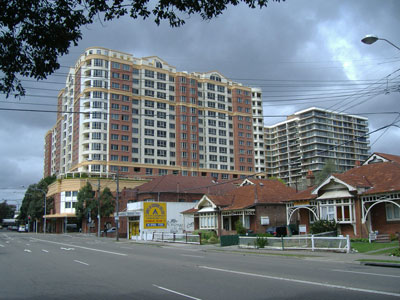 The fact is that higher densities are strongly associated with more traffic, which means greater traffic congestion. The additional stop and go traffic produces greater pollution on the roads adjacent to which people and their children live. It also means more greenhouse gas emissions, because fuel consumption increases as traffic congestion intensifies.
The association between higher densities and greater traffic congestion is also indicated by the ICLEI-Local Governments for Sustainability Density-VMT Calculator, based upon Sierra Club research. According to the Calculator, under the urban consolidation (“smart growth”) scenario, residential housing would be 37 housing units per hectare, as opposed to its “business as usual” scenario at a density of 10 housing units per hectare. The density of traffic (vehicle kilometers per square kilometer) under the higher density “urban consolidation” strategy would be 2.5 times as high as under the “business as usual” scenario.
According to federal Bureau of Transport and Regional Economics, Sydney’s total traffic volume is projected to increase nearly 20% over the next decade. Nearly half of the increase will come from commercial and heavy vehicles. With little or no expansion of the urban footprint, there will be nowhere for the new traffic to go except onto the existing already over-crowded roadways.
Stuck in Sydney’s Traffic: Already, the average one-way trip to work in Sydney is longer than in all but one of the 52 metropolitan areas in the United States with more than 1,000,000 population. Only New York takes as long as Sydney, because so many people use public transport, which is inherently slower for nearly all trips.
Of Blind Faith: Public Transport: Public transport serves as an article of faith to which officials cling in the innocent or cynical hope that it can reduce traffic congestion. There is no doubt of the good that public transport can do to get people to the central city (CBD), with its highly concentrated employment. However, Sydney’s CBD oriented system is over-crowded. A succession of state governments have been incapable of providing sufficient service to make the trip comfortable for the less than 20% of Sydney employees who work there. Proposals to centralize more of Sydney’s employment in the CBD could not be more wrong-headed.
Transit is about the CBD, whether in Sydney, Toronto, Portland or Atlanta. The public transport system capable of attracting a significant number of commuters to the smaller concentrated centers like Chatswood, Parramatta, or Norwest (much less the dispersed employment throughout the rest of the metropolitan area) has never been conceived, much less seriously proposed or built.
Why We Regulate Air Pollution: Public health was the very justification for regulating air pollution. Air pollution’s negative impacts are principally local. The consequences are measured reduce the quality of life of people intimately exposed to the more intense air pollution from nearby roads.
Higher densities come with a price. Higher densities are producing greater traffic congestion, higher levels of air pollution and greater public health risks. This is just the beginning.
Photograph: Strathfied, Sydney: Densification of detached housing neighborhood.
Comments
13 responses to “Sydney: Choking in its Own Density”
Sydney could always be more like Minneapolis/Saint Paul.
http://www.startribune.com/local/west/86722707.html?page=1&c=y
Your logic is flawed. It fails to take into account the change to transit-oriented urban design will take years to accomplish. We’ve got 75 years of poor planning to undo, to reclaim the civic realm from automobiles. Once again, ignorance is bliss, and you must be a very happy man.
That was a very interesting read, thanks for taking the time to post it.
ovulation symptoms
there is a solution that may solve the problem: work at home.
60% of our daily works can be done only by computer. we can complete these works at home, go to office just when necessary. it will reduce the traffic jams and save the energy. if we can do it for a year, we can buy a Rolex for ourselves.
that is a general issue… i am from Romania, Bucharest and the situation is the same… maybe worst.
executive jobs
I agree with you absolutely, home offices might solve the problem with pollution, because of less traffic jams. I am sure that employees would appreciate to work from home. Pamela @ web hosting reviews
I would say that you are right about this. If the offices are built near home buildings the traffic would degrease significantly. The Knapp’s centre is very impressive indeed.
Jerico at web hosting sources.
I am interested in this article. Please if you send me the email address more about this article? Or tell me where can I get more information about this topic. thanks
sports betting
I was very pleased to find this web-site.I wanted to thanks for your time for this wonderful read!!!
seo in india
Sydney is one nice place, too bad it is now becoming polluted. But then pollution issues seem to bud from every part of the world now and looks like there’s no stopping.
Jogos de culinaria
Pollution is everywhere nowadays. It basically occupies almost every part of the world and not only in Sydney. That’s the sad reality.
Slime Volleyball
I found this is an informative and interesting post so i think so it is very useful and knowledgeable. I would like to thank you for the efforts you have made in writing this article. I am hoping the same best work from you in the future as well. In fact your creative writing ability has inspired me.office space
Thank you for the work you have put into this post, it helps clear up some questions I had.I will bookmark your blog because your posts are very informative.We appreciate your posts and look forward to coming back..debt relief programs
I really loved reading your blog. It was very well authored and easy to undertand. Unlike additional blogs I have read which are really not tht good. I also found your posts very interesting. In fact after reading, I had to go show it to my friend and he ejoyed it as well! California Dui Lawyer