To many observers, America’s place in the world is almost certain to erode in the decades ahead. Yet if we look beyond the short-term hardship, there are many reasons to believe that America will remain ascendant well into the middle decades of this century.
And one important reason is people.
From 2000 to 2050, the U.S. will add another 100 million to its population, based on census and other projections, putting the country on a growth track far faster than most other major nations in the world. And with that growth — driven by a combination of higher fertility rates and immigration — will come a host of relative economic and social benefits.
More fertile
Of course the percentage of childless women is rising here as elsewhere, but compared to other advanced countries, America still boasts the highest fertility rate: 50 percent higher than Russia, Germany or Japan, and well above that of China, Italy, Singapore, Korea and virtually all of eastern Europe.
As a result, while the U.S. population is growing, Europe and Japan are seeing their populations stagnate — and are seemingly destined to eventually decline. Russia’s population could be less than a third of the U.S. by 2050, driven down by low birth and high mortality rates. Even Prime Minister Vladimir Putin has spoken of “the serious threat of turning into a decaying nation.”
In East Asia, fertility is particularly low in highly crowded cities such as Tokyo, Shanghai, Tianjin, Beijing and Seoul. And China’s one-child policy — and a growing surplus of males over females — has set the stage for a rapidly aging population by mid-century. South Korea, meanwhile, has experienced arguably the fastest drop in fertility in world history, which perhaps explains its extraordinary, if scandal-plagued, interest in human cloning.
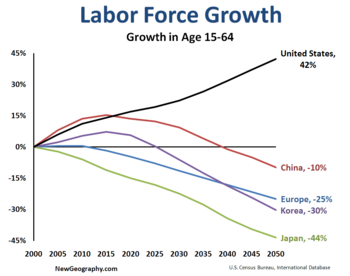 Even more remarkably, America will expand its population in the midst of a global demographic slowdown. Global population growth rates of 2 percent in the 1960s have dropped to less than half that rate today, and this downward trend is likely to continue — falling to less than 0.8 percent by 2025 — largely due to an unanticipated drop in birthrates in developing countries such as Mexico and Iran. These declines are in part the result of increased urbanization, the education of women and higher property prices. The world’s population, according to some estimates, could peak as early as 2050 and begin to fall by the end of the century.
Younger and More Vibrant
Population growth has very different effects on wealthy and poor nations. In the developing world, a slowdown of population growth can offer at least short-term economic and environmental benefits. But in advanced countries, a rapidly aging or decreasing population does not bode well for societal or economic health, whereas a growing one offers the hope of expanding markets, new workers and entrepreneurial innovation.
In fact, throughout history, low fertility and socioeconomic decline have been inextricably linked, creating a vicious cycle that affected such once-vibrant civilizations as ancient Rome and 17th-century Venice and that now affects contemporary Europe , Russia and Japan.
Within the next four decades, most of the developed countries in both Europe and East Asia will become veritable old-age homes: a third or more of their populations will be older than 65, compared with only a fifth in the U.S. By 2050, roughly 30 percent of China’s population will be older than 60, according to the United Nations. The U.S. will have to cope with an aging population and lower population growth, in relative terms, but it will maintain a youthful, dynamic demographic.
More Hopeful About the Future
The reasons behind these diverging trends is complex. In some countries, a sense of diminished prospects, combined with a chronic lack of space, appear to be the root causes for plunging birthrates. As Italians, Germans, Japanese, Koreans and Russians have fewer offspring — one recent survey found that only half of Italian women 16 to 24 said they wanted to have children — they will have less concern for future generations.
In contrast, in the United States roughly three-quarters of young people report they plan to have offspring. Such individual decisions suggest that America, for all its problems, is diverging from its prime competitors, placing its faith in a future that can accommodate 100 million more people.
As author Michael Chabon recently wrote, “In having children, in engendering them, in loving them, in teaching them to love and care about the world,” parents are “betting” that life can be better for them and their progeny.
This article originally appeared at AOLNews.com.
Joel Kotkin is executive editor of NewGeography.com and is a distinguished presidential fellow in urban futures at Chapman University. He is author of The City: A Global History

Photo: victoriapeckham
Comments
17 responses to “What American Demographics Will Look Like in 2050”
I’m hoping you’re more sophisticated than to argue based on straight line projections. How do you answer the following questions:
-Declines in fertility are a universal phenomenon everywhere that women’s educational and career opportunities expand. If Hispanics become economically integrated, their fertility will drop, and this growth won’t happen. They are the only Americans reproducing above replacement.
-Our recent bubble economies drew in millions of Hispanic immigrants. With our economy stalled, and unskilled labor markets flooded, why do we think they’ll still come?
-Fertility among whites who hold most of the wealth, power, and intellectual leadership is below replacement (I saw 1.87 recently). Among older boomers, children are still seen as an expensive, restrictive “lifestyle choice,” or an unfortunate side effect of sex. Boomers will be obsessed with defending their pensions and expanding their medical benefits. How do we invest in education and create jobs for young people while carrying the boomer’s burden?
-As the California experience has shown, people don’t like to pay for education for “other people’s kids,” unless it directly translates into home price appreciation. Once the white majority see that most school children are minorities, will public funding of education stagnate (be cut in real terms)? This in turn means middle class families have to finance their children’s education on their own – which becomes a very strong incentive to have fewer or no children.
Getting a Social Security number for your newborn is voluntary. But, it is a good idea to get a number when your child is born. You can apply for a Social Security number for your baby when you apply for your baby’s birth certificate. The state agency that issues birth certificates will share your child’s information with us and we will mail the Social Security card to you.
egipt last minute
If you wait to apply at a Social Security office, you must show us proof of your child’s U.S. citizenship, age and identity, as well as proof of your own identity. We must verify your child’s birth record, which can add up to 12 weeks to the time it takes to issue a card. To verify a birth certificate, Social Security will contact the office that issued it. We do this verification to prevent people from using fraudulent birth records to obtain Social Security numbers to establish false identities.
-Our recent bubble economies drew in millions of Hispanic immigrants. With our economy stalled, and unskilled labor markets flooded, why do we think they’ll still come? fotografia ślubna Bielsko This in turn means middle class families have to finance their children’s education on their own – which becomes a very strong incentive to have fewer or no children.
Americanized. The term refers to the point where new immigrants forget their ideals of hardwork and sacrifice and start acting like all the other self-indulgent Americans around them. I am sure that once many of the “unskilled” labor that currently fuels much of the American economy becomes “citizens” the will likely wind up on the public welfare system; especially successive generations of our newest citizens. Once our “un-documented workers” become “documented workers” what will be their incentive to work for the artificially low wages that allow for profit in every industry from agriculture to zoo-keeping (yes there are illegals cleaning the stalls in America’s zoos). What will result is yet another drain on the productive members of America’s work force. The concept of “state-provided” welfare has only been around in America for about 80 years but it has grown to a point where approximately 43.4 million Americans pay ZERO income tax. I pay almost $600 a month in income tax alone, (not counting SSI and local/state taxes, property taxes, fuel taxes, school taxes, taxes on utilities and the list goes on and on) my guess is this same group pays lower amounts or none of those taxes as well. I am not rich and I live in a 21 year old home; I drive a seven year old truck and a 4 year old car. I am not a Hilton heir. But I am the guy that most of the expected immigrant/new American population will be asked to replace. The question is will they?
There are always to sides of a story. The Earth’s population was rising very fast in the past few decades and there are many studies that ring alarm bells about the fact that there are not enough resources and food for so many people. But in a context where most of the countries have a low birth rate that’s dropping even more, by 2050, their population will be made up mostly of old people. A growing population means more young people, with more brain and working power. This can only be a good thing for a country’s economy on the long term.
2000 to 2050, the U.S. will add another 100 million to its population, based on census and other projections, putting the country on a growth track far faster than most other major nations in the Custom sticker printing. And with that growth — driven by a combination of higher fertility rates and immigration — will come a host of relative economic and social benefits.
Regards!
Metin2
No one has any idea what Europe or the rest of the world will look like then. We can analyze current demographic trends and predict what the world may look like based upon that, but it’s only a hypothetical. And that 75% white stat includes white Hispanics. The non-Hispanic white percentage is closer to 66%.
The author of this dribble sounds like a progressive Markstlcard. As well as in this video http://www.tubehome.com/watch/joel-kotkin-why-america-will-still-lead-the-world-in-2050 which also made me smile… Who is having all these children? The middle-class that used to be described as the working poor? Now we don’t have jobs because we don’t make anything here anymore. People like myself in the future will have 1 child, maybe 2 and struggle to have a home and anything else. I don’t know who gave you the Kool-Ade, but it sure makes you see things most other Americans would strongly disagree with. Immigration, legal or not needs to be slowed to a crawl until the U.S. can elect leaders that can do the right thing to get us out of this horrible economic hole we are in and will get deeper if we don’t right this ship. We just keep getting taken deeper out to sea and there is no refueling ship that is in sight.
The middle-class that used to be described as the working poor? Now we don’t have jobs because we don’t make anything here anymore. People like myself in the future will last minute have 1 child, maybe 2 and struggle to have a home and anything else. I don’t know who gave you the Kool-Ade, but it sure makes you see things most other Americans would strongly disagree with.
The prediction makes sense to me if the demographic transition process, which in the West we call “aging”, and which many have supposed is related to what we call “modernizing”, “industrializing”, what have you goes global. Which it hasn’t quite. China and India are still growing, with India set to eclipse China in population by mid-century or so.
I believe the prediction is likely to prove out, but the timing may be off.
War, disease, environmental disaster: events of this order could well disrupt the process.
Zemko from Global real estate.
The concept of “state-provided” welfare has only been around in America for about 80 years but it has grown to a point where approximately 43.4 million Americans pay ZERO income tax. I pay almost $600 a month in income tax alone, (not counting biuro podróży bielsko SSI and local/state taxes, property taxes, fuel taxes, school taxes, taxes on utilities and the list goes on and on) my guess is this same group pays lower amounts or none of those taxes as well. I am not rich and I live in a 21 year old home; I drive a seven year old truck and psycholog online a 4 year old car. I am not a Hilton heir. But I am the guy that most of the expected immigrant/new American population will be asked to replace.
I live in a 21 year old home; I drive a seven year old truck and treppenlift a 4 year old car.
say Zalim Treppenlifte
I am pretty sure that no one has any idea what Europe or the rest of the world will look like in the future. Of course you can analyze current demographic trends and predict what the world may look like based upon that, but it’s only a hypothetical and we’ve seen various changes to those predictions in the past Browserspiele. By the way: 75% white stat includes white Hispanics right?
Young teens can drink only whey they are 21, thus what else do they do for fun? Some teens stay off drugs which is good, however others go around in groups and then have relations with each other which leads us to increasing population… Also you will find that US citizens are far more outgoing then other areas, e.g. the UK is reserved and a lot of other countries are too.
USB flash drive
Don’t forget about different global catastrophes which will occur from time to time and take a lot of lives. People face a lot of natural disasters now and in future there will be more because of the global warming.
Viola from http://mp3hounddog.com
Well, it´s not possible to be sure how the world will loke like in the future. These are some “trends”, you´re describing in your article, which will be true or not – who knows? Everything can change. What will happen with american and other Ramacity demographics, we will see in 2050 🙂
I think another point that needs to be made is the growing ease of attending a college or university. Although it can still be quite expensive, money lenders are making it easier for more people to afford higher education. As more and more Americans graduate college, the labor force may very well reach an all time high in even highly technical fields. It is for this reason that Friedman, in his book The World Is Flat, states that in the near future companies will begin to prize the creative minded above the knowledge oriented worker. Creativity, according to Friedman, is not an attribute to be learned and thereby is “worth” more to businesses across the globe. It is this very golden rule that drives his view of professionalism in the near future, and how the use of the internet will truly flatten the playing field globally.
Walt Hobbs