The Dallas-Fort Worth metropolitan area (Note 1), which corresponds to the Dallas-Fort Worth urban area, provides a casebook example of expanding urbanization. Dallas-Fort Worth has been one of the fastest growing major metropolitan areas in the nation for decades. Dallas-Fort Worth was among only three US metropolitan areas adding more than 1,000,000 residents between 2000 and 2010. Only Houston’s addition of 1,230,000 exceeded that of Dallas-Fort Worth, which grew by 1,210,000, a 23.4 percent growth rate. Atlanta was the third metropolitan area to add more than one million residents, at 1,021,000. During the 2000s, Dallas-Fort Worth passed Philadelphia to become the nation’s fourth largest urban area, with a population of 6,372,000. Only New York, Los Angeles and Chicago are larger.
On an international scale, the United Nations estimates indicate that only Singapore, Houston and Atlanta had greater percentage growth between 2000 and 2010 among high-income world urban areas that exceed 4,000,000 in population.
The Core: The core of the metropolitan area experienced the earliest growth and has since seen its share of growth and its growth rate decline significantly. Dallas County, which includes the historical core municipality of Dallas (Note 2), had a growth rate of 6.7 percent between 2000 and 2010, approximately one third less than the national growth rate of 9.7 percent. Nearly all of the growth in Dallas County was outside the city of Dallas, which added only 0.8 percent to its population, less than one-tenth of the national rate. The city of Dallas added 9,000 residents, while the suburbs within Dallas County added 140,000 residents.
Overall, Dallas County accounted for 12 percent of the metropolitan area’s growth between 2000 and 2010. This is down from 41 percent between 1950 and 2000. Between 1900 and 1950, Dallas County accounted for an even larger share (66 percent) of growth (Figure 1). Dallas County’s annual growth rate fell from 4.1 percent between 1900 and 1950 to 2.6 percent between 1950 and 2000 to 0.7 percent in the last decade (Figure 2).
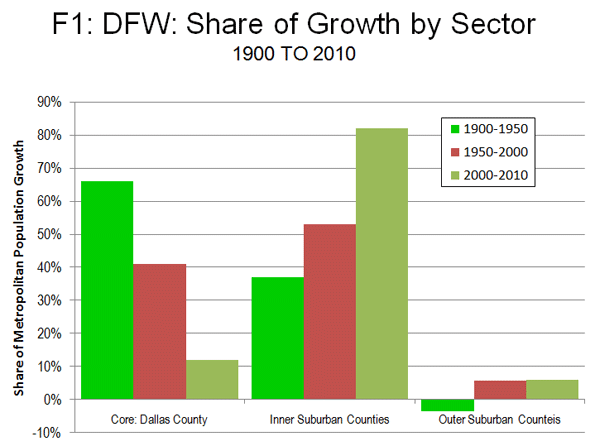
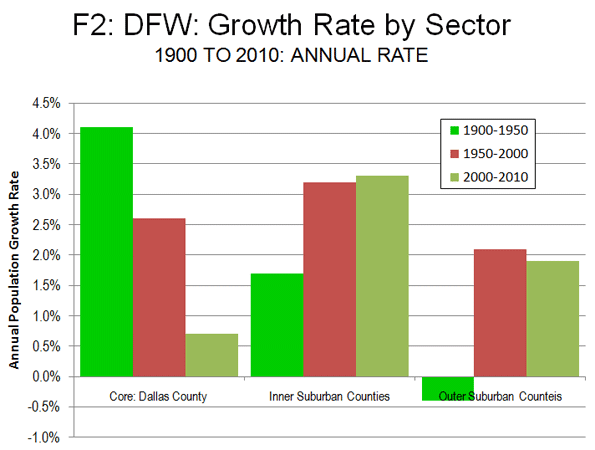
Inner Suburban Counties: During the 2000s, the greatest growth was experienced in the inner suburban counties (those abutting the core county, Dallas). These six counties (Collin, Denton, Ellis, Kaufman, Rockwall and Tarrant, where Fort Worth is located) experienced a population gain of 38.9 percent. Inner suburban counties now contain 56 percent of the metropolitan area population. Between 2000 and 2010, the inner suburban counties captured 82 percent of the metropolitan area, up from 53 percent between 1950 and 2000 and 38 percent between 1900 and 1950. The inner suburban counties grew 1.7 percent annually from 1900 to 1950, increasing to 3.2 percent between 1950 and 2000 and 3.3 percent in the 2000s.
Outer Suburban Counties: The outer suburban counties represent a comparatively small portion of the metropolitan area’s population. These five counties (Delta, Hunt, Jasper, Parker and Wise) accounted for only 7 percent of the metropolitan area population. The 2000 to 2010 growth rate was 20.9 percent, somewhat below the metropolitan area rate of 23.4 percent, and more than double the national population growth rate of 9.7 percent national growth rate.
Between 2000 and 2010, the outer suburban counties captured 6 percent of the metropolitan area growth, the same share as between 1950 and 2000. However, perhaps surprisingly, their combined 1950 population was 19 percent below that of 1900. This illustrates the declining fortunes in the early part of the 20th century of counties that were dominated by agriculture, as the farm population and population of many small farm dependent communities declined. Of course, the 1900 to 1950 losses have since been compensated many times over by the post 1950 suburbanization. Nonetheless, one outer suburban county, Delta is unique in continuing to lose population through the 2010 census. Delta County’s 2010 population of 5,200 is approximately one third of its 1900 population of 15,200.
The outer suburban counties lost 0.4 percent of their population annually from 1900 to 1950, but turned around to gain 2.1 percent from 1950 to 2000. Between 2000 and 2010, the growth rate fell back to 1.9 percent.
The City of Dallas: The historical core municipality of Dallas illustrates of the dynamics of aggressive annexation policies. In 1910, Dallas covered only 16 square miles (41 square kilometers) and had a population of 92,000. Even at this early date, the city of Dallas was not very dense, with 5,700 residents per square mile (2,200 per square kilometer). The city reached its peak density of 7,300 (2,800 per square kilometer) in 1940, after having expanded to 41 square miles (106 square kilometers) and a population of 295,000.. Even at this peak density, the city of Dallas remained well below the densities of other core cities, especially in the East and Midwest, most of which had densities exceeding 10,000 per square mile (3,900 per square kilometer).
By 1950, the city had expanded to 112 square miles (289 square kilometers) and with a population of 334,000, the population density had fallen to 3,900 (1,500 per square kilometer). Larger annexations were to follow, with the city reaching 343 square miles (885 square kilometers) by 2010. With a population of 1,198,000, the population density was 3,500 per square mile (1,350 per square kilometer), less than one-half the 1940 peak. Virtually all new owned housing was built consistent with the post-World War II suburban form, as occurred in metropolitan areas around the nation. The city’s addition of 9,000 residents between 2000 and 2010 was far less than the 182,000 gain between 1990 and 2000. By 2000, there was little greenfield land left to develop in the city and the population could be peaking. Indeed, the population could decline in future censuses, as has happened in geographically constrained urban cores around the world. Any such decline could, however, be counteracted by immigration, as has occurred in some urban cores.
Ethic Trends in the Metropolitan Area: As would be expected in a state bordering Mexico, the Latino population of Dallas-Fort Worth grew substantially between 2000 and 2010, at a 43 percent rate. Overall, Latinos accounted for 42 percent of the metropolitan area’s growth. The Latino population increase was nearly 520,000, more people than live in the core city of Atlanta.
However, unlike a number of other metropolitan areas, there was strong growth in the African-American population, which added 33 percent to its count. African-Americans accounted for 19 percent of the metropolitan area’s growth.
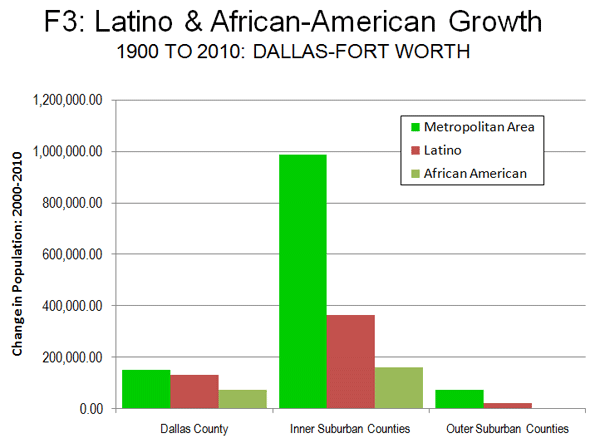
This growth was strongest in the core county of Dallas, where Latino and African-American growth made up for a decline in the rest of the population. In the inner suburban counties, 53 percent of the growth was Latino or African-America, while the lowest share of Latino and African American growth was in the outer suburban counties, at 30 percent.
Overall, 75 percent of Latino growth and 69 percent of African-American growth took place in the suburban counties, which is a substantial change from the past (Figure 3).
The Urban Area: Urban area data has not been released from the 2010 census. However, it is clear that Dallas-Fort Worth has become less dense since 1950. Between 1950 and 2000, the population density of the urban area declined approximately 10 percent. Even so, it is surprising to some that the Dallas-Fort Worth urban area, with its low-density reputation, was only 12 percent less dense that Portland urban area in 2000, despite the aggressive densification strategies employed by Portland.
The Expanding Metropolitan Area: The story in Dallas-Fort Worth is little different (Table) from what has emerged in metropolitan areas around the world, in places like Seoul, Mexico City and Mumbai. Dallas-Fort Worth also illustrates a trend only now becoming more obvious, that middle-sized and smaller metropolitan areas are generally growing faster than the megacities within their own countries (see the report by the McKinsey Global Institute). The United States has two megacities, the New York metropolitan area, which grew 3.1 percent from 2000 to 2010 and Los Angeles, which grew 3.7 percent. Dallas-Fort Worth’s far higher growth rate of 23.4 percent translated into an actual population increase of 175,000 more than the combined increase of the two megacities, despite their having five times the population.
| Dallas-Fort Worth: Population Trend by Sector and County | ||||
| 1900-2010 | ||||
| 1900 | 1950 | 2000 | 2010 | |
| CORE COUNTY | ||||
| Dallas County | 82,756 | 614,799 | 2,218,899 | 2,368,139 |
| INNER SUBURBAN COUNTIES | 222,747 | 527,281 | 2,596,623 | 3,585,286 |
| Collin County | 50,087 | 41,692 | 491,675 | 782,341 |
| Denton County | 28,318 | 41,365 | 432,976 | 662,614 |
| Ellis County | 50,059 | 45,645 | 111,360 | 149,610 |
| Kaufman County | 33,376 | 31,170 | 71,313 | 103,350 |
| Rockwall County | 8,531 | 6,156 | 43,080 | 78,337 |
| Tarrant County | 52,376 | 361,253 | 1,446,219 | 1,809,034 |
| OUTER SUBURBAN COUNTIES | 149,302 | 120,754 | 346,022 | 418,348 |
| Delta County | 15,249 | 8,964 | 5,327 | 5,231 |
| Hunt County | 47,295 | 42,731 | 76,596 | 86,129 |
| Johnson County | 33,819 | 31,390 | 126,811 | 150,934 |
| Parker County | 25,823 | 21,528 | 88,495 | 116,927 |
| Wise County | 27,116 | 16,141 | 48,793 | 59,127 |
| METROPOLITAN STATISTICAL AREA | 454,805 | 1,262,834 | 5,161,544 | 6,371,773 |
The Future? It is an open question whether the rapid growth of Dallas-Fort Worth will continue. As it continues to grow, the stagnation that now afflicts the nation’s two megacities and its near-megacity, Chicago could spread to Dallas-Fort Worth. On the other hand, Dallas-Fort Worth has advantages that could permit its growth to continue for multiple decades into the future. Texas has a favorable business climate, low taxes and less heavy handed regulation than New York, California and Illinois. Dallas-Fort Worth has plenty of developable land as well as a political culture not cowed by development. The economic advance of its growing population, particularly the burgeoning Latino population, depends upon public policies that favor housing affordability and urban expansion. If it continues on its current course, Dallas-Fort Worth could pass the Chicago metropolitan area in population by 2050 and could even challenge Los Angeles later in the century.
—-
Note 1: As currently defined by the Census Bureau. Officially titled the Dallas-Fort Worth-Arlington metropolitan statistical area. Metropolitan areas are essentially labor markets and include a principal urban area and rural (non-urban) areas and may include smaller urban areas.
Note 2: Fort Worth is not considered a historical core municipality, based upon the discussion in Perspectives on Urban Cores and Suburbs, though the Census Bureau considers Fort Worth and Arlington to be principal cities (which are a different thing). The "Dallas-Fort Worth" terminology is used because of its wide acceptance and to make the geographical expanse of the metropolitan area more clear.
Wendell Cox is a Visiting Professor, Conservatoire National des Arts et Metiers, Paris and the author of “War on the Dream: How Anti-Sprawl Policy Threatens the Quality of Life”
Photo by Trey Ratcliff
Comments
31 responses to “The Evolving Urban Form: Dallas-Fort Worth”
Thane has become the largest district in the Mumbai larger metropolitan area, with a population of 11.1 million, passing Outer Mumbai. Thane is now the largest district in India. In 2001 Thane had 8.1 million residents in 2001 and grew 35 percent to 2011. This, however, is down from a 55 percent free internet advertising
The city is develop very fast nowadays, it is more beautiful than before. Hope more people come to this city to live in the future.
Ghe giam doc
Public transit commuting remains overwhelmingly dominated by New York City, with a metro commute mode share for transit ford t-shirt
I wanna say thanks to you and your entire team for writing such a wonderful and knowledgeable article. You are too cool guyz. Svenska Artiklar
I definitely enjoying every little bit of it. It is a great website and nice share. I want to thank you. Good job! You guys do a great blog, and have some great contents. Keep up the good work. using this system
This is so beautiful and creative. I just love the colors and whoever gets it in the mail will be smiling. fotografos profesionales valencia
Afterwards, the overwhelming majority of test subjects reported feeling extremely attracted to their test partner.. skintervention pdf
Great, This specific net webpage is seriously thrilling and enjoyment to learn. I’m an enormous fan from the subjects mentioned ecigs
Sea Horizon EC has full and unique facilities, which includes a guard house, clubhouse, children’s playground, swimming pool, Aerobic/Yoga room, piano room, pool room, indoor gym, hydrotherapy beds, hydrotherapy baths, reading room, function room, onsen, jacuzzi where you can find the book
Thank you for taking the time to publish this information very useful!
Dog Food Flavors
I really loved reading your blog. It was very well authored and easy to undertand. Unlike additional blogs I have read which are really not tht good. I also found your posts very interesting. In fact after reading, I had to go show it to my friend and he ejoyed it as well!
Kelly Leis Massage Therapy
I admire this article for the well-researched content and excellent wording. I got so involved in this material that I couldn’t stop reading. I am impressed with your work and skill. Thank you so much.
Medical Assistant Training – Salary, Jobs, Certification & Schools Listing
Very informative and helpful. I was searching for this information but there are very limited resources. Thank you for providing this information bongs uk
Extremely useful information particularly the last part I care for such information a lot. 100% recommended . zodiac watches
It is awesome feeling when you are spending time with your friends and when you all are together. fast vitiligo cure book
Solar Stirling engine plans and easy blueprint. The solar Stirling engine is progressively becoming a viable alternative to solar panels for its higher efficiency and simpler set up guaranteed phone contracts
I am curious on the way you write down this topic can be so detailed. This is the kind of content that will give clearance to this issue. Great pos Air Condition Burbank
Hello! I just wish to give an enormous thumbs up for the nice info you’ve got right here on this post. I will probably be coming back to your weblog for more soon. Business Intelligence
I am really aroused by this wonderful stuff. I always prefer to read the quality content and this thing I found in you post. Thanks for sharing. Graviditetstest
A top new subject in this publish creates your website is significantly valued. Through this publish, we know that your excellent information, You have a brilliant yet eye-catching way of writing. Warenwirtschaft
This post is really interesting and useful for me. Thank you very much indeed. I’m looking forward to seeing the next post. Highly recommend to everyone sunglasses
This post is really interesting and useful for me. Thank you very much indeed. I’m looking forward to seeing the next post. Highly recommend to everyone author robin hall
Admission and jobs portal is one of the best Education Portal providing. Colleges , Universities, Institute, Schools and other details related to Education. sweat miracle book
This article gives the light in which we can observe the reality. This is very nice one and gives indepth information. Thanks for this nice article.
fotografi
Admission and jobs portal is one of the best Education Portal providing. Colleges , Universities, Institute, Schools and other details related to Education. katzen vermisstenanzeige
Whenever coffee espresso beans are roasting nevertheless, a critical this essential component is destroyed consequently reducing the great consequences of coffee bitskin abzocke
Thanks for your post. I’ve been thinking about writing a very comparable post over the last couple of weeks, I’ll probably keep it short and sweet and link to this instead if thats cool. Thanks.
http://www.avsservice.be
I’m impressed. You’re truly well informed and very intelligent. You wrote something that people could understand and made the subject intriguing for everyone. I’m saving this for future use. wicker outdoor furniture
Engage with leading bloggers who offer advice on family and career as well as share stories about our rich workmom experience. rachat de crédit réduire le montant des mensualités
Just wanted to stop by and say that as a graduating student looking for work, this map made my day!
You deserve applause for the huge amount of work that this must have taken http://www.rebelmouse.com
I actually added your blog to my favorites list and look forward to get the same quality content every time I visit your blog. Thanks a lot.
AC Servicing