UCLA’s most recent Anderson Forecast indicates that there has been a significant shift in demand in California toward condominiums and apartments. The Anderson Forecast concludes that this will cause problems, such as slower growth in construction employment because building multi-unit dwellings creates less employment than building the detached houses that predominate throughout California and most of the nation. The Anderson Forecast says that this will hurt inland areas (such as the Riverside-San Bernardino area and the San Joaquin Valley) because their economies are more dependent on construction than coastal areas, such as Los Angeles, the San Francisco Bay Area and San Diego.
Detached Housing Permits Remain Strong in the Historic Context: The Anderson Forecast reports that multi-unit building permits have recovered more quickly than building permits for detached housing. However, any such shift is likely to be highly volatile. Since the peak of the bubble, the distribution of building permits between detached and multi-unit in California has been on a roller coaster. Indeed the Anderson Forecast characterizes the "2010 US Census" as "showing a significant shift in demand toward condominiums and apartments." Actually, the 2010 US Census asked no question from which such a conclusion about housing types or any question from which such a conclusion could be drawn.
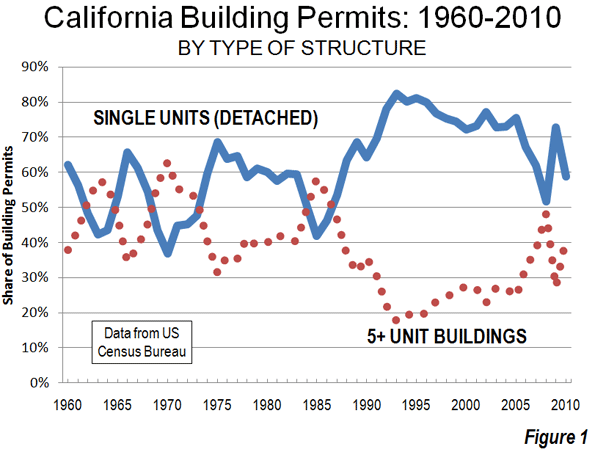
The trends in the building permit data are not completely clear. In 2005, the year before prices started to collapse, 75 percent of building permits in California were for detached housing. This trended downward, reaching a low of 52 percent in 2008. In 2009, the detached housing recovered to account for 73 percent of all housing building permits. Then the figure fell back to 59 percent in 2010.
With these erratic trends, it is tricky to forecast longer term market trends and consumer demand. Economic projections in 1934 would have suffered from a similar problem, as the Great Depression was continuing and no one could really tell when it would end. Today’s continuing housing depression may be similar.
Moreover, as the Anderson Forecast notes, detached housing construction declined in the early 1980s, dropping to 42 percent in 1985. In fact, over the 25 years between 1960 and 1985, detached houses accounted for an average of only 54 percent of new housing construction in California, well below the 2010 figure of 59 percent (Figure 1).
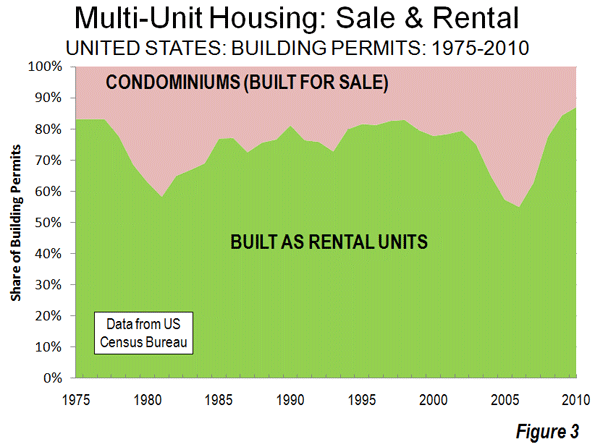
Equally important, the condominium market remains in a deep depression. In 2010, less than four percent of houses built for sale in the United States were multi-unit buildings, including condominiums (Figure 2), as an increasing majority of multi-unit buildings have been built as rentals (Figure 3). Comparable California data is not available, but from the peak of the bubble (2006/7) to 2009, there was a loss of more than 3,000 owner occupied multi-unit dwellings with 10 or more units, while owner occupied detached houses increased by nearly 100,000 (Note 1).

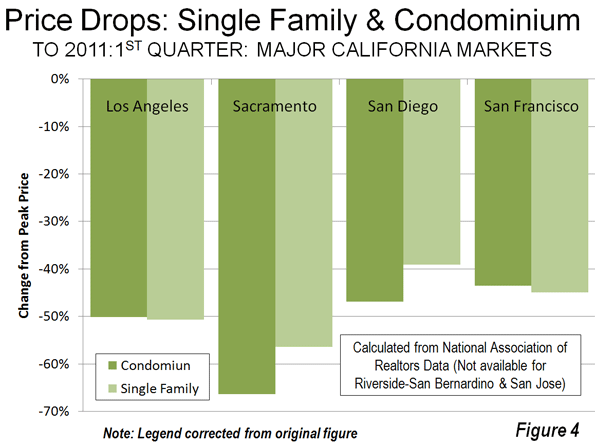
If there is an intrinsic pent-up preference for condominium living, it is not evident in the poor performance of high-density developments even in such theoretically desirable places as Santa Monica, San Francisco, Oakland, San Jose and North Hollywood. Condominium prices, for example, have fallen 52 percent in the major California metropolitan areas, compared to 48 percent for single-family houses (Figure 4). Naïve developers, relying too much on the much promoted notion that suburban empty-nesters were chomping at the bit to move to new housing in the core area, often watched their empty units liquidated at $0.50 or less on the dollar or turned into rentals. Further, if people are moving to apartments, it’s not for love of density but more likely due weakening economic circumstances.
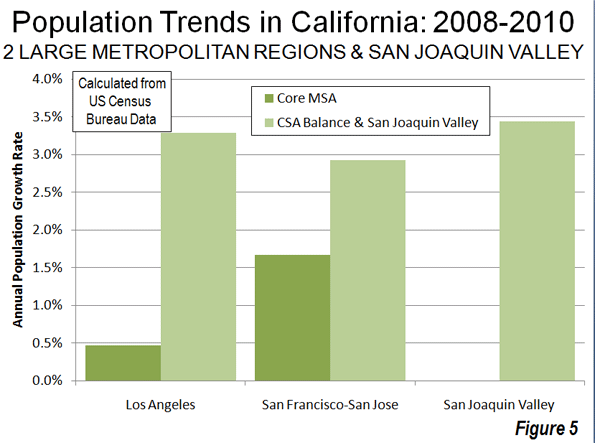
Inland California Continues to Grow Faster: The Anderson Forecast also suggests that growth in interior California will suffer because "workers are less likely to move inland into an apartment and commute toward the coast." This assumption of slower inland growth reflects the conventional wisdom that areas outside the large coastal metropolitan areas have stopped growing since the burst of the housing bubble as people flock towards the coastal urban core (Note 2). The reality is different, as interior California and the peripheral metropolitan areas of the larger metropolitan regions (Note 3) continue to grow more strongly even in bad economic times. After the burst of the bubble, from 2008 to 2010 (Figure 5):
- In the Los Angeles area, the adjacent Riverside-San Bernardino ("Inland Empire") and Oxnard metropolitan areas, combined, have grown at seven times the rate of the core Los Angeles metropolitan area.
- In the San Francisco Bay area, the adjacent Napa, Santa Cruz, Santa Rosa and Vallejo metropolitan areas, combined, have grown nearly twice as quickly as the core San Francisco and San Jose metropolitan areas.
- California’s deep interior, the San Joaquin Valley has grown even faster than the exurban areas of Los Angeles and San Francisco.
One key reason: most people who move to interior areas do not commute toward the core. For example, less than 10 percent of workers in the Riverside-San Bernardino metropolitan area commute into Los Angeles County, a market share that declined 15 percent between 2000 and 2007. Many also simply cannot afford the higher cost of living in the coastal metropolitan areas, which likely will continue to retard growth in the core metropolitan areas.
The Policy Threat to New Houses : A survey by the Public Policy Institute of California suggests a vast preference (70%) for detached housing among the state’s consumers. This continuing preference is demonstrated by detached housing prices that are generally two times historic norms relative to incomes in the coastal metropolitan areas (Los Angeles, San Francisco, San Diego and San Jose).
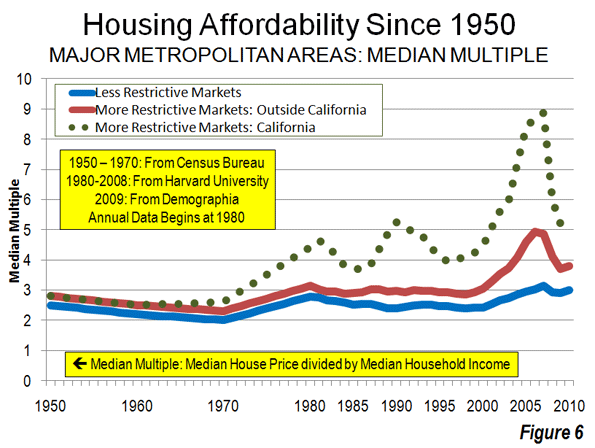
Yet now, this choice is under a concerted assault by both the state and many local governments, cheered on by most media and the academic community. For years, planning regulations have driven land prices so high that house prices have risen to well above the rest of the nation (Figure 5) under regulations referred to by terms such as "smart growth" and "urban containment." The regulations and the inevitably resulting speculation propelled a disproportionate rise (nearly $2 trillion) in California house prices compared to national norm. If California house prices had risen at the same rate relative to incomes as in more liberally regulated areas, the loss to financial markets could have been hundreds of billions of dollars less when the bubble burst (Figure 6).
Planning for Crowding and Density: California’s assault on detached housing is taking on a distinctly religious fervor. The state’s global warming law (Assembly Bill 32) and urban planning law (Senate Bill 375) is providing a new basis to impose draconian limits on the construction of detached housing. For example, in the San Francisco Bay area, it has been proposed that 97 percent of new housing be built within the existing urban footprint. That would mean an emphasis on multi-unit housing and little or no new housing on the urban fringe. The option of a single family home will be all but non-existent for even solidly middle income Californians.
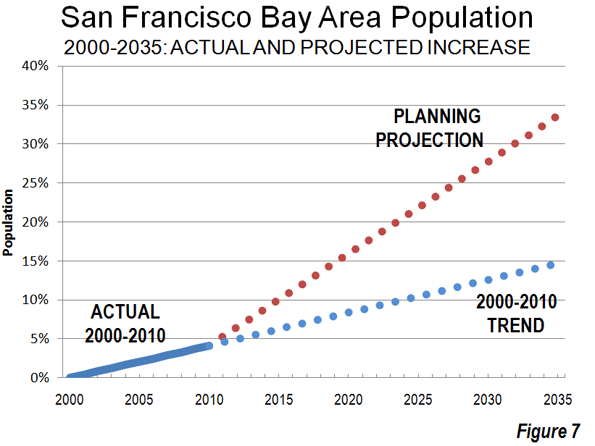
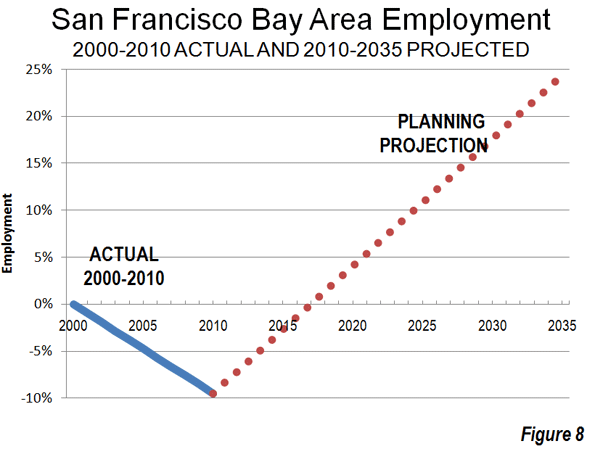
Planning authorities in the Bay Area seem oblivious to the fact that destroying affordability also destroys growth, already evident by the state’s poor economic performance and ebbing demographic vigor. Planners rosily project 2 million more people between 2010 and 2035 in the San Francisco Bay area. The growth rate over the past 10 years suggests a number less than half that (Figure 7) and given the rapid aging of the area, even this estimate may be too high. The planners also project more than 1.2 million new jobs, something difficult to believe given the more than 300,000 job loss (Note 4) that occurred in the Bay Area between 2000 and 2010 (Figure 8).
The Environmental "Fig Leaf:" The environmental justification for these policies is fragile . Research supporting higher density housing has routinely excluded the greater emissions from construction material extraction and production, building construction itself and common greenhouse gas emissions from energy consumption that does not appear on consumer bills. Further, higher densities are associated slower and more erratic speeds, which retards fuel efficiency and increases greenhouse gas emissions, a factor not sufficiently considered.
The report seems to ignore any other options besides rapid densification, which as McKinsey Global Institute has pointed out is not at all necessary to reduce GHG emission reductions. They point to other factors as more fuel efficient cars.
Oddly, the San Francisco Bay Area proposal does not even mention working at home (much of it telecommuting), the most environmentally friendly way of accessing employment. Working at home has grown six times the rate of transit since 2000 in the Bay Area.
Outlawing New Houses Detached housing remains the overwhelming choice of Californians. There is no indication that this preference is about to be replaced by a preference for high-density housing. Current and future middle class Californians could be corralled into more crowded conditions, because questionable planning doctrines mandate that detached housing should be outlawed.
—-
Notes:
1. Calculated from 2006, 2007 and 2009 American Community Survey data. The over ten unit category is used because is more generally reflective of the dense condominium development generally favored by densification advocates (Latest data available).
2. Another questionable tenet of conventional wisdom is that the price declines in the outer suburbs were greater than in the cores. When the price declines reached their nadir, core California markets were generally at least as depressed from their peak prices as suburban markets.
3. Metropolitan region refers to combined statistical areas, which have a core metropolitan area, such as the Los Angeles MSA and include surrounding metropolitan areas, such as the Riverside-San Bernardino MSA and the Oxnard MSA.
4. Annual, 2000 to 2010, calculated from California Economic Development Department data.
Lead photo: Houses in Los Angeles. Photograph by author.
Wendell Cox is a Visiting Professor, Conservatoire National des Arts et Metiers, Paris and the author of “War on the Dream: How Anti-Sprawl Policy Threatens the Quality of Life”
Comments
27 responses to “Outlawing New Houses in California”
I am baffled at why the mainstream economics profession is so obtuse about the role of land markets in numerous examples of national and regional economic “plateauing” or even decline. Look at Britain, the Netherlands, Japan, and South Korea (at least). California is going the same way now as Britain since WW2 and Japan and Korea in the 1980’s.
It is absurdly simple to see that when an economy “runs out of land”, income increases will capitalise into land rents just as Karl Marx and Henry George obsessed about in the 1800’s. What they missed was the potential for abundant land to be brought into the urban economy sufficiently rapidly to prevent this from happening.
The rising land rents under a constrained supply situation, hinder social mobility; raise labour force costs; reduce discretionary incomes, savings, and investment; reduce productivity; and erode economic competitiveness. Also, speculative manias are provoked, rapidly worsening the situation. This is what has happened in all the examples I mention above.
Even China and India today, have a serious problem that will have the same effect on their economies, as what happened to Japan and South Korea in the 1980’s – only China and India are much bigger.
It is not necessary to ACTUALLY “run out of land” – regulatory boundaries and/or outright political corruption will have the same effect.
If planners want to constrain urban growth AND still have economic growth, they need to adopt the Netherlands solution – compulsory government acquisition of land for development, at artificially low prices. (By the way, the THREAT of this is sufficient most of the time). This is an enormous abuse of private property rights in one sense, but the Dutch seem to be astute enough to see the connection with continued economic competitiveness, growth, and social justice.
Note that “governments” are equally capable of acting as the rent-seeking abusers of monopoly land ownership power; as in China, Australia, Arizona, and Nevada.
Meanwhile, the city-economies with abundant and unrestricted land supplies, will “OWN” the economic future of the USA and the world. Expect to see a major trend for certain types of “industry” to select heartland and Southern USA as their favoured location ahead of China, let alone California. SOME types of industry depend for their productivity, on “factor substitution” of land for labour and capital. Like Jumbo Jet factories, for example.
Demographic and economic trends are changing housing market demands. Aging population and a declining portion of households with children, declining household size, rising fuel prices, increasing traffic congestion, increasing health and environmental concerns, and changing consumer preferences with regard to home location are all reducing demand for large-lot, single-family homes and increasing demand for small-lot and multi-family housing. This is not to say that demand for large-lot homes will disappear, but market analysis suggests that the existing stock of such homes is sufficient to meet demand for the next few decades.
This blog overlooks all of these factors. The title is hyperbole: California is not outlawing new housing and the shift from single-family to multi-family construction makes sense in response to changing market demands. Cox cites a 2004 report to prove that there is a “vast” preference for single-family housing, but more recent and detailed analysis indicates that, although most households prefer single-family, many are willing to accept more compact housing types (small-lots, townhouses, condominiums, etcs.) in exchange for improved accessibility and financial savings. For example, the 2009 “Emerging Trends in Real Estate” report explains:
Energy prices and road congestion accelerate the move back into metropolitan-area interiors as more people crave greater convenience in their lives. They want to live closer to work and shopping without the hassle of car dependence. Higher-density residential projects with retail components will gain favor in the next round of building. Apartment and townhouse living looks more attractive, especially to singles and empty nesters—high utility bills, gasoline expenses, car payments, and rising property taxes make suburban-edge McMansion lifestyles decidedly less economical.
Cox continues to make the mistake of evaluating housing affordability alone, rather than housing and transportation costs together. The Housing and Transportation Index (www.htaindex.cnt.org ) indicates that sprawled locations are actually less affordable than more compact locations because their low housing costs are more than offset by high transportation costs.
I suspect that Mr. Cox is simply expressing his own preferences and prejudices when he criticizes current market trends to more compact development, and smart growth policies that allow such development to occur.
For more information see:
Helen Chernikoff and Al Yoon (2010), Smart Money in Real Estate Is on Smart Growth, ABC News (http://abcnews.go.com); at http://abcnews.go.com/Business/wireStory?id=11311919.
Todd Litman (2009), Where We Want To Be: Home Location Preferences And Their Implications For Smart Growth, Victoria Transport Policy Institute (www.vtpi.org/sgcp.pdf )
Todd Litman (2010), Affordable-Accessible Housing In A Dynamic City: Why and How To Support Development of More Affordable Housing In Accessible Locations, Victoria Transport Policy Institute (www.vtpi.org/aff_acc_hou.pdf ).
NAR (2011), 2011 Community Preference Survey: What Americans Are Looking For When Deciding Where To Live, National Association of Realtors (www.realtor.org/press_room/news_releases/2011/04/smart_growth ).
Arthur C. Nelson (2009), The New Urbanity: The Rise of a New America, University of Utah Metropolitan Research Center; summary at http://www.froogalizer.com/news/research-on-homeownership-rate-through-2030.html. Also see The Next $40 Trillion: Texas Trends (www.texasarchitect.org/texastrends.ppt).
RCLCO (2008), Measuring the Market for Green Residential Development, Robert Charles Lesser and Company (www.rclco.com/pdf/Measuring_the_Market.pdf ).
ULI (Annual Reports), Emerging Trends in Real Estate, Urban Land Institute (www.uli.org/ResearchAndPublications/EmergingTrends/Americas.aspx ).
Todd Litman is founder and executive director of the Victoria Transport Policy Institute (www.vtpi.org), an independent research organization dedicated to developing innovative solutions to transport problems.
A major mistake made by many people doing a home improvement project is letting price dictate the decision on who to hire. More problems occur because homeowners pick the lowest price they can find.
Plasterer in Hampshire
This is a really good post. Must admit that you are amongst the best bloggers I have read. Thanks for posting this informative article.
remodel Vail, Colorado
It is excited to present their readership with a new series of articles, Career Profiles that i like to discuss more about this in my blog thanks for sharing.Thanks.
Yoga retreats
I was just browsing for relevant blog posts for my project research and I happened to stumble upon yours. Thanks for the excellent information.
Cooling units installation, CO
This is very nice post ! I will bookmark this blog
snowmobile summit county
Its a nice information you have here. Thanks for sharing it!
outdoor activities Colorado
This is very nice post ! I will bookmark this blog
http://slickadvice.com/
It is a wonderful site and I love to visit this again and again.
Couples counsellor Mosman
That is very good comment you shared.Thank you so much that for you shared those things with us.Im wishing you to carry on with ur achivments.All the best.
chat
I found your this post while searching for some related information on blog search. Look forward to exploring your web page repeatedly. Well, I appreciate your efforts in creating this post however I believe you should take the time and Thank you for the great article I did enjoyed reading it, – cara memperbesar alat vital pria
What a nice piece of information buddy. I’ll try to follow these steps. Thanks for sharing a such a nice informative post.
Clinical Psychologist Mosman
In fact your creative writing abilities have inspired me to start my own blog.
vail kitchen and bath remodel
formulate the design and technology decisions necessary to make sure successful technology implementation projects.
mcitp mcts // mcse mcsd // mcsa mcpd
I read this post and got lots of information from this Post.
snowmobile Vail
Since the peak of the bubble, the distribution of building permits between detached and multi-unit in California has been on a roller coaster sewer camera inspection nj
The young people were enthusiastic about the program, Took me time to read all the comments, This website has very good content.So I am sure this website will form the well-known in the future. – sprei
The Anderson Forecast concludes that this will cause problems, such as slower growth in construction employment because plumbing repair nj
This trended got downward, reaching a low of 52 percent in 2008. Visit Fully Furnished Accommodation.
Great Depression was continuing and no one could really tell when it would end. Today’s continuing housing depression may be similar. nj metal roofing
Depression was continuing and no one could really tell when it would end. Today’s continuing housing depression may be similar. electricians alvechurch
Valley) because their economies are more dependent on construction than coastal areas, such as Los Angeles, the San Francisco Bay Area and San Diego. sora class nj
The Anderson Forecast concludes that this will cause problems, such as slower growth in construction employment because building multi-unit http://www.squidoo.com/find-out-if-your-entitled-to-claim-for-a-work-related-injury
The Anderson Forecast reports that multi-unit building permits have recovered more quickly than building permits for detached housing. buy facebook fans
I am sure to all the commenters here! It’s always nice when you can not only be informed, but also entertained! I’m sure you had fun writing this article. Really impressed! Everything is very open and very clear clarification of issues. – Hotel Semarang
Metropolitan region refers to combined statistical areas, which have a core metropolitan area, such as the Los Angeles MSA and include surrounding metropolitan areas everycode