The prospect of falling car use now needs to be firmly factored into planning for western cities.
That may come as a bit of a surprise in light of the preoccupation with city plans that aim to get people out of their cars, but it is already happening. And it is highly likely to continue regardless of whether or not we promote urban consolidation and expensive transit systems.
But not necessarily lower resource consumption
Of course, as day-to-day travel savings are made by households these can simply result in other forms of consumption, offsetting any resource savings. This should not be surprising. Final demand embodies resources consumed right across the production and distribution chain. Savings from lower transport spending (including commuting) – an intermediate input in the chain – that lead to lower prices translate into increases in discretionary spending (assuming constant or rising incomes).
Hence, the reduction in resource use and pollution sought by subsidising public transport and promoting higher density living may simply be spent on resource-intensive appliances, recreation, entertainment, and inter-city and international travel.
Look to the fringe to look to the future
Putting that inconvenient equation aside, long-term plans for cities should avoid simply projecting past behaviours into the future. Instead, we might look to changes at the margin that signal the issues, discoveries, and events that might determine the long-term outcomes we are interested in.
So let’s look at what’s happening at the margins of car use, focusing for the purpose of illustration on Auckland.
First, travel demand
The New Zealand Travel Survey has been conducted since 2003. The results are published on a two-yearly rolling basis. Using Statistics New Zealand population estimates I have calculated annual “per person” measures for Auckland from 2003 to 2011. There are some sampling issues and qualifications regarding the survey that mean motor cycle and bicycle use statistics for Auckland are not considered reliable enough to use. Even given sampling error, the balance point to some significant and consistent shifts.
For example, total travel (measured as annual kilometres per resident) appears to have peaked around 2007 (Figure 1). In fact, recorded travel declined by 15% over the period. Public transport has done better, down 12% overall but actually increasing 13% between 2007 and 2011.
 |
| Figure 1: Aucklanders’ Travel by Mode, 2003-2011 |
More telling, though, has been declining car use. The first column in Table 1 shows changes over the whole period. The second column shows changes between the 2007 travel peak and 2011.
The fall in car dependence since 2007 has been marked among passengers (-23%). Perhaps that means fewer discretionary trips are being taken. This and a 14% decline in driver kilometres and 17% fewer trip legs confirms what the vehicle counts say – cars are being driven significantly less in Auckland (particularly inner Auckland) now than they were five or ten years ago.
|
|
Period 2003-11
|
Peak
2007-11
|
|
Driver
|
||
|
Km
|
-4%
|
-14%
|
|
Hours
|
3%
|
-12%
|
|
Trip Legs
|
1%
|
-17%
|
|
Passenger
|
||
|
Km
|
-33%
|
-23%
|
|
Hours
|
-18%
|
-17%
|
|
Trip Legs
|
-8%
|
-22%
|
|
All Car Users
|
||
|
Km
|
-16%
|
-17%
|
|
Hours
|
-5%
|
-13%
|
|
Trip Legs
|
-3%
|
-19%
|
Possible reasons:
1. We know already that an ageing population reduces car use.
2. Public transport is playing a growing but so far minor role (up from 3.7% to 3.9% share of all kilometres travelled). An average 76km per person growth in public transport use since 2007 hardly offsets the 1,810km average contraction in distance travelled by car.
3. Lower real incomes and higher fuel prices play a part. A sharp contraction since 2007 suggests that economic conditions have an impact on motoring far more immediate and influential than trying to reshape the shape the city and how people live in it might.
4. The decentralisation of jobs, recreation and entertainment, professional services, and consumer services – including retailing – mean that people can get more done closer to where they live. Trying to turn this clock back by pushing commercial activity back into the central city and then providing subsidised public transport to access it seems somewhat obtuse in the light of this development.
Second, car purchases
The Ministry of Transport publishes new car registrations (which include imported used cars). It also provides data on the total vehicle fleet since 2000.
Long-term registration statistics are interesting when related to national population data (Figure 2). Apart from a hiccup in 1991 growth in registrations was more or less continuous from 1950 until 2003. Since then there has been a sharp decline. Time will tell whether this is cyclical or signals a long-term shift. It is noteable, though, that 2009, 2010, and 2011 figures fall well below trend.
 |
| Figure 2: Trends in New Car Registrations |
This slowdown in new car registrations is reflected in two ways. First, it is reflected in total fleet size, for which data are available from 2000 (Figure 3). This shows that 2007 was a turning point in total numbers, consistent with evidence that driving in Auckland peaked in that year. That’s presumably good for the environment.
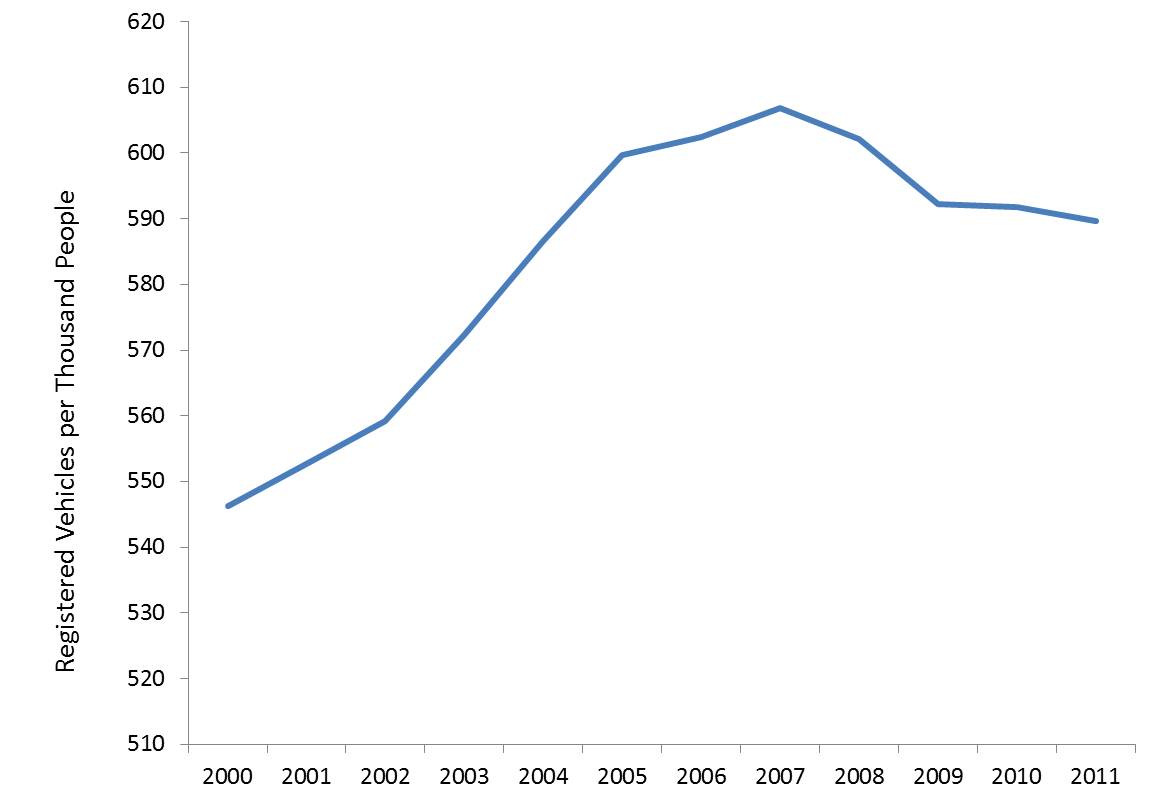 |
| Figure 3: New Car Registrations, New Zealand 2000-2011, |
Second, with the slow-down in imports, the fleet has begun to age (Figure 4). That’s presumably bad for the environment, as older cars are less efficient and generate more emissions.
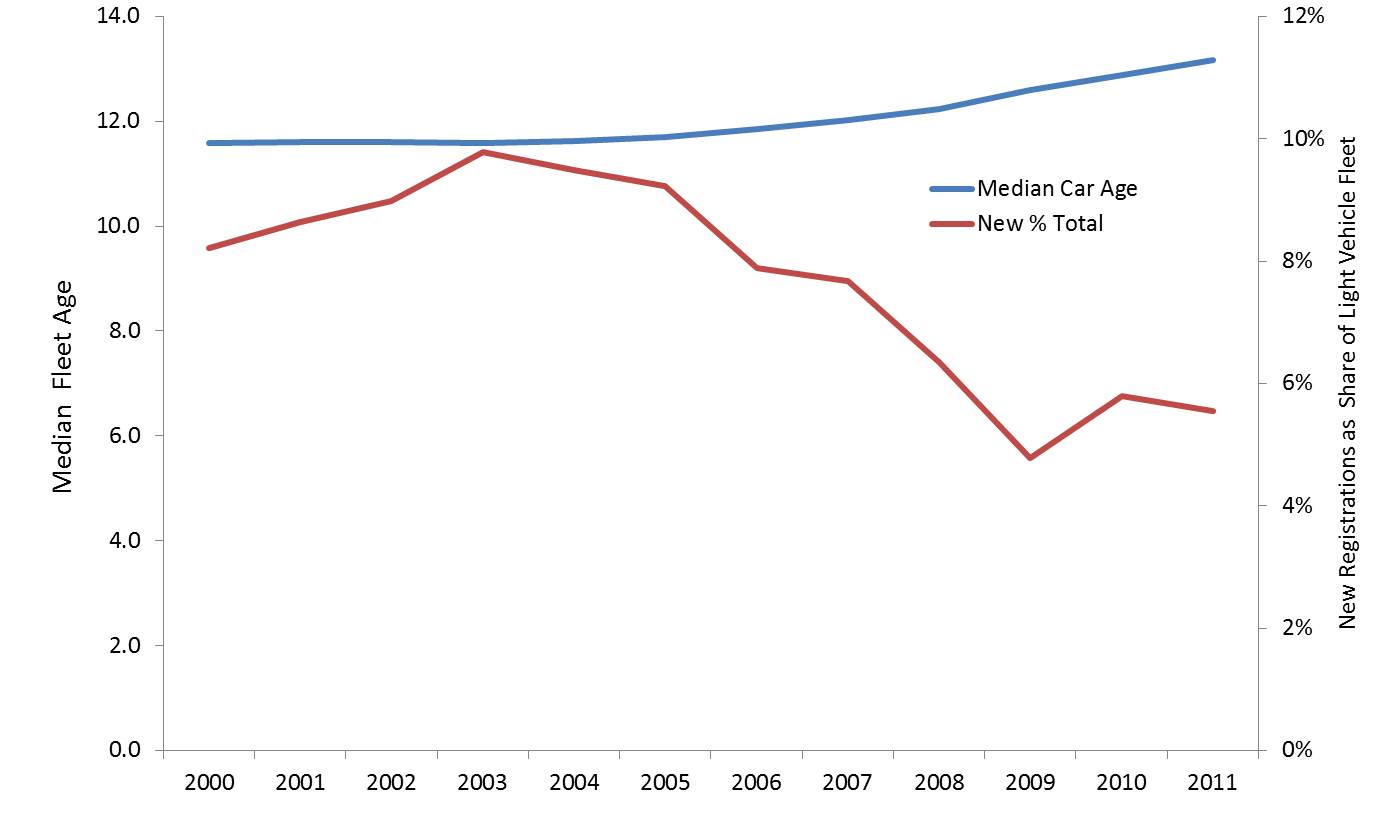 |
| Figure 4: New Zealand’s Ageing Car Fleet |
Third, fleet changes
Fleet composition is changing as growth slows. The average CC rating of newly registered vehicles in 2000 was 2,127. This climbed to 2,191 in 2005, but fell to 2,033 in 2011, an 8% fall in six years.
If this is a sign of things to come an increase in the turnover of vehicles would boost fleet efficiency over the medium term even without taking account of the greater engine efficiencies being delivered and gains among electric and hybrid vehicles
Add to that the prospect supported by these numbers of increasing differentiation among vehicle styles (Figure 5). At one end sits the large weekend recreational vehicle, perhaps falling as a share of new vehicles – or at least being down-sized. At the other is the increasingly popular city runabout or smart car, and in the middle the family sedan, the work horse with an engine size now likely to be well under 2,000cc.
 |
| Figure 5: Changes in Engine Size of Newly Registered Vehicles, 2000-2011 |
So what does this all mean?
There is evidence accumulating to suggest that significant changes are taking place at the margin of transport demand and car dependence. If this is a sign of things to come it raises questions about long-term road expenditure, about dire predictions of road congestion, and about the benefits of adopting expensive land use and transport measures designed to force people out of their cars.
Already, within a more constrained economy, people seem to be making their own decisions to reduce car dependence.
In terms of city planning, it suggests that decentralisation may be more sustainable than the compact city protagonists make out. In this respect, is interesting that motorway traffic counts show that significant reductions in inner city vehicle flows are offset by gains (albeit much smaller) in outer parts of the city – even as measured distance travelled falls.
And Auckland definitely needs to rethink assumptions behind spending plans for major road and rail infrastructure – and confront the risks and costs of getting them wrong.
And, incidentally, it’s about time New Zealand’s Ministry for the Environment updated its report card on trends in the environmental impact of vehicle travel – which only goes up to 2007, a year which may prove to be a turning point in long-term travel behaviour.
Phil McDermott is a Director of CityScope Consultants in Auckland, New Zealand, and Adjunct Professor of Regional and Urban Development at Auckland University of Technology. He works in urban, economic and transport development throughout New Zealand and in Australia, Asia, and the Pacific. He was formerly Head of the School of Resource and Environmental Planning at Massey University and General Manager of the Centre for Asia Pacific Aviation in Sydney. This piece originally appeared at is blog: Cities Matter.
Comments
19 responses to “Time to Acknowledge Falling Private Car Use”
Let’s look at a first-world county of 4M people and extrapolate the results to the entire first world of 1G. Let’s not as everyone knows Kiwis are weird.
How about some data from a country of 300+G?

What about the effects of hourly car rentals such as ZipCar?
What about the effect of electronic-chauffeur cars? I predict that by 2060 it will be illegal for humans to drive an auto in the USA.
Dave Barnes
+1.303.744.9024
WebEnhancement Services Worldwide
My point entirely. When thinking about the future, think about what is happening on the margins. NZ is a small country, often quick to change and generally an early adopter. What’s happening on the fringe may well become mainstream for the behemoth in due course. ZipCars fit the model, and electronic chauffeuring is definitely on the fringe at the moment – so worth thinking about before we commit to over-investment in more of the same.
Valuable analysis, Phil McD.
It is sad that so few people in Auckland understand:
“….. The decentralisation of jobs, recreation and entertainment, professional services, and consumer services – including retailing – mean that people can get more done closer to where they live. Trying to turn this clock back by pushing commercial activity back into the central city and then providing subsidised public transport to access it seems somewhat obtuse in the light of this development…..”
“……..decentralisation may be more sustainable than the compact city protagonists make out. In this respect, is interesting that motorway traffic counts show that significant reductions in inner city vehicle flows are offset by gains (albeit much smaller) in outer parts of the city – even as measured distance travelled falls.
And Auckland definitely needs to rethink assumptions behind spending plans for major road and rail infrastructure – and confront the risks and costs of getting them wrong……”
HEAR, HEAR.
Still more insights can be gained from the paper “Gridlock and Growth”, by David Hartgen and Gregory Fields (2009).
http://reason.org/files/ps371_growth_gridlock_cities_full_study.pdf
The Hartgen and Fields paper points out that besides “decentralization” of urban form being efficient (a free market response to congestion and high CBD rents) focusing congestion reducing measures on “the CBD” does not improve productivity in the whole region anywhere near as much as reducing congestion via road improvements “elsewhere”. This is logical if one considers the following.
Firstly, there is actually a lot more jobs “elsewhere”, than what there is in the CBD (Cities with more than 25% of regional employment in their CBD’s are international outliers).
Secondly, capacity expansions on “suburban” roads and arteries will be proportionately far more significant – adding 1 more lane to 1 lane, or to 2 lanes, is obviously far more effective than adding one lane to 8 or 10 or 12.
Thirdly, traffic proceeding from suburban homes to suburban jobs will not be all going one way. So road space is utilized to the maximum in both directions at both ends of the day. Managing “cross traffic” conflicts with interchanges and smart intersections becomes an important issue for efficiency.
Fourthly, land rent curves are far flatter when urban form is “dispersed”, and it is far more affordable for any household to “locate” near any job or amenity. But under a “monocentric” urban model, “relocating” closer to a job will be financially difficult, apart from the fact that this difficulty is worse anyway in growth-constrained cities with inflated land prices relative to incomes. Of course, households do not relocate every time one earner in it changes their job. There are costs associated with moving, and households do in any case have other costs to consider besides the commuting costs of one of their members. Therefore, it is likely that productivity will be higher in a city where better “automobility” (via an efficient polycentric road network) enables much more choice of optimum job-switching with reduced necessity for costly household relocations in the process.
Fifthly, congestion involves “cost”, and “agglomeration” involves “efficiency”. Is it not odd that an “additional road user” is now most commonly regarded as “imposing a negative externality” rather than “participating in an increase in agglomeration efficiency”? (Not to mention the numerous other “positive externalities” that are also generated from “automobility”, such as productivity and employment growth. And note also the “historical trivia” subheading at the end of this essay). But we can (and in fact urban “market economies” do) minimize the congestion cost and maximize the agglomeration benefit. Crucially, agglomeration can suffer from the law of diminishing returns. But there is actually no need, in fact it is counter-productive, to “agglomerate” all kinds of employment in one location. Agglomeration efficiencies are higher when there are multiple agglomerations by type, rather than a single one of all types of employment. Agglomeration efficiencies, in most cities, are actually of several different types. It is completely unnecessary for production line manufacturers to be located nearby to law firms, for example, to achieve agglomeration efficiencies. (In fact, urban planners have for generations, been “zoning” against undesirable mixtures of activities in urban areas). Silicon Valley is the classic example of the “suburban” agglomeration efficiency. And under the conditions of multiple nodes of agglomeration, congestion externalities are minimized at the same time as agglomeration efficiencies are at the very least “not foregone”.
Lastly, the costs of acquisition of land, and the economic costs of disruption, for expansion of capacity, are far higher in the CBD than they are closer to the urban fringe.
Increasingly private citizens are turning to GPS vehicle tracking to increase personal safety, reduce the chances of their vehicles being stolen and lower insurance rates. It provides a cost effective solution to a range of issues that have long plagued car owners.vehicle repairs wadebridge
It is clear that the planner and forecaster working in 1970 would have no more evidence to doubt the possibility of continued uninterrupted growth in car demand than their parents to doubt the continued growth of road public transport use in 1950 or their grandparents to doubt the continued growth of rail use in 1918. But will they be proved right even though their parents and grandparents were proved wrong?
toyota sports cars
Which railroad are you modeling? If you are modeling UP, you should be aware that they did not have a route between Utah and San Francisco back in the era of the two tone gray. Their service to San Francisco was operated jointly with the Southern Pacific and known as the Overland Route, and that’s why some SP passenger cars were painted in UP armor yellow. SP guys might have an idea of whether any SP passenger stock was painted in two tone grey during the short time that scheme was in vogue for use on San Francisco trains. I’m thinking the main train on that route was the City of San Francisco? vehicle wraps
this data is very informative as it’s being supported by graphs to the one who post this article, as well, to the threadster who comments. it only shows this is not only interesting but gives facts and figures that tells the truth about the said subject. it also helps us readers to weigh things and be enlighten.
instagram unfollow bot
We are facing fuel crisis and environmental pollution presently. So dependance on public transport system has increased and this is the solution to both the problems. The use of private cars have been reduced due to increased fuel prices. People are now traveling by bus and other public mode of transportation that saves fuel and reduces the rate of pollution.
car service newark airport
Pollution causes many diseases, it is also destroyed our environment. In scientific view automobiles plays a vital role in pollution. The gas, smokes, sound all are responsible separately for pollution in different way. Our science and technology is now so developed that they have the alternate precaution to prevent pollution, but it is quite ineffective due to less awareness. This blog also the awareness to make our environment pollution free and built a healthy surrounding.
Thank to EPA for such decisions. It was very essential for our environment. Now there are billions car moving on the road daily. I admire it facilitated our daily life activity but it is the most vital product which cause of our environment pollution. So reduce the use of car and stop the hazardous elements by using new technology and science.
Mini Cooper Repair Victorville
Rapid increase in the price value of crude oil or vehicle fuels decrease the demand of car and its marketing. It is quite obvious that the marketing will surely down, because maximum cars run by using diesel or petrol. So now we need to focus on the natural gas and bio-diesel to run our vehicles. BMW Repair Orange
Purchasing a car is becoming very tough day to day. The costs of cars varying every time .To purchase a new car mostly costs more than $10,000 above. From my own experience I bought a car at $11,345 but I got a car loan from the same car provider show room in a less amount of interest. While purchasing a car we have to look for many factors. Mostly price of the car matters more. When we are buying a car we are paying more price than leasing a car, because while leasing a car we are paying the original price of car. So better to go for leasing of car.
mini cooper repair calabasas
I wanted to write a quick note to express my thanks. I’m really impressed by a blog unique and perfectly chosen and organized.
Indeed growing cities should carefully plan their roads and expand it right away to avoid road congestion in the future. A lot of major cities in the world are now experiencing road congestion that leads to heavy traffic that last an hour or more before you can leave a particular place. Government are doing rerouting plans and number coding to lessen the traffic but it is not sufficient thus creation of more roads is needed at the moment but the problem is there is no more space for new roads.
kamloops storage units
The main reason why green roads are important is to compete with the developing world in terms of building its own highways to connect various countries and countries have to decide, whether blacktop or green and dirty or clean. The old construction methods of roads and highways would lead to exceptional environmental impact and also contribute to global warming which all results in increase the economic costs of the budget.
storage edmonton
Private and personal car use gradually decreasing these days due to the hike in fuel price. The price value of diesel and petrol is so high that people unable to maintain the expenses of using vehicles. So, we need to use more of electric vehicles and vehicles,which can run in bio-diesel. It will help the industry a lot and the use of private and personal car will remain better than this.
Audi Repair Newport Beach
To rent a car in Abuja is really difficult but people mostly want their own new car and in that case they want to sell car. If a business or brand doesn’t have a website but serves a modern market then it isn’t an encouraging sign, especially from a customer relations perspective. How can you be convinced that this business will offer you reliable services when you can’t interface with them conveniently online? An online precedes is a necessity for all types of services especially car rental companies. So they are trying to invent their own live website that may help them to find out the best solution for selling the cars.
Auto Body Shop Portland
These are some of the ways our growing population is impinging on our quality of life, and in many regions of the Globe, life itself. It’s a long list, and more could be added. As some point out, these problems are not entirely the result of overpopulation. We could consume less, we could use resources more efficiently, and we could distribute them in ways that would not deprive so many of access to the basics. But there is no doubt that these problems could be solved more easily if we don’t add 3 billion or 5 billion, or many many more people to our lovely planet.
buy facebook likes
This post provides beneficial information about cars, day by day we have found the communication strategies are developing, especially in urban regions due to advanced automobile services. A countries development partially depend upon communication and transport, therefore we have found automobile industries are highly developed in those regions and traveling business earns high level of profits.
BMW Repair
Transportation is the largest single source of air pollution in the United States. Fortunately, clean vehicle and fuel technologies can significantly reduce Air Pollutionfrom cars and trucks.Cars and trucks produce air pollution throughout their life, including pollution emitted during vehicle operation, refueling, manufacturing, and disposal. Additional emissions are associated with the refining and distribution of vehicle fuel. There are many impacts of Petrol run vehicles they are affect us a lot ,the dangerous gases like carbon monoxide which is exhausted through the vehicles which as like poison for the people. And also the vapors of the fuel which is released into the atmosphere without being burnt. These are some things which is really dangerous for the human being life. So, we should follow some steps to make our earth pollution free.