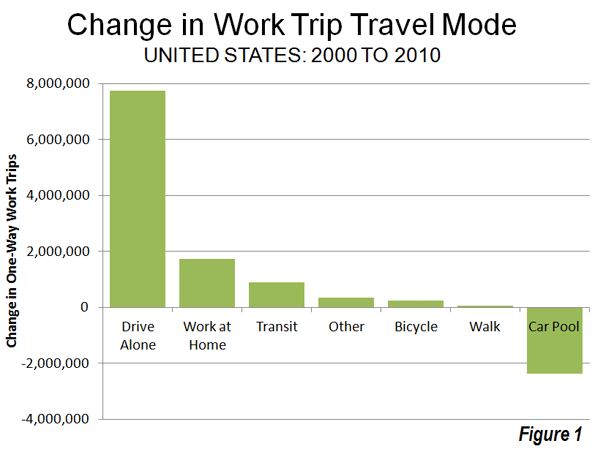
Despite higher prices and huge media hype over shifts to public transit, the big surprise out of the 2010 American Community Survey has been the continued growth over the last decade in driving alone to work. Between 2000 and 2010, driving alone to work increased by 7.8 million out of a total of 8.7 million increase in total jobs. As a result, this use of this mode reached 76.5% of the nation’s workers, up from 75.6% in 2000. This is the largest decadal share of commuting ever achieved for this mode of transport.
In view of the much higher gasoline prices that prevailed in 2010, it might have been expected that driving alone would lose market share from 2000 (Figure 1). But this did not — despite many media and academic claims that would or was already taking place — occur.
The Census Bureau began compiling data on commuting in the 1960 census. In each census through 2000, commuting data was obtained through the census "long form" questionnaire. During the last decade, however, the Census Bureau has begun an annual survey, the American Community Survey, which includes commuting data and a considerable amount of additional data, and the decennial census survey was discontinued.
Cars Dominate: There have been substantial changes in how the nation travels since the first survey in 1960. In 1960, 64% of the nation’s workers traveled by car. Separate data was not obtained for driving alone and carpools until 1980. The 2010 data indicates that 86.2% of employees used cars for the work trip in 2010. This was a slight reduction from 87.9% in 2000. But the anti-automobile crowd should not celebrate; all of the loss was due to a substantial decline in carpooling. In 2000, 12.2% of workers traveled by car pool. This figure dropped to 9.7% in 2010. With the higher gas prices, it might have been expected that carpooling would have become more popular, because of the lower costs from sharing experiences with other workers. This simply did not occur.
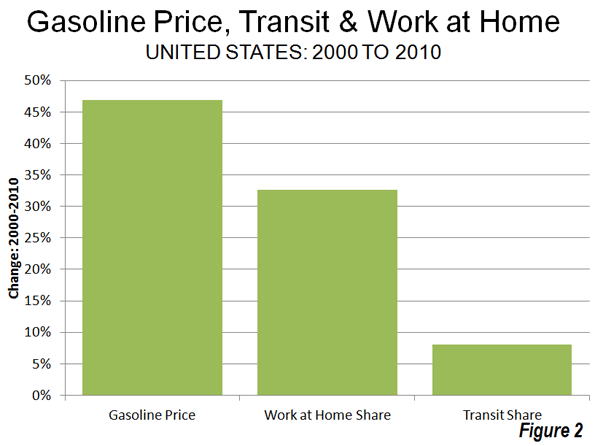
Working at Home: The big winner among the nation’s commuting modes was working at home, a large share of which is telecommuting. Working at home increased from 3.3% of the workforce in 2000 to 4.3% of the workforce in 2010, for a market share increase of 33%, Overall 1.7 million more people work at home in 2010 than in 2000. It seems likely that the high gas prices encouraged a more working at home as did the move by companies to offload work to freelancers to reduce their costs or boost efficiency. Over the decade, gas prices increased 46%, adjusted for inflation, while the work at home market share increased 33% (Figure 2).
Further, working at home, as indicated in a previous article, is poised to become the third most popular method of accessing work before 2020, passing transit and trailing only driving alone and carpooling (see Decade of the Telecommute). Working at home might have been much more popular in 1960, when it accounted for 7.2% of employment. But as many home-based industries lost share to chains and malls, this figure fell by more than one-half by 1970 and then fell to 2.2% in 1980. The doubling of the work at home market share since that time, on the other hand, is attributable to the advances in information technology.
Transit: Transit experienced by far its best decade since the Census Bureau began tracking commuting. Transit’s long market share slide came to an end, rising from 4.6% in 2000 to 4.9% in 2010. Even so, it might have been expected that a more substantial increase in transit commuting would have occurred as a result of the high gasoline prices. However, only an 8% increase in the transit market share occurred at the same time as gasoline prices increased a real 46%, less in percentage terms than the shift to working at home (Figure 2).
Part of the problem was revealed in a Brookings Institution report. The percentage of metropolitan area jobs that can be reached by transit for the average worker is very low, which seriously limits transit’s potential for commuting use. Brookings data indicates that less than 10% of the jobs in major metropolitan areas can be reached within 45 minutes by transit by the average worker in major metropolitan areas (see Transit: The 4 Percent Solution). This is not only because transit service is infrequent in many parts of metropolitan areas, but also because it operates so much more slowly, on average, than cars. By comparison, the median work trip travel time by people driving alone is 21 minutes.
Transit carried 12.1% of the nation’s commuters in 1960 and had fallen to 5.3% by 1990. The results of the last three decades indicate that transit commuting may have stopped declining but has reached a plateau, with only small increase.
Recent decades have seen establishment and substantial expansion of urban rail systems. A principal rationale for these systems has been reducing traffic congestion, especially during peak hours. The majority of commuting takes place during peak hour and is principally responsible for peak hour traffic congestion. Between 2000 and 2010, Metros (subways and elevated) accounted for 48% of the increase in transit commuting, while buses and a trolley buses accounted for 43%. Light rail (trolleys and streetcars) accounted for less than 2% of the additional transit commuting, despite the fact that light rail has been the dominant form of rail transit expansion (Figure 3).
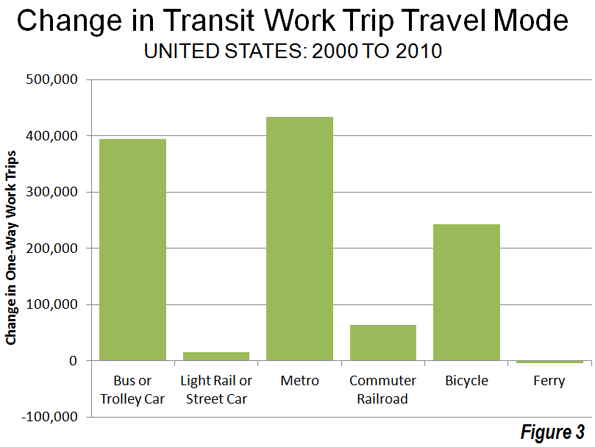
Bicycling: It was also a good decade for bicycle commuting. Bicycling added nearly 250,000 new commuters and rose from 0.4% of the market in 200 to 0.5% in 2010. The increase in bicycle commuting was 15 times that of light rail. Bicycling was first surveyed by the Census Bureau in the 1980s census, when its market share was also 0.5%.
Walking: There was little change in walking as a form of commuting. In 2000, 2.9% of commuters walked to work, a figure that dropped to 2.8% in 2010. However, walking has suffered even greater losses than transit over the last 50 years. In 1960, 9.9% of commuters walked to work.
The Future? One thing is clear from the data of the last decade. There has been no sea-change in commuting, even with the huge gasoline price increases. Few analysts would have predicted that single-occupant commuting would have increased at a time of both high gasoline prices and high joblessness. Further, as the shift to personal mobility continues, the largest percentage increases will like take place in telecommuting, arguably the most energy-efficient form of transport.
Data from 1960: The table below summarizes work trip access market shares over the 50 years of data collection by the US Census Bureau.
| US Work Access by Mode: 1960-2010 | ||||||
| COMMUTERS | 1960 | 1970 | 1980 | 1990 | 2000 | 2010 |
| Car, Truck or Van | 41,368,062 | 59,722,550 | 81,258,496 | 99,592,932 | 112,736,101 | 118,123,873 |
| Drove Alone | 62,193,449 | 84,215,298 | 97,102,050 | 104,857,517 | ||
| Car Pool | 19,065,047 | 15,377,634 | 15,634,051 | 13,266,356 | ||
| Transit | 7,806,932 | 6,514,012 | 6,007,728 | 5,890,155 | 5,867,559 | 6,768,661 |
| Bicycle | 468,348 | 466,856 | 488,497 | 731,286 | ||
| Walk only | 6,416,343 | 5,689,819 | 5,413,248 | 4,488,886 | 3,758,982 | 3,797,048 |
| Other or Unspecified | 4401718 | 2240864 | 1289613 | 1225420 | 1243866 | 1,595,942 |
| Work at Home | 4,662,750 | 2,685,144 | 2,179,863 | 3,406,025 | 4,184,223 | 5,924,200 |
| Total | 64,655,805 | 76,852,389 | 96,617,296 | 115,070,274 | 128,279,228 | 136,941,010 |
| MARKET SHARE | 1960 | 1970 | 1980 | 1990 | 2000 | 2010 |
| Car, Truck or Van | 64.0% | 77.7% | 84.1% | 86.5% | 87.9% | 86.3% |
| Drove Alone | 64.4% | 73.2% | 75.7% | 76.6% | ||
| Car Pool | 19.7% | 13.4% | 12.2% | 9.7% | ||
| Transit | 12.1% | 8.5% | 6.2% | 5.1% | 4.6% | 4.9% |
| Bicycle | 0.5% | 0.4% | 0.4% | 0.5% | ||
| Walk only | 9.9% | 7.4% | 5.6% | 3.9% | 2.9% | 2.8% |
| Other or Unspecified | 6.8% | 2.9% | 1.3% | 1.1% | 1.0% | 1.2% |
| Work at Home | 7.2% | 3.5% | 2.3% | 3.0% | 3.3% | 4.3% |
| Notes | ||||||
| Other includes taxicabs, motorcycles and other | ||||||
| Blank cells indicate no data | ||||||
| Taxicab included in transit in 1960 | ||||||
| Workers 14 and over, 1960 & 1970. Workers 16 & over, subsequent censuses | ||||||
| US Census Bureau data | ||||||
Wendell Cox is a Visiting Professor, Conservatoire National des Arts et Metiers, Paris and the author of “War on the Dream: How Anti-Sprawl Policy Threatens the Quality of Life”
Photo: Junction of Interstates 110 (Harbor Freeway) and 105 (Glenn Anderson Freeway) in Los Angeles, which carry four varieties of passenger transport, cars, busway, high-occupancy vehicles and light rail (by author).
Comments
22 responses to “Surprise: Higher Gas Prices, Data Shows More Solo Auto Commuting”
At least in parts of the United States where Verizon has seen fit to deploy its FiOS fiber-optic telecommunications product (which runs to individual subscriber residences), this has become an entirely reasonable (and environmentally benign) way to do “knowledge” work.
Indeed, because some of my work assignments involve uploading and downloading huge amounts of data, being able to do so with FiOS means my employer’s IT staff prefers me to do it at home and not burden the network at the office with such huge volumes of data.
I’m not shilling for Verizon either – competing products from other companies (and in areas not served by Verizon’s landlines) will tend to make it possible for even more people to work at home.
I had nice discussion about the topic named pds behandeling last week. And your post reminds me of that. Thanks for this excellent writing. I’m glad Yahoo pointed me to it. After I initially commented I clicked the -Notify me when new comments are added- checkbox and now every time a comment is added I get four emails with the identical comment. – Hotel di Semarang
You should check this infographic, which explains why the world should start carpooling:
http://www.carpooling.com/i/carpooling_com_infographic.jpg
In America, carpooling is mainly considered for work commute. In Europe, carpooling.com is the #5 travel portal in Germany. Maybe America is looking for another simpler way to carpool?
But again, it’s even less flexible than the bus. I do not need to call the bus if I’m not going to make it that day or have to work late. And don’t care much about the carbon thing as a motivating factor. It’s a bonus, not a reason.
If people aren’t that worried about increasing gas price maybe we should see more people considering an automobile donation. Lately, I haven’t seen that many people willing to help others in distress.
I am find information on this topic as I am working on a business project. Thanks a lot for enjoying this beauty article with me. I am appreciating it very much! Thank you posting relative information and its now becoming easier to complete this project. – baju branded
The slowdown of the economy has placed enormous stresses in individuals and families to “make it work.” Take the back-to-school crowd. Adults wanting to finish their degrees, often working full-time, with a family to boot, cannot rely on the transit system because of the time-stealing it causes the worker. Every minute counts. Running to the bus stop, waiting for the bus, not enough real time to study while riding, watching for the stop, going from the often inconveniently located stop to class…and guess what? When the class ends at 9 or 9:30 there are no more runs anywhere, let alone the suburbs. Without driving, there is no flexibility to pick up kids from school or attend midday teacher conferences. No flexibility to run over to speak to an adviser at lunch. No flexibility to pick up groceries on the way home. This time is money. Money is labor. Public transportation costs not only the money lost by investing the time when it’s not a workable scenario, but whether you take it or not, you’re paying for it as a taxapyer, as it is heavily subsidized.
Lest I sound like a complainer, I took the bus from the burbs to downtown for several years. It worked great, and the bus puts me right outside my house. I got to read books. It was fantastic. But now, the flexibility of those who have to have second or third jobs, or pick up a now-working spouse who didn’t have to drive before, or cobble together a couple odd-hour retail-hour part-time jobs…public transportation doesn’t work.
Here’s what works: Express buses from the burbs for those who can do the 7-5 thing. Guaranteed ride home programs for emergencies paying taxi fare. Local routes in the burbs that pick up people from all over and take them all to beginning of express route. Express city buses, that clone existing routes with fewer stops. Advertising on buses to help with expenses. Advertising on bus stops and inside buses. Elimination of routes in areas with low ridership to help pay for busy routes. Private contracted drivers, rather than city employees.
Here’s what works even better: great roads with zillions of lanes and well-planned junctions. Highways with plans for accidents and how to get them off the road, with timely rerouting info on the signs over feeder routes. Woefully inefficient right now.
People not only want their freedom to drive where they like, when they like, but these days, with the economy forcing multiple locale destinations, the luxury of a daily ride isn’t really possible for many people.
How is this a surprise? Well, to the academics who do the study, it must be. Most of my professors roll into work bleary-eyed at 9:30am into their faculty parking spaces or they live near campus and bike. None of them take the bus either.
Despite higher prices and huge media hype over shifts to public transit, the big surprise out of the 2010 American Community Survey watch Suisei no Gargantia anime has been the continued growth over the last decade in driving alone to work. Between 2000 and 2010, driving alone to work increased by 7.8 million out of a total of 8.7 million increase in total jobs. As a result, Nise Koi manga read this use of this mode reached 76.5% of the nation’s workers, up from 75.6% in 2000. This is the largest decadal share of commuting ever achieved for
Visit: tu van dau tu nuoc ngoai, cong bo thuc pham, thiet ke website ban hang, thanh lap cong ty, dang ky nhan hieu, cong bo luu hanh my pham…
Despite higher prices and huge media hype over shifts to public transit, the big surprise out of the 2010 American Community Survey has been the continued growth over the last decade in driving alone to work. Between 2000 read manga online and 2010, driving alone to work increased by 7.8 million out of a total of 8.7 million increase in total jobs. As a result, this use of this mode reached 76.5% of the nation’s workers, up from 75.6% in 2000. This is the largest decadal watch anime online share of commuting ever achieved for
In spite of higher gas prices, the individual auto commuting is growing higher. Single transportation in vehicle are gradually increasing these days even if the cost of gas fuel is higher in price. We know that the commuting or the public transportation is very necessary for the daily works in government, public and private sectors. So people relying on this to go to their work places. Basically, individual car commuting increasing day by day. Coach Bus Camarillo
Thanks for taking the time to discuss this, I feel strongly about it and love learning more on this topic.
Click Sirius Poetry Link
Thanks you very much for sharing these links. Will definitely check this out..
Healthy Relationship with Boat Harbour
Absolutely fantastic posting! Lots of useful information and inspiration, both of which we all need!Relay appreciate your work.
Borui Pharma Articles
A mind blowing article is provided here. And it is written with great skill and the words directly explain the thought of author and it is Semarang Hotel nice to know the information provided around the Earth and really it is great topic of interest
Pollution causes many diseases, it is also destroyed our environment. In scientific view automobiles plays a vital role in pollution. The gas, smokes, sound all are responsible separately for pollution in different way. Our science and technology is now so developed that they have the alternate precaution to prevent pollution, but it is quite ineffective due to less awareness. This blog also the awareness to make our environment pollution free and built a healthy surrounding.
BMW service and repair in Sherman Oaks
Car, bus and truck are used for the transportation. Car and bus are used for the transportation of people and truck is used for the transportation of materials and other things. These days the use of diesel vehicles, like: car, bus and truck are used in large numbers and causing more environmental pollution. Diesel is the most impure fuel and can affect the Eco-system so badly. Also the price value of diesel and petrol increasing day by day. So its better to use the electric vehicles more and also the vehicles those can run by Natural gas.
Porsche repair Chino Hills
Thank you for taking the time to publish this information very useful!
walkfit platinum orthotics reviews
Nice post! This is a very nice blog that I will definitively come back to more times this year! Thanks for informative post.
https://www.rebelmouse.com/mikegearytruthaboutabs/
Great post, you have pointed out some excellent points, I as well believe this is a very superb website.
web design los angeles
Thank you for such a well written article. It’s full of insightful information and entertaining descriptions. Your point of view is the best among many.
PTS
Day by day gas price along with fuel price rapidly increases; therefore automobile industries are suffering from huge losses. Apart from fuel and gas vehicles we love to get perfect solution from electric vehicles; which are chargeable and run without the use of fuel and gas. Report says that American automobile industry and travel industry suffers due to rise in gas and fuel price; so its better to switch towards electric vehicles.
Mini Cooper repair Centennial, CO