Author: Aaron M. Renn

  • Dallas: A City in Transition

    I was in Dallas this recently for the New Cities Summit, so it’s a good time to post an update on the city.

    I don’t think many of us realize the scale to which Sunbelt mega-boomtowns like Dallas have grown. The Dallas-Ft. Worth metro area is now the fourth largest in the United States with 6.8 million people, and it continues to pile on people and jobs at a fiendish clip.

    Many urbanists are not fans of DFW, and it’s easy to understand why. But I think it’s unfair to judge the quality of a city without considering where it is at in its lifecycle. Dallas has been around since the 1800s, but the metroplex is only just now starting to come into its own as a region. It is still in the hypergrowth and wealth building stage, similar to where a place like Chicago was back in the late 19th century. Unsurprisingly, filthy, crass, money-grubbing, unsophisticated Chicago did not appeal to the sophisticates of its day either. But once Chicago got rich, it decided to get classy. Its business booster class endowed first rate cultural institutions like the Art Institute, and tremendous efforts were made to upgrade the quality of the city and deal with the congestion, pollution, substandard housing, and fallout from rapid growth, which threatened to choke off the city’s future success. At some point in its journey, Chicago reached an inflection point where it transitioned to a more mature state. One can perhaps see the 1909 Burnham Plan as the best symbol of this. In addition to addressing practical concerns like street congestion, the Burnham Plan also sought to create a city that could hold its own among the world’s elite. And you’d have to argue the city largely succeeded in that vision.

    The DFW area is now at that transition point. They realize that as a city they need to be about more than just growth and money making. They need to have quality and they need to address issues in the system. Much like Burnham Plan era Chicago, this perhaps makes DFW a potentially very exciting place to be. It’s not everyday when you can be part of building a new aspirational future for a city that’s already been a successful boomtown. The locals I talked to were pretty pumped about their city and where it’s going.

    How true this is I don’t know, but some people have attributed a change in mindset to the loss in the competition to land Boeing’s headquarters. Boeing ended up choosing Chicago over Dallas. In part this was because Chicago bought the business with lavish subsidies that far outclassed what Dallas put on the table. But it was also because Boeing saw Chicago as a more congenial environment for global company C-suite and other top executives to be, both from a lifestyle perspective and that of access to other globally elite firms and workers available in Chicago.

    Meanwhile, the cracks in the DFW growth model were becoming apparent, especially in the core city of Dallas. Ten years ago the Dallas Morning News ran a series called “Dallas at a Tipping Point: A Roadmap For Renewal.” This series was underpinned by a report prepared by the consulting firm Booz Allen. This report is well worth reading by almost anyone today as it is a rare example of a city that was able to get insight and recommendations from the type of tier one strategy firm used by major corporations. Booz Allen was direct in their findings, though perhaps with a bit of hyperbole in the Detroit comparison:

    Dallas stands at the verge of entering a cycle of decline…On its current path, Dallas will, in the next 20 years, go the way of declining cities like Detroit – a hollow core abandoned by the middle class and surrounded by suburbs that outperform the city but inevitably are dragged down by it.
    ….
    If the City of Dallas were a corporate client, we would note that it has fallen significantly behind its competitors. We would warn that its product offering is becoming less and less compelling to its core group of target customers…We would further caution the management that they are in an especially dangerous position because overall growth in the market…is masking the depth of its underlying problems. We would explain that in our experience, companies in fast growing markets are often those most at risk because they frequently do not realize they are falling behind until the situation is irreversible.

    Put into the language of business, we would note that Dallas is under-investing in its core product, has not embraced best practices throughout its management or operations, and is fast becoming burdened by long term liabilities that could bankrupt the company if the market takes a downturn.

    The city responded in a number of ways, some of which were similar to Chicago at its inflection point. Many of these involve various urbanist “best practices” or conventional wisdom type trends.

    By far the most important of these was adopting modern statistically driven policing approaches. As crime plummeted in places like New York during the 1990s, Dallas did not see a decline of its own. But with the expansion of police headcount and adoption of new strategies by new police chief David Kunkle in 2004 – and no doubt some help from national trends – crime fell steeply during the 2000s. The Dallas Morning News says that the city’s violent and property crime rates fell by a greater percentage than any other city with over one million residents over the last decade. In 2013, Dallas had its overall lowest crime rate in 47 years.

    This is critical because nothing else matters without safe streets. I’ve had many a jousting match with other urbanists on discussion boards about where crime falls on the list of priorities. In my view it’s clearly #1 – even more so than education. It’s simply a prerequisite to almost any other systemic good happening in your cities. Students can’t learn effectively if they live and attend school in dangerous environments, for example. NYU economist Paul Romer made this point forcefully in his New Cities keynote, saying that fighting crime is the most important function of government and that if you don’t deliver on crime control your city will go into decline. Fortunately, Dallas seems to have gotten the message.

    But there’s been attention to physical infrastructure as well. The area has built America’s largest light rail system (which was in the works since the early 1980s).


    Dallas Area Rapid Transit (DART) light rail train. Source: Wikipedia

    Both the city and region remain fundamentally auto-centric, however, and this is unlikely to change.

    There’s been a significant investment in quality green spaces. A major initiative called theTrinity River Project is designed to reclaim the Trinity River corridor through the city as a recreational amenity. This is underway but proceeding slowing. Among the aspects of the project is a series of three planned signature bridges designed by Santiago Calatrava. The only one completed is the Margaret Hunt Hill Bridge.


    The Margaret Hunt Hill Bridge in Downtown Dallas. Designed by Santiago Calatrava. Source: Wikipedia

    The single bridge tower is quite an imposing presence on the skyline. However, the size of the bridge creates an awkward contrast with the glorified creek that is the Trinity River. It looks to me like they significantly over-engineered what should have been a fairly straightforward flood plain to span just so they could create a major structure.

    Another green space project – and the best thing I saw in my trip to Dallas – is Klyde Warren Park, which is built on a freeway cap. About half the cost came from $50 million donations. I’ll be going into more detail on this in my next installment, but here’s a teaser photo:


    Klyde Warren Park. Source: Wikipedia

    The Calatrava bridge shows that Dallas has embraced the starchitect trend. This was also on display in the creation of the Dallas Arts District. Complementing the Dallas Museum of Art are a billion dollars worth of starchitect designed facilities including Renzo Piano’s Nasher Sculpture Center, IM Pei’s symphony center, Norman Foster’s Winspear Opera House, and OMA’s Wyly Theatre.


    Dee and Charles Wyly Theatre. Designed by OMA’s Joshua Prince-Ramus (partner in charge) and Rem Koolhaas

    This arts district – which naturally Dallas boasts is the world’s largest – along with the other major investments that were funded with significant private contributions show a major advantage Texas metros like DFW and Houston have: philanthropy. These are new money towns on their way up and local billionaires are willing to open their wallets bigtime in an attempt to realize world class ambitions, exactly the way Chicago’s did all those decades back.

    By contrast many northern tier cities are dependent on legacy philanthropy, such as foundations set up in an era when they were industrial power houses. This is a dwindling inheritance. What’s more, what wealthy residents they do have are as likely to be taking money out of their cities through cash for cronies projects than they are to be putting it in. Thus they can be a negative not positive influence.

    This shows the importance of wealth building in cities. Commercial endeavors can appear crass or greedy at times, and deservedly so. But without wealth, you can’t afford to do anything. There’s a reason Dallas could build America’s largest light rail system – it had the money to do so. Similarly with this performing arts district. To be a city of ambition requires that a place also be an engine of wealth generation.

    I’m sure that Dallas’ moneyed elite are well taken care of locally and exert outsized influence on decision making. I don’t want to make them out to be puristic altruists. But they’ve shown they are willing to open their wallets in a serious way, something that’s not true everywhere.

    This is a flavor of what Dallas has been up to. It’s too early to say whether the city will make the same transition Chicago did. Its greatest challenge also awaits some time in the future. When DFW’s hypergrowth phase ends and the city must, like New York and Chicago before it, reinvent itself for a new age, that’s when we will find out if DFW has what it takes to join the world’s elite, or whether it will fade like a flower as Detroit and so many other places did.

    Toyota did just announce it’s moving 3,500 jobs to north suburban Plano. But corporations have long seen Dallas a place for large white collar operations. Boeing was what I call an “executive headquarters” – a fairly small operation consisting of only the most senior people. I haven’t seen Dallas win any of these as of yet.

    The Dallas Morning News takes a somewhat mixed view on the city itself. They just did a special section called “Future Dallas: Making Strides, Facing Challenges,” the title of which sums it up. Dallas has put a lot of pieces on the board and made major progress on areas like crime, but it’s failed to make a dent in others, such as Booz Allen’s call to make the city more attractive to middle class families. Poverty is actually up since then, and the city is increasingly unequal in its income distribution. Dallas is not unique in that, but that’s cold comfort.

    Despite gigantic regional growth, the city’s population has been nearly flat. Despite the vaunted Texas and DFW jobs engine, Dallas County has lost about 100,000 jobs since 2000. The core is clearly continuing in relative decline, and the Dallas County job losses are particularly troubling. I’m no believer in this idea that everybody is going to abandon the suburbs and head back to the city. But as former Indianapolis Mayor Bill Hudnut put it, you can’t be a suburb of nowhere. If the core loses economic vitality, the entire DFW regional will take a hit to its growth.

    Aaron M. Renn is an independent writer on urban affairs and the founder of Telestrian, a data analysis and mapping tool. He writes at The Urbanophile, where this piece originally appeared.

    Dallas photo by Bigstock.
  • Is Brazil Still the Country of the Future?

    Not long ago, Brazil was riding high. It was feted as one of the “BRIC” nations destined to be the next world economic powers. The commodities boom had its natural resources and agricultural sectors humming. The press – for example, Monocle magazine’s swooning over Brazil’s push to boost its diplomatic presence – was adoring. And Rio was awarded the 2014 World Cup and the 2016 Olympics, two events that were intended to both serve as a catalyst for further development, and also as a coming out party of sorts for the country.

    The World Cup is underway, but otherwise things haven’t quite worked out as Brazil thought they would. The average citizen of the country is upset at the vast sums being spent on international events that don’t benefit them. The last two years have featured riots, strikes, and various other expressions of unrest. Economic growth in the country has collapsed. In a special section last September, the Economist asked, “Has Brazil Blown It?

    Late last month the McKinsey Global Institute issued a major report on the country called “Connecting Brazil to the World: A Path to Inclusive Growth.” At 104 pages, it’s massive, but a must read for anybody interested in South America’s giant.

    And it’s a somewhat depressing read as well. Though there are immense strengths and opportunities for the future, Brazil has big problems too, most of them longstanding, and which hobble its aspirations.

    Brazil is the 7th largest economy in the world and the 7th leading destination for foreign direct investment. But it’s 95th in per capita GDP, 114th in the quality of its infrastructure, and 124th in its level of ease in trading across borders. Its export sector is also heavily commodity dependent, particularly oil. Ranked only 43rd in global connectedness on McKinsey’s index, they estimate a potential boost of 1.25% (presumably percentage points) to annual GDP growth from improvements on that measure alone.

    Three particular items jumped out at me from the study. One is the “custo Brasil” – the Brazil cost, so notorious it gets its own Wikipedia entry. A variety of factors from bureaucracy to the tax regime to an uncertain legal climate, poor infrastructure, crime, and corruption make the cost of doing business in Brazil very pricey indeed.

    The second is the very low rate of investment in the economy. Brazil’s gross investment rate as a percentage of GDP is 18%, compared with 26% in Chile, 29% in Mexico, 40% in India, and 49% in China. Conversely, government consumption is at 22% in Brazil vs. 12% in Chile and Mexico, 13% in India, and 14% in China. Private consumption is similar in the countries except for China, which is notably lower. This probably helps explain the poor state of the infrastructure in the country.

    The third is something I have personal experience with, namely protectionist trade barriers designed to create and sustain domestic industries in sectors like autos and computers. I suspect these rules were modeled on Japan, and more lately China, which used rules and business practices to build successful local champions. But in Brazil this has rendered its industry sclerotic. In effect, cars sold in Brazil have to be made in Brazil, ditto for computers, etc. This is where my personal experience comes in. When we were doing global PC procurement, Brazil was always a special case and our vendors had to have special Brazil made PCs for domestic use. This may not be an actual rule, but tariffs produce a de facto barrier. While this technique may have worked in Japan, it’s clear that it failed in Brazil. As the exception that proves the rule, McKinsey uses the example of regional jet manufacturer Embraer as a counterfactual. That company was privatized and opened to global competition. The result is that its got tough itself and is now an industrial champion for Brazil.

    There are tons of statistics in the study that are worth scanning just to see. Brazil is consistently benchmarked against Chile and Mexico in Latin America, as well as fellow BRICs India and China. The comparisons aren’t pretty.

    Reading a lot about the country in the last year, I put its problems into three categories: poor governance, geographic disadvantage, and scale disadvantage.

    1. Poor Governance
    Most of the issues pointed out by McKinsey fall squarely under the heading of poor governance. The contrast with nearby Chile could not be more plain across every dimension: corruption, the rule of law, investment, public sector debt, tax burden, infrastructure, regulation, etc.

    Latin America seems to prefer two sorts of governments these days. One is a right wing nationalist heir to the military juntas of the past, best exemplified by the Kirchner regime in Argentina. The other are left wing populist-nationalist movements like Venezuela that tend to feature a streak of anti-Americanism. Both of these have produced pitiful results.

    Brazil is a sort of lite version of the latter. Lula da Silva was a charismatic labor activist who led strikes and was jailed by the previous military dictatorship in his youth. Post-democratization, he went into politics. After moderating some of his more radical views, he was elected president on a reform agenda. While he had some success and was arguably and improvement on his predecessors, he ultimately failed to deliver on material changes in governance. His hand picked successor Dilma Rousseff has not been as effective and is in an electoral struggle for another term.

    In line with the nationalist streak of this governing type, one of Da Silva’s primary concerns was Brazil’s amour-propre. As one of the world’s largest countries, he found it self-evident that Brazil should be treated as a great power. He lobbied for Brazil to have a permanent seat on the UN Security Council. He and others responded in kind to any affront to the nation’s pride, such as requiring American and only American visitors to be finger printed after the US imposed a fingerprinting requirement on foreign visitors. He sought out diplomatic coups where ever he could find them, which included cozying up to unsavory characters like Mahmoud Ahmadinejad who thinks Israel should be destroyed and that Iran has no gays (presumably because he has them executed when he can find them).

    Da Silva forgot that there’s more to being a great power than being a big country – you’ve got to earn it. And as a very popular politician he did not seize his moment of opportunity to truly grasp the nettle of reform.

    Meanwhile nearby Chile is one of the Latin American governments that’s followed a different model. It’s been run by center-left governments more or less the entire time since the restoration of democracy, and they’ve delivered on a good governance model that has taken them to effectively developed country status. Chile is now even a member of the OECD. Chile is basically the Minnesota of Latin America, and the results demonstrate it. This should show Brazil the size of the prize if the get their act together.

    2. Geographic Disadvantage
    Brazil is simply a long way from major developed markets. This puts it at a geographic disadvantage versus many other countries. Current airplanes cannot make a non-stop flight from Brazil to East Asia, arguably the most important emerging part of the world. It’s even a long haul from the United States, with relatively few gateway cities vs. say major European capitals. Brazil is time-zone advantaged with the US, however. It also speaks Portuguese instead of Spanish, which imposes a linguistic handicap.

    3. Scale Disadvantage
    Brazil is a big country, geographically and in population. Size can be an advantage, but it also makes reform difficult as it’s hard to turn a battleship. Brazil’s population of 200 million is more than ten times that of Chile.

    Brazil’s two principal cities, São Paulo and Rio de Janeiro, are also megacities. São Paulo in particular is huge, and at north of 20 million people (more than the entire country of Chile) is the 10th largest city in the world. I recently wrote that it’s unlikely the world’s emerging megacities will turn the corner in eliminating dysfunction. Their problems are just too huge and their national growth rate too low. Though I’d consider this more hypothesis than conclusion at this point, my rule of thumb is that a megacity can only achieve escape velocity from pervasive dysfunction if they are a major city in a country that is the world’s current rising economic (or historically imperial) power.

    Brazil is not that country, and two mega cities will be a drag on growth. Although São Paulo is an important emerging global city – 23rd in the world in a forthcoming report I helped create – I’m told that both São Paulo and Rio are growing more slowly than secondary cities in the country. A previous McKinsey study threw cold water on the idea that megacities are an advantage, noting their under performance by saying:

    It is a common misperception that megacities have been driving global growth for the past 15 years. In fact, most have not grown faster than their host economies, and MGI expects this trend to continue. Today’s 23 megacities—with populations of 10 million or more—will contribute about 10 percent of global growth to 2025, below their 14 percent share of global GDP.

    In contrast, 577 middleweights—cities with populations of between 150,000 and 10 million, are seen contributing more than half of global growth to 2025, gaining share from today’s megacities.

    So I’m not surprised that it’s Curitiba, not one of the megacities, that’s where the innovative BRT revolution was begun. If I were looking to invest in Brazil, I’d be looking at this next tier of cities. Nor is it surprising that Santiago, Chile (population 5.4 million) has had great success in modernizing given its more moderate size.

    Plain and simple the degree of difficulty is higher in Brazil because of the size.

    Brazil is also a very racially diverse country with a number of challenges resulting from its history of oppression. Brazil had more slaves than any other country in the world and was the last New World colony/nation to abolish it. If slave reparations are on the agenda in the United States, how much more so similar issues in Brazil? Again, contrast with Chile, which never had very many slaves and abolished slavery in 1818. With the exception of a relatively few indigenous peoples on reservations, Chileans largely perceive themselves as ethnically homogenous, though with some skin tone based status (moderately sized…historically racially homogenous…Minnesota?)

    Which is to say that it’s tough to entirely fault Brazil for not living up to the example of Chile. Its degree of difficulty is much higher. And its geography hamstrings its global interaction.

    Nevertheless, solving the governance challenges to address the real issues Brazil faces remains the top agenda item. McKinsey has laid out a number of good suggestions, the real question is whether or not Brazil’s socio-political system can produce the ability to implement them.

    Aaron M. Renn is an independent writer on urban affairs and the founder of Telestrian, a data analysis and mapping tool. He writes at The Urbanophile, where this piece originally appeared.

    Photo: Ponte estaiada Octavio Frias – Sao Paulo by Marcosleal

  • Columbus, Know Thyself

    What Is Your Ambition?

    Columbus doesn’t have a powerful brand in the market outside of Ohio. Having said that, the city is growing rapidly in population and jobs, is extremely livable and improving day by day, and seems to make its residents very happy. Is there any reason the city has to be better nationally known in order to be complete or something?

    I say No.  It’s a valid choice to simply stay with the status quo.

    Many citizens may indeed feel that way, but much of the city’s leadership doesn’t. This was hammered home in a 2010 New York Times piece on the city’s rebranding efforts. That desire to be seen as a high caliber city at the national level clearly came through in my most recent trip, even from Mayor Coleman himself.

    I also tend to be personally biased towards high ambition, particularly in a place where it’s obvious that the ambition can be realized.  Columbus is that place, in contrast to long troubled regions  like Detroit and Cleveland are really struggling to rebound from severe problems. And no matter what they do, they will never recover the national stature they once enjoyed.   

    Columbus is both operating from a baseline of strength, and also at a point where it is still on the way up as a city.   Columbus has never been a larger, more important, more prominent city in the world than it is right now – and it has the potential to reach still higher  Not every city and not every generation is granted the opportunity that Columbus has right now.  

    Finding Columbus’ Mojo

    But assuming the answer is go for it, then what needs to be done? There is a need to go beyond the checklist.

    The first thing  is to really be committed to change and going after the brass ring. This is not an easy journey to make. Some of the things you are going to have to do are really, really hard because they involve looking  closely at civic insecurities, and also questioning perhaps your most fundamental and cherished truths, especially the truth about what you’re best at.

    It’s very hard for cities to admit where they are weak, but it can actually be even harder for them to admit where they are strong.

    One of the sayings of the Greek oracle was “Know Thyself.” Sage wisdom, indeed. Knowledge of yourself is often the most difficult to come by but valuable of commodities. Because as the saying goes, “Without awareness there is no choice.”

    Where does a city get knowledge of itself that’s useful for branding? I argue it very often comes from the past. Cities didn’t just take their present form overnight. They are the process of a long process of growth and change. In particular, the founding ethos of a place profoundly stamps its character, usually in a permanent way. The Dutch trading culture and spirit of openness of New Amsterdam is still present in contemporary New York, for example.

    When a new creative director comes in to revive a failing fashion house, what’s the first thing he does? He goes to the archives. He investigates the history of the house. What does this brand stand for? Who were the people who founded it? How did they become who they were? What happened along the journey of that house?

    To use a hackneyed phrase, that new creative director wants to understanding the “Brand DNA,” and the key to the brand DNA is in the past.

    I think that’s as true of Columbus as anyplace. Columbus certainly had good luck in getting where it is today, but I’d argue there’s more to it. One of their historical keys to success was a fateful decision in the 1950s to pursue an aggressive annexation strategy. You can say that was one mayor’s choice, but I believe the fact that it happened in Columbus and not elsewhere in Ohio signaled  that there was something different about the city. What is it?
    You need to start with an anthropological, archeological, historical deep dive into a city, its people and its culture. I’d suggest tapping into Ohio State’s cultural anthropology resources. There might even be a dissertation in it for someone.

    Aspirational Narrative

    One you have the mojo, you not only use it to build the future reality, you also sell it by telling the story of Columbus to the world. You need to create an aspirational narrative of the city that people can imagine themselves being a part of.

    Think of the story of New York. TV shows like Friends, Sienfield, and Sex and the City have created a contemporary positive narrative of life in New York. People know what it’s about. If you can make it there, etc. (This wasn’t always the case. Escape from New York, Death Wish, and Fort Apache the Bronx told quite a different narrative in a previous era). Portlandia tells a story about the place where young people go to retire. Think about the Bay Area, LA, Miami, etc. and the stories come to our heads without much thinking.

    What’s that story of life in Columbus? You create that story around the authentic mojo of the city.

    What’s on your rap sheet?

    Beyond finding the mojo, there’s another key task that goes along with the investigation. That’s finding the missing or defective genes in the civic DNA that could sabotage the city’s ambitions.

    Everybody’s got a rap sheet. The only question is whether or not we know what’s on ours. When I was working in corporate America I knew if I was getting nothing but glowing feedback from my boss, if Ihad nothing I need to get better at, I was dangerously blind. If not, why was I not the CEO of the company? Clearly, there’s a reason why I am where I am and not the President of the United States.

    So Columbus needs to understand not just checklist items it is missing like a major transit investment, but also cultural items that are holding the city back and what they are rooted in. Then it can attack them with a change program that can hopefully work, like the civic equivalent of therapy.

    On a related note though methodologically different, the city needs to be willing to take a hard look in the mirror and realistic assess its assets and accomplishments and how compelling they are in the market. The cold reality is that while Columbus is a great city in many ways and has lots of great stuff, what it has doesn’t add up to a nationally or globally compelling story. You need to take the marketing glasses off and ask how people who aren’t in or from the city   see things.

    That doesn’t necessarily mean you recategorize your assets as bad. But you have to understand that checklist items that lots of other cities are doing (e.g., bike infrastructure) are probably not going to set the city apart in the marketplace. If you don’t have it, you’re in trouble. But if you do, it doesn’t win the game. These things are just the new urban ante.

    Illustrative Applied Examples

    I want to give a quick examples – and let me stress this is provisional and speculative to some extent – illustrating these three points.

    On the mojo front, the city’s previous branding effort that identified “smart” and “open” as two key civic attributes is right on in my view. It’s a good start. But why is Columbus open? That is, why is it easier for newcomers to acclimate, penetrate networks, accomplish things, etc. in Columbus than in many other places?

    I speculate it’s rooted in being the state capital. I’ve seen a similar trait in other capitals. I speculate that because people from all over the state are coming to Columbus on political business, and because there’s always churn in elected office, civic networks don’t become closed and calcify in a sort of “Why the Garden Club Couldn’t Save Youngstown” effect.

    For the missing gene example, I think it’s very possible that one reason Columbus didn’t create a compelling, unique product in the market is that it it’s just not in the civic DNA. One local leader I talked to speculated that the city’s values were shaped by those of Ohio State football and Woody Hayes. That is, the secret to success is to work relentlessly at the fundamentals and always be pounding the ball ahead with the running game – “three yards and a cloud of dust.” Not exactly the West Coast Offense. This may be too facile, but it is clear that Columbus excels at the fundamentals, the blocking and tackling of city stuff, but hasn’t thrown the civic equivalent of the long bomb.  

    For the asset evaluation example, I think Columbus needs to be realistic about Ohio State’s stature. Ohio State is a great school, but it’s not Harvard or Stanford. I went to Indiana University and I’d say the same about them. Now, obviously you’d never come out in public and downplay Ohio State, which legitimately is a power house for the city. But you don’t want to mistakenly believe it’s doing to spawn the next Cambridge or Palo Alto without some major change either.

    It’s Cow Town, Jake

    To truly discover the secret of its mojo, Columbus needs to be willing to stare into the abyss of cow town.

    Talk to people in Columbus and you’ll hear them claim that they are not a “cow town” anymore or how people used to refer to them as a “cow town.” I have seen this as an analogy to the case of Indianapolis and “naptown.” I’ve always doubted that hardly anyone outside of Indianapolis itself ever used the term Naptown historically as an insult. No one would ever have cared enough about the city to even bother insulting it.

    Similarly, I’d never heard the term cow town until somebody from Columbus told me about it. I strongly doubt it’s ever really been a term of derision nationally, at least not outside Ohio. I know there’s a strain of Cincinnatian who loves heaping abuse on places like Columbus and Indy. As Columbus has grown while other cities in Ohio wandered in the wilderness, it’s easy for me to believe there’s been a lot of sniping. So while the market would never think of Columbus as cow town, there may be some legitimate in state reasons for them to be sensitive to the term.

    The impression I get, again provisional based on my limited experience, is that in an attempt to rid itself of the stigma of being a cow town, Columbus has sheared off its past, in effect repudiating everything that happened before 1990 or 2000.

    I observed to Mayor Coleman that Indianapolis in recent years has downplayed the 500 Mile Race. I asked him whether or not Columbus was similarly neglecting its greatest brand asset in the market by downplaying Ohio State football. He said, “No. There was a time in the 60s and 70s and the 80s, and even the 90s, where Columbus was nothing but Ohio State football. And I love the Buckeyes; I love the football team. It’s better than any professional team in the state of Ohio. And they’re still amateurs. That’s good. But having said that, Columbus is no longer just the Ohio State football team. We don’t view ourselves that way anymore [emphasis added].”

    This seems consistent with what I hear from other people. There’s an embedded idea here that there’s little to nothing of value in the city’s past and in fact that past is something to be embarrassed about or outgrown. I have never heard anyone from Columbus brag about their city for anything related to the past, apart from historic architecture.   For example, the mayor went on to talk about the importance of Ohio State in terms of its contemporary research impact. I’m not sure I’ve ever heard a city talk less about its heritage.  That lack of historic rooting may be one reason why the city can come across as somewhat generic.

    As I’ve noted before, this is normal for us to go through. When we go off to college, Mom puts our high school letter jacket up in the attic. We try as hard as we can to fit in at the new level, and treat the stuff we left behind as little kids stuff.

    But eventually we become comfortable in our own skin. We learn who we are and what we stand for, and we stop becoming so concerned about what other people think of us. Of course we are social creatures and will never stop caring about others’ perceptions of us. We find a healthier balance.

    The same is true of cities. Columbus is far enough along in its growth path to really be comfortable being itself, and acknowledging and embracing its past.

    This doesn’t mean Columbus should be or ever was a cow town. What it does mean is that things from its past that Columbus   are actually its strongest brand assets and things to be proud of and build its future on.

    Let’s give some examples. The Midwest has a history of local, low grade lager brands. Virtually all of these were abandoned and ceased production. The hip, cool thing to do was to drink microbrews, not even Bud or Miller Lite, to say nothing of Sterling (my dad’s brand).

    Then one day the hipsters on the coasts started drinking Pabst Blue Ribbon, and all of a sudden back in the Midwest, we started drinking it too and now are re-launching or re-embracing all those old blue collar brands (including Sterling). The same thing happened with workwear clothing, which is now selling for quite a premium in some places and very popular among the Bearded Ones.

    In effect, we had to re-import our own heritage after a bunch of other people elsewhere saw the value in it – the same heritage we rejected as “cow town.”

    The clearest example of this is agriculture. The Midwest is all about ag. Ohio State is a huge ag power house. Columbus could have owned urban agriculture, farm to table, organics, etc. But it didn’t. And now it’s doing them, but it’s doing them as the follower, not the leader.   

    This is one of the tragedies of the Midwest. We turned away from our heritage and a bunch of guys in Brooklyn bought it from a thrift store for a song.

    The South avoided this. Look at Nashville. Did they turn their back on country music as “cow town”? No, they embraced it as central to their identity past, present, and future. Of course they are more than country. But they kept it front and center. But they also updated it. It’s not the old AM radio country. It’s not Hee Haw. They respect those people and institutions and see them as in continuity with today, but they have evolved. Today’s it’s glitzier, “Nashvegas.” Think Carrie Underwood, not Minnie Pearl.

    This is what it means to know thyself and build the future out of the authentic mojo of the past. Columbus surely has many things in its past and in its historic civic character   of immense value. The question and the challenge to the city is being willing to find out what those are and own and embrace them and champion them as a key part of the mojo on which it will build its future reality and aspirational civic narrative.

    I believe the potential is right there. The question is whether the city is ready and willing to step up and grab it.

    Aaron M. Renn is an independent writer on urban affairs and the founder of Telestrian, a data analysis and mapping tool. He writes at The Urbanophile, where this piece originally appeared.

  • Will the World’s Emerging Megacities Turn the Corner? For Most of Them, Probably Not

    Two distinct expressions of urbanism, the global city and the mega city, are often conflated in the public’s mind. This can lead people to implicitly link the future fortunes of megacities (urban regions of more than 10 million people) with the success of global cities (defined roughly as a very important node at the high end of the global economy), especially as there’s overlap between the two types. They can then assume that the world’s emerging megacities will ultimately be successful, maybe even very successful. Places like São Paulo and Istanbul are held up as global cities in the making. Even more clearly struggling megacities like Jakarta and Lagos are sometimes portrayed as up and coming hip.

    But in reality most emerging megacities likely will never turn the corner to developed status and achieve a decent standard of living and quality of life for their residents. They may be important national centers of aspiration, but most of them will never become influential global cities.  Their huge size and vast problems will leave them with perpetual entrenched poverty, poor infrastructure and public services, and low quality of life by global standards.

    The general rule seems to be that a megacity can only achieve escape pervasive dysfunction if they are a major city in a country that is the world’s current rising economic (or historically imperial) power.

    Rank

    City

    Population

    1

    Tokyo-Yokohama, Japan

    37,555,000

    2

    Jakarta, Indonesia

    29,959,000

    3

    Delhi, India

    24,134,000

    4

    Seoul-Incheon, South Korea

    22,992,000

    5

    Manila, Philippines

    22,710,000

    6

    Shanghai, China

    22,650,000

    7

    Karachi, Pakistan

    21,585,000

    8

    New York, USA

    20,661,000

    9

    Mexico City, Mexico

    20,300,000

    10

    São Paulo, Brazil

    20,273,000

    11

    Beijing, China

    19,277,000

    12

    Guangzhou, China

    18,316,000

    13

    Mumbai, India

    17,672,000

    14

    Osaka-Kobe-Kyoto, Japan

    17,234,000

    15

    Moscow, Russia

    15,885,000

    16

    Los Angeles, USA

    15,250,000

    17

    Cairo, Egypt

    15,206,000

    18

    Bangkok, Thailand

    14,910,000

    19

    Kolkata, India

    14,896,000

    20

    Dhaka, Bangladesh

    14,816,000

    21

    Buenos Aires, Argentina

    13,913,000

    22

    Tehran, Iran

    13,429,000

    23

    Istanbul, Turkey

    13,187,000

    24

    Shenzhen, China

    12,860,000

    25

    Lagos, Nigeria

    12,549,000

    26

    Rio de Janeiro, Brazil

    11,723,000

    27

    Paris, France

    10,975,000

    28

    Nagoya, Japan

    10,238,000

    29

    London, United Kingdom

    10,149,000

    Table 1: World’s Megacities, 2010, based on urban agglomeration size. Source: Demographia World Urban Areas, 10th Edition (May 2014)

    This is the case with most developed world megacities. Moscow was the capital of the Soviet Empire. New York and Los Angeles came of age when America was the rising, and ultimately dominant, economic colossus. It’s the same for Paris and London, two borderline megacities, which rose as imperial capitals. London remains arguably the premier global city in the world.

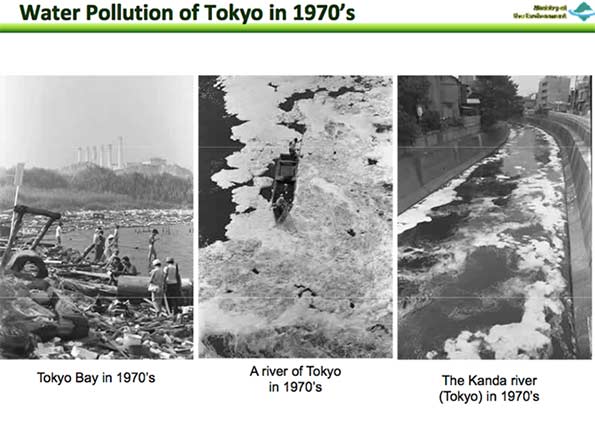
    But it’s also true of other megacities you might not consider. Tokyo only achieved its fully developed state when Japan was the rising power. Until fairly recently, much of Japan’s capital was backwards by developed world standards. For example, despite Japan’s famously high tech toilets, even in the inner 23 wards of Tokyo it was only in 1995 that 100% sewer service was achieved. In the second edition of Peter Hall’s landmark book The World Cities, he describes a 1970s Tokyo in which the night soil pickup industry was alive and well.  Only in an era of national economic hyper growth – culminating in the 1980s – was Japan able to fully modernize its urban infrastructure and clean up the massive environmental problems resulting from its rapid industrialization and urbanization. This was the time when Japan seemed destined to become the world’s leading economic power, and America was fretting as Japanese investors bought trophy assets ranging from Columbia Pictures to Rockefeller Center.


    Image from 2011 presentation by Takatoshi Wako, “Night Soil Management and Decentralized Wastewater Treatment Systems in Japan”

    We are witnessing the same today in China. It’s no accident that cities like Beijing and Shanghai are becoming fully modernized at the same time that China is the world’s rising economic power.  Even there, serious problems with social integration, pollution, and low quality development remain. China had best hope its economic growth continues until such time as it’s rich enough to solve those problems too.

    Apart from the developed West, Japan, and China, only one world megacity has ever pulled off the transition to full modernity is Seoul. Seoul, however, followed a similar trajectory to Tokyo. Destroyed in the Korean War, it was rebuilt with the help of massive foreign aid. As dictatorship gave way to democracy, South Korea emerged as the leading “Asian Tiger” economy, a sort of mini-Japan. Yet it’s only recently that Seoul has begun to transcend its soulless apartment towers and focus on building a quality of life to match its advanced subways and broadband networks, for example, by uncovering a stream previously channeled underground into storm sewers to create an attractive greenway.


    Cheonggyecheon stream in Seoul, daylighted in 2005. Image: Wikipedia

    The world’s other megacities, sadly, are located in countries on a less positive trajectory.  Many of them are in impoverished developing countries in South and Southeast Asia and Africa. Others are in economies like the BRICs once touted as emerging powers, but many of which , have badly stumbled.  India and Brazil are not following the path of Japan and South Korea – not even that of China. Their economies are large and in a sense important, but face massive structural challenges.


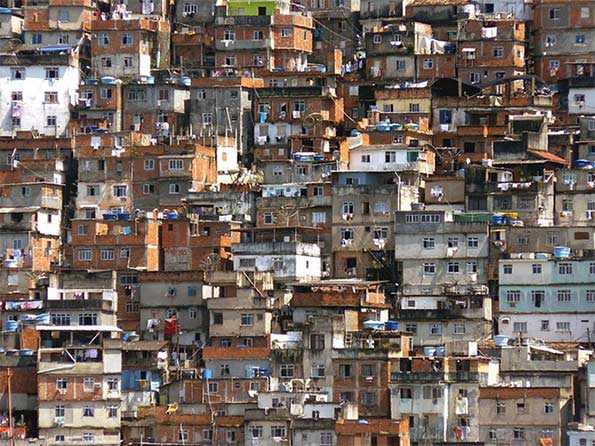
    Pavãozinho favela, Rio de Janeiro. Photo: Wikipedia

    Brazil is planning a coming out party with the World Cup and Olympics. The city of São Paulo has even established its own foreign ministry to develop direct diplomatic and other ties with countries overseas to flex its global muscles.  Yet the social reality is less impressive: Paulistanos rioted last year in response to transit fare increases. Income inequality in São Paulo is stark, and public safety very questionable.  Rio has numerous favelas where military style units are trying to establish basic security, albeit with heavy handed tactics.  Rowers training for the Olympics have described Rio’s waterways as the most polluted they’ve ever seen, with one of them telling the New York Times, “I’ve never seen anything like this before.” In next door Argentina, once wealthy Buenos Aires continues to decay along with the nation, the consequences of lengthy misrule.


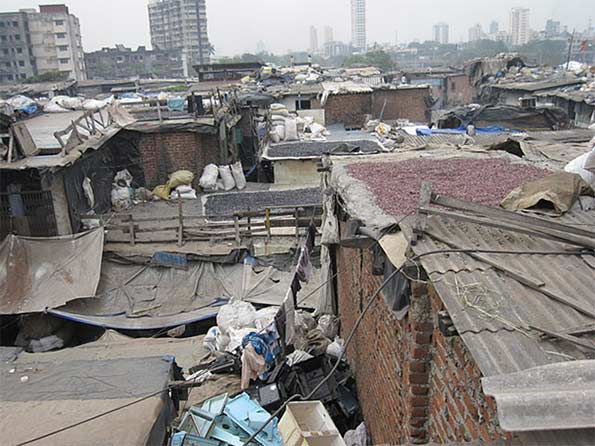
    Dharavi slum, Mumbia. Photo: Wikipedia

    But problems in Latin America’s megacities pale next to those elsewhere. In India’s financial and commercial capita of Mumbai, over half the population lives in slums. Delhi was recently noted as having the world’s worst air pollution. Dhaka, Bangladesh is both impoverished and has extreme flooding problems. Karachi, Manila, and Jakarta suffer severe poverty and infrastructure problems.  Large African cities like Lagos can’t overcome the basic development problems of the continent.


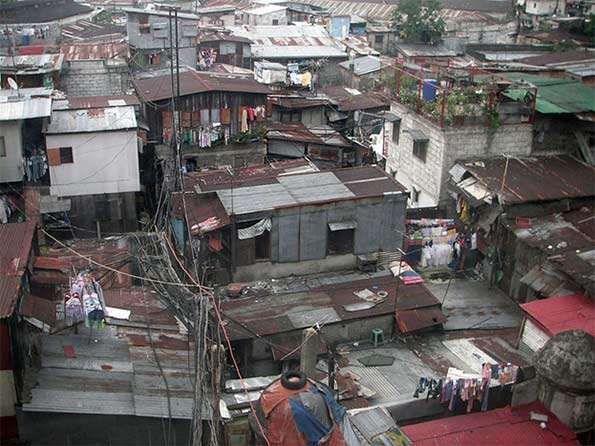
    Shantytown in Manila. Photo: Wikipedia

    Some argue that these megacities are actually opportunities zones for their country and even that their slums should be praised – or might eventually, as one article claimed, save the planet. After all, people are voting with their feet to move there. Perhaps that’s true in some sense, though some of the advantage of cities stems from a decline in the viability of rural life. 

    But the problem is that there’s no clear path to prosperous maturity for these megacities.  They are so huge, and their problems so immense that they are difficult to even conceptualize, much less do something about.  The amount of needed infrastructure provision alone – water, sanitation, drainage, transport, telecom, electricity, parks, schools, etc. – is staggering. And that doesn’t even touch arguably more difficult problems like corruption and good governance. Absent national hyper growth – a la Japan or Korea – of a level that creates a plausible claim to being the world’s rising economic power, or the proceeds of empire, it seems unlikely any of these cities will ever succeed. By contrast, smaller cities have a much more addressable problem space.

    Megacities may have their virtues and short term advantages, but unlike yesterday’s imperial or economic capitals like New York and Tokyo, today’s emerging world megacities will have a hard time even achieving the basics of urban quality of life, much less succeed in rising to join the world’s elite.

    Aaron M. Renn is an independent writer on urban affairs and the founder of Telestrian, a data analysis and mapping tool. He writes at The Urbanophile.

    Lead Photo: São Paulo City by Julio Boaro

  • Know Your City’s Marketplace Leverage

    I’ve noticed so often that urbanist policy suggestions or case studies are treated as universals. That is, with a presumption that a good idea or policy can be replicated pretty much anywhere. Clearly, there are a number of items like bike lanes and trails that would appear to be widely applicable, and for which the best practice standards would appear to work without much modification in most places. On the other hand, this isn’t true of everything.

    Where do most urban progressive policy ideas come from? From what I’ve seen, these tend to get wide currency when the come from one of the major urbanist citadels like London, New York, Washington, San Francisco, or Portland. This doesn’t always mean that was the place that came up with the idea, but it often is. But these cities are very different from your average, workaday type place.

    One problem with our analysis of these things is that they seldom take into account the amount of marketplace leverage a particular place has. Let’s take New York, for example. That’s a city with immense marketplace leverage, meaning that people and businesses are willing to put up with enormous cost and hassles to live, work, and do business there. In particular, the finance industry, which remains heavily centralized in New York as one of the two top global finance centers, generates tons and tons of cash. Most places don’t have that. It’s similar for tech in the Bay Area, government in Washington, DC, etc. These places have high value industries that are bound to the geography they are located and generate immense wealth and tax revenue. That means these places can get away with a lot of things other cities can’t. They’ve got a cash register that never stops ringing.

    One current case study is Seattle’s raising of the minimum wage to $15. First the small city of SeaTac raised its minimum wage to that level. SeaTac has 27,000 residents, but also includes SeaTac airport as the name implies. Airports employ a large service class who can benefit from a minimum wage increase. And most airport service businesses don’t have the luxury of moving off airport. That gave SeaTac marketplace leverage to raise the minimum wage significantly without huge risk to its employment base. SeaTac airport isn’t going anywhere.

    The city of Seattle itself has followed suit with a graduated increase to $15/hr. Again, Seattle is, like San Francisco, a city of the elite or on its way. The cost of doing business there is such that most businesses that are cost sensitive are already gone or on their way out the door. The coffee shops and other establishments with lower paid workforces mostly can’t move without losing their customer base. So in my view Seattle also has more leverage than your average city in setting this policy.

    It would be tempting to look at the Seattle case and say that other cities should raise their minimum wage. But for places without the concomitant marketplace leverage, it could prove to be economically disastrous.

    So understanding that degree of marketplace leverage you have is critical to evaluating local policies where the result could affect competitive positioning. Cities with greater marketplace leverage will have more flexibility to have local specific policies that might otherwise disadvantage them by raising costs, regulatory hurdles, etc. They can afford to be in the vanguard of policy experimentation.

    Places that fail to take stock of this do so at their peril. One place that has clearly done that is Rhode Island. It has basically acted like it’s entitled to put into place the same sorts of policies as next door Massachusetts and Connecticut, but without the captive high value industries to finance it. Massachusetts has the global power of greater Boston with its unmatched universities, tech, and biotech clusters. Connecticut has access to New York money. Rhode Island doesn’t have anything like this.

    Unfortunately for the Ocean State, it doesn’t seem to get it. I think in part that’s because the state’s intellectual elite – its cultural 1%, so to speak – live in a different reality. Many of them have lived and worked elsewhere like Manhattan and chose to move to Providence for lifestyle. Or they are affiliated with Brown or RISD, two atolls of actual competitive advantage in the state. They look around and see that they are in Rhode Island and they can compete at the global level, so they push for the same sorts of ideas that they used to have back when they actually did live in Manhattan or wherever, without realizing that the other 99% of Rhode Island can’t compete at that level.

    Back in early 2013, I summed it up like this:

    The basic problem of Providence (and by extension the rest of Rhode Island) becomes obvious: it is a small city, without an above average talent pool or assets, but with high costs and business-unfriendly regulation. Thus Providence will neither be competitive with elite talent centers like Boston, nor with smaller city peers like Nashville that are low cost and nearly “anything goes” from a regulatory perspective.

    One reason it’s unlikely they’ll escape from this dilemma is that in my view they aren’t ready to face up to the reality of where they stand in the market competitively.

    Acting like you have leverage when you don’t can be a serious problem, but you can also “leave money on the table” when you do have leverage and fail to take advantage of it. Just as one example, Indianapolis has a “beggar’s mentality” when it comes to development. It just so happens that because of the tourism/sports business and the locals penchant for chain dining that upscale national chains have some of their best locations anywhere in downtown Indianapolis. It’s literally one of the most profitable places in the country for that kind of business – not that you’d know it from the way the city treats them.

    As one example, a BW-3 was built on Washington St. downtown a couple years back. As it turned out, they built something contrary to their approved plans and which violated numerous design guidelines of the city. Did the city make them fix it? Nope. So BW-3′s insult to streetscape humanity was allowed to stand. The city had a lot of marketplace leverage in this case, but didn’t recognize it or wasn’t willing to use it.

    The lesson here is that you need to take stock of the amount of marketplace leverage you have, and tailor your approach accordingly. This is part of coming up with an urban solution set that is right for a specific place and not just a bunch of imported ideas from elsewhere pursued without thought.

    Also, cities should also be asking what they can do to add to their marketplace leverage. Hopefully over time as they continuously improve, their intrinsic attractiveness will go up, which will accrue leverage benefits right there.

    Aaron M. Renn is an independent writer on urban affairs and the founder of Telestrian, a data analysis and mapping tool. He writes at The Urbanophile, where this piece originally appeared.

    Top Photograph: Downtown Seattle from the Space Needle (by Wendell Cox)

  • Is Something Wrong With Chicago’s Suburbs?

    I previously talked about Connecticut becoming a suburban corporate wasteland as well as the rise of the executive headquarters in major global city downtowns. What we see is that high end functions have shown anecdotal signs of re-centralizing, while the more bread and butter – though still often well-paying – jobs are heading to less expensive suburban locales in places like Austin, Charlotte, and Salt Lake City. These leaves expensive and business hostile suburbs around global cities, like most of those in Connecticut, in a tough spot.

    Suburban Chicago isn’t as expensive or business hostile as say Connecticut or New Jersey, but there are so many stories about businesses leaving it that I can’t help but wonder if something is seriously wrong there.

    First, downtown Chicago has attracted a number of marquee executive headquarters locations like Boeing, MillerCoors, and now ADM. The suburbs have only picked up a handful of smaller operations, like Mead Johnson Nutritionals.

    Second, a number of suburban companies have relocated (or announced relocations of) headquarters to downtown. This includes a Sara Lee spinoff, the old Motorola cell phone division, United Airlines, and Gogo Internet. What distinguishes this from the executive headquarters relocations is that some of these involved big numbers of jobs. I believe there were about 3,000 United Airlines employees and about 2,500 Motorola ones.

    Third, even companies that haven’t moved their headquarters have opened downtown offices or relocated operations there. Walgreens moved its e-Commerce operations to the Loop and BP relocated some employees, for example.

    Fourth, some suburban based companies have simply abandoned the Chicagoland area outright. Office Max comes to mind, which is moving 1,600 jobs to Boca Raton. Sears is having a slow-motion going out of business sale.

    Two recent news articles this week reinforce to me the lack of competitiveness of Chicago’s suburbs. First, when Toyota announced it was relocating its headquarters from Los Angeles and Cincinnati to suburban Dallas, Greg Hinz at Crain’s Chicago Business asked why Chicago wasn’t even on the list of candidate cities for this operation.

    I believe Toyota wanted to be in the South. But if you look at where they located, namely the suburb of Plano, you’ll see that this is why Chicago is off the list. Chicago’s suburbs have been losing these types of corporations, not gaining them. If you’re going to choose a suburban location, why would you pick Schaumburg over Plano? You probably wouldn’t unless you had a major reason to be in Chicagoland, such as having a primarily Midwest presence or if your company was founded in the area.

    What this shows is that while Chicago’s stellar Loop environment is great for executive headquarters type operations, the suburbs lack appeal to people looking to build a greenfield operation from out of town. This hurts the region’s ability to attract large scale employers like Toyota.

    Then yesterday Crain’s reported that Walgreens is looking at relocating its entire headquarters downtown in the old Main Post Office building. This isn’t a done deal by any means, but the fact that a company I’d always considered dyed-in-the-wool suburban would consider this is incredible. (Investors have been pressuring Walgreens to move its HQ overseas, but like Aon’s re-domicle to London, even if it happened it might not involve many jobs, especially since the pharmacy business in the United States is so radically different from that in the rest of the world).

    So unlike in even other global cities, Chicago’s suburbs can’t even seem to hang on to large scale employers within the region. I don’t want to overstate a trend here, but this would be at least the third company moving thousands of jobs downtown. That’s huge and I don’t see it happening anywhere else at this scale.

    Which raises the question of what might be wrong with Chicago’s suburbs. They can’t seem to be competitive for greenfield operations like Toyota, and they are losing some marquee established employers. I took a quick peek at suburban vacancy rates, and it looks like at first glance every major sub-market is over 20% and there was net negative absorption last year (do some further research before quoting me on that). Is there a big problem going on out there?

    I’ve long observed that while Chicago has some great residential suburbs, its business suburbs are weak. Places like Schaumburg and Oak Brook are just generic, unattractive edge cities of a typology that, like the enclosed mall, appears falling out of favor. Chicago seems to lack the kind of suburb that combines residential appeal with a strong business presence and a significant regional amenity draw. Only Naperville would seem to fit the bill here.

    So while Chicago’s suburbs are not super-high cost by global city standards, and Illinois isn’t the worst when it comes to taxes and a poor business climate by any means, those suburbs appear to have a serious competitiveness issue. It’s a major concern that regional suburban business centers should look to address. As other edge city environments around the country like Stamford (one part of Connecticut I would say has significant strengths) and Tyson’s Corner upgrade themselves, Chicago’s suburbs are only going to fall further behind.

    Aaron M. Renn is an independent writer on urban affairs and the founder of Telestrian, a data analysis and mapping tool. He writes at The Urbanophile, where this piece originally appeared.

    Photograph: Outer suburbs of Chicago (by Wendell Cox)

  • Connecting Citizens to Economic Opportunity

    I recently received an email from the folks behind the Meetings of the Minds conference asking if I’d participate in a group blogging event they were doing by writing a post on the topic of “How can cities better connect all their residents to economic opportunity?” As this is a topic I personally care quite a bit about, I was happy to do so. They will be linking to responses to other people’s answers should you be interested.

    Firstly, what is economic opportunity? Simply put, I’ll define it as a) a job, b) a better job, or c) an opportunity to start a business. There are a number of possible avenues one could suggest for making one of these outcomes more likely: better education, better transportation, migration assistance (which I’ve written about before), and more.

    But many of those are difficult to implement, uncertain in their result, long term to realize benefits, and require money that we don’t have. That doesn’t mean we shouldn’t tackle them, but I can’t help but ask: what can we do that would be relatively fast to implement, provide jobs and entrepreneurship opportunities where people already are (particularly those who are lacking a decent job today), and which has a relatively high likelihood of payoff?

    In my view overwhelmingly the number one thing we can do that fits this is to pare back the local regulatory burden on small business. I say local because affecting federal or state regulations involves making change at levels of government that are hard to move. Local regulations are mostly within the control of local political leaders. Changing them doesn’t require spending a lot of money. In fact, eliminating regulations might actually save the government money. Change a regulation and it’s changed immediately, and without a lag. It seems intuitive that lighter touch regulation would help small businesses launch and thus have some benefit.

    There always are possibilities of unforeseen problems, of course, which should be watched for. And actually, significant improvement can be made without implementing some “anything goes” environment. The goal isn’t necessarily to have low standards. Rather, we can have high standards. But they have to operate objectively, transparently, and predictably, and in a timely fashion. And they have to be things businesses can realistically be expected to do without seeking special exemptions.

    Why focus on small businesses? Because starting a small business is fastest path to the middle class in many of our cities today, cities that are often places where the middle class is getting killed. As the NYT recently put it, the King can’t even afford Queens anymore. What we’re seeing in cities is a bifurcated economy with lots of high end jobs and lots of low end service class jobs, but shrinking middle class employment prospects. Major large scale manufacturers aren’t coming back, so the idea of traditional work at the plant is largely gone.

    So what’s left in the middle? There are basically three things: 1) government employment (which is shrinking because we’re in a fiscal squeeze 2) skilled trades (a viable path more people probably should follow, but sometimes with its own limits such as having a connection to get you into the union) 3) start a business to create your own opportunity.

    Regulatory change is targeted right at #3. Let’s make it easy for people to start businesses and support the best path to the middle class we have. And also the best path to creating traditional employment in city neighborhoods where high end banks and internet companies and such aren’t setting up shop. Many of these neighborhoods have seen their job base obliterated. By reducing the barriers to entry and success in business, we are helping people create their own jobs – and maybe to create jobs for others down the road.

    There’s only one major challenge to local small business regulatory relief – political will. Change isn’t necessarily financially difficult, it’s politically difficult. But how many mayors are championing small business? Next to none. Compare how much effort big city mayors put into improving their business climate for traditional small businesses vs. say select segments like tech, and you see right away where the priorities are.

    The stories of the insane difficulties small businesses have to go through in places like New York, Chicago, and San Francisco are incredible and widely known but rarely feature in the urbanist discourse unless it’s a hip establishment like a frozen custard stand, a high end shared kitchen, etc. When even a guy like Matthew Yglesias experiences pain trying to set up his one man shop, imagine how hard it must be for everybody else? We have no clue what lower income, minority, and immigrant entrepreneurs must be going through to pursue their dream of starting a business.

    What we need is for America’s mayors to stand up and make it a priority to start whacking away at this stuff. Waive fees for the first year for most permits (easy to do by charging in arrears). So many small businesses don’t even make it a year. Let’s give them at least that long to survive before we start socking them. Create a single point of contact for permit checklists and safe harbor protections for businesses that do what this office tells them. A true one stop shop would be best, but that’s likely harder than we think given the different agencies involved, but why not start by at least having someone who authoritatively tells you want agencies you do need to talk to and which permits you do need? Price permits at the cost of administering the permitting and compliance system. Hold management accountable for timely actioning. Use electronic forms wherever possible. The list goes on.

    Part of this is simply resisting the urge to pile on one regulation after the next. For example, a recent urbanist darling is banning plastic bags. The impact on the environment will be almost precisely zero, but it’s just one more thing businesses have to deal with. As Rhode Island Builder’s Association Executive Director John Marcantonio put it, “It’s not one specific regulation, it’s death by a thousand paper cuts.” Before adding on a new regulation, we should be sure there’s an absolute, bona fide need to. Because if we don’t, then over time we’ll accrete an absolute mess that makes it way too difficult to do things we actually want people to do.

    I’d go so far as to that that if you’re a mayor who isn’t putting a serious focus on improving the regulatory climate for small business, you’re not serious about retaining or building a middle class and stopping the development of a two tier economy. Especially in big cities this is a huge, well known need. There’s no excuse for mayors of either conservative or progressive bents not putting a major push behind making it happen.

    Aaron M. Renn is an independent writer on urban affairs and the founder of Telestrian, a data analysis and mapping tool. He writes at The Urbanophile, where this piece originally appeared.

    Self employment photo by BigStockPhoto.com.

  • Are States an Anachronism?

    Obviously states aren’t going anywhere anytime soon, but a number of folks have suggested that state’s aren’t just obsolete, they are downright pernicious in their effects on local economies.

    One principal exponent of this point of view is Richard Longworth, who has written about it extensively in his book “Caught in the Middle” and elsewhere. Here’s what he has to say on the topic:

    In the global era, states are simply too weak and too divided to provide for the welfare of their citizens…The reason is a deep, intractable problem. Midwestern states make no sense as units of government. Most Midwestern states don’t really hang together – politically, economically, or socially. In truth, these states and their governments are incompetent to deal with twenty-first century problems because of their history, rooted in the eighteenth and nineteenth centuries.

    Longworth expounds upon this to identify a series of specific issues, which I’ll put into my own terms.

    1. States do not represent communities of interest. With some exceptions, states consist of cities, rural areas, and regions that have very distinct histories, geographies, economies, and and event cultures. As a result, it is incredibly difficult for legislators and leaders from various parts of the state to find common cause.

    Here’s how Longworth describes Illinois:

    Illinois, like Indiana, is three states, and for the same reasons. The southern third, again south of I-70, is a satellite of the South – more give to conservative religions, gun racks in pickup trucks, and a deeply conservative Republicanism….Most of the rest of the state is called Downstate to differentiate it from Chicago, even though some of it, such as Rockford, is actually north of the city. It is an unfocused place…what unites this heterogeneous region is a dislike of the third region, Chicago. Chicago dominates Illinois – politically and economically…If the rest of Illinois obsesses about Chicago, Chicago gives the impression – an accurate one, in fact – of never thinking about the rest of Illinois.

    Additionally, I might add my observation that this creates a situation where the policies which are right for one area may be wrong for another. Since it is the nature of governments to promote uniform rules, this often leaves one or even all regions of a state with suboptimal rules. In fairness, there are are often some types of flexibility, such as that provided by different classes of cities. But important macro policies remain one size fits all.

    Consider Illinois. It’s a combination of a global city core in Chicago, a Rust Belt hinterland, and a southern fringe region. State policy is set by the Chicago elite as a general rule, and predictably it follows a big city, global city favorable model: strong home rule powers for large municipalities, a high tax/high service type model, strong public sector unions, etc. This pretty much works for Chicago, but for downstate it puts their communities in a major economic vice since they don’t benefit from global city friendly policies and are competing against other places that have optimized in other ways.

    Indiana being one example. It is pretty much the opposite. Its largest city region is only about 25% of the state’s population, meaning Indiana is dominated by rural and small city constituencies. As a result, Indiana has optimized for a “Wal-Mart” strategy such as through its low-service/low-tax approach, weak environmental rules, and very weak (I’d argue nearly non-existent) home rule powers for even its largest municipalities. This is great if you are a small manufacturing city trying to beat out Ohio, Michigan, and Illinois for low wage manufacturing and distribution jobs (which sounds bad but is realistically the best short term play these places have). But it’s pretty terrible if you are Indianapolis and trying to fight to have a place in the global economy, attract choice talent, build biotech and high tech business clusters, etc.

    2. Arbitrary state lines encourage senseless border wars. With limited exceptions, the major cities of the Midwest (and often elsewhere around the country) were founded on major bodies of water like rivers, lakes, or an ocean. These were often boundaries of states, thus major cities are frequently at the edge, not the center of states. This means not infrequently you find multi-state metro areas, which creates structural conflicts of interest. The logical economic unit is the metro area, but it matters from a local fiscal point of view (i.e., the ability to collect income, sales, and property taxes) where particular businesses locate. Thus we frequently see the case where localities spend tons of money on incentives simply to get businesses to relocate within the same metro area. You can have bidding wars without multiple states (such as neighboring suburbs competing over a Wal-Mart), but these seldom involve major state level incentives.

    Longworth again summed this up masterfully in a recent blog post called “The Wars Between the States” where he documents the incentives being doled out to convince companies to move back and forth across the state border in the Kansas City metro area:

    It would seem impossible for Midwestern states to get any sillier and more irrelevant, but they’re trying. In a time of continuing recession and joblessness, with crunching budget problems, failing schools, crumbling infrastructure and no real future in sight, these states have decided to solve their problems by stealing jobs from each other.

    The most recent example is the so-called “border war” between Kansas and Missouri, as the two states compete to see how much money they can throw at businesses to move from one state to the other. The focus of this war is Kansas City — both the Kansas one and the Missouri one, basically a single urban area divided not only by an invisible line down the middle of a street but by a mindless hostility that keeps its two parts from working together.

    Competition with “Europe, India, China and the rest of the world” has nothing to do with this juvenile job-raiding. In fact, this “border war” keeps Missouri and Kansas from competing globally — indeed, robs them of the tools they need to compete globally. Some rational thought shows why. It’s precisely these states’ inability to compete globally that causes them to declare war on the folks next door. In a global economy, Kansas and Missouri aren’t competing with each other, any more than Illinois, Indiana and Wisconsin are competing with each other. The real competition is 10,000 miles away and all Midwesterners know that we’re losing it.

    [ Update 5/5/2014: It looks like Missouri and Kansas may be about to declare a truce in their border war ]

    3. Many state capitals are small, isolated, and cut off from knowledge about the global 21st century economy. In some states the state capital is a large city that is well-connected to the global economy – Atlanta, Indianapolis, St. Paul, and Nashville come to mind. But often state capitals were selected because they were in the geographic center of the state, not because they were major centers in their own right. Some, like Indianapolis, managed to grow into major cities. But many others did not. Think Springfield, Jefferson City, Frankfort, etc. This means that the state capital of many states is not very large, and often not very plugged into the global conversation. Longworth again captures the implications of this:

    There is another reason why state governments are botching the economic needs of their states. Some 150 to 200 years ago, state capitals were picked not for economic reasons, but for geographic ones. Many of them remain in this isolated irrelevance today, far from the real action of any of the territories they are meant to govern…In this era of globalization, with overnight shipping and instant communications, this shouldn’t make any difference. In fact, it does. Global cities such as Chicago depend on face-to-face contact, and isolated state capitals live out of earshot of this conversation. The winds of globalization are transforming state economies and generating new thinking about state futures, but the news takes a long time to get to the state houses and legislatures.

    4. Metro areas are the engines of the modern economy, but the rules for municipal and regional governance are set by states, and often in a manner that is directly contrary to urban interests. In this Longworth channels the Brookings Institution, which has tirelessly documented the importance of metro area economies to the nation as well as all the ways states, frequently controlled by non-urban legislators who are actively fearful of cities, have often imposed enormous burdens on those metro areas by tying them down with a morass of Lilliputian rules. Again Longworth:

    States set the boundaries of urban jurisdictions and decide whether or how they can merge. They tell cities who they can tax and how, whether this helps cities or not. State governments help finance local infrastructure and dictate, from miles away, how that money is spent. State priorities on education and workforce programs leave city residents incompetent to deal with the global job market. Highway funds go to rural areas, not to cities that need them more; job creation money goes to wealthy areas, not to the core of battered cities.

    Some urban regions have more or less given up any hope that their state will ever change or be a positive partner, such as Kansas City, as Longworth notes:

    When the Greater Kansas City Community Foundation issued a report on the city’s future, it pretty much told the state to get out of the way. “Nations and states still matter,” it said. “They particularly can do their cities harm. But cities have to take the lead. San Diego did not become San Diego by looking to Sacramento, not Seattle to Olympia.” When the authors talked about Sacramento and Olympia, one felt their really meant Jefferson City.

    I’d probably go even further than Longworth. I think that historically states imposed rules on cities deliberately designed to hobble their growth. For example, the laws that restricted branch banking in most states until recently had the effect of keeping big city banks from buying up rural and small town banks around the state. The end game of course is that when deregulation occurred, the banks in most big cities were so small because of these rules, they were easy prey to out of state acquirers. Thus most states saw basically their entire indigenous banking industry swallowed up.

    Also, states seem to more or less treat their urban regions like ATM machines. Every study I’ve seen documents how, contrary to popular belief, cities actually are net exporters of tax dollars to their state government. Marion County, Indiana for example (Indianapolis), sends a net of about $400 million a year to the state – enough to cover the entire public safety budget of the city.

    I actually don’t have a problem with some redistribution as cities are generally economic engines and more efficient to boot, so they should be expected to be donors at some level. On the other hand, when states proceed to starve those cities of the critical funds they need stay healthy and strip them of the powers they need to manage their own affairs, this is like sticking a knife in the golden goose.

    Again I can use Indianapolis as an example. As part of a tax reform package the state took over all operating educational funding for K-12. So far so good. But they also imposed a funding formula that severely disadvantaged growing suburban districts by denying them equal per pupil funding. The net result was a major funding problem for the best suburban Indianapolis districts like Carmel, Fishers, etc. Many of these districts had to go to referendums to raise local taxes to make up the difference (which was no doubt the state’s plan all along – it simply outsourced the unpleasantries of a tax increase to localities). Here is a state that claims it wants to be in the biotech business, the high tech business, etc, yet it singles out the school districts where the labor force you are trying to attract for those industries is likely to live for outsized cuts. That hardly seems like a winning strategy.

    Indiana also keeps its cities on a tight leash, with some of the weakest home rule powers around. Indianapolis basically can’t do much without legislative approval (a transit referendum, for example, will require specific legislative authorization). And the legislature seems to like it that way. Indiana’s property tax caps, which I support generally from a percentage of assessment perspective, include a lot of poorly advertised gotchas. For example, regardless of assessed value, the total tax levy can only grow at a rate equal to the average personal income growth over the last six years. I’ll caveat this by saying I haven’t studied this in detail and thus may be a bit off base, but the levy cap appears to be a de facto spending cap at current levels regardless in growth of tax base. This may be ok for some, but not others that are growing say their commercial office space base at a rapid clip and need to expand infrastructure and services to support it.

    Clearly many of these policies have no real benefit to the Indianapolis region, which is more or less being asked to be the economic engine of the state and finance state government without being given the tools to do that job property.

    The list goes on but that should give you a flavor. Similar things occur around the country.

    To this list I’ll add one of my own, which has also been richly illustrated by Jim Russell. Namely,

    5. States can’t to much to help, but they can do a lot to hurt. A lot of the national debate seems to center on whether the “red state” or “blue state” model makes the most sense. But to a great extent, policy almost doesn’t matter. In Ohio, with one set of state policies, Columbus thrives while Cleveland struggles. Tennessee is a right to work state with no income tax, but Nashville booms while Memphis stagnates. Texas is doing great with its red state model, but Mississippi and Alabama not so much. And even within Texas, there are plenty of places that are hurting badly.

    While good policy can set the stage for growth, it can’t guarantee local economies will prosper. But bad policies can hurt regions that otherwise would thrive. Extremes of either the blue or red model seem to lead to problems. Witness California, for example, which seems to be holding up a sign to business saying, “Get lost.”

    This puts states in the difficult position of being almost being able to aspire at best to being a neutral influence on their own economy. But it’s easy for them to screw things up.

    This piece first appeared at The Urbanopihle on July 11, 2011.

    Aaron M. Renn is an independent writer on urban affairs and the founder of Telestrian, a data analysis and mapping tool. He writes at The Urbanophile, where this piece originally appeared.

    States map image by Bigstock.

  • The Rise of the Executive Headquarters

    Headquarters were once a defining characteristic of urban economic power, and indeed today cities that can still brag of the number of entries they boast on the Fortune 500 list of largest American firms. Yet as urban centers increasingly lost headquarters, boosters started to downplay them as a metric, particularly with the rise of the so-called “global city” concept. Today the HQ is back into the urban mix, but increasingly as what I would call the “executive headquarters” which brings bragging rights to a city but not much in terms of middle class jobs.

    The corporate headquarters in a downtown skyscraper took a beating during the 70s, 80s, and 90s as America’s inner cities went into decline. Why locate in a decaying, lawless, dysfunctional urban setting that seemed destined for the scrap heap when the shiny suburbs beckoned?  Indeed, companies increasingly vacated downtowns for massive suburban office campuses, frequently in idyllic, pastoral settings where employees would exist in a cocooned bubble without any but approved distractions such as on site gyms, dry cleaning, cafeterias, and daycare.

    Tom Wolfe, writing of the early 90s recession in New York, presciently pointed out the one thing that continued to hold urban allure for many CEOs, namely the lavish lunch:

    Eight years before 9/11, financial services and commercial real estate were superseded as driving forces in the New York economy by the restaurants appearing in boldface in Zagat’s. The exodus of corporations from New York during the near-depression of 1992-95 was stanched by a single thing: lunch. The C.E.O.’s would do anything rather than give up the daily celebrations of their eminence at eateries in the town where the wining and dining were as good azagats. (I know, I know; just read it out loud.) The case could be made that any post-9/11 federal appropriations to prop up business in New York should go first to the places where you can get Chilean sea bass with a Georgia plum marmalade glaze on a bed of mashed Hayman potatoes laced with leeks, broccoli rabe and emulsion of braised Vidalia onions infused with Marsala vinegar.

    Many CEOs might prefer to be close to home, but others enjoyed hobnobbing with their peers and getting treated like royalty at the Four Seasons.

    Yet even as many corporate headquarters were leaving and as Time magazine published its “Rotting of the Big Apple” cover in 1990, it was clear major change was already afoot. The cleanup had begun in the mid-1980s and by the 90s Americas biggest cities were on the way back.

    How could the urban center be coming back while headquarters bled away? The answer was the rise of the global economy and the services based “global city”. Saskia Sassen and other writers pioneered the analysis of this new entity.  In this world the complexities of the global economy generated demand for new forms of financial and producer services needed to manage and control the far flung networks of the global corporation. These highly specialized services providers were subject to clustering economics and concentrated in large urban centers like New York, London, and Chicago where they provided a new type of urban economic vitality.

    Sassen specifically says, “The key sector specifying the distinctive production advantages of global cities is the highly specialized and networked intermediate economy rather than corporate headquarters. In developing this argument, I am responding to a very common notion that the number of headquarters is what specifies a global city.”

    This not only provided an explanation for why urban centers could economically rebound while simultaneously losing headquarters, but from a civic marketing perspective it provided a justification for pooh-poohing the loss of HQs as much ado about nothing.  Headquarters were yesterday’s news anyway.

    Except that they weren’t. In recent years we’ve seen increasing evidence of the return of the corporate headquarters to the global city, a phenomenon I identified in 2008.  Today the “back to the city” theme for corporations is much written about, and the headquarters is once again conveniently seen as a signifier of urban strength.

    But in most cases this is not the old monolithic headquarters of yore, with their thousands of employees. Rather this takes the form of an “executive headquarters.” That is, a headquarters consisting largely of the C-suite and a small number of other very senior leaders and support staff.

    These have been around for a while, but traditionally existing to serve the desire of the CEO to live in a particular city. Men’s Wearhouse established headquarters in Fremont, CA for example, but most of the corporate employees are located in Houston. Lincoln National moved its executive headquarters to Philadelphia from Ft. Wayne, IN but the distribution of employment was barely affected. Both were CEO living preference driven.

    The people in “executive headquarters” are precisely those who most need proximity to the global city service providers that increasingly form a key part of company operations. Also, recruiting executive talent and proximity to airports play a role. And when companies want to think in a totally global manner, they can want to have their main office physically separate from any particular operating location.

    There are numerous examples. In Chicago alone, MillerCoors moved its top staff from Milwaukee. Mead Johnson Nutrionals established an executive headquarters in the suburbs away from its main Evansville, IN base. Boeing’s move to Chicago from Seattle can be seen in the same light. And just recently agribusiness giant ADM announced it was moving its HQ from Decatur, IL to Chicago.

    The Mead Johnson case is instructional. According to press reports at the time:

    Working in a large city will make it easier to conduct business throughout the world. Mead Johnson makes Enfamil and similar products and about half of its sales come from overseas. Having offices near Chicago, for instance, will place executives in close proximity to global-business consultants, leaders in the field of nutrition and an international airport.

    Between 40 and 60 people will work in the corporate offices, most of them in new positions. Evansville will retain the company’s operations in research and development, U.S. sales and marketing and information management, as well as a bulk of the finance and human-resources departments, Paradossi said. Mead Johnson’s liquid products will continue to be made in Evansville, he said.

    Note the stated reasons for the move, as well as the small number of people involved.  The ADM move is similar, with only about 100 jobs initially. This suggests that while headquarters are in some cases coming back to the global city, they aren’t brining many jobs.  Also, many second tier business centers like Indianapolis continue to see their downtown job base hollowed out apart from hot sectors like technology.

    The executive headquarters is one more example of the increasing bifurcation of America’s elite cities. A handful of top executives gather in America’s capitals of capitalism while the good paying core of the old headquarters – including many upper middle class positions – remain in more workaday cities. This but one example of the “growth without growth” model in which cities dispense with “old fashioned” notions like population and job growth in favor of higher per capita GDP and income in which parts of cities thrive by becoming downtown versions of the exclusive gated subdivision.

    A few cases have gone beyond this, with even more wholesale moves back to the core. United Airlines moved 3,000 to the Chicago Loop from Elk Grove Village. And Google is moving 2,500 people from Libertyville as a result of the Motorola Mobility purchase. (This unit is already being sold to Lenovo, however). These more substantial moves could bring more bread and butter jobs.

    But as a recent column in the Economist noted, investors are putting huge pressures on companies to slim down bloated overheads. This does not bode well for bringing middle-skilled jobs to expensive headquarters locations. Additionally, the rise of telecommuting the and 1099 economy, just in time offices, co-working spaces, etc. are transforming the way people work and putting further pressure on the traditional HQ.  Office floor plates are expensive, and increasing numbers of people no longer want to spend their days toiling away in the salt mines of cubicle farms anyway.

    Where does this lead?  If there’s one thing the last few decades have shown it’s that the only constant is constant change.  With unpredictable market dynamics and various iterations of the cycle of reincarnation (centralizing vs. decentralizing, etc), even the shift to selected downtowns may bring fewer benefits to the urban economy than imagined, and could ultimately accelerate the bifurcation between a small elite population and largely poor communities around them.

    Aaron M. Renn is an independent writer on urban affairs and the founder of Telestrian, a data analysis and mapping tool. He writes at The Urbanophile.

    Boeing Chicago photo by J. Crocker.

  • Sunday Night Dinner in Indianapolis

    Urban culture varies radically from city to city. Yet to a great extent the culture of the usual suspects type of places tends to get portrayed as normative. In New York, for example, with its tiny apartments, the social life is often in public, in many cases literally on the streets of the city, which pulse with energy. As the ne plus ultra of cities, the street life of New York is often seen as what every place should aspire to. There’s a body of literature which attributes all sorts of positive effects to this New York style urbanism, such as the notion of “collisions” and “serendipitous encounters”. But while New York’s street life and social scene may indeed be engaging, how often does one actually strike up a conversation with someone random on the street or in a coffee shop there that turns into something meaningful? The only collisions I’ve ever had there were literal.

    New York is the most well known and championed style of interaction, though hardly the only one. Think of San Francisco and something clearly distinct will come to mind, albeit with some similarities. LA has its own mythos. The TV show Portlandia does a great job of capturing our idea of the quirky urban life of that city.

    Cities that lack the cachet of an NYC, SF, or Portland can often find their own urban culture lacking in comparison. To be taken seriously, the logic goes, they must measure up to the yardstick defined by others. But while I do not subscribe to the idea of value free cultural comparisons, I do believe cities need not judge themselves as wanting just because they don’t function like New York City. Rather, they should seek to be the best they can be on their own terms. Since few cities are anything like New York, aspiring to that kind of urbanism would only be a case study in frustration anyway.

    Indianapolis cultural commentator David Hoppe once said something to the effect that “the social life of Indianapolis happens in back yards.” And this is true. Unlike a New York City, Indianapolis does not wow you just by walking down the street. While I believe in trying to contextualize the facts on the ground in the most positive way possible for moving forward, that doesn’t mean reclassifying genuine defects as virtues. In the case of Indianapolis, the generally poor impression left by its built environment and lack of street life can’t be denied. There are plenty of great places to go, but you generally need someone to point you in the right direction.

    But there are countervailing virtues as well, ones generally under appreciated. Unlike New York, Indy has a far more robust social life in private spaces like houses and back yards. This produces a qualitatively different type of social capital, one with its own unique set of strengths.

    One example of this is the emergence of community based Sunday dinners. This was an organic movement and as a result lacks a fancy name, but in keeping with the generally low key and unpretentious character of the city, let’s just call it Sunday Night Dinner.

    Sunday night dinners are a type of intentional community in which 6-8 families in a neighborhood decide to get together for dinner every Sunday night on a rotating basis. This originated in 2006 on Pleasant St. in the Fountain Square neighborhood when a group of neighbors decided to start getting together regularly for dinner. Here’s how Tonya Beeler, one of the founding members, describes it:

    When most of us talk about it, we just call it Sunday Night Dinner. It’s unassuming, I know – but that’s what Sunday Dinner is to us. We’ve had it consistently for almost 8 years – having only cancelled dinner a handful of times. The majority of the families on the original list are still regular participants and we’ve added and lost a few through the years.

    What is Sunday Night Dinner to us? In this stage in our lives, its sometimes difficult to physically connect to your neighbors, but we know that each Sunday we’re going to see our friends. It’s also a good time to have newcomers to the neighborhood connect with some of us old timers. We’ve also had visits from Mayor Ballard (before he was elected) and Melina Kennedy (when she was running) and I still have a fond memory of John Day sitting down to sup with us. But what is it mostly? Just a day in the week where we meet to take a breath, sit down, and eat together. It’s my favorite day of the week.

    I used to be part of a quarterly dinner club in Chicago. Given the frequency, our idea was to make each dinner “special” in the sense that we went all out with super high-quality food, etc. In Indy, while good food is certainly part of the equation, the regular weekly cadence means it’s as much about friends and neighbors as it is special ambiance. It’s about regular life lived in the city. In the picture at the top it’s paper plates and plastic cups all the way – and that’s just fine. Can’t stay for some reason? No worries, bring some tupperware, grab some food, and run. In a sense, it’s the Kinfolk Magazine ethic (motto: doing things simple sure is complicated – and expensive) in genuine form, shorn of Portland pretense.


    Sunday night dinner in the Beeler’s backyard in Fountain Square, Indianapolis, Easter 2012. Photo: Cindy Ragsdale

    Oh, and typically with children, which actually exist in abundance in Indianapolis.

    The idea spread and now there are Sunday night dinner groups all over the city. I’m told there are three in Herron-Morton Place alone, which I can’t quite wrap my head around given how small the area is.

    I can’t help but notice the similarity of these dinner groups to religious small group gathering. In the last couple decades, Evangelical churches have moved away from mid-week services in favor of small group gathering during the week (sometimes called home groups or other names). The idea is to promote more actual community than is possible in a larger assembly format. These dinner groups are in effect secular small groups, ones that help provide the sense of connectedness, regularity, and rootedness that’s so often missing from our contemporary world.


    Outdoor fun on Sunday night isn’t just for summer in Herron-Morton Place, Indianapolis. Photo by Amanda Reynolds.

    These groups aren’t just walled garden cliques, however. The host generally invites guests to attend. So there’s a type of brokered introduction which in my experience is the real source of “serendipitous” encounters of genuine value. An arranged guest invite is one way to get people connected in their neighborhood, or even to help people who are deciding whether or not to take the plunge into city living to get a feel for what life lived in a particular neighborhood is actually like.

    In fact, if you are visiting Indianapolis on a Sunday night, or live there and want to check it out, email the City Gallery at the Harrison Center For the Arts and they will set you up. The email address is citygallery@harrisoncenter.org

    I don’t want to suggest that Indianapolis invented the concept of the dinner club or is the only place such events occur. For all I know, lots of places do this. (Heck, as big as it is, odds are that includes New York City). And as with all traditions, this particular instantiation will likely die off at some point (though it’s still growing eight years after starting on Pleasant St). Yet the prevalence of this type of cultural phenomenon is part of the explanation for why Indianapolis has consistently managed to punch above its weight class in so many areas. Although the type of obvious assets and strength evidenced by super-cool buildings or crowds on the street may be lacking in Indianapolis vis-a-vis some other places, the city contains deep reservoirs of cultural capital that aren’t as visible and may never be fully understood or mapped, but nevertheless are of profound importance. This is the real secret sauce of the city.

    Copying this idea, locally or anywhere, is definitely welcomed. Should you be interested, here are the “Indianapolis Rules” for Sunday night dinners, courtesy of Tonya Beeler:

    1. Dinner is every Sunday night, with six to eight families, each hosting on a rotating basis.

    2. The host is responsible for preparing all of the food for everyone. (Work? Yes, but it also means seven weeks of not having to do anything but show up).

    3. The host is responsible for inviting all guests. Do not invite guests without checking with the host first.

    4. If you’re not coming, tell the host as far in advance as possible.

    5. At the very beginning of the dinner, the host makes sure all the guests know of any rules for the house (no one allowed upstairs, kids can’t eat in the living room, toilet handle needs to be held down for 3 seconds, whatever).

    6. If your family will not be coming for dinner, but you still want food, there’s no need to let the host know, just stop by early in the meal (so you don’t miss anything, food goes fast!!!) with some tupperware and fill it to go.


    Sunday night dinner in Fountain Square, Indianapolis. Painting by Kyle Ragsdale.

    Aaron M. Renn is an independent writer on urban affairs and the founder of Telestrian, a data analysis and mapping tool. He writes at The Urbanophile, where this piece originally appeared.

    Lead photo: Sunday night dinner in Herron-Morton Place, Indianapolis. This is one of three dinner groups in that neighborhood. Photo by Amanda Reynolds (check out the mirror!)