Author: Aaron M. Renn

  • The Great Skills Gap Myth

    One of the great memes out there in trying to diagnose persistently high unemployment and anemic job growth during what is still, I argue, the Great Recession is the so-called “skills gap”. The idea here is that the fact that there are millions of unfilled job openings at the same time millions of people can’t find work can be chalked up to a lack of a skills match between unemployed workers an open positions. To pick one random example out of many, here’s the way US News and World Report put it last year:

    Some 82 percent of manufacturers say they can’t find workers with the right skills. Even with so many people looking for jobs, we’re struggling to attract the next generation of workers. The message about the opportunities in manufacturing doesn’t seem to be reaching parents and counselors who help guide young people’s career ambitions.

    We face two major problems – a skills gap and a perception gap. Today’s modern, technology-driven manufacturing is not your grandparents’ manufacturing, yet for many, talk of the sector evokes images from the Industrial Revolution.

    What’s interesting about this is that the “skills gap” continues to have tremendous resonance in public policy discussions I come across although it’s very easy to find many mainstream press articles that challenge it. So I want to take my shot at the problem.

    Is there a skill gap? In select cases I’m sure there’s a mismatch in skill, but for the most part I don’t think so. I believe the purported inability of firms to find qualified workers is due largely to three factors: employer behaviors, limited geographic scope, and unemployability.

    Employer Behaviors

    Let’s be honest, it’s in the best interest of employers to claim there’s a skills gap. The existence of such a gap can be used as leverage to obtain public policy considerations or subsidies. So there’s a self-serving element.

    But beyond that, several behaviors of present day employers contribute to their inability to hire.

    1. Insufficient pay. If you can’t find qualified workers, that’s a powerful market signal that your salary on offer is too low. Higher wages will not only find you workers, they also send a signal that attracts newcomers into the industry. Richard Longworth covered this in 2012. He explains that companies have refused to adjust their wages due to competitive pressures:

    In other words, Davidson said, employers want high-tech skills but are only willing to pay low-tech wages. No wonder no one wants to work for them….So why doesn’t GenMet pay more? In other words, why doesn’t it respond to the law of supply and demand by offering starting wages above the burger-flipping level? Because GenMet is competing in the global economy. It can pay more than Chinese-level wages, but not that much more.

    In other words, this company in question doesn’t have a skill gap problem, they have a business model problem. They aren’t profitable if they have to pay market prices for their production inputs (in this case labor). It’s no surprise firms in this position would be seeking help with their “skill gap” problem – it’s a backdoor bailout request.

    2. Extremely picky hiring practices enforced by computer screening. If you’ve looked at any job postings lately, you’ll note the laundry list of skills and experience required. The New York Times summed it up as “With Positions to Fill, Employers Wait for Perfection.” Also, companies have chopped HR to the bone in many cases, and heavily rely on computer screening of applicants or offshore resume review. The result of this automated process combined with excessive requirements is that many candidates who actually could do that job can’t even get an interview. What’s more, in some cases the entire idea is not to find a qualified worker to help legally justify bringing in someone from offshore who can be paid less.

    3. Unwillingess to invest in training. In line with the above, companies no loner want to spend time and money training people like they used to. I strongly suspect most of those over 50 machinists and such we keep hearing about learned on the job. Why can’t companies simply train people in the skills they need? When I started work at Andersen Consulting in 1992, we weren’t expected to have any specific skill. Instead, they were looking for general aptitude and spent big to train us in what we needed to know. In a sense, outside of some professional services fields, today’s companies, despite their endless talk about talent, don’t actually recruit talent at all. They are recruiting people with specific skills and experience. That’s a very different mindset.

    4. Aesthetic hiring. This one I think is specific to select industries, but in some fields if you don’t have the right “look”, you’re going to find it difficult. For example, the NYT Magazine just today has a major piece called “Silicon Valley’s Youth Problem” talking about this very issue. Hip, cool startups see their working environment and culture as critical to success. And that’s true, but those cultures aren’t very inclusive, which is why many Silicon Valley firms are continuously under fire for various forms of discrimination. When they’re trying to be the hot new thing, the last thing an app startup wants is some 55 year old dude with a pocket protector cramping their style, no matter how much of a tech guru he might be.

    Limited Geographic Scope

    You frequently see the skills gap phrased in terms of specific geographies. For example, a state. Rhode Island has X number of unemployed people and Y number of unfilled jobs. So what do we do to match them up?

    This type of thinking is too limited. I attended an hour brainstorming session on the Rhode Island skills gap a while back and not once did anyone suggest anything that crossed the state boundary. One person mentioned these technical high schools in Boston that produce grads with exactly the skills the market is needing. His idea was that Rhode Island needed to create these types of institutions. Not a bad idea, but I was struck that nobody thought about sending these Rhode Island employers who can’t find workers on the one hour drive to Boston to go hire some of those grads directly out of Boston’s high schools. Problem solved. And maybe while bringing some young, fresh blood into the state to boot.

    Similarly, no one ever suggested that an unemployed person in Rhode Island might seek work out of state. Realistically, America has often solved unemployment problems through migration. People need to be willing to move to where the job opportunities are. In fact, if you look at the highly educated people who might say telling people to move in order to find work is evil awful, they are actually the most mobile people there are. Clearly the highly skilled see the value in pursuing opportunity through migration. We need to extend the same opportunity to those who are currently stuck in place.

    Unemployability

    A third problem is that a significant number of adults in this country are simply unemployable. If you’re a high school dropout, a drug user, etc. you are going to find it tough slogging to find work anywhere, regardless of skills required.

    Watching the Chicagoland documentary and seeing what kids in these inner city neighborhoods face, a lack of machine tool or coding skills is far from the problem. Similar problems are now hitting rural and working class white communities where the economic tide has receded. Heroin, meth, etc. were things that just didn’t exist in my rural hometown growing up – but they sure do now.

    These aren’t skill problems, they are human problems. And the answer isn’t simply job training. These problems are much, most more complex and they are incredibly difficult to solve. They need to be tackled by very different means than a job skills problem.

    If you want more info that documents that there is no skills gap, google around and find plenty of economists crunching the numbers to show that’s the case. But I hope this gives you a sense of some of the trends that explain why there can be persistent unemployment with many job openings without recourse to a skills gap to explain it.

    Aaron M. Renn is an independent writer on urban affairs and the founder of Telestrian, a data analysis and mapping tool. He writes at The Urbanophile, where this piece originally appeared.

    Auto manufacturing photo by BigStockPhoto.com.

  • Welcome to Chicagoland

    As part of his plan to boost sagging ratings at the network, CNN chief Jeff Zucker commissioned an eight part reality series about Chicago and its mayor called Chicagoland that premiers tonight at 10pm ET. The show is produced by the same people who did the Brick City series about Newark Mayor Cory Booker, with support from mega-star executive producer Robert Redford.

    Rahm and the Media

    Given that Brick City seems to have only helped Booker’s reputation, cynics in Chicago have already noted the fact that show’s producers are represented by the William Morris Endeavor Agency, which just so happens to be the home of Chicago Mayor Rahm Emanuel’s brother Ari. This is as much because of as in spite of a well-publicized move by directors Marc Levin and Mark Benjamin to ask the agency to recuse themselves from representing them when it comes to the show.


    Trailer for CNN series “Chicagoland” – click here if the video does not display.

    One need not believe in such a conspiracy to see this show as yet another example of Rahm’s media power – and his fearlessness in pursuing high profile opportunities to get his message out even in venues where he’s not in complete control. Rahm has had significant success in getting high profile national and global attention – for example, a glowing profile from NYT columnist Thomas Friedman – since taking office. He didn’t shy away from getting out there even when a spike in murders made global headlines Chicago of the type Chicago didn’t want – a time when many mayors would have crawled into their bunkers. And although he’s been in office a while now, Rahm fatigue seems not to have set in. Sun-Times columnist Neil Steinberg has a lengthy piece on him in the March issue of Esquire with the colorful title of “And Now For the Further Adventures of Rahm the Imapler.” The Financial Times recently ran a mostly positive piece called “Rahm Emanuel: Mayor America.” It even includes a high production quality six and a half minute video that will give you a flavor of it (if the video doesn’t display, click here):


    With his ambition for Chicago as a global city, Rahm clearly sees global media as the ones that really count. Chicago’s status as a media center afterthought means few out of town reporters actually know that much about the city, hence Rahm has a huge opportunity to shape the message. This must infuriate the local media, which to a great extent Rahm is free to ignore because of his ability to go direct at the national and global level. Chicagoland should thus be seen as part of Rahm’s global media push, both for Chicago and for himself.

    Reality TV vs. Journalism

    The series is probably as good for Rahm and the city as it could possible get. Certainly the problems – high crime, poor schools, and labor troubles – are not glossed over. But given that they’ve been well publicized globally, it’s hard to imagine how they could be without sacrificing all credibility. Within the context of realism, this is a big win for the city.

    Whether it’s a big win for journalism is another story. Like most modern documentaries or reality TV shows, Chicagoland is non-fiction in a sense, but also heavily scripted and edited to provide a compelling narrative. This makes for great TV drama and characterizations, but whether it represents truth as a reporter would tell it is much more doubtful.

    Just as one example, the producers clearly had extensive access to Rahm and he’s frequently shown as concerned about crime, battling with unions, boosting the local economy, talking to school kids and even mentoring an inner city kid he brought on as an intern. But is that a fair representation of how Rahm Emanuel spends his time? The Chicago Reader did a two part series analyzing Rahm Emanuel’s schedule and published a two part series about it called “The Mayor’s Millionaire Club” (see part one and part two). They show that access to Rahm is heavily dependent on your wealth, influence, and donations. Yet that doesn’t come through in Chicagoland at all. Instead when the occasional powerful people are shown, they are always doing a good turn for the city, such as a group of tech executives donating products to schools.

    I’m not suggesting this series should have been a bulldog investigative piece. However, I strongly suspect that CNN’s actual journalists will be seething at seeing their network and its relatively strong reputation being used for what is clearly not the type of work they themselves would undertake. Right or wrong, the CNN brand carries an expectation of a certain type of journalistic standard that the Sundance Channel (where Brick City originally ran) doesn’t. Right now on CNN’s Chicagoland page there’s an ad for Anderson Cooper 360. Something tells me that were Anderson Cooper in charge of Chicagoland, it would look quite different.

    Compelling Drama and Characters

    However, taken on the terms of a Sundance series, Chicagoland succeeds, and my guess is that Rahm will be overall pleased. The show sets up the drama by structuring the series as battles between opposing forces. In the first couple episodes, this is the battle between Rahm and Chicago Public Schools leadership on the one hand, and the teachers union and some affected parent groups on the other over plans by CPS to shutter 50 schools. Frankly, I thought it overly portrayed Chicago as if it were Newark. The segments were introduced by short positive vignettes of some aspect of Chicago (like the Stanley Cup playoffs), followed by more extensive coverage of the school closing dispute, and educational and crime problems in Chicago’s impoverished South Side. It would be like doing a flyby of Times Square before doing a deep dive on some of the worst blocks in Newark. While I myself have written on the two Chicagos theme, I was feeling that Chicago was being unfairly stigmatized.

    I need not have worried. After the initial focus on the school closing dispute, the focus shifts. The drama is now between the good guys (basically every single person featured in the show) and the bad guys (gangsters and such who exist almost entirely offscreen, or so we’re led to believe). Almost without exception, the good guy characters are shown as 100% white knight types. Instead of positive vignettes followed by something Newarkesque, there’s a more balanced take in time allocation and the threads start merging across the two Chicagos. The show also starts laying the Chicago sales job on with a trowel. In Chicagoland’s coverage of things like the food scene, the music scene, the comedy clubs, or even footage of Rahm protesting a neo-Nazi march back in the 70s as a teenager, it’s hard to see how this could have been any more positive in its portrayal of the city if it had been produced directly by the Chicago Convention and Tourism Bureau. This is a huge win for the city.

    The show also manages to create several compelling characters. One of them is the surgeon who leads the trauma unit at Cook County Hospital, a job I certainly would not want. How that guy manages to balance family life in Roscoe Village (my old neighborhood) with the reality of what he deals with every night at his job is beyond me.

    But the star of the show is clearly Elizabeth Dozier, principal at Fenger High School in the South Side neighborhood at Roseland. She’s shown fighting not only to only educate her students, but keep them safe over the summer, and even invest in their lives after graduation when they get in trouble. (Dozier trying to help a former student who’s in jail for robbery realistically shows the need for “retail” 1:1 or N:1 investment in the lives of specific troubled people, not just programs, to make a real difference in a troubled person’s life – and even so the difficulty in seeing life change happen). Her obvious passion and dedication in the face of tough odds clearly come through. Yet even here there’s a sense of manufacture. Dozier is a young, attractive, stylish black professional who not only runs a South Side High School, but also gets personal face time with Rahm, knows Grant Achutz of Alinea, and hangs out with Billy Dec on his boat. How much of this A-list hob-nobbing was happening prior to Chicagoland coming to town I wonder? Regardless, it makes for compelling TV.

    While I have my quibbles, I think on the whole Chicagoland is an enjoyable watch that will end up being good for the city and the mayor. Just don’t go in expecting journalism. This is first and foremost reality TV style drama. With that caveat in mind, I recommend watching it.

    Takeaways From the Chicagoland

    Watching Chicagoland made me think again two bigger picture issues.

    First, in watching gangs take revenge on each other in an endless cycle of retaliation that literally stretches on for years and in which no one can actually recall the original offense, I was reminded of Hannah Arendt writing on the role of forgiveness:

    Forgiveness is the exact opposite of vengeance, which acts in the form of re-acting against an original trespassing, whereby far from putting an end to the consequences of the first misdeed, everybody remains bound to the process, permitting the chain reaction contained in every action to take its unhindered course. In contrast to revenge, which is a natural, automatic reaction to transgression and which because of the irreversibility of the action process can be expected and even calculated, the act of forgiving can never be predicted; it is the only reaction that acts in an unexpected way and thus retains, though being a reaction, something of the original character of action. Forgiving, in other words, is the only reaction which does not merely re-act but acts anew and unexpectedly, unconditioned by the act which provoked it and therefore freeing from its consequences both the one who forgives and the one who is forgiven. The freedom contained in Jesus’ teachings of forgiveness is the freedom from vengeance, which incloses both doer and sufferer in the relentless automatism of the action process, which by itself need never come to an end.

    Forgiveness is not the only way to put a stop to a cycle of revenge. Arendt posits official punishment as another. But forgiveness is clearly the fastest and surest route. Until either the police are able to impose order and mete out genuine justice, or the grieving family and aggrieved gang compatriots of these murder victims are able to forgive and forswear vengeance, the cycle is unlikely to ever end.

    I don’t want to judge too harshly teenagers in a ghetto living out the only life script they’ve ever known. But what’s our excuse? We too often live out in miniature the same process ourselves. How often do most of us forgive genuine wrong done against us, even of a much less consequential nature? Tune into the internet any day of the week and see untold amounts of shrieking over some offense or another, real or imagined. I suspect the vast majority of us would be behave no differently from those gangbangers in similar circumstances. We are blessed not to be there, however. But will we use that privileged position to end or perpetuate cycles of wrong in our own lives?

    Secondly, Chicagoland made me think about the bigger picture of leadership in our cities and the major problems they face. I voted for Rahm as mayor, for three reasons. 1) I saw him as like his mentor Bill Clinton, namely someone to whom getting elected and staying in power is more important than pushing any ideological agenda. In short, I saw him as a pragmatist, not an ideologue with a policy ax to grind like Bill de Blasio. 2) Rahm spent a lot of time outside of Chicago. He’s got a global perspective and a global network that’s critical in this era. He’s also got the gravitas to interact at the highest levels of power in America, which is something few mayors can say. 3) Rahm has no natural constituency in Chicago. So if he wants to be re-elected, he needs to perform. He clearly has future political ambitions, and flaming out as mayor wouldn’t be helpful in pursuing them.

    Looking back, while I’ve criticized Rahm for an excessive focus on the elite, I believe my judgment then was correct and on the whole I think he’s done a decent job in a very difficult situation. Apropos of point #3, if Chicago thinks differently, the popular and competent Cook County Board President Toni Preckwinkle is waiting in the wings. Whatever you think of his neoliberal policies, it’s clear Rahm is an actual leader, one with a ton of intelligence, drive, power, and the will to get things done.

    Yet watching Chicagoland, it’s evident that even leadership ability of Rahm’s caliber struggles mightily with the city’s huge challenges. Chicago has a massive fiscal hole, and a very serious problem with a two tier society that has left vast tracts of the city behind. It’s by no means certain that Rahm will be able to make Chicago soar in the way that Daley did in the 90s, or even get re-elected if a there’s any stumble and a credible candidate like Preckwinkle gets into the race.

    When I think about the difficulties in solving the problems in Chicago, which has not only Rahm’s leadership but a massively successful global city economy in the Loop and hundreds of thousands of well-heeled residents, it makes me pause. If Chicago struggles with its problems, how much more so other cities facing similar or worse problems but with much weaker leadership and no global city money and firepower? It really makes me wonder if a lot of places are simply going to die a slow death barring some lucky break from a change in the marketplace.

    This ultimately is what I’d challenge the residents of other cities to think about when watching this show. Look at Chicago and what it is dealing with. Think about your own problems and your resources for combating them vis-a-vis Chicago. If that doesn’t make you sober up, I’m not sure what will.

    Aaron M. Renn is an independent writer on urban affairs and the founder of Telestrian, a data analysis and mapping tool. He writes at The Urbanophile, where this piece originally appeared.

  • We Had To Destroy the City In Order to Save It

    As housing prices and rents soar out of control in tightly regulated cities like San Francisco and New York, many people have called for a significant loosening of zoning rules to permit greater densification. Many policies contribute to unaffordable housing, including rent control, historic districts, eminent domain abuse, and building codes, but zoning puts an absolute cap on dwelling units per acre thus is generally part of any solution to the supply problem. What’s more, as recent commentators have started to notice, even many of America’s most dense cities are predominantly zoned for single family homes, calling into question the need to dedicate so much space to a single housing typology.

    For example, a web site called Better Institutions posted this map of Seattle, in which all of the yellow districts are zoned exclusively for single family homes:

    The poster lets his feelings be known by using scare quotes to denote single family “character” and blaming the zoning for Seattle’s high rents.

    And Daniel Hertz posted a similar map of Chicago in which the red is single family homes only and yellow is industrial space unavailable for any residential use:

    Some go beyond affordability, saying that we also need to significantly increase densities in central cities in order to reduce greenhouse gas emissions.  Harvard professor Ed Glaeser wrote an article advocating this subtitled, “To save the planet, build more skyscrapers—especially in California.”  He says, “A better path would be to ease restrictions in the urban cores of San Francisco, San Jose, Los Angeles, and San Diego. More building there would reduce average commute lengths and improve per-capita emissions” and “Similarly, limiting the height or growth of New York City skyscrapers incurs environmental costs. Building more apartments in Gotham will not only make the city more affordable; it will also reduce global warming.” He claims that, “The best thing that we can do for the planet is build more skyscrapers.”

    These complaints and the proposed solution of more dense multi-family development may be true in a technical sense, but what would carrying that out mean for people who actually live in our cities?

    Some critics may disdain the character of single family districts but few of these pundits ask the question of what eliminating lower-density housing actually means to the survival of the urban middle class.  Districts, like the Portage Park example Daniel Hertz gave in Chicago, are some of the last bastions of middle class family life in the city.  It’s clear that some densification can be implemented without radically changing the appearance or functioning of the built environment. Allowing 2-flats and coach houses, or even the corner apartment building or townhouse development, wouldn’t ruin Portage Park. There’s no reason such things should not be allowed. But nor would they make a major dent in affordability in places where a tidal wave of global demand is washing over the city such as in San Francisco.

    To materially boost the number of units in an era in a manner that moderates prices in a highly desirable place like San Francisco would require massive changes in the built environment of its neighborhoods.  This would radically transform the character and nature of the city in question.  If San Francisco were really covered in skyscrapers, it would cease to be San Francisco— a city of low-rise buildings framed by hills that would be obscured by high rises. There may well be the same geography on the map labeled as such, but it would be a completely different place. We would have to destroy the city in order to save it.

    One person who gets that is Alex Steffan. He’s angry about prices, saying that the “criminal lack of housing is a global scandal.”  He’s also honest enough to forthrightly acknowledge that a sufficient scale of new homes to bend the cost curve would fundamentally change many of our cities:

    We can build some housing incrementally, without changing the skyline or cityscape, but not anything like enough. To produce enough homes to matter, fast enough, we’re going to have to fundamentally alter parts of our cities. That, of course, demands a local government willing and able to plan and permit such widespread change. It also takes an array of homebuilders doing the actual work, often in more innovative and low-cost ways, like more collaborative housing, manufactured buildings and flexible living spaces. Most of all, it takes broader public insight into how large-scale development can improve our cities.

    In other words, it’s a major change in communities that requires selling the public on the idea. He believes that young people will be the agents of change here. This shows perhaps one of the signature affects such changes would have. They would displace families by eliminating their preferred housing typologies in favor of forms more amenable to predominantly younger singles or the childless for  whom living in an apartment with no backyard is more likely a relief than an imposition. But it’s hard to imagine cities as places for solving the problem of climate change if they are, like San Francisco, increasingly places devoid of families with children.

    Steffan also says affordable housing is a social justice issue. Yet is it really social justice to require everyone to have equal access to San Francisco, population 825,000?  I think not. Especially not when America is replete with urban centers whose biggest problems are depopulation and worthless houses that you can’t give away. There are plenty of options of places for people to live; we should look at making our now failing cities more attractive to people who may like the housing and neighborhood, if not for issues such as crime and poor schools. There’s no guarantee in America that you can afford to live in the place you might most want to choose. That’s long been true of suburbanites and city dwellers alike.

    Also, the willingness to fundamentally reshape cities is odd in light of the fact that such previous attempts are uniformly viewed in the urbanist community as disasters. The idea of Manhattanizing San Francisco brings to mind nothing so much as Le Corbusier’s Plan Voisin for Paris, in which the historical cityscape is replaced with towers in the park.

    Of course no one is actually saying to take it this far, although Glaeser’s vision gets close it. But once we enshrine the rule that a certain threshold of unaffordability means more density and building regardless of neighborhood character, it’s hard to see what the limiting principle would be. Also, high rises or even buildings above 4-5 stories in height usually require expensive construction techniques, and thus are inherently costly.

    It’s true, however, that cities are not static entities. Every downtown skyscraper in America is built on a site that was once used for something else. Yet we see this densification overall as a good thing. Had Manhattan been preserved as of its pre-skyscraper era, it’s not clear the city would have benefitted.

    Clearly the zoning and building regulations in our cities are often too strict. Yet the disasters of previous generations’ radical change suggests that incrementalism is a better course.  By all means allow two-unit houses, corner stores with upper story apartments, etc. into currently all-single family zones. Add areas where high rises are allowed the peripheries of districts currently zoned for such; warehouse districts as well as office buildings that are not well occupied.  But don’t bring out the bulldozer wholesale.  Additionally, a healthy city should make sure to embrace the entire palette of housing types – including single family homes. There’s more to making cities attractive to middle class families than just cost, and things like the prospect of a backyard for the kids to play in are among them.

    And given the relatively few intact and attractive urban cores in America, prices are going to continue to go up. That’s true even with radical new building. As mentioned, San Francisco only has a bit over 800,000 people. Boston and DC have only about 600,000 each. How many people can you plausibly put into these places? Realistically, not all of us who would like to live in San Francisco or lower Manhattan are going to be able to do so.  That’s true no matter how many skyscrapers we build.

    Aaron M. Renn is an independent writer on urban affairs and the founder of Telestrian, a data analysis and mapping tool. He writes at The Urbanophile.

    Lead Photo: More density in Los Angeles

  • Has Scott Walker Really Turned Around Wisconsin?

    I’ve seen a few pieces in the conservative press lately boasting about Scott Walker’s performance as governor of Wisconsin. For example, the American Spectator ran an article called “Wisconsin Thrives Under Scott Walker“:

    In 2011, Wisconsin had a whopping deficit of $3.6 billion dollars. But a cooperate tax cut and collective bargaining reforms invigorated the state economy. Now, the state is boasting a $911 million surplus, credited to “good stewardship of the taxpayers’ money.”

    And what will Walker do? Buy his wife a $19,000 dress? Increase his paycheck? Go on vacation? Nope. He’s proposing $800 million in tax cuts. “What do you do with a surplus? Give it back to the people who earned it. It’s your money,” Walker said.

    I find these articles revealing because they show how the Tea Party mindset has affected the definition of success in Republican circles generally. Why has Scott Walker been a success in their view? Because Wisconsin’s state government is financially healthy. The actual people of Wisconsin take a back seat to that. A friend of mine in Indiana summed up the mindset when she noted that many people today equate the financial health of government with the well-being of the people in the state.

    This I think is the Tea Party mindset writ large. As I’ve noted before, under Tea Party influence, Republicans have come to see government as purely a fiscal machine in which nearly the entirety of good policy consists in reducing the amount of money flowing through it. This is rooted in a single factor determinism view of economics. Much like Marxism, it has a base and a superstructure. The base in Tea Party thinking is government. If you shrink it, the theory goes, prosperity must inevitably follow.

    The fiscal health of government is no doubt important. But to determine if Wisconsin is actually “thriving” you need to look at statistics that actually affect people. So let’s do that. Scott Walker took office in January 2011. So here is the percentage change in jobs in Midwest states between December 2010 and December 2013 from the Bureau of Labor Statistics:


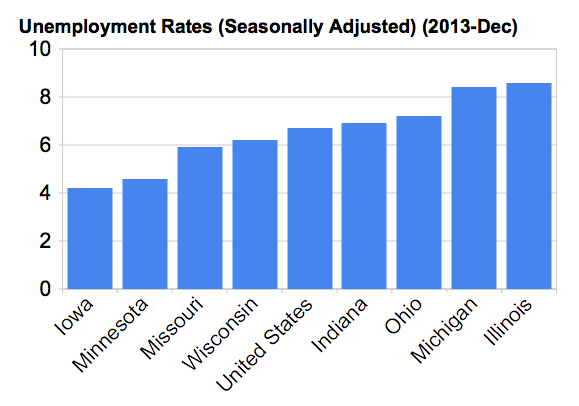
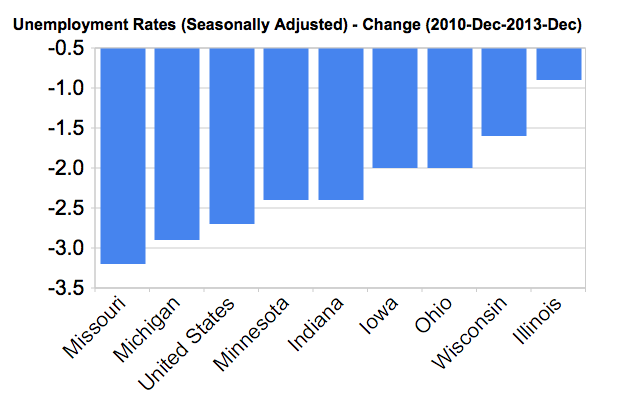
    Wisconsin actually doesn’t rank that well in job growth during Scott Walker’s administration, barely beating fiscal basket case Illinois. The state looks better in its unemployment rate:


    However, in part that’s because Wisconsin’s unemployment rate was already low on a relative basis when Walker took over. It ranks near the bottom in reducing its unemployment rate, though obviously reductions are harder to come by when you’re already lower. Michigan had nowhere to go but down.


    I actually support many of Scott Walker’s reforms. Public sector unions clearly need to be reigned in or even eliminated as they are a huge barrier to rational fiscal management and effective service delivery in addition to being an inherently corrupting political force. Items like allowing unions to force localities to buy health insurance through union affiliated firms at inflated rate were clearly abusive.

    It’s also early to judge, and this is monthly data that is fairly volatile, even though it’s seasonably adjusted and with a same month comparison. There just isn’t that much other data available.

    What I object to is declaring victory when the budget is balanced. The attitude exposed by this is profoundly revealing and shows everything that’s wrong with Tea Party type thinking. It’s obvious that people claiming Wisconsin has thrived under Walker didn’t even take a cursory look at the actual economic performance of the state.

    Wisconsin balanced its budget? Big deal. You’re supposed to balance the budget. That’s just doing your job. It shows how far we’ve come that you can receive plaudits simply for meeting what should have been the baseline expectation.

    The charts above should also cause a reconsideration of the notion that government finances are the primary determinant of business climate and economic growth. There are states on both the left and right of that issue that are both thriving and struggling. Part of it is that states have limited power in the modern economy. There’s only a limited amount they can do to make things better, whereas they can definitely screw it up.

    Also, the natural condition of a participant in a marketplace is failure. The vast majority of new businesses fail. Similarly, places can fail too, and having a budget surplus can’t necessarily stave that off.

    My view is that while state governments are weak actors and there’s a risk of screwing it up, the likelihood of failure in the marketplace is high enough that government does actually have to try to do things. By all means prudent finances and a good regulatory climate need to be maintained, but if you think that’s enough to save you, you’ve got another thing coming. Now that Scott Walker has repaired the budget, what’s his actual plan moving forward to try to build actual personal and marketplace success for Wisconsin residents and businesses? That’s what will determine his actual legacy. It’s in whether he boosts the fortunes of the state’s residents over the longer term, and manages to bend the curve of progress in a positive direction over time.

    Aaron M. Renn is an independent writer on urban affairs and the founder of Telestrian, a data analysis and mapping tool. He writes at The Urbanophile, where this piece originally appeared.

    Scott Walker photo by AndyLindgren.

  • City-Specific Immigration Visas Would Be a Modern Day Indentured Servitude

    An idea that’s been kicked around by many is to help turn around struggling cities like Detroit by offering geographically limited immigrations visas. That is, to allow foreigners get their green card if they agree to live in a particular city for a certain number of years.

    Michigan Gov. Rick Snyder has now officially endorsed the concept, calling for Detroit to be awarded 50,000 city-specific immigration visas for skilled workers over five years. As the NYT put it:

    Under the plan, which is expected to be formally submitted to federal authorities soon, immigrants would be required to live and work in Detroit, a city that has fallen to 700,000 residents from 1.8 million in the 1950s.

    “Isn’t that how we made our country great, through immigrants?” said Mr. Snyder, a Republican, who last year authorized the state’s largest city to seek bankruptcy protection and recently announced plans to open a state office focused on new Americans.

    Later, he added, “Think about the power and the size of this program, what it could do to bring back Detroit, even faster and better.”

    The appeal of the idea is obvious. I’ve probably said positive things about it myself in the past. But examine it more closely and it’s clear this is an idea that’s fatally flawed. By requiring immigrants to live and work in the city of Detroit for a period of time, this program would effectively bring back indentured servitude, only instead of having to work for the people who paid for their trip to America, these immigrants would have to work for Detroit.

    I’ve got to believe that the courts would look skeptically at such a scheme that so radically restricts geographic mobility and opportunity. What’s more, I think it’s plain wrong to invite people into our country with the idea that they are de facto restricted to one municipality.

    L. Brooks Patterson, county executive of wealthy Oakland County in suburban Detroit, took huge heat again this week when he was quoted in the New Yorker saying “I made a prediction a long time ago, and it’s come to pass. I said, ‘What we’re gonna do is turn Detroit into an Indian reservation, where we herd all the Indians into the city, build a fence around it, and then throw in the blankets and the corn.’” Yet isn’t this idea of city specific visas almost literally treating Detroit like a reservation, only for immigrants instead of Indians?

    Some have likened this to programs to entice doctors to rural areas by paying for medical school. I’m not sure how all of those are structured, but they may have questionable elements as well. But more importantly, my understanding is that they are purely financial, where medical school loans are paid off in return for a certain number of years of service. If a doctor elects to leave the program, they are in no worse shape than someone who didn’t sign up would be. They are still licensed to practice medicine and have to repay their loans just like every other doctor.

    I don’t think Gov. Snyder is motivated by any ill will in this. I think he’s genuinely looking for creative solutions to the formidable problems Detroit faces. He’s taken huge heat for finally facing up to the legacy of problems there, and hasn’t shied way from making tough calls. He’s even willing to call for some bailout money, which many in his own party don’t like. But this idea is a bad one. He should withdraw it, and the federal government should by no means open to the door to these types of arrangements.

    Immigrants remain a great way to pursue a civic turnaround, however. Detroit just needs to lure them on the open market the same way Dayton, Ohio and others are trying to do.

    Aaron M. Renn is an independent writer on urban affairs and the founder of Telestrian, a data analysis and mapping tool. He writes at The Urbanophile, where this piece originally appeared.

    Photo by telwink

  • St. Louis: Salvage City

    A three installment start at a potential Discovery Channel “reality” program called Salvage City has created a minor kerfuffle in some local quarters. I haven’t seen the show, but it appears to feature a group of the Beautiful and the Bearded who break into buildings, ostensibly illegally, on architectural salvage missions one step ahead of the wrecking ball, all for fun and profit. Here’s the trailer. (If the video doesn’t display for you, click here).

    Not everybody is happy with the “Rust Belt boneyard” take on the city. Michael Allen at Next City says this is an example of the Rust Belt frontier myth:

    The term “Rust Belt” itself exaggerates the physical decay and isolates the identity of many cities in static matter. Advocates, journalists and scholars have popularized the term, often endearingly, while perpetuating the emphasis on what makes these places frontiers of decline. Narratives of the Rust Belt are still focused on loss, rife with a cynical nostalgia and a nagging refusal to cast in with wealthier and less damaged cities. The singularity of the conditions of places like St. Louis and Detroit remains mythic fodder for would-be heroes of public policy, architectural design and public art. There are many Daniel Boones of the legacy cities.

    Allen, however, isn’t writing just to cast stones at the show. Chris Haxel at the Riverfront Times is more emphatic, saying St. Louis deserves better:

    Where the producers really stumble is their characterization of St. Louis as a foe on the level of alligators or hurricanes. Salvage City is rife with images of decay or ruin porn, a style that fails to tiptoe the line between appreciation and exploitation. The salvage scenes are ostensibly about rescuing doomed valuables, but in reality glorify theft, plunder and trespassing.

    What he and the show’s producers have done — exploit the city in exchange for personal gain — is the definition of selling out. Not the artistic selling out that is inevitable when a band or artist enjoys mainstream success, but the kind that constitutes betrayal….Here they are on national television, selling the city as an “urban wasteland…ripe for plunder.” Ultimately, Salvage City disappoints because St. Louis deserves better.

    I post this because I always find it interesting to see the reactions people have when their city is supposedly mischaracterized for the worst in contrast to the crickets when locals use whitewash and marketroid materials to promote their city to the world. Want to see a real myth? Check out “Here Is St. Louis” (if the video doesn’t display for you, click here).


    There’s nothing per se wrong with this. It’s a classic city video that portrays St. Louis as an amalgam of family friendly fun and Portland-style hipness, with a dollop of local flavor a multi-culti thrown in. But is it a full and inclusive portrayal of the reality of St. Louis? I don’t think so. In effect, videos like this are the flip side of Salvage City, but few people ever think to critique them.

    I don’t want to suggest too much collective outrage, however. The response to Salvage City is a bit muted from what I can tell. And Alderman Olgilvie strikes a better tone in telling folks totake a chill pill:

    Our mini freak-out over Salvage City comes on the heels of several media panic attacks in 2013. Other examples include reactions to a New York Times look at crime and murder in St. Louis, and a humorous Art Forum takedown of an overwrought guided bus tour of St. Louis art venues that culminated with a violet-hour visit to SLAM’s expansion grand opening. The story, and the predictable freak-out. (See RFT‘s “Snobby New York Art Critic Scowls on St. Louis.”) Writers snapped our photo when the light wasn’t flattering, and we didn’t like it one bit.

    What it boils down to is a little hypersensitivity about how St. Louis is portrayed in national media, positive or negative. It is this nagging worry that folks on one coast or the other will write us off the same way one of Kendzior’s article headlines refers to us, as flyover country.

    Perhaps our New Year’s resolution should be a little bit thicker skin, and a renewed confidence in telling, and hearing, all the stories about our city: good, bad and indifferent. Rather than make one story carry the burden of representing all the facets of our city, let a thousand voices rise in song or storytelling, each with its own particular perspective.

    The challenge for St. Louis and other such place is to develop a maturing sense of confidence about who they are. One that accepts the vicissitudes of the media, isn’t afraid to acknowledge legitimate faults, isn’t dependent on the approval of others for a sense of self-worth, and is willing to go its own way into the future.

    Aaron M. Renn is an independent writer on urban affairs and the founder of Telestrian, a data analysis and mapping tool. He writes at The Urbanophile, where this piece originally appeared.

    St. Louis Skyline photo by Wendell Cox.

  • Why State Economic Development Strategies Should Be Metro-Centric

    Globalization, technology, productivity improvements, and the resulting restructuring of the world economy have led to fundamental changes that have destroyed the old paradigms of doing business. Whether these changes are on the whole good or bad, or who or what is responsible for bringing them into being, they simply are. Most cities, regions, and US states have extremely limited leverage in this marketplace and thus to a great extent are market takers more than market makers. They have to adapt to new realities, but a lack of willingness to face up to the truth, combined with geo-political conditions, mean this has seldom been done.

    Three of those new realities are:

    1. The primacy of metropolitan regions as economic units, and the associated requirement of minimum competitive scale. It is mostly major metropolitan areas, those with 1-1.5 million or more people, that have best adapted to the new economy. Outside of the sparsely populated Great Plains, smaller areas have tended to struggle unless they have a unique asset such as a major state university. Even the worst performing large metros like Detroit and Cleveland have a lot of economic strength and assets behind them (e.g., the Cleveland Clinic) while smaller places like Youngstown and Flint have also gotten pounded yet have far fewer reasons for optimism. Many new economy industries require more skills than the old. People with these skills are most attracted to bigger cities where there are dense labor markets and enough scale to support items ranging from a major airport to amenities that are needed to compete.

    2. States are not singular economic units. This follows straightforwardly from the first point. As a mix of various sized urban and rural areas, regions of states have widely varying degrees of economic success and potential for the future. Their policy needs are radically different so the one size fit all nature of government rules make state policy a difficult instrument to get right. Additionally, many major metropolitan areas that are economic units cross state borders.

    3. Many communities may never come back, and many laid-off workers may never be employed again. Realistically, many smaller post-industrial cities are unlikely to ever again by economically dynamic no matter what we do. And lost in the debate over the n-th extension of emergency unemployment benefits is the painful reality that for some workers, especially older workers laid off from manufacturing jobs, there’s no realistic prospect of employment at more than near minimum wage if that. As Richard Longworth put it in Caught in the Middle, “The dirty little secret of Midwest manufacturing is that many workers are high school dropouts, uneducated, some virtually illiterate. They could build refrigerators, sure. But they are totally unqualified for any job other than the ones they just lost.” This doesn’t even get to the big drug problems in many of these places. This isn’t everybody, but there are too many people who fall into that bucket.

    I want to explore these truths and potential state policy responses using the case study of Indiana. An article in last week’s Indianapolis Business Journal sets the stage. Called “State lags city with science, tech jobs” it notes how metropolitan Indianapolis has been booming when it comes to so-called STEM jobs (Science, Technology, Engineering, Math). Its growth rate ranked 9th in the country in study of large metro areas. However, the rest of Indiana has lagged badly:

    Indiana for more than a decade has blown away the national average when it comes to adding high-tech jobs. But outside the Indianapolis metro area, there isn’t much cause for celebration.

    Careers in science, technology, engineering and math—typically referred to as STEM fields—have surged in growth compared to other careers in Marion and Hamilton counties. It’s a boon for economic development, considering the workers earn average wages almost twice as high as all others, and employers sorely need the skills. Dozens of initiatives focus on building STEM jobs in the state.

    A recent report ranked the Indianapolis-Carmel metro area ninth in the country in STEM jobs growth since the tech bubble burst in 2001. But while the metro area has grown, the rest of Indiana has barely budged from the early 2000s, an IBJ analysis of U.S. Bureau of Labor Statistics found.

    Indianapolis grew its STEM job base by 39% since 2001 while the rest of the state grew by only 10% (only 6% if you exclude healthcare jobs). Much of the state actually lost STEM jobs.

    This divergence between metropolitan Indianapolis (along with those smaller regions blessed with a unique asset like Bloomington (Indiana University), Lafayette (Purdue University) and Columbus (Cummins Engine)) and the rest of the state is a well-worn story by now. Here are a few baseline statistics that tell the tale.


    Item Metro Indianapolis Rest of Indiana
    Population Growth (2000-2012) 15.9% 4.1%
    Job Growth (2000-2012) 5.9% -7.2%
    GDP Per Capita (2012) $50,981 $34,076
    College Degree Attainment (2012) 32.1% 20.1%

    Additionally, there does appear to be something of a brain drain phenomenon, only it’s not brains leaving the state, it’s people with degrees moving from outstate Indiana to Indianapolis. From 2000-2010 a net of about 51,000 moved from elsewhere in Indiana to metro Indianapolis. As Mark Schill put it in the IBJ:

    “Indianapolis is somewhat of a sponge city for the whole region,” said Mark Schill, vice president of research at Praxis Strategy Group, an economic development consultant in North Dakota.

    The situation in Indiana, Schill said, is common throughout the United States: States with one large city typically see their engineers, scientists and other high-tech workers flock to the urban areas from smaller towns.

    Even I find it very surprising that of my high school classmates with college degrees, half of them live in Indianapolis – this from a tiny rural school along the Ohio River in far Southern Indiana near Louisville, KY.

    What has Indiana’s policy response been to this to date? I would suggest that the response has been to a) adjust statewide policy levers to do everything possible to reflate the economy of the “rest of Indiana” while b) making subtle tweaks attempt to rebalance economic growth away from Indianapolis.

    On the statewide policy levers, the state government has moved to imposed a one size fits all, least common denominator approach to services. The state centralized many functions in a recent tax reform. It also has aggressively downsized government, which now has the fewest employees since the 1970s. Tax caps, a comparative lack of home rule powers, and an aggressive state Department of Local Government Finance have combined to severely curtail local spending as well. Gov. Pence took office seeking to cut the state’s income tax rate by 10% (he got 5%), and now wants to eliminate the personal property tax on business. Indiana also passed right to work legislation.

    I call this “the best house on a bad block strategy.” I think Mitch Daniels looked around at Illinois, Ohio, and Michigan and said, “I know how to beat these guys.” Indiana is not as business friendly as places like Texas or Tennessee, but the idea was to position itself to capture a disproportionate share of inbound Midwest investment by being the cheapest. (I’ll get to Pence later).

    The subtle tweaks have been income redistribution from metro Indianapolis (documented by the Indiana Fiscal Policy Institute) and using the above techniques and others to apply the brakes to efforts by metro Indy to further improve its quality of life advantage over many other parts of the state (see my column in Governing magazine for more). One obvious example is a recent move by the Indiana University School of Medicine to build full four year regional medical school campuses and residency programs around the state with the explicit aim of keeping students local instead of having them come to Indianapolis for medical training.

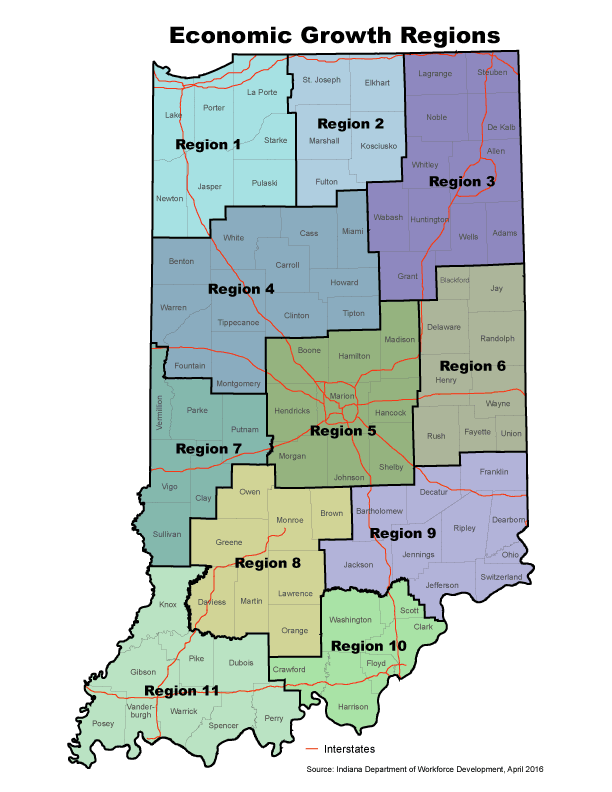
    What there’s been next to nothing of is any sense of metropolitan level or even regional thinking. The state does administer programs on a regional level, but the strategy is not regionally oriented and the administrative borders don’t even line up. Here are the boundaries of the various workforce development boards:
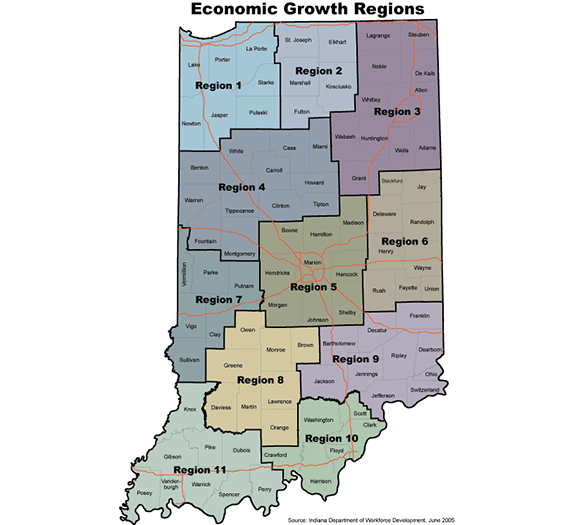

    There’s a semi-metropolitan overlay, but as I’ve long noted places like Region 6 are economic decline regions, not economic growth regions. Here’s how the Indiana Economic Development Corp. sees the world:
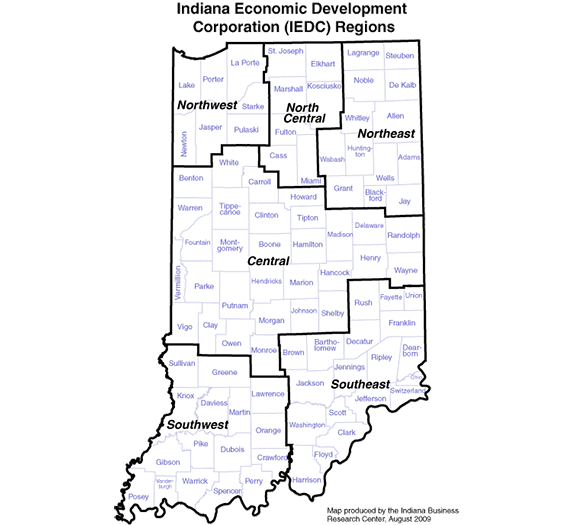


    These are not just agglomerations of the workforce districts, there are numerous differences between them. The point is that clearly the organization is driven by administrative convenience and the political need for field offices, not a metro-centric view of the world or strategy.

    Add it all up and it appears that Indiana has decided to fight against all three new realities above rather than adapting to them. It rejects metro-centricity, imposes a uniform policy set, and is oriented towards trying to reflate the most struggling communities. I don’t think this was necessarily a conscious decision, but ultimately that’s what it amounts to.

    When you fight the tape, you shouldn’t expect great results and clearly they haven’t been stellar. Since 2000, Indiana comfortably outperformed perennial losers Michigan and Ohio on job growth (well, less job declines), but trailed Kentucky, Wisconsin, Minnesota, Iowa, and Missouri. But notably, Indiana only outpaced Illinois by a couple percentage points. That’s a state with higher income taxes (and that actually raised them) that’s nearly bankrupt and where the previous two governors ended up in prison. Yet Indiana’s job performance is very similar. What’s more, Hoosier per capita incomes have been in free fall versus the national average, likely because it has only become more attractive to low wage employers.

    Fiscal discipline, low taxes, and business friendly regulations are important. But they aren’t the only pages in the book. Workforce quality counts for a lot, and this has been Indiana’s Achilles heel. (My dad, who used to run an Indiana stone quarry, had trouble finding workers with a high school diploma who could pass a drug test and would show up on time every day – hardly tough requirements one would think). Also aligning with, not against market forces is key.

    I will sketch out a somewhat different approach. Firstly, regarding the chronically unemployed, clearly they cannot be written off or ignored. However, I see this as largely a federal issue. We need to come to terms with the reality that America now has a population of some million who will have extreme difficulty finding employment in the new economy (see: latest jobs report). We’ve shifted about two million into disability rolls, but clearly we’ve to date mostly been pretending that things are going to re-normalize.

    For Indiana, the temptation can be to reorient the entire economy to attract ultra low-wage employers, then cut benefits so that people are forced to take the jobs. I’ve personally heard Indiana businessmen bemoaning the state’s unemployment benefits that mean workers won’t take the jobs their company has open – jobs paying $9/hr. Possibly the 250,000 or so chronically unemployed Hoosiers may be technically put back to work through such a scheme – eventually. But it would come at the cost of impoverishing the entire state. Creating a state of $9/hr jobs is not making a home for human flourishing, it’s building a plantation.

    Instead of creating a subsistence economy, the focus should instead be on creating the best wage economy possible, one that offers upward mobility, for the most people possible, and using redistribution for the chronically unemployed. You may say this is welfare – and you’re right. But I would submit to you that the state is already in effect a gigantic welfare engine. In addition to direct benefits, the taxation and education systems are redistributionist, and the state’s entire economic policy, transport policy, etc. are targeted at left-behind areas (i.e., welfare). Even corrections is in a sense warehousing the mostly poor at ruinous expense. So Indiana is already a massive welfare state; we are just arguing about what the best form is. I think sending checks is much better than distorting the entire economy in order to employ a small minority at $9/hr jobs – but that’s just me. Again, we are in uncharted territory as a country and this is ultimately going to require a national response, even if it’s just swelling the disability rolls even more. I do believe people deserve the dignity of a job, but we have to deal with the unfortunate realities of our new world order.

    With that in mind, the right strategy would be metro-centric, focusing on building on the competitively advantaged areas of the state – what Drew Klacik has called place-based cluster – and competitively advantaged middle class or better paying industries.

    Contrary to some of the stats above, this is not purely an Indianapolis story. Indiana has a number of areas that are well-positioned to compete. Here’s a map with key metro regions highlighted:



    This may look superficially like the maps above, but it is explicitly oriented around metro-centric thinking. Metro Indy has been doing reasonably well as noted. But Bloomington, Lafayette, and Columbus (sort of small satellite metros to Indy) have also done very well. In fact, all three actually outperformed Indy on STEM job growth.

    Additionally, three other large, competitively advantaged metro areas take in Indiana territory: Chicago, Cincinnati, and Louisville. These are all, like Indy, places with the scale and talent concentrations to win. True, none of the Indiana counties that are part of those metros is in the favored quarter. But they still have plenty of opportunities. I’ve written about Northwest Indiana before, for example, which should do well if it gets its act together.

    This covers a broad swath of the state from the Northwest to the Southeast. It comes as no surprise to me that Honda chose to locate its plant half way between Indianapolis and Cincinnati, for example.

    The state should align its resources, policies, and investments to enable these metro regions to thrive. This doesn’t mean jacking up tax rates. Indiana should retain its competitively advantaged tax structure. But it should mean no further erosion in Indiana’s already parsimonious services. The state is already well-positioned fiscally, and in a situation with diminishing marginal returns to further contraction.

    Next, empower localities and regions to better themselves in accordance with their own strategies. This means an end to one size fits all, least common denominator thinking. These regions need to be let out from under the thumb of the General Assembly. That means more, not less flexibility for localities. Places like Indianapolis, Bloomington, and Lafayette would dearly love to undertake further self-improvement initiatives, but the state thinks that’s a bad idea. (I believe this is part of the subtle re-balancing attempt I mentioned).

    It also means using the state’s power to encourage metro and extended region thinking. For example, last year within a few months of each other the mayors of Indianapolis, Anderson, and Muncie all made overseas trade trips – separately and to different places. That’s nuts. The state should be encouraging them to do more joint development.

    This also means recognizing the symbiotic relationship that exists between the core and periphery in the extended Central Indiana region, clearly the state’s most important. The outlying smaller cities, towns, and rural areas watch Indianapolis TV stations, largely cheer for its sports teams, get taken to its hospitals for trauma or specialist care, fly out of its airport, etc. Metro Indianapolis and its leadership have also basically created and funded much of the state’s economic development efforts (e.g., Biocrossroads) and many community development initiatives (the Lilly Endowment). Many statewide organizations are in effect Indianapolis ones that do double duty in serving the state. For example, the Indiana Historical Society. (There is no Indianapolis Historical Society).

    On the other side of the equation, Indianapolis would not have the Colts and a lot of other things without the heft added from the outer rings out counties that are customers for these amenities. It benefits massively from that, particularly since it’s a marginal scale city. One of the biggest differences between Indy and Louisville is that Indy was fortunate enough to have a highly populated ring of counties within an hour’s drive.

    So in addition to aligning economic development strategies around metros, and freeing localities to pursue differentiated strategies, the state should encourage the next ring or two of counties that are in the sphere of influence of major metros to align with their nearest larger neighbor.

    Contrary to popular belief, this is a win-win. When I was in Warsaw, Indiana, people were concerned that many highly paid employees of the local orthopedics companies lived in Ft. Wayne. From a local perspective, that’s understandable and obviously they want to be competitive for that talent and should be all means go for it. On the other hand, what if Ft. Wayne wasn’t there for those people to live in? Would those orthopedics companies be able to recruit the talent they need to stay located in small town Indiana?

    It’s similar for other places. Michael Hicks, and economist at Ball State in Muncie, said, “Almost all our local economic policies target business investment and masquerade as job creation efforts. We abate taxes, apply TIFs and woo businesses all over the state, but then the employees who receive middle-class wages (say $18 an hour or more) choose the nicest place to live within a 40-mile radius. So, we bring a nice factory to Muncie, and the employees all commute from Noblesville.” Maybe Muncie isn’t completely happy about this, understandably. But would they have been able to recruit those plants at all (and the associated taxes they pay and the jobs for anybody who does stay local) if higher paid workers didn’t have the option to live in suburban Noblesville? Would the labor force be there?

    I saw a similar dynamic in Columbus. Younger workers recruited by Cummins Engine chose to live in Greenwood (near south suburban Indy). Columbus wants to keep upgrading itself to be more attractive – a good idea. But the ability to reverse commute from Indy is an advantage for them.

    Louisville, Kentucky has one of the highest rates of exurban commuting the country because so many Hoosiers in rural communities drive in for good paying work.

    This is the sort of thinking and planning that needs to be going on. Realistically, most of these small industrial cities and rural areas are not positioned to go it alone and they shouldn’t be supported by the state in attempting to do so. They need to a align with a winning team.

    There are two groups of places that require special attention. One is the mid-sized metro regions of Ft. Wayne, Evansville, and South Bend-Elkhart. These places are too far from larger metros and aren’t large enough themselves to have fully competitive economies. No surprise two of the three lost STEM jobs. Evansville has done better recently on the backs of Toyota, but has a vast rural hinterland it cannot carry with its small size. The region has done ok of late, but it has also received gigantic subsidies in the form of multiple massive highway investments, and now a massive coal gasification plant subsidy. I don’t believe this is sustainable. These places need special assistance from the state to devise and implement strategies.

    The other grouping consists of rural and small industrial areas that are too far outside the orbit of a major metro to effectively align with it. This would includes places like Richmond or Blackford County. They might get lucky and land a major plant, but realistically they are going to require state aid for some time to maintain critical services.

    For the last two groups especially, there also needs to be a commitment by the state’s top brain hubs – Indy and the two university towns – to applying their intellectual and other resources to the difficult problem at hand. Part of that involves helping them be the best place of their genre that they can. While cities are competitively advantaged today, not everybody wants to live in one. So there is still an addressable market, if not as large, for other places.

    Put it together and here’s the map that needs to be changed. It’s percentage change in jobs, 2000-2012:
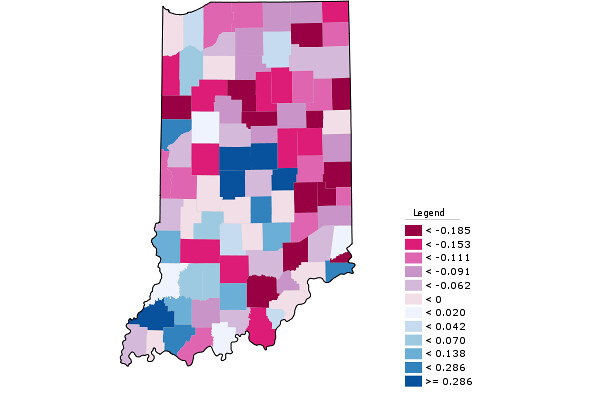


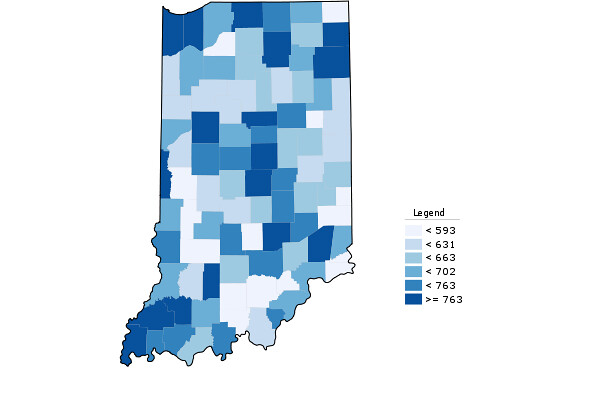
    Pretty depressing. Urban core counties had some losses, but suburban Indy, Chicago, and Cincy did decently (Louisville’s less well), plus Bloomington area, Lafayette, and Columbus. You see also the strong performance of Southwest Indiana which is fantastic, but the sustainability of which I think is in question. Wages are higher in metro areas too, by the way. Here’s the average weekly wage in 2012, which shows most of the state’s metros doing comparatively well:


    In short, I suggest:

    – Retain lean fiscal structure but limit further contractions
    – Goal is to build middle class or better economy, not bottom feeding
    – Align economic development efforts to metro areas, particularly larger, competitively advantages locations. Align capital investment in this direction as well.
    – Greater local autonomy to pursue differentiated strategies for the variegated areas of the state
    – Special attention/help to strategically disadvantaged communities, but not entire state policy directed to servicing their needs.
    – Utilization of transfers for the chronically unemployed pending a federal answer, but again, not redirection of state policy to attract $9/hr jobs.

    This requires a lot of fleshing out to be sure, but I think is broadly the direction.

    Back to Gov. Mike Pence, would he be on board with this? He’s Tea Party friendly to be sure and interested in fiscal contraction. But he’s not a one-trick pony. He’s actually taken some interesting steps in this regard. He is subsidizing non-stop flights from Indianapolis to San Francisco for the benefit of the local tech community. He also wants to establish another life sciences research institute in Indy. And he’s talked about more regionally focused economic development efforts. It’s a welcome start. I think he groks the situation more than people might credit him for. Keep in mind that he did not establish the state’s current approach, which arguably even pre-dated Mitch Daniels, and he has to deal with political realities. And if as they say only Nixon could go to China, then although a reorienting of strategy is not about writing big checks, still perhaps only someone with conservative bona fides like Pence can push the state towards a metro-centric rethink.

    Aaron M. Renn is an independent writer on urban affairs and the founder of Telestrian, a data analysis and mapping tool. He writes at The Urbanophile, where this piece originally appeared.
  • How Houston’s Missing Media Gene Hobbles Its Global City Ambitions

    In an upcoming study I am working on with Chapman University’s Center for Demographics and Policy, we show that San Francisco and Houston are North America’s “emerging” global cities. They are also rival representative champions and exemplars of two models of civic development. San Francisco is the world’s technology capital; focused on the highest levels of the economic food chain; paragon of the new, intangible economy; and promoter environmental values and compact development.  Houston is the closest thing to American laissez-faire; unabashed embracer of the old economy of tangible stuff, including unfashionable, but highly profitable, industries like oil, chemicals, and shipping.

    San Francisco embraces development restrictions that it sees as environmentally sustainable — and not coincidentally produced the highest housing costs compared to income in the nation, rendering the region unaffordable to all but the elite — whereas Houston has risen as an “opportunity city” for the non-elite; and the land of no-zoning and unrestricted development.  Somewhat unexpectedly, both cities are remarkably socially tolerant. Houston has an openly lesbian Democratic mayor and is extremely diverse, and while San Francisco may be a bit more free wheeling with its Folsom Street Fair and such, it’s also more strictly enforces its intellectual and political orthodoxy.

    Yet to date the competition between these two emerging models has been non-existent, at least from Houston’s perspective. Simply put, the Bay Area has played its hand brilliantly, and is lavished with praise in the media. In contrast Houston seems to be missing the self-promotion gene, at least outside what it has to pay for with advertising. The Bay Area has built its own image, often with the avid support of journalists who grant tech moguls demi-god status, and understandably prefer San Francisco’s spectacular scenery, mild weather and world-class restaurants to flat, steamy Houston, whose exciting food scene is typically housed in nondescript strip malls.

    In conventional (that is New York or London) terms it’s easy to see San Francisco as a global capital. It has long been established as an elite national center, the financial capital of the West Coast, as well as the traditional center, along with parts of New York, of the American counter-culture. With the comparative decline of Los Angeles, the Bay Area reigns supreme on the west coast. Its technology industry strides the globe like a colossus, its tech titans have managed, at least to date, to play simultaneously the roles of both modern day robber barons and populist heroes.

    Houston is less obvious. Though the energy capital of the world, Houston is still emerging as a prominent national and global city. It’s less mature, and was a small, obscure city when San Francisco was already emerging as the uncontested capital of the west coast.  And unlike San Francisco, whose only real rival is much smaller Seattle, Houston competes with an equally large, and in many ways also rising rival in Dallas-Ft. Worth.

    Unlike tech, energy has produced few rockstars, but many who are castigated as demons. Although there are 5,000 energy companies and 26 Fortune 500 headquarters in Houston, few of its leaders have achieved public prominence apart from Dick Cheney and Enron’s Jeff Skilling and Ken Lay — not exactly folk heroes.

    This is not to say some energy people don’t deserve celebration. For example, few Americans noticed the recent death of George Mitchell, the father of the fracking revolution that has driven America’s greenhouse gas emissions down at the fastest rate in the world, and one of America’s premier developers of master planned developments in the form of The Woodlands near Houston. The Economist said of this son of poor Greek immigrants, “Few businesspeople have done as much to change the world as George Mitchell.”  (Most people hearing the name would probably think of former Maine Senator George Mitchell).

    The maturity curve alone isn’t enough to account for the difference. Two additional factors are at work. First, the Bay Area self-consciously sees itself as a leader and moral exemplar. It wants to world to follow where it leads. Houston it seems, perhaps in line with its laissez-faire approach, wants to leave others alone, and be left to its own.  It may boast of having a great model, but whether others adopt has been of no particularly great local concern.

    The second big divergence relates to media. After all, the media, understood broadly, is how we come to have knowledge about or opinions of many things. Simply put, San Francisco and the tech industry get the power of media, while Houston doesn’t.

    The content creators may still prefer a New York, LA, or DC but the tech moguls are circling the last redoubts of entertainment and information.   Apple now has a dominant position in content distribution for music and is expanding in other areas.  Google generates huge advertising revenues that are greater than the entire newspaper and magazine industry.  Despite its many troubles, Yahoo remains one of the most-visited news sites. Meanwhile in just last year or two, Facebook co-founder Chris Hughes has bought the venerable New Republic while Seattle’s Jeff Bezos  recently bought the Washington Post. Pierre Omidyar, founder of Ebay, recently announced a $250 million new media venture featuring Glenn Greenwald and other well-known leftist media types.

    This isn’t just hubris, it’s good business. With Silicon Valley magnates starting to come under the same scrutiny as their 1% peers in other industries, it pays to have the means to control the narrative. Glenn Greenwald helped break the story on NSA snooping, but now that he’s on Silicon Valley’s payroll, how likely is it that he’ll take a similarly tough line on tech company privacy matters?  Give the Bay Area/tech crowd their due – they know what they are doing.

    Houston, by contrast, has close to zero media influence or impact and seems not to care. It’s much less an influencer of media than one whose reputation has been shaped by it, and often not in a good way. Though there are many sprawl dominated metropolises in America, it’s Houston that has become the bête noire of urbanists.

    It’s easy to understand historically why Houston has so little media influence, but harder to understand why the city is so blasé about it.  Tory Gattis, a former McKinsey consultant and local Houston blogger, suggests that it has to do with the DNA of the energy industry.  Most energy companies in Houston are B2B operations, so have little need for mass media. Energy has always been a political game and the industry’s approach has been a fairly direct one: employ a phalanx of lobbyists and former politicians around the world to help secure deals.  Also, unlike with the latest smart phone or social media app, you don’t need to convince anybody to fill up his gas tank or turn on his furnace in the winter.  The product is already completely understood by the end customer and literally sells itself.

    This mindset explains why the city has a blind spot, a missing gene if you will, that keeps it from understanding the necessity of having a robust media presence as part of its ambition to become a true global city. The Bay Area tech community may have been slow to the party when it comes to lobbying, but they are spending big to catch up fast and many of their executives have political as well as media aspirations. But despite its incredible wealth and surfeit of billionaires, Houston is absolute nowhere when it comes to media or thought leadership, and seems indifferent to the fact.

    Beyond merely asserting a role on the stage, getting in the media game is critical to the survival of Houston and its model.  The Bay Area sees itself as a model for a future America and world. It is spending big, lobbying big, and invading politics to create the kind of future it wants to see. Its mindset is to dominate.

    Houston may be content to let San Francisco go its own way but the reverse does not hold.  Silicon Valley has its sights set on overturning the fossil fuel industry through big investments (and good ol’ government pork) in green tech companies. Legal mandates that favor their investments are popular. It should be no surprise that folks like Bay Area billionaire Thomas Steyer have been vocal opponents of the KeystoneXL pipeline. (Such opposition is not uniform. Mark Zuckerberg’s Fwd.us organization supports KeystoneXL. But there’s clearly a lot of Silicon Valley support for policies that aren’t great for the Houston model).

    Houston can brag all its wants about its legitimate accomplishments in important areas like job and population growth and in providing middle-class opportunity. But if it wants to claim the mantle of global city, or even just head off threats to its way of doing business, it needs, like the Bay Area, to self-consciously stake out the role of leader.  For starters, that means putting its bigtime financial and intellectual muscle behind getting its message out. That means, like it or not, investing not only in oil wells, but inkwells.

    Aaron M. Renn is an independent writer on urban affairs and the founder of Telestrian, a data analysis and mapping tool. He writes at The Urbanophile.

    Photo by telwink.

  • Some Implications of Detroit’s Bankruptcy

    There’s been so much ink spilled over Detroit’s bankruptcy that I haven’t felt the need to add much to it. But this week the judge overseeing the case ruled that the city of Detroit is eligible for bankruptcy. He also went ahead and ruled that pensions can be cut for the city’s retirees. Meanwhile, the city has received an appraisal of less than $2 billion for the most famous paintings in the Detroit Institute of the Arts.

    A couple of thoughts on this:

    First, every city in America should be doing a strategic review of its assets, and moving everything it doesn’t want turned into de facto debt collateral into entities that can’t be touched by the courts. In the case of the DIA, the city owns the museum and the collection. Hence the question of whether or not art should be sold to satisfy debts. If it were typical separately chartered non-profit institution, this wouldn’t even be a question.

    At this point, I’d suggest cities ought to be taking a hard look at whether they own assets like museums, zoos, etc. that should be spun off into a separate non-profit entity. Keep in mind, the tax dollars that support the institutions can continue flowing to it. But this does protect the assets in the event of a bankruptcy.

    In the case of Detroit, it seems inevitable that at least some art work will be sold. Given that worker pensions are going to be cut, it would be pretty tough to say no to selling art. Assuming this is the case, post-sale the museum should be spun off as a separate entity to hopefully reboot its standing the museum world. As the trustees of the group that operates it have been adamantly opposed to any sale, one would hope other museums would not hold any violations of industry standards against them for, particularly if they acquire ownership of the building and artwork away from the city afterward. The city of Detroit doesn’t need to be in the museum business anyway. It has bigger fish to fry.

    Secondly, public sector employees will have to start rethinking their approach to retirement benefits. The current mindset has been to grab as much as you can anytime you can because the taxpayer will always be forced to cover the promises no matter what. As the actual results in Central Falls, RI and now this show, that’s no longer a good assumption.

    Detroit’s workers don’t have lavish pensions as these things go. But they weren’t shy about abusing the system either. They in effect looted their own pensions by taking out extra, unearned “13th checks”. They also used pensions funds to give a guaranteed 7.9% annual rate of return on supplemental savings accounts workers were allowed to establish. All told these “extra” payments drained about $2 billion out of the pension system.

    This was not something the city did through an arm’s length transaction. As the Detroit Free Press reported, Mayor Dennis Archer was alarmed by the practice and wanted to stop it. But “the city doesn’t control its pension funds, which have been largely administered by union officials serving on two independent pension boards.” So he tried to amend the city’s charter to stop the practice. According the Free Press, “Archer backed an effort to block the payments through a proposed new city charter, which actually passed in August 1996. Enraged, several city unions and a retiree group sued and won. Archer tried again to block payments through a ballot initiative, called Proposal T, but it failed.”

    The unions could brazenly loot their own pension plan because they felt rock-solid assurance that the taxpayers would ultimately be required to make them whole. This bankruptcy is showing that may not be the case after all. It should serve as a warning to unions everywhere not to get too aggressive with their shenanigans.

    They’ll of course appeal the judge’s ruling and may win. But the Michigan constitution says pensions are a contract right. The very definition of bankruptcy is that you can’t pay what you’re contractually obligated to. Bankruptcy is all about breaking contracts. The bondholders have contracts that are not supposed to be impaired too, after all. I’m a fan of local government autonomy as you know, but as Steve Eide rightly points out, any freedom worth its name is freedom to fail. If cities and their various constituencies don’t suffer the consequences of their mistakes, they should be heavily micromanaged from on high.

    When individuals fail, we have a safety net (unemployment insurance, for example). Plus we have personal bankruptcy to give people a fresh start. We don’t even worry about whether the person is at fault for their own position or not. We provide that backstop regardless. But that backstop doesn’t allow people to go on living like they did before as if nothing happened. Similarly, cities in trouble shouldn’t be abandoned, but they need to realize that there are genuine consequences for failure. A realization that failure has consequences for pension holders as well as the taxpayer should hopefully promote healthier decisions about how retirement benefits should be offered, funded, and administered.

    Aaron M. Renn is an independent writer on urban affairs and the founder of Telestrian, a data analysis and mapping tool. He writes at The Urbanophile, where this piece originally appeared.

  • Srirachagate Gives a Window Into California’s Business Climate Problem

    I love Huy Fong Foods’ Sriracha sauce as much as the next guy, which is to say a lot. The red hot sauce with the rooster on the bottle has a cult following across the nation. So unsurprisingly it made national news when the city of Irwindale, CA sued to shut down production at the company’s processing plant there. The processing of the hot peppers, done during only a limited time of year because Huy Fong only uses fresh peppers, was alleged to be causing a noxious odor in the town.

    This looks like a pretty garden variety dispute between neighbors and an industrial business. Clearly industrial odors can be a problem. I don’t know how long they’ve been in Irwindale, but Sriracha has been around a long time so I’m a bit skeptical something changed just this year. Regardless, I don’t think odor complaints are necessarily evidence of a bad business climate as there could be a legitimate problem.

    Then came the state order to stop shipping the product for 30 days. The state of California decided that to reduce the risk of food borne illnesses, the sauce had to sit for 30 days before it can be shipped. Keep in mind, this is for a product that has never had a complaint against it for making someone sick.

    How many businesses can afford to halt shipments for a month and survive? Sriracha has a cult following and so they’ll likely overcome it. But many businesses wouldn’t have this luxury. When their customers can’t get product, they lose the business. Indeed, I wouldn’t be surprised if restaurants do turn to alternative suppliers. At a minimum, Huy Fong is going to lose a lot of sales.

    Who in their right mind would want to do business in a state like this? And this is far from the worst case. It just so happens that because this is such a popular consumer product, it’s visible. If even these types of companies get shut down, how much more so a firm where this wouldn’t create an avalanche of bad publicity?

    Urbanists put way too little thought into business climate, which can sound like such a shady way of saying cut services and taxes. But taxes are often the least part of it. It’s the regulatory apparatus that makes doing business in many places too painful to contemplate. This even affects city-suburb investment patterns. I’ve observed that in many places, the urban core is a flat out terrible place to do business, unless you’re very politically wired up.

    This doesn’t usually bother urbanists all that much until a trendy business they like gets affected. For example, an urban farming supply shop in Providence called Cluck got sued when they tried to open. The beautiful and the bearded were outraged and the shop was ultimately approved. But there’s no similar visibility or outrage when a Latino immigrant runs into the red-tape buzzsaw when he tries to open a muffler shop.

    If we want to promote investments in our cities and states, we need to be focused on basics like an objective, predictable regulatory framework that operates in the timely fashion and in which arbitrary denials, rule changes, and such are minimized. This is way more important to attracting capital investment than sexier items like streetcar lines.

    This piece first appeared at The Urbanophile.