Author: Aaron M. Renn

  • Suburban Corporate Wasteland

    I was a guest on the show “Where We Live” on WNPR radio in Connecticut this week. The theme was “Suburban Corporate Wasteland” – the increasing numbers of white elephant office campuses in suburbs. Apparently Connecticut has several of these and some buildings are actually being demolished because there’s no demand for them.

    The entire program is worth a listen, particularly if you are someone trying to figure out how to redevelop one of these things. Several local officials join to talk about efforts to do that in their towns. If you want to just hear Yours Truly, I’m on for about 10 minutes starting at 38:30. Follow this link to listen to the show.

    There are a number of challenges converging to put pressure on suburban office campuses in some places:

    1. Decentralization has run its course. There was a massive wave of suburbanization in the post-War era that has finished. That’s not to say things are going to be re-centralizing. Rather, the massive move from the core to the periphery is largely complete. The development pattern of the United States will continue to be decentralized, but it will largely be driven by organic growth rather than relocations. I think something similar happened with driving. The factors driving VMT growth above the rate of inflation – more cars per household, women entering the workforce, and such – are pretty much played out in terms of driving huge additional travel miles.

    2. Corporate M&A and industry restructurings have dampened demand in some areas. In Connecticut specifically, a number of the complexes in question were from pharmaceutical and insurance companies. There has been a lot of consolidation in the pharma industry, for example. And with a challenging environment for new drug development, pharma companies are now really focusing on cost cutting and reducing overhead, not building massive new office parks.

    3. The nature of work is changing. There was a popular trend for a while towards massive suburban office HQ campuses. For example, Sears moved from its namesake tower in downtown Chicago to a big campus in Hoffman Estates. These campuses had tons of free parking and lots of onsite amenities like gyms, dry cleaners, cafeterias, day care, etc. They also offered an idyllic, almost pastoral setting in some respects. Workers could spend their days cocooned inside the campus. Today’s firms are less vertical integrated and more networked. They are heavily globalized and collaborative. They’ve also figured out that people who don’t get out and engage with the world around them end up cut off from information flows, leaving them a step behind. Workers are also demanding more flexible working conditions. And of course there’s cost cutting pressures. This leads to things like hoteling, co-working, and telecommuting – no massive suburban office park needed.

    4. In select industries and cities, there has been a resurgence in the fortunes of downtown offices. This has particularly been the case in high tech. Google’s second largest office is in Manhattan. Salesforce.com’s Exact Target unit employs a thousand people in downtown Indianapolis. Amazon is building a large urban campus is Seattle. Many companies in Chicago have relocated downtown from the suburbs. I’ve probably seen more announcement of these types of moves in Chicago than anywhere else. I’d caution that in most downtowns the trends in private sector employment have remained negative. But in select locales and industries, things have been looking up. In industries where there’s a need for proximity to high end business services or where there are unique clustering or labor force issues, downtowns will retain an appeal.

    Put it all together and it’s clear office space demand is weaker than it used to be. Joel Kotkin recently surveyed the same trends and suggests that the US may have hit “peak office”. The idea is not that office space will actually decline, rather that it won’t be growing at the same rates as in the past. This will affect both urban and suburban markets.

    It’s easy to see how these trends combined to pound a place like Connecticut. It’s next to NYC, the premier central business district zone in America. But it is also far enough to make commuting to most of it a pain (even the express train to Stamford takes about an hour). And it’s an expensive and business hostile environment to boot. Large scale employers who want a suburban footprint can find many better places.

    We are in fact seeing this happen in finance. Goldman Sachs is booming in Manhattan, but has what I believe is their second largest US office in Salt Lake City, presumably housing back office functions. Deutsche Bank is building a big facility in Jacksonville. JP Morgan Chase has a huge presence in Columbus, Ohio, where its former Bank One unit was based. A place like Connecticut is the odd man out. Suburban Chicago is probably set to be another loser. But in smaller cities the suburbs will do much better.

    Also, don’t be too quick to write the eulogy for the suburban office campus, even in the tech industry. A recent article in Der Spiegel featured Silicon Valley’s new “monuments to digital domination” – including Apple’s $5 billion Norman Foster designed campus, Frank Gehry’s campus for Facebook, and others for Google, NVidia, and Samsung. In Houston, Exxon Mobil is putting the finishing touches on a three million square foot campus that will employ 10,000 people. But unlike Google moving 2,500 people to downtown Chicago, projects like that don’t make national headlines.

    I don’t think there will be a massive back to downtown wave, and the suburban office park is not dead. But there are headwinds facing suburban office space, particularly in expensive, mature markets.

    Aaron M. Renn is an independent writer on urban affairs and the founder of Telestrian, a data analysis and mapping tool. He writes at The Urbanophile, where this piece originally appeared.

  • Are Special Service Districts a Boon or a Bane?

    America’s cities have been under fiscal pressure for an extended period of time. To cope with this, and better manage assets, they’ve increasingly turned to various forms of special purpose districts or entities for service delivery. Traditional independent service districts such as sewer districts or transit districts were often designed to circumvent bonding limits or to deliver services regionally, so were larger in scale. These newer service districts are much smaller in scope. They consist of two basic components:

    1. A private sector, usually non-profit management agency that operates a public asset or delivers services under contract to the city in a form of public-private partnership.
    2. Special purpose funding sources to finance this entity’s activities. These funds can include private donations, proceeds raised from Tax Increment Financing (usually for capital purposes), and taxes raised from so-called Business Improvement Districts (or BIDs, with special property taxes collected from businesses in a given area on a semi-voluntary basis, generally after a super-majority of property owners vote to agree to impose the tax).

    Examples of these special service districts abound. One of the most famous is the Central Park Conservancy, which manages Central Park in New York under contract to the city.  The conservancy was founded in 1980 to raise funds to restore Central Park.  It received funds from the city budget, but also does significant private fundraising as well, for both capital and operating purposes.

    Another well-known example in New York is the Bryant Park Corporation, which runs Bryant Park in Manhattan.  Once known as “Needle Park” because it was taken over by drug users and deals, today Bryant Park is a lavish showplace right down to fresh cut flowers in its marble restrooms.  Bryant Park is only 9.6 acres, but has an annual budget of $7 million. As Bryant Park Corporation CEO Dan Biederman once noted, that is more than the entire $4.3 million parks budget of the city of Pittsburgh.  This cash is raised from a BID, sponsorships, and commercial concessions in the district.

    A different type of entity is the Chicago Loop Alliance.  As with similar groups in many cities, Chicago uses the Alliance as a downtown management agency, responsible for marketing, beautification, public art, events, etc. in downtown Chicago. It’s backed by local businesses, especially retailers, but also receives funding from a BID (known as a Special Service Area (SSA) in Chicago).

    As a final example, when the city of Indianapolis built the eight mile downtown Indy Cultural Trail, a non-profit called Indianapolis Cultural Trail, Inc. was created maintain and promote it. The trail was the brainchild of Central Indiana Community Foundation President Brian Payne. To ensure that the trail would be well maintained over the long term in an era of tight budgets, he included a maintenance endowment in the original private fundraising to build it.  Additionally, ICT, Inc. raises private funding to supplement this.

    These four examples are different in various ways, but something they obviously all have in common is that they serve prosperous areas or are focused on showplace type amenities. While not all such districts around the country are quite so upscale, in general they tend to be most prominent and effective in central business districts or wealthier neighborhoods.

    These special service districts are part of a trend towards privatized government in America. Given the state of Central and Bryant Parks when their respective organizations where formed, obviously those two have been a success. Many of these districts are very well run because they depend at least in part on private sector cash raising and because as private entities they are free from many cumbersome government rules.

    On the other hand, it’s not hard to see these as perpetuating the move towards two-tier municipal services, in which wealthier areas receive higher services levels than elsewhere. In effect, techniques like BIDs enable relatively thriving areas to purchase better levels of service for themselves without having to help finance similar services elsewhere.  That’s not necessarily a good thing.  For example, New York City has been criticized in some quarters for a lack of investment in outer borough parks.  State Senator Daniel Squadron of Brooklyn said in AM New York, “Large conservancies get millions every year from private donors. But the parks that find it hardest to get that support are the ones that need it the most.” He wants to force the Central Park Conservancy to pass long 20% of its donations to smaller parks.

    However, it isn’t always bad if a central business district, clearly a unique area in a city, has different services delivered there. Its dense concentration of employment and visitors almost necessitates it.  The same is true for special regional attractions. Central Park truly is unique.

    In fact, the move towards privatized services in wealthier areas could be a good thing for the rest of the city if it is used to free up funds for use where there isn’t as much private capital available.  In this case a city could look to move parks, street cleaning, and other items “off the books” via special service districts in areas that can afford to fund such services largely by themselves. The city would then concentrate public funds in poorer or middle class areas. The tradeoff would be that the wealthier areas might be allowed to purchase higher quality services for themselves, but that would be structured in a way that let service quality be raised for others.

    On the other hand, it’s not hard to see how this could evolve as a mechanism for “strategic abandonment” as well.  In this case the city would cut general service levels then allowing wealthier areas to buy them back.  Critics have charged that special service districts are exactly the legal mechanism that will be used to implement planned shrinkage in Detroit.

    In short, how this plays out will depend greatly on the strategic intent (or neglect) of city leaders. But regardless, in an era of financial extremis for cities, the trend towards more privatized government and special service districts is sure to continue.  The key is for the public to demand that these deals be structured as win-wins that don’t just benefit the already thriving areas of the city, but enable investments in struggling areas that are often overlooked.

    Aaron M. Renn is an independent writer on urban affairs and the founder of Telestrian, a data analysis and mapping tool. He writes at The Urbanophile.

    Bryant Park photo by Jean-Christophe BENOIST

  • Shareable Cities: Blurring the Lines


    “We believed then as we do now, that the sharing economy can democratize access to goods, services, and capital – in fact all the essentials that make for vibrant markets, commons, and neighborhoods. It’s an epoch shaping opportunity for sustainable urban development that can complement the legacy economy. Resource sharing, peer production, and the free market can empower people to self-provision locally much of what they need to thrive. Yet we’ve learned that current U.S. policies often block resource sharing and peer production. – From the report “Policies for Shareable Cities”


    “Digital information technology contributes to the world by making it easier to copy and modify information. Computers promise to make this easier for all of us. Not everyone wants it to be easier.” – Richard Stallman, “Why Software Should Not Have Owners”

    Not long ago there were pretty clear boundaries between the personal sphere and the commercial one, as well as more clear boundaries between public and private space. What’s more, most things, both personal and commercial, were heavily based on a model of exclusive use. Today these lines are increasingly dissolving in ways that upset current business models and lifestyles. It portends a present and a future in which property is increasingly shared, not exclusive, and where there are a mixture of public, private, personal, and commercial entities intersecting in the same spaces. The key driver of this is technology, which has reduced barriers and transaction costs in a way that enables things like car sharing that would have been impossible not long ago. However, our legal frameworks have often not kept up with this. Some people who benefit from the current models would like to keep it that way. But if we let the marketplace evolve, then institute good rules to fit this new reality, it promises to hold huge benefits to the public.

    First an example that’s by now old hat. In an age before cell phones and personal computers, there was a more rigorous separation of work and personal life. People need to be physically co-located in a office. They commuted there every day, worked in a dedicated personal office or cubicle, then went home where work as a rule did not intrude. Today’s workers are checking email every waking hour (and even being interrupted during the night), while also spending much more time on personal things (online banking, fantasy football, or random web surfing) while in the office. The internet has enabled distributed work environments, in which teams collaborate from offices, airports, and homes around the world. Companies increasingly have turned to “hoteling” or other shared space concepts in the office on the assumption employees no longer need dedicated space. Many people have flexible work arrangements or otherwise telecommute. In the latter case, home and office have literally merged.

    This has had huge benefits across the board. Companies love it because they can access cheap labor pools overseas, effectively recruit people with a need for workplace flexibility, and reduce their office space needs. Joel Kotkin has said the latter trend may mean America has hit “peak office.” Workers get the flexibility they like, can save on commuting costs, access geographically remote clients, etc. The environment benefits from reduced commuting. The ultimate green commute is one you don’t have to make. I would say that the balance of the benefits here has accrued to business, while workers have sometimes had arrangements they don’t like forced on them. Still, on the whole this shows great promise of being a win, win, win.

    The “hoteling” concept and “just in time” delivery aren’t limited to corporate uses. Things like car share are bringing them to the household market. The average personal car is supposedly idle 90% of the time. When you factor in all the additional infrastructure costs needed to support a one person, one car model (e.g., parking), the deadweight loss from all that idle capacity is stunning. Imagine factories that sat idle 90% of the time doing nothing. If a corporate manager had this low a rate of asset utilization, he’d be in deep trouble.

    When you sign up for Zipcar or another service, you avoid some of this deadweight loss. By effectively sharing a fleet of vehicles with others, a relatively small number of cars can serve a large number of people, greatly improving asset utilization rates and delivering big value to consumers, even when they are paying a business to manage the fleet for them. It’s a huge form of productivity gain. This also has the effect of converting transportation from a largely fixed cost to a mostly variable one, with signficiant impacts on the decision making process for everything that involves transportation (mostly positive, I believe).

    Though having a limited addressable market at present, obviously car sharing in the Zipcar style poses a threat to the entire US car industry, arguably one of the most important employers in the country and one President Obama himself personally intervened to save during the meltdown. Clearly the highest levels of politics in America will defend the car industry, though to date there’s been very little complaint from them about car sharing.

    Things have been different when it’s transport service providers who are threatened. Public transit agencies have long been unrelentingly hostile to jitney services. Today car service booking tool Uber and ride sharing company Lyft have experienced an all out regulatory assault from entrenched interests. Lyft is a particularly interesting case. It’s a peer to peer ride sharing platform. Just as 90% of the time a private car is unused, when it is used, 80% of the available seat capacity goes vacant. Again, this is a massive deadweight loss. (The amount of theoretically wasted capacity in the world of private cars is stunning). Imagine an airline trying to make a business out of 20% load factors. It just doesn’t work, yet we as individuals run a “business” like that every time we drive our cars solo. Lyft helps fill up those empty seats, and even get some money – “donations” – in the process.

    In other words, Lyft is a business that effectively turns your personal vehicle into a pseudo-livery vehicle. I’ve long argued that we should have “every car a jitney” by legalizing it and having personal auto polices cover ancillary commercial use as a matter of course. Lyft is trying to solve that problem and make it happen. Obviously the traditional “commercial” sector (e.g., taxis), which is highly regulated and subject to many taxes and fees hates this. They feel, rightly to some extent, that there’s a double standard. This is the type of conflict and legal uncertainty are spurred when the boundaries between personal and business, and between exclusive and shared use, start breaking down.

    The big kahuna in provoking outrage of late has been AirBnB, an application that lets people rent out rooms in their homes as de facto hotel spaces. Again, the same principle applies. An empty bedroom is deadweight loss just like an empty office or an idle factory. It makes sense to put those spaces to work where feasible. This had been done previously in the form of house swaps and couch surfing. But the rise of commercially oriented AirBnB has raised hackles, especially in governments that have strict rules and high taxes on hotels. There have been a number of media articles of late taking note of or weighing in on the controversy. For example, in the New York Times piece, “The Airbnb Economy in New York: Lucrative but Often Illegal.”

    Again, the benefits are clear in the improved utilization of space which is a pure efficiency gain. What’s more, AirBnB was even used by the government during Hurricane Sandy to find temporary free housing for those displaced by the storm. Peter Hirshberg noted that this type of distributed app might be the real killer app for smart cities, and will play an increasingly important role in urban resiliency. But it legitimately does create a set of parallel environments and rule sets, and exposes a world in which ancillary commercial activity at a residence is something that doesn’t really fit into our existing categories.

    The list of situations like this are endless. Many zoning laws don’t appropriately allow home based businesses. Fund raising bake sales have been banned because it’s not legal to sell products prepared at home. In some places there have been issues with selling vegetables from home gardens.

    Then there’s the disputes arising from the increasing use of public space for commercial purposes, whether that be curb side intercity bus service or food trucks. Pushcart style food vendors, often ethnic, are also often technically illegal (e.g., rogue elotes stands).

    In short, traditional barriers are falling and boundaries are dissolving, especially when it comes to those key dimensions of personal-commercial, exclusive-shared, and public-private.

    I don’t want to suggest all of the complaints about these are unfounded, though many of them are pure rent seeking. From the standpoint of someone running a fully commercial operation, who complies with massive amounts of costly red tape, it certainly seems unfair that others are allowed to operate what are basically businesses under a lighter tough regulatory scheme. The status quo isn’t necessarily where we need to be.

    But let’s take a step back and look at the big picture. Our economy is in huge need of a massive injection of dynamism and new value creation. Many observers have said we need a completely new economic model. Walter Russell Mead has called this “beyond blue”. Richard Florida styles it the “great reset”. But clearly the old ways of doing things aren’t working and we need change.

    This new style “shareable” economy based on peer to peer production in a distributed, small scale form is one that promises to provide at least part of the answer. It also renders addressable a huge amount of previously trapped value. Companies reaped huge amounts of gains by eschewing vertical integration in favor of more networked relationships. That’s corporate-speak for peer to peer sourcing. Similarly, things like hoteling, just in time delivery, etc. have let to much greater and more effective asset utilization. The amount of under-utilized assets in the household sector is stunning. This is about bringing to that household sector the same types of efficiency boosting and value creating techniques previously employed only by traditional businesses.

    But beyond the sheer efficiency gains, I think it’s under appreciated in developed countries how economic informality can create economic dynamism. Peruvian economist Hernando de Soto noted that lack of property titles and difficulties of the formal economy perpetuated poverty because people in developing countries couldn’t access the system for credit to fuel business, etc. In the developed world we’ve got a similar problem brewing. Our economy has been largely entirely formalized to the point where we are choking in red tape that has produced an economic system that has failed too many of its residents and leading to the creation of these informal economies as a safety valve. And our societies are very ill equipped to deal with that as we’ve become excessively formalized.

    We don’t need to establish property titles as we already have them, but we do need regulatory systems that enable entrepreneurship and new business models like peer to peer to thrive. What’s more, I think enabling some level of an informal sector to flourish is actually a good thing, as it’s a de facto “incubator” for new ideas that can later be developed into a more officialized system. Without a toleration of informality, these would never get off the ground. I’ve highlighted how this worked with regards to uncertain property titles on abandoned buildings in Berlin that helped launch the creative scene there. I also highlighted similar trends in Detroit. Those again were born of desperation, but we’re starting to get there in our economy more broadly.

    It seems hypocritical to me for businesses to suggest that consumers be prohibited from doing exactly what business does every single day to improve productivity and generate more value. (It would hardly be the first time though. Business love globalization – for themselves. They can buy raw materials in Brazil, manufacture in China, do their IT in India, etc. But you try applying “consumer direct globalization” by purchasing your drugs from Canada or buying an out of region DVD and see how far you get. It’s a completely two tier system designed to free corporations while trapping the consumer in hyper-segregated markets).

    This would seem to be one area where the left and right could agree. Free marketers should love light-touch regulation and lower taxes in the new peer to peer economy. The left should like the way it frees consumers from dependency on big business/neoliberalism, sustainability, etc.

    Adjusting our rules to make this happen is an imperative. A non-profit called Shareable and the Sustainable Economies Law Center recently issued a report called “Policies for Shareable Cities” that talk about what a lot of places have been doing to make this happen. For example, they explained how Portland updated its zoning code to allow “food distribution” an accessory use in all zones in order to facilitate the development of the Community Supported Agriculture Model. Similarly, Marcus Westbury has talked about the need to update the software of cities in order to help redevelopment, as he helped with in the Renew Newcastle project.

    But beyond new rules, maybe we should just go along with no rules for a while, and let this sector develop. After all, that’s what we did with tech. The government took a hands off approach and the feds even prohibited levying taxes. This helped the United States build a massive industry off internet technology, one that has continued to thrive even with the rise of offshoring. We should do the same here to see if we can replicate that success with peer to peer shared production in the household/personal sector.

    Aaron M. Renn is an independent writer on urban affairs and the founder of Telestrian, a data analysis and mapping tool. He writes at The Urbanophile, where this piece originally appeared.

    Tapei bike share photo by Richard Masoner.

  • The Tough Realities Facing Smaller Post-Industrial Cities

    A couple weeks ago the Economist ran a leader and an article on the plight of smaller post-industrial cities, noting that these days the worst urban decay is found not in big cities but in small ones. They observe:

    Partly, this reflects the extraordinary success of London and continuing deindustrialisation in the north of England. Areas such as Teesside have been struggling, on and off, since the first world war. But whereas over the past two decades England’s big cities have developed strong service-sector economies, its smaller industrial towns have continued their relative decline. Hartlepool is typical of Britain’s rust belt in that it has grown far more slowly than the region it is in. So too is Wolverhampton, a small city west of Birmingham, and Hull, a city in east Yorkshire.

    And even with growth, the most ambitious and best-educated people will still tend to leave places like Hull. Their size, location and demographics means that they will never offer the sorts of restaurants or shops that the middle classes like.

    Their editorial forthrightly embraces a policy of triage, saying “The fate of these once-confident places is sad. That so many well-intentioned people are trying so hard to save them suggests how much affection they still claim. The coalition is trying to help in its own way, by setting up ‘enterprise zones’ where taxes are low and broadband fast. But these kindly efforts are misguided. Governments should not try to rescue failing towns. Instead, they should support the people who live in them.”

    This same dynamic is clearly evident in the United States as well. Bigger cities have tended to weather industrial decline far better than smaller ones. There seems to be some threshold size below which it is difficult to support the infrastructure, the amenities, and the thick labor markets that attract the people and businesses in 21st century growth industries. My “Urbanophile Conjecture” heuristic suggests that you need to be a state capital with a population greater than 500,000 to be thriving. But even larger places that aren’t capitals and conventionally viewed as failures like Detroit retain powerful metro area economies and large concentrations of educated workers, especially in the suburbs. Conversely, smaller places like Youngstown, Ohio and Flint, Michigan face much bleaker circumstances.

    There are exceptions to the rule, including many delightful college towns or the occasional oddball like Columbus, Indiana, but for the most part smaller post-industrial cities have really struggled to reinvent themselves.

    In part this is because a rising tide hasn’t lifted all boats, only some of them. As economist Michael Hicks noted, “Almost all our local economic policies target business investment, and masquerade as job creation efforts. We abate taxes, apply TIF’s and woo businesses all over the state, but then the employees who receive middle class wages (say $18 an hour or more) choose the nicest place to live within a 40-mile radius. So, we bring a nice factory to Muncie, and the employees all commute from Noblesville.”

    In short, growth actually fuels divergence because a) the growth disproportionately accrues to the places that are doing well in the first place and b) even when struggling cities can attract jobs, people earning middle class wages frequently live elsewhere. Doug Masson likened this to Jesus’ statement that “For he that hath, to him shall be given: and he that hath not, from him shall be taken even that which he hath.” I think there’s a lot of evidence that for bigger cities a lot of activity is exhibiting a convergent or flattening effect. That’s why so many places today have decent startup scenes, quality food, agglomerations of talent, etc. But for smaller cities my observation is that it’s still a divergent world.

    You see this on full display in central Illinois, where the town of Danville (population 33,000) and Champaign-Urbana (combined population 124,000) are only about half an hour’s drive apart on I-74. Danville is one of the bleakest towns I’ve ever visited in the Rust Belt. When your Main Street is a STROAD, you know you’re in trouble. Champaign-Urbana by contrast, is a fairly healthy community. It’s home to the main campus of the University of Illinois, seems to be reasonably thriving, has many high quality residential streets, a direct rail connection to Chicago, etc. As a college town, it’s one of those “exception” smaller places.

    Anyone within reasonable driving distance with a choice would almost undoubtedly choose to live in Champaign over Danville, unless they had a family or personal connection to the latter. It’s an easy slam dunk decision. In effect, proximity to Champaign acts as kryptonite to Danville’s revitalization. Again, a rising tide only fuels this divergence.

    This sort of divide between communities mirrors the divide in society as well. The question is, what approach should be taken to address these disparities? One approach is to focus on the people, and leave the places to rot. Jim Russell has noted that “people develop, not places” thus most place based economic strategies are destined to fail. This approach has also been advocated by economist Ed Glaeser, who in an article title, “Can Buffalo Ever Come Back?” answered his own question by saying, “probably not—and government should stop bribing people to stay there.”

    This is obviously unpalatable to policy makers of either the left or the right, as no one has yet embraced it openly. How then have the left and right responded? The response of the left seems to be what Walter Russell Mead has labeled the “blue model” solution. His basic view is that the post-war economy was based around a policy consensus he labeled the blue social model (and which Urbanophile contributor Robert Munson has simply labeled the New Deal). This involved large corporations, powerful unions, extensive industrial regulation, and an expanding safety net. Those who wish to retain the model suggest allowing divergence to continue, but raising taxes on the wealthy and successful in order to redistribute them to sustain those at the bottom of the ladder (via an expanded welfare state), who are in effect seen as lost causes in the modern global knowledge economy, though few of them will openly say it. So the idea is to invest in success, and redistribute the harvest aggressively. That’s why you see lots of left advocacy in favor of tax increases on higher income earners and against food stamp and other benefit cuts, but a paucity of ideas for how to provide the left behinds with jobs and opportunity.

    Mead suggests there’s no such thing as the red social model, and perhaps he’s right in that there’s never been a national policy consensus we could label as such, but there’s certainly a red model response to current conditions and it’s called the Tea Party, or what Mead has labeled a “Red Dawn” in many places like KansasNorth Carolina, and New Mexico. This is a type of single factor determinism model. In these kinds of models, a single factor like education, transportation infrastructure, climate, etc is treated as overwhelmingly determinant in driving the economic structure and outcomes. The factor posited by the Red Dawn model is government, therefore the red model response is to slash and burn government (with the potential exception of highway spending) to lower costs, taxes, and regulatory barriers that are perceived to be holding the economy back. In other words, government is the base, and the economy and everything else is the superstructure. Fix the base and the superstructure will correct itself. That’s the theory.

    Broadly speaking, these are the paths that Illinois and Indiana have followed. Chicago’s size enables it and its values to political dominate the state in the modern era. With only a rump of a Republican Party, the Democrats are free to do what they like. Conversely, in Southern influenced Indiana it is the outstate areas that are numerically superior to the successful urban regions, thus the state follows their policy preference, and Republicans overwhelmingly dominate the state so there’s little real opposition to red model policies.

    What have the results been? Most obviously, Illinois is nearly bankrupt while Indiana is sitting on a AAA credit rating and a $2 billion surplus in the bank. (It has a pension deficit, but it’s manageable and there’s a funding strategy in place). Clearly Indiana has a more functional political system than Illinois, which somehow manages to remain gridlocked despite a “four horseman” style legislative system and overwhelming Democratic dominance. So score two for Indiana.

    Finances aside, what have the results been? Illinois has poured massive quantities of cash into building on success, with items like the O’Hare Modernization Program and Millennium Park. The successful side of the economy, epitomized by the global city portion of Chicago, has soared to incredible heights. This is a city that earned at seat at the table of the global elite. On the other hand, the overlooked areas like much of the south and west sides of Chicago and places like Danville, are in horrific shape. The goal of allowing divergence clearly worked. However, with the state’s finances in abysmal shape, the redistribution portion did not happen. Indeed, the social safety net and basic services depended on by the rest of Illinois are being shredded. Even if you believe that it’s viable to simply support a large lumpenproletariat in perpetuity on welfare – which is doubtful – financial extremis means Illinois isn’t even able to try.

    Meanwhile in Indiana, pretty much the entire state policy has been reoriented towards making the left behind areas attractive to lower wage businesses. Policies that would cater to higher end businesses in successful urban areas have been less popular. That’s not to say there’s been nothing. Gov. Pence recently agreed to subsidize a non-stop flight between Indianapolis and San Francisco to help the local tech industry, for example. And he’s supported efforts to boost the life sciences sector. But I think think it’s fair to say low costs and low taxes are the watchword, with right to work, light touch environmental regulation, mass transit skepticism, etc.

    However, most of Indiana’s left behind type places have not recovered. Overall the state has retained a stubbornly high unemployment rate significantly above the US average, and, even more worrying, incomes have been declining relative to the US. Metropolitan Indianapolis, Lafayette, Bloomington, and Columbus have done reasonably well. Much of the rest of the state has continued to struggle, particularly in adding jobs with middle class wages. As the recent commentary by Brian Howey, Michael Hicks, and Doug Masson shows, Indiana retains its “Noblesville-Muncie” divides mirroring Illinois’ “Champaign-Danville” ones.

    In short, the blue and the red model produced some success, albeit in different modes (think San Francisco vs. Houston, Chicago vs. Indianapolis), for the “haves” side of the equation but haven’t yet proven equal to the “have nots.” The Economist makes it clear the totaly different policy configurations of the UK haven’t made a dent in it either. Post-industrial blight in much of Europe tells a similar tale. This suggests that there are powerful macro forces at work that are extremely difficult if not impossible to overcome. It’s no surprise then that the Economist suggests giving up.

    Again, that’s not likely, so what should we do? I won’t pretend to have all the answers to a very difficult question. However, I’ll suggest a few possibilities:

    • Seek to stop the civic death spiral. This means getting ahead of the decline curve by seeking to halt the cycle of people and businesses leaving, leading to revenue declines and degraded quality of place, leading in turn to to service cuts and tax increases and disinvestment, which leads to more people and businesses leaving. This involves getting ahead of decline and restructuring government to a place where you can hold a defensible position on services and taxes from which you can seek to rebuild.
    • Integrate with metropolitan economies. Rather than Muncie trying to hold Noblesville/Metro Indy at bay, or Danville the same to Champaign, closer connectivity is the key. I’ve written on this before regarding Indiana. In the short term losing the highly paid employees to a nearby municipality is a good thing. Without those living options for the managers, etc. you’d never be in play for the plant in the first place. That connection expands your labor pool, provides trade opportunities, etc. Just the property taxes from the plant is valuable, and can be used in rebuilding. Fostering these connections would require decisions that seem counter-intuitive on the short run. For example, Ball State University in Muncie should clearly expand its downtown Indianapolis presence. That isn’t necessarily taking away from Muncie. It’s building new connections and opportunities for Muncie where they don’t exist today.
    • Find a claim to fame around which to rebuild. Carl Wohlt says that every commercial district needs to be known for at least one sure thing. Similarly, what’s Danville’s sure thing? Some towns like Warsaw or Elkhart already have it and need to build on it. Others need to find one. That’s not to say one thing is the only thing you’ll ever need or that you aren’t opportunistic around potentials deals that come your way. But you have to start somewhere. Where do you put your limited available civic funds?

    I’m not so naive as to think this it the complete answer. But if there’s to be a genuine attempt to rescue places, then new thinking is needed and a turnaround will take a long time. In the meantime in parallel, clearly people-centric solutions also need to be pursued, to give people the best opportunity to realize their potential and dreams in life, where ever that may take them. No city is a failure that does this for its citizens.

    Aaron M. Renn is an independent writer on urban affairs and the founder of Telestrian, a data analysis and mapping tool. He writes at The Urbanophile, where this piece originally appeared.

    Photo by Randy von Liski
  • To Rebuild, the Midwest Must Face Its Real and Severe Problems

    Despite well-publicized problems that earned it the nickname of the “Rust Belt”, on paper the Midwest possesses some formidable strengths. These include the largest concentration of engineers in America, world class educational institutions, a plethora of headquarters of global champions ranging from Proctor and Gamble to Caterpillar to the Chicago Mercantile Exchange, the world’s greatest reserves of fresh water, and an expanding immigrant population.

    Yet with limited exceptions, these have been around for a while, but haven’t produced much growth across the region. Instead, outside of an archipelago of successful outliers (mostly select parts of major metros or college towns), the region has seen its population, job, and income growth badly trail the nation.  During the 2000s US population grew by 9.7%, the Midwest* 3.8%. For jobs, the US lost 1.5% but the Midwest 7.8%.

    Reversing this requires not just leveraging strengths and building on assets, but facing the very real and severe structural challenges that plague the region. However, most of the strategies out there remain outside the region’s essential DNA:

    • Economic clusters like high tech startups or water industries are in effect attempts to build new success enclaves outside the system.
    • Rebuilding downtowns into urban playgrounds for the upscale often takes place against a backdrop of vacant lots, abandoned structures, and depopulation – in other words, empty space.
    • The Rust Belt Chic movement suggests that many of the problems are actually the solution.  But while there are intriguing and important elements to this, it bypasses core issues.

    These are all good as far as they go, but they require little broad-based reform (as opposed to district or enclave based solutions) to structural problems and thus are limited in what they can achieve.

    What are these structural problems? Among the key ones are:

    1. Racism. The modern history of Midwest cities is enmeshed in the history of race relations, particularly between black and white. Places like Chicago and Milwaukee remain among the absolutely most segregated in America. Race riots have been defining feature of cities ranging from Detroit to Cincinnati (which had a race-influenced riot as recently as 2001). In all of these places, a large population of black residents live in segregated neighborhoods plagued with problems ranging from poor schools to low quality housing to a lack of jobs.  Significant social distress has resulted. 

    There are signs the Great Migration that brought blacks north in search of factory work is reversing, with black residents actually seeing more welcoming environments and better economic opportunities in Southern metro areas like Atlanta, Houston, and Charlotte. As well, historically it’s been the more ambitious who leave, not such a good thing for the people and places left behind.

    2. Corruption.  Midwest cities ranging from Chicago to Detroit to Cleveland are famous as cesspools of corruption and cronyism. Systems like Chicago’s “aldermanic privilege” tradition that gives city council members almost dictatorial control over their districts produce environments of almost required tacit corruption even if no laws are violated. In other cities, it’s well known that your approvals will go much faster if you hire the right wired-up subcontractors, lawyers, or lobbyists. While this type of environment exists at some level everywhere, it’s very bad in many Midwest cities and badly degrades an already challenged business climate.

    3. Closed Societies. Contrary to the assertions of Robert Putnam and Bowling Alone, a lot of Midwest places suffer from an excess of social capital. As Sean Safford noted in Why the Garden Club Couldn’t Save Youngstown, excessively dense social networks can create a hermetically sealed environment into which new ideas can’t penetrate or get a hearing.  There are many reports of newcomers to Midwest cities saying that they have difficult making friends and penetrating the social networks in places as diverse as Minneapolis and Cleveland. In Cincinnati and St. Louis expect that the first question you’ll be asked is “Where did you go to high school?” which tells you everything you need to know about those cities.  Immigration has ticked up in recent years, but overall the Midwest has done a poor job of attracting outsiders.

    4. Two-Tier Environment and Resulting Paralysis.  Despite the plethora of high end companies, educated workers, and top quality universities, the Midwest economy was traditionally based on moderately skilled labor in agriculture and industry. This forged a work force that places too low value on education and which can even be suspicious of people with too much of it. Today’s agriculture and manufacturing concerns, at least the ones with jobs that pay more than subsistence wages, require much higher levels of skills and education than in the past. What’s more, with the global macro-economy favorable to larger cities and talent based industries, larger metros have comparatively done well while most smaller towns have struggled. As a result, their quality of life and services have so badly degraded they are no longer attractive to “discretionary residents” (those with the means and opportunity to leave), which perpetuates a downward spiral as the educated flock to bigger cities. That’s why manufacturers complain they can’t find workers with skills, even if those skills are just passing and drug test and showing up to work everyday. This produces massive inequities, resentment, and policy confusion. What’s more, realistically many very poorly performing communities may never recover.

    Beyond these core issues, many places have aging infrastructure, massive blight issues, a regulatory environment not suited to the 21st century, and severe fiscal problems. All of these are extremely difficult problems to resolve, but that does not mean they don’t need to be faced, and overcome.

    Unsurprisingly, the Midwest has not been a particularly competitive region.  There will continue to be bright spots ranging Des Moines to Madison to the greater Chicago Loop to the fracking fields of western Pennsylvania, but until the region faces up to its problems don’t expect a major turnaround anytime soon.

    Aaron M. Renn is an independent writer on urban affairs and the founder of Telestrian, a data analysis and mapping tool. He writes at The Urbanophile.

  • Bridges Boondoggle, Portland Edition

    A couple weeks ago I outlined how the Ohio River Bridges Project in Louisville had gone from tragedy to farce. Basically none of the traffic assumptions from the Environmental Impact Statements that got the project approved are true anymore. According to the investment grade toll study recently performed to set toll rates and sell bonds, total cross river traffic will be 78,000 cars (21.5%) less than projected in the original FEIS. What’s more, tolls badly distort the distribution of traffic that will come such that the I-65 downtown bridge, which is being doubled in capacity, will never carry just what the existing bridge carries right now anytime during the study period, and won’t exceed the design capacity even slightly until 2050. Meanwhile, the I-64 bridge that will remain free will grow in traffic by 55% by 2030, when it will be 34% over capacity.

    A nearly identical scenario is playing out in Portland with the $2.75 billion I-5 Columbia River Crossing. Joe Cortright of Impresa consulting unearthed the information through freedom of information requests looking into the investment grade toll study on that is being conducted for that bridge. You can see his report here (there’s also a summary available).

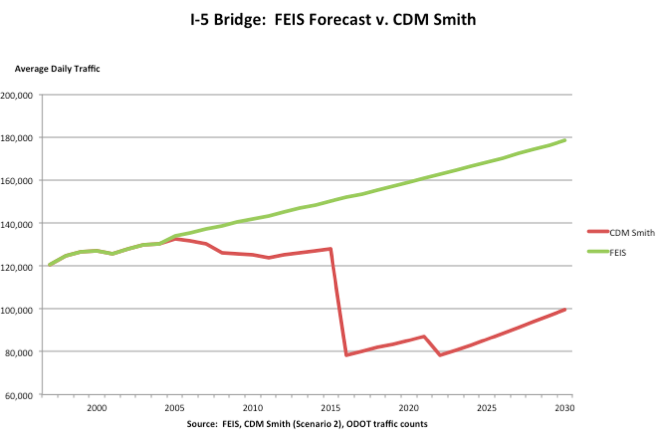
    I’ll highlight some of his truly eye-popping findings. Traffic forecasts are inflated, of course. The toll study is suggesting traffic increases of 1.1% to 1.2% per year when over the last decade traffic has actually declined by 0.2% per year on average even though there are no tolls. But it’s the addition of tolls that badly distort cross-river traffic and make a mockery out of the EIS. Here’s the money chart for the I-5 bridge itself:


    How is it possible that after building a gigantic multi-billion dollar bridge traffic declines? For the same reason as Louisville: tolling will cause huge amounts of traffic to divert to the I-205 free bridge. By 2016 traffic on I-205 would rise from 140,000 per day to 188,000 – and up to 210,000 by 2022 (full capacity).

    This is so eerily similar to the Louisville situation, that someone suggested, only half in jest I suspect, that they must be having “how to” training sessions on this stuff over at AASHTO HQ.

    Unlike Louisville, where a docile press is basically in cahoots with the state DOTs pushing the project, Portland’s media started asking questions. And one local paper even caught a civil engineering professor from Georgia serving on the independent review board for the project labeling the tolling scheme “stupid.” (Louisvillians take note).

    Oregon DOT director Matt Garrett released a letter in response in which he says, “This work is fundamentally different than the traffic analysis completed for the Final Environmental Impact Statement, and with very different goals in mind.” I agree. The FEIS was performed with the goal of getting this bridge the DOT wanted built approved. The toll study was designed to withstand financial scrutiny on Wall Street and be relied on in selling securities. I’ll let you be the judge of which is more likely to be closer to the truth. What’s more, Cortright addresses this very issue by saying in his report, “Neither federal highway regulations nor federal environmental regulations authorize or direct using multiple, conflicting forecasts for a single project, or using one set of traffic numbers for one purpose, and a different set for another.” I might also add that the DOTs in Louisville have not to the best of my knowledge made similar claims to explain away an identical discrepancy there. Nevertheless, the rest of Garrett’s letter acknowledges that I-5 will see a big traffic drop and there will be diversion from tolling. So he appears to just be doing the bureaucratic equivalent of “pay no attention to that man behind the curtain.”

    Again, want to know how it is that we spend so much money on transport infrastructure and get so little value? It’s because far too many of our highway dollars go into boondoggle mega-projects ginned up through political pressure (watch this space as I have another example coming soon) instead of into projects that make transportation sense. It may well be that there are legitimate problems with the existing I-5 river crossing, but these numbers give no confidence that the Oregon DOT has come up with a good or cost-effective plan for dealing with them. Unlike some, I do think we need to build more roads in America. Unfortunately our system is set up to ensure the survival of the unfittest instead of projects that make actual transportation and economic sense.

    Aaron M. Renn is an independent writer on urban affairs and the founder of Telestrian, a data analysis and mapping tool. He writes at The Urbanophile, where this piece originally appeared.

    Photo of current Columbia River crossing by Jonathan Caves.

  • Well-Heeled in the Windy City

    A couple weeks ago, noting the apparently immunity of global city Chicago to problems elsewhere in the city, I asked the question: What happens when global city Chicago realizes there’s a good chance it can simply let the rest of the city fail and get on with its business?

    I’d argue we’re seeing the results right before our eyes.

    At the same time murders in significant parts of the city are even higher than during the peak of the crack epidemic, when the city says its too poor to hire more cops, when 54 schools are closed and a 1000 teachers laid off, half the mental health clinics closed, libraries cut back, etc., Chicago has found a nearly limitless stream of money for elite amenities, most recently – and appallingly – $50+ million in TIF subsidies for a new DePaul arena. There’s also been hundreds of millions of dollars more in corporate welfare under Daley and Rahm.

    Investing in success is a great idea – if you plan to harvest a return on that investment to fund city services and your safety net. It’s clear there’s no intention of doing this in Chicago. I discuss this in my most recent City Journal piece, “Well-Heeled in the Windy City.” Here’s an excerpt:

    Clearly, cities like Chicago must retain a substantial portion of upscale residents and businesses. Detroit and other cities show the results of failure on this front. Yet the moral case for elite amenities has always rested on the assumption of a broader public good: what benefited the wealthy would also make life better for the rest of the city….Under Emanuel’s leadership, though, Chicago has made peace with a two-tier society and broken the social contract. Rather than trying to expand opportunity, Chicago has bet its future on its already successful residents—leading some on the left to call Emanuel Mayor 1 Percent. The Windy City isn’t alone in following this strategy. Detroit has gone bankrupt, but that hasn’t stopped city government from lavishing $450 million in subsidies on a new Red Wings arena.

    Since I critique bike infrastructure as part of Chicago’s splurge for the elite, I want to clarify that point here where there are lots of bike advocates. I strongly support bike infrastructure. In fact, I once gave a presentation where I said protected bike lanes and bike share should be Rahm’s top two transport priorities on taking office because they are cost-effective and can leverage outside funds. However, even the most passionate advocates must admit that the optics are bad on making a full court press on bike lanes when cutting core services elsewhere. More importantly, Rahm’s explicit rationale on bike infrastructure has been luring talent for the tech economy, thus it is an elite focused venture. For example, the Sun-Times reported:

    Emanuel called protected bike lanes central to the city’s sustainability plan and his efforts to make Chicago the high-tech hub of the Midwest. Chicago “moved up dramatically” in the list of major cities whose employees bike to work, he said.

    “It’s part of my effort to recruit entrepreneurs and start-up businesses because a lot of those employees like to bike to work,” he said.

    “It is not an accident that, where we put our first protected bike lane is also where we have the most concentration of digital companies and digital employees. Every time you speak to entrepreneurs and people in the start-up economy and high-tech industry, one of the key things they talk about in recruiting workers is, can they have more bike lanes.”

    I’m simply taking the mayor at his word. (See also here and here).

    This piece originally appeared at The Urbanophile.

  • My Presence Is a Provocation

    The urbanist internet has been a ga ga over an article by artist and musician David Byrne (photo credit: Wikipedia) called “If the 1% stifles New York’s creative talent, I’m out of here.” Now David Byrne himself is at least a cultural 1%er, and at with a reported net worth of $45 million, isn’t exactly hurting for cash. In fairness to him, he forthrightly admits he’s rich. He also is bullish on the positive changes in New York in areas like public safety, transportation, and parks, and does not fall prey to romanticizing the bad old days of the 70s and 80s. However, in his assigning blame for New York’s affordability, he points the finger squarely at Wall Street, neglecting the role he himself played in bringing about the changes he decries, changes in which he was more than a passive participant.

    Back in the early 90s I liked to hang out in a neighborhood called Fountain Square in Indianapolis, a down at the heels commercial district near downtown largely populated by people from Appalachia. I enjoyed browsing the low end, marginal shops and eating at diners where the food was mediocre and the waitresses sassy but not all that attractive (not that I let that stop me from flirting with them). Today, Fountain Square is not exactly gentrified, but is seeing a lot of investment and new residential construction. It’s a long way from unaffordable, but it isn’t impossible to conceive of a day when it features almost entirely higher prices (by Indianapolis standards) in the way some other zones downtown do.

    About that time I also liked to drive around the city and take pictures of various neighborhoods in the inner city. One time I was on the East Side and was walking around taking snaps of streetscapes. I apparently pointed my camera too close in the direction of a white minivan whose owner took umbrage. The driver, who was white, long-haired, with a bit of a redneck air about him, circled the block and pulled up next to me to berate me in a semi-menacing way, alternately demanding to know why I was taking pictures of his van and warning me I should never do it again. (I generally take pains to try to avoid including people in my photographs when possible, and things like this are one reason why).

    I’m not going to claim there was any hidden agenda here other than this guy being directly suspicious of my pointing a camera his way. But I can’t help but wonder if subconsciously he was aware of a more subtle but potentially more dangerous threat that I posed to his neighborhood and way of life.

    I’m not taking credit or blame for neighborhood change in Indianapolis. But I do know that I’m part of the dynamic of the city I’m in. And when I guy like me walks into a neighborhood, my mere presence can be a provocation. Cities are inherently dynamic places, and we are agents of the forces of change whether we want to be or not. (Which is as true for the poor as for the one percent, we just label it “fair housing” when poor people move into rich neighborhoods, but “gentrification” when the reverse occurs).

    While I am a writer and observer on cities, I’m an endogenous not exogenous observer. All of us are players in the development of the places we live and visit, event if only bit players in some cases. And oftimes in the complex world of the city, our actions are part of forces or trends we are not event aware of, ones that may have consequences we would never have desired. That does not absolve us of our role.

    As for David Byrne, the role of artists and musicians in paving the way for gentrification is so well known as to be conventional wisdom. Similarly today the hipster. And what’s one of the original signature markers of the hipster? The fixed-gear bicycle.

    Just as reductions in crime obviously have an effect of dramatically raising property values (and thus rents) in a place as intrinsically attractive as New York, so do other quality of life improvements such as bicycle infrastructure. By making New York an even more desirable place to live, these improvements, wonderful as they may be and which I would heartily endorse, clearly attract more well-off residents and drive up prices.

    Byrne has even taken a direct role in this. He created a series of nine public art type back racks from the city, all but one of which is in Manhattan, and which even includes this delightful example from Wall Street:


    Photo Credit: Flickr/zombiete

    These racks and his activism with regards to bicycles are what give Bryne his standing an urban commentator.

    I for one am glad he made the bike racks as they are fantastic and I’m a fan of New York’s improved cycling infrastructure. But I also recognize that this sort of quality of life improvement contributes towards New York’s attractiveness to the wealthy. It’s just not realistic to think one can clean up the crime, the parks, improve infrastructure, etc. and then expect that prices will remain what they were back in the 70s when Bryne moved to the city. Rather than pointing the finger at the Other, the finance industry in this case, it would be more helpful if those of us who advocate for better urban environments would recognize the inevitable side effects many of our proposed policies would produce, and our own role in bringing them about.

    Aaron M. Renn is an independent writer on urban affairs and the founder of Telestrian, a data analysis and mapping tool. He writes at The Urbanophile, where this piece originally appeared.

  • Exporting Metros

    If there’s one thing that people of pretty much every political persuasion agree on, it’s the need to boost exports. This is true not just at the national level, but also the local one. The balance of world population and economic growth is outside the United States. McKinsey estimates that there will be an additional one billion people added to the global “consuming class” by 2025.  An economy focused solely on a domestic American or North American market is missing a huge part of the addressable market, dooming it to slower growth.

    Exports have also long been seen as a key part of economic growth in the city. Jane Jacobs noted how cities develop import substitutes. That is, cities develop replacements for goods and services they formerly imported, and subsequently start exporting these to other places. So exporting, both to domestic and to foreign destinations, is critical for cities.

    The US Department of Commerce recently released foreign export totals by metropolitan area for 2012. The data series goes back as far as 2005. A number of metro regions are exporting power houses.  There are 31 metro areas that export more than $10 billion in goods and services every year.  Here is the top ten:

    Rank

    Metro Area

    2012

    1

    Houston-Sugar Land-Baytown, TX

    110,297,753,116

    2

    New York-Northern New Jersey-Long Island, NY-NJ-PA

    102,298,029,869

    3

    Los Angeles-Long Beach-Santa Ana, CA

    75,007,521,224

    4

    Detroit-Warren-Livonia, MI

    55,387,305,415

    5

    Seattle-Tacoma-Bellevue, WA

    50,301,690,645

    6

    Miami-Fort Lauderdale-Pompano Beach, FL

    47,858,713,857

    7

    Chicago-Joliet-Naperville, IL-IN-WI

    40,567,953,537

    8

    Dallas-Fort Worth-Arlington, TX

    27,820,946,540

    9

    San Jose-Sunnyvale-Santa Clara, CA

    26,687,656,696

    10

    Minneapolis-St. Paul-Bloomington, MN-WI

    25,155,739,576

    Table 1: Dollar Value of Exports, 2012

    Unsurprisingly, bigger cities have more exports, but it’s not a perfect correlation. Energy and chemicals intensive Houston ranks #1, and places like #5 Seattle (home to Boeing and Microsoft) and #6 Miami (the hub of Latin American trade) punch above their weight.

    But perhaps a better measure of the export intensity of an economy is exports per capita. Here’s a map of US metro areas for that metric:


    Map 1: Export dollar value per capita, 2012.

    Here are the top ten metros in America among those with a population greater than one million:

    Rank

    Metro Area

    2012

    1

    New Orleans-Metairie-Kenner, LA

    20209.1

    2

    Houston-Sugar Land-Baytown, TX

    17778.0

    3

    Seattle-Tacoma-Bellevue, WA

    14160.9

    4

    San Jose-Sunnyvale-Santa Clara, CA

    14087.7

    5

    Salt Lake City, UT

    13764.1

    6

    Detroit-Warren-Livonia, MI

    12904.6

    7

    Cincinnati-Middletown, OH-KY-IN

    9312.0

    8

    Portland-Vancouver-Hillsboro, OR-WA

    8881.9

    9

    Memphis, TN-MS-AR

    8522.5

    10

    Miami-Fort Lauderdale-Pompano Beach, FL

    8304.9

    Table 2: Top Ten Large Metros, Dollar Value of Exports Per Capita, 2012

    Here we see that some top exporters like Houston, Seattle, and Miami continue to rank well.  But some smaller metros crack the list like #1 New Orleans (another major petroleum center) and #7 Cincinnati (which has a major GE aircraft engine plant).

    And lastly, here’s a look at the growth in total exports from metro areas over the time period for which data is available:


    Map 2: Percent change in total exports, 2005-2012.

    There was extremely wide variability in the growth rates of exports among metro areas. Here is the top 10 for large metro areas:

    Rank

    Metro Area

    2005

    2012

    Percent
    Change

    1

    San Antonio-New Braunfels, TX

    2,346,954,123

    14,010,234,128

    496.95%

    2

    New Orleans-Metairie-Kenner, LA

    4,857,754,172

    24,359,505,265

    401.46%

    3

    Salt Lake City, UT

    3,912,555,433

    15,989,999,420

    308.68%

    4

    Houston-Sugar Land-Baytown, TX

    41,747,920,224

    110,297,753,116

    164.20%

    5

    Las Vegas-Paradise, NV

    716,805,170

    1,811,480,065

    152.72%

    6

    Birmingham-Hoover, AL

    796,241,450

    1,939,217,017

    143.55%

    7

    Washington-Arlington-Alexandria, DC-VA-MD-WV

    6,058,364,485

    14,609,712,467

    141.15%

    8

    Raleigh-Cary, NC

    974,832,168

    2,308,052,342

    136.76%

    9

    Miami-Fort Lauderdale-Pompano Beach, FL

    20,382,947,257

    47,858,713,857

    134.80%

    10

    Providence-New Bedford-Fall River, RI-MA

    2,667,670,867

    5,830,785,377

    118.57%

    Table 3: Large metro top ten, Percent change in total exports, 2005-2012.

    San Antonio is the champion, but Houston and New Orleans score well again.  A few unexpected metro areas like Birmingham and Providence, traditionally viewed as economic laggards, appear on the list though these are growing admittedly from small bases. What this does show is that even long struggling metros have a major opportunity to improve themselves through focusing on export growth.

    While there’s a general nod of approval in the direction of boosting exports, few urban strategies seem to focus on it. Rather, sexier items like subsidized real estate development is generally front and center. But given the positive results even struggling cities like Providence have seen with exports, this type of more basic economic blocking and tackling would seem to be a better place to focus.

    Aaron M. Renn is an independent writer on urban affairs and the founder of Telestrian, a data analysis and mapping tool. He writes at The Urbanophile.

    Great Lakes Freighter photo by BigStockPhoto.com.

  • The Promise and the Peril of Rust Belt Chic

    What do you do when you’re a post-industrial city fallen on hard times? There’s a sort of default answer in the marketplace that I’ll call for want of a better term the “Standard Model.” The Standard Model more or less tells cities to try to be more like Portland. That is, focus on things like local food, bicycles, public transit, the arts, New Urbanist type real estate development, upscale shopping, microbreweries, coffee shops, etc., etc. The idea seems to be that the Rust Belt city model is a failure and should be chucked in favor of something better. In this model the publicly subsidized real estate project is the preferred economic development strategy. We’ve seen city after city work to create downtown and near-downtown “Green Zones” resembling miniature Chicagos. While these have generated excitement and even attracted some residents (upwards of 4,000 in Cleveland and 3,000 in St. Louis, though these are the high end), they have not fundamentally changed the civic trajectory other than in the largest Tier One type cities. And they likely never will. People who want Standard Model urbanism can find superior versions in many cities that generally boast more robust economies to boot.

    Enter Rust Belt Chic. This approach in theory solves two of the issues plaguing Standard Model urbanism, authenticity and uniqueness. I haven’t seen a crisp definition of what Rust Belt Chic actually is according to its boosters, but Pete Saunders summed up some of the salient points. The three key elements I see, which build upon each other:

    1. Do the Fail. Giving up on the idea of the factories coming back or large scale re-population.

    2. Reject Growth as a Success Marker. This actually aligns it somewhat with the standard model. Traditional signs of civic success such as population and job growth are rejected in favor of items like per capita income, brain gain, etc.

    3. Brashly Embrace the “Rust” in Rust Belt. This extends Do the Fail to actually embrace the civic characteristics failure produced, as well as various quirky legacies of the industrial past such as Pittsburgh potties.

    The best part of Rust Belt Chic is that it understands that you have to be who you are, not who you aren’t. Someone once described a brand as “a promise delivered.” When cities decide that what they are is of no worth or that it can’t succeed in the marketplace, the temptation can then be to try to pretend like they are Portland or some such. Almost invariably in such cases cities end up building towards a false promise they can never deliver. That’s not to say any of the elements of Standard Model urbanism are bad in an of themselves. The problem is that they are basically “best practices” types of things. Just as no company can succeed as nothing but an agglomeration of best practices, no city can either.

    The tendency in Rust Belt cities has been to try to downplay their authentic characteristics in order to try to portray themselves as hip and with it. As I’ve noted before, the one thing most clearly associated with Indianapolis is the Indianapolis 500, yet auto racing plays a fairly small role in how the city tries to sell itself these days.

    Rust Belt Chic is a first attempt at a region deciding no longer to be a passive importer of ideas about what cities should be, but instead trying to chart a path that is rooted in a unique, local history, culture, geography, etc. To the extent that it steers cities away from a purely “me too” strategy towards creating something that has a unique market positioning that’s real to the place and has at least some competitive advantage in the marketplace, Rust Belt Chic is a big win.

    However, as currently constituted, Rust Belt Chic would appear to be limited. In effect, it is really a marketing and to some extent a talent attraction program. Looking at the ironically appropriated trappings of the working man that characterize so much of hipsterdom, Rust Belt Chic says “Hey, we’ve got the real thing.” So rather than drinking PBR ironically, you drink I.C. Light with a more subtle degree of irony (i.e., by pretending that you’re actually drinking it authentically). The term “chic” itself is suggestive of fashion, and thus of artifice.

    What Rust Belt Chic does not do is address any of the core problems of the cities in question, ranging from fiscal crises to corruption to poor business climates to segregation, to say nothing of safe streets, better schools, etc. Maybe that isn’t its aim. But if not, then it would appear to be only one small component of an overall civic strategy, and not an alternative to the Standard Model in its own right. The theory of change it embodies would appear to be that authenticity of place and culture will attract people looking for the real, thus restarting the demographic engine through more population dynamism and ultimately that will percolate into the economy. That’s fine as far as it goes, but it’s insufficient.

    The elevation of authenticity also poses the danger of imprisoning the community in a straitjacket from the past. With “do the fail” and the embrace of decline as part of the culture, Rust Belt Chic deftly side steps some of the worst dangers of the corrosive force of nostalgia. However, the problem with authenticity is that is has to be, well, authentic. And the way that’s normally accomplished is by encasing something in amber, stunting its evolution.

    What Rust Belt Chic needs to be able to do is inform real, substantive change, and to not only unearth the authentic civic character, but updates it for 21st century realities.

    A city I think has done this quite well is Nashville. It would have been tempting for them to see their country music legacy as déclassé, and try to basically pitch themselves as the Portland of the South or some such. Instead, while they have embraced a number of Standard Model approaches – as I said, there’s nothing per se wrong with them – they kept country music as core to their identity. But it isn’t yesterday’s country music or culture. People in Nashville today aren’t sitting around watching Hee Haw reruns. Country music today is as much Hollywood as Hank Williams.

    That’s not to say Nashville disparages its past. Far from it. The old classic country performers are still honored, and their music still respected and listened to. And they see today’s country as linked across time to that of previous generations. So there’s evolution, but with continuity. They very much value their traditions. But they haven’t become imprisoned by them. Also, Nashville happens to have a stellar business climate, far less corruption than your average Rust Belt city, an openness to outsiders, an increasingly diverse population base, and an aggressiveness towards growth missing in most of the Rust Belt. That’s not to say Nashville’s perfect, but they’ve done a pretty good job of updating their authentic culture while backing it up with an actual product that’s functional demographically and economically.

    If Rust Belt Chic wants to reach its potential, it has to be able to do more than unearth and embrace the authentic culture of a place – though that’s important – it needs to be able to inform cultural evolution and also the very real changes in the product (such as Atlanta’s striving to shuck itself of the stigma of racism in the South by becoming the “city too busy to hate” and in the process becoming America’s premier city for blacks) needed to make these cities competitive again.

    Aaron M. Renn is an independent writer on urban affairs and the founder of Telestrian, a data analysis and mapping tool. He writes at The Urbanophile, where this piece originally appeared.