Author: Aaron M. Renn

  • What Triggers a Civic Turnaround?

    Lots of cities in America are struggling with low population growth and sluggish economies. Poor demographics and economics lead to fiscal problems that result in more people and businesses leaving, perpetuating a downward spiral. Detroit, which recently filed bankruptcy, is an extreme case, but many cities and states find themselves in similar straits, including much of New England and especially most of Rhode Island.

    How to places break out of this and renew prosperity? Looking at cities where there has been change, I have observed several basic patterns of turnaround.

    Structural Changes

    Many cities failed for structural economic reasons like deindustrialization and globalization. Similarly, many ended up reviving for similar external reasons. In her seminal book The Global City, Saskia Sassen noted that while globalization permitted the dispersal of economic activities to lower cost locations, it created a parallel need for specialized financial and producer services to manage and control those global production networks. These services were disproportionately concentrated in so-called “global cities” like New York and London. While once those cities had fallen on hard times (in NYC’s case, nearly going bankrupt itself in the 1970s), globalization more than any other factor perhaps brought them back to life. Unfortunately, localities have no ability to conjure up these macro-economic changes.

    Natural Lifecycle Progression

    In a few places, notably Pittsburgh, it seems that the problems simply reached the end of their life cycle. To borrow a phase, they “hit bottom” and started reviving, if slowly. Of course, many places hit bottom and stayed there. Pittsburgh has been helped by the presence of large, world-class institutions. Being in the Marcellus Shale formation that’s the epicenter of the American gas fracking boom doesn’t hurt. It’s worth noting that Pittsburgh has seen fairly slow growth and still faces big challenges, including major pension and infrastructure problems.

    Outsider Influx

    Other cities hit a growth inflection point when they were able to attract a critical mass of outsiders. I have argued that having a critical mass of outsiders, that is, of people who aren’t long time natives or “boomerang” migrants, is almost a prerequisite for major civic change:

    You need them, and you need enough of them that they a) don’t get beaten down by the man, so to speak and b) that they become a base of support for change in their own right. Once this group becomes large enough, it opens up the field of possibilities. They have the insights and different ideas from having lived elsewhere. They aren’t bought into the status quo or burdened by the baggage of the past. They are willing to question they way things are done. They are more likely to want change. In short, outsiders are the natural constituency for the new. That’s why outsiders are so important for a community to change, and why absent enough newcomers, change is difficult if not impossible.

    Of course, this almost begs the question: how do you attract those outsiders? This would appear to be a second order factor. It would be worth doing a deep dive on how significant inward migration began in these places. Also, the places that seemed to do well on this model – like Nashville or Denver – are places that weren’t in terrible shape to begin with.

    Transformational Leaders

    Any number of cities lend themselves to a narrative of transformational change led by a particular leader or group of leaders. You can think of Richard M. Daley in Chicago or Rudy Giuliani and Michael Bloomberg in New York. Cory Booker in Newark may be an emerging story in this mold. Or in previous generations there were business magnates like J. Irwin Miller in Columbus, Indiana that through superior vision combined with clout were able to put their community on a different path than other similarly positioned cities. (Among other things, Columbus, Indiana is an internationally renowned center of modernist architecture, with no fewer than six National Historic Landmarks in a modernist style).

    The obvious question here is how much leadership had to do with it. So many of these large tier one type cities came back at the same time that it seems likely some common outside force like globalization was the real driver. Or at least that it was a prerequisite to enable the leadership to be effective. However, there are some examples like Columbus that appear to be less the result of outside forces.

    Civic Sector Led Revitalization

    Some cities have done well in models without a single dominant leader such as a larger than life mayor. In Indianapolis, for example, it was a broader coalition of business, community, and institutional leaders that championed items such as their sports hosting strategy that had a transformational impact. This is the model most cities try to use, but it has failed nine times out of ten in delivering transformational impact, so would appear to be a very high risk strategy.

    What other models suggest themselves? I won’t claim this as a comprehensive list.

    A Look At Providence and Rhode Island

    Where does Rhode Island fit in? Well, it hasn’t seen a turnaround yet. But there has been a sort of slow growth in personal incomes that could add up over time. In this light, Providence would be a sort of Pittsburgh-like city from a lifecycle perspective, though I should note with a much smaller asset base. Alon Levy made the case for this view last year in a piece called “The Quiet Revival”:

    Rhode Island may have one of the highest unemployment rates in the US today, but income growth is high; things are slowly getting better. The most visible growth in the US is in population rather than income, and so the usual markers are new housing starts, new infrastructure, and a lot of “coming soon” signs. Providence of course doesn’t have much of this. Instead, people are getting richer, slowly… Economic growth in the richest countries is slow enough that people don’t perceive it. Instead, they think it’s the domain of countries that are catching up, such as China, where it’s so fast it includes new construction and the other markers that signify population growth in the first world. In the long run, it matters that a city’s income grows 1.8% a year rather than 1.1%, but it’s not visible enough to be captured by trend articles until long after the spurt of growth has started.

    Given the lack of structural economic forces boosting the city, and a comparatively small base of newcomers, particularly outside of Providence proper and other core cities, this will likely have to do for now, unless we witness the emergence of a disruptive and transformational type leader.

    This post originally appeared in GoLocalProv on August 26, 2013.

    Aaron M. Renn is an independent writer on urban affairs and the founder of Telestrian, a data analysis and mapping tool. He writes at The Urbanophile.

    Photo by Will Hart.

  • Is the Census Bureau On Track For Another Estimating Fiasco?

    When the 2010 Census results were released, a number of big cities had populations that were very off from what would have been expected based on the Census Bureau’s previous annual estimates of the population – sometimes grossly so.  Some of these were related to cities that had challenged the estimates and had adjustments made in their favor, such as Cincinnati and St. Louis. Given that the Census Bureau seems to have approved every challenge, bogus challenges were all but encouraged.  Still, there were significant variances in cities that didn’t challenge the Census, such as Chicago and Phoenix. 

    Had the estimates been correct, Atlanta would have gained over 125,000 people in the last decade – a stunning gain of 30%. But Atlanta’s actual population was nearly flat, growing less than 1%. Other cities experiencing huge swings due to misestimates were places like New York City (projected to gain 417,000, actually gained less than half that at 167,000) and Chicago (projected to lose 29,000 people, actually lost over 200,000).  I myself ended up with some egg on my face for drawing unwarranted inferences from what appear to be badly botched estimates.

    Urban advocates were quick to cry foul, alleging undercounts (though taking the strong growth counted for downtowns as gospel).  Given the much more rigorous Census standards for challenges to decennial counts, it was virtually impossible for these to succeed, but some have continued to maintain systematic undercounting in the decennial census as a matter of course.

    When the first round of new post-2010 Census estimates were released for cities, the media started crowing again about a supposed resurgence in city populations. However, this wasn’t real growth. Instead, the Census Bureau had created a new, temporary methodology to get the estimates out the door. Rather than producing real numbers, they simply took the estimates for growth at the county level and assumed every municipality in the country grew at the exact same percentage as the county as a whole.  The media missed the story because they relied on the headline data, and were attracted to the “back to the city” meme. They would have had to dig into the methodology document – something ordinarily no one would need to do for this sort of routine release – to figure this out.  This release was embarrassment number two for the municipal estimates program.

    You would think that after these two fiascos, the Census Bureau would be highly attuned to getting the municipal estimates right. Indeed, for the recently released 2012 vintage municipal estimates, they went back to using a real estimating methodology instead of the simple allocation approach from 2011. However, as with the 2000s, these are showing strong municipal population growth in places where that would represent a major discontinuity with the actual decennial Census results from the 2000-2010, and from economic conditions.

    How is it that cities, after a disappointing 2000s where some places actually underperformed versus the 1990s, in an economy that has been recessionary to sluggish the entire post-2010 person and in which the housing market that triggered the crash has also yet to recover, that these growth rates are possible? It’s certainly eyebrow-raising at a minimum.

    Consider Chicago. After losing over 200,000 people in the 2000s, Chicago supposedly gained 17,000 people between 2010 and 2012. With a highly publicized murder problem in many of the neighborhoods that saw the severest depopulation in the previous decade, where housing was whacked leaving any number of uncompleted building shells, and with a budget crunch that is squeezing service provision, this would certainly represent a remarkable accomplishment.

    Or look at Indianapolis. In its urban core area, Center Township (township data is reported in a similar manner to municipal estimates in some areas), the population declined by almost 25,000 people during the 2000s, a steep 14.5% loss that was worse than Buffalo and St. Louis and nearly as bad as Cleveland.  Center Township has lost population every decade since 1950. Yet the Census Bureau has estimated that it gained 2,300 people since the census. Though a lower total percentage due to the base, this is more physical people than was estimated to be added by all but three of Indy’s suburbs, many of which posted huge gains in the 2000s (such as Westfield, which added 20,800 during the 2000s but was only estimated to have added 1,800 since the census despite building permit issuances at all time record highs).  This sort of radical turnaround in fortunes would certainly be nearly miraculous if true.

    Amazingly, the Census Bureau actually even went back to the estimating status quo ante in Atlanta by claiming very high population growth, despite missing by a country mile last time around. Atlanta is projected to have gained almost 24,000 people since the census, even though it was nearly flat the previous decade. This is a rate very close to what the Census Bureau estimated it had in the last decade.

    You can go right down the line and find similar effects at work in other places. It raises serious questions about these estimates. Places like San Francisco, DC, and even Pittsburgh have had economic growth that might seem to underpin more robust core population growth, it’s hard to credit many of these other places with such turnaround.  Some of the analysts focused on an inability of people to move outwards because of the economy, but it’s hard to believe this alone grew the population of Atlanta by 24,000 people.

    There are red flags all over these numbers. Perhaps the urban advocates claiming dramatic undercounting in the census were right – or maybe not. Regardless, something very odd appears to have been going on with the Census Bureau’s municipal estimates and counts over the last decade or so. Until there’s reason to believe they’ve finally started getting it right, I would treat any number that comes out before the decennial census with extreme skepticism. After having fooled us not once, but twice before, smart money should apply a steep discount to any annual municipal estimates coming out of the Census Bureau.

    Aaron M. Renn is an independent writer on urban affairs and the founder of Telestrian, a data analysis and mapping tool. He writes at The Urbanophile.


    Photo: Travelin’ Librarian

  • Humiliating Detroit

    As I’ve noted before, Detroit is all too frequently just a blank screen onto which people project their own personal bogeymen. So liberals see in Detroit racism gone wild, America’s comeuppance for its love affair with the automobile, and corporate greed. Conservatives see the ultimate end result of unions and where liberalism will take the US as a whole if it isn’t stopped.

    There’s a bit of truth in all of these. The left would have us believe that having Democrats in charge of the city for so long had nothing to do with where it is today. But they reality is, they’ve got to own their piece of blame. Detroit certainly hasn’t been a bastion of conservative policy, that’s for sure.

    On the other hand, Republicans should be aware that Detroit’s decline has been ongoing for quite a while, and there were definitely some mayors with R’s by their name who were in on the game. And economic forces shaped Detroit far more than they’d like to admit.

    But ultimately what we see today is the left furiously spinning about Detroit (for example, see the book “Detroit: A Biography”) and the right trying to use it as a poster child for everything they hate. Yet on the right I can’t help but observe a particularly mean streak in the commentary, one that’s positively gleeful about Detroit’s demise. It’s as if, not content with letting the results speak for themselves about what happened under Democratic rule, the right seems determined to humiliate Detroit, reveling in its pain. It’s schadenfreude on steroids.

    Let me highlight this. First Kurt Schlichter says that “Conservatives Should Point and Laugh As Detroit Dies.”

    The agonizing death of Detroit is cause for celebration. It’s the first of the liberal-run big cities and states to fall, and we should welcome its collapse with glee.

    Yeah, liberals, eventually you do run out of other people’s money.

    The blue state model is a terminal disease, and Detroit is its poster child. Only this is one telethon where we should pledge that we won’t pay a single dime to keep the progressive party going a single minute longer.

    Detroit represents the epitome of the blue state, Democrat machine liberalism that Barack Obama represents. Well, not one damn cent for Barry’s Kids.

    Don’t hold back, tell us how you really feel. John Fund at the National Review is nowhere near vicious, but he does paint a target on Detroit’s art, basically arguing that the city should be forced to sell off its assets to satisfy creditors:

    What no one wants to do, apparently, is sell the city’s assets. The city has largely unused parks and waterfront property that could be opened to economic development. The Detroit Historical Museum has a collection of 62 vehicles, including an 1870 Phaeton carriage and John Dodge’s 1919 coupe, that is worth millions. But the biggest sacred cow is the Detroit Institute of Art (DIA), one of the nation’s oldest and most valuable art museums. It has pieces by Vincent van Gogh, Henri Matisse, Andy Warhol, and Rembrandt. The Institute also owns William Randolph Hearst’s armor collection and the original puppet from the children’s TV show Howdy Doody.

    The Detroit Free Press asked New York and Michigan art dealers to evaluate just a few of the 60,000 items in the Institute’s collection. The experts said the 38 pieces they looked over would fetch a minimum of $2.5 billion on the market, with each of several pieces worth $100 million or more. That would go a long way toward relieving the city’s long-term debt burden of $17 billion.

    Let me get this straight. Instead of Detroit being $17 billion in debt, let’s sell off everything left that makes Detroit viable and end up still $14.5 billion in debt and still bankrupt. (Though only a few items were evaluated, they were clearly the handful of most valuable ones. Howdy Doody ain’t Van Gogh). Oh, yeah, that will help – if your definition of help is bailing out banks who loaned money to a city everyone has known is a basket case for many, many years. If those banks expected the art to be sold, they should have made the city pledge it as collateral.

    Fund is right that Detroit does need to make tough choices about assets. I’ve made that argument myself. But the goal should be to create at a minimum a sustainably functional government and ensure the bankruptcy of the city of Detroit doesn’t undermine the broader region and state. Selling off secondary assets (and yes, Howdy Doody may be a good candidate) is worth pursuing if there’s cost/benefit. But saying that Detroit should sell off its regional cultural crown jewels is little more than an attempt to inflict counter-productive penance, to force humiliation upon the city. And it would also be completely unlike say a corporate Chapter 11 restructuring, which is designed to produce a viable firm on the other end and thus the most valuable assets are often retained.

    Of course, Detroit’s own residents make it easy to act this way. A group of protestors referred to the bankruptcy filing as a “declaration of war,” saying that outsiders aren’t entitled to any say or even get the money back they loaned the the city, saying instead “the banks owe us.”

    Still, have some compassion. It’s understandable Detroit’s residents are in pain and lashing out. Clearly they have tough medicine they haven’t reconciled themselves to taking. But there are better ways to respond to it. Andrew Biggs at the American Enterprise Institute took a more moderate path, suggesting that while a plain reading of Michigan’s constitution suggests it wouldn’t protect pensions in bankruptcy, there’s still reason to give pensioners some preferential treatment (thought not being made 100% whole, saying:

    Does this mean that retired city workers should take the same haircut as municipal bond holders? I really don’t think so. Anyone loaning money to the city of Detroit was knowingly taking the risk that the city might not repay; that’s why bonds issued by Detroit paid a higher yield than Treasury securities, which are assumed to be riskless. As with any risk investment, sometimes it pays off, sometimes it doesn’t.

    City employees, on the other hand, exchanged services today — along with employee contributions to their pension plan — for benefits to be delivered in the future. Sure, employees should consider the financial stability of their employer in its ability to deliver what is promised, but city employees seem to be a qualitatively different group than municipal bond holders.

    This seems more rational type analysis and isn’t rooted in mean-spiritedness.

    Though eager to point out how Democratic policies and corrupt Democratic politicians helped propel Detroit headlong in bankruptcy (which is certainly a valid political claim to make), having a vengeful streak only shows Republicans behaving in a ways that’s as hard hearted as Democrats say they are.

    Aaron M. Renn is an independent writer on urban affairs and the founder of Telestrian, a data analysis and mapping tool. He writes at The Urbanophile.
  • What Detroit’s Bankruptcy Teaches America

    As has long been expected, the city of Detroit has officially filed for bankruptcy.  While many will point to the sui generis nature of the city as a one-industry town with extreme racial polarization and other unique problems, Detroit’s bankruptcy in fact offers several lessons for other states and municipalities across America.

    The Day of Reckoning Can Take Much Longer Than We Think to Come

    What’s most surprising about Detroit’s bankruptcy is not that it happened, but how long it took to get there. In authorizing the bankruptcy filing Gov. Rick Snyder talked about “60 years of decline.” He’s not joking. It’s been widely known that Detroit has been in trouble for a very long time.

    Time Magazine ran a 1961 story called “Decline in Detroit.”  Jane Jacobs described its lack of vitality in her 1961 classic “The Death and Life of Great American Cities”:

    Researchers hunting the secrets of the social structure in a dull-gray district of Detroit came to the unexpected conclusion there was no social structure….Virtually all of Detroit is as weak on vitality and diversity as the Bronx. It is ring superimposed upon ring of gray belts. Even Detroit’s downtown itself cannot produce a respectable amount of diversity. It is dispirited and dull, and almost deserted by seven o’clock of an evening….Detroit today is composed of seemingly endless miles of low density failure.

    Moving from urban planning to economics. She wrote in 1969’s “The Economy of Cities”:

    This was the prosperous and diversifying economy from which the automobile industry emerged two decades later to produce the last of the important Detroit exports and, as it turned out, to bring the city’s economic development to a dead end.

    These are both well known, but the record of troubles in Detroit even predates this, going back at least to Life Magazine’s 1942 article “Detroit Is Dynamite” which gave a prescient warning to the city just a year before 1943’s race riot.

    For a city as uniquely troubled as Detroit to remain in serious decline for such an extended period of time before going bankrupt is a testament to the sheer resilience of cities. It also suggests that those predicting eminent doom for their own city unless it changes its ways are likely to end up as false prophets.

    Indeed, Detroit’s day of reckoning may not even yet be fully given that various challenges to the bankruptcy filing are expected. The fact that Detroit has limped along for so long suggests that cities may be able to survive nearly definitely as “zombie municipalities” similar to zombie banks. Though this may possibly end a Greek style crisis at some point, a very lengthy existence as the undead would seem to be possible.

    Decline Poisons Civic Culture and Sunders the Commonwealth

    Detroit also illustrates that once decline starts it sets in motion a toxic civic dynamic that makes the tough choices needed to turn things around nearly impossible. Just as growth begets growth, decline begets decline, and part of the reason is social dynamics.

    This comes about because in a city in decline – such as in late imperial Rome –people start thinking only about themselves and no longer come to see themselves as part of a greater enterprise or commonwealth. The city and suburbs, blacks and whites, taxpayers and unions no longer see their fortunes as linked. Rather than rising and falling together, it’s every man for himself.

    When the pie is growing, it’s easy to come to an agreement over how to divide it because everybody can get a bigger slice at the same time. But when the pie is stagnant or shrinking, zero-sum thinking takes over. To make a sacrifice is seen to in effect allow someone else to profit at your expense. Perhaps these dynamics were present latently before, but tough times bring out the real civic character.

    In Detroit’s case everyone from public employee unions who refuse to give up any of their benefits (and will no doubt fight to deny the bankruptcy filing) to suburban towns that would rather pretend the city does not exist have played a role in setting the disaster. With nobody willing to sacrifice for the greater good, prisoner’s dilemma logic results happen. You can see this playing out in nearly any troubled American city. By contrast, it seems to be healthier places like Denver that have managed to build stronger regional civic consensus. It’s simply easier in those places.

    Instead, Detroit chased conventional wisdom approaches and fad of the month type endeavors ranging from constructing the fortress-like Renaissance Center to the People Mover to former Gov. Jennifer Granholm’s “Cool Cities” program, none of which did anything but generate hype. What they all had in common is a transfusion of subsidies to the city (and taking on debt) rather than building a consensus around addressing the real issues.

    America Doesn’t Learn Lessons From the Past

    The last thing Detroit teaches us is that America too often doesn’t learn from its mistakes. Detroit’s troubles have been evident for quite some time, yet it’s hard to see that many other post industrial cities have managed to carve out a different path. Rather, they pretended that Detroit’s civic was somehow unique due to its auto industry dependence – and managed to ignore other failed cities as well – while embarking on the same turnaround strategy via conventional wisdom and silver bullets.

    They have even managed to ignore failures much closer to home. Booming new suburbs can look just 5-10 miles down the road to see yesterday’s hot spot now turned into a festering mess of dead and dying malls, declining schools, increasing poverty, and falling home prices. Yet most of them are simply replicating the same pattern that is destined to fail financially over the long term in any region without either severe building restrictions or very high population growth.

    Sadly, none of these augur favorably for change. Detroit may continue to garner special international attention as a train wreck people can’t stop watching, but less spectacular slow motion civic failures seem likely to remain commonplace unless somebody finds a way to overcome these forces.

    Aaron M. Renn is an independent writer on urban affairs and the founder of Telestrian, a data analysis and mapping tool. He writes at The Urbanophile.

    Photo by Kate Sumbler.

  • Will Europe Hit a Demographic Tipping Point?

    The best hope for the youth of France, according to a recent New York Times op-ed, is, well, to get out of France.  Youth unemployment in France is running at 26%.  No wonder some might believe their best opportunity lies elsewhere, including their old colony of New France (Quebec). 

    But this punishing level of unemployment is only slightly worse than the EU-wide rate of 23%. Countries like Spain and Greece have astonishing youth unemployment rates of nearly 60%. What does the future of these countries’ youth look like? Or their adults for that matter? Maybe it’s a future on another continent, including former colonies.

    Young people in France are starting to test the economic waters in Quebec. Fairly recently Spain became a place immigrants came to for opportunity, becoming one of the primary draws for immigrants for both Africa and Latin America. But now Spain is again seeing people leave for greener pastures in Latin America. It’s a similar case in Portugal, where tens of thousands of Portuguese natives have moved to their former colony of Angola in recent years.  

    In 1968 Paul Ehrlich’s doomsday tome The Population Bomb predicted mass starvation and civilizational collapse in much of the world due to overpopulation. But the more serious problem – particularly in traditionally higher-income countries – today is actually too few, not too many new people. The pivot to seeing this as the problem has come through something very basic: pension math. Across the developed world, public pension systems built on the assumption of continued population growth are now facing an actuarial day of reckoning as the bills come due while birth rates have plummeted.

    A society needs a total fertility rate – that is, the average number of children born to each woman – of 2.1 just to maintain its population without immigration. Some European countries like France (2.03) and the UK (1.98) are in reasonably good shape, but they are the exception. The total fertility rate in Greece is 1.43, in Germany 1.36, in Spain 1.36, in Portugal 1.30, and in Poland 1.30.  Much of southern and central Europe hovers near the so-called “lowest-low” rate of 1.3 in which the population is naturally being cut in half every 45 years.

    Simple birth rates alone have caused some to posit a societal going out of business sale in Europe. However, just as extrapolation of high population growth rates in the past led to wildly alarmist claims that proved false, so today we must be careful about not proclaiming Europe is doomed. But with the population on tap to be halved every generation, the runway to turn things around is difficult to conjure. And while we’ve seen many countries make the shift from high to low birth rates, there isn’t a huge track record of success in the other direction.

    It’s against this backdrop that Europe’s youth unemployment crisis must be seen.  Not only are Europe’s young facing short term pain from economic crisis, they also face the long term prospect of being a small population cohort that has to spend their entire working lives (when they eventually find jobs) paying for previous generations’ lavish retirement benefits never properly funded. Along with this, they are the ones who will likely bear the brunt of reduced pension payouts for themselves while the current and nearly retired are fully protected from cuts. This is on top of the massive official public sector debts that have been accrued, along with many years of pain from IMF and EU mandated austerity in a number of countries. Contracting demographics is like a “force multiplier” for unfunded liabilities, and this generation may never achieve the affluence – and buying power – of their parents.

    Immigration has been heralded as a solution to demographic issues, but this seems unlikely to bail Europe out. Unlike the US or Canada, European nation-states are built primarily on ethnic identities that make integration difficult no matter how progressive the policies.  Sclerotic economies and regulations that reward incumbents and large “national champion” firms while punishing entrepreneurs – immigrants are disproportionately entrepreneurial – don’t help.  With Europe having a large percentage of unassimilated and unemployed immigrants along with high native born unemployment rates, there has been social unrest all around. Immigrants have rioted, even in unlikely locales like Stockholm, while there has been an alarming rise in far right extremist groups among the native born.  Unlike immigrant-friendly North America, immigration has been as much problem as solution in Europe.

    So what exactly is in it for a young person in Greece, Italy, Spain, or apparently even France to stay home? Increasingly not a lot other than avoiding the difficulty involved in moving to another country far from home where the culture, language, etc. are different. That’s a daunting challenge to be sure, especially in a continent where people are very rooted, not just in their country, but often their town, though this can be reduced if they move to a former colony. But it appears we are seeing early signs of migration out of some European countries.

    It’s way too early to say what this will turn into, but if an exodus of the youth does take hold, it isn’t hard to imagine how this could hit a catastrophic tipping point in some countries. Facing unemployment, unfunded pensions, massive debts, austerity, and social unrest – as well as the prospect of getting stuck as the bag holder for all this – it isn’t hard to imagine a flight for the exits among the young. This would be like a demographic Lehman Brothers. Once confidence is lost, there’s a run on the bank, or in this case, a run for the exit.

    This is far from assured, of course. But it’s not an inconceivable outcome if things stay on the present course. Solving the nexus of issues around growth-euro-debt is critical for Europe, as is cracking the code on immigration. It seems unlikely birth rates will improve until these items are solved first. In the meantime, the US and Canada should be revisiting their own immigration laws to make sure they are poised to respond to – and benefit from – another wave of European economic refugees heads their direction.

    Aaron M. Renn is an independent writer on urban affairs and the founder of Telestrian, a data analysis and mapping tool. He writes at The Urbanophile.

    Photo by funtik.cat (Dasha Bondareva).

  • The Hall of Gimmicks

    Occasional Urbanophile contributor Robert Munson has talked about how Chicago Mayor Richard M. Daley was among the first to recognize that there was a “taxpayer strike” in America. That is, given the breakdown in the social contract in our cities, taxpayers were increasingly unwilling to pour money down a rat hole.

    Localities have also been in a fiscal vice as their tax receipts have collapsed thanks to the Great Recession and especially the decline in housing values, while at the same time the chickens are coming home to roost from the accumulated unfunded liabilities that had been racked up from sweetheart pension deals and the like.

    And state and federal retrenchment have cut into municipal budgets. Aid to municipalities is easy to cut. Also, it’s easy for states to make municipalities bear the brunt of tax caps and other disempowerment items since living with them is Somebody Else’s Problem for state office holders. And most states radically under-empowered local governments to begin with.

    Combine these and there’s little room to maneuver for many cities and mayors. They are hemmed in on all sides. So what do they do? Unsurprisingly, they’ve increasingly turned to gimmicks, especially in bigger cities that have the talent firepower to dream them up.

    Exhibit A is parking meter lease in Chicago. It generated $1.2 billion in “free money” for Mayor Daley to use to paper over deficits, but at a huge long term cost. We’ve seen all sorts of other “public-private partnership” type deals that accomplish similar things. Many of these are not per se problematic – I’m a fan of privatization done right, for example – but the details can be troublesome when you examine them.

    One common complaint I hear in places like Chicago and Indy is the abuse of Tax Increment Financing (TIF). Without a doubt TIF has been abused in a number of cases. But what critics fail to take into account is that TIF is one of the few tools left in the civic toolbox that can actually raise real money.

    Let’s say we are all opposed to gimmicky privatization deals and TIF to raise money. Now let’s ask the question: how are our cities supposed to pay to rebuild their obsolete infrastructure like pothole-ridden streets that, even if they were already pristine, don’t meet modern 21st century demands? This is a real liability of the city, accrued over the years as previous generations failed to keep up with maintenance and such. Absent gimmicks, how is this supposed to be funded? And if the answer is don’t fund it, then how is a completely run down, dilapidated city with creaky services supposed to retain choice consumers who can easily pull up stakes and move to a new suburb or other part of the country that doesn’t have these problems? It’s easy to criticize, but solutions are needed.

    Munson thinks that we need to have accountability reforms so that the public will be convinced to open their wallets and invest. I agree this is critical. I personally have no desire to pour any more of my money into the local treasury until I can see that I’m going to get some return on it. And there’s evidence that the public will spend if you can demonstrate that. Capital bonds and actual tax increases for things like schools, transit systems, stadiums, and even cultural facilities have frequently passed across America when there’s assurance that the money is ring-fenced. When people know that they can vote for a tax and get something tangible for it, even something as dubious as a stadium, they can be convinced to vote for it. But more money for fewer and worse services is a loser every time.

    The problem is that the state controls the fiscal levers. Therefore there’s no guarantee that even if a city got its house in order, it would even be permitted to ask its residents for more money. Also, too many local leaders are beholden to special interests and so are unlikely candidates to deliver reform anyway. Paddy Bauler eloquently summed up this mindset when he famously said, “Chicago ain’t ready for reform.” Sadly, this remains true in all too many places.

    So while the use of gimmicks may be distasteful (and even destructive in the long term at times), we should expect more of it since the incentives are all aligned to produce this outcome. Those cities that do manage to reform, and get state support for the type of legal framework the need to operate (as called for in The Metropolitan Revolution) will be the ones that end up with long term success.

    Aaron M. Renn is an independent writer on urban affairs and the founder of Telestrian, a data analysis and mapping tool. He writes at The Urbanophile, where this piece originally appeared.

    Chicago parking meter photo by Ed Fisher.

  • Did the Midwest Ever Have Strong Coastal Connections?

    Pete Saunders recently described how, after being built in part with eastern money, West Coast outposts like San Francisco and Los Angeles never relinquished their East Coast connections. This created bi-coastal connectivity that continues to play dividends for both coast at the expense of relatively disconnected “flyover country.”

    But I wonder: did most places in the Midwest ever have great connections to the East Coast (especially New York City) to begin with? It brought to mind William Cronon’s tour de force book “Nature’s Metropolis: Chicago and the Great West” in which he documented the rise of Chicago and the rest of the Midwest together as an integrated system. One of the things he did was try to trace financial flows. This wasn’t easy, but he looked at things like bankruptcy and probate records, as well as other people’s research into correspondent banking relationships.

    What Cronon found is that Chicago served as the the gateway that connected the rest of the Midwest to eastern markets. This was true physically via the industrial works in Chicago that converted raw materials into finished goods, railroads, etc. But it was also true financially. Cronon notes:

    By choosing Chicago to be the greatest concentration of railroad capital on the continent, and by giving Chicago merchants special access to credit and discounts that made wholesaling possible, New Yorkers and other eastern capitalists place it atop the western system at the very moment that settlement in the region began its most explosive growth
    ….
    Canadian geographer A. F. Burghardt has used less grandiloquent language to describe this same process. In his phrase, Chicago became a “gateway city” by serving as the chief intermediary between newly occupied farms and town in the West and the maturing capitalist economy of the Northeast and Europe.

    Writing specifically about finance, Cronon notes:

    In 1884 a Chicago guidebook author could report, “Our banks are now depended on to a great extent to furnish Eastern exchange for other cities, and Chicago has become the recognized financial center of the West – bearing the same relation to the West that New York does to the entire country.”

    If one moves further down the urban hierarchy, the implications of these banking linkages for Chicago’s regional hinterland become clearer still. By looking at medium-sized cities that used Chicago banks for their principal correspondent relations, one discovers that Chicago’s financial hinterland extended from Cleveland in the east to Denver in the west. Three decades later, in 1910, it extended all the way west to Seattle, San Francisco, and Los Angeles.

    What this suggests to me, though I didn’t see Cronon explicitly state it, is that much of the Midwest may never have had much in the way of independent East Coast connections. Rather, their connections were with Chicago, relationships that definitely continue to the modern day. Thus it may be less a matter of Midwestern cities giving up East Coast ties as never having had much of them in the first place.

    Chicago, by contrast, had not only its original East Coast connections, but also developed networks to the West. The persistence of these networks is one of the many factors that enabled Chicago to more readily adapt to the global era than other Rust Belt locales. Chicago may be the only Midwest city with reasonably strong coastal connections.

    It would be interesting to study the development of financial relationships in cities over time. Saunders posited that New York money originally financed San Francisco, but Cronon notes the dominance of Chicago connections by 1910. San Francisco ultimately became the major west coast financial center in its own right and retains a significant finance center function through its venture capital concentrations.

    Cleveland as the easternmost extent of Chicago’s hinterland is something we see today. Indeed, I’ve been told the west side of the Cleveland region tilts towards Chicago and the east side towards New York even today.

    In any case, I’m not making definitive claims, just looking for potential explanations for the paucity of Midwest networks. Cronon basically makes the argument that Chicago and the Midwest were the original “megaregion” and as a result, perhaps Midwestern cities developed networks that were excessively Chicago-centric. Given the historic status of Chicago as a gateway city to national and global markets, my idea that Chicago should see itself as the Midwest’s global gateway seems directionally correct.

    Aaron M. Renn is an independent writer on urban affairs and the founder of Telestrian, a data analysis and mapping tool. He writes at The Urbanophile where this piece originally appeared.

    Photo by Doug Siefken

  • The Mad Drive to Subvert Democracy in Toronto

    Let me stipulate that I think Toronto’s Rob Ford is a terrible mayor. In fact, while I might not go so far as Richard Florida, who labeled Ford “the worst mayor in the modern history of cities, an avatar for all that is small-bore and destructive of the urban fabric, and the most anti-urban mayor ever to preside over a big city,” I’m willing to say he’s probably in the running for the title.

    The roots of Rob Ford lie in “amalgamation,” the forcible merging of the city of Toronto government with various of its suburbs by the Ontario provincial government. The idea was cost savings, but of course costs went up. Also, it created a Mars-Venus situation that ultimately led to Ford, a former city councilor in Etobicoke, being elected mayor. This would be like a consolidation of Chicago with Cook County in which a member of the Schaumburg city council ended up mayor. Not good. The urban intelligentsia that despises Ford now find themselves in the embarrassing position of having to explain to their friends that they are in total agreement with Wendell Cox, an implacable foe of government consolidations, who predicted these results.

    But there’s a big difference between Florida’s bashing of Ford, which falls within the principles of democratic discourse as we’ve come to know it, and what appears to be an effort by some to subvert democracy by finding any pretext to run Rob Ford out of office.

    I’m not sure where the idea that the loser in an election tries to undermine the legitimacy of the government of the winner came from. But in the modern era it could be the Republican impeachment of Bill Clinton that launched it. This quickly proved to be standard fare. There was the brouhaha over the “selected not elected” George W. Bush as well as the more passionate strain of “birthers” when it comes to President Obama. Given that, especially in the big leagues, there is always some dirtiness in politics, it’s easy to find things to seize upon to claim someone’s holding of an office is invalid. After all, it appears that Clinton really did commit perjury and there was shall we say some murkiness down in Florida. However, these aren’t truly what the people raising a ruckus cared about. What they cared about was the man in office they didn’t like – and getting him out of it.

    Canada has a reputation as a kinder, gentler nation, but they now appear to have imported from America what Clinton labeled “the politics of personal destruction.” Rob Ford has been the target of a series of vicious attacks, generally aided and abetted (if not outright instigated) by the old city Toronto media that clearly don’t like him, designed to drive him out of office.

    One was a lawsuit that claimed he should be tossed out of office because of events related to his using official letterhead and such to raise $3,500 for a charity. Believe it or not, the trial judge actually agreed with this and ordered him removed from office. If that’s the threshold for getting someone kicked out of office, I dare say every major politician in America would be gone. Yes, politicians do often use affiliated charities as a, shall we say, lubricating mechanism. Yes, there’s the appearance or even the reality of some impropriety in these things. But this is such small fry stuff that to throw the mayor of the biggest city in the country out of office over it defies belief. If you think this is removal worthy, I’m confident I can find something just as bad in almost any politician that you actually like. Fortunately, saner heads at the appeals level prevailed and the ruling was overturned.

    Recently we’ve also seen reports originating from, I kid you not, Gawker, in which some shady Somalis supposedly showed a reporter a cell phone video of Rob Ford smoking crack. Shortly thereafter the Toronto Star got in on the act, saying their reporters had seen the video in the back seat of the car, though with the CYA proviso that they had “no way to verify the authenticity of the video.” Other media that may not have directly originated such a story have piled on and thus there’s a firestorm awhirl.

    Where is the video, you might ask? Good question. Supposedly it’s for sale for $200K but oddly no one snapped it up, not even one of the extremely wealthy Ford haters that Toronto has in abundance. So you want to buy it? Oh, Gawker now tell us it might be “gone.” Hmmm…..

    I’m not saying there’s no video. Rob Ford has certainly acted like he’s guilty of something. But it seems amazing to me that in this era in which all types of tapes and documents spontaneously get loose, this one is no where to be found. Also, the idea of the mayor of Toronto smoking crack with a bunch of Somalis while they film him falls into the “extraordinary claims require extraordinary proof” category. The still photo is interesting, but I’ve seen many compromising photos of mayors, who are routinely snapped with all sorts of random people who they may find out later are unsavory characters. I can’t imagine this sort of media feeding frenzy over say, similar allegations against Michael Bloomberg or Rahm Emanuel.

    The Toronto Globe and Mail is a serious newspaper that’s roughly Canada’s New York Times. Though they didn’t break the video story, they did follow-up with a rather tabloidesque article about the history of Rob Ford’s family with drugs. Ford’s brother Doug, the focus of the piece, is on the city council himself, so is a legitimate investigative target so to speak, but the piece also digs into other family members.

    Not only is the Globe and Mail digging up dirt on Rob Ford’s family, this piece did it entirely with anonymous sources. They claimed to talk to no fewer than ten people who called Doug Ford a drug-dealer, but curiously none of them were willing to talk on the record. That didn’t stop the Globe and Mail from reporting:

    Ten people who grew up with Doug Ford – a group that includes two former hashish suppliers, three street-level drug dealers and a number of casual users of hash – have described in a series of interviews how for several years Mr. Ford was a go-to dealer of hash. These sources had varying degrees of knowledge of his activities: Some said they purchased hash directly from him, some said they supplied him, while others said they observed him handling large quantities of the drug.

    The events they described took place years ago, but as mayor, Rob Ford has surrounded himself with people from his past. Most recently he hired someone for his office whose long history with the Fords, the sources said, includes selling hashish with the mayor’s brother.

    There’s nothing on the public record that The Globe has accessed that shows Doug Ford has ever been criminally charged for illegal drug possession or trafficking. But some of the sources said that, in the affluent pocket of Etobicoke where the Fords grew up, he was someone who sold not only to users and street-level dealers, but to dealers one rung higher than those on the street. His tenure as a dealer, many of the sources say, lasted about seven years until 1986, the year he turned 22. “That was his heyday,” said “Robert,” one of the former drug dealers who agreed to an interview on the condition he not be identified by name.

    Upon being approached, the sources declined to speak if identified, saying they feared the consequences of outing themselves as former users and sellers of illegal drugs.

    The Globe also tried to contact retired police officers who investigated drugs in the area at the time. One said he had no recollection of encountering the Fords.

    The article is full of innuendo about the Ford’s such as the idea that Rob Ford recently hired a drug dealing associate of Doug’s from the old days (highlighted above), along with curious mentions and links to beatings, killings, and white supremacy/KKK. (Rob Ford is a white supremacist who likes to smoke crack with Somalis???) It’s capped off by having various anonymous sources given pseudonyms so that they appear to be actual people on the record. As this excerpt notes, the police record and police contacts don’t back up the story, which just adds to the general notion of dubiosity and suggests this is a very exaggerated piece that tries to throw things to the wall to see what sticks.

    All it all, given the extreme reactions to financial dealings that, even if they were proven, would have been a non-issue almost anywhere else, along with a firestorm of allegations about smoking crack and so much more with no actual proof, the Rob Ford affair has thus far generated much more smoke than fire.

    Rob Ford is the price Toronto is paying for the foolishness of the provincial government and the failure of an urban candidate to offer a compelling vision for the entire amalgamated city. But it strikes me very much that a group of old Toronto city partisans, who are incensed a guy like Ford had the temerity to win an election, are determined to use any means necessary to correct what they see is that injustice. But just as with what happened in America and its politics in the wake of the Clinton impeachment, Canada may come to rue the day a group of its citizens decided to try to overturn an election by destroying the winner rather than waiting for their next opportunity at the ballot box.

    Aaron M. Renn is an independent writer on urban affairs and the founder of Telestrian, a data analysis and mapping tool. He writes at The Urbanophile, where this piece originally appeared.

    Photo by Wiki Commons user MTLskyline.

  • Suburbs and Sacred Space

    Suburbs are often unfairly maligned as lacking the qualities that make cities great. But one place that criticism can be fair is in the area of sacred space. There most certainly is sacred space in the suburbs, but usually less of it than in the city both quantitatively and qualitatively.  In fact, the comparative lack of sacred space is one of the distinguishing characteristics of the suburb that makes it “sub” urban, that is, in a sense lesser than the city.

    Lewis Mumford put it this way:

    Behind the wall of the city life rested on a common foundation, set as deep as the universe itself: the city was nothing less than the home of a powerful god. The architectural and sculptural symbols that made this fact visible lifted the city far above the village or country town….To be a resident of the city was to have a place in man’s true home, the great cosmos itself.

    Mumford was onto something here in positing how great temples and such distinguished the city as unique.

    What Is Sacred Space?

    Mumford also hints at what makes something truly sacred space. We should clearly distinguish between what is merely public space and truly sacred space. The key to sacred space is the linkage to the transcendent.  That is, sacred space connects us to something beyond or bigger than our surroundings, our present existence, and even ourselves.

    Here are three ways sacred space can do that. It can:

    1. Connect us to a larger spiritual or religious reality, as in our Mumford example.  This is the most obvious case.
    2. Serve as a locus or repository of the culture and traditions of a people.
    3. Be a temporal connection between the present and the past and/or the future.

    As one example, consider the Indiana World War Memorial in downtown Indianapolis.

    This building is of course a symbol of the bedrock American values of that community and the willingness of its people to die to defend them yesterday, today, and tomorrow. Thus it is both a cultural repository and a temporal linkage.

    Also note the use of neoclassicism. The use of neoclassical architecture anchors Indianapolis and Indiana firmly within the 2,500 year history of Western Civilization, as a link in a chain of peoples connected by shared, timeless values and extending backwards and forward throughout time, thus achieving a sort of immortality.  This building is a statement of the permanence of this community, its people, and their values.

    We can also think of a radically different space such as Times Square, and how it has played host to so many civic celebrations and traditions over the years such that it has become not just a local but a national repository of our culture. The ball dropping on New Year’s Eve is an obvious example. But consider also this iconic photo.

    This is one of the most famous pictures from the war era and I don’t think it’s any surprise it was taken Times Square.

    How Suburbs Are Comparatively Lacking in Sacred Space

    Let’s apply the definition of sacred space to the suburbs. Yes, suburbs do have war memorials and culture and traditions and churches, but in general these are qualitatively different from what is found in the city core.  Here are three reasons why.

    1. Suburban traditions and spaces are often ephemeral and generational. When I was in high school, everybody liked to go to a place called Down Home Pizza in Corydon on the weekends. And that was something kids from every high school in the area did, not just those from mine. Today that place is long gone. And the kids are doing something else, whatever that may be.  In fact, it’s amazing how many of the places and traditions from my high school days are already gone after only 25 years because of physical and economic changes in the community such as restaurants and stores going out of business.

    This happens in the city too, like when the department stores went under, taking their white-gloved tea rituals and the like with them. But to a much greater extent than the city, suburbs rely on commercial establishments as focal points of shared experience, and by their very nature those tend to come and go. And suburbs have not to nearly as a great a degree established truly trans-generation rituals and spaces.

    2. Lack of transcendent scale. This is also something Mumford hints at. The “human scale” is a big buzzword in urbanism today. Contrary to what many say, the suburbs actually do a pretty good job of the human scale, especially from an automobile era perspective. But a unique essence of urbanity and often of transcendent experience itself is what we might call the “anti-human scale.” British writer Will Wiles put it this way:

    The “human scale” only tells part of the story of the city – after all, this can be found in villages and small towns. All cities need sublimity, a touch of holy terror, a defiance of human scale that asserts connection to the greater urban whole.

    The sheer scale of something like the Indiana War Memorial, which is a very imposing structure inside and out, renders it qualitatively different that your average small scale suburban memorial. This is true not just physically but also in terms of the humanity represented. That memorial stands for an entire state, not just a single town. Which is the same reason there may be more suburban school kids who have visited their state capital or the US Capitol than their local village hall.  There’s a reason the US Capitol and Lincoln Memorial and such have such powerful resonance. They represent an entire nation and a vast sea of humanity. Cities also participate in this scale effect.

    3. Low quality religious architecture. When it comes to the most obvious category of sacred space, the religious building, the suburbs also fall flat. That’s because Protestant Christianity, the largest suburban religious strain, has itself become unmoored from the transcendent. This is clear, for example, from the rise of what has been dubbed “Moralistic Therapeutic Deism” as a dominant worldview, especially among the young.

    The average suburban megachurch is an architectural horror show. The best of them generally rise to the level of an upscale corporate conference center. The worst are like “That 70’s High School”.

    Someone once said that all sin results from failing to believe one of the “4 G’s” about God, namely, God is great, God is good, God is gracious, and God is glorious. Applying that to religious life generally, in modern Evangelical churches, God may be very good and gracious, but He’s doesn’t seem all that great, and He’s certainly not very glorious.  This is religion that can inspire good works, but not great ones. There’s no trace of the overwhelming glory of God in nearly any of these structures. There’s no longer a faith like the Lutheranism of Johann Sebastian Bach that can inspire the greatest works of human artistic achievement.  Because modern suburban church architecture is so poor and so disposable, it diminishes the impact of sacredness in the space.

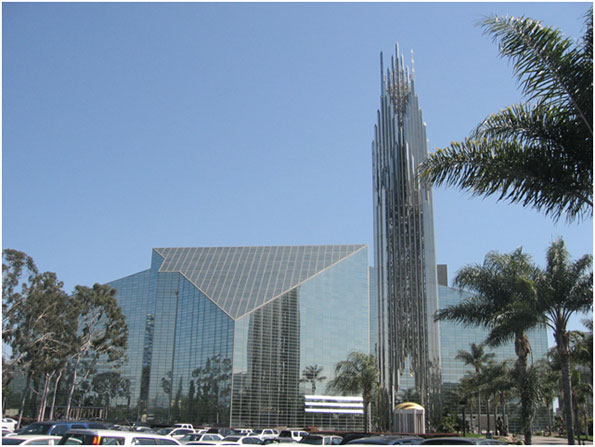
    The recent stories about the sale of Orange County’s Crystal Cathedral, designed by Philip Johnson, brings to mind an exception that proves the rule.

    Unsurprisingly it was the Catholic Church that bought it. Unlike Protestantism, Catholicism has always had a theology of place. And they’ve always used architecture and art as a way of telling the story of the gospel. Though obviously not in this case, they’ve also used Gothic sort of like neoclassical architecture as a way creating a sense of permanence and linkage to an everlasting, eternal church.

    So sacred space is one area where the suburbs really are deficient versus the city. But how important is this? Metropolitan areas today are mosaics. In an ever more complex and competitive global economy, every part of a region, city and suburb, needs to know its role on the team and bring it’s A-game. Just as there’s no need for every job to be located downtown, there’s no need for every major piece of sacred space in a region to be replicated in every suburb. Downtown does just nicely. However, this is one reason that while economically the core may no longer dominate a region, a healthy center still plays a key role in overall regional vitality. That’s because it remains home to things like the major pieces of sacred space such as war memorials and cathedrals that bind a region together and give it civilizational permanence, meaning, and purpose beyond the mundane.

    This article was adapted from remarks at the No Place Like Home conference on June 3, 2013 in Anaheim, CA.

    Aaron M. Renn is an independent writer on urban affairs and the founder of Telestrian, a data analysis and mapping tool. He writes at The Urbanophile.

    Suburbs photo by Bigstock.

  • Why Gentrification?

    The mostly commonly chosen means, or at least attempted means, of revitalizing central cities that have fallen on hard times is gentrification.  Gentrification is the process of replacing the poor population of a neighborhood with the affluent and reorienting the district along upscale lines.  This has seen enormous success in large swaths of New York and Chicago, but even traditionally struggling cities like Cleveland have seen pockets of this type of development downtown.

    What makes gentrification so attractive as a redevelopment strategy? There are many reasons.

    The first and most easily understandable is that is works, at least in a given geographic area. There’s a proven track record and model for redeveloping cities on an upscale basis. It may do very little for the rest of the city, but it does work for those who live, work, and, perhaps most importantly, invest in them.

    But perhaps the best question is: are there any other success models? It’s hard to point to many other successful models for redeveloping urban cores. The only alternative, and one that cities generally pursue in parallel, is attracting immigrants who seek out and revitalize out of fashion districts, often in outlying precincts of the city or the inner ring suburbs. Where there are successful working class districts in cities today, most of them are older neighborhoods that have hung on, not new ones birthed out of decline.

    In a modern America where income equality and class divisions are a huge problem, it’s definitely mission critical for America to restart the middle class jobs engine and renew our metro regions as engines of upward mobility. But that’s easy to say and hard to do, at least from an inner city perspective.

    The manufacturing jobs that previously supported a middle and comfortable working class lifestyle are gone and likely are not coming back. Public sector employment, traditionally another way to a middle class life in the city, is under extreme pressure due to fiscal mismanagement. Key services like the public schools remain intractably broken in most places. Segregation remains entrenched. What is the basis on which a middle or working class life will be re-established in the city? It isn’t clear.  Untold billions pumped into various Great Society type programs accomplished little that was sustainable. Indeed, many programs like urban renewal, yesterday’s urban planning conventional wisdom, turned out to be disasters for cities. Community organizing may have launched the career of President Obama, but it’s not clear how it has helped Chicago’s marginalized communities.  Given the paucity of models other than gentrification, it’s easy to see the attraction.

    Other reasons also drive cities toward gentrification. Clearly with a fiscal crisis, attracting more high income taxpayers (even where local taxes are predominantly on property) is clearly attractive. And the existing affluent residents need to have some assurance that they are being taken seriously by the city and aren’t just being used as ATM machines for redistribution.

    The change in the macro-economy that led to the income gap, including national policies that favor finance and technology rather than traditional manufacturing and energy type sectors, plays a huge role as well. These elite industries require a highly educated, highly skilled workforce and they are subject to clustering economics. Theories like “Creative Class” that describe this phenomenon suggest that this is a fickle group of people who seek out a gentrified neighborhood consisting largely of people like themselves. This has been glommed onto by the elite themselves – the various politicians, the wealthy, business executives, cultural leaders, academics and others. They hold power in cities  and use this to justify further investment in gentrification related programs – that is, their own class interest – although these programs do little for anyone who is not elite.

    Lastly, changes in the composition of local elites favor the publicly subsidized luxury real estate projects aimed at gentrification. In previous generations the CEOs of local operating businesses like banks and utilities were major power players. These tended to be fragmented industries and predominantly local in focus, so the overall civic health – in everything from education to infrastructure – was critical to the health of their core business. The interests of the community and CEOs were aligned.

    Today, most large-scale, and even many smaller, businesses have been nationalized or globalized, and the local power players are increasingly people like lawyers, real estate developers, and construction magnates who make money by the hour or project. The shift from locally focused operating businesses to national or global operating businesses, with remaining locally owned and focused businesses tending to be of the transactional type, produced a local elite who prefers doing deals than building broad community success. Unsurprisingly, they’ve doubled down on high end luxury developments, often subsidized by the government. 

    Lastly, once the ball gets rolling on gentrification, market forces can sustain it provided that the overall policy set remains favorable to elite type development. And having a lot of high end, swanky type development generates buzz for a city, something more prosaic, and more broadly based, working class success never does.

    Given the lack of proven alternative models and the alignment of multiple incentives behind it, there’s no surprise gentrification is the almost universal aspirational choice for cities in redevelopment.  But the gentrification model in most places is simply too narrow to move the needle or produce any benefits down the economic ladder. It is imperative that urban thinkers and leaders try harder to find models that provide more inclusive and broadly-based and socially sustainable benefits.

    Aaron M. Renn is an independent writer on urban affairs and the founder of Telestrian, a data analysis and mapping tool. He writes at The Urbanophile.

    Photo by Dom Dada.