Author: Aaron M. Renn

  • The 2012 Year in Unemployment

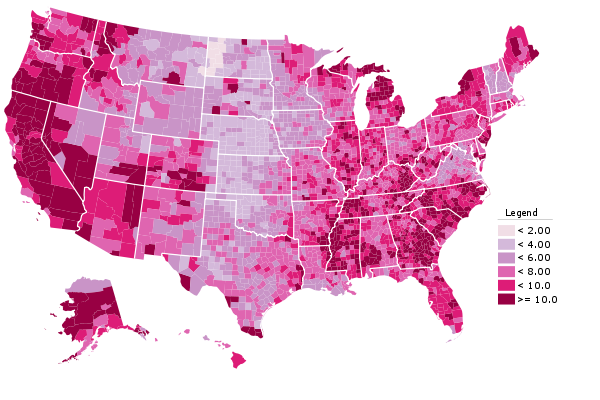
    I recently looked at the changes in jobs in metro areas for 2012. Here’s a follow-on look at unemployment. First a look at the national unemployment rate picture, which has improved remarkably.


    2012 Unemployment Rate by County

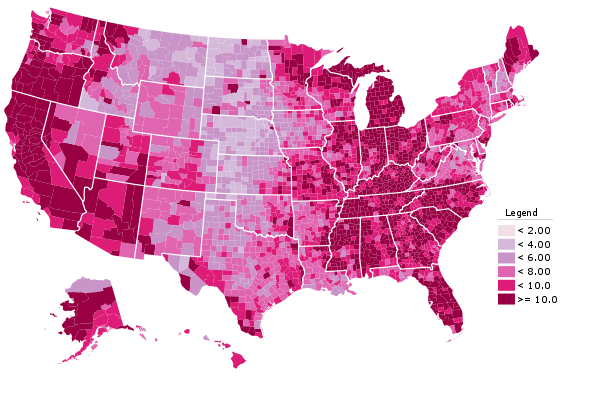
    To put this in perspective, here’s the corresponding map for 2009:


    2009 Unemployment Rate by County

    It’s interesting to see where there has been improvement versus where there hasn’t, though I stop thresholding at 10% so that if people we well above it but dropped to just merely above it, my maps wouldn’t show that improvement.

    Here’s a look at the large metro areas, ranked by total decline in unemployment rate.

    Rank by Total Improvement Metro Area 2011 2012 Total Change
    1 Las Vegas-Paradise, NV 13.5 11.2 -2.3
    2 Orlando-Kissimmee-Sanford, FL 10.2 8.4 -1.8
    3 Tampa-St. Petersburg-Clearwater, FL 10.6 8.8 -1.8
    4 Miami-Fort Lauderdale-Pompano Beach, FL 10.2 8.5 -1.7
    5 Jacksonville, FL 9.9 8.3 -1.6
    6 Sacramento–Arden-Arcade–Roseville, CA 11.9 10.4 -1.5
    7 Birmingham-Hoover, AL 7.9 6.4 -1.5
    8 Cincinnati-Middletown, OH-KY-IN 8.6 7.1 -1.5
    9 Riverside-San Bernardino-Ontario, CA 13.6 12.1 -1.5
    10 Nashville-Davidson–Murfreesboro–Franklin, TN 8.1 6.6 -1.5
    11 Louisville/Jefferson County, KY-IN 9.7 8.3 -1.4
    12 San Jose-Sunnyvale-Santa Clara, CA 10.0 8.6 -1.4
    13 Columbus, OH 7.5 6.1 -1.4
    14 Kansas City, MO-KS 8.0 6.6 -1.4
    15 Houston-Sugar Land-Baytown, TX 8.1 6.8 -1.3
    16 Charlotte-Gastonia-Rock Hill, NC-SC 10.8 9.5 -1.3
    17 Seattle-Tacoma-Bellevue, WA 8.7 7.4 -1.3
    18 San Francisco-Oakland-Fremont, CA 9.4 8.1 -1.3
    19 Los Angeles-Long Beach-Santa Ana, CA 11.4 10.1 -1.3
    20 Salt Lake City, UT 6.7 5.5 -1.2
    21 Phoenix-Mesa-Glendale, AZ 8.5 7.3 -1.2
    22 St. Louis, MO-IL 8.8 7.6 -1.2
    23 Dallas-Fort Worth-Arlington, TX 7.8 6.7 -1.1
    24 San Diego-Carlsbad-San Marcos, CA 10.0 8.9 -1.1
    25 Detroit-Warren-Livonia, MI 11.6 10.5 -1.1
    26 Portland-Vancouver-Hillsboro, OR-WA 9.3 8.2 -1.1
    27 Atlanta-Sandy Springs-Marietta, GA 9.8 8.8 -1.0
    28 Austin-Round Rock-San Marcos, TX 6.8 5.8 -1.0
    29 San Antonio-New Braunfels, TX 7.5 6.5 -1.0
    30 Memphis, TN-MS-AR 10.0 9.0 -1.0
    31 Chicago-Joliet-Naperville, IL-IN-WI 9.8 8.9 -0.9
    32 Minneapolis-St. Paul-Bloomington, MN-WI 6.3 5.5 -0.8
    33 Raleigh-Cary, NC 8.5 7.7 -0.8
    34 Providence-Fall River-Warwick, RI-MA – Metro 11.1 10.3 -0.8
    35 Richmond, VA 7.1 6.4 -0.7
    36 New Orleans-Metairie-Kenner, LA 7.2 6.5 -0.7
    37 Cleveland-Elyria-Mentor, OH 7.8 7.1 -0.7
    38 Oklahoma City, OK 5.5 4.8 -0.7
    39 Denver-Aurora-Broomfield, CO 8.6 7.9 -0.7
    40 Hartford-West Hartford-East Hartford, CT – Metro 9.0 8.4 -0.6
    41 Milwaukee-Waukesha-West Allis, WI 8.0 7.4 -0.6
    42 Indianapolis-Carmel, IN 8.4 7.8 -0.6
    43 Baltimore-Towson, MD 7.7 7.2 -0.5
    44 Virginia Beach-Norfolk-Newport News, VA-NC 7.1 6.6 -0.5
    45 Boston-Cambridge-Quincy, MA-NH – Metro 6.6 6.1 -0.5
    46 Washington-Arlington-Alexandria, DC-VA-MD-WV 6.0 5.6 -0.4
    47 Philadelphia-Camden-Wilmington, PA-NJ-DE-MD 8.6 8.6 0.0
    48 Pittsburgh, PA 7.2 7.2 0.0
    49 New York-Northern New Jersey-Long Island, NY-NJ-PA 8.6 8.8 0.2
    50 Rochester, NY 7.8 8.1 0.3
    51 Buffalo-Niagara Falls, NY 8.1 8.5 0.4
  • The Sound and the Fury In Chicago

    The Second City syndrome is alive and well. An anti-Chicago essay masquerading as a book review in the New York Times provides the latest example of the truth of that.  Rachel Shteir, a former New Yorker now living in Chicago, notes the various ills in the Windy City that should come as a surprise to no one, least of all residents:

    “Poor Chicago,” a friend of mine recently said. Given the number of urban apocalypses here, I couldn’t tell which problem she was referring to. Was it the Cubs never winning? The abominable weather? Meter parking costing more than anywhere else in America — up to $6.50 an hour — with the money flowing to a private company, thanks to the ex-mayor Richard M. Daley’s shortsighted 2008 deal? Or was it the fact that in 2012, of the largest American cities, Chicago had the second-highest murder rate and the ­second-highest combined sales tax, as well as the ninth-highest metro foreclosure rate in the country? That it’s the third-most racially segregated city and is located in the state with the most underfunded public-employee pension debt? Was my friend talking about how a real estate investor bought The Chicago Tribune and drove it into bankruptcy? Or how 15-year-old Hadiya Pendleton, who performed at Barack Obama’s inauguration, was shot dead near the president’s Kenwood home?"

    Illustrating the rule that criticizing Chicago is something that is Simply Not Done, this piece sent locals into collective apoplexy. Huffington Post Chicago provides a roundup of the “epic backlash.”  The Atlantic Cities chimes in with its own roundup of “Everything You Need to Know About Why Chicago Is Furious With Rachel Shteir and The New York Times,” noting that “We don’t have to wait for the angry letters to be printed in the next Book Review. The counter-manifestos are already here! In the past few days, it seems, everyone from Gary to Milwaukee has read Shteir’s ‘Chicago Manuals’ piece, resulting in a groundswell of angry rebuttals.” An army of angry tweeters spoke out.  And even the mayor addressed the issue. Not a bad day’s work for a theater professor at Depaul (Shteir’s day job).

    In a sense Shteir is right. I’ve long noticed that Chicago is basically an echo chamber of boosterism in which everyone is terrorized about deviating from the party line lest they be excommunicated from polite company, a fate that may well indeed await Shteir. And Chicago clearly has manifest problems as a city, many of which she notes, though many of her list such as the perennial disappointment of Cubs fans are clearly more snark than substance.

    However, what Shteir and Chicago both miss is the real value proposition of the city. Taken on its own terms, Chicago is a simply fantastic place to live. It has a magnificent lakefront setting, a stunning skyline, fantastic cultural institutions, incredible opportunities to consume (from designer clothing to world class dining), and much more. It may be true that these great things largely benefit those from more affluent precincts with vast tracts of the city left behind in segregated, entrenched poverty, but it’s tough to name a place where that isn’t likewise true. Much of Brooklyn, for example, remains mired in poverty, but no one in New York seems to care and criticisms of it as such are simply shrugged off.

    Chicago also has perhaps – at least in my view – the best blend of the best of the elite urban center with much of the best of cities further down the food chain. You can have genuinely walkable neighborhoods, take transit to work, and eat food that would be impressive in any city in the world while simultaneously having a spacious and affordable condo with parking that allows you to drive to a conveniently located Target or Costco to stock up when you need to. It’s car oriented when you need it and walkable when you need it, all at a reasonable price. Now that’s certainly something that many cities lower down in the hierarchy will also claim – big city amenities with a high quality of life. But Chicago is the most elite city in America that can plausibly make that claim.

    What Chicago is not, despite its pretensions, a truly global tier one city like New York, London, or Paris. That is what the booster culture can’t abide. It is an article of faith that every Chicagoan must believe, or at least pretend to believe, that Chicago is worthy of being spoken of in the same breath as any city in the world. Even a critic like Shteir seems to evaluate it on that basis.

    But the reality is that Chicago is a “1B” city like Frankfurt or Toronto not a “1A” city. There’s nothing wrong with that. In fact, I happen to believe Chicago’s value proposition is arguably better than most of the 1A cities for everyone who isn’t in the 0.1%. But both local boosters and critics can’t look at Chicago for what it is, but rather what it isn’t and never will be. Chicago will never be New York. But neither will New York ever match the best of Chicago on the Windy City’s own terms with a comparable quality/price/ease mix.

    In this sense, Chicago might be seen as the leader of a wave of other emerging would be 1A cities – Houston, Dallas, San Diego – that are making the cut from a second tier city. Being the leader and something of a role model for a wave of rising cities may not be bad positioning at all.

    Aaron M. Renn is an independent writer on urban affairs and the founder of Telestrian, a data analysis and mapping tool. He writes at The Urbanophile.

    Photo by Doug Siefken.

  • The 2012 Metro Year in Jobs

    Last month the BLS put out the first official release of annual job data for metropolitan areas, so I wanted to take a brief look at this for large metro areas (more than one million in population, based on old metro area definitions that the BLS still uses). Here are the top 10 cities for percentage job growth. Nashville takes the crown. I’m also personally glad to see Indy bounce back after a couple tough years.

    Rank (Best) Metropolitan Area 2011 2012 Pct Change
    1 Nashville-Davidson–Murfreesboro–Franklin, TN 756.7 786.2 3.90%
    2 Houston-Sugar Land-Baytown, TX 2592.1 2691.4 3.83%
    3 Austin-Round Rock-San Marcos, TX 795.0 823.2 3.55%
    4 Salt Lake City, UT 620.0 641.0 3.39%
    5 San Jose-Sunnyvale-Santa Clara, CA 876.4 905.2 3.29%
    6 San Francisco-Oakland-Fremont, CA 1917.2 1977.8 3.16%
    7 Charlotte-Gastonia-Rock Hill, NC-SC 825.1 850.3 3.05%
    8 Raleigh-Cary, NC 506.9 521.9 2.96%
    9 Dallas-Fort Worth-Arlington, TX 2932.2 3016.0 2.86%
    10 Indianapolis-Carmel, IN 888.6 913.8 2.84%

    Here are the bottom ten performers. The federal slowdown already appears to be hitting DC:

    Rank (Worst) Geography 2011 2012 Pct Change
    1 St. Louis, MO-IL 1298.7 1298.8 0.01%
    2 Rochester, NY 510.1 513.2 0.61%
    3 Providence-Fall River-Warwick, RI-MA – Metro 544.8 548.3 0.64%
    4 Buffalo-Niagara Falls, NY 543.5 547.0 0.64%
    5 Philadelphia-Camden-Wilmington, PA-NJ-DE-MD 2707.4 2725.2 0.66%
    6 Milwaukee-Waukesha-West Allis, WI 815.5 821.4 0.72%
    7 Virginia Beach-Norfolk-Newport News, VA-NC 737.7 743.8 0.83%
    8 Hartford-West Hartford-East Hartford, CT – Metro 538.2 542.7 0.84%
    9 New Orleans-Metairie-Kenner, LA 525.1 529.7 0.88%
    10 Washington-Arlington-Alexandria, DC-VA-MD-WV 3007.6 3039.8 1.07%

    And here is the complete list:

    Row Metropolitan Areas 2011 2012 Total Change Pct Change
    1 Atlanta-Sandy Springs-Marietta, GA 2306.0 2349.9 43.9 1.90%
    2 Austin-Round Rock-San Marcos, TX 795.0 823.2 28.2 3.55%
    3 Baltimore-Towson, MD 1292.6 1317.8 25.2 1.95%
    4 Birmingham-Hoover, AL 493.6 501.4 7.8 1.58%
    5 Boston-Cambridge-Quincy, MA-NH – Metro 2459.5 2499.2 39.7 1.61%
    6 Buffalo-Niagara Falls, NY 543.5 547.0 3.5 0.64%
    7 Charlotte-Gastonia-Rock Hill, NC-SC 825.1 850.3 25.2 3.05%
    8 Chicago-Joliet-Naperville, IL-IN-WI 4305.1 4369.2 64.1 1.49%
    9 Cincinnati-Middletown, OH-KY-IN 990.1 1002.4 12.3 1.24%
    10 Cleveland-Elyria-Mentor, OH 1001.2 1016.6 15.4 1.54%
    11 Columbus, OH 926.0 950.4 24.4 2.63%
    12 Dallas-Fort Worth-Arlington, TX 2932.2 3016.0 83.8 2.86%
    13 Denver-Aurora-Broomfield, CO 1213.6 1246.1 32.5 2.68%
    14 Detroit-Warren-Livonia, MI 1785.7 1826.8 41.1 2.30%
    15 Hartford-West Hartford-East Hartford, CT – Metro 538.2 542.7 4.5 0.84%
    16 Houston-Sugar Land-Baytown, TX 2592.1 2691.4 99.3 3.83%
    17 Indianapolis-Carmel, IN 888.6 913.8 25.2 2.84%
    18 Jacksonville, FL 586.8 595.6 8.8 1.50%
    19 Kansas City, MO-KS 980.6 996.8 16.2 1.65%
    20 Las Vegas-Paradise, NV 808.2 823.6 15.4 1.91%
    21 Los Angeles-Long Beach-Santa Ana, CA 5165.8 5264.6 98.8 1.91%
    22 Louisville/Jefferson County, KY-IN 598.0 610.9 12.9 2.16%
    23 Memphis, TN-MS-AR 593.8 600.9 7.1 1.20%
    24 Miami-Fort Lauderdale-Pompano Beach, FL 2228.6 2278.2 49.6 2.23%
    25 Milwaukee-Waukesha-West Allis, WI 815.5 821.4 5.9 0.72%
    26 Minneapolis-St. Paul-Bloomington, MN-WI 1735.0 1766.4 31.4 1.81%
    27 Nashville-Davidson–Murfreesboro–Franklin, TN 756.7 786.2 29.5 3.90%
    28 New Orleans-Metairie-Kenner, LA 525.1 529.7 4.6 0.88%
    29 New York-Northern New Jersey-Long Island, NY-NJ-PA 8418.2 8554.3 136.1 1.62%
    30 Oklahoma City, OK 580.1 593.4 13.3 2.29%
    31 Orlando-Kissimmee-Sanford, FL 1014.9 1040.3 25.4 2.50%
    32 Philadelphia-Camden-Wilmington, PA-NJ-DE-MD 2707.4 2725.2 17.8 0.66%
    33 Phoenix-Mesa-Glendale, AZ 1715.6 1757.1 41.5 2.42%
    34 Pittsburgh, PA 1144.9 1158.6 13.7 1.20%
    35 Portland-Vancouver-Hillsboro, OR-WA 987.8 1006.6 18.8 1.90%
    36 Providence-Fall River-Warwick, RI-MA – Metro 544.8 548.3 3.5 0.64%
    37 Raleigh-Cary, NC 506.9 521.9 15.0 2.96%
    38 Richmond, VA 610.9 623.4 12.5 2.05%
    39 Riverside-San Bernardino-Ontario, CA 1128.8 1151.6 22.8 2.02%
    40 Rochester, NY 510.1 513.2 3.1 0.61%
    41 Sacramento–Arden-Arcade–Roseville, CA 808.6 822.5 13.9 1.72%
    42 Salt Lake City, UT 620.0 641.0 21.0 3.39%
    43 San Antonio-New Braunfels, TX 858.4 877.9 19.5 2.27%
    44 San Diego-Carlsbad-San Marcos, CA 1233.4 1258.8 25.4 2.06%
    45 San Francisco-Oakland-Fremont, CA 1917.2 1977.8 60.6 3.16%
    46 San Jose-Sunnyvale-Santa Clara, CA 876.4 905.2 28.8 3.29%
    47 Seattle-Tacoma-Bellevue, WA 1671.3 1711.5 40.2 2.41%
    48 St. Louis, MO-IL 1298.7 1298.8 0.1 0.01%
    49 Tampa-St. Petersburg-Clearwater, FL 1129.7 1155.7 26.0 2.30%
    50 Virginia Beach-Norfolk-Newport News, VA-NC 737.7 743.8 6.1 0.83%
    51 Washington-Arlington-Alexandria, DC-VA-MD-WV 3007.6 3039.8 32.2 1.07%

    Aaron M. Renn is an independent writer on urban affairs and the founder of Telestrian, a data analysis and mapping tool. He writes at The Urbanophile, where this piece originally appeared.

    Get a job photo by Bigstock.

  • Why Cities Matter

    Why Cities Matter
    by Stephen Um and Justin Buzzard

    Pretty much everybody doing anything today has to be thinking about how to respond to urbanism, especially in a global but also a developed world context. While it’s clearly too early to proclaim the “death of the suburb” clearly cities have experienced a resurgence. New York, LA, and San Francisco are at all time population highs. The District of Columbia and Philadelphia grew for the first time since 1950 according to the latest census.

    Religion has been one of those movements that has to respond to urbanism. Christianity was traditionally an anchor of cities, especially the Catholic Church which was a key agency of assimilating of immigrants into American society, among other things.

    However, in recent decades the urban church went into decline while the heartland of Christianity moved to the suburbs (along with rural and small town environments where it had always been strong). The growth of mega-churches to some extent parallels the rise of the mega-mall. Those steeped in this more suburban milieu need to have adjust their thinking if they want to succeed in penetrating a more urban one.

    The book “Why Cities Matter” by Stephen Um of Citylife Church in Boston and Justin Buzzard of Garden City Church in Silicon Valley is an attempt to provoke that thinking. It’s fairly brief at only six chapters (of which I’ll talk about five), but covers some interesting ground.

    The first couple of chapters make the case for why cities are important in general. I actually think this is a pretty good general purpose overview of the case for urbanism quite apart from any religious context.

    One thing that really caught my eye was when they tackled the matter of why some cities fail. They seem to anticipate the objection that if cities are so great, why are so many of them like Detroit so screwed up? The answer they give is diversity – in the broadest sense of the word. Detroit is very racially diverse, but lacked economic diversity. As they put it:

    The one phenomenon guaranteed to stifle the power of density is homogeneity. In other words, if everyone in a city does the same thing for work, thinks along the same lines, and lives relatively similar lives, no matter how densely clustered they may be, that city will lack the necessary innovation capital needed to sustain itself over the long haul.

    Or as they put it in a way I’d never read elsewhere:

    Density + Diversity = Multiplication
    Density – Diversity = Addition

    In effect, the non-diverse city is simply scaling horizontally as it grows. And when that growth stops, as it inevitably will, the authors note the obvious implication: “When the bottom falls out on a density-minus-diversity city, population addition becomes subtraction and there is no platform left on which to rebuild.”

    The third chapter is a Biblical case for the city. I think this is particularly key and is something far too many people trying to adapt to cities and urbanism – the auto companies, for example – haven’t really done. What the authors are doing is re-telling the narrative of their own movement in an urban context. It’s not just that cities are important. But you have to be able to see how what you do has some authentic urban component to it so that you see the city as part of you, not just some foreign country you have to go figure out.

    Having taken a look at the narrative of Christianity as authentically urban, they then turn for two chapters towards how to contextualize Christianity to serve the city. This starts with understanding the city itself on its own terms. In short, it starts with knowing the city’s story. Some questions they suggest asking include:

    1. What is your city’s history?
    2. What are your city’s values?
    3. What are your city’s dreams?
    4. What are your city’s fears?
    5. What is your city’s ethos?

    I’ve noted before how urban church leaders like Tim Keller have been willing to ask themselves the tough question of what they need to do adapt their ministry to the needs of their city, in contrast to too many urbanists themselves. How many urbanists really ask themselves these questions? How many of them go on an anthropology mission to understand their city? Too often, it doesn’t seem like many do. Because so frequently it’s the exact same “school solutions” that are proposed in city after city with little to indicate they’ve been seriously thought about in relation to the city in question: light rail, bike lanes, tech startups, mixed use, density, etc., etc., etc.

    I’m not saying there’s anything wrong with these or that sometimes you can’t just import a good idea once it’s been perfected elsewhere. Lots of mass consumer products succeed. However, if your entire plan for your city is based on off the shelf ideas from elsewhere, it’s probably going to fall far short of your ambitions.

    I find it ironic that it is religious leaders, who I would expect might argue that they are selling the Ultimate Product, actually seem to be more advanced in seeking to contextualize what they do than do some urbanists themselves.

    Aaron M. Renn is an independent writer on urban affairs and the founder of Telestrian, a data analysis and mapping tool. He writes at The Urbanophile, where this piece originally appeared.

  • Churches and Parking

    A recent story over at Atlantic Cities got me thinking about a debate that’s heated up over the last few years: urban parking policy for churches.

    Per Atlantic Cities, San Francisco has decided to start charging for metered parking on Sundays. This is starting to happen across America. In San Francisco, as in Chicago and elsewhere, the driver (no pun intended) appears to be revenue raising, plain and simple.

    This has angered many attendees of local churches (who have in many cases now moved out of town and drive in for services). They seem to believe that they have a constitutional right to free parking on Sunday mornings. On the other side, of course, are bicycle advocates, who are positively gleeful. (Bicycle advocates are without a doubt the single most self-righteous advocacy group I know, which is why so many people who otherwise might support reasonable pro-bicycling policy can’t stand them).

    I think a more nuanced approach should be taken, based on neighborhood conditions and creating the right incentive structures. For example, in some places across the country (San Francisco and Chicago come to mind again), it’s traditional for church goers to park even in what would otherwise be illegal spots. In general, this isn’t a problem – at least from my personal observations in Chicago. Traffic is pretty light on Sunday mornings, and it doesn’t cause any problems.

    What’s more, enabling that temporary use of public space for a couple hours on a Sunday morning is exactly the sort of thing we need more of, not less. An institution like a church that has a single demand spike for parking during a generally low demand period is a great candidate for flexible uses of public space that would otherwise be underutilized. Liveable streets advocates are quick to decry the empty lanes off peak from oversized roads. So what’s the problem with putting a boulevard on a “road diet” on Sunday morning by using a lane for parking? Sounds like a winner to me. I’d be asking what other types of institutions or events could do similar things.

    And consider, what will happen if churches are banned from using these spots or otherwise have to pay? Well, it depends on the neighborhood, but it’s easy to see what organizations often do when they need parking: build parking lots. Do we really want churches acquiring private off street lots that will sit empty 166 out of 168 hours per week – and generate no property taxes? It makes no sense to me. Why would we want to create incentives for people to own parking lots just because some folks hate cars? We should be going exactly the other direction. There are way too many church parking lots already if you ask me. We should be trying to cut deals with them to open that land up for development by making temporary blocks of street parking available for a couple hours on Sundays.

    Now, in places where there is legitimately congestion and/or parking shortages on Sunday mornings (and San Francisco might be a case here – I don’t know for sure), implementing parking charges and restrictions would certainly be reasonable. The principal reason for allowing these church uses in the first place shouldn’t be some religious exemption per se, but rather enabling a local chronologically niche use to take advantage of underutilized public space. (Keep in mind that many other local users get truly special privileges based solely on their local presence: loading zones, valet zones, residential parking – and the latter is usually de facto free). If the space is over-subscribed, then feeding the meters to help rationalize demand is reasonable, and the churches should stop grumbling.

    In short, we should be basing this on some type of rational decision process based on neighborhood conditions, setting the right overall incentives, and balancing the needs of competing uses, not pandering to churches treating illegal spots as if they were some ancient feudal right, nor sanctimonious bicyclists behaving as if a double parked car on Sunday morning is a menace to the planet or to their own self-evident status as the most perfectly entitled form of urban transport.

    This piece first appeared at The Ubanophile.

  • Is Urbanism the New Trickle-Down Economics?

    The pejoratively named “trickle-down economics” was the idea that by giving tax breaks to the wealthy and big business, this would spur economic growth that would benefit those further down the ladder. I guess we all know how that worked out.

    But while progressives would clearly mock this policy, modern day urbanism often resembles nothing so much as trickle-down economics, though this time mostly advocated by those who would self-identify as being from the left. The idea is that through investments catering to the fickle and mobile educated elite and the high end businesses that employ and entertain them, cities can be rejuvenated in a way that somehow magically benefits everybody and is socially fair.

    Trickle down economics type policies failed both because while they contained a great deal of truth – tax rates do matter in economic development – they were a reductionist oversimplification, and perhaps more importantly were self-interested recommendations of the very class that would benefit from them. The tax breaks for the wealthy and big business were in fact the real goals, not primarily policies intended for socially beneficial consequences it was said would result from them.

    As it turns out, urbanism in its current form appears to suffer from the exact same problems, as Richard Florida has just documented in an article over at Atlantic Cities called “More Losers Than Winners in America’s New Economic Geography.”

    A key question remains: Who benefits and who loses from this talent clustering process? Does it confer broad benefits in the form of higher wages and salaries to workers across the board or do the benefits accrue mainly to smaller group of knowledge, technology, and professional workers?

    The University of California, Berkeley’s Enrico Moretti suggests a trickle-down effect, arguing that higher-skill regions benefit all workers by generating higher wages for all workers. Others contend that this new economic geography is at least partially to blame for rising economic inequality.
    ….
    I’ve been examining the winners and losers from this talent clustering process in ongoing research with Charlotta Mellander and our Martin Prosperity Institute team….Our main takeaway: On close inspection, talent clustering provides little in the way of trickle-down benefits. Its benefits flow disproportionately to more highly-skilled knowledge, professional and creative workers whose higher wages and salaries are more than sufficient to cover more expensive housing in these locations. While less-skilled service and blue-collar workers also earn more money in knowledge-based metros, those gains disappear once their higher housing costs are taken into account.

    In short, there’s no flow through to people who aren’t directly tapped into the knowledge economy itself. I might add that this probably does include a number of service sector workers like celebrity chefs and personal trainers who cater to the luxury end of services. But the majority of residents are missing out.

    To put it in political speak, the creative class doesn’t have much in the way of coattails.

    These findings also foot to the implications of Saskia Sassen’s global city theories, in which the global city functions of a region comprise a sort of “city within a city” which has little in common with the rest of the metro region as thus perhaps little impact on it. Indeed, we might even view the two economic geographies as being in conflict.

    Florida and Sassen are academics and so can’t necessarily be seen as advocates for the phenomena they describe. They are describing what is, not what should be. The question is, what have policy makers done with this information?

    As with the tax rate example, there really is an importance to attracting educated people to your city. College degree attainment explains almost everything about per capita income in a region. (Though as Florida notes, per capita values, as means, can be misleading and median is a better way to do analysis where it’s available).

    Have urbanists used this as a call to arms to put all of their energy into helping those left behind in the knowledge/creative class economy? No. Instead, urban advocates have gone the other direction, locking onto this in a reductionist way to develop a set of policies I call “Starbucks urbanism.” That is, the focus is on an exclusively high end, sanitized version of city life that caters to the needs of the elite with the claim that this will somehow “revitalize” the city if they are attracted there.

    As with trickle-down economics, this a) doesn’t work and b) is being promoted by the self-interested.

    Firstly, it doesn’t work because it more or less operates on the basis of displacement. So it might revitalize certain select districts, but only as physical geographies not human ones. This is exactly because of the phenomenon Florida identified: there are few trickle down benefits to be had. Also, this only works in a handful of districts or in cities that are so small that you can plausibly gentrify the entire thing. The area left behind in these places, as the in the violence stricken neighborhoods of Chicago that are making national news, receive virtually no benefit. And as Bill Frey of Brookings once said, “There aren’t enough yuppies to go around to save Detroit.” Thus only a comparatively small number of cities benefit from talent concentrations anyway. (Indeed, the notion of “concentration” is inherently a relative one).

    Secondly, and here I go beyond Florida’s article, urban advocates are a largely self-interested class. Everybody knows that a hedge fund plutocrat is looking out for number one and has a class interest, but if we were honest with ourselves, most of us probably do the same at some different level. For example, it’s easy to cry nepotism when a politician’s relative gets put on the payroll, but if a man gets his son on at the ironworkers union, it generally flies under the radar. I don’t claim to be exempt from this myself.

    The people most aggressively pushing urbanist policies like bike lanes, public art, high end mixed use developments, high tech startups, swank boutiques and restaurants, greening the city policies, etc. are disproportionately those who want to live that lifestyle themselves, or hope to someday. Like me in other words. The fact that you’re a Millennial who rides around to microbreweries on your fixie without necessarily having a high paying job yourself (yet) doesn’t matter. You are still advocating for your own preferred milieu, and that of others who think like yourself.

    I have observed that when challenged on this, urbanists grow indignant, talking about their commitment to the planet or how transit benefits the poor, etc. But ultimately as with the tax cut advocates, that’s just a self-justification. With some notable exceptions, you don’t see social justice and equity issues front and center in the urbanists discussions outside of old-school community organizing/activism circles, groups that are almost totally distinct from Atlantic Cities style urbanism.

    Most urbanists I know are quick to advocate tax increases for the 1% but fail to see how their own policies contribute to a widening of the income gap and class divide in their own cities. Even if they are genuinely motivated to help the entire civic commonwealth, hopefully they recognize that they at least have the same conflict of interest situation they would be quick to highlight in a businessman or politician.

    The answer isn’t to junk urbanism. Just as class warfare rhetoric that demonizes the wealthy and business and wants to tax the daylights out of them isn’t the solution to what ails our economy, neither is abandoning many of the principles of urbanism. After all, tax rates do matter for economic growth. Similarly, liveable streets and such are indeed very important to urban revitalization.

    What’s needed is a new orientation of these ideas so that we don’t end up with an explicitly elitist policy rationale and policy set that caters to the already privileged at the expense of the poor and middle classes of our cities. We need to be asking the question of what exactly we are doing to benefit the people without college degrees beyond assuring them that if we attract more people with college degrees everything will be looking up for them. We need to sell ideas like transit in a way that isn’t totally dependent on items like “enabling us to attract the talent we need for the 21st century economy.” If I read half as much about providing economic opportunity and facilitating upward social mobility for the poor and middle classes as I do about green this, that, or the other thing, we’d be getting somewhere. (Observe Robert Munson’s recent call to broaden the practical definition of green as one example of starting to think this way). I need to do this as much as anyone.

    It’s easy to see why people default to trickle-down type theories even beyond class interest. Both sets of prescriptions – tax cuts for the elite and urbanism for the elite – took place against a backdrop of globalization and deindustrialization that eviscerated the engines of traditional working and middle class prosperity. The answers to how to fix this core problem aren’t obvious. Richard Longworth recently put together a compilation of views on middle class malaise and it is sobering reading.

    In a sense, elite boosting policies have “worked” because they’ve successfully boosted the elite – a reasonably tractable problem in the new economy. But they’ve had few benefits to anyone else and have fueled huge class-based resentments that threaten civic cohesion. But just because the problem of opportunity for the poor and middle classes isn’t easy, doesn’t mean it doesn’t need to be solved. Indeed, rebuilding an engine of broad-based prosperity and upward mobility is the signature challenge of our age, and one to which urbanists should be encouraged to apply their fullest efforts.

    Aaron M. Renn is an independent writer on urban affairs and the founder of Telestrian, a data analysis and mapping tool. He writes at The Urbanophile, where this piece originally appeared.

    Chicago skyline photo by Bigstock.

  • Why Are There So Many Murders in Chicago?

    After over 500 murders in Chicago in 2012, the Windy City’s violence epidemic continues – 2013 saw the deadliest January in over a decade – and continues to make national news.  The New York Times, for example, ran a recent piece noting how Chicago’s strict gun laws can’t stem the tide of violence.

    The NYT piece predictably spurred much debate over gun policy, but that distracts from the real question: why exactly does Chicago have so many murders?  Chicago had 512 murders in 2012. New York City – with three times Chicago’s population – had only 418 murders, the lowest since record keeping began in the 1960s.  Los Angeles, with over a million more people than Chicago, had only 298 murders.  These other cities can’t be accused of lax gun laws or somehow being immune to guns being brought in illegally from more lenient jurisdictions. So what’s different about Chicago?

    It’s impossible to say for certain what is causing Chicago’s unique murder problem, but a few possibilities suggest themselves.

    1. The number of police officers.  Depending on the report, Chicago’s police department is about 1,000 officers short of authorized strength and is facing a large number of looming retirements while few new recruits are brought in due to budget constraints. This clearly has had an impact. However, NYPD has also seen a decline in the number of officers without this effect.
    1. Police tactics. New York has made headlines with controversial, but apparently effective, tactics like the so-called “stop and frisk” policy.  The city hasn’t hesitated to defend these, even in the face of enormous negative press and lawsuits. Los Angeles has made huge strides in moving past its Detective Mark Furhman era reputation to build bridges to minority communities while Chicago has spent years and millions of dollars ignoring and defending officers who used torture to extract confessions. New York and Los Angeles also have more experience with statistically driven policing than Chicago.
    1. Politically controlled policing.  Mayor Daley hired Jody Weis from the FBI as police superintendent, but neutered his ability to run the department by assigning a political operative as Weis’ chief of staff.  Similarly, Rahm Emanuel, a fan of centralized control, has been heavily involved in driving major decisions like disbanding the anti-gang strike forces. It’s not clear whether police decisions have been driven by purely professional crime fighting concerns or, as in likely given the city’s culture, political considerations.
    1. William Bratton. Both New York and Los Angeles saw the start of their major successes against crime under the leadership of William Bratton. Los Angeles in particular was extremely smart to go hire him after his success in New York. While other cities have experienced murder declines, often with similar strategies, they are not places of the same scale, demographic diversity and political complexity of New York and LA. Perhaps Chicago should have spent whatever it took to get Bratton as police superintendent, though whether Bratton would have been willing to come into a place with such a history of political meddling with the police is uncertain.
    1. Gang fragmentation. Local and federal officials had great success taking out the leadership of many of the city’s gangs. The result has been significant gang fragmentation and a lack of hierarchical control over the rank and file that some have blamed for contributing to the violence epidemic.
    1. Depopulation. Few analyses of Chicago’s murder problem focus on the city’s very poor demographic performance.  New York City and Los Angeles are at all time population highs. Other urban areas like Boston and Washington, DC have started rebounding from population losses. However, Chicago lost a stunning 200,000 people in the 2000s and now has a population rolled back to levels not seen since 1910.  Loss of population in many neighborhoods has had many pernicious effects, including a loss of social capital (notably middle class families), loss of businesses due to loss of customers, and a diminished tax base.  It’s hard to maintain social cohesion in the face of both extreme poverty and population decline.  Similarly, the Chicago region had the worst jobs performance of any large metro in the US during the 2000s, which couldn’t have helped.
    1. Public housing demolitions. Chicago’s high rise projects like Cabrini-Green and the Robert Taylor Homes were yesterday’s national shame as hotbeds of crime and the killing of youths. Chicago was one of the most aggressive demolishers of these, with all of the high rises effectively destroyed. While this perhaps reduced localized crime, it destroyed the only homes many people had ever known, and, like depopulation, destroyed significant social capital and possibly simply redistributed and dispersed crime, as some research in other cities has suggested.  New York’s public housing is hardly problem free, but NYC  took a very different approach, investing in the high-rises rather than destroying them.  It’s hard not to speculate on what this has meant to the trajectory of crime in those two cities.

    Whatever the actual answer may be, Chicago’s murder epidemic continues to ravage families and neighborhoods. Given the results in January, it would appear the city is no nearer to getting a handle on it than it was a year ago. A reconsideration of the differences between Chicago and other large cities, and a resulting adjustment in strategy, would seem to be long overdue.

    Aaron M. Renn is an independent writer on urban affairs and the founder of Telestrian, a data analysis and mapping tool. He writes at The Urbanophile.

    Chicago photo by Bigstock.

  • Detroit Future City

    Recently the Detroit Works Project released their long awaited strategic plan for the city. This is the one led by Toni Griffin that produced a lot of public controversy because of suggestions it would result in the planned shrinkage or decommissioning (or even forced residential relocations) in sparsely populated neighborhoods.

    Called “Detroit Future City,” this plan doesn’t shy away from facing the tough realities that face Detroit, but its recommendations are somewhat muted with regards to shrinkage. Nevertheless, the message is clear: in a broke, declining city, neighborhood triage is a must.

    The full document is 184 pages. I perused it, but wasn’t able to review at the level of detail I normally like to. Partially this is because it was published in a hyper-annoying “cinemascope” type format that makes it almost impossible to read on screen without magnification and lots of horizontal scrolling. This aspect of the plan’s publication was an immediate knock against it in my view. However, it will share a few observations I gleaned.

    Neighborhood Development

    The plan is notable for admitting that Detroit can never be repopulated. In fact, its only goal is to stabilize population loss 20 years from now, and settle in for a population of 600-800,000 people, or approximately the same as now.

    The plan is frank about the scale of the challenges, including 150,000 vacant and abandoned parcels, empty land equal to the area of Manhattan, and vastly oversized infrastructure relative to the population and industrial base, along with poor service delivery in areas ranging from public safety (Detroit has the second highest violent crime rate in the country) to street lighting (about half of the street lights don’t work).

    Part of that does involve identifying how to deploy infrastructure in neighborhoods. Here’s a graphic on that which will no doubt get some airplay:
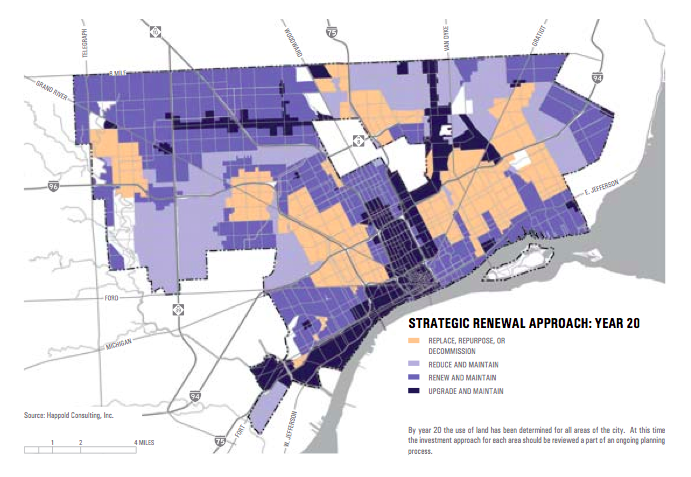


    Some areas are slated for upgrades, others reductions, and some perhaps “decommissioning.”

    The strength of the plan, however, is in its approach to development in which the core concept is to develop a multi-nodal network of neighborhoods, and to have neighborhoods that are strategically differentiated from each others. This is very different from the core-centric or “hub and spoke” model that exists today, and is somewhat similar to my “100 Monument Cirles” concept for Indianapolis. Suffice it to say, I like it. What was missing from this was strengthening neighborhood identify, something Pete Saunders identified as a key weakness of the city.

    A lot of the content behind this is disappointingly standard, however. The focus is green infrastructures, transit, mixed use neighborhoods, etc. This is basically planning conventional wisdom that would be at home in lots of different cities.

    I was pleased to see that they de-emphasized rail transit. Only the M-1 light rail on Woodward remains. The rest of the core network would be BRT. I’d argue that reliable and higher frequency “plain old bus service” is the core need, however. There’s the proposed transit map:
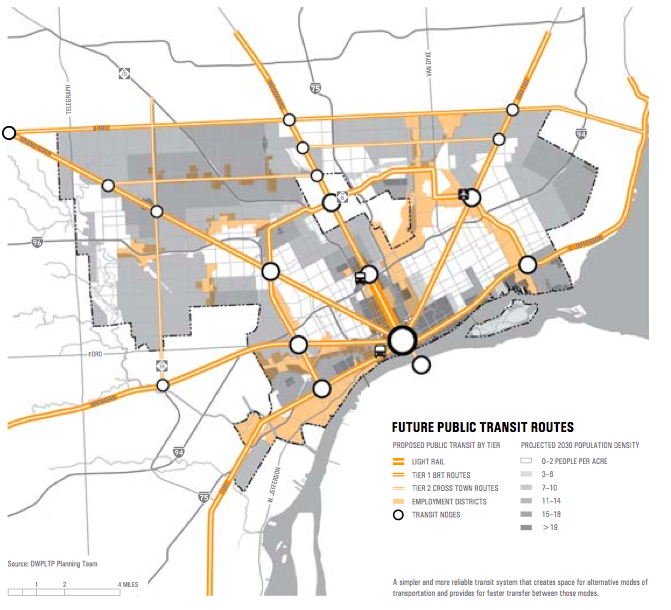


    Some may decry this, but in a city that’s over-infrastructured as it is, the last thing you need is more physical plant to maintain over time.

    And perhaps the focus on green is to some extent understandable given the vast quantity of vacant land in Detroit. One of their intriguing concepts is “landscape as infrastructure”, though it didn’t fully connect with me. They did talk about ideas like medium intensity agriculture and new urban forest typologies. The Hanzt Farm example shows this already underway.

    Lastly, the focus, and especially the near term recommendations around, regulatory restructuring is critical. Detroit benefits today from a sort of laissez-faire environment because government is so ineffective. If government effectiveness were restored, it could easily strangle the good things happening in Detroit, which are largely non-conforming. The answer is to get the regulatory system up to date with what we want to see. I would have preferred to see some types of harder targets around this, such as “85% of new development approved as of right.”

    Economic Development

    The plan considers boosting the number of jobs in Detroit as the most important mission. The city today has the 5th lowest number of jobs per resident of any of the top 100 cities in America, this despite large population losses. Jobs in the city are needed both for residents and rebuild the tax base.

    The numbers on this seemed a bit squishy though. The report says that there is one job for ever four residents of Detroit. As there are about 700,000 residents, this would mean about 175,000 jobs. Yet they say there are 350,000 jobs. (If the resident figure included only working age adults, the projected number of current jobs would be even lower than my estimate).

    The goal by 2030 is to increase this to between 2 and 3 jobs for every resident. This implies simply staggering job growth. Their mid-point population estimate for 2030 is still 700,000, so to go from 0.25/1 to 2/1 or 3/1 implies 700-1100% job growth. This is a CAGR of 11-13% – off the charts. To put it in perspective, metro Houston’s job growth CAGR from 2000 to 2011 was only 1.3%.

    I may be totally off base on what they were getting at in these numbers, but having solid and realistic projections is critical, and, alas, all too rare. Unrealistic growth rate assumptions are common in civic plans, as I highlighted in the example of Cincinnati’s Agenda 360 plan.

    [ Update: I was contacted by someone from the study’s technical committee indicating that the 2 or 3 jobs per resident figure was an error in the PDF that was not present in the official version of the plan. There are apparently about 193,000 jobs in the city, with the plans actual goal a doubling of that over 30 years. Still ambitious, but not mathematically impossible. ]

    The job growth is projected to come from four key target sectors: eds and meds, digital and creative, industrial, and local entrepreneurship. These sectors are reasonable as these things go given where Detroit is, but seem unlikely to drive the major growth they seek, excepting possibly entrepreneurship.

    Neither Wayne State nor Detroit’s health care/life science infrastructure is nation leading. Every city and state in America is chasing eds and meds, and as I noted, the great growth curve in these industries may be over. Additionally, the trend nationally seems to be towards more decentralization of health care infrastructure in metro areas. While I’m sure there will be some growth here, I’m not optimistic about major expansion.

    Similarly, digital and creative jobs are the fad du jour. I strongly doubt anyone will even consider there to be categories of jobs called “digital” or “creative” by 2030. These will be absorbed into industry generally. These are also the same types of sectors being pursued everywhere. Detroit certainly has a concentration of these because of its auto design cluster and just simply being a big city. But other than autos, does it really have a competitive advantage here? The big expansion opportunity would seem to be mostly suburban relocations of the type spearheaded by Dan Gilbert. I wonder how much gas is left in that tank, however.

    The other two are more promising. Local entrepreneurship is a catch-all, but clearly indigenous startups are a great way to boost the economy. The report’s focus on equipping and facilitating minority entrepreneurship was especially relevant. Given the collapse of the city, Detroit’s residents have had to become innovative and self-sufficient of necessity. These skills from the school of hard knocks are in many ways worth much more than formal education when it comes to starting a business. If the city can figure out how to marry these “survival skills” of residents with a commercial orientation, it could be powerful. The same recipe of figuring how to do business in unstable and tough environments is common in the Middle East, where there’s a longstanding entrepreneurial and trading tradition. Unsurprisingly, Middle Easterners have been prominent among those who’ve thrived in Detroit. The challenge is how to activate the similar skills in other ethnicities for business purposes.

    Industrial employment would also seem to be a possible area of growth, but not in the way envisioned in this plan. Industrial employment has been in decline, and new industrial facilities have tended to locate in outlying areas, not traditional urban manufacturing zones.

    However, there are types of industrial businesses that can have a hard time finding a home. For places that are willing to welcome them, there could be opportunity. I noted this around the heavy industrial zone in Northwest Indiana.

    This involves being willing to take on more brown than green industry, however. And it raises a whole host of issues around environmental justice, etc. However, Detroit, as this plan notes, is desperate for jobs. Trade-offs at least need to be considered. Rather than “focusing on the look and feel” of industrial areas, as the plan put it, why not roll out the red carpet for businesses like tanneries, scrap metal processing, etc. that are increasingly unwelcome in places like Chicago? Being friendly to to these types of businesses is probably the most likely road to success in industrial employment.

    Conclusion

    On first read, there’s some interesting stuff in here. They plan is less creative than I’d hoped overall, but probably takes the most aggressive line that was politically realistic. The real questions is, what happens next? Can any of this actually be actioned, or will fiscal and other problems effectively render it a dead letter? Only time will tell.

    Aaron M. Renn is an independent writer on urban affairs and the founder of Telestrian, a data analysis and mapping tool. He writes at The Urbanophile, where this piece originally appeared.
  • Why Republicans Need the Cities

    Republicans took an all around shellacking in the 2012 elections. Part of the reason is that Democrats dominated the cities. President Obama won 69% of the big city vote, according to a New York Times exit poll analysis. Some of this is perhaps on account of the racial makeup of the cities, as blacks overwhelmingly vote Democratic. Yet it’s clear that, even among the upscale white urbanist crowd, Republican policies and candidates are finding few takers.

    This bodes ill for the Republicans, but also for the future of cities. Most places suffer when under single-party rule, whether liberal or conservative. This has plagued big cities. Chicago, for example, doesn’t have a single Republican member of its city council. For a long time Republicans dominated large tracts of the suburbs.

    These geographically discrete monopolies have resulted in a thoroughly corrupt bi-partisan system that Chicago Tribune columnist John Kass has dubbed “The Combine.” Some competition remained at the state level, but it should come as no surprise that as the state as a whole as gone solidly blue, state and city finances have cratered, leaving Illinois as a national basket case.

    Cities can benefit from Republican ideas on a variety of fronts. As Harvard Economist Ed Glaeser points out in City Journal, Republicans have been leaders in ideas around urban crime reduction, education reform, and privatization and rationalization of city services.

    Unfortunately, Republicans have largely abandoned the urban playing field, preferring to condemn the cities as cesspools of Democratic corruption, high taxes, and decay. The Republican party today is largely driven by exurban and rural leaders, as well as populist movements like the Tea Party, with values that are not widely shared by urban dwellers. This has not only cost the party votes, but, critically, it has left it on the outside looking in on many debates, as culture is shaped in large urban centers where Republicans have little voice.

    It’s well past time for Republicans to take cities seriously again. This starts with valuing urban environments, and respecting (or at least taking time to understand) the values of the people who live there. For example, urban dwellers expect and indeed require a higher level of public services than many suburban residents. The suburbs might not need quality street lighting, for example, but cities do. The rural area I grew up in can rely on people passing by in pickup trucks with chain saws to clear away trees that fall on the road. Cities can’t. Thus, Tea Party-type policy prescriptions in which basically everything the government does is considered bad, and in which cutting taxes is the main political value, aren’t likely to sell. Urban dwellers actually want to know how you are going to deliver services more effectively. Similarly, just bashing transit as a waste of money, lashing out against location-appropriate density, opposing all environmental initiatives, and shrill anti-immigrant rhetoric only turn urban dwellers off.

    If Republicans took urban concerns seriously, they would find that they have much to offer urban residents and voters. For example, Democrats pay lip service to transit, but much transit policy in America today (heavily shaped by Democrats) is more oriented towards protecting entrenched constituencies than it is towards actual effectiveness. A serious Republican-led effort to reform the federal process and reduce the insane construction price premium (effectively a transit surtax) for American transit versus overseas systems would be welcomed, as long as it was not a Trojan horse for undermining transit. Republicans have so abandoned transportation (other than highway spending), that ideas which Republicans invented, like congestion pricing, have been claimed by the left as their own.

    As an example of what a more urban focused Republican/conservative could be, consider the Manhattan Institute, a free market think tank (full disclosure: I have been a writer for their City Journal magazine). Because they are based in New York City, demonizing transit and such is just not realistic. Hence they’ve focused on policy ideas that are actually relevant to the city. They’ve also not hesitated to praise Mayor Bloomberg’s transportation reforms, and even gave an award to Rhode Island Democratic state treasurer Gina Raimondo for her leadership in pension reform. If more conservatives were similarly focused on driving better urban outcomes in the inner city rather than demonizing it, or on scoring political points, Republicans might be back in the game.

    Republicans have a huge opportunity in the enormous income and wealth gap in inner cities, which Democratic policies, focused on things like greening the city, have done little to address. Indeed, all too much urbanism amounts to a sort of trickle down economics of the left, in which a “favored quarter” of artists, high end businesses, and the intelligentsia are plied with favors and subsidies while precious little ever makes it to those at the bottom rungs of society. A key lever to end this is to cut away at the massive regulatory burden that stifles small scale entrepreneurs, particularly minorities and immigrants. Regulatory relief is right up the Republicans’ alley.

    Republicans also need to take on cities, especially the biggest ones, in order to get more of a voice in the cultural debates. Culture and media emanate from big cities, particularly New York, Los Angeles, and Washington, DC. Major academic centers also are idea generation factories.

    Republicans became all but excluded from the cultural/media industry as the 60s generation took over. The party’s response has been to create a parallel infrastructure of think tanks, talk radio shows, web sites, and even its own TV network, Fox News. This worked well in the era immediately following the end of the Fairness Doctrine, but as the so-called mainstream media reacted by shifting to the left, this has left the Republicans often talking mostly to themselves while the national culture gets shaped by Hollywood, etc. A good example is the web site Atlantic Cities, which fully embodies the values of the international urban elite left, with few identifiable conservative ideas.

    The 2012 election shows the limits of this strategy. Just as evangelical Christians have decided that they must look to plant their flag in the inner cities – both to reach an increasingly secularized, ,upscale population, and to engage with culture where it is made – Republicans need to start showing up seriously in the cities again if they want to influence the culture. There are already some top-notch conservatives participating in and writing about serious culture (e.g., Terry Teachout). More ambitious, talented young conservatives should seek to enter culture and media industries apart from simply writing for conservative magazines. This battle won’t be easy by any means, but defeat is certain if you never fight.

    One thing is for sure: if Republicans want to have any future in America, they can’t afford to cede any more constituencies as monolithic Democratic voting blocks. Urban America is one constituency the Republican Party can’t afford to ignore.

    Aaron M. Renn is an independent writer on urban affairs and the founder of Telestrian, a data analysis and mapping tool. He writes at The Urbanophile.

    Flickr photo by jvoves: Immigrants protest a Republican-sponsored proposal in Chicago.

  • First Impressions of Rhode Island

    My latest post is online over at GoLocalProv. It is called “My First Impressions of Rhode Island” and is a first take on the Providence region after six months of living there. Here’s an excerpt:

    Thinking about it this way, the basic problem of Providence (and by extension the rest of Rhode Island) becomes obvious: it is a small city, without an above average talent pool or assets, but with high costs and business-unfriendly regulation. Thus Providence will neither be competitive with elite talent centers like Boston, nor with smaller city peers like Nashville that are low cost and nearly “anything goes” from a regulatory perspective. There’s little prospect of materially changing either the talent/asset mix or the cost structure in the near term even if there was consensus to do so, which there isn’t. So expect struggles to continue, even if there’s a bit of lift from a change in national macroeconomic conditions.
    ….
    But as a place to live, there’s a lot to enjoy about being here. One thing that has really surprised me is the people of Rhode Island. I come from the Midwest and the land of “Hoosier Hospitality.” I was thinking honestly it would be hyper rude and abrasive, like some stereotype of Boston. Yet the people of Rhode Island have been fantastic to me. And while the total talent pool (college degree attainment) is about average compared to peer cities, I’ve met some truly top notch people who would thrive in any city. The people of Rhode Island are really first rate.

    Click through to read the entire op-ed.

    Here are some related articles you might enjoy:

    New England vs. Midwest Culture
    Providence and the Virtues of Scale
    Is Providence the Rust Belt’s Most Northeasterly Point?
    A Quiet Revival in Providence
    Don’t Fly Too Close to the Sun