Author: Aaron M. Renn

  • Is the Acela Killing America?

    Has the finance industry trainjacked America?

    By all accounts the Acela has been a success. Thought it is far from perfect and constitutes moderate speed rail for the most part, it seems to have attracted strong ridership. A midday train was totally packed on both the BOS-NYC leg and NYC-DC leg the last time I rode it. I didn’t see an empty seat anywhere. Which is pretty amazing given how much more expensive it is than the regional, and frankly not that much faster. It does seem to have accomplished its mission of more closely linking Boston, New York, and Washington.

    The question is, is that actually a good thing? Or has the improved connectivity the Acela brings had unforeseen negative consequences? I believe you can make an argument that the Acela has actually helped birth the stranglehold the finance industry has over federal fiscal and monetary policies, and thus has hurt America.

    I don’t have time to fully develop that here, but to anyone who has been following any of the many excellent sites tracking the financial crisis over the last few years, it is obvious.

    There is now a near merger between Wall Street and K Street. During the financial crisis, the government and the Fed have kept Wall Street well supplied with bailouts and nearly free access to capital that allows them to literally print risk free profits by recycling in the free loans into interest bearing government debt, all while Main St. businesses and homeowners have borne the full brunt of a credit crunch, state and local governments fiscally starve, and infrastructure funds dry up. Finance industry insiders have now obtained a near lock on the position of Treasury Secretary. When a president like Bush dares to appoint someone with actual industrial experience, Wall Street’s displeasure is made manifest, and it generally succeeds in undermining him. New laws like Dodd-Frank strangle new entrants to the field while enshrining the privileged status of the too big to fail. The fact that it allows government to seize these “systematically important financial institutions” shows not the industry’s weakness but its strength, as big banks de facto function as instrumentalities of the state, but with profits privatized and losses socialized. Not a single major figure in the events causing the financial meltdowns has gone to jail or even been prosecuted (only a collection of ponzi schemers and insider traders who, despite their criminality, had no systematic impact – the crisis blew up their scams, their scams did not cause the crisis). The list goes on.

    The geographic proximity of New York to Washington, with quick trips back and forth on the Acela, facilitates this. Clearly, you could get back and forth on the shuttle without it, but given the Acela’s popularity, it does seem to have some big benefits in shrinking the distance between New York and DC. I’d argue this has been unhealthy for America. If true high speed rail ever came to the NYC-DC corridor, who knows what might happen?

    Perhaps you don’t agree and will feed me to the dogs for this post. But I think it’s very clear that transportation networks have vast impact on the structure of society, not just how people and goods get from Point A to Point B. The interstate highway system is proof of that. Indeed, advocates of high speed rail (and I’ve been a qualified one myself, supporting it clearly in the Northeast Corridor but being skeptical about most others) boast of the positive transformational effects of HSR as one of the reasons to build it. But as with the interstate highway system, we need to be aware of the hidden risks as well.

    The Acela is perhaps living proof that high speed rail can reshape America. It is literally helping rewrite the geographic power map of America. Unfortunately, at this point don’t think that’s been a good thing.

    This piece originally appeared at The Ubanophile.

  • What Is a Global City?

    We hear a lot of talk these days about so-called “global cities.” But what is a global city?

    Saskia Sassen literally wrote the book on global cities back in 2001 (though her global cities work dates back well over a decade prior to that book). She gave a definition that has long struck with me. In short form, in the age of globalization, the activities of production are scattered on a global basis. These complex, globalized production networks require new forms of financial and producer services to manage them. These services are often complex and require highly specialized skills. Thus they are subject to agglomeration economics, and tend to cluster in a limited number of cities. Because specialized talent and firms related to different specialties can cluster in different cities, this means that there are actually a quite a few of these specialized production nodes, because they don’t necessarily directly compete with each other, having different groupings of specialties.

    In this world then, a global city is a significant production point of specialized financial and producer services that make the globalized economy run. Sassen covered specifically New York, London, and Tokyo in her book, but there are many more global cities than this.

    The question then becomes how to identify these cities, and perhaps to determine to what extent they function as global cities specifically, beyond all of the other things that they do simply as cities. Naturally this lends itself to our modern desire to develop league tables.

    A number of studies were undertaken to produce various rankings. However, when you look at them, you see that the definition of global city used is far broader than Sassen’s core version. Wikipedia lists some of the general characteristics people tend to refer to when talking about global cities. It cites a very lengthy list, but some of them are:

    • Home to major stock exchanges and indexes
    • Influential in international political affairs
    • Home to world-renowned cultural institutions
    • Service a major media hub
    • Large mass transit networks
    • Home to a large international airport
    • Having a prominent skyline

    As you can see, this is quite a hodge-podge of items, many of which are only tangentially related to globalization per se. In effect, many of them seek to define cities only in term of global prominence rather than functionally as related to the global economy. That’s certainly a valid way to look at it, but it raises the point that we should probably clarify what we are talking about when we talk about global cities.

    To clarify our thinking, let’s look at how various ranking studies have defined global city for their purposes.

    One oft-cited such ranking was a 1999 research paper called A Roster of World Cities. The authors, Jon Beaverstock, Richard G. Smith and Peter J. Taylor, explicitly reference Sassen’s work, seeking to define global cities in terms of advanced producer services.

    Taking our cue from Sassen (1991, 126), we treat world cities as particular ‘postindustrial production sites’ where innovations in corporate services and finance have been integral to the recent restructuring of the world-economy now widely known as globalization. Services, both directly for consumers and for firms producing other goods for consumers, are common to all cities of course, what we are dealing with here are generally referred to as advanced producer services or corporate services. The key point is that many of these services are by no means so ubiquitous; for Sassen they provide a limited number of leading cities with ‘a specific role in the current phase of the world economy’ (p. 126).

    They took lists of firms in four specific service industries – accounting, advertising, banking, and law – and determined where those firms maintained branches and such around the world in order to determine the importance of various cities as production nodes of these services. This has some weaknesses in that it doesn’t necessarily distinguish whether say a particular accounting firm is doing routine type work of the sort accountants have always been doing, or performing advanced work of a type specific to globalization, but it at least tries to derive lists related to the production of services.

    As the global city concept grew in popularity, various other organizations entered the fray. Most of these newer lists take a very different a much broader approach closer to the Wikipedia type lists of characteristics rather than a Sassen-like definition.

    One example is AT Kearney’s list, developed in conjunction with the Chicago Council on Global Affairs. Their most recent version is the 2012 Global Cities Index. This study uses criteria across five dimensions:

    • Business Activity (headquarters, services firms, capital markets value, number of international conferences, value of goods through ports and airports)
    • Human Capital (size of foreign born population, quality of universities, number of international schools, international student population, number of residents with college degrees)
    • Information Exchange (accessibility of major TV news channels, Internet presence (basically number of search hits), number of international news bureaus, censorship, and broadband subscriber rate)
    • Cultural Experience (number of sporting event, museums, performing arts venues, culinary establishments, international visitors, and sister city relationships).
    • Political Engagement (number of embassies and consulates, think tanks, international organizations, political conferences)

    The Institute for Urban Strategies at The Mori Memorial Foundation in Tokyo published another study called “The Global Power City Index 2011.” This report examined cities in terms of functions demanded by several “actor” types: Manager, Researcher, Artist, Visitor, and Resident. The functional areas were:

    • Economy (Market Attractiveness, Economic Vitality, Business Environment, Regulations and Risk)
    • Research and Development (Research Background, Readiness for Accepting and Supporting Researchers, Research Achievement)
    • Cultural Interaction (Trendsetting Potential, Accommodation Environment, Resources of Attracting Visitors, Dining and Shopping, Volume of Interaction)
    • Livability (Working Environment, Cost of Living, Security and Safety, Life Support Functions)
    • Environment (Ecology, Pollution, Natural Environment)
    • Accessibility (International Transportation Infrastructure, Inner City Transportation Infrastructure)

    Another popular ranking is the Economist Intelligence Unit’s Global City Competitiveness Index. They rank cities on a number of domains:

    • Economic Strength (Nominal GDP, per capita GDP, % of households with economic consumption > $14,000/yr, real GDP growth rate, regional market integration)
    • Human Capital (population growth, working age population, entrepreneurship and risk taking mindset, quality of education, quality of healthcare, hiring of foreign nationals)
    • Institutional Effectiveness (electoral process and pluralism, local government fiscal autonomy, taxation, rule of law, government effectiveness)
    • Financial Maturity (breadth and depth of financial cluster)
    • Global Appeal (Fortune 500 companies, frequency of international flights, international conferences and conventions, leadership in higher education, renowned think tanks)
    • Physical Capital (physical nfrastructure quality, public transport quality, telecom quality)
    • Environment and Natural Hazards (risk of natural disaster, environmental governance)
    • Social and Cultural Character (freedom of expression and human rights, openness and diversity, crime, cultural vibrancy)

    Note that these were not all equal weighted. Economic strength is paramount.

    Yet another ranking comes from the Knight Frank/Citibank Wealth Report. This ranking is purely subjective and was based on surveying wealth advisors as to which cities they felt would be most important to their clients today and in the future based on four areas: economic activity, political power, knowledge and influence, and quality of life.

    It’s worth noting that Sassen contributed to various of these surveys.

    Looking at the newer surveys versus the Roster of World Cities, it’s clear that the game has changed. Rather than attempting to look at specific global economic functions, the global city game has become effectively a balanced scorecard attempt to determine, as I like to put it, the world’s “biggest and baddest” cities.

    There are quite a few differences in methodologies, which is inevitable. But a few things jump out at me. First the focus on aggregate measures in these surveys. For example: total GDP, total foreign population, number of headquarters. There is a remarkable lack of attention to dynamism variables such as growth in various metrics, though the Economist survey includes a couple.

    The focus on static totals versus dynamism tends to reward large, developed world cities versus rapidly growing or emerging market cities. (The AT Kearney survey has a separate emerging cities list). In a sense, these rankings are biased in favor of important legacy cities.

    It’s also interesting to see what was included vs. not included in quality of life type ratings. For example, items like censorship, media access, the rule of law, and the environment are listed. But measures of upward social-economic mobility or income inequality or not.

    Lastly, a number of the rankings suggest a self-consciously elite mindset, such as shopping and dining options. As with many quality of life surveys, these seem to orient them towards expatriate executive types rather than normal folks.

    Looking at these, I can’t help but think that the criteria were the product of an iterative process where the results were refined over time. Thus in a sense the outcomes were likely somewhat pre-determined. That’s not to say that the game was rigged necessarily. But I suspect if anyone were doing a global city survey and London and New York did not rank at the top, the developers would question whether they got the criteria right. In a sense, a global city is like obscenity: we know one when we see it, but we don’t necessarily have a widely agreed upon objective set of criteria to measure it by.

    I sense that these rankings attempt to look at global cities in four basic ways:

    1. Advanced producer services production node. This is basically Sassen’s original definition. I think this one remains particularly important. Because the skills are specialized and subject to clustering economics, the cities that concentrate in these functions have a Buffett-like “wide moat” sustainable competitive advantage in particular very high value activities. For cities with large concentrations of these, those cities can generate significantly above average economic output and incomes per worker.
    2. Economic giants. Namely, this is a fairly simple but important view of that simply measures how big cities are on some metrics like GDP.
    3. International Gateway. Measures of the importance of a city in the international flows of people and goods. Examples would be the airport and cargo gateway figures.
    4. Political and Cultural Hub. An important distinction should perhaps be made here between hubs that may be large but of primarily national or regional importance, and those of truly international significance. For example, there are many media hubs around the world, but few of them are home to outlets like the BBC that drive the global conversation.

    There may potentially be other ways to slice it as well. The fact that these various ways of viewing cities can often overlap can confuse things I think. For example, New York and London score highly on all of these. And there are surely underlying reasons why they do. Yet trying to sum it all up into one overall ranking or score, while making it easy to get press, can end up obscuring important nuance.

    So when thinking about global cities, I think we need to do a couple of things:

    1. Clarify what it is we are talking about at the time.
    2. Relative to the definition we are using, seek to identify the specific parts of the city in question that generate real above average value at the global level.

    Aaron M. Renn is an independent writer on urban affairs and the founder of Telestrian, a data analysis and mapping tool. He writes at The Urbanophile, where this piece first appeared.

    Chicago photo by Bigstock.

  • Cities Flying Too Close to the Sun

    I was honored to speak at a conference in Milwaukee over the summer called Milwaukee’s Future in the Chicago Mega-City. Chicago and Milwaukee are about 90 miles apart on I-94. There’s an Amtrak link that makes the journey in about 90 minutes. The two cities have been sprawling such that there’s now more or less continuous development along the lakefront between the two cities. Milwaukee has been a challenged city economically and demographically. Chicago has had its own serious problems, but has seen its already muscular core boom in terms of residents and investment. High end business seems to be doing well in Chicago, and the city gets pretty good press nationally.

    If you are Milwaukee, the idea of somehow tapping into Chicago naturally presents itself. Local leaders clearly see Milwaukee’s future as, if not a giant suburb of Chicago, at least a city for which Chicago’s cachet and prosperous zone somehow provides them with a leg up. As Richard Longworth put it, “Once an independent economic power of its own, Milwaukee now belongs to Greater Chicago.”

    The notion that proximity to Chicago or another mega-city* represents an unambiguous good seems nearly universal. While the mechanics and value basis of greater collaboration are often illusive, it’s assumed that such value must be present and such collaboration desirable. Not just Milwaukee, but places like South Bend, Indiana and Grand Rapids, Michigan look towards Chicago as an economic engine for them.

    But what if it this is actually backwards? What if proximity to Chicago or another mega-city is actually a curse, not a blessing?

    My friend Drew down in Indy has a model of this, clearly targeted as his own city but relevant to the discussion. He says that the Midwest is like a solar system with Chicago as the sun. As he see is it, Indianapolis is Earth – it’s the perfect distance from Chicago. A place like Cleveland is too far away – it doesn’t get enough heat and light. But Milwaukee is like Mercury – it’s too close to the sun and gets burned up.

    I suggested at the conference that one reason Milwaukee should want to active engage in shaping the interaction between the two regions is that the natural development could actually be negative. I had in mind here Providence, which is in a similar situation. Providence is 50 miles from Boston – that’s closer than Milwaukee is to Chicago, but Boston is also smaller than Chicago. Like Milwaukee, there’s a rail connection between the cities, with commuter service taking a bit over an hour.

    Providence, like Milwaukee, has struggled. In fact, it’s struggled far worse. Sticking with solar system thinking, my immediate gut take here has been that Providence is a brown dwarf of a city. Maybe at one time it generated real economic life force, but today is a shell of a metro region in many ways.

    Another similar example is New Haven, Connecticut, which is about 80 miles from NYC, and is a notoriously troubled city. And even being in the same state hasn’t helped Springfield, Mass at 90 miles from Boston. It too has struggled.

    Is this actually the pattern? Is proximity a negative indicator not a positive one? Does proximity drain vitality instead of creating it? Let’s consider further.

    I believe a lot of the thinking that being close is positive comes from the example of two very successful twin cities: Dallas-Ft. Worth and Minneapolis-St. Paul. Two things jump out at me about these, however. One, in both cases the cities are significantly closer than Milwaukee and Providence are to Chicago and Boston. Dallas is about 35 miles from Ft. Worth. Minneapolis and St. Paul actually abut each other, and the downtown-downtown trip by freeway is 14 miles. These actually are part of the same metro area by any standard.

    Two, the cities in these cases are reasonably balanced in size. Dallas is bigger than Ft. Worth and Minneapolis bigger than St. Paul, but it doesn’t have the feel of the vast disparity of say a Chicago vs. Milwaukee. Indeed, the difference is clear in how we compare the cities. With a Chicago and Milwaukee, metro area seems the way to go, but with the others municipal population seems a reasonable proxy.

    Another positive example might be Washington-Baltimore. The distance here is about 40 miles. These are separate metros, but overlap considerably and could potentially be combined. Also, Washington is only about twice as big as Baltimore, which is pretty hefty in its own right at 2.7 million people. Contrast Chicago at over six times as big as Milwaukee and Boston at almost three times as big as Providence, a number I think is understated since part of Southern Massachusetts that’s in Providence metro arguably has a strong Boston orientation as well. In any case, while the city of Baltimore remains infamous in many ways, the overall metro area has done well.

    So the idea that proximity is a positive could have originated in models that aren’t applicable. Being close works: but only if you are really, really close – say about 40 miles or better – and your size ratio is no more than about 2:1.

    Or maybe the latter might not even be necessary. There are a few examples of old industrial cities turned into suburbs in Chicago – Aurora (41 miles), Elgin (42 miles), and Joliet (44 miles) being the prime examples. These were once independent cities of sorts, and now are clearly suburbs. They aren’t nirvana yet, but proximity to Chicago has clearly invigorated them to a certain extent. The size ratio vs. the overall Chicago region or even just the city would obviously be huge. So perhaps the only question is whether you could plausibly be a true suburb.

    Interestingly, Detroit and Ann Arbor fit this and are only a bit over 40 miles apart, so also follows this rule. It may seem ludicrous to credit Detroit with injecting life into Ann Arbor, but I don’t think it would be as successful if it were isolated in the middle of the state. (Madison, Wisconsin succeeded on its own, but is a bit bigger and also the state capital).

    But it may even be worse than this. Back to my provocation a few paragraphs back, is it possible that not only does anything other than true suburban style proximity not help you, it might even hurt you? The examples of Milwaukee, Providence, New Haven, and Springfield suggest it’s at least possible. Now all of these are post-industrial cities that have clearly struggled for reasons other than proximity to a mega-city. Many similarly situated places (or even more badly troubled ones) are not near a much bigger city. But it’s worth considering the point.

    I hypothesize about it in terms of attempting to reboot a high value economy. If you are a high value business – say a biotech startup or some such – looking to locate in New England, why would you ever pick Providence over Boston? You wouldn’t – not unless they paid you a ton of money a la 38 Studios (a Curt Schilling backed video game company that went bankrupt after receiving $100 million in loan guarantees from Rhode Island). Not only is Providence itself an expensive place to live and do business, it’s talent and ecosystem disadvantaged. Why subject yourself to that when you can move 50 miles up the road to one of the world’s premier innovation areas? The kicker is that this applies to business ideas in Providence as well. You can launch your business in Boston and still basically stay where you live.

    I’m not a believer in the oft-repeated claim that these tier one cities are sucking all the talent out of smaller places. The numbers don’t back it up. Chicago has the second highest college degree attainment among large Midwest cities, but at 34.2% hardly towers over other regional cities, most of which are at least in the 30s, including Milwaukee. And Chicago’s growth in population with degrees is actually in the bottom half of large Midwest metros.

    However, perhaps there is a “dead zone” of sorts around mega-cities. This zone extends from the edge of their suburbs to some unknown outer radius. In that zone, perhaps black hole like, high value functions really are sucked into the mega-city. Or perhaps negative aspects of the mega-city like traffic and pollution act like kryptonite on the economy of cities in this zone. I don’t know for sure. It’s just a hypothesis to consider based on a few observations. I would love to see some research done into this. In the meantime, small cities near a very large one shouldn’t be too quick to celebrate their location as boon.

    Aaron M. Renn is an independent writer on urban affairs and the founder of Telestrian, a data analysis and mapping tool. He writes at The Urbanophile, where this piece first appeared.

    Milwaukee photo by Bigstock.

  • Is College Worth It?

    Is college worth it? The question almost seems ludicrous on its face.  The unemployment rate for people with a college degree is only 4.2% versus 9.1% for people without a college degree and 13.0% for people with less than a high school education. In this economy, that should be an open and shut case.

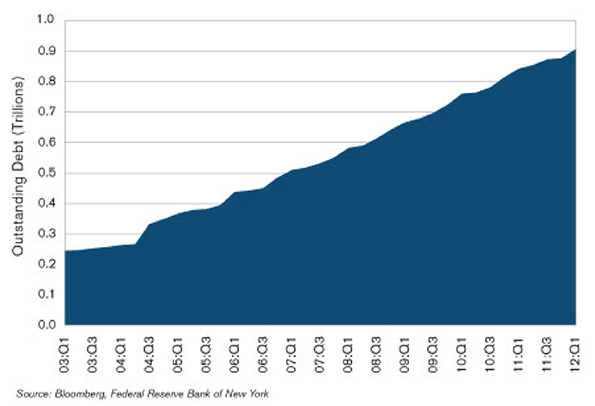
    Yet in an uncertain world, many are questioning the value of college. There’s significant talk of a “higher education bubble.”  Skyrocketing tuition rates and the correspondingly high levels of student debt has driven a lot of this. Tuition has been rising at a much faster rate than inflation overall. Total student loan debt is now at $1 trillion. And unlike other forms of debt, student loans can’t be easily discharged in bankruptcy.

    In many ways college finance does mirror the housing bubble. You’ve got an asset everyone believes will only go up in value, a multi-party transaction, a situation where the seller of the product (the college) gets their money up front and so is indifferent   to the student’s ability to repay, third parties  insured against loss by the federal government, a non-transparent market where each student is in effect charged a unique price, young and unsophisticated consumers who are told they “have to get” a college degree, financial products without any income requirements, and even worse the asset (a degree) doesn’t have a secondary market.

    All of these factors create a situation ripe for exploitation and abuse. Indeed, it isn’t hard to see that the massive increases in tuition cost are heavily driven by the ability of students to get huge loans with few questions asked. And as with the housing crisis, outright fraud by educational institutions is likely more widespread than commonly believed.  The University of Illinois law school falsified its admissions data, for example, by inflating its students LSAT scores. The “cockroach theory” (if you see one, there’s probably a lot more you don’t see) suggests that this type of behavior is probably rampant.

    Students and their parents are starting to wise up to the game, and the amount of student loan debt they think appropriate is plummeting. For example, in 2011 only 21% of people felt $20,000 in college debt was too much. Just a year later that percentage increased to 42%. In 2008, 81% of adults thought a college degree was a good investment. In 2012 that had dropped to 57%.  That’s a stunning decline in the number of people who think college is worthwhile, though it might suggest that the problem is less with the value of a degree itself than in how much is paid for it. But there are anecdotes to suggest that some feel college (especially graduate school) isn’t worth what it used to be.

    Why is that? In part it is surely the economy. Though degreed adults as a whole have lower unemployment, youth unemployment and probably more important underemployment remains high for college grads. A shocking 53% of recent graduates are jobless or underemployed. This has fed through into popular culture, with student loan debt relief being part of the grab bag of demands made by the various “Occupy” movements.  When you graduate from college with huge, non-dischargeable debts, and you can’t find a job, particularly in your chosen field, you no doubt complain loudly about this to your friends.

    But there’s also good reason to believe college is worth less today in many cases. Back in the 1980s and 90s the value of college was clear. Manufacturing was in decline. If you didn’t have a degree, you would probably struggle. In contrast, a college degree was like a golden ticket to success.

    Today, in the age of globalization, it’s not so simple. Those without degrees are still hurting, but so are plenty of people with degrees. The emerging new separation is not between those with degrees and without, but those in jobs that are subject to international competition (tradeable) vs. those that aren’t (non-tradeable). High skill, white collar workers like computer programmers suddenly found themselves in competition with much lower paid people in places like India. This upended that entire job market.  Today you might be better off as an ironworker or welder whose job has to be done on site than as an accounting manager whose entire department can be sent to the Philippines. A college degree is no longer a guaranteed passport to prosperity.

    Also, today’s technology driven world is changing so rapidly that skills learned in college can prove obsolete by graduation.  At the same time, open source frameworks and cloud computing have dropped the cost of starting a tech business to almost literally zero. In the dot com era, it took millions of dollars to buy servers and database licenses if you wanted to start a company. Today anybody can start a technology business in his bedroom.

    So if you’ve got a good idea, why wait around for graduation to get started? The role models here are Bill Gates and Mark Zuckerberg, who dropped out of Harvard but both got rich starting companies.  This dropping out of college to start companies is actively being encouraged by some folks like Peter Thiel, who is actually paying people to do it.

    What these modern day Timothy Learys overlook is what Bill Gates and Mark Zuckerberg already had in common. Namely, they had already gotten in to Harvard. If you make it to Harvard, you already probably come from a privileged background. Thus you’ve got a family safety net in place if things go south. Those from working class backgrounds aren’t so lucky. Indeed, I’m struck that many suggesting that college isn’t the answer are presently an upper-middle class or better situations.

    For a limited number of people, dropping out of or skipping school to start a business might make sense. But trend setters may manage to convince a significant numbers of kids from marginal backgrounds to forgo the college education —perhaps in a needed skill — that would provide necessary credentials and culturally acclimate them to the new economy world. Many of those kids don’t have a family cushion to fall back on.  For them, turn on, tune in, drop out is not the answer.

    The real answer isn’t to skip education, but to be more judicious about the decisions being made. Racking up large amounts of debt probably isn’t the right answer. The marketing promises of especially for-profit colleges should be heavily discounted. For some, getting education through going into a skilled trade may be a good choice. College majors that don’t deliver skills in demand in the marketplace or that aren’t considered valuable credentials by employers ought to be scrutinized. But getting an education remains one of the single best decisions any person can make.

    Aaron M. Renn is an independent writer on urban affairs and the founder of Telestrian, a data analysis and mapping tool. He writes at The Urbanophile.

    Graduation photo by Bigstock.

  • Thoughts on Chicago’s Tech Scene

    I’ve said before that I don’t think Chicago is well positioned to become some type of dominant tech hub, but should only seek to get its “fair share” of tech. However, as the third largest city in America, Chicago’s fair share on tech is still pretty darn big. If you look at what’s been happening in the city the last couple of years, I think you’d have to have to say it’s something real. Built in Chicago lists 1145 companies in its inventory, and that’s definitely something. I’ll give a bit of a mea culpa by admitting that the tech community has done better than I probably thought it would a couple years ago, though I still stand behind the statement I made at the beginning of the paragraph.

    Part of what has happened in Chicago is the general decentralization of technology in America. It used to be that tech in America was heavily concentrated in the Bay Area and Boston. In an era when pretty much literally anybody can start a company, you simply don’t need to be in any particular place to be successful these days.

    Mark Suster made this point in his Tech Crunch post, 12 Tips To Building A Successful Startup Community Where You Live:

    I would point out that these days there are really talented tech developers and teams everywhere. And I really mean everywhere. Ever play Zynga’s “Words with Friends” or any of their “with Friends” games? Didn’t come out of the SF facility. It came from an amazing small startup in McKinney, Texas (30 miles North of Dallas) called NewToy, which they acquired.

    Think the next big startup can’t come from Dallas? Think again. Angry Birds? From startup Rovio in Finland.

    Think USV is only invested around Union Square in NYC? How about in the last 12 months deals were announced with Dwolla (Iowa) and Pollenware (Kansas City). I met the Pollenware team myself – they were KILLER.

    In this environment, it’s possible for lots of cities to find success. This is why places like New York and Chicago have been table to reboot their tech ambitions, and why some of those hot startups Suster mentioned are in smaller Midwest cities. Strong tech/startup scenes have been emerging all over the country. Being a startup hub isn’t what it used to be in terms of joining a highly exclusive club.

    This is a case where there aren’t of necessity winners and losers. It isn’t like the Midwest can have just one tech center, for example, and thus the battle for Chicago is to be the winner, while everyone else gets to be a loser. The good news here is that Chicago can win and other places can win too. This might be one economic change that really can start rebranding a region.

    Not only has there been legitimate strength in the Chicago tech community of late, it is also starting to get some good press. For example, just this week the New York Times ran a story on tech businesses moving into the Merchandise Mart. (An unfortunate subtext of this piece appears to be a serious decline in Chicago’s vaunted design community, however). This is one of a number of positive pieces that have appeared recently.

    The city has really put on the full court press for tech, with Mayor Rahm Emanuel in effect making it the signature economic development cluster of his administration. I cannot think of any other sector of the economy in which Emanuel has so put his personal imprimatur. He has repeatedly stood up to endorse Chicago tech and its ambitions, and I think it’s fair to say he’s got a lot riding on it being successful – and not just successful, but an outsized success compared to peer cities.

    Rahm has also put city action behind the marketing. For example, making an open data push, and also the recent broadband deployment initiative to underserved areas.

    The trendlines certainly appear positive for Chicago at this point, but I want to highlight a few areas I find lacking and/or risky to the future.

    The Booster Club Society

    I’ll lead off a video from last year’s Chicago Ideas Week. This is JB Pritzker’s keynote at the Midwest Entrepreneur’s Summit. (If the video doesn’t display for you, click here).

    This is a pretty good talk, but thinking about it a bit, a few things jumped out at me.

    First, this is a talk in the finest tradition of “the sun is always shining on Chicago.” I’ve noted many times that under the Daley administration there was in effect a gag rule against saying anything that could be construed as even slightly negative about the city. I’ve noticed a change in that under Emanuel, but there’s one big exception, and that’s the tech sector. In Chicago tech pretty much everybody is pretty much 100% on the rails of the marketing message all of the time.

    Listening to this, you’d think Chicago basically is tech nirvana, with the exception of a central gathering place for techies, something that Pritzker conveniently has a plan to create. Strong as Chicago may be, I can’t believe everything could possibly be this rosy. Similar sentiments from various members of the tech community are prominently on display in pretty much every article out there.

    There’s nothing wrong with being a champion for your city, but when you become too much the booster club society, it’s not healthy. A little more paranoia and a little less spin would probably do the city good. Chicagoans would clearly recognize the excess earnestness that characterizes such rhetoric if they saw it in another city – I see it all over the place, as all kinds of cities make the case for why they too are one of the next great tech hubs by closing ranks and presenting a unified, totally positive marketing front to the outside world – so I’d suggest they think about how they’d evaluate the statements they make if those same statements were being made by boosters of another place like say Kansas City.

    Here’s another example. Announcing some additional protected bike lanes, Rahm Emanuel had this to say:

    It’s part of a planned bike lane network that Mayor Rahm Emanuel on Sunday said will help Chicago to attract and keep high tech companies and their workers who favor bicycles.

    “By next year I believe the city of Chicago will lead the country in protected bike lanes and dedicated bike lanes, and it will be the bike friendliest city in the country,” Emanuel said Sunday at Malcolm X College.

    “It will help us recruit the type of people that have been leaving for the coast. They will now come to the city of Chicago. The type of companies that have been leaving for the coast will stay in the city of Chicago.”

    I like protected bike lanes. I applaud Chicago’s protected bike lane program. But this is a bit over the top. I got unsolicited email from as far away as the West Coast mocking this.

    I think Emanuel’s media savvy and willingness to sell Chicago is a big plus for the city. But he has had a tendency to sometimes step over the line and make extravagant statements that just don’t pass the sniff test. I think this comes from his days in Washington where that sort of thing is expected, understood, and discounted by everyone. It’s just the way the game is played there. But for mayors there’s a different standard of judgement. Yes, everyone expects you to make the aggressive case for your city. But mayoral statements that seem un-moored from reality – like the various claims that have been made about crime and shootings, for example – end up calling into question the truth of everything else you say. This in my view is a danger for Rahm or anyone else who has been overly steeped in Beltway style communications.

    So I would suggest that Chicago continue to be aggressive on marketing, but tone down some of the orgasmic rhetoric and take care that they don’t end up believing too much of their own press. This can be a fine line to walk. I hope that in private at least the city’s tech community has a huge punch list of things that need to be better they are actively working on.

    Better Tech Media

    Another aspect of Pritzker’s talk that jumped out at me immediately at the time he gave it (I attended the event), was his failure to mention that Chicago already had a very successful version of his own 1871 incubator called Tech Nexus. Tech Nexus is a self-described “clubhouse” for Chicago’s tech community, a co-working space, and an incubator (ranked one of the top ten in the United States by Forbes) that has served over 100 companies. Tech Nexus also hosts tons of meetups and other events, and through the affiliated Illinois Technology Association has been an instrumental booster of the Chicago tech scene the last few years.

    Now Pritzker did mention them in passing in a long list of institutions he gave in the talk. But to claim Chicago lacked the central gathering place for tech until he, JB, rode to the rescue with 1871 is a) not true and b) pretty obviously a deliberate snub of Tech Nexus.

    I certainly don’t think everybody needs to be on the same page in a city’s tech community. I actually think that would be a weakness. I think it’s healthy to have different groups of people with different visions each pushing them. Building a space like 1871 is a positive. The more the merrier I say. But this type of talk smells to me like pretty much just a political power play in the Chicago tech community.

    Speaking of which, Pritzker may be a venture capitalist, but he’s also an heir to the Pritzker family fortune and one of the richest men in America. (Oh, the irony of having as the keynote speaker for your entrepreneurship conference a guy who inherited over a billion dollars – that tells you a lot about how Chicago works). The Pritzkers have long been power players in Chicago and a key part of what I’ve called the Nexus. So being on the executive committee of World Business Chicago is not so far a leap as he may have us believe. (I also wonder if perhaps Pritzker is the guy who convinced Emanuel to make the very risky move of piling all those chips on the tech square, as he’d appear to be one of the few guys with an interest who would have the clout to do it).

    My point here isn’t to bash JB Pritzker, but rather to wonder why no one is asking questions or talking about stuff like this in the press. There are lots of very rich guys with no doubt big egos involved Chicago tech. There’s bound to be lots of interesting politics and personality clashes and maneuverings going on behind the scenes. I want to be able to pop some popcorn and follow the drama. But it doesn’t get covered. I think the local media is basically out of their depth when it comes to covering Chicago tech.

    My believe is that Chicago needs a new, independent media source covering the local tech market. This would not be part of the marketing machine of Chicago tech, though like TechCrunch would of course be institutionally favorable to the industry, but instead would provide real, credible coverage of the what’s what and who’s who of the community. As Mark Suster said in the post I linked to earlier, “Local press matters.”

    In my review of Enrico Moretti’s book, I noted how he took a face value some mainstream media reports on how tech giants like Facebook were acquiring startups just to get their talent while shutting down the actual companies. He apparently didn’t read Gawker, which gave a fuller story. New York tech community also benefits from other sites, such as the irreverent Betabeat from the New York Observer. Suster mentions sites like GeekWire in Seattle and SoCalTech as well but I don’t know them personally so can’t say they’d be the models to replicate.

    In any event, I believe Chicago needs a first class tech media site. A site like Technori does a good job, but it strikes me more as a “how to” site than a media property. Chicago needs a someone asking tough questions, and looking at the people and politics around tech, not just the bits and the bytes. Because IMO the traditional Chicago media hasn’t really shown any interest in pursuing this.

    Why Digital?

    I’m also a bit puzzled as to why Chicago is leading its marketing with the digital/social media/consumer space. Obviously Groupon (which seems to be in the process of getting airbrushed out of the Chicago tech politburo photo) played a role in this. But this seems like a shaky place to stake a claim. I don’t see consumer type brands as Chicago’s strong suit, and the digital market seems weak in any case. Even juggernaut type companies like Facebook and Groupon have struggled financially. There’s a big question mark over the whole space. What’s more, it seems like lots of places, ranging from San Francisco to New York, are rushing to tell basically the same story in digital and are frankly ahead in the space.

    By contrast, Chicago has a long and successful history of business to business and information technology. Flip Filipowski’s Platinum Technology was a great example of this. These types of companies might not have the sexiest brands, but they deliver value and make money. What’s more, because of the support demands of corporate clients, these businesses often employ a material amount of highly skill, highly paid people, unlike most digital startups.

    Also, Chicago has been a major center of corporate IT for a long time. This is often not valued by the pure tech crowd, but is a huge source of value and good paying jobs. Terry Howerton (who runs TechNexus) said of State Farm:

    “State Farm has 12,000 employees in IT in Bloomington,” Howerton said. “I’m sure many of those employees are really smart people, but how innovative can you be with 12,000 IT workers in your bureaucratic corporate environment in an industry as historic as insurance?”

    Well, to start with, 12,000 IT employees is likely more than the total local employee count of every digital startup in Chicago combined. And that’s just one company. Howerton is the best advocate out there for a B2B vision for Chicago tech, but I would also add the IT part to the equation as well.

    Chicago’s IT shops have a long track record of innovation going back to before a lot today’s digital folks were even born. Walgreen’s Intercom system, for example, linked all their pharmacies nationwide together back in the 1980s so that you could get your prescription refilled anywhere you needed it. And they didn’t have today’s open systems and frameworks to make life easy. They had to use a proprietary satellite system and a specialized high volume, 24×7 uptime mainframe operating system called TPF (originally developed for airline reservations). I’m not sure most of today’s digital coders could figure out how to build and support a TPF application if their lives depended on it.

    Given Chicago’s heritage as a center for professional and business services, and corporate headquarters, I believe its natural strengths in technology are in B2B tech companies, technology consulting, and corporate IT. If you can get digital/consumer startups that’s great, but I wouldn’t make that the public face of the city. Instead, take all that corporate services mojo and embed it in tech.

    The Big Risk

    If you look at what I’ve written about changes so far, most of them are tweaks around the margins. They don’t indicate core weaknesses. Frankly they are sort of nit-picky. That should tell you something. As I said, I think the Chicago market has been doing well – better than I thought it would. I’m not even concerned about the so-called “developer drought” of which I’m extremely skeptical (see more here).

    But there’s one thing that is a clear risk to Chicago, one that could undo all its effors – and it’s one that the city can’t do anything about. That’s the risk of another tech crash.

    Technology is very cyclical. Every so often, Silicon Valley has had a major crash. I believe it is these crashes that have actually helped to keep the tech industry concentrated in its major hubs. That’s because when crashes come, industries retrench and reconsolidate. For example, Joel Kotkin has said that it was actually the 1980’s energy crash, the one that devastated Houston, that actually helped trigger the industry consolidation there. We’re seeing something similar in media, where financial pressure is consolidating it into NYC and to a somewhat lesser extent DC while secondary markets get wiped out.

    So too in tech. Think about the dot com era. Lots of cities had their startup dreams back then too, and it seemed like parts of the country outside the major hubs would be able to get their bite at the apple. Chicago had its “Silicon Prairie” and New York its “Silicon Alley.” All of them got blown up by the dot com crash. But Silicon Valley and Boston survived. Chicago and New York tech eventually came back, but it was on a totally new basis.

    There’s a tendency locally in Chicago to now talk about the flaws of the city’s tech ambitions in the Silicon Prairie days in contrast to how it now has its act together. The idea is that Silicon Prairie collapsed because people didn’t get along, or because they chased away their entrepreneurs, etc. But the reality is that it most likely collapsed simply because the market did, not because of flaws or mistakes. I’m not convinced there’s anything the city could have done to survive that shakeout. And if another crash hit, the same thing might easily happen all over again.

    We’re seeing the early part of the cycle repeat again today. We’ve had a frothy investment climate with a spread of tech around the country to a whole slew of me-too places. But as I said, the whole digital startup thing has questions marks. It’s not clear that there’s a lot of sustainable, cash generating businesses out there. Many of them (e.g. Groupon) are not even really tech companies. A lot of them are basically media type entities, and like much media in the world have more eyeballs than profits.

    Regardless of whether the digital wave crashes soon, another tech crash would appear to be inevitable at some point. If it happens at a time when Chicago hasn’t built some sort of a sustainable franchise, that would be bad. Right now, I don’t believe the Chicago tech scene as currently conceived would survive a major crash. I’m somewhat skeptical New York’s would either. That’s not because the city is doing anything wrong, but because of where it is in the maturity cycle.

    That is really the key weakness in the Chicago story. It’s not the fortress hub that Silicon Valley is. I believe it is benefiting from a general decentralization of tech along with a boom cycle investment climate. That can be very good for Chicago, but unless and until it can turn the corner into something that can survive the next big crash, there will continue to be a major question mark over its viability.

    This is what I find most interesting about Rahm’s all-in bet on tech. The last go round ended badly. There’s lots of reasons to believe Chicago can be a strong player in the current market, but the city doesn’t have intuitive structural advantages that would make it a slam dunk candidate to become a fortress hub in tech. The digital market is looking somewhat questionable, as the stock charts on Groupon and Facebook show. This was a risky bet. Not to say a bad one, but a risky one. That’s why I think it would be a very intriguing story to find out how it came to be.

    In the meantime, while we wait for the judgement of history, Chicago should enjoy where it’s at, build on the present success, and look to shore up those addressable areas of weakness around an excessive booster club mentality, the need for stronger media, and getting away from an overly digital based marketing approach to Chicago tech.

    Aaron M. Renn is an independent writer on urban affairs and the founder of Telestrian, a data analysis and mapping tool. He writes at The Urbanophile, where this piece originally appeared.

    Photo by Doug Siefken
  • Where Do You Live?

    I recently moved to Providence, Rhode Island, where I live in the town of West Warwick. I’ve been learning the place more and soaking in New England culture (and seafood). This area has a Rust Belt type profile: declining population, post-industrial economic landscape, high unemployment, etc. So I’ve been trying to get a handle on conditions and think a bit about what the opportunities are.

    I have been really struck by the way people here seem to think about their geographic identity. All of us have various layers of identity. Some of these are more primary than others. But let’s consider three possibilities in trying to answer the basic question “Where do you live?” Those are your state, your metro, or your town. Which of these forms the most important basis of identity?

    My observation so far is that most people here think of themselves first as Rhode Islanders, and secondly as residents of their town. Providence, possibly because at 178,000 people it’s fairly small, is sort of seen as just another town. (Southern Massachusetts is maybe seen as a type of Canadian province with its own collection of towns).

    So what? you might ask. Unit recently I probably would have said that it doesn’t matter that much. But now I see that it has a profound effect on creating the lens through which people process the world. Here are some local implications.

    First, it leads people to exaggerate the uniqueness here. Rhode Island is geographically the smallest state, and also quite small in population. I heard people say that only in Rhode Island can you get pretty much every leader in the place to show up for a conference on the state’s economic future. If your worldview is the state, that may be true. But if your worldview is metro area, I think there are many similar sized regions that could pull this off. There are many things that appear unique if your lens is Rhode Island that are not if your lens is Metro Providence. It may be that there’s uniqueness in the small geography of Rhode Island from the standpoint of state policy, but if I may be so bold, this is hardly its strong suit. (But for a positive example of how this can work in a place like Rhode Island where it’s more difficult elsewhere, see the example of pension reform).

    Second, the economic geography of the new economy is metro regions. When you look state first, you are missing the bigger picture. If you doubt that the metro area is the primary economic unit, I suggest spending some time perusing material over at the Brookings Institution. States are more or less irrelevant economically, except that they can screw things up for the metro and non-metro regions they contain.

    Third, Providence is a bi-state metro area that includes Southern Massachusetts. You can also see Providence as an extended node in the Greater Boston economy. If you look primarily at the state, you miss this, or even see Massachusetts as the competition. You also lose about 60% of the population scale you have to work with.

    Fourth, when you look state first, your natural inclination is to compare yourself against other states. In Rhode Island’s case, there really aren’t many similar places, so the default is other New England states. On the other hand, one can imagine many similar Rust Belt type metros to compare Providence too. Places like Buffalo, Pittsburgh, and Cleveland come to mind. Of course these aren’t exactly the same, but they’ve been grappling with the legacy of de-industrialization seriously for a really long time. There have got to be many things that could be learned by studying and networking with these areas. There’s a lot of pan-Rust Belt discussion going on these days, but Providence isn’t part of it. This is part of that new economic geography of cities I was talking about.

    In short, I think treating state identity as primary has problems. Rhode Island is most certainly not the only place where this crops up, but it is noticeable here and perhaps more important here since the state is a subset of a metro geography instead of a superset.

    Aaron M. Renn is an independent writer on urban affairs and the founder of Telestrian, a data analysis and mapping tool. He writes at The Urbanophile, where this piece originally appeared.

    Downtown Providence photo by Bigstock.

  • A Look at Commuting Using the Latest Census Data

    Continuing my exploration of the 2011 data from the American Community Survey, I want to look now at some aspects of commuting.

    Public Transit

    Public transit commuting remains overwhelmingly dominated by New York City, with a metro commute mode share for transit of 31.1%. There are an estimated 2,686,406 transit commuters in New York City. All other large metro areas (1M+ population) put together add up to 3,530,932 transit commuters. New York City metro accounts for 39% of all transit commuters in the United States.

    If one were to guess the #2 city for transit commuting, another older, pre-auto, centralized city on the lines of New York (say Chicago) might be the obvious guess. It would also be wrong. It’s actually Washington, DC that has the second highest transit commute share among large metros at 14.8%. Here’s the complete top ten:

    Rank

    Metro Area

    2011

    1

    New York-Northern New Jersey-Long Island, NY-NJ-PA

    2,686,406 (31.1%)

    2

    Washington-Arlington-Alexandria, DC-VA-MD-WV

    439,194 (14.8%)

    3

    San Francisco-Oakland-Fremont, CA

    299,204 (14.6%)

    4

    Chicago-Joliet-Naperville, IL-IN-WI

    503,535 (11.6%)

    5

    Boston-Cambridge-Quincy, MA-NH

    267,568 (11.6%)

    6

    Philadelphia-Camden-Wilmington, PA-NJ-DE-MD

    251,285 (9.3%)

    7

    Seattle-Tacoma-Bellevue, WA

    137,858 (8.1%)

    8

    Portland-Vancouver-Hillsboro, OR-WA

    66,619 (6.3%)

    9

    Los Angeles-Long Beach-Santa Ana, CA

    355,811 (6.2%)

    10

    Baltimore-Towson, MD

    80,472 (6.1%)


    Not only are New York and Washington top two cities for public transit commuting, they are also the two cities that have been dominant in increasing transit’s market share. Both cities showed material share gains since 2000, over three and a half percentage points each, for transit. Among large cities, Seattle was the only one that managed to post a share gain of even one percent.

    Rank

    Metro Area

    2000

    2011

    Change in % of Workers Age 16 and Over

    1

    New York-Northern New Jersey-Long Island, NY-NJ-PA

    2,181,093 (27.4%)

    2,686,406 (31.1%)

    3.74%

    2

    Washington-Arlington-Alexandria, DC-VA-MD-WV

    278,842 (11.2%)

    439,194 (14.8%)

    3.61%

    3

    Seattle-Tacoma-Bellevue, WA

    106,784 (7.0%)

    137,858 (8.1%)

    1.17%

    4

    Orlando-Kissimmee-Sanford, FL

    12,601 (1.6%)

    24,901 (2.5%)

    0.91%

    5

    Hartford-West Hartford-East Hartford, CT

    15,755 (2.8%)

    21,794 (3.7%)

    0.91%

    6

    Charlotte-Gastonia-Rock Hill, NC-SC

    9,532 (1.4%)

    19,227 (2.3%)

    0.91%

    7

    San Francisco-Oakland-Fremont, CA

    278,207 (13.8%)

    299,204 (14.6%)

    0.81%

    8

    Los Angeles-Long Beach-Santa Ana, CA

    287,392 (5.6%)

    355,811 (6.2%)

    0.67%

    9

    Miami-Fort Lauderdale-Pompano Beach, FL

    67,685 (3.2%)

    95,536 (3.8%)

    0.61%

    10

    Nashville-Davidson–Murfreesboro–Franklin, TN

    5,574 (0.8%)

    10,705 (1.4%)

    0.55%


    Vaunted Portland only managed to eke out a share gain of 0.07%, which could be entirely statistical noise. Its performance lagged even auto-centric cities like Charlotte and Nashville.

    Bicycling

    Every city out there seems to be vying to be the bike friendliest city in the world. Yet bicycling has yet to make much of an impact on commuting. Only 7 out of 51 large metros even post 1% mode share for cycling:

    Row

    Geography

    2011

    1

    Portland-Vancouver-Hillsboro, OR-WA

    23,941 (2.3%)

    2

    San Francisco-Oakland-Fremont, CA

    38,419 (1.9%)

    3

    San Jose-Sunnyvale-Santa Clara, CA

    16,013 (1.9%)

    4

    Sacramento–Arden-Arcade–Roseville, CA

    15,804 (1.8%)

    5

    Austin-Round Rock-San Marcos, TX

    8,847 (1.0%)

    6

    New Orleans-Metairie-Kenner, LA

    5,307 (1.0%)

    7

    Phoenix-Mesa-Glendale, AZ

    18,007 (1.0%)

    8

    Seattle-Tacoma-Bellevue, WA

    15,949 (0.9%)

    9

    Denver-Aurora-Broomfield, CO

    12,052 (0.9%)

    10

    Los Angeles-Long Beach-Santa Ana, CA

    50,080 (0.9%)


    Portland grew bicycle mode share by 1.51% Perhaps this explains its poor transit performance. Cycling is canabalizing transit growth.

    Walking

    The low level of bicycling can perhaps best be illustrated by comparing it to walking. Even in Portland more people walk to work than ride bikes.


    Rank

    Metro Area

    2011

    1

    New York-Northern New Jersey-Long Island, NY-NJ-PA

    540,733 (6.3%)

    2

    Boston-Cambridge-Quincy, MA-NH

    121,537 (5.3%)

    3

    San Francisco-Oakland-Fremont, CA

    87,409 (4.3%)

    4

    Philadelphia-Camden-Wilmington, PA-NJ-DE-MD

    101,107 (3.7%)

    5

    Seattle-Tacoma-Bellevue, WA

    62,238 (3.7%)

    6

    Pittsburgh, PA

    36,857 (3.4%)

    7

    Portland-Vancouver-Hillsboro, OR-WA

    35,242 (3.4%)

    8

    Rochester, NY

    15,573 (3.2%)

    9

    Washington-Arlington-Alexandria, DC-VA-MD-WV

    94,698 (3.2%)

    10

    Chicago-Joliet-Naperville, IL-IN-WI

    134,399 (3.1%)


    Working from Home

    Looking at telecommuting gives a much different list of top cities, this one dominated by “wired” metros like Austin and Raleigh. The share of telecommuters in these cities is bigger than walking or biking, or even transit in many cities. This is an oft-overlooked part of the green transport agenda. The most green commute possible is the one you never have to make.

    Rank

    Metro Area

    2011

    1

    Austin-Round Rock-San Marcos, TX

    62,593 (7.1%)

    2

    Raleigh-Cary, NC

    37,030 (6.6%)

    3

    Portland-Vancouver-Hillsboro, OR-WA

    67,223 (6.4%)

    4

    San Francisco-Oakland-Fremont, CA

    131,029 (6.4%)

    5

    San Diego-Carlsbad-San Marcos, CA

    89,547 (6.3%)

    6

    Denver-Aurora-Broomfield, CO

    76,025 (5.9%)

    7

    Phoenix-Mesa-Glendale, AZ

    105,570 (5.8%)

    8

    Sacramento–Arden-Arcade–Roseville, CA

    52,143 (5.8%)

    9

    Atlanta-Sandy Springs-Marietta, GA

    132,979 (5.5%)

    10

    Seattle-Tacoma-Bellevue, WA

    87,839 (5.2%)


    Commute Times

    Unsurprisingly, large cities – including New York and Washington again at the top – feature the longest average commute times. Larger cities tend to have worse congestion and feature longer commutes. As transit commutes are generally longer than driving, the high transit mode share helps to drive up commute times in those cities.

    Rank

    Metro Area

    2011

    1

    New York-Northern New Jersey-Long Island, NY-NJ-PA

    34.9

    2

    Washington-Arlington-Alexandria, DC-VA-MD-WV

    34.5

    3

    Riverside-San Bernardino-Ontario, CA

    31.0

    4

    Chicago-Joliet-Naperville, IL-IN-WI

    30.9

    5

    Atlanta-Sandy Springs-Marietta, GA

    30.6

    6

    Baltimore-Towson, MD

    30.3

    7

    Boston-Cambridge-Quincy, MA-NH

    29.2

    8

    San Francisco-Oakland-Fremont, CA

    29.2

    9

    Los Angeles-Long Beach-Santa Ana, CA

    28.6

    10

    Philadelphia-Camden-Wilmington, PA-NJ-DE-MD

    28.5


    Whether New York might prefer a more auto-oriented layout in order to reduce commute times is a different matter. There’s no precedent for such a huge region having anything less than terrible congestion and commute times. And clearly New York would not be New York with such a radical change. The same forces that drive up commute times in places like New York and Washington are some of the same forces that sustain them as centers of elite economic production.

    Note: An early version of this piece contained an incorrect version of “Working from Home” table.

    Aaron M. Renn is an independent writer on urban affairs and the creator of Telestrian, a data analysis and mapping tool. He writes at The Urbanophile.

    Light trails photo by Bigstock.

  • Rethinking Brand Chicago

    So many Midwest places flail around looking for a brand image or identity. Not Chicago. In fact, the identity and stories of Chicago overflow the page. They are too numerous to be written in a mere blog posting.

    Yet Chicago has in effect decided to jettison that powerful, historic brand identity in favor of a type of global city genericism. This, I believe, is a mistake.

    One trend you can’t help but notice if you travel is the increasing homogenization of the urban culture and standard of urban development. Global markets demand standardized commodities that can be graded and traded. This includes cities. This forces cities increasingly into a standard model of what one expects.

    I’ve written in the past about the example of the Wallpaper guides to world cities. These travel guides, ostensibly a guide for the modern, sophisticated urban traveler to the best of each globally elite locale, often seem identical except for the name on the spine. One modern boutique hotel, one swank restaurant or bar, one fashion outlet, one bike share program, one piece of starchitecture is much the same as another in any city you visit around the world. The frosting might be different, but the cake is the same. And once you’re commoditized, you’re done.

    So it is too with Chicago. I noted in my review of the city’s street lighting what appears to be a deliberate downplaying of the city’s rough-edged, masculine past in favor of a feminized, generic, even suburban motif. You see this repeated throughout.

    It’s truly incredible. Travel anywhere in the world in mention that you’re from Chicago, and immediately the other person will mime a couple of pistols with their fingers and say, “Bang! Bang!” This is a sore spot with many local leaders, who hate the notion that it is still known more for gangsters than glitter. The city over the years has so tried to suppress its Al Capone heritage that it has obliterated many historic sites related to the mob. It’s like the city that wants to pretend it doesn’t exist.

    This sadly makes Chicago like all too many smaller cities that suppress their strongest brand assets out of embarrassment and a desire to be taken seriously by members of the cool kids club. Go talk to urban boosters in Indianapolis, and you probably won’t hear much about the Indy 500, for example. So too it is with Chicago. It’s as if to prove it’s a member of the club – i.e., is exactly like every other cool city – Chicago has to ignore its gritty past and essential culture.

    A friend of mine likes to say that “Chicago is a city that runs on testosterone.” It’s a rugged, manly city, a place where it was said high culture was just the ransom rich men paid to their waves. A place where people wore their shoe leather out trying to make a buck. The land of the hustler. A place of bellowing blast furnaces and brawny immigrants. A place where pedigree didn’t matter and crazy newcomers, dreamers, schemers, and gamblers could win or lose big. A place with audacious ambition and a relentless determination to demolish rivals, whether that be Cincinnati, St. Louis, or Milwaukee. A place that once dreamed to dethroning New York. A place of limitless imagination and inventiveness that brought us everything from the skyscraper to the futures market. A place with music like the blues made for and by the hard luck working man. And yes, a place of gangsters and crooked politicians.

    None of that is part of new Chicago, at least not the image the city wants to portray. The iconic architecture remains, but it has been drained of its cultural content. Listen to what the city tries to project of itself and see what it says. It says that Chicago has become just another way-station along the global city parade. Starchitecture (no longer architecture made in Chicago for the most part), microbrews and microroasts, culinary delights, high culture, boutique hotels, great shopping, bike infrastructure, digital startups (the exact same type every other “hub” is bragging about), music festivals by and for the high end educated hipster, global conferences, etc. Almost every box is checked, with a few exceptions like fashion and media as I highlighted earlier.

    All of this is good in a way and proof of a transformation in Chicago that is in many ways for the better. But something has been lost along the way. These items are all disconnected from the city in which they happen to reside. It’s as if they descended on the place out of the heavens like that flying saucer on top of Soldier Field. Drawing Room mixologist Charles Joly may have a Chicago flag tattooed on his arm, but his bar could be located anywhere.

    Saskia Sassen has written that the economies of global cities are not generic but are inherently linked to their histories. Chicago in the past was a great center of manufacturing, for example, and today is expert at providing global services to manufacturers. But where in underlying economic reality there may be distinctiveness, on the surface there is more homogenization. This may explain why people tend to assume all global cities are alike. To a visitor staying in the central core, the experience may well be quite similar in many ways.

    What’s more, the aspiration seems to be generic. The idea, again, is to demonstrate that you are part of the club by focusing on replicating all the same stuff everybody else is already doing and talking about yourself in much the same way. I’ve seen little in Chicago’s branding or global city rhetoric that is much different from anywhere else.

    Yet the differences remain, especially outside the rarefied precincts of the global elite. And much of that continues to inspire embarrassment to this day. Corruption and cronyism seem to continue unabated, for example.

    Yet there is good as well. Ask yourself what more than anything epitomizes Chicago. To me, it is none other than former Mayor Richard M. Daley. Listen to him speak. Barack Obama he is not. But character he had, lots of it, and what’s more, a fanatical dedication to making Chicago the best city it could possibly be. Was there a lot of corruption in Daley’s Chicago? No doubt. Did he desire to have maximum power over politics in his city? Of course. But nevertheless I get the impression of, as I said in my last piece, a guy who every morning wakes up and asked himself, “What can we do today to make Chicago a greater city?” This is a quality of leadership all too lacking in most Midwestern cities. The character of Chicago and the character of Mayor Daley himself seem to me to have so much in common.

    Ironically, under Mayor Daley, the city pursued that policy I mentioned of abandoning its past, of abandoning the image of the city as evidenced by the mayor himself. You walk down Michigan Ave., through Millennium Park, around the newly thriving neighborhoods, and you expect that city to be led by a Dr. Smooth type character, not a blunt, plainspoken man like the Mayor. But if only he had seen the value in a city that presented a face like his own. A city not ashamed but proud of its rough and tumble edge, of the fact that it was where generations of ne’er-do-wells and hustlers came to wear out their shoe leather trying to make it big, a city that both Al Capone and Paddy Bauler thought not ready for reform, a city that drew generations of farm boys off to its earthly delights, a city from Bridgeport not the Gold Coast. That’s Chicago. Not a genteel, refined metropolis, not a swank, sophisticated type of town, not a city on a hill. No, but a city of dreams nevertheless, where people came to get rich, to reinvent themselves, to change the course of world history. That’s Chicago.

    No, Chicago will never be the Chicago of Cyrus McCormick and Philip Amour and Aaron Montgomery Ward and all the rest. You can’t live off the past. That’s nostalgia and there’s no more corrosive force known to mankind. But you can know who you are, what you stand for, what your heritage is, and how it fits into the future. Not a clinging to the past, but letting your essential character be a guidepost to the future.

    The fifth Frank Gehry titanium Bilbao clone, the n-th swank restaurant or shop, the latest in Italian furniture – ultimately none of them will make Chicago Chicago. It’s going to take the real city, an expression of its own terroir and primal identity to do that.

    I happen to think Chicago can do it. If it changes course and gets way from following the trends to creating its own future. If it steps up and makes sure the world knows that Chicago, and not just yet another generic world city, is here, and determined to claim its rightful place.

    Chicago will only realize its potential for greatness if it is willing to let go of its insecurity and desire to be a member of the club, and dares once again to think of itself as it did back in the days of the Burnham Plan as a city destined to be the greatest in the world, a city proud of itself and not afraid to boldly chart its own course into the great unknown of the future.

    Is Rahm Emanuel is the person who can pull this off? He’s from the North Shore. He was a ballet dancer. He’s a man clearly most comfortable dealing with the elite. Yet he’s also got a rougher side. He’s supposedly Captain F-Bomb. He hates to lose. He mailed some dead fish to a someone once to show his displeasure with some polling. I’d say there’s more than a streak of authentic Chicago in there.

    Maybe the bigger question is whether he wants any change of course. The NATO Summit play suggests not. But it’s still early.

    I would strongly urge the city to rethink its brand and what it wants to be in the marketplace. Bottle up some that classic Chicago heritage and apply it liberally. This is a huge opportunity in the marketplace. With the vast bulk of cities trying to convince you they are all the same, this is in opportunity for Chicago to seize the advantage and stride forth with classic boldness and braggadocio, making other cities take real notice for a change. Want to actually put Chicago on the brand consciousness map? That’s the way to do it.

    In short, it’s time to stop aspiring to global city goo and instead give the world a punch in the face with a little old school Chicago.

    This is the fourth installment in my “State of Chicago” series. Read part one here, part two here, and part three here.

    Aaron M. Renn is an independent writer on urban affairs and the founder of Telestrian, a data analysis and mapping tool. He writes at The Urbanophile, where this piece originally appeared.

  • The End of the Road for Eds and Meds

    In the last few decades, as suburbanization and deindustrialization devastated so many cities, they turned to two sectors that seemed not only immune to decline, but were actually growing: universities and hospitals. The so-called “eds and meds” sectors, often related through university affiliated hospitals, became a great stabilizer for many places. For example, the fabled Cleveland Clinic cushioned the blow of manufacturing decline in that city.  Après steel, a city like Pittsburgh practically saw themselves as defined by an eds and meds economy, with the new economic pillars being the University of Pittsburgh Medical Center and Carnegie-Mellon University.

    Perhaps unsurprisingly, these sectors have come to dominate so many cites’ economic development strategies. It’s harder to find a major city that isn’t touting some variation of a life sciences “cluster” as a strategic industry than one who is, and local medical schools and hospital complexes feature prominently in this. Similarly, technology transfer from schools is supposed to power startups, while in many cities growth in the number of students itself is supposed to be an engine of growth. For example, there are 65,000 students in the so-called “Loop U” collection of colleges in downtown Chicago, and education growth has been a bulwark of the Loop economy.

    Yet in reality, overreliance on eds and meds is problematic. Firstly, these tend to be non-profit, and thus reduce the tax base in cities that are dependent on them. In danger of bankruptcy, Providence, Rhode Island was forced to ask for special contributions from Brown University and RISD, for example. Also, as quasi-public sector type entities, eds and meds are seldom a source to dynamism in communities in and of themselves.  Indeed, universities are among the most conservative of institutions in many respects.  Witness the firing and re-hiring of University of Virginia president Teresa Sullivan, for example, or faculty protests against the appointment of Indiana Governor Mitch Daniels as Purdue University’s next president due to his lack of an academic background.

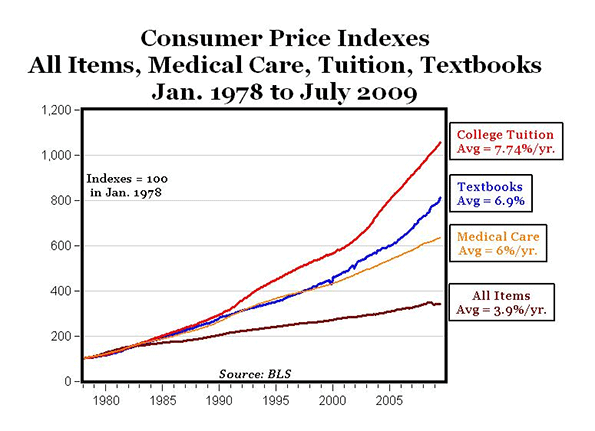
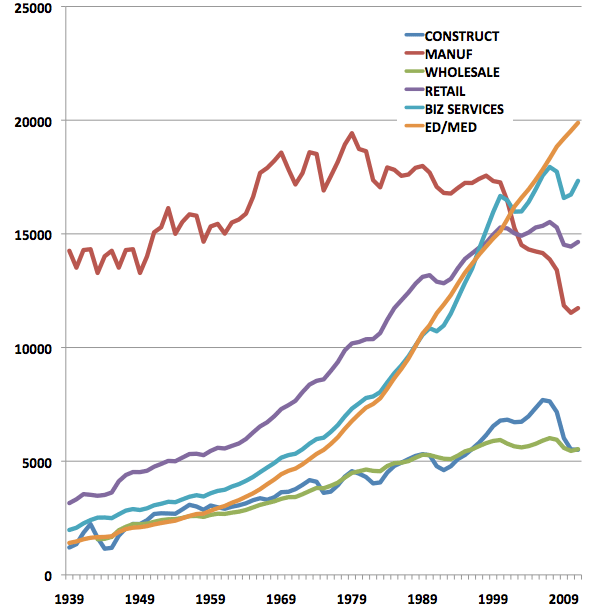
    But for cities hanging their hat on eds and meds growth, a more fundamental problem now looms: these industries are at the end of their growth cycle. Spending on healthcare and college tuition costs has been skyrocketing at rates greater than inflation for years.  Here’s a chart, via Atlantic Cities, showing job creation by sector since 1939:


    If eds and meds employment has been going up continuously since 1939, what’s the problem?  None, so long as it started from a low base at a time when other productive sectors of the economy were likewise growing strongly. But as sectors like manufacturing went into decline or stagnated, eds and meds has continued to increase relentlessly, accounting for an ever larger  portion of total growth.  For example, between 1990 and 2008, eds, meds, and government accounted for about 50% of all national job growth.

    Unsurprisingly, with growth in jobs exploding, costs have followed. Medical costs and tuition have been growing at twice the rate of inflation, and at an increasingly divergent rate, as this chart from Carpe Diem shows:

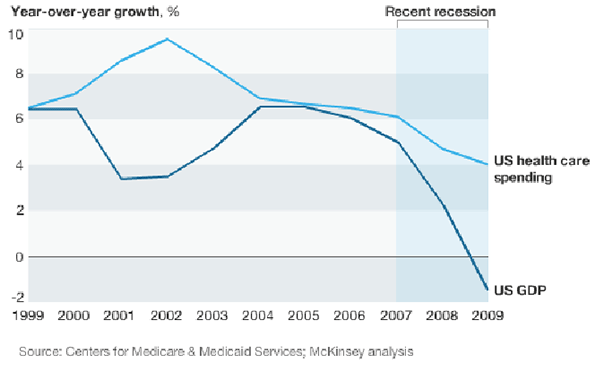
    Clearly, such a trend cannot go on indefinitely. As the US starts to groan under the weight of spending on health care and higher education, it’s clear that, as a society, we need to be spend less, not more on these items as a share of national output.  Some cities with unique strengths, like Boston, with its many specialized biotech firms, or Houston, with the world’s largest medical center, may thrive in this environment, but the vast majority of cities are likely to be very disappointed in where eds and meds growth will take them.

    The problem with health care is most obvious. Aggregate spending on health care has been exceeding the inflation rate for many years. According to a report by McKinsey, spending on health care has consistently grown faster than GDP:


    The net result is a sector that has been consuming an increasing portion of the national economy.  Health care spending is projected to consume fully 20% of the entire US economy by 2021.

    The health care reform act will do little to nothing to rein in this cost. It’s difficult to see how in fact the trend will slow. But with the federal government (especially through Medicare) accounting for more and more total health care coverage, $16 trillion in national debt, and large deficits and unfunded entitlements, one can safely assume that whatever can’t go on forever, won’t. Eventually the government will be forced to take action to stabilize health care spending.

    If the health care cost crisis has long been known, the public is just waking up to the crisis in higher education costs.  Skyrocketing tuition has driven the cost of many colleges through the roof.  This traditionally didn’t bother students, who were assured that a college education the key to a good job that would easily allow loans to be repaid.  In a global age where even knowledge economy jobs are subject to offshore competition, and a recession that’s kept many young people — including many now deeply in debt — unemployed or underemployed.  There is now about $1 trillion of it outstanding, much of it non-dischargeable in bankruptcy:


    This student loan spike was created by many of the same dubious forces that led to the housing crisis. Indeed, some have said that student loans are the next subprime crisis, and commentators like Glenn Reynolds talk of a higher education “bubble”.

    The overall economy will come back at some point, but it’s clear that America is reaching the point at which it can no longer pile more debt onto the backs of students. This by itself will serve to moderate tuition increases at most institutions. There is also a significant amount of reform the current system obviously needs that, if implemented, would also tend to moderate tuition increases.  For example, it doesn’t seem unreasonable to suggest that colleges ought to have some skin in the game for these loans being repaid. Or that cheaper online education might substitute for physical classrooms in some cases.

    Regardless of how it plays out, when you look at spending in aggregate in America, it’s clear increases in health care and higher education spending cannot keep increasing at current rates.  This means that it just isn’t possible for all the cities out there dreaming of eds and meds glory to realize their dream. America simply can’t afford it.

    Whether the end of the great growth phase in eds and meds comes 1, 5, or 10 years from now can’t be predicted. But come in the reasonably near future it will, and that’s when the bulk of the cities that put all their chips in those baskets will receive a very rude awakening.

    Aaron M. Renn is an independent writer on urban affairs and the creator of Telestrian, a data analysis and mapping tool. He writes at The Urbanophile, where this piece originally appeared.

    Hospital photo by Bigstock.

  • Carmel, IN Named Best Small City in America to Live In But Can Others Follow?

    Money Magazine just named the Indianapolis suburb of Carmel as the top small city in America to live in. Fishers, another Indianapolis suburb, ranked #12.

    Any ranking survey, and particularly one done by a magazine, needs to be taken with a grain of salt. However, Carmel and Fishers (along with occasionally Noblesville), frequently show up high in various national rankings. For those interested in suburban living, these places offer a pretty strong combination of good schools, low real estate prices (Indianapolis is basically the cheapest big city housing market in America), low taxes, and fairly high quality of life. With populations of over 75,000 each, these communities also have the scale to efficiently provide quality public services.

    I personally think Fishers has long term sustainability issues. It has kept up with very rapid growth admirably, but it has really not done much to secure its long term future, and when it reaches buildout, I expect problems to set in.

    Carmel by contrast has invested heavily in building towards a future where greenfield growth is no longer the driver. It has invested in high quality public facilities, some of the best suburban transportation infrastructure in the nation, building new urbanist neighborhoods from scratch, upgrading utilities, improving the environment, etc. Dan McFeely of the Indianapolis Star covers Carmel and wrote a bit about this.

    I’ve covered Carmel extensively for years here on the blog, calling it the “next American suburb” and writing about its civic strategy, new urbanist approach, and various criticisms of its leadership.

    I think the Carmel story is an interesting one because it shows how a city, albeit an affluent one, in a very conservative state can fundamentally transform itself in a way that that demonstrates results. This includes urbanism standards and infrastructure standards that exceed those of the urban core of Indianapolis, with many of its public services being better as well.

    The results most notably show up in incomes. While incomes cratered relative to the US in both Indiana and metro Indianapolis, Carmel’s median household income actually inched up versus the US average despite starting from a higher base.

    In short, the strategy has been working, though obviously the national economy has had an effect. And I don’t necessarily support everything they have done. Their $150 million performing arts center, for example, all paid for with public funds, seems expensive for a city of this size, and has saddled the city’s redevelopment commission with debt. But on the whole, things seem to be paying dividends.

    This is part of the explanation for why Indianapolis as a region has done well while its urban core lags many other cities. The majority of people prefer suburbs, and Indy’s newer suburbs provide an exceptional value proposition.

    Ultimately to be successful, the region will have to fire on all cylinders. This means both urban and suburban, with each neighborhood and town bringing a unique approach and its A game to the table. It’s not an either/or situation. I want to build urban cores up, not tear suburbs down. (Downtown Indianapolis has its own game going. Despite some recent criticisms that I stand behind, downtown Indy has positive momentum in a lot of areas. For example, another 300 tech jobs were just announced yesterday).

    I previously highlighted Columbus, Indiana, which has accomplished something similar in a more blue collar environment. So positive stories based on different variations of the same playbook aren’t limited merely to upscale suburbs.

    In a state that has long lagged the nation in job and output growth, and where the very large decline in relative incomes has been a huge issue at all levels, you would think that leaders would be streaming in to study these successful models.

    Alas, that is not the case. Not only is there little interest in learning from models that are actually working (save perhaps for other Indy suburbs looking to Carmel), there’s actual hostility. It’s as I said in some recent posts: Indiana actively discourages the pursuit of excellence. They’d rather cut down the successful than bring up the failing. State level policy choices are trying to do just that.

    Start with school funding. As part of a property tax reform process, the state of Indiana took over 100% of all local school operating funding. However, they also changed the funding formula in a way that stuck well performing metro Indy districts at the bottom of the pile. Out of about 360 school districts statewide, Carmel is fourth from the bottom in per pupil funding from the state. Other regional districts like Fishers and Zionsville are also at the bottom. In effect, the state decided to starve fast growing and well performing suburban districts. Somehow this didn’t make the list of education reforms in that recent Economist article. For a state that claims to want to base its economic future on things like life sciences, this sure seems puzzling.

    The state has also sought to impose a one size fits all, least common denominator approach to services. While it didn’t affect Carmel directly since they already built their first class library, the state’s Department of Local Government Finance vetoed plans by the suburbs of Westfield and Greenwood to build new libraries (partially inspired by Carmel), even though the bonding plans survived a petition challenge. The state’s rationale was that the cost per resident was higher than the state average. It’s easy to see that a policy like this acts as a one way downward ratchet.

    The state also passed a law that not only capped property taxes as a percentage of assessed value – a measure I support – but also put in place a de facto spending freeze for all cities at current levels through a levy cap.* (This levy cap ignores growth in commercial tax base, so if a town built a 50 million square foot industrial park, it wouldn’t even be able to raise the revenues to provide services to it).

    This has left cities increasingly depending on gimmicks to finance anything. And every time a city figures something like that out, the state makes noises about shutting it down. The state has also refused to allow communities to even let their own citizens vote in favor of spending money on things like transit. Indiana has never particularly empowered municipalities, but recent years have seen a strong turn towards disempowerment, with the state’s General Assembly serving as a sort of uber-city council (and now uber-school board too).

    I’d be willing to venture that neither Carmel nor Columbus would be able to accomplish what they have if they were starting out on the journey today under the current state legal and political climate.

    This is not to say that spending money is a solution to problems. Actually, by national standards, places like Carmel and Columbus don’t spend very much money at all. With some exceptions like that performing arts center, they are actually quite frugal. They understood the concept of long term total cost of ownership, and as a result have kept taxes low by not being penny wise, pound foolish in the short term, while so many other places that thought only about the now have descended into a near death spiral of service cuts, tax increases, and abandonment. That’s the tragedy.

    In a rational world, one would think that we’d look at models that are producing population growth, job growth, corporate (including foreign) investment, high quality of services and quality of life, keeping incomes at or above US levels – and mostly importantly all while keeping taxes well below normal (at the bottom of the state in Carmel’s case) even by the standards of Indiana – and say to ourselves: how can we get more of that? Unfortunately, that’s not the case here. (Again, some other Indy suburbs excepted).

    Before proposing solutions to Indiana’s long term under-performing economy, I would suggest that the candidates for governor first take a look around the state to examine at the places that are already doing well and have been doing well over the last decade or more. Then ask the question: what are they doing different and right and what do we need to do to get other places doing those things? First among the places to visit would be suburbs like Carmel and industrial cities like Columbus. If you’re ranked #1 in America, you must be doing something right.

    * This is complicated, but my understanding is that the total property tax levy cannot grow faster than inflation + population growth. This has had many perverse incentives, including keeping entities like townships from lowering their tax levy even when possible because they’re afraid they’ll never be able to raise it again if needed.

    Aaron M. Renn is an independent writer on urban affairs and the creator of Telestrian, a data analysis and mapping tool. He writes at The Urbanophile, where this piece originally appeared.

    Carmel City Hall photo by Bigstock.