Author: Aaron M. Renn

  • Cities of Aspiration

    Drew Klacik’s recent post on how he ended up in Indianapolis got me thinking about the unique status of what I’d describe as “cities of aspiration.” Pretty much all cities seem to be reasonably good at attracting people in the following cases:

    1. Recruiting someone to a specific career or other opportunity. In this case, the value of the opportunity is really the question at stake. The attractiveness of the community itself is generally a secondary consideration though may have an impact pro or con.

    2. Luring residents based on a family connection. This would often be the case for “boomerang migration” – people who left and came back, ordinarily after marriage and children. More broadly we could think of this as retaining or attracting those with a historic connection to a place, such as being born there.

    3. Drawing people from a city’s natural catchment area. The size of this area depends on a variety of factors, but pretty much every city has some natural hinterland from which it draws people.

    I call this the “normal model” of attraction. Clearly, a place like Indianapolis does well on all of these types of attraction, as do most similar sized cities I’d argue. That’s how Drew ended up in Indy.

    However, there’s another basis of attraction. This is what I call “aspirational attraction” – it’s people deciding to move or desiring to move to a city from outside of its natural catchment area despite a lack of a job offer or historical connection. I see this as based in one of three primary motivations:

    1. Desire to work in a particular industry that is centered in a particular location. Want to be a country musician? Moving to Nashville helps. Similarly, if you want to be an actor, New York, LA, or Chicago are basically your only options.

    2. Desire to live in a particular city for lifestyle reasons. Portland would be the paradigmatic example here. People sure don’t move there for its job market.

    3. Desire to live in a city because of its reputation for a rapidly growing economy or superior job market. Many of the Sun Belt boomtowns might fall into this category. They’ve got similar quality of life to many other places, but their robust job markets (and perhaps a bit of nicer weather) draw people in.

    Clearly, there are comparatively few places that function as a aspirational cities in a meaningful sense.

    Back to Drew’s piece, I don’t want to put words into his mouth, but my impression was that he sees Indianapolis having a strong “normal model” of attraction but not functioning as an aspirational city. I agree. More than 80% of Indy’s net domestic in-migration comes from elsewhere in Indiana, the city’s natural catchment area, and it isn’t hard to believe that specific opportunities and boomeranging account for almost all the rest. Perhaps the implication of his notion of tradeoffs is that if a city like Indy isn’t aspirationally attractive, you have the luxury of compromise since you probably already have a lock on the market you’re currently capturing. That’s a perfectly valid conclusion to reach, IMO.

    A very serious question cities that function nearly exclusively as normal attractors need to ask themselves is whether they desire to become aspirationally attractive. If so, then some exploration of the basis of that, and a realistic assessment of whether or not it is possible is important to undertake. Included in this would be the implications of not becoming aspirationally attractive. It seems to me that not having some type of aspirational component to your city’s attractiveness ultimately puts a ceiling on what it can achieve. On the other hand, it is far from clear that it’s easy to consciously create an aspirational value proposition where none currently exists.

    Aaron M. Renn is an independent writer on urban affairs and the founder of Telestrian, a data analysis and mapping tool. He writes at The Urbanophile, where this piece originally appeared.

    Photo: sparktography

  • Why I Don’t Live In Indianapolis

    It’s no secret that Indianapolis has been a huge focus of my blog over the years. One of the biggest criticisms I get here, especially when I ding some other city, is that I’m nothing more than a mindless booster for Indy. While I like to think I’ve given the city a lot of tough love over the years, it’s definitely true that I’ve had many, many good things to say, and I have no problem saying that I’m a big fan of the city overall.

    Why then, might one ask, don’t I actually live in Indianapolis?

    The answer is multifaceted, but without a doubt one key reason is that I simply can’t sign up to what the city is doing in its urban environment. Indy is going one direction, I’m going another. It’s as simple as that.

    Let me give you an example of what I’m talking about. The city recently announced a plan to subsidize a mixed used development on a parcel in the core of downtown, a project called “Block 400.” It would include apartments, retail, etc – all good. While the concept is great, the design is another matter. I could go into depth on the monotony of the structure and other matters, but what I want to show you instead is a parking garage that will house employees from One America insurance. Here was an initial rendering of the garage:

    It’s about as boring a garage as can be imagined. It’s on a prime block just steps from Monument Circle, but has no street level retail or other interest. It’s just a dead parking garage.

    Various folks took umbrage at this, so the developer decided to tack on some awnings, which got them approved by the city’s hearing examiner. Here’s their updated design:

    Let’s be honest: this isn’t a garage, it’s urban design garbage. And guess what? The city of Indianapolis itself is paying to build it.

    I don’t want to let the perfect be the enemy of the good. I can certainly understand that there are economic constraints, tradeoffs to be made, etc. And not every project can be a home run.

    But this isn’t unusual at all – this is standard operating procedure for Indianapolis. This is par for the course. This is just what Indianapolis builds. I cannot name another major city in the United States where the city’s own developer community (including Flaherty and Collins, the developer of this property), own architectural firms (including CSO Architects, who designed this) and own city government so consistently produce subpar development.

    I’m not exaggerating at all. And this isn’t even the worst offender. For example, here’s another downtown development that not only sucks out loud, but the state fire marshal condemned it and forced residents to move out:

    While I’ve named the names of the folks involved in the parking garage and they certainly deserve it, let’s not focus overly on them. This trend goes back a really long way, and is pervasive. The previous city administration, which was of a different political party, behaved no differently. Partially it’s a result of a lack of good urban history of the type that exists in other places. So there isn’t a good template ingrained in the city to follow.

    But ultimately, as I’ve written before, it’s a crisis of values.

    Indianapolis is the place where, as a rule, not good enough is more than good enough for most people, even community leadership.

    That’s why I don’t live there. Because that’s not good enough for me. I may not be perfect, but I aspire to more than mediocrity. I don’t expect any city to be perfect or all the way there yet. You can inspire people, including me, to join your army to take hamburger hill or to get behind the rock and push, if you provide a vision of what can be. That’s one reason people are planting their flag in Detroit. It’s the hope of the possible.

    But when it’s clear that the city itself – and I mean that in the broadest sense – has decided it wants to go march off in a different direction, it’s a lot harder to enlist in that army, no matter how much you might want to.

    Alas, it seems lots of people agree with me – on the actions if not the reasons – as Center Township (the urban core) lost another 24,000 people in the 2000s. They voted with their feet – just like tens of thousands of others have been continuously voting with their feet since 1950 – to go build a better life for themselves somewhere else.

    And in a decade where downtowns made strong residential comebacks, with young people streaming in to live in them, Indianapolis was an exception. Its downtown* added less than a 1000 residents, and their distribution suggests that almost all of that might be a result of jail population expansion. Even downtown Cleveland did better.

    I’m sure Indy’s boosters will be happy to talk about world class parts of downtown like Monument Circle, the Cultural Trail, Georgia St., etc. And these are legitimately first rate. Actually, that makes it worse. It shows that Indianapolis can compete with the best if it wants to, but most of the time it just doesn’t care to. It’s not ignorance. The city knows that to do, it just doesn’t want to do it.

    For some reason locals seem to think that doing it right should be reserved for a handful of special places and occasions. But the mark of at great city isn’t how it treats its special places – everybody does that right – but how it treats its ordinary ones. Indy is like the guy who thinks he can get away with wearing the same old dirty clothes fives days in a row and not taking showers, as long he slaps on a little top shelf cologne before he leaves the house. I’ve got news for you, people are going to notice.

    Indianapolis retains a very compelling regional story to tell. There are tons of reasons for people to come to or build a business in, metropolitan Indianapolis. But the real story there is mostly in the suburbs.

    Yet I believe even the urban core of this not very historically urban city could be compelling as well – if it wanted to be. Indianapolis has all the potential in the world. Indy is like the up and coming star at a company whose boss pulls him aside one day and says, “You’ve got all the potential in the world, but if you want to get that big promotion, you need to stop doing/start doing X, Y, or Z.” Anybody who has made it to the top was fortunately enough to have somebody give them one or more of those good kicks in the pants along the way.

    Indy, unfortunately, has heard the message many times before from many different people, and has elected not to do anything about it.

    Locals love to make excuses for why things can’t be better. F&C’s development director for the project said of the garage, “Some things aren’t achievable.” What is so different about Indianapolis that makes that true there but no where else? What miracle of economics allowed similar cities like Nashville or Cincinnati or Columbus to build many urbanistically correct new developments in those places while somehow it is impossible in Indianapolis? Maybe it’s time to recruit some out of town developers and architectural firms who have a different attitude towards the possible.

    I would encourage Indy’s leaders to take a short hour and a half drive to downtown Cincinnati and take a look around what’s there. Not the old buildings, but the new ones. Most of them are candidly quite bland architecturally, but from an urbanism perspective – and be sure to take someone with you know what’s what they are talking about on this so that they can point it all out – even the bottom quartile of new buildings in downtown Cincinnati beat most of the top 5% of what’s been build in downtown Indy.

    I’ve listened to various civic leaders of late talk about how rebuilding the urban core is now a big priority of the city. If that’s true, and business as usual has been leading to a catastrophic population collapse for some time, wouldn’t you think that you might, you know, try something different? Apparently not.

    When people in Indy want to do something, they can. That’s why they built an amazing franchise in events hosting, particularly sports. They understand what world class is there, they understand the competitive marketplace, and they do what it takes to succeed – including building world class venues, districts, and capabilities to make it happen. So why hasn’t it happened elsewhere?

    I was involved in a discussion about building a high tech industry in Indianapolis a few years ago. Someone boldly said that since Indy had been able to pull off building the sports cluster, it should be very capable of equally pulling off a high tech cluster to rival top hubs in the country. A friend of mine was very dubious about this, and said insightfully, “Sports succeeded because sports is consistent with the state of mind (i.e, the culture, values, and patterns of life) of Indiana. But high tech is more consistent with the state of mind of other places and not so much with Indiana.” Indianapolis is #1 in sports. And while it’s done well in some parts of tech, I don’t see how you could really rate it as more than the middle of the pack nationally on that.

    “State of mind” makes a big difference. That’s ultimately a question people ask themselves these days, whether it is a company and a prospective employee sizing each other up, a consultant and client, or a city and a prospective resident or business. The most important question is always, “Is there a cultural fit?”

    In an era where an ability to attract talent is perhaps the defining characteristic of urban success over the long term, Indy needs to ask itself the hard questions. How competitive is it? I’d have to say right now that it does a great job for people who want to live in a suburban environment like Carmel or Fishers. That’s very, very important and not to be minimized.

    But there are people out there that want more, who prefer different types of environments. Right now Indy is simply not very competitive in that market. And if it keeps on its current path, it never will be. Convince yourself otherwise by finding the exceptions to the rule and getting them to gush about how great things are. But the numbers don’t lie.

    Like that young up and coming employee who’s got the goods but has a few problem areas that will, if not fixed, hold him back, Indy needs to take a serious gut check about the things that hold it back – and an embrace of mediocrity and lack of seriousness in its approach to urban core development are chief among them.

    Ultimately as I said it’s a question a values. There’s nothing wrong with being happy about where you are. Most people don’t have that burning ambition to make it higher, nor a passion for excellence. In this competitive world a lax attitude will probably undermine your performance in the end, but if that’s what you want be, go for it. I won’t judge a place for that. Just don’t expect those who want better for themselves to sign up for it.

    In any choice a city makes, somebody is going to be unhappy. Any branding choice is, in a sense, a choice to exclude by focusing on something rather than something else. There’s nothing wrong with setting down a marker of what you’re going after – and being comfortable with fall out from that.

    Ultimately it’s not about me or any other specific individual. I’m under no illusion that I’m someone who is personally important to future of any city I might find myself. But it about people generally, and being able to attract enough of them – particular of those that are critical to the 21st century economy – to make the city successful and indeed sustainable over the long term.

    Just remember, talented, ambitious people – those with big dreams and hopes for themselves and their societies – want to live in a place where the civic aspiration matches their personal aspiration.

    What do you aspire to, Indianapolis?

    * Downtown defined as the area inside the inner freeway loop and the White River.

    Aaron M. Renn is an independent writer on urban affairs and the founder of Telestrian, a data analysis and mapping tool. He writes at The Urbanophile, where this piece originally appeared.

  • State of Chicago: Explaining the 1990s Versus the 2000s

    In my article “The Second-Rate City?” I noted Chicago’s very strong economic and demographic performance in the 1990s and contrasted it with the very poor performance in the 2000s. Then I outlined several problems with Chicago I thought helped drive the struggles. A few people asked a very fair question, saying, “All the negative factors you cite about Chicago (e.g., clout, business climate) were equally as true in the 1990s as in the 2000s, so what really made the difference?” I want to try to respond to that today.

    First, let’s ask ourselves, why did Chicago decline into its Rust Belt malaise? Was it some unique to Chicago factor? No, clearly not, as a broad swath of the industrial United States experienced a similar collapse. Likewise, lots of big cities (I mentioned New York before) seemed to be on the fast track to oblivion in the 1970s. In a sense, the city was a victim of outside macro-economic forces and secular trends.

    Next, why did Chicago come back? Saskia Sassen helps us understand why. Globalization, which enabled the global distribution of many functions of production, also simultaneously created the demand for new types of functions to help control and manage these far flung networks, especially new types of financial and producer services. These require very specialized, high skill workers operating in dense knowledge networks, which led to agglomeration effects and the emergence of so-called “global cities.”

    So, in a sense, the rise of global cities is simply an emergent property of the new global economy. The global transformation that renewed Chicago, New York, London, etc. had little to do with good leadership or great mayors, and everything to do with a historical context that was ripe for repositioning in a new world economy that demanded it. In other words: outside forces again. This includes other secular changes like the start of a new wave of people who prefer urban to suburban living. These forces laid the cities low and they brought them back.

    So as I’ve said before, when it comes to Chicago’s transformation, the city was the artifact, not the architect.

    The 1990s were a great decade nationally. Combine that with these forces I mentioned, and Chicago really had the wind at its back. It’s easy to do well in that environment. However, when the national economy took at turn for the worse in the 2000s and we experienced a “lost decade,” things were very different. It’s when the tide goes out that, as Warren Buffett likes to put it, you get to see who’s been swimming naked.

    In a sense, the 2000s tough times exposed the weaknesses of Chicago in the same way that the financial meltdown blew up so many Ponzi schemes.

    Also, I believe there were some particular characteristics about the way the markets changed in the 1990s and 2000s that particularly benefited Chicago in the 1990s and hurt it in the 2000s. I can’t claim to have done a rigorous study on it (though I think there is some good research to be done), but working in the industries affected and living it myself – and having some personal knowledge of various firm employee counts during the period – I feel somewhat qualified to state this as a hypothesis.

    I’ve outlined this before, particularly in a very extensive post called “A Better Tomorrow” but I’ll restate it in part here.

    There were two main forces that converged on Chicago in the 1990s: the tech revolution and the nationalization of industry. Note that I consider the 1990s really the prelude to globalization, which was the dominant force of the 2000s.

    Consider the technology world of 1990. It was an era dominated by staid mainframe shops. By the end of the decade, the world was completely transformed. Just think of some of what we went through: the client/server revolution, the emergence of the web and the dot com boom, the ERP revolution, the Y2K retrofit problem, and the emergence of mobile telephony and laptops as ubiquitous. These were all huge, gut wrenching changes that required not just incredibly large numbers of people skilled in new technologies themselves, but also with tremendous business, functional, and people skills so they could be deployed effectively.

    At the same time, the 1990s was the Great Rollup era. Back in the 1980s most cities had their three big local banks, their local electric and gas companies, their local retailers, even their local manufacturers. Only AT&T seemed to be a true national player of the type we know today. Fast forward through the 1990s and industry after industry was subject to national rollups. First was the emergence of “super-regional” banks, which led to today’s huge giants. (It was also when Glass-Steagall fell, arguably to our chagrin). Utilities merged, department stores merged, and major big boxes and category killers like Wal-Mart, Target, Walgreens, Best Buy, and Home Depot developed national footprints. Integrating these businesses, and building scalable processes and technology to manage these huge enterprises, was another gigantic effort.

    Both of these worked enormously to Chicago’s benefit. Chicago had always been the dominant location in the interior for professional services, with core sub-industries including: management consulting (e.g., McKinsey), technology consulting (e.g., Accenture), IT/business process outsourcing (e.g., TCS), accounting (e.g., KPMG), and law (e.g., Mayer Brown).

    Both the technology and nationalization trends generated huge amounts of demand for new people to manage them, which drove a huge increased demand generally for consultants and other service providers. What’s more, unlike the old back office “data processing” mainframes, the new technology was directly embedded into the fabric of the business. This meant that people working with it needed industry knowledge like never before. Clearly, to help executives merge and manage large national firms, consultants and such needed a lot of industry expertise as well, and needed to be able to serve their clients on a national, not just local basis.

    This led to a sea change in the organization of professional services firms. Historically they had been organized by local office practice. But in the 1990s they reorganized along industry lines, with national practices. Instead of a Chicago consultant serving Chicago clients primarily, you’d have, for example, a retail consultant serving retailers where ever they might be nationally.

    If you need to fly consultants all over the country to work with clients, where do you want to do it from? The two best options are Chicago and Dallas. So Chicago, with its huge labor market, its urban environment hitting at the emerging youth trend, its status as a major air hub, its central location, and its head start through its already robust professional services sector, became the best location in America for professional services overstaffing. That is, hiring people into a city with the idea that they’ll fly around the country servicing clients coast to coast. I believe this explains why Chicago boomed like nobody’s business during the 1990s. I suspect most major professional services companies doubled or tripled employment in Chicago in this period.

    The 2000s were very different. First, the dotcom bust deflated demand for tech generally and Chicago as a hub got blasted. Second, the 2000s really didn’t see the same sorts of technology revolutions that we saw in the 1990s. I believe that things like Web 2.0 were mostly evolutionary. (Smart devices and such may be leading us through another fundamental revolution, but that wasn’t mostly a 2000s phenomenon). Third, the rise of the global age led to the emergence of offshore software development and business process delivery. Thus, much of the new demand, and existing demand, could be satisfied offshore, and didn’t require an army of expensive onshore consultants anymore. This new competition caused traditional firms to have to revamp themselves to become much more efficient internal business operators. (Law seems to be the last holdout, and is in the early stages today of a major shakeup in how legal business gets done).

    This hurt Chicago badly. You didn’t need to overstaff in Chicago because you could do it in India. When there was recovery from the dotcom bust, much of it was offshore. I suspect that even 12 years later, there isn’t a single technology consultancy that employs as many people in Chicago as it did in 2000, new companies excepted. Consider that major firms like Arthur Andersen and Whitman-Hart don’t even exist anymore. Many smaller sized internet era firms also experienced the same fate, and Chicago’s “Silicon Prairie” ambitions more or less got wiped out, which cost a huge number of telecom jobs. Also, industries like finance have been subject to increasing centralization in global hubs. Chicago went from being #2 nationally as a financial hub to something further down the chart in a global hierarchy. Chicago retains great strengths in derivatives and risk management generally, but second tier financial hubs like Chicago and Boston have been feeling the pinch.

    This, in a nutshell, is what I think explains the difference in performance. The general “wind at the back” of Chicago and big cities in a boomtime economy papered over a multitude of civic sins in the 1990s that the lean years of the 2000 exposed. And the tech/nationalization era of the 1990s particularly benefited Chicago, helping to explain why it rated so highly in that decade.

    I’ve got one more piece in my “current conditions” segment of State of Chicago. Then I’ll turn to articulating my rationale for some of the structural weakness factors I outline in the article, then move on to a series of proposed fix-its.

    This is the third installment in my “State of Chicago” series. Read part one here and part two here.

    Aaron M. Renn is an independent writer on urban affairs and the founder of Telestrian, a data analysis and mapping tool. He writes at The Urbanophile, where this piece originally appeared.
  • State of Chicago: The New Century Struggle

    This is the second installment in my “State of Chicago” series. Read part one here.

    Last time I looked at Chicago’s 70s and early 80s horrible struggles followed by rebirth and robust out-performance during the 1990s. Today we turn our attention to the first decade of the 21st century. During the 2000s, Chicago experienced a bit of a two-track performance. Parts of the urban core continued to grow robustly, fueled by the real estate bubble and perhaps the greatest urban condo building boom in America. The culinary, cultural, and other scenes in Chicago only improved. Yet while there was a solid core of health at the center, the overall city and region stumbled badly with aggregate statistics that were, bluntly, awful in most respects. I’ve detailed these elsewhere already so won’t go in depth, but let’s review. These are metro area statistics unless otherwise noted.

    Population

    I already discussed how Chicago got shellacked in the 2010 Census. It was the only one of the 15 largest municipalities in the United States as of 2010 to lose population. The cities of New York, Los Angeles, and San Francisco hit all time record high populations. Philadelphia and DC grew for the first time since 1950, and Boston continued growing. But Chicago has now rolled back its population clock a hundred years and stands at its lowest population since 1910.

    Chicago’s metro population growth of 4% was less than half the national average, and virtually all of that came at the exurban fringe. Chicagoland ranked 40 out of 51 large metros for population growth, though it did beat New York, LA, and Boston on a regional basis, which is positive.

    International Population

    This previous data was all from previous writings. I want to highlight a couple of other areas of demographic weakness though. First is international population. Chicago’s percentage of foreign born residents is 17.6%, which beats the national average, but trails New York and LA by over ten percentage points. It ranked 5 out of the 10 largest US metros. On a growth basis in foreign born population, Chicago did beat New York and LA. Those three were at the bottom in the percentage growth category, most likely because they all started from relatively high bases of total foreign born population. On a total change basis Chicago ranked 7th, with New York #1, but sick man LA brought up the bottom, a stunning change of fortunes for them.

    The city of Chicago itself seems to have lost its allure to immigrants. The foreign born population of the city actually declined during the 2000s. Even during a decade of huge Hispanic population growth nationally, Chicago barely grew its Hispanic population. The city of Indianapolis, about a third of Chicago’s size, added nearly twice as many total Hispanic residents. To the extent that immigrants now see Chicago as an opportunity zone, it appears to be suburban Chicago.

    Education

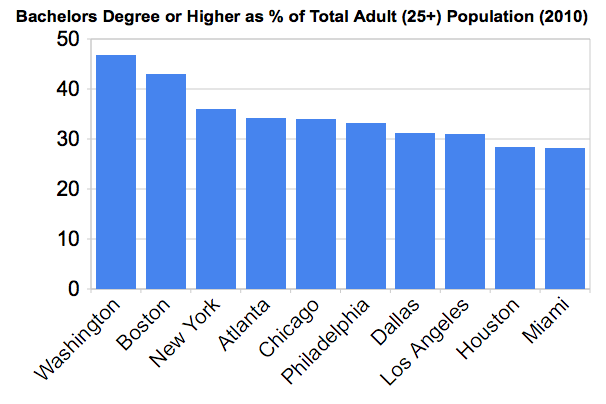
    Chicago’s college degree attainment is in the middle of the pack for the top 10, ranking #5. Considering it came from an industrial heritage, I think this is pretty good.


    However, Chicago only ranked 8th out of the top 10 in the growth in population with bachelor’s degrees.


    This hardly suggests that metro Chicago is a talent magnet. If you look at the numbers vs. other large Midwest metros, Chicago is healthy, but not looking like it is pulling away from the pack. I don’t see anything to suggest that Chicago is hoovering up all the college grads in the Midwest.

    Economy

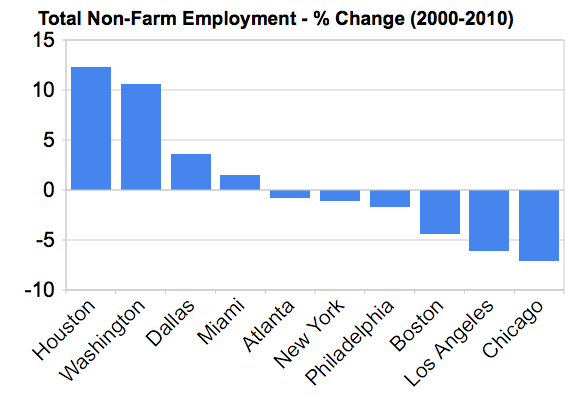
    Chicago lost 323,000 jobs during the 2000s, or 7.1%. The was the worst performance on a percentage basis of any of the 10 largest US metros:


    One of the stats that took some flak from my City Journal piece was that private sector employment in the Loop had dropped by 18.6% during the 2000s. This seems at odds with the massive skyscraper boom and other improvements. This wasn’t my stat. It came from a Chicago Loop Alliance report, and they commissioned a credible analytics firm to do the work, and the data was also reported by the Chicago Sun-Times, so I believe it is solid. A few things to consider:

    – This figure is for the Loop, not the Central Area (a bigger construct). The Loop does have the majority of the Central Area jobs, however.
    – Much of the construction was residential, not commercial. Also, things like the booming Loop U probably brought in more students than jobs.
    – Keep in mind that 2000 was the peak of the dotcom bubble. For reasons I’ll explore later, I believe this hurt Chicago badly. So there’s a tough comp (also why the Bay Area and to a lesser extent Boston look bad on comps vs 2000).
    – Consider major Chicago companies that totally went out of business: Arthur Andersen and Whitman-Hart come to mind.
    – Also consider that pledges of added jobs generally are trumpeted to the sky, while jobs are often cut silently as much as possible.

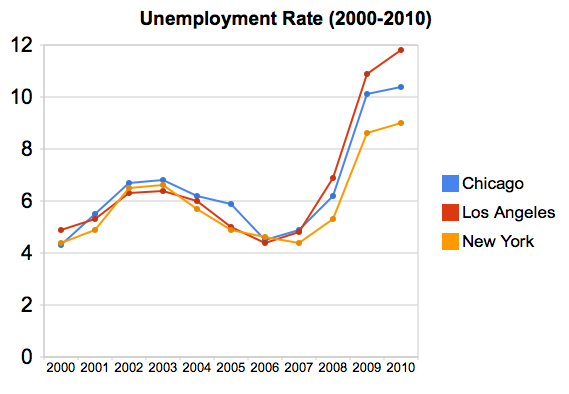
    Looking at unemployment rate in our Chicago vs. NYC/LA chart from before, we now see that Chicago is no longer winning, though is beating LA:


    Chicago is a large economy, but not a particularly high value added one. Out of the ten largest metros, Chicago ranks 8th in per capita GDP. (Chicago is 3rd among large Midwest metros on this figure)


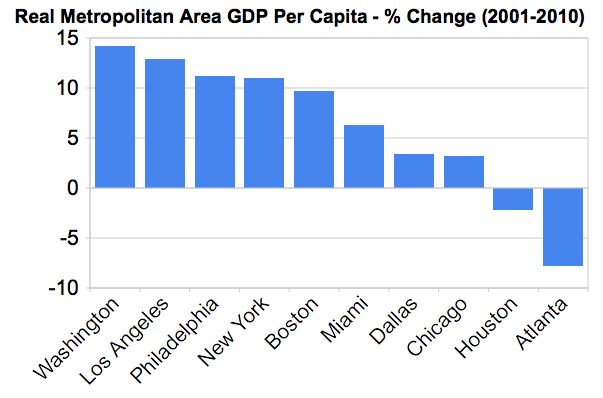
    Chicago also ranked eighth in real per capita GDP growth over the decade.


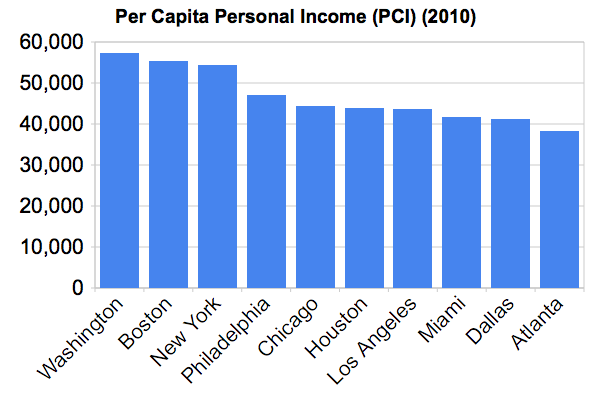
    Chicago ranked 5th out of 10 in per capita personal income, beating LA:


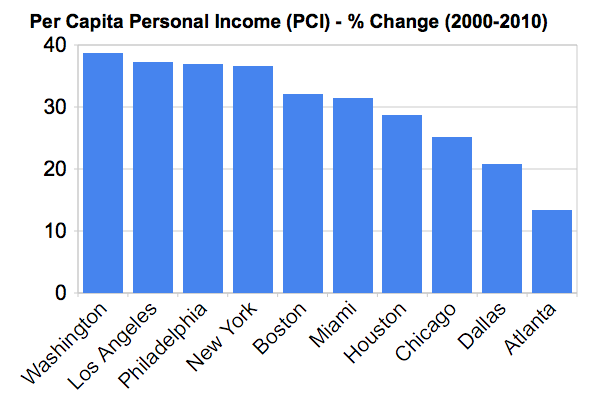
    But Chicago ranked only 8th out of 10 in PCPI growth:


    On the whole, this is a rather uninspiring collection of economic statistics for the Windy City, particularly after it did so well in the 1990s.

    Fiscal Crisis

    No discussion of Chicago’s problems in the 2000s would be complete without a review of its fiscal problems. However, as I already gave the numbers in my City Journal article, I won’t repeat them here. If anything, the problem has only gotten worse since that went to press. While Chicago may not be the worst municipality in terms of fiscal issues, Illinois is the worst state, and that will continue to be a drag until it’s addressed.

    Crime

    Among the biggest complaints about my article was that I didn’t address the crime problem in Chicago. Without a doubt, crime is a problem. Murders are up 38% or so just in 2012. The city of Chicago has a much higher murder rate than the cities of New York or Los Angeles. There has also been a national headline grabbing series of high profile attacks in affluent areas like the Gold Coast and Streeterville. The strength of the Chicago Police Department is somewhere between 500-1000 officers short of where it should be.

    I’m not the best equipped person to talk about crime, but I actually think the crime problem is overstated. Yes, it’s serious. The murder rate especially is troubling. But analyses I’ve read suggest that overall crime isn’t spiraling out of control in Chicago. Also, flash mob type attacks are happening across the country, in places ranging from Philadelphia to Portland. This isn’t a unique to Chicago situation. So I don’t want to claim that Chicago’s crime problems are uniquely bad, though they shouldn’t be minimized.

    Without a doubt the incredible collapse in crime in New York perhaps more than any other single factor fueled that city’s comeback, and it wouldn’t surprise me if it were a big factor in that city’s out performance in the 2000s. Mark Bergen cited some interesting research that suggested that for every murder in your city, 70 people move out. If Chicago had matched New York’s crime performance, it would have held steady or even gained population based on this relationship. If true, wow.

    Regardless, public safety is job #1 for any mayor, so Rahm Emanuel is rightly feeling the heat on this even if he can’t necessarily be blamed for what’s going on.

    Schools

    Others have cited Chicago’s poor public school system. Again, I’m not sure Chicago’s schools are any worse than any other big city system, and there are a number of magnet and neighborhood schools that are now attracting the children of the well-off. I’d have to see something that suggested Chicago took a turn for the worse on schools in the 2000s on a comparative basis.

    Conclusion

    There are more statistics that could be given, and if you want them, I suggest reading the very data rich OECD Territorial Review of Chicago.

    On the whole I think it’s pretty clear that there was trouble in Chicago during the 2000s – and more trouble than most large cities experienced during what was a tough decade nationally.

    Some rightly noted that I discuss the divergent performance of Chicago in the 1990s vs the 2000s, but that my structural factors that weaken Chicago were probably the same in both decades. So why the difference? I want people to know I plan to address that in a future post shortly, but next up we’ll have a look at Chicago’s present day strengths before moving on.

    Read part 1 in this series.

    Aaron M. Renn is an independent writer on urban affairs and the founder of Telestrian, a data analysis and mapping tool. He writes at The Urbanophile, where this piece originally appeared.
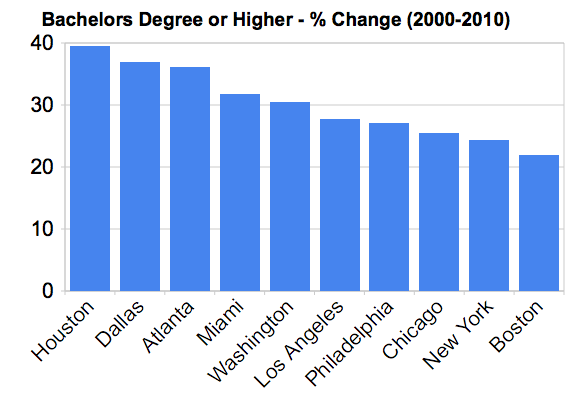
    Photo by smik67.

  • State of Chicago: The Decline and Rise

    I’ve had it in my head for over a year now to do an in-depth exploration of Chicago, a project I’ve called “State of Chicago.” This is the first a series of pieces that expand on the themes in my recent article “The Second-Rate City?

    First, I’d like to list three reasons why I wrote that piece:

    1. To bring to the attention of Chicago the very poor statistical performance of the city on basic demographic and economic measures.
    2. To write a corrective to the many national puff pieces that have been written on the city that totally overlooked its real and serious problems.
    3. To lay out some frames that I had on the underlying causes that are different from the typical explanations, in particular the excessive focus on “global city” and the “cost of clout.”

    As it turns out, Rahm Emanuel’s own economic plan and the OECD report beat me to the punch on point #1. As a lot of what I wanted to accomplish with State of Chicago was data oriented, my project is now much less ambitious than I’d originally intended since Chicago’s leaders are now, fortunately, owning up to the problems.

    The Fall of Chicago

    Today I want to start out by giving the prequel to my article: Chicago’s Rust Belt decline and subsequent comeback, particularly in the 90s. I think everybody knows that cities had a rough 70s and early 80s. It was the “Rotten Apple” era in New York, for example, a time of needle parks, mugger money, graffiti trains, a brush with bankruptcy, and much more.

    Chicago had a similar rough patch. When Richard Longworth (now of Caught in the Middle and Global Midwest fame) returned to Chicago in 1976 from many years overseas as a foreign correspondent for the Chicago Tribune, it was to a grim, decaying city that, like so many big cities in America at the time, clearly was a city that did not work.

    This was perhaps best symbolized by the city’s inept response to the Blizzard of ’79, which left the city paralyzed for days. Mayor Michael Bilandic’s blizzard response was widely credited for his subsequent re-election defeat. Old mayor Richard J. Daley’s City Hall alliance with business had preserved the Loop as a powerful, if somewhat drab, business district while so many other Midwest downtowns fell into ruin. But otherwise Chicago was a troubled, declining city covered by a veneer of boosterism.

    In 1981 Longworth wrote a damning four part, front page series for the Chicago Tribune called “A City on the Brink” drawing a powerful portrait of a city in crisis. He noted that, “Chicago has become an economic invalid. The situation may be permanent.” The Economist, in a far cry from its praise in the 2000s, described the city as having little more than a “facade of downtown prosperity.”

    The city was losing people, losing businesses, and losing jobs – even in the Loop. Manufacturing was collapsing and the middle class was fleeing, leading to neighborhood decline and eroding the city’s tax base, which in turn degraded the city services residents had come to expect and demand. The decline in services and neighborhoods drove more people way, which led to further declines, perpetuating a vicious cycle.

    University of Illinois at Chicago Professor Pierre de Vise predicted, “I see very little hope for locating economic activities here again.” And a local business executive added, “Is the city being annihilated? It’s probably inevitable.” While careful to note that Chicago was not at the point of New York City’s brush with bankruptcy nadir, Longworth noted it was headed that direction and glumly asked, “What happens when a major city becomes a backwater?”

    The city was failing on nearly every measure. I was struck by how similar Longworth’s litany of statistics were to my own. There was a big different however: back then things were way worse. Today the problems of Chicago take place against a backdrop of many areas of strength in the urban core and a secular uptrend in the fortunes of cities. Given that Chicago has come back from far more dire circumstances than it faces today, there’s reason for optimism in the present.

    Chicago Reborn

    As I noted in City Journal, during the 90s (probably starting in the late 80s), Chicago had a massive comeback. It gained people, it gained jobs, and the core reasserted itself. I moved to Chicago in 1992 when only a few select lakefront precincts were really gentrified. Though I lived in Lincoln Park, I was told not to move west of Racine, not because it was dangerous, but because it was dead. The area where I used to live near Belmont/Ashland/Lincoln was completely boarded up except for the Army-Navy surplus store. Recruiters for my company tried to sell me on the city by telling me it was now a location of the uber-hip coffee chain Starbucks. I watched vast tracts of the city transformed before my eyes. The 90s boom was real. I saw it. I felt it.

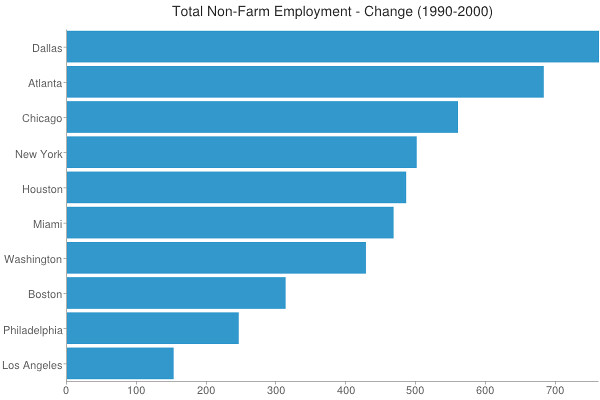
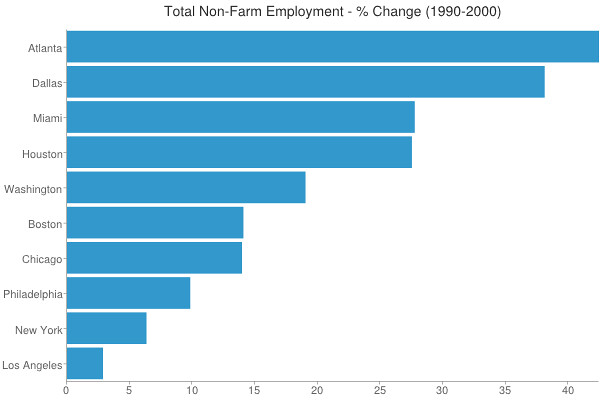
    It also showed up in the data. I don’t want to go too crazy, but I wanted to look at some economic statistics. First, I want to look at metro area job growth in the 1990s for selected cities. I’ll show the percentage gains in a moment, but here’s the raw job growth for the ten largest US metros during the 1990s. (Top ten selected based on today’s 2010 census population).


    Note: Data in thousands

    Chicago actually had the third highest total job growth. Not only did metro Chicago outgrow New York and crush LA (which got bruised by the “peace dividend”), it actually added more total jobs than Houston, everybody’s darling today. Wow. And more than currently booming Washington, DC. In short, Chicago beat out its mature tier one peers while holding its own with the emerging boomtowns. Very impressive.

    Here’s the percentage view:


    Not as impressive vs. the emerging cities, but Chicago held its own with Boston (a big beneficiary of the dotcom boom) and more than doubled up traditional peers New York and LA. I think it’s fair to label Chicago an outperformer here.

    Let’s do a quick look at unemployment rates for the big three:


    As you can see, Chicago metro had a much lower unemployment rate than NYC or LA during most of the 90s. Since unemployment rate is available at the municipal level, here’s a quick look at the big three core cities. We’ll see again that even at the municipality level, the city of Chicago had a lower unemployment rate:


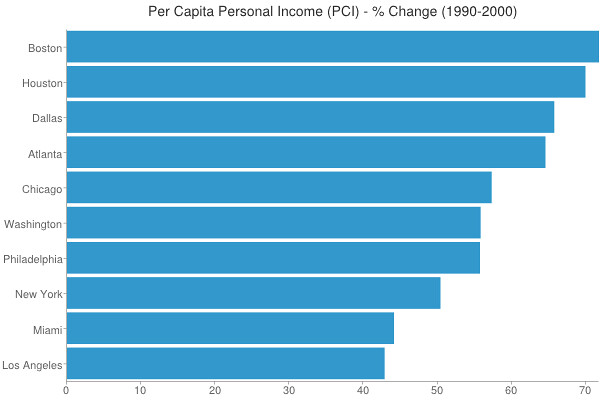
    So in terms of quantitative measures, Chicago was winning in the 90s. But it also seemed to do well qualitatively. I don’t have GDP data going back to the 90s, but I do have per capita personal income. Here’s how the top ten cities fared:


    Boston topped out, perhaps to be expected from the dotcom boom. But Chicago beat NYC and LA again, and also Washington, DC. (Interestingly, the southern boomtowns that did well on this metric in the 90s mostly got killed on it in the 2000s, Houston excepted).

    So I think it’s fair to say that compared to its large mature peers, Chicago economically was the winner (or at least near the top depending on who you put in there) during the 1990s, along with Boston. This is the type of performance Chicago is capable of delivering.

    But beyond the statistical measures, there were many qualitative improvements as well. For example, Chicago was really the early leader in quality of space. After Mayor Daley’s famous trip to Paris, he came back and encased the city in wrought iron. He also put in miles of streetscapes, with median planters, new streetlights and the like. (I happen to think the aesthetic style of these was not appropriate to Chicago, but they clearly upgraded the city in a big way). The CTA saw a brand new L line open to Midway Airport. New cultural facilities blossomed. For example, both the Chicago Symphony and the Lyric Opera undertook $100+ million building projects. And Daley even brought political stability back to the city after the turbulence Bilandic-Bryne years and the racially driven “Council Wars” of the 1980s.

    In a post-Cold War global order, Chicago also emerged as a global city. No longer just a superpower of the American interior, Chicago came to play a critical role in the global economy, through its derivatives exchanges, its professional services complex, and its status as a transport and cultural hub. Globalization became the lens through which the city sees its role in the modern economy, and with some justification. By 2010, Foreign Policy magazine ranked Chicago as the sixth most important global city in the world, for example. Chicago began to regard itself no longer as merely the “Second City,” but as a global player in its own right.

    So in the 1990s, Chicago was riding high. Little did the city know that with the dotcom collapse and the national economic trends of the 2000s, the city was about to enter a tailspin. But there was clearly a lot of real progress and change in the city and a lot for the city to feel good about and be proud of. Chicago was the big city champion of the 90s.

    I don’t want that story to get lost and people to think I’m just picking on Chicago. I’m happy to shout out its accomplishments when merited. But when things aren’t going so well, the city likewise deserves people who are willing to tell the truth.

    In the next installment, we’ll expand a bit on the troubles.

    Aaron M. Renn is an independent writer on urban affairs and the founder of Telestrian, a data analysis and mapping tool. He writes at The Urbanophile, where this piece originally appeared.
    Chicago skyline photo by BigStockPhoto.com.

  • High Speed Rail Advocates Discredit Their Cause – Again

    Is there any high speed rail boondoggle big enough to make rail transport advocates reject it?  Sadly, for all too many of them, the answer is No, as two recent developments make clear.

    The first is in California, where the state continues to press forward on a high speed rail plan for the state that could cost anywhere from $68 billion to $100 billion. Voters had previously approved $10 billion in bonds for the project, but as the state’s economy and finances have continued to sour – including multiple major cities going bankrupt – the polls have turned against it, and with good reason. The state faces the prospect of already enacted education cutbacks if Gov. Jerry Brown’s tax increase proposal in not approved in a vote this fall.  Other painful service cuts loom. Voters are rightly asking themselves if now is the time to be borrowing public money for very expensive, speculative infrastructure. 

    Equally, many of the much cited overseas examples of high-speed rail seem, well, to be off the tracks.    China’s rail system has serious safety problems, for example. And developing the most extensive high speed rail system in Europe hasn’t stopped Spain from seeing 50% youth unemployment, a 3 percentage point increase in the VAT tax, and a humiliating bailout from the rest of the EU.

    Nevertheless, the California assembly recently voted to go full speed head on its high speed rail plans. As part of an overall $8 billion rail spending package, the state is borrowing $2.6 billion to complement $3.2 billion in federal funds left over from the stimulus (shovel ready???) to build a starter segment of the line linking Bakersfield and Madera through the Central Valley. This is the easiest segment on which to build – though legal action is likely to delay construction – but doesn’t do anything to link the state’s huge population centers around LA and the Bay Area. With no more significant federal funds likely to be forthcoming, and the state’s finances a wreck, this segment risks becoming an embarrassing white elephant, or, as critics call it, “a train to nowhere”.

    After this vote it came to light that respected French high speed rail operator SNCF had approached California officials, private funding in hand, with a preliminary offer to build the LA-SF link themselves on a better and cheaper alignment along I-5 that would cost only $38 billion. But this was rejected by the state. The Times account suggests this rejection came about due to a combination of a political preference for the inefficient Central Valley segment and the clout of Parsons Brinckerhoff, the lead contractor.  Some commentators have referred to this revelation as a “bombshell.”

    Despite management misstep after management deception, rail advocates around the country cheered California’s decision to build the Central Valley segment. Jerry Brown, with not much to show for his reprise as Governor, is excited of course. Secretary of Transportation Ray LaHood called it a “big win.”  America 2050 (an offshoot of the Regional Plan Association of New York), “commended” the state for “taking a big step forward.”  Streetsblog called it a “major victory.”  While I respect what these organizations do in other contexts, this high speed rail vote is not a major victory, but a major defeat for common sense.

    But apparently not willing to let California take the prize in the rail boondoggle category without a fight, Amtrak shortly thereafter issued a “vision” for rail in the Northeast Corridor that would provide faster service between Boston and Washington, DC – at a cost of $151 billion. Strange as it sounds, some commentators actually lauded Amtrak for reducing costs since the previous plan was $169 billion.  The Brookings Institution was measured in its reaction to the plan, but managed to describe it as “more rational.”   With Republicans seemingly safely in charge of the House for now, and large federal deficits projected for the mid-term future, $151 billion for Amtrak seems purest fantasy.

    These developments are unfortunate because high speed rail could play an important role in US transportation, particularly in the Northeast. But that’s unlikely to happen because of the indiscriminate way establishment advocates have supported anything with the “high speed rail” label attached, ranging from $2 billion, 110 MPH peak speed Toonerville Trolleys in Illinois that barely beat Megabus in terms of journey time to the California rail boondoggle, regardless of merit. All they know that if it claims to be high speed rail, they are in favor of it.

    There are other people who take a more serious view. Unfortunately, they tend to be outsiders with little influence.  For example, Alon Levy suggested a set of near term, incremental Northeast Corridor improvements that might cost 90% less than Amtrak’s plan.

    $8 billion in stimulus dollars have gone to purchase us nothing of any real significance in terms of rail infrastructure. That money, invested wisely in high priority projects in the Northeast Corridor, could have made a big difference and started building a real demonstrated case for high speed rail investment in America. Unfortunately, the way high speed rail has been botched by its advocates, all the money we’ve spent on it has accomplished just the opposite. If California’s Central Valley segment is built and the complete line is never finished, it will likely discredit high speed rail in America for the long term.

    Aaron M. Renn is an independent writer on urban affairs and the founder of Telestrian, a data analysis and mapping tool.

    CA route map by Wikipedia user CountZ.

  • Will New York’s Economy Strangle Itself With Success?

    Big cities have been on a bit of a roll in recent years. But sometimes you can have too much success, as we may be seeing in the case of New York. This week the New York Times reported that finance firms are moving mid-level jobs away from Wall Street to places like Salt Lake City and Charlotte.

    There’s a lot going on here. First, a lot this is driven by New York’s success, not its failure. New York is increasingly valuable as a site of high end production. As a result, lower value activities get squeezed out and replaced with higher ones. Despite the exodus of Wall Street jobs, New York City has been booming, and a stat from last year showed that the city was within 60,000 jobs of its all time employment high. This sort of churn is somewhat normal when high value and lower value economic geographies come into contact within the same physical space, as I noted regarding California in “Migration: Geographies in Conflict.”

    It might be tempting for city leaders to actually celebrate this, but they shouldn’t. In a city that is desperate for middle class jobs, these are white collar middle class positions that are being lost. New York has stunningly high levels of income inequality – Joel Kotkin has noted it is the same as Namibia’s – and this can’t be making it any better.

    Also, is there any precedent for a city being successful and dynamic, over a longer term purely as a production center for ultra-high end activities (with perhaps an associated servant class)? Sure, places like Aspen can do it. Imperial capitals seem to have been able to do something of the sort. Perhaps that’s how New York’s leaders like to see their city, but they are taking an awful risk.

    New York is too concentrated in high end activities already, notably the high end of finance, as Ed Glaeser noted in his article “Wall Street Is Not Enough.” This renders it extremely vulnerable to downturns in that sector.

    It might seem like exporting finance jobs would be part of that re-balancing, but when they are lower end positions, all you are doing is re-concentrating finance at more elite levels. Because to these types of businesses cost is almost literally no object, they have driven the cost of New York real estate through the roof.

    When one industry becomes super-dominant in a neighborhood, Jane Jacobs noted it could lead to a situation she called “the self-destruction of diversity,” where a particular type of user – generally banks – gobble up the land and ultimate sterilize what formerly drew them to the area.

    I wrote about this in regard to Chicago in a speculative piece called “Chicago: Corporate Headquarters and the Global City” in which I note a flow of corporate headquarters back into global cities, albeit reconstituted executive headquarters only).

    This puts the bigger cities in a tough spot. They have to continue to go up the value chain because smaller cities are rapidly eroding their competitive advantage at lower ends. Ultimately we’ll see where this leads but I don’t think it’s healthy in the long term at all. Figuring this out is just one piece of the rebuilding our overall economy for the 21st century that needs to be accomplished.

    Aaron M. Renn is an independent writer on urban affairs based in the Midwest. This piece originally appeared at The Urbanophile

  • Religion and the City

    Seek the welfare of the city where I have sent you into exile, and pray to the LORD on its behalf; for in its welfare you will have welfare. – Jeremiah 29:7

    Religion is another one of those topics seldom discussed in urbanist circles. Though Christianity was originally an urban religion, modern Christianity has always had a bit of a problem with cities, with their licentious ways, anonymity, and the little bit of Babylon and Sodom they all contain.

    The religious in the US are often associated with the political right and conservative stances on social issues – just the type of people who don’t like cities or city dwellers much, and vice versa. In particular, the strident opposition of many to abortion and homosexuality puts religion on the wrong side of what are also litmus test issues for many urbanists.

    Yet urbanists should take religion much more seriously than they often do. That’s because it plays a much bigger role in the city and civic health than currently believed, and because many urban congregations have mastered the art of outreach and conversion in a way that transit and density advocates can only dream out.

    The Importance of Religion

    Churches have always been important institutions in cities. Even today, the only reason many families with children are confident enough to stay in the city is because they can enroll their kids in Catholic or other religious schools. I can only imagine what a place like Chicago would look like if its religious school network wasn’t there. Religious institutions are also heavily involved in poor relief and other social service activities that help reduce the tax burden. And regardless of what you personally think about any particular religion, if someone is able to use faith to help them get over serious personal dysfunction like criminal behavior or alcoholism, more power to them.

    For ethnic and minority communities, churches have long been key community institutions and support organizations. In a video I’ll get to shortly, Tim Keller notes as one example how the Jewish community of New York City has built extensive institutions there that made it much easier for Jewish families, not just young Jewish singles, to stay in the city. Churches have long been important in black communities that are often neglected and underserved by government, and many black pastors are seen not only as religious, but very important community or political leaders as well. I suspect religious institutions play a particularly key role in fostering community networks for what are niche minorities in many cities – Muslims, Sikhs, etc.

    This is an urban world that doesn’t feature much in the landscape of the traditional affluent white bobo demographic that dominates urbanist discussion. But even in that group, I see many examples of how religious minded urbanists types have helped boost and build a better future for their city.

    For example, in Indianapolis, the Earth House Collective, a “group of peace activists, conservationists, artists, musicians, Methodists, teachers and many more dedicated to peace, wellness, community and culture” is based in the heart of downtown Indianapolis at Lockerbie United Methodist Church. Similarly, the Harrison Center for the Arts, one of the city’s most important arts venues, is housed at Redeemer Presbyterian Church. Both of these are taken seriously by even the most hardened atheists in the city.

    The Harrison Center’s executive director, Joanna Taft, was one of the people who helped found the church as well (and the charter Herron High School and lots of other things). She explained how her Christian motivation propels her work in city revitalization:

    I have been Presbyterian my whole life and my worldview has been influenced by the protestant reformed concept of the cultural mandate. This is the idea that humankind has been called to continue God’s work of creation–building cities, restoring broken neighborhoods, creating beauty, raising children, planting gardens, etc…..While some of our Christian friends would feel guilty doing this work because it was not “full-time Christian service”, understanding the cultural mandate gave us the freedom to pursue what some would see as secular work.

    There’s a lot more to religion in the city than just abortion protests. It’s time urbanists took religion and religious institutions a lot more seriously, even if they don’t agree with the religious in many cases.

    Learning from Evangelism

    Not all religions seek out converts, but Christianity and Islam, two of the big kahunas, do. Since in most countries you can’t force someone to belong to a religion or have a particular set of beliefs, this requires the ability to persuade, and really speak to the people you are trying to convert.

    If you really are trying to save souls, then it isn’t enough just to be right, you have to also be effective. That’s the part of the message that’s too often lost on urbanists of various stripes. They are pushing transit, density, sustainability, etc. largely based on a belief that these are self-evidently correct policies. I find that often their ability to sell them to people who are skeptical or come from a different worldview is poor. When people don’t sign on to the latest carbon reduction scheme, rather than blaming a bad sales job, the blame is almost always put on the people rejecting it, such as by calling them idiots, intellectually dishonest, shills for corporations, or “deniers.” I’m sure there are some of these types out there, but I believe the vast bulk of people don’t fall into these categories.

    Not all, but a good chunk of religious evangelists actually care about what works. Their mandate doesn’t allow them to simply write off unbelievers as a hopeless sinners. As a result, you often see a lot more analysis of what they think they need to do to be successful in their mission.

    As an example, I highly recommend watching the following 18 minute video of a speech by Rev. Tim Keller of Redeemer Presbyterian Church in New York City. (If the video doesn’t display, click here). If you aren’t familiar with the Redeemer story, this New York Times article from 2006 is good background. Keller’s speech is called “God’s Global Urban Mission,” and this segment discusses Contextualization. He gives 10 ways that urban churches are different from suburban or rural churches, and what they need to do differently to be successful in urban environments. Almost all of these are very relevant to urbanism.

    He talks about items ranging from multicultural sensitivities to taking the arts serious to “being famous for helping the poor.” The latter was an item that jumped out at me because, as I’ve noted before, too many urbanist arguments are basically arguments for what I call “Starbucks urbanism.” If called on this, people will say, “But of course transit will benefit the poor too.” But that’s not how it’s sold. Urbanists ought to be famous for the way they design, implement, and talk about their policies as instruments for helping the poor and facilitating upward economic and social mobility. There’s a lot of other good stuff in the video that’s relevant to urbanism.

    For those who prefer reading, Keller also wrote a paper called “Our New Global Culture: Ministry in Cities, which says of itself: “This paper surveys the rise of global cities, the culture and dominant worldviews within these cities, and a framework for ministering in them.”

    You may think Keller’s analysis and framework is bunk, but at least he’s trying to look at the city as it is, and figure out what he’s got to do to adapt his ministry to it, not trying to make the city adapt itself to his ministry.

    By the way, Keller is excited about immigration from places like Africa or China where Christianity is a lot more alive and expanding than it is in the US and especially Europe. I was clicking around Wikipedia and found this picture of a Chinese evangelical Christian church in Madrid is that is a perfect example of this trend and how it is changing the face of cities.


    If you prefer a more purely secular example, Saul Alinsky also believed in understanding the worldview of people he was trying to organize. Even people he thoroughly disagreed with, he refused to hold in contempt, instead trying to see things from their perspective on their own terms. In “Rules for Radicals” (1971), he had this to say:

    To bring out this reformation requires that the organizer work inside the system, among not only the middle class but the 40 percent of American families – more than seventy million people – whose incomes range from $5,000-$10,000 per year. They cannot be dismissed by labeling them blue collar or hard hat.
    ….
    Many of the lower middle classes are members of labor unions, churches, fraternal, service and nationality organizations. They are organizations and people that must be worked with as one with work with any other part of our population – with respect, understanding, and sympathy. To reject them is to lose them by default. They will not shrivel and disappear. You can’t switch channels and get rid of them. This is what you have been doing in your radicalized dream but they are here and will be.

    Wise words indeed.

    Thanks to Pastor Kevin Bruursema at New Life Community Church in Lakeview, Chicago for the Tim Keller video reference.

    Aaron M. Renn is an independent writer on urban affairs and the founder of Telestrian, a data analysis and mapping tool. He writes at The Urbanophile, where this piece originally appeared.
    City Church photo by BigStockPhoto.com.

  • The Collapse of Chicago Media

    When the satirical humor weekly The Onion announced it was moving its editorial staff from New York to Chicago it was considered quite a coup by boosters of the Windy City. Yet the hoopla surrounding revealed more about Chicago’s decline as a media center than any significant uptick. This includes news of a staff rebellion at the Onion in which writers attempted to scotch the move, with some ultimately deciding not to come. The strong celebration of a relatively small relocation in the grand scheme of things also shows a city looking hard for good media news where there has been so much bad recently.

    The biggest blow of the all has been the end of the Oprah Winfrey show and her departure for Los Angeles to start a new network. She was the one legitimate mega-star who came from Chicago and built an empire recognizably Chicago-based. When she left, her network, which has struggled to obtain distribution and viewers, carried a Rosie O’Donnell talk show based in Chicago that ultimately folded as well. Similarly, Playboy, another iconic Chicago media brand, also departed for LA.

    Some of this reflects national trends that have led to a greater concentration of media in New York and, to some extent, Washington. All across America, local media has struggled. The Tribune, Sun-Times, and alt-weekly Chicago Reader all went bankrupt, and while they continue to publish, they have become in many respects shadows of their former selves. New mayor Rahm Emanuel, while still engaging with local media, has frequently decided to bypass it, going directly to major national media to get the city’s story out. For example, he hosted New York Times columnist Tom Friedman, resulting in a fawning profile.

    Daley also had occasional good luck with the national media, getting glowing stories in publications like the Economist and the New Yorker. Many of these read like classic Sunday travel section pieces in their boosterism. One possible reason for that is that they are travel pieces. Chicago never had a huge number of national bureaus, and the number has shrunk in the past few years because of the difficulty in supporting a national footprint generally. For example, the Washington Post closed all of its bureaus, and the Chicago bureau was a casualty. Today most national news outlets don’t have a boots on the ground perspective of the city, and thus are open to being spun by clever locals.

    This lack of out of town and foreign media means that what coverage Chicago does get is often positive, but the flip side is that Chicago doesn’t have a built in platform for getting its message out nationally or globally. New York is America’s media center. DC, LA, and the Bay Area all have a robust out of town media presence because of the industries based there (government, entertainment, and tech respectively). They have a megaphone to the world that Chicago doesn’t. That’s perhaps one reason Emanuel made what many consider an ill-advised play for the NATO summit: it was a rare opportunity to showcase Chicago to global journalists.

    Chicago also falls short in new media. In many cities, the decline of the daily paper has been offset by a robust new media infrastructure. This includes sites like Crosscut in Seattle or MinnPost in the Twin Cities.  Major national sites like Gawker or the Huffington Post have tended to be based in traditional media center like New York or Washington. Chicago has been curiously absent here. An attempt at a non-profit online new site, the Chicago News Cooperative, failed due to financial difficulties, despite seven figures in funding from the MacArthur Foundation and a contract with the New York Times.  

    Where major platforms have arisen in Chicago, they’ve often left in order to pursue their ambitions. For example, music site Pitchfork, which started out of a music festival in Chicago, moved its editorial staff to Brooklyn. Statistical journalist Nate Silver likewise moved to New York.

    The challenge facing media and journalists in Chicago was best perhaps summed up by JC Gabel, a die hard fan of the city.  He relaunched the historic Chicagoan magazine in an effort to rebuild the sort of infrastructure the city once had. He wrote in the launch issue:

    By all accounts, it should be an exciting time to live and work in Chicago. But there is little well-paid creative work available for the hungry freelancers—the writers, artists, photographers, editors and designers—who call Chicago home. Locally, what work there is pays a pittance; nothing that could sustain the kind of long-form storytelling we were discussing.

    This might help explain the mass exodus from Chicago of creative minds of our generation throughout the last few years. Opportunities on either coast—or overseas—eventually come calling, and although they retain pride in their erstwhile Midwestern hearts, they cease to be Chicagoans by physical address.

    Stop Smiling, the magazine I co-edited and co-published for more than a decade from Chicago, ultimately couldn’t have made it without also keeping a New York office and a strong West Coast presence. By and large, a majority of stories were executed in Los Angeles or New York, and all the money we raised through ad sales came right out of the agency machines on either coast. But Chicago was always our inspiration, a place where we retired to—first to brood, then to get our work done.

    I know firsthand how difficult it is to carve out a national niche audience in a city that many still consider fly-over country, despite its rich history and inventive spirit.

    Part of the challenge for Chicago lies in the ongoing changes being wrought by the internet and globalization. These are both spreading around some activities and ever more concentrating others. Media is among those undergoing further centralization into the handful of fortress hubs, notably New York and DC. This has hit Chicago, always a second-tier media center, hard.

    But the good news is that Chicago is full of talented folks like Gabel with a passion for their city. Chicago actually does have the critical mass of talent to support a far stronger media ecosystem than it has today. And with the low barriers in the internet age, there’s no insurmountable obstacles to making that happen. But clearly anyone trying to make a go of it in media in Chicago today is swimming upstream against a fast flowing current of decline.

    Aaron M. Renn is an independent writer on urban affairs and the founder of Telestrian, a data analysis and mapping tool. His writings appear at The Urbanophile.

    Tribune tower photo by Bigstockphoto.com.