Author: Aaron M. Renn

  • Changing the Narrative in Cleveland

    Cleveland, like many Rust Belt cities, has both an image and a self-image problem. Its residents have simultaneously had passion and loyalty for the city, while also being filled with shame about it and relentlessly negative and fatalistic about its future. Again, this is something that is the case for any number of places.

    This is a problem because the economy runs on expectations. Why do you start a business doing X? Because you expect to make a profit at it. Why move to city Y? Because you expect the job you have there will be a good fit or you otherwise expect that you are going to find personal satisfaction there.

    If we expect the economy to do poorly, we tighten our belts and help create the weakened demand conditions that bring that economy about. If we have positive expectations about the future we behave differently.

    Any number of cities seemed to be created from nothing much out of sheer boosterism, a sort of fake it till you make it approach that generated expectations that ultimately became a self-fulfilling prophecy. Houston may be a good example of this.

    So in a sense the real future of a place depends on people’s expectations about it in the future. That’s not to say that any expectation can simply be willed into being. Just because you expect to win the Super Bowl doesn’t mean it will happen. But positive expectations play a critical role in creating positive realities.

    Expectations are simply beliefs about the future, and thus can be shaped by sales and marketing techniques. This is part of what the city branding business is all about.

    Traditionally, marketing folks in Midwest cities have struggled to definite a positive aspirational identity and sell it to the world. Cleveland falls into this category. But a recent article in Cleveland Magazine talks about how the narrative and expectations about the city have changed in light of recent developments such as the return of LeBron James and the resulting NBA championship.

    “It got to the point where we began to believe the negative side of our image, to the point where we ourselves began to reinforce that,” says Mayor Frank Jackson. “When we did that, it became true, not only what the world thought we were, but also what we thought we were.”

    Research by Destination Cleveland showed that in 2012, only 34 percent of locals would recommend Cleveland to friends and family. Consider that for a second. Only five years ago, 66 percent of Clevelanders were so down on their town they couldn’t even bear the agony of putting in a good word with their college pals or Uncle Al. Other similar cities would usually have positive numbers in the mid-60s.

    Well, we’ve got a problem, thought David Gilbert, Destination Cleveland president and CEO.

    Five years later, amid an avalanche of good news, our chests swell with civic pride. LeBron came back. We won an NBA championship and made it to the World Series in the same year. We hosted a major political convention. The renovated Public Square opened. The lakefront is blossoming. Health care technologies and professional services are opening a connection to the globalized economy. We are, proportionately speaking, drawing more than our fair share of millennials to the region.

    The article goes on to describe the various ways in which Clevelanders are much more optimistic about the future of their city than they were in the past. That’s great news and a sign of shifting internal expectations.

    It’s hard to convince the world your city is great if you don’t even believe it yourself. I myself have had the experience in other cities of having people berating their own town and wondering why people who had moved there had done such a darned fool thing. Changing the internal narrative really helps set the stage for changing the external one.

    The article rightly highlights the risk facing Cleveland and other cities in the region. Namely that this expectations turnaround has been based on events like the NBA win, the GOP convention, etc. Previous Cleveland renaissances flamed out when those externals changed.

    The challenge for Cleveland is to create something durable that carries them through the difficult challenge of long term change and dealing with some of the challenges they face. But for now the fact that the spirits of residents have been lifted – and not without cause – and that there have been some events that generated positive national press is good news for this long-struggling city. It’s right and proper to celebrate it.

    This piece first appeared on Urbanophile.

    Aaron M. Renn is a senior fellow at the Manhattan Institute, a contributing editor of City Journal, and an economic development columnist for Governing magazine. He focuses on ways to help America’s cities thrive in an ever more complex, competitive, globalized, and diverse twenty-first century. During Renn’s 15-year career in management and technology consulting, he was a partner at Accenture and held several technology strategy roles and directed multimillion-dollar global technology implementations. He has contributed to The Guardian, Forbes.com, and numerous other publications. Renn holds a B.S. from Indiana University, where he coauthored an early social-networking platform in 1991.

    Photo by Aeroplanepics0112 (Own work) [CC BY-SA 3.0], via Wikimedia Commons

  • Children and Cities

    My wife recently gave birth to our first child. It’s an exciting time – and also one that portends great changes for our future.

    Cities are supposedly hostile to children. But living on the Upper West Side of New York, we’ve experienced nothing but oohs and ahhs over our son. The people in our neighborhood love children. And there are plenty of them around. The UWS is one of those places you could probably classify as a “strollerville.”

    But it’s hard not to notice that while there are lots of very young children here, there are far fewer school aged ones. I don’t have any desire or plans to leave, but I have to recognize that children have a way of changing your priorities. Realistically, most people with school-aged children still seem to move to the suburbs. Those I see raising older kids in the city are generally well-off enough to afford large apartments or even single family homes (in cities like Chicago). They can also either pay the premium to live in a high quality neighborhood school zone or pay the freight for private schooling.

    The number of children in cities, particularly in the dense urban centers were the creative class often congregates, is often low. San Francisco, one of the paradigms of creative class urbanism, has the lowest share of children of any major city at only 13%. The city famously has as many dogs as children.

    This has important implications. These global cities are where the culture is made, where the media are, etc. To the extent that they represent a very atypical demographic profile that largely excludes families with school-aged children, this only perpetuates the “bubble” in which America’s leadership class often lives.

    The values and priorities of people without children are different from those with children. One example is the value people put on space. In our central cities populated with largely people who have no children, a big obsession is changing zoning regulations to allow smaller units, including so-called “micro-apartments.” These kinds of developments would enable more upscale young adult singles to live in cities. That’s good in itself. Yet it is not paired with equal concern about creating more housing for families. What’s more, urbanists are often hostile to changes in the city that would increase child friendliness. For example, central cities often have smaller apartments. One way to create the space families require is to combine units. But people doing just that in Chicago – converting or deconverting multi-flat buildings into single family homes – are opposed by urbanists, who see this as destroying housing supply and reducing density.

    Jane Jacobs saw cities as a superior vehicle for the socialization of children, writing:

    In real life, only from the ordinary adults of the city sidewalks do children learn – if they learn at all – the first fundamental of successful city life: People must take a modicum of public responsibility for each other even if they have no ties to each other. This is a lesson nobody learns by being told. It is learned from the experience of having other people without ties of kinship or close friendship for formal responsibility to you take a modicum of public responsibility for you.

    Yet today cities are increasingly no longer seen as a locus of family life and child rearing, but rather an “entertainment machine” for adults, as Terry Nichols Clark famously labeled.

    There’s nothing wrong with urban centers playing that role as playground for adults and production node in the creative class economy – as long as you recognize the limits that implies. These urban environments are often held up as the model for the future, especially in a world of climate change. But a city without children has no future. To the extent that central cities outsource the rearing of future generations to the suburbs or foreign countries, they cannot plausibly serve as a general-purpose model. The world can have and celebrate its San Franciscos or lower Manhattans, but they will remain a minority of places.

    Aaron M. Renn is a senior fellow at the Manhattan Institute, a contributing editor of City Journal, and an economic development columnist for Governing magazine. He focuses on ways to help America’s cities thrive in an ever more complex, competitive, globalized, and diverse twenty-first century. During Renn’s 15-year career in management and technology consulting, he was a partner at Accenture and held several technology strategy roles and directed multimillion-dollar global technology implementations. He has contributed to The Guardian, Forbes.com, and numerous other publications. Renn holds a B.S. from Indiana University, where he coauthored an early social-networking platform in 1991.

    Photo by Garry Knight, via Flickr, using CC License.

  • Smaller American Cities Need to Focus on Private Sector Job Growth Downtown

    I’m back from a short break. While I was away my debut contribution to City Lab was published. In it I argue that the next frontier for smaller cities (meaning metros in the 1-3 million raise) in their downtown development efforts needs to be a focus on growing private sector jobs.

    There’s a reason it’s call the Central Business District. Commerce is the beating heart of a downtown. Here’s an excerpt:

    For downtowns in major American cities, these are boom times. The urban centers of New York and Chicago boast record high employment. In San Francisco and Seattle, there’s an explosion of residential construction, dining, and entertainment options, as well as a commercial rebirth in high-end, white-collar employment.

    But in many smaller cities, the downtown renaissance doesn’t rest on such solid ground. Look to downtown Cincinnati or St. Louis and you’ll see large growth in residential and entertainment offerings, and major investment in civic spaces and buildings. What you won’t see is the same level of success in becoming growing centers of commerce.

    For decades, jobs have been leaving downtowns and heading to the suburbs. In 2015, a City Observatory report suggested this might be turning around based on 2007-2011 data, but many downtowns were still losing jobs in that time, including Kansas City, Minneapolis, and San Antonio. A 2015 analysis by Wendell Cox found that just six cities were responsible for about three-fourths of all major-city downtown employment growth from 2010 to 2013: New York, Chicago, Boston, San Francisco, Seattle, and Houston. This shows the disparity between the major business and tech hubs and all the rest.

    Click through to read the whole thing.

    This piece originally appeared on Urbanophile.

    Aaron M. Renn is a senior fellow at the Manhattan Institute, a contributing editor of City Journal, and an economic development columnist for Governing magazine. He focuses on ways to help America’s cities thrive in an ever more complex, competitive, globalized, and diverse twenty-first century. During Renn’s 15-year career in management and technology consulting, he was a partner at Accenture and held several technology strategy roles and directed multimillion-dollar global technology implementations. He has contributed to The Guardian, Forbes.com, and numerous other publications. Renn holds a B.S. from Indiana University, where he coauthored an early social-networking platform in 1991.

    Photo: The tallest building in Indianapolis was recently renamed after tech giant Salesforce. Image via Salesforce.com.

  • Diners and the Decline of Shared Social Institutions

    Grub Street posted another installment in the decline of the New York diner genre.

    I’ve made the point before that many of these old line institutions are going out of business because their product simply isn’t very good. I’m a fan of diner food, but I’ve never had a good meal in a Manhattan diner.

    But there are many other forces at work, including changes in the structure of our society. One thing the disappearance of diners illustrates is the loss of shared social infrastructure spanning across social classes.

    Something I’ve always liked about diners is that they are the kinds of places that you could find people from all walk of life. There were cops and blue collar workers, college students, professionals grabbing breakfast, etc. It was the kind of institution that was broadly patronized across social groups.

    These kinds of institutions are in decline. There has a been fragmentation of the shared American common culture that existed as recently as 1990 into a multiplicity of niche markets.

    There’s also been a gulf that has opened between the consumption and cultural practices of the upper middle class (the top 20% by education and income) and everyone else. They shop in different stores, eat in different restaurants, drink different beers, etc.

    There are fewer of the spaces were classes intersect as they did in diner. There are still NYC restaurants where multi-class patronage does occur – pizza by the slice places and delis come to mind. Those are both great. But in my experience, in diners it’s more likely that people will actually strike up a conversation with others, and thus have real cross-class conversation, even if just idle banter.

    So the decline of the diner is not just about the loss of a restaurant format – those come and go – but also the decline of shared social space and the increasing alienation between social classes and groups.

    You might also like: The fact that you get to interact in a positive way with people of so many different backgrounds is why I love jury duty.

    This piece originally appeared on Urbanophile.

    Aaron M. Renn is a senior fellow at the Manhattan Institute, a contributing editor of City Journal, and an economic development columnist for Governing magazine. He focuses on ways to help America’s cities thrive in an ever more complex, competitive, globalized, and diverse twenty-first century. During Renn’s 15-year career in management and technology consulting, he was a partner at Accenture and held several technology strategy roles and directed multimillion-dollar global technology implementations. He has contributed to The Guardian, Forbes.com, and numerous other publications. Renn holds a B.S. from Indiana University, where he coauthored an early social-networking platform in 1991.

    Photo Credit: Coyote-mania, CC BY-SA 3.0

  • Red State Conundrum

    How do you raise incomes when your state’s economic appeal is based on low costs?

    That’s the basic conundrum facing a number of red states. They rightly talk about their cost climate, touting tax rates and such. But the biggest component of cost for many businesses is labor. Being a low cost state is tantamount to being a low wage one in many cases.

    A recent workforce survey from the Indiana Chamber of Commerce highlights this dilmmea. Some key findings:

    • Applicants not willing to accept pay offered (45% agree or strongly agree). Lack of minimal educational requirements was only 27% [problems in recruitment]
    • Only 26% very likely or extremely likely to add high-wage jobs in next two years

    Employers are having trouble finding workers. A big problem is pay, but not many employers plan to add higher wage jobs.

    The survey asked how firms dealt with positions they couldn’t fill. Here were the results:

    • 55% left unfilled until a candidate was found< • 18% assigned duties internally to other workers • 11% hired an underqualified candidate • 16% other

    Notice what’s missing from this list: raising the wage on offer in order to attract qualified applicants. Maybe some of that is included in “other” but it’s clearly a small amount.

    The real question that needs to be asked is why these firms aren’t offering a market clearing wage.

    If they can’t afford to pay the going rate, then these firms don’t have a skills gap problem, they have a business model problem. The problem is with the companies, not the workforce.

    That’s not to say there isn’t some skills gap, training gap, etc. But when the pay problem is screaming at you loud and clear and you refuse to address it, something bigger is going on.

    It’s not government’s job to underwrite a highly skilled but poorly paid workforce.

    This piece originally appeared on Urbanophile.

    Aaron M. Renn is a senior fellow at the Manhattan Institute, a contributing editor of City Journal, and an economic development columnist for Governing magazine. He focuses on ways to help America’s cities thrive in an ever more complex, competitive, globalized, and diverse twenty-first century. During Renn’s 15-year career in management and technology consulting, he was a partner at Accenture and held several technology strategy roles and directed multimillion-dollar global technology implementations. He has contributed to The Guardian, Forbes.com, and numerous other publications. Renn holds a B.S. from Indiana University, where he coauthored an early social-networking platform in 1991.

    Photo by Bidgee/Wikipedia – CC BY 3.0.

  • Shrinking America

    The Census Bureau released its 2016 county level population estimates earlier this year. This gave us a window into the places that are gaining or losing total population.

    Here’s a map of all the counties that have lost population since 2010.

    The numbers in the legend are the percentage change in population (multiply by 100).

    But just last week the Census Bureau released the population estimates by age, sex, and race. I popped the age estimates into my database and mapped the counties whose child population (those under 18) is in decline. This is the demographic future of these communities apart from migration. Here’s that map:

    Yikes!

    I also rolled this up to to the metro area level – and there are even a number of major metropolitan areas in the US – 25 out of 53 – with a declining population under the age of 18.

    This is a very quick preliminary view for the blog. I’d definitely go dig into these numbers yourself before taking them to the bank. But this doesn’t look good for much of the country.

    This piece originally appeared on Urbanophile.

    Aaron M. Renn is a senior fellow at the Manhattan Institute, a contributing editor of City Journal, and an economic development columnist for Governing magazine. He focuses on ways to help America’s cities thrive in an ever more complex, competitive, globalized, and diverse twenty-first century. During Renn’s 15-year career in management and technology consulting, he was a partner at Accenture and held several technology strategy roles and directed multimillion-dollar global technology implementations. He has contributed to The Guardian, Forbes.com, and numerous other publications. Renn holds a B.S. from Indiana University, where he coauthored an early social-networking platform in 1991.

    Photo by Abe Kleinfeld, via Flickr, using CC License.

  • Urban Talent Sheds Say a Lot About Cities

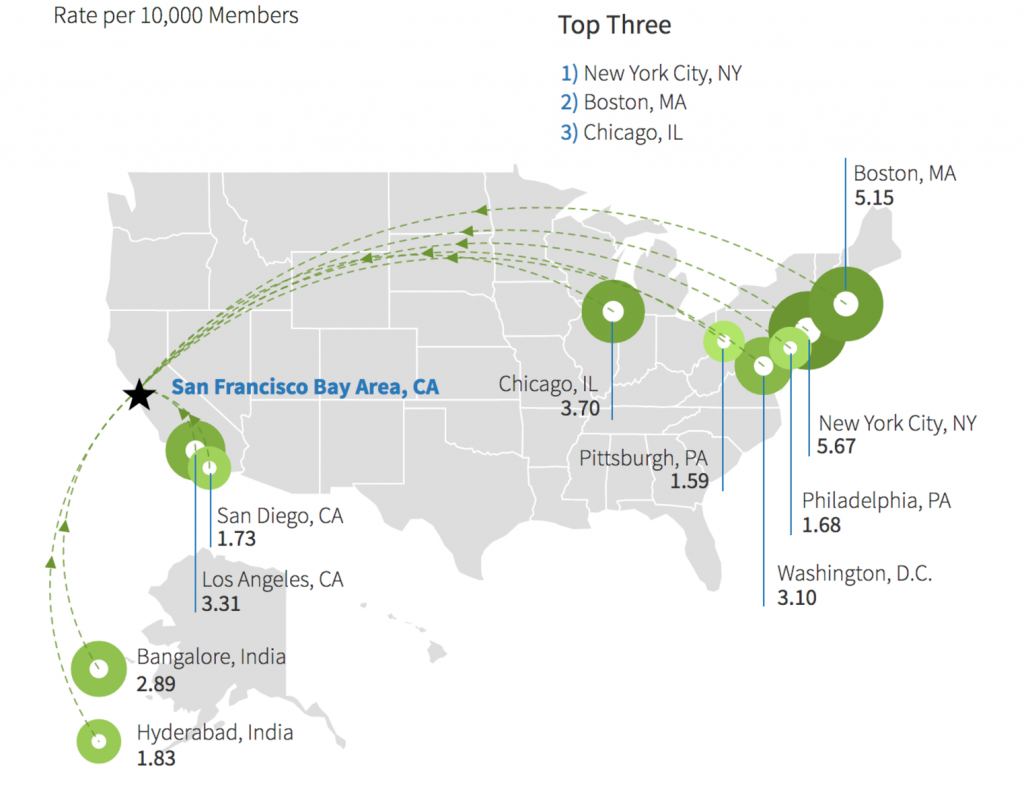
    Jim Russell pointed me as the workforce report program that LinkedIn runs.  They use their data to show trends in 20 major job markets.

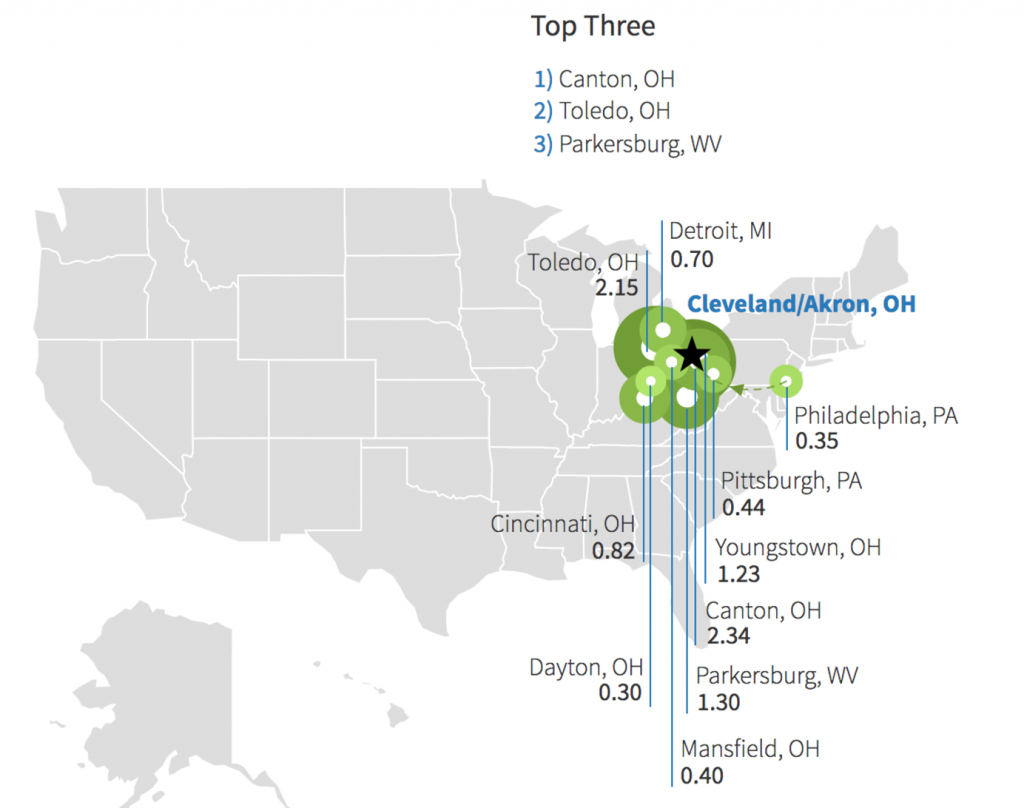
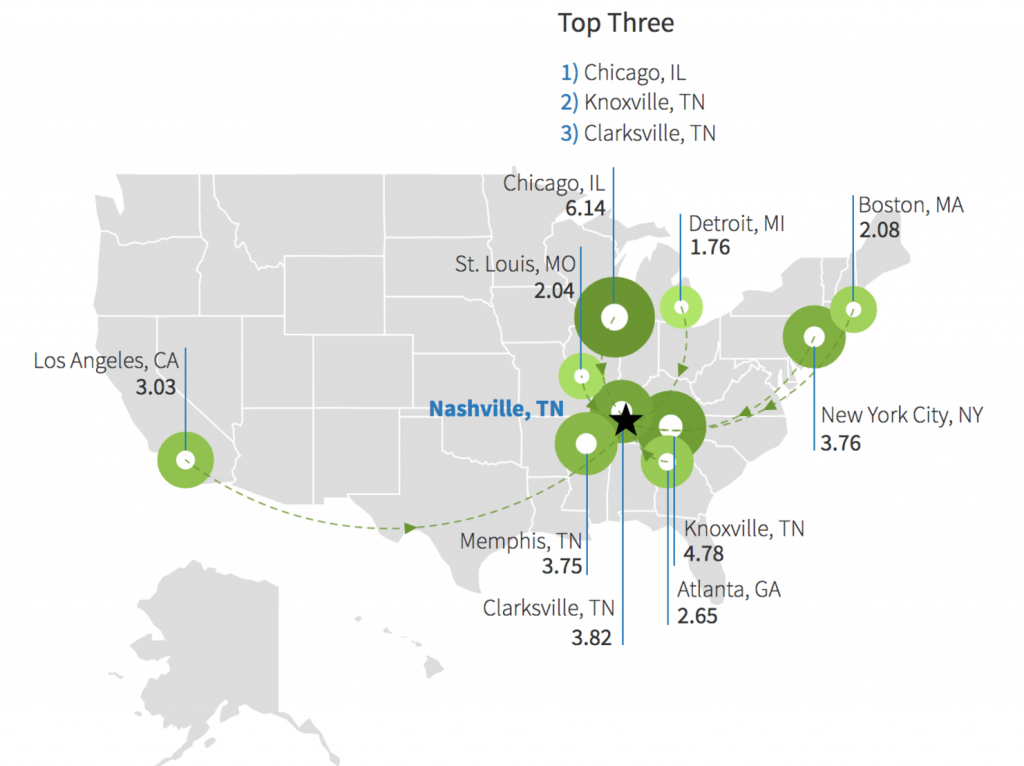
    For each market they track, they put together a map of the 10 cities that market gains the most workers from and the ten in loses the most workers too.

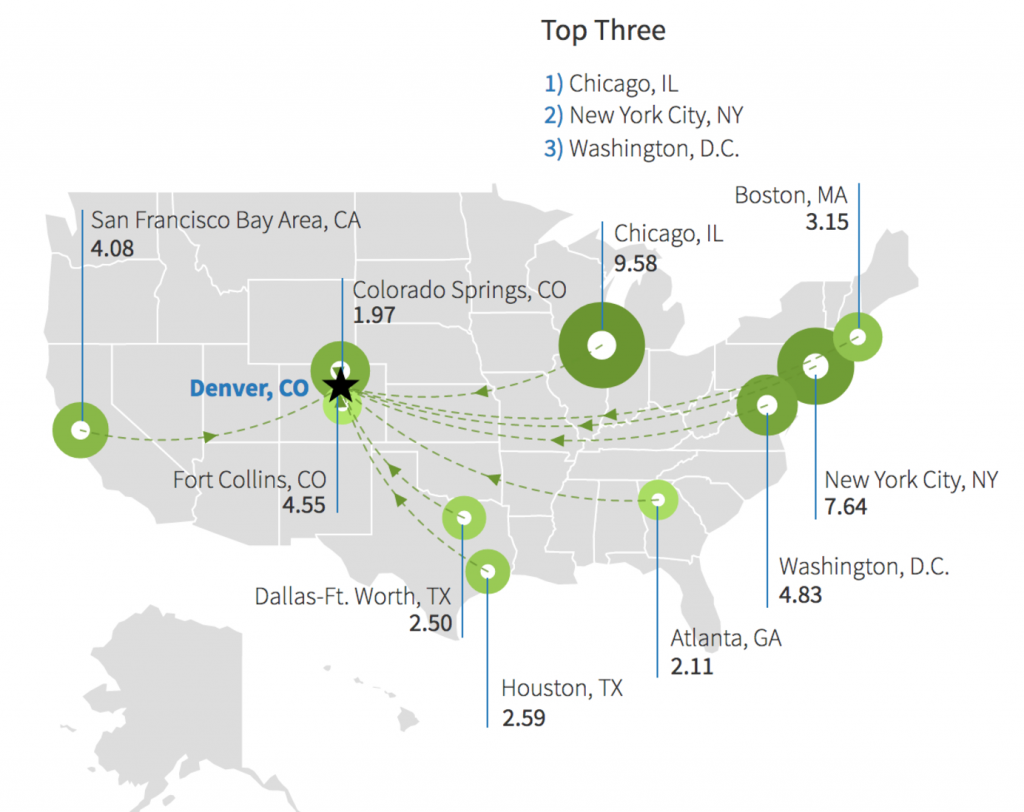
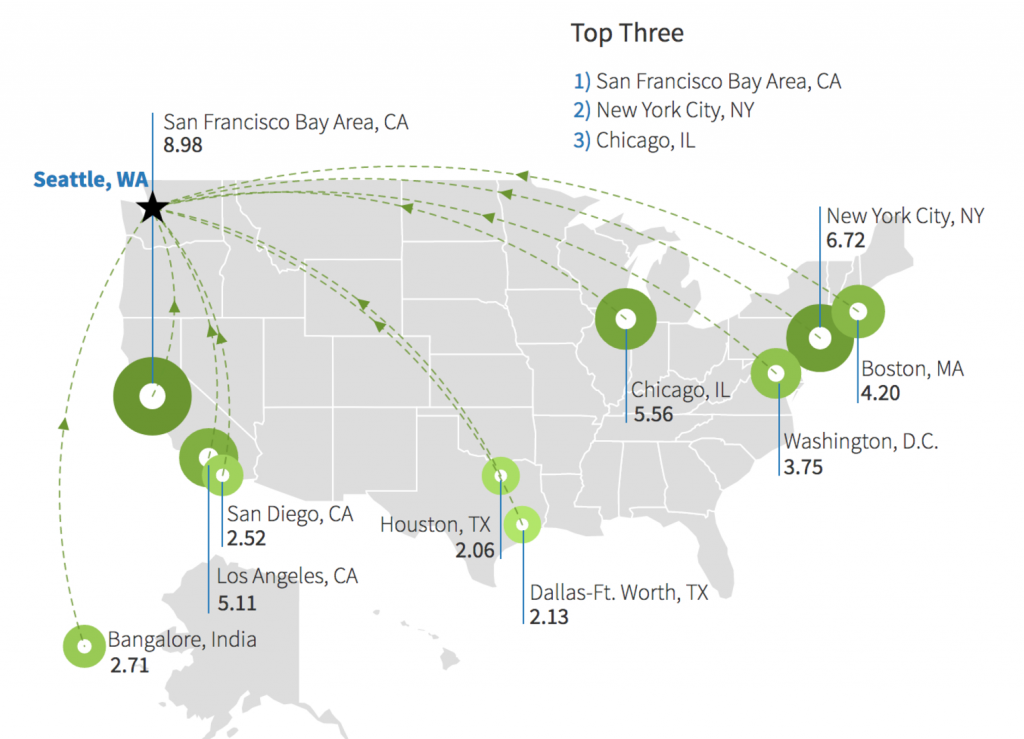
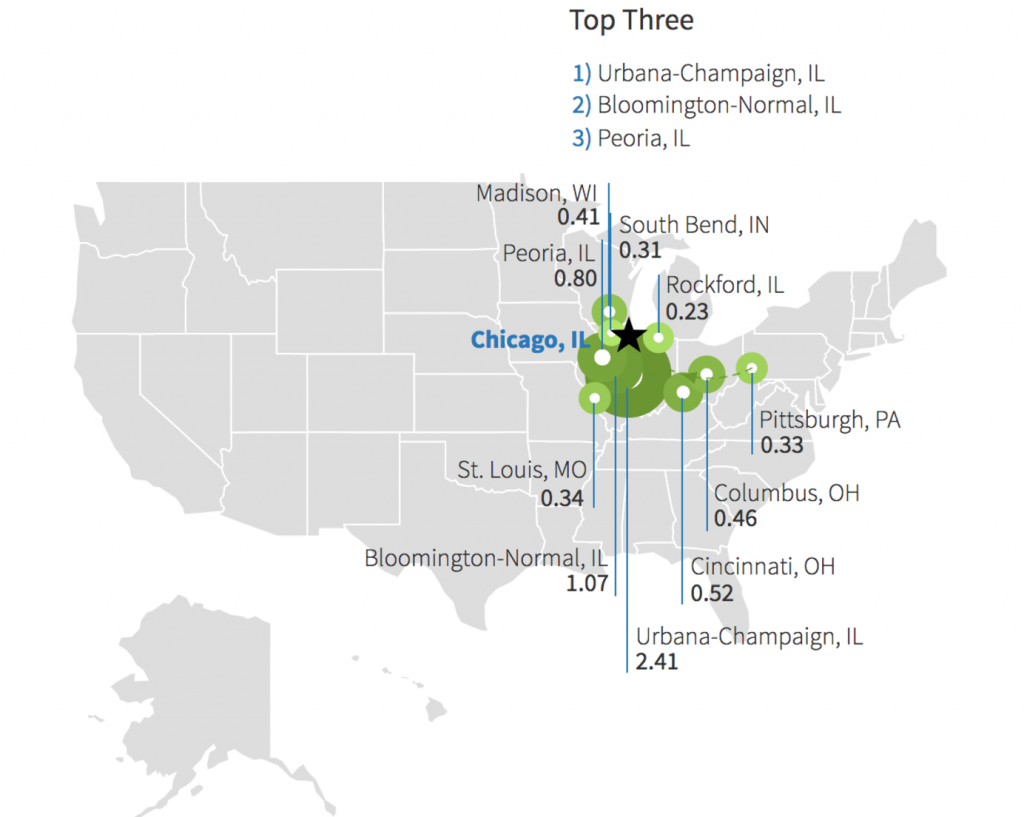
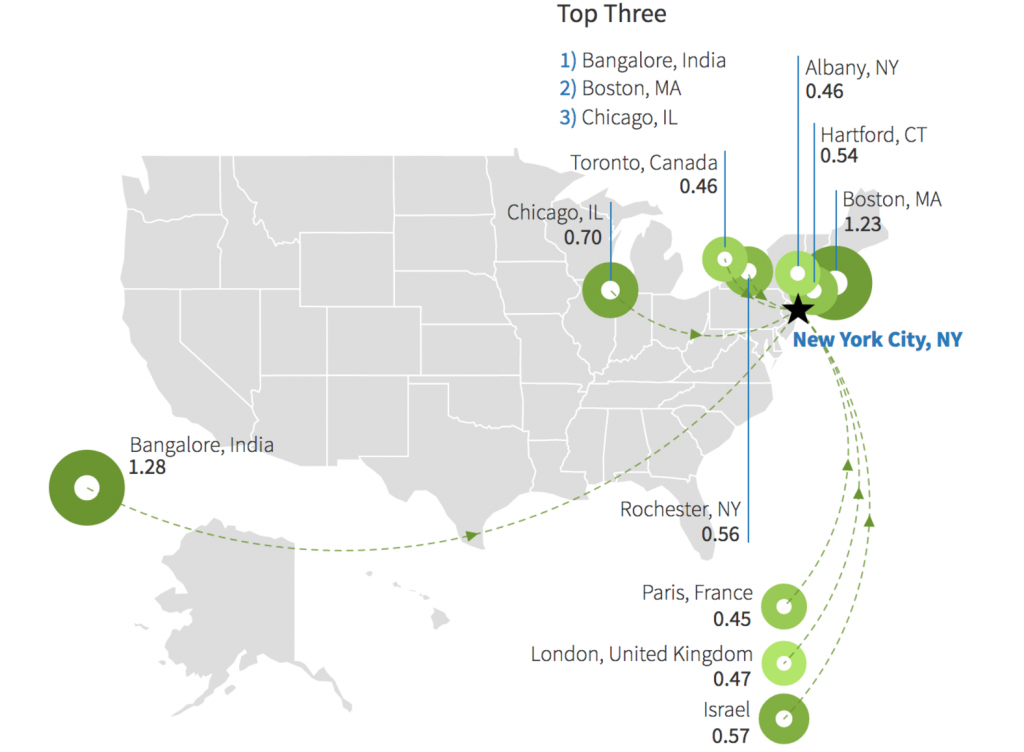
    These are interesting maps in their own right. They also highlight the extremely parochial nature of the talent flows into Midwestern cities. It’s pretty stark, actually. Here’s a set of comparisons, looking strictly at inflows. There are also outflow and gross migration charts and more information that’s interesting too, but I’ll leave you to dig into that yourself.

    Minneapolis vs. Denver vs. Seattle

    Let’s take a look at these three roughly peer cities. First, the top ten cities for Minneapolis.

    Despite the Twin Cities enjoying a high reputation withing the Midwest region, their draw remains highly regional. Their top draws are from adjacent states plus Chicago.

    By contrast, here’s Denver.

    And here’s Seattle:

    The difference is stark.

    Chicago vs. New York vs. San Francisco

    Living up to its reputation as the capital of the Midwest, Chicago’s draw is from a tightly focused region.

    Now, here’s New York:

    Four of New York’s top ten draws are actually from outside the country. That’s pretty amazing.

    And here’s San Francisco.

    You see the flows in mostly from other major tech hubs and big cities.

    Again, a pretty start difference.

    Cleveland vs. Nashville

    We see the same thing in smaller tier cities. Here’s Cleveland.

    And here’s Nashville.

    Again, I’d encourage you to spend some time over at LinkedIn. You can tell a lot about these cities and their economies just by their migration maps. You can also instantly see another dimension of the challenge facing Midwestern cities.

    This piece originally appeared on Urbanophile.

    Aaron M. Renn is a senior fellow at the Manhattan Institute, a contributing editor of City Journal, and an economic development columnist for Governing magazine. He focuses on ways to help America’s cities thrive in an ever more complex, competitive, globalized, and diverse twenty-first century. During Renn’s 15-year career in management and technology consulting, he was a partner at Accenture and held several technology strategy roles and directed multimillion-dollar global technology implementations. He has contributed to The Guardian, Forbes.com, and numerous other publications. Renn holds a B.S. from Indiana University, where he coauthored an early social-networking platform in 1991.

  • What’s the Matter With Kansas – and Connecticut?

    In 2012, the state of Kansas under Gov. Sam Brownback passed a large tax cut. Despite this massive fiscal stimulus, the state’s economy actually underperformed the nation during much of the subsequent period and the cuts blew a gigantic $900 million hole in the state’s budget.

    Finally the legislature cried uncle. It passed a $1.2 billion tax hike. Brownback vetoed it but the Republican dominated legislature overrode the veto.

    Not only did the tax cuts fail to grow the economy, one of the state’s major metro regions, Kansas City, received a gigantic free broadband investment in the form of Google Fiber. Spanning Kansas and Missouri, this investment also failed to produce significant tech growth.

    Meanwhile in Connecticut, the state twice raised taxes to address a budget deficit. Unfortunately, these tax hikes did not create long term revenue growth. What’s more, after the most recent rounds of tax hikes, the state experienced a corporate exodus highlighted by GE and Aetna. The state capital of Hartford is also flirting with bankruptcy. Gov. Dannel Malley now admits the state is tapped out on tax increases.

    There are a lot of claims one can make out of these situations. I’m only going to point out that both Kansas and Connecticut are out of favor in the marketplace right now. For example, while the suburban office park may not be extinct, it’s certainly facing challenges in high tax settings like New Jersey and Connecticut. Companies like GE are in fact increasingly looking to global city centers for their highest level executives. Connecticut doesn’t have that product on offer and can’t create it. Regarding Kansas, it was likely a low tax state even before the cuts, which did not materially improve its competitive position or instrinsic attractiveness.

    It’s simply very difficult to counter these macro forces. When cities were out of favor, even NYC was en route to oblivion. Trying to push on a string often only creates as many problems as solutions.

  • The Superstar Gap

    The biggest challenge facing many cities in transitioning to the knowledge economy is a shortage of “A” talent, especially true superstars.

    All “talent” isn’t created equal. Crude measures such as the percentage of a region with college degrees, or even graduate degrees, don’t fully capture this. It is disproporationately the top performers, the “A” players and superstars that make things happen.

    Sections of the knowledge economy have long been geared to superstars. Economist Enrico Moretti cites research on biotech hubs, in which he notes that it is not just having a top university nearby that mattered in establishing biotech clusters, but having the true handful of academic superstars researchers. In The New Geography of Jobs, he writes:

    In a fascinating and now classic article and in a series of subsequent studies, they argued that what really explains the location and success of biotech companies is the presence of academic stars – researchers who have published the most articles reporting specific gene sequencing discoveries. Among top universities, some institutions happened to have on their faculties stars in the particular subfield of biology that matters for biotech; others had comparable research but did not have stars in that specific subfield. The former group created a local cluster of biotech firms while the latter did not.

    Richard Florida devotes a significant amount of his latest book The New Urban Crisis discussing the rise of the superstar phenomenon, which he also links to specific superstar cities.

    Superstars are important in tech because of the 10x principle I mentioned in my recent post on the Silicon Valley mindset. The best coders are 10x as productive as the merely very good coder. The top entrepreneurs are probably 100x or or more. The presence of superstars, along with some amount of good fortune, can transform the economy of a city or region.

    Jeff Bezos is a superstar. Mark Zuckerberg is a superstar. Michael Bloomberg is a superstar.

    These superstars are disproporationately located in only a handful of regions.

    To see this effect, just look at Austin vs. Seattle. Austin is a booming, prosperous city with a major tech industry. Yet Seattle is generating significantly greater value. Seattle’s real per capita GDP is $75,960 vs. only $55,323 in Austin. Seattle’s per capita income is $61,021 vs. $51,014 in Austin.

    Austin had some good entrepreneurs like Michael Dell, but not superstars in industries that would create massive platforms like Microsoft and Amazon. Austin has a lot of quantity, but it looks to me like there’s a big quality gap vs. Seattle.

    And it’s not just that superstars create things, they act like a magnet attracting others. As economic development consultant Kevin Hively once told me, “When you’re the best in the world, people beat a path to your door.”

    To see this in action, just look at Carnegie Mellon University in Pittsburgh. CMU has the #1 ranked computer science program in the country. And companies like Google (600 employees), Uber (500 employees), Apple (500 employees), Intel, and Amazon been drawn there and set up shops around it. Ford is investing a billion dollars into autonomous vehicle ventures there. And GM also has a presence.

    It’s interesting to contrast with the University of Illinois’ program. U of I is ranked 5th in computer science. My impression is that from a commercial impact, they used to be bigger time than they are now. The web browser as we know it was invented there, but that was a long time ago. They have a research park designed for companies wanting to take advantage of proxmity of U of I. There are a lot of companies there, but the tech roster isn’t as marquee as Pittsburgh’s and my impression is that the scale is smaller.

    There’s a big differnce between being number one and number five, particularly when something like ownership of the driverless car market is at stake. Maybe that’s why former GE CEO Jack Welch said he only wanted to be in a business if he could be number one or number two.

    Cities and states in the Midwest and elsewhere in the interior like to boast of their assets, which include many great schools, but very few world dominating number ones in important fields. This is a big challenge for them.

    Superstars aren’t the entire world. The presence of superstar businesses also creates problems as well as wealth. But if these places want to not only thrive but perhaps for some of them even just survive in the knowledge economy world, they need to look at their attractiveness to the truly top tier talent (I will address “A” caliber but not superstar talent in a future post). I don’t often see this talked about.

    For example, one thing I don’t see in most discussion of Chicago is its lack of superstar talent. Chicago is very good but not the best in a lot of things. Where they do have arguably world beating talent, such as in their culinary industry, they shine. (I know people in New York who happily admit Chicago has better restaurants).

    If I were that city, I’d be looking to see how to create a world’s best talent pool in additional particular high impact industries. Maybe the state should consider some radical type action, such as relocating U of I’s entire computer science and select engineering programs to Chicago as part of UI Labs, and putting serious muscle behind getting at least some critical subspecialities with high commerical potential to be clear #1’s in the world.

    This is actually a scenario I plan to study in the future. Right now I’m not sure it’s necessary and some of my initial thoughts are impressionistic. So this post is in part a honeypot to try to lure in those who might react to this or even help flesh out the facts (which might augur against it).

    Regardless, this lack of superstar/number one type talent in the interior is a big handicap in the world we live in now. For example, just look back at a 2010 analysis Carl Wohlt did of where the people on Fast Company’s “100 Most Creative People in Business” list lived. Only six in the Midwest and seven in the South vs. 35 in the West and 32 in the Northeast (with 20 international). This isn’t a scientific survey but illustrates the scope of the problem.

    Cities and states need to take a more finer grained view of talent, and understand the criticality of having at least some of the absolute best talent to kicking a region’s knowledge economy into high gear. Too many places have a superstar gap.

    This piece originally appeared on Urbanophile.

    Aaron M. Renn is a senior fellow at the Manhattan Institute, a contributing editor of City Journal, and an economic development columnist for Governing magazine. He focuses on ways to help America’s cities thrive in an ever more complex, competitive, globalized, and diverse twenty-first century. During Renn’s 15-year career in management and technology consulting, he was a partner at Accenture and held several technology strategy roles and directed multimillion-dollar global technology implementations. He has contributed to The Guardian, Forbes.com, and numerous other publications. Renn holds a B.S. from Indiana University, where he coauthored an early social-networking platform in 1991.

    Photo by John Picken (Flickr: Chicago River ferry) [CC BY 2.0], via Wikimedia Commons

  • How Does Housing Stock Affect Urban Revitalization?

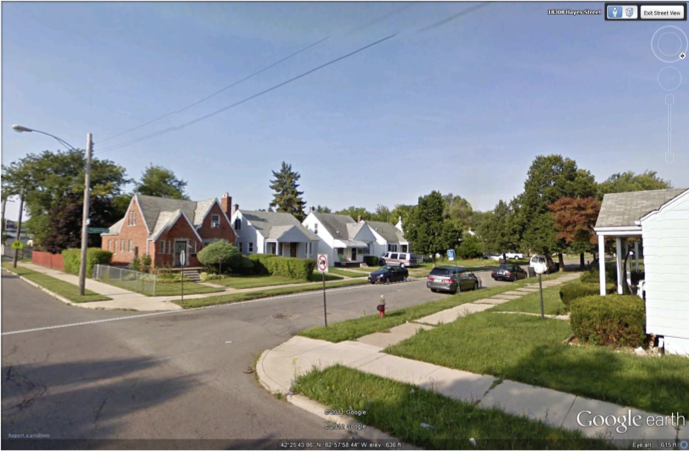
    The second of Pete Saunders’ nine reasons why Detroit failed is “poor housing stock,” particularly its overweighting towards small, early postwar cottages. Here’s a sample:


    Here’s what Pete had to say:

    Detroit may be well-known for its so-called ruins, but much of the city is relentlessly covered with small, Cape Cod-style, 3-bedroom and one-bath single family homes on slabs that are not in keeping with contemporary standards for size and quality…..The truth, however, is that Detroit may have one of the greatest concentrations of post-World War II tract housing of any major U.S. city….True, Detroit has more than its share of abandoned ruins that negatively impact housing prices. But it also has many more homes that simply don’t generate the demand that higher quality housing would. That is a major contributor to the city’s abundance of very cheap housing.

    I have often been struck by the same thing in Philadelphia. There are some districts of great buildings, but most of the city is made up of mile after mile of two-story, very small row houses. Here’s a snap I took in the Kensington neighborhood that provides a sample.

    This is decent density of these to be sure. However, keep in mind that most of these row houses contain a single unit. The Upper West Side brownstone I live in has been converted into ten units. Also, many of these rowhouse units are extremely shallow. Here’s a picture I found online that illustrates a typical depth.

    Photo credit: Flickr/pwbaker CC BY-NC 2.0

    As it happens, there has been some redevelopment activity in Kensington, both in residential and industrial spaces. (Some neighborhoods nearby are seeing significant redevelopment).

    Someone I know recently bought and renovated a rowhouse in the neighborhood, so I got to tour it. It’s a two-bedroom unit, but very small. It’s barely bigger than your average one bedroom apartment. Unsurprisingly, the person who bought it is in her 20s and single.

    As nice as this unit was, it’s basically a starter home, much like those Detroit Cape Cods. Cities need to have housing like that, but if it is overwhelmingly dominant, that’s not healthy.

    It’s similar to how so many downtowns are seeing tons of Millennial targeting apartment construction. Older families can have trouble finding housing in these areas because there isn’t great housing to take you through your full lifecycle.

    Philadelphia should be fine in the near term. The city has great bones and I really find it compelling in a lot of ways. But I wonder if this type of housing stock is one reason the city has seen less demand than other old major tier one urban centers with great transit.

    I put out a poll on Twitter about this and most people didn’t seem to agree with me on the potential negative of being overweight very small rowhouses. We will see how this plays out for Philly.

    Aaron M. Renn is a senior fellow at the Manhattan Institute, a contributing editor of City Journal, and an economic development columnist for Governing magazine. He focuses on ways to help America’s cities thrive in an ever more complex, competitive, globalized, and diverse twenty-first century. During Renn’s 15-year career in management and technology consulting, he was a partner at Accenture and held several technology strategy roles and directed multimillion-dollar global technology implementations. He has contributed to The Guardian, Forbes.com, and numerous other publications. Renn holds a B.S. from Indiana University, where he coauthored an early social-networking platform in 1991.

    This piece originally appeared on Urbanophile.

    Top photo by Aaron M. Renn.