Author: Aaron M. Renn

  • Rethinking Urban Dynamics: Lessons from the Census

    Much has been made of the vaunted “back to the city” movement by “the young and restless,” young professionals, the creative class, empty nesters and others were voting with their feet in favor of cities over suburbs.  Although there were bright spots, the Census 2010 results show that the trend was very overblown, affecting mostly downtown and near downtown areas, while outlying ones bled population.  One culprit for this discrepancy seems to be that the intra-census estimates supplied by the Census Bureau were inflated – in some cases very inflated.

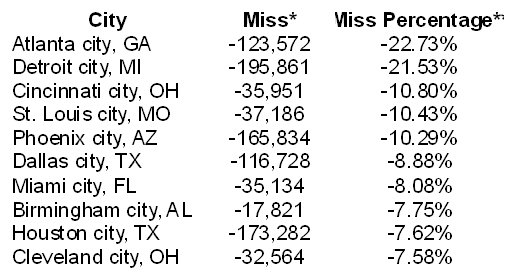
    Looking at selected core cities for major US metropolitan areas, many of them were materially over-estimated:


    One particularly egregious case relates to Atlanta. Its huge projected population increase in the 2000s led me to describe it as “one of America’s top urban success stories.”  The reality proved to be quite different. Rather than strong population growth in the city, the population growth turned out to be basically flat, quite a different story.  Other declines might be more predictable, such as Detroit, or those who had previously challenged estimates like Cincinnati and St. Louis.  Still, even urban cores in rapidly growing regions like Dallas and Houston were not immune from this trend.

    There were some exceptions. Cities like Indianapolis, Columbus, and Oklahoma City came in slightly ahead of expectations, but the number of cities with misses and the sizes of the positive and negative misses tilted towards the down direction.

    It seems clear now that the justification for much of the “back to the city” story reflected bad estimates. People can’t be faulted for relying on the official government numbers – I did. But the reality of the 2010 Census, as demonstrated by Wendell Cox and others, is that the 1990s were actually better for urban population growth in America than the 2000s in many respects.

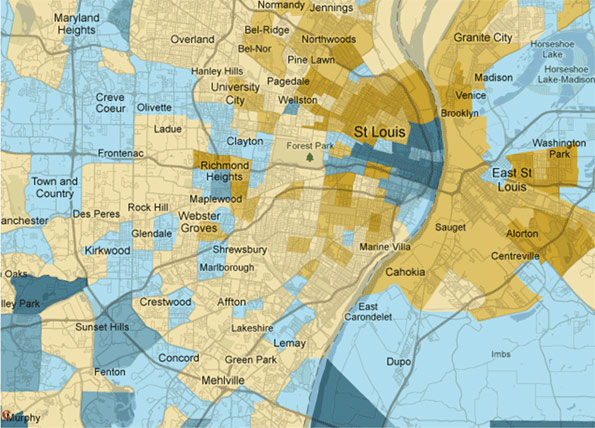
    One legitimate bright spot for cities lay in the growth of downtown and near downtown areas.  Though often starting from low bases, these areas often showed impressive increases.  For example, St. Louis showed good growth downtown despite a very disappointing decline in total city population:

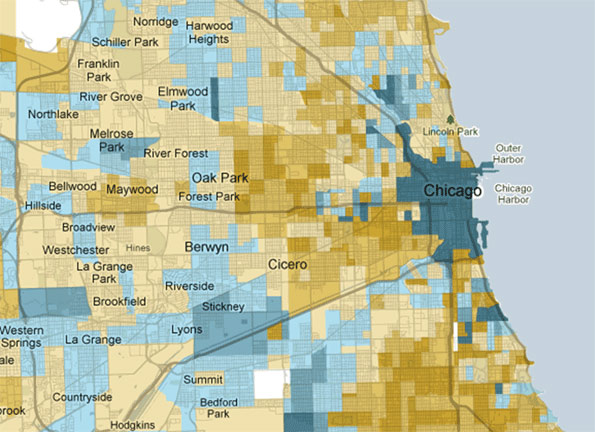
    The poster child for this phenomenon was Chicago, where a fairly expansive area in the greater core showed large population growth.  Areas that were formerly almost all commercial, such as the Loop, added significant residential population, while areas that were nearly derelict like the near South Side have blossomed into thriving upscale neighborhoods.


    The problem, from places ranging from Chicago to Cleveland, is that the gains in the “core of the core” have been more than offset by losses elsewhere, especially the flight of blacks and other minorities – many of them immigrants – to the increasingly diverse suburbs.

    Cities across America have invested enormous sums into downtown redevelopment and major projects in selected districts.  The good news: these investments have shown some ability to move the needle in terms of attracting young professionals downtown.  The bad news lies with the fact that these developments have been extremely costly, and have not transformed the overall demographic or economic climates of the cities that tried them.  This demonstrates the limits of the policies.  Those who aren’t in the young professional, empty nester, or creative class demographic have rightly figured out that they are no longer the target market of city leadership. No surprise then that many of them    have decided to vote with their feet.

    Given the resulting overall negative swings, cities may want to revisit their strategy of putting all their chips in the downtown redevelopment basket in favor of less glamorous improvements in basic neighborhood safety, services, schools and other critical elements.  A handful of elite enclaves and talent hubs may be able to thrive on a “favored demographic quarter” strategy, but for most places there just aren’t enough young professionals and artists to go around.

    Aaron M. Renn is an independent writer on urban affairs based in the Midwest. His writings appear at The Urbanophile.

    * Actual population minus projected population as of 4/1/2010 using a run rate projection based on the 2008-2009 estimated population growth.
    ** Base is the projected 4/1/2010 population above.

    Photo by Ian Freimuth

  • Census 2010 Offers Portrait of America in Transition

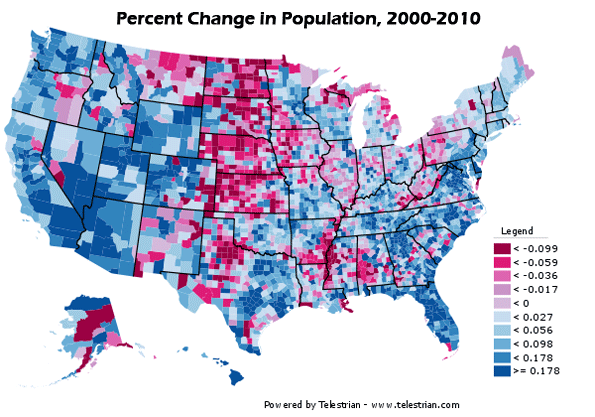
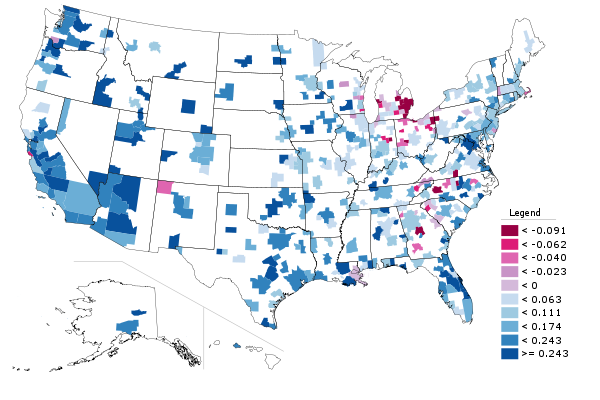
    The Census Bureau just finished releasing all of the state redistricting file information from the 2010 Census, giving us a now complete portrait of population change for the entire country.  Population growth continued to be heavily concentrated in suburban metropolitan counties while many rural areas, particularly in the Great Plains, continue to shrink.


    Percentage change in population, 2000-2010. Counties that grew in population in blue, decliners in red. Note: Legend values not multiplied by 100.

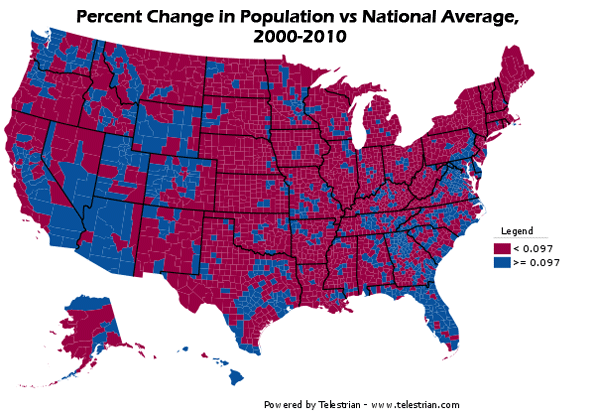
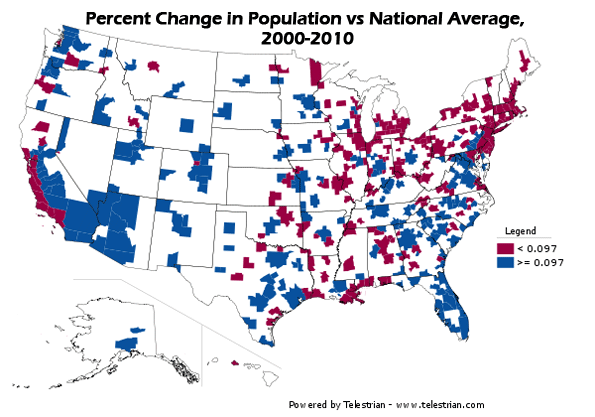
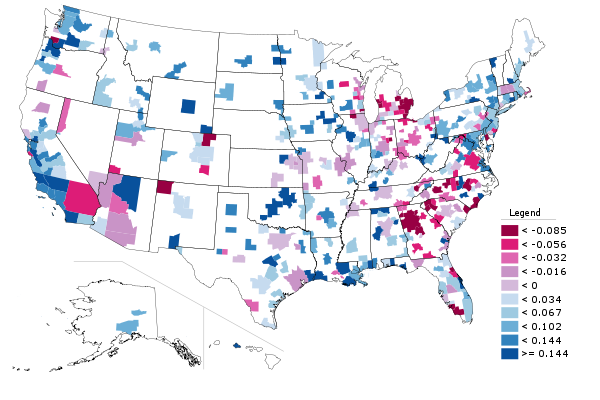
    Dividing counties by those growing faster or slower than the US average paints the picture even more starkly:


    Percentage change in population, 2000-2010.  Counties growing faster than the US average in blue, slower than the US average in red.  Note: Legend values not multiplied by 100.

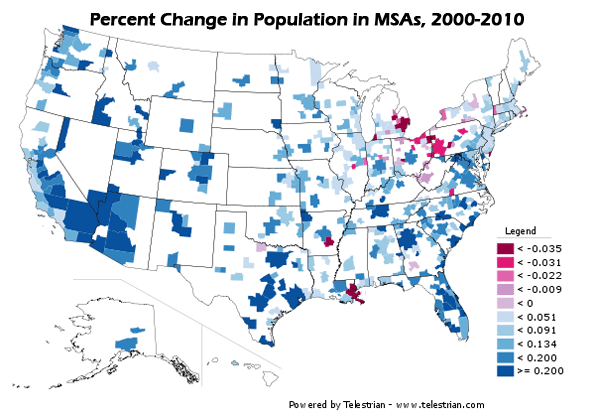
    The release of all county data means it is also possible to take an unofficial, preliminary look at metropolitan area growth.  The biggest gainers were Sunbelt cities in the South, Texas, and the Midwest, while the Midwest and Northeast continued to lag, particularly the old heavy manufacturing axis stretching from Detroit to Pittsburgh. But this picture was not monolithic. Many Southern cities with Rust Belt profiles like Birmingham failed to grow much compared to neighbors, nor did coastal California with its development restrictions.


    Percentage change in population, 2000-2010. MSAs that grew in population in blue, decliners in red. Note: Legend values not multiplied by 100.


    Percentage change in population, 2000-2010.  Counties growing faster than the US average in blue, slower than the US average in red.  Note: Legend values not multiplied by 100.

    A full table of population change for large metro areas (greater than one million people) is available at the bottom of this post.

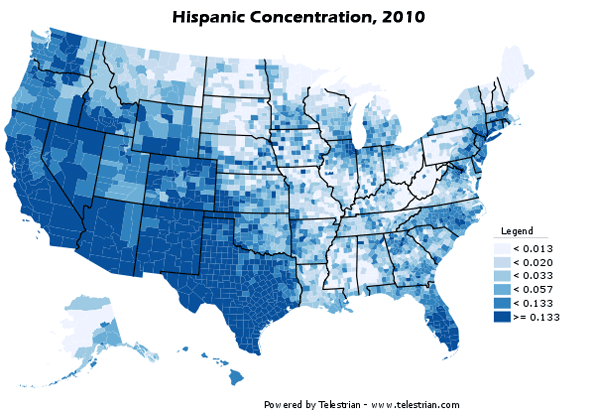
    Basic race information is also available in this data release, since it is used to ensure redistricting complies with the requirements of the Voting Rights Act.  Here’s a map showing the concentration of Hispanic population the US:


    Population of Hispanic Origin, as a percentage of total population. Note: Legend values not multipled by 100.

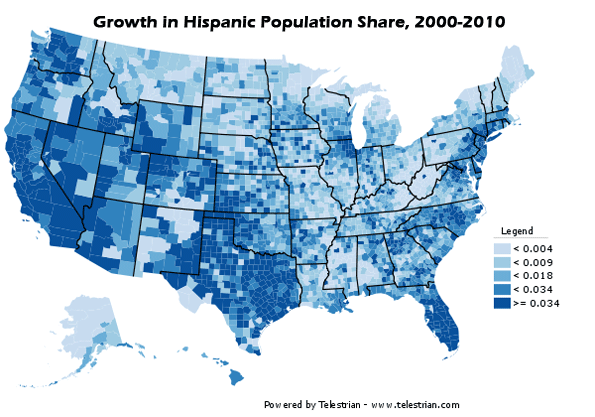
    Hispanic population remains heavily concentrated in the Southwest, but the interior, and especially parts of the South one would not expect, such as Alabama, posted significant gains in Hispanic population share.


    Hispanic population as change in percentage of total population, 2000-2010.  Note: Legend values not multiplied by 100.

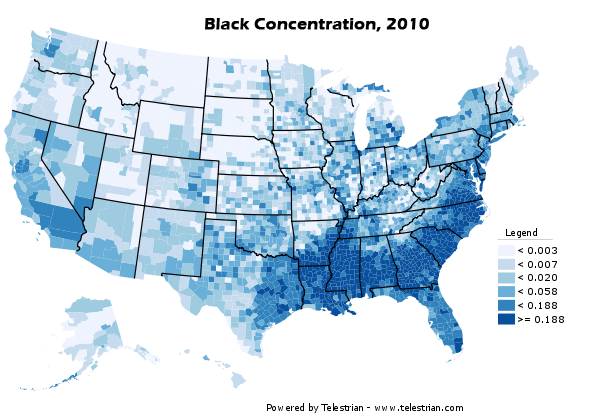
    As the highest concentrations of Hispanics remain in the Southwest, similarly the Black population is at its heaviest concentrations in the South:

    Black Alone population as a percentage of total population, 2010.  Note: Legend percentages not multiplied by 100.

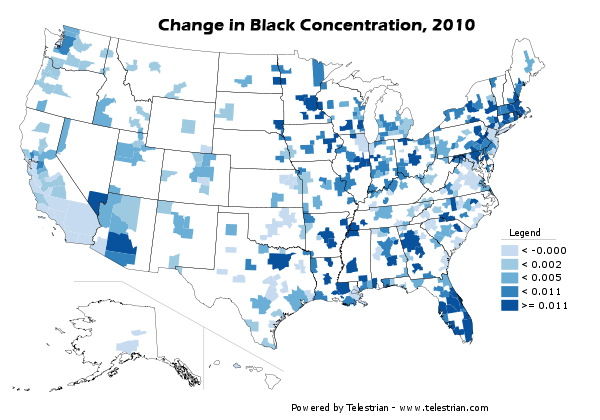
    A lot has been written about the so-called reverse Great Migration of blacks from the North to the South.  These results show something of that effect, but less of a general than a specific migration. Some cities both North and South are becoming magnets for Blacks, while other traditional Black hubs like Chicago are no longer favored. Note that some northern cities that showed a larger increase in concentration started off on a low base, like Minneapolis-St. Paul:


    Black Alone population as change in percentage of total population, 2000-2010.  Note: Legend values not multiplied by 100.

    As noted above, here are all US metro areas with a population greater than one million people in 2010, ranked by percentage change in population:

    2000-2010 Population Growth, MSAs of 1 Million or More
    Rank Metropolitan Area 2000 2010 Total Change Pct Change
    1 Las Vegas-Paradise, NV 1,375,765 1,951,269 575,504 41.8%
    2 Raleigh-Cary, NC 797,071 1,130,490 333,419 41.8%
    3 Austin-Round Rock-San Marcos, TX 1,249,763 1,716,289 466,526 37.3%
    4 Charlotte-Gastonia-Rock Hill, NC-SC 1,330,448 1,758,038 427,590 32.1%
    5 Riverside-San Bernardino-Ontario, CA 3,254,821 4,224,851 970,030 29.8%
    6 Orlando-Kissimmee-Sanford, FL 1,644,561 2,134,411 489,850 29.8%
    7 Phoenix-Mesa-Glendale, AZ 3,251,876 4,192,887 941,011 28.9%
    8 Houston-Sugar Land-Baytown, TX 4,715,407 5,946,800 1,231,393 26.1%
    9 San Antonio-New Braunfels, TX 1,711,703 2,142,508 430,805 25.2%
    10 Atlanta-Sandy Springs-Marietta, GA 4,247,981 5,268,860 1,020,879 24.0%
    11 Dallas-Fort Worth-Arlington, TX 5,161,544 6,371,773 1,210,229 23.4%
    12 Nashville-Davidson–Murfreesboro–Franklin, TN 1,311,789 1,589,934 278,145 21.2%
    13 Jacksonville, FL 1,122,750 1,345,596 222,846 19.8%
    14 Sacramento–Arden-Arcade–Roseville, CA 1,796,857 2,149,127 352,270 19.6%
    15 Denver-Aurora-Broomfield, CO 2,179,240 2,543,482 364,242 16.7%
    16 Washington-Arlington-Alexandria, DC-VA-MD-WV 4,796,183 5,582,170 785,987 16.4%
    17 Tampa-St. Petersburg-Clearwater, FL 2,395,997 2,783,243 387,246 16.2%
    18 Salt Lake City, UT 968,858 1,124,197 155,339 16.0%
    19 Portland-Vancouver-Hillsboro, OR-WA 1,927,881 2,226,009 298,128 15.5%
    20 Indianapolis-Carmel, IN 1,525,104 1,756,241 231,137 15.2%
    21 Richmond, VA 1,096,957 1,258,251 161,294 14.7%
    22 Oklahoma City, OK 1,095,421 1,252,987 157,566 14.4%
    23 Columbus, OH 1,612,694 1,836,536 223,842 13.9%
    24 Seattle-Tacoma-Bellevue, WA 3,043,878 3,439,809 395,931 13.0%
    25 Miami-Fort Lauderdale-Pompano Beach, FL 5,007,564 5,564,635 557,071 11.1%
    26 Kansas City, MO-KS 1,836,038 2,035,334 199,296 10.9%
    27 Minneapolis-St. Paul-Bloomington, MN-WI 2,968,806 3,279,833 311,027 10.5%
    28 Louisville/Jefferson County, KY-IN 1,161,975 1,283,566 121,591 10.5%
    29 San Diego-Carlsbad-San Marcos, CA 2,813,833 3,095,313 281,480 10.0%
    30 Memphis, TN-MS-AR 1,205,204 1,316,100 110,896 9.2%
    31 Birmingham-Hoover, AL 1,052,238 1,128,047 75,809 7.2%
    32 Baltimore-Towson, MD 2,552,994 2,710,489 157,495 6.2%
    33 Virginia Beach-Norfolk-Newport News, VA-NC 1,576,370 1,671,683 95,313 6.0%
    34 Cincinnati-Middletown, OH-KY-IN 2,009,632 2,130,151 120,519 6.0%
    35 San Jose-Sunnyvale-Santa Clara, CA 1,735,819 1,836,911 101,092 5.8%
    36 Hartford-West Hartford-East Hartford, CT 1,148,618 1,212,381 63,763 5.6%
    37 San Francisco-Oakland-Fremont, CA 4,123,740 4,335,391 211,651 5.1%
    38 Philadelphia-Camden-Wilmington, PA-NJ-DE-MD 5,687,147 5,965,343 278,196 4.9%
    39 St. Louis, MO-IL 2,698,687 2,812,896 114,209 4.2%
    40 Chicago-Joliet-Naperville, IL-IN-WI 9,098,316 9,461,105 362,789 4.0%
    41 Los Angeles-Long Beach-Santa Ana, CA 12,365,627 12,828,837 463,210 3.7%
    42 Milwaukee-Waukesha-West Allis, WI 1,500,741 1,555,908 55,167 3.7%
    43 Boston-Cambridge-Quincy, MA-NH 4,391,344 4,552,402 161,058 3.7%
    44 New York-Northern New Jersey-Long Island, NY-NJ-PA 18,323,002 18,897,109 574,107 3.1%
    45 Rochester, NY 1,037,831 1,054,323 16,492 1.6%
    46 Providence-New Bedford-Fall River, RI-MA 1,582,997 1,600,852 17,855 1.1%
    47 Buffalo-Niagara Falls, NY 1,170,111 1,135,509 -34,602 -3.0%
    48 Pittsburgh, PA 2,431,087 2,356,285 -74,802 -3.1%
    49 Cleveland-Elyria-Mentor, OH 2,148,143 2,077,240 -70,903 -3.3%
    50 Detroit-Warren-Livonia, MI 4,452,557 4,296,250 -156,307 -3.5%
    51 New Orleans-Metairie-Kenner, LA 1,316,510 1,167,764 -148,746 -11.3%

    Aaron M. Renn is an independent writer on urban affairs based in the Midwest. His writings appear at The Urbanophile. Maps and analysis done using Telestrian.

  • Is Nashville the Next Boomtown of the New South?

    I traveled to Nashville for the first time in 2007, spending most of my time in the downtown area. I posted my impressions here, noting the high growth and high ambition level as well as the fantastic freeways, but also the generally unimpressive development and built environment.

    I did another fly-by in April 2008. I made a conscious effort to try to get out and see different areas this time around. My tour guide was an Indy native who had spent the last decade or so in the northeast. He’d moved to the city about a year previously, so was seeing some of this for the first time himself. But it worked well, I thought.

    I believe Nashville is an extremely important case study for metros in the Midwest to examine. Here is a city that was a sleepy state capital for many years while other southern towns such as Atlanta and Charlotte took off. Then it began heading on an upwards trajectory. It is not yet at such a high growth rate that it appears to be a completely different sort of place than the Midwest. Its population growth is only 1.9% per year, for example, not much higher than Midwest growth champion Indianapolis at 1.5%. But all the trend lines are accelerating. Corporate headquarters are flocking, in city development is booming, transplants from the north are arriving. It would not surprise me to see this city pop into a higher gear when the economy turns upwards again.

    Nashville is a great case study because we can observe the inflection point in growth more or less as it happens. And also try to make sense of what is driving it. And to understand why Midwestern cities aren’t seeing it. I look at Nashville and ask myself: what does this place have on the Midwest? Compare it to Columbus, Cincinnati, Indianapolis, Louisville, Kansas City, and Milwaukee and see if anything jumps out that would explain it. Some unique factor of Nashville. Consider:

    • Nashville is smaller than most of those places today, so it isn’t size
    • It can’t be just because Nashville is in the south or a no income tax right to work state. Memphis in the exact same state and is hurting. Birmingham and Montgomery haven’t done much in right to work Alabama.
    • Its college degree attainment of 31% is below many comparable Midwest cities, though it should be noted that Nashville is moving up the league tables fast. It was recently ranked the 4th biggest “brain magnet” in the United States.
    • It has no particular unique industry or assets. It can cite its Music City USA image, which certainly drives tourism and money. But Midwestern cities have other equivalent things they can counter with. Plus, it was Music City USA all the time it was a sleepy state capital as well.
    • Just being the state capital doesn’t explain it. Indy and Columbus are both in that role and are getting out paced by Nashville.
    • Having a consolidated city-county government is not unique. Indy and Louisville are both consolidated, and Columbus is quasi-consolidated because of the ability of that city to annex most of Franklin County and even parts of several adjacent counties.
    • There are mountains, but the geography does not appear to be particularly compelling.
    • There are not fabulous historic districts in every region. In fact, while there are some nicer neighborhoods, much of the city is built out exactly like most Midwestern burgs of equivalent size. A lot of it is outright dumpy.
    • Its cultural institutions are not as advanced as Midwestern ones. The Nashville Symphony isn’t going to take on the Cincinnati Symphony any time soon, that’s for sure.
    • It doesn’t have some fortress home grown companies that are driving it.
    • It has Vanderbilt University, but most Midwestern cities have a good school in them too.

    I compare Nashville to the top performing Midwest metros and just scratch my head. Nashville’s arguably got nothing on the Midwest and in many ways is playing from an inferior position. So what is going on?

    I’ll take a shot at explaining a few things I’ve noticed. I’m not saying these are necessarily the answers. But they are things to consider. If I were head of strategy for a Midwestern metro, I’d be conducting an extensive peer city comparison of Nashville to try to figure it out in more detail. But here are some thoughts:

    • First, as I previously noted, is the extremely high ambition level. These guys are clearly looking at places like Atlanta, Dallas, Charlotte, etc. and saying “Why not us?” Their mission is to become one of America’s great cities. There’s no “era of limits” in Nashville. You see this come through, for example, in their convention center plans, which call for 1.2 million square feet. It comes through in their highways, which are being built 8-10 lanes with HOV lanes, as if getting ready to become the much bigger city they plan to be. It shows in the numerous residential high rise and midrise projects. It shows in how Nashville, unlike every comparable Midwest metro, already has a commuter rail line in service. Midwesterners recoil from change, and would view becoming the next Charlotte or Atlanta with horror. But Nashville is eager to move up to the premier league, so to speak.
    • Second is the unabashedly pro-growth and pro-business stance. Every development in the Midwest is opposed by some group of NIMBY’s. Densification, even in downtown areas, is often anathema to influential neighbors. Not in Nashville. Huge tracts of inner city are being rebuilt from vacant lots or single family homes into multi-story town houses or condos. There are midrises all over the place. It does not appear that development has any problem getting approved there.
    • Third is low taxes and costs. Tennessee does not have a state income tax. Electricity from the TVA is dirt cheap. Property taxes cannot be increased without a public vote. It remains to be seen if this environment can be sustained, but for right now, cost appears to be an advantage.
    • Fourth is that they’ve embraced instead of rejecting their heritage. Rather than saying that country music is for hillbillies and an embarrassment to their new ambitions as a big league city, they’ve proudly embraced it. They updated the image with a glitzy, “Nashvegas” spin and made it the core of what Nashville is all about. Most Midwestern elites seem to view their existing heritage negatively. But great cities have to spring from the native soil in which they are born. Their character has to be organic. Import all the fancy stores, restaurants, sports teams, transit lines, etc. you want, but it won’t distinguish your city. Nashville learned this lesson well, probably from Atlanta. The southern boomtowns took their existing Southern heritage, dropped the negative items that needed to be changed, updated the core positive elements, and created the vision of the “New South”. This is something that can be embraced by the masses, unlike the elitist transformations that are often promulgated.
    • Fifth is that, again, they appear to have studied the lessons of places like Dallas, Atlanta, Charlotte, etc. They’ve seen the need for freeways. They’ve looked at the style of development and the neo-traditional urban form. I was very impressed to see that there while most condo developments and such were fairly undistinctive, I did not note any that exhibited poor urban design form. When I consider the poorly designed projects that are frequently implemented in, say, downtown Indianapolis, it is easy to see who gets out more. Nashville has done its homework.
    • Sixth, Nashville is realistic and open to self-criticism without being self-flagellating. I posted my previous take on the city on a discussion forum dedicated to that city. Given the modestly negative tone contained in much of it, I expected to get crucified. Surprisingly, most of them basically agreed with it. Too many cities in the Midwest either engage in naive boosterism or wallow in woe-is-us. Perhaps because of the large number of newcomers, there’s a more realistic assessment of where Nashville stands. And this enables rational decisions about where it needs to go.

    If anyone else has observations to share, I would love to hear them.

    Here are some photographs I took while there. First, a view of the Tennessee capitol building across a green space I believe is called the Bicentennial Mall.


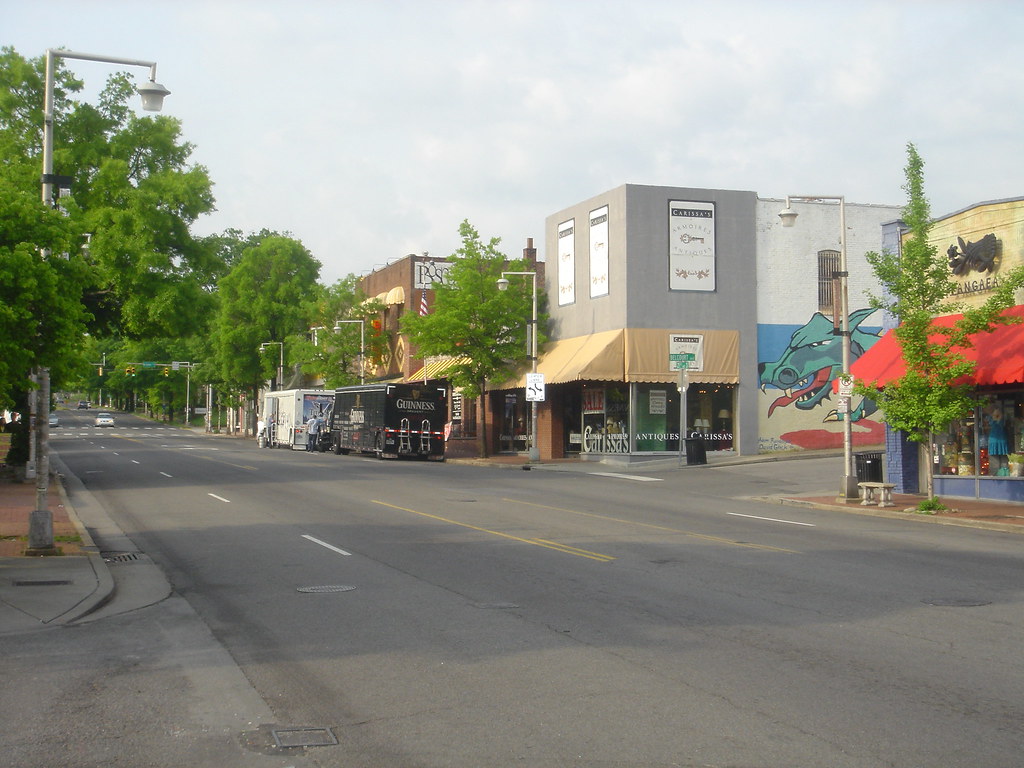
    A street scape in Hillsboro Village, a small commercial district near Vanderbilt University.


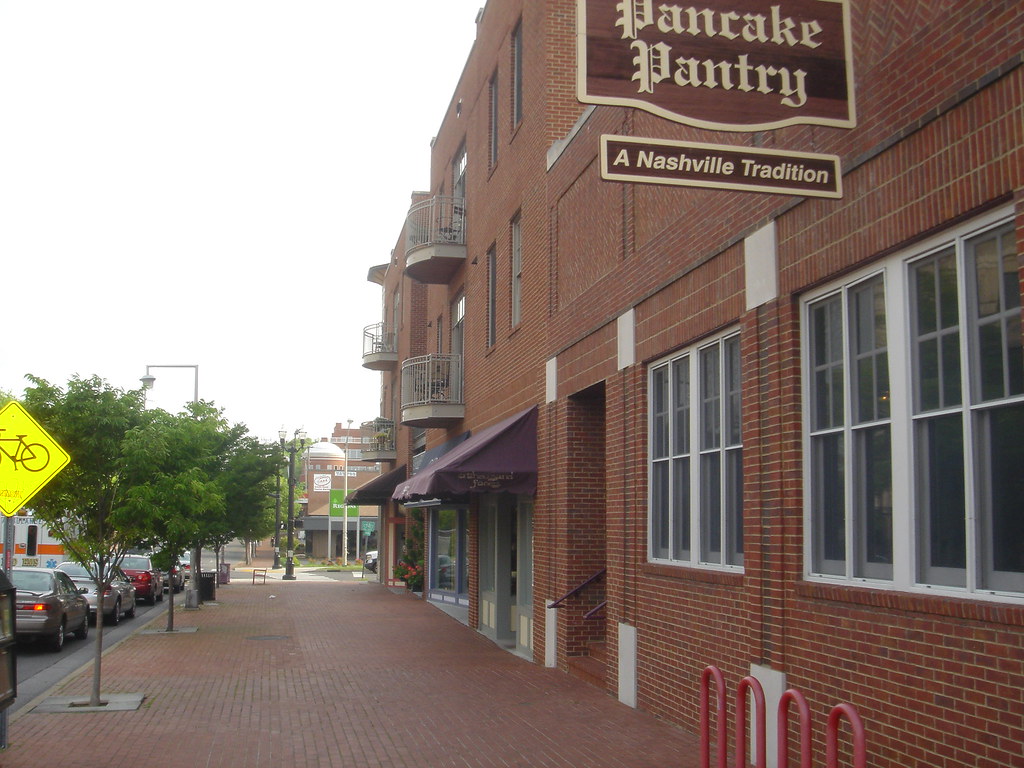
    The Pancake Pantry in Hillsboro Village, a breakfast place of high local repute. I was initially skeptical but the food was actually pretty darn good. This place is huge and there was still a line out the door at 10am on a Friday morning. Pretty crazy.


    The storefronts are a nice urban touch, but if you look behind this building you see a gigantic parking lot. This is perhaps an example of faux-urbanism. Putting the parking lot in the back doesn’t make it any less a strip mall. It is a difference in form, not function.


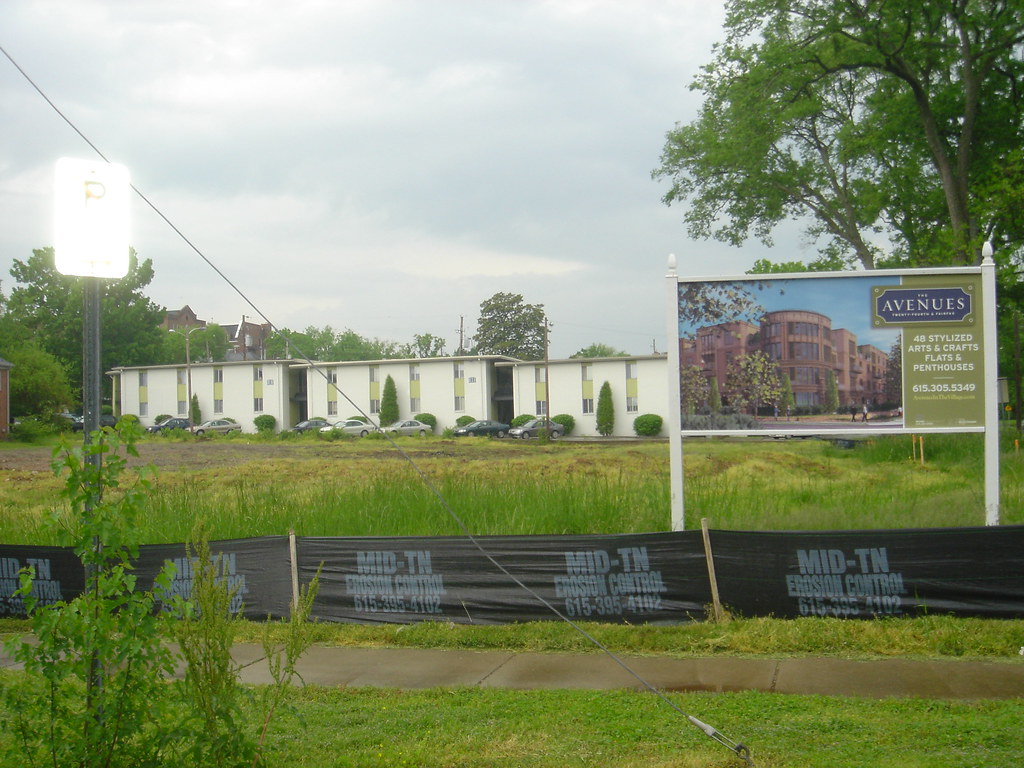
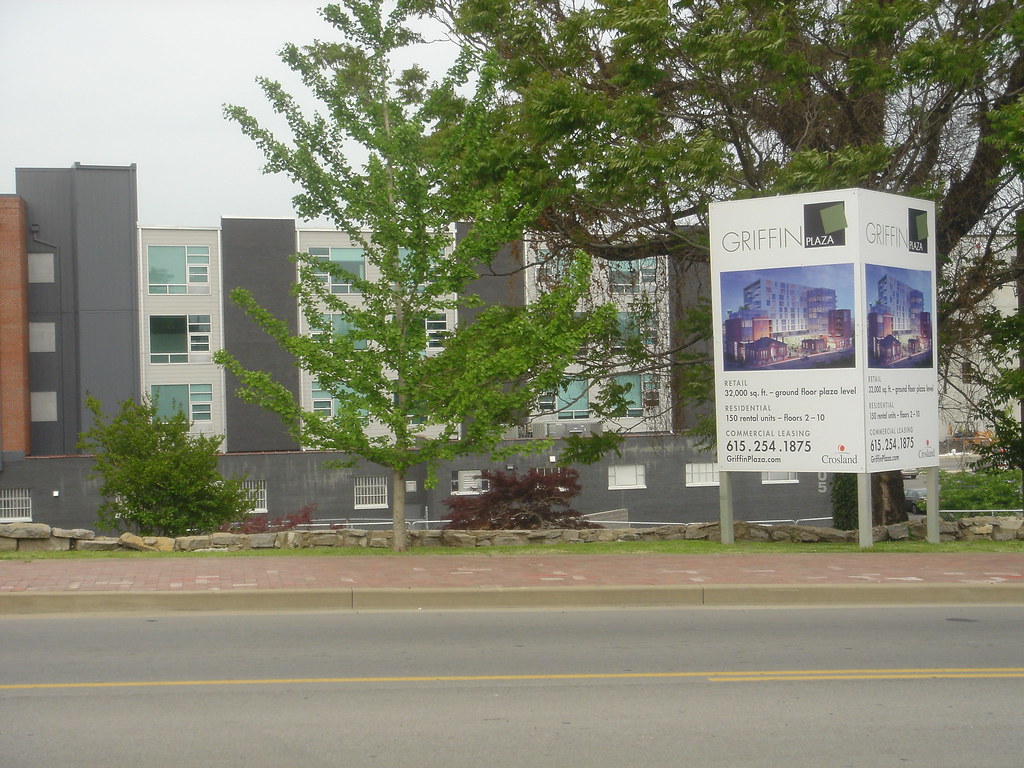
    One of the many vacant lots with a “condos coming soon” sign.


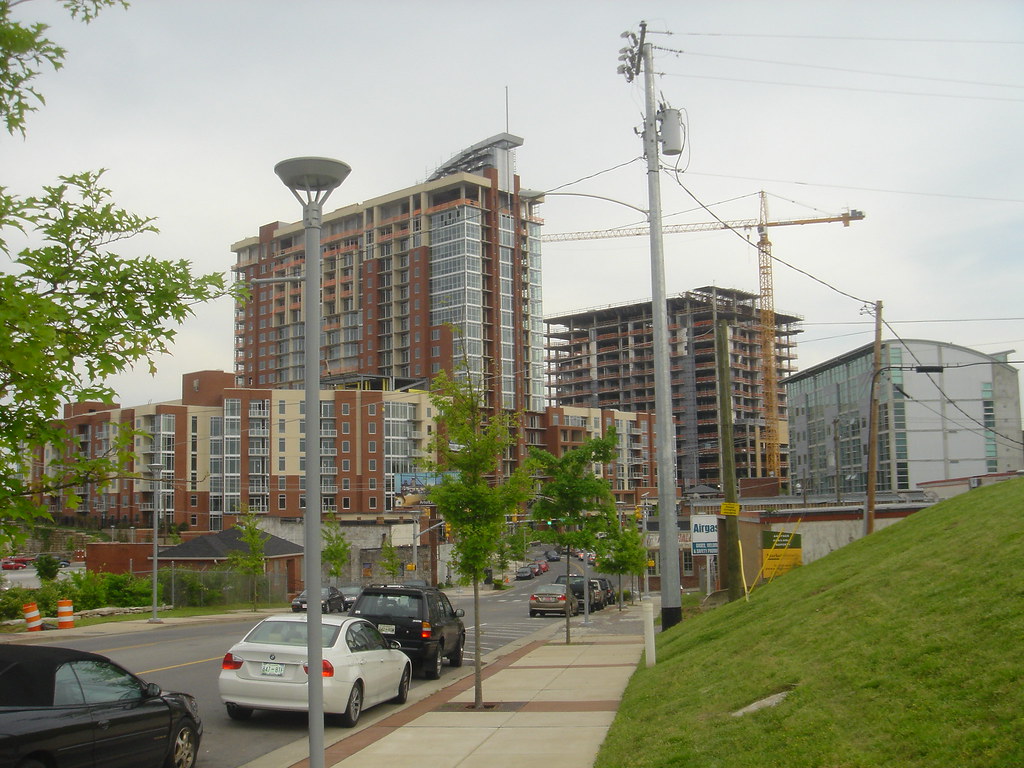
    The main road heading west of out downtown, West End Avenue, is developed at very high densities. I haven’t seen much in the way of this in most Midwestern cities. Midrises line both sides of the road basically from downtown to the interstate loop. It’s a six lane mega-street that moves tons of cars, but appears to have great bus service as well.


    Here is another one under construction.


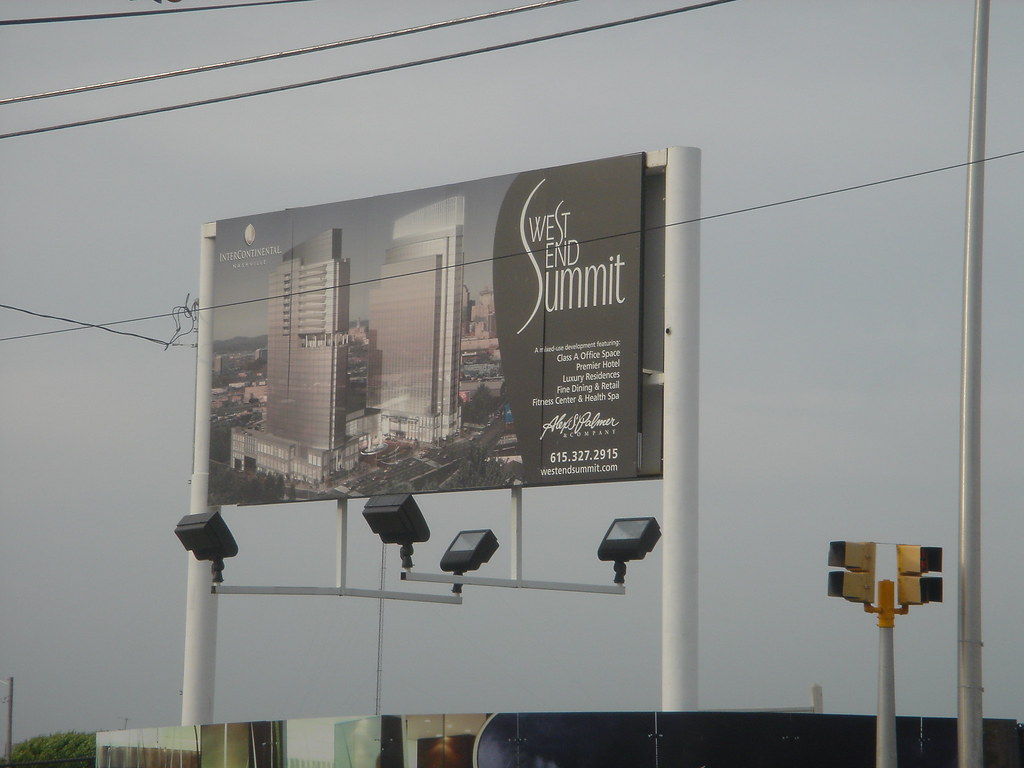
    A proposed, but I believe not yet funded, high rise development. Indianapolis readers will no doubt recognize one of the towers as a clone of the proposed Intercontinental hotel for Pan Am Plaza that lost out as the convention center anchor hotel.


    If you continue out to the west from here, you run into neighborhoods like Green Hills, which is where the most premier shopping in the area is found, and the suburb of Belle Meade, which serves as Nashville’s mansion district. Unlike traditional Midwestern mansion districts, this one is more rural in nature, with large estates that wouldn’t be out of place in a plantation. I did not take pictures of these areas, however.

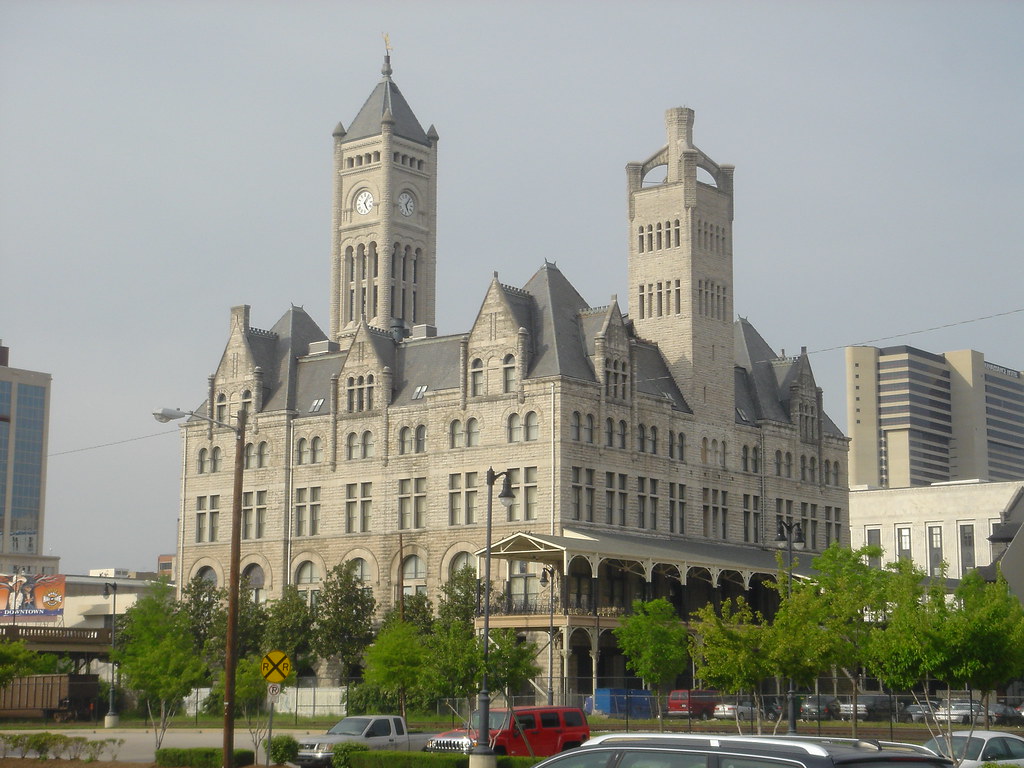
    Back closer to downtown is a nearby area known as the “Gulch”. It is not too far from Nashville’s Union Station.


    This appears to be some seedy industrial district that is being transformed all at once by a series of large developments. It also has several clubs and restaurants. I ate at a seafood place called Watermark that was surprisingly good. I believe most of the places are upscale chains, though I’m not sure if Watermark is or not. Here’s a picture of some of the development.


    More development


    North of downtown is a small historic district called Germantown. This was rather unimpressive if you ask me. I didn’t see much that was German about it. It sure isn’t Columbus’ German Village, that’s for sure. There were some restaurants there. I had lunch at one of them which, fortunately for them, I can’t remember the name of because it was terrible. This area is mostly older single family homes.


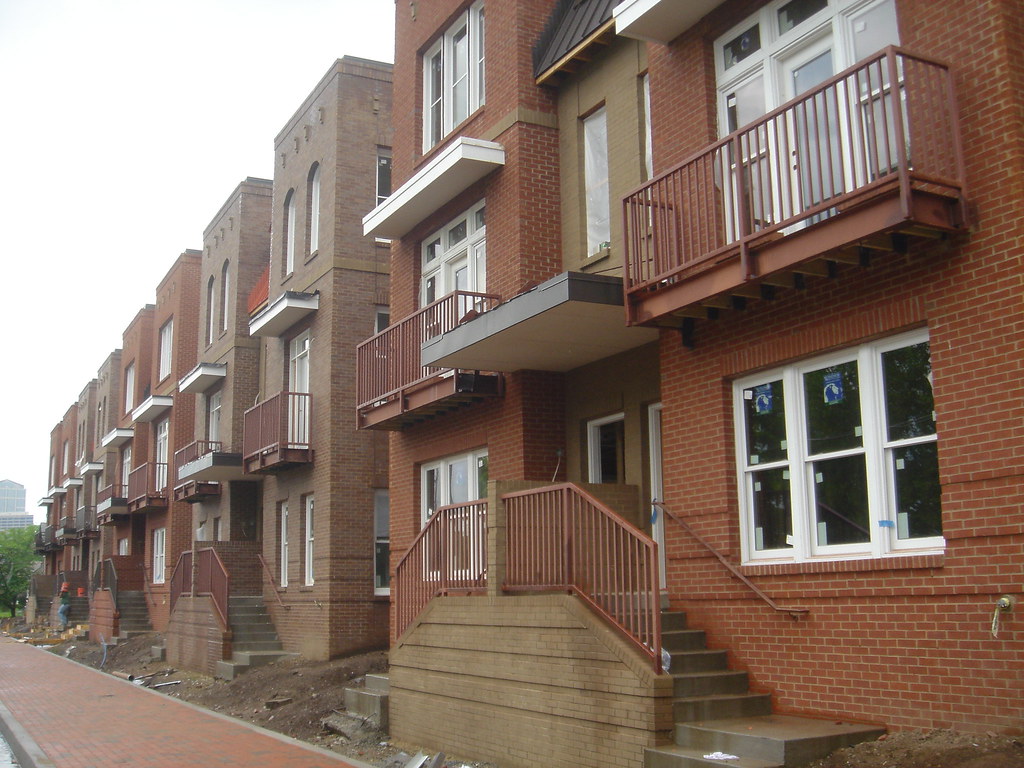
    The amazing thing about this area is that almost every vacant or industrial parcel was being redeveloped as condos. This really brought home to me the difference between Nashville and the Midwest. Were this, say, the Cottage Home area in Indianapolis, the local neighborhood association would use their historic district status to keep developments like these out. In Nashville, they are seen as a positive. Here are some examples.


    More condos


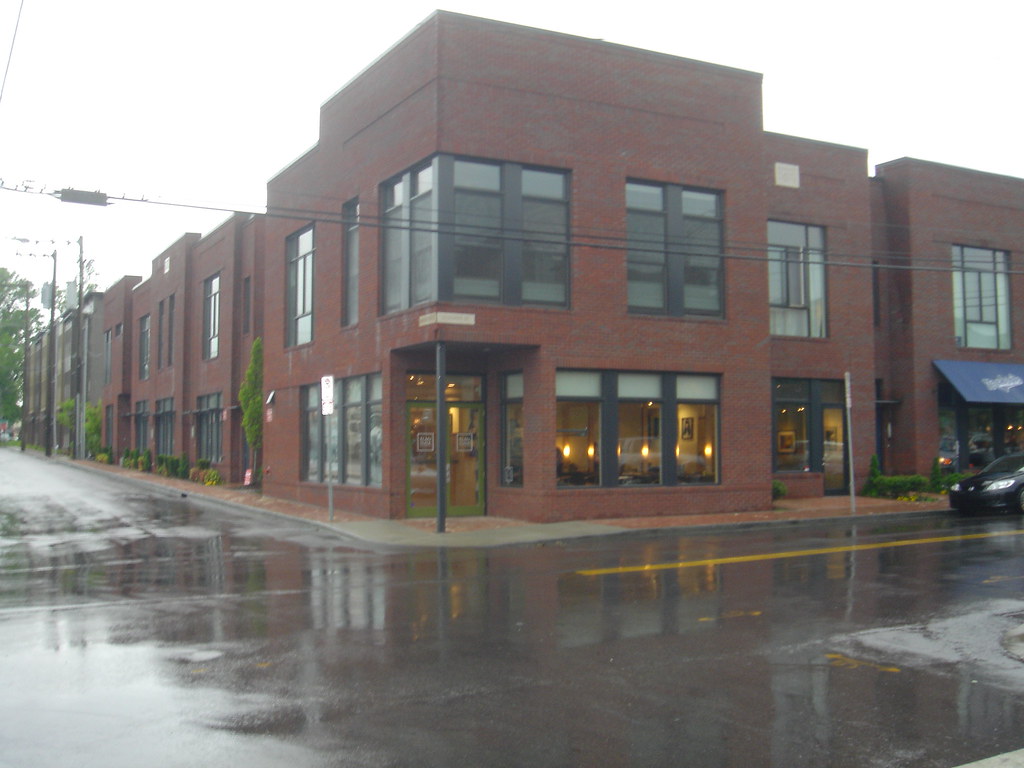
    More condos with retail space. Sorry for the very blurry pic but it was raining as you can see.


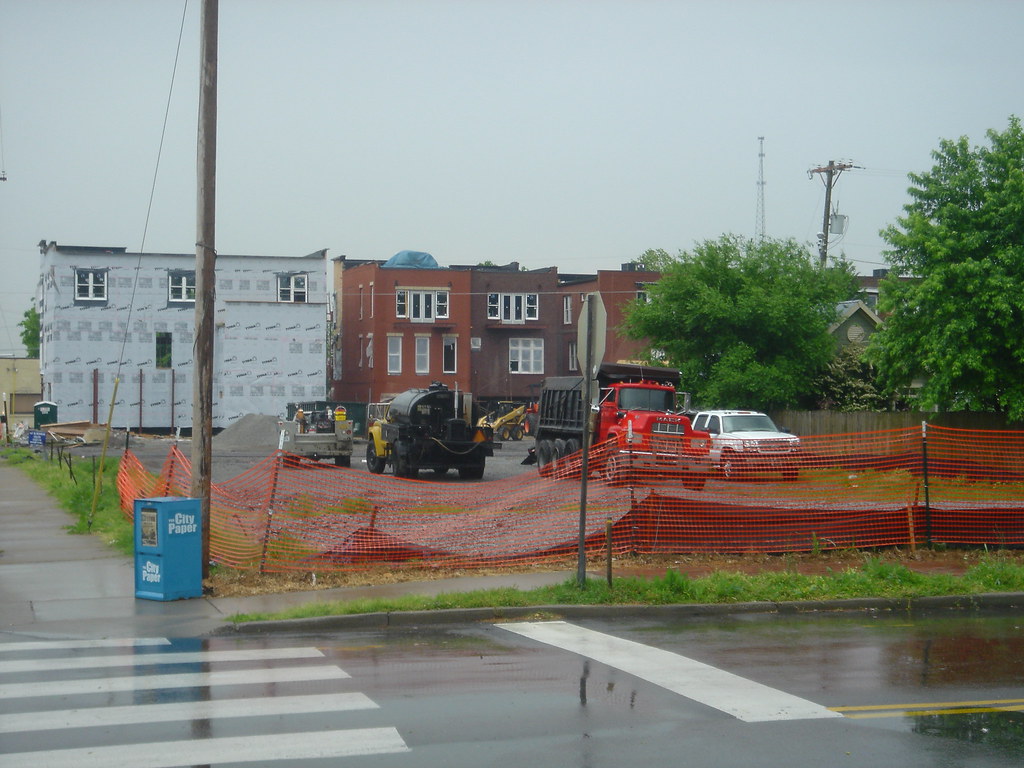
    More condos being built, and still more proposed.


    You get the picture. Also, note from all these photos the lack of design disasters. These are all workmanlike structures. The challenge for Nashville is that while there is a ton of new development, all of it is in a relatively generic, undistinguished style that could be in the downtown of almost any city. I did not get a strong sense of any type of vernacular style emerging. That is something I’d be looking for if I were them.

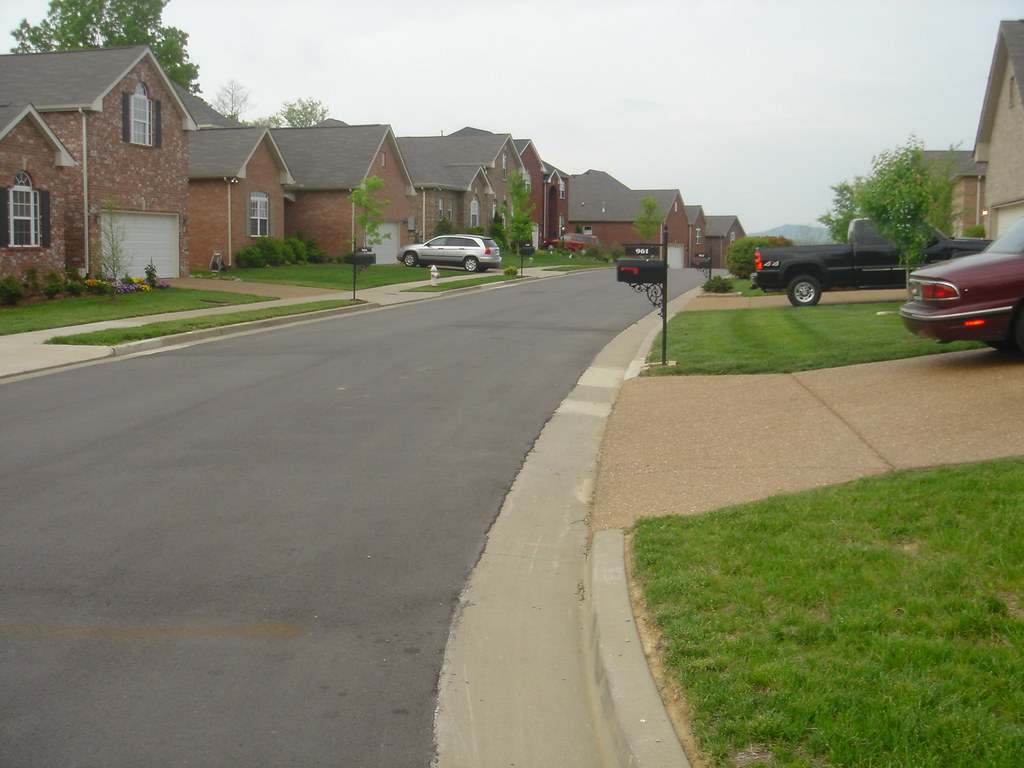
    Lastly, here’s one suburban example that shows something I pointed out last time. Namely that even in brand new, upscale subdivisions they aren’t putting in sidewalks on both sides of the street. I find this very odd. While I noticed some bike lanes this time around, Nashville’s definitely got a long ways to go when it comes to pedestrian and bicycle friendliness.


    Nashville is definitely a city that is on an upward trajectory. The volume of urban development and the business attraction success are impressive. It is exceeding even the best performing Midwest metros in that regard. However, it still lags the top southern and western metros. The current rate is very healthy, but probably isn’t sufficient to realize the civic ambitions. It remains to be seen whether Nashville can put it in another gear and take its place among the boomtowns, or whether it will merely stay on its current growth path. Either path is possible or a valid civic choice. While always possible, the likelihood that Nashville is going to take a major downtown does not appear high in the short term.


    Aaron M. Renn is an independent writer on urban affairs based in the Midwest. His writings appear at The Urbanophile, where this piece originally appeared.

  • New Metro GDP Data Released

    The Bureau of Economic Analysis yesterday released the 2009 data for metropolitan area GDP. Their headline, “Economic Decline Widespread in 2009,” should come as a surprise to no one.

    The BEA focuses on the year on year change. I’d rather look at the full span of the data that’s available, which is now 2001-2009. Here’s a look at percent change in total real metro area GDP during that time period:

    And here are the top ten metro areas over one million in population on this metric:

    Row Metro 2001 2009 Pct Change
    1 Portland-Vancouver-Hillsboro, OR-WA 81,505 114,028 39.90%
    2 Oklahoma City, OK 43,835 59,532 35.81%
    3 Austin-Round Rock-San Marcos, TX 55,466 75,136 35.46%
    4 Las Vegas-Paradise, NV 63,730 82,255 29.07%
    5 Orlando-Kissimmee-Sanford, FL 71,940 91,400 27.05%
    6 Phoenix-Mesa-Glendale, AZ 138,780 174,617 25.82%
    7 Washington-Arlington-Alexandria, DC-VA-MD-WV 294,656 368,793 25.16%
    8 San Jose-Sunnyvale-Santa Clara, CA 117,447 146,448 24.69%
    9 Salt Lake City, UT 48,157 59,603 23.77%
    10 San Diego-Carlsbad-San Marcos, CA 126,875 155,850 22.84%

    Per capita tells is a little bit different story. Here’s a map of US metro areas for percent change in real GDP per capita:

    The stunning collapse in real per capita GDP and also the erosion in per capita personal income relative to the nation is one of the key reasons I see Atlanta as a region with far more troubles than is generally assumed.

    Here are the top ten large metros again:

    Row Metro 2001 2009 Pct Change
    1 Portland-Vancouver-Hillsboro, OR-WA 41,256 50,863 23.29%
    2 Oklahoma City, OK 39,573 48,507 22.58%
    3 San Jose-Sunnyvale-Santa Clara, CA 67,299 79,604 18.28%
    4 San Diego-Carlsbad-San Marcos, CA 44,252 51,035 15.33%
    5 San Francisco-Oakland-Fremont, CA 63,260 72,259 14.23%
    6 Los Angeles-Long Beach-Santa Ana, CA 46,147 52,158 13.03%
    7 Washington-Arlington-Alexandria, DC-VA-MD-WV 59,801 67,344 12.61%
    8 Virginia Beach-Norfolk-Newport News, VA-NC 37,960 42,521 12.02%
    9 Buffalo-Niagara Falls, NY 31,160 34,472 10.63%
    10 New Orleans-Metairie-Kenner, LA 49,100 53,835 9.64%

    All I can say is, this data looks great for Portland. That city isn’t perfect to be sure, but on the GDP side of the house, the plan is working beautifully. Contrary to slacker stereotypes, high value work is increasingly being produced there.

    Aaron M. Renn is an independent writer on urban affairs based in the Midwest. His writings appear at The Urbanophile.

  • Census 2010: Urbanizing Indiana

    The first Census results for Indiana were recently released, painting a picture of an increasingly metropolitan state.  Indianapolis continues to be the growth champion as its strong economy attracted people from the rest of the state, as well as increasingly diverse populations.  Although  the core of Indianapolis fell well below expectations, its population did not fall like that of Chicago. In a switch from some other regions, the outer suburbs also lagged expectations while inner suburbs boasted a robust performance.

    Population Change in Indiana

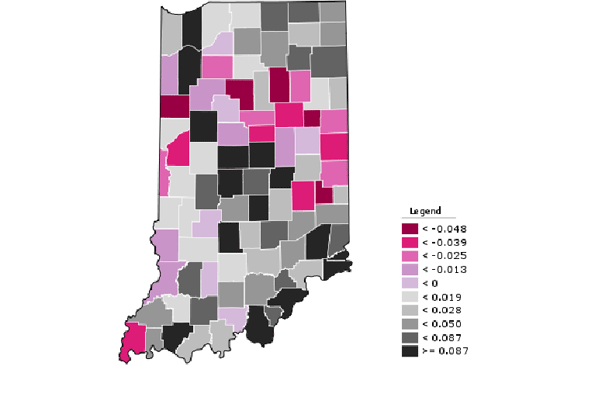
    The map below shows how Indiana’s counties faired between Census 2000 and 2010, with counties gaining population in black, and those losing population it in red.

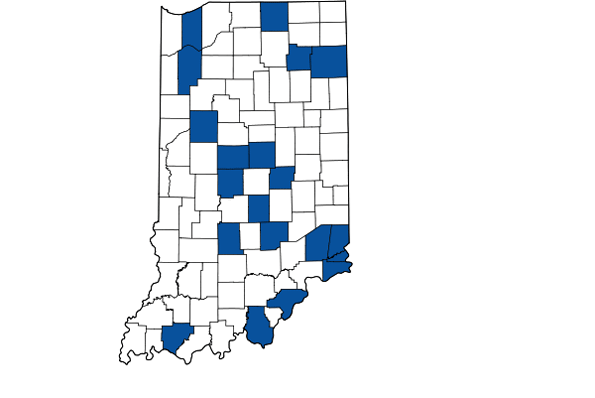
    Many rural and small industrial counties either shrank or posted anemic population growth while most metro counties, especially suburban ones, were standouts.  This is particularly illustrated by this map highlighting only those counties that grew faster than the statewide average:


    This list features heavily counties in suburban Indianapolis, Cincinnati, Louisville, and Chicago, as well as areas near midsized cities like Fort Wayne and Evansville.  Big Ten college towns Bloomington and Lafayette also did well.

    Metro Indianapolis: Indiana’s Growth Champion

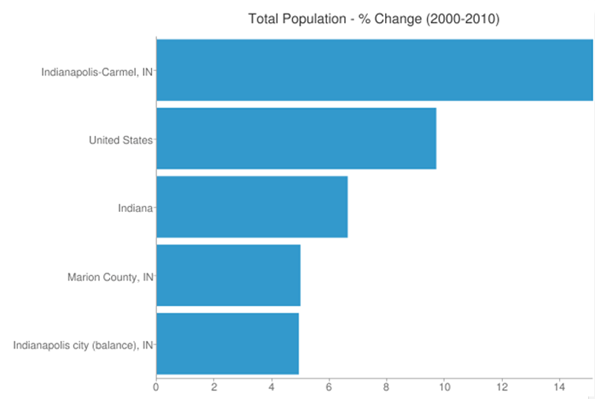
    But the clear population winner was metro Indianapolis, which grew at a rate 15.2%, nearly double the US average and well above that of the state:

    The growth even extended even to the central city/county, with Marion County breaking the 900,000 barrier.   The 231,137 people added by metro Indy was fully 57% of total statewide growth, even though that region only contained 25% of the state’s population in 2000.  Unsurprisingly, metro Indy added 15,000 jobs during the last decade  while the rest of the state shed nearly 200,000 of them.

    Indy Suburban Migration Missed Expectations, But No Core Renaissance Either

    Indianapolis showed some of the same urban core patterns as Chicago, which bodes ill for the back to the city story at the national level.  There is a city-county consolidation in effect which muddies the waters here, but the old township boundaries that are still reported by the Census Bureau as minor civil divisions can serve as a proxy for old boundaries.  Center Township covers most of what used to be the old City of Indianapolis, while the remaining townships constitute the Inner Suburbs and the collar counties the Outer Suburbs.

    Those of us who are urban boosters were excited that the Census Bureau estimates showed Center Township’s decades long population slide ending and even hitting an inflection point during the 2000s. Alas, these Census results demolished that notion as Center Township was shown to have lost 24,268 people, falling well short of estimated population in 2009.  Like Chicago, the inner city also featured a large black exodus.

    But the Outer Suburbs didn’t fare that well either, especially Hamilton County.  Long ranked among the fastest growing in the entire United States, I had been waiting to see if growth there might have been slightly above trend as in the past and put them over the 300,000 mark. It turns out to be a very different story, as Hamilton County’s 2010 population was 274,659, actually coming in below the 279,287 the Census Bureau had estimated in 2009. Still, the majority of regional growth was still in the Outer Suburbs, although less than estimated.

    This of course means that the Inner Suburbs did better than expected, particularly the southern ones of Perry and Franklin Townships, which still have some greenfield development opportunities left.  As in cities across the US, older Inner Suburbs of Indy have been experiencing their own problems as they aged. But this shows that the problems may not be as bad as feared.  Though the economy doubtlessly affected this, nevertheless it still buys additional time for transformations driven by demographic growth and entrepreneurship among immigrants and a burgeoning black middle class to take root.

    More Diversity, But Still Not That Diverse

    Indianapolis and Indiana grew more diverse during the 2000s particularly with Hispanic immigration. But again the changes were concentrated in metro areas.  And Indianapolis, long a very white city with a black minority, showed very strong growth in diversity, but still not enough to make this a truly diverse place in the manner of New York or Los Angeles.

    As in Chicago, the core lost black-only population, but other than that it was a very different story.  Metro Indy added 48,824 new blacks, a growth rate of 22.8% that outpaced overall growth.  This boosted black population share by nearly one percentage point.   Unlike Chicago, where local journalists are asking what happened to the city’s incredible shrinking black population, leading Indy black talk show host Amos Brown issued a press related titled “Blacks Fueled Indy’s Growth in 2010 Census Reports” to trumpet the black numbers there. One big reason might be: in contrast to Chicago, Indianapolis’ African-Americans did not have to flee south for jobs or affordable housing.

    The black core population decline in Indy seems less driven by gentrification than the prosaic concerns that generally drive suburbanization, such as safer streets,  better housing and schools.  This migration pattern is very evident in places like the Inner Suburban Lafayette Square area, which in addition to becoming a thriving immigrant business district is also home to large numbers of black owned businesses that are helping to transform this once decaying area.

    The state’s black population as a whole remains heavily concentrated in large urban areas, with Marion and Lake Counties accounting for 62% of the state’s total black population.

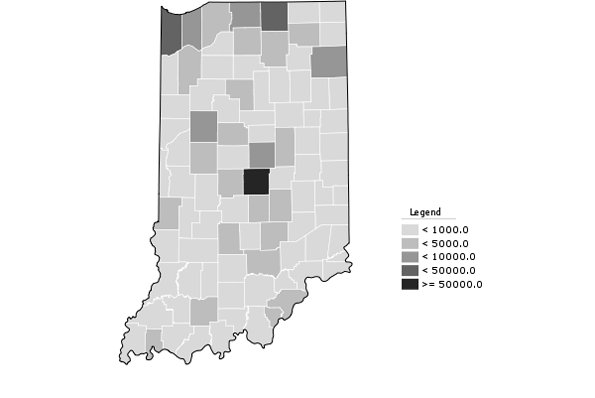
    Indy’s Hispanic growth surged as well, with 66,715 new Hispanics representing a 161% increase, though this is less than some expected. Hispanic population growth was more evenly spread, though from a total numbers perspective Indy and northern Indiana dominated the growth, as illustrated by the following chart of total Hispanic population growth in the last decade:

    Indy’s Asian population also more than doubled to almost 40,000..  Add this all up and the metro area non-Hispanic white-only population share dropped by six percentage points, but remains at 74.6%.  The city of Indianapolis itself is pushing 40% minority, however.  Regardless, this is still a material change and shows that metro Indy is a strong magnet not just for whites, but for pretty much everybody.  Its challenge is to continue building on this for the future, while the state’s challenge will be to  pull itself up to Indy’s level of demographic and economic performance.

    Aaron M. Renn is an independent writer on urban affairs based in the Midwest. His writings appear at The Urbanophile.

    Photo by Carl Van Rooy

  • Chicago Takes a Census Shellacking

    The Census results are out for Illinois, and it’s bad news for the city of Chicago, whose population plunged by over 200,000 people to 2,695,598, its lowest population since before 1920.  This fell far short of what would have been predicted given the 2009 estimate of 2,851,268. It’s a huge negative surprise of over 150,000, though perhaps one that should have been anticipated given the unexpectedly weak numbers for the state as a whole that were released in December.

    The American Community Survey data from last year show a clear improvement in items like college degree attainment (up 7.6 percentage points since the 2000 Census) and median household income (up 18%, which trailed the nation slightly, but beat Cook County and the state).  These data points show the very real improvements that have swept over a portion of the city, the visible gentrification that envelops the greater core area has now been shown to have been unable to power overall population growth, or to restrain the rampant exurbanization in the region.

    White and Black Flight

    The non-Hispanic White Only population of the city actually declined by 52,449, or 5.78%.  The “minority” population declined even further, -147,969 or 7.44%, meaning the city actually grew its white population share by 0.38 percentage points, perhaps indicating the early stages of the “Europeanization” of Chicago as the core gentrifies and disadvantaged groups and the white working class are pushed further to the fringe.

    Indeed, the Black Only population plunged by 177,401 as blacks increasingly moved to suburbs, especially southern ones  like Matteson, Lansing, Calumet City, Park Forest, and Richton Park, each of which added thousands of new black residents.  Some indications are that a significant number of black residents left the region altogether.  The traditional black magnet of Atlanta – which struggled through much of the decade – was a top five destination for people leaving Chicagoland over the past decade, and Chicago was the #2 source of in-migrants to Memphis, another black hub, according to IRS data.

    Hispanic population was the bright spot for Chicago, as the city added Hispanic residents to the tune of 25,218, or 3.35%.  Hispanics boosted their population share in the city by nearly 3 percentage points.  But even this growth isn’t that impressive.  The city of Indianapolis, at less than a third Chicago’s population, added over 45,000 Hispanics on a much smaller base.

    Demographic Reality: Massive Exurbanization

    Much has been made of Chicago’s legitimate and real urban core renaissance, but the cold reality remains that this is one of America’s most sprawling regions. Regional growth continued to be heavily focused not in the city or established inner suburbs, but the exurbs.  Kendall County more than doubled in population, and counties like Grundy, Boone, and Kane also made the top five in the state. Cook County, which is about half made up of the city of Chicago, as a whole actually lost population. And traditional suburban powerhouse DuPage has flattened, while Lake County, Illinois fell just short of the national average in growth. During the last decade, a net of over 25,000 people moved from metro Chicago to metro Rockford, making that city the #2 destination for those leaving Chicagoland. Given that Rockford is hardly an economic mecca, clearly exurbanization is spreading far beyond traditional metro boundaries. Sprawl of the most intense kind is alive and well in Chicagoland.

    The following map illustrates this, with a five bucket sort of 2000-2010 population percentage change, growing counties in black, shrinking in red:


    The raw data on regional growth speaks for itself:

    Core+Suburb vs. Exurb

    2000

    2010

    Total Change

    Pct Change

    Core + Established Suburb (Cook, DuPage, Lake Counties)

    6,925,258

    6,815,061

    -110,197

    -1.6%

    Exurb (Other IL Metro Chicago Counties)

    1,347,510

    1,771,548

    424,038

    31.5%

    This sprawl might be more understandable in rapidly growing cities like Atlanta and Houston that can both densify the core and grow outwards simultaneously.  But the Chicago-Joliet-Naperville-IL Metropolitan Division (the full MSA is not yet available since Wisconsin hasn’t been released yet) grew at less than half the national average. This means that the exurbanization trend in Chicagoland is almost entirely loss of population share by the core to the fringe.

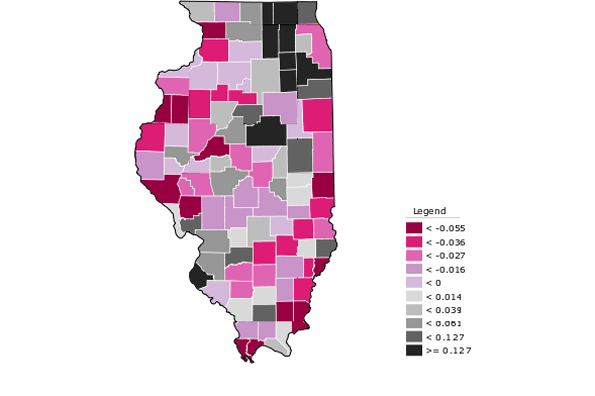
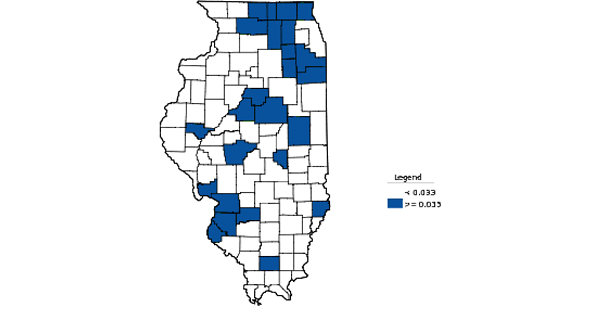
    To put an even starker view on the concentration of growth in Illinois as a whole, this map highlights only those counties that grew faster than the already anemic statewide average:


    Other than a handful of counties, the group of fastest growing counties in the state is dominated by suburban and especially exurban Chicago and St. Louis counties.

    For those of us who’ve chosen to plant our flag in the city, these results are most unwelcome news, no two ways about it. This is especially true as underfunded pensions and city budget gaps loom large, and where the per capita load only goes up as the population goes down.  This report should be a call to arms to the next mayor and the city as a whole to make the promise of revitalization a reality, and bring growth and prosperity to the city as a whole, not just a the upscale core. Cities like Chicago have to become more aspirational; places of upward mobility to broad sections of the middle and working classes. The city and Cook County can’t afford another decade like this one.

    Aaron M. Renn is an independent writer on urban affairs based in the Midwest. His writings appear at The Urbanophile.

    Photo by Gravitywave

  • Chicago: The Cost of Clout

    The Chicago Tribune has been running a series on the challenges facing the next mayor. One entry was about the Chicago economy. It described the sad reality of how Chicago’s economy is in the tank, and has been underperforming the nation for the last few years. I’ll highlight the part about challenges building an innovation and tech economy in Chicago:

    The region also has lagged in innovation, firm creation and growth in productivity and gross metropolitan product over the past decade, according to economic development consultant Robert Weissbourd, president of RW Ventures LLC. Daley’s two long-held dreams of Chicago emerging as a high-tech center and a global business center remain just out of reach… “We haven’t made the real global jump yet, and we have not made the tech jump either, but we are finally poised,” said Paul O’Connor, who for many years ran World Business Chicago, the city’s economic development affiliate. “We are still a major contender, but, yeah, we can blow it.” Or, as [Chicago Fed Economist William] Testa put it, “Given the poor performance of this decade, we need to rethink the challenges for Chicago.”

    “If I could wave a magic wand, I would get government to start thinking differently about … what are the levers that we need to push, away from the traditional (tax increment finance district) thinking and away from the traditional thinking of, ‘Let’s just get a big company to move here,’ and toward thinking about how to foster innovation and creativity,” Christie Hefner, former chairman and chief executive of Playboy Enterprises Inc., said at a recent economic forum.

    It has been extremely rare to see people with establishment positions ever say a discouraging word about the city. Most honest observers would have to rate Daley highly has a leader, but certainly not perfect. Yet any criticism at all of him (directly or implicitly by that of the city he runs) has been studiously avoided by most. They are terrified of being excommunicated or broken on the wheel if they deviate from the script. To have corporate executives asking tough questions is unusual, and hopefully an example of a forthcoming “Great Thaw” we need to have here in the wake of Daley’s retirement.

    Chicago’s inability to build an innovation/tech economy is pretty remarkable if you think about it. Here’s third largest city in the country, one with enormous human capital, tremendous wealth, incredible academic institutions, and above all an ability to execute that far outclasses virtually any city I know. How is it then that Chicago has been unable to execute on this?

    Believe it or not, a lot of it goes back to that bane of Chicago politics: Clout. People in Chicago tend to write off clout and political corruption in Chicago with a shrug, as a unique or even amusing local affectation, or just part of the character of purely political life of the city, but one that doesn’t fundamentally change its status as the “City That Works.” But nothing could be further from the truth. Chicago’s culture of clout is a key, perhaps the key, factor holding the city back economically.

    Chicago’s Ambition: Clout

    In Paul Graham’s essay Cities and Ambition, he writes about the subtle messages cities send about what you should try to achieve, and how that shapes their fortunes:

    “Great cities attract ambitious people. You can sense it when you walk around one. In a hundred subtle ways, the city sends you a message: you could do more; you should try harder. The surprising thing is how different these messages can be. New York tells you, above all: you should make more money. There are other messages too, of course. You should be hipper. You should be better looking. But the clearest message is that you should be richer.

    What I like about Boston (or rather Cambridge) is that the message there is: you should be smarter. You really should get around to reading all those books you’ve been meaning to. When you ask what message a city sends, you sometimes get surprising answers. As much as they respect brains in Silicon Valley, the message the Valley sends is: you should be more powerful.

    How much does it matter what message a city sends? Empirically, the answer seems to be: a lot. You might think that if you had enough strength of mind to do great things, you’d be able to transcend your environment. Where you live should make at most a couple percent difference. But if you look at the historical evidence, it seems to matter more than that.

    Chicago’s ambition, the message it sends is: “You should have more clout.” Does that matter? You bet it does.

    What Is Clout?

    Clout is a term of art in Chicago that normally refers to the ability to use connections to obtain jobs, contracts, subsidies or other favors from government. But more broadly, we can think of clout as the ability to influence organizational action within the context of a particular power structure.

    But if that’s the definition, isn’t saying you should have clout the same thing as saying you should have power like Graham said of Silicon Valley? No. Having power, like that held by Mark Zuckerberg or Larry Page and Sergey Brin, is about being autocephalous. It’s about have an independent base of authority or ability to act others are forced to respect. Clout, by contrast is all about petty privileges. Clout can be given, but it can also be taken away. That’s what makes it so corrupting. Tellingly, no one ever talks about Mayor Daley as having clout. That’s because he has real power instead. Having power is like being a king or a duke or a baron. Clout is all about being a courtier.

    To see this in action, just contrast Jesse Jackson with Al Sharpton. Both are prominent national civil rights leaders and black ministers. But Jackson rarely goes hard after anyone in Chicago, at least not anymore. Jackson has clout. One son is a congressman. Another somehow managed to acquire ownership of a lucrative beer distributorship. Jackson bought into the system in Chicago.

    By contrast, Sharpton wants to be a power player in New York, to be someone to whom even a would-be mayor has to come visit and, as they say, kiss the ring. He’s not interested in being bought off. Sure, he’ll make alliances. But he’ll never give up his independent base of power that makes him someone to be reckoned with. That’s the difference between power and clout.

    The Chicago Nexus

    John Kass likes to talk about clout in terms of the “the Combine,” or the bi-partisan system in Illinois in which the Democrats and Republicans have often proven less rivals than partners in crime, sometimes literally. But I prefer to think of “the Nexus” – a unitary social structure that pretty much everyone who’s anyone in Chicago is part of, one that goes far beyond the world of politics.

    Ramsin Canon had a good illustration of the Nexus in a piece he wrote over at Gapers Block:

    With big city economies cratering all around him, the Mayor was able to raise in the neighborhood of $70 million dollars to fund the Olympic Bid. At the same time he was able to get everybody that mattered–everybody–on board behind the push for the Olympics. Nobody, from the largest, most conservative institutions to the most active progressive advocacy group, was willing to step out against him on that issue.

    The list of big donors to the Chicago 2016 bid committee is a comprehensive list of powerful Chicago institutions. I mean, it’s exhaustive. Economy be damned, when the Mayor called, they listened. Why? What did those conversations sound like? And do we believe that the Mayor is so powerful–or that their relationship with him is so close–that they must obey him? Or–more likely–is it a mutual back-scratching club with an incentive to protect the status quo? Chicago’s political infrastructure isn’t about the Democratic Party or “the Machine” or special interest groups or labor unions. Those are elements of varying importance. It’s real power lives in the networks that tie that list together.


    Replace the man on the Fifth Floor–Bureaucracy Man, the superhero who keeps our alleys clear–and will these networks evaporate? Will they just disappear? How long would it take them to reorganize around the new personalities that moved in there?

    All cities have elite networks, but I have never seen a city that has a unitary power nexus to the extent Chicago does. I believe the Nexus resulted from the culture of clout combined with the fact that, with the exception of the interregnum between Daley pere and fils, power has been centralized on the 5th floor of city hall for decades. The Nexus may have come into being around the mayor, but now it has become a feature of civic life, one that practically longs for what Greg Hinz has labeled a “Big Daddy” style leader to sustain the system.

    Clout’s Effect on the Culture of Chicago

    The emergence of the Nexus is one of the key cultural impacts of clout in Chicago. If clout is only effective within a given power structure, then clearly the clouted want to see their power structure expand. The ultimate dream of the clout seeker is a centralized unitary state like Louis XIV’s France. In Chicago, we’ve come amazingly close to achieving it. It’s not that there’s no conflict, but it is all of the palace intrigue variety, not true conflicts between rival power centers. Without centralized political power and a tradition of clout, the Nexus would never have come into being.

    There are many other cultural impacts as well. As Douglas and Wildavsky note in Risk and Culture, “An individual who passes his life exclusively in one or another such social environment internalizes its values and bears its marks on his personality.”

    People are bought into and defend the system. They mapped these social environments along the axes of “grid” and “group” – the degree of hierarchy in the system and the degree of group cohesion. The Chicago Nexus is a high-grid, high-group structure, or collective hierarchy, with centralized decision making and a high cost of defection. Even groups that in other cities tend to be more oppositional to government will say something like, “Decisions get made in the mayor’s office here, so we have to play that game” and buy into the system. I’ve lost track of the number of times I’ve heard, “That’s just how it works here.” Of course, this means the basis of their own ability to make things happen then becomes influence – clout – within the Nexus. Thus they defend the system, because if it went away, so would their ability to make things happen because they’ve cultivated no alternative vectors for action. Also, the Council Wars period of the 1980’s still looms large in many leaders’ minds. Chicago remains heavily segregated and racially balkanized, as the recent quest for a single black mayoral candidate illustrates. There’s a lot of worry about what might happen if the current system breaks down.

    Conservatism and favoring of the establishment. Following on from that, the system fosters a sort of generalized conservatism, one dominated by a desire for institutional stability. It takes a heavy hitter to get the mayor’s attention or even access to the mayor, which reinforces establishment control, an inherently conservative model. This conservatism is even visible the realm of public design, as I’ve noted in discussion the retro-nostalgia design of the city’s streetlights and other streetscape elements. The evidence of clout-fed conservatism is literally graven in into the very streets of the city.

    Parochialism. Though fancying itself a cosmopolitan burg, I don’t see that Chicago is that much less parochial than most other Midwest cities. You see this in a thousand little ways. For example, in the way beloved long time personalities dominate the local airwaves. As the New York Times noted about turmoil at long time ratings leader WGN-AM, “Chicago tends to be unforgiving to newcomers. And with WGN pulling in the second- most radio revenue in the market behind WBBM, its moves are fraught with risk. ‘It was always difficult to bring someone in from out of town,’ said Bob Sirott, a longtime Chicago broadcaster.” (Longevity seems particularly prized here generally, as unless you are fortunately enough to be born to the right family or in the right parish, it takes time to accumulate clout). Or in the focus on local and hyper-local news in the local internet journalism community.

    Fear. As a high-group social structure, people are terrified of being kicked out of the club. Hence the unwillingness to cross the party line on almost any issue. As Tocqueville put it: “That which most vividly stirs the human heart is not the quiet possession of something precious, but rather the imperfectly satisfied desire to have it and the continual fear of losing it again.” People are even afraid of collateral damage if others near them cross the line. As Mike Doyle said, “In systems like Chicago’s, people don’t just refrain from rocking the boat, they do their best to keep anyone else from rocking it either.”

    Total Rejection of the Other. Anyone who exists outside the structure is a potential threat. Hence they are either co-opted or marginalized. The best illustration of this is the very title of that wonderful book on Chicago politics, We Don’t Want Nobody Nobody Sent. Or as Steve Rhodes said to me:

    One of the bartenders at the Beachwood says it took her awhile to figure this city out. In other cities you apply for a job with a resume, talk about your experience, etc. Here they just want to know who you know, who sent you – even at the bartender level….I’m not naive enough to believe this doesn’t happen elsewhere, but nowhere near as it does here, where it’s in the DNA. …Here, merit counts for next to nothing…In New York, everyone wants to know: “What do you do?” In Chicago, everyone wants to know: “Who do you know?”

    Why Clout Is Toxic to the Innovation Economy

    When you think about these cultural impacts of clout on Chicago, it becomes obvious why the city has failed to build an innovation economy. Innovation is fundamentally about new ideas, new ways of doing things, new players in the game, those from the outside, about merit, about dynamism. Clout is about what happened yesterday, the fruits of long years of efforts, and the same old – sometimes really old – players, about insiders, about connections, about stasis. As Jane Jacobs noted, “Economic development, no matter when or where it occurs, is profoundly subversive of the status quo.” Innovation driven economic development is fundamentally about disrupting the status quo. Clout is all about preserving it. Innovation welcomes the outsider, the clout-fueled Nexus abhors the Other. Innovation and clout are enemies.

    Think about the innovation hubs in America. They are all places that welcome the new. Not that it’s easy to make it in them. In fact, these place are often brutally competitive. And of course they have elite networks where the scions of the rich and powerful have a leg up and such. But the new is an important part of what makes them tick. In Silicon Valley, they are always looking for the tomorrow’s HP, Apple, Cisco, Google, Facebook, or Twitter, not just celebrating the past. They know that success today is ephemeral and, as Andy Grove put it, “only the paranoid survive.” DC loves its establishment, but the very nature of the place assures there will always be new players in the game. President Obama comes out of nowhere to gain the White House. But two years later it is the upstart Tea Party’s turn. Possibly because of their entertainment industry clusters, NYC and LA are always on the lookout for the fresh face and the next big thing.

    But Chicago? What do you think is going to happen when an ambitious 20-something with a great idea for a new business but no clout shows up in Chicago trying to make it happen and knocks on the door?

    I may not be 20 anymore, but at the risk of making this post sound like merely a bit of personal pique, I’ll share a true personal story to illustrate one example of how this plays out in real life in Chicago. In 2009 I received an award from the Chicagoland Chamber of Commerce for innovative thinking on public transit, winning first prize in a global competition they ran to solicit ideas for boosting public transit ridership in Chicago.

    I was thinking at the time that I might want to do something more entrepreneurial. I knew that the Chamber ran a sister organization called the Chicagoland Entrepreneurship Center chartered with boosting startups in Chicago. In the wake of my award I decided to check them out and see how they might be able to help me.

    There was just one problem: they wouldn’t return my phone calls. I made many attempts to get in touch with them by phone and email, and couldn’t even get them to give me a “No Thanks” or pawn me off on a peon. Now I’m a guy who a) had significant business experience, who b) built up one of America’s top urbanist sites from scratch, an inherently entrepreneurial act, and a successful one, if you think about it, and c) just got an award for innovation from the Chamber itself. Yet they wouldn’t even give me the time of day.

    What’s more, the Chamber mothership never showed any interest in engaging with me post-competition either. It was clearly just a PR exercise for them. Now don’t get me wrong, I’m delighted to report it was a very successful one. I got my picture on the front page of the Chicago Tribune above the fold. It exceeded my wildest expectations. I think the folks at the Chamber are nice people and I was extremely pleased with how it went. But clearly from their perspective, that’s where it ended. Actually uncovering innovators or something was not part of the agenda.

    From standpoint of the the Chicago system, this experience actually makes perfect sense, as I don’t have clout, nor can I bestow it on anyone. So why burn cycles on me?

    If you think about my profile and the treatment I got, can you imagine what a 23 year old armed with nothing but a crazy idea would get? A lot of ink has been dedicated to talking about how far Chicago and Illinois have come since they days when Mark Andreesen was actively harassed while trying to commercialize his web browser, then run out of town on a rail. But there is no doubt in my mind that if the next the next Andreesen showed up today, he’d get the exact same treatment. (I’m not familiar enough with Andrew Mason’s history to know how he was treated pre-Groupon, and pre-his association with the likes of big money Eric Lefkofsky. It would make an interesting case study to look at the history there – though he is a possible exception. I don’t know. In any case, his major local profile came after Groupon was already a huge success).

    This is what clout in Chicago hath wrought. The culture of the establishment Chicago is simply incompatible with an innovation economy. It’s not just about money or resources. It’s about respect. It’s about what this town respects, and more importantly what it doesn’t. It’s about what Chicago whispers to you about what you should aspire to achieve, what success means in this city, and the subtle – and not so subtle – messages about how you get ahead here.

    Until you’ve already made your millions or somehow wormed your way into connections or up through the hierarchy, establishment Chicago has no use for you in its economic plans, no matter what talent, ideas, or ambitions you might harbor. (Ironically, the biggest exception is Daley himself, who was famous for seeking out and rapidly promoting young talent like Ron Huberman and Richard Rodriguez. That’s another example of how he is head and shoulders above your average leader).

    By contrast, the local entrepreneurial tech community gets it, is energized, knows where the city is and where it needs to be, and is working hard to make progress with a sense of legitimate optimism backed up by recent good news. Grass roots and “by tech for tech” institutions ranging from Technori, to the Chicago Lean Startup Circle, to the folks at Groupon – which is a huge, inspirational success story, with people who get it and are committed to trying to build up Chicago’s tech scene – are hugely supportive of anyone trying to make a go at it no matter what stage they are in, and providing legitimately useful info and help along the way. Every single person in this group I’ve talked to has been more that willing to do anything to try to help me out, sometimes even more than I’d hoped or asked for – 100% of them. (Yes, this does mean I am starting an internet business myself – watch this space).

    I’ve long said Chicago isn’t going to be the next Silicon Valley and should seek only to get its “fair share” of tech. Having said that, as the third largest city in America, a fair share is still pretty big. If Chicago’s going to make it, this collaborative effort by the local tech community is what is going to get it there – not the Nexus.

    The Way Forward

    Pretty much every report out of officialdom – from Gov. Quinn’s Illinois Economic Recovery Commission Report to CMAP’s Go To 2040 Plan – suggests the public and quasi-public sectors need to do more to boost innovation. But what’s really needed is cultural change in the establishment. Until that happens, I’d suggest that what’s really needed is to take a page from the Getting Real playbook and for them to do less.

    Think about it. If Joe Investor shoots you down, you know the odds were probably long in the first place. While you might not come away feeling good about him, you probably don’t feel any worse about Chicago. But if you approach an official or quasi-official organization chartered with promoting “innovation”, “entrepreneurship”, “clusters”, “technology” or whatever in Chicago and they shoot you down, it’s not just them but your city you feel has rejected you. It’s one thing to generate a negative interaction with a private entity, but with an official entities that hurts the very thing they’re trying to promote. If an official or quasi-official organization can’t say Yes, or at least make sure that well over 50% of the people it says No to feel good about the experience, it should be shut down, because it’s doing more harm than good.

    What’s more, these organizations and leaders glom on to these hot phrases du jour and, as someone put it, “suck the oxygen out of the room.” They hog the microphone and the real stories and the real discussion that need to happen out there don’t get told in the press because big names are the default easy answer for reporters. Just look at the number of big titled civic folks and such quoted in the Tribune piece, for example. Startup blog Technori has already told me more in two months about things that matter in tech than the Tribune and the Sun-Times combined did all last year. As Mike Madison said of Pittsburgh:

    Tech-based economic development is not something that can be conjured in  meetings of mayors and CEOs.   That’s top-down, old-school, clear-the-skies, ACCD thinking.  In fact, I would guess that the more that the Downtown Duquesne Club crew gets in the middle of this process, the more the real entrepreneurs and innovators and risk-capital investors get turned off.

    Or as Paul O’Connor put it in that Tribune piece I led off with:

    “What we have now, to some extent, is a stodgy Midwest establishment, and underneath them are the kids who moved here, some of them in their 30s now,” he said. “They get it; they know how to do it. … We either give them permission and invite them to the table, which the next mayor should do and which Mayor Daley has begun to do a little bit lately, or we let them do it themselves.”

    Blowing Up the Culture of Clout

    Clout is so persistent in Chicago not just because of the people who personally benefit from it, but because there’s little perception of the ways the culture of clout affects Chicago outside the political realm. Indeed, to the extent people regard the Chicago Way at all, it’s often positively, because it enabled the city to “get things done.” It’s the same thing that causes Thomas Friedman to have his schoolgirl crush on China.

    But unfortunately for Chicago (and likely China too down the road) it doesn’t just matter if you can get things done, it matters what it is you do. And it also matters how you do it and who is involved. Until people understand the linkage between clout and other parts of the city like its economic under-performance, and care enough to change it, the non-political members of the Chicago Nexus are not going to feel the need to change the way things are done here. It’s not that these folks are corrupt by any means. Far from it. I believe they are completely sincere in their desire to better the city. But they don’t perceive the issue at the level that will collectively move them to action, or else feel the status quo is better for their institutional interests.

    Changing the culture is mission critical to Chicago realizing its ambitions as a global city and a center of the innovation economy, and a lot of other things too. The notion that you can have a centralized, top-down, clout driven Nexus infusing your civic culture but that somehow you’ll have an innovation driven economic culture – that’s just impossible. The attempt to fix and transform Chicago’s economy with a bunch of behind the scenes maneuvering and initiatives by a few heavy hitters has failed. We need to try a different way. That doesn’t mean Chicago has to become paralyzed with dysfunction of in-fighting or civic anarchy. But there need to be multiple power centers and a receptivity to everything innovation is all about. And it will be a bit messier. I think that’s a good thing. There’s no doubt Chicago is a great city with incredible assets and capabilities. There’s no reason it can’t join the ranks of the innovation elite – if it’s willing to start jettisoning the culture of clout the so hobbles its ambitions and embracing a more dynamic future for the city. What will it be, Chicago?

    Aaron M. Renn is an independent writer on urban affairs based in the Midwest. His writings appear at The Urbanophile, where this piece originally appeared.

    Photo by Bryce Edwards
  • The Urban Energy Efficiency Retrofit Challenge

    I was welcomed home to Chicago from visiting family on Christmas Day by a cold house and a gas furnace that wasn’t working. The next day a repair tech gave me the bad news about a blown circuit board that would cost over $500 to replace. But I heard that were was a $1500 tax credit for energy efficient upgrades that was expiring at year end. With $2000 in “free money” to spend, I thought maybe furnace replacement might be a better option. At eight years old, the furnace might have more years of life. But it was a “developer special” – that is, a basic workhorse model that was not particularly energy efficient – only 80% Annual Fuel Utilization Efficiency (AFUE) rated – or with other features I might like. My hot water heater dated to the same time and was probably closer to needing to be replaced, so why not do them both at the same time? Maybe I would even go super-enviro friendly with a tankless model water heater.

    This is exactly what the stimulus was supposed to be stimulating. Unfortunately, the reality didn’t work out like I thought it would, and in a way that shows the challenge of doing energy efficiency retrofits in urban areas.

    I had my heating company come out to give me an estimate on replacement for my furnace and hot water heater. Immediately, I learned that there were problems. Chief among them is that newer, energy efficient systems recycle heat that previously went up the chimney. This makes their exhaust much cooler, and requires special chimney pipes that are plastic, not metal. My old chimney wouldn’t work, nor could a new pipe be inserted through it, since my water heater and furnace shared a chimney and there wasn’t room to install all the piping needed. They’d have to punch new holes in my roof. I’m on the top floor of my 14 unit building, which means this is actually doable, but it would cost money and require getting permission from my association. It’s also not something I’d want to take on in the winter unless absolutely required. And, as it turns out, I might not have a big enough gas line required to feed regardless tankless water heater. Tankless units consume less energy overall, but they do burst at higher output, requiring heftier gas supplies.

    I decided to just fix the circuit board.

    According to the heating company, if I lived in a single family home, this would probably have all been a non-issue. First, no permission would be needed from anyone, and generally furnaces and such are located where you can just punch an exhaust line directly out the side of the house. This makes upgrading a snap. But since I’m in an urban multi-unit building, things aren’t so easy. What’s more, even though I and the other person who live on the top floor might be able to make an upgrade happen, the other 12 units below us will never be able to upgrade to energy efficient heating because it is impossible for them to run new chimney pipes to the roof. That is, unless a new generation of technology vents through older metal chimney pipes. In essence, then, my building is permanently precluded from installing high efficiency heating – although the structure is less than a decade old.

    Gas forced air is the standard heating solution for new construction in Chicago and much of the Midwest. This may not apply to the largest buildings, but certainly to single family homes and most of the new construction condos in Chicago. Being able to upgrade building systems is key to energy efficiency, because buildings are the number one source of carbon emissions. In the city of Chicago, about 70% of all carbon emissions come from buildings. And while multi-unit buildings may be inherently more efficient in some regards, they create huge challenges for upgrades because of all the shared infrastructure and lack of access to the roof, exterior walls, and utility feeds. This might not apply in some cases where there is, for example, a shared boiler where one upgrade takes care of all units. But for most new construction condos outside of high rises, I strongly suspect they were built without energy efficient furnaces and in a way that effectively precludes upgrading to current technology.

    This shows the need for infrastructure and buildings that are designed to physically evolve over time. With rapidly changing technology, a “build once for the ages” approach is no longer appropriate. Even if codes were changed to require energy efficient heating at the time of construction or the installation of provisions for gas supply and venting, it would only deal with the here and now. We’d be fools to believe we are never going to want to upgrade things again in the future.

    The things we buy become obsolete more rapidly than ever. Consumer electronics companies have solved this with a short product cycles and rapidly declining costs that assumes the things you buy will be disposable. We should think about this principle as applied to buildings, but we’re probably a long way off from that.

    This is a difficult challenge and one that requires significant thought and trial and error as technology doesn’t always evolve like we think it will. I was very proud of myself for being forward looking enough to run network cabling to every room when I renovated an 1898 house back in the 1990s. A few years later wireless rendered that investment in wires itself obsolete.

    But it’s worth the effort to try to find a solution. From our highways and transit systems, to water and sewer lines, to our buildings, we are facing a huge overhang of required replacements and upgrades, much of the cost driven by a need to bring designs up to new, modern design requirements and the state of the art. We could spend an enormous amount of money doing this only to find ourselves right back in the same boat a few decades down the road when things are old again, and society’s desires and technology have moved on to the next generation. In an era of ever greater technology change, finding a way to ride the upgrade curve effectively is an imperative.

    Aaron M. Renn is an independent writer on urban affairs based in the Midwest. His writings appear at The Urbanophile.

    Photo by Ron Zack

  • Yes, We Do Need to Build More Roads

    Road are clearly out of fashion in urban planning circles. Conventional wisdom now decries roads in favor of public transit, walking or biking in developments designed to mimic traditional 19th century urbanism. Common refrains are “we can’t build our way out of congestion” or “widening roads to cure congestion is like loosening your belt to cure obesity.” Also frequently noted is the vehicle miles traveled has – at least until recently – outpaced population growth.

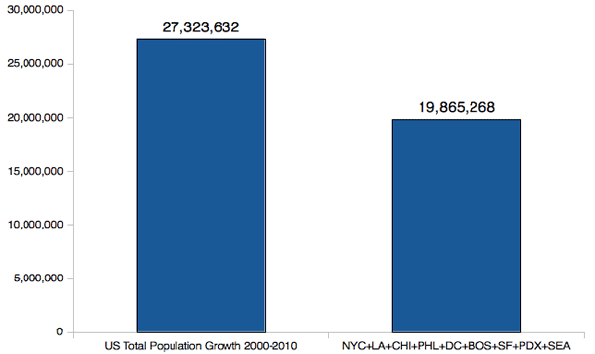
    But this piece of conventional wisdom is also deeply flawed. It obscures the bigger point that in a growing country we need to expand infrastructure to keep pace. The recent 2010 Census results put this in stark relief. The rate of growth from 2000 to 2010 slowed considerably from the previous decade, but still at a robust 9.7%, or 27.3 million new Americans. It would have been physically impossible to house all those people in traditional urban communities well-served by transit. The 27.3 million number is more than the combined 2009 population of the cities of New York, Los Angeles, Chicago, Philadelphia, Washington, Boston, San Francisco, Portland, and Seattle.

    In fact, this national growth is greater than the combined population of the 12 largest municipalities in the country.

    That’s just one decade’s worth of growth. America’s traditional urban areas couldn’t contain this, even if they were emptied of all their current residents. And the United States is projected to add an additional 90 million people by 2050. Where are all those people going to go? And how would they get to work even if they could live in these cities, given that much of America’s job growth has been suburban?

    Keep in mind also that much of this urban and transit infrastructure must be seen as more legacy than a reflection of modern choices. It was largely compete 50 or more years ago. Only Portland and Washington, DC have really managed to build new transit friendly urban core cities in the modern era. And despite their growing populations, these two places can only absorb a relatively small amount of new population every year. In Washington, it’s less population growth than gentrification – the replacement of largely poor African Americans with more affluent whites – that is the most outstanding demographic trend.

    That’s not to say America can’t invest more in transit or build more transit friendly cities. It can and it should. In particular, large, already dense urban areas like New York, Chicago, and Washington with large core area employment require major investment to upgrade their systems.

    Even smaller cities need better transit options and more urban neighborhoods. They are simply not well positioned to compete head on with newer suburban areas built from the ground up to support an auto-oriented lifestyle. But this will be difficult since they will have to build transit largely from scratch, and given anticipated cutbacks in new federal transit funding. this suggests they would be well-advised to avoid costly boondoggle mega-projects in favor of unglamorous but basic activities like running a quality urban bus system.

    But even if we achieve our potential in transit, America still needs to build more roads. We’ve got an interstate system originally designed for a 1960 population of 180 million and we are now well over 300 million and going up. By 2050 we’ll have more than double the 1960 population. This will require a major expansion of infrastructure, and that includes highway infrastructure.

    Just as one example, consider a moderate growth area like the Indianapolis-Carmel MSA. Its interstate system was mostly designed and completed circa 1970. The region had a population of a bit over 1.1 million then. Today it is over 1.7 million, an increase of 52%, or 596,000 people. A county the size of that increase would be the second largest county in the state of Indiana, well exceeding that of today’s #2, Lake County, a heavily urbanized county in Northwest Indiana.

    Yet until recently there had been almost no expansion of the Indianapolis freeway system. Fortunately, it was over-designed when built, but that is no longer the case. Thanks to a fortuitous lease of the Indiana Toll Road however, over 50 miles of freeway in the region are now being widened. Without this, the region would have faced decades of commuting misery.

    Unfortunately, that’s the bind where most cities now find themselves: managing growth with funding for roadway expansion and even maintenance running dry nationally.

    Keep in mind that tomorrow’s roads need not resemble yesterday’s monstrosities. The days of simplistically adding lanes while neglecting basics like enclosed drainage, sidewalks and paths, bus shelters, and aesthetics are likely over in many parts of the country. We need to provide room for the traffic we need to accommodate without excessive over-designs for a 15 minute peak of the peak, or dehumanizing roadway design approaches. Reform of our civil engineering educational system is eminently doable as plenty of great examples of suburban roadway design already exist. Federal standards need a revamp as well. We need to build not just more, but also better roads.

    With a botched stimulus, huge deficits at the federal and state level, and a public that has decisively turned against those deficits, a major construction program seems unlikely at this time. But in a couple years the economy should be back and a plan for fiscal recovery put in place and under execution. If not, we’ll have much bigger problems than roads.

    But assuming we get past this moment, we need to be laying the groundwork for a major continuation of the long history of American investment in infrastructure, from the Erie Canal to the interstate highway system. This includes not only a significant boost in urban transit spending where appropriate, but also a major program of both roadway repair and quality expansion, particularly in our growing metro regions. And as the Indiana example of a Toll Road lease shows, this doesn’t all have to come from tax dollars. Without this investment, our critical transport networks will ultimately seize up and America cannot hope to be competitive globally over the long haul.

    Aaron M. Renn is an independent writer on urban affairs based in the Midwest. His writings appear at The Urbanophile.

    Photo of a suburban road in Carmel, IN by author.

  • State GDP Performance

    Gross Domestic Product is the basic measure of economic output. The government released 2009 GDP data for US states recently, so it’s worth taking a look. Here’s a map of percent change in total real GDP from 2000 to 2009, with increases in blue, decreases in red:

    As you can see, Michigan actually experienced a decline in its total real output over the last decade. Given the restructuring of the auto industry, that’s not surprising.

    Here’s another view, this one a similar percent change view of real per capita GDP:

    Here you can see that Michigan is not alone. Some of the fast growing Sun Belt states added people at a faster rate than they grew economic output. Georgia in particular is worth noting, because even metro Atlanta has been showing declining real per capita GDP. In fact, Georgia actually declined by more than Michigan did on this metric, so obviously all is not well down there. Texas, despite its vaunted jobs engine, is expanding almost totally horizontally. It is 9th lowest in the US on real per capita GDP growth, with a nearly flat 2% performance over the last decade.

    North Dakota is also interesting. They are leading the charts, I presume driven by energy and high tech. (Thanks to Great Plains software, I believe Fargo is now Microsoft’s biggest software development center in the US outside Redmond).

    This post originally appeared at The Ubanophile.