Author: Aaron M. Renn

  • The Privatization-Industrial Complex

    “I think this is just the latest way for people to make money off state and local governments. This is the new way the investment banks, their lawyers, and consultants squeeze the taxpayers….They’re going around making these deals, and it’s very lucrative. It’s like a circus coming to town.” – Clint Krislov

    Privatization has long been advocated by many conservatives as a good government measure. Traditionally, privatization was used a tool that subjects government monopolies to competition from the marketplace, driving down costs and improving quality of service. Privatization pioneer Steve Goldsmith, former mayor of Indianapolis and now deputy mayor of New York City, used to apply what he called the “Yellow Pages test.” If he could open the Yellow Pages and find several companies providing a service, he wondered why government should be in that business.

    As Mayor, Goldsmith privatized dozens of city services in Indianapolis, saving the city an estimated $120 million the process. This ranged from contracting out services, to forming a public/private partnership to implement a $500 million infrastructure improvement plan to hiring private managers to run – but not own or lease – the airport and water utility.

    Today, sadly, privatization is less about Goldsmith style operational effectiveness and more about providing jackpots for financiers who stand at the core of a growing privatization-industrial complex. Cities and states salivate over ways to sell or lease off underperforming public asset for large payouts. With local governments cash-strapped and the public unwilling to pay more in taxes, it is politically difficult to even bring user fees to a market rate. Combined with the potential billions in payoffs – Indiana received $3.9 billion for its toll road and Chicago $1.1 billion for its parking meter system – the appeal is obvious.

    But these transactions differ markedly from the Goldsmith-style privatization. They are driven not by efficiencies but by an investment banker mindset focus on money and narrow parameters of the asset operations. They also provide enormous temptation to elected officials to grab the money now even at the expense of future generations. They are also rife with potential conflicts of interest and incentive problems.

    One major source of conflict comes with the professional advisors that drive the deals. Since long term leases involve so much money and are so complex, they require millions of dollars of services from investment banks, lawyers, financial advisors, etc. Unlike for typical government transactions such as issuing bonds or contracting out services like printing, building maintenance, or call centers, for which cities have some experience, the vast majority of cities have little in house expertise for complex financial transactions.

    Thus local officials are at the mercy of these out of town experts to give them the best advice they need to defend the public’s interest. But what advice can we expect from these firms, who have a stake on highly leveraged deals? The people in the firm may be technically competent and possess the highest levels of personal integrity, but still are prisoners of a structural conflict of interest in promoting privatization transactions.

    Consider Morgan Stanley. An arm of Morgan Stanley was the winning bidder on the Chicago parking meter lease. That deal is widely seen as a disaster, giving the idea privatizing meters a black eye, and engendering such headlines as “Morgan Stanley’s $11 billion makes Chicago taxpayers cry (Bloomberg) and “Company [Morgan Stanley] Piles Up Profits from City’s Parking Meter Deal” (NY Times).

    Now Morgan Stanley is back, this time advising Pittsburgh and Indianapolis on potential parking meter privatizations. Morgan Stanley has a huge structural incentive to want those deals to go through. It would restart the market for parking meter privatization, and position the firm as the preferred advisor to cities. Even where they were not the city’s advisor, a restarted parking meter market means they could potentially bid on many more assets.

    If you make money on privatization transactions, then no deals means no money. So obviously these firms have every reason in the world to promote privatization and see deals go through regardless of whether any particular deal is good or not. This doesn’t mean they are crooks, it’s just the reality. These firms now form of the core of the “privatization-industrial complex” with an incentive to cheerlead for leading public assets because that’s how they make their money. They need deal flow, the more transactions the better.

    This was picked up on by Harrisburg, PA. Facing bankruptcy, the state offered an $850K grant to hire Scott Balice Strategies of Chicago, one of the nation’s top privatization financial advisors. The city council turned it down. As one city councilor noted, “Their recommendation is always the same: ‘sell assets’”.

    Many of these investment banks, operators, financial advisers, and law firms also have tight links with each other, and participate on deals together, often as partners, other times as opponents. The Pittsburgh Post-Gazette noted how many of these firms have ties to Chicago’s earlier round of privatization. “When Pittsburgh proposed leasing its public parking facilities, the city became a magnet for a passel of firms – many of them connected to Chicago by blood, politics or business – that pursues similar deals around the country. The firms may be partners in one city, rivals or referees in the next.” The winning bidder on the Pittsburgh parking transaction is actually Morgan Stanley’s partner in the Chicago deal, for example.

    These potential conflicts make it very difficult for cities to know they are making a good deal, especially since they lack the experience necessary to independently judge it. Right now, they often are at the mercy of their advisors. And ask yourself this: when was the last time a city or state looked seriously at one of these deals and their advisors told them not to do it?

    This is frequently combined with traditional clout driven contracting. Many of the Chicago parking meter firms had tight links to the Daley administration. Similarly, in Indianapolis a city-paid chief advisor to the office of the mayor is conveniently also a registered lobbyist for the winning bidder. This combination is a recipe for disaster, resulting in very long term deals that could be very bad for the public.

    Long term lease deals can still make sense – if they are done right. The Chicago Skyway and Indiana Toll Road deals were both home runs, for example. But given the enormous risks if something goes wrong, governments must put into a place a robust process for protecting the public, with a full airing and mitigation plan for the bad incentives that populate so many areas of this field.

    Aaron M. Renn is an independent writer on urban affairs based in the Midwest. His writings appear at The Urbanophile.

    Photo by ehfisher
  • Chicago’s Eroding Competitive Performance (Chicago vs. New York)

    A lot of my thinking on Chicago has been shaped by an overarching view of its performance. Believe it or not, I used to be a huge Chicago cheerleader. I don’t think there’s any doubt that during the 1990’s, Chicago rediscovered its mojo and was really tearing up the charts of performance for big cities. But something changed in the mid-2000’s. I date it to the opening of Millennium Park. Millennium Park was a huge home run for the city, and obviously a key positive part of Mayor Daley’s legacy, no matter what the cost over runs. It added hugely to reconnecting the Loop to the lakefront park system, created a huge tourist attraction, and probably more than any other single factor sparked a residential boom in the Loop itself.

    But Millennium Park was also a sort of high water mark for the city. While I can name a lot of great things the city did before then, after that, there have arguably been more negatives than positives, ranging from a failed Olympic bid that monopolized civic attention for far too long, to a white elephant of a partially completed $300M train station under Block 37 (which hopefully will some day look like a wise move in retrospect), to a disastrous parking meter lease. What’s more, Chicago started hemorrhaging jobs and its economic performance cratered. I think anyone who looked at the situation honestly would have to admit a good chunk of the wind has gone out of the city’s sails. That’s not to say Chicago is doomed. It has fantastic strengths and resources. But it is trending the wrong direction.

    I think this is massively underdiscussed locally, both because the city is imbued with an admittedly not uncommon booster club society culture, and because America’s struggles generally of late make it seem like Chicago is just part of a macrotrend. It is, but it’s more than that.

    I’m going to illustrate Chicago’s reversal today by comparing it to New York City, looking at various key civic performance data. I’ll try to compare both metro and city where possible (all data is metro unless explicitly labeled as city), and to back to 1990 where possible, though for many items I could only conveniently get data for the past decade. You’ll see that where once Chicago was crushing New York, now the situation has reversed itself, erasing 20 years of relative gains for Chicago.

    New York’s Quality of Life Program

    While reading this I want you to keep in mind my recent post on New York’s quality of life agenda. I said I would demonstrate how that is paying dividends, and this post shows that too. Though perhaps I can’t claim causation, think about the correlation at least. In the 90’s and early 2000’s it was Chicago who was the leader in transportation and urban space, with its streetscape program and median planters, the wrought iron fence program, one of the first large scale bike lane deployments, the McDonald’s cycle center at Millennium Park, and more. Now Chicago has stagnated while New York powers ahead on all those items I’ve written about before. It’s hard for people to make the mental leap from stagnant transport planning and banal public place design to economic performance. So hopefully this helps make the picture clear.

    Population Growth

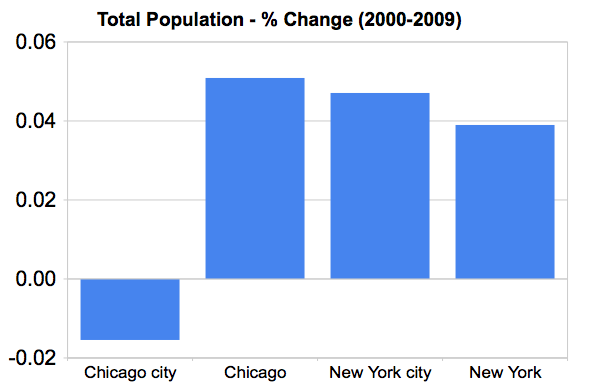
    Here’s a chart from the last decade. For these charts, I am sometimes inconsistent on my use of percentages as multiplied by 100 or not. I did not have time to make them consistent, but keep in mind that any 0.XX value should be multiplied by 100 unless otherwise noted.


    Population Growth – July 1, 2000-July 1, 2009

    Source: Census Bureau Population Estimates Program

    This one is a mixed result. Both regions have anemic growth, but Chicago wins on the metro measure while losing on the city measure. Despite the city of Chicago’s massive condo building boom, its population has been stagnant.

    Jobs

    Here is where it starts getting ugly.


    Source: BLS Current Employment Statistics

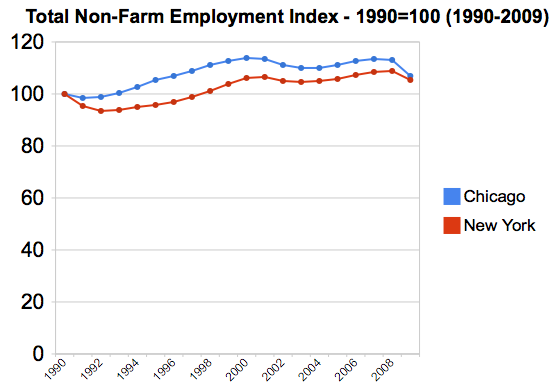
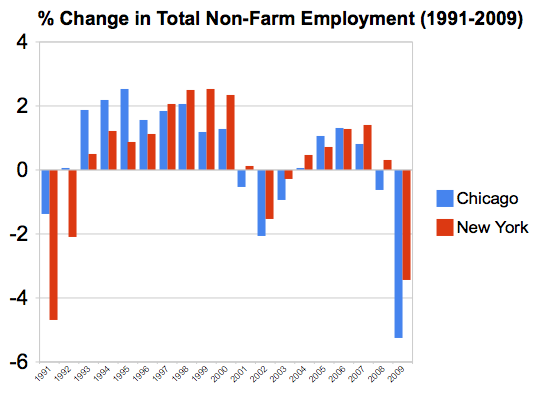
    You see Chicago jumping out to a big lead in job in the 90’s, only to see that relative performance gain almost completely erased by today. A year by year view shows this in action.

    This may be the scariest one of the bunch. I think back to 1992 when I first started work out of college. My employer was still hiring aggressively in Chicago even though it was during a recession, while one of the first rumors I heard when I started was about an east cost layoff. This chart backs that anecdote up. Now the shoe is on the other foot.

    If you pull the monthlies for 2010 to date, the situation is continuing on this trend.

    Unemployment Rate

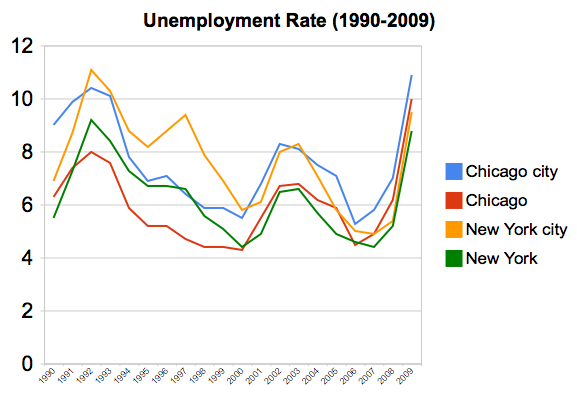
    Unsurprisingly, we see the same trend at work in the unemployment rate, where New York was far higher than Chicago in the early to mid-90’s, but is now consistently below it.


    Source: BLS Local Area Unemployment Statistics

    Gross Domestic Product

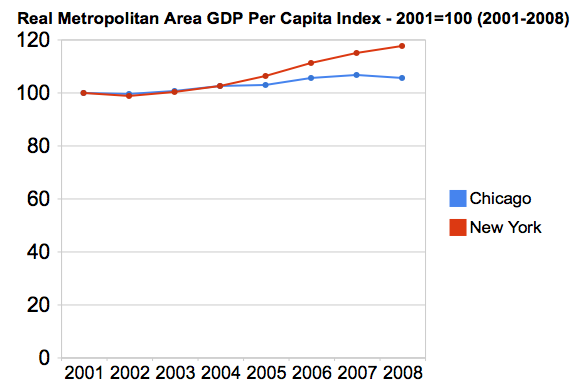
    GDP is a basic measure of economic output. The data is only available at the MSA level for a short term period at present, and there’s some debate over how accurate narrow geographic parsing of this variable is, but the same trend is in evidence.


    Source: BEA Regional Economic Accounts

    Please keep in mind that for this and most of the other charts, I rendered them as percentage type comparisons to make the data comparable between cities. If you looked at the actual underlying values, New York’s GDP per capita is already far higher than Chicago’s – $57,097 vs. $45,463. The chart above only measures the growth in the spread between them.

    Personal and Household Income

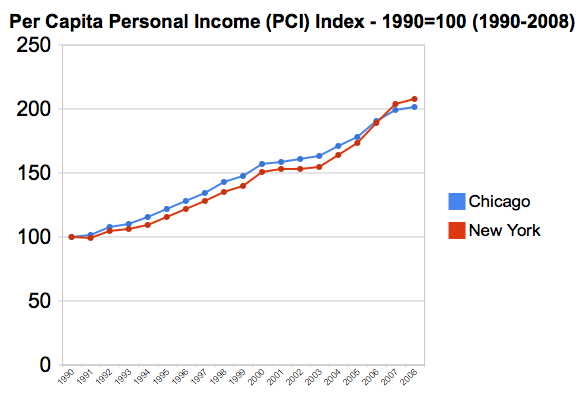
    Again, not surprisingly, the trend flows through to per capita income:


    Source: BEA Regional Economic Accounts

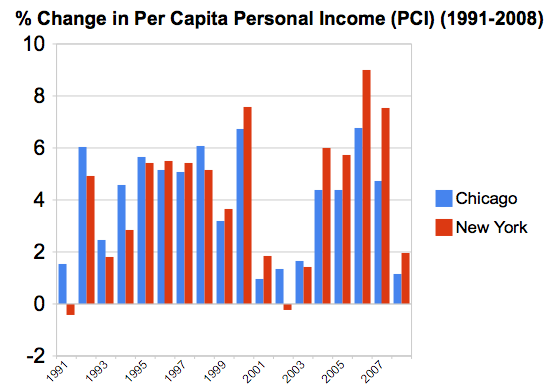
    And the year by year view of the same data:

    One might argue that this is influenced by the finance bubble that particularly blessed New York. And possibly so. So let’s take a look at an alternate data point, median household income from the Census Bureau. As a median value, this should be less likely to reflect huge gains at the high end. Unfortunately, the Census 2000 data for MSAs is based on the old definition, and it wasn’t a straightforward matter to recalculate this to current definitions, so here is city only performance for the last decade:


    Source: Census 2000 and ACS 2009

    Doesn’t matter – same result.

    Educational Attainment

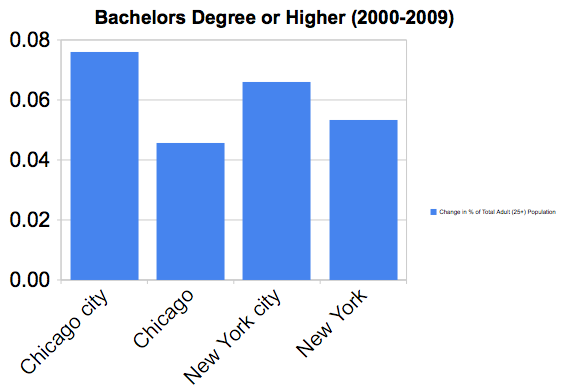
    I’ll round out with a couple of additional factors often viewed as important. First, the increase in percentage of adults with a college degree. Note that this is a percentage point change (difference), not a percentage change in the total value.


    Source: Census 2000 and ACS 2009

    Back to a mixed result, with New York winning on the regional basis, but Chicago doing better in the city.

    Commuting

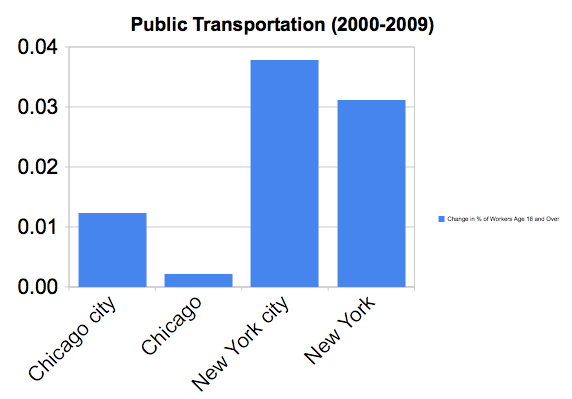
    And lastly, a couple of commuting stats. First, public transportation mode share for commuting. Note that this again is a percentage point change, not a percent change.


    Source: Census 2000 and ACS 2009

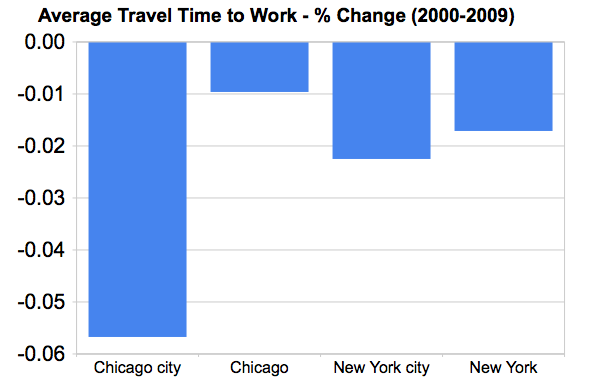
    There’s debate to be sure on the value of public transit, but clearly New York has outperformed on getting people onto buses and trains. How has that changed commute time? Let’s take a look:

    Source: Census 2000 and ACS 2009

    The city of Chicago had a much bigger drop in commute times. I personally wouldn’t be too excited about this since since lower commute times nationally appear to be driven (so to speak) by the poor economy rather than transport efficiency. Whatever the case, New York performed slightly better on a regional basis.

    Before concluding I should note that the ACS survey has a margin of error associated with it, which should be taken into account before reading too much into changes in values derived from it. I’m only reporting the headline number.

    Conclusion

    While Chicago had a couple of bright spots, it’s pretty clear that not only is New York ahead of Chicago, something that is to be expected, but it is pulling away. It would be easy to say that New York is one of a kind and that nobody can compete with it. Well, it is one of a kind, and while it isn’t a direct competition, Chicago was doing far better than New York as recently as 15 years ago. So it can be done and indeed was being done.

    The reality is that Chicago is falling behind versus traditional peer cities, to say nothing of emerging global cities around the planet. Perhaps it’s not a direct competition, but if you aren’t creating jobs, economic output, and wealth, you aren’t going to be able to make the investments to stay relevant. One reason New York has been doing what it has been on the public space and transportation front and Chicago has not is that New York is in a lot better shape financially. We are watching the cultural institutions of Detroit get dismantled before our eyes as that city can no longer afford them. Clearly, Chicago is no Detroit and never will be. But that can serve as a sort of cautionary tale of what happens when the wealth generating capacity of your city erodes. Chicago is going to find it tougher and tougher to keep up unless it figures out a way to restore the regional economic engine to good working order. That, more than anything, is the key challenge not just for the next mayor, but for all the city and regional leadership.

    This piece originally ran at The Urbanophile.

    Aaron M. Renn is an independent writer on urban affairs based in the Midwest. His writings appear at The Urbanophile.

    Photo by Stuck in Customs

  • Iowa’s Agro-Metro Future

    When Brent Richardson, a field rep for Cadillac, was told he’d been transferred to Des Moines, he assumed he’d be spending the next year in a small town environment. Des Moines turned out to have much more bustle than he expected. The city had a robust insurance sector among its diverse industries. And the lifestyle was very similar to what he was able to live in big city suburbs like Naperville, Illinois or Bellingham, Massachusetts. Steeped in a decade of Farm Aid concerts, he also expected the surrounding rural areas to be populated with hardscrabble homesteaders struggling to hang on. Instead, he discovered that farming was big business – and, these days in particular, reasonably profitable. And some of those Iowa farmers turned out to be Cadillac buyers.

    Richardson’s outsider view of Iowa is typical. Few people give it much thought, and those who do conjure up visions of cornfields and American Gothic. There’s some truth to that, but the real Iowa today is much more than that. A resurgent but industrialized agriculture sector and thriving cities give the state a 1-2 “agro-metro” punch, although large areas of the state still struggle.

    Straddling the Midwest and the Great Plains, Iowa is in a region known for trouble. But the state has managed to pile up impressive statistics. Iowa lost fewer jobs than the nation in the last decade, and has consistently maintained a lower unemployment rate. In 2009, Iowa’s unemployment was only 6.0% compared to a national average of 9.3%, a huge differential. Its agricultural sector is booming. So far this year US farm cash incomes were up 23%. That’s increasingly driven by large farm operations, as 75% of farm output comes from just 12% of farms. Iowa is right in the middle of this.

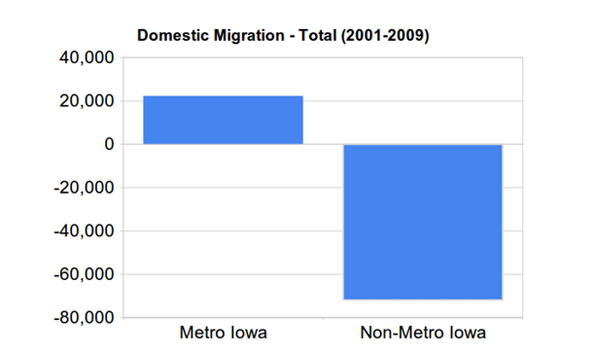
    But if the state as a whole looks reasonably healthy, this obscures its unevenness. Des Moines and big farms are doing well, but many rural and manufacturing communities are not. This is best illustrated by a map of domestic migration over the last decade.

    Net Domestic Migration, 2000-2009, in-migration in gray, out-migration in red. Darker shading denotes intensity.

    This shows net in-migration in grays and net-outmigration in pinks. The darker gray areas are clustered in metro Iowa, which is showing incredible growth, particularly around Des Moines. Des Moines population is actually up 16.5% in the last decade, about double the national average growth rate. In a decade where the US as a whole didn’t add any jobs, Des Moines powered ahead on employment by 9.3%. It’s GDP per capita is actually 12% higher than Chicago’s.

    Many other Iowa metros are likewise doing well. Dubuque recently landed a 1,000 job operation from IBM and grew its employment by over 3% last decade. Dubuque, along with other Iowa metros like Ames and Sioux Falls, grew economic output per capita faster than the average for the rest of America’s cities.

    But for non-metro Iowa, it can be a different story. Some big farmers are doing well, but many places are living up to their Great Plains reputation; they are simply drying up and emptying out. They are too remote, too sparsely populated, too lacking in talent concentrations, and ill prepared for the demands of the global economy.

    As farming transforms, cities thrive, and other areas shrivel, Iowa in changing, splitting into two states as its regions diverge, and becoming increasingly metropolitan in character.

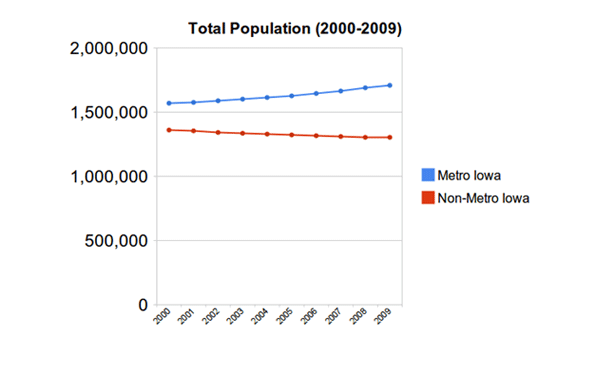
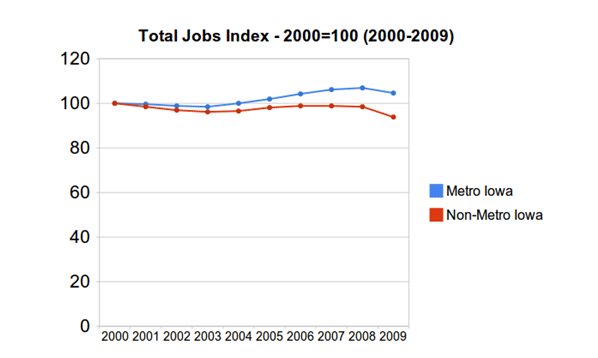
    This divergence is most easily illustrated by a chart of population:

    There are already more people living in metro areas than non-metro areas in Iowa, and the gap is only getting wider. Non-metro Iowa is actually shrinking as people leave and the population re-orders itself in the state:

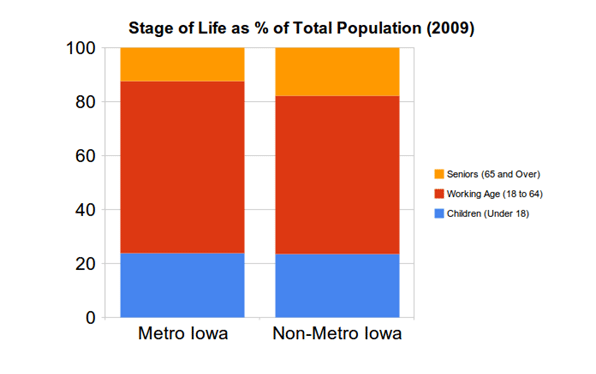
    Non-metro Iowa also has a larger senior population and lower population of working age. Generational turnover will drive even further population declines over time:

    And of course, these demographic trends are reflected in employment numbers as well, with metro Iowa adding jobs even in the last decade while non-metro Iowa is losing them.

    People’s opinions of Iowa are largely shaped by which of these two states they are looking at. More people tend to think about the struggling parts because that fits the traditional coastal media narrative and those places look big on a map. Iowa’s thriving metro regions are often overlooked because they are smaller and don’t fit the mold espoused by big city urbanists. Des Moines might not look like a Boston or Chicago, but that doesn’t mean it isn’t prosperous – and growing at almost Sunbelt rates.

    Like all of America, Iowa is a state in transition. And while it faces challenges to be sure, it’s managing that change better than most. Iowa’s future is likely to be very different from its small town past. It will be a more urban state, with several thriving metro regions. Farming will remain important, but will increasingly as a big business operation. Iowa’s future will be neither small town nor “hip cool” big city; it will represent the kind of agro-metro future that is emerging across wide swaths of America’s heartland.

    Aaron M. Renn is an independent writer on urban affairs based in the Midwest. His writings appear at The Urbanophile.

    Photo by Pete Zarria

  • City Thinking is Stuck in the 90s

    The 1990s proved to be quite a nice decade indeed for most of America’s largest cities. It was an era of general prosperity in all of America to be sure, but in contrast to previous decades, the turnaround also extended from the suburbs to many of the nation’s biggest cities, notably New York, Chicago, Miami, San Francisco and San Jose. The notion – popular in the 70s and 80s – associating cities with a sour and fatalistic sense of decline and dysfunction, or even anarchy, in the 90s finally began to evaporate. There emerged a bracing new sense of optimism that these large cities had found a new role for themselves in the world.

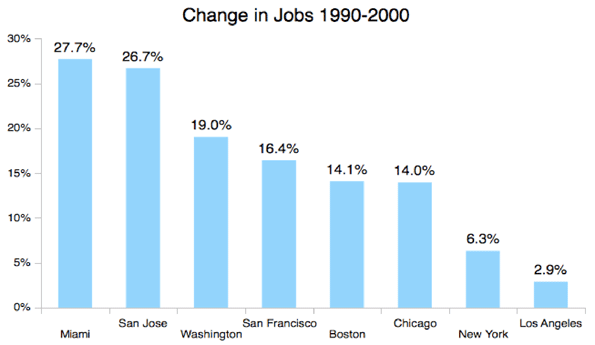
    This is evident from the large decreases in crime in these cities where lawlessness once reigned and also from the job numbers from that decade, when all of America’s tier one metros added jobs.

    Some of these places lagged overall US growth, but considering their lower rate of population growth most of these cities enjoyed robust economies. The aerospace and defense center of Los Angeles, hit hard by the post-Cold War “peace dividend”, and the devastating 1992 riots, was a partial exception.

    The 90s saw the convergence of two trends that profoundly benefited these cities: the digitization and globalization of business. The 90s were the heart of the digital revolution. At its beginning, corporate “data processing” was still dominated by mainframes and personal computers were not yet fully deployed even on corporate desktops. By the end of it, the internet was widespread and had caused a business revolution. In the middle were several waves of technology change and disruption: first client/server, then internet based computing, PC and mobile phone ubiquity in business, the Y2K retrofit, and the beginnings of integrated Enterprise Resource Planning systems.

    The 90s also saw a lesser known revolution in American business: deregulation and structural changes. In the past many businesses that had previously operated on a local or regional basis – banking, utilities, retail, etc – got rolled up into much larger super-regional, national, and increasingly global players.

    These shifts provided big benefits to these tier one cities. Obviously high tech havens like the Bay Area, DC, and Boston did particularly well in this decade. Also performing strongly were professional services hubs like Chicago. These rapid waves of technology and business change created a lot of new openings for professionals to master, not just by creating and implementing technology, but also in adapting business processes to the new realities as well as managing the organizational change journey. These newly rolled up businesses also needed the types of services firepower typically located in larger locales, stimulating further demand. Notably, virtually all of this demand was satisfied with employment growth on shore, much of it in these tier one cities.

    The 2000s, however, were a very different story. This decade began with the dot com bust and its associated recession, a funk from which the Bay Area economy has yet to fully recover despite Silicon Valley’s continued reign as high tech capital. Similarly, while specialized professional services still flourish, the more mainline areas, such as IT implementations or business process outsourcing, found themselves under significant pressure as digital business matured.

    This caused one commentator to famously declare that “IT Doesn’t Matter.” Then the offshore wave, which had been a born in the 1990s, began to suck away services work just as had occurred previously in manufacturing. This included not just low skill business process outsourcing like invoice processing, but also high value IT engineering and other services not dependent on face to face interaction. This, we found out, could be performed by high skill, low cost labor in places like India.

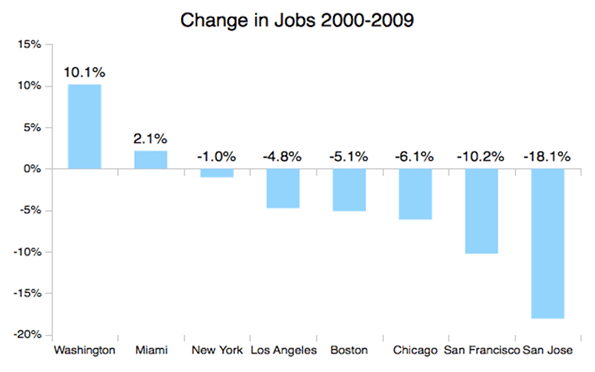
    This helped to create a so-called “lost decade” of job creation in the US during the 2000s. The tier one metros, save for recession-proof Washington, fared even worse, losing jobs during the decade.

    These are facts and trends that barely impacted the world of urbanists, who continued to act as if nothing had changed. The media, located almost totally in primary cities, bought the message but rarely looked at the basic facts.

    As a result, when it comes to thinking about America’s big cities, too many people remain stuck in the 90s.

    Partially this is understandable. The 2000s saw strong increases in GDP per capita in many of these cities. Also, they experienced huge real estate booms and an associated increase in high end amenities of all kinds: swanky hotels, starchitect buildings, upscale new restaurants and shops, etc. But a lot of this has proved somewhat self-delusional. Like Citigroup CEO Chuck Prince’s now infamous statement that “As long as the music is playing, you’ve got to get up and dance,” these cities continued to party like it was 1999 even as their job base continued to erode and the real estate bubble headed for a crash.

    Today, as the Great Recession has civic finances in a vice grip, and places like Chicago and Los Angeles face stunning budget shortfalls, people are less sanguine. Advocates for the big city model still refuse to face up to the core problems that face our large cities. The real issue should not be how to restart the condo boom, but how to restore what drove the resurgence of the 90s: job creation. This is a national problem to be sure, but not one that seems to interest most big city advocates. It’s almost as if there’s an assumption the jobs will come without working for them. The stimulus and bailout, which helped key urban sectors like green building, university research and public employees, is now running out of steam and political support. In the long run they may have served largely to exacerbate complacency.

    So rather than a focus on private sector job growth, many urban boosters have remained free to focus on other things like sustainability and lifestyle enhancers in the assumption they would generate jobs But what if it doesn’t work out that way? What if the current economy, unlike those boom years of the 90s, does not generate enough money and employment to support these huge regions?

    These cities would be well-advised to go beyond counting skyscrapers, new condo construction, green roofs, and bike share programs. Those things are all good, but basic measures of civic health and dynamism like job growth ultimately underpin those things for the long haul. More than anything, these cities need to be fundamentally focused on their commercial success. Their great challenge is figuring out how to recapture that previous era of job growth, and once again become engines of employment.

    Aaron M. Renn is an independent writer on urban affairs based in the Midwest. His writings appear at The Urbanophile.

    Photo by Werner Kunz (werkunz1)

  • Civic Choices: The Quality vs. Quantity Dilemma

    Advocates on opposite sides of urban debates often spend a great deal of time talking past each other. That’s because there’s a certain Mars-Venus split in how they see the world. In effect, there are two very different and competing visions of what an American city should be in the 21st century, the “high quality” model and the “high quantity” model One side has focused on growing vertically, the other horizontally. One group wants to be Neimans or a trendy boutique and ignores the mass market. The other focuses more on the middle class, like a Costco and Target. It should come as no surprise that there’s seldom agreement between the two.

    America’s “High Quality” cities are the traditional large tier-one metro areas, but also include smaller cities like Seattle and Portland. They stress high wage activities such as finance, high tech, and luxury consumption. In this model, traditional growth in areas like population, jobs, or the size of the urban footprint are less important and even seen as a negative. Understandably so. It’s difficult to see, for example, how another million people living in the Bay Area would improve the fortunes of companies like Google or Facebook, or another million Angelenos helping Hollywood.

    Indeed many residents would oppose such growth due to increased traffic, infrastructure spending, and other of the challenges associated with it. In effect, the anti-growth agenda that dominates the culture of many of these places is not based simply on environmental concern, but the economic interests of their dominant regional elites. These places have already achieved the size to support their urban amenities.

    Another reason not to press the growth button: on measures of urban quality such as economic output and income, most are clearly doing very well. Most of these places generate GDP per capita far above the US metro average of $41,737. With the exception of Chicago, they are also growing at a pace that beats the US average. These cities also boast incomes – although often a cost of living – generally well above average, though have been mixed in performance on that metric over the last decade.

    “High Quality” Cities
      Quality Indicators Quantity Indicators
    MSA 2008 Real GDP per Capita Percent Change in GDP per Capita, 2001-2008 2008 Per Capita Income as Pct of US Average PCI Change vs. US Average 2009 Pop. Pop. Pct. Change 2000-2009 2009 Jobs Percent Change in Jobs 2000-2009
    Boston 57916 11.50% 137 -1 4589 4.20% 2408.1 -5.10%
    Chicago 45463 5.50% 113 -4 9581 5.10% 4291 -6.10%
    Los Angeles 47214 16.90% 111 6 12875 3.80% 5200.9 -4.80%
    Miami 40447 15.60% 107 2 5547 10.40% 2201.9 2.10%
    New York 57097 17.60% 137 6 19070 3.90% 8304.5 -1.10%
    Portland 47811 22.40% 99 -9 2242 15.80% 972.4 -0.10%
    San Francisco 60873 10.50% 156 -8 4318 4.40% 1908.8 -10.20%
    San Jose 82880 20.90% 146 -35 1840 5.80% 855.6 -18.10%
    Seattle 55982 11.30% 126 -1 3408 11.60% 1668.7 1.30%
    Washington 61834 15.20% 141 5 5476 13.60% 2950.2 10.10%

    But if these areas are doing well, for those who can afford to live them at least, they tend to do poorly on quantity measures. Many of them have anemic population growth, albeit from a large base. And virtually all of them actually destroyed jobs in the last decade. The ravenous maw of Washington, DC of course, being the great exception.

    This mixed performance isn’t surprising. High end activities are by definition exclusive. The specialized environments they require, and the high value and wealth they create, create expensive places to do business. Unless you have to be in one of these places, such as to take advantage of industry clusters or specialized labor markets, it doesn’t make sense to pay the price to do so. Clearly, mass employers have voted with their feet.

    Four data points from Silicon Valley sum it up. Between 2001 and 2008, the San Jose MSA’s: a) real GDP per capita increased by 20.8% b) total real GDP increased by 25.9%, c) real GDP per job increased by 39.6%, BUT d) total employment declined by 9.4%. That’s the high quality city dynamic in a nutshell.

    America’s “High Quantity” cities follow the opposite pattern. They might have their occasional claims to fame, but few feature the high end business or glamorous lifestyles of America’s premier metros – even though some have spent big bucks on vanity projects to polish their reputations. Rather, what these cities do well is provide quality workaday environments for the middle class. And create jobs – lots of jobs, the Great Recession notwithstanding.

    This is again backed up by the numbers. These cities fare well on quantity measures such as population growth, where they crush the US average of 8.8%, and job growth, where several of them actually managed to post double-digit gains during the generally anemic 2000s.

    “High Quantity” Cities
      Quality Indicators Quantity Indicators
    MSA 2008 Real GDP per Capita Percent Change in GDP per Capita, 2001-2008 2008 Per Capita Income as Pct of US Average PCI Change vs. US Average 2009 Pop. 2009 Jobs Percent Change in Jobs 2000-2009
    Pop. Pct.
      Change
      2000-2009
    Atlanta 43020 -6.00% 95 -16 5475 27.90% 2290.3 0.50%
    Austin 43819 8.50% 93 -16 1705 34.70% 758.2 12.70%
    Charlotte 59191 0.70% 99 -11 1746 30.20% 810.2 5.70%
    Dallas 50067 5.10% 104 -9 6448 24.10% 2864.3 3.70%
    Houston 49182 3.60% 114 1 5867 23.80% 2539 12.60%
    Nashville 43891 9.90% 99 -5 1582 20.10% 723.7 3.30%
    Orlando 42353 13.30% 89 -3 2082 25.70% 1009.5 10.60%
    Phoenix 38009 2.80% 90 -5 4364 33.10% 1719.6 8.90%
    Raleigh 41681 -3.70% 99 -16 1126 40.00% 499.7 14.10%
    Salt Lake City 46453 9.30% 95 0 1130 16.20% 610.8 8.00%

    But all is not well with these cities just because they are adding jobs and people. Their GDP per capita is generally above average, but is growing slowly. Their per capita income may be lower than some, but their cost of living is rock bottom, enabling a high quality of life. But worryingly, those incomes are often not keeping pace with the US average.

    These two dynamics reflect what has happened throughout America, from retail to media, where there has been a great “hour glassing” effect in the marketplace. A small but significant high end is thriving, almost everywhere but particularly in the quality oriented cities. The low end is also doing well, particularly in the quantity oriented cities. Neimans and Wal-Mart, indeed.

    In the future, both models face big challenges. The high quality cities continue to become more exclusive. The problem with getting high end on a smaller base is that your market is asymptotically zero. And as high quality talent gets squeezed out – by being not quite elite enough, for lifestyle, affordability or other reasons – the quantity cities start to poach great people and start stealing even more market share. It’s always easier to climb up the value chain than go down it. At some point, these cities could run out of room to shimmy up the flag pole.

    Some high quantity cities may face even greater risks. America’s great elite metropolises have proven they can stand the test of time. New York, Boston, Chicago, San Francisco – all have made it through many economic cycles, fundamental transformations, and even great physical disasters. Few of the high growth cities have proven they’ve got staying power after exhausting their first great growth phase. Detroit, Cleveland, and other Rust Belt burgs were yesterday’s Sun Belt boomtowns. They serve as a cautionary tale about the risks of not having a quality calling card to fall back on when your allure as a growth story fades

    Partisans of these two models need to learn how to learn from each other. The high quality cities need to learn again the lessons of their youth about the importance of growth. And the high quantity cities need to create environments that will sustain them after they’ve lost greenfield advantages. An hourglass America is not one most of us want to live in for the long term. Maintaining a stable commonwealth for the long term means striving again to restore some new 21st century version of our lost middle ground.

    Data Sources:
    Real GDP per Capita (in 2001 chained dollars) is from the US Bureau of Economic Analysis
    Per Capita Personal Income as a percentage of the US average is from the US Bureau of Economic Analysis.
    Population is the from the annual mid-year estimates from the US Bureau of the Census.
    Total jobs from the US Bureau of Labor Statistics Current Employment Statistics program.
    Data changes are calculated.

    Aaron M. Renn is an independent writer on urban affairs based in the Midwest. His writings appear at The Urbanophile.

    Photo by Werner Kunz (werkunz1)

  • “James Drain” Hits Cleveland

    The ten story of mural of LeBron James is coming down in Cleveland. This one hurts. James wasn’t just the latest embodiment of Cleveland’s hopes, he was a local kid who, unlike so many, had stayed home in Northeast Ohio. His joining of the Cleveland exodus at a time of severe economic distress prompted Cavaliers owner Dan Gilbert to pen a now infamous open letter to fans:

    As you now know, our former hero, who grew up in the very region that he deserted this evening, is no longer a Cleveland Cavalier…..The good news is that the ownership team and the rest of the hard-working, loyal, and driven staff over here at your hometown Cavaliers have not betrayed you nor NEVER will betray you….This shocking act of disloyalty from our home grown “chosen one” sends the exact opposite lesson of what we would want our children to learn. And “who” we would want them to grow-up to become….

    Forty years of frustration boiled over in that letter. Gilbert is from Detroit, but perhaps that’s why he too shares these feelings so viscerally.

    Cleveland’s “Big Thing Theory”

    In a sense though, Cleveland’s disappointment was inevitable. LeBron James was never going to turn around the city. No one person or one thing can. Unfortunately, Cleveland has continually pinned its hopes on a never-ending cycle of “next big things” to reverse decline. This will never work. As local economic development guru Ed Morrison put it, “Overwhelmingly, the strategy is now driven by individual projects….This leads to the ‘Big Thing Theory’ of economic development: Prosperity results from building one more big thing.”

    These have all failed, now even “King James”. The trend lines haven’t changed, even where the individual projects have done well. But often even that hasn’t happened. For example, the Flats, a once-thriving entertainment district in an old warehouse district, now resembles, as one local comedian put it, a “Scooby Doo ghost town.”

    Combating “James Drain”

    James’ departure also fits the narrative of generalized anxiety around “brain drain” and cities losing their best and brightest of each generation. As lots of people really have left Cleveland, this is understandable. But the real story is much more complex. A look at IRS tax return data shows that in reality Cleveland doesn’t have especially high out-migration. Its metro out-migration rate* in 2008 was 28.02. Miami’s was 40.34 and for even the boomtown of Atlanta it was 38.95. Not only is Cleveland not losing an especially high number of people, you can actually argue it is losing too few. A big part of the problem in Cleveland’s economy is that too many people are stuck there.

    Conversely, a real migration problem is that too few people are moving in. As local attorney Richard Herman noted, “New York City and Chicago, like most major cities, see significant out-migration of their existing residents each year. What is atypical is that Cleveland does not enjoy the energy of new people moving in.” The Cleveland metro in-migration rate was only 22.19. Miami’s was 30.36 and Atlanta’s a robust 51.91.

    Cities need new blood. Cleveland isn’t getting it. Its circulatory system is shut down. Cleveland needs more natives to leave and more newcomers to arrive. Both sides win. Those Cleveland departees will move on to be part of the new energy other cities so desperately need. James is going to get to live the high life he wants in South Beach, but somebody else will be fired up to get the opportunity to play in Cleveland.

    Selling Cleveland

    But that begs the question, what’s going to get more people to move to Cleveland? The fact is, James wasn’t getting the job done, and never would. Nor will amenities like the Cleveland Orchestra or the Rock and Roll Hall of Fame Museum.

    The mistake Cleveland and other Rust Belt cities make is that they are too worried about the likes of LeBron James moving to Miami. For people with the means and the desire to choose a place like South Beach, Cleveland simply can’t compete. And let’s not forget, James snubbed Chicago, New York, and Los Angeles too.

    Rather than trying to take on the Chicagos, Miamis, and New Yorks of this world at their strongest points, Cleveland would be far better served ceding that market and fighting where it can best compete. Believe it or not, not everyone wants to live in a huge global city. There are plenty of people who might choose to live in Cleveland, if the city focused on the basic blocking and tackling of city services, quality of life, and business climate instead of splashy grands projets. As Anthony Bourdain said this week:

    I think that troubled cities often tragically misinterpret what’s coolest about themselves. They scramble for cure-alls, something that will “attract business”, always one convention center, one pedestrian mall or restaurant district away from revival. They miss their biggest, best and probably most marketable asset: their unique and slightly off-center character….Cleveland is one of my favorite cities. I don’t arrive there with a smile on my face every time because of the Cleveland Philharmonic.

    In short, Cleveland needs less South Beach, less Chicago Loop, and more American Splendor. Ultimately, my bet is Cleveland will end up missing Harvey Pekar a lot more than it will any multi-millionaire sports star.

    Shooting the Messenger

    Who is going to get that message out about Cleveland? After that sendoff, it sure won’t be LeBron James. That’s a shame. As Jim Russell has richly illustrated, people make migration – and investment – decisions based on knowledge, not just information. Nobody picks a city to live in by entering reams to statistics into a sixteen tab spreadsheet. They’re more likely to move to be near family, friends, or places they know. That knowledge comes from first hand experience – and trusted recommendations.

    Until the switch flips on Cleveland’s brand, it needs to be out earning that trust of prospective residents. The people who’ve left aren’t Judases, they’re your field sales force – or at least they should be. James could have been a missionary “Witness” for Cleveland in a foreign land. Instead, Cleveland blew an enormous opportunity, and left itself with little more than soured memories and a partially demolished mural as an ephemeral reminder of yet another failed Next Big Thing.

    * Tax return exemptions migrating per 1000 overall tax return exemptions in the base year.

    Aaron M. Renn is an independent writer on urban affairs based in the Midwest. His writings appear at The Urbanophile.

    Photo by alexabboud

  • The Vote: Democracy or Disease?

    When the California polls closed on Tuesday, the most costly primary race in the state’s history—thus far—came to an end. Like many high profile races for Senator and Governor nationwide, the spending attracted national attention.

    Of course, this isn’t the first time that California politics and political trends have captured the national imagination and spread like a virus. Given the particularly brutal economic meltdown in California, one would not expect the state’s notoriously dysfunctional governance system to be a role model for others to follow. Alas, it unfortunately seems that it is. Three examples below from the Midwest show that California-style governance definitely has its fans. Indeed, the rise of using constitutional amendments to make policy, and of big money/ special interest- backed referendum petitions shows that the California governance disease is starting to metastasize, even in the Heartland.

    The first example is Missouri, where billionaire Rex Sinquefield launched launched a successful drive to get an initiative on the ballot to eliminate the city earnings tax in Kansas City and St. Louis. Sinquefield is a self-made man who became rich after, among other things, creating the first S&P 500 index fund. Known for his ardent support of free market views, Sinquefield has followed in the footsteps of George Soros and other wealthy financiers in pushing his ideas politically, albeit in a smaller arena. Like Soros, Sinquefield channels plenty of money to candidates, and even has his own think tank, the free market Show Me Institute.

    Sinquefield’s latest crusade is to change state law to prohibit new cities from having local earnings taxes, and to require those cities where they are already in place to put them to a vote every five years and phase them out if ever voted down, with no mechanism for ever reinstating such a tax, even if the city’s voters approve it. While this is a state law change, it targets two specific cities, Kansas City and St. Louis; the latter gets a third of its revenue from the earnings tax. Sinquefield says he wants to replace the earnings tax with a land value tax – an excellent idea – though his actual initiative text doesn’t replace it with anything.

    Whatever one thinks of the actual policy, the idea of billionaire-backed petition drives is right out of the California special interest playbook. Also, while Sinquefield might reasonably want to eliminate the earnings tax in St. Louis, where he lives and pays taxes, it isn’t clear what skin he has in Kansas City’s tax. In effect, Kansas City residents are will have their city’s fiscal future determined by voters who largely live outside the city limits, in a campaign financed by an out-of-town billionaire who lives 250 miles away on the far side of the state.

    And there will be more than 20 other referendum votes on the Missouri ballot this fall. In this governance environment, it shouldn’t be surprising that a significant number of Kansas City businesses are migrating across the state line to Overland Park and other Kansas suburbs where they don’t have to deal with this type of politically induced uncertainty. The political risk in Missouri is commercially toxic.

    The second example is Indiana. Prodded by court rulings, Indiana switched from a property assessment system that undervalued older buildings to one more reflective of market values. This, in combination with the elimination of an inventory tax, led to a spike in property taxes across the state. The spike, along with an income tax increase, led to the mayor of Indianapolis losing his reelection bid to a total political neophyte without any significant financial or establishment backing.

    This stunning upset jolted the legislature into action. Indiana sales taxes were raised by one percentage point, the state took over several key municipal expenses, including educational operations costs and juvenile justice, and it bailed out underfunded local pensions. In return, property taxes were capped to prevent a repeat of the tax crisis.

    So far, so good. By most accounts the financial restructuring and the tax caps are working reasonably well. But state politicians aren’t satisfied. They are in the process of amending the state constitution to write the tax caps into law.

    This is a mistake on two levels. First, it assumes a constitutional tax cap is a substitute for political will on fiscal policy. The notion that if property taxes are limited, then legislative spending won’t increase has been disproven; the example of Prop 13 in California immediately comes to mind. In fact, writing the tax caps into the constitution might actually cause future legislatures to breathe easy and take their eye off the fiscal ball.

    The second is that constitutions should deal with the structure and general powers of government, not with setting tax rates. Writing specified property tax rates into the constitution is simply an attempt by the current legislature to take advantage of high current popularity for a particular policy, and to prevent future legislatures from changing that policy, even if conditions or public opinion change. As a general rule, one legislature or governor should not be able to bind the terms of policy of their successors. If that is established as a valid exercise of legislative power, it seems likely to be used again and again in the future, perhaps for more dubious policies.

    The last and most incredible example is Ohio, where a group of developers wanted to open casinos. Led by Rock Ventures, the investment vehicle of Quicken Loans owner Dan Gilbert of Detroit, the group spent $47 million to draft, put on the ballot, and pass a constitutional amendment permitting casino gambling in Ohio. But this initiative did much, much more than that. It only permitted casinos on four specific properties — properties controlled by the referendum backers — and thus granted them exclusive rights to open casinos. It exempted their casinos from zoning or most other types of local control, authorized them to operate 24 hours a day, and specified a very low license fee of only $50 million per casino to the state. It also permitted them not only to run any game currently allowed by any surrounding state, but also any game those states might approve in the future. It’s undoubtedly one of the most incredible constitutional amendments in the history of the United States.

    Casino companies are far from the only special interest groups to use Ohio’s liberal initiative process to their own ends. Other users include the conservative Cincinnati anti-tax group COAST – Citizens Opposed to Additional Spending and Taxes. COAST does endorse candidates, but in general has a poor track record of getting politicians elected. It has, however, used initiatives to defeat or delay a slew of projects locally. On another front, animal rights advocates at the Humane Society are trying to amend the Ohio constitution to implement their preferred standards for treatment of animals in agriculture.

    The takeaway on Ohio referendums for any special interest group is very clear: “Why not us, too?”

    The legislature is starting to get fed up. Rep. John Domenick wants to amend the constitution to require future changes to obtain a two-thirds supermajority vote, not just a simple majority. He cites the growing ability of deep pocketed, out-of-state interest groups like the Michigan-based casino developers to effectively take over policy making from elected officials.

    Domenick is on the right track. Direct democracy can play an important role in many cases. For example, there’s nothing wrong with requiring voter approval for large tax increases or bond issues for major civic programs after they are approved by elected officials. This gives the matters in question extra legitimacy. But referendum petitions that are too easy to submit and approve only lead to political gridlock and a special interest takeover of the levers of power. The lessons of California suggest that going too far down the road of reliance on constitutional restrictions can become a substitute for political will.

    Flckr photo by SanFranAnnie

    Aaron M. Renn is an independent writer on urban affairs based in the Midwest. His writings appear at The Urbanophile.

  • Is It Game Over for Atlanta?

    With growth slowing, a lack of infrastructure investment catching up with it, and rising competition in the neighborhood, the Capital of the New South is looking vulnerable.

    Atlanta is arguably the greatest American urban growth story of the 20th century. In 1950, it was a sleepy state capital in a region of about a million people, not much different from Indianapolis or Columbus, Ohio. Today, it’s a teeming region of 5.5 million, the 9th largest in America, home to the world’s busiest airport, a major subway system, and numerous corporations. Critically, it also has established itself as the country’s premier African American hub at a time of black empowerment.

    Though famous for its sprawl, Atlanta has also quietly become one of America’s top urban success stories. The city of Atlanta has added nearly 120,000 new residents since 2000, a population increase of 28% representing fully 10% of the region’s growth during that period. None of America’s traditional premier urban centers can make that claim. As a Chicago city-dweller who did multiple consulting stints in Atlanta, I can tell you the city is much better than its reputation in urbanists circles suggests, and it is a place I could happily live.

    Yet the Great Recession has exposed some troubling cracks in the foundations of Atlanta’s success. Though perhaps it is too early to declare “game over” for Atlanta, converging trends point to a possible plateauing of Atlanta remarkable rise, and the end of its great growth phase.

    Growth Is Slowing

    As with many other boomtowns, in Atlanta growth itself has been among the biggest industries. Construction particularly played a big role in its economy. The housing crisis cut the legs from under Atlanta’s real estate machine. Though prices didn’t collapse, new home building did. From 2005 to 2009 Atlanta’s number of annual building permits fell by 66,352, the biggest decline of any metro area.

    Atlanta grew strongly in the 2000s, with growth of over 1.2 million people, a 29% rise that beat peer cities like Dallas and Houston. But look at the recent past and see a very different dynamic. Domestic in-migration has cratered, only reaching 17,479 last year, or 0.32%. While migration did slow nationally last year due to the economy, Dallas and Houston continued to power ahead. Dallas added 45,241 people (0.72%) and Houston added 49,662 (0.87%). Even Indianapolis added 7,034, but that’s 0.42% on a smaller base, meaning Atlanta is actually getting beat on net migration by a Midwest city; its in-migration rate is about on par with Columbus, Ohio, another healthy Midwest metropolis..

    The collapse in in-migration should be very worrying to Atlanta’s leadership. No new people, no new housing demand, thus no construction jobs. It should come as no surprise that Atlanta’s 10.8% unemployment rate is well ahead of the 9.7% national rate.

    The Infrastructure Brick Wall

    Last July, Judge Paul Magnuson ruled that Atlanta had been illegally taking water from Lake Lanier, the principal source of the region’s water supply. The ruling may not stick but it nevertheless has brought into focus the long term insufficiency of the water supply for Atlanta. Lake Lanier almost ran dry during a recent drought, but has since recovered in the recent wet years. The problem is more political than environmental. Atlanta has not appreciably expanded its water sources in 50 years despite all that growth.

    Atlanta has a myriad of infrastructure problems. It suffers some of the highest water and sewer rates in the nation, double those of New York City. And these are only going to get worse as the city embarks on a multi-billion dollar Clean Water Act Compliance program. This is an ominous sign for a city whose attractiveness is in large part due to its low costs. As Councilwoman Clair Muller put it, “I’m not sure being No. 1 in the country for water and sewer rates is a good selling feature for Atlanta.”

    But the biggest infrastructure issue for Atlanta is transportation. Atlanta is famous for its bad traffic and attendant pollution. Its freeways are among the world’s widest, but this disguises the extent to which the roadway infrastructure is woefully insufficient. Atlanta has a simple beltway and spoke system similar akin to Indianapolis and Columbus, much smaller cities. Other big cities like Houston, Dallas, Minneapolis, and Detroit have much more elaborate systems. In particular, rather than relying on a single ring road, these cities have webs of freeway with multiple “crosstown” routes.

    But Atlanta’s greatest road problem lies in the lack of arterial street capacity. Atlanta’s suburban arterial network is mostly former winding country roads, many of which have never been upgraded to handle the traffic demands on them. Most upgraded streets are radial routes, not crosstown ones, which forces even more traffic onto the overloaded freeway network.

    For those who prefer transit, Atlanta hasn’t invested there either. It built the MARTA heavy rail system as an extremely forward looking transportation investment, mostly in the 1970s and early 80s. This was built before Portland’s system and is far better than light rail to boot. But there has been almost no expansion of the network. The state of public transport has been largely frozen for some time. Meanwhile, Dallas, Houston, Phoenix, and others have invested billions.

    Competition Is Here

    Bad traffic congestion and other infrastructure ills didn’t matter much when Atlanta was the only game in town. For a long time, anyone who needed a presence in the Southeast found Atlanta the easy default answer. In many cases it was the only real possibility.

    That’s no longer true. Atlanta is now surrounded by upstart, much faster growing cities such as Charlotte and Raleigh-Durham in North Carolina, Nashville, Tennessee and Charleston, South Carolina – all in many ways now have the ambitions once characteristic of Atlanta.

    Atlanta’s problem lies in its insufficient differentiation from these other places. Other than the airport, a clear major asset to Atlanta, what do you actually lose by moving to Charlotte or Nashville? Your commute is likely to be less. Except for certain groups – African Americans or gays – the city seems to be losing allure.

    These other cities also have the talent to compete for a lot of the business Atlanta used to pick up without working for it. The new head of the Atlanta Regional Commission declared Atlanta’s love affair with the edge city high rises all but over. Planners always talk like this, but it is still a startling sentiment to hear in Atlanta, formerly the most boosterish of cities. That’s the sound of a city losing its mojo. Meanwhile, Charlotte chamber of commerce chief Bob Morgan says, “To understand Charlotte, you have to understand our ambition. We have a serious chip on our shoulder. We don’t want to be No. 2 to anybody.” That’s the way Atlanta used to talk.

    Caught in the Middle

    Atlanta does seem to realize it’s in a different competitive world. It must elevate its game and upgrade its product. Like Chicago and other growth stories before it, as Atlanta got big and rich, it decided it needed to get classier as well. To go for quality, not just quantity. And to embrace a more urban future for its core.

    But it might be too little, too late. Atlanta is urbanizing, but despite the huge influx of people into the city, it’s not there yet. Atlantic Station got built and attracted lots of press, but numerous other mixed use projects were killed by the poor economy. Ambitious projects like the Beltline park and transit project lack funding.

    Atlanta is left as a sort of “quarter way house” caught between its traditional sprawling self and a more upscale urban metropolis. It offers neither the low traffic quality of life of its upstart competition, nor the sophisticated urban living of a Chicago or Boston.

    Here too, Dallas and Houston continue to power ahead of Atlanta. Both are seeing significant urban infill and are also making major investments in cultural infrastructure that far outstrip those of Atlanta. For example, Dallas just opened a showplace performing arts complex, with buildings by the likes of Norman Foster and Rem Koolhaas. Houston has emerged as a dynamic multi-cultural city. Both have a long way to go, but are in a much stronger growth position to pull it off.

    Atlanta at Maturity

    Cities, like companies, go through a life cycle. There’s the youthful founding, the explosive growth phase, then maturity and, for some, decline. Chicago and Detroit were two of the huge growth stories of the industrial era, for example. Atlanta, Houston, and Dallas have been three of the boomtowns of the current age. Like other cities before them, that growth will come to an end one day. It is then that we’ll see if, like Chicago and New York, they will succeed as mature regions and truly take their place in the pantheon of great American cities, or, like Detroit or to a lesser extent Philadelphia, will decline or stagnate.

    Atlanta is far from dead, but it may be facing the beginning of the end of its growth cycle. If so, this will be the true test and measure of the greatness of that city. Will Atlanta make the grade? And how?

    Aaron M. Renn is an independent writer on urban affairs based in the Midwest. His writings appear at The Urbanophile.

    Photo by james.rintamaki

  • A Carbon Added Tax, Not Cap and Trade

    Paul Krugman devoted a recent lengthy New York Times Magazine article to the promotion of a disastrous “cap and trade” regime for reducing carbon emissions. Though he doesn’t outright endorse it, he strongly suggests that the Waxman-Markey bill that passed the House would be acceptable to him. Krugman then proceeds to pooh-pooh the carbon tax idea, one that I believe has far more merit.

    Cap and trade would be a debacle for a slew of reasons. The most important is that it won’t even reduce carbon emissions. Two of the EPA’s own San Francisco attorneys dismissed the Waxman-Markey cap and trade regime as a “mirage” that would not reduce carbon because of the ability of polluters to obtain fictitious carbon offsets, among other problems.

    Even if cap and trade would require American producers to reduce carbon emissions, it would do nothing about overseas polluters. An American manufacturer could escape cap and trade simply by moving production to China. Given China’s massive coal-based electricity infrastructure and other notoriously polluting practices, carbon emissions would likely only get worse as a result, in addition to the US jobs lost.

    Krugman suggests this can be fixed with a carbon tariff, but that’s dangerously naïve. There’s no guarantee a carbon tariff would be put in place after cap and trade passed. In effect, it requires two completely separate policy mechanisms be put in place and kept synchronized over time, which seems dubious. Our trading partners would surely chafe at any carbon tariff, which would be vulnerable to challenge under international trade treaties.

    Cap and trade also has huge distortive impacts within the United States. The Brookings Institution crunched the numbers and found that cap and trade costs vary widely across the country. Compliance costs would be minimal in California and rest of the West and Northeast, while the Midwest, Mid-Atlantic, and the South get pummeled. It should come as no surprise that it is California Rep. Henry Waxman who’s pushing the bill. One can’t help but suspect these regional disparities are the real implicit goal of the bill. Indiana Gov. Mitch Daniels denounced cap and trade as “imperialism”.

    Perhaps the most diabolical part of cap and trade is in its very name. The operative word is “trade”. Who do you think will be doing the trading? Why, none other than the very people who got us into the economic mess we’re in today. Cap and trade is a gigantic giveaway to Goldman; it’s yet another instrument for speculation; it’s another way for the profiteers on Wall Street to line their pockets at our expense.

    So in a sense it’s also another way that, perhaps unintentionally, the richest sectors, the upper classes, and the financial centers like New York, Boston and San Francisco are being favored over the poor Main Street rubes who have taken it on the chin during this recession without a bailout. If you think things are bad now, just wait until CDS stands for “carbon default swap”. It’s pouring fuel on the fire of inequality between the haves and have nots.

    Cap and trade is nothing more than another tranche in the never-ending merry-go-round of bailouts for the financiers. And didn’t we learn anything from Enron’s electricity trading shenanigans? When an Iowa farmer opens up in his electric bill that’s suddenly spiked, or has to pay double to fuel his farm equipment, it’s not too much to ask that it be in the service of actual carbon reduction, not houses in the Hamptons, owned by people to whom the added cost is not material given their wealth.

    There is a better way, and that’s the Carbon Added Tax. Similar to a European-style Value Added Tax, a CAT tax would directly tax the quantity of carbon emissions added to the atmosphere in each stage of the production cycle. The tax could be set at a level that would provide certainty of price such that investments in lower carbon technologies are financially feasible right now, not decades from now.

    Also, similar to the US income tax system, the CAT would apply to the carbon emitted globally, not just in the United States. A deduction would be permitted for any bona fide carbon taxes paid in a foreign jurisdiction, up to the level of the US tax. A true-up on the carbon tax due would be paid at the point of import into the United States. That is, an importer would have to pay the CAT on products brought into the country, less any deductions for foreign carbon taxes paid, at the port of entry.

    While this global approach is a widely, and correctly, maligned feature of the US income tax code, it has important benefits from a carbon reduction perspective. First, it is location neutral. Since the tax is the same whether the carbon is emitted in China or the United States, it doesn’t encourage business to move offshore. But it also doesn’t discriminate against foreign producers. (Like any anti-carbon regime, it would raise costs in the US, affecting both domestic consumers and the competitiveness of exports).

    The CAT is also functionally equivalent to a carbon tariff, but is a unitary regime. That is, you don’t have to figure out how to bundle in or pass a separate carbon tariff as part of implementing a domestic cap and trade system. You simply pass a CAT on global carbon emissions and you are done.

    And this system allows each country to decide on its own level of carbon taxation. If countries like China want to have no tax, that’s their choice. Or, European countries could decide to have a higher tax. The complexity would come in figuring out the allowed deductions for emissions in countries that adopted other schemes like cap and trade, but this should be a readily solvable technical issue.

    There will still be divergent regional domestic impacts under a CAT. This is unavoidable in a nation where carbon emissions are unevenly distributed. But by preventing the financiers from skimming off the top, the total burden is reduced, and a CAT is a more location neutral, transparent mechanism for carbon reductions.

    A Carbon Added Tax is a far superior way to reduce carbon emissions than a cap and trade system only a Wall Street trader could love.

    Aaron M. Renn is an independent writer on urban affairs based in the Midwest. His writings appear at The Urbanophile.

    Photo by Gilbert R.

  • The New Look of the American Suburb

    If you want an easy demonstration of the unsustainability of the classic American suburb, just take a drive around the inner ring suburbs of almost any city, starting with the ones that have a classic branching, winding streets, not traditional grids or those that grew up along transit lines. It is easy to find untold miles of decay, of “dead malls”, “grayboxes”, and subdivisions that have seen better days. If most of today’s new suburbs think they’ll fare any better, they are going to be in for a rude shock in 30 years or so.

    Some have argued that what we need are “suburban retrofits,” where older areas are redeveloped along new urbanist lines. While this is certainly an attractive option in some places, particularly in town center areas, the sheer quantity of decaying older suburbs means this isn’t a viable option across the board at the moment. Retrofits are hard to pull off and expensive to boot. There simply isn’t enough planner/political bandwidth or TIF dollars to make it happen on a wholesale basis. So we have to find some method to renew most of these areas in place.

    Enter immigrants. In older cities, immigrants were historically crammed into near downtown ghettos like the various “Chinatowns” and the like we see. Today, in cities that have them, those districts might still have a cultural role, but they are no longer the demographic core of their communities. Also, for cities without longstanding histories of immigration, these ghettos never developed. Instead, today immigrants disperse throughout metro areas. You find them everywhere from inner city neighborhoods to the most posh suburbs. One of the places along that spectrum you can find them are these inner ring suburbs.

    I want to share some pictures of immigrant driven revitalization of inner ring suburbs through some facts and photos from Indianapolis. But I think you’d find similar things in many cities across the nation.

    Indianapolis was traditionally one of America’s least diverse cities, featuring only the classic black-white split. But it has seen a large influx of immigrants in the last decade. Its metro foreign born population is only 5.19%, which is small, but the Indianapolis Star reported last year that this represented a 70% population increase since 2000. Unlike some towns which have seen immigration driven almost entirely from Mexico, Indianapolis has seen a very diverse set of immigrants, that come from all over the globe, including 26,000 Asians and 10,500 Africans. The Indian population has doubled to 6,000, the Pakistani and Nigerian populations have tripled to 1,000 each. There are 5,600 Chinese and 1,500 Burmese. These aren’t huge numbers today, but given the network effects of international immigration and the lead time to build a large community (remember the example of the large community from Tala, Mexico, which has its roots in the 1970’s), this represents a potential future tsunami of immigration, provided the economy stays strong, the local climate welcoming, and a bit of pro-active marketing takes place. Again, I’m sure we’d see similar diversity of immigrants in other cities, ranging from Detroit’s Arab community to Bosnians in St. Louis to Somalis in Columbus, Ohio.

    The most diverse area in Indianapolis is Pike Township on the northwest side. Though technically part of the city today, it is originally an inner ring suburban area. Its schools have children from 63 different countries speaking 74 different languages. The Lafayette Square area on the southeast boundary of Pike Township is a classic struggling inner ring commercial zone, complete with a dying mall.

    Yet the presence of all of those immigrants has led to a spontaneous renewal of parts of this struggling area in the form of businesses catering to local ethnic populations.

    One of them is a 62,000 square feet international supermarket called Saraga:


    Saraga is run by Korean brothers Jong Sung and Bong Jae Sung and features hundreds of spices and 40,000 products from around the world, ranging from house made kimchi to a halal meat department. Lest I stir up too much suspicion I didn’t take many photos inside the store, but wanted to share one shot of some of the contents from a Middle Eastern aisle:


    The owners are planning to open a second location on the South Side. They are facing a lot of competition from an array of new specialty markets in their current location, and also want to be positioned closer to the burgeoning immigrant community on the South Side and south suburbs. Not long ago the South Side of Indianapolis was stereotyped as the “redneck” side of town, but as American Dirt chronicled, this has changed a lot. While not part of the favored quarter, the South Side has increasing diversity both ethnically and in terms of incomes. Notably the South Side has become epicenter of the Indianapolis Sikh community.


    Saraga should be careful. There are already two Indian groceries and a Mexican grocery in Greenwood. Here is part of the competition in Lafayette Square:


    This, and many of the other establishments, might not look like much. But imagine what it would look like if they weren’t there.

    Here’s one of my favorite signs from a nearby strip center, showing the diversity of establishments rubbing elbows:


    The facade of Cairo Cafe shows a typical Indianapolis pattern, where an ethnic restaurant does double duty as a small scale specialty grocery.


    It’s the same thing at the Vietnamese restaurant Saigon and Guatelinda. Saigon is beloved of hipsters, but I’ve got to confess I don’t think it is very good.


    Another nearby strip mall always blows my mind for the diversity of restaurants and stores it contains. You might need to enlarge this one to see, but it’s a Peruvian restaurant next to a Mexican restaurant next to an Ethiopian restaurant:


    A pastry shop next to another oriental market:


    Some type of Latino shop:


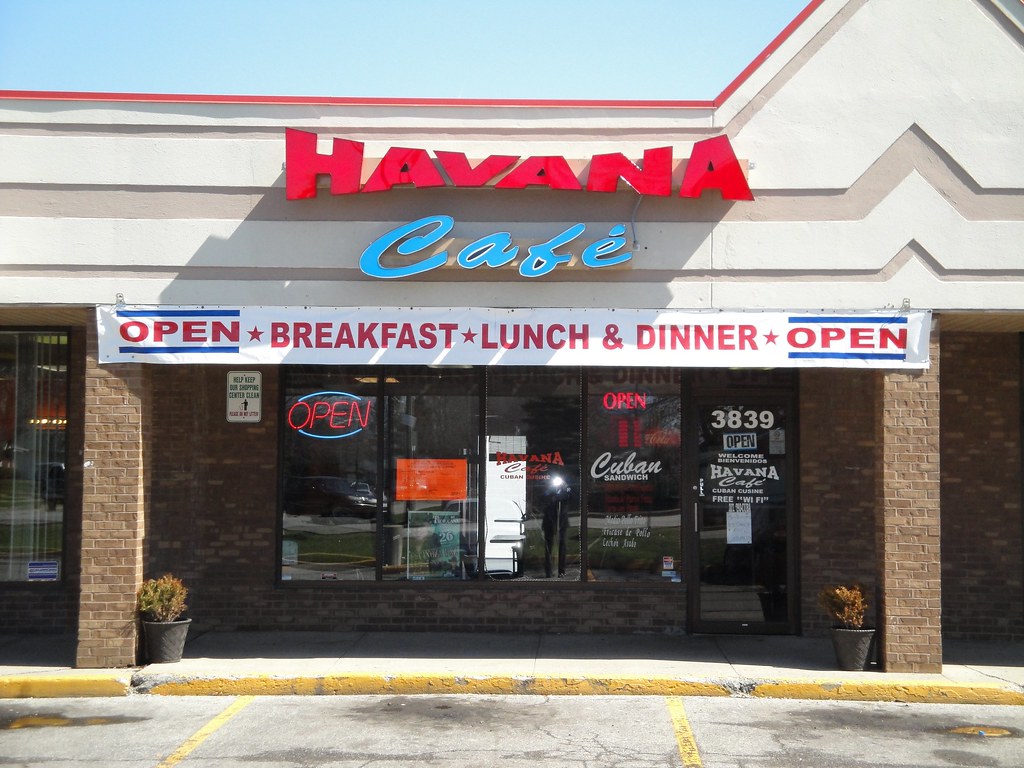
    A Cuban sandwich shop:


    Hopefully this gives you a flavor for how immigrants can be a force of renewal for older, struggling suburban area. I’ll admit I focused on food establishments, since that’s what’s most interesting to me, but there are plenty of others. This also shows the increasingly multi-cultural face of America, even in an interior city in the middle of Midwest corn country. If I were a city with lots of these struggling areas – and let’s face it, that’s most cities – I’d sure want to get me a lot more immigrants pronto.

    In the interest of completeness, I should also note that the Lafayette Square area has also become home to large number of independent black-owned businesses. In addition to being Indy’s immigrant heart, Pike Township has also emerged as a key hub for the region’s black middle class. That will have to be the topic of a future post, alas.

    Aaron M. Renn is an independent writer on urban affairs based in the Midwest. His writings appear at The Urbanophile.

    This article is re-posted from The Urbanophile.