Author: Aaron M. Renn

  • The Urbanophile Plan for Detroit

    If Brookings’ plan for Detroit isn’t enough to get the job done, what is?

    Turning around Detroit means facing head on the core problems that hobble the region, notably:

    • America’s worst big city race relations
    • A population that is too big for current economic reality
    • A management and labor culture rooted in an era that no longer exists and is unsuited to the modern economy
    • A tax, regulatory, and political system toxic to business

    A robust plan for renewal in Detroit will tackle these problems, recognizing that matters like improving race relations and cultural change need indigenous solutions from courageous local leaders. Then mix this with best practices from elsewhere and innovative, unique to Detroit solutions. And be patient, knowing the turnaround won’t be a short journey.

    1. Repair race relations. The city-suburb divide in Detroit, to an extent far greater than elsewhere, is a matter of black and white. Bringing racial rapprochement won’t be easy, but it is an absolute imperative for future regional success. Perhaps a newly shared sense of economic pain can foster this, along with grass roots connections such as white urban gardeners making common cause with black ones seeking better access to fresh foods.

    2. Active shrinkage. Many recognize the need for Detroit to “right size” to its reduced population and for federal help doing so. But beyond adjusting to the city’s decline, the region remains too big. Detroit no longer needs large armies of unskilled and even skilled laborers in its factories. There is simply no economic raison d’etre for a region the size of Detroit in that location today. A lot more people need to leave Detroit. Many already would like to but can’t because they can’t sell their house or afford to move. Serious consideration should be given to a federally assisted voluntary relocation program when the national economy recovers to help Detroiters move to Texas or other places with strong jobs growth if they want to. Detroit should also engage with those who did move away to create an urban alumni network. In a globalized economy, those Michigan expatriates can serve as a sort of field sales force for the city.

    3. Improve the Business Climate. Michigan’s government needs to be downsized to match a downsized state. Dubious programs of all types, from film industry subsidies to “cool cities” initiatives need to be scaled back or eliminated. The criminal justice system should be reformed to stop over-incarcerating non-violent offenders. Streamline or eliminate regulation wherever possible, and make those that remain operate swiftly and predictably. Eliminate or merge overlapping jurisdictions, and especially non-general purpose entities that are too often patronage dumps operating out of the public eye. Reduce taxes on business, especially small business.

    4. Change the culture. Michigan’s social and business approach, its labor and management culture and business practices were designed for a stable industrial age dominated by a limited number of large and vertically integrated corporations. Today’s economy is based around smaller, more innovative, nimble firms, virtual networks of people and collaborative business relationships, rapid change, and a competitive global environment. This sort of change has to come from the inside. No one can just tell Detroit how to do it.

    5. Renew Brand Detroit. How does Detroit want to be known in the world and how can it make itself known? Within a framework of shrinkage, Detroit needs to become attractive to the right new talent and new businesses. It needs an aspirational narrative that is authentically Detroit in a way “cool cities” will never be. Cool, No – but edgy? Definitely. Think of Detroit as the new American frontier, a blank canvas where anything is possible, and the ultimate arena in which to pursue alternative visions of urban life. A place where you can pursue a personal urban vision without getting tortured by a Byzantine blizzard of bureaucracy. This should be nourished – and preserved – by maintaining a “light touch” approach to regulation in the city proper. The region is well positioned to attract new urban pioneers and homesteaders, and to leverage its reputation as both a black city and large Arab population center. Detroit should stand proud as “Detroit”. It shouldn’t hide behind euphemisms like “Southeastern Michigan” or “The Big D” – as if that fools anybody. Detroit is a name with international recognition and resonance. Wear it with pride.

    6. Pursue Targeted Industry Clusters. The auto industry will remain a mainstay in Detroit, particularly management and R&D, though a lot smaller after a federally assisted restructuring. But the city should be wary of overly pursuing “me-too” industries like life sciences without distinctive advantages. Instead, Detroit should look to get its “fair share” of those, then look for where it is positioned to uniquely excel and try to create the environment favorable for investment. Potential targets include:

    • A lead role in international trade with Canada.
    • Dominating and expanding non-energy/non-financial trade and relations with the Middle East and Muslim world. With America’s largest Arab population, Detroit is positioned to be the American gateway to that ever more important part of the globe the way Miami is to Latin America.
    • Music. Detroit has one of America’s richest and most innovative musical legacies, from Motown to electronica to hip hop. But it hasn’t profited from it. Detroit needs to take a page from Nashville and figure out how.
    • Realize the Detroit Aerotropolis plan.
    • Alternative urban visions. The recipe for grass roots neighborhood renewal in the city, and a potential innovation cluster for any new Detroit ideas that gain widespread adoption.

    7. Rationalize Regional Governance and Infrastructure Investment. Detroit should seriously question any expansion of infrastructure when shrinking in regional population. All subsidized infrastructure expansion outside of currently fully urbanized areas should be terminated. It makes no sense to be widening streets on the fringes when you are ripping them out in the city. In this context, the kind of fixed rail investments advocated by Brookings and other “me too” urban boosters should be avoided in this highly decentralized region. Rather, the central city should start with a quality bus network, with rail added later if and only if existing ridership justifies it.

    8. Secure Irreplaceable Assets. Detroit built amazing treasures during its golden age, many of them lost or threatened. Detroit has one of the largest collection of pre-War high rises in America. Yet many of them stand vacant. Another gem, the Lafayette Building, is about to be demolished because it is so badly deteriorated, with trees growing on the roof. Some funds need to be earmarked for securing and and supporting basic maintenance such as roof integrity. While there may not be demand to reuse these structures now, they are irreplaceable and should be saved for future generations. On the cultural side, Detroit needs to ask itself tough questions about institutions like the Detroit Institute of the Arts and the Detroit Symphony Orchestra that are bleeding red ink.

    The road back for Detroit won’t be short or easy. It will certainly not be back as the colossus of its past. But Detroit can grasp a more successful future if it finds the courage and the leadership to change, and to find a unique path forward for a city that is simply not like anyplace else in the world. Conventional wisdom solutions are just not enough. It will take radical change, new attitudes and an ability to think independently about what’s best for the region.


    The Brookings Plan

    The Urbanophile Plan

    Race Relations

    Segregation is acknowledged

    Improving race relations is a top imperative

    Regional Governance

    Strong Regionalism Featuring:
    – Council of Mayors
    – Regional transportation and land use management
    – Potential tax sharing
    – Receivership for failed government entities

    Adopt Brookings Plan

    Brand Positioning

    N/A

    – “The New American Frontier”, the land of possibility, a blank canvas, and the ultimate arena in which to realize alternative and new visions of urban life.
    – “Detroit”, NOT “Southeast Michigan”, “The D”, etc.

    Economic Development Paradigm

    Government industrial policy

    Improve the business climate

    Fiscal Policy

    N/A

    – Downsize all level of government to match a downsized Michigan and Detroit
    – Eliminate dubious programs (e.g., film industry subsidies and “cool cities” initiatives)
    – Merge or eliminate overlapping obsolete jurisdictions
    – Cut taxes on business, especially small businesses

    Regulatory Reform

    N/A

    – Seek out and eliminate rules without a clear rationale and net benefits, esp. ones that negatively affect the business climate
    – Make remaining regulations operate swiftly and predictably
    – Reform a criminal justice system that over-incarcerates for non-violent offenses
    – Maintain “Light Touch” Regulation in the City of Detroit to Sustain Frontier Appeal

    Target Economic Sectors

    – Advanced Manufacturing / Auto-Related R&D
    – Green Industry
    – Life Sciences
    – University Spin-Offs

    – Advanced Manufacturing / Auto-Related R&D
    – International Trade with Canada
    – Non-Energy/Non-Financial Trade with the Arab and Muslim World.
    – Music-Related Development
    – Aerotropolis Industry
    – Alternative Urban Visions (e.g., urban agriculture, urban decay tourism)
    – “Fair Share” of Green Industry, Life Sciences, and University Spin-Offs

    Auto Industry Future

    Federally assisted restructuring

    Adopt Brookings Plan

    Management & Labor Culture; Regional Business Practices

    N/A

    Urgent change is prerequisite to success

    Human Capital Targets

    N/A

    – New Urban Pioneers
    – African Americans
    – People of Middle Eastern or Muslim Origin
    – Musicians and Musical Acts

    Adjusting to Population Loss

    – Government sponsored footprint shrinkage
    – Brownfield remediation

    Adopt Brookings Plan and Supplement With
    – A federally-assisted voluntary relocation program
    – Creation of a “Detroit Alumni Network”

    Transportation

    Rail transit

    – Terminate highway and other infrastructure expansion outside of fully developed areas
    – Build privately funded Woodward light rail, then avoid further rail investments
    – Improve the urban bus network
    – Build new bridge crossings to Canada
    – Support improvements to entire 401/I-75 corridor for freight growth

    Historic Preservation

    N/A

    – Inventory and invest to secure and “mothball” key historic structures, esp. pre-War downtown high rises

    Aaron M. Renn is an independent writer on urban affairs based in the Midwest. His writings appear at The Urbanophile.
  • Detroit Needs a Bolder Plan

    The Brookings Institution recently unveiled “The Detroit Project”, a plan to revive Detroit, in the New Republic. Brookings’ plan has good elements and recognizes some important realities, but also has key gaps. It relies excessively on industrial policy and conventional approaches that are unlikely to drive a real turnaround in America’s most troubled big city.

    On the plus side, Brookings does a great job stating why Detroit’s fortunes will take a long time to reverse, possibly a generation or more. As they note, “Detroit’s leaders must manage expectations. It took half a century for the city to get this low. It won’t turn around in a four-year political cycle.” Authors as prescient as Jane Jacobs and as conventional as Time were talking about Detroit’s decline as far back as the early 60s. Turnaround won’t happen in six months or even six years. Given the political preference for election-cycle results, this means strong and courageous leadership will be needed, a point they also stress. Sadly, that’s a commodity that has long been in short supply in Detroit.

    Brookings is known for their promotion of regionalism, and this plan predictably follows that prescription. Clearly, rationalization of investment policy on a regional basis is needed. The Detroit region is losing population, yet the long range transportation plan calls for huge amounts of spending to widen roads on the fringes. That makes no sense. People and businesses in Detroit keep moving out as the cities and suburbs they once inhabited fall into ruin under a regime of failed stewardship and the endless search for new greenfields to exploit. It’s like prospectors skipping from one clapped out mining town to the next. If they want to do that, they shouldn’t expect the rest of us to pay for it via federal funds – either to build the new or to clean up the mess in the ghost towns they leave behind.

    They also recognize the need for improved governance, including potentially state receivership for failed institutions. (They did not, however, give due credit to new Mayor Bing for the change and new leadership attitude he has already brought to the table). Suggestions like a focus on brownfield remediation and managed shrinkage were on point, as was the recognition that significant federal assistance will be required. Given the depths of the problems in Detroit and Michigan, the city and state are not going to be able to do it alone.

    The plan also rightly notes that “Detroit will have to become a different kind of city, one that challenges our idea of what a city is supposed to look like, and what happens within its boundaries.” Very true. Unfortunately, much of the rest of the Brookings prescription failed to meet that challenge.

    Brookings’ plan relies heavily on analogy to other post-industrial cities, especially in Europe, which makes it difficult to be sure exactly what they are recommending at times. Even to casual observers, these cities are far different from Detroit. For one thing, Detroit is huge. The region, if one includes Ann Arbor and Windsor, Canada, is over five million in population – more than double the size of Brookings comparison areas.

    Places like Turin and Bilbao also have radically different built forms, history, culture, and are virtually racially and ethnically homogeneous compared to Detroit. Even the measurements of European success need to be redone. Neither Italy nor Spain represent role models since both have fared worse than America in the current downturn. These countries (and cities) are aging rapidly, with some of the world’s lowest birthrates.

    Their US examples of Toledo and Akron (i.e., greater Cleveland) are hardly bright and shining lights of economic or demographic success. Since 2000, Akron has lost nearly 10,000 people and Toledo over 20,000. Toledo’s 11.4% unemployment rate exceeds the nation’s. These aren’t even Ohio’s biggest cities, much less dominating the state’s economy the way Detroit does Michigan.

    Brookings also all but ignores a lot of the root issues of Detroit’s problem. Firstly, they fail to make a point about healing America’s most poisoned race relations, arguably the signature issue of Detroit. Racial tensions and inequity have perpetually bedeviled America. Making progress in Detroit won’t be easy, but is an absolute prerequisite to progress. Perhaps shared economic struggles will finally provide a common interest around which to build some form of racial rapprochement.

    Most glaringly, Brookings has nothing at all to say about Detroit and Michigan’s tax and regulatory regime, its failed management and labor cultures, or its dysfunctional state politics. Brookings’ desire to stay on good terms with the establishment might inhibit their ability to speak freely, but these problems must be confronted.

    It is impossible to ignore this witch’s brew of policies and attitudes that is totally toxic to economic development. It’s a classic case of ignoring the elephant in the room. Until these blocking and tackling matters are addressed, Detroit is going to remain kryptonite to business expansion. In Forbes 2009 list of the best states for business, Michigan ranked 49th.

    Instead of improving the terrible business climate, Brookings proposes a top-down industrial policy, explicitly stating “local government (or NGOs, even) can play the role of industrial planner. That is, they can look across the map and find instances where research institutions and manufacturers should collaborate on new ventures.” And they say “public money” is needed to retool old industries and advance new ones. The government in Detroit can’t even manage the delivery of basic city services. None of the region’s levels of government have performed well on their core competency, so why would we believe these entities would be effective venture capitalists or industrial planners? This is a recipe for epic rent seeking and an economic Waterloo on a grand scale.

    Their suggested industries for Detroit are a tired looking roster of the same ones everyplace else is chasing: green industry, life sciences, advanced manufacturing, and university technology spin-offs. With such a crowded playing field – 49 out of 50 states are chasing life sciences, for example – it is hard to discern the Detroit region’s distinctive capabilities in any of these areas apart from automotive related R&D and manufacturing. Sure, they’ll get some slice of the pie in these growing markets, but unlikely enough to turn the ship around or create a true innovation cluster.

    Public-private partnerships do have a strong role to play in Detroit’s economic development. This includes looking for sectors where it can realistically compete and win, and looking to create the infrastructure and conditions necessary for them to flourish in terms of facilities, talent attraction, legal and regulatory frameworks, regional business culture and practices, and more. It’s about creating fertile soil, not picking winners.

    However, assistance to the restructuring auto industry was clearly required. Without federal aid, GM and Chrysler would have been liquidated. They still might, but given the importance of that industry to our economy, it is probably worth doing what we have to do for now. But we should recognize that getting in was a lot easier than getting out will be, and that the end result might still be failure or Soviet style zombie companies that survive only as wards of the state.

    Lastly, the praise of rail transit by Brookings – the cook book solution du jour for cities – is puzzling. Again, Detroit is shrinking and needs to shrink more. Trains work best when people are commuting to a central point, but jobs have been disappearing from the core of Detroit for generations. Today barely 4.5 percent of area employment takes place in the urban core, among the lowest percentages among the nation’s top 50 cities.

    As with fringe highway expansion, the last thing Detroit needs is even more infrastructure. It has too much already that it can’t afford to maintain. Taking on a costly new rail transit system with both high capital expenditures and significant ongoing operations and maintenance costs is a dubious proposition – particularly when the existing bus network is on the verge of a near shutdown. The biggest game changer from an infrastructure perspective – new highway crossings to Canada to strengthen Detroit as the premier gateway to Canadian international trade – is not mentioned.

    So while Brookings gets a few key pieces of the puzzle right, ultimately their solution is too standard issue and lacks the boldness and innovative thinking needed to tackle the core problems and create a realistic prospect for renewal.

    In the next installment tomorrow: a better plan for Detroit.

    Aaron M. Renn is an independent writer on urban affairs based in the Midwest. His writings appear at The Urbanophile.
  • Migration: Geographies In Conflict

    It’s an interesting puzzle. The “cool cities”, the ones that are supposedly doing the best, the ones with the hottest downtowns, the biggest buzz, leading-edge new companies, smart shops, swank restaurants and hip hotels – the ones that are supposed to be magnets for talent – are often among those with the highest levels of net domestic outmigration. New York City, Los Angeles, San Francisco, Boston, Miami and Chicago – all were big losers in the 2000s. Seattle, Denver, and Minneapolis more or less broke even. Portland is the only proverbially cool city with a regional population over two million that gained any significant number of migrants.

    Those who find this an occasion for a schadenfreude moment attribute it to tax and regulatory climates. Clearly, things like cost of doing business are clearly very important. And indeed this is often under-rated by cool city proponents. And other things equal, people do prefer low tax jurisdictions. Still, is this the only answer, or is there another explanation? Could it be that rather than high costs driving migration, both costs and migration are being driven by other underlying factors?

    Perhaps the root problem is structural change in the economy in the age of globalization. As business became more globalized and more virtualized, this created demand for new types of financial products and producer services – notably in the law, accounting, consultancy, and marketing areas – to help businesses service and control their far flung networks. Unlike many activities, financial and producer services are subject to clustering economics, and have ended up concentrated in a relatively small number of cities around the world.

    These so-called “global cities” serve as control nodes for various global networks and key production sites for these services, along with other specialized niches they long had. In effect, more distributed economic activities requires increasing centralization of select functions, particularly the most highly value-added functions. Yet these activities are not set in stone; for example, areas that were once centers for global business, like Cleveland or Detroit, are fading; others like Houston and Dallas are rising.

    Yet unlike the Texas cities, which retain a strong middle-class and middle-echelon economy, many of the more elite, established urban centers – for example New York and London – increasingly create parallel economies and labor markets in those cities. These cities now generally contain two kinds of people and firms: those who are part of the global city functions and those who are not. Those who are engaged in global city functions operate in a world of very high value-added activities; specialized, niche skill markets; and rising demand conditions. Those skills are not readily acquired outside of global cities. Often, they are sub-specialized to particular places as different global cities specialize in different niches.

    In many cases, these functions have not yet migrated to India or China or often even another global city. This tends to inflate salaries significantly for these specialized, niche skill jobs.

    On the other hand, many people who once thrived in these cities have not benefited from these economic forces. They often are in occupations where labor arbitrage is feasible, and their jobs can either be off-shored, or readily transferred to lower cost locales in the US. This includes manufacturing work, but also important but less specialized white collar occupations like basic accounting, loan officers, corporate IT, and HR. In short, the routine side of the traditional monolithic corporate headquarters and services firm.

    In effect, in these global cities, two economic geographies share the same physical geography – and those economic geographies are in conflict. One set requires catering to high skill, highly paid workers and firms where cost is a secondary concern. The other involves occupations and industries where cost is very much a concern. The occupants of these two geographies have very different public policy priorities. Which of them will win out?

    In a global city, particularly a mature and expensive one, the elite geography wins. It is generating the most money, and with money comes power and influence. Additionally, the high wage workers in these industries are simply able to pay more for real estate and other items. Their mere paychecks are driving up costs in the city they live in. They are re-ordering the city in their own high income image, aided and abetted by a speculative financial fueled housing bubble.

    The prestige of these industries burnishes the civic brand, making them attractive to civic boosters. What’s more, leaders in global cities feel that these are their businesses of their future. For them the attractiveness of concentrating in areas where you think you can create a “wide moat” advantage makes sense.

    This is why cities like Portland, Minneapolis, Denver, and Seattle haven’t fared nearly so badly – they aren’t really full metal global cities and thus, while not always cheap, have remained relatively affordable versus places like San Francisco and New York.

    At the same time it is not easy for these more expensive cities to adopt a low tax, low cost approach. For many reasons, places like San Francisco, New York, and London will never, no matter what they do, be able to match Atlanta, Houston, or Dallas, or even Chicago in a war on costs. That would be a suicide mission. Their logical strategy is to follow the law of comparative advantage, and specialize where you have the best competitive position in the market, and that’s global city functions.

    Many other cities have followed this strategy, but with differing success. Fearing to end up like the next Michigan and Detroit pair, many states and cities have invested heavily to build up urban amenities to cater to the global city firms and their workers: transit systems, showplace public buildings, art and culture events, bike lanes, and beautification. Cost fell by the wayside as a concern, as did investments in priorities of the traditional middle class.

    This explains why, for example, not only have taxes gone up, but things like schools and other basic services have declined so badly in places like California. Traditional primary and secondary education is not important to industries where California is betting its future. Silicon Valley, Hollywood, and biotech draw their workers from the best and brightest of the world. They source globally, not locally. Their labor force is largely educated elsewhere. Basic education and investments in poorer neighborhoods has no ROI for those industries. With the decline of high tech manufacturing in Silicon Valley, even previously critical institutions such as community colleges are no longer as needed.

    The same goes for growth and sprawl. They are playing a game of quality over quantity. They specialize in elite urban areas and elite suburbs or exurbs. For example, San Francisco also has Marin, Palo Alto and Los Altos Hills. New York has, in addition to Manhattan, Greenwich and northern Westchester. The only thing they need size for is sheer scale in certain urban functions, and they already have it. Growth is unnecessary for them and only brings problems.

    It also explains the highly pro-immigration stance of these cities, as a large service class is needed for globalization’s new aristocrats. Immigrants are needed as low cost labor in the burgeoning restaurant and hotel business. In America’s global cities immigrant housekeepers, landscapers, and nannies are common. They may not dress like His Lordship’s butler, but that doesn’t make them any less servants.

    Lastly, it explains why we have seen the same polarizing class pattern so consistently despite broad geographic and socio-political differences between places like Los Angeles, Boston, and Chicago, to say nothing of overseas locales like London. A common global phenomenon probably has a common underlying cause.

    The traditional middle class, feeling the squeeze, is simply moving to where its own kind is king and its own priorities are catered to. In a battle of conflicting economic geographies, the one with higher value added wins, displacing others in what Jane Jacobs termed the “self-destruction of diversity”. First, an attractive environment draws diverse uses, then one becomes economically dominant and, through superior purchasing power, displaces other uses over time. The story ends when that dominant economic activity exhausts itself – the true danger facing global cities, though fortunately they are generally not dependent on just one small niche. It’s basic comparative advantage.

    If you are just an average middle class guy, why live in one of those global cities anyway? Unless you have roots there that you value, take advantage of something you can’t get anywhere else such as by having a passion for world class opera, or are one of globalization’s courtiers – a hanger on like a high end chef, artist, or indie rocker, perhaps – why put up with the high cost and hassles? It makes no sense. You’re better off living in suburban Cincinnati than suburban Chicago.

    And frankly, the folks on the global city side prefer it if you leave anyway. Immigrants are unlikely to start trouble, but a middle class facing an economic squeeze and threat to its way of life might raise a ruckus. That won’t happen if enough of them move to Dallas and rob the rest of critical mass and resulting political clout.

    Many of those leaving are college educated, especially, when they get older, get married, and start having families. A relatively large number of these people could be replaced by a smaller number of elite bankers, biotech PhDs, and celebrity chefs. In that case, both “narratives” could hold simultaneously. One type of talent moves in, while a greater number of a different kind moves out. As with trade generally, this could even be viewed as a win-win in some regard.

    Again, it is easy to blame the costs and public policy. Clearly there is room for improvement in governance such as reigning in out of control civil service pay and pensions in places like California and New York. But what is more pernicious is the rising income gap in America, and the likely outcomes it drives when a city acquires a small elite economic class with incomes that far outstrip the average, and lacks strong economic linkages to the rest of the city other than for personal services. It sets in motion economic logic that undermines the traditional middle class, which then starts leaving, exacerbating the gap.

    For years we worried that a large, stable middle class with a permanent, largely minority underclass constituted an unjust order. As it turns out, the alternatives are sometimes worse. Ultimately some American cities have come to take on the cast of their third world brethren, a perhaps somewhat less extreme version of Mexico City or São Paulo, where vast wealth and glitter exist side by side with the favelas.

    This explains why America’s global cities often feel more kinship with their international peers than with many of the places in their own country. The global cities, which now enjoy something of a political ascendency, are also sundering the American commonwealth. Taking steps to prevent a further widening of the income gap may be the only way to save these cities’ middle class – and maintain the solidarity of the country.

    Aaron M. Renn is an independent writer on urban affairs based in the Midwest. His writings appear at The Urbanophile.
  • Reducing Carbon Should Not Distort Regional Economies

    A pending bill in Congress to reduce carbon emissions via a “cap and trade” regime would have significant distorting effects on America’s regional economies. This is because the cost of compliance varies widely from region to region and metro to metro. This is all the more important since such legislation may do very little to reduce overall carbon emission according to two of the EPA’s own San Francisco lawyers.

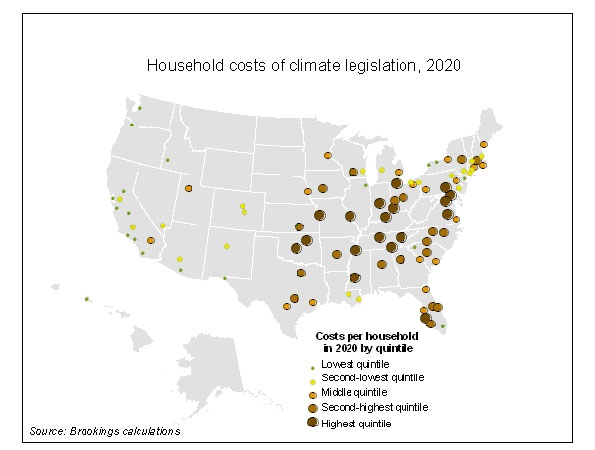
    The Brookings Institution recently calculated the projected cost of compliance under the cap and trade plan on a metro by metro basis and produced the map below for The New Republic:

    The costs of compliance are highest in the lower Midwest through to the Mid-Atlantic and in the South. New England, the Upper Midwest, and the West are the winners from a cost standpoint.

    The actual costs vary from a high of $277 per household per year in 2020 in Lexington, KY to a low of $96 in Los Angeles among the 100 largest metros. Other hard hit metros include Washington, DC ($250), Indianapolis ($246) and Kansas City ($228). Among the winners are Portland ($107), San Francisco-Oakland-Fremont ($119) and Chicago ($135).

    In aggregate, this adds up to a significant amount of money. The Cincinnati metro had 815,000 households in 2008. Brookings did not include their household estimates for 2020, but even with no population growth at all, at $244 per household that still adds up to about $200 million per year in compliance costs. To put that in perspective, Cincinnati is proposing to construct a new downtown streetcar system for that same amount of money. It could conceivably build a new streetcar line every single year in perpetuity for the cost of compliance. Portland has 835,000 households, for an annual compliance cost of $90 million. Though they are about the same size regions, Cincinnati will be paying over $100 million more per year compliance costs. This creates a $100 million disincentive to live or locate a business in Cincinnati vs. Portland.

    In short, cap and trade creates disparities between metros. As the New Republic put it, “place matters” on cap and trade. And because the effects are geographically clustered, these disparities aren’t just local, they are regional. This is enough to immediately prompt the question as to whether or not this was an implicit design goal of the system.

    Among the biggest beneficiaries of cap and trade is California. Its large metros are clustered together at the bottom of the list. I noted previously how California is placing a huge bet on the green economy as its engine of economy renewal. In fact, beyond legacy industries such as high tech, agriculture, and entertainment, California’s political leaders are betting their entire future on green. With so much on the line for California, it should come as no surprise that the state would seek to federalize its policies and institutionalize the advantages it has in this arena through its state level climate regulations. One might even better name this bill “The California Economic Recovery and Competitor Hobbling Act of 2009”.

    This reality isn’t lost on Indiana Governor Mitch Daniels. With Indianapolis the fifth hardest hit metro in the country, it is no surprise he denounced the plan in a Wall Street Journal editorial, saying, “Quite simply, it looks like imperialism. This bill would impose enormous taxes and restrictions on free commerce by wealthy but faltering powers – California, Massachusetts and New York – seeking to exploit politically weaker colonies in order to prop up their own decaying economies.”

    It is clear that getting a bill out of Washington is not just a matter of cost, but of states and regions jockeying for position. The significant regional disparities in impact grind the legislative gears and might ultimately imperil getting legislation passed. Reducing regional disparities could help improve the chances of action on carbon.

    But shouldn’t places that implemented what is considered good policy be rewarded? To some extent, yes. Many places actually voted to cause economic pain for themselves for the sake of a better environment. Other places have fought environmental regulation every step of the way. Clearly, we do want to provide incentives for good behavior, and certainly not reward bad.

    On the other hand, not all the differences in current carbon emissions or abilities to reduce them are the result of good policy. Quite a bit of them are the result of simple good luck. Some places have climates that reduce the need for heating and air conditioning. Other places face more extreme weather.

    Plentiful clean energy sources are unequally spread throughout the country. Not every place has access to large amounts of solar, wind, or hydro power sources. Much of the Midwest and South built coal fired power plants due to plentiful coal supplies in the region. Technology and transportation costs made other sources cost prohibitive. Carbon emissions were not on anyone’s radar then. Some places like Chicago were fortunate to build nuclear plants, which were bitterly opposed by environmentalists at the time, but now are praised by some as a source of low carbon power.

    In short, much of the inequality in carbon emissions results from accidents of geography or history, not deliberate bad choices. People shouldn’t be punished for practices that were rational at the times. As Saul Alinksy put it, “Judgment must be made in the context of the times in which the action occurred and not from any other chronological vantage point.” And while one could say perhaps regions whose climates require excessive heating and cooling shouldn’t be favored places to live, one could say the same about much of the West, including California, whose existence depends on a vast edifice of what many consider environmentally destructive water works.

    To actually get action on carbon – the true imperative – we should adopt the following policy guiding principles:

    1. The goal is carbon reduction, full stop. Encumbering it with additional regional economic gamesmanship, or becoming overly enamored with particular means to that end should be avoided.
    2. Reducing carbon emissions will come with an economic cost. It isn’t realistic to expect that we will get away with pain free reductions. Obviously we should seek to get the best blend of costs and benefits, but let’s not pretend we can have our cake and eat it too, holding carbon action hostage to a standard that can never be met.
    3. The carbon reduction regime should not create significant regional cost disparities. As a purely practical matter, this helps ease passage and should be embraced. Complete equality is never realistic, but when some regions will pay twice as much as others, that by itself creates oppositional voting blocs. If a cap and trade scheme is the preferred approach, then perhaps assistance to high compliance cost areas should partially fund the transition away from coal and towards less polluting sources.
    4. The carbon reduction regime should not encourage business to migrate offshore. We should also not take action that reduces the attractiveness of America as a place to do business and especially to manufacture. Regulatory arbitrage already provides an incentive to move to China, where you can largely escape environmental rules, health and safety regulations, and avoid the presence of independent, vigorous unions. An ill chosen carbon regime could simply enhance China’s allure as a “carbon haven”. Again, this skews manufacturing regions and labor interests against action on carbon, while shifting production to areas with only minimal regulatory restraints.

    In short, action on carbon reduction may well be a good policy goal. But we shouldn’t embrace any means to that end uncritically if it creates huge distortions in regional economic advantage or further damages America’s industrial competitiveness.

    Aaron M. Renn is an independent writer on urban affairs based in the Midwest. His writings appear at The Urbanophile.
  • Detroit: Urban Laboratory and the New American Frontier

    The troubles of Detroit are well-publicized. Its economy is in free fall, people are streaming for the exits, it has the worst racial polarization and city-suburb divide in America, its government is feckless and corrupt (though I should hasten to add that new Mayor Bing seems like a basically good guy and we ought to give him a chance), and its civic boosters, even ones that are extremely knowledgeable, refuse to acknowledge the depth of the problems, instead ginning up stats and anecdotes to prove all is not so bad.

    But as with Youngstown, one thing this massive failure has made possible is ability to come up with radical ideas for the city, and potentially to even implement some of them. Places like Flint and Youngstown might be attracting new ideas and moving forward, but it is big cities that inspire the big, audacious dreams. And that is Detroit. Its size, scale, and powerful brand image are attracting not just the region’s but the world’s attention. It may just be that some of the most important urban innovations in 21st century America end up coming not from Portland or New York, but places like Youngstown and, yes, Detroit.

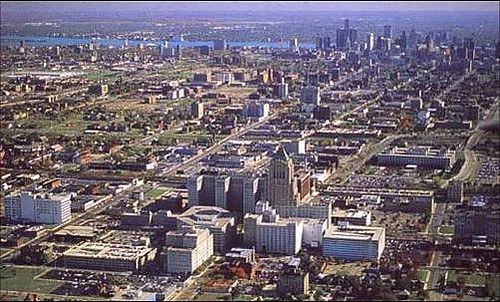
    Let’s refresh with this image showing the scale of the challenge in the city of Detroit proper:


    There are zillions of pictures to illustrate the vast emptiness in Detroit. Kaid Benfield at NRDC posted these:


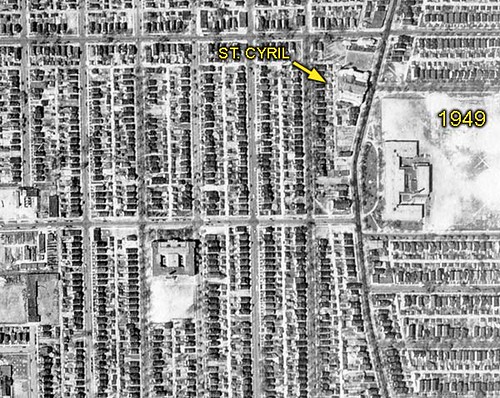
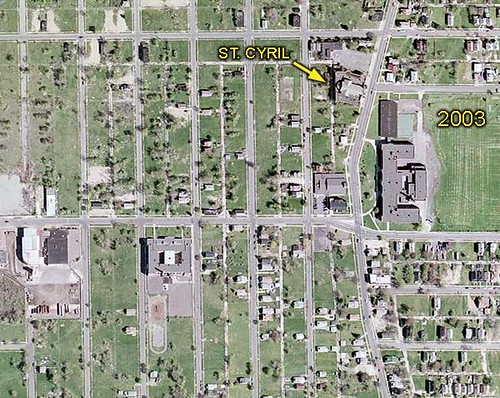
    This phenomenon prompted someone to coin the term “urban prairie” to capture the idea of vast tracts of formerly urbanized land returning to nature. The folks at Detroit’s best discussion site, DetroitYES, posted this before and after of the St. Cyril neighborhood. Before:


    After:


    A site named “Sweet Juniper” recently had a fantastic photo of the spontaneous creation of “desire line” paths across all this vacant land. You should click to enlarge this photo.


    One natural response is the “shrinking cities” movement. While this has gotten traction in Youngstown and Flint, as well as in places like Germany, it is Detroit that provides the most large scale canvas on which to see this play out, as well as the place where some of the most comprehensive and radical thinking is taking place. For example, the American Institute of Architects produced a study that called for Detroit to shrink back to its urban core and a selection of urban villages, surrounded by greenbelts and banked land. Here’s a picture of their concept:


    It seems likely that this will get some form of traction from officialdom, as this article suggests, though implementation is likely to be difficult.

    Detroit is also attracting dreams of large scale renewal through agriculture, as Mark Dowie writes in Guernica (hat tip @archizoo).

    Were I an aspiring farmer in search of fertile land to buy and plow, I would seriously consider moving to Detroit. There is open land, fertile soil, ample water, willing labor, and a desperate demand for decent food. And there is plenty of community will behind the idea of turning the capital of American industry into an agrarian paradise. In fact, of all the cities in the world, Detroit may be best positioned to become the world’s first one hundred percent food self-sufficient city.

    This isn’t just a crazy idea from some guy who lives in California. He documents several examples of people right now, today growing food in Detroit. It wouldn’t surprise me, frankly, if Detroit produces more food inside its borders today than any other traditional American city.

    About five hundred small plots have been created by an international organization called Urban Farming, founded by acclaimed songwriter Taja Sevelle. Realizing that Detroit was the most agriculturally promising of the fourteen cities in five countries where Urban Farming now exists, Sevelle moved herself and her organization’s headquarters there last year. Her goal is to triple the amount of land under cultivation in Detroit every year. All food grown by Urban Farming is given free to the poor. According to Urban Farming’s Detroit manager, Michael Travis, that won’t change.

    The fact that Urban Farming moved to Detroit is exactly the effect I’m talking about. To anyone with aspirations in this area, it is Detroit that offers the greatest opportunity to make your mark. It is the ultimate blank canvas. For urban agriculture and many other alternative urban dreams, it is Detroit, not New York City that is the ultimate arena in which to prove yourself.

    It’s not just farmers; intellectuals and artists of various types are drawn to Detroit, both to study it and pursue ideas about the remaking of the city:

    Detroit has achieved something unique. It has become the test case for all sorts of theories on urban decay and all sorts of promising ideas about reviving shrinking cities.

    “It’s unbelievable,” said Sue Mosey, president of the University Cultural Center Association, who has been interviewed recently by two separate PBS crews and an Austrian journalist writing about Detroit.

    “All of us have been inundated with all of these people who somehow think that because we’re so bottomed out and so weak-market, that this is this incredible opportunity,” Mosey said.

    Robin Boyle, a professor of urban planning at Wayne State University who has been interviewed by numerous visitors, echoed that sentiment.

    “They realize that there is an interesting story to tell, that has real characters, but even more, they discover a place that is simply not like everywhere else,” he said.

    Toby Barlow wrote in the New York Times about out of towners buying up $100 houses, moving to Detroit, and doing all sorts of interesting things with them:

    Recently, at a dinner party, a friend mentioned that he’d never seen so many outsiders moving into town…Two other guests that night, a couple in from Chicago, had also just invested in some Detroit real estate. That weekend Jon and Sara Brumit bought a house for $100.
    ….
    A local couple, Mitch Cope and Gina Reichert, started the ball rolling. An artist and an architect, they recently became the proud owners of a one-bedroom house in East Detroit for just $1,900. Buying it wasn’t the craziest idea. The neighborhood is almost, sort of, half-decent. Yes, the occasional crack addict still commutes in from the suburbs but a large, stable Bangladeshi community has also been moving in.

    So what did $1,900 buy? The run-down bungalow had already been stripped of its appliances and wiring by the city’s voracious scrappers. But for Mitch that only added to its appeal, because he now had the opportunity to renovate it with solar heating, solar electricity and low-cost, high-efficiency appliances.

    Buying that first house had a snowball effect. Almost immediately, Mitch and Gina bought two adjacent lots for even less and, with the help of friends and local youngsters, dug in a garden. Then they bought the house next door for $500, reselling it to a pair of local artists for a $50 profit. When they heard about the $100 place down the street, they called their friends Jon and Sarah.
    ….

    But the city offers a much greater attraction for artists than $100 houses. Detroit right now is just this vast, enormous canvas where anything imaginable can be accomplished. From Tyree Guyton’s Heidelberg Project (think of a neighborhood covered in shoes and stuffed animals and you’re close) to Matthew Barney’s “Ancient Evenings” project (think Egyptian gods reincarnated as Ford Mustangs and you’re kind of close), local and international artists are already leveraging Detroit’s complex textures and landscapes to their own surreal ends.

    In a way, a strange, new American dream can be found here, amid the crumbling, semi-majestic ruins of a half-century’s industrial decline. The good news is that, almost magically, dreamers are already showing up. Mitch and Gina have already been approached by some Germans who want to build a giant two-story-tall beehive. Mitch thinks he knows just the spot for it.

    It’s what Jim Russell likes to call “Rust Belt chic”, and Detroit has it in spades.

    This piece also highlights the absolutely crucial advantage of Detroit. It’s possible to do things there. In Detroit, the incapacity of the government is actually an advantage in many cases. There’s not much chance a strong city government could really turn the place around, but it could stop the grass roots revival in its tracks.

    Can you imagine a two-story beehive in Chicago? In many cities where strong city government still functions effectively, citizens are tied down by an array of regulations and permits that are actually enforced in most cases. Much of the South Side of Chicago has Detroit like characteristics, but the techniques of renewal in Detroit won’t work because they are likely against code and would be shut down the minute someone complained. Just as one quick example, my corner ice cream stand dared to put out a few chairs for patrons to sit on while enjoying a frozen treat on a hot day. The city cited them for not having a license. So they took them away and put up a “bring your own chair” sign. The city then cited them for that too. You can’t do anything in Chicago without a Byzantine array of licenses, permits, and inspections.

    In central Indianapolis, which is in desperate need of investment, where the city can’t fill the potholes in the street, etc., the minute a few yuppies buy houses in an area and fix them up, they immediately petition for a historic district, a request that has never been refused, ensuring that anyone who ever wants to do anything will be forced to run a costly and grueling gauntlet of variances, permits, hearings, etc. Only the most determined are willing to put up with that.

    In most cities, municipal government can’t stop drug dealing and violence, but it can keep people with creative ideas out. Not in Detroit. In Detroit, if you want to do something, you just go do it. Maybe someone will eventually get around to shutting you down, or maybe not. It’s a sort of anarchy in a good way as well as a bad one. Perhaps that overstates the case. You can’t do anything, but it is certainly easier to make things happen there than in most places because the hand of government weighs less heavily.

    What’s more, the fact that government is so weak has provoked some amazing reactions from the people who live there. In Chicago, every day there is some protest at City Hall by a group from some area of the city demanding something. Not in Detroit. The people in Detroit know that they are on their own, and if they want something done they have to do it themselves. Nobody from the city is coming to help them. And they’ve found some very creative ways to deal with the challenges that result. Consider this from the Dowie piece:

    About 80 percent of the residents of Detroit buy their food at the one thousand convenience stores, party stores, liquor stores, and gas stations in the city. There is such a dire shortage of protein in the city that Glemie Dean Beasley, a seventy-year-old retired truck driver, is able to augment his Social Security by selling raccoon carcasses (twelve dollars a piece, serves a family of four) from animals he has treed and shot at undisclosed hunting grounds around the city. Pelts are ten dollars each. Pheasants are also abundant in the city and are occasionally harvested for dinner.

    This might sound awful, and indeed it is. But it is also an inspiration and a testament to the human spirit and defiant self-reliance of the American people. I grew up in a poor rural area where, while hunting is primarily recreational, there are still many people supplementing their family diet with wild game. Many a freezer is full of deer meat, for example. And of course, rural residents have long gardened, freezing and canning the results to help get them through the winter. So this doesn’t sound quite so strange to me as it might to you. The fate of the urban poor and the rural poor are more similar than is often credited. And contrary to stereotypes the urban poor often display amazing grit and ingenuity, and perform amazing feats to sustain themselves, their families and communities.

    As the focus on agriculture and even hunting show, in Detroit people are almost literally hearkening back to the formative days of the Midwest frontier, when pioneer settlers faced horrible conditions, tough odds, and often severe deprivation, but nevertheless built the foundation of the Midwest we know, and the culture that powered the industrial age. No doubt in the 19th century many of those sitting secure in their eastern citadels thought these homesteaders, hustlers, and fortune seekers crazy for leaving the comforts of civilization to head to places like Iowa and Chicago. But some saw the possibilities of what could be and heeded the call to “Go West, young man.” We’ve come full circle.

    More Detroit

    Detroit: Do the Collapse
    Detroit: Not the Future of the American City
    For talent – good jobs, cools places, new narrative (Crain’s Detroit Business – featuring Yours Truly)

    Aaron M. Renn is an independent writer on urban affairs based in the Midwest. His writings appear at The Urbanophile.

  • The White City

    Among the media, academia and within planning circles, there’s a generally standing answer to the question of what cities are the best, the most progressive and best role models for small and mid-sized cities. The standard list includes Portland, Seattle, Austin, Minneapolis, and Denver. In particular, Portland is held up as a paradigm, with its urban growth boundary, extensive transit system, excellent cycling culture, and a pro-density policy. These cities are frequently contrasted with those of the Rust Belt and South, which are found wanting, often even by locals, as “cool” urban places.

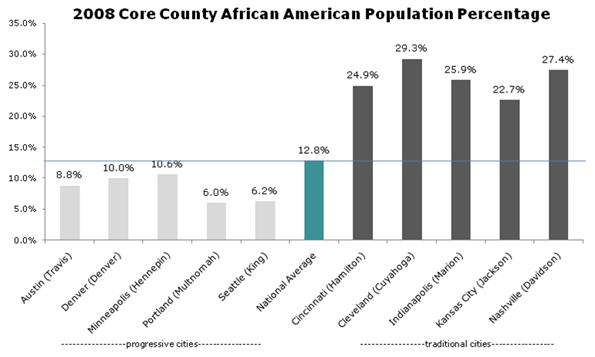
    But look closely at these exemplars and a curious fact emerges. If you take away the dominant Tier One cities like New York, Chicago and Los Angeles you will find that the “progressive” cities aren’t red or blue, but another color entirely: white.

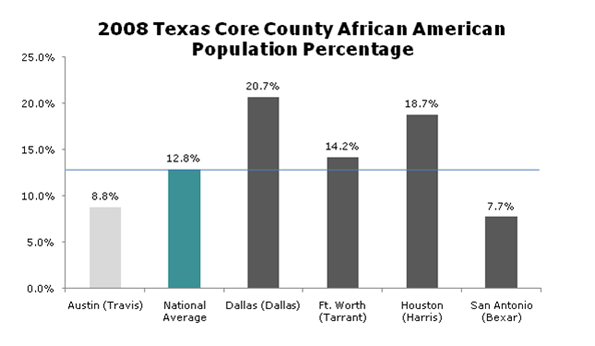
    In fact, not one of these “progressive” cities even reaches the national average for African American percentage population in its core county. Perhaps not progressiveness but whiteness is the defining characteristic of the group.

    The progressive paragon of Portland is the whitest on the list, with an African American population less than half the national average. It is America’s ultimate White City. The contrast with other, supposedly less advanced cities is stark.

    It is not just a regional thing, either. Even look just within the state of Texas, where Austin is held up as a bastion of right thinking urbanism next to sprawlvilles like Dallas-Ft. Worth and Houston.

    Again, we see that Austin is far whiter than either Dallas-Ft. Worth or Houston.

    This raises troubling questions about these cities. Why is it that progressivism in smaller metros is so often associated with low numbers of African Americans? Can you have a progressive city properly so-called with only a disproportionate handful of African Americans in it? In addition, why has no one called these cities on it?

    As the college educated flock to these progressive El Dorados, many factors are cited as reasons: transit systems, density, bike lanes, walkable communities, robust art and cultural scenes. But another way to look at it is simply as White Flight writ large. Why move to the suburbs of your stodgy Midwest city to escape African Americans and get criticized for it when you can move to Portland and actually be praised as progressive, urban and hip? Many of the policies of Portland are not that dissimilar from those of upscale suburbs in their effects. Urban growth boundaries and other mechanisms raise land prices and render housing less affordable exactly the same as large lot zoning and building codes that mandate brick and other expensive materials do. They both contribute to reducing housing affordability for historically disadvantaged communities. Just like the most exclusive suburbs.

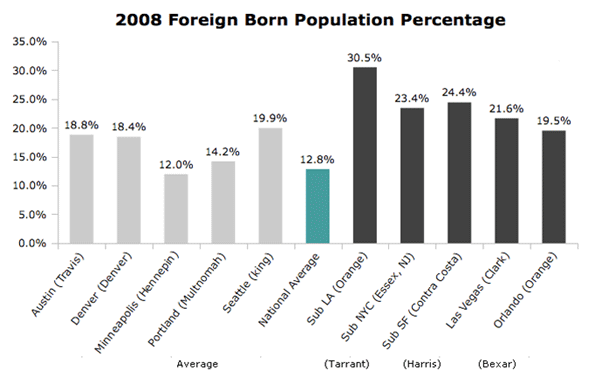
    This lack of racial diversity helps explain why urban boosters focus increasingly on international immigration as a diversity measure. Minneapolis, Portland and Austin do have more foreign born than African Americans, and do better than Rust Belt cities on that metric, but that’s a low hurdle to jump. They lack the diversity of a Miami, Houston, Los Angeles or a host of other unheralded towns from the Texas border to Las Vegas and Orlando. They even have far fewer foreign born residents than many suburban counties of America’s major cities.

    The relative lack of diversity in places like Portland raises some tough questions the perennially PC urban boosters might not want to answer. For example, how can a city define itself as diverse or progressive while lacking in African Americans, the traditional sine qua non of diversity, and often in immigrants as well?

    Imagine a large corporation with a workforce whose African American percentage far lagged its industry peers, sans any apparent concern, and without a credible action plan to remediate it. Would such a corporation be viewed as a progressive firm and employer? The answer is obvious. Yet the same situation in major cities yields a different answer. Curious.

    In fact, lack of ethnic diversity may have much to do with what allows these places to be “progressive”. It’s easy to have Scandinavian policies if you have Scandinavian demographics. Minneapolis-St. Paul, of course, is notable in its Scandinavian heritage; Seattle and Portland received much of their initial migrants from the northern tier of America, which has always been heavily Germanic and Scandinavian.

    In comparison to the great cities of the Rust Belt, the Northeast, California and Texas, these cities have relatively homogenous populations. Lack of diversity in culture makes it far easier to implement “progressive” policies that cater to populations with similar values; much the same can be seen in such celebrated urban model cultures in the Netherlands and Scandinavia. Their relative wealth also leads to a natural adoption of the default strategy of the upscale suburb: the nicest stuff for the people with the most money. It is much more difficult when you have more racially and economically diverse populations with different needs, interests, and desires to reconcile.

    In contrast, the starker part of racial history in America has been one of the defining elements of the history of the cities of the Northeast, Midwest, and South. Slavery and Jim Crow led to the Great Migration to the industrial North, which broke the old ethnic machine urban consensus there. Civil rights struggles, fair housing, affirmative action, school integration and busing, riots, red lining, block busting, public housing, the emergence of black political leaders – especially mayors – prompted white flight and the associated disinvestment, leading to the decline of urban schools and neighborhoods.

    There’s a long, depressing history here.

    In Texas, California, and south Florida a somewhat similar, if less stark, pattern has occurred with largely Latino immigration. This can be seen in the evolution of Miami, Los Angeles, and increasingly Houston, San Antonio and Dallas. Just like African-Americans, Latino immigrants also are disproportionately poor and often have different site priorities and sensibilities than upscale whites.

    This may explain why most of the smaller cities of the Midwest and South have not proven amenable to replicating the policies of Portland. Most Midwest advocates of, for example, rail transit, have tried to simply transplant the Portland solution to their city without thinking about the local context in terms of system goals and design, and how to sell it. Civic leaders in city after city duly make their pilgrimage to Denver or Portland to check out shiny new transit systems, but the resulting videos of smiling yuppies and happy hipsters are not likely to impress anyone over at the local NAACP or in the barrios.

    We are seeing this script played out in Cincinnati presently, where an odd coalition of African Americans and anti-tax Republicans has formed to try to stop a streetcar system. Streetcar advocates imported Portland’s solution and arguments to Cincinnati without thinking hard enough to make the case for how it would benefit the whole community.

    That’s not to let these other cities off the hook. Most of them have let their urban cores decay. Almost without exception, they have done nothing to engage with their African American populations. If people really believe what they say about diversity being a source of strength, why not act like it? I believe that cities that start taking their African American and other minority communities seriously, seeing them as a pillar of civic growth, will reap big dividends and distinguish themselves in the marketplace.

    This trail has been blazed not by the “progressive” paragons but by places like Atlanta, Dallas and Houston. Atlanta, long known as one of America’s premier African American cities, has boomed to become the capital of the New South. It should come as no surprise that good for African Americans has meant good for whites too. Similarly, Houston took in tens of thousands of mostly poor and overwhelmingly African American refugees from Hurricane Katrina. Houston, a booming metro and emerging world city, rolled out the welcome mat for them – and for Latinos, Asians and other newcomers. They see these people as possessing talent worth having.

    This history and resulting political dynamic could not be more different from what happened in Portland and its “progressive” brethren. These cities have never been black, and may never be predominately Latino. Perhaps they cannot be blamed for this but they certainly should not be self-congratulatory about it or feel superior about the urban policies a lack of diversity has enabled.

    Aaron M. Renn is an independent writer on urban affairs based in the Midwest. His writings appear at The Urbanophile.

  • Pittsburgh Renaissance?

    In the third of a three part New Geography series on Pittsburgh for the G-20 summit, Aaron Renn assesses Pittsburgh’s value as a model region for other cities suffering decline.

    As the G-20 leaders prepare to convene in Pittsburgh, expect the recent chorus of praise for that city’s transformation to reach a crescendo. Pittsburgh, once the poster child for industrial decline and devastation, is now the media darling as an exemplar of how to turn it around. The New York Times talks about how “Pittsburgh Thrives After Casting Steel Aside” while the New York Post informs us that “Summer in Pittsburgh Rocks”. The Economist named Pittsburgh America’s most livable city. This emerging reputation for cracking the code on revitalization is prompting struggling burgs like Cleveland and Detroit to ask what lessons the Steel City holds for them.

    But does reality live up to the hype? Has Pittsburgh really turned the corner? For the most part, a look at the data suggests otherwise:

    1. Population Is Shrinking. The city of Pittsburgh has lost over 50% of its population since its peak and it is still declining. Just since the 2000 census Pittsburgh has lost nearly 25,000 people – over 7% of its population. The metro area is shrinking too, making Pittsburgh one of only a handful of large metro areas with the dubious distinction of population decline. Others on that list: Buffalo, Cleveland, Detroit, and New Orleans. Since 2000, metro Pittsburgh has actually lost a greater percentage of its population than metro Detroit.
    2. People Are Leaving. Part of Pittsburgh’s population loss is a result of a rare case of more deaths than births. But the region has net outmigration too. Few other stats are so telling about a city. Is this a place people are voting with their feet to move to or leave from? They may come to school or an internship at a local hospital, but, more often than not, they are not putting down roots. With more people moving out than moving in, Pittsburgh is clearly not a destination city
    3. International Immigrants Are Staying Away. Metro Pittsburgh’s foreign born population percentage was 2.6% in 2000 – very low. The Pittsburgh Technology Council summed it up best when it said, “Our region has negligibly grown its foreign born population.” Contrast Pittsburgh with the national average for foreign born population of 5.7%, and regions like Boston (11.2%), Denver (9.3%), and even Detroit (6.1%).
    4. Poverty Is High. Pittsburgh’s economic area poverty rate is worse than all cities benchmarked against it by Pittsburgh Today at 11.6% versus 9.3% in Milwaukee, 9.9% in Cincinnati, and 10.5% in Cleveland among 14 comparison cities.
    5. The City Is in Debt – Bigtime. Pittsburgh is buried under a mountain of liabilities. Its unfunded pension liability is over $1 billion. Its annual interest on its debt is $352 per capita, far higher than peer cities. Pittsburgh Quarterly is very direct: “Put simply, compared with all the benchmark regions, Pittsburghers have been saddled by their governments with relatively huge amounts of public debt.”

    Still, by other measures Pittsburgh is, if not thriving, certainly outperforming both the Rust Belt and the nation as a whole. Its July metro unemployment rate of 7.8% is well below the national average. In the last 12 months, Pittsburgh lost 2.8% of its jobs, which is a much better performance than regions like Chicago (-4.5%), Atlanta (-4.9%), and Portland (-5.8%). Its housing market, having never boomed to begin with, has not experienced the declines of most of the rest of the country, making it a Rust Belt outpost of the “zone of sanity”.

    Pittsburgh has a large “eds and meds” sector, led by the University of Pittsburgh, whose medical center employs over 25,000 people, and Carnegie-Mellon University. Pittsburgh was early to the game in this approach, with steel fortunes powering the development of these institutions starting in the 1950s. There are now seven universities within a five mile radius of downtown.

    Eds and meds employment is quasi-public sector. It can be a source of stability, but it’s not proved to be the source of dynamism that you see in Silicon Valley, around Boston or even Madison. Sure, there have been some high tech successes in Pittsburgh, but the city is far from a hub of the innovation economy.

    Pittsburgh’s downtown remains an employment center with a density uncommon in a Rust Belt full of cores defined more by parking lots than vital streetscapes. Pittsburgh has long had a rich fabric of dense, urban neighborhoods, and many of those are strengthening. The city’s geography retains its charm, and a lot of former industrial areas along the three rivers have been repurposed for recreational use.

    The truth is that the Pittsburgh story is still being written. It’s still more “green shoots” than a true renaissance so far. Until its migration statistics change course, and it demonstrates sustained and growing economic dynamism, the city cannot claim to have truly turned itself around. Still, the signs of progress are better than in places like Cleveland and Detroit.

    What accounts for this? A few success factors come to mind:

    1. Passion for the City. Older river cities like Cincinnati and New Orleans tend to have strong provincial cultures, with all the good and bad that implies. You see this in Pittsburgh in the unique local “yinzer” dialect, traditions like the cookie table at weddings, and of course the Steeler Nation. There’s a strong attachment to the native soil in Pittsburgh, even for those who left.
    2. Starting Early Into the Cycle. Jane Jacobs pegged Pittsburgh’s economic stagnation to 1910. The steel industry collapsed decades ago. Pittsburgh had troubles before other cities, so it is figuring out how to deal with them before other cities. It takes a long time to recover from a hundred years of status quo thinking.
    3. Shrinkage. There’s no longer a need for a Fort Pitt to project military power. The steel industry is gone and with it the need for thousands of steelworkers. Part of the issue in the Rust Belt is that there is no longer any economic raison d’etre for some of these big cities. Pittsburgh long was too big for its role in today’s economy, so shrinkage was good. This also created the rather unique institution of the Pittsburgh diaspora, best known through the Steeler Nation. Like the Indian and Chinese diasporas, it’s a network of people who went out, made connections in the world, built new skills, etc. that Pittsburgh can now tap into, as tirelessly documented by Jim Russell.
    4. The Totality of the Collapse. On Wall Street they call it “capitulation”, where the markets hit bottom and there is no positive sentiment. You have to hit that bottom to start back up. Pittsburgh went through a civic devastation when the steel industry collapsed the likes of which few American cities have seen. This shock to the system created the conditions necessary for change that a more gradual decline would not have.
    5. Dramatic Educational Improvements. The Chicago Fed reported that Pittsburgh’s national rank for percentage of adults who were high school grads went from 55th to 3rd. And for college grads it went from 69 to 37. These are amazing numbers.

    Is the Pittsburgh model transplantable elsewhere in the Rust Belt? In the short term, no. Pittsburgh’s successes of today are rooted in 30 years of steel industry collapse, shrinkage, and boosting its brain power. The auto industry restructuring eventually might bring a needed jolt to Detroit and other Rust Belt cities, but recovery is a long term game that requires sustained commitment over many years to things like education. Pittsburgh has achieved some of this, perhaps not as spectacularly as the media suggests, but in ways that are still useful for other Rust Belt cities to ponder.

    Aaron M. Renn is an independent writer on urban affairs based in the Midwest. His writings appear at The Urbanophile.
  • Recession Job Losses and Recovery in Midwest Cities

    The Windy Citizen pointed me at coverage of metro area job losses in the recession. Here is how the 12 cities I principally cover in this blog stacked up, sorted in descending order of percentage losses:

    1. Detroit; 139,600 jobs; -7.5%
    2. Milwaukee; 44,800; -5.2%
    3. Cleveland; 54,100; -5.1%
    4. Chicago; 206,200; -4.5%
    5. Indianapolis; 40,200; -4.4%
    6. Cincinnati; 42,200; -4.0%
    7. Louisville; 22,900; -3.7%
    8. Minneapolis-St. Paul; 63,100; -3.5%
    9. St. Louis; 43,900; -3.3%
    10. Pittsburgh; 32,800 – 2.8%
    11. Kansas City; 21,900; -2.1%
    12. Columbus, Ohio; 19,600; -2.1%

    A couple things that jump out of me from this are that Chicago and Indianapolis are doing far worse than conventional wisdom views of their overall economic health. Both regions are getting clobbered. The Pittsburgh story gets some additional ammunition, as does my view that Columbus is the next Midwestern star.

    Recession Job Recovery

    So when will the jobs come back? Nobody knows for sure, but an organization called IHS Global Insight has predicted the year in which employment will match its pre-recession peak in various major US cities (via IBJ News Talk):

    • Kansas City: 2011
    • Columbus: 2012
    • Indianapolis: 2012
    • Louisville: 2013
    • Minneapolis-St. Paul: 2013
    • Pittsburgh: 2013
    • Chicago: 2014
    • Cincinnati: 2014
    • St. Louis: 2014
    • Cleveland: After 2015
    • Detroit: After 2015
    • Milwaukee: After 2015

    Visit Aaron’s blog at The Urbanophile.

  • The New Industrial City

    Most American urban economic development and revitalization initiatives seek to position communities to attract high wage jobs in the knowledge economy. This usually involves programs to attract and retain the college educated, and efforts to lure corporate headquarters or target industries such as life sciences, high tech, or cutting edge green industries. Almost everything, whether it be recreational trails, public art programs, stadiums and convention centers, or corporate incentives, is justified by reference to this goal, often with phrases like “stopping brain drain” and “luring the creative class”.

    The future vision underpinning this is a decidedly post-industrial one. This city of tomorrow is made up of people living upscale in town condos, riding a light rail line to work at a smartly designed modern office, and spending enormous sums – with the requisite sales tax benefits – entertaining themselves in cafes, restaurants, swanky shops, or artistic events.

    In contrast the factory has no place in this future city. Indeed industry is considered a blight that needs to be eliminated or repurposed. What were once working docks are to be converted to recreational waterfront parkland. Warehouses and small factories become the site for developing lofts, studios, or boutiques. This urban economy is based almost solely around intellectual work and services, not physical production.

    But there is a problem with this equation. In almost any city, the bulk of the people do not have college degrees. According to Brookings, the average adult college degree attainment rate for the top 100 metro areas is only 30.6% In the many years it will take to raise this, what are the rest of the people supposed to do for a living? Younger cohorts are better educated than their grandparents, so this will improve over time. But better educated for what? Not everyone is cut out, or wants to be a stock-trader or media consultant. We have to think about those who would rather work with their hands, or are better suited for that kind of work.

    The vision touted by too many urban boosters is that of an explicitly two-tier society. There are elite, well paid knowledge workers in industries like finance, law, and technology, and then there is everybody else. Programs designed to boost knowledge industries turn out to be subsidies to cater to the most privileged stratum of society. The public is called on to pay for urban amenities for the favored quarter of the intelligentsia, with the benefit to the rest of the people assumed.

    But little thought is given as to how everyone else will get by, other than working in low wage service occupations catering to the privileged. In the Victorian era, they called this going “into service”. Today we might think of them better as globalization’s coolie class.

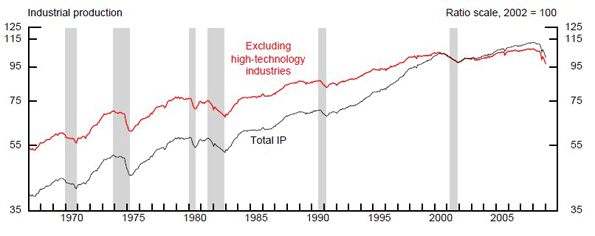
    Beyond this, can we as a country prosper if we don’t actually make things anymore? Some of the fear of manufacturing decline is overblown. Despite large scale job losses in the manufacturing sector, the US has continued to set industrial production records outside of recessions. However, as the chart below from the Federal Reserve shows, industrial production growth flattened significantly in the late 1990s.

    Sadly, manufacturing has been hammered in this Great Recession. There will certainly be a cyclical upturn in output, but restructuring in the automobile industry portends a permanent reduction in domestic output in that sector among others. Unless carefully handled, increasing regulation of carbon emissions, along with the associated energy price rises, will encourage further offshoring to countries with few climate change obligations, such as China, India, Brazil and other developing nations.

    Yet to remain both a prosperous and fair society, the United States must remain a manufacturing power. Manufacturing still provides the traditional route to middle class wages for those without college degrees. It also alone employs 25 percent of scientists and related technicians and 40 percent of engineers and engineering technicians.

    Of course, the next wave of manufacturing will differ greatly from the past. Improvements in productivity and global competition mean a bleak future for large scale, low value-added, routinized production. The era where an assembly plant provided thousands of good jobs at good wages is a thing of the past other than for the lucky few. And where there are new factories, they are often in greenfield locations like the new Honda plant in Greensburg, Indiana – halfway between Indianapolis and Cincinnati – not urban centers. Polluting heavy industry like primary metals and refining really are incompatible with neighborhoods. So what is to be done?

    One answer is to build a new industrial city focusing on small scale craft and specialty manufacturing with high value added. We’re seeing a precursor to this in the rise of organic farming and artisanal products of all kinds. TV shows featuring hip young carpenters renovating homes or gearheads tricking out cars and motorcycles make these professions seem glamorous. Magazines targeted at the global elite like Monocle scour the world in favor of the finest handcrafted products from old school workshops, building demand for these products. The New York Times Magazine recently did an article making the case for working with your hands, and also noted how digitally oriented designers are rediscovering the use of their hands. Perhaps it is no surprise that sociologist Richard Sennett turned his attention to the idea of the craftsman. In short, making things, craftsmanship, and quality are back in fashion.

    The challenge for urban economies is to develop this and put it on a sound industrial and economic footing. One key might be to inspire people to start these craft oriented businesses by tapping into people’s desire to purchase ethical and sustainable products. We increasingly see with foods and other items that people want to understand their provenance, to know who made them, how, with what, and under what conditions. Often today businesses catering to this desire are small scale “Mom and Pop” type operations, but there is no reason they can’t be done at greater scale, or expanded into areas like organic food processing, not just organic farming. American Apparel has done just that by manufacturing low cost, stylish clothing “Made in Downtown Los Angeles. Sweatshop Free.” at scale, for example.

    Beyond craft products, reinvigorating small scale, specialty fabrication and other businesses, to rebuild an American version of Germany’s Mittlesand, creates another, often ignored option for urban economies. Quality, flexibility, responsiveness, and a willingness to do small runs are keys. These businesses can also underpin product companies higher in the value chain. They start building an ecosystem of local companies and expertise that can be useful for related or spin-off businesses. Jane Jacobs, and before her the great French historian Fernand Braudel, noted how cities could incubate many new enterprises because all the diverse products and services they needed were available locally. If you need to scour the globe looking for custom parts and services, it can quickly overwhelm a small business. That’s one reason American Apparel started in Los Angeles, which already had a network of garment producing firms and expertise to draw on. What’s more, these firms might be ideal candidates to take over empty strip mall or other space in decaying inner ring suburbs, helping to solve the “graybox” problem. Even Main St. locations could potentially benefit from businesses beyond traditional boutiques.

    Today these types of specialty firms are often found in America’s largest cities, so they stand to benefit most from this. Smaller cities also need to figure out how to build this ecosystem. The culture needs to change too. Particularly in the Midwest/Rust Belt area, industrial labor has tended towards low skill, repetitive work in larger scale mass production industries. Retraining will be needed for these newer types of businesses, but this is vocational or skill training, not necessarily a college degree. It is a much more tractable problem.

    Not only could this new manufacturing base be a source of urban middle class jobs for the non-college degreed, it would do something arguably more important. It links the fortunes of the new upscale urban residents, the people who are both the customers for many of these products and potentially also the entrepreneurs making them, with that of their less educated neighbors. For many owners, managers, and workers, it might bring into daily contact people who might not otherwise ever interact if one group worked in an office and another in a warehouse. Rebuilding that sense of community and commonwealth, that we are neighbors, fellow citizens, and all in this together, is critical to building a truly sustainable, well-functioning and broadly prosperous society.

    Aaron M. Renn is an independent writer on urban affairs based in the Midwest. His writings appear at The Urbanophile.