Author: Aaron M. Renn

  • Cities Need Connectivity in the Global Economy

    My latest column is now online in the September issue of Governing magazine. It’s about the criticality of connectivity to success in the global economy.

    One of the most important ways for cities to get connected is through migration. Jim Russell and his collaborator Richey Piiparinen at Cleveland State University’s Center for Population Dynamics have been documenting how Cleveland has been getting more connected to the global world through this process. This includes foreign immigration but isn’t limited to that. A key part of it is the influx into places like Cleveland of people who have lived in major global cities like New York, then cycled out.

    There are many reasons for this kind of migration, but living costs are certainly one of them. America’s major global urban centers have become extraordinarily expensive to live in. Life in a “microapartment” in New York is less attractive when you are in your 30s and married with kids than it is when you are 22, single and fresh out of college.

    What Rust Belt cities like Cleveland can offer is an authentic urban experience in a genuinely historic place at a price that can’t be beat. No one will mistake it for life in Brooklyn, but these cities’ price/performance ratio has a growing appeal, as their downtown population growth shows.

    Click through to read the whole thing.

    Aaron M. Renn is a senior fellow at the Manhattan Institute, a contributing editor of City Journal, and an economic development columnist for Governing magazine. He focuses on ways to help America’s cities thrive in an ever more complex, competitive, globalized, and diverse twenty-first century. During Renn’s 15-year career in management and technology consulting, he was a partner at Accenture and held several technology strategy roles and directed multimillion-dollar global technology implementations. He has contributed to The Guardian, Forbes.com, and numerous other publications. Renn holds a B.S. from Indiana University, where he coauthored an early social-networking platform in 1991.

    Photo by wzefri

  • What the Blues Brothers and Ferris Bueller’s Day Off Tell Us About Gentrification

    The Blues Brothers and Ferris Bueller’s Day Off are two of the seminal films set in Chicago. Indeed, Chicago itself is a character in both films.

    The films are radically different even though released only six years apart. There are many ways to slice this. Some have said that one is the South Side movie (The Blues Brothers) and the other the North Side movie (Ferris Bueller). Some see one as more urban, one more suburban.

    One other way to look at it is to see how the films portray an urban transition in progress. The Blues Brothers is a look backward at a fading industrial, working class metropolis.  Ferris Bueller looks forward to an upscale, gentrified city.

    I explore the parallels and contrasts in my new article in the Summer issue of City Journal, “Gentrification on the Big Screen“:

    Florida might regard some of Ferris Bueller’s traditional settings for diversion—the Art Institute and Chez Quis, a fictional fancy French restaurant—as stodgy relics from the city’s older, pre–knowledge economy era. But the scene in which Ferris bluffs his way into Chez Quis for lunch, claiming to be Abe Froman, “Sausage King of Chicago,” is perhaps the most revealing one in the film—and it marks another contrast with The Blues Brothers, in which a French restaurant also figures prominently. In the earlier movie, when Jake and Elwood show up at the legendary Chez Paul, they behave boorishly on purpose, to compel a former bandmate now working a legit job as the maître d’ to quit and rejoin them. By contrast, when Ferris and friends crash Chez Quis, they foreshadow a changing of the social guard. The hip young friends are destined to become Chicago’s new proprietors. They will soon be remolding the city, and its restaurants, in their own image. Chez Paul closed in 1995. Today, the city’s highest-end restaurants—like Alinea, a sleek, uber-hip purveyor of innovative cuisine—represent the culmination of this transition. A 48-year-old Ferris might well be eating at Alinea today.

    Watching these films today, viewers under the age of, say, 45 would be struck by how alien Jake and Elwood’s Chicago seems and how familiar Ferris’s Chicago has become. The vibrant working-class culture, tough old nuns, SROs, and Maxwell Street Market of The Blues Brothers have all either disappeared or survive only as shadows of what they once were. With a bit of cultural updating to cars, hairstyles, fashion, music, and phones, however,Ferris Bueller’s Day Off could be remade today, virtually shot for shot. Modern proto-hipsters might well still skip school to visit Wrigley Field, the lakefront, the Sears Tower Skydeck, or the Art Institute. Three decades after Ferris Bueller played hooky from the suburbs, the triumph of the gentrified city is complete.

    Click through to read the whole thing.

    Aaron M. Renn is a senior fellow at the Manhattan Institute, a contributing editor of City Journal, and an economic development columnist for Governing magazine. He focuses on ways to help America’s cities thrive in an ever more complex, competitive, globalized, and diverse twenty-first century. During Renn’s 15-year career in management and technology consulting, he was a partner at Accenture and held several technology strategy roles and directed multimillion-dollar global technology implementations. He has contributed to The Guardian, Forbes.com, and numerous other publications. Renn holds a B.S. from Indiana University, where he coauthored an early social-networking platform in 1991.

    Photo: Aretha Franklin singing in a diner in The Blues Brothers. Image via City Journal

  • Culture, Circumstance, and Agency: Reflections on Hillbilly Elegy

    The intractability of poverty has been recognized since at least the time the Deuteronomist wrote, “The poor will never cease to be in the land.” Explanations vary: ill favor of the gods, deficient natural endowments, personal defects, the culture of the poor, external circumstances such as a lack of economic opportunity, some type of oppression—all have been popular options.

    In his bestselling new memoir Hillbilly Elegy, J.D. Vance takes a blended view, recognizing the role of economic and personal circumstances in poverty and life dysfunction but also stressing the way that the culture of his own working-class Appalachian tribe has crippled its response to life’s challenges. He comes down firmly on the side of individual agency and the ability of people to overcome obstacles through hard work and adopting the cultural habits of successful groups. He writes, “This book is about something else: what goes on in the lives of real people when the industrial economy goes south. It’s about reacting to bad circumstances in the worst way possible. It’s about a culture that encourages social decay instead of counteracting it.” And: “The truth is hard, and the hardest truths for hill people are the ones they must tell about themselves.”

    Vance’s book has hit a nerve by providing a compelling lens through which those appalled by the popularity of Donald Trump in working-class circles can understand his improbable rise. Who are these Trump voters? Hillbilly Elegyoffers an answer.

    Vance is a 31-year-old graduate from Yale Law School. Happily married to his wife Usha, whom he met there, he appears to be the perfect embodiment of upper-middle-class success. As it happens, though, he started out in the world of the deeply troubled working class. Vance was raised in Middletown, Ohio, today part of suburban Cincinnati, but his heritage is Appalachian Scots-Irish, and his family originated in Breathitt County, Kentucky—so-called Bloody Breathitt for its history of violent feuds and its military tradition—and is related to the Hatfields of Hatfield-McCoy feud fame. So he really is a legitimate hillbilly, not a pretender.

    It’s ordinarily presumptuous for a 31-year-old to write a memoir, but Hillbilly Elegy justifies the exception. Vance provides an honest and powerful account of his toxic upbringing and the long history of Appalachian dysfunction that produced it. His book also positions Vance, a conservative who has contributed to National Review and describes former Indiana governor Mitch Daniels as his “political hero,” as a potential post-Trumpian political figure. In that respect,Hillbilly Elegy is perhaps an aspirational analogue of Dreams From My Father. Vance’s story forms a bridge between the upper middle class, whose values he fully embraces, and the alienated white working class, with which he still claims tribal identity.

    Papaw and Mamaw, Vance’s maternal grandparents, moved to Ohio as teenagers after a pregnancy and shotgun wedding. Papaw got a good union job at Armco Steel, and the family was in theory financially prosperous and upwardly mobile. But the problems of Appalachia followed them to Ohio. They were poor money managers, with Papaw buying new cars on impulse. He was also a violent drunkard. Mamaw, with her own reputation for violence, once threatened to kill him if he ever came home drunk again, and, after he promptly transgressed, doused him with gasoline and set him on fire (he survived with only minor burns). At times she was a hoarder. Papaw and Mamaw ultimately separated but remained close.

    Their behavior came in part from the values they brought with them and in part from the many Appalachians who followed them along the “Hillbilly Highway” north, looking for work in booming Midwest factories. Though this migration has since radically slowed, cities like Indianapolis retain Appalachian “immigrant” neighborhoods today, some still being restocked with new arrivals.

    Vance’s mother Bev fared much worse than her parents, unable to maintain even the semblance of a steady romantic relationship. Vance barely knew his biological father until he was 12. He was adopted by one of his mother’s many husbands, but that fatherly bond proved no more durable than the biological one. He told conservative writer Rod Dreher that his mother had 15 husbands and boyfriends. None of his many brothers and sisters was full-blooded. Indeed, Vance’s family relationships boggle the mind:

    One of the questions I loathed, and that adults always asked, was whether I had any brothers or sisters. When you’re a kid, you can’t wave your hand, say, “It’s complicated,” and move on. And unless you’re a particularly capable sociopath, dishonesty can only take you so far. So, for a time, I dutifully answered, walking people through the tangled web of familial relationships that I’d grown accustomed to. I had a biological half brother and half sister whom I never saw because my biological father had given me up for adoption. I had many stepbrothers and stepsisters by one measure, but only two if you limited the tally to the offspring of Mom’s husband of the moment. Then there was my biological dad’s wife, and she had at least one kid, so maybe I should count him, too. Sometimes I’d wax philosophical about the meaning of the word “sibling”: Are the children of your mom’s previous husbands still related to you? If so, what about the future children of your mom’s previous husbands? By some metrics, I probably had about a dozen stepsiblings.

    Only his older half-sister Lindsay was a consistent presence. He cried when he learned that she was not his full sister.

    Bev continued to spiral downward, attempting suicide at least once, becoming abusive toward Vance, and ultimately falling into severe drug addiction. Vance shuttled between homes, sometimes with his mother, sometimes with his Mamaw, whom he credits as a positive influence. In an underexplored episode of his life, Vance meets and for a time lives with his biological father, who has embraced Pentecostal Christianity and turned his life around. “Dad had built a home with an almost jarring serenity,” Vance writes. “In some ways, I loved living with Dad. His life was normal in precisely the way I’d always wanted mine to be.” He prefers his Mamaw’s folk theology to his father’s intense religion, but recognizes the role that the latter, extreme though he perceives it to be, played in improving his father’s life.

    Yet he never feels fully comfortable living with his father. When Mamaw calls and asks him to move back, he abandons this healthy home to return to his previous life of chaos. Throughout the book, Vance displays an obvious and strong matriarchal orientation. He’s emotionally bonded to his deeply flawed Mamaw, whose family name he and his wife adopt when they marry. He idealizes his sister Lindsay and his wife Usha. But he seems unwilling to reflect on this female dependency or understand how it shaped decisions like leaving his father.

    Things get better for Vance later in high school, in part because he lives full-time with his Mamaw instead of shuttling back and forth between her and his drug-addicted mother’s various abodes. After graduation, he thinks seriously about going to college. Lacking the funds and recognizing he wasn’t ready, he wisely enlists in the Marines, which proves a transformative experience. Newly fashioned into a stable, functioning adult courtesy of the Corps, Vance enrolls in Ohio State, where he excels while working two or three jobs simultaneously to avoid taking on debt.

    He then applies to and is accepted at Yale Law School, where the cultural gulf between his hillbilly upbringing and the American elite first comes into full relief. He discovers the role that social capital, mentors, and connections play in success. One of his professors at Yale, Amy Chua, of Tiger Mom fame, becomes a key advisor and advocate for him. He struggles in settings upper middle-class students would navigate with ease. He spits out sparkling water in disgust and surprise the first time he drinks it. When a law firm takes him to an upscale restaurant for dinner, he has to call Usha, then his girlfriend, to ask how to use the silverware. At Yale, he discovers that he must not just reject the toxic elements of his old culture but also embrace this new one to get anywhere.

    The social deficiencies of the working class are under-appreciated by those who never suffered them. I also came from a working-class background. After flying to a job interview in Chicago in college, I didn’t know how to take a taxi and was too ashamed to ask. I tried getting in a cab dropping off passengers; the driver was kind enough to tell me where the cabstand was without humiliating me. I didn’t know how to use chopsticks. I didn’t know the way much of the professional world functioned. And a lot of those things I didn’t know that I didn’t know. I estimate that I started out five to ten years behind those who came from upper middle-class homes in important ways. I’ve heard the same from others of similar origins.

    E.D. Hirsch talks about the “core knowledge” every kid must learn. For those with above-average intelligence, knowledge is relatively easy to acquire if you don’t have it. But there’s also a set of core social knowledge and experiences needed to function effectively in educated society. This can be more challenging to obtain, especially without a mentor. Vance illuminates this oft-overlooked aspect of upward mobility.

    Hillbilly Elegy has received nearly universal praise on both the left and right, much of it well-deserved. Though Vance may be a conservative, his book has something for everyone.

    For the Right, Vance questions the efficacy of war-on-poverty solutions, which he sees as enabling the worst aspects of Appalachian culture. Upscale liberals find it difficult to comprehend why the white working class often despises the welfare programs from which their own communities would purportedly benefit. Vance helps them understand this rejection by describing the challenges of working-class life and how working-class communities can be easily undermined by government benefits. He worked for a time in a tile warehouse, earning $13 an hour for physically demanding labor. That’s a viable if modest living in a low-cost town, but it’s hard to motivate oneself to take such a backbreaking but low-wage job if benefits, even if less in cash value, can be had without working at all.

    Another aspect of the book that appeals to non-Trumpian conservatives is also what powerfully attracts it to the Left: its placing of the locus of responsibility for white working-class malaise in its own culture. Intellectuals on the left and right have been aghast at support for Trump from the white working class. Vance tells them what they want to hear: that the travails of this class stem in large part from their dysfunctional and self-destructive culture. Vance acknowledges that the white working class faces legitimate hurdles, such as the decline of union manufacturing jobs, an analysis that resonates with the Left. But ultimately he sees this demographic’s failure to overcome obstacles—as he did, and as President Obama, one of his examples, also did—as stemming from personal and cultural flaws, notably a lack of a sense of agency:

    Too many young men immune to hard work. Good jobs impossible to fill for any length of time. And a young man with every reason to work—a wife-to-be to support and a baby on the way—carelessly tossing aside a good job with excellent health insurance. More troublingly, when it was all over, he thought something had been done to him. There is a lack of agency here—a feeling that you have little control over your life and a willingness to blame everyone but yourself.

    Rather than seeing the working class as victims of, say, current economic policies, which would require addressing underlying structural inequities, Vance says that these people are in large part the authors of their own demise. Their predicament thus requires no fundamental change of course economically—a great relief to those prospering under the current regime. This flattering of audience sensibilities, combined with Vance’s immensely compelling life story, helps explain why Hillbilly Elegy has received so much praise and so little substantive criticism, despite some limitations.

    As someone who came of age 15 years before Vance, in a very different white working-class milieu, I see problems in the book that deserve more attention. The most significant is Vance’s conflating of his Appalachian Scots-Irish hillbilly world with the white working class generally. Appalachia has been a byword for poverty and dysfunction for generations. Vance’s culture has no living memory of anything else, so it’s natural for him to see the culture of his people as overwhelmingly influential in their fate. But this is not the case for the majority of the white working class. For example, sociologist Robert Putnam had a different experience in his hometown of Port Clinton, Ohio. The Port Clinton of his 1950s upbringing, as related in his book Our Kids, certainly had its share of working class poverty, but it was socially intact and functional—a world away from that experienced by Vance’s family.

    I grew up in white, working-class, rural Southern Indiana during the 1970s and 1980s. While it had some Appalachian cultural influence, its demographic and social conditions were different. German was the dominant ethnic background of the area. My family is of mostly German Catholic stock, with one Sicilian grandfather added to the mix. My recently divorced mother, brother, and I moved to Harrison County in 1976, when I was seven. We lived in a trailer on a gravel road. We soon built a house, but our water came from a cistern, we had a party-line telephone, and we burned our trash in a 55-gallon drum. I was a classic case of “poor but didn’t know it.” There was certainly a lot of poverty around. Yet I, too, recall a functional and socially intact, if hardly idyllic, community.

    Today, however, both Putnam’s Port Clinton and my Southern Indiana are a lot more like Vance’s Appalachian world than Putnam or I would have believed possible, even after allowing for nostalgia. We face a different question from the ones that confront Vance. We must ask what changed in only a generation or two to damage communities that once did broadly sustain healthy working-class marriages, families, and community life. It’s harder to blame culture entirely here when that same culture was producing respectable if unglamorous success as recently as 30 years ago.

    Some answers are easy. Hard drugs are available now in a way they weren’t before. Working-class communities were almost always hard-drinking ones. But the potential for destruction has been greatly magnified by meth, heroin, and prescription opioids—dangers that Putnam and I never had to face growing up. These drugs are devastating many working-class communities today.

    Other answers require facing up to unpleasant truths. For the Right, that means acknowledging that the economy has changed in ways that have badly disadvantaged the working class, offering lower pay and less job security than the solid base of union manufacturing jobs that previously anchored these communities. “Creative destruction” is not so great when you’re on the receiving end of the destruction, and when it’s human lives rather than widgets or corporate profits at stake. The scope of this displacement has been far larger than originally anticipated, with the prospect of more to come, thanks to rapidly advancing technology. Trade deals and tax cuts won’t fix the problem.

    For the Left, the unpleasant truth is what Vance makes clear if not explicit: the sexual revolution has been a disaster for the working class. No-fault divorce and the diminishment of the stigmas attached to casual sex and single or divorced motherhood have been a liberating dream—or at least a manageable reality—for educated urbanites. But these changes have been a nightmare for the children growing up in a white working-class world, where broken homes and a string of romantic and sexual partners for Mom is the new normal. “Of all the things that I hated about my childhood,” Vance writes, “nothing compared to the revolving door of father figures.”

    My own childhood was an early harbinger of bad things to come. I was a child of the first generation of no-fault divorce. But both sets of my grandparents were in lifelong marriages, and my community was mostly shaped by a culture of intact homes. My mother’s Pentecostal faith—similar to that of Vance’s father—shaped her conservative behavior with men after her divorce; I was spared the revolving door of boyfriends that Vance had to endure. Without these advantages, who knows where I would have wound up?

    Today, after 40 more years of broken marriages and out-of-wedlock births, far fewer people in my hometown come from intact families. I now see grandmothers, even great-grandmothers, sometimes single and, like Vance’s Mamaw, belatedly trying to make up for major life problems they themselves only recently emerged from, raising children of drug-addicted mothers. There remain some successful, intact families back home, but this new reality exerts a powerful influence on the local culture.

    Vance overcame his domestic instability. Many others don’t. Harvard economist Raj Chetty found that when it comes to explaining the variance in upward social mobility across so-called commuting zones, “the strongest and most robust predictor is the fraction of children with single parents.” That observation is likely to prove about as popular among liberals as the Moynihan Report.

    By Vance’s own account, the confidence, discipline, and work ethic he acquired in the Marine Corps enabled him to overcome a difficult background. But the Marines don’t instill order into the disordered lives of recruits by inspiration or encouragement; they impose it by force. Historically, de facto legal and social controls limited personally and socially destructive choices in many working-class communities (if not Appalachian ones). These norms were undoubtedly repressive and often cruel, but so are drill sergeants. The elimination of these norms—at the behest of the educated, not working, classes—has corrosively undermined the supports that once sustained functional working class communities, particularly when combined with the rise in college attendance that has sucked out the most talented, like Vance, and routed them to metro or neighborhood enclaves of the similarly successful. (Vance currently lives in San Francisco.)  

    The major form of social control that we have retained with full vigor is the criminal justice system. So today, problems previously handled through other means now fall into the lap of police and judges, with predictable challenges. We have continued to use traditional social-control mechanisms for some purposes: promulgating gay rights, reducing the use of the Confederate flag, and so on. Until we’re willing to re-embrace similar means to restore a semblance of family stability in poor and working-class communities—white or otherwise—too many children will never stand a chance.

    Vance also lacks self-awareness in some areas, especially in his rejection of the idea that talent—that is to say, good fortune—played a major role in his success. He instead attributes it to the character and work ethic he developed in the Marines, and explicitly rejects innate talent as a factor. “Today people look at me, at my job and my Ivy League credentials, and assume that I’m some sort of genius, that only a truly extraordinary person could have made it to where I am today,” he writes. “With all due respect to those people, I think that theory is a load of bullshit.”

    But undoubtedly Vance won the genetic lottery for IQ. He got into Yale Law School. Based on the LSAT scores needed for admission there, his IQ is likely north of 140—probably genius-level. No wonder he didn’t think that the people there were any smarter than he was. No amount of hard work can substitute for this. Untold numbers of people have worked extraordinarily hard and yet failed to gain admission to the Ivy League.

    Vance even concedes his good intelligence genes. His mother was also the salutatorian of her high school. “Mom was, everyone told me, the smartest person they knew,” he writes. “And I believed it. She was definitely the smartest person I knew.” He describes his cousin Amber as an “academic star” and tells legends of his Uncle Jimmy’s precociousness. But he doesn’t connect the dots.

    That’s not to say that his hard work was irrelevant or unimportant. I, too, went to a Big Ten state school, in my case Indiana University. Yet unlike Vance, who emerged from the Marine Corps driven and focused, I initially drifted through life, taking what success offered without much effort, though I was valedictorian of my high school and had a successful corporate consulting career. But while it’s purely speculative as to whether I could have gotten into Yale Law, it’s indisputable that I underperformed my potential, because I was lazy. Vance’s hard work was important, then, but the idea that he could have gone to Yale Law without unearned, innate intellectual talents is highly dubious.

    Thus, Vance falls into the trap of too many of today’s winners in a “meritocratic” (his term) system: he believes, in effect, that he morally merits his outsize success because he earned it through hard work. This is the flip side of his cultural condemnation. He understands that he benefitted from encouragement from Mamaw and others, which many kids in his milieu don’t receive: “Whatever talents I have, I almost squandered until a handful of loving people rescued me.” But he fails to recognize the role that unearned merit, in the form of those talent endowments, played in his success. This position is deeply unfair to the half of the population with below-average intelligence—tens of millions of them with significantly below-average intelligence—in a knowledge economy that greatly privileges brainpower over brawn. Someone born into a poor, chaotic community with an IQ below 100 can’t just solve his problems by bootstrapping himself into Yale, not even after a tour in the Marines.

    Hillbilly Elegy nevertheless remains remarkable for its first-person portrayal of Appalachian culture from someone who has affection for its people—indeed, still sees them as his people—but also the courage to admit its flaws. The larger problems come less from the book itself than from the way in which educated readers have seized on it to confirm their own negative impressions of the white working class—and, by extension, to flatter the superiority of their own cultural values and their sense of moral entitlement to the success they enjoy.

    At the heart of the matter, Vance is right. It’s not a question of either circumstances or culture, but “both-and.” The poor and working class do face challenging, sometimes horrific circumstances. They also have agency in choosing how to respond. Too often, their culture produces bad responses, even when the opportunity exists to choose otherwise. This culture itself may be an inheritance that individuals did not choose. But people can have disabilities for which they are not to blame. That doesn’t change their real-world effect. Unless both the external circumstances and the culture of the working class, of all races, are ameliorated, broad-based change is unlikely.

    This piece was originally published by the City Journal.

    Aaron M. Renn is a senior fellow at the Manhattan Institute, a contributing editor of City Journal, and an economic development columnist for Governing magazine. He focuses on ways to help America’s cities thrive in an ever more complex, competitive, globalized, and diverse twenty-first century. During Renn’s 15-year career in management and technology consulting, he was a partner at Accenture and held several technology strategy roles and directed multimillion-dollar global technology implementations. He has contributed to The Guardian, Forbes.com, and numerous other publications. Renn holds a B.S. from Indiana University, where he coauthored an early social-networking platform in 1991.

    Lead photo courtesy of The City Journal.
  • Trump’s Pitch to Blacks

    After Trump made a recent speech in Milwaukee in which he directly asked for black votes, I was asked to write a about it. My piece is now online in City Journal and is called “Trump’s Pitch to Blacks.”

    I personally doubt whether he’s really going after black votes (though of course he wouldn’t mind getting some). Rather, this is designed to polish his image as more inclusive. What’s more, his language of “law and order” seems more designed to appeal to whites, and he mentions nothing about black grievances with the police (in contrast to his previous rhetoric in which he labeled the shootings of Alton Sterling and Philandro Castile “terrible” and “disgusting”).

    He also talked about his economic policies, etc. But the focus of my piece was on his immigration pitch. Large scale immigration seems likely to downgrade black aspirations and social justice claims in the American political sphere over the long term:

    As ethnic groups multiply and grow in America, often borrowing the template of the civil rights movement for their own goals, they dilute the claims of black Americans. A study by sociologists Mary C. Waters, Philip Kasinitz, and Asad L. Asad argued that “the increasing racial diversity of the population owing to immigration means policies that aim to promote racial equality but that are framed in terms of diversity often do not address the needs of native African Americans who, arguably, need such policies the most.” Diversity used to mean “black.” Now it can mean anything from a Mexican small-business owner to a Chinese software developer to a Pakistani doctor. Major Silicon Valley firms actually employ a lower share of whites than the population as a whole—and virtually no blacks.

    Click through to read the whole thing.

    I have generally been a proponent of immigration (or outsiders generally), arguing that a critical mass of outsiders is necessary to civic dynamism, and that we have actually sucked out many of the risk takers and entrepreneurs from Mexico.

    But we can have too much of a good thing. Clearly, we’ve reached the point where the level of immigration is having socially destablizing consequences. Brexit is a perfect example. You can say that’s just racism or whatever. But even if it is, it doesn’t excuse Remainers who refused to make any changes from their share of the blame. Politics exists in the realm of human reality, not utopian ideals.

    One likely consequence of U.S. diversification resulting from the current immigration trend is that the claims of blacks will be downgraded in society. Black Americans are longstanding citizens who have suffered unique historic injustices and have yet to be integrated into the economic and cultural mainstream of the country. I believe that’s an urgent task. But it doesn’t seem likely that immigrants and their children will feel a special debt to black Americans in the way that whites – soon to be a minority themselves – do.

    Indeed, immigration has already shifted demographics in some cities to make the prospect of future black mayors very unlikely. I highlight this in the piece with regards to Chicago:

    Immigration has also badly diluted black voting power and political influence in many cities. In 1980, Chicago was about 40 percent black and 14 percent Hispanic. Blacks and lakefront liberals formed an electoral alliance to elect Harold Washington as the city’s first black mayor in 1983. Today, after black population losses and a doubling of Latino population share, the city’s one-third white, one-third black, and one-third Latino population produces a divide-and-rule dynamic benefiting white mayors like Richard M. Daley and Rahm Emanuel.

    Again, read the whole thing.

    Aaron M. Renn is a senior fellow at the Manhattan Institute, a contributing editor of City Journal, and an economic development columnist for Governing magazine. He focuses on ways to help America’s cities thrive in an ever more complex, competitive, globalized, and diverse twenty-first century. During Renn’s 15-year career in management and technology consulting, he was a partner at Accenture and held several technology strategy roles and directed multimillion-dollar global technology implementations. He has contributed to The Guardian, Forbes.com, and numerous other publications. Renn holds a B.S. from Indiana University, where he coauthored an early social-networking platform in 1991.

    Image at top my photo of an anti-Trump rally in New York. Cover photo by Gage Skidmore. CC BY-SA 3.0

  • Life Is Beautiful in America When You’re Paul Krugman

    I live on the Upper West Side in New York and love it. But when Paul Krugman wrote a blog post using the UWS an example of what’s right in America – “If you want to feel good about the state of America, you could do a lot worse than what I did this morning: take a run in Riverside Park” –  I had to respond.  Not only is the UWS obviously unrepresentative of America, but many people see its prosperity as purchased at least in part at their expense.

    My piece “Paul Krugman’s Bubble” is now online at City Journal:

    Most Americans have never heard of gorgeous Riverside Park. In fact, they may have only a vague idea about the Upper West Side of Manhattan, the neighborhood where Riverside Park is located. But they understand that life on the Upper West Side—and places like it—is fabulous for the people who live there. Such places have boomed thanks to changes in the economy, but also from deliberate government policies designed to make them prosper. Wall Street, unlike Main Street, got bailed out during the financial crash. Most Americans may not be able to tell you what TARP stands for, or what quantitative easing is, but they have a good understanding of who profited the most from them—and that such people often take morning jogs in places like Riverside Park.

    Click through to read the whole thing.

    Aaron M. Renn is a senior fellow at the Manhattan Institute, a contributing editor of City Journal, and an economic development columnist for Governing magazine. He focuses on ways to help America’s cities thrive in an ever more complex, competitive, globalized, and diverse twenty-first century. During Renn’s 15-year career in management and technology consulting, he was a partner at Accenture and held several technology strategy roles and directed multimillion-dollar global technology implementations. He has contributed to The Guardian, Forbes.com, and numerous other publications. Renn holds a B.S. from Indiana University, where he coauthored an early social-networking platform in 1991.

    The Upper West Side of New York – Image via City Journal

  • A Window Into the World of Working Class Collapse

    Some time back my brother recommended I watch the documentary film Medora, about a high school basketball team from rural Southern Indiana. I finally got around to doing it.

    Someone described this film as an “inverse Hoosiers“, which is an apt description. Hoosiers is a fictional retelling of the Milan Miracle, the legendary story of how tiny Milan High School (enrollment 161) won the state’s then single-class basketball championship in 1954.

    There’s no such happy ending in prospect in Medora (available on Netflix). The town’s basketball team had gone 0-22 the season before the film. The question is not whether they will win a championship or even the sectional, but if they can win just a single game.

    The basketball team is a proxy for the community as a whole, a once proud town fallen on hard times.  The town of Medora (pop ~700) and its surrounds, locals believe, used to be prosperous, socially cohesive, and have a great basketball team too.

    This history is part mythological. I don’t doubt that these towns once had all the doctors and lawyers and such that people say they did. I’ve heard the same stories about where I grew up (two counties south). But that was a different era and I doubt there was ever real prosperity. Rural and small town life has always been tough in America.

    But the social history certainly has much truth.  Even in my own childhood I remember that people not only didn’t lock their houses, they left their keys in their cars.  City water service, cable TV, garbage pickup, and even private telephone lines may not have been available, but it had its upsides too.

    Today those Mayberry like characteristics are long gone.

    In Medora we see not only poverty, but nearly complete social breakdown. I don’t recall a single player on the team raised in an intact family. Many of them lived in trailer parks. One kid had never even met his father. Others had mothers who themselves were alcoholics or barely functional individuals. They sometimes bounced around from home to home (grandmother, etc.) or dropped out of school to take care of a problematic mother.

    These kids are also remarkably unsophisticated about the world. Once we see someone drive to Louisville – to pick his mother up from a rehab center – and another time one kid visits a seminary, but otherwise there’s no indication that these kids have spent much time or in some cases ever left Medora. One flirts with enlisting in the military. Another with what appears to be a for-profit technical college. But all of these are clearly unable to apply an independent knowledge or critical thought to what the sales reps for these entities are telling them.

    Much of what structure exists in the town and the kids lives appears to be imported. Both the coach and one assistant coach appear to be from Bedford – 30 miles away. Neither really seems equipped to deal with these troubled kids.

    Nothing indicates that these kids have much prospect of success in life.

    Yet we see that there’s also little motivation on the part of the people in the town to actually change that.  They are steeped in nostalgia and cling to a idealized vision of a past community that they surely know can never be reclaimed, yet insist on grasping until it is physically pried from their grip.

    Medora is one of the last unconsolidated small town high schools left in Indiana. (I attended a small school, but one that was already consolidated, with the uninspiring name of South Central High School).  It’s clearly not really viable as an independent school – it’s facing a major budget shortfall during the film – yet they steadfastly refuse to consider consolidation.

    The town residents believe that the loss of the school would be the death knell of their community. They aren’t wrong about that. Merging the school would destroy the locus of identity. But the cold reality is that the modern world doesn’t need towns like Medora anymore. Always changing is the future as they say, but it’s hard to imagine anything that would sustainably restore the town.  America is full of towns like Medoras. Some of them may experience a miracle. Most won’t, and will slowly bleed away to a dysfunctional rump community. (Interesting, Medora’s population grew by 23% during the 2000s, something worthy of further investigation).

    The residents of Medora refuse to surrender their town and resolutely refuse to leave. In that they are not unlike the handful of people hanging on in depopulated Detroit neighborhoods who will accept planned shrinkage only over their dead bodies. It’s irrational to those of us who have no such attachment to a place, but it is clearly a sentiment that animates many such people all over the world.

    The National Review’s Kevin Williamson blames the residents of these towns for their own demise. This is manifestly false. The people in these communities did not change the structure of the economy to render their homes obsolete. They did not invent the technology that destroyed the need for agricultural labor. They did not create the divorce revolution. They did not invent Oxycontin.  These towns have always been belated, sometimes unwilling consumers of what is created elsewhere.

    Yet the fact that outside forces acted on them does not absolve them from taking action now. Williamson is right about that. Much of the rural Midwest was settled by homesteaders who ventured off into the risky unknown, or German immigrants like the Renn family. These places were created by people who embodied different values than those who live there now, people who had no choice but to do something desperate in response to desperate conditions.

    I chose to leave my hometown. Many other chose to stay. I know that many people there think it is God’s country and can’t imagine anyone ever leaving. I don’t want to claim that their attachment to place is less valid than my lack of it. Even in the city, to the extent that no one is attached to the place, to their neighborhood, for anything other than immediate self-interest, that’s not a good sign for the long term. I see today the consequences of viewing places purely as a mechanism for extracting personal or corporate profit in the now.

    Yet the reality is that to the extent that people do choose to stay in the Medoras of this world, their future prospects aren’t good. Nor are those of their children. But if they leave their towns will die, along with a way of life. This isn’t a pleasant choice. They didn’t ask to be faced with it. But it’s the choice they face nevertheless.

    Aaron M. Renn is a senior fellow at the Manhattan Institute, a contributing editor of City Journal, and an economic development columnist for Governing magazine. He focuses on ways to help America’s cities thrive in an ever more complex, competitive, globalized, and diverse twenty-first century. During Renn’s 15-year career in management and technology consulting, he was a partner at Accenture and held several technology strategy roles and directed multimillion-dollar global technology implementations. He has contributed to The Guardian, Forbes.com, and numerous other publications. Renn holds a B.S. from Indiana University, where he coauthored an early social-networking platform in 1991. His personal urban affairs website is Urbanophile, where this piece originally appeared.

  • Lessons Learned from Long-Term Privatizations

    Is long term privatization of government assets in the form of leases or concessions a good idea?

    The answer is not Yes or No but rather What and How.

    Done right, long-term privatization can be a great thing to the public. But given the multi-decade nature of some of these deals, the risk of getting it wrong is high.

    My new Manhattan Institute research paper The Lessons of Long-Term Privatizations: Why Chicago Got It Wrong and Indiana Got It Right looks at two privatization deals, the Chicago parking meter lease and the Indiana toll road lease, and draws lessons about the right kinds of assets to lease and the things you need to get right while leasing them.

    I identify several flaws in the Chicago parking meter lease as compared to the Indiana Toll Road one, grouped into two categories:

    • Things Chicago managed poorly in the transaction (how items). These include the public review process, the transition to the private vendor, squandering the proceeds, and impairing future revenue streams. None of these invalidates the idea of privatization, but rather are areas where governments need to focus to get it right.
    • Reasons why parking meters are a bad kind of asset for long term leases (what items). These include regular, recurring compensation events and the dynamic and close interaction of on street parking with neighborhood health and other public policy considerations.

    Note that I do not critique the amount of money Chicago got for leasing its parking meters. This is a debatable item at best.

    I also do not criticize privatization of parking meter operations. Nobody cares who takes the quarters out of the meter.

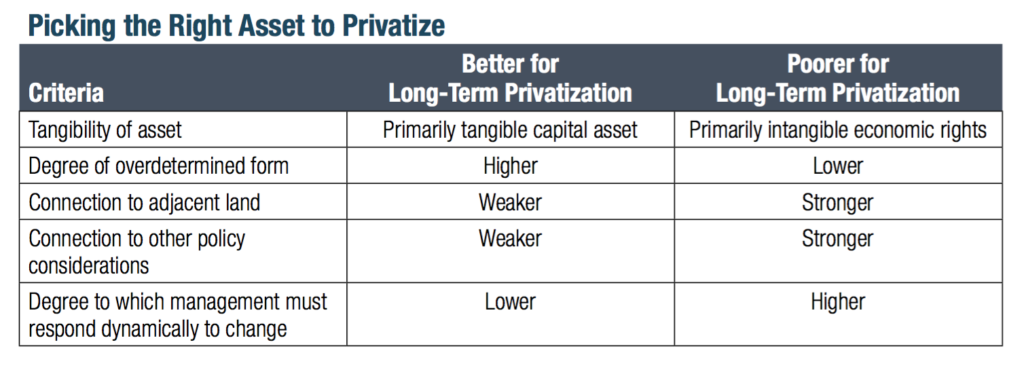
    Contrasting toll roads with parking meters, I created a matrix of characteristics to help determine whether or not an asset is a good candidate for privatization.

    privatization-asset-matrix

    Items that would appear to be better candidates for long term privatizations would be toll roads and bridges, airports, ports, and hospitals.

    Click through to read the entire report.

    Greg Hinz at Crain’s Chicago Business kindly posted some of his thoughts about the study.

    Aaron M. Renn is a senior fellow at the Manhattan Institute, a contributing editor of City Journal, and an economic development columnist for Governing magazine. He focuses on ways to help America’s cities thrive in an ever more complex, competitive, globalized, and diverse twenty-first century. During Renn’s 15-year career in management and technology consulting, he was a partner at Accenture and held several technology strategy roles and directed multimillion-dollar global technology implementations. He has contributed to The Guardian, Forbes.com, and numerous other publications. Renn holds a B.S. from Indiana University, where he coauthored an early social-networking platform in 1991.

  • Silicon Valley and the Logic of the Globalized Economy

    The technology driven global economy is brutally competitive and has put enormous stress on businesses to adapt or die.

    I lived through this at Accenture. When I started the firm was a partnership that did almost entirely consulting, mostly in an on-shore, on-site model with bespoke solutions.  By the time I left, the company had become a publicly traded corporation that pulled in huge revenues from completely new businesses like long-term outsourcing contracts, delivered contracts through blended on-shore/off-shore model that was heavily delivery center based, and tried to sell standardized solutions. The company’s name had even changed. It was a far more competitive business at the end of my tenure than it was at the beginning.

    Having lived through it, this wasn’t pleasant. It involved radical cultural change. Candidly, I don’t know anyone who came from the “before” era who really liked the “after” one, even if they thrived in both.

    With the exception of the IPO, which was arguably a partner cash out, all of these actions were more or less forced on Accenture by the global marketplace.  Had the company not made changes, it might easily have would up another has-been. I’m assuming there’s been further major change since I left, since that’s just the nature of the economy today.

    To see the ultimate logic of the global economy we need only to look at Silicon Valley. The following passages in a recent New York Times magazine piece on Netflix caught my eye:

    There is another underappreciated aspect of Netflix that Hastings views as a competitive advantage: what he calls its “high performance” culture. The company seeks out and rewards star performers while unapologetically pushing out the rest.

    One person who helped Hastings create that culture is a woman named Patty McCord. The former head of human resources at Pure Software, she was also Hastings’s neighbor in Santa Cruz. She car-pooled to work with him and socialized with his family on weekends. “I thought the idea for Netflix was kind of stupid,” she told me. But she trusted Hastings’s instincts and wanted to keep working with him. Her title was chief talent officer.

    The origins of the Netflix culture date to October 2001. The internet bubble burst the year before, and Netflix, once flush with venture capital, was running out of money. Netflix had to lay off roughly 50 employees, shrinking the staff by a third. “It was Reed’s first layoffs,” McCord says. “It was painful.”

    The remaining 100 or so employees, despite working harder than before, enjoyed their jobs more. McCord and Hastings concluded that the reason was that they had held onto the self-motivated employees who assumed responsibility naturally. Office politics virtually disappeared; nobody had the time or the patience. “There was unusual clarity,” McCord says. “It was our survival. It was either make this work or we’re dead.” McCord says Hastings told her, “This is what a great company feels like.”

    ….

    For those who fit in, Netflix was a great place to work — empowering and rational. There are no performance reviews, no limits on vacation time or maternity leave in the first year and a one-sentence expense policy: Do what is in the company’s best interest. But those who could not adapt found that their tenure at Netflix was stressful and short-lived. There was pressure on newcomers to show that they had what it took to make it at Netflix; those who didn’t were let go. “Reed would say, ‘Why are we coming up with performance plans for people who are not going to work out?’ ” McCord says. Instead, Netflix simply wrote them a check and parted ways.

    In 2004, the culture was codified enough for Netflix to put it on a sequence of slides, which it posted on its corporate website five years later. It is an extraordinary document, 124 slides in all, covering everything from its salaries (it pays employees what it believes a competitor trying to poach them would) to why it rejects “brilliant jerks” (“cost to effective teamwork is too high”). The key concept is summed up in the 23rd slide. “We’re a team, not a family,” it reads. “Netflix leaders hire, develop and cut smartly, so we have stars in every position.”

    One of my last interviews at Netflix was with Tawni Cranz, the company’s current chief talent officer, who started under Patty McCord in 2007. Five years later, McCord, her mentor, left. When I asked her why, she visibly flinched. She wouldn’t explain, but I learned later that Hastings had let her go.

    You may recall a similar take on Silicon Valley corporate culture from the Times on Amazon. Journalism, a field that has been squeezed hard by technology and economic change, seems to look very askance at the Silicon Valley model.

    What we see here is the “superstar” model, where firms are looking to hire all “A players” who are willing to be ridiculously committed to work, in a strong common culture, where there’s tremendous focus on performance – “high performance” in the case of Netflix (and Accenture – whose tag line is “High Performance. Delivered.”)

    Because Silicon Valley has largely gotten a pass from the rules and norms that apply to every other industry in America, they’ve been able to take this to the next level, so we see it in the purest form. The results in Silicon Valley speak for themselves.

    You can say that this is inhumane, but look at how many sectors in tech have become de facto winner take all. Netflix has serious competition out there, and it’s not at all clear they will be the long term winner. Their focus on being that winner is not at all misplaced according to the rules of the marketplace.

    In short, this remorseless, amoral, brutal global economy is producing a sort of superstar talent economy in the developed world, whereby if you want to succeed, you need to be not just good but the best and utterly devoted to success.

    Reality might not be quite that bleak, but this is clearly a force that’s been at work.

    Most of us have probably had some experience with this kind of increasingly competitive and demanding environment. I know I have. You have to be a lot tougher coming out of school today than when I did.

    Now consider that most of you reading me probably have an IQ of 115+.  And we are all still feeling the heat, although some of us surely thrive on it at some level.  Imagine what it’s like for people who have a below average IQ, which is by definition half the population.

    If we proceed on with the superstar economy, where enormous value can be delivered with relatively small teams of ultra top players, what does that mean for the social environment?  It’s worth pondering what the future would look like if the Netflix/Amazon models of personnel became more standard.  The nature of technology and global competition seems to be pushing things in that direction.

    Aaron M. Renn is a senior fellow at the Manhattan Institute, a contributing editor of City Journal, and an economic development columnist for Governing magazine. He focuses on ways to help America’s cities thrive in an ever more complex, competitive, globalized, and diverse twenty-first century. During Renn’s 15-year career in management and technology consulting, he was a partner at Accenture and held several technology strategy roles and directed multimillion-dollar global technology implementations. He has contributed to The Guardian, Forbes.com, and numerous other publications. Renn holds a B.S. from Indiana University, where he coauthored an early social-networking platform in 1991.

  • How Demographics Explain the World

    Demographics may not be destiny, but they do play a huge role in driving the fortunes of society and the economy. Sami Karam of Populyst joined me for a podcast on demographic trends around the world. The conversation ranged from the rise of China to the fall of Japan – and even why Occupy Wall Street failed to achieve lift-off.

    Topics include:

    • 0:00 Introduction and overview of Sami Karam’s work
    • 2:20 Why Occupy Wall Street didn’t take off
    • 3:15 Demographics on the problems of the Japanese economy
    • 3:50 What does demographics tell us about the rise of China?
    • 7:49 What is the demographic future of Africa?
    • 12:45 How will declining European and booming African population interact?
    • 17:30 An overview of the Populyst Index
    • 21:32 Is the demographic dividend a Faustian bargain?

    If the embed doesn’t display for you, click over to listen on Soundcloud.

    Subscribe to podcast via iTunes | Soundcloud.

  • Chicago’s Advantages

    When I wrote that Chicago is the duck-billed platypus of American cities, I noted that there were a lot things about Chicago that were unique – both good and bad – putting it in a class of its own and making it hard to compare Chicago with other cities.

    Today I want to put together a starter list of some of the positive distinguishing factors about Chicago. This doesn’t include things like a downtown construction boom because lots of places have one of those. If Chicago’s boom is big, well, it’s a big city. I only want to put something on the list if it is truly distinguishing, or perhaps something limited to only one or two other places.

    I’ll create a starter list. Feel free to share yours in the comments.

    • Cheap – least expensive major urban center in America. A middle management level couple can afford a very nice condo in Chicago.
    • Only globally important financial exchange in America outside NYC (the CME Group)
    • Only full slate of globally renowned cultural institutions outside NYC
    • Only large scale, transit oriented central business district outside NYC – and with a skyline to match
    • Fantastic architecture
    • Not only does Chicago have great skyline, it’s got great vistas of the skyline even from within the city (something missing in NYC inside Manhattan)
    • It’s the alley capital of America
    • Improv capital of the world, and one of only three major training locations for comedy in the US (with NYC and LA)
    • Incredible lakefront park system
    • Most car friendly urban big city in America (traffic is bad, but much of housing stock comes with a parking spot, and there are plenty of stores you can drive to – great for families)

    There are probably some things like food and music scene were you can rate Chicago as in a league above most cities, but it’s tougher to make that case since you can get great food everywhere now, etc.

    Share your thoughts in the comments because I don’t want to leave anything out.

    Aaron M. Renn is a senior fellow at the Manhattan Institute, a contributing editor of City Journal, and an economic development columnist for Governing magazine. He focuses on ways to help America’s cities thrive in an ever more complex, competitive, globalized, and diverse twenty-first century. During Renn’s 15-year career in management and technology consulting, he was a partner at Accenture and held several technology strategy roles and directed multimillion-dollar global technology implementations. He has contributed to The Guardian, Forbes.com, and numerous other publications. Renn holds a B.S. from Indiana University, where he coauthored an early social-networking platform in 1991.

    Photo by Doug Siefken