Author: Aaron M. Renn

  • Vote For Brexit Explodes the Myth of the Global City-State

    The UK has voted to leave the European Union.

    The Brexit campaign was revealing because it was based on the exact opposite of the urban triumphalist vision that so often dominates the discourse.

    Globalization doesn’t respect borders we’re told. Cities, not provinces or nation-states, are the real actors in the global economy.  Some have fantasized about the Singapore model of the city-state as ideal.  Virtually all mayors express great dissatisfaction about their national governance arrangements. Benjamin Barber even wrote that mayors should rule the world.

    The ultimate vision of this would be an independent, polyglot London, arguably the world’s most truly global city, bestriding the global economy like a colossus.

    Yet most of the London establishment – and 60% of Londoners themselves in the vote – strongly supported the Remain option. They warned of disaster for London if it lost access to the EU single market.

    This more or less demolishes the arguments for the city-state. If London, the world’s ultimate global city, can’t thrive without access to a continental scale de facto state in the EU, there’s little prospect anyone else can either.

    It’s telling that so many city leaders hate their state or national governments, but love supra-national governments like the EU.  The shows that their real desire isn’t to go it alone in the marketplace, but to create replacement governance structures that are more amenable to their way of thinking, that constitutionally enshrine their preferences, and are insulated from democratic accountability.

    What’s more, if London suffers because it loses access to the single market, it shows that borders to matter to globalization, and that states and quasi-states like the EU very much can exert control on global flows. They are not simply helpless in the face of the global marketplace.

    Of course when I say these arguments are destroyed, I only mean that the people advancing them don’t really believe them themselves. We will find out in a real life test to what extent those ideas are actually valid. Will London’s unparalleled global orientation, talent concentrations, unique and specialized functions enable it to thrive outside the EU? Or will it take a permanent hit? (This assumes, of course, that Brexit actually does happen).

    If London does actually continue thriving in the long term, then that would actually back up the city-state idea to some extent, as London will have gone from being part of a gigantic state to a much smaller one. That might suggest that a further devolution to a greater London city-state might be viable after all, if highly unlikely.

    But if London can’t recover from the inevitable turbulence around Brexit, this would show that not only do cities need to be part of states, they need to be part of very large and powerful ones.

    If you think about it, history suggests that is the case to some extent. London is London because it was the capital of the British Empire. Dittos for Paris and Moscow, both imperial capitals. New York isn’t New York just because of its own characteristics – though those do play a role – but because it is the most important city in the world’s most important country. Shanghai and Beijing are coming on strong because they are in China.

    In any event, the city-state theory is going to get something of a trial run, if an imperfect one. Ironically, that real life trial will come over the objections of the city itself, and much of the urbanist class who otherwise preach urban independence.

    Aaron M. Renn is a senior fellow at the Manhattan Institute, a contributing editor of City Journal, and an economic development columnist for Governing magazine. He focuses on ways to help America’s cities thrive in an ever more complex, competitive, globalized, and diverse twenty-first century. During Renn’s 15-year career in management and technology consulting, he was a partner at Accenture and held several technology strategy roles and directed multimillion-dollar global technology implementations. He has contributed to The Guardian, Forbes.com, and numerous other publications. Renn holds a B.S. from Indiana University, where he coauthored an early social-networking platform in 1991.

    Image via Shutterstock

  • What Happens When There’s Nobody Left to Move to the City?

    Following up on the Pew study that found many states will face declining work age populations in the future, I want to highlight a recent Atlantic article called “The Graying of Rural America.” It’s a profile of the small Oregon town of Fossil, which is slowly dying as the young people leave and a rump population of older people – median age 56 – begin to pass on.

    Like the Pew study, this one has implications that weren’t fully traced out.

    There’s a lot of urban triumphalism these days, as cities crow about Millennials wanting to live downtown and such.

    But the dirty little secret is that a lot of these places have been growing their youth populations by hoovering up the children of their hinterlands. To the extent that urban population growth is dependent on intrastate migration in these states with declining working age populations, at some point there are just plain going to be a lot fewer youngster to move to the big city. That will start to crimp urban population dynamics.

    Indianapolis is a poster-child for this.  About 95% of the metro area’s net migration has come from elsewhere in the state of Indiana since 2000, according to IRS tax return data.

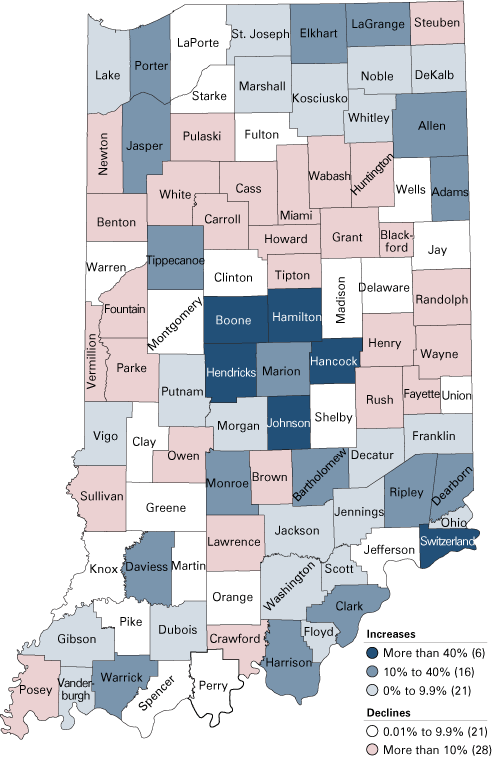
    Looking at the future, about half of the states counties (49 out of 92) are projected to actually lose population by 2050. Here’s the map from the Indiana Business Research Center.


    Projected population change in Indiana counties, 2010-2050. Source: Indiana Business Research Center

    The entire state is only projected to add 100,000 15-44 year olds by 2050. Even if 100% of them, or even more than 100% of them, are in Indianapolis, this still implies a fairly modest growth rate.

    Given the projected demographics of its migration shed, we should expect Indianapolis to start seeing a falloff in migration. In fact, we are already seeing it. Indy was previously the Midwest champ in net domestic in-migration, but recent Census Bureau estimates show a fall-off.

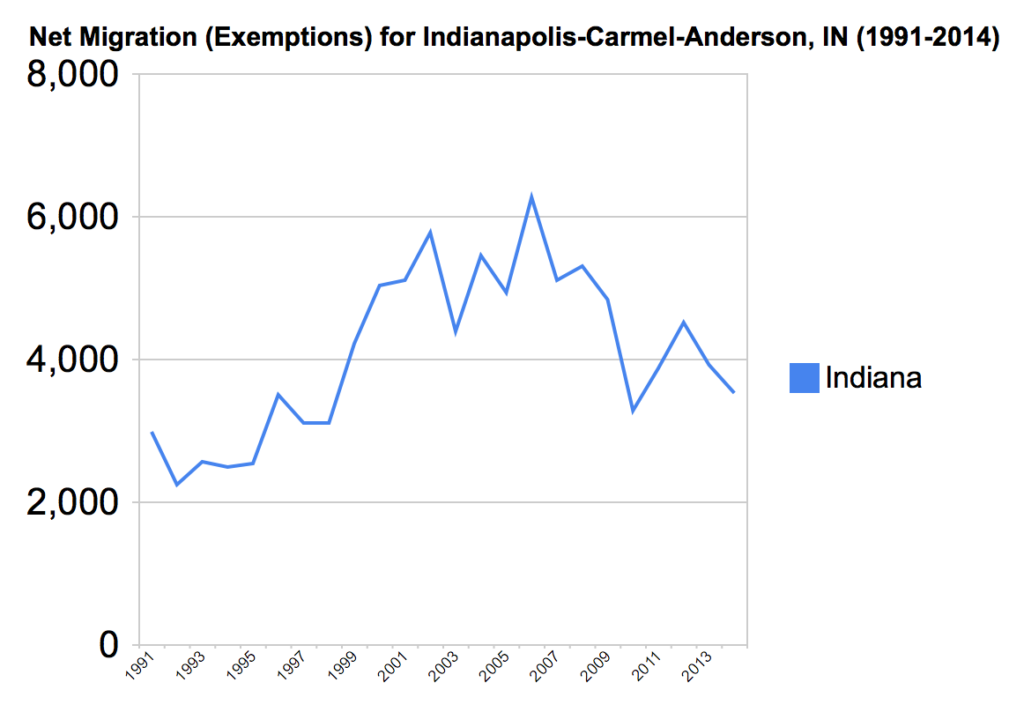
    Here’s what the IRS migration data says about net migration into Indy metro from the rest of the state.

    Net migration into metro Indianapolis from the rest of the state, 1991-2014. Source: Aaron Renn analysis of IRS county to county migration data

    There was a spike up starting around 1997, the dawn of the dotcom era. This more or less corresponded with the rise of the city talk. (Richard Florida’s Rise of the Creative Class came out in 2002).

    During the 2000s, Indianapolis was the Midwest growth champ, and killed it on net domestic migration. This graph helps explain why.

    But starting around 2010, inbound migration from the rest of the state has fallen off. I don’t want to claim this is entirely demographic related. Migration declined nationally during the Great Recession. And there were some methodology tweaks in this data during that time. But we can see already in the numbers what happens to metro growth if migration from the rest of the state slows down.

    At some point, the decline of rural and small manufacturing counties is going to have to show up in the migration numbers to cities like Indy. Other cities that draw primarily from a national base – like Nashville or Dallas – will be less affected.

    But cities that are dependent on a regional migration shed need to start doing the math on how the decline of their hinterlands will affect them.

    The collapse of rural and small manufacturing economies may have been good for cities in the short term, but those cities might discover down the road that they ended up eating their seed corn.

    Aaron M. Renn is a senior fellow at the Manhattan Institute, a contributing editor of City Journal, and an economic development columnist for Governing magazine. He focuses on ways to help America’s cities thrive in an ever more complex, competitive, globalized, and diverse twenty-first century. During Renn’s 15-year career in management and technology consulting, he was a partner at Accenture and held several technology strategy roles and directed multimillion-dollar global technology implementations. He has contributed to The Guardian, Forbes.com, and numerous other publications. Renn holds a B.S. from Indiana University, where he coauthored an early social-networking platform in 1991.

  • The End of Job Growth

    Pew Charitable Trusts recently posted an analysis of population projections that show several states with stagnant to declining workforces.

    This means that for nearly 20 states, it’s basically impossible to add jobs in the future. How can you add more jobs with fewer workers?

    That doesn’t mean there won’t be cyclical ups or downs or that some slack in the system might be taken up with some growth, but overall, stagnation to decline in jobs is going to follow.

    Pew’s article mentions states fighting to retain a high skill labor force, but this doesn’t seem very likely. Most of these places are in the north and northeast and have been stagnant for a long time.

    What’s going to change the migration of population to the South and West? While change is always possible, it’s not obvious what might cause it.

    Cities and states need to think hard about what this means for them. It seems to me is that one effect will be to fuel intrastate divergence, as success pools into islands in an era of overall shrinkage. You can argue we’re already seeing this.

    For most localities who aren’t among the favored winners, the reality is that they need to do what I advocated for Buffalo, and find a new psychology of civic improvement that isn’t rooted in growth – in population, jobs, or building stock. (I should add, Buffalo is in a far better position than most and could enjoy a relatively bright future – but it probably won’t be a big growth story)

    This won’t be easy.

    One of the great assumptions of the American worldview is the equating growth with success in our communities. Communities that are adding people, adding jobs, building new things, etc. are seen to be succeeding, whereas shrinking or stagnant ones must be failing.

    Everybody believes this. Even those who talk about “growth without growth” or tout increasing per capita income as the real measure of economic development invariably tout growth if there’s a figure that shows it.

    Lots of urbanists like to pooh-pooh Texas growth, but when 60,000 people move into downtown Chicago, or transit ridership soars in New York, or tech jobs explode in the Bay Area, they immediately tout and trumpet those figures as signs of success.

    And good for them. The point is that we all view growth as the measure of success.

    What would a new psychology look like?

    One example would be the boutique model. Rather than trying to be bigger, you become more exclusive. This isn’t a model that’s applicable to these stagnant places however.

    More realistically, these places need to focus on healing from or managing their problems (including managing decline in some places like rural communities).  Some areas of focus:

    • Pension and debt issues
    • Environmental remediation
    • Segregation
    • Raising educational attainment (to high school at least), even if that means the people subsequently leave
    • Infrastructure
    • Restructuring core services to be sustainable

    Not easy, and realistically requiring outside financial and technical assistance.

    What’s more, this is a to do list, not a psychology of success. How can one begin to articulate a positive, affirmational view of a place’s future that captures some program like this?

    Perhaps there are other ways to think about this too. Please share thoughts in the comments if you have them.

    The key is that with a shrinking working age population, there’s little prospect of job growth. So any governor in one of these places who has that as a long term economic objective is bound to be frustrated. This is a reality that will have to be faced.

    Aaron M. Renn is a senior fellow at the Manhattan Institute, a contributing editor of City Journal, and an economic development columnist for Governing magazine. He focuses on ways to help America’s cities thrive in an ever more complex, competitive, globalized, and diverse twenty-first century. During Renn’s 15-year career in management and technology consulting, he was a partner at Accenture and held several technology strategy roles and directed multimillion-dollar global technology implementations. He has contributed to The Guardian, Forbes.com, and numerous other publications. Renn holds a B.S. from Indiana University, where he coauthored an early social-networking platform in 1991.

    Top map image via Pew Stateline

  • Chicago Is the Duck-Billed Platypus of American Cities

    Census results last week show Chicago as the only one of the twenty largest cities in America to lose population. The freaking out over a tiny loss isn’t really warranted. The comparison to Houston is bogus. Etc, etc. Yet Chicago’s leaders have refused to grapple with the real and severe structural and cultural challenges that face the city. That’s something they need to do if they want it to succeed over the longer term.

    I wrote about this in my latest City Journal web piece, “The Duck-Billed Platypus of Cities“:

    When it comes to population estimates, municipal-level data is largely irrelevant, especially when comparing cities with one another. That Houston may soon outpace Chicago in municipal population doesn’t mean that much—the city of Houston includes vast tracts of suburbia, making for an apples-to-oranges comparison. Chicago’s metro area is much larger than Houston’s and will remain the third-largest in the country for years to come. Similarly, while Chicago has the most murders in America, its murder rate is lower than other major cities like St. Louis, Baltimore, and Detroit. Comparisons with Detroit, with its hollowed-out economy, particularly infuriate Chicagoans, who reside in what remains a major economic center. And Detroit’s population loss far exceeds Chicago’s.

    But just because Chicago shouldn’t be compared to Detroit doesn’t mean that it should be compared with San Francisco.

    Click through to read the whole thing.

    Aaron M. Renn is a senior fellow at the Manhattan Institute, a contributing editor of City Journal, and an economic development columnist for Governing magazine. He focuses on ways to help America’s cities thrive in an ever more complex, competitive, globalized, and diverse twenty-first century. During Renn’s 15-year career in management and technology consulting, he was a partner at Accenture and held several technology strategy roles and directed multimillion-dollar global technology implementations. He has contributed to The Guardian, Forbes.com, and numerous other publications. Renn holds a B.S. from Indiana University, where he coauthored an early social-networking platform in 1991.

    Chicago photo by Bigstock.

  • De-Industrialization and the Displaced Worker

    Much has been made of working class pain in this election, but the problems go well beyond that.  I don’t like the 1% vs. 99% frame, but it captures something important about our society, namely a sort of bifurcation that has occurred between top and bottom. Roughly the top 20% are doing quite well, and increasingly live in communities surrounded by others like themselves. The bottom 80% does not seem to be faring so well on a variety of social and economic statistics.

    The policies offered by the mainstream of both parties has more or less boiled down to “more of the same stuff we’ve always pitched.” Clearly, the public is looking for something different.

    That’s the subject of my column now out in the May issue of Governing magazine called “De-Industrialization and the Displaced Worker.”  Here’s an excerpt:

    In George O. Smith’s science fiction short story “Pandora’s Millions,” society collapses when the invention of a “matter replicator,” like the ones from Star Trek, instantly renders most of the economy, and money itself, obsolete. Being a short story, this is resolved quickly with the invention of a substance that can’t be duplicated, followed by rebuilding the economy and society around services. Real life doesn’t always recover so quickly from disruptions, as we are finding out.

    Unsurprisingly, this has generated discontent. Back through to the 1980s and ’90s, this was mostly limited to displaced industrial workers. Today that has grown to a much broader spectrum, from young master’s degree holders with piles of student loan debt who are stuck working at Starbucks to corporate middle managers losing their jobs to outsourcing or foreigners working here under H1-B visas.

    This has percolated through to the political system, with the rise of Donald Trump and Bernie Sanders, both questioning many of the premises of the current economic system. America is more receptive to these arguments than many ever would have believed possible. That’s because the current system has lost legitimacy in the minds of many. Not only did it fail to deliver the promised benefits to them, but then government turned around and bailed out the big banks in the financial crash.

    Click through to read the whole thing.

    Aaron M. Renn is a senior fellow at the Manhattan Institute, a contributing editor of City Journal, and an economic development columnist for Governing magazine. He focuses on ways to help America’s cities thrive in an ever more complex, competitive, globalized, and diverse twenty-first century. During Renn’s 15-year career in management and technology consulting, he was a partner at Accenture and held several technology strategy roles and directed multimillion-dollar global technology implementations. He has contributed to The Guardian, Forbes.com, and numerous other publications. Renn holds a B.S. from Indiana University, where he coauthored an early social-networking platform in 1991.

    Image by Flickr/Mirko Tobias Schäfer – CC BY 2.0

  • Black Residents Matter

    Black lives matter, we’re told—but in many American cities, black residents are either scarce or dwindling in number, chased away by misguided progressive policies that hinder working- and middle-class people. Such policies more severely affect blacks than whites because blacks start from further behind economically. Black median household income is only $35,481 per year, compared with $57,355 for whites. The wealth gap is even wider, with median black household wealth at only $7,133, compared with $111,146 for whites, according to a study by Demos and the Institute on Assets and Social Policy.

    How, then, are cities faring in meeting the aspirations of their black residents, judged especially by the ultimate barometer: whether blacks choose to move to these cities, or stay in them? Among major American cities, three main typologies emerge: the high-flying progressive enclaves of the West, the historically large cities of the Northeast and the Midwest, and the fast-growing boomtowns of the South. Though results vary to some extent, the broad trend is clear: the most progressive-minded cities are either seeing a significant exodus of blacks or, never having had substantial black populations, are failing to attract them. These same cities, home to some of the loudest voices alleging conservative insensitivity to blacks, are failing to provide economic environments where blacks can prosper.

    In theory, prosperous, growing western cities—the San Francisco Bay Area, Portland, Seattle, and Denver—should find it easier to provide upward mobility, as they have fewer disadvantaged people. Far from the South and not part of the Rust Belt industrial complex, they attracted far fewer blacks during the twentieth century’s Great Migration, when millions of blacks moved north. As a result, their black populations are small, compared with those of eastern cities—just 5.6 percent in the city of Portland, for example, compared with 53.4 percent in Cleveland and 46.9 percent in St. Louis. And many western cities are driving their small number of black residents out.

    Portland is part of the fifth-whitest major metropolitan area in America. Almost 75 percent of the region is white, and it has the third-lowest percentage of blacks, at only 3.1 percent. (America as a whole is 13.2 percent black.) Portland proper is often portrayed as a boomtown, but the city’s tiny (and shrinking) black population doesn’t seem to think so. The city has lost more than 11.5 percent of its black residents in just four years. Metro Portland’s black population share grew by 0.3 percentage points from 2000, but that trailed the nation’s 0.5 percentage-point growth. This implies that some of Portland’s blacks are being displaced from the transit- and amenity-rich city to the suburbs that progressives themselves insist are inferior.

    The San Francisco Bay metro area has lost black residents since 2000, though recent estimates suggest that it may have halted the exodus since 2010. The Los Angeles metro area, too, has fewer black residents today than in 2000. The performance in the central cities is even worse. America’s most liberal city, San Francisco, is only 5.4 percent black, and the rate is falling. It’s a similar tale in Seattle—“one of the most progressive cities in the United States,” as a Black Lives Matter protester noted. One city bucking the western trend is Denver. Though the Rocky Mountain city has a small black population—6.1 percent in the region and 9.5 percent in the city proper—that population is growing in both areas, if slowly.

    These figures might not be important if they merely reflected a choice by blacks to move to more auspicious locations, but the evidence suggests that specific public policies in these cities have effectively excluded and even driven out blacks. Primary among them are restrictive planning regulations that make it hard to expand the supply of housing. In a market with rising demand and static supply, prices go up. As a rule, a household should spend no more than three times its annual income on a home. But in West Coast markets, housing-price levels far exceed that benchmark. According to the Demographia International Housing Affordability Survey, the “median multiple”—the median home price divided by the median household income—should average about 3.0. But the median multiple is 5.1 in Portland, 5.1 in Denver, 5.2 in Seattle, 8.1 in Los Angeles and San Diego, 9.4 in San Francisco, and 9.7 in San Jose. As the Demos/IASP report found, differences in homeownership rates between whites and blacks account for a large share of the racial wealth gap. Policies that put the price of homeownership out of reach for black families exacerbate the problem.

    Even some on the left recognize how development restrictions hurt lower- and middle-income people. Liberal commentator Matt Yglesias has called housing affordability “Blue America’s greatest failing.” Yglesias and others criticize zoning policies that mandate single-family homes, or approval processes, like that in San Francisco, that prohibit as-of-right development and allow NIMBYism to keep out unwanted construction—and, by implication, unwanted people. They don’t mention the role of environmental policy in creating these high housing prices. Portland, for example, has drawn a so-called urban-growth boundary that severely restricts land development and drives up prices inside the approved perimeter. The development-stifling effects of the California Environmental Quality Act (CEQA) are notorious. California also imposes some of the nation’s toughest energy regulations, putting a huge financial burden on lower-income (and disproportionately black) households. Nearly 1 million households in the Golden State spend 10 percent or more of their income on energy bills, according to a Manhattan Institute report by Jonathan Lesser. While liberals are quick to point out that in suburban communities, land-use restrictions that appear race-neutral can be functionally discriminatory, they don’t acknowledge that their own environmental-based restrictions on housing and energy are similarly exclusionary.

    The Windy City’s black population loss accounted for the lion’s share of the city’s total shrinkage during the 2000s.

    In some cases, western cities’ support for gentrification has come at the expense of long-standing black communities. In Portland, residents of the historically black Albina neighborhood complained about bike lanes—a progressive fetish—being built in their neighborhood. In Oakland, recent upscale arrivals got the government to cite Pleasant Grove Baptist Church, a fixture in the city for 65 years, for creating a public nuisance—because its gospel-choir practice was disturbing the newcomers.

    During the Great Migration, cities of the Midwest and the Northeast were industrial magnets, sucking in vast quantities of labor not just from the American South but also from Europe. As northern industry declined during the Rust Belt era, the great northern cities fell on trying times, and black residents, who had struggled to gain equal opportunity in factory jobs and in housing, were hit hard. Racial turbulence, often including riots, intensified, and helped drive a white exodus. Suburb-bound whites left behind an often-impoverished black underclass in segregated neighborhoods that, in many cases, remain so today.

    The most distressed cities in this region are the usual suspects: Detroit, Cleveland, Flint, and Youngstown. All have declining black populations, both in their urban cores and region-wide. Others, like St. Louis, have maintained their black populations only through natural increase (births outnumbering deaths). They are losing black residents to migration.

    The greatest demographic transition is taking place in Chicago. The Windy City’s black population loss of 177,000 accounted for the lion’s share of the city’s total shrinkage during the 2000s. Another 53,000 blacks have fled the city since 2010. In fact, the entire metro Chicago area lost nearly 23,000 blacks in aggregate, the biggest decline in the United States.

    By contrast, in northern cities with more robust middle-class economies—even if job growth doesn’t match Sunbelt levels—black populations are expanding. Since 2010, for example, metro Indianapolis added more than 19,000 blacks (6.9 percent growth), Columbus more than 25,000 (9 percent), and Boston nearly 40,000 (10.2 percent). New York’s and Philadelphia’s black population growth rates are low but positive, in line with slow overall regional growth. Washington, D.C., a traditional hub of black American life, is seeing declining black population share in the district itself, but the overall D.C. region continues to show solid black population growth.

    The somewhat unlikely champion for northern black population growth is Minneapolis–St. Paul. Though its black population makes up a much smaller proportion than many of its midwestern peers—at only 8 percent in the region and 19.5 percent in the city—Minneapolis’s black population has grown at a strong rate. Since 2010, the black population in the city has grown by 15,000 people, or 23 percent. The region added 30,400 black residents, growing by 12.1 percent. Part of the Minneapolis story (and that of Columbus as well) involves an influx of Somali immigrants—the metropolitan area has more Somalis than anywhere else in the United States. But immigration doesn’t explain everything. Minneapolis is also the third-leading destination for blacks leaving Chicago (behind Atlanta and Davenport, Iowa). About 1,000 black Chicagoans make the move north every year.

    Obviously, many blacks like what they see in places like Minneapolis, Indianapolis, and Columbus. One key is a development environment that keeps housing affordable. This is dramatically clear in Minneapolis, a liberal, historically white city often likened to western cities like Seattle and Denver. But being more housing-development-friendly, and also perhaps in part because of its famously brutal winters, Minneapolis is much more affordable than those cities, with a home-price median multiple of only 3.2. Similarly, in Columbus (with a median multiple of 2.9) and Indianapolis (also 2.9), black families can afford the American dream. When cities get the basics (planning policy, job growth, and reasonable taxation levels) right, even tough winters are no obstacle to a growing population—of whites and blacks.

    Where else do blacks go when they leave declining Rust Belt cities? Some seek opportunity in better-off regional cities, but others head to smaller regional communities that, if anything, are even worse off. Census Bureau data suggest that a significant number of blacks leaving Chicago are ending up in struggling downstate Illinois communities like Danville or Carbondale, where they’re unlikely to find economic opportunity. Why move to these places? One answer: they’re dirt cheap. But there’s a particular reason for that—demand has collapsed along with local economies. This creates a false allure. Harvard economist Edward Glaeser noted that some failing cities become so cheap that they turn into “magnets for poor people.” This left-behind population of blacks in places with low opportunity will prove challenging for these regions. The North also remains racially stratified. Milwaukee, New York, and Chicago are the three most segregated regions in the country. The maps of where black and white residents live in cities like Detroit shock the conscience. Urban school districts tasked with educating predominantly black students are failing miserably. Powerful public-employee unions make reform a difficult prospect.

    But for those blacks leaving the West, Midwest, and Northeast, one destination dominates: the South. A century ago, in search of economic and social opportunity, blacks were leaving the South to go north and west; today, they are reversing that journey, in what the Manhattan Institute’s Daniel DiSalvo dubbed “The Great Remigration” (Autumn 2012). DiSalvo found that blacks now choose the South in pursuit of jobs, lower costs and taxes, better public services (notably, schools), and sunny weather for retirement. The new arrivals aren’t solely working-class, either. Even better-off blacks, with household incomes over $100,000, are heading south from cities like Chicago.

    Historically, Southern blacks lived in rural areas. A large rural black population remains in the South today, often living in the same types of conditions as rural whites, which is to say, under significant economic strain. But the new black migrants to the South are increasingly flocking to the same metro areas that white people are—especially Atlanta, the new cultural and economic capital of black America, with a black population of nearly 2 million. The Atlanta metro area, one-third black, continues to add more black residents (150,000 since 2010 alone) than any other region.

    In Texas, Dallas has drawn 110,000 black residents (11.3 percent growth) and Houston just under 100,000 (9.2 percent) since 2010. Austin, a rare liberal city in the South, remains, at 53.4 percent, the whitest major Texas metro—Dallas and Houston double its black population share—but it, too, has seen strong black population growth. Miami, with its powerful Latino presence that includes both historically American as well as Afro-Latinos, also added about 100,000 blacks (8.3 percent). Today, Dallas, Houston, and Miami are all home to more than 1 million black residents.

    Many smaller southern cities—including Charlotte, Orlando, Tampa, and Nashville—are also seeing robust black population growth. Even New Orleans has seen a rebound in its black population since 2010. Not surprisingly, these southern cities are extremely affordable. A combination of pro-business policies combined with a development regime that permits housing supply to expand as needed has proved a winner. Among these southern cities, only Miami, with its massive influx of Latin American wealth, is rated as unaffordable, with a median multiple of 5.6. In addition to their sensible policies, many of these southern cities have also viewed their black communities not as a problem to be solved but as a potential civic asset and engine of growth. Atlanta embraced its emerging status as the capital of black America. Houston famously opened its doors and offered temporary shelter to thousands of poor black residents of New Orleans displaced by Hurricane Katrina. Many of those refugees stayed in Houston, attracted by its job opportunities and quality of life.

    Blacks are returning to southern cities, like Atlanta, drawn by economic opportunity and lower costs, especially compared with progressive cities like San Francisco, where restrictive housing policies have made living unaffordable for many. JIM WILSON/THE NEW YORK TIMES/REDUXBlacks are returning to southern cities, like Atlanta, drawn by economic opportunity and lower costs, especially compared with progressive cities like San Francisco, where restrictive housing policies have made living unaffordable for many. JIM WILSON/THE NEW YORK TIMES/REDUX

    These regional trends reveal two basic patterns. First, like whites, blacks are attracted by strong, broad-based economies. Pro-growth polices that allow workaday, not just elite, businesses to flourish are foundational to inclusive success. Second, with lower household incomes, black families are vulnerable to high housing costs. A few high-cost cities attract black residents; but for the most part, blacks are flocking to cities that are not only economically vibrant but generally affordable. Even strong urban economies can’t keep blacks from being displaced from cities, such as many on the West Coast, where housing costs remain stratospheric.

    Another conclusion revealed by the data: when it comes to how state and local policies affect black residents, the track record of the most liberal cities in the United States is truly dismal. These results should be troubling to progressives touting blue-state planning, economic, and energy policies as models for the nation. After all, if wealthy cities like San Francisco, Portland, and Seattle—where progressives have near-total political control—can’t produce positive outcomes for working-class and middle-class blacks, why should we expect their urban approach to succeed anywhere else?

    This piece first appeared at The City Journal.

    Aaron M. Renn is a senior fellow at the Manhattan Institute, a contributing editor of City Journal, and an economic development columnist for Governing magazine. He focuses on ways to help America’s cities thrive in an ever more complex, competitive, globalized, and diverse twenty-first century. During Renn’s 15-year career in management and technology consulting, he was a partner at Accenture and held several technology strategy roles and directed multimillion-dollar global technology implementations. He has contributed to The Guardian, Forbes.com, and numerous other publications. Renn holds a B.S. from Indiana University, where he coauthored an early social-networking platform in 1991.

  • There Are No Writers Here

    I’ve long noted that the civic identity or culture of many places seems to be a cipher. What is our identity as a city? is a question frequently asked. And one that needs to be. Cities will succeed best when they undertake policies that are true to the place. To most successfully build or rebuild a place, it’s important to articulate that civic identity and work with it, not against it.

    Of course some of that happens by the very fact that the people who live in a place are steeped in its culture. But a lack of self-awareness can be a big liability. As the Greek oracle noted, the first call is to “Know Thyself.”

    But this is hard to do, both for people and places. It’s hard to give a succinct description of the culture of say Cleveland, Columbus, or Cincinnati, but visitors to those cities will be instantly struck by how starkly different they are.

    To unearth and understand the culture and identity of a place requires going on an anthropological or archeological mission deep into the soil of a city, with a proper balance of affection and detachment.  This takes time to do, and a lot of my own writing on various places would certainly be much better if I had time to embed in them and understand them more deeply.

    One big advantage larger cities have is that they have a much larger supply of journalists and writers than smaller ones, and these are the very people who are most likely to investigate, unearth, and articulate that culture.

    New York in an embarrassment of riches in this regard. Practically every day someone is writing something interesting about the city. Just today, for example, City Journal published a piece about the layers of New York history represented in Straus Park. And Urban Omnibus had one about finding New York in West Side Story.

    Back when the mega-bookstore chains were still going strong, I always liked to visit one when I came to a city, and go to the “local interest” section. In too many places, the titles on offer were pathetic. A number of large cities don’t even seem to have one high quality history on offer.

    The biggest cities, by contrast, had sections that were disproportionately large even relative to their larger population. There have been a massive number of great books written about Chicago, for example, and the Chicago section in the old downtown Borders was correspondingly huge.

    You can learn a lot about a city just by taking a look at the local interest section in a bookstore.

    Unfortunately, just when this kind of writing is greatly needed, the number of people who might be writing it have been shrinking.  Nieman Lab just published an article talking about the increasing concentration of media in New York, DC, and Los Angeles, noting, “[T]he increase in concentration is unmistakable. Journalism jobs are leaving the middle of the country and heading for the coasts.”

    What reporting remains is often done by inexperienced reporters with little tie to a community. Chains like Gannett seem to deliberately practice rotating reporters and even columnists from city to city, preventing them from really getting a place. Few of them have any real knowledge of even fairly recent history.

    Perhaps unsurprisingly, when you do go looking for books about smaller (but often still sizable) places, you can sometimes find books that are collections of pieces from long gone columnists.

    There has been a ton of money and effort poured in supporting artists and other “creative class” type endeavors in cities, but remarkably little financing of high quality writing about cities, their past, and their culture.

    By its very nature this work is often very time consuming and with limited, highly localized market appeal. It can require a ton of research. Unsurprisingly, a lot of the best of it is produced by writers who take it on as a side project while doing their “day job.”  Writers are often almost compelled to write, after all. For example, my colleague Stephen Eide typically writes studies about municipal finance, but also wrote an essay about the Lorelei fountain commemorating Heinrich Heine in the Bronx.

    Cities without a large resident base of writers are at a disdvantage here. And it appears to be growing by the day, yet another example of the bifurcation of society.

    This particularly local concern that is highly unlikely to be produced by the market is one local philanthropists will need to take on if they wish to fill this gap.  It is perhaps hyperbole so that that there are no more writers in these cities, but there certainly aren’t enough of them.

    This piece first appeared at Urbanophile.com.

    Aaron M. Renn is a senior fellow at the Manhattan Institute, a contributing editor of City Journal, and an economic development columnist for Governing magazine. He focuses on ways to help America’s cities thrive in an ever more complex, competitive, globalized, and diverse twenty-first century. During Renn’s 15-year career in management and technology consulting, he was a partner at Accenture and held several technology strategy roles and directed multimillion-dollar global technology implementations. He has contributed to The Guardian, Forbes.com, and numerous other publications. Renn holds a B.S. from Indiana University, where he coauthored an early social-networking platform in 1991.

  • In Praise of Plain Old Bus Service

    My recent post on counting the long term costs of building rail transit got a lot of hits – and as expected a lot of pushback.

    There are a lot of people out there that are simply committed to the idea of rail transit, no matter how unwarranted a particular line or system might be.

    I find it interesting that the place with the most people applying serious skepticism to transit projects seems to be New York – the place with the biggest slam dunk of a case for it of any city.

    Lots of people, for example, have critiqued the proposed Brooklyn-Queens light rail line. In a city where there’s a desperate need for more transit, advocates are very focused on making sure the limited capital we have gets spent on useful projects. Not everyone agrees with each other, but there’s a robust debate, focused on the actual merits.

    In cities without much experience of transit, there appears to be a huge bias in favor of very expensive rail projects regardless of their merits.

    Some have asked me whether I support Bus Rapid Transit. I can, in some circumstances. Though Alon Levy has convinced me that the economics of South American style BRT don’t necessarily transfer to high income countries.

    What I do very much support is significantly improved Plain Old Bus Service (POBS).

    Most cities in America have pretty awful bus service, with meandering, radial routes that run infrequently and are basically deployed as a social service.

    Contrast that with Chicago or LA (or even New York, despite its subway dominance), where we see bus grid networks that run with reasonable frequency.

    I define “reasonable frequency” as meaning I can show up at the stop without consulting a schedule or tracker app, confident that my max burn on wait time is at least semi-humane. Ten minute or less headways would be best, but I can live with 15.

    Jarrett Walker has highlighted the role of Portland’s high frequency bus grid, launched in 1982, as changing the game there and making the city’s subsequent light rail system actually functional.

    Thirty years ago next week, on Labor Day Weekend 1982, the role of public transit in Portland was utterly transformed in ways that everyone today takes for granted.  It was an epic struggle, one worth remembering and honoring.

    I’m not talking about the MAX light rail (LRT) system, whose first line opened in 1986. I’m talking about the grid of frequent bus lines, without which MAX would have been inaccessible, and without which you would still be going into downtown Portland to travel between two points on the eastside.

    Pretty much any city could benefit from a better POBS network and higher frequencies.  This is where there is vast opportunity to invest in American transit without breaking the bank.

    Yes, buses cost money. I’m not saying its free. This is where I say we should spend more. A solid POBS system is just the basics to be in the game for any city looking to retrofit transit culture.

    Even Portland, the city held up as the exemplar for light rail investment, started by getting its bus system right.

    Aaron M. Renn is a senior fellow at the Manhattan Institute, a contributing editor of City Journal, and an economic development columnist for Governing magazine. He focuses on ways to help America’s cities thrive in an ever more complex, competitive, globalized, and diverse twenty-first century. During Renn’s 15-year career in management and technology consulting, he was a partner at Accenture and held several technology strategy roles and directed multimillion-dollar global technology implementations. He has contributed to The Guardian, Forbes.com, and numerous other publications. Renn holds a B.S. from Indiana University, where he coauthored an early social-networking platform in 1991.

    Portland Bus Grid. Image via Human Transit

  • Why You Should Think Twice Before Building a Rail Transit System

    The Washington Metro system was shut down completely for a day recently to allow crews to inspect all of the power cables in the system. They found 26 cables and connectors in need of immediate repair.

    This is just the latest in a series of safety problems and breakdowns that have plagued the system.

    Metro has a large unfunded maintenance liability. This doesn’t surprise us because we expect American transit systems to have a backlog.

    The difference is that unlike NYC, Chicago, Boston, etc., which have systems a century old, the Washington Metro system is actually new.

    The oldest part of the Metro opened in 1976. That means Metro is 40 years old – max. Much of it is actually newer than that.

    Forty years after opening, Metro already faces a maintenance crisis.

    This should give other regions pause when it comes to building a rail transit system. My colleague Alex Armlovich points out that NYC has more or less been on a 40 year refresh cycle, with two rounds of major system investment since the subways opened. This doesn’t seem out of line as a capital life heuristic to me.

    So cities need to keep in mind that if they build a rail system, they not only have to pay to build it, they pretty much have to pay to rebuild it every 40 years. This is a challenge because as we see it’s easier to muster the will to build something new than to maintain something you already have.

    Given the huge permanent capital outlays implied by rail transit, you only want to build it where there’s sufficient value to justify it. Washington unquestionably achieves this. It simply hasn’t been able to capture the value into a maintenance revenue stream, plus Metro (like many systems) has been badly mismanaged.

    The problem comes in for cities that aren’t NYC, Chicago, Boston, Philly, DC, and San Francisco. Once you get below that group, the value starts becoming more debatable.

    Exhibit A is Los Angeles, which has spent untold billions on a huge rail system as ridership actually declined.  LA is continuing to build more and more rail.

    But what happens when this system is old?

    LA’s Red Line opened in 1993, so is 23 years old.  By the time LA finishes its current rail build out, it’s likely that the original parts of the system will be coming into the zone for a major capital refresh.

    Thus shortly LA will find itself in a perpetual capital catchup cycle starting in only a couple decades. This possibly may not happen, but it has happened everywhere else, so why should LA be different?

    Given the ridership levels we’ve seen so far, will the value added from rail vs. the old bus approach be there? It’s not looking good. And if the case in LA is looking weak, certainly smaller and less dense places are even more speculative.

    All these smaller cities investing billions into rail had better hope their projections of massive benefits come true, because all too soon the rebuild bill will start coming due.

    If you don’t believe me, just ask Washington.

    Aaron M. Renn is a senior fellow at the Manhattan Institute, a contributing editor of City Journal, and an economic development columnist for Governing magazine. He focuses on ways to help America’s cities thrive in an ever more complex, competitive, globalized, and diverse twenty-first century. During Renn’s 15-year career in management and technology consulting, he was a partner at Accenture and held several technology strategy roles and directed multimillion-dollar global technology implementations. He has contributed to The Guardian, Forbes.com, and numerous other publications. Renn holds a B.S. from Indiana University, where he coauthored an early social-networking platform in 1991.

    Photo Credit: Ben Schumin – CC BY-SA 3.0

  • Rethinking America’s Cities’ Success Strategy

    This piece is reprinted from a Kauffman Foundation series focusing on the role of cities in a new entrepreneurial growth agenda. Read the entire cities series here.

    Most cities are economically weak actors with limited ability to affect the critical forces driving their economies. Furthermore, changes in the structure of the economy often have changed the composition of urban leadership in ways that break the link between personal and community success and create an additional bias in favor of subsidized real estate development as a civic strategy. Less dependent on the local market, this local leadership increasingly identifies with a global community and its concerns in ways that have lowered the civic priority placed on inclusive economic development and entrepreneurship. To change these trends, local leadership should focus on inclusive local economic success first and make policies that reflect that priority and address areas where local government can make an impact. Creating an entrepreneur- and business-friendly local regulatory environment is a key piece of this effort, and the delivery of high-quality basic public services is vital.

    Cities as economically weak actors

    One of the most important preliminary steps to designing and implementing policies that promote entrepreneurial growth is understanding the economic and competitive context within which such policies are made. The STEEP (Social, Technological, Economic, Environmental, and Political) forces model is one method of inventorying and categorizing a business’s or community’s external context. The table below summarizes some of the key STEEP forces that create both challenges and opportunities for communities today.


    This list includes quite an array of profound and powerful forces that are difficult to understand and even more challenging to address. They are also primarily large macro forces that cities are not in a position to influence in a significant way, leaving most cities in a weak market position. Generally, local governments are weak actors and are more often market takers than market makers; they typically have limited scope for fundamentally transformative actions. Local policymakers must undertake efforts that respond to the economic context where there is a possibility of making an impact with the tools available.

    Ramsin Canon, a progressive political commentator in Chicago, describes this challenge and Chicago’s lack of pricing power in an article about his city, titled, “Entrepreneur-in-Chief: The New Model City:”1

    Why not raise property or luxury taxes, or institute a city income tax, to make up the deficit? Why not divert money from the TIF districts? …. Chicago is no longer a political community, it is an economic entity that is in competition with other cities in the region, in the state, across the world. In that mental framework, tax is cost, or price. You raise prices, you drive away your clients. In the case of the neoliberal city, the client is the developer, the investor, the employer. The federal government and the state are not going to give the city any real money; they are not investing in infrastructure, or education, or social welfare in any real way, the way they did up through the late 1970s and 1980s. The name of the game is “growth” through enticement of capital.— Ramsin Canon

    While one may not agree with Canon’s politics, his economic analysis insightfully illustrates how even many large cities today have become structurally weak players in the economic market.

    Most of the STEEP forces above have been discussed extensively elsewhere, but there are two under-appreciated and related items that deserve more consideration because of the impact they’ve had on local leadership: (1) the change in composition of local leadership resulting from the nationalization of the industrial base, and (2) the elite identification with global rather than local concerns.

    Changes in local leadership resulting from the nationalization of industry

    While talk of globalization is ubiquitous, less appreciated is the intermediate nationalization of many industries. Up until the 1980s, most cities’ commercial activities were conducted by local entities across a wide range of industries. In banking, for example, local banks dominated each city because state laws heavily restricted expansion. These banks were all independently owned, restricted to their home markets by branch banking rules, and limited in their activities by the Glass-Steagall Act. Similarly, most electric and gas utilities were local concerns due to restrictions from the Public Utilities Holding Company Act. And local and regional retailers, particularly department stores, were prominent and, often, dominant.

    This industrial structure produced a class of leaders whose business and personal successes were tied closely to the economic success of the local community. The only way to make more loans or sell more electricity, for example, was to grow the local market. There was, therefore, a high degree of alignment between business leadership and community interest.

    Beginning in the 1980s and especially the 1990s, however, deregulation and a wave of industrial rollups created a very different landscape ruled in many places by national players. The four largest banks in the country now hold about 45 percent of total national banking assets.2 There also has been significant utility consolidation. And, in retail and other industries, we have seen consolidation into a de facto “two towers” model, in which there are two large, national, primary players (e.g., Wal-Mart and Target, Home Depot and Lowe’s, Walgreens and CVS, and AT&T and Verizon).

    As a result, there is no longer local ownership over these key businesses in most markets, and the executives running local markets are effectively branch managers. Even where local firms survived, they did so largely by becoming larger national or global entities themselves. There is now, therefore, less overlap between the interests of business leadership and community economic growth; the nationalization of industry weakened the linkage between personal success and community success for local civic leadership.

    This broken link is exacerbated by the imbalance it created in the mindset of local business leadership. In the past, the business leadership was made up of a significant number of executives of operational-type businesses, such as banks and utilities, whose successes were tied closely to the success of the local market. Today, however, the businesses that continue to operate at the local level are primarily transactional businesses, including law firms (which are currently in early-stage consolidation), construction firms, architects, developers, and the “business” of politics. There are significant differences between operational and transactional businesses and their relationships to the community. While banks make money on the spread between what they pay for funding and what they charge for loans, lawyers, by contrast, get paid by the hour for work on specific matters. Bankers are making money while they are playing golf in the afternoon. Lawyers are only making money on the golf course if they are closing deals. Transactional business leaders’ interests are less closely aligned with the success of their communities.

    Lawyers and other local transactional business leaders always have been very influential, but there are no longer as many powerful bankers and other operating industry executives to balance their perspective. This imbalance has led to a transactional growth mindset among local leaders, which leads to a theory of change for the local economies that favors real estate development. The change from an operational to a transactional mindset, in other words, has introduced an additional bias in favor of publicly subsidized real estate projects as a strategy for growth. These projects satisfy the needs of a large segment of the transactional leadership class of the community, as well as the politicians who love cranes and ribbon cuttings. More broadly, real estate development is now seen as economic development.

    To be sure, major downtown development-type real estate projects, such as stadiums, malls, and convention centers, long have been popular for cities and may even be seen as populist projects. Mayors are under pressure to be seen as taking action to create jobs and growth, and, as this type of land development is within local control, it always will retain some popularity. Increasingly, however, these projects appear to be more pure play cronyism, with enormous subsidies bringing dubious public benefit. Cincinnati’s NFL stadium deal, for example, was described by The Wall Street Journal in a news (not editorial) item as “one of the worst professional sports deals ever struck by a local government.”3

    Identification of local elites with global, rather than local, interests

    In addition to weakening the link between the success of business leaders and that of their broader communities, the consolidation and globalization we’ve seen in many industries has resulted in a new affinity between the local elite and those who hold similar positions throughout the world. As business leaders and other elites are no longer as invested in their communities and have fewer economic ties to them, they identify primarily with their global class and have more loyalty to their global brethren in other places than to those who live in the same local region.

    Saskia Sassen, a pioneer in research on what are now called “global cities,” identified this trend in her description of the bifurcation of these regions. The global city, in this view, is a kind of city within a city. Richard Longworth at the Chicago Council on Global Affairs noted a similar trend: “Globalization is disconnecting a city from its hinterland.”4 The global city of the Chicago Loop and North Side, for example, exists in an almost parallel universe to those left behind in the South and West Sides.

    The term “elite” may seem inherently pejorative, but all systems have a group of leaders and agenda setters. At the local level, the elite includes prominent business, political, civic, academic, religious, and philanthropic leadership, as well as members of the media and cultural communities. The most educated strata of the community, or, more broadly, the upper middle class, also may be included. This group has best adapted to new economic realities and represents roughly the top 10 percent to15 percent of most communities, though higher in the largest urban centers.

    While this elite group is now more disconnected from the rest of a community, attracting and retaining this stratum is now often seen as critical to a region’s success. Richard Florida’s “creative class” theory maintains the importance of this group to local economic growth. Similarly, CEOs for Cities, an urbanist organization, released a report called “The Young and the Restless,” which suggests that the youth portion of this group is fickle, demanding, and highly mobile. A failure to cater to their desires, the report indicates, might harm a city’s economic future severely.5 This phenomenon is the human capital side of Canon’s description of the city as an economic entity.

    In this worldview, servicing the needs of the community’s elite and attracting more people like them is paramount to a particularly desired form of economic success. This strategy is not necessarily rooted in elitism or snobbery. Rather, communities facing enormous pressure from the STEEP forces above are looking to replicate models of success and finding their models in places like New York and San Francisco. While gentrification has been criticized, one can point to plenty of places where it has happened successfully. Meanwhile, there is little track record of success turning around non-elite portions of post-industrial cities. No wonder, then, that cities look to strategies that appear to offer the prospect of success, with the added benefit of some glamour, instead of going against the grain and trying to tackle problems that are much harder and lack obvious solutions.

    The consequence of this worldview, however, is that local leadership prefers to implement policies that show that their city belongs in the global club, rather than focusing on primarily local concerns. The priorities of the global community are set in the world’s major cities, including London, New York, San Francisco, Paris, and Hong Kong, among many others. These communities are very different from workaday American cities. It’s difficult to see how the same policies would suit such diverse places as Los Angeles, Buffalo, Oklahoma City, and Portland equally. While there is a clear need to spend more money on transit in New York City, for example, spending large sums to attempt to retrofit smaller and entirely auto-oriented cities to transit makes little sense.

    Furthermore, these major cities have, to some extent, market-making power, at least to a far greater degree than smaller localities do. A place like New York, for example, can implement the tactics that Canon says even Chicago cannot. It is no surprise that New York has far higher taxes than Chicago does, since New York has more marketplace leverage.

    Following a global, rather than a local, piper works well in many cases. For example, most local tech startups around the country are following the same script that appears to be effective, including open collaboration, co-working, meetups and events, angel investors, local venture capital funds, and local marketing groups. Similarly, aspirational locals opening top-quality coffee shops and microbreweries legitimately enhance their communities.

    This strategy can cause problems, however, as smaller cities may see quite different results when they try to prove their global bona fides by implementing the policies and priorities of global cities, especially those related to economic regulation and those that do not align with local needs. For example, America’s coastal cities are adopting very high minimum wages, and local progressives in cities with far less leverage than San Francisco often want to implement the same policy. Furthermore, it should be noted that global cities themselves are not without challenges, including growing inequality, which is an enormous problem in these places. In Chicago, we saw the juxtaposition of the opening of a gorgeous Riverwalk downtown on a Memorial Day weekend in which fifty-six people were shot and twelve of them killed.6

    Perhaps the greatest disconnect between the elites’ concerns and the localities’ needs is in the area of climate change. The quintessential global problem, climate change is particularly ill-suited to be addressed at the local level. No city alone could make a material impact on climate change, even if it eliminated all of its carbon emissions. Nonetheless, climate change is a core concern of the global class, and the fact that this issue drives policy and regulatory mandates in many cities is a powerful illustration of city elites’ global identification. These policies don’t align well with many smaller cities’ weak market power, and, more importantly, these smaller cities are poorly positioned to thrive under these policies.

    Even the global cities, in fact, have very particular economic structures and participate in specific global networks. Although globalization has produced a type of surface homogeneity among cities, Sassen points out that each city is truly unique. Similarly, Berkeley economist Enrico Moretti has identified a “great divergence” between cities.7 America’s cities are said to all look basically the same, but there are many different typologies, and each place has its own particular characteristics.

    Ultimately, the identification of community elites with global communities rather than local communities leads policymakers to imitate other localities’ efforts instead of thinking about the unique policy priorities for a particular city that are based on its own indigenous history, economy, culture, demographics, and geography. Civic policy at the local level is dominated by “school solutions” that promote the same characteristics everywhere, often as a way of signaling that a city belongs in the “club.” While companies try very hard to convince their audiences that they are different and better than other companies in their industries,8 most cities try to look exactly the same as other cities that are considered cool, including offering bike lanes, coffee shops, microbreweries, a creative class, a food scene, and a startup culture. Even most cluster analysis seems to produce primarily a collection of the same five basic focus areas in every region (high tech, life sciences, green industry, advanced manufacturing, and logistics). Instead, local thinking should play a critical role in policy setting. Copying some good attributes can be helpful, but it’s hard to be successful with a collection of borrowed ideas. Cities need locally tailored policies and unique, indigenous thinking based on the cities’ singular histories, economies, cultures, demographics, and geographies.

    How to think about local entrepreneurship and economic growth

    In light of all these factors, it is unsurprising that economic results have been meager in the aggregate, but good in select high-end sectors. To improve results throughout the country, I propose that local governments should apply the guidelines listed below to their economic development policies.

    1. Local civic priorities should favor building a successful and inclusive local economy, including entrepreneurship, over global concerns and real estate development.
    2. Policies should be made considering the totality of the environmental context (STEEP).
    3. Policies should be oriented toward areas in which local governments can have the most impact, given the contextual constraints that have been identified.
    4. Policies should be designed to fit each city’s unique situation.

    Because cities are all distinct, there is no one-size-fits-all solution. Some focus areas, however, do appear to be broadly applicable. For example, local communities can’t do much to affect global trade policy, but they largely can control local regulations and zoning. Reducing red tape is frequently discussed, but seldom accomplished to any significant degree. Rather than solely focusing on cutting regulations, local governments should make sure the operations of the regulatory structure are clear, predictable, transparent in their operations (not politicized), and timely. The most important factor of production in almost any business is management time and attention; owners and managers want to be able to get through compliance quickly so that they can focus on—or even simply start—their businesses.

    Local governments also are directly responsible for delivering an array of basic and critical services, including parks, libraries, policing, and streets, among many others. Getting these basics right throughout a city or region, rather than simply having a few select world-class districts, is important to inclusive success. These core services provide the basic platform on which businesses operate and are the actual business of local government. They must be performed well.

    There may be other appropriate actions, depending on each city’s particular local needs and opportunities. The key is to determine what policies and actions to undertake with a high priority on inclusive economic success for the local community based on where the best opportunities are for local actors to make a difference.

    The most important shift that needs to occur in cities is one of mindset. The civic elite and upper middle class of our cities need to see their communities as the places where they live, not see themselves primarily as part of a community of their peers in other cities and around the world. They must ask themselves the oldest questions: Who is my brother? Who is my neighbor? And, local leadership needs to see all of the people of their community, not just the upscale portion of them, as those to whom they owe first allegiance.

    Aaron M. Renn is a senior fellow at the Manhattan Institute, a contributing editor of City Journal, and an economic development columnist for Governing magazine. He focuses on ways to help America’s cities thrive in an ever more complex, competitive, globalized, and diverse twenty-first century. During Renn’s 15-year career in management and technology consulting, he was a partner at Accenture and held several technology strategy roles and directed multimillion-dollar global technology implementations. He has contributed to The Guardian, Forbes.com, and numerous other publications. Renn holds a B.S. from Indiana University, where he coauthored an early social-networking platform in 1991.

    Endnotes

    1. Canon, Ramsin. “Entrepreneur-in-Chief: The New Model City.” Gapers Block. January 4, 2013.
    2. Federal Deposit Insurance Corporation. 2012. FDIC Community Banking Study.
    3. Albergotti, Reed, and Cameron McWhirter. “A Stadium’s Costly Legacy Throws Taxpayers for a Loss.” The Wall Street Journal, July 12, 2011.
    4. Longworth, Richard. Caught in the Middle: America’s Heartland in the Age of Globalism.
    5. Coletta, Carol, and Joseph Cortright. “Wanted: The Young and Restless.” The Washington Post, February 13, 2006.
    6. http://www.chicagotribune.com.htmlhttp://chicago.curbed.com.php.
    7. Moretti, Enrico. The New Geography of Jobs.
    8. Apple, for example, once had an ad campaign called “Think Different.”

    Photo by caruba