Author: Aaron M. Renn

  • Chicago Is Winning the Battle for the Executive Headquarters

    The corporate headquarters used to be the primary measure of a city’s economic clout. Saskia Sassen, while not ignoring headquarters, documented how in the age of globalization, the resurgence of the global city was driven by demand for financial and producer services, not more and bigger HQs. As she pointed out in her seminal book The Global City, “Major cities such as London, New York, and Chicago have been losing top ranked headquarters for at least three decades.” Yet despite this they were coming back strong.

    Back in 2008, I started observing a shift in the marketplace in which corporate HQs were relocating back to the city. But this wasn’t a traditional monolithic HQ, but rather a reconstituted, smaller version consisting of only the most senior people that I call the “executive headquarters.”

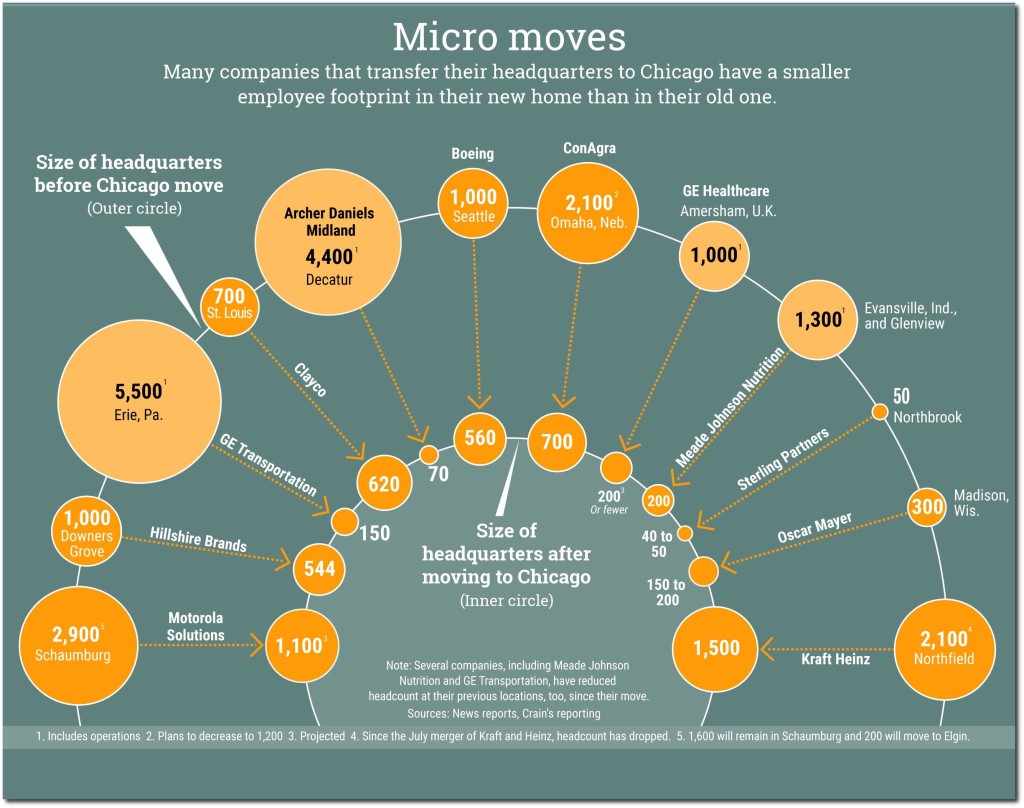
    Crain’s Chicago Business has a major feature this week investigating the executive headquarters trend as it is playing out there. They point out that these HQs make for great headlines, but they don’t necessarily result in that many jobs.

    ADM is Exhibit A in the rise of a new type of corporate headquarters, one that arrives from afar but packs light. These headquarters represent the pinnacle of the corporate pyramid, snapped off and relocated, free of jobs tied to operations and often midlevel HQ functions such as payroll, human resources or purchasing. To be sure, migrating headquarters offer benefits to the city: They boost demand for business services, their executives join the philanthropic scene and, of course, they confer bragging rights. But in terms of jobs, the farther a company travels to set up shop in Chicago, the fewer people come with it.

    “The notion of the corporate headquarters in the ‘Mad Men’ world when there were hundreds or thousands of people in a building with the company logo . . . those days are gone,” says David Collis, a professor at Harvard Business School who studies corporate headquarters.

    Click through to read the whole thing, which features me and my work on the topic. This is an important trend to grapple with.

    The bad news, which the Crain’s piece highlights, is that the headquarters ain’t what it used to be. On the other hand, Chicago is winning the battle for them.  These smaller executive headquarters, particularly for major global businesses, benefit from being in a global city. Chicago has lured a number of these from out of town. In line with Sassen’s findings that the “deep economic history of a place” matters, note that we see a lot of agro-industrial firms choosing Chicago: ADM, Con Agra, Mead Johnson Nutrionals, Oscar Mayer.  This industry space is where Chicago has a major advantage over New York and other coastal cities.

    A trend I see playing out, and which I am currently researching in more detail, is the bifurcation of HQ attraction. For executive headquarters of global firms, and for companies that are looking for an urban location, Chicago is reasserting its dominance as the interior business capital. But for those who prefer a suburban environment, or which maintain a mass employment HQ, the Sunbelt remains strong, especially Dallas, where Toyota is a building its North American campus. Dallas replicates many of Chicago’s non-urban advantages at lower cost and with a more suburban feel: central location and time zone, a major airport, a diverse economy, and scale. Increasingly it looks like Chicago is the urban interior capital, Dallas the suburban interior one. Stay tuned for more on this in the future.

    Aaron M. Renn is a senior fellow at the Manhattan Institute and a Contributing Editor at City Journal. He writes at The Urbanophile, where this piece originally appeared.

    Chicago photo by Bigstock.

  • Why High Taxes Aren’t the Only Reason GE Left Connecticut

    General Electric, unhappy with a recent corporate tax increase in Connecticut, has now announced that it is relocating to Boston’s south waterfront. Indeed Connecticut’s tax climate is bad, ranking 44th according to the Tax Foundation, but GE’s move points to much bigger problems in the state.  I examine this in my new piece over at City Journal. Here’s an excerpt:

    For decades, nearby New York City’s pain was Connecticut’s gain. New York was a grim, dangerous, failing city that almost went bankrupt in the 1970s. More than 100 Fortune 500 companies fled during that era, many heading to suburban New Jersey and Connecticut—including GE, which moved in 1974 from 570 Lexington Avenue to Fairfield, Connecticut. The same story played out in cities across America, with corporations fleeing dying downtowns for the safety of the suburban office campus.

    Today, cities are back. The policing revolution—helped by the waning of the crack epidemic—made cities safe again. Core public services were slowly restored, parks were rebuilt, and transit systems were cleaned up and refurbished. Investment started returning. The structure of the economy changed, too. Starting in the 1990s, technology radically transformed the business world and is now a major industry in its own right. The financial industry was deregulated. Globalization drove demand for new types of business services, reinforcing the need to stay on top of a constantly shifting landscape. People with advanced, specialized knowledge are the ones who help companies innovate now. These employees work in highly interactive ways that benefit from clustering together—disproportionately in urban areas like New York, Chicago, and Boston.

    Click through to read the whole thing.

    Aaron M. Renn is a senior fellow at the Manhattan Institute and a Contributing Editor at City Journal. He writes at The Urbanophile, where this piece originally appeared.

    Photo: The former General Electric/Remington facility in Bridgeport, CT. The buildings have been demolished in recent years.

  • What Does It Mean to Bring Buffalo Back?

    Prior to the holidays City Journal published  my major essay on Buffalo in their fall issue.  Here’s an excerpt:

    Local planner Chuck Banas observes that while Buffalo’s regional population today is roughly the same as it was in 1950, the urbanized footprint of the region has tripled. “Same number of people, three times as much stuff to pay for” is the quip—and it’s true. Physical capital must either be maintained at great cost in perpetuity or ignored and allowed to become a drag on the city. Between 1980 and 2011, according to the University of Buffalo Regional Institute, Buffalo-area governments issued permits for almost 60,000 new single-family homes—while regional population declined. Given the gargantuan scale of state aid to the region, this is clearly not market-rate development.

    While Buffalo’s urban advocates agree that investing in sprawl is misguided, they’re less critical about new construction in the urban center. The city’s $550 million light-rail line was an epic civic folly, yet Buffalo is currently reconstructing a downtown station on the line. More ill-conceived spending lies ahead. The region’s long-range transportation plan projects a need for an additional $100 million in capital expenditures through 2040, just to keep the existing line running—plus more operating subsidies every year. Seen in this light, neither cranes on the skyline nor bulldozers paving the countryside are necessarily good signs for Buffalo.

    I learned a lot in Buffalo and it stimulated my thinking about post-industrial cities generally. What is the best way to bring some of these places back? What does it even mean for them to be back?  If you wanted to inject a billion dollars of state or federal money into them, where would it most profitably be spent? These and other questions are ones I’ll be looking at in more detail during 2016.

    Read the entire piece at City Journal.

    Aaron M. Renn is a senior fellow at the Manhattan Institute and a Contributing Editor at City Journal. He writes at The Urbanophile, where this piece originally appeared.

  • The Fall of Rahm Emanuel

    Rahm Emanuel, a man of obvious talent, drive, and leadership capacity, should have been an ideal person to run a big city like Chicago. Unfortunately, because of his stubborn unwillingness to admit and compensate for his flaws, that was not to be.  After barely limping across the finish line in his re-election bid and tamping down the fallout from Moody’s downgrading the city’s debt to junk status, Emanuel has now been rocked by a truly huge scandal. The Chicago Police Department shot 17 year old Laquan McDonald 16 times, killing him, then did not release a video of it for over a year – including sitting on it during the entire election season. And that’s just the start of it.

    My latest piece in City Journal, The Fall of Rahm Emanuel, looks at Rahm’s tragic trajectory:

    Emanuel’s leadership style came with fatal flaws. A political streetfighter by inclination, he lacks an operational orientation. He didn’t appear to grasp the scope of the city’s financial problems until four years after he was first elected, when Chicago’s bond rating was cut to junk. His infrastructure trust fizzled. The schools went from bad to worse, with his first CPS leader forced out and his secondpleading guilty to corruption. He didn’t get it that Chicago’s police department hadn’t been fundamentally reformed the way New York’s and Los Angeles’s had been.

    Emanuel’s governing style has been all tactics, no strategy. He’ll pick up the phone to twist the arm of a CEO or fight to win the day’s media cycle. But what’s his vision for the city? He has no idea how to make Chicago as a whole work over the long term. Nobody is great at everything, but Emanuel’s arrogance seemingly won’t allow him to address his own shortcomings. Famously vindictive, he alienated the local press and others, turning those who might have helped him into enemies. He also brought a Washington-style spin-control mindset to Chicago. In Washington, an army of apparatchiks and a compliant media lets politicians like Obama create a reality bubble. In national politics, perception is often is reality. But in local government, reality is reality. The West Side isn’t Benghazi. The people who live in Chicago can walk out their front doors and see for themselves what’s going on.

    Click through to read the whole thing.

    Aaron M. Renn is a senior fellow at the Manhattan Institute and a Contributing Editor at City Journal. He writes at The Urbanophile, where this piece originally appeared.

    Photo: Chicago Mayor Rahm Emanuel, left, greets U.S. Defense Secretary Leon E. Panetta upon his arrival at a CEO roundtable in Chicago, May 20, 2012, courtesy of the Department of Defense.

  • How Oklahoma City Decided to Change Its Image

    I was in Oklahoma City for the first time earlier this year. I got to see a lot of the things I’d heard about, such as the in-progress Project 180, a $175 million plan to rethink and rebuild every downtown street.

    OKC is not yet where it needs to be in a number of respects. Very little of the side has sidewalks, for example. But they are pedaling in the right direction, and making some smart choices about what to do – and equally as importantly, how to pay for it. If you visit you’ll also get a sense of the city’s ambitions for more.

    I have a short piece in the most recent City Journal about OKC, which is now available online.  Here’s an excerpt:

    In 1991, Oklahoma City lost out to Indianapolis in the competition for a United Airlines maintenance base. Mayor Ron Norick wanted to know why. He was certain that Oklahoma City had put the most compelling financial deal on the table for United. The company answered that its decision had nothing to do with the subsidy package. Rather, United simply couldn’t imagine its employees living in a place as bleak as Oklahoma City. “The quality of life had sunk so low we couldn’t buy someone’s attention,” as current mayor Mick Cornett puts it. “No matter how many incentive dollars we put in place, corporate America wasn’t interested in us.”

    Click through to read the whole thing.

    Aaron M. Renn is a senior fellow at the Manhattan Institute and a Contributing Editor at City Journal. He writes at The Urbanophile, where this piece originally appeared.

  • How Portland Is a Lot Like Texas

    One theme I always hammer is that you have to look at proposed policy solutions in the context of the area where you want to apply them.

    A great example of this is Portland’s Urban Growth Boundary (UGB). The UGB, a policy that limits suburban development outside of a line drawn around the Portland region, is widely admired and perhaps even seen a type of holy grail policy in terms of preventing sprawl.

    Obviously restricting development outside the UGB raised demand for land inside of it and thus housing prices. Portland’s median home price multiple – that is, the median home price divided by the median household income – is 4.8. The average household in Portland would need to spend 4.8 times its annual income to buy a house there.  This compares with 2.9 in Kansas City, 3.0 in Columbus, and 3.9 in Austin.

    So Portland is less affordable than many similar sized housing markets around the US.

    But despite this, Portland remains the most affordable major West Coast metro area.  That’s because housing prices in other major coastal cities are even higher, including Seattle (5.2), Los Angeles (8.0), San Diego (8.3), the Bay Area (9.2), and Vancouver (10.6).

    So even while its home prices have risen, Portland remains the cheapest major city to live apart from Sacramento (4.7).  That is, even with the UGB Portland has a big cost advantage over its regional competition. In short, it’s cheap.

    In this way, the attraction of Portland is a lot like Texas. Its draw is more a cost arbitrage play for people leaving San Francisco than an upgrade to superior urbanism from the interior. As it happens, California refugees make up the bulk of the net migrants into Portland.

    The Texas comparison is relevant on the tax front too. Portland is one of the rare places you have the potential for double border tax arbitrage. Washington state has no income tax and Oregon has no sales tax. While only a limited number of people can take advantage of both (you have to both live and work in Washington to avoid the income tax), being able to zero out one or more major tax categories is a win.

    This is not to say that Portland is a lousy place to live. It’s fantastic as near as I can tell. The point is that Portland was able to put in place policies to create good enough urbanism to lure a certain number of San Franciscans without compromising its competitive position because it was in a high cost neighborhood.

    The story would be very different for a place like Oklahoma City or Columbus. These cities are in low cost regions, and if they undertook policies that raised their housing prices, they’d rapidly find themselves the most expensive market in their area.

    Cloning Portland’s UGB is simply not a viable policy for most interior cities, even if they had the political alignment to make it happen.

    There are many policies that can be broadly implemented across cities. The general principle is to first understand why a policy worked in the original context, then ask whether it is applicable to the target context, and if so how to implement it most successfully.

    Aaron M. Renn is a senior fellow at the Manhattan Institute and a Contributing Editor at City Journal. He writes at The Urbanophile, where this piece originally appeared.

  • When Detroit Stood Tall and Shaped the World

    My recent post about how urban planning decisions helped lead to the Motown sound in Detroit was inspired by David Maraniss’ new book Once in a Great City: A Detroit Story.

    The book takes a deep dive into Detroit 1963, a city that was, although in some ways already in decline, in others near its zenith.

    It’s a great read, in particularly for the depth of characterization. Too often Detroit writing is a story of heroes, villains, and victims. Maraniss rejects that approach and provides mostly nuanced portrayals of Detroiters that allows them to be the actual real, red-blooded human beings that they are.

    I just posted a review of the book over at City Journal.  Here’s an excerpt:

    In his new book, Once in a Great City: A Detroit Story, Pulitzer Prize winner David Maraniss takes a fascinating and engrossing look at the Motor City during this fateful year. Under Henry Ford II (“the Deuce”) and hard-charging salesman Lee Iacocca, the Ford Motor Company was set to unveil its revolutionary Mustang. The civil rights struggle was creating tensions in Detroit and elsewhere, but Mayor Jerome Cavanagh was committed to addressing discrimination and reforming the police. Detroit was about to transform the American musical landscape with Motown Records, whose roster of superstar artists included Smokey Robinson, Diana Ross and the Supremes, Stevie Wonder, and Marvin Gaye. The United States Olympic Committee even nominated Detroit as the American representative to host the 1968 summer Olympics, though it lost out to Mexico City. On the more dubious side, the mafia had a powerful presence in the Motor City, where colorful mob boss Tony Jack Giacalone rode around town in his garish “Party Bus” painted blue and silver, the colors of the NFL’s Detroit Lions.

    Click through to read the whole review or buy the book.

    Aaron M. Renn is a senior fellow at the Manhattan Institute and a Contributing Editor at City Journal. He writes at The Urbanophile, where this piece originally appeared.

  • 12 Ways to Map the Midwest

    What is the Midwest? There’s been a lot of debate about this question among folks passionate about such thing. But it defies easy definition. Here are eleven ways various people have taken a crack at drawing the map.

    Traditional Maps

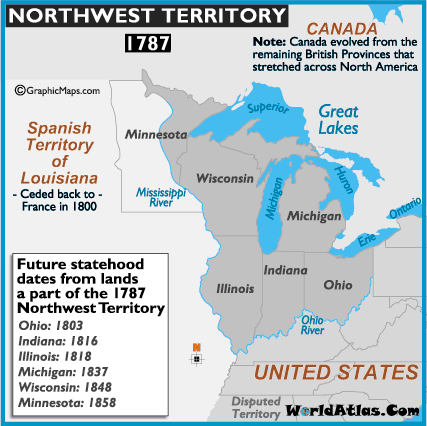
    1. The Northwest Territory

    Start with the original Northwest Territory, now sometimes referred to as the Great Lakes region. This is the historic core of what we now think of as the Midwest.

    nwterr

    Image via WorldAtlas.com

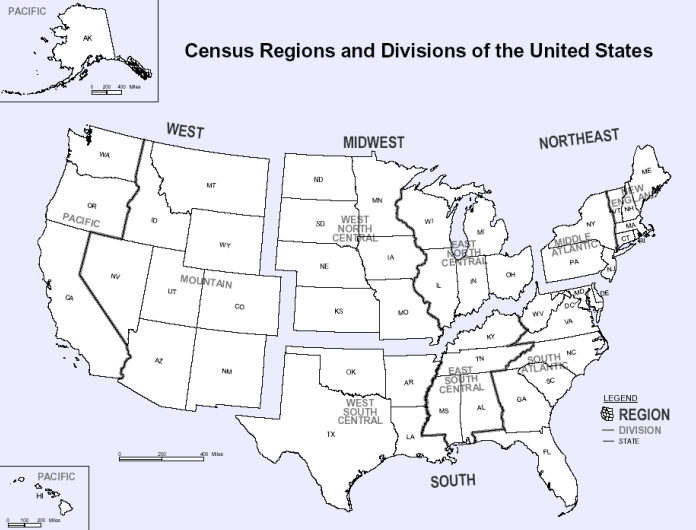
    2. Midwest Census Division

    The Census Bureau has an official definition of the Midwest, which is one of four so-called “Census Divisions.” This is further divided into two “Census Regions” as in the map below.

    Ethnic and Cultural Definitions

    Others have attempted to draw maps based on shared ethnicity and culture. These tend to deny the existence of an actual Midwest as we think about it today.

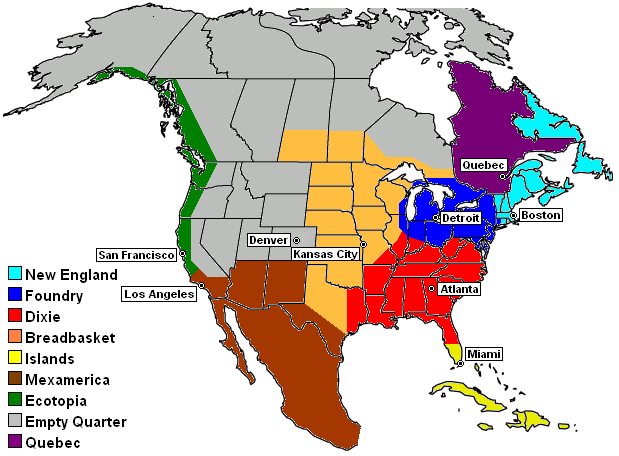
    3. Nine Nations of North America

    One of the most famous of these is from Joel Garreau, who made a claim that there were actually nine nations on the North American continent in his book of that same name.

    9nations

    Joel Garreau’s Nine Nations

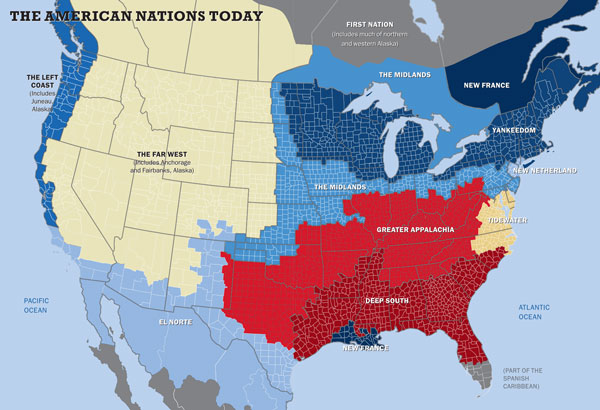
    4. Eleven Nations of North America

    Colin Woodard took this a step further and argued that there were really eleven nations in North America, which he identifies based on settlement patterns. You can see his writeup on this in an article in Tufts Alumni magazine.

    Colin Woodard's 11 Nations

    Colin Woodard’s 11 Nations

    Economic Definitions

    Other maps try to define a region based on shared economic characteristics such as industries.

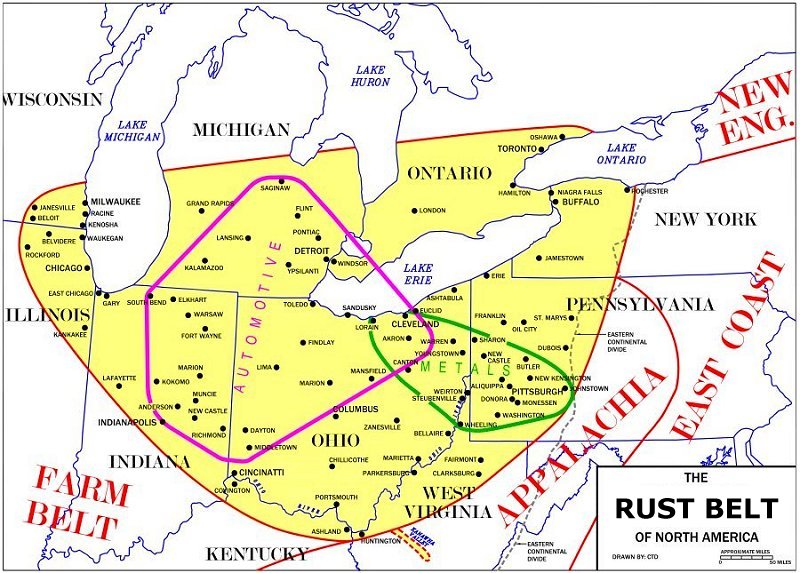
    5. The Rust Belt
    Here’s a map of the Rust Belt that’s floating around the I found on a website about coal communities of all places. I’m not sure exactly where it originated.

    The Rust Belt

    The Rust Belt

    Hybrid Definitions

    These maps attempt to use both shared cultural/historical and economic characteristics to define a Midwest region.

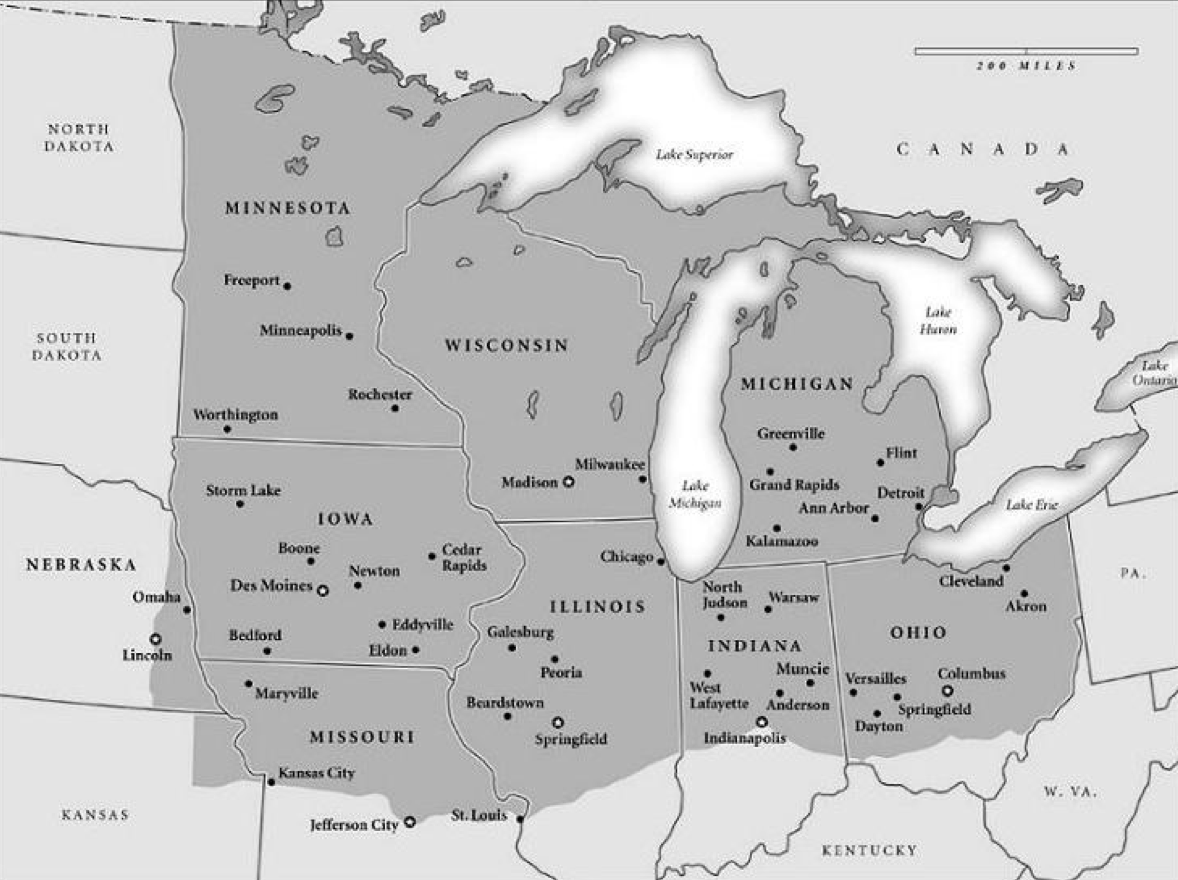
    6. Richard Longworth’s Midwest

    In his book Caught in the Middle: America’s Heartland in the Age of Globalism, Richard Longworth created his own bespoke definition of the Midwest. He notably excludes the southern regions of Missouri, Illinois, Indiana, and Ohio as extensions of the south (similar to the 9 & 11 nations map), and also the pure play Great Plains states along the western edge of the Census definition.

    Richard Longworth's Midwest

    Richard Longworth’s Midwest

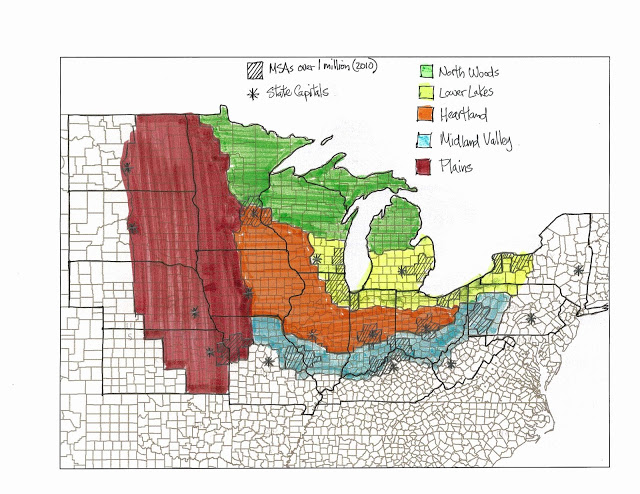
    7. Pete Saunder’s Five Midwests

    Pete combines the nations approach with the traditional Census definition of the Midwest in order to divide the Midwest into five sub-regions.

    Pete Saunder's Five Midwests

    Pete Saunders’s Five Midwests

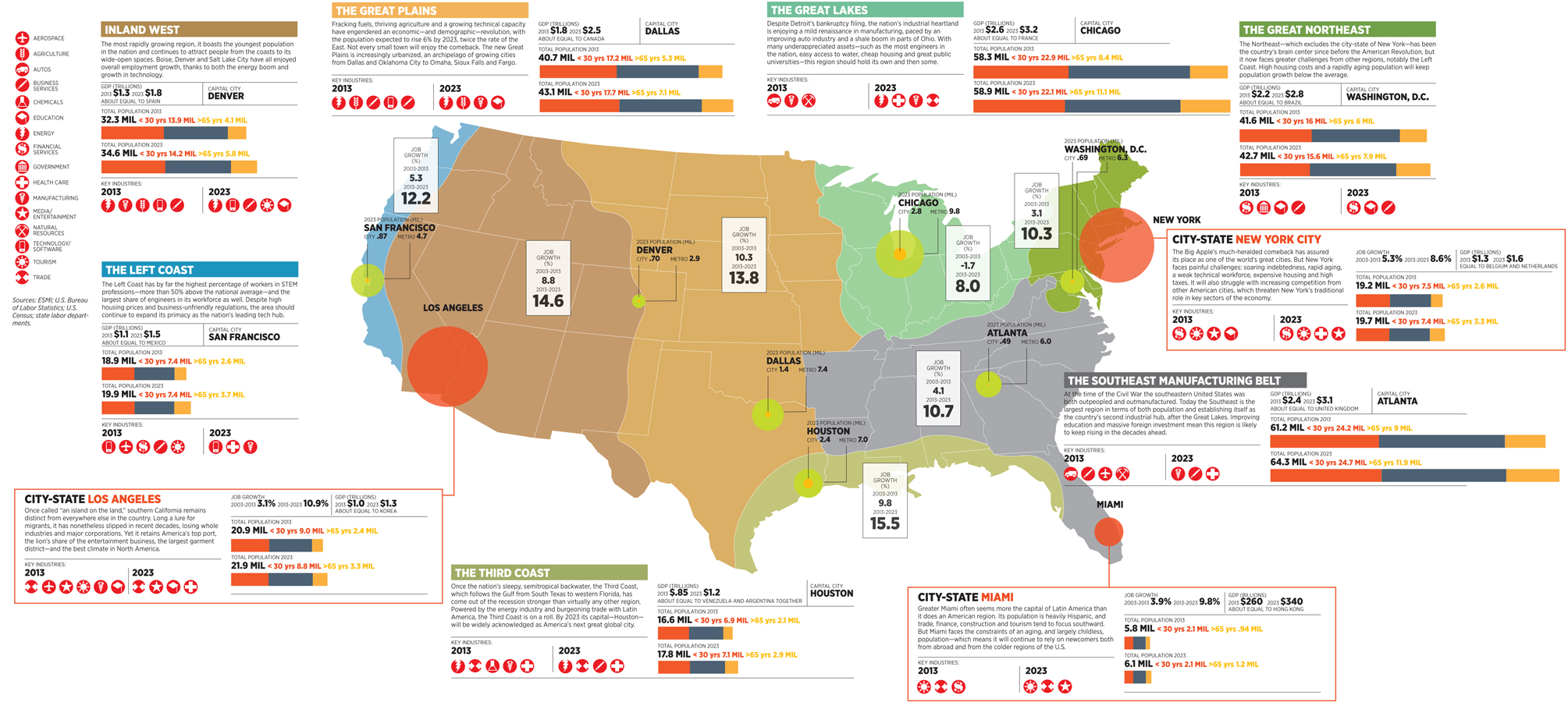
    8. Kotkin’s American Regions and City-States

    Joel Kotkin took a similar approach to dividing America up in Forbes magazine. His view also appears to be a hybrid of culture, economics, and history. He turns America into seven regions and three city-states (New York, LA, and Miami). The full map is too huge to blog, but an excerpt is below which you can click on to see the whole thing in a new window.

    The Midwest in Kotkin's map

    The Midwest in Kotkin’s map

    Crowdsourced Maps

    A couple of other people used crowdsourcing, in whole or in part, to define the Midwest

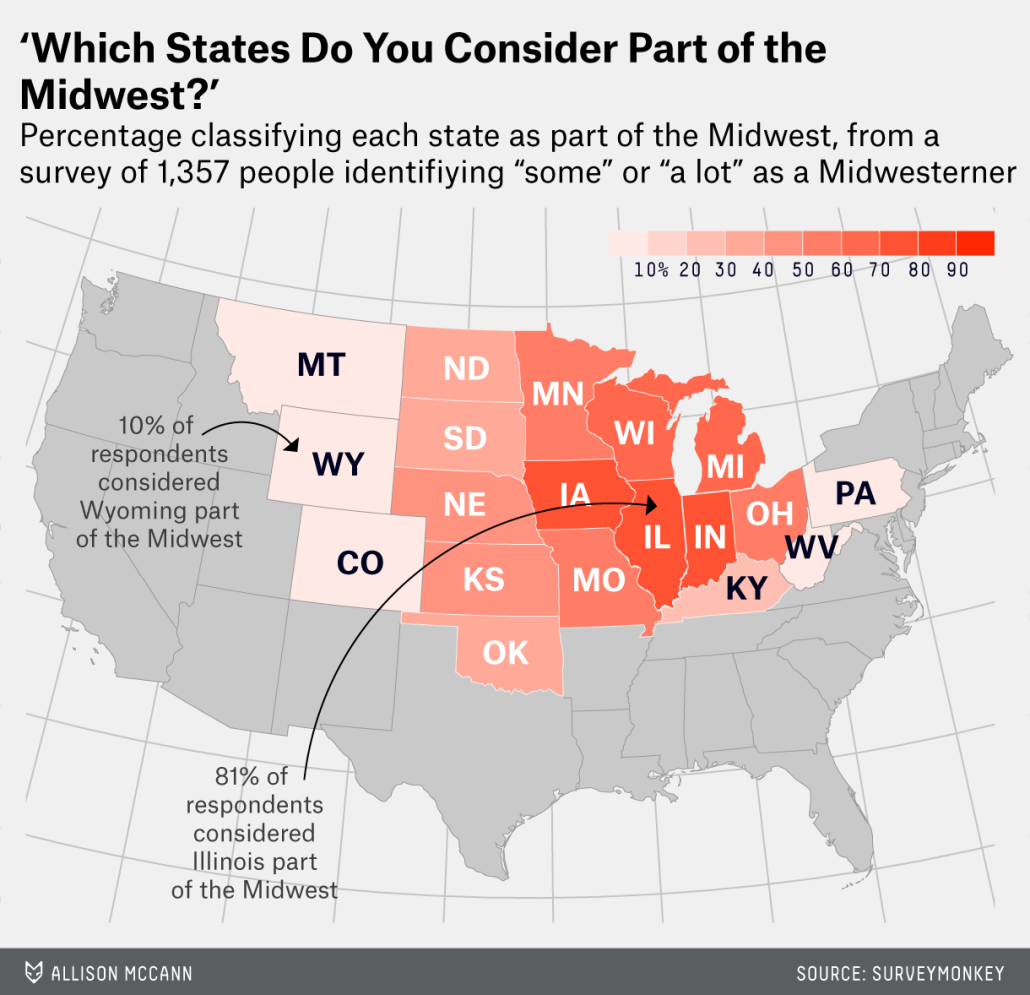
    9. Walter Hickey/538 Map

    Walter Hickey, writing at 538, conducted a survey with Survey Monkey to ask people which states they thought were in the Midwest. Here’s what he came up with.

    Walter Hickey/538 Map

    Walter Hickey/538 Map

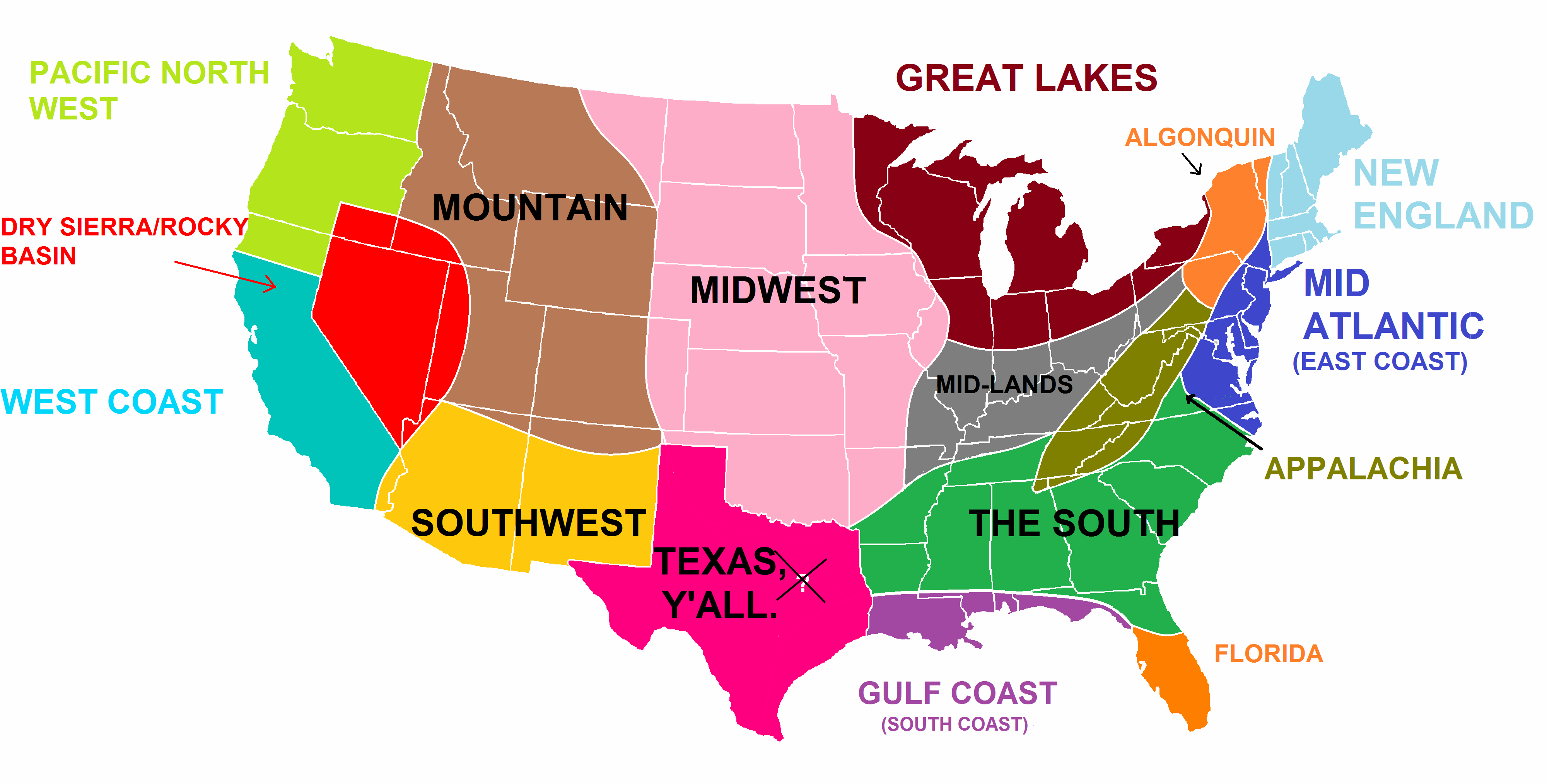
    10. miguecolombia’s Reddit Map

    Here’s one that I found on a Reddit thread started by user miguecolombia. It appears to be his personal take on how to divide America, with a strong dose of crowdsourcing from Reddit.

    miguecolombia and Reddit's map

    miguecolombia and Reddit’s map

    Self-Defining Maps

    And a couple maps that try to use statistical techniques to let the Midwest map itself.

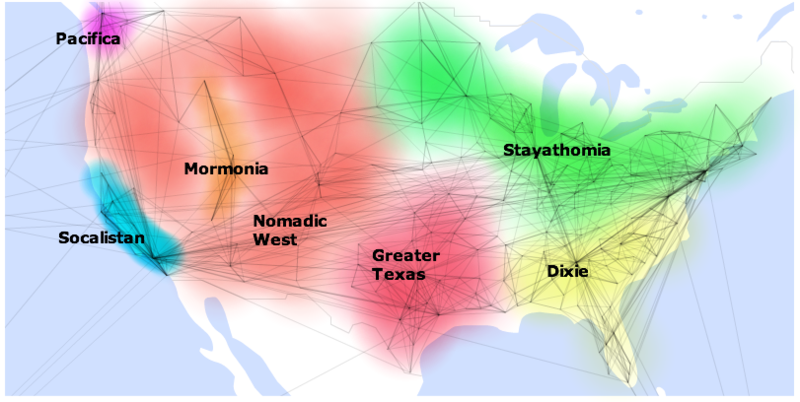
    11. Facebook Network Maps

    Pete Warden took a look at Facebook profiles and connections to create clusters of regions. Most of what we’d think of as the Midwest he called Stayathomia, which also covers much of New England.

    Pete Warden's Map

    Pete Warden’s Map

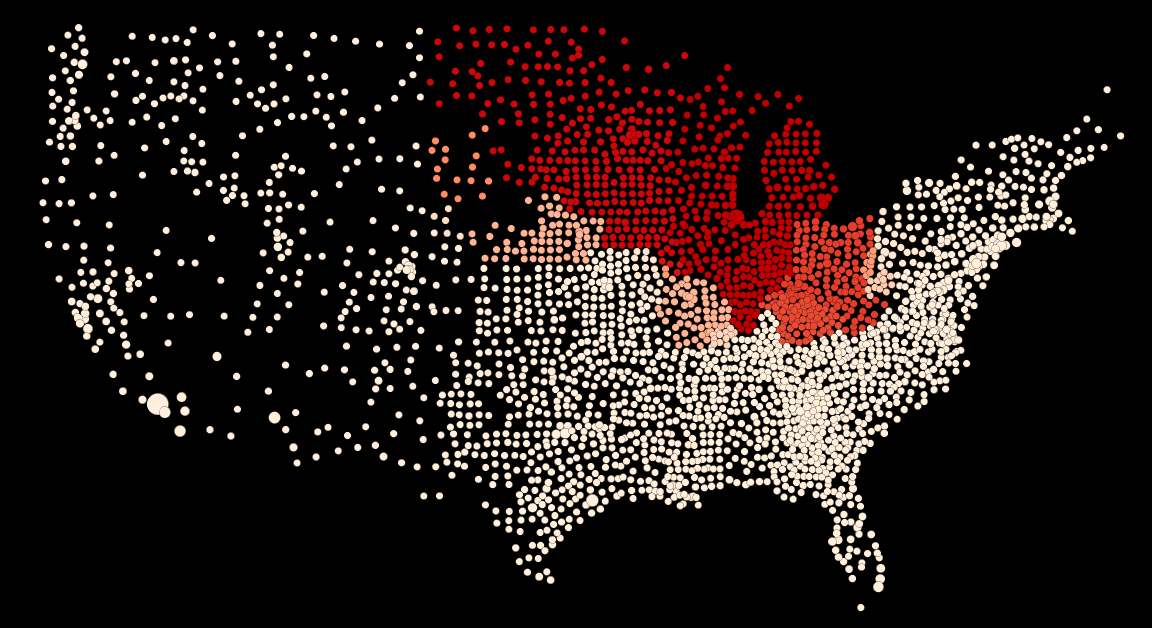
    12. Chicago Migration Map

    Lastly, a special surprise – a map you’ve never seen before. This was created by someone named Daniel Jarratt, who emailed it to me back in 2012. Using Chicago as the capital of the Midwest, he used IRS migration data and a statistic technique called modularity to divide the US into regions based on affinity with Chicago. Darker red means more connection to Chicago and thus in a sense more Midwest.

    Daniel Jarratt's Midwest

    Daniel Jarratt’s Midwest

    Aaron M. Renn is a senior fellow at the Manhattan Institute and a Contributing Editor at City Journal. He writes at The Urbanophile, where this piece originally appeared.

    Top photo by Benjamin Reed (flying over the midwestUploaded by France3470) [CC BY-SA 2.0], via Wikimedia Commons

  • How Chicago’s 606 Trail Fell Short of Expectations

    When I was back in Chicago over Labor Day, I had to check out the “big three” new public space projects there: the Riverwalk, Maggie Daley Park, and the 606 Trail. The Riverwalk is a spectacular project I already wrote about. Maggie Daley Park, a new playground just across Columbus Dr. from Millennium Park’s Frank Gehry designed band shell, has been controversial and got mixed reviews. But I really liked it. More importantly, kids seem to love it. The place was jammed, and it appeared to be mostly locals. My cousin tells me her young daughter can’t get enough of the place. I’m not doing a post on this, but it looks like another big win.

    The 606 Trail, a 2.7 mile biking and walking trail built on the embankment of an abandoned rail line, is a different story, however.

    The problem with the 606 is not that it’s bad. In fact, it’s a nice, eminently serviceable rail trail. I won’t do a full writeup since Edward Keegan had a good review in Crain’s in which he asks, “Is that all there is?” that I think gets it basically right.  Numerous other reviews are also available.

    What I will do is highlight three areas that I think contribute to Keegan being underwhelmed: inflated expectations, financing problems, and an odd lack of attention to design detail.

    Inflated Expectations

    The fact that the 606 is an elevated trail on an abandoned rail line creates an almost inevitable comparison to New York’s High Line. The city did nothing to downplay those comparisons, and in fact suggested Chicago’s trail would actually be considered superior. For example, in national urbanist web site Next City, Deputy Mayor Steve Koch said, “A lot of people are familiar with the High Line — this is a concept far beyond that truly transformative project.”  Frances Whitehead, lead artist for the project, told WBEZ regarding the High Line, “I think we’re gonna smoke them.”

    It’s very clear the city wanted this to be considered a project worthy of national, not just local attention. Back to Koch, he said, “Someone will call you up and say, ‘I want to see the city’ Thisis where you’ll go; this is the way you’ll do it. And I think people are going to come from all over the globe.”

    The very name speaks to the ambition level. Originally it was known as the Bloomingdale Trail, a name that technically still exists but which has been replaced for most purposes by “the 606.” The new name was taken from the first three digits of zip codes in the city of Chicago. Thus by using 606, the name itself suggests a project of citywide, not neighborhood, significance. The city also pushed for national media – and got it.

    The problem is that the 606 is not even remotely another High Line, nor a project of citywide significance, nor a bona fide tourist attraction for the masses. It’s a neighborhood serving rail-trail that is elevated above the streets with some nicer features like lighting that you don’t see often. Like many other rail trails around the country, I expect it to have a significant positive development affect in the neighborhood, as well as being a great recreational amenity. All great things – if the trail had been sold that way originally.

    To be fair, some like the Trust for Public Land, which was involved in the project design, were more realistic. Their CEO Will Rogers told Next City, “The High Line really reshaped the whole Meatpacking District. The Bloomingdale is going to provide parks and green space for neighborhoods that desperately need it, and bicycle access for people going downtown. It’s a different kind of investment.” But this isn’t the message that won out in shaping perceptions. The city would have been better off setting expectations much differently.

    Insufficient Funds

    The 606 Trail was primarily paid for using federal CMAQ transportation funds. According to DNA Chicago, the total price of the 606 is $95 million, with $50 million in CMAQ funds, $20 million privately raised, $5 million from the city, and $20 million to fill (for what purposes I am not sure, though see below).

    The use of a CMAQ funding had key implications. One is that it more or less required the project to be primarily a bicycle trail. The entire edifice of obnoxious federal transport regs are in play here. Two is that it made this a CDOT project, not a Parks District one (though I believe the Parks District is now in charge of it). I believe many of the things that contribute to Keegan’s feelings come from the funding strings and a budget that was too low. In fact, this project to me brought back echoes of the CTA’s Brown Line expansion project in the way that various parts of it give off the vibe of being value engineered.

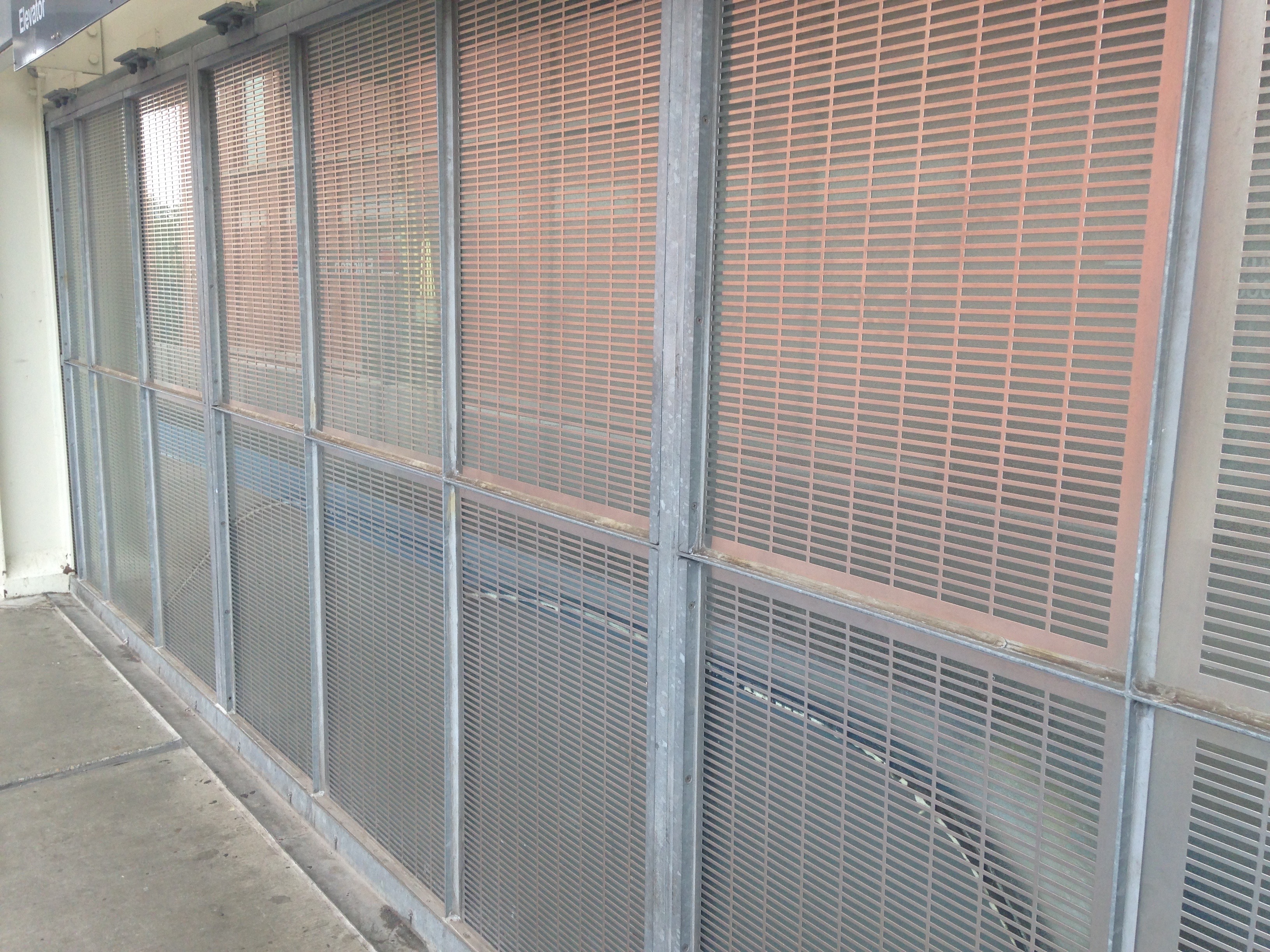
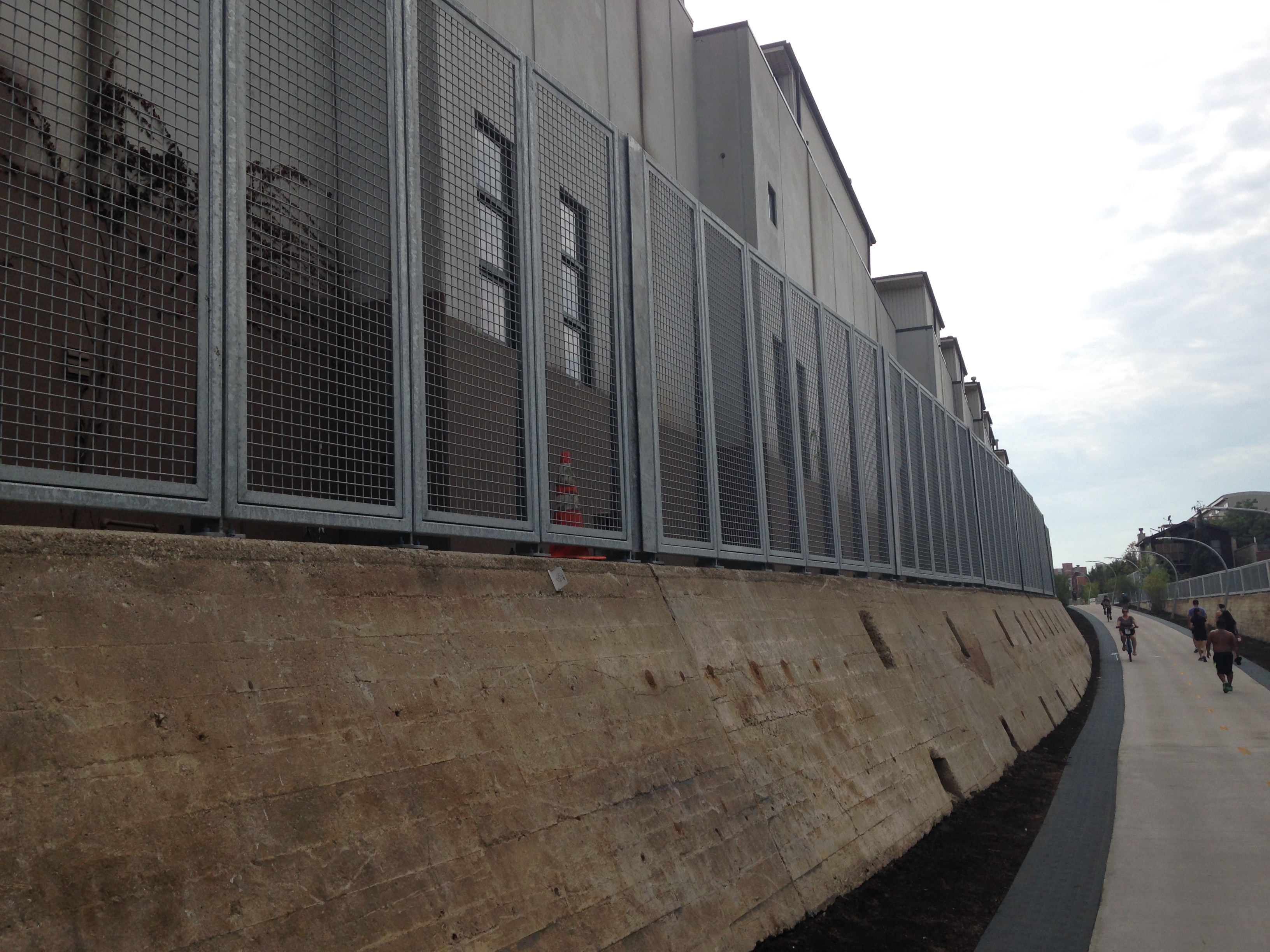
    One of the things that got whacked in the Brown Line project, for example, was paint. Except for a handful of places such as over Armitage Ave, metal on the project was simply left in a raw galvanized state. I previously noted the austere results of that project give off an homage to prison yard feel. The same look is present on the 606. Consider these photos:
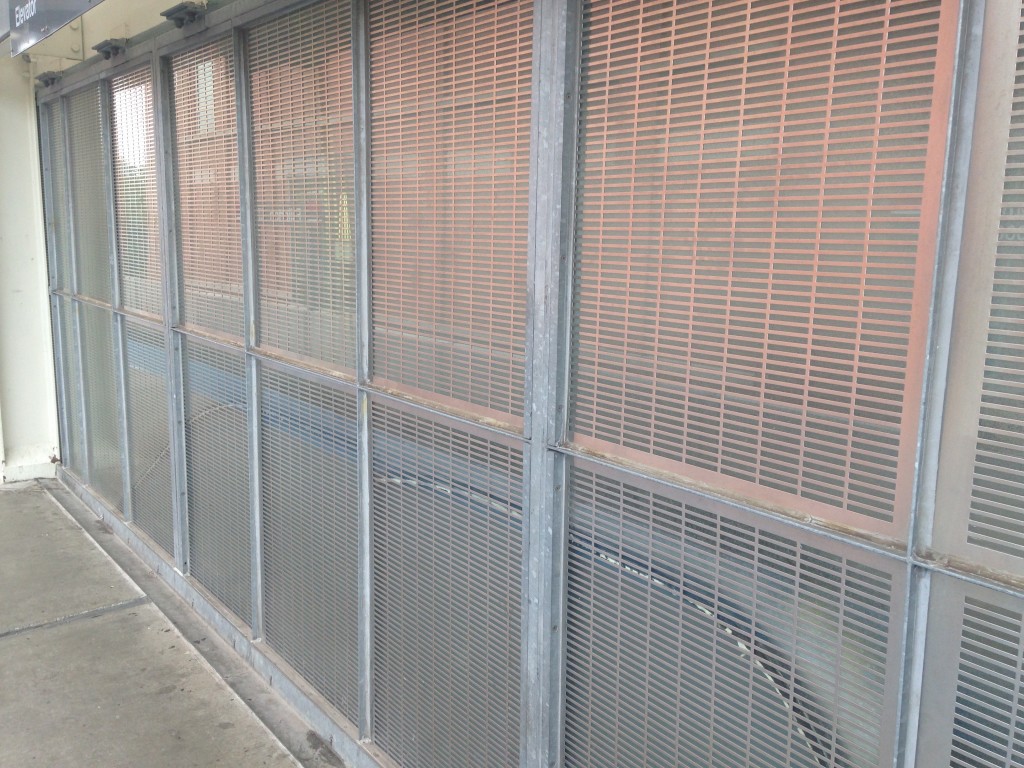
    Galvanized metal railing at the CTA Fullerton station.
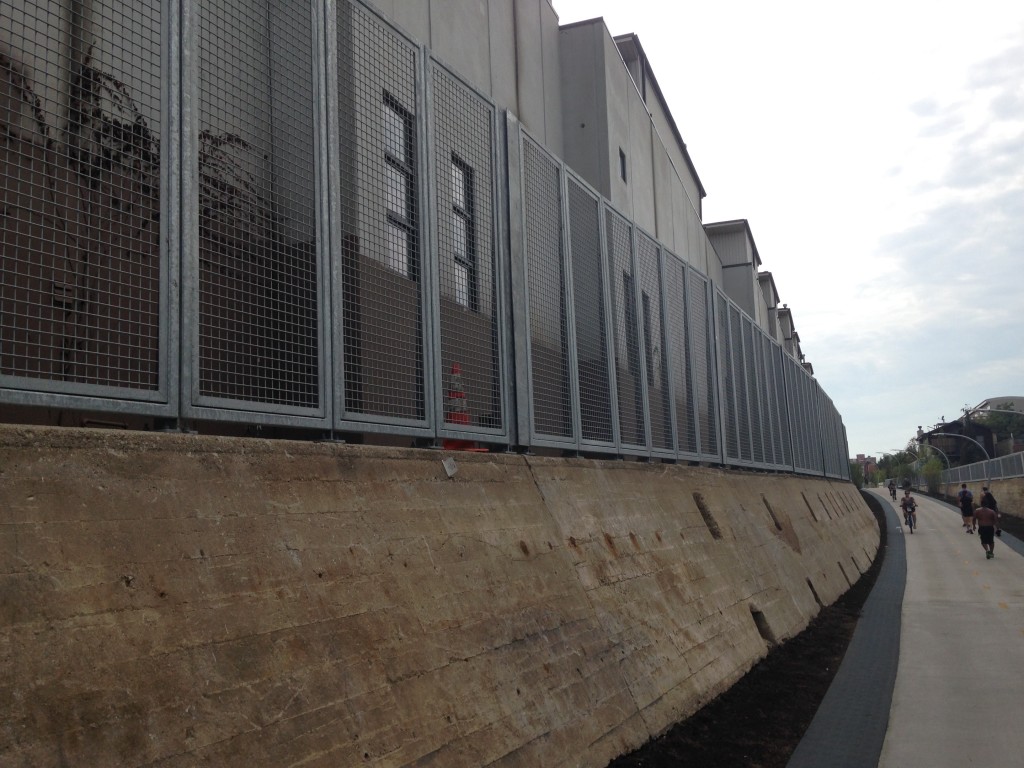
    Mesh galvanized metal railing at the CTA Fullerton station.


    IMG_2128

    Mesh galvanized railings along the 606.


    There’s nothing wrong with using an industrial motif, which is very appropriate in Chicago. And obviously security for adjacent property owners is important. It’s also possible that these had to be over-engineered to meet DOT/federal standards, much like the Brown Line station railings for passengers that could stop a Mack truck. The designers may well have felt these were the best choices. But my gut tells me that, like with the Brown Line, this may have been a money issue.

    A lot of people have noted the fact that the landscaping has not yet been fully planted or grown to maturity as a reason for the trail’s feel. That surely plays a role. But the preponderance of galvanized metal through much of it plays a big role in giving the 606 an austere feel.

    This also demonstrates how the city’s financial problems have practical consequences. Because the city’s budget is in such bad shape, it had to turn to CMAQ, which imposed strings you’d rather not have in an ideal world. And you may not have the cash to do it right. (The Riverwalk doesn’t suffer from this, possibly because its commercial spaces generate revenues to bond against).

    Design Oddities

    The 606 also has some odd design misses. For example, here is what the Trail physically looks like. It’s a concrete biking path with a soft blue rubberized running path on either side.

    IMG_2116

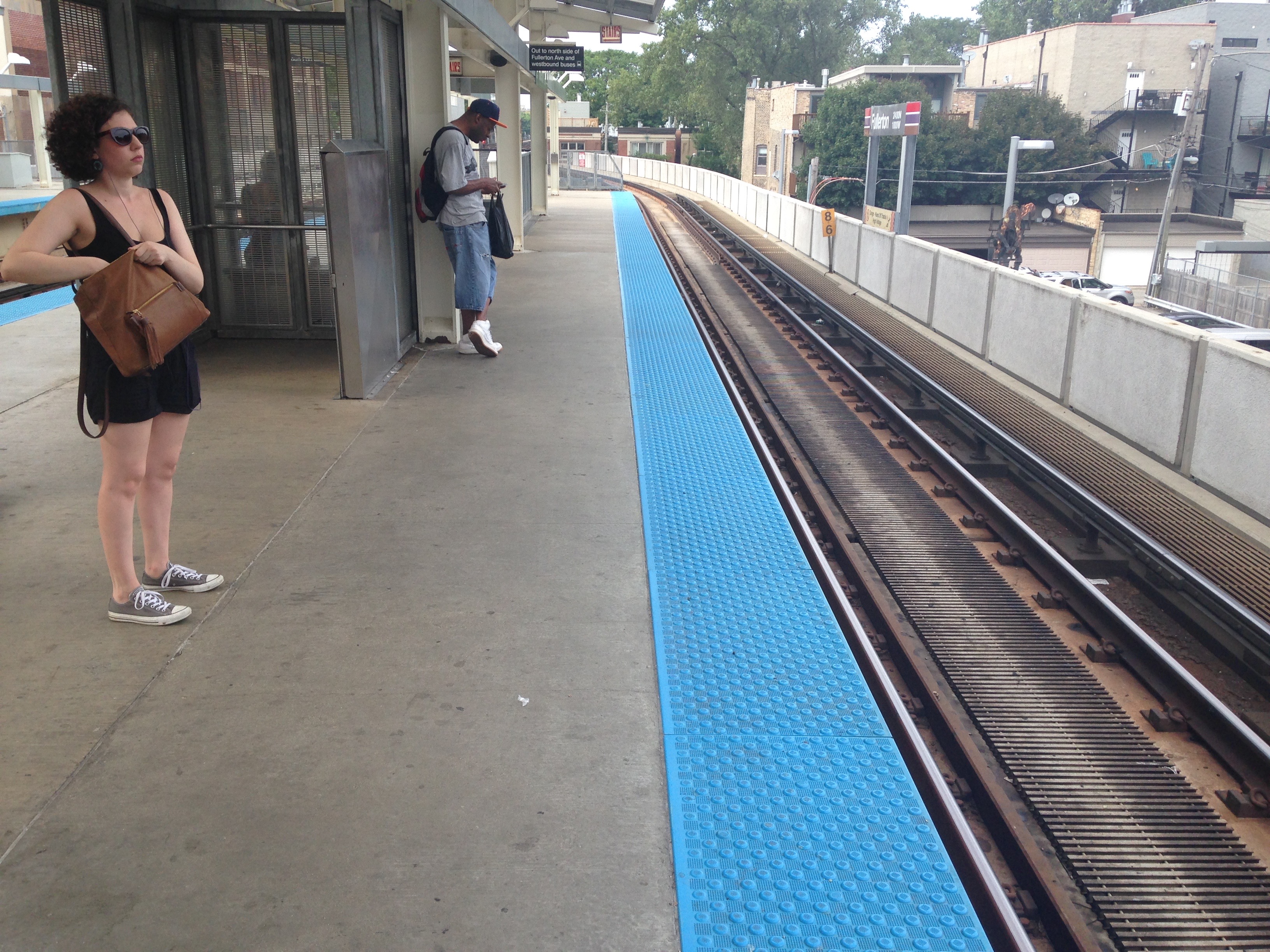
    Let’s see, where have I seen this design pattern before?
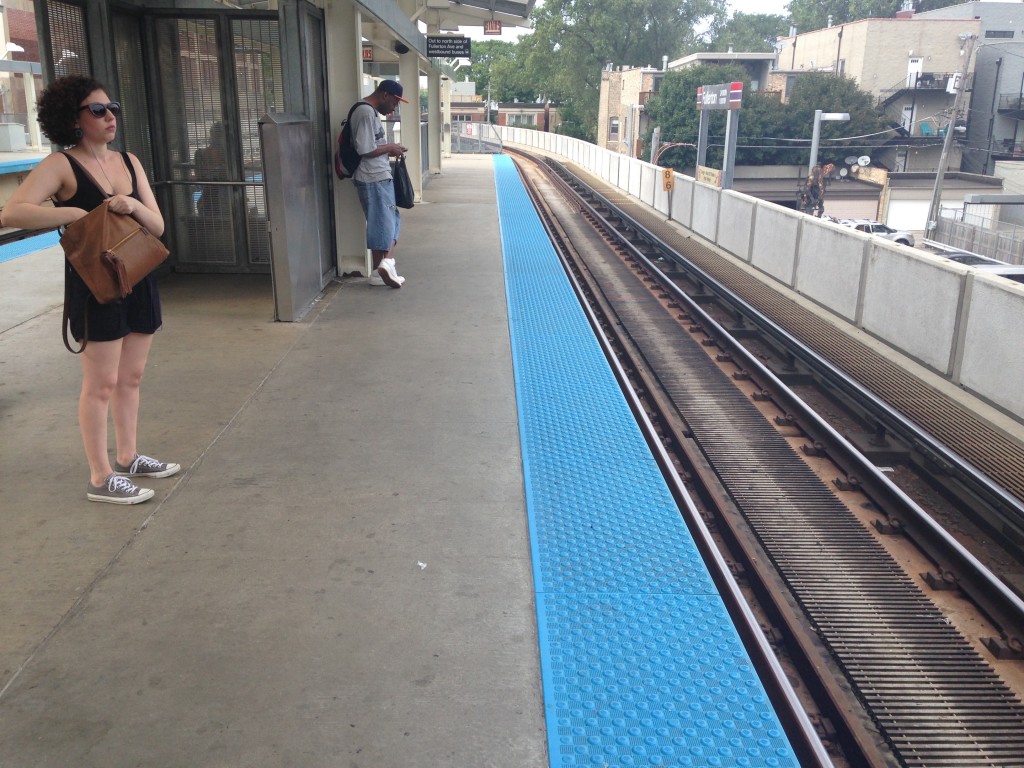
    Fullerton L platform.

    Fullerton L platform.

    The CTA uses a similar blue shoulder area on its platforms. But in its case, the design pattern is used to indicate the edge of the platform and thus an unsafe area to stand. You are supposed to stand behind the blue line. Using a similar width blue area, even if a different shade, for a jogging path on the 606 violates a local design affordance, like putting a handle on a door and labeling it “Push.”

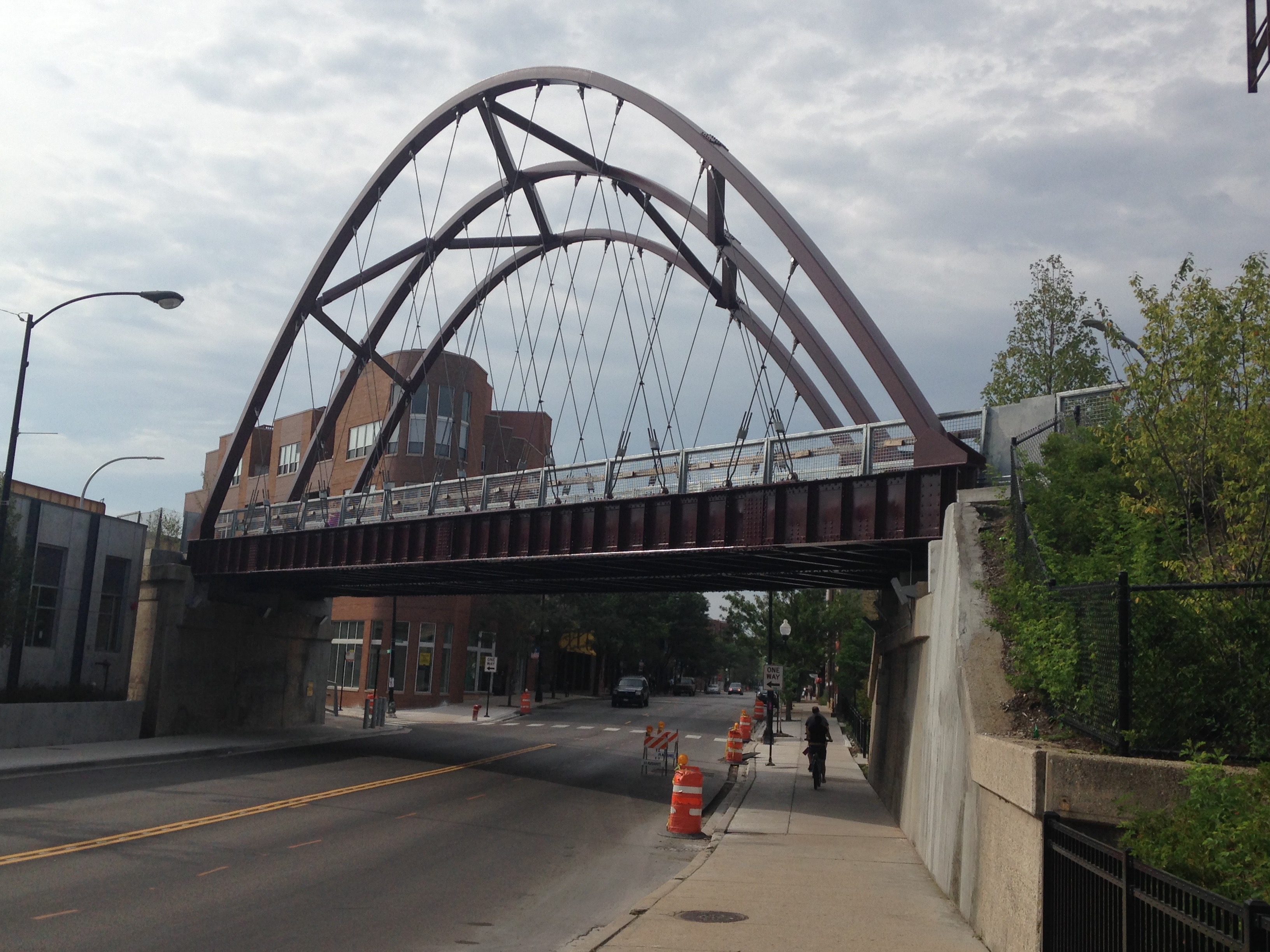
    Then there’s this arch bridge:
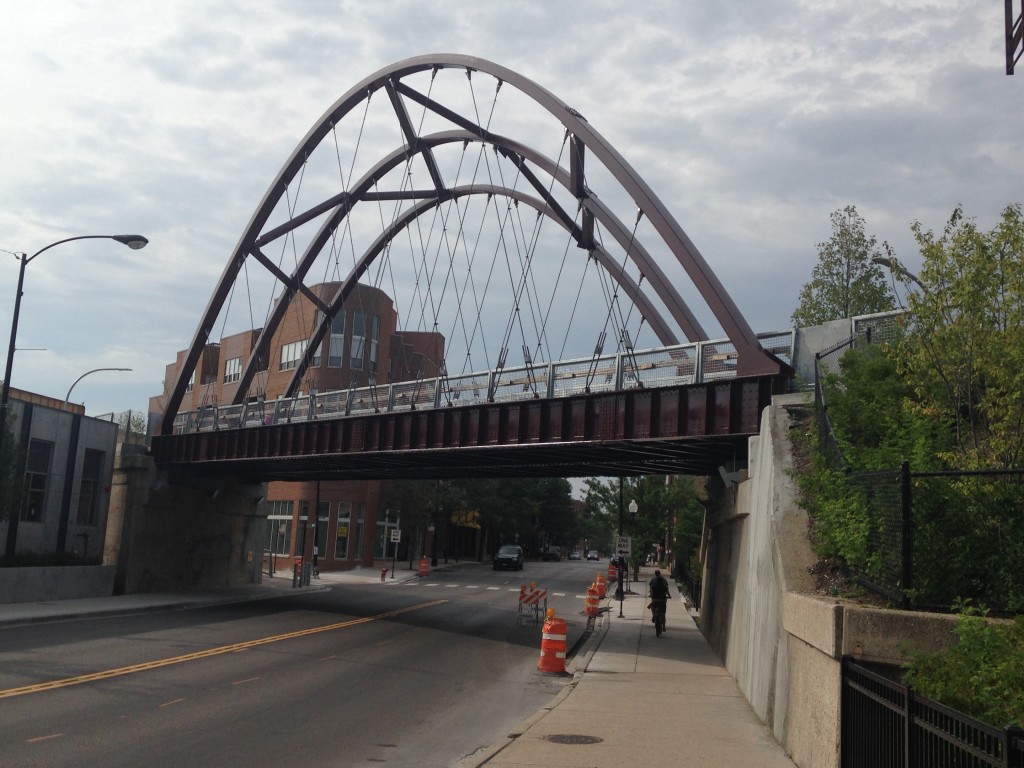
    The 606 Trail over Milwaukee Ave.

    The 606 Trail over Milwaukee Ave.

    This design is dimensionally awkward, something Keegan points out too. Given that this is a rail trail, it’s also notable that the designers chose a steel arch pattern that is not idiomatic of rail bridge design, certainly not in Chicago anyway. This also makes me again wonder about the role of CDOT in the project. This arch structure is the same pattern they used for the Halsted St. bridge over the north branch of the Chicago River that Blair Kamin similarly labeled, “less than graceful.” (The Damen Ave arch bridge works much better, probably because the span is longer and higher, lending itself to more elegant design proportions).

    The name “606” itself is also a bit off. Inside Chicago the reference may be obvious, but outside of its this name is likely to be parsed as an area code, particularly with the “0” middle digit from the original North American Numbering Plan. Today you frequently see people sporting their city’s main area code on shirts and such as a bit of local pride, particularly as area codes have shrunk down to city scale size in many places. The 606 area code is Appalachian Kentucky, however, not Chicago. Few people without a connection to Chicago will know that its zip codes start with 606.

    These aren’t huge items, but cumulatively they add up. The little things separate great design from good, and the 606 missed some opportunities.

    On the whole, this trail will be a great amenity for the neighborhoods it passes through, and also be legitimately functional for transportation given its elevated nature and the transportation lines it connects to such as Metra’s Clybourn station. It was fairly well patronized when I was on it, but with no sense of crowding. And this was on a nice Labor Day afternoon, suggesting that that chaos and safety issues of the lakefront path won’t be repeated here.

    If only it had originally been sold for what it was instead of a High Line beater, had raised that last $20 million (plus a bit more, perhaps), and had a little more attention to detail in some design elements, the 606 would be probably be seen as something that significantly exceeded expectations instead of something that did not live up to the hype.

    Aaron M. Renn is a senior fellow at the Manhattan Institute and a Contributing Editor at City Journal. He writes at The Urbanophile, where this piece originally appeared.
  • How Urban Planning Made Motown Records Possible

    I’m reading Once in a Great City: A Detroit Story by David Maraniss, a book I plan to review for City Journal. But I want to highlight something briefly that really caught my eye about Motown Records. It’s no secret Detroit punches above its weight in musical influence, and the Motown sound was clearly a big part of that. Maraniss asks “Why Detroit? What gave this city its unmatched creative melody?” He lays out his theory of the case with regards to Motown Records.

    The family piano’s role in the music that flowed out of the residential streets of Detroit cannot be overstated. The piano, and its availability to children of the black working class and middle class, is essential to understanding what happened in that time and place, and why it happened, not just with Berry Gordy, Jr. but with so many other young black musicians who came of age there from the late forties to the early sixties. What was special then about pianos and Detroit? First, because of the auto plants and related industries, most Detroiters had steady salaries and families enjoyed a measure of disposable income they could use to listen to music in clubs and at home. Second, the economic geography of the city meant that the vast majority of residents lived in single family homes, not high-rise apartments, making it easier to deliver pianos and find room for them. And third, Detroit had the egalitarian advantage of a remarkable piano enterprise, the Grinnell Brothers Music House. [emphasis added]

    Like most things, the rise of Motown Records was multifactoral. Maraniss keys in on the prevalence of pianos in black homes. Note his factors creating this, to which one could also add the first rate musical education available to public school students at places like Cass Tech that he refers to multiple times throughout the text.

    But of course I highlight: “the vast majority of residents lived in single family homes, not high-rise apartments, making it easier to deliver pianos and find room for them.”

    It’s no secret that Detroit, like most Midwest cities, is a city of single family homes. Detached houses have a bad rep in planning circles today, but in this case the space they afforded allowed black families to have a piano – and in Motown Records founder Berry Gordy, Jr.’s case, a baby grand at that. This would be much more difficult in a microapartment to say the least.

    Let’s not get too carried away. As Gordy was founding Motown, Jane Jacobs was pointing out the trouble with Detroit’s “gray belts” of single families that were already being abandoned. Pete Saunders has highlighted Detroit’s housing stock as one of the nine key urban planning reasons Detroit failed (ironically, in part because today these houses are too small).

    Nevertheless, no preponderance of single family homes, no widespread pianos in black Detroit homes, and likely no Motown Records either. The history of American music was literally shaped by the single family housing character of Detroit. If we can acknowledge its flaws, it’s only fair to acknowledge it’s unique strengths too.

    What this suggests is that cities shouldn’t despair too much about their existing built form, even if in many cases they are struggling with it. The question might be, what does that form enable that you can’t get elsewhere? Grinnell Brothers Music figured out that auto money + under-served black households + single family homes meant a potential market for pianos. And the rest is history. What other market opportunities exit right before our urban planning eyes that we have not yet noticed?

    Aaron M. Renn is a senior fellow at the Manhattan Institute and a Contributing Editor at City Journal. He writes at The Urbanophile, where this piece originally appeared.