Author: Adam Mayer

  • Mega-City Semantics in China’s Pearl River Delta

    Recently an article ran in The Telegraph about China ‘creating the largest mega-city in the world with 42 million people‘. The title of the piece is a bit misleading as the government is not planning a new city per se, but rather combining a group of nearby cities into one huge ‘mega-city’. The targeted group of cities makes up the Pearl River Delta region in China’s southern Guangdong Province.

    Home to China’s famous first tier cities Guangzhou and Shenzhen, the Pearl River Delta is already one of the most populated places on earth. It is the manufacturing powerhouse of the country, thanks in large part to it being the first economically liberalized region after Reform and Opening Up. As a result of this, the Pearl River Delta has absorbed ambitious migrants from all over China for the better part of three decades.

    In addition to Guangzhou and Shenzhen, the proposal calls for integrating smaller (albeit still in the millions population-wise) cities of Donggaun, Foshan, Huizhou, Zhaoqing, Jiangmen, Zhongshan and Zhuhai into one. Upon first reading, the proposal doesn’t make much sense as the Pearl River Delta region has done an excellent job already of linking transportation and infrastructure among its different cities- so why the need to amalgamate into one city?

    Yet the intention of the integration becomes clear when Ma Xiangming, the chief planner at the Guangdong Rural and Urban Planning Institute, articulates that:

    “The idea is that when the cities are integrated, the residents can travel around freely and use the health care and other facilities in the different areas.“

    This is the key. The Chinese government still enforces the hukou household registration system for its citizens, making it difficult for people who move from one city to another to use the services offered by their new city. Restrictions for migrants to new cities are not only limited to healthcare and educational services, but to investment opportunities as well such as starting a business or purchasing a new home.

    By amalgamating the cities of the Pearl River Delta into one ‘mega-city’, this gets rid of the bureaucratic restrictions of the hukou registration. Now, the migrants who have left their native homes and settled in the Pearl River Delta can move more freely around the region. This is much more than semantics, it is a huge step forward in the liberalization of movement and opportunity for its citizens. It is unbelievable that The Guardian piece makes no mention of the significance of this development.

    UPDATE:

    Now there are reports that the story of the Pearl River Delta mega-city is false. According to an AFP report, China denies plan to create world’s biggest city.

    The error made by the original Telegraph article is most likely due to a misunderstanding by the reporters. As I mentioned above, the title was highly misleading, nothing more than a sensational headline designed to get reader attention. And the consultants quoted in the original article are city planners, professionals whose job it is to make recommendations on how to go about development, not the final decision makers who approve projects.

    The fact that the Pearl River Delta is not going to become one ‘mega-city’ doesn’t necessarily take away from the interest in integrating the region, making it a place where services are shared and the ease of mobility between its cities is increased.

  • China Development: Go West, Young Comrade

    Deng Xiaoping, the pragmatic leader who orchestrated China’s ‘reform and opening-up’ 30 years ago, once said that “some areas must get rich before others.” Deng was alluding to his notion that, due to the country’s massive scale, economic development could not happen all at once across China. Planning and implementation of such an economy would take years, even decades, and some areas would inevitably be developed before others.

    The logical place to start was the coastal regions of China, with the natural advantage of access to Asian and overseas markets via the South China Sea and Pacific Ocean. Not surprising then that the two areas that benefited most after initial economic reforms were the Yangtze River Delta region in the east and Pearl River Delta region in the south. Both places became international manufacturing centers with numerous factories and busy seaports.

    Today, the prosperity of the Yangtze River Delta can be experienced in Shanghai, ‘the Pearl of the Orient’- undoubtedly China’s most modern and cosmopolitan city. Down south in the Pearl River Delta, the city of Shenzhen, chosen by the Central Government as a ‘Special Economic Zone’ in 1980, transformed from a small fishing village to a bustling metropolis of nearly 10 million people in a mere 30 years. Both places best represent China’s economic achievements of the recent past.

    Although China’s coastal regions continue to develop, the initial boom has already slowed. Furthermore, foreign investors are beginning to grow weary by the increasing costs of doing business in cities like Shanghai and Shenzhen. Now both international and domestic businesses have their eyes looking towards the interior of the country, where overhead costs are lower and the cities are building the necessary infrastructure to support growth.

    China’s vast western region will be perhaps the most exciting economic development story of the next decade. The country’s west includes 6 provinces, 5 autonomous regions and 1 municipality. Overall the entire region comprises a whopping 70% of China’s landmass and 28% of its population. It also currently accounts for 17% of the country’s GDP, but that is set to change for the better.

    In 2001, the Chinese government implemented its Western Development Strategy also known as the ‘Go West’ campaign. The lagging economic progress of the region prompted the Central Government to offer incentives for business development, including a 10% corporate income tax reduction. The plan also calls for massive infrastructure development both in urban and rural areas.

    Nearly 10 years after the beginning Western Development Strategy, the positive effects are evident in the region’s largest cities. The key cities that have benefitted most so far are Xi’an (capital of Shaanxi Province), Chengdu (capital of Sichuan Province), Kunming (capital of Yunnan Province) and Chongqing (a direct-controlled municipality). These cities form a tight bond, and despite each being within a less than 2 hour flight from one another, each is unique in character and culture.

    At the center of this prosperity is the Chengdu-Chongqing Megaregion. About 200 miles apart from each other, the two cities form a combined urban population of about 10 million people. Chengdu and Chongqing are the principal economic, government, and cultural centers that serve a regional population of nearly 110 million (the combined population of Sichuan Province and Chongqing Municipality). Given these demographics, the potential for growth in these two cities is enormous.

    In the past, like the ambitious living in our own heartland, those from China’s interior were forced to leave home for the far-off coastal regions to benefit from the country’s economic growth. Migrant workers from Sichuan had it especially difficult, facing employment discrimination due to their strong local accent (seen as low-class by the eastern cosmopolitans) and the misperception that they are lazy workers. Today, the rise of Chengdu-Chongqing Megaregion means that workers from Sichuan need not go far from home in order to find opportunity. This is a considerable departure from China’s migrant worker narrative of the past 30 years.

    Increasingly what you see today is a reversal of past emigration trends, as not only young people from the Chengdu-Chongqing Megaregion opt to stay close to home but people from other regions relocate to the interior to take advantage of the growth.

    There is a bit of a rivalry between the cities of Chengdu and Chongqing, with much talk about which of the two will become western China’s most important city. In reality they are more like ‘sisters’ as both cities stand to benefit. As my American friend who lived in the area for over 10 years described the relationship, “Chengdu is the fat provincial nobleman to Chongqing’s beer and hot pot steel worker.”

    In the case of Chongqing, he is referring to the importance of the city as an industrial center, both in metal manufacturing and natural resource mining (the surrounding area is rich in coal and natural gas). In contrast, Chengdu is quickly becoming a major player in China’s information technology sector.

    Much of this has to do with Chengdu’s advantageous geography. Whereas the surrounding terrain in Sichuan and Chongqing is mountainous and hilly, Chengdu lies in a flat, fertile basin, allowing the city to sprawl out. Dubbed the ‘Land of Abundance’ for its long history of agricultural prosperity, Chengdu is today abounding in domestic and foreign investment in high-tech.

    The local government has set up the ‘Chengdu Hi-Tech Industrial Development Zone (CDHT)’ with 2 locations: the South Park and the West Park. Both areas lie outside the historical city center and are being built on previously undeveloped land. The character of the CDHT is not the dense urban forest of supertall skyscrapers that characterizes other Chinese cities. Rather, a series of modern low-rise office parks can be seen popping up in the CDHT, not dissimilar from what can be found close to where I grew up in Silicon Valley.

    Already, international IT behemoths like Intel have established operations in the CDHT, having opened semiconductor assembly and testing facilities. Other American companies look to expand in the CDHT. Just a few days ago Dell Computer announced it would open an operations center in Chengdu, creating 3,000 new jobs. Cisco Systems has also been involved in Chengdu, collaborating with local institutions like the University of Electronic Science and Technology of China in research and development.

    Chengdu attracts foreign investment not only because of its lower cost-value compared to other cities in China but because of its efficient infrastructure and logistics. Chengdu’s Shuangliu Airport is national airline Air China’s third major traffic hub after Beijing and Shanghai. The city is also undergoing the construction of a comprehensive subway system with the first line scheduled to open in on October 1st. This line, Line 1, will connect the historic center of the city with the South Park area of the CDHT- making commuting for IT workers who live in the city more reasonable.

    Most interestingly, Chengdu is also promoting quality of life when courting business investment. The local government has established what is called a ‘Modern Garden City’ to keep in line with the city’s history as an agricultural base. The sense of the past is strong with locals, and Chengdu is doing everything to preserve this despite the development.

    If Deng Xiaoping were still alive today, he would probably be proud to see Sichuan flourishing- after all it is the patient pragmatist’s native region.

    Adam Nathaniel Mayer is an American architectural design professional currently living in China. In addition to his job designing buildings he writes the China Urban Development Blog.

    Photo by Toby Simkin

  • The Decline and Revival of an American Suburb

    In 1952, a white Protestant couple from Pasadena, California along with their newly born first child, moved 22 miles east to a small town called Covina. There, among acres of open space and endless rows of orange, lemon, and avocado trees, the young family was able to purchase a plot of land and build a brand-new home with swimming pool for a total of $20,000.

    Not far away, in an unincorporated area of Los Angeles County straddled by the towns of La Puente, Baldwin Park and West Covina, a Mexican-American Catholic couple from central Los Angeles with two small daughters purchased a newly built 3-bedroom, 2-bath home with a large backyard for $15,000. The young husband had served in the Navy during World War II, allowing the couple to buy their home with the help of the G.I. Bill. The year was 1956.

    The two couples featured are my paternal and maternal grandparents. Both were young families of the prosperous post-war years claiming their stake on the middle class American Dream. My paternal grandfather worked as a sales representative for Drackett Products (the creators of Drano and Windex- now part of S.C. Johnson & Son) while my maternal grandfather worked as unionized welder at an aerospace plant in Burbank. Both grandmothers were career stay-at-home moms.

    The place they chose to call home is the San Gabriel Valley- a sprawling expanse east of Los Angeles comprised of 47 independent municipalities and unincorporated areas. Today, the region is a demographically diverse melting pot of more than 2 million residents. To a casual visitor heading east towards the Inland Empire on one of the Valley’s three main east-west arteries (the 210, 10 and 60 freeways), the separate municipalities-with names like Glendora, Rosemead, and Duarte-are virtually indistinguishable. Aside from Pasadena, the oldest city in the Valley and famous for its Rose Parade and accompanying Rose Bowl Game, most San Gabriel Valley cities are largely forgettable in terms of architecture or town planning.

    Such failings in the built environment were not a consideration back in the 50s and 60s. My father describes his childhood setting as ‘heaven on earth’ where he could ride his bike with friends for miles from his home exploring rolling hills, untouched rivers and endless citrus groves.

    My mother describes her childhood neighborhood as what Life magazine once dubbed ‘kidsville. She recalls the neighborhood kids playing a variety of games outside in the street after school. Most often, she would not even be allowed inside the house until 5 pm when dinner was promptly served. On special occasions, her parents would take her and her siblings, my aunt and uncle, to a new fast-food joint called In-N-Out Burger. The now iconic chain had their first location literally just around the corner from their home.

    By the mid 1970s, both of my parents had left the San Gabriel Valley for another valley in Northern California where they met and later got married. My younger sister and I were raised in the Bay Area’s Silicon Valley, but we would still make the drive down to Southern California at least once a year to visit relatives.

    This trip always prompted mixed feelings from my parents.

    My father later explained to me that over the course of 25 years the San Gabriel Valley had devolved from an idyllic bedroom community to a crowded and polluted assortment of endless strip-malls. The year he left, 1973, had one of the worst air-pollution levels on record. Most days it was impossible to even see the majestic San Gabriel Mountains towering over the Valley. Sometimes, my father tells me, his high school football practices had to be canceled due to the inability of the players to catch their breath.

    Today the air-quality is significantly improved (thanks in large part to the introduction of catalytic converters to automobiles).

    The demographic make-up is also drastically different. My mother’s childhood street, which was about 50-50 split between Mexican-Americans and white Americans is now predominately populated by Central American immigrants. Long gone are the children playing on the street and neighbors socializing with each other. Now, most homes have unkempt front lawns surrounded by chain-link fences and windows and doors with security bars on them. On commercial streets nearby, strip malls are dominated by small restaurants and grocery stores with signs in Spanish catering to the local Latino community.

    In the neighboring city of West Covina, the present demographics are markedly more mixed. About half of the population is of Hispanic origin while the remainder is split between white and Asian. The Asian influx to West Covina is a recent phenomenon, taking place over the past two decades. This is physically visible in several strip malls throughout the city catering to Chinese immigrants and Chinese Americans.

    The growing Asian population is part of a larger trend in the greater San Gabriel Valley region. Already, cities in the western part of the Valley, including Alhambra, Monterey Park, San Gabriel, and even the upscale enclave of San Marino, are majority Asian. Die-hard foodies of Southern California claim this area has the most authentic Chinese food in North America.

    I can’t blame my parents for wondering what happened to the suburban utopia of their youth. Many other Baby Boomers across the U.S. probably share similar sentiments about the communities where they grew up.

    Yet if the dream seems endangered, or even delusional, to many sophisticated Americans, many other people, particularly immigrants from outside of America’s borders, want a piece of it.

    Ultimately these newcomers may be the ones to save suburbs like those in the San Gabriel Valley. They are the ones now starting businesses, improving their houses, and building the new cultural institutions. This may not be the suburbia of my parent’s childhood but it is not the doomed dystopia imagined by many urbane observers.

    These newly energized suburbs will also not depend as much on the center city. More residents now work closer to home, and fewer commute to the core of Los Angeles, which has lost hundreds of thousands of jobs over the past decade.

    Instead these towns are reviving along the lines of ‘suburb as village’, building on now underutilized downtown areas with charming mid-century structures that once served as commercial hubs for their respective towns. A growing emphasis on locality, as well as a renewed interest in civic identity, may help these places find their individual character once again – even if the signs of revival may be in Mandarin or Spanish as well as English.

    Adam Nathaniel Mayer is a native of California. Raised in Silicon Valley, he developed a keen interest in the importance of place within the framework of a highly globalized economy. Adam attended the University of Southern California in Los Angeles where he earned a Bachelor of Architecture degree. He currently lives in China where he works in the architecture profession. His blog can be read at http://adamnathanielmayer.blogspot.com/

    Photo by BurlyInTheBay

  • Distilling China’s Development

    The economic rise of China has created two growth industries pulling in opposite directions. There’s either the school of blind praise of ‘The China Miracle’ or its opposite, apocalyptic predictions about the country’s impending implosion.

    On the surface, it appears as if the fundamentals of China’s modernization are similar to what the Western nations went through in the past, that is, a mass migration of farmers from the countryside to the urban centers to work in factories and construction sites. Taking into account the enormous scale at which this migration is happening, the country seems to be moving toward what some observers are dubbing the ‘Chinese Century’.

    Similarities aside, however, China’s development is uniquely Chinese. Whereas the U.S. was built upon the backs of immigrants from outside of its borders, China’s development owes its current success to its own huge population. China will never become a nation of external immigrants and will remain a homogenous behemoth long into the future.

    China’s current condition and its immediate future remain shrouded in a state of unsettling mystery. Having lived and worked as an architectural designer in China for nearly a year now, my own fervent curiosity has hardly been assuaged. There are a few things I’ve learned though that should be clarified regarding China’s development. Following, I will attempt to belie some common misconceptions.

    Misconception: As China continues develop, it will become more open to outside influence and the government system will reform itself to become more democratic and free.

    To the naive Western observer, China’s continued economic evolution means that the country must allow more democratic freedoms in order to remain competitive in the future. This assumption is extraordinarily dubious. China’s model is top-down, centralized planning and it has proven to be successful. To argue that it will not continue to work for China is a biased Western-projected fantasy.

    A pre-existing culture of collectivism constitutes one reason why state-driven development continues to blaze forward totally unhinged. When it comes to sensitive issues like media censorship or human rights, most Chinese citizens passively shrug their shoulders knowing full well that protesting will ultimately prove futile and self-defeating. Furthermore, most citizens are too busy hustling to make money and pull themselves up the socioeconomic ladder to be concerned with such matters.

    Perhaps the past two centuries of Chinese history will offer some clues into why the status-quo is so apathetically accepted. China’s experience of 19th and 20th Centuries consisted largely of a series of hardships: the Opium Wars to the fall of the Qing Dynasty, the subsequent Japanese Invasions and Chinese Civil War, and concluding with Mao’s Cultural Revolution. It is obvious that China is much better off now than it has been for the past 200 years.

    This might explain why China’s populace is now seizing the unique opportunity of “reform and opening” to make the best out of the current situation. It might also explain why people are reluctant to disrupt the established order. Thought about in this way, China’s current system of rule is not so much a ‘big-brother’ entity as it is an unspoken collective social contract to keep peace.

    Misconception: China’s rise to global prominence is over estimated. The looming real estate bubble in China means that economic collapse is imminent.

    Doomsday predictions about China’s collapse have become something of a growth industry. Commentators like Gordon Chang and hedge fund manager James Chanos are placing their bets on China’s demise. Many of these criticisms stem from what is speculated to be a coming crash in the real estate market.

    To the central government, constructing new buildings is much more than just providing new and modern accommodations for the populace; it stands for social stability. It doesn’t take an economist to acknowledge that city-building is an important part of economic growth. But what is often overlooked is how city-building is a key part of the modernization process, employing rural migrants and giving them opportunity to earn substantially more than they could as farmers.

    In China, real estate development is only one part of economic growth equation. Chinese leaders are well aware that the mad pace of constructing new buildings cannot last forever and already there seems to be an overabundance of supply in the residential and commercial sectors in first-tier cities like Shanghai and Beijing. Yet China is not anywhere near finished with its construction boom as 2nd, 3rd and 4th tier cities race ahead to catch up with their 1st tier counterparts.

    Looking into the future, China’s leaders are preparing to shift the economic growth to more information-based sectors. The city I live in, Chengdu, the capital of Sichuan province, has already recruited American heavy-hitters such as Cisco and Intel. Chengdu has been successful in doing this by investing in new infrastructure and developing a series of high-tech industrial zones that give foreign companies the option of lower operational costs than found in the increasingly pricey coastal cities.

    Misconception: Revaluing China’s currency will help bring manufacturing jobs back to the U.S.

    China’s economy would not be the success it is today without the foreign investment that flooded through the gates since they first opened in 1978. The number of foreign enterprises directly benefitting from the low cost of labor in China has expanded greatly since that time. China’s maintaining a low valuation of its currency, the Renminbi (RMB), has been a key factor in attracting and keeping investment from overseas businesses.

    Yet the talking heads in Washington have taken to pressuring China to revalue the RMB in order to help ‘rebalance the global economy’. Just ahead of the G20 last month, Treasury Secretary Timothy Geithner told Congress that China’s RMB peg to the U.S. dollar is an ‘impediment to sustainable global growth.’ Responding to the pressure, China announced that it would in fact let the RMB appreciate against the dollar.

    Following China’s announcement, the RMB rose a whopping .4% in value leading to what Economist Paul Krugman called the ‘Renminbi Runaround’. Krugman is correct to call out China on its currency manipulation- but it should be no surprise that what China is doing is simply looking out for its own national interests. A rapid rise in RMB value would cause some serious damage to the Chinese economy.

    American politicians know this but will continue to pressure China to raise the RMB value to score brownie points with their constituents. The reality is that both China’s economy and foreign companies using Chinese labor benefit from the low value of the RMB. For instance, companies such as Apple would not be able to sell their much coveted iPads at reasonable prices if it were not for cheap Chinese labor.

    Pressuring China too much could result in a trade war which would in fact not only hurt Chinese exporters but the American consumer as well. Politicians are also deluded into thinking that manufacturing jobs will come back to the U.S. if China’s RMB goes up. On the contrary, companies will move manufacturing operations to some other place where regulations and labor costs remain substantially lower.

    Conclusion: China’s accomplishments over the past two decades are unprecedented and fascinating. The scale at which change is happening means that complexity and uncertainty are unavoidable facts of life. Many challenges lie ahead, both for China’s domestic issues and its relationship with the rest of the world. As far as China has come, there still is a long way to go as millions still aspire to a better life.

    Adam Nathaniel Mayer is a native of California. Raised in Silicon Valley, he developed a keen interest in the importance of place within the framework of a highly globalized economy. Adam attended the University of Southern California in Los Angeles where he earned a Bachelor of Architecture degree. He currently lives in China where he works in the architecture profession. His blog can be read at http://adamnathanielmayer.blogspot.com/

    Photo by DavidM06

  • Pondering Urban Authenticity: A look at the new book “Naked City”

    “If you seek authenticity for authenticity’s sake you are no longer authentic.”

    – Jean-Paul Sartre

    As the United States shifted from a manufacturing to a knowledge-based economy during the latter half of the 20th Century, former industrial cities suffered population losses to the suburbs and post-WWII boomtowns. Some of these cities were able to stay afloat while others went into permanent decline never to fully recover. Most experienced an increase in crime and a decrease in quality-of-life.

    Following flight from the city core, an entire generation of Americans, Generation X (born roughly between the early 1960s and early 1980s), was raised in suburban environments which they came to resent as bland and homogenous. Alienated by the conformity of the ‘burbs,, this generation suffered a kind of postmodern malaise which in turn spurred a quest for meaning. Rather than uniting around a single cause like their parents and grandparents, Xers searched for meaning by seeking out a variety of ‘authentic experiences’.

    One of the places that more adventurous GenXers sought authentic experience was in gritty but dangerously alluring urban environments. Rejecting the values of post-war America, many looked to the city as a place to reconnect with the hustle and bustle of diverse and ethnic neighborhoods.

    This was a significant break from what might be seen as aspirational urbanism. Instead of returning to the city for economic opportunity, as had been the case since the inception of the Industrial Revolution, to the move to the city had transformed into essentially a lifestyle choice.

    In her new book Naked City: The Death and Life of Authentic Urban Places, Sharon Zukin assess the effects of this phenomenon by taking stock of her home city New York. Zukin, a Professor of Sociology at Brooklyn College, asserts that a true sense of authenticity has been lost. In the introduction she clarifies this assertion by stating

    “Authenticity is not a stage set of historic buildings as in SoHo or a performance of bright lights as at Times Square; it’s a continuous process of living and working, a gradual buildup of everyday experience, the expectations that neighbors and buildings that are here today will be here tomorrow.”

    Naked City highlights areas where gentrification has had the most impact on neighborhood character, including Manhattan’s Harlem and East Village as well as several Brooklyn neighborhoods. Despite their differences, each of these neighborhoods experienced a similar increase in real estate prices during the recent boom years. As is typically the case with gentrification, condo developers – often constructing projects far larger than commonly found in the area’s traditional landscape – descended upon these places once they had proved to be up-and-coming hip spots.

    In a sense, a neighborhood like Williamsburg has become a victim of its own success. Located conveniently across the East River from Manhattan and full of convertible industrial spaces, Williamsburg is the quintessential model for post-industrial gentrification. With a keen sociologists’ eye, Zukin observes how the influx of hipsters from out of town looking for ‘authentic experience’ has ironically made the neighborhood too costly for long time working-class residents that gave it its appealing identity in the first place.

    One of the most thought-provoking chapters of Naked City, titled A Tale of Two Globals, examines the small Brooklyn neighborhood of Red Hook – not long ago a crime-infested poor community. Red Hook’s sinister reputation subsided in large part due to the arrival of New York City’s first IKEA store in 2008. Zukin describes how the big-box store was fought tooth and nail by gentrifiers yet positively concedes that IKEA ultimately transformed a dead zone and lived up to its promise of hiring local workers.

    Not far from IKEA, a group of Central American immigrants have been serving up snacks in traditional fare at a local soccer field since the early 90s when crack was still a major problem. The pupusa street vendors originally catered to immigrant families attending soccer matches on the weekends. Zukin details how the Salvadoran vendors gained popularity with the hip crowd when the word of the delicious authentic food spread over local food blogs. With their newfound popularity, the street food vendors attracted the attention of city regulators who then proceeded to make their life difficult, coming close to shutting down their entire operations.

    The subtitle of the book alludes to urban deity Jane Jacobs, with whom Zukin shares the skill of making a compelling narrative out of describing urban development battles. Zukin is obviously influenced by Jacobs, but she also dares to be critical of her ideas. She posits that Jacobs focused too much on the built character of the street and did not give enough attention to the sociological factors effecting cities. Zukin might have a valid point: the popularity of Jacobs’ romantic notions of the city helped attract people back to the city in the first place, but in the process transformed them into idealized urban playgrounds. Jacobs’ message has even been twisted by developers and their pundit allies to the point where her ideas are used as marketing tools.

    Zukin deserves much credit for taking on the complex issue of the authenticity of cities. Yet, by the end of Naked Cities, we are left with more questions than answers. Is it really so bad that New York has been gentrified? Has gentrification and increases in living costs been one of the determining factors in helping crime rates drop to historic lows? Certainly, a lower crime rate is better for quality of life but an increased cost of living is no good for the middle and working classes. At one point in her book, Zukin discusses Union Square Park and its affiliation with the local ‘Business Improvement District’ (BID). Union Square Park is in reality a privately run zone masquerading as public space. Is this where are cities are headed? Is this good or bad? A libertarian would say fine but a socialist would probably cry foul.

    Although Naked Cities deals specifically with New York, the issues brought forth by the book are familiar to other American cities. For one, the ‘hipster’ culture, largely defined by Williamsburg in Brooklyn, has replicated itself in neighborhoods in other cities such as the Mission District in San Francisco and Silver Lake in Los Angeles. Though very different in character, the types of people attracted to these places generally share the same tastes in art, fashion and music, bringing their own form of cultural homogenization and conformity to once unique and authentic neighborhoods.

    One thing is for sure – ‘authenticity’ in the true sense of the word has probably departed large parts of New York City for good. Once a representation of new beginnings, the city is well on its way to museum status. This does not mean New York will go away – it may become to the 20th Century what Paris is to the 19th Century.

    When it comes to hope and aspiration, a true sense of ‘authenticity’ is probably best experienced in cities in the developing world such as China where opportunity abounds in urban centers. It can also be found, curiously, in suburban ethnic malls and strip-centers around Los Angeles, San Jose or Houston, or at farmer’s markets and neighborhood activities in less fashionable cities. But, increasingly, not in the once ‘authentic’ place now subsumed in what New York Mayor Michael Bloomberg has dubbed ‘the luxury city’.

    Adam Nathaniel Mayer is a native of California. Raised in Silicon Valley, he developed a keen interest in the importance of place within the framework of a highly globalized economy. Adam attended the University of Southern California in Los Angeles where he earned a Bachelor of Architecture degree. He currently lives in China where he works in the architecture profession. His blog can be read at http://adamnathanielmayer.blogspot.com/

    Photo by [charlie cravero]

  • China’s Heartland Capital: Chengdu, Sichuan

    On May 12, 2008, Chinese architect Stepp Lin was focusing intensely on his professional licensing exam in a testing center in central Chengdu when suddenly he felt someone bumping his desk. By the time he looked up to see what it was, most of the other exam takers were frantically fleeing for the exit. It turns out that what he was feeling were the tremors of what was to be the most devastating earthquake to hit China in recent memory.

    China’s heartland province of Sichuan was overtaken by an 8.0 earthquake that rocked the region that day. The quake was so powerful that it was felt as far away as Beijing. Graphic images broadcast around the world showed the devastation caused by the powerful tremor. All in all, it is estimated that more than 60,000 people perished in the Sichuan earthquake.

    During the aftermath, the response from both within China and abroad in terms of aid was highly encouraging. Unfortunately, the footage of primary schools reduced to rubble resulting in the deaths of thousands of children and the subsequent scandals regarding culpability denial and cover-up did not bode well for China’s new image.

    Surprisingly, Sichuan’s capital and largest city, Chengdu, escaped from the earthquake largely unscathed. Most of the serious damage took place in rural areas where buildings, due to lack of sufficient funding and regulation, had not been constructed to safety standards. Building safety codes have since been updated and are now rigorously enforced.

    Perhaps more importantly, the 2008 Sichuan earthquake managed to highlight the growing disparity between the rich and poor, urban and rural areas of China.
    Unlike the United States, where suburbanization has managed to blur the line between rural and urban, the contrast remains stark in the Middle Kingdom.

    It is no secret that within the framework of rapid development, China is urbanizing at unprecedented rates. Beijing and Shanghai continue to lead the country politically and economically, but a group of ‘second tier’ cities is now being targeted by China’s planners for increased new investment. Included in this group are up-and-coming cities like Nanjing, Dalian, Tianjin and Chongqing.

    Yet perhaps no other second tier city represents the future of China more than Chengdu (pronounced chung-doo). Strategically located at the geographic heart of China, Chengdu bridges the gap between the country’s booming eastern seaboard and the still largely mysterious far west.

    Chengdu is one of China’s oldest cities, with continuous settlement dating back to the ancient Kingdom of Shu. Today, the city is renowned for its local spicy cuisine and famous Panda Breeding Center. It is also a popular launching-off point for international trekkers heading onto Tibet. Within China, Chengdu is reputed for its leisurely atmosphere where friendly locals often take off work early to sip tea and relax over a game of mahjong.

    Sitting at an elevation of about 1,600 feet on the western portion of the Sichuan Basin, Chengdu’s climate is mildly humid-neither too hot in the summer nor too cold in the winter. Yet one drawback is the presence of the pervasive fog that hovers low in the sky year-round, making Chengdu one of least-sunny cities in China.

    Similar to Beijing, Chengdu is concentrically organized with ring roads circling the city. At the center of the city is Tianfu Square-a pleasant public space featuring larger-than-life water fountains and a large statue of Chairman Mao. Nearby is the Jin River, which flows through the middle of the city, dividing it in half.
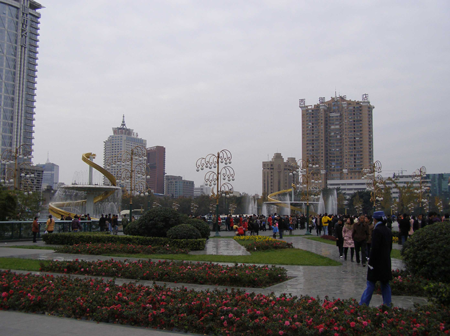
    Despite the slower pace of life, at least in comparison with the rest of China’s hyper urbanity, the Central Government has recognized the city’s advantages. Being the western-most big city in China, Chengdu is China’s gateway to central Asia. As such, the city has been identified as an air traffic hub. Already, Chengdu International airport is one of the busiest in the mainland. Next year, Air China inaugurates its new Chengdu-Los Angeles route: the first direct flight from the city to the United States.

    The new Air China route to LA reflects the growing presence of U.S. firms in the area. Technology companies like Microsoft and Intel have realized the competitive advantages of opening research and development facilities in an area of the country where the cost of doing business is still relatively low. These firms have located their offices in an area in the south of Chengdu that has been designated as the ‘Hi-Tech Zone’ by China’s Ministry of Science and Technology.

    Along with becoming western China’s high tech center, the city is grabbing a foothold on the country’s aviation industry. Chengdu Aircraft Industrial Group (CAC), which was contracted out by Dallas-based Vought Aircraft, supplied the rudder for Boeing’s new 787 ‘Dreamliner’ jet. CAC also supplies parts for Boeing’s 757 series.

    To accommodate the new business, the city is going through a construction boom. Although Chengdu had a late start on its eastern counterparts, the city is attracting high-profile developers like New York-based Tishman Speyer and Singapore’s CapitaLand – both of whom currently have large-scale commercial and retail projects being built in the city. Chengdu has even recruited Hong Kong businessman Allan Zeman to develop a version of Hong Kong’s popular nightlife district, Lan Kwai Fong, scheduled to open in March.

    The city’s development would not be complete without an overhaul of its transportation system. One word summarizes the current state of Chengdu’s roads: chaos. The traffic on the streets remains an assortment of bicycles, motorbikes, automobiles and buses. Yet, as incomes rise and more people purchase cars, the congestion on the streets is becoming unbearable. Furthermore, the fact that the streets do not follow a formal grid pattern, but rather array out from the center of the city, adds another degree of complexity to Chengdu’s traffic dilemma.
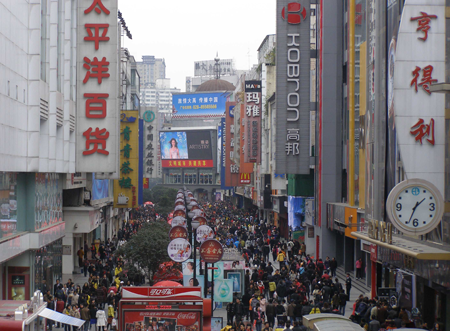
    Thankfully, the city’s first subway line is slated to open in 2010. As additional underground lines become operable, it will also give the city a better sense of cohesiveness as the limited number of surface level crossings of the Jin River currently contributes to both a physical and psychological divisiveness.

    In discussing the rise of Chengdu as a hotbed of economic activity, it is worth mentioning the city’s relationship with its closest rival, Chongqing. Chongqing, which was separated from Sichuan Province in 1997 to become an autonomous provincial-level municipality, lies just over 200 miles to the east. The city has the advantage of direct access to the Yangtze River, providing a strategic connection to the river’s terminus of Shanghai.

    Chongqing’s urban development is limited by the surrounding mountainous terrain-thus the reason for the dense high-rise jungle rising in the skyline. Chengdu, in contrast, has an abundance of land for growth and is more likely to sustain long-term development. Also, the fact that Chongqing has been plagued by corruption and local mafia activity in recent years means that foreign firms may be more attracted to safer Chengdu.

    That is not to say that there is not room for both cities in China’s future. In fact, the two cities are likely to form what will become the Chengdu-Chongqing mega-region – the economic powerhouse of western China. Already, other mega-regions in China like the Bohai Bay Rim (Beijing, Tianjin and Dalian), the Yangtze River Delta (Shanghai, Hangzhou, Nanjing and Suzhou) and the Pearl River Delta (Guangzhou, Dongguan, Shenzhen, and Hong Kong) are setting groundbreaking standards in the history of global urbanization.

    The Sichuan earthquake of 2008 managed to bring about an awareness of the major issues still facing China. In stark contrast to the days of the Cultural Revolution when urban areas were viewed as pariahs, the Sichuan quake solidified the triumph of the city over the countryside. As the city on the frontier, Chengdu is likely to become a key player as thousands of migrants arrive from Sichuan and adjacent provinces. How these newcomers are incorporated represents a great challenge for China as it shifts from a largely rural to a predominately urban country.

    Adam Nathaniel Mayer is a native of California. Raised in Silicon Valley, he developed a keen interest in the importance of place within the framework of a highly globalized economy. Adam attended the University of Southern California in Los Angeles where he earned a Bachelor of Architecture degree. He currently lives in China where he works in the architecture profession.

  • Beijing is China’s Opportunity City

    “What the Western fantasy of a China undergoing identity erasure reveals is a deep identity crisis within the Western world when confronted by this huge, closed, red alien rising. There is a sense that world order is sliding away from what has been, since the outset of industrialization, an essentially Anglo-Saxon hegemony, and a terrible anxiety gathers as it goes.” – Adrian Hornsby, “The Chinese Dream: A Society Under Construction”.

    One year after the conclusion of what may have been the most bombastic Olympic Games ever staged, the host city of Beijing has solidified its position as a growing influential global metropolis. While the rapid pace of change and development in China is well-documented by the Western media, the foreign consensus regarding The Middle Kingdom’s ascendancy to global super power remains decidedly ambivalent. Yet a closer look at China’s second largest city may yield a different, more promising outlook for this gigantic yet mysterious country.

    Much like London was to England in the 19th Century and Los Angeles was to the U.S. in the 20th Century, Beijing is today ground zero for opportunity in China. Shanghai holds on to its reputation as the country’s most cosmopolitan city and banking center, but Beijing continues to strengthen its role as political and cultural hub of China.

    To call Beijing an ‘opportunity city’ is counterintuitive based on its monumental physical characteristics and history as imperialistic capital. Home to the massive Forbidden City and the adjacent Tiananmen Square, the city is defined by a tradition of architectural pomposity. Continued today in buildings like the Olympic Bird’s Nest Stadium and the ominous CCTV Building, subtlety and grace are not Beijing’s strongest suits. Yet underlying these iconic structures is a restless population of 17 million, including many newcomers eager about the prospect of upward mobility.

    As construction of new buildings came to a screeching halt in the U.S. late last year, I also heeded the call of opportunity and headed to Beijing myself. My story is not unique in this regard as the phenomenon of recent American graduates moving to China for jobs was documented earlier this month in an article from the New York Times. Now working with a young, up-and-coming Chinese architecture firm, I am bearing first-hand witness to phenomenal changes.

    Problems exist of course, but criticizing Beijing or the rest of China from afar for its poor air quality or the rampant destruction of its old neighborhoods is too easy. The reality underlying these problems is much more complex, much of it depending on varying perspectives of how Westerners as opposed to Chinese view the country’s direction.

    For instance, Western planners and architects lament the razing of the charming alley and courtyard Hutong neighborhoods as significant losses of urban history. Yet most Chinese people view the process of destruction and rebuilding as a necessary piece of the modernization of their country. As 21-year-old film student and native Beijinger Ashley Zhang observes, “Although the loss of the Hutongs is sad, the reality is that most people would prefer to live in modern buildings where they do not have to go outside and use a shared bathroom or live in an old structure where they are going to be cold during the winter.”

    Other Beijingers have noted how owners of homes in Hutongs are more than willing to trade in their digs for large paydays. Ms. Zhang went on to explain to me that a “change in accommodations will not necessarily alter the spirit or the culture of the Chinese people”. This presents a markedly different perspective from the Western view on the relative importance of permanence in the built environment.

    It could be argued that a true sense of Chinese-ness exists more in the tradition of language and cuisine than in the built form. As such, the new and prolific building and infrastructure projects of China represent more a desire to join the modern world rather than to celebrate its architectural history.

    Yet to say that there is no urban planning in Chinese cities would be off the mark. As put forth by the Beijing Municipal Commission of Urban Planning in 2004, the ‘Beijing 2020 Masterplan’ calls for high intensity development eastwards towards Tianjin and low intensity development westward towards the mountains. The ‘Two Axes, Two Corridors – Multicenters’ Plan’ aims at relieving congestion towards the historic center of Beijing by strengthening outlying polycenters.

    Lisa Friedman of the New York Times recently lambasted the city’s development pattern as Beijing locking itself into a pattern of Los Angeles-type sprawl. In fact, Beijing’s polycentric development can be attributed to the fact that the historic core of the city is already well defined and remains off-limits to new development.

    Also, contrary to most American cities, the designated ‘Central Business District’ lies east of the center of the city. Concentrations of jobs form other business ‘nodes’ in all directions around Beijing. This is not due to any desire to copy Los Angeles per se but rather because the city is gaining tremendously in population and must ‘sprawl’ in order to accommodate these newcomers. In addition, businesses prefer to set up shop in places where land is cheaper.

    Detractors of rapid urban development like to note how sprawl creates unbearable automobile traffic. Yet they forget that the first great exemplars of “sprawl” – London and Los Angeles – did so with massive commuter rail systems long before the rise of LA’s freeway system or London’s ring roads.

    In fact what you have in Beijing is sprawl abetted by a Metro system that would be the envy of American public transportation enthusiasts. There are currently six subway lines operating in the city and in addition, 10 new lines which are under construction are all slated to be completed by 2015. In the end, Beijing’s rail network will constitute 350 miles of track. Compare that to Los Angeles, which destroyed its own huge rail system in favor of buses, where a planned ‘subway to the sea’ consisting of a mere 14 miles of rail is estimated to not be completed until the year 2036.

    Beijing is well on its way to ‘megacity’ status. Along with the city of Tianjin, about 70 miles southeast of Beijing, the Beijing-Tianjin mega-region will be one of the largest in the world. Tianjin, as the fifth-largest city in China and boasting a population of about 11.5 million residents, is going through a building boom of its own. Acting as Beijing’s main port, the two cities together form an economic powerhouse. The marriage between the two cities was consummated a year ago with the opening of the 350 km/h (217 mph) Beijing-Tianjin Intercity Rail – reducing travel time to a mere 30 minutes. I rode this train myself recently and had to cover my eyes from the constant flashbulbs going off recording the speedometer on the monitor in the front of our car.

    China has come a long way since the days of Chairman Mao’s ‘Great Leap Forward’. Although still ‘Communist’ in terms of a political system of one-party rule, traversing the streets of Beijing gives the impression that China may in fact be the most capitalist place on earth. From weather-worn women selling fruit to crafty young men hawking fake watches and pirated DVDs, no piece of the city is off-limits to commerce.

    There’s a huge generation gap between the younger generations and those who were unfortunate enough to have lived through the Cultural Revolution. But I would warn Westerners to not be fooled into thinking that China will forever be just a ‘cheap place to manufacture things’. The country is still very young, and as more young people get educated and travel abroad, China will evolve into an important player in everything from architectural design to green technology and the arts. At that point in time, sadly, there will no longer be any need for ‘Western experts’ like me. But for the time being, as I wait for our economy to recover, I am enjoying the ride as I witness perhaps one of the most compelling urban development stories of the 21st Century.

    Adam Nathaniel Mayer is a native of the San Francisco Bay Area. Raised in Silicon Valley, he developed a keen interest in the importance of place within the framework of a highly globalized economy. Adam attended the University of Southern California in Los Angeles where he earned a Bachelor of Architecture degree. He currently lives in Beijing, China where he works in the architecture profession.

  • San Jose, California: Bustling Metropolis or Bedroom Community?

    Dionne Warwick posed the question more than 40 years ago, yet most Americans still don’t know ‘The way to San Jose’. Possessing neither the international cachet of San Francisco nor the notoriety of Oakland, San Jose continues to fly under the national radar in comparison to its Bay Area compatriots. Even with its self-proclaimed status as the ‘Heart of Silicon Valley’, many would be hard pressed to locate San Jose on a map of California.

    More well-known American cities may try to gain population by branding themselves as interesting places, but San Jose does not struggle to attract newcomers. Sprawling over 178 square miles, San Jose sits at the southern end of the San Francisco Bay. This year the city exceeded the 1 million population mark for the first time.

    So what makes this city, the 10th-largest in the United States, appealing? Unlike its precious neighbor 50 miles to the north, San Francisco, people move to San Jose primarily for jobs – especially those related to the coveted technology sector. Whereas San Francisco balances its role as playground for the independently wealthy and welfare state for the lumpenproletariat, San Jose remains favored among families and those looking for a safe environment in which to raise children – not to mention, the weather is better.

    San Jose does not stimulate a sense of urban exaltation. Aside from a commercial downtown core with a collection of mediocre high-rises (limited in height due to do downtown’s adjacency to the San Jose Airport), the city is unapologetically suburban in a character.

    San Jose’s pattern of development can be traced back to its origins as an agricultural community supporting early Spanish settlers who chose to settle in the fertile Santa Clara Valley. It remained a modest-size agrarian community until the end of World War II when it underwent a period of rapid expansion-not unlike that of Los Angeles to the south. During the 1950s, with the emergence of semiconductor technology derived from silicon, San Jose and the greater Santa Clara Valley exploded into a center for the evolution of computer technology.

    Today, San Jose can best be understood by its ambivalent relationship with neighboring Silicon Valley cities. Mid-size suburbs such as Cupertino, Sunnyvale, Mountain View and Palo Alto, all located west/northwest of San Jose as one travels up the peninsula towards San Francisco, are very distinct and separate entities. Home to some of Silicon Valley’s heaviest hitters (Cupertino has Apple, Sunnyvale has Yahoo!, Mountain View has Google, Palo Alto has Hewlett-Packard, Facebook and Stanford University), these cities largely define the technology-focused region. To be sure, San Jose’s has its share of big players, including eBay and Adobe as well as the ‘Innovation Triangle’, an industrial area of north San Jose, home to the headquarters of large companies like Cisco Systems and Cypress Semiconductor.

    Yet, despite the presence of these firms, San Jose has become ever more a residential community, with among the worst jobs to housing balances in the region. Furthermore, a whopping 59% of the city’s developed land constitutes residential use – 78% of that being single-family detached housing. In this sense, despite being the largest city, San Jose essentially serves as a ‘bedroom community’ for the rest of Silicon Valley.

    This has been a burden for the city, which, unlike its neighbors, lacks enough large information technology companies to help fill their tax coffers. In contrast job rich ‘green’ cities like Palo Alto have remained staunchly ‘anti-growth’ regarding residential development and consequently have very high housing prices.

    This pattern poses fiscal problems for San Jose. City officials have long been aware of the need to stimulate economic development instead of continuing to lose out to its neighbors but the city seems determined to increase further its role as dormitory for its neighbors. Indeed, amazingly the city’s development agenda has in recent years shifted to a relentless focus on high-density, multi-family residential in the downtown core and along transit corridors. In 2007, 79% of all new housing built in San Jose was multi-family – a staggering deviation from its history of low density development.

    Though well-intentioned, the slant towards densification has yielded a glut of empty condo units throughout the city. Those that have purchased units in new developments often find themselves with underwater mortgages. During a recent visit to one the flashy new downtown condo buildings, The 88, I entered a desolate sales office and was greeted by a skittish sales agent. When asked how sales were, my question was deferred without a direct answer in an act of not-so-quiet desperation.

    Although it’s clear most people in San Jose prefer lower density living, the city government continues hedging tax dollars against a future in which newcomers will want to live in a high-density setting. Outside of downtown, low to mid-rise multi-family housing has been built along the city’s light-rail lines in what are conceived to be ‘transit villages’. The popularity for such a lifestyle is questionable given the high price point and unreasonable HOA dues of these condo units, particularly when single-family detached houses can be purchased at comparable prices.

    Despite these issues, San Jose seems hell-bent on its path towards densification. The city has major plans to develop the area around its Diridon Train Station, just west of downtown, as California High-Speed Rail and BART are projected to make their way to San Jose. Furthermore, the city government is counting on the Oakland A’s baseball team making a move to San Jose.

    From the Champs-Élysées to Tiananmen Square, grand urban visions are what have defined cities historically. As a product of the Silicon Valley ethos as well as an observer of planning trends, I would argue that this is no longer valid – especially for any city with the hopes of a prosperous future. Rather, in democratic societies, it will be the idiosyncrasies of individual actors and the prospect of upward mobility that will define a sense of place.

    Obsessed with density and urban form, planners don’t seem to grasp the chicken and egg conundrum – the notion that lifestyle amenities follow on the heels of economic opportunity. San Jose needs to cast its future on nurturing its entrepreneurs instead of trying to become something it is not yet ready to become.

    Adam Nathaniel Mayer is a native of the San Francisco Bay Area. Raised in the town of Los Gatos, on the edge of Silicon Valley, Adam developed a keen interest in the importance of place within the framework of a highly globalized economy. He currently lives in San Francisco where he works in the architecture profession.

  • Millennials’ First Recession

    Each generation has been affected differently by the deepening global recession. Baby boomers have witnessed their retirement savings evaporate into oblivion. Generation X families who finally saved enough for a down payment on their first house find themselves deep underwater without SCUBA gear. And earnest Millennials fresh out of college are wondering where all those high-paying jobs promised by duplicitous corporate recruiters went.

    No doubt the economic collapse is most palpable for the Boomer generation. Closing in on retirement, many are now holding off on purchasing that winter home in Florida. Moreover, many Boomers have no other choice but to delay retirement (provided they have managed to keep a job) in order to maintain current lifestyles.

    Ironically, this may not be too much of a stretch for the ‘forever young’ generation who has come to define themselves by their occupations. Yet this does pose a problem from those who are actually young and currently entering the workforce.

    Over the past few months I have witnessed many of my 20-something peers lose their jobs – not to mention me as well. This contradicts the popular, yet flawed notion that ‘technologically savvy’ Millennials are rendering older workers obsolete. It is clear now that upper management at corporations across the country have opted for a more conservative approach to hunkering down. This includes letting go of those with less experience (low on the company ladder) and closing the door completely to new hires out of college.

    Justin Pope of the Associated Press has confirmed that college graduates face the worst job market in years. As is indicated in Pope’s article, employers plan to hire 22% fewer graduates this spring – an alarming statistic reported from a survey conducted by the National Association of Colleges and Employers.

    Perhaps one of the more unnerving new realities spawned by the recession is what appears to be the diminishing returns to education. Even those graduating with J.D. or M.B.A. degrees find themselves in panic mode. Traditionally, these prestigious degrees meant relatively high salaries right out of grad school. Yet with law firms laying off in droves and corporations slashing entry-level positions, not only do graduates with fresh Master’s degrees find themselves without any job prospects, many are stuck with exorbitantly high student loan bills.

    So what are Millennials doing to ride out the storm? Those who do have jobs are hanging on for dear life. Some are applying to graduate school with the hopes that the economic climate will be better by the time they graduate. Others, like 26 year-old Michael Kaainoni have opted to move back home.

    After graduating from Columbia University with a Masters in Architecture degree last year, Michael landed a job at a large international architecture firm in Manhattan. Only months later, he found himself caught in a wave of corporate downsizing. Rather than scrape by and continue to pay ridiculous New York City rents, Michael opted to move back to his hometown of Kailua, Hawaii. Now living back in Hawaii, he works for a local architecture office that gets steady commissions from the government.

    Michael’s story is not uncommon for young people these days. The Millennial generation does not share the same horror about moving back home as the rabidly ‘independent’ Boomers or Gen Xers. Rather than seeing a retreat back to the nest as taboo, many Millennials will tell you that this is just smart financial planning.

    In many ways the Millennials may be following not the boomers but the experience of immigrants. For decades strong family networks have allowed immigrants to the U.S. to become ‘upwardly mobile’ despite all sorts of disadvantages from lack of English fluency to discrimination. Now that this secret is out into the mainstream consciousness, the ‘going it alone’ mentality is rapidly disappearing. Familial and community support networks are making a strong comeback out of financial necessity – and probably for the better.

    Writer Tamara Draut focuses on the financial plight facing young people today in the book “Strapped: Why America’s 20- and 30-Somethings Can’t Get Ahead”. In her book, Draut explains why young people in the workforce might seem too eager to get ahead:

    “If today’s young adults can be accused of wanting it all too soon, the ‘it’ isn’t riches, gadgets, or luxury cars. The elusive ‘it’ that today’s twenty-somethings are after is financial independence, and then hopefully, financial security.”

    Derided as the ‘everyone gets a medal’ generation by cultural commentators who believe that young people today have a bloated sense of self-esteem, most Millennials just want to live secure, modest lifestyles. This observation goes against everything that civic boosters and urban real estate speculators have hoped for during the recent boom years.

    With the notion that lifestyle trumps employment, urban planners have been deluded into thinking that by turning cities into expensive playgrounds, they will attract the best and the brightest young workers. This was an idea touted by urban theorist Richard Florida in his highly influential book “The Rise of the Creative Class”. Florida claims that, according to his focus groups, young creative people do not want to live in places that “do not afford a variety of ‘scenes’”.
    The idea that young people can choose their city at will based on lifestyle preference does not make much sense given the current economic circumstances. Job opportunity and affordability, not to mention family ties, are more likely to dictate where young people end up settling now and in the immediate future.

    Furthermore, many of the ‘lifestyle amenities’ – such as cool coffee shops, farmer’s markets, and culturally diverse restaurants – desired by these young creatives can now be found in more affordable environments outside of the traditional urban core.

    By the time this recession is over, Millennials may have passed their ‘city phase’. This spells bad news for places that have banked on spurring a renaissance driven by young people who often like urban settings but can no longer afford the luxury. Neighborhoods like San Francisco’s SoMa or downtown Los Angeles could be the losers. Cities completely missed the boat by allowing greedy real estate developers to build expensive condos for a largely ephemeral surge of Boomer empty nesters while ignoring basic issues like quality of life, safety and affordability.

    Millennials will bounce back. As the youngest generation in the workforce, they will be defined by the experience of the current economic slump and take its lessons with them throughout their lives. Instead of greed and selfishness, which is likely to define the Boomer legacy, Millennials will more likely resemble that of their grandparents’ generation – one where family and frugality is valued over individuality and self-interest.

    Adam Nathaniel Mayer is a native of the San Francisco Bay Area. Raised in the town of Los Gatos, on the edge of Silicon Valley, Adam developed a keen interest in the importance of place within the framework of a highly globalized economy. He currently lives in San Francisco where he works in the architecture profession.

  • The Former East Germany: Is It Time for Red Nostalgia?

    2009 marks the 20th anniversary of the reunification of East and West Germany into one country. Germany was divided into two separate nations with competing economic and political ideologies. Now it’s time to reassess the results of this melding of two very different systems and the impact on the urban environment.

    Emerging from the ashes as one of the world’s most powerful economies, Germany may be the quintessential example of the triumph of capitalism over communism. Yet now with Frankfurt’s powerful banking sector reeling from the global economic meltdown, reticent Marxists may well be coming out of the woods to proclaim the death of capitalism.

    The sentiment for a bygone communist dream still exists for a small minority of those living in the former German Democratic Republic (GDR), where the unemployment rate has hovered around 18% since reunification. After a recent trip, it seems clear economic growth has stagnated. Job opportunities remain very limited. Rather than attract people with its lower costs and new opportunities, the region continues to see a strong outflow, particularly among the young.

    Yet all is not hopeless in the area comprising the former GDR. The crumbling of the wall and subsequent mass exodus of East Berliners to the west may remain the most vivid symbol of reunification, but the story remains decidedly mixed in Leipzig – the second largest city in the former GDR after Berlin.

    Leipzig can be considered the birthplace of the anti-communist revolution. On October 9th, 1989, in what is known as the “Monday Demonstrations”, protests in Leipzig (pronounced lipe-tsig) came to a head. In what some feared at the time would become another Tiananmen Square nightmare, 70,000 demonstrators peacefully took to the streets chanting, “We are the people”. The Monday Demonstrations served as a turning point in the quest towards reunification. Having witnessed the courage of the citizens of Leipzig, others trapped in the GDR came out and made their voices heard. One month after the Monday Demonstrations, the Berlin Wall came down.
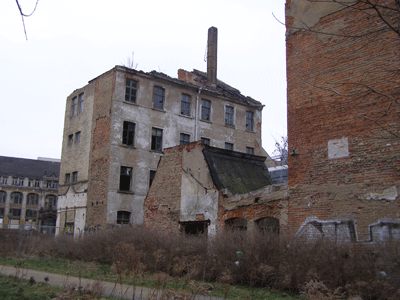
    With just over 500,000 residents, Leipzig is the largest city in the German state of Saxony. Roughly 90 miles south of Berlin, the city lives in the shadow of the much more “sexy” and culturally apt German capital.

    The city has a considerable history, even prior to the events following World War II. Leipzig residents included such notable individuals as the mathematician Gottfried Leibniz and composers Johann Sebastian Bach, Richard Wagner, and Felix Mendelssohn. The playwright Goethe attended the University of Leipzig and referred to the city as ‘little Paris’ in his seminal work Faust. In 1813, Napoleon Bonaparte and his troops were dealt a strategic defeat there in what became known as ‘The Battle of Nations’. More recently, Carl Friedrich Goerdeler, the Mayor of Leipzig from 1930 to 1937, is remembered as being one of the staunchest opponents of the Nazi regime.

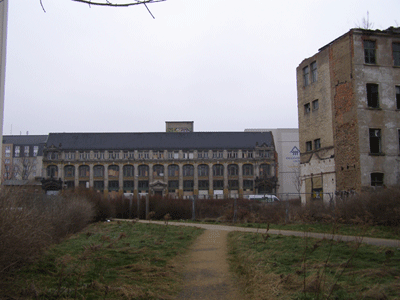
    It is difficult to imagine the breadth of this history while traversing the streets of Leipzig today. The city still certainly has its share of old and beautiful architecture, but much of this is now abandoned, with many structures adjacent to the central core covered in graffiti. In this regard, Leipzig looks like the German equivalent of a decaying American rust-belt city.

    The derelict atmosphere that a new visitor may sense upon arriving in Leipzig is at least partly due to the fact that many long-time residents still live in Soviet-style communist housing blocks at the peripheral edges of the city. Known as Plattenbau, or “plate buildings”, these ubiquitous and dehumanizing structures were communism’s answer to the issue of quickly re-housing East German citizens displaced by the ravages of war. Building these massive housing structures far outside the center also had the advantage of locating workers closer to places of industry.
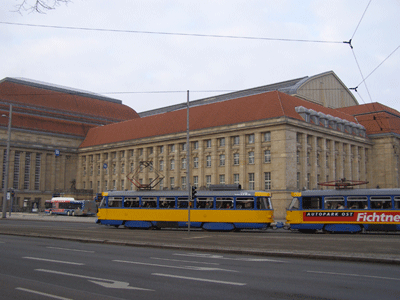
    Taking into account Leipzig’s urban planning policies under communism, it is no wonder that neighborhoods near the city center appear neglected. Yet, stepping into the pedestrian-only heart of the city also tells a much more encouraging story. Unlike the often failed policies of many American cities to spur a “downtown renaissance”, Leipzig has had considerably more success at revitalizing its once thriving core.

    This is apparent by the number of construction sites around Leipzig’s central core. The city still has the advantage of possessing a significant stock of aesthetically appealing buildings, ranging in style from Baroque to Neoclassical. Furthermore, the University of Leipzig, one of Germany’s oldest, has taken the lead in making the city center a destination by consolidating its operations there. Currently, the University is constructing a new main building off of the city’s main square, Augustusplatz (formerly known as Karl-Marx-platz during the GDR).

    Public transportation is also a bright spot for Leipzig. Modern streetcars ride above ground to the outer limits of this concentrically laid out city. The efficiency of the streetcar system would turn any American public-transportation proponent green with envy. Moreover, the construction of an ambitious underground metro system is slated to be completed next year, further easing mobility for Leipzigers.

    Leipzig’s location in the central-north portion of continental Europe also has its advantages. As a node for the transport of goods and people through central Europe, the city serves as a bridge between Germany and the once burgeoning but now suffering Eastern European nations. Even so, over time it would be in the city’s best interest to further capitalize on this asset.

    Adding clout to Leipzig’s location as a transportation hub is the city’s central train station – one of Europe’s largest and most historically significant. Grand in scale, Leipzig’s Hauptbahnhof not only sees a great deal of rail traffic from all over Germany, the station doubles as a shopping center for those living in the city. Practically a second “downtown”, the central station boasts everything from a constantly busy grocery store to clothing boutiques, numerous cafes and even two McDonald’s franchises.

    Despite its inspiring history, famous university and state-of-the-art transportation, Leipzig still faces tremendous challenges ahead. The city is not only struggling to attract newcomers but to retain a new generation of Germans born to parents who still remember what it was like to live in the GDR. Economically speaking, Leipzig stands little chance competing with other German cities in the west such as Frankfurt, Cologne or Munich where there are many more job opportunities. Aside from a plant that assembles Porsche’s struggling Cayenne line of SUVs – itself now threatened for both economic and environmental reason – industrial activity in Leipzig is limited. And with the Bohemian behemoth of Berlin not far away, Leipzig would be hard pressed to realize a full renaissance of its status as a prime destination for arts and culture.

    What does this mean for the future? In a sense, Leipzig’s problem is the same problem facing the entire region that comprises the former German Democratic Republic. The issues have been hotly debated in Germany since reunification. Some in the western parts of the country regard cities in the east as a lost cause. Contributing to the contentiousness of the debate is the ‘Solidarity Tax’ instituted to aid in the reunification process. At a rate of 5.5% of annual income tax, many Germans feel their tax dollars are being squandered on frivolous projects in the former GDR – projects that will have little to no impact on those living in the west.

    The renovation of the city center and the construction of the new Leipzig underground metro are examples of projects that benefit from funding from the Solidarity Tax. The key issue now is to see if the eastern cities themselves can use the generous government support and newfound infrastructure to stimulate economic activity and create jobs that will keep people from leaving for good. If this is not addressed immediately, the future of the former GDR looks bleak. The last thing Germany needs, especially in these times of global economic turmoil, is for those living in the east to become nostalgic for the days before the fall of the Iron Curtain.

    Adam Nathaniel Mayer is a native of the San Francisco Bay Area. Raised in the town of Los Gatos, on the edge of Silicon Valley, Adam developed a keen interest in the importance of place within the framework of a highly globalized economy. He currently lives in San Francisco where he works in the architecture profession.