Author: admin

  • Ten American Experiences: A Fourth of July Meditation

    The Fourth of July is a good time to ask the question: what exactly are we celebrating when we celebrate “America?” Is it a set of ideals and principles rooted in the Enlightenment? Is it a blood-and-soil nation on the American continent, with unique institutions and culture? Is it an idea that happens to have a nation, a nation that happens to have an idea, or something else entirely?

    Another way to define it might be an empirical account of various American experiences. What follows, then, is a narrative litany of what this writer believes to have been the most influential historical experiences shaping Americanism in every epoch of our existence as a nation, from colonial days to the present. Together, in their creative tension, they contribute to the great American story and conversation, full as it is with contradictions and irregularities.

    Of course, in these polarized times, there’s the political question. Some of these experiences, for one reason or another, are distasteful to modern observers of whatever political persuasion. Some might willfully abandon their legacy, out of hopes to build “a better future.” But we cannot forget our own past, or our civilization will fail to thrive beyond its fourth century of existence.

    Ten Experiences that defined America.  

    1. The Origins.

    Americans came from somewhere- the first settlers were different groups of colonists from various parts of England. David Hackett Fischer’s magisterial study of American origins, Albion’s Seed, documents this brilliantly. At a foundational level, America remains and always has been an Anglo nation-state with a powerful yet flexible core cultural heritage. The English language, traditions of common law, and the Protestant influence on American individualism, philosophy, and civic culture and community are all undeniably components of the American identity at a very basic level.

    2. The War of Independence.

    It was the American Revolution that granted our nation its nationhood. Whereas the colonial experience had been a conservative affair of the transference of culture from one side of the Atlantic to the other, the American Revolution sparked the beginnings of American radicalism and universalism, the exuberance and triumphalism of a newly-awakened people firm in the belief that they had Providence on their side.

    3. The Constitution.

    The Revolution won but did not secure America’s liberty- that important work was done by the Framers of the Constitution, who through toil and conflict, reflection and compromise, designed the framework and foundations of a constitutional republic. The Constitution’s checks and balances and divisions of authority, the federal system of state and national sovereignty, a national government that was energetic and powerful, yet limited and constrained, and capable of addressing the great issues of the day and many days beyond, all contributed to the successful organization of the thirteen states and their western territories into a great new federal union. This federal union alone could preserve the liberty of the American people.

    4. The Rise of Jackson.

    The basically aristocratic culture of the early Republic would not outlive the Framers. The Jacksonian Revolution of the late 1820s and 1830s would forever change the culture of American politics, decisively shifting American legitimacy from a mere faith in institutions to something looking more like a democratic “common will.” It would infuse American politics with a common man’s ethos of simplicity, tradition, people’s wisdom, and folk culture, and would turn “democracy” from the dirty word of the Federalists into the litmus test for American statesmen for generations to come. By some measures, America was first truly “American” upon the onset of this democratic ethos.  

    5. The Civil War.

    Upon Abraham Lincoln’s election to the Presidency in 1860, America’s Iliad broke out and consumed the young nation. The Union cause in the Civil War was in some ways a radical affair- the erasure of Southern plantation culture, the expansion of freedom and franchise to more Americans than ever before, the coming hegemony of free-labor industrial capitalism- but in the eyes of the Republicans and the Union Army’s general staff, it was a conservative project. The preservation of the Union, and of American power over the Continent, was the crucial question. The Civil War’s conclusion ensured that the Union, which by now stretched across the American continent from sea to shining sea, would be preserved in whole and not in parts. It would remain the great power it was, positioned towards even higher greatness in the decades and centuries to come.

    6. The Western Migration.

    Long before Fort Sumter, the American people were being shaped by their expansion across the American continent. Americans pushed further and further West, in great numbers starting in the 1830s, and would continue to do so until they’d populated the entirety of American territory between the Mississippi and the Pacific in the late 19th century. As Frederick Jackson Turner argued in The Significance of the Frontier in American History, the land and its conditions left its mark on the culture and society of those who crossed it and settled it. The poet Sam Walter Foss, speaking as the American continent, asked for “Men to Match My Mountains,” and the American people obliged.

    7. The Industrial Revolution.

    Matching the individualist ethos cultivated by the experience of the Westward movement was an entrepreneurial ethos- a great knack for management and organization and innovation, a brilliance and genius rooted in benevolent acquisitiveness, all of which inspired and drove American inventors, investors, and captains of industry. Over the course of several great industrial revolutions, starting in the early 1800s and still ongoing, Americans built titanic industries, infrastructure, and cities, harnessed the power of every natural resource conceivable, and invented contraptions and machines that sent men to the moon and split the atom.

    8. The Progressive Era and the New Deal.

    The excesses and social dislocations of industrial capitalism precipitated a great social crisis, and by the turn of the 20th century, Americans clamored for major reforms in their governing institutions. Some of these efforts were quite radical- the great labor strikes, populist politicians, and socialist movements of the early 20th century have gone down into legend, and few remember today that between the 1880s and 1910s, a few Presidents of the United States were shot by anarchist terrorists. Conservative statesmen and radical reformers joined hands in compromise to reform institutions to quell the social crisis. Americans built up a federally-sponsored safety net and welfare state, a system of collaborative enterprise and regulation, and a government promising a better quality of life for all citizens. The notion that the government ought to serve its people in all ways possible, and marshal resources for national ends, remains integral to American political culture.

    9. World Leadership.

    These modernizing reforms bound the American people together at home just in time for the great Eurasian crises of 1914-1991. The crisis of imperialism in the First World War, and the rise of Fascism and Communism in the 1930s, and our subsequent involvement in the Second World War and competition with the Soviets in the Cold War, stretched our resources and our need to defend the homeland to degrees never before known.  The architects of post-1945 American foreign policy institutionalized the stewardship of international institutions, the maintenance of a navy that could command the seas and keep open the sea lanes of trade, and the preservation of a peaceful balance of power between the most powerful nations on the planet. The consummation of America’s role as a “city upon a hill” and a “light unto the nations” took its fullest form when America assumed the mantle of world leadership- and this has been integral to its self-image ever since.

    10. The Civil Right Movement.

    In the 1950s and 1960s, the Civil Rights Movement- building off of earlier antecedents including Temperance, Abolition, and Women’s Suffrage- successfully enshrined equality before the law, for people of all races and origins, into the American national identity. It paved the way for a fuller integration of people from around the world into the American experience. Its legacy is still felt acutely today, when questions on immigration, civil rights, and American identity frequently bubble up to the foreground of public discourse. More than any of the other American experiences listed here, this one is still ongoing.

    The Future

    We can imagine future “American experiences” that one hundred years from now may prove to be just as vital to the American identity as these ten listed have been. Perhaps the reform of the New Deal state towards a more localized, sustainable, and fundamentally workable system – something like the stymied “New Federalism” of the Nixon Administration, updated by the power of the Information Revolution – could transform American governance in the 21st century as did the Progressive and New Deal reforms of the 20th century. Another great quest with historic antecedents is the conquest of the Solar System: the rejuvenation of the American space program and the exploration and colonization of other worlds beyond the Moon. A great period of exploration can bring out the greatest facets of the existing American character and transform them into something new.

    One begins to notice a pattern, looking across American history: each of these experiences was in some ways conservative and in other ways radical, but distinctively one more than the other. The conservative transference of Anglo culture from the British Isles to the American continent; the radical universalism of the American Revolution; the conservative caution of the Framing of the Constitution; the radical experiments with Jacksonian Democracy; the conservative preservation of the Union in the Civil War; the radical egalitarianism and democracy of the Westward Conquest; the conservatism of culture and class wrought by the Industrial Revolution; the radicalism of the Industrial Age’s excesses, tempered into reforms in the Progressive Era and New Deal movements; the conservatism that went into building the Liberal International Order after the ravages of two world wars; and the fundamental radicalism and reformism of the Civil Rights Movement and its antecedents. Will all this be followed by a conservative reformation of American governance down to the localities? Will that be followed by the radical disruptive technological advancement of space colonization?

    In each case, a primarily radical historical experience was followed by a primarily conservative one, and so on and so forth. This should surprise no one, for America has always been a remarkably extreme nation with no less remarkable staying power. American schizophrenia has been a quality of our national existence for our entire experience as a people, and will surely remain with us until we’ve been extinguished from the Earth.

    Luke Phillips is a political activist and writer in California state politics. His work has been published in a variety of publications, including Fox&Hounds, NewGeography, and The American Interest. He is a Research Assistant to Joel Kotkin at the Center for Opportunity Urbanism.

  • Future Work: What, Where, and Why

    The growth industries and professions of the future will shape our cities in very different ways to the industries and professions that shaped our cities in the past. There are profound implications for urban planning and property, if we’re ready for them.

    The biggest growth industry for coming years and for the foreseeable future, the official forecasts all seem to agree on, will be in health care and social assistance. This includes professions from surgeons to GPs to nurses to child care or aged care, various therapies and counsellors, dental, and even laundry workers, cleaners and administrative support roles. Already our biggest single industry, it employs more than 1.5 million Australians. It grew by over 20% in the five years to 2015 and that rate of growth is unlikely to change going forward. Nearly half of everyone in this industry has a bachelor’s degree or some higher education qualification so they’re not all hospital cleaners – many will be skilled professionals.

    This will be followed by the professional, scientific and technical services industry and very close behind that, the education and training industry. Construction, manufacturing (yes, still growing despite all attempts to kill it off) and accommodation and food services round up the top six biggest growth industries of the future.

    This is important because the nature of the growth industries of the future and where they will be located is going to reshape our cities in a very different way to the industries that grew with and shaped our cities in the past. This was highlighted in a recent report on employment in the growing region of South East Queensland, prepared by Macroplan for The Suburban Alliance.

    The health care and social assistance industry is predicted by government authorities to grow more than any other industry in the years to 2041, producing around 220,000 extra jobs. But this industry has very different spatial needs to, say, the legal industry which has the highest inner city concentration of any occupation in the region. In health and social assistance, 200,000 of those 220,000 jobs will likely be in suburban business districts or otherwise scattered across suburbia. The biggest growth industry has little need or preference for clustering in the inner city.

    Consider the implications for transport networks, property development and urban planning. Our urban model, reflecting a 100 years of employment centralization, is changing to one of employment dispersal. Jobs are not moving from the city centre to the suburbs but the industries which fuel growth are changing, and with them, the patterns of employment location.

    Even in the professional, scientific and technical services industry, much of that future growth will occur outside the inner city. Take the generically titled occupation of “professional.” There were 284,300 of these in the South East Queensland region but only 24% of them in the inner city. A further quarter were in a number of defined suburban business districts and the balance – half – elsewhere in suburbia. This is our second biggest growth industry and those patterns of employment distribution are unlikely to change meaning of the 146,000 new jobs in this industry to be created to 2041, the clear majority will likely be suburban based.

    The third biggest growth industry with education professionals also shows little evidence of centralization – only 7% of educators are inner city workers the rest are suburban. Even for those who describe their occupation as “Chief executives, general managers or legislators” there are only 21% of them in the inner city. And for clerical and administrative workers, it’s a similar picture: only 22% are inner city workers. The rest are suburbia based.

    Engineers appear to have a preference for central locations with 42% of the 16,639 engineers of South East Queensland in the inner city as do the lawyers with 65% of them in the entire region to be found in the inner city. But there are only (fortunately?) just over 9,000 lawyers in the entire region so unless there’s to be an unpredicted explosion of work in the legal profession in the future it’s hard to see this occupation fueling demand for space and transport in the inner city of the future.

    Fifty years ago, cities were full of clerical and administrative, managerial and professional workers, shuffling in to centralized offices on trams or trains or buses to clock on at 9am and clock off at 5pm. In the suburbs there were centres of manufacturing and heavy industry. In fifty years’ time, our cities will have different industries generating the bulk of jobs and many of those jobs will need to be based in suburban centres to be closer to their markets or regional transport arteries.

    What’s that going to mean for urban planning, transport systems or property development? Will we see existing commercial and retail centres in the suburbs expand to accommodate a growing need for premises associated with health or medical professions, education or professional suites? Will our city centres evolve to become more entertainment, recreational and culture based hubs for the regions they serve, rather than largely just places of work?

    There’s much more to be explored in this because the implications are profound. Sadly, much of our thinking around urban planning seems firmly rooted in traditional models which owe more to a sentimental rear vision view of urban development rather than a forward looking one.

    Footnote: If you or your organization is interested in exploring what this means in more detail, or for specific regions, please just drop me an email. I’d be very interested to discuss with you. I’ve got a handy presentation which runs through all this in a bit more detail which I’d be happy to share.

    Ross Elliott has more than twenty years experience in property and public policy. His past roles have included stints in urban economics, national and state roles with the Property Council, and in destination marketing. He has written extensively on a range of public policy issues centering around urban issues, and continues to maintain his recreational interest in public policy through ongoing contributions such as this or via his monthly blog, The Pulse.

  • Connecticut’s Future is Suburban, Not Urban

    Connecticut is now grappling with a fiscal and economic crisis that, according to some leading Democrats, has been caused by ineffective urban policy. In late May, Hartford-based insurer Aetna confirmed long-discussed rumors that it will be moving its headquarters from Connecticut. General Electric announced plans to move from Fairfield, Connecticut to Boston in January 2016. Though the Great Recession officially ended eight years ago, state budget forecasters are projecting a $2 billion deficit for next fiscal year, or 11 percent of the budget. One policy report published in March, when rosier estimates pegged Connecticut’s deficit at only 9 percent, ranked Connecticut as having the 8th largest shortfall among American states. Hartford, the state capital, is on the verge of bankruptcy.

    What course should Connecticut take to stabilize government budgets and stimulate the economy? Gov. Dannel Malloy and Hartford mayor Luke Bronin believe that stronger cities are the answer. As Malloy said recently, explaining why his budget increases state aid for cities, “I think there is a body of people who don’t understand urban environments, and I think Connecticut has too long pursued a public policy of insufficient support for our urban environments.”

    But there are many questions to raise about just how vital urban Connecticut is to the state’s future. Connecticut’s major cities have their charms, especially Hartford and New Haven. But in terms of meeting the enormous fiscal and economic challenges with which the state is now faced, they are and will remain less important than its suburban regions.

    With all due respect to Gov. Malloy and Mayor Bronin, there’s a certain glibness in how they presume that Connecticut’s poor urban areas can be revitalized. It’s not as if their predecessors haven’t been trying. Any visitor to downtown Hartford and New Haven will be struck by several imposing works of mid-20th century modern architecture. Examples include Constitution and Bushnell plazas in Hartford and New Haven’s Temple Street Garage. These projects date back to the “urban renewal” era of the 1950s and 1960s, when massive government resources were devoted towards breathing new life into tired central cities.

    New Haven was nationally-renowned for its urban renewal efforts, both because it focused just as much on rehabbing old buildings as demolishing them . Mayor Richard Lee’s “human renewal” social service programs anticipated criticisms that poverty can’t be cured through real estate development alone. But the widely celebrated Mayor Lee failed to hit the mark. New Haven, the “Model City,” was rocked by a race riot in 1967, as was Hartford in 1969.

    Despite growing evidence that Connecticut cities were not coming back, urban renewal in modified forms would continue throughout the decades. In 1974, Hartford gained the “Hartford Civic Center,” (now known as the XL Center), a sports and entertainment venue where the NHL’s Hartford Whalers played from 1980 to 1997. The state’s convention center opened in Hartford in 2005, and a minor league baseball park just came online in April. And yet, among American cities with a population above 100,000, Hartford’s poverty rate is 8th highest in the nation. Mayor Bronin himself describes the current fiscal state of affairs in Hartford as “the largest budget crisis in our city’s history.”

    State government is not much better off. Connecticut’s budget deficit is driven by escalating costs for public pensions, which powerful government unions have balked at reforming, and weak tax receipts despite—or perhaps because of—a series of recent income tax hikes. Gov. Malloy, a progressive Democrat, has recently taken the position that trying to further increase the tax burden on the state’s 1 percent would be counterproductive.

    Urban revitalization is an unsound strategy for addressing budget deficits because creating strong cities is the work of generations. The secret of Boston’s success is reflected in a famous saying attributed to Daniel Patrick Moynihan: “If you want to build a world-class city, build a great university and wait 200 years.” Cities like New York that are now envied as talent magnets have had that reputation going back many years. Even in the 1970s, when New York was plagued by high crime and the threat of insolvency, it was still a national leader in finance, media and the arts.

    Bronin and Malloy have said that they understand Hartford can’t become New York or Boston. But among Hartford’s true peers—formerly industrial small and mid-sized cities throughout the northeast and Midwest—it is very difficult to find any examples of an authentic comeback city. In an analysis I recently wrote about Hartford, New Haven, Waterbury and Bridgeport, I found that, since 1970, the number of poor people living in these cities had increased by 56.1%, 40.8%, 153.6% and 86.3%, respectively. Over the same span, all have seen their total populations decline with the exception of Waterbury, which has grown by 1.7%.

    Despite all the hype over America’s urban renaissance, cities remain a tough sell for the middle class. However magnetic a city may be in attracting young millennials, as studies by William Sander of DePaul University and William Testa of the Chicago Fed have demonstrated, the more educated you are, the more likely you are to opt for suburbs when you settle down. If, 20 years ago, a given city had an underperforming school system that was unattractive to middle class families, it most likely remains unattractive to them now. According to the most up-to-date Census data we have, within most major metros, suburban areas are growing more rapidly than central cities.

    Connecticut is often associated with suburban blandness. But it happens to boast one of the most talented labor forces in the nation. A 2016 McKinsey report ranked Connecticut second among states in productivity (GDP per worker). Statewide, 16.6 percent of adults have advanced degrees, a rate which trails only Massachusetts and Maryland. (Only 6.7 percent of adults in Hartford have advanced degrees.) In coming years, the high levels of productivity and educational attainment among Connecticut’s suburban residents will be essential to any growth the state manages to achieve. Fairfield County Connecticut boasts some of the strongest public schools in the nation, whereas the state’s urban school districts remain troubled.

    As Connecticut officials contemplate a policy response to Aetna’s exit, it is crucial that they not lose sight of the following. We don’t know how to revitalize poor old industrial cities, especially small and mid-sized ones. Middle class families with children are opting for the suburbs just as reliably as in prior generations. One of the soundest economic development strategies is for a state to offer potential employers a productive and educated workforce, which Connecticut plainly does. State officials should build on current virtues, avoid chasing fads, focus more on budget discipline, and by all means stop trying to make Connecticut into something it’s not.

    Stephen Eide is a Senior Fellow at the Manhattan Institute.

    Photo by Doug Kerr, via Flickr, using CC License.

  • A New Age of Progressive Suburbanism?

    We are living in a global suburban age… While statistics demonstrate that the amount of the world population in metropolitan areas is rapidly increasing, rarely is it understood that the bulk of this growth occurs in the suburbanized peripheries of cities. Domestically, over 69% of all U.S. residents live in suburban areas; internationally, many other developed countries are predominately suburban, while many developing countries are rapidly suburbanizing as well.”

    That’s not some anti-urban crackpot statement (as some inner urban elites might think) but from the introduction to a biennial theme of the MIT Center for Advanced Urbanism (USA). They understand that suburban and regional centres are not irrelevant for the future economy but highly important.  MIT are a pretty credible lot – hardly likely to pursue fringe urban planning or economic theories.

    In Australia, however, that message is not getting through. From the Prime Minister, down, there is a sense of irrational exuberance that the jobs of the future will mostly be concentrated in our CBDs and inner cities. Urban planning which supports increased concentration of employment through generous infrastructure allocations to inner urban areas is the manifestation of this inner urban obsession.  And while CBDs and inner urban areas are lavished with costly projects designed mainly to benefit the minority of people who work there, suburban and regional centres – where the majority live, work and play – have been largely left to fend for themselves.

    This process started in the late 1990s and early 2000s, notions about the “creative class” — many of which are being re-examined by author Richard Florida in a new book —   was a cause celebre amongst planning and government circles. It was widely argued that to attract the creative class of worker (synonymous with high skills and the new economy) cities needed to invest heavily in the quality of life in their downtowns. This was a precursor to the inner urban hipster, and, when real estate prices, rose their successors, the rise of the inner-city latte set.

    This thinking fit in well with two other trendy theories, New Urbanism and ‘Smart Growth’ (which redefined suburban progress as urban sprawl). The collective wisdom moved from supporting a growing suburban realm to one that disparaged it: the burbs were for bogans, the home of sprawl, “McMansions” full of low wage earning, culturally deficient and poorly educated masses, eating fast food diets and slurping sugar drinks. Inner cities by contrast were for educated, cultured and knowledgeable people – who had little need for suburban spaces or suburban habits but greater need for inner city waterfront cycle ways, museums, theatres and quality restaurants run by notable chefs. And, of course, lots of baristas. 

    Urban planning shifted quickly to a highly-regulated approach which promoted much higher densities of inner urban housing (and limits on outward expansion) because, after all, the inner city is where everyone in the future will want to live, right? The promises of these regional planning policies bordered on messianic. Take this example from the “Draft Metropolitan Strategy for Sydney to 2031” from the early 2000s:

    “A home I can afford. Great transport connections. More jobs closer to where I live. Shorter commutes. The right type of home for my family. A park for the kids. Local schools, shops and hospitals. Liveable neighbourhoods.”

    And what have we got thus? Some of the worst housing affordability in the world. Worsening congestion. Longer commutes. Limited housing choice, much of it not ideal for raising families.

    The ongoing policy focus and infrastructure obsession with centralisation is utterly at odds with economic and community signals. New economy industries in technical, scientific or professional services, or health and social care, have little interest in centralisation. Digital technology has broken that tyranny of distance. Undeterred though, we continue to watch as political and industry leaders promote costly infrastructure projects that enhance and support further centralised employment and a concentration of amenity in inner urban cores enjoyed by a privileged, mostly childless minority.

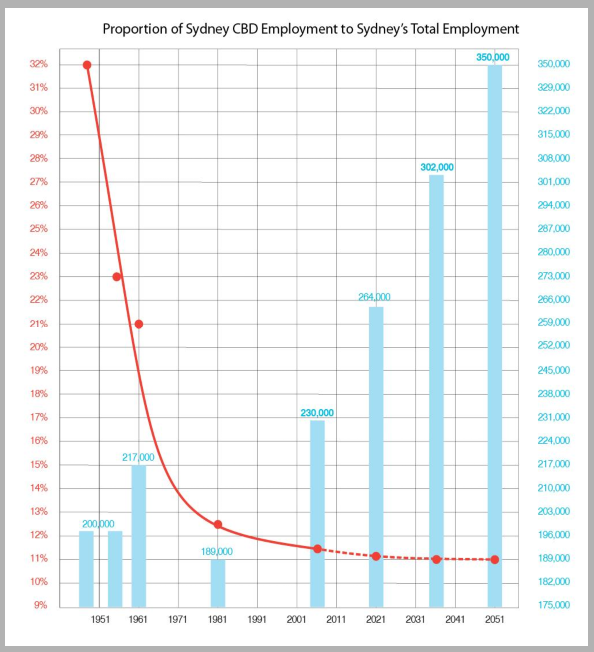
    For the record, the proportion of metropolitan wide jobs in the inner cities of Melbourne, Sydney and Brisbane was 11%, 13% and 12% respectively at the last census.  The reality remains that in our metropolitan centres, most people both live and work outside inner city bubbles of privilege. 

    The penny is finally dropping in some minds. Former Victorian Planning Minister, Matthew Guy (now Opposition Leader) once extolled the virtues of high density inner urban development. Looks like he has had a Damascus moment, commenting in The Australian (March 1, 2017) that: “Victoria is becoming a great, heaving, unsustainable mess. The whole of Victoria is just becoming an offshoot of Melbourne.”

    The emphasis on centralisation of jobs, housing and supportive infrastructure makes little sense in a country with such large land masses and capacity for expansion. Not only that, but the economic winds – enabled by rapid expansion of disruptive technology – are blowing the other way. Suburban and regional centres, long disparaged by the cognoscenti should instead be looked on as part of the solution to economic expansion and development. Where once we promoted urban renewal, we now need to turn our minds to suburban and regional renewal. We need to identify the critical infrastructure constraints of suburban and regional business centres and remedy them to encourage accelerated development of employment opportunities across the board.

    In a bid to put some balance into the discussions about urban development and growth, a Suburban Alliance (www.suburbanalliance.com.au) has been formed in Australia – with the intention of supporting research projects into the nature and needs of the suburban economy, and to use these as a platform for well-informed policy advocacy. Wish us luck. The initial focus starts in Brisbane but if the idea finds support, we’d like to see this expand to cover all major urban and regional centres. 

    The more supporters we can muster the sooner this absurd preoccupation with all things inner city can begin to be balanced with a better understanding of the important role played by suburban and regional business centres and why these are part of the solution to enhanced economic opportunity.

    Ross Elliott has more than twenty years experience in property and public policy. His past roles have included stints in urban economics, national and state roles with the Property Council, and in destination marketing. He has written extensively on a range of public policy issues centering around urban issues, and continues to maintain his recreational interest in public policy through ongoing contributions such as this or via his monthly blog, The Pulse.

    Photo: Photograph by Gnangarra [CC BY 2.5 au], via Wikimedia Commons

  • Nixon’s Revolutionary Vision for American Governance

    President Nixon, though possessing the instincts and speaking the increasingly conservative language of the mainstream Republican Party all his life (his writings on domestic policy attest to this,) governed within the boundaries set by the New Deal. Where other conservatives like Barry Goldwater had no interest in “streamlining government,” “making it more efficient,” and “promoting welfare,” Nixon sought to do exactly these things. He might be considered a “good-government conservative,” seeking, as did his mentor Eisenhower, to make the institutions of the New Deal state work more effectively and efficiently for the American people. At the time, liberal Democrats had no interest in reforming governance in this way, while more conservative Republicans offered no solutions but “starve-the-beast.” Nixon was pioneering a pragmatic middle ground.

    If there was a single animating principle behind Nixon’s good-government reform efforts, it was this: lessen the power of the federal bureaucracy. There were various ways Nixon went about this, but this article will examine three. Nixon would empower the poor and those dependent on federal aid by replacing strings-attached welfare and social programs with no-strings-attached payments, believing poor people would be better at deciding how to spend their money than bureaucrats. Nixon would empower officials (and bureaucrats) at the state, city, and county levels by passing revenue sharing aid along to them. Finally, Nixon would oversee the smoother management of the federal government, by reorganizing the federal departments into departments based on broad purpose and function rather than on sector or constituency.

    These initiatives-the Family Assistance Plan, General Revenue Sharing, and Executive Reorganization- made up a significant chunk of Nixon’s domestic policy, also known as the “New Federalism.” There were other aspects, including Keynesian full-employment spending, creation of new federal regulatory departments, and a push for universal healthcare. But the Family Assistance Plan, Revenue Sharing, and Executive Reorganization were the boldest in terms of reforming the New Deal and Great Society institutions for a new era, and incidentally, they all failed to gather sufficient popular support to be institutionalized in the long term. The Reagan Administration ended most Revenue Sharing plans in 1986, while the Family Assistance Plan and Executive Reorganization never passed in Congress (in the latter case, largely due to the distracting factor of Watergate.)

    But these bold good-government reforms are worth revisiting today, if only to gain insight into the unique governing philosophy of President Nixon.

    The Family Assistance Plan

    Daniel Patrick Moynihan, head of Nixon’s Urban Affairs Council, strongly advocated for what he called the “income strategy-“ a resolution to fight poverty by boosting incomes and putting money in poor people’s pockets, rather than providing social services staffed by career bureaucrats. After much internal jockeying over such issues as the enforcement of work requirements and rates of support payments, the “Family Assistance Plan” became the administration’s keystone domestic policy initiative, the vital core of its New Federalism.

    The Family Assistance Plan (FAP) was designed to largely replace the Aid to Families with Dependent Children (AFDC) put in place by the New Deal and expanded under the Great Society. FAP’s logic was simple: poor families would have a better knowledge and understanding of how to help themselves if given welfare payments than would the social workers and bureaucrats whose programs those dollars might otherwise fund. There was also a strong work requirement and work incentive, distinguishing the plan from previous versions of welfare programs. As President Nixon said in his August 8, 1969 Address to the Nation on Domestic Programs,

    … I, therefore, propose that we will abolish the present welfare system and that we adopt in its place a new family assistance system. Initially, this new system will cost more than welfare. But, unlike welfare, it is designed to correct the condition it deals with and, thus, to lessen the long-range burden and cost.…The new family assistance system I propose in its place rests essentially on these three principles: equality of treatment across the Nation, a work requirement, and a work incentive.

    The FAP would have been the most significant reform in American social welfare policy since the 1930s and one of the most transformative domestic policies of the latter half of the 20th Century. It would have served the administration’s goal of weakening the bureaucracy by reducing the responsibilities of federal service agencies, opting instead for a cash handouts approach that incentivized job attainment.

    Ultimately, due to lengthy conflicts over the substance of welfare reform between the Moynihan and Burns camps, the administration never put forth a bulletproof proposal to Congress, and Congressional conservatives and liberals united to defeat what they respectively regarded as too generous and too stingy a proposal.

    Revenue Sharing

    If the purpose of the Family Assistance Plan was to remove the bureaucratic middleman from welfare policy, then the point of Revenue Sharing was to remove the bureaucratic middleman from many other aspects of federal policy, particularly social services. Revenue Sharing in its various forms- General Revenue Sharing, which did not have any strings attached, and Special Revenue Sharing, which was directed at specific sectors but still had few strings attached- was conceived in the spirit of decentralizing policymaking power to states, counties, and municipalities. As President Nixon said in his February 4, 1971 Special Message to Congress proposing General Revenue Sharing,

    There is too much to be done in America today for the Federal Government to try to do it all. When we divide up decision-making, then each decision can be made at the place where it has the best chance of being decided in the best way. When we give more people the power to decide, then each decision will receive greater time and attention. This also means that Federal officials will have a greater opportunity to focus on those matters which ought to be handled at the Federal level.

    Strengthening the States and localities will make our system more diversified and more flexible. Once again these units will be able to serve–as they so often did in the 19th century and during the Progressive Era–as laboratories for modern government. Here ideas can be tested more easily than they can on a national scale. Here the results can be assessed, the failures repaired, the successes proven and publicized. Revitalized State and local governments will be able to tap a variety of energies and express a variety of values. Learning from one another and even competing with one another, they will help us develop better ways of governing.

    The ability of every individual to feel a sense of participation in government will also increase as State and local power increases. As more decisions are made at the scene of the action, more of our citizens can have a piece of the action. As we multiply the centers of effective power in this country, we will also multiply the opportunity for every individual to make his own mark on the events of his time.

    Finally, let us remember this central point: the purpose of revenue sharing is not to prevent action but rather to promote action. It is not a means of fighting power but a means of focusing power. Our ultimate goal must always be to locate power at that place–public or private-Federal or local–where it can be used most responsibly and most responsively, with the greatest efficiency and with the greatest effectiveness.

    Integral to the Revenue Sharing programs, and indeed to the New Federalism as a whole, was the urge to, as Richard P. Nathan put it, “sort out and rearrange responsibilities among the various types and levels of government in American federalism.” With the complex ecosystem of American federalism approaching incomprehensibility, Nixon’s administration sought to rationalize it somewhat by decentralizing some functions and centralizing others. Nathan argues that inherently trans-regional issues, such as air and water quality or basic minimum welfare standards, were best managed at the federal level, as were basic income transfer payments. Meanwhile, more complex and regionally variant issues, such as social services and healthcare and education, might be better dealt with locally.

    Many of the functions of powerful federal departments would thereby increasingly be taken up by states and cities, which would now have the federal funding to manage things they once could not. In this way, Nixon weakened the federal bureaucracy by empowering political entities far away from the national bureaucracy’s central core in Washington.

    Revenue Sharing of all sorts was broadly popular across party lines, but was terminated by the middle of the Reagan Administration.

    Executive Reorganization

    The third significant aspect of President Nixon’s domestic agenda was the wholesale reorganization of the Executive Branch’s departments. The twelve departments existing at the time of Nixon’s presidency had all been born out of necessity over the first two centuries of American history, and typically corresponded to particular economic or infrastructural sectors (for example, the Department of Agriculture.) New agencies proliferated within the departments, and often times different departments would pass conflicting regulations on the same subjects, making a tangled environment for citizens navigating through the mess.

    The solution developed by the President’s Advisory Council on Executive Organization (PACEO) was to completely reorganize the Executive Branch based on function rather than constituency. The Departments of Defense, State, Treasury, and Justice would remain largely as they were; the remaining departments would be reorganized into a Department of Human Resources, a Department of Natural Resources, a Department of Community Development, and a Department of Economic Development. As President Nixon said in his March 21, 1971 Special Message to Congress on Executive Reorganization,

    We must rebuild the executive branch according to a new understanding of how government can best be organized to perform effectively.

    The key to that new understanding is the concept that the executive branch of the government should be organized around basic goals. Instead of grouping activities by narrow subjects or by limited constituencies, we should organize them around the great purposes of government in modern society. For only when a department is set up to achieve a given set of purposes, can we effectively hold that department accountable for achieving them. Only when the responsibility for realizing basic objectives is clearly focused in a specific governmental unit, can we reasonably hope that those objectives will be realized.

    When government is organized by goals, then we can fairly expect that it will pay more attention to results and less attention to procedures. Then the success of government will at last be clearly linked to the things that happen in society rather than the things that happen in government.

    Rather than being a conscious component of the New Federalism, the Executive Reorganization is more rightly thought of as a part of what Richard P. Nathan calls the “Administrative Presidency-“ Nixon’s attempts after 1972 to bring the federal bureaucracy much more directly under his personal control, through reorganizing the Executive Branch and through appointing personal loyalists to Cabinet positions and other spots. This, of course, would have lessened the influence of career bureaucrats and directly increased the President’s power over policy implementation.

    The Executive Reorganization failed largely due to the Watergate scandal.

    Conclusion

    It’s very likely that much of Nixon’s plan to weaken the federal bureaucracy and fundamentally reform the federal government was driven by his own distrust of the “Establishment.” That does not, however, detract from the very real fact that the U.S. federal government of 1968, after almost three-and-a-half decades of near-continuous expansion, was cumbersome, overbearing, and inefficient at fulfilling the tasks assigned it by the American people. Much of this dysfunction, it could be argued, lay in the fact that the federal bureaucracy was becoming an interest group committed to its own perpetuation and loathe to undergo reforms imposed from the outside.

    Nixon’s plans to lessen the federal bureaucracy’s authority, responsibility, and power, whatever their fundamental motive, bore much potential to transform the federal government from a hulking behemoth into a sleeker, more responsive, and fundamentally more effective machine attuned to the needs of the last few decades of the 20th Century. Had the Family Assistance Plan, Revenue Sharing and policy decentralization, and the Executive Reorganization passed, the apparatus of the federal government might well look different today. Agencies and departments would be more goal-oriented than constituency-oriented; many federal services would be outsourced to newly-vibrant state and local governing entities; the welfare system would be entirely transformed into a payments system rather than a services system.

    President Nixon’s legacy as a good-government reformer ought to be examined more closely, both for its own sake, and for the sake of better informing government reform efforts in the 21st Century. There is potentially much we could learn from many of Nixon’s initiatives.

    Luke Phillips is a political activist and writer in California state politics. His work has been published in a variety of publications, including Fox&Hounds, NewGeography, and The American Interest. He is a Research Assistant to Joel Kotkin at the Center for Opportunity Urbanism.

    Photo: Oliver F. Atkins [Public domain], via Wikimedia Commons

    Sources

    “The Plot That Failed: Nixon and the Administrative Presidency,” Richard P. Nathan, 1975

    “Richard M. Nixon: Politician, President, Administrator,” Leon Friedman and William F. Levantrosser, 1991

    “Address to the Nation on Domestic Programs,” Richard Nixon, August 8th 1969

    “Special Message to Congress Proposing General Revenue Sharing,” Richard Nixon, February 4th 1971

    “Special Message to Congress on Executive Reorganization,” Richard Nixon, March 21st, 1971

  • Opportunity Urbanism: The Tech Edition

    This essay is part of a new report from the Center for Opportunity Urbanism titled “The Texas Way of Urbanism“. Download the entire report here.

    Any observer of urbanism in America knows that Austin tops numerous rankings of urban dynamism. Austin — defined as a metropolitan area, not just the city — is consistently atop Forbes’ annual list of Best Cities for Jobs in America over the past five years, which is why so many people move there in the first place.

    In other surveys Austin has been ranked the number one city for young entrepreneurs, small businesses, jobs, millennial homebuyers, singles, dog owners, and food trucks. Its central downtown ZIP code has more bars per capita than any other ZIP code in the country by a long shot. Last year, Savills ranked Austin over San Francisco as the nation’s best technology city, and college information aggregator Niche ranked the University of Texas, situated on the north end of downtown, as the top public university in America. And, of course, Austin has long claimed the title of “live music capital of the world.”

    No surprise then that a visitor to a gathering of technology entrepreneurs in any mid-size to large American city will hear someone talking about how we need to be more like Austin. And Austin is indeed a success story, but one that on examination does not look exactly how outsiders may expect.

    Our conclusion here is that although Austin’s urban vibe is critical, its success has more to do with some distinctly Texan features, including development on the periphery, low taxes, affordable housing (particularly in comparison with coastal California) and less stringent regulation. It is the culture of opportunity, as much as anything else, that defines the Texas capital, and makes it so distinct from its other “hip and cool” rivals.

    The New Dynamism

    When George W. Bush was watching the 2000 presidential election results from the governor’s residence in Austin, Texas, he was sitting in a city of 1.2 million people. Since then, Austin has grown 60 percent to over 2 million residents. Only Raleigh, NC, has come close to matching that rate of growth over 15 years. Austin and Raleigh are 20 percentage points ahead of fifth place Houston. Perhaps most remarkable, however, is Austin’s growth since 2010, the worst financial meltdown since the Great Depression. The city grew by 16.6 percent, while Raleigh grew 12.7 percent. Austin has largely defied gravity since the economic collapse.
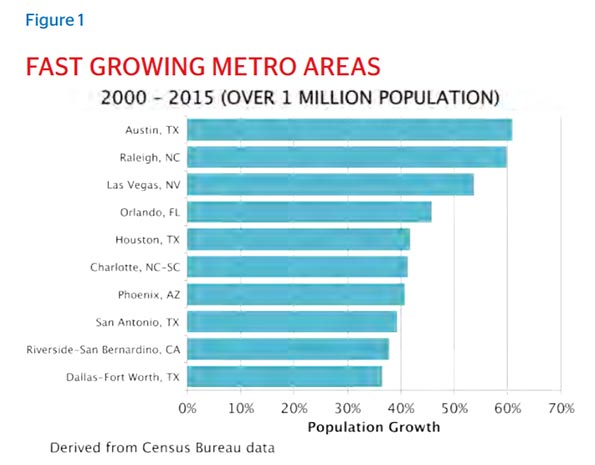
    Among the nation’s 53 metro areas with populations over 1 million, the fifteen that have experienced double-digit growth since 2000 are all located in the south and west, including Texas’s four largest metros. And of the top 25 fastest-growing cities since 2010, the only city not in the south, west, or northwest is Columbus, Ohio, in 24th position. Columbus is the only city east of the Mississippi River and north of the Mason-Dixon line growing at a rate above six percent.

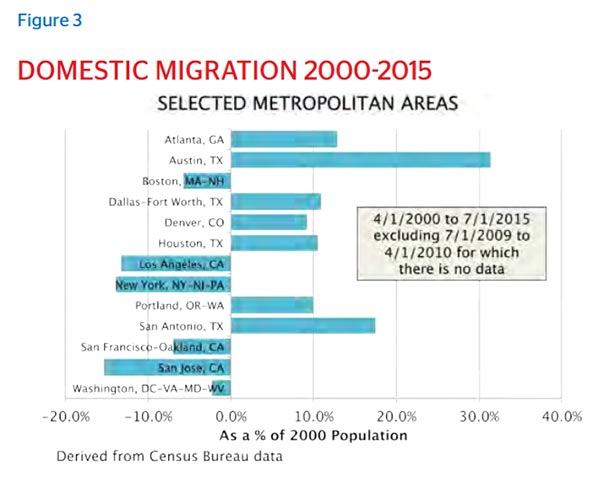
    Weather is a factor but America’s fast-growing cities attract aspiring workers and business owners through a blend of favorable economic conditions, new infrastructure, and increasingly, proximity to talent. Political sclerosis and economic elitism in coastal and northern cities have served as a helping hand, pushing workers away from a toxic blend of rising expenses and falling quality of life. Using a mix of Census data, cross-metro moving requests on moving.com, and cross-metro searches on realtor.com, a recent Realtors study found New York, Chicago, San Jose, and Los Angeles are among the top five cities losing the most domestic migrants to mostly smaller, newer Sun Belt cities. In the same study the top ten gainers are Sun Belt cities, with the exception of Portland, Oregon, all who offer newer, more affordable housing stock than in the prime metro areas of New York, Illinois, and California.

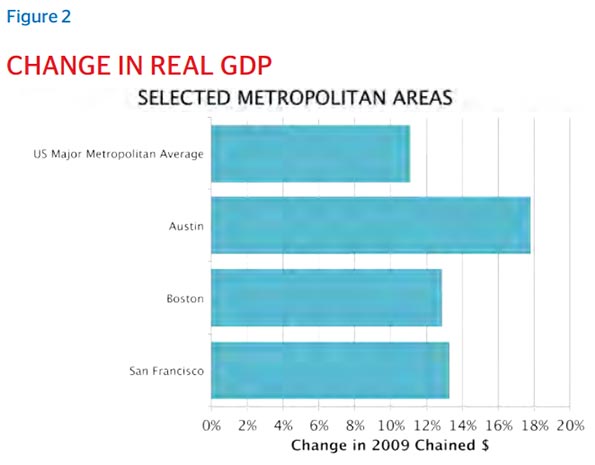
    Arguably no city in the country has taken advantage of these conditions more than Austin. Since 2009, the low point of the Great Recession, its metro area GDP has grown 31 percent. By comparison, San Francisco and Boston each grew by 13 percent during the same period. The national average for U.S. metro areas was 11 percent.
    Demographically, domestic migration drives Austin’s economy. Austin has had to innovate and import a lot of talent. Austin has become a quintessential knowledge economy that thrives not so much by cultivating natural and historical resources, but by absorbing ideas, innovation and talent from elsewhere and selling them as products back to the world.
    Anyone who has spent any time in Austin understands the tension that exists in the city between the defenders of its erstwhile charm as an unconventional music and college town and boosters of its high-growth technology cosmopolitanism. Whatever the community’s gatekeepers contend, however, Austinites themselves think that the massive influx of people is inextricably bound to its economic growth.

    An annual survey of Austin residents casts this phenomenon in clear relief. When asked what they think Austin has gained by its population growth over the past five years, residents cite a stronger economy as their top pick. Compared to the 22 percent of Austinites who cite “more diversity” and 7 percent who say “more creativity,” 42 percent say Austin’s explosive population growth has been a boon to the city’s economy. Even those who have lived in Austin for more than 20 years believe the economy has benefited from great migration to the city.

    An openness to newness, strangers, and change are hallmarks of Austin’s economic culture. Perhaps rooted in the city’s past as a music-centric, indie-friendly college town, these hallmarks have translated well economically for the city.

    The Great Migration Game

    Austin’s migration story can perhaps be understood best in contrast with Silicon Valley. No metro area in America can compare to the Bay Area in terms of the sheer size and force of its technology community, Austin’s attractiveness has grown, in large part , unlike in San Francisco and San Jose, tech workers in Austin are able to afford housing close to the office, raise kids close to good school options, and enjoy a variety of cultural amenities in close proximity.

    Between 1991 and 2013, people moved between Austin and 304 MSAs. Of these, Austin only experienced a net loss to eleven. Compare that to San Francisco. The gem of the Bay Area lost population to 133 of the 242 MSAs with which it “traded” population. For San Jose, the figures are 127 out of 253. In other words, while the Bay Area lost population to well over half of the MSAs it has traded with across the country, Austin’s loss was just 3.6 percent.
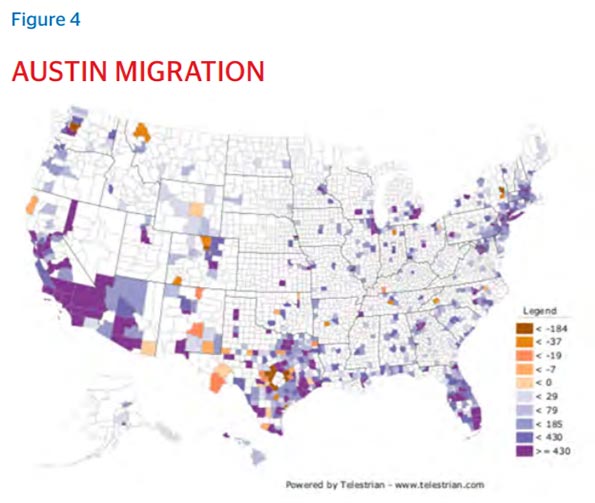
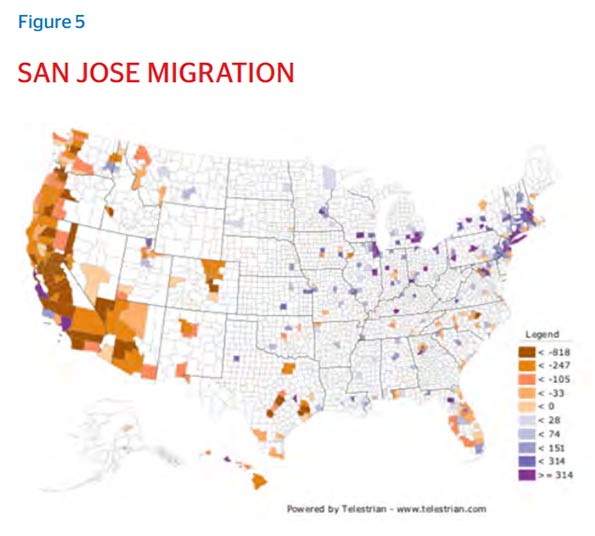
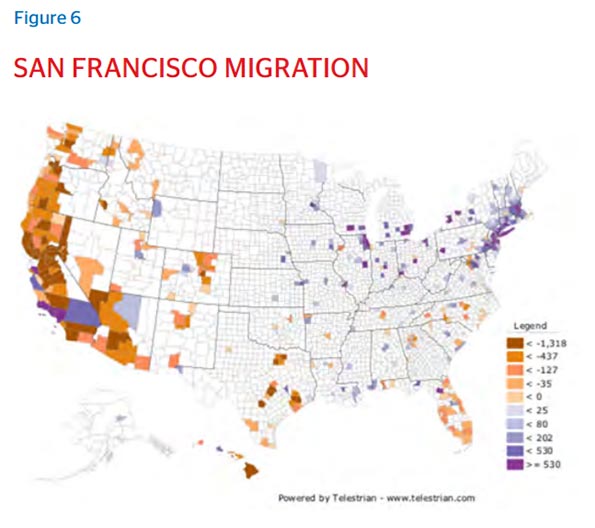
    Figures 5 and 6 show clearly how the Bay Area has dispatched population to a number of western and southern boomtowns, whereas Austin has pulled in workers and families from every population centers all across the country.

    Silicon Valley is renowned for its high-level talent pool. It attracts the best and the brightest from around the world to work in the most vibrant technology ecosystem in the world. However, when one looks at where U.S. cities export most of their talent, the numbers tell a slightly different story.

    First, Austin is more of a regional talent destination than Silicon Valley. Since 1991, Austin has seen a net population increase of more than 33,000 people from Houston and 21,000 from Dallas. San Jose has lost thousands of people to both Texas cities over the same period of time. So has San Francisco. Perhaps that is expected, given Austin’s proximity to its fellow Texan metropolitan areas.

    But the pull is much greater from California than one would suspect. During the same period, Austin attracted nearly 20,000 migrants from the Los Angeles metropolitan area, which sent only 15,000 to San Jose. Austin also saw thousands of arrivals from San Diego during the same period.

    The other tech-heavy, talent-centric cities in the Northwest also prefer Austin. Net migration from Seattle to Austin has been positive since 1991, while San Francisco and San Jose have lost a combined 25,500 people to Seattle in the same time period. Portland tells an even more dramatic story. A city frequently compared to Austin, Oregon’s commercial capital has lost more people to its Texas peer than it has gained, while Silicon Valley has lost tens of thousands of residents to their northern neighbor. In contrast, since 1991, San Jose and San Francisco have exported nearly 51,000 people to Portland and Austin combined.

    Second, looking at talent centers nationwide, Austin outperforms the Bay Area quite decisively as cities with a high proportion of college-educated residents have consistently chosen the Texas capital as an ultimate destination over Silicon Valley. Raleigh, for example, the only other American city to come close to matching Austin’s rate of growth over the past five years, has lost more people to Austin than it has gained since 1991, but both San Francisco and San Jose have lost population to Raleigh over the same period. In other words, plenty of people are choosing to leave the Bay Area for North Carolina, but the talent base in North Carolina has a fonder eye for Austin.

    Other talent centers display a bias for Austin as well. The three largest cities on Wallet Hub’s 2015 list of the educated cities in America — New York, Los Angeles, and Chicago — have all sent more people to Austin than to the Bay Area, despite an enormous tech-led boom in the area. Washington, D.C. has become a talent boomtown in its own right, owing to the stability of employment for the knowledge workers the federal industrial complex increasingly needs and rewards. Yet it has exported more workers to Austin than to San Jose and San Francisco combined over the past twenty years. Provo and Colorado Springs, the mountain West’s talent hubs, have also lost people to Austin but gained people from San Jose and San
    Francisco.

    Opportunity Cities Win

    For cities aspiring to grow as Austin has grown, the first order of business is to understand Austin as an opportunity city, not just a technology center or music capital. So what are the hallmarks of an opportunity city?

    First, Austin, like other Texas cities, is friendly to those who want to start and grow a business. These are cities in which small businesses not only participate in, but also drive economic growth. A recent study conducted by the American City Business Journals ranked cities with 500,000 or more residents according to 16 indicators constructed to measure the vitality of the small business sectors in American cities. Austin ranked number one on the list because of the relationship between small business job growth and overall economic growth. San Francisco and San Jose ranked sixth and ninth, respectively, bested by nimbler hot spots such as Miami and Provo. Austin has also made other high-level appearances over the past few years on similar rankings, such as CNBC’s “Friendliest Cities for Small Business” list.

    Small businesses are woven into the fabric of Austin’s economic ecosystem. Austin’s small businesses are ahead of the national average and a significant source of the tireless job creation engine for which Austin has earned a national reputation. Companies in Austin with fewer than 100 workers account for 35 percent of the area’s workforce, and yet they created enough jobs in 2009-2011 to offset the job losses caused by Austin’s largest employers after the Great Recession.

    Second, an opportunity city is a jobs city. Small businesses by themselves do not necessarily guarantee that a city will have a healthy jobs environment, but a critical mass of new small companies typically does, especially if a significant minority grow into larger companies.

    Austin reflects the growing body of academic literature on the impact of new firms on the labor market. Startups and other young companies generate the vast majority of net new jobs in America and spur income growth, especially for younger workers. New companies in Austin are the fuel that powers the creation of new jobs at a rate impressively above the national average.

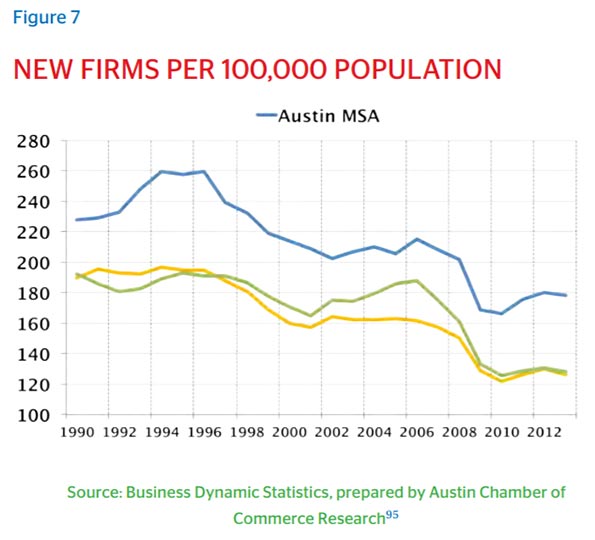
    New firm formation in Austin tracks with general national trends, but it does so at a consistently higher rate. As figure 7 shows, Austin has produced a significantly greater share of new firms per capita compared to the rest of country over the past 20 years, and it rebounded faster post-recession than the nation as a whole. The tech centers of Raleigh, San Francisco, and San Jose have all had lower startup rates than Austin since 2010.

    Austin is the only major metro in Texas creating as many or more new firms than it was pre-recession. Just three years after the nation’s economic nadir, Austin created more new firms in absolute terms than it ever had. It also produces a disproportionately high number of startups for its size. In the Kauffman Foundation’s Index of Startup Activity, Austin has been in the top two spots for a few years running.

    In addition to its startup culture, Austin is a premier relocation destination, especially for companies looking to expand operations in a business-friendly atmosphere with an abundance of talent. Since 2004, nearly one-third of all high-tech company relocations and expansions to Austin from elsewhere have come from California. Among these are household name giants such as Apple, Google, eBay, Oracle, PayPal, and Facebook.
    A churning startup culture drives a dynamic job-creation ecosystem. Austinites work more hours per week than the national average, enjoy the lowest unemployment rate among the nation’s top 50 metro areas and experienced non-farm payroll growth at the 3rd fastest rate last year.

    This has a lot to do with a healthy balance between job growth in all sectors of the economy with particularly strong performances in higher-growth sectors of the economy. Between 2014 and 2016, every sector of Austin’s economy added jobs, except manufacturing, which only declined by less than a percentage point. Since 2010, job growth in professional business services has grown 42 percent and information jobs by 34 percent, and over the past two years Austin has outperformed growth rates nationally in sectors diverse as wholesale trade, construction, leisure and hospitality, and retail.

    Third, an opportunity city attracts professionals on the front end of their careers. One of the best ways to test the dynamism of a region is to look at the degree to which young professionals in their 30s are moving there. Immediately after college, 20-somethings will often move to big cities to get their professional footing and enjoy the fruits of cosmopolitan living. As they approach their thirties, they begin to think about affordability more seriously and consider other opportunity-related factors such as the quality of neighborhoods and schools if they are in the marriage and-kids market. Looked at this way, Austin is the preferred destination for upwardly mobile, aspirational 30-somethings looking to make a life for themselves.

    A recent Niche.com ranking of the 25 best cities for millennials used as its key metric the percentage of 25-34 year olds living in each city. Austin, which ranked second overall on the list, had the highest percentage of 25-34 year olds among the top 25 cities.

    When we compare 25-34 year olds moving to the Bay Area versus Austin, we see several sharp contrasts. Between 2000 and 2014, this group grew by 49 percent in Austin but declined by nearly 4 percent in Silicon Valley. There are now more 25-34 year olds living in Austin than in the San Jose metro area.

    A greater share of 25-34 year-olds in Silicon Valley have a bachelors degree than in Austin, but Austin has been growing its educated young population at a much faster rate. The 25-34 year-old population with at least a bachelors degree has grown in Austin by nearly 61 percent since 2000, compared to 18 percent in San Jose.

    Balancing the Basics: Why Austin Works

    Austin’s success as an opportunity city differs from what has occurred in the Bay Area’s anchor metros, San Francisco and San Jose. These places have led the nation in job creation and startups in recent years and are growing their share of highly-educated young professionals. Yet they are losing population — and company relocations — to Austin. Why is Austin succeeding where San Francisco and San Jose, at some level, are not?

    The answer lies somewhere in the answers provided by those who have made the move from the Bay Area to Austin.

    Vasili Triant, CEO of LiveOps, moved his company from Silicon Valley to Austin after concluding that quality of life and cost issues would keep his company from achieving its growth objectives. Before assuming the helm of LiveOps, Triant moved to the company’s Austin office to direct sales. He and his family were able to buy a home and attend schools in the kind of district that would be utterly uaffordable in the Bay Area. The easy-going yet ambitious nature of Austin’s workforce provided a solid talent pool.

    Meanwhile, back in Silicon Valley, employees at Triant’s company were constantly pushing for pay raises to accommodate the cost of housing, complaining about the multiple hours a day they spent commuting, and worrying about the schools their kids would have to attend. Employees earning over $200,000 were in debt and not contributing to their 401ks.

    Once he was elevated to CEO, Triant confronted his board with the built-in costs of doing business in the Bay Area. He proposed moving the company to Austin, to which the board agreed after reviewing the numbers. Triant likens the difference between the Bay Area and Austin to a difference in premise about what makes a good life worth living in each place. In Silicon Valley one gambles that he or she will make it big, has family money, or just wants to be near the ocean and the mountains. “If your premise about a good life involves saving money for the future and having a good community and school for your kids, then Austin is for you – and the Bay Area won’t be unless you’re phenomenally wealthy,” Triant says.

    Pradeep Vancheeswaran, a Senior Vice President of Global Business Operations at VMWare, lived in California for his entire U.S. professional career, including seven years in the Bay Area, before moving to Austin. The cost of living and the rat-race culture of the Bay Area prompted him and his wife to reconsider whether it was the best place to raise their kids and make a life. On a scouting trip to Austin he saw the kind of home his money could buy, the kind of neighborhood he could live in, and the quality of the schools, and the decision was made. Friends said he was committing career suicide. The opposite has happened, and the family is flourishing in Austin. “Texas gets a bad rap in the Bay Area,” he says. “But the truth is Austin is an inclusive place. We have great neighbors, people are friendly, and I have been able to hire talent here with no problems. In fact, Austin ranks at the top of our global talent assessment and has been a great place to hire for our company.”

    Triant’s and Vancheeswaran’s stories are not uncommon in Austin and exemplify the fundamental pillars supporting Austin’s sustained growth.

    More for Your Money

    Underneath the vibrant regional economy, Austin’s bedrock, not often mentioned in the hype about the city, has been its affordability.

    As Triant and Vancheeswaran’s personal accounts attest, Austin’s diverse and affordable housing stock is a key lure for upwardly mobile professionals. Housing in Austin is growing more expensive but still remains a reasonably good deal, particularly in comparison with the Bay Area, Los Angeles and San Diego, where housing costs more than double that of Austin, adjusted for income.

    The key to maintaining housing affordability is to allow supply to keep up with demand. This requires avoiding the restrictions on suburban housing development that have been adopted in places like California, Portland and Seattle, and avoiding the high development charges typical of more restrictively regulated markets. As Figure 8 shows, affordability was nearly identical in Austin, Portland, and Denver in 1990. Since then, unaffordability has grown faster in the latter two markets, which place more restrictions on housing than Austin does. And in the Bay Area, of course, California’s notorious penchant for restricting housing is breaking records for unaffordability.
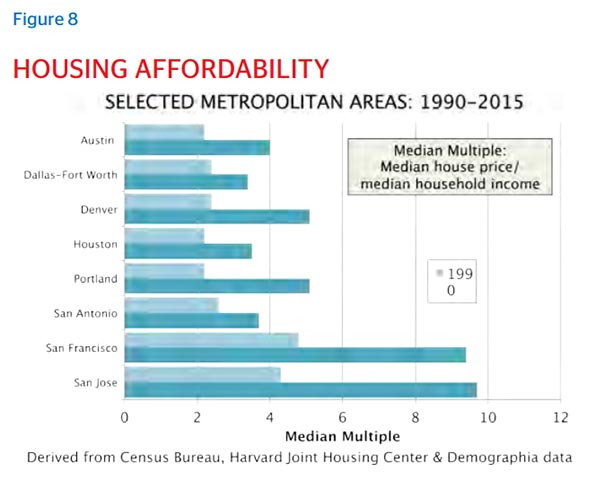
    Using Demographia’s International Housing Affordability Survey, we find that single-family homes in Austin remain more affordable than rival talent centers such as Portland, Denver, Seattle, and Washington, DC. When compared to San Jose, which is the United States’ most unaffordable housing market, it is not hard to see the appeal for Bay Area technology transplants. The median house price in San Jose and San Francisco is nearly ten times the area’s median income, compared to four times in Austin. Technology executives in the Bay Area cite housing costs as the biggest threat to their continued success.

    Still, at four times median income, Austin is facing the beginning of affordability problems. It has grown from an affordable to moderately unaffordable housing market since 2000 and is presently on the cusp of becoming severely unaffordable according to Demographia’s calculations. Trulia’s chief economist agrees, arguing that Austin is on the verge of denting its continued growth trajectory should housing prices climb much farther relative to income.

    When it comes to total cost of living advantages, though, the story improves somewhat for Austin. According to BEA data, between 2008 and 2013 the overall cost of living actually decreased slightly in Austin even as it rose in New York and Washington, DC. Austin’s workforce enjoys a 20 percent cost advantage over residents of New York, who labor under the highest cost of living standards in the nation. Austin costs about the same as Phoenix or Orlando. The Bay Area, by contrast, is an indistinguishable percentage point more affordable than New York. Therefore, it is not surprising that San Francisco and San Jose have seen positive net migration from New York in recent years. If life must cost an unbearable amount, the weather and scenery might as well be better.

    Follow the Money

    Austin’s real median income is the highest of Texas’s four largest metros and even surpasses the New York metro area. Of the nation’s 53 cities with more than one million residents, Austin’s median household income is the tenth highest adjusted for cost of living. African American and Asian median incomes in Austin are fourth and fifth respectively among the largest U.S. cities, and salaries in Austin typically track slightly above the national average for most job categories.

    Given Austin’s emergence as a technology center , the region now has twice as many high-tech jobs as a percentage of all jobs than the national average. Nearly one-quarter of all payrolls in Austin are in the high-tech sector, with an average salary greater than $100,000, nearly double the average salary for all other industries. Though high tech salary growth has slowed in Austin in the past few years compared to the rest of the nation, the average high tech worker in Austin still earns more than the national average. Before the Great Recession, there were more high-tech manufacturing than IT jobs in Austin, but the past five years have seen an explosion of information and other IT-related high tech jobs. The number of IT jobs in Austin has nearly doubled in the past ten years, totaling more than 56,000.

    High-tech manufacturing jobs remain the highest-paying, though, with an average annual salary fetching $122,000. Income growth outside of high tech jobs has grown at a faster rate than tech jobs. Between 2010 and 2015, Austin had the second-highest annual job growth across all industries at 3.7 percent, just a click behind San Francisco’s 3.8 percent growth rate. Austin’s high tech job growth rate of 5.7 percent was also the second-highest nationally, once again behind San Francisco’s peerless 10.7 percent growth rate. These rates of growth have been matched by healthy income growth that makes Austin a premier opportunity city.

    Good Place for the Kids

    Austin’s relative affordability and earning power is buttressed by two additional factors that are especially important to families and young people planning to have children: safety and schools. As Austin has grown, the sheer influx of families with children has placed a premium on the availability of strong educational options and a safe environment.

    Between 2000 and 2014, the number of households in Austin with children under the age of 18 grew 35 percent. By contrast, such households grew 4 percent in San Jose. This does not mean that Austin is necessarily more pro-family or pro-marriage in the sense of cultural norms. The percentage of married adults in Austin has declined just as it has across most urban areas in the past 15 years, as has the percentage of young couples with children.

    But, as sheer volume of families with children moving to Austin in absolute terms shows, the overall environment is very family-friendly. Austin’s schools fare better on most assessments of public school quality than Texas’s other large cities, and families have public school options all across the metro area. For instance, consumer-oriented data analysis sites such as FindtheHome.com rate Austin’s city schools ten points or more ahead of Dallas, Houston, and San Antonio, and the State of Texas’s overall rankings show a substantial percentage of high-performing schools in the metro area. Whether a family chooses to live downtown or the suburbs, there are strong public school options unlike ones one would normally find in large urban areas.

    An annual survey of residents shows that Austinites value choices in education as well. A majority of adults believe the public schools in Austin are a good value for their tax dollars. Yet 59 percent of 18-34-year-olds support school vouchers, as do 50 percent of adults over 35. Fifty-nine percent of all adults either send their kids to charter schools or would consider doing so. Sixty percent of respondents say they chose where to live based on school options.

    Austin is also one of the safest cities in Texas. According to the FBI’s Uniform Crime Reports, Austin ranks 21 out of Texas’s 24 metro areas in the report in crime incidents, well below the other larger metros.106 As a state capital and university town Austin’s growth has “skipped over” the debasements that accompany deindustrialization and largescale losses within working-class economies. But Austin’s growth patterns, variegated and multi-nodal as they are across the metro area, have also created diverse economic centers that have prevented large swaths of the city from falling into decline.

    Option Urbanism: Austin’s Polycentric Character

    The thing that ultimately makes Austin’s population and economic growth work is the multi-nodal quality of the metro area’s growth. Despite its reputation as a “hip” and dense urban area, in reality Austin is a city of districts that balances and disperses urban-style amenities across its urban and suburban landscape.

    Austin’s reputation as an urban hotspot is well-deserved. The Austin City Limits concert venue and annual festival are in or immediately across the Colorado River from downtown. South By Southwest, the global technology, film, and music festival, occurs mostly in venues spread across Austin’s urban core. The heart of the Austin music scene along 6th Street downtown is only a short walk from the Texas state capitol and a mere 13 blocks from the University of Texas at Austin, the state’s flagship university whose iconic tower is a fixture along the Austin skyline. Visitors to Austin over the past decade are always greeted by construction cranes that dot the downtown landscape, as high rises compete with one another to make a new mark on the skyline.

    Suburban Austin

    Demand for downtown living has never been higher in Austin, and yet the cranes and construction zones tend to hide the true locus of Austin’s dynamism—the area’s lively suburbs. This is where the vast majority of the region’s population growth in the past 15 years has occurred. Not merely appendages to downtown, Austin’s suburban communities have done a notable job of incorporating elements of the city’s urban identity into the quality of life its suburban residents experience. One can find food trucks, coffee shops, new restaurants, indie shops of various kinds, music, and festivals dispersed across the metro area. The Barton Creek Greenbelt that stretches southwest off the Colorado River downtown spreads outdoor recreational opportunities, for which Austin is also well-known, across multiple access points through a variety of neighborhoods.

    In 1990, when Austin metro’s population was less than one million, 45 percent of residents lived in the suburbs. Today, 53 percent of Austinites live in the suburbs. The city grew 47 percent between 1990 and 2000, and then another 37 percent between 2000 and 2010. The vast majority of this growth has been suburban in nature.
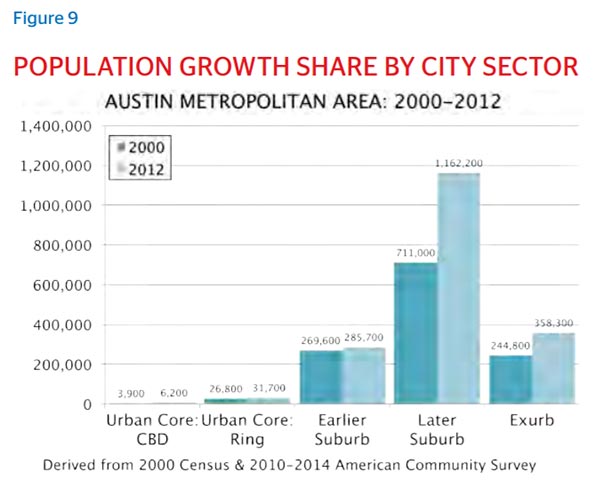
    Using Demographia’s City Sector Model, we see the urban core and urban core’s ring, defined as the central business district and original downtown ring pre-dating World War II, experienced healthy rates of growth but added little in absolute terms between 2000 and 2012. What most people think of as today’s booming downtown Austin only accounted for 1.6 percent to the metro area’s entire growth during this period. Of the 588,000 new residents to Austin during this period, 564,700 of them moved into suburban neighborhoods.
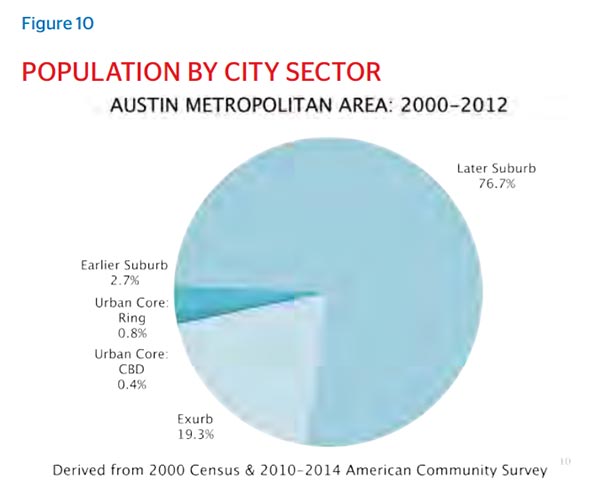
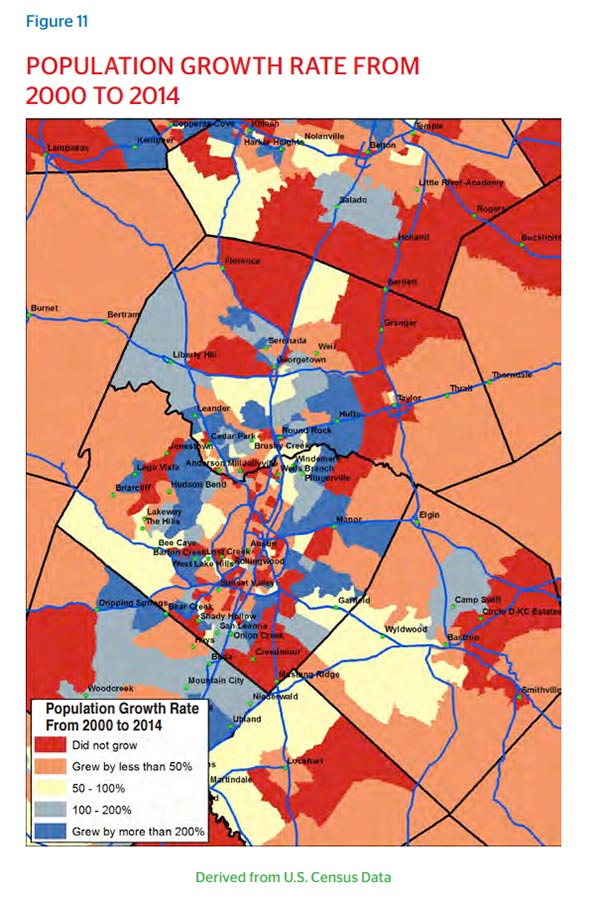
    Figure 11 shows how this growth looks geographically. Central Austin grew very little between 2000 and 2014. The fastest growth, depicted by the grey and blue areas, is largely suburban.

    Homeownership in Austin follows this suburban trajectory. Compared to 30 percent among the nation’s 52 largest metro areas, 62 percent of the owned housing stock in Austin can be found in suburbs in which the median home construction year was after 1980. That figure is less than 10 percent in Silicon Valley. By contrast, 77 percent of owned housing in Silicon Valley is in older suburbs with a median home construction year before 1980, compared to 14 percent in Austin and 41 percent nationally. Another 23 percent of Austin’s owned housing is located in exurban communities, compared to 19 percent nationally and 13 percent in Silicon Valley.

    Austin’s success as an urban model is closely tied to its ability to meet population demand with new housing in new communities. The increasing difficulty to build and afford housing in the Bay Area is effectively making homeownership a phenomenon of aging suburban communities, as greater shares of aspiring homeowners leave the area altogether, as seen earlier.

    Multi-Nodal Tech City

    Austin’s suburban expansion also dominates much of the economy. Nearly half – 43 percent – of tech jobs are in the suburbs and much of the rest in areas outside downtown. Local markets for urban-style amenities such as bars, cafes, and events have arose to meet the demand of a highly-educated, relatively young workforce that nonetheless prefers lower-density suburban living. This creates a district effect that has worked relatively well with Austin’s zoning codes and allowed for either mixed-use, or regional mixes of uses, in various points across the metro area.

    Figure 12, an Austin Chamber of Commerce map of the city’s 100 largest high-tech companies, paints a picture of a multi-nodal tech community that is both urban and suburban. Since 2014, 37 percent of high-tech companies that have moved to Austin have relocated downtown, while the rest are dispersed across the various hubs.
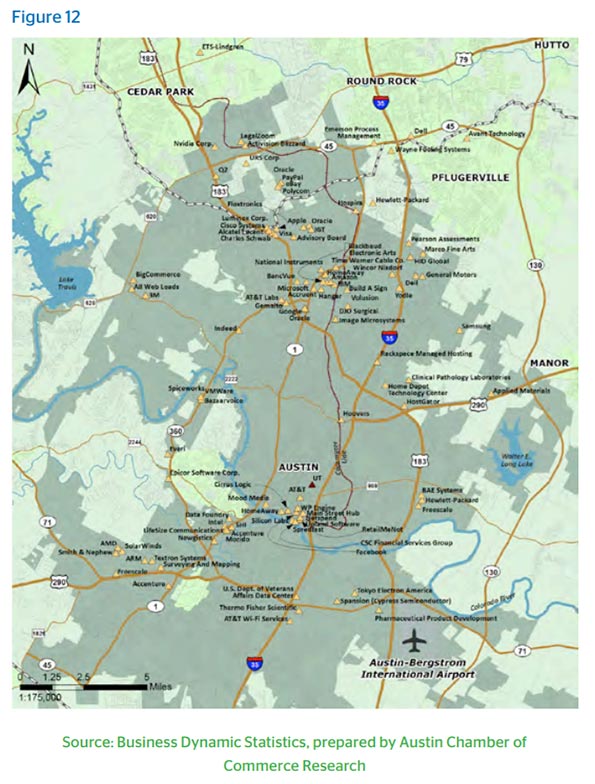
    The heavily concentrated hub downtown and the corridor stretching southwest of downtown offer a diverse array of living options. South Austin interweaves leafy residential neighborhoods around its three north-south district roadways: South Congress, South First, and South Lamar. To the west are rolling, leafy suburban-style communities that offer proximity to downtown. Downtown increasingly offers dense, high-rise living with ample amenities. The Bartin Creek Greenbelt and trails around Lady Bird Lake (created by two dams in the Colorado River) are the centerpieces of Austin’s esteemed outdoor fitness culture.

    Between downtown and the concentration of tech firms along and north of route 183 are patchworks of neighborhoods and districts that blend homes, apartments, restaurants, shops and bars, once again creating options for families and single workers. The Domain, the mixed use complex near the intersection of Routes 1 (Mopac) and 183, is beginning to serve as a kind of “city center” north of downtown. Suburban neighborhoods west, north, and east of the northern tech hub offer an array of suburban options for families and workers. Apple is completing its second-largest campus outside of its California headquarters in the community, and other tech giants such as Google and Oracle have nearby offices.

    Dell anchors the tech community in Round Rock to the north, which effectively functions as a separate city center. Round Rock, with a population of more than 100,000, has more than tripled in size since 1990. Dell employs more than 13,000.

    Austin’s rapid growth, coupled with lagging investments in transportation infrastructure, accounts for why Austinites frequently rank traffic congestion as the biggest problem facing the city. Viewed comparatively, however, average work commute times in Austin match the national average at 25.5 minutes one way, compared to 31.2 minutes in San Francisco and 28.1 minutes in San Jose. Atlanta’s car commute times take a full five minutes longer than Austin’s, and in Washington, DC, an extra ten. Overall, Austin’s average commute times – whether by car, transit, bike or foot – is on part with Indianapolis or Charlotte. For transplants from New York or the Bay Area, commutes are likely to contribute to Austin’s appeal rather than the other way around. Car commute times are lower in Austin than either of those areas, as one might expect, but so are walk-to-work times.

    Despite this relatively good performance, over time traffic congestion along with housing affordability could begin to chip away at the city’s magnetic appeal. But for now, despite the frequent grousing one hears from locals about the traffic, Austinites on average are not worse off than other Americans living in cities larger than 1 million people.

    Austin’s still reasonable commute times reflect the polycentric quality of its economic geography. With commercial and cultural locations spread across the metro area, together with an array of single- and multi-family housing options nearby, Austin offers choices. If a young professional couple wants a single family home with a yard, proximity to restaurants and shops and good schools, they have options. If they want to live in more of a mixed-use apartment community close to work, they have options. Downtown living is increasingly becoming harder for people not commanding top salaries, but it still remains an option for young workers that other cities do not offer.

    Conclusion

    Austin is well-known as a talent center, but students of urbanism would do well to study the geographic nature of the talent economy in Texas’s capital. It is a dispersed talent pool, spread across a relatively affordable metro area with proximity to urban-style amenities.

    Austin has managed to encourage and allow the concurrent development of its central core and inner and outer rings in a way that has made variety a central feature of the Austin model. People, young and old, have options in Austin. Good schools can be found across the metro area meaning people rarely have to sacrifice amenity preferences in order to live close to a good school, which is a conventional understanding of what “moving to the ‘burbs” often entails in most cities.

    Austinites have work options, too, in two ways. The diverse economy, with a high proportion of high tech and other educated workers, offers opportunities in the job market for workers who decide what they are doing is not the right fit for them. Workers also have choices where they work. The polycentric nature of Austin’s commercial hubs makes this possible.

    And even as affordability problems present unprecedented challenges to Austin, the city still offers alternatives for where people want to live. Because of the timing and trajectory of Austin’s population growth, a lot of new housing is available, as well.

    The key to the Austin model’s continued success will be to preserve its core features as an opportunity city and the fundamentals that have made it work until now. Over-planning or limiting growth, concentrating economic strength in too few places, allowing school quality to erode – these are precisely the things that have done significant damage to other previously successful cities in America. Austin’s strength has been in going in the other direction. Its continued success depends upon continuing along the same path it has traveled until now, but with a vision to accommodate what seems as inevitable greater growth.

    Ryan Streeter is the Executive Director of the Center for Politics and Governance at the University of Texas at Austin and Clinical Professor of Public Policy at the LBJ School of Public Affairs. Streeter has conducted policy research projects for think tanks, institutional nonprofits, and public agencies at the federal, state, and local levels. He served as a Special Assistant for Domestic Policy to President George W. Bush, Deputy Chief of Staff for Policy and Strategy to Indiana Governor Mike Pence, and Policy Advisor to Indianapolis Mayor Stephen Goldsmith. He was a Senior Fellow at the Legatum Institute in London, has served as a Transatlantic Fellow with the German Marshall Fund, and was a Research Fellow at the Hudson Institute.

    Top photo: Photo by jdeeringdavis, Licensed under CC License
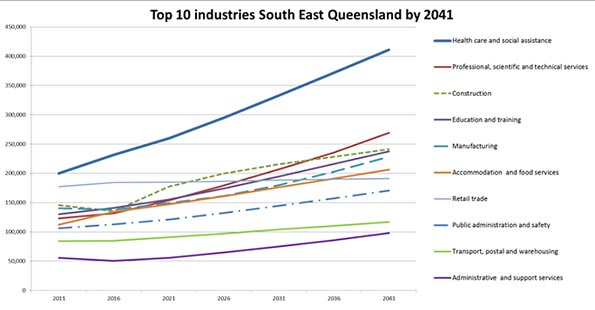
  • Economic Participation Matters Most

    This piece first appeared at Real Clear Policy.

    POLICIES FOR THE NEXT ADMINISTRATION. PART 10: ECONOMIC INEQUALITY

    This is the tenth in a series on the major policy ideas — from Left and Right — that should guide the next presidential administration’s agenda. (For the opposing view, see David Madland, “A Path Forward for the Middle Class and the Country.”)

    Do we want to live in a society in which people profit when they have new ideas, products, and abilities that others are willing to pay for? If so, then we will also have economic inequality. 

    To most economists and ordinary Americans, inequality is the price we pay for an economy that rewards innovation, risk, and hard work. The topic has been a recurrent theme in our recent political discourse, however, because of two things: the outsized income of the nation’s top earners and the stagnation, or tepid growth, of middle-class incomes. The question is whether we think these two trends say something bad about America, and if so, what public policy can do about them.

    On the first issue, the rising incomes of the rich, politicians and advocates who want to reduce inequality typically rely on one of three rationales. 

    First, there is the “piece of the pie” rationale. This view regards the economy as a kind of zero-sum game in which larger slices of the economic pie for the rich mean less for everyone else. But the evidence for this view is dubious at best. Even Paul Krugman has claimed to be a skeptic of the idea that inequality affects economic performance.

    The second rationale is a kind of moral objection: It is simply wrong, or unfair, for the rich to earn so much. Behind the veil of ignorance, as the political philosopher John Rawls taught us to think, no one would choose to live in a society where 1 percent of the population earns more than $430,000 while everyone else averages one-eighth that amount. But, the fact is, we live in a non-Rawlsian reality in which many would roll the dice and say, “I’ll take those odds!” 

    Besides, as polls suggest, everyday Americans just don’t care about inequality as much as they care about upward mobility. They may dislike faceless “bankers” and “CEOs of insurance companies,” but they admire Steve Jobs and Mark Zuckerberg, whose earnings make most bankers and insurance executives look middle class.

    The third rationale blames cronyism, the “rigged game,” for making people rich. It is unlikely that cronyism is the main driver of the top 1 percent’s income. Still, as research from Boston University’s Jim Bessen shows, there is a positive relationship between growing corporate profits and lobbying. And Sutirtha Bagchi and Jan Svenjar have found that inequality is greater in countries whose richest citizens earn their wealth through cronyism rather than free enterprise. We live in an era in which the CEO of Goldman Sachs praises Dodd-Frank for making things better for Goldman. Clearly, we have policy work to do to fix this.

    But the energy policymakers and pundits spend worrying about the super-rich might be better spent focusing on the second initial question: What do we do about lower and middle-class incomes that are not rising as they should? 

    If we get this question right, maybe the first one becomes less important. This seems to be what Adam Smith’s mentor and friend David Hume had in mind back in 18th-century Scotland. Hume observed merchants, who were not welcome in elite society, earning “great profits” by importing and exporting novel and innovative products. Their success made them “rivals in wealth to the ancient nobility.” Commercial exchange had narrowed the gap between the birthright rich and an enterprising class of hardscrabble commoners. 

    Not only merchants saw their lot improve. The growing taste for newer and better products prompted ordinary people to become innovators and to get in on the action, producing “every home commodity to the utmost perfection of which it is susceptible…[S]teel and iron, in such laborious hands, [had] become equal to the gold and rubies of the Indies.”

    What Hume called “luxury” — goods from overseas and improved products through innovation at home — was no longer the domain of kings and aristocrats alone. The iPhone 4 replaced the flip phone, and the iPhone 6 surpassed the iPhone 4 — not just for the king, but for you. Not only did luxury make life better, it opened up new opportunities to earn a living for those making the products. 

    Detouring through 18th-century Scotland reminds us that upward mobility comes not primarily from redistributing money from the nobility to the poor but through economic participation — that is, encouraging work in those sectors of the economy where innovation and growth are robust.

    The problem in America today is that some people are participating in the growing, opportunity-rich parts of the economy and others are not. It is the inequality among the 99 percent, not the 1 percent, that matters most in America. MIT’s David Autor has calculated that growth in income between the top and bottom of the 99 percent between 1979 and 2012 was four times greater than the redistribution of income from the entire 99 percent to the top 1 percent.

    The so-called “hollowing out” of the middle class can be understood in these terms. As Pew has reported, of the 11 percent decrease in middle-class households between 1971 and 2015, 7 percentage points are the result of families moving up and out of the middle class. Of the remaining 4 percent that moved down, a large share can be explained by the growth in immigrants working in low-wage jobs. 

    The best way up for people is — and always has been — the capacity to participate in the economy as an employee, entrepreneur, or owner. No amount of redistributive policy can achieve the same result. The safety net, as the name implies, is to prevent downward mobility; it has never been a very good trampoline. 

    Given the gap between the top and bottom of the 99 percent, we need to focus with revolutionary zeal on increasing economic participation among marginalized workers. To do this, our approach to workforce development should emphasize the following:

    1. High school certification paths in high-demand skills. Career and technical education needs to move from a sideshow to a central part of high school curricula. The programs should be flexible, using online learning platforms and easily convertible physical space so schools can quickly offer new programs as market demand changes. Also, in place of textbook economics, students should learn about the role of investors and owners in the economy, how firms are formed, what innovation is, and which companies are successful and why.

    2. Apprenticeships for the American economy. Current workforce-development funding should shift to support on-the-job training more than classroom vocational training. Given the flexibility of the U.S. labor market, employers should bear minimal cost in the event that the apprentice leaves for another company.

    3. Increased rate of new business creation. This may sound more pro-entrepreneur than pro-worker, but the reality is that new companies: create most of the new jobs each year; employ a disproportionate number of young people; and pay on par with more established firms. Sophisticated startups with patents and Delaware registrations are doing well. The rest, not so much. Local clubs, entrepreneur networks, school partnerships, and other ways of connecting would-be entrepreneurs to real entrepreneurs as well as to investors and lenders are needed now more than ever.

    We need a policy environment that connects people to the growing, highly productive sectors of our economy. This will do more to “make work pay” than conventional ideas such as setting wage floors, making marginally effective community colleges “free,” and strengthening unions. The only way to increase mobility and deal with inequality is to increase the earning power and vocational prospects of people who are currently on the outside looking in.

    This piece first appeared at Real Clear Policy.

    Ryan Streeter is the Executive Director of the Center for Politics and Government at the University of Texas at Austin.

  • How to Reform the California Legislature and Restore Power to the People

    The Western states, and California in particular, have had a long history of spearheading progressive reforms, especially in their electoral and governmental systems. A former Governor of California, Hiram Johnson, actually ran with Theodore Roosevelt on the Progressive Party presidential ticket of 1912. If you are looking for reform ideas, look no further than the Golden State.

    California, with its immense size and natural resource wealth, has always been a corruption-promising realm for unscrupulous politicians and those who buy them. From the early land barons to the Southern Pacific Railroad to mid-century housing developers to the currently ascendant tech oligarchs of Silicon Valley, the self-made rich have always exerted undue influence over the state’s political development. This has prompted resentment and reformist sentiment among the public-spirited of California. These reforms have not always been the wisest or most sustainable. Plenty of criticism has been leveled at the initiative system in particular, but it still indicates a willingness to experiment with ways to combat oligarchic interests.

    As was the case in the days of Southern Pacific’s dominance, California is once again falling prey to the over-centralization of policy-making power in Sacramento, where the wealthiest and most connected interests hold sway. This unholy alliance of big government, big business, and big labor stagnates the functionally one-party political system and precludes important reforms on major issues as diverse as budgeting, education, pensions, infrastructure, energy, and more.

    As a result, the special interests with the most money – namely, the green-and-blue liberal coastal elites, especially in Hollywood and Silicon Valley – are more or less able to ram through the politically-correct climate and labor and social legislation they like, oftentimes at the expense of working-class and middle-class Californians who sometimes are forced to flee the state to escape the green aristocracy. Unlike Washington, California’s problem lies not in hyper-partisan gridlock, but one-party dominance beholden to the special interests that control the state legislature.

    Localism as a Solution

    The most cogent solution to this is a return to localism. In California, this means taking power away from the bureaucrats, career politicians, and their funders in Sacramento. This would return a higher measure of control to California’s diverse counties and cities over their own destinies. On issues as diverse as zoning, housing, energy, and labor, rolling back the regulatory power of the central state would be a massive break from current policy trends, reanimating the diverse lower-level political units that have always contributed to California’s — and the country’s — political and social dynamism.

    The entrenched interests must be defeated, and the system they have constructed must be overturned. Fortunately, there is a reformist political entrepreneur in California working on a 2018 ballot initiative that could do exactly that.

    The Neighborhood Legislature

    John Cox’s Neighborhood Legislature initiative is a far-reaching reform that increases the number of California state legislators from 120 to 12,000 – yes, that is three zeroes. The gist of the proposal: every State Assembly and State Senate district would be subdivided into 100 “Neighborhood Legislature” districts, each roughly the size of a neighborhood. Therefore, the Assembly members and Senators would each represent 5,000-9,000 people rather than 500,000+ constituents, and as such, it would be far easier for constituents to communicate with their representatives.

    But all 12,000 would not convene in Sacramento’s statehouse. Each district of 100 neighborhood legislators would appoint a single representative to go to the statehouse to hammer out legislation, so the number of hands involved in crafting legislation would remain 120. The legislation would be voted upon, though, by all 12,000 legislators.

    This is not “indirect democracy,” like the pre-17th Amendment system of State Legislators electing U.S. Senators, because ultimately the directly-elected neighborhood legislators are still the ones casting votes. 120 legislators would serve as members of a “Working Committee” of lawmakers, similar to any other committee that drafts legislation in the statehouse and presents it to the rest of the chamber for approval or disapproval.

    One of the perks of this plan would be reduced costs. Cox’s proposal calls for the replacement of legislator salaries with mere $1,000 yearly stipends. The citizen-legislators would work out of their homes rather than being given offices in Sacramento. The combination of decreased salaries and facilities expenses results in $100 million savings per year, as the Neighborhood Legislature website notes. This is before factoring in the near-complete erasure of campaign financing expenses.

    Perhaps the strongest benefit of the Neighborhood Legislature is its undermining of the current centralized system, which is hopelessly corrupt and dominated by oligarchic and special interests. Rather than having to raise hundreds of thousands of dollars for ad buys and voter data to reach hundreds of thousands of constituents, candidates would now be able to merely tap into local community groups and knock on doors to reach the couple thousand constituents they would be representing. A citizen would not need the financial backing of special interests to win an election.

    Additionally, the subdivision of each seat into 100 seats would increase the number of moving parts special interests would need to target in order to influence votes. Sure, they would probably target Working Committee members in order to influence the content of bills; but it would be much harder for businesses, unions or other lobbies to threaten 99 more voting representatives who do not need their money to get elected.

    Most importantly, the Neighborhood Legislature system would foster the development of political participation at the local level and directly connect citizens to their state government. As people tend to like keeping their fates in their own hands, it can be well-assumed that the rising influence of local political communities would result in bills and new laws reversing decades of centralization of political power, and returning regulatory, zoning, pricing, and other functions back to cities, counties, and other entities. The very notion of a citizen being able to meet directly with their representative on a regular basis would fulfill the Jeffersonian dream of local democracy in a free republic.

    Moving Forward

    Of course, these benefits would not be immediately clear to most people, simply because the content of the proposal is so complex. In the run up to the 2018 elections, Cox will be traveling around the state explaining the initiative to community groups of all stripes and temperaments, with the intent of fostering public consciousness about the initiative. Expect him to stop by a community near you.

    The State of California and the United States as a whole could use a good dose of political reformism, and this revolutionary reform is well inside the West’s tradition of political experimentation. Who knows, if by some stroke of luck the Neighborhood Legislature passes in California and proves effective at breaking the power of special interests and returning it to the localities, perhaps other states and even Congress will be persuaded. It has been said that California guides America in more ways than one, maybe this time in a good way.

    Luke Phillips is a political activist and writer in California state politics. His work has been published in a variety of publications, including Fox&Hounds, NewGeography, and The American Interest. He is a Research Assistant to Joel Kotkin at the Center for Opportunity Urbanism.

  • Australia: Mad As Hell And Not Gonna Take It?

    The result of Australia’s recent Federal election remains unclear, as the count has continued — as of this writing — for days. What is clear is that the major parties suffered a rebuff. One in four Australians voted for an alternative to the traditional mainstream parties, a historic record. Even if incumbent Prime Minister Malcolm Turnbull can win enough seats to control the lower house (nearly tossing out a first term Prime Minister is another first for this election), the Senate is well beyond reach of a majority. As psephologists — those who study elections — digest the details, it is looking increasingly as if the losses can be related to a suburban and regional community disgruntled with the attitudes and indulgences of inner urban elites.

    The values of these elites, including the Prime Minister, seem increasingly at odds with the wider community in everything from economic opportunity to housing, transit, access to education, cost of living concerns, immigration policy, the environment, and more. That divergence made itself felt with a tectonic shift in the latest ballot result.

    First, a crash course in Australian politics. Australia operates a Westminster style democracy. Every person aged 18 and over is required to vote (yes, it’s compulsory). They vote for geographic representatives in the lower house (the House of Representatives), and also for State representatives in the upper house, the Senate — a house of review. Each lower house seat represents approximately 150,000 people. Some electoral districts, given our sparse population density in rural and remote areas, can be larger than Texas in area. Most, however are metropolitan, given that 80 percent of Australians live in just five major cities. Each State elects 12 Senators, plus two for each Territory — being the Australian Capital Territory and the Northern Territory. There are 150 Members of the House of Representative and there are 78 Senators.

    Voting is by a preferential system. Imagine a lower house seat with five candidates representing various political parties. Voters are required to number their ballots in order of preference, and to number each box. The candidate with the least votes is eliminated, but the second preference flows to the candidate numbered next on a given ballot. This process continues until only two candidates remain, the one with the most votes being declared the winner. The same happens in the Senate for each State. Because the Senate typically attracts a wide field of candidates and parties (we even had a Pirate Party this time), the Senate Ballot paper can be over three feet wide. Fortunately, voters only need to number their top six choices of party ‘above the line’ for the Senate. Suckers for punishment can number every single box.

    The main political parties in Australia are the Labor Party (akin to the Democrats); the Liberal Party (akin to Republicans); the National Party (mainly rural conservatives); and The Greens (left wing environmentalists). The party that wins a majority of seats in the House of Representatives forms the government. There is usually a range of smaller fringe parties that record little support, but in this election, One Nation (resembling the Tea Party movement), The Nick Xenophon Party (a populist party), various Christian groups and others combined to achieve 5 seats in the lower house and around 11 in the Senate. Forming a majority in the lower house is now looking difficult, and there is no chance of a majority in the upper house.

    It is unlike the American system in that there is no Presidential vote, although our politics have become Presidential in campaign style. Our Prime Minister (from the conservative Liberal Party, although many in the party dispute his conservatism), is elected by the party’s Members of Parliament only. In other words, the only people who actually get to vote for our current (for the time being) Prime Minister are the voters of Wentworth, his electorate. The rest of the country votes locally for their own candidates. PMs rely on the support of their party room. This is how we manage to have Prime Ministers who can be tossed out not by popular vote, but by party room vote. It makes life interesting, especially in recent years, when we seem to be averaging a new PM each year without the need for an election. The PM forms a Cabinet of their own choosing, drawn from elected party members. This cabinet includes members of both upper and lower houses, but the PM is drawn from the lower house.

    So what happened? In a word: rebellion. Prime Minister Malcolm Turnbull, a graduate of Oxford University and a former barrister, is independently wealthy, living in a multimillion dollar Sydney harbour-side home. Having millionaire leaders might be familiar to Americans, but for Australians it’s unusual. His wife is Lucy Turnbull, a former Lord Mayor of Sydney (which represents only the downtown and immediately adjacent areas), and a prominent urbanist, who also chairs the Greater Sydney Commission. Together, they proudly champion the agenda of the inner urban elites: light rail projects, mass transit projects, increasing urban density, ‘knowledge workers’ as the future of industry, and so on. In the election campaign, Labor Opposition Leader Bill Shorten was happy to be pictured in his campaign bus, actively touring disadvantaged outer-urban and regional areas, while Turnbull was happy to be pictured riding in a Sydney train.

    One of Turnbull’s first acts as Prime Minister, after unseating his conservative predecessor Tony Abbott in a party room coup, was to form a ‘Cities Ministry’ which later released a Smart Cities Plan, much to the adulation of the elites who claimed that without a dedicated Minister for Cities, Australia’s future prosperity was in jeopardy. “Great cities attract, retain and develop increasingly mobile talent and organisations, encouraging them to innovate, create jobs and support growth,” the PM said. The statement was received with wide applause from fawning urban industry groups, media, academics, planners, and left leaning think tanks.

    This wasn’t a focus of the election campaign, but it does perhaps provide an insight into how the politics of a mainstream party and incumbent government, still in its first term, diverged from mainstream Australia. Australia may be among the world’s most highly urbanised nations, but our urbanism is largely suburban by nature. The concerns of suburban and regional electorates focus on cost of living pressures, low wage growth, unaffordable housing, evaporating job opportunities and the casualization of work towards contract positions. For these voters, the importance of inner city light rail projects designed to improve commuting opportunities for a minority of high income, inner-urban dwellers just doesn’t rate on the scale of essential public policy investment. Analysis of the voting patterns of the latest election show that some of the greatest swings against the government came from those middle and outer urban electorates, along with disadvantaged regional communities.

    Neither can the Labor opposition take much comfort from the result. The swing resulted in only a small pickup for them— insufficient to win government — and failed to win enough support from their traditional base, which abandoned the mainstream left for alternative minor parties. Both Liberals and Labor had fallen for the politically correct, left leaning, inner urban policy kool-aid that has increasingly come to represent orthodox establishment views.

    In the same way that the UK ‘Brexit’ Leave vote was supported by communities that did not share in the benefits enjoyed by inner-London elites, many Australians also cast a vote of rebellion, turning their backs on the advice and views of the many inner-urban experts who have talked down to them for years.

    For many, the recent Australian election resembled an opportunity to re-enact the speech of Howard Beale (played by an Australian, Peter Finch) in the film Network: “Things have got to change. But first, you’ve gotta get mad!… You’ve got to say, ‘I’m as mad as hell, and I’m not going to take this anymore!’”

    Ross Elliott has more than twenty years experience in property and public policy. His past roles have included stints in urban economics, national and state roles with the Property Council, and in destination marketing. He has written extensively on a range of public policy issues centering around urban issues, and continues to maintain his recreational interest in public policy through ongoing contributions such as this or via his monthly blog, The Pulse.

    Flickr photo by Pedro Szekely: cloudy skies over the Sydney Opera House.

  • Cars or Trains: Which Will Win the Commuting Future?

    Infrastructure investment is a hot topic and the focus of that discussion tends to lean towards transport infrastructure over other categories (like energy or water for example). When it comes to transport, trains seem to feature prominently on the wish lists of big investment or ‘nation building’ projects. But how far could billions of dollars in new rail infrastructure actually go in improving congestion across our cities?  Will cars inevitably win? If so, why?

    ‘We need more public transport’ is the silver bullet catch cry often heard in conjunction with debates about congestion in major cities. It has become so common that its validity is rarely tested. Even large scale commuter rail projects like Brisbane’s proposed $5billion (or $8billion – what a few billion amongst friends?) cross river rail can still maintain preferred project status – despite no business case after several years of discussion and now being in the hands of the project’s third state government.

    As technology reshapes the nature of work – and with it where we work – and as Australia faces cities policy with renewed national interest – led primarily by our Prime Minister – it is timely to ask how infrastructure priorities might be shaped by evolving metropolitan form and the fast changing habits of urban inhabitants. Will old ways serve new days? Do we need more passenger rail, or will cars find a new purpose in decongesting our cities and serving a new economic model?

    Some recent figures through Macroplan serve to highlight the role played by rail in urban life. In 2013–14, there were 178.5 billion passenger kilometres travelled on capital city roads in Australia and 12.6 billion passenger kilometres travelled on urban rail networks. I’ve written before that this share is unlikely to change for the simple fact that only around 10% of metropolitan wide jobs are based in central business districts of our major cities. Agreed, it’s an important 10% for public transport because PT best serves a highly centralized workforce as you find in CBDs. Commuter rail in particular relies on a ‘hub and spoke’ model, mainly designed to ferry people from into and out of CBDs.

    For people who work in CBDs, a high proportion will use public transport – rail included. But that’s a high proportion of the 10% minority of people in a metro wide area. Even if every single person who worked in a CBD caught PT, the mode share can never rise very high because around 90% of the workforce work in suburban areas, for which rail is not well suited. There has been a lot of talk about Transit Oriented Development (TODs) particularly around suburban rail nodes but despite decades of discussion, we are yet to see many (any?) genuine examples.

    And the reality is that the economy is fast suburbanizing. New employment engines in sectors like personal services or health and caring are not beneficiaries of industry proximity. Being close to others in the same industry might have been good for finance, property and business service industries in traditional CBDs but the fastest growing sector of our economy at present is health care related, where being close to the people being served is important. This is not the CBD. There is even evidence that technology startups in the US have tended to prefer suburban or high street locations, offering high amenity, ample low cost or free parking, and cheap (or free) premises. Steve Jobs and Steve Wozniak of Apple fame started in a suburban garage after all. And Mark Zuckerberg got started at a desk in his college dorm.

    As this shift of the economy moves from centralized to increasingly decentralized models – aided by new and fast evolving digital technology which makes connectivity over larger geographic areas so much easier – do the foundations of commuter rail feasibility begin to crumble?

    This graph, which shows the dramatic long term decline of the CBD as the dominant employer region in Sydney, could apply equally to other capitals:

    Source: The Polycentric Metropolis – Sydney’s Centres Policy in 2051, Bob Meyer, Director of Planning, COX Richardson Architects and Planners

    This shift is directly related to how public transport versus private has fared over a similar long term scale, as evidenced by this chart:


    Source: Mode share of motorised travel (passenger kms) 1945-2014 for five largest Australian cities, public transport vs private transport (source data: BITRE), taken from Alan Davies writing in Crikey.

    Adding to this shift has been the enabling factor of falling car prices. According to COMMSEC, in 1976 the cost of a new Holden sedan (back then it was Holden or Ford and that was about it) was $4,336 and the average male full time wage was $182 a week – meaning it took 24 weeks income to pay for a new car. Today, the average full time weekly wage is around $1,440 and there are plenty of good quality brand new sedans you can buy for $19,000 on road. In just over three months, you can own one. New cars are fuel efficient, emissions efficient, reliable, technologically enabled and comfortable.

    Rubbing salt into the commuter rail wound is that travel by car – even across larger distances – tends to be quicker than rail. Here’s the picture in Melbourne:


    Source: Average journey to work trip duration by mode and ring, Melbourne (source data: VISTA 2012-13). Taken from Alan Davies in Crikey.

    In Sydney, according to their Household Travel Survey 2013-14, only 13% of car drivers took longer than 45 minutes to get to work, while 79% of train passengers took more than 45 minutes. 

    So, given that commuter rail is best designed to serve an increasing minority of the workforce with jobs in traditional CBDs, how will spending extra billions on commuter rail infrastructure expansion solve congestion? How will it translate into more rail passengers, given the way the economy is changing?

    Is there an alternative?

    For me it’s actually not a case of one or the other. Sensible investment in commuter rail, given the existing investment in rail networks, makes sense provided there’s a valid business case and the alternative options for that investment have been measured.

    It also strikes me that we may have a forgotten the massive sunken investment in metropolitan road networks which do most of the transport work in our cities. Some (not all) of these roads are congested for maybe 4 to 6 hours out of every 24. Our cars which move us around our cities spend maybe only 3 or 4 hours a day going anywhere. For more than 20 out of 24 hours, they are parked.

    Talk about driverless cars is not just about a fictional scene from ‘Total Recall’ – it’s also about computer aided traffic management on a city wide scale. Squeezing more efficiency from the road network and from motor vehicles seems to make a lot of sense. Ride sharing apps like Uber provide an early insight into how disruptive technologies can impact on traditional, cumbersome and market protected transport thinking. There are also car sharing Apps like Goget and more are on their way. Technology is changing the way we do everything, from entertainment to where we work and how we get around. Would it not make sense for cities to be exploring how this wide scale urban economic shift can best served, rather than stubbornly sticking to mantras about public transport systems designed for traditional urban employment models?

    And what about buses? Their great virtue is that they can use the metrowide road networks. It is easy to change a bus route to adapt to demand. You can’t do that with rail. Think how technology might soon morph public transport buses and private transport cars into a hybrid of some sort? Driverless buses are not new. Perth is already about to trial them. This is just a baby step. Think about where this could lead.

    There’s no such thing, in my view, as a bad infrastructure investment. But there’s only so much money to go around. The decisions on infrastructure investment, when it comes to issues like urban economic productivity and reducing congestion, should focus on how to get the best bang for the buck. That can mean thinking more about the future and how patterns of work will shape what we need from transit systems, and working back from that to identify the best solutions.

    Ross Elliott has more than 20 years experience in property and public policy. His past roles have included stints in urban economics, national and state roles with the Property Council, and in destination marketing. He has written extensively on a range of public policy issues centering around urban issues, and continues to maintain his recreational interest in public policy through ongoing contributions such as this or via his monthly blog The Pulse.

    Flickr photo by Curtis Perry: Another perfect day for highway drivers in LA.