Author: admin

  • The Uncertain Future of the California Bullet Train

    On July 18, at a site pregnant with symbolism — the future location of what HSR advocates hope will become San Francisco’s terminus of the state’s bullet train — California Gov. Jerry Brown signed a bill to fund construction of the first section of the high-speed line. Earlier in the day, Brown had traveled for a similar ceremony to Los Angeles, the other "bookend" of the project. The bill signing ceremonies followed the state Senate’s approval (by a single vote) earlier in the month of nearly $8 billion in state and federal money to build the initial section of the line in the Central Valley and to make  a series of  transportation infrastructure improvements in the LA and Bay Area. 

    According to sources at the California High Speed Rail Authority (CHSRA), the total infrastructure commitment now involves:

    *  $6 billion for construction of the first section of the high-speed line in the Central Valley ($2.7B of state HSR bonds and $3.3B of federal ARRA funds);

    *  $1.2 billion for electrification of Caltrain, the commuter rail line in the SF Peninsula (half from state HSR bonds and half from local funds);

    *  $1 billion for San Francisco’s Central Subway (of which $61M is in HSR "connectivity" funds and $930M in federal New Starts money);

    *  $1.5 billion in other connectivity improvements (BART car replacements, LA Metrolink upgrades, LA regional connector, grade separation improvements) funded by the remaining "connectivity" funds, which must be matched ; and

    *  $1 billion in other SoCal projects ($500M from state HSR funds which must be matched).

    As can be seen from the above summary, almost half the funding is for upgrades to conventional transit/commuter rail services in LA and the Bay Area. Much to the chagrin of high-speed purists, the project has morphed into a statewide transportation program much of which is totally unrelated to the high-speed rail initiative approved by the voters in Proposition 1A.

    Whether this shift in emphasis represents "a giant fraud perpetrated on the voters who passed Proposition 1A and voted for a true HSR system;" or whether this is a "victory for common sense, a decision that wisely places greater value on satisfying present-day needs than on promises and conjectures of distant-in-time benefits" depends on one’s point of view (both are direct quotes from our interviews.) While bullet train visionaries will view the "bookends" strategy as a betrayal of the original Prop 1A pledge, pragmatists will hail it as a prudent and realistic move to gain political support and a  hedge against  the uncertainties facing the high speed rail project. Just what obstacles confront the project in the months ahead can be gleaned from the discussion below.

    Obstacles and Uncertainties

    Despite the celebratory and self-congratulatory tone of the Governor’s speech, the project faces a number of impediments that could delay it for years if not put an end to it altogether. As a headline in a Wall Street Journal article put it, "For Now, the Bullet Train May Go Nowhere." (WSJ, July 8, 2012). The hurdles the project must overcome include:

    *   A major lawsuit asserting that the Central Valley line project as proposed and approved by the Legislature does not comply with various provisions of the enabling Proposition 1A. According to the plaintiffs, the deficiencies include:(1) no electrification, (2) lack of a "useable segment" (the 130 mile section in the Central Valley by itself is claimed not to satisfy the requirements of an operable segment); (3) lack of adequate committed funding; (4) trip times above the promised 2 hrs 40 min; (5) the need for an operating subsidy; (6) inability to meet the Federal requirement to complete project by September 2017; and (7) inability to meet the promise of a "one-seat ride" from LA to SF (the "blended" approach would require at least one transfer). (John Tos, Aaron Fukuda and County of Kings v. California High Speed Rail Authority). The suit is moving toward trial sometime in 2013.

    *   A lawsuit filed by the Madera County and the Madera and Merced County Farm Bureaus asking for a preliminary injunction to block rail construction in the Central Valley, slated to begin later this year. The suit asserts that the rail line would disrupt 1500 acres of fertile land by cutting off irrigation canals. Officials of the two bureaus say more than 500 farmers whose land lies in the path of the rail line plan to fight any attempts by the state to seize their properties by eminent domain. "It’s going to be a long battle for the Rail Authority," said executive director of the Merced County Farm Bureau. "There is going to be opposition every step of the way."

    *   Several lawsuits challenging the Program level EIR for the Bay-Area-to-Central-Valley section of the statewide project. A victory by the challengers of the Program EIR would "undo" the project level EIRs for the Central Valley construction project, according to Gary A Patton, an attorney who has been involved in the litigation.

    *   Several environmental lawsuits charging the HSR project with violations of the state environmental law (CEQUA) and the Endangered Species Act. The Governor, under pressure from environmentalists, has recently withdrawn his threat  to waive CEQUA requirements.

    *   The possibility of a legal challenge that Proposition 1A money is being used "unlawfully," i.e. for non-HSR projects, in the "bookend" areas.

    Any of the above actions could delay the issuance of the bonds and/or land acquisition, potentially delaying the start of construction and threatening the Authority’s ability to complete the Central Valley section by the federally imposed deadline of September 2017.

    When asked about the potential impact of litigation on the Authority’s schedule, Chairman Dan Richard observed that "simply filing a lawsuit does not means they will win, nor if they do win does it automatically mean injunctive relief." In other words, the litigation may or may not delay construction in the Central Valley. It’s California, so there will always be lawsuits," Richard added with a chuckle.

    The "Bookends" Approach 

    Chairman Richard’s approach is two-pronged. While supportive of the distant vision of linking the Southern and Northern portions of the state with a high-speed rail line, he sees a need to show signs of near-term service improvements in order to gain crucial political support of skeptical local officials and the public. The dollars spent on the "bookends" could have "an immediate and dramatic effect" he told us.

    Improving the metropolitan "bookends" of the system will make it possible to increase the speed of local commuter trains and thus bring immediate travel benefits to large segments of California’s urban population. Will Kempton, chief executive of the Orange County Transportation Authority (OCTA) and chairman of the Independent Peer Review Group advising the High Speed rail Authority agrees. It will be a good investment whether or not the overall $68 billion high-speed rail project ever gets completed, he said. Sensing a promise of new money, planning and transportation agencies in Southern California and the Bay Area have thrown their support to the Authority’s "bookend" strategy.

    The Long-Term Strategy

    As for implementing the high-speed rail project itself, Richard is convinced that its various pieces will eventually fall into place, one step at a time. "What we’re doing is building a high-speed rail line," he told us, "that will connect to the existing tracks and allow passenger-only service between the town of Madera (north of Fresno) and Bakersfield. It will cut significant time off the trip from Oakland/Sacramento to Bakersfield.. At the same time we will be upgrading Metrolink from LA/Union Station up to Palmdale and we have our sight set on the next phase, which is Bakersfield to Palmdale. Once that gap is closed, we’ll have an intercity rail line from LA to northern California, albeit one with a couple of transfers, but we think that is when private sector investment will come in and help upgrade the entire line to full high speed rail. Even our critics agree that if we get to Palmdale, everything changes. We’re not that far away, in terms of either miles or dollars. … Richard summed up, "We took great pains to make sure the investment is not stranded. The point is that we have an effective beachhead for a true advanced passenger rail system."

    Exactly how does the Authority propose to fund the $8-11B cost to close the gap from Bakersfield and the Central Valley to Palmdale and down to LA (assuming the project does not go over budget)? Richard remains serene and confident. "We will have about $4 billion of our bonds left," he said." They must be matched. We will be looking for federal funding, to be sure, arguing that this can help free up freight capacity, assist goods movement through the Central Valley and enhance the efficiency of ports. … We will also be pushing hard to look at other private sources…If all of that fails, we have the prospect of state cap-and-trade revenues."

    These are heroic assumptions. Future federal support is highly uncertain. Congress, by eliminating Title V of the Senate transportation bill (the National Rail System Preservation, Expansion and development Act of 2012) from the final version of the surface transportation reauthorization (MAP-21) and by denying Administration requests for high-speed rail funds three years in a row, could not have sent a clearer message that states should not count on continued congressional funding of high speed rail, Transportation Secretary Ray LaHood’s bluster notwithstanding ("We will not be dissuaded by the naysayers in Congress…High speed rail is alive and well in America…The Administration is keeping high-speed rail on track…") "The President’s high-speed rail program is "a vision disconnected from reality," members of the Democratic-controlled Senate Budget Committee lectured Secretary LaHood at a recent hearing.

    Private sector funding is equally problematic. "We see no evidence that private investors are taking serious interest in this project at this time," a financial consultant knowledgeable in public-private partnerships told us. As for cap-and-trade revenues, their use to bail out HSR is expected to meet with opposition from the state legislature, according to several sources.

    For the backers of high speed rail, the implications are grave. Absent further federal funds and absent private capital, the State will be obliged to seek a fresh infusion of public money as early as 2014 if it is to continue pursuing its $68 billion train project. Will California voters be willing to approve new bonds for this venture, given recent surveys indicating dwindling popular support? Can the Governor and the Authority keep the faith alive by dangling a vision of a bullet train that few voters (and politicians) can hope to see deployed in their lifetime? There is reason to be skeptical.

    Ken Orski has worked professionally in the field of transportation for over 30 years.

    CA route map by Wikipedia user CountZ.
  • Modern Families: Fact from Fiction

    I sometimes struggle with our willingness to look straight through evidence to see only what we want to see, or what we believe we should be seeing. Some recent interpretations of the Australian census and conclusions about housing form and consumer choice regrettably fall into this category.

    Early results from the Australian census may have disappointed some boosters who have actively promoted the view that the typical family household is a thing of the past. The argument has had many forms but usually includes one or more of the following:

    • that single person households are the fastest growing household type; that lifestyle choices mean that more people want to live closer to city centres;
    • that the suburban housing block is an environmental calamity and is no longer even suited to what households want;
    • that high density, multi-level housing with high reliance on public transport is a preferred housing model for the ‘new’ generation of family types.

    And so it goes.

    Sadly for the promoters of rapid social change, the census reveals that the facts aren’t on their side. Indeed, in terms of housing form and family type, nothing much has really changed. There have been movements at the margin and movements in both directions, but nothing I would interpret as conclusive evidence of fundamental social change.

    Housing form

    Across Australia, 73.8% of us live in a detached house. In the last census, it was 74.3%. That’s hardly a seismic shift. In 2011, 14.6% of us lived in apartments compared to 14.7% five years earlier. Townhouses account for 9.9% of households versus 9.3%.  Don’t hold the front page, nothing much has changed.

    There are regional differences. In Sydney, detached housing is at 58.9% from 60.9% while apartments represent 27.6% of households against 26.4% five years earlier. This higher proportion in apartments comes as little surprise given the highly restrictive planning policies of NSW in that period and prior (which included a virtual prohibition on suburban expansion), combined with the long established tendency of Sydney to accommodate more people in apartments than other capitals. But for all the hype about Bob Carr’s ‘brawl against sprawl’ and subsequent planning regimes, the actual change in housing has been minimal. (Instead, what happened is that the industry stopped supplying much of either).

    In Melbourne by contrast, detached housing represents 71.1% of housing from 71.6% five years earlier. Apartments are 16.6% versus 16.4%. Melbourne, and Victoria generally, has had a less deterministic approach to planning whereby detached suburban expansion hasn’t been as vigorously opposed, so the higher dominance of the detached house is no surprise. But it also shows little change over recent times, which doesn’t support the view that a majority of consumers would prefer higher density over lower.

    In Brisbane, detached housing is at 77.6% versus 78.7% five years earlier, which is a very small change and also one of the highest proportions of households in detached housing in the country. Once again, the evidence isn’t pointing to massive social change. It isn’t even pointing to modest change.

    Family type

    Also regrettable for the promoters of widespread social change has been the fact that family types have remained largely unchanged. There are 43% of people living as a couple with children (it was 43.3% five years earlier) and there are 39.5% living as couples without children.  Remember also that ‘couples without children’ includes couples in the pre-family formation stage (young, and starting out in life in the main) and also ‘empty nesters’ (parents whose children have left the family home). A further 16% are single parent families. 

    The Census this time also went into some detail about same sex couples. But set aside the media and political hype and the facts show that the proportion of same sex couples across the country is 0.7%. There’s been a lot of media comment and public policy attention recently about that 0.7%.

    The inevitable conclusion from this evidence is simply that the overwhelming majority of people in Australia remain families who either have children, who plan to have children, or who have had children who have left home, and that this proportion hasn’t changed to anywhere near the extent promoters of social change might have wished.

    This also has implications for housing choice and style. There will be a market for higher density, inner city housing but our policy makers need to keep in mind that the detached home remains the overwhelming preference for families as a place to raise children. That also includes couples planning to raise children (not all of whom live in apartments until the first child comes along – many prefer to plan ahead) and it also includes couples with children who have left home but for whom a third or fourth bedroom is needed for grandparent child minding or children returning to the family home.

    However, the evidence hasn’t stopped some sections of the media or social commentators from reaching entirely different conclusions. “Up not out for housing” declared one writer who wrote: “Australia is increasingly favouring higher density living, according to the 2011 census.” Really? Based on the same evidence above? You’d be seriously pushed to draw that conclusion. Add to this that supply side policies have restricted the choice of detached housing in preference to the promotion of higher density, which means that increasingly housing choice has been restricted, and what there is of it, much more expensive. To conclude anything about ‘favouring’ one type of housing or another, without assessing the supply side policy constraints which limit choice, is a bit like saying more people prefer mangoes in summer than in winter. Duh.

    The Grattan Institute is another that seems committed to turning the evidence on its side to support pre-determined points of view. In this opinion piece, Grattan Institute cities program fellow Peter Mares concluded that: “that despite paying significantly more to put a roof over their head than they were five years ago, many are not ending up in the kind of housing that best matches their preferences.”  Describing the “popular view that we are wedded to the suburban block” as a mismatch, the conclusion is that ‘we’ (being, I presume, the unelected policy makers)  need to have “a serious, if difficult, conversation about what type of housing we should build and where it should be built.”

    Well, that would be difficult if it means imposing a form of housing on a population that might prefer to make its own choices about what type of housing it ‘should’ have and where they ‘should’ be living. 

    These aren’t the only examples and as more Census data becomes available, plenty more commentators will seek to extrapolate minor changes at the margin into claims this represents evidence of fundamental social change. It doesn’t and we can only hope our policy makers know the difference between evidence and a sitcom.

    Ross Elliott has more than 20 years experience in property and public policy. His past roles have included stints in urban economics, national and state roles with the Property Council, and in destination marketing. He has written extensively on a range of public policy issues centering around urban issues, and continues to maintain his recreational interest in public policy through ongoing contributions such as this or via his monthly blog The Pulse.

    Family illustration by BigStockPhoto.com.

  • More Unwelcome News for the California High Speed Rail Project

    Decidedly, early June has not been the best of times for the California high-speed rail project.

    On June 2, came a new poll showing that fifty-nine percent of voters would now oppose building high-speed rail if the measure were placed on the ballot again. Sixty-nine percent said that they would "never or hardly ever" ride the bullet train if it were built. (USC Dornsife/LA Times survey). The poll made news throughout the state, and indeed nationally. The public was treated to headlines such as "Voters have turned against California bullet train" (LA Times); "California high speed rail losing support" (Bloomberg); "California high speed rail doesn’t have the support of majority of Californians" (Huffington Post); "Voters don’t trust state to build high speed rail" (CalWatchdog) and "Poll finds California voters are experiencing buyers’ remorse" (Associated Press).

    Then, on the heels of the poll, came news that Central Valley farm groups have filed a major environmental lawsuit asking for preliminary injunction to block rail construction slated to begin later this year. Plaintiffs include the Madera and Merced county farm bureaus and Madera County. Still more agricultural interests in the Central Valley are reportedly threatening to sue.

    The Sierra Club, traditionally a loyal supporter of Gov. Brown, announced it was "strongly opposed" to Brown’s proposal to eliminate California environmental (CEQA) requirements for the high speed rail program and its Central Valley construction project. The Brown administration has made its proposal despite a solemn promise to the legislature by the Authority’s Chairman, Dan Richard, that they would never try to bypass CEQA ("We have never and we will never come to you and ask you to mess with the CEQA requirements for the project level").

    The multi-billion dollar HSR program is exactly the sort of large scale public works project that CEQA was designed to address, wrote Kathryn Phillips, Sierra Club’s Director in a June 5 letter to the Governor. "By removing a large-scale project such as high-speed rail from full CEQA coverage, the proposal grants the state a status that suggests it does not have to fully and seriously consider and mitigate environmental impacts. … In the interests of the environment and in the interest of rebuilding public support for rail in this state, we urge you in the strongest possible terms to abandon the proposal to weaken environmental review for the high-speed rail system," the letter concludes.

    Nor was this the end to unwelcome news for the Brown administration. A series of editorials and opinion pieces by some of California’s most influential columnists has reinforced the public’s growing disenchantment with the bullet train project and with the Governor’s stubborn determination to defy public opinion.

    In a June 3 commentary,  the Sacramento Bee columnist Dan Walters, a longtime observer of the legislative scene, refuted the Governor’s attempt to compare the high speed rail project with the iconic Golden Gate Bridge. Both projects, the Governor had said in a ceremony marking the 75th anniversary of the bridge, took much political courage and foresight, and both will go down in history as remarkable gifts to posterity.

    "Nice try, Governor," wrote Walters, but the comparison is misleading. The need for the Golden Gate crossing was clearly demonstrable and the bridge used revenue bonds to be repaid with bridge tolls. The need for a bullet train, on the other hand, "exists only in the minds of its ardent backers" and the Governor assumes that the federal government will finance nearly two-thirds of the project’s cost—an assumption that is nothing more than wishful thinking. Asked Walters, if the train is as financially viable as Brown and the Authority insist it is, why wouldn’t they do what the bridge builders did — float revenue bonds to be repaid from the train’s supposed operating profits. "Public works projects make sense when they fit well-documented needs. When they don’t, they are just political ego trips," Walters concluded.

    Daniel Borenstein, columnist and editorial writer for the Contra Costa Times, came to a similar conclusion. In pushing for the bullet train, he wrote, Gov. Brown is motivated by a quest for a legacy. But, the columnist warned, while the Governor strives to be remembered like his late father for the capital projects he leaves behind, he could derail the November tax measure by his "reckless exuberance for spending billions on high speed rail." "Does he really want to anger [the voters] when he needs them the most?" Borenstein asked.

    Perhaps the most devastating criticism of the Governor’s high speed rail initiative came in a June 8 editorial in the San Jose Mercury News, one of the Bay Area’s most influential newspapers. Entitled "High Speed Rail Plan is Delusional" the editorial has been syndicated in a number of Bay Area and Los Angeles Sunday papers. Follow this link to read it at the Mercury News website.

  • How the Tobacco Companies Should Spend Their Money

    Once again, in the debate over California’s Proposition 29, the tobacco companies seem to have all the money in the world, even though relatively few people smoke nowadays. Under the circumstances, I don’t shed much of a tear for them.

    1. They could put on their packs, in type as large as the health warning, “DISPOSE OF PROPERLY – PUT BUTT BACK IN PACK”. Or, they could include a little plastic bag with each pack, of the kind that we insist dog walkers carry – no one crusades against dogs as a health hazard, and the way we deal with solid dog waste is the way we should deal with cigarette waste. It’s amazing, in a society where so few people supposedly smoke, how much litter is composed of butts. In fact, one reason I took up smoking cigarettes at the advanced age of 59 is precisely that I wanted to be able to practice what I preach, and show that it could be done. A stupid reason for starting smoking? Well, is there an intelligent reason for starting smoking? I don’t think so. I mean, if the beer companies can put on their cans “Dispose of Properly” so can Altria, or whatever it’s called.
    2. They could take back filters and recycle them into something, paying us a penny per filter, like we already do with certain kinds of glass bottles and cans. Surely all those filters can be used for something. And surely the tobacco companies have enough money to be able to support some research on this subject. And, for those who wish to keep the penny in circulation (the Canadians are phasing out theirs, and no coin in common use in Europe is worth that little) here’s a use for it.
    3. Tobacco taxes could be used to support the supplemental health insurance system, for those who have trouble affording health insurance, because their product does burden the health care system. I’m not in favor of a “public option,” necessarily, so I don’t know how it is to be worked out. Maybe an “assigned risk pool” like with auto insurance. Anyhow, tobacco should not be the cash cow for everybody’s favorite cause, as it seems to be now. Cigarette smokers and rich people – not much overlap between the two nowadays – are the “other people” or “not me” whom we feel free to tax heavily.
    4. I never want to go back to the days of indoor smoking, with the possible exception of some bars (not restaurants) in colder or more extreme climates. (I still find the idea of smoking with food, or with anything but water, beer, coffee, or bourbon, disgusting.) The companies could chart and promote “smoking patios,” which are places where you can have your alcoholic drink and smoke at the same time, as people like to do. Amusing to British people are the restrictions on taking one’s drink outside; if you can’t smoke inside, and can’t drink outside, only on these patios do the two universes intersect. Here in my own community, the individual bars are allowed to choose whether their “patios” (which you have to enter from inside, not from the street) allow smoking, or not; some do, some don’t, depending on their clientele.) And, apartment complexes that ban smoking in their apartments could have an outdoor space in the courtyard, where you can also take your drink. It encourages certain people to leave their rooms and their video games and come out into the courtyard or street and be reasonably social. Another reason why I don’t want to return to indoor smoking. Public and street life is encouraged by banning it. The New Urbanists ought to take a note of this. And if people are trained to not drop their butts on the ground, the aesthetic and litter aspects of the vice can be minimized. Smoking cigarettes, given the hazards, is something of an extreme sport; I have no problems with it being mainly an outdoor one.
  • Populate or Perish?

    Many global population projections point to the current world population of roughly seven billion people peaking at around nine to ten billion in 2050, after which numbers will slowly decline. In the midst of this growth, Australia’s current population of 23 million is predicted to rise to around 30 or 35 million in the same period. This low growth outlook has been called ‘big Australia.’ We are kidding ourselves, aren’t we?

    ‘Populate or perish’ was a rallying cry of post-World War II Labor Immigration Minister Arthur Calwell as he sought to overcome domestic resistance to immigration. For Calwell, immigration was the key to quickly boosting Australia’s population numbers in the interests of economic and military security. An avowed supporter of the ‘white Australia policy’ he sought immigrants from European backgrounds. Asia was, back then, regarded as the enemy.


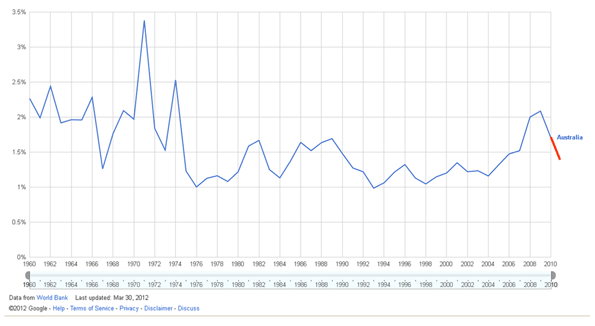
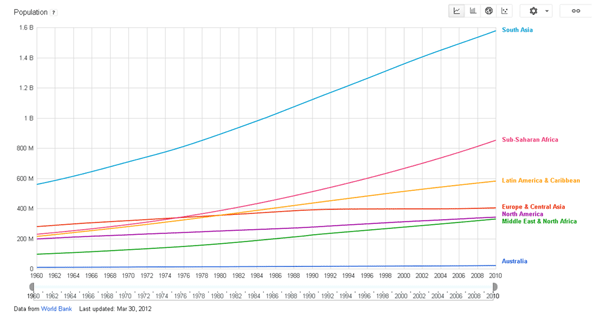
    Above: world populations since 1960. Below: Australia’s rate of population growth since 1960. Source: World Bank.

    How things change, yet stay the same. In 2012, it’s arguably just as much in Australia’s interests to boost its population numbers, in the interests of economic security and (according to some) military security also. And again, immigration – not an accelerated breeding program of naturalised Australians – is the only way this can realistically occur. As domestic industries increasingly surrender to global competition and as energy, agriculture and services industries increasingly depend on foreign markets for their long term survival, the issue of Australia’s relatively small population – despite its huge continental mass – raises little by way of public debate. A larger domestic population might provide markets for domestic industries, for local employment and for community wide infrastructure.

    In contrast the planning fraternity’s dreams of Parisian, London, or New York standards of public transport, for example, will never succeed. Our cities are simply too small to make this work.

    But talk of a ‘big Australia’ has become ‘persona non grata’ in public policy circles. We have a Federal Population Minister, but he hasn’t issued a single statement on population policy this year.  Our Prime Minister has other things on her mind, but even if her government was on more solid ground her antipathy to a ‘big Australia’ is well known and a matter of public record. And such is the apparent public hostility to the notion of a bigger population, intermixed as it is with a blend of doomsday environmentalism and references to failed Malthusian or Paul Ehlrich ‘Population Bomb’ scenarios and  myths (suggesting that Australia is running out of room and resources), that few political or public policy leaders want to take up the debate in favour of growth.

    With that in mind, I thought some very simple reality checks might prove helpful to stimulate your thinking about Australia’s population capacity relative to the rest of the world. Wendell Cox, author of the global housing affordability study ‘Demographia’ recently published his Demographia World Urban Areasreport with this summary on New Geography. I want to take just two examples and interpose them into the Australian context.

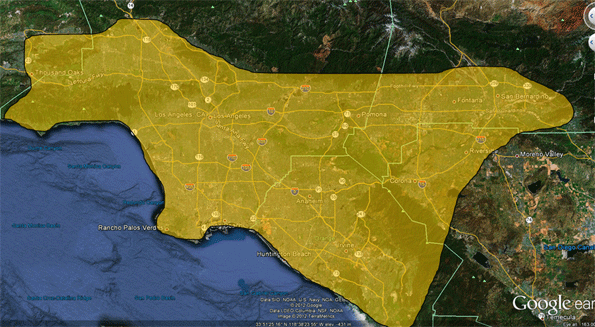
    First, let’s look at Los Angeles, California.  Often cited as a region with similarities to the Australian urban context (both in a positive and negative sense), this city popularly known for its ‘sprawl’ actually has a very high level of population density. The total population of the Greater Los Angeles area is around 15 million people. Put into context, that’s roughly two thirds of the entire population of Australia living in the Greater Los Angeles ‘sprawl.’


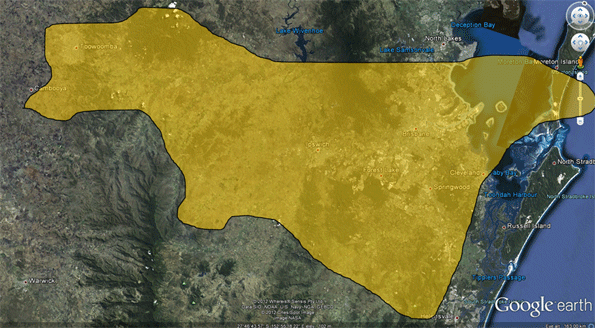
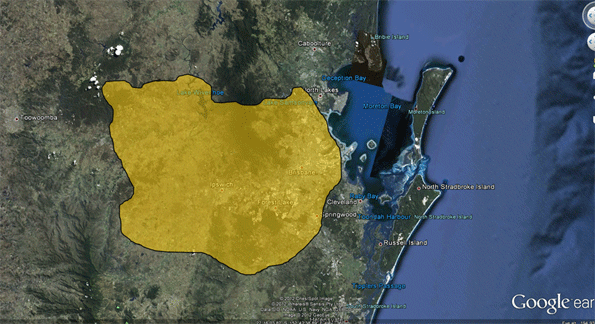
    Above: The greater Los Angeles area and below, the same area superimposed in south east Queensland.

    Put into a visual context, the contrast is even more apparent. At LA levels of population density, roughly the area we know of as south east Queensland could accommodate some 15 million people comfortably. Yet the conventional “wisdom” is that with just 3 million people it’s bursting at the seams and can’t possibly take any more

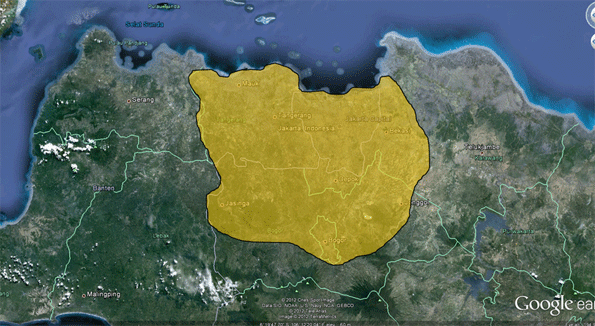
    A more extreme example, just to stretch the imagination further, is worth thinking about. Jakarta, Indonesia (our nearest large foreign neighbour) has a population of 26 million people. That’s more than the entire population of Australia, living in one (very crowded) city – at the rate of 9,400 people per square kilometre.

    Now, I’m not wishing that sort of urban density (and in large part, misery) on anyone in Australia, but the hypothetical comparison still applies, for the sake of discussion only. The footprint of greater urban Jakarta, home to 26 million people, easily fits within the boundary of south east Queensland.  In fact, it doesn’t even require the Gold or Sunshine Coasts to do it. Imagine this: the entire population of Australia, crammed as it would be into this super-compact urban footprint, and not a single soul living anywhere else on the entire continent?


    Above: Jakarta’s footprint and below, the same footprint – home to 26 million people – superimposed on south east Queensland.

    The argument that Australia is somehow incapable of supporting substantially larger population relies on a myth that we short of room. Nor can it rely on suggestions that we would exhaust our energy stocks (we are a net exporter and would remain so at much larger population numbers), nor our food production capacity (again, we are a net exporter and would remain so even with much higher levels of population). In fact, in terms of food production, a lack of domestic market scale poses a significant problem for producers. The efficiency gains of primary production (livestock to cropping) have outpaced the growth in population.

    There is an argument regularly raised that Australia has insufficient water supply to support much larger population numbers but this argument doesn’t hold water (sorry, couldn’t help that) either. What we do lack is water storage by way of dams, but the environmental lobby has vigorously opposed almost every proposed dam in the last 30 years whether for domestic supply, agriculture or hydro energy. The lack of water storage has been a policy decision made by successive governments for varying political reasons.   

    Think also for a moment how cities like Mexico City (population nearly 20 million people) or Cairo (population 18 million) or even countries like Morocco (population 32 million in 500,000 square kilometres on the edge of the Sahara compared with Australia’s 7.6 million square kilometres) manage for water? For Australia to claim it cannot support more people due to water limitations is a bit of joke.

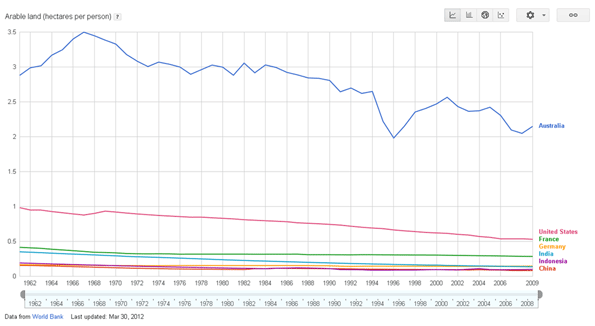
    Above: arable land area in hectares per person. Australia is well ahead of the field.

    Infrastructure deficits are the other vexed issue raised by by those concerned with population growth. They have pointed out that infrastructure investment has not kept pace with population, and they’re right. The problem though is largely that strategic infrastructure investment in this country is something really only talked about. Instead, what typically happens is that billions are doled out on pet projects in marginal seats or designed to win over particular interest groups that some focus group or other suggests could hold the key to winning the next election. Politically motivated rail projects (especially in NSW), home insulation schemes, TV set box boxes, green energy schemes… the list of our nation’s capacity to waste vast sums quickly is pretty impressive. Our deficient national road network, our inadequate domestic water storage (in many areas), our looming potential energy problems (not just in price thanks to a carbon tax but also in terms of power generation shortages according to some experts) – the bigger and more strategic infrastructure priorities which would support growth seem to get the least attention. Witness the latest Federal Government budget. (Read what Infrastructure Partnerships Australia, among others critical of the budget, had to say here).

    So the capacity to fund and deliver strategic infrastructure isn’t the issue. Inept public policy is.

    Instead, do we have some other more deep seated aversion to a bigger population? And is this race based? Despite being a successful nation of immigrants (  are we fearful for our culture if we had more immigration? Environmental impacts are often publicly cited as the reason to oppose more people, but if the examples of Los Angeles or Jakarta are remembered, we could in theory house a great deal more people without encroaching on vast areas of natural terrain.

    Another big reason to reconsider objections to a ‘big Australia’ is the ticking clock on Australia’s ageing population. Even the Federal Government’s own ‘Tax Reform Roadmap’ released with the May budget warned that:  “The proportion of working age people is projected to fall markedly over the coming decades. Today there are about 4.8 people of traditional working age for every person aged 65 and over. This is expected to fall to around 4 people within the next 10 years and to around 2.7 people by 2050.”

    Australia’s current rate of population growth is hovering around 1.4%. We are just shy of 23 million people. We say we’re concerned about getting to 35 million by 2050, by which time the world population will have increased by 2 billion people. We know that our ageing population will struggle to be supported by a diminished workforce  and that we lack sufficient critical mass to sustain a variety of industries in the face of global competition. Yet we consistently refuse to confront the question of a larger population and the consequences of failing to have one.

    Ultimately even if we agree collectively to prefer to remain a small nation of less than 30 million, it’s a discussion we need to be having. Pretending the issue isn’t there won’t do anyone any good.

    Ross Elliott has more than 20 years experience in property and public policy. His past roles have included stints in urban economics, national and state roles with the Property Council, and in destination marketing. He has written extensively on a range of public policy issues centering around urban issues, and continues to maintain his recreational interest in public policy through ongoing contributions such as this or via his monthly blog The Pulse.

    Australia graphic by Bigstockphoto.com.