Author: admin

  • Australian Elections: A Comeback for Pro-growth Policy?

    The latest local government elections in Queensland, along with the by election for former Premier Anna Bligh’s state seat of South Brisbane, may point to a fundamental shift in popular mood back in favour of growth and development. After many years of anti-growth policy paranoia, it’s a refreshing wind if it lasts.

    Was the electoral storm that swept ‘Can Do’ Campbell Newman and the conservative LNP to power only a few weeks ago something more than a direct reaction to a failed state Labor government? Subsequent local government election results state-wide may point to a more fundamental shift in community attitude. Why? Because one month after a resounding rejection of the state government, voters once again lined up to sink the knife into incumbent mayoral candidates who have presided over needless bureaucracy, excessive red tape and anti-growth policies disguised in political or media spin.

    Those who expected a bounce back to Labor from voters recognising the very large mandate of the new LNP state government were proven badly wrong. Even Labor’s stronghold state seat of South Brisbane, narrowly held by the former Premier at the last election, barely got over the line to Labor this time in a by election.

    Is this a sign that anti-growth and anti development policies, manifesting themselves in all manner of precautionary principles, red tape and green tape and which effectively ground the Queensland economy to a standstill, are on the nose? Maybe it’s not just the Labor ‘brand’ but bad public policy per se which is being rejected.

    The real economy – undisguised by the statistical support of the booming resources sector – has been suffering, with construction activity across the board falling to record lows, interstate migration and population growth slowing to record lows, and house prices and personal balance sheets under stress. Rising utility costs, partly or largely (depending on your view) driven by green-tinged policy settings, have hurt average families. New housing costs have risen and proven a barrier for a generation of young families wanting to enter the market without having to sacrifice everything in exchange for a mortgage they can’t afford. Overall, the people are clearly pissed off. And they showed it.

    In Brisbane, Lord Mayor Quirk – a prominent anointee of ‘Can Do’ Campbell Newman – was returned with an increased majority. And elsewhere, pro-growth candidates replaced incumbents whose administrations had presided over growth in regulatory process with little by way of measureable outcomes. In Redlands, a reputedly notorious local authority in terms of its hostile attitude to growth and development, Mayor Melva Hobson was turfed out in favour of pro-growth candidate and new Mayor, Karen Williams, (Williams scoring 69% of the primary vote to Hobson’s 31%).

    On the Gold Coast, pro-growth candidate and Chamber of Commerce President Tom Tait won resoundingly with 37% of the primary Mayoral vote. The next closest candidate was Eddie Saroff – a long serving Gold Coast Councillor and former Labor federal candidate, on 17.5%.

    On the Sunshine Coast – another Council which became notorious for being difficult to deal with and consumed with red tape and pointless administrative process – the pro growth and pro business candidate Mark Jamieson (33%) scored more than double his nearest two rivals, each on 17%.

    In Ipswich, popular Mayor Paul Pissale increased his majority, with almost 88% of the primary Mayoral vote. You would be hard pressed to find a more passionate, pro-growth and pro-development Mayor than Pissale, especially when it comes to his beloved Ipswich. This is a man who proudly proclaimed that he welcomed development and developers to his city.

    In Cairns, another region fast developing a reputation for an economy strangled in anti-development red and green tape and excessive planning controls, prominent local business identity and pro growth candidate Bob Manning picked up 56% of the primary vote, well ahead of his nearest rival, the incumbent Val Schier on 20%.

    The South Brisbane by-election result adds weight to the argument that this is part of a widespread and deep seated mood for change. Labor, in what is billed as a stronghold inner city seat, expected some solid bounce back as South Brisbane voters were encouraged not to give the LNP another seat in Parliament. They didn’t listen to the party line, and only one in three (33%) put the new Labor candidate Jackie Trad first. By contrast 38% of South Brisbane voters put LNP candidate Clem Grehan first. Labor had to survive on the preferences of the green vote, which drew 19.4% of the primary vote in that seat.

    Now take these most recent results and put them back to back with what happened in the state election just over a month ago. The LNP picked up a staggering 50% of the primary vote state wide, giving them 78 of the 89 seats. Labor picked up just over one in four primary votes, at 26%. The Greens only picked up 7.5% – less than their result in the previous election. The Greens in fact were outpolled by Katter’s ‘Australia Party’ which scored 11.5% of primary votes state wide. (I’m not sure whether to describe Katter’s party as pro growth but its connections to pro development rural interests suggests it is).

    That state election was a clear cut choice between a ‘Can Do’ Campbell Newman and a Labor machine which ran heavily on anti-development messages in its campaign, alleging that an LNP Government would be hostage to developers and hostile to the environment. There was no confusion in voter’s minds when they rejected the latter and firmly chose the former. You don’t get much more pro-growth than a candidate and a party which uses ‘Can Do’ as its rallying cry.

    The point of all this is that the new political mandate for growth shouldn’t be dismissed as some isolated reaction to the past government’s failings. The community seem to be making their views clear: bring back growth, bring back economic prosperity, restore the state’s balance sheet and with it, restore some health to personal balance sheets. The anti-growth movement will never be silenced by majority views but hopefully in this clear message from the people, it will take a backseat and keep a low profile, for a while at least.

    For Labor, aligning itself with anti-growth movements might prove even more damaging in the long run. Average workers on average wages left the Labor Party in Queensland in no doubt they were on the nose. It’s not just an issue of a damaged brand, and much more than a failed campaign strategy. If Labor stands in people’s minds as a party which objects to progress, which imposes punitive taxation on even humble endeavours, which is responsible for excessive intrusion of regulation into people’s lives, and which is hostage to fringe interest groups in a bid to win preference deals, it may be left in a political wilderness for a long time to come. Labor’s reconnection to working families and their values and interests is as surely the key to the revival of their fortunes, just as John Howard achieved and as Campbell Newman and a host of newly elected Mayors in Queensland have proven.

    Ross Elliott has more than 20 years experience in property and public policy. His past roles have included stints in urban economics, national and state roles with the Property Council, and in destination marketing. He has written extensively on a range of public policy issues centering around urban issues, and continues to maintain his recreational interest in public policy through ongoing contributions such as this or via his monthly blog The Pulse.

    Brisbane photo by Bigstockphoto.com.
  • Smart Growth: The Maryland Example

    This is Part Two of a two-part series.

    Evidence that people just don’t like Smart Growth is revealed in findings from organizations set up to promote Smart Growth. In 2009, the Washington Post reported, “Scholars at the National Center for Smart Growth Research and Education found that over a decade, smart growth has not made a dent in Maryland’s war on sprawl.”

    Citing the “most comprehensive review to date” from the same Center, the Baltimore Sun in 2011 argued that Maryland had made “little progress with Smart Growth” despite adopting laws and policies hailed across the country as models for growth management.

    One of the innovative policies was the establishment of Priority Funding Areas (PFAs) where development was to be directed and incentivized with money for cash-strapped jurisdictions. Yet the representative bodies closest to the people continued to permit development outside the PFAs.

    Assessing the failure of incentives to concentrate development, the Center concluded: “As the Maryland experience suggests, without statutory requirements, tools that matter to the state are not always those that matter to local governments.”

    The anti-democratic outlook among Smart Growthers was evident in a comment by Gerrit Knapp, the director of the National Center for Smart Growth Research and Education, who said, “What makes incentives so politically attractive is that governments and individuals can choose to ignore them if they wish. Unfortunately, in Maryland over the last decade, that’s exactly what many have been doing.”

    This “unfortunate” behavior by free people is consistent with the conclusion of Robert Bruegmann, author of Sprawl: A Compact History, who found that low density development was “the preferred settlement pattern everywhere in the world where there is a certain measure of affluence and where citizens have some choice in how they live.”

    Deconstructing Density

    Under the new PlanMaryland, Priority Funding Areas essentially become urban growth boundaries. People still can choose to live outside PFAs, but new housing can be built at no greater than one unit per 20 acres, making such dwellings unaffordable to all but the extremely rich. Ninety percent of new development must be inside the PFAs at a minimum density of 3.5 units per acre.

    The impact of increased densities is hard to gauge when presented in this manner, but 3.5 units per acre converts to 2,240 units per square mile. Maryland averages 2.62 people per dwelling unit, so the minimum population density for almost all new development will be on a scale of 5,846 people per square mile, a density higher than Portland or San Francisco, and just shy of Copenhagen, Denmark.

    Furthermore, reviewing previous drafts of PlanMaryland leads one to believe that this minimum density will be the exception to the rule of even higher densities. The earliest draft available for public comment, April 2011, was unapologetic about the need for significantly higher densities, saying this “threshold for new development – a relatively low density of 3.5 units per acre – is not accommodating growth in PFAs as needed to minimize continued impacts on our rural and resource lands and industries.”

    A later draft, September 2011, established ranges for “medium density” (3.5 to 10 units per acre) and “high density” (10+ units per acre) and repeatedly showed a preference for the high density classification, which converts to a scale of at least 16,704 people per square mile.

    For example, on page 18 is the complaint that incentive-based planning “hindered high-density urban development,” and page 35 says there would be dramatic per capita savings “if 25 percent of the low-density development projected to be built from 2000 to 2025 was shifted to high-density development.”

    But a strange thing happened on the road to the final draft: high density was euphemized. The sixteen-page Executive Summary does not once mention density. “Low density” makes numerous appearances in the final draft in the context of wasteful land use patterns, and “high density” appears just once.

    Instead, PlanMaryland relies on the phrase “compact development”. A comparison table, laughably labeled “Low Density versus Compact Development,” steers clear of medium or high density labels even though, when converted to population per square mile, the “compact” living arrangement would be more than seven times Maryland’s current density.

    To discern the density thresholds that Maryland planners have in mind, consider, PlanMaryland claims that “Compact development leads people to drive 20 to 40 percent less, at minimal or reduced cost, while reaping fiscal and health benefits.”

    This appears to be lifted from the influential 2007 Growing Cooler report, sponsored by the National Center for Smart Growth Research and Education, Smart Growth America, and other advocacy organizations. The authors call on “all housing growth” to be built at an average density of 13 units per acre (21,798 people per square mile), in order to increase the overall metropolitan density to 9 units per acre (15,091 people per square mile) by the year 2025. There’s not a lot of room for detached single family homes in this scenario.

    PlanMaryland’s Best Practices section highlights White Flint in North Bethesda for redeveloping “an auto-dominated suburban strip into an environment where people walk to work, shops and transit.” This project puts 1,400 apartments on 32 acres, for a density of 44 units per acre.

    Hyattsville’s Arts District is recognized because “this mixed-use community features row homes, condominiums, live-work units, shops and a new community center,” but there is no room for detached, single family homes among the 500 dwellings crowded onto 25 acres, or 20 units per acre. Also featured is Carroll Creek Park that has 300 residential units, all multi-family, mixed among commercial and office space along a linear 1.3-mile strip.

    As a “Traditional Neighborhood Development,” Kentlands is closer to the norm, and features some single family housing among its mix of shops, apartments, and condos, but the 1,655 residential units on 352 acres is still 35 percent higher than the “minimum” densities mentioned in PlanMaryland, and thirteen times the state’s current density level.

    These places are architecturally striking and aesthetically attractive, but they are unaffordable to most of the state’s population. Furthermore, the dearth of detached single family housing, the predominance of multi-family dwellings mixed with (not nearby) other uses, and dramatically higher densities are not at all what an overwhelming majority of people want in Maryland or anywhere else.

    The emergence of Smart Growth in Maryland is indicative of the movement in general: For successful implementation, it would be necessary to replace incentives with mandates, and continue to rely on euphemistic language to avoid a candid discussion of density.

    In October, I spoke — along with Wendell Cox and a few others — at a technical forum on PlanMaryland, addressing many areas of concern including density. Signed into law by Governor Martin O’Malley in December 2011, PlanMaryland weakens the authority of local governments, eviscerates property rights, and expresses hope for declining interest in the single family home.

    Defenders will argue that most people support Smart Growth; after all, O’Malley and others like him were popularly elected. Yet these politicians never campaign on the specifics of Smart Growth, such as how many people per square mile they believe is necessary, or what kinds of restrictions they will impose on single family housing in the suburbs, or the impacts on affordability.

    The September draft of PlanMaryland said, “PlanMaryland, we believe, is what the public says it wants and deserves in government.” Tellingly, this statement is missing from the final report. That’s because what planners want and what people prefer are starkly different.

    Photo: New residential smart growth, from the state of Maryland’s, “Smart, Green, and Growing” site.

    Ed Braddy is the executive director of the American Dream Coalition, a non-profit organization promoting freedom, mobility and affordable homeownership. Mr. Braddy often speaks on growth management related issues and their impact on local communities or at ed@americandreamcoalition.org

  • Smart Growth and The New Newspeak

    It’s a given in our representative system that policies adopted into law should have popular support. However, there is a distinction to be made between adopting a policy consistent with what a majority of people want, and pushing a policy while making dubious claims that it harnesses “the will of the people.”
    The former is a valid exercise in democracy; the latter is a logical fallacy. Smart Growth advocates are among the most effective practitioners of Argumentum ad Populum, urging everyone to get on the bandwagon of higher densities, compact mixed-uses, and transit orientation because all the “cool cities” are doing it.

    Smart Growth advocates also claim this is what people prefer, even if it is not how they currently live. The two core features of Smart Growth land use — high densities and multi-family dwellings — are simply not preferred by most Americans in most places, despite the trendy push for Livability, New Urbanism, Resilient Cities, Smart Codes, Traditional Neighborhood Design, Transit Oriented Developments or any other euphemistic, clever name currently in fashion.

    Survey Says!

    In the internal data of the 2011 Community Preference Survey commissioned by the National Association of Realtors, no specific question was asked about density, but 52 percent of respondents said, if given a choice, they would prefer to live in traditional suburbs, small towns or the rural countryside. Another 28 percent chose a suburban setting that allowed for some mixed uses (Question 5). Taken together, this shows an overwhelming preference for low densities. Only 8 percent of the respondents favored a central city environment.

    As for vibrant urbanism, only 7 percent were “very interested” in living in a place “at the center of it all.” Most people wanted to live “away from it all” (Question 17). An astonishing 87 percent said “privacy from neighbors” was important to them in deciding where to live. One can reasonably infer that a majority of this majority would favor low density places with separated uses rather than crowded, noisy mixed use locations that blur the line between public and private.

    When presented with a range of housing choices, 80 percent preferred the “single-family detached house” (Question 6). Only eight percent chose an apartment or condominium. Furthermore, 61 percent preferred a place where “houses are built far apart on larger lots and you have to drive to get to schools, stores, and restaurants” over 37 percent who wanted a place where “houses are built close together on small lots and it is easy to walk to schools, stores and restaurants” (Question 8).

    So — absent the loaded terms and buzzwords that are central to Smart Growth — a large majority of randomly selected people from across the country showed a strong preference for the land use pattern derisively referred to as “sprawl.”

    Yet the press release from the National Association of Realtors proclaimed that “Americans prefer smart growth communities.” This is because on Question 13, respondents were given a description of two communities:

    Community A, a subdivision of only single family homes with nothing around them. Not even sidewalks!

    Community B: lots of amenities all “within a few blocks” of home. Of course, the description neglected to mention the population density and degree of residential stacking required to put all those dwellings in such close proximity to walkable retail. This was a significant omission, since the first housing option offered in Community B was “single family, detached,” on “various sized lots.”

    Community B received 56 percent support.

    So, with just one response to an unrealistic scenario, out of twenty answers that included many aversions to Smart Growth, the myth that people prefer Smart Growth was spread. The National League of Cities released a Municipal Action Guide to thousands of elected and appointed officials declaring the preference for Smart Growth, and the online network Planetizen, among others, uncritically helped spread the news.

    Missing from the triumphalism was this important caveat in the 98-page analysis of the results by the consultants who conducted the survey:

    “Ideally, most Americans would like to live in walkable communities where shops, restaurants, and local businesses are within an easy stroll from their homes and their jobs are a short commute away; as long as those communities can also provide privacy from neighbors and detached, single-family homes. If this ideal is not possible, most prioritize shorter commutes and single-family homes above other considerations.”

    In addition to spinning the results of preference surveys, Smart Growthers also ignore them. Maryland is a case study in how to disregard what people want while claiming the opposite. In drafting a statewide growth management plan that anticipated “increased demand for housing, an aging population, and diverse communities,” Maryland officials ignored a robust 55+ Housing Preference Survey from Montgomery County that specifically addressed this concern.

    The survey showed that most seniors planned to remain in their present homes upon retirement. Only 30 percent planned to move, and, of that group, only a small percentage would consider an apartment or condominium. This should have mattered to Maryland officials trying to gauge housing preferences for their senior population. Instead, the architects of PlanMaryland looked elsewhere to find studies that reinforced their assumptions.

    The Great Conflation

    There is an abundance of examples like these, and the key to understanding how they influence decision-makers lies in the conflation of specific amenities with the overarching concept of Smart Growth. For example, Todd Litman’s Where We Want to Be, published by the Victoria Transport Policy Institute, claims that “preference for smart growth is increasing due to demographic, economic and market trends such as aging population, rising future fuel prices, increasing traffic congestion, and increasing health and environmental concerns.”

    Does this mean most seniors – such as those in Maryland – want to live in high density, mixed use, transit-oriented apartments even when they say they don’t? Hardly. Litman concedes that “most Americans prefer single-family homes,” but finds “a growing portion want neighborhood amenities associated with Smart Growth including accessibility, walkability, nearby services, and improved public transport.”

    Those amenities are things like sidewalks, which evidently are now a Smart Growth invention, and shops that are close to (but not mixed into) residential areas. Litman’s clever construction – e.g., sidewalks equal walkability equal Smart Growth policy – is convincing to officials who mistakenly conclude that their constituents must want Smart Growth when, in fact, they do not.

    This has been Part One of a Two-Part Series on Smart Growth by Ed Braddy.

    Photo by W. Cox: Rail station in Evry, a suburb of Paris

    Ed Braddy is the executive director of the American Dream Coalition, a non-profit organization promoting freedom, mobility and affordable homeownership. Mr. Braddy often speaks on growth management related issues and their impact on local communities. He can be reached at ed@americandreamcoalition.org.

  • The House Home Savings Built

    After doing his duty for the Navy in Washington D.C. during World War II, my father returned to Los Angeles, and my parents moved into the Talmadge Apartments between Western and Vermont. They’d been married for 17 years without having any children. So my father informally adopted his two nephews.

    Around 1949, those nephews, who were students at UCLA, threw a party at the apartment. It was apparently a night to remember. The management decided to not renew my father’s lease. Shortly after that, my father’s wife announced, after nearly two decades of a childless marriage, that she was with child. (Full disclosure: that child was none other than this writer.)

    So my dad leased a house facing the Wilshire Country Club in Hancock Park. Then, in 1959, he formed a corporation to buy a nearby Tudor house, hire domestics, and rent the house back to him with domestic services. This was the man who founded the largest savings and loan in America, who in those years probably enabled more Californians to become homeowners than anyone else. But he was technically a renter all his life. Those were the days of the 70-percent and 90-percent top tax brackets, and byzantine legal structures were common.

    In mid-century Los Angeles, anything on Wilshire Boulevard was considered more prestigious than anything on the side streets. On the eastern end near Lafayette Park was the Bullocks Wilshire department store. Several miles west were the Miracle Mile department stores, which had beautiful shop windows facing the boulevard, even though most people entered the stores through portes-cochères in the rear. Many of the major liberal establishment churches—the PCUSA, the United Methodists, St. Basil’s Cathedral, and the Wilshire Boulevard Temple, Rabbi Magnin’s huge reform synagogue—lined the street. The Ambassador Hotel was one of the great hotels of the city. And then there was The Brown Derby Restaurant, which gave us the Cobb Salad.

    My father was originally from Omaha, Nebraska, but he moved west, graduating from the University of Southern California in 1927 and emerging from the Great Depression as a successful insurance underwriter. During the war, he heard talk among the military that Southern California was going to take off, so he bought a one-branch thrift downtown called Home Savings and Loan. Soon, it grew to be a multi-branched empire in four counties: Los Angeles, Orange, San Bernardino, and Riverside.

    Partly to get involved in philanthropy and partly to set up an estate plan, my father set up The Ahmanson Foundation. The idea was that The Ahmanson Foundation, after my father’s death, would inherit and control the for-profit companies. This was a common legal arrangement at the time, offering a way for wealthy families to preserve more of the family fortune. (I recommend the novel God Bless You, Mr. Rosewater, by Kurt Vonnegut, for a sense of how it worked.)

    Apparently, my father wasn’t a full member of the downtown establishment, for he chose to base his business several miles west of the establishment thoroughfares of Flower and Figueroa. He recruited the artist Millard Sheets to design for him a corporate headquarters on the north side of Wilshire Boulevard, between Serrano and Oxford Streets, in the early 1950s. Then he conceived of a fancier project for that site and hired Edward Durell Stone to design it. A model of it was in our house during my later high school years. It featured two buildings next to each other, with concave faces toward a courtyard. A third, taller building was to stand in back. But that part was never built.

    My father died suddenly on June 17, 1968, before ground was broken on the project. Fifteen months later, the U. S. Congress passed, and President Nixon signed, a bill called the Tax Reform Act of 1969. It rendered my father’s estate plan obsolete, for a non-profit foundation could no longer own a controlling interest in a for-profit corporation. Instead of remaining under the control of the The Ahmanson Foundation, Home Savings of America would have to go public. In the meantime, my father’s nephew Robert Ahmanson wound up overseeing construction on the pair of buildings. They were finished in 1973.

    The interest rate spike of the early ’80s was hard on Home Savings of America, and they sold off the Ahmanson Center on Wilshire at that time. Still, Home Savings coasted through the savings and loan crisis of the end of the ’80s, thanks to maintaining the conservative policies that my father had instituted.

    The area changed a lot in these years. After the Watts Riots of 1965, and in the 10 or 15 years after that, the upper and upper-middle classes of Pasadena, San Marino, Arcadia, and Hancock Park relocated en masse to the Newport Beach area in what I call the secessio patriciorum, or the secession of the patricians. Los Angeles Magazine featured an article in 1977 called “The Ripening of Orange County: Is It Stealing the L.A. Dream?” Indeed, a lot of the life seemed to get sucked out of Los Angeles at that time. One consequence of the secessio was that finance and retail and new construction tended to concentrate either downtown or west of central Beverly Hills. That left the Wilshire corridor in between down at the heels.

    Later, that part of Wilshire recovered and reinvented itself. New immigrants from Korea and Latin American countries moved in, and, for many years, such gentrification as took place in the area was done by these immigrants and not so much by white Anglos. After 1990, previously uncool areas like Pasadena, Santa Monica, and parts of downtown began to recover, and the Wilshire district became the heart of Koreatown. I now think of Los Angeles as being similar to San Francisco and Oakland. The West Side up to Hancock Park is like San Francisco, while the parts east of it are like Oakland and the East Bay. London and Berlin have the same sort of east-west-ness.

    Koreatown is a wonderful neighborhood, and the Ahmanson Center is still beautiful. But I can’t help feeling a touch of melancholy that my dad’s vision was never fulfilled. He’d hoped to make that part of Wilshire Boulevard one of the great financial and retail corridors of America. Today, the big players are concentrated downtown or in Beverly Hills and westward.

    If you walk up the Oxford Street side of the Ahmanson Center, you can see a travertine block with a Latin inscription. Translated, it says, “Robertus and Mauritius, two virtuous men, dedicate this stone to themselves.” Robertus is Robert Ahmanson, who supervised the construction of the center. Mauritius is Maurizio Bufalini, owner of a marble quarry in Carrara, Italy. Bufalini was a good friend of our family, and he provided the Italian and Greek marble that decorates the center. Both these men are “late,” as they say in Botswana English, meaning dead. The stone is dusty now, but the words can still be read. I wonder if anybody notices it, or wonders what it means.

    This piece first appeared at Zocalo Public Square.

  • Floribec : Quebec in the Tropics

    Floribec has been part of the collective imagination of the Quebecois for nearly 50 years. Over time, a movie, a novel, advertisements and news reports played an important part in establishing the greater Miami region as the destination of choice for Quebec tourists. Floribec began as a result of tourism and it later evolved into a transnational community. After visiting southeast Florida, some Quebec tourists decided to take up permanent residence there and to make their living providing services in French to other French-speakers. Motels, restaurants, convenience stores, lawyers, and other services for winter residents appeared, creating a Floribecois community, where the lifestyle and economy were largely based on the ever-present Quebecois tourists, visiting for a week or for several months. The result was a French-speaking community outside Quebec, distinct from other French-speaking communities in North America. However, the survival of the declining community is now in jeopardy.

    The Origins of Floribec 

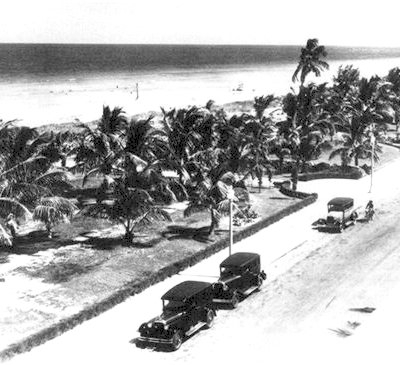
    Ocean Drive (Miami) sometime in the 1940's

    Ocean Drive (Miami) sometime in the 1940’s

    It is hard to pinpoint the origin of the word "Floribec" but it appears to have been adopted in the 1970s by Quebec residents wintering in Florida and made official in a study by Louis Dupont in the 1980s. According to him, French Canadians began immigrating to Florida in the 1930s. This immigration came in the wake of spending by the United States government, which, in an effort to resolve the 1929 economic crisis, undertook to build a network of canals through the marshland in southeast Florida and, notably, to open the Intercoastal Waterway, a navigable canal hundreds of kilometres long. At the same time, the government was also attempting to develop the infrastructure for tourism. Thousands of Americans travelled to the "Sunshine State" to work on this vast construction site. Among them were Franco-Americans from New England, some accompanied by their French-Canadian cousins. Once the construction work was completed, rather than going home, many of the French-Canadian workers took up permanent residence in the Miami region, particularly in Surfside, on the Atlantic coast, and in North Miami. After the Second World War, there were 67,000 French-Canadian and Franco-American families living in the State of Florida. These new permanent residents of Surfside and North Miami and of Sunny Isles generally found work in the tourist industry because Florida, especially Miami, was the holiday destination of a growing number of wealthy French-Canadians. This initial wave of Quebecois mass migration to Florida began at the end of the war and continued until 1960.

    Establishment of the Floribecois Community 

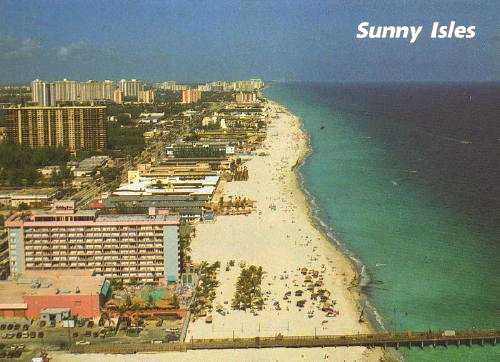
    Postcard of Sunny Isles, before the arrival of the giant hotels

    Postcard of Sunny Isles, before the arrival of the giant hotels

    The period from 1960 to 1970 saw a second wave of French-Canadian, mainly Quebecois, migration to the Miami region, with the appearance of a new type of immigrant: the investor. Two of the factors contributing to increased immigration were the liberating effect of the Quiet Revolution and the growth of wealth in Quebec. The fact that these two phenomena occurred simultaneously appears to have encouraged the people of Quebec to look beyond their borders. Expo 67 and a number of other Quebec cultural events made the rest of the world more aware of the province and, as well, the people of Quebec used this period of cultural vitality to increase their travel to foreign destinations. 

    At the same time, the tourist industry was experiencing rapid development in Florida with the arrival of the major airlines, the construction of the United States freeway system, and the north-south shift of economic and political power, which sparked phenomenal growth in the cities of the Sun Belt, including Miami. Miami Beach and its suburbs of Surfside and Sunny Isles became the favourite seaside destinations of the Quebecois. Recognizing the opportunity the situation presented, the Floribecois set up businesses in the area to cater mainly to Quebecois tourists, building French-language motels, restaurants, bars, convenience stores, and various other services to meet their needs. 

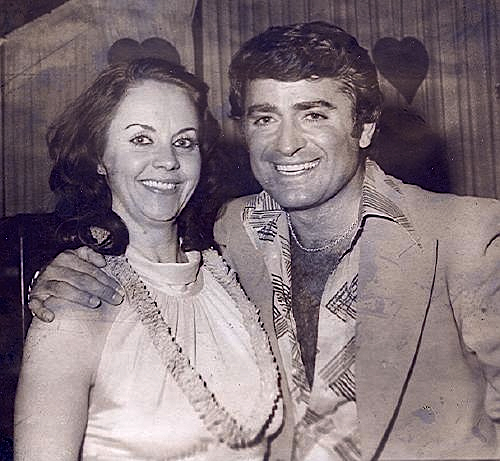
    Gemma Cossette with popular singer Michel Louvain

    Gemma Cossette with popular singer Michel Louvain

    From the 1970s onward, most businesses were established in Surfside and Sunny Isles, especially along Collins Avenue, whose location less than a kilometre from the beach offered increased customer traffic. The favourite tourist destination of the Quebecois was now affordable and there was no longer any language barrier. During this period, the Thunderbird, Suez, Waikiki and Colonial hotels were familiar to any Quebecois who travelled regularly to Florida, and even to those who were merely thinking of going there. Cultural life was vibrant because of the continued presence of such artists as Gilles Latulippe and other popular Quebec comedians and singers, who performed to sold-out audiences in the most popular hotels. The localization of these cultural activities in the gathering places of Quebecois tourists would serve to establish the physical boundaries of Floribec as a transnational tourist community.

    Floribec’s Shift Northward 

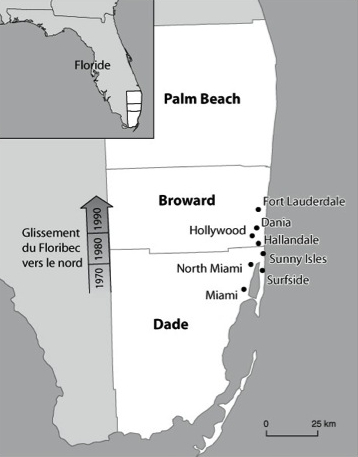
    Map showing location of concentrations of Quebec residents in Florida


    Map showing location of concentrations of
    Quebec residents in Florida

    The Floribecois communities in Surfside and Sunny Isles moved in the 1980s because, as had been the case in the Mafia era of 1920-1930, Miami once again became an international money-laundering centre for the drug trade, as well as being the scene of major racial conflicts. The city gained the status of unofficial capital of Latin America, not only because it had become a hub of the Latin-American banking system, but also because its downtown attracted hundreds of thousands of Cubans, Nicaraguans, Columbians and others. This continual influx of migrants led to a major exodus of WASP’s (White Anglo-Saxon Protestants), who moved north to the neighbouring counties of Broward and Palm Beach, leaving Dade County to the Hispanic population. Many Quebecois tourists and immigrants also left Dade County at that time.

    Floribec’s Glory Years 

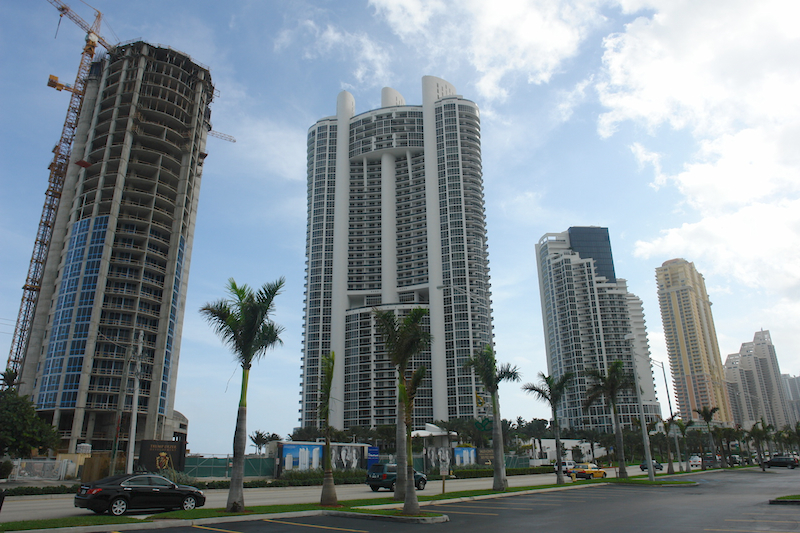
    Giant hotels replaced small motels

    Giant hotels replaced small motels

    For all intents and purposes, the Floribecois areas in Surfside and Sunny Isles disappeared in the early 1990s. The small, modest hotels, motels, and apartment buildings, where many Quebecois lived, were torn down and replaced by luxury high-rise condominiums up to 30 storeys high, some of them owned by Donald Trump. 

    The changes to that area explain why the neighbouring cities of Hallandale, Hollywood and Dania experienced such considerable growth during this period. They had not suffered from the demolition associated with urban sprawl and, for this reason, they became the southernmost destinations to which Quebecois tourists could travel affordably. The small, reasonable motels so popular with the majority of Quebecois tourists remained. It was here, in a well-defined area, that the Floribecois community really took root again and where it continued to be possible to carry on everyday life in French.

    Floribec’s Current Configuration

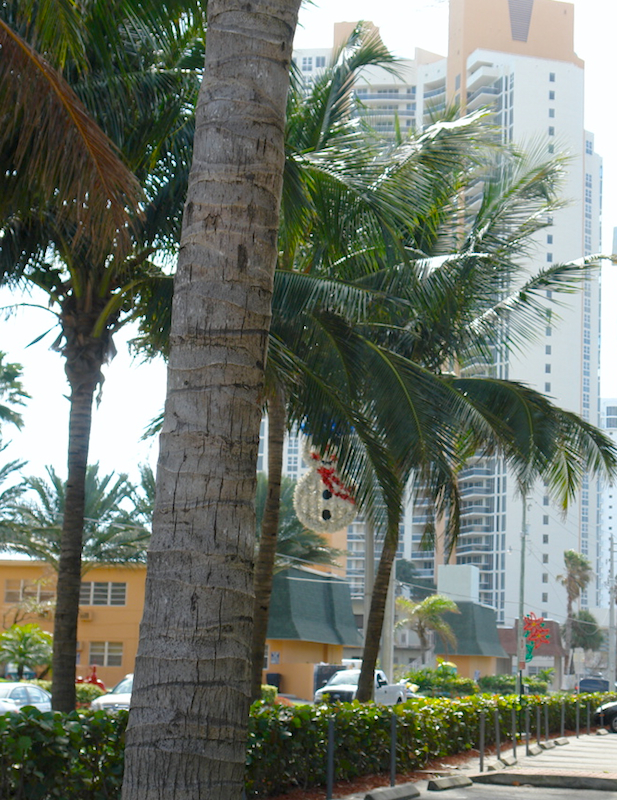
    Christmas decoration hanging discreetly from a palm tree

    Christmas decoration hanging discreetly from a palm tree

    Like numerous other seaside resorts, Floribec has a recreational business district (RBD) where the main tourist services are located. In the Floribecois RBD, there is a pedestrian walkway along the beach, the Broadwalk, and perpendicular to it, a main artery, Johnson Street. Depending on the season, restaurants, specialty food stands, candy shops and souvenir shops line these two streets in the RBD. The beach is the location of the sites most vital to Floribec life, namely the Broadwalk itself and the Johnson Street stage, as well as social institutions like the famous Frenchie’s Café.  Only a few kilometres from the RBD, other very popular Floribecois motels, including Richard’s Motel, branches of the Caisse populaire Desjardins and the National Bank of Canada, Lacroix Real Estate AgencyAu Coq restaurant, and other services are grouped together along U.S. Highway 1. Beyond the Hollywood-Dania-Hallandale corridor, the Floribecois population and its landmarks are soon swallowed up by the greater community. 

    It is important to note that Quebec is an integral part of the Floribecois community. The ongoing relationship with Quebec is sustained by the seasonal influx of thousands of tourists, often called "snowbirds", and the ready access in Florida to Quebec newspapers and radio, the main Quebec television programs, and the Internet, which also makes on-line banking possible. All of the regular and ongoing media and tourist contact between Quebec and Floribec make the latter a "transnational community" whose existence is largely dependent on the many connections it maintains with Quebec.

    Floribec in Decline? 

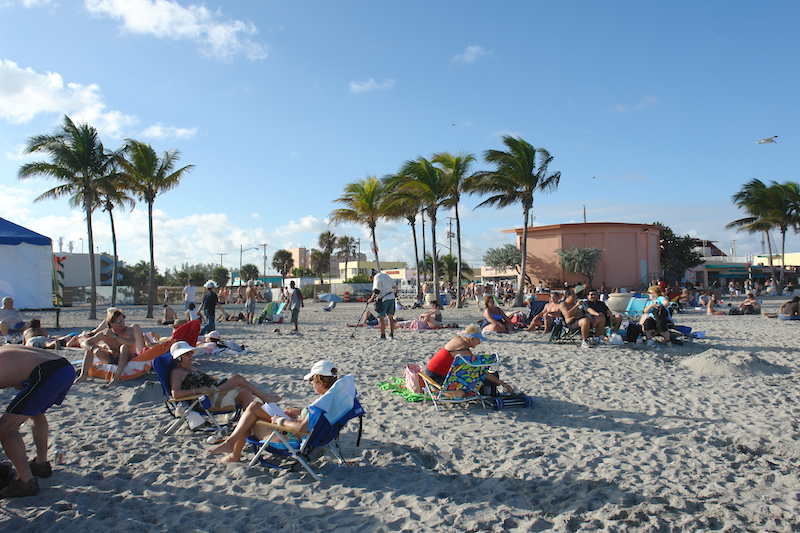
    Enjoying the beach...

    Enjoying the beach…

    Floribec has changed considerably since 2000. While Quebecois tourists continue to travel to southeast Florida, and the Quebecois culture and everyday living in French no longer dominate the scene around Johnson Street, as they did in the 1990s. People still gather on the beach but the tourists and immigrants live elsewhere, often at some distance from the ocean. Three factors may explain this erosion: 1) pressure from Miami’s continuing urban sprawl; 2) the negative image local political authorities have of the Floribecois; 3) competition from numerous tourist destinations that are as affordable as Florida, such as the Dominican Republic, Mexico and Cuba, which attract an increasing number of Quebecois.

    Miami‘s urban sprawl

    The purchase and demolition of Floribecois motels by rich local and Latin-American land developers has expanded beyond the cities of Surfside and Sunny Isles. Due to the shortage of available land, the trend has now reached Hollywood. For example, a huge luxury hotel complex was built only a few kilometres from the Broadwalk, which is also being rebuilt, and Floribecois motels located on Hollywood Beach have been demolished to build luxury condominiums. It is Hollywood’s turn to face the phenomenon of urban high-rise construction and tourist gentrification; it may be fighting a losing battle. 

    A veritable Quebecois


    A veritable Quebecois

    Negative image of the Floribecois

    The socio-economic class to which the Floribecois belong troubles Hollywood City Hall. In strictly economic terms (daily spending, property taxes, etc.), it is not in the municipality’s interest to encourage the Floribecois to remain in the area. Nor does the caricature of the Floribecois presented in Quebec films and the local media help to reassure the city councillors. While the City of Hollywood welcomed the economic benefits associated with French-speaking residents in the 1980s, it now fears that these same people may tarnish the city’s image and it feels that Hollywood should follow the example of neighbouring municipalities who are moving to attract a higher class of tourist. The city has already taken the first step by demolishing one of Floribec’s most significant institutions, Frenchie’s Café, at the corner of the Broadwalk and Johnson Street, along with the adjacent small businesses. Since the demolition, the Floribec atmosphere, so appreciated by tourists, is much less vibrant than it was in the 1990s. Although there are still many Quebec tourists on the beach, fewer services are available to them in French, quite a different situation that in Floribec’s glory days. The only time that the Floribecois now flock to this subtropical area of the country is in January, when the annual festival, Canada Fest, brings together Floribec businesses and Quebec singers. Annual attendance at this cultural event is about 100,000 visitors. However, it is increasingly difficult to find signs of Floribec’s existence. While some insist that all is well, it would appear that Floribec’s days are numbered. At the very least, it seems that Floribec has lost its heart and soul.

    Competition in the tourist trade

    The increased number of affordable tourist destinations adds to the pressure on Floribec. Because those who love Florida enjoy temperatures of 25º C or above, the West Indies, the Caribbean and Mexico are harming the Floribecois economy. Le Soleil de la Floride, a monthly newspaper established in 1983, has reason to continually boast the merits of the Sunshine State, pointing out how familiar and safe a destination it is. However, there is no doubt that sun-seekers, especially those who do not travel south by car (single people or couples), are being lured away by the Dominican Republic, Cuba or Mexico. Direct flights from Montreal and Quebec to Cancun, Acapulco, Punta Cana, Varadero, and many other destinations are rapidly growing in number to meet demand, making vacations in these tropical and exotic areas accessible, often at a lower cost than an extended stay in Florida.

    Heritage in Danger? 

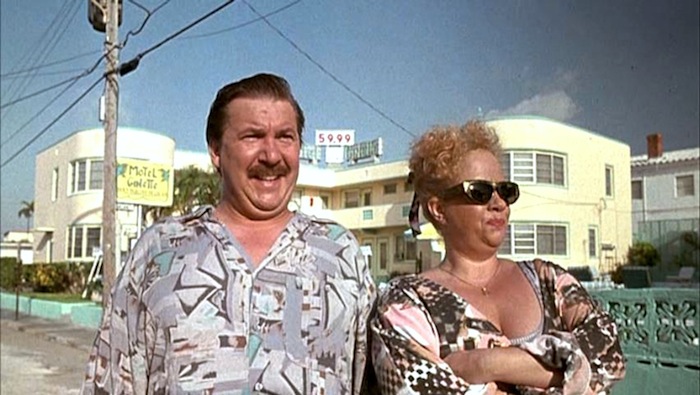
    Image from the movie «La Florida» (George Mihalka, 1993) starring Rémy Girard and Pauline Lapointe

    Image from the movie «La Florida» (George Mihalka, 1993) starring
    Rémy Girard and Pauline Lapointe

    Floribec constitutes an interesting chapter in the history of modern Quebec and it represents an intriguing and unique pocket of French-speaking America. This transnational community came into being as a result of people patronizing numerous businesses and other community-building venues situated in a relatively small geographical area on the Atlantic coast. These sites played an essential role as centres of community life for French-speakers who were living in or visiting the greater Miami area. Today, certain community practices formerly associated with Floribec can still be found; however, they are dispersed over a much wider area and signs of any Quebecois presence in the Florida landscape are increasingly difficult to discern.

    Rémy Tremblay is Canada Research Chair on Knowledge Cities, Université du Québec à Montréal

    ——–

    This piece is courtesy of the Encyclopedia of French Cultural Heritage in North America.

    ——–

    Bibliography

    CORTÈS, G. E FARET, L. (dir) (2009) Les circulations transnationales. Paris, Armand Colin, 244 p.

    DUPONT, L. (1982). Le déplacement et l’implantation de Québécois en Floride. Vie française, 36 (10-11-12), p. 23-33.

    GILBERT, A., LANGLOIS, A. et R. TREMBLAY (à paraître) Habiter Floribec. Voisinage et communauté. Revue internationale d’études canadiennes.

    LEVITT, P. (2001). The Transnational Villagers, Berkeley et Los Angeles, University of California Press.

    MORISSONNEAU, C. (1983). « Le peuple dit ingouvernable du pays sans bornes: mobilité et identité québécoise », dans Dean Louder et Éric Waddell (dir.), Du continent perdu à l’archipel retrouvé: le Québec et l’Amérique française, Sainte-Foy, Presses de l’Université Laval.

    TREMBLAY, R. (2003) « Le déclin de Floribec », Téoros, 22 (2).

    TREMBLAY, R. (2006). Floribec. Espace et communauté, Ottawa, Presses de l’Université d’Ottawa.

    TREMBLAY, R. (2008) Le Floribec éphémère, dans Dean Louder et Éric Waddell (dir.), La Franco-Amérique : traces et enracinement, Québec, Septentrion.

    TREMBLAY, R et O’REILLY, K (2004) « Les communautés touristiques transnationales. » Revue de Tourisme/Tourism Review, 59 (3).

  • Historic Day in Corruption History: Two Governors From Same State in Jail at Same Time

    Today, history will be made. Rod Blagojevich is going to jail in Littleton, Colorado. Blagojevich will join his predecessor Governor George Ryan who’s in prison in Terre Haute, Indiana. America’s fifth largest state will now have two back-to-back Governors in federal prison at the same time. What other state in America can say that? Both Illinois Governors were convicted of major felonies. Have Illinois voters turned the corner on supporting corrupt politicians? It appears not. Recently, U.S. Attorney Patrick Fitzgerald has been busy. Long time Chicago Machine boss William Beavers was indicted on tax fraud. Tuesday, Illinois State Rep. Derrick Smith was arrested on a federal bribery charge.

    Here’s a report from WLS-TV:

  • No G-8 Summit for Chicago

    Veteran Chicago journalist Ben Joravsky explains why Chicago’s better off without the G-8 summit:

    One, we’re not equipped to handle it. Two, we can’t afford it. And, three, it has the potential to give the Republicans great campaign material for the coming election.

    President Obama has done Mayor Emanuel a great favor, because there’s no real upside to the summit for Chicago. Banks on La Salle Street were planning to close. Many major corporations located downtown were telling their employees to stay home. The fear of violence from the demonstrators was bound to dampen economic activity. There’s no real need to showcase Chicago, international travelers are well aware of the town.

    Some may view as an embarrassment to Emanuel. The Chicago Sun-Times reported to President Obama only gave Emanuel “an hour’s advance notice.”  But Emanuel is the lucky one. Violent demonstrations or not, the G-8 would have put the spotlight on Chicago. Do we want to shine a light on the recent loss of  200,000 people? The high retail sales tax? The bad public schools? The relentless legacy of public corruption?

    President Obama helped his former Chief of Staff dodge a major bullet.

  • California’s Bullet Train — A Fresh Start and a Change in Direction

    A new strategy is beginning to emerge toward California’s embattled high-speed rail venture. The strategy is designed to rescue the project from a possible defeat at the hands of the state legislature, gain friends and supporters among local transportation agencies, win converts among independent analysts and turn around a largely skeptical public.

    The plan combines the existing commitment to proceed with construction of the first rail segment in the Central Valley with near-term actions aimed at upgrading rail facilities at both ends of the proposed LA-to-SF high-speed line. Specifically, the so-called "bookend" strategy will involve "blending" high-speed rail service with commuter rail service in existing Bay Area and Southern California rail corridors.

    At the northern end of the line, between San Francisco and San Jose, bullet trains would share track with Caltrain commuter trains. Both would benefit from new investments in electrification, signaling systems, bridge replacements, passing tracks and grade crossings elimination. Similar type of improvements would be introduced at the Los Angeles/Orange County/San Diego ends of the line, benefitting LA’s Metrolink and other Southern California commuter rail and transit systems.

    Improving the urban "bookends" of the system will make it possible to increase the speed of local commuter trains and thus bring immediate benefits to large segments of California’s urban population. It will be a good investment whether or not the overall $98 billion high-speed rail project ever goes forward, said Will Kempton, chief executive of the Orange County Transportation Authority (OCTA) and Chairman of the independent Peer Review Group advising the High Speed Rail Authority.

    The investments will be funded with a portion of Proposition 1A funds, supplemented by matching funds from local government agencies. Up to $2.3 billion in bond money and its $950 million "interconnectivity" fund would be committed to these near term improvements according to well-informed sources. This would provide approximately $1.4 billion for Southern California and $900 million for the Bay Area, assuming a 60/40 split. Another $2.7 billion has been already set aside for the 130-mile Central Valley segment, leaving roughly $4 billion of Proposition 1A money for future HSR construction.

    The new strategy has evolved from discussions held by the High Speed Rail Authority’s new chairman, Dan Richard with the Governor and his fellow board members. In a conversation we had with Chairman Richard several weeks ago, he was frank to admit that significant changes must be made in the Authority’s way of doing business if the bullet train project is to retain the support of the state legislature, overcome the skepticism of independent critics and turn around public opinion. The Authority must find ways, in the Governor’s words, to do things "better, faster and cheaper."

    While supportive of the Governor’s vision, Richard saw a need to show signs of near-term progress and not have to wait until 2033 to demonstrate the benefits of the investment. The dollars spent on the "bookends" could have "an immediate and dramatic effect," he told us.

    Turning to the Central Valley project, Richard freely admitted the ham-handed way in which the Authority dealt with the affected property owners and local governments. He made plain his resolve to restore trust and rebuild the agency’s credibility with the Valley constituencies. We also were struck by his refreshing willingness to reach out to the program’s critics, in contrast to the Authority’s often arrogant and dismissive posture of the past.

    Richard’s new strategy is beginning to bear fruit. Six Southern California planning and transportation agencies, including the Southern California Regional Rail Authority (Metrolink) voted as a group on March 1 to support the development of high-speed rail "while providing funding for local early investment projects in

    Southern California that will improve rail service immediately." The Authority hopes to stimulate similar expressions of support in Northern California by working closely with the Bay Area’s Caltrain and San Francisco’s Municipal Transportation Agency. The Peer Review Group, which has long supported the "bookends" approach, can be expected to provide an additional boost to Richard’s strategy.

    As for the initial Central Valley segment, its construction, initially planned to begin in September, has been pushed back. The slowdown is due to the need to revisit the environmental report whose initial version has run into a storm of objections concerning the proposed route. The revised draft report will be subject to another round of public hearings before the route through the valley is finalized. Assuming the state legislature authorizes the bond funding, construction in the Central Valley is now expected to begin in early 2013, although court challenges may cause further delays. Critics are expected to continue questioning the value of that investment, fueling continued controversy and increasing the project’s vulnerability.

    A New Perception

    Regardless of what ultimately becomes of the Central Valley project, the new urban "bookends" strategy is bound to profoundly modify the public perception of the bullet train venture. While the Governor and Chairman Richard maintain that the ultimate year 2033 goal of a 2 hour 40 minute train trip from LA to San Francisco has not changed, the practical effect of the new strategy will be to shift the focus from achieving that distant vision to effecting concrete near-term improvements— investments designed to benefit millions of present-day commuters in California’s two largest metropolitan rail corridors.

    Given California’s budget deficit, given the uncertainty of further federal support for high-speed rail in general and for California’s HSR project in particular (see below), and given a lack of any evidence of private investor interest, the"bookend" program of investments may indeed end up as the key accomplishment of the Proposition 1A initiative. While bullet train visionaries will regret this shift in the focus, pragmatists will welcome it as a prudent and realistic response to the growing skepticism. From an economist standpoint, the bookend strategy will be viewed as the best use of scarce financial resources. The public will see it as a victory for common sense: a decision that wisely  places greater value on satisfying present-day needs than on the promise of distant-in-time benefits.

    Could Washington come to the rescue?

    Meanwhile, in Washington, the Administration continues pursuing its fantasy-land rhetoric. "We envision an America in which 80 percent of people have access to high-speed rail," Transportation Secretary Ray LaHood reiterated in a recent blog. "We’re committed to this program… there’s no going back… we will keep the momentum going" he stated at a February 29 high-speed rail conference sponsored by the U.S. High Speed Rail Association.

    Except that this momentum, if there ever was one, has long since vanished. No funds for high-speed rail have been provided two years in a row, including the current (FY 2012) year. Nor are any HSR funds likely to be appropriated  in the next year’s budget. Congressional reaction to the Administration’s $2.5 billion HSR request in its FY 2013 budget submission has ranged from cool to dismissive. The President’s high-speed rail program is "a vision disconnected from reality" members of the Senate Budget Committee told Sec. LaHood at a recent hearing on the Administration’s transportation budget.

    Rep. John Mica (R-FL), chairman of the House Transportation and Infrastructure Committee was even more blunt. "If the president thinks his proposal for high-speed rail is going to fly, he’s pipe-dreaming," he told participants at the February 29 rail conference. In short, all signs point to continued congressional unwillingness to support a federal high-speed rail program. This sentiment seems to cross party lines: neither the Republican-controlled House nor the Democratic-led Senate have included HSR funds in their reauthorization bills. Rep. Jeff Denham’s (R-CA) bill would specifically prohibit new federal funds from going to California’s bullet train project during the entire life of the bill.

    For California, the implications are grave. Without further federal funds, the State of California will be obliged to seek a fresh infusion of public and private funds by 2015 if it is to continue pursuing its $98 billion bullet train vision. Will a new bond initiative or a public-private partnership succeed? Time alone will tell.

  • The White House Transportation Re-authorizaion: An “Unserious” Proposal

    The Administration’s $476 billion six-year transportation reauthorization proposal —included as part of its FY 2013 budget submission —has met with indifference if not outright skepticism in the transportation community. For one thing, the proposal comes at a time when both houses of Congress have already developed and are actively pursuing their own versions of reauthorization legislation. For another thing, the White House proposal is a close replica of the FY 2012 reauthorization proposal — a proposal that had been soundly rejected last year by the Republican House and the Democratic-controlled Senate alike. Lastly, the White House proposal is viewed –both in its levels of spending and its approach to funding — as totally disconnected from political reality The New York Times called it “more a campaign document than a legislative proposal.”

    The six-year budget provides a total of $305 billion for highways, $108 billion for transit and $47 billion for high-speed rail. It calls for an average funding level of $79 billion/year — almost double the $40-42 billion/year proposed in the House and Senate reauthorization bills.

    The total spending authority over six years would exceed the expected revenues by $231 billion. To offset this deficit, the Administration proposes to use “savings” achieved from “reduced Overseas Contingency Operations”— bureaucratic jargon for ending military operations in Iraq and Afganistan. Such offsets have been dismissed as “an accounting gimmick,” “imaginary” and “meaningless” by both Republicans and Democrats on the Senate Budget committee during recent hearings on the Administration’s bill.

    The White House has not helped itself by announcing that “After the six-year reauthorization period, the Administration is committed to working with the Congress on a financing mechanism.” (p.158 of the DOT budget). In effect, the White House is saying, Let the next Administration figure out how to pay for the program. For our part, let’s just pretend it’s paid for with an imaginary “peace dividend” from ramping down overseas military operations.

    Senate Minority Leader Mitch McConnel (R-KY) has called the FY 2013 budget submission “so unserious and political that even members of the President’s own party don’t want to have anything to do with it.” Sen. Jeff Sessions (R-AL), the Budget Committee’s ranking member, described the proposal as “not connected to reality.” Few Congressional aides we have talked to had anything charitable to say about it. In sum, the White House reauthorization proposal, like its FY 2012 version, is considered “dead on arrival.”

    As one Washington wit put it, “it makes you wonder why the Administration keeps coming up with the same proposals over and over again and expecting different results. Didn’t Einstein say…?