Author: admin

  • A Devastating Verdict for California HSR

    Like many other observers, we have found the California High-Speed Rail Peer Review Group to have made a convincing case for a fresh look at the feasibility of the California high-speed rail project. The group’s report was issued as eleven House Democrats – eight from California – joined an earlier request from twelve Republican House members for an independent GAO investigation of the embattled project. 

    That is why we find Governor Brown’s reaction – that the peer reviewers’ report "does not appear to add any arguments that are new or compelling enough to suggest a change of course” – to be incomprehensible. Either the governor issued the statement without the benefit of having read the report, or else he is so ideologically committed to the project that he refuses to look the facts in the face.

    Precisely which conclusions of the report are not compelling enough, the governor’s spokesman has not made clear. Is it the statement that "the Funding Plan fails to identify any long term funding commitments" and therefore "the project as it is currently planned is not financially feasible"?

    Is it the reviewers’ assertion that "the [travel] forecasts have not been subject to external and public review" and, absent such an open examination, “they are simply unverifiable from our point of view"?

    Could it be their statement that "the ICS [Initial Construction Section] has no independent utility other than as a possible temporary re-routing of the Amtrak-operated San Joaquin service…before an IOS [Initial Operating Segment] is opened"?

    Or, is it the Panel’s conclusion that "…moving ahead on the HSR project without credible sources of funding, without a definitive business model, without a strategy to maximize the independent utility and value to the State, and without the appropriate management resources, represents an immense financial risk on the part of the State of California?"

    To us, the findings seem at least deserving of a respectful consideration.

    But the California High-Speed Rail Authority (CHSRA) is not ready to concede anything. Here is the opening paragraph of its response: 

    "While some of the recommendations in the Peer Review Group report merit consideration, by and large this report is deeply flawed, in some areas misleading and its conclusions are unfounded. …Although some high-speed rail experience exists among Peer Review Panel members, this report suffers from a lack of appreciation of how high-speed rail systems have been constructed throughout the world, makes unrealistic and unsubstantiated assumptions about private sector involvement in such systems and ignores or misconstrues the legal requirements that govern construction of the high speed rail program in California."

    It is not our intention to delve in detail into the Authority’s response and judge the soundness of its arguments. No doubt, the CHSRA response will come under a detailed examination by the Authority’s critics in the days ahead. Suffice it to say that, having carefully and with an open mind examined the Authority’s rambling nine-page response, we find that it did not satisfactorily rebut the peer group’s central point: that it is not prudent, nor "financially feasible," to proceed with the $6 billion dollar rail project in the Central Valley (including $2.7 billion in Proposition 1A bonds) in the absence of any identifiable source of funding with which to complete even the Initial Operating Segment. To do so, would be to expose the state to the risk of being stuck, perhaps for many years, with a rail segment unconnected to major urban areas and unable to generate sufficient ridership to operate without a significant state subsidy. 

    The Authority’s lashing out at the peer reviewers and the dismissive tone of its response suggest that it has already made up its mind to stay the course and circle the wagons. That is not a wise posture to assume in the face of an already skeptical state legislature. 

  • What Lies Ahead for Transportation in 2012?

    As befits this time of year, our thoughts turn to the events that await us in the days ahead. Putting aside the major imponderable — the outcome of the presidential and congressional elections that inevitably will impact the federal transportation program —what can the transportation community expect in 2012? Will Congress muster the will to enact a multi-year surface transportation reauthorization? Or will the legislation fall victim to election year paralysis? What other significant transportation-related developments lie ahead in the new year? Here are our speculations as we gaze into our somewhat clouded crystal ball.

    Will Congress enact a multi-year transportation bill?

    In 2011, the Senate Environment and Public Works (EPW) Committee passed a bipartisan two-year surface transportation bill (MAP-21) and the Senate Commerce Committee approved the measure’s safety, freight and research components. But at the end of the year, the bill’s titles dealing with public transportation, intercity passenger rail and financing were still tied up in their respective committees (Banking, Commerce and Finance). What’s more, the Senate bill ended up $12 billion short of meeting the $109 billion mark set by the EPW Committee as necessary to maintain the current level of funding plus inflation.

    Finance Committee Chairman Max Baucus (D-MT) has yet to publicly identify the offsets needed to cover the final $12 billion of the bill’s cost. Repeated assurances by EPW committee chairman Sen. Barbara Boxer (D-CA) that the necessary "pay fors" have been found, has met with widespread skepticism. "I’ll believe it when I see it" has been a typical reaction among congressional watchers. With the Republicans opposed to using "gimmicks" (Sen. Orrin Hatch’s words) to come up with the needed money, it’s not entirely clear that the bill, as approved on the Senate floor, will contain the full $109 billion in funding.

    On the House side, the fate of a multi-year bill remains equally clouded. In November, Speaker Boehner announced that he would soon unveil a combined transportation and energy bill, dubbed the "American Energy & Infrastructure Jobs Act" (HR 7). The bill would authorize expanded offshore gas and oil exploration and dedicate royalties from such exploration to "infrastructure repair and improvement" focused on roads and bridges.

    However, questions have been raised about this approach. Critics, including Sen. Barbara Boxer and Sen. James Inhofe (R-OK) EPW committee’s ranking member, judge the approach as problematical. They allege, along with many other critics, that the royalties the House is counting upon would fall billions of dollars short of filling the gap in the needed revenue (the gap is estimated at approximately $75-80 billion over five years). They further contend that the revenue stream from the royalties would not be available in time to fund the multi-year transportation program. What’s more, using oil royalties to pay for transportation would essentially destroy the principle of a trust fund supported by highway user fees. In sum, the House bill, if unveiled in its currently proposed form, will meet with a highly skeptical reception in the Senate.

    Assuming that both reauthorization bills in some form will gain approval in February, will the two Houses be able to reconcile their widely different versions by March 31 when the current program extension is set to expire? Or will the negotiations bog down in an impasse reminiscent of the current payroll tax stalemate? Given the importance that both sides attach to enacting transportation legislation and given the desire of both sides to avoid the blame of causing an impasse, we think the odds are in favor of reaching an accommodation — probably more along the lines of the Senate two-year bill than the still vague and unfunded House five-year version. If this simply kicks the can down the road a couple of years, that may be OK with Senate Republicans. As one senior Senate Republican confidently told us, by the bill’s expiration date the Senate will be in Republican hands and "the true long-term bill will be ours to shape."

    Will California lawmakers pull the plug on the high-speed train?

    In 2011 Congress effectively put an end to the Administration’s high-speed rail initiative by denying any funds to the program for a second year in a row. Does the same fate await the embattled $98 billion California high-speed rail project at the hands of the state legislature in 2012?

    At a December 15 congressional oversight hearing, witnesses cited a litany of reasons why the projects is a "disaster" (Rep. John Mica’s words). Among them: unrealistic assumptions concerning future funding; quixotic choice of location for the initial line section ("in a cow patch," as several lawmakers remarked); lack of evidence of any private investor interest in the project; eroding public support (nearly two-thirds of Californians would now oppose the project if given the chance, according to a recent poll); a "devastating" impact of the proposed line on local communities and farm land; unrealistic and out-of-date ridership forecasts; and lack of proper management oversight.

    More recently, the project came under additional criticism. The job estimates claimed by the project’s advocates ("over one million good-paying jobs" according to House Minority Leader Nancy Pelosi) have been challenged— and acknowledged by project officials— as grossly inflated. Four local governments in the Central Valley, including the City of Bakersfield, have formally voted to oppose the project, fearing harmful effect on their communities. And agricultural interests are gearing up for a major legal battle, according to the Los Angeles Times.

    But most unsettling for the project’s future is the inability of its sponsors to come up with the needed funding. To complete the "Initial Operating Segment" to San Jose (or the San Fernando Valley) would require an additional $24.7 billion. To finance this construction, the California Rail Authority’s business plan calls for $4.9 billion in Proposition 1A bonds and assumes $19.8 billion in federal contributions – $7.4 billion in federal grants and $12.4 billion in the so-called Qualified Tax Credit Bonds (QTCB). But the latter assumptions came in for sharp congressional criticism as so much wishful thinking, given the bipartisan congressional refusal to appropriate funds for high-speed rail two years in a row.

    Further challenges await the project early in 2012. A group of 12 congressmen led by House Majority Whip Kevin McCarthy (R-CA) has formally requested the Government Accountability Office (GAO) to review the project’s viability and "questionable ridership and cost projections." Also expected early in January are a critique of the Authority’s business plan by the Independent Peer Review Group and a follow-up report by the State Auditor.

    Meanwhile, the governor and state legislature, are being asked by the Rail Authority to approve a $2.7 billion bond issue authorized by Proposition 1A to fund and begin construction  of the initial Central Valley section of the rail line from Fresno to Bakersfield. Will they be swayed by the findings of the three respected reviewing bodies and by the increasingly negative editorial and public opinion? Or will they continue to hold on to the seductive vision of bullet trains zooming from northern to southern California in two and a half hours — however distant and uncertain that vision may be? At this point, we believe the decision could go either way. However, sharply critical reports by the Peer Review Group and the General Accountability Office could tip the scale against funding the Central Valley project.

    Will tolling join the gas tax as a mainstream source of highway revenue?

    With the possibility of a near-term gas tax increase "less than zero," attention has turned to alternative means of raising transportation revenue. The most prominent option appears to be tolling— and 2012 may be the year when tolling becomes accepted as a mainstream source of highway revenue.

    Recent toll increases on the nation’s highways attest to their growing use (if not popularity) as revenue enhancers. In New Jersey, tolls are set to rise by 53% on the New Jersey Turnpike and by 50% on the Garden State Parkway. The Port Authority of New York and New Jersey also has approved substantial toll increases on bridges linking the two states. These moves have provoked Sen. Frank Lautenberg (D-NJ) to sponsor a "commuter protection act" that would transfer toll setting powers to the U.S. Secretary of Transportation. But the Senator’s initiative does not appear to have obtained much support in Congress. IBTTA, the toll industry association, has lodged strong objections, arguing that federalizing toll rate setting would encroach on the states’ jurisdiction and interfere with their ability to use tolls as a tool of infrastructure financing, and Congress appears to be listening.

    A recent Reason Foundation poll has found that people are more willing to pay tolls than increased fuel taxes (by a margin of 58 to 28 percent.) Moreover, the formation of a new "U.S. Tolling Coalition" suggests a growing interest in tolling on the part of the states. Under a pilot program that allows up to three Interstate highways to be reconstructed with tolls, Virginia will add tolls along the I-95 corridor and Missouri will toll its stretch of I-70. Arizona and North Carolina have applied for the remaining slot in the pilot program. Other states are embracing tolling to finance new capacity. Washington State, for example, has begun tolling the SR-520 floating bridge over Lake Washington to help pay for its replacement. Nor is the practice of tolling confined just to a few states. All told, 35 states already depend on toll revenue to some extent.  

    The Tolling Coalition wants to expand the pilot program and give the states the flexibility to toll any portions of their Interstate and other federal highways, "whether for new capacity, system preservation, or reconstruction." So far, neither the Senate nor the House have agreed to relax existing prohibitions, but they are prepared to retain the current pilot program.

    However, the need to reconstruct and modernize the existing Interstates which are reaching the end of their 50-year design life, combined with the necessity to expand capacity of the Interstate highway system to meet the needs of an expanding population, may soften congressional opposition to relaxing the current Interstate tolling restrictions. With the gas tax no longer able to meet the nation’s transportation investment needs, and with the concept of a VMT (vehicle-miles travel) fee still a distant vision, the year 2012 could mark a turning point in the acceptance of tolling as a serious highway revenue enhancer.

    ###

    Note: the NewsBriefs can also be accessed at www.infrastructureUSA.org
    A listing of all recent NewsBriefs can be found at www.innobriefs.com

  • Looking at the New Demography

    In the last 200 years the population of our planet has grown exponentially, at a rate of 1.9% per year. If it continued at this rate, with the population doubling every 40 years, by 2600 we would all be standing literally shoulder to shoulder. 
    — Professor Stephen Hawking

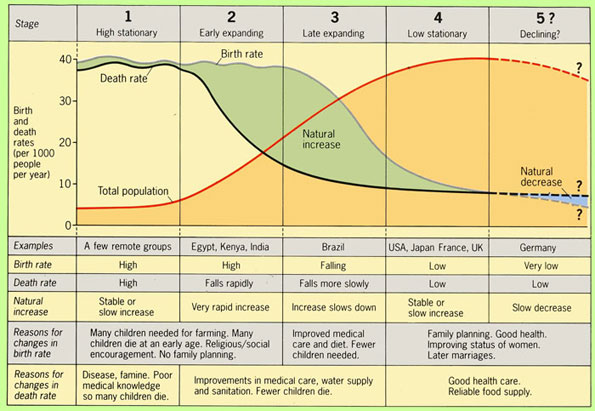
    Eighty-two years after the original development of the four stage Demographic Transition Model (DTM) by the late demographer Warren Thompson (1887-1973), the cracks are starting to show on the model that for many years revolutionised how we think about the geography of our global population.

    Thompson’s achievement was an important one. He suggested that we were in the midst of a transition, from an ‘old’ world dominated by high mortality, autocracy and subsistence to a ‘new’ world characterised by low mortality, democracy and an ever globalising economy. Our global society, slowly but surely, was moving to what he described as a ‘stage 4’ of the DTM: an earthly paradise in which mortality, fertility and population growth are low. However, is this really paradise? Is it too early to pop the champagne and congratulate ourselves for thousands of years of social and economic development? Is this the end of the demographic transition?

    What is stage 5?

    The mainstay of the geography classroom in secondary and tertiary education is the 4 part DTM.  Its theoretical representation shows a graph whereby high and fluctuating birth and death rates dramatically decline in stages 2 and 3 and come to equilibrium in stage 4 whereby birth and death rates are low. Simultaneously intertwined in the graph is a line representing population growth rates which starts low, increases exponentially and levels off in stage 4.

    Today we may be entering the next and largely unanticipated stage of development. Countries of the developed world have long said farewell to times where woman used to be chained to an animal cycle of reproduction and death used to be an almost daily occurrence. We may need to ask: is stage 4 really sustainable in the long term? Are we still in transition? The developed world is now one that experiences a low death rate and therefore an aging population, a birth rate far below the replacement level and a flat lining of population growth.

    I would by no means be the first to suggest we may be entering something what would be best defined as stage 5. The three main indicators of stage 5 of the DTM are: a very low birth rate, a low death rate and a slow decrease of the total population. How is this different from stage 4? The birth rate is the lowest the human race has ever experienced and for the first time since the Stone Age (excepting medieval plagues), the total population of some developed countries are in decline.

    Does Stage 5 exist anywhere?

    Firstly, a distinction needs to be made between the old world, the new world and the whole world. The ‘old’ world simply refers to the relatively undeveloped world characterised by high birth rates and a predominantly agrarian economy. Examples include Zambia and Uganda, places sitting at around stage 2 of the DTM. The ‘new’ world refers to the developed world of places which include East Asia, Europe, North America and increasingly parts of the developed world, notably China. Much of the developed and developing world has already reached stage 4 and many countries are headed decisively into stage 5.

    The most startling example of the exhaustion of stage 4 is Russia’s recent demographic performance. Since the breakup of the Soviet Union, Russia has lost 5.7 million people through higher death rates and lower birth rates. This is equivalent to the emptying of Scotland and the city of Newcastle-upon-Tyne.

    The rest of Europe is seeing below replacement level fertility rates. The only phenomena sustaining the level of population in these countries are the diasporas of overpopulated Africa and Asia. Not only has Europe entered stage 5 of the demographic transition, it’s now facing the challenge of its related social issues*.

    What might a stage 5 world look like?

    Some current trends lead to some fascinating projections of the future demographic make-up of the most technologically advanced factions of our global society. The low birth rate, especially in Europe, has allowed for an empowerment of women unseen before in history. Many are essentially swapping children for careers. This financially advantages both the parents and the 1 or 2 children who can enjoy a healthy share of the family income.

    Another dimension to a ‘stage 5 family’ is the inter-generational relationships between 3 and sometimes 4 generations of a single blood line. That is to say, it creates a situation where a grand child can have a relationship with a parent, a grand-parent and sometimes even a great grand-parent thanks to longer life expectancy and low death rates. This of course is rare in the ‘old’ world where a child may never know a grandparent beyond childhood. The reader may care to notice that this particular geography of the family, a 1 or 2 child household with living grand-parents, is not all that unusual.

    The decline of fertility in Europe has reached a point where it is below the replacement level needed to sustain the population. The reason that the European population is still growing, albeit slightly, is because of the influx of immigrants. The resulting greater multiculturalism can strain the patience of the most liberal and tolerant of people. It is a well known script from social scientists that immigrants tend to form insular communities in their arrival destination. The conflict between the British far-right pressure group, the English Defence League and British Muslims provides a textbook example of problems that arise from the ever evolving demographic transition. Problems that are of such importance, they are often reflected in the make up of parliament.

    Beyond stage 5

    Clearly, Thompson’s 4 stage DTM is increasingly outdated in most developed parts of the world. One possible solution to the dilemma of lost identity, rapid aging and depopulation may be a policy aimed at reversing the negative correlation between economic development and fertility. Mikko Myrskylä, Hans-Peter Kohler and Francesco C. Billari published an article in Nature 36 months ago outlining an irregularity in one of the most established relationships in the social sciences. Although it is normal for fertility decline in medium to high-HDI countries, there is evidence for fertility increase in areas of very advanced human development.  Perhaps it is this that could serve as a new model of what might be called ‘stage 6’ of humanities ever changing demographic transition.

    Edward Morgan is a 3rd Year Human Geography student at the University of St Andrews, Scotland.

    *It has been suggested that the ‘top-up’ of population with immigrants has led to the return of the anti-immigration far-right in Europe and it has been used to explain the electoral successes of parties such as the British National Party, Front National (France) and the ultra-right wing Danish Peoples Party.

    ~~~~~~~~~~~~~~~~~~

    Keith Montgomery does a good introduction to the demographic transition model

    Paper by Mikko Myrskylä, Hans-Peter Kohler and Francesco C. Billari.


    http://hs-geography.ism-online.org/2010/09/07/the-demographic-transition-model/
    Thompson’s Demographic Transition Model with stage 5.

    Photo courtesy of BigStockPhoto.com

    .

  • California in 2011: Suburbs Up, Exurbs Down?

    I had the fortune recently to stumble on the California Department of Finance’s estimates of population change in California during the period July 1, 2010 – July 1- 2011. This is distinct from the Federal census, which tried to establish the number of people in all localities as of April 1, 2010. These California statistics are for a short period of only one year; they are not as reliable, of course, as a real census.  

    Percentagewise, the county that grew fastest was a Sacramento suburban county called Placer, which grew by 1.45 per cent (or, I suppose, what financial people would call 145 basis points) during that one year. It was also only one of two California counties where more people moved to from within the United States than from outside the United States (the other being Riverside County). It was also  one of three where the number of people moving in over that moving out was greater than the excess of births over deaths, the other two being Napa County, which is suburban in its southern reaches before the grapes begin, and San Francisco County, which is known for, well, for not being big on baby-making. (Nevertheless San Francisco County did have a natural increase of 3,138 persons, whereas, as we shall see later, some rural counties had more deaths than births.)

    But what came as a surprise  was that Placer’s sister county, El Dorado, also a Sacramento suburban county running up into the mountains, gained a mere 26 basis points; and the other foothill counties of the Gold Country actually lost population during the year! This came as a surprise to me, for I have a house in Calaveras County and in the past I had spent time there; the Gold Country seemed to be a haven for the semi-retired and the part-time worker and even the long distance commuter; and Grass Valley had the beginnings of a high tech industry spilling over from Silicon Valley.

    I don’t know what the terms “suburb” and “exurb” mean to New Geography readers, but I have my own definition which seems handy enough to me. A “suburb” has subdivisions and planned communities; developers buy land, subdivide, and build homes or sell lots often with covenants of various kinds.  People still prefer suburbs – even ones quite distant from the urban cores – over the city, in part due to factors like cheaper housing, better schools, and newer amenities.

    Exurbs are different. In an exurb, people split parcels into smaller lots, sell the lots, and then people build custom houses on them with no covenants (except maybe a few easements) and any architectural style the government will allow and perhaps a few they don’t. A good place to see the contrast is in the area just north of Cajon Pass. Victorville, Adelanto, and parts of Hesperia and Apple Valley abound with subdivisions, like the Orange County of my youth. But if you go a little bit to the southwest, around Pinnon Hills and Phelan, there is not a “subdivision” to be seen, and yet houses and, on the road, commercial establishments get thicker and thicker every year. (I have, on occasion for the past 25 years, taken the road to the monastery at Valyermo from Orange County, and I have seen these changes.)

    Overall, it looks like the “suburbs” are growing – far more than the cities –  while the “exurbs” are not. Placer County is an explosion of subdivided suburbs and “planned communities” as far as Newcastle and Lincoln.

    In contrast, El Dorado has some of these in its west end, but they are not expanding much. And the other Gold Country Counties, Nevada, Amador, Calaveras, Tuolumne, and Mariposa, all of which shrank slightly in population, fit my definition of “exurban” – they have exurbs, and they are not very agricultural unless you count backyard wine and marijuana patches.  These areas had been much sought out since the inflationary “survivalist” days of the 1970s. Now, it seems, the economy and gasoline prices are not affecting the prosperity and desirability of organized suburbia, but they are making the areas beyond organized suburbia less desirable than they used to be. I wonder if this is a nationwide trend.

    Another discovery may point to the age of residents in various counties. Of the counties that actually lost population over the year the three on the Redwood Coast  – Del Norte, Humboldt, and Mendocino – did so in spite of having an excess of births over deaths. So did the two in the far northeast, Modoc and Lassen. To read that a county in California lost population is in the “this I have lived to see” category.

    Oddly, did one county in the Central Valley also declined. Kings, which is metropolitan Hanford, declined despite the fact that next door Tulare County was a big gainer; and Inyo County – home of Bishop, Lone Pine, and Death Valley – had an identical number of births and deaths. On the other hand, the Gold Country counties I mentioned – plus Sierra, Plumas, Siskiyou, Trinity, and Lake, outside the Sacramento Valley – had an excess of deaths over births. Perhaps these particular counties, more than the others, had been settled by retirees or empty nesters, who were no longer having children.

    For its part, the rain-drenched Redwood Coast and the far northeast were less attractive, apparently, to retirees. In the counties not attractive to retirees, natural increase exceeded even immigration from outside the United States, which was positive in every county except Alpine, where it was exactly zero. Also, only in the aforementioned Placer and Napa Counties, and the City of San Francisco, did inward migration of any kind – from the U.S. or outside – exceed the “natural increase.”

    The “native Californian,” once a slightly exotic phenomenon, seems to be becoming the norm. The days of what Carey McWilliams called, in his book title of 70 years ago, California: The Great Exception, seem to be at an end. We have entered a world we never knew before. California may become, at long less, less exceptional, still sprawling but in a more organized fashion.

    Howard Ahmanson of Fieldstead and Company, a private management firm, has been interested in these issues for many years.

    Photo courtesy of Bigstockphoto.com

  • The Troubled Future of the California High-Speed Rail Project

    A congressional oversight hearing, focused on the concerns surrounding the troubled California high-speed rail project, cast new doubts on the likelihood of the project’s political survival.

    The December 15 hearing was the second of two hearings called by the House Transportation and Infrastructure Committee to examine the Administration’s "missteps" in handling the high-speed rail program. Before a largely skeptical groups of committee members — Reps Mica (R-FL), Shuster (R-PA), Denham (R-CA), Miller (R-CA), Napolitano (D-CA), and Harris (R-MD)— two panels of witnesses offered a mixture of support and criticism concerning the project’s impact, financial feasibility and prospects for the future. The first panel comprised six California congressmen — three testifying against the project (Reps. Nunes (R), McCarthy (R) and Rohrabacher (R)), three in support of it (Reps. Cardoza (D), Costa (D) and Sanchez (D).) The second panel consisted of FRA Administrator Joseph Szabo, California Rail Authority CEO, Roelof Van Ark, local elected officials and representatives of citizen groups.

    A Brief Project Overview

    The proposed high-speed line, from Sacramento and San Francisco to Los Angeles and San Diego, was originally estimated to cost $43 billion in 2008 when the state’s voters approved a $9.95 billion bond measure (Proposition 1A) to help finance the project.  Since then, the total cost estimate for the project has more than doubled to $98.5 billion and the completion date has been pushed back by 13 years to 2033.

    The "initial construction section" of 140 miles is proposed to be built in the sparsely populated Central Valley from south of Merced to north of Bakersfield. The $6 billion project is to be financed with a $3.3 billion federal contribution and $2.7 billion worth of state Proposition 1A bonds. Construction is to begin in 2012. However, to qualify as an "Initial Operating Segment" as required by the authorizing bond measure and capable of running high-speed trains, the line has to be extended by another 290 miles to San Jose (or 300 miles to the San Fernando Valley), at an additional cost of $24.7 billion.

    To finance the latter construction, the California Rail Authority’s business plan calls for $4.9 billion in Proposition 1A bonds and assumes a $19.8 billion federal contribution – $7.4 billion in federal grants and $12.4 billion in the yet to be created Qualified Tax Credit Bonds (QTCB). The latter assumption came in for sharp committee criticism as wishful thinking. The bill authorizing QTCB (or TRIP) bonds, proposed by Sen. Wyden (D-OR), is not given much chance of passing in the House. Even if passed, it would only offer $1 billion for the California HSR project rather than $12.4 billion as claimed in the Authority’s business plan. Further federal high-speed rail grants are equally uncertain given the bipartisan congressional refusal to appropriate funds for high-speed rail two years in a row. In other words, the funding for the Initial Operating Segment hinges on highly questionable assumptions as to continuing federal aid.

    Even more conjectural are the Authority’s funding assumptions for the subsequent phases of the project— a line extension from San Jose to the San Fernando Valley and a southern connection, to Los Angeles and Anaheim. That phase of construction according to the Authority’s business plan, would require a further federal contribution of $42.5 billion between 2021 and 2033 (plus $11 billion in private investment).

    Left unstated in the Authority’s business plan, one informed observer speculated, is the secretly entertained hope that by 2015 (when the additional federal funding will be needed), the economic circumstances — and perhaps political circumstances as well — will have changed, allowing a resumption of generous federal support.

    A "Boondoggle" or a "Compelling Opportunity for Our State"?

    Witnesses testifying before the committee aligned along predictable fault lines. Critics of the rail project (mostly, but not all, Republicans) tended to focus on the specific weaknesses of the project: its unrealistic assumptions concerning future funding; the quixotic choice of location for the initial line section ("in a cow patch," as several lawmakers remarked); a lack of evidence of any private investor interest in the project; the eroding public support for the project (nearly two-thirds of Californians would now oppose the project if given the chance, according to a recent poll); the "devastating" impact of the proposed line on local communities and farmers; and the unrealistic and out-of-date ridership forecasts (with more passengers in 2030 predicted to board trains in Merced, a small farming community in Central Valley, than in New York’s Penn Station). Other witnesses asserted that the current project is vastly different from the one Californian voters approved in 2008; and that it is lacking proper management oversight (it is a project "of the consultants, by the consultants and for the consultants" one witness remarked).

    Defenders of the project (mostly, but not all, Democrats) resorted largely to abstract arguments about the merits of building a high-speed rail system in California. They saw the project as a compelling long-term vision, as a travel alternative to congested highways and air lanes, as a way to reduce greenhouse gas emissions, and as a means of creating thousands of jobs. They argued about the difficulty and prohibitive costs of the alternative of building more highways and airports to accommodate future population growth.

    Federal officials are fond of reminding us that construction of the interstate highway system also began "in a cow patch " — in that particular case, a wheat field in the middle of Kansas. But they ignore a fundamental difference between the two decisions: the interstate highway system was backed from the very start by a dedicated source of funds, thus ensuring that construction of the system would continue beyond the initial highway segment "in the middle of nowhere." 

    The California project has no such financial assurance. Should money for the rest of the system never materialize— as is likely to happen— the state will be stuck with a rail segment unconnected to major urban areas and unable to generate sufficient ridership to operate without a significant state subsidy. The Central Valley rail line would literally become a "Train to Nowhere" — a white elephant and a monument to wasteful government spending.
     
    ~~~~~~~~~~~~~~~~~~~~

    Note: the NewsBriefs can also be accessed at www.infrastructureUSA.org

    A listing of all recent NewsBriefs can be found at www.innobriefs.com

  • Rethinking College Towns

    As a practitioner in both consulting and local government, I have observed that in local communities nothing seems to prompt productive action better than a local crisis or strongly felt threat like a factory closure. 

    Unfortunately, we are often inclined to take action to close the barn door only after the horse has escaped.

    That may be why “college town economic development” could be considered the ultimate oxymoron.  Higher education has been a growth industry for half a century. As a result, college towns and university neighborhoods have prospered in good times and bad and typically see little reason to pursue economic growth. 

    New realities in the economy and technology, however, mean their admirable invulnerability is no longer assured.  The paradigm of guaranteed growth in college town USA is coming to an end.

    More Debt, Fewer Jobs

    As this is written, the Occupy movement on campuses is protesting high tuition costs and the $25,000 average debt that comes with the diploma, with even the Secretary of Education in a Democratic administration calling upon colleges in a Las Vegas conference November 29 to cut their prices.

    Increasingly, what doesn’t always come with that diploma these days is a job or even a place to live away from mom and dad. Corporate cost-cutting, offshoring, and white collar automation promise fewer jobs for our graduates even beyond the current slowdown.  And the growth of for-profit universities, fast-track degree programs, and lower-cost distance learning offer strong competition to the traditional economic base of college towns that relies on large numbers of students spending four years in their town.

    In addition, there is likely to be a reduction in the number of future college students, as the millennial or “echo boom” begins to pass through their teens and early twenties.    To survive, college towns have to reinvent themselves in order to “find a new way to prosper and thrive” in future years.

    Additional Roles for College Towns

    These various threats to colleges place the economy of the town or neighborhood outside the campus in even greater jeopardy. Thanks to technology, professors can now deliver their services to customers who have never set foot in town. College town barbers and pizza places cannot.

    But happily, the college town has the potential for even greater growth than the university, not being narrowly tied like the latter to instruction and research nor to serving a single age group.

    The key to that growth lies in marketing. But that’s an activity college towns have seldom done well when they’ve done it at all. Colleges themselves have often mystifyingly underperformed in this pursuit.

    Despite the college town’s current prestige and trendiness, there simply won’t be enough high tech to fill the space in every college town with aspirations for a research park. And tech is unlikely to create jobs in places with only small non-research colleges.

    But colleges’ assets can lend themselves to college town success not only as “A Place to Learn” and “A Place to Research” but also as “A Place to Visit” and “A Place to Live.”

    A Place to Visit or Live

    As detailed in The Third Lifetime Place, college towns have significant opportunities to further develop and market themselves to potential visitors as “A Place for Sports and Entertainment,” “A Place to Heal,” “A Place to Meet,” and even “A Place to Vacation.”  The biggest payoff, however, may be from marketing the college town as “A Place to Come Home To” during working years or “A Place to Retire” thereafter.

    College towns are already taking off as retirement destinations. With the now-beginning retirement of the huge Baby Boom generation, a college town with advantages for retirement that doesn’t develop and market them is simply leaving money on the table.

    But the technology that enables telecommuting and the money it saves both corporations and independent entrepreneurs can also make the college town a great place to live for workers who are not faculty or college staff. The advantages of good schools and small town living that so many families pay top dollar for in metropolitan suburbs can be readily found in many college towns and with a smaller price tag.

    A Unique Competitive Advantage

    As places to market for living or retirement, college towns are blessed with a unique competitive advantage: their status as the Third Lifetime Place (TLP) in the lives of thousands of alumni. 

    Most of us have a special place that joins in lifetime significance the place where we grew up — which will always be “home” — and the place where we’re spending most of our adult lives. This third place is or was a pleasurable temporary refuge from both work and home responsibilities.

    The traditional TLP has been the year-after-year vacation spot. Later becoming the location of the second home, the final validation of its TLP significance was its choice for retirement. The most conspicuous success among traditional TLPs has been Florida, which moved from vacationland status to Retirement Central and also a favored place to locate a business, take a job, or hold a convention.

    But as suggested in The Third Lifetime Place, for the  highly college-educated generations that started with the Boomers, the four or more years spent in the college town may make it a more potent TLP than the place at the lake where they spend two weeks every July. 

    The most enjoyable and often most life-changing years of one’s youth were often those spent in the college town. Lifetime devotion to the football team, return trips to campus for reunions, and gifts to the alma mater testify to the strong feelings graduates have about these years.  And emotional appeals are probably the most potent force in marketing anything.

    Obstacles to Overcome

    But despite the powerful TLP marketing advantage, business as usual on campus, in city hall, or in the chamber of commerce office will not be enough to make the economic payoff happen.

    The most daunting impediment may be an “if-it-ain’t-broke-don’t-fix-it” complacency, the consequence of a seemingly bulletproof prosperity. Another is a left-of-center activist political climate that is characteristically anti-business and anti-growth which commonly results in high local taxes or high levels of regulation.   

    Unfortunately, a long history of dominating the provision of a universally popular product like higher education no longer assures places perpetual prosperity. The poster child for that reality is Detroit.  The Motor City once figured it would keep riding high so long as Americans continued to buy cars. But that’s not what happened.

    Per the Chinese character that designates both “danger” and “opportunity,” the effects of changes in higher education on college towns will depend on how our towns respond to them.  And that will depend to a large degree on the quality of their business, civic, and political leadership.

    John L. Gann, Jr., President of Gann Associates, Glen Ellyn, Illinois–(800) 762-GANN—consults, trains, and writes on marketing places to grow sales, jobs, property values, and tax revenues.  Formerly with Extension at Cornell University, he is the author of How to Evaluate (and Improve) Your Community’s Marketing published by the International City/County Management Association.

    E-mailed information on The Third Lifetime Place: A New Economic Opportunity for College Towns is available from the author at citykid@uwalumni.com.

    New Paltz, NY photo by Flickr user joseph a

    .

  • The Trend Away from Illinois

    Illinois has become famous for producing Barack Obama, but now another sort of fame is in the news. The Illinois Policy Institute has come out with a devastating report on “the state of Illinois”:

    Illinois residents are fleeing the state. When people leave, they take their purchasing power, entrepreneurial activity and taxable income with them. For more than 15 years, residents have left Illinois at a rate of one person every 10 minutes.

    Recent data from the Internal Revenue Service shows that, in 2009, Illinois netted a loss of people to 43 states, including each of its neighbors – Wisconsin, Indiana, Missouri, Kentucky and Iowa. Over the course of the entire year, the state saw a net of 40,000 people leave Illinois for another state.

    The data reflects a continuation of a trend of out-migration from Illinois that has lasted more than a decade. Between 1995 and 2009, the state lost on a net basis more than 806,000 people to out-migration. 

    When people leave, they take their income and their talent with them. In 2009 alone, Illinois lost residents who took with them a net of $1.5 billion in taxable income. From 1995 to 2009, Illinois lost out on a net of $26 billion in taxable income to out-migration.

    Illinois lost one person every 10 minutes between 1995 and 2009. Will the people who stay in Illinois demand reform before more wealth and jobs leave the state?

  • The High-Speed Rail Program Under Congressional Scrutiny

    A combative and clearly agitated Transportation Secretary Ray LaHood defended the Administration’s high-speed rail program at a December 6 oversight hearing of the House Transportation and Infrastructure Committee to discuss congressional concerns with the program’s direction and focus. "We will not be dissuaded by the naysayers and the critics," LaHood said heatedly.

    But he convinced few skeptical committee members who believe that the Administration has bungled the program by spreading the money too thinly all over the country and on projects that are not truly high-speed. Average speeds after the $10 billion worth of improvements, the Committee was told, will range from 60 to 70 mph. In Europe and Japan, high speed trains maintain average speeds of 150 mph and higher (average speed is considered a more accurate measure of performance and service quality than top speed for it reflects trip duration.) "The President’s vision of providing 80 percent of Americans with access to high-speed rail service is unnecessary and isn’t going to happen," said Railroads Subcommittee Chairman Bill Shuster (R-PA).

    "We need one high-speed rail success, and our country‘s best opportunity to achieve high-speed rail is in the Northeast Corridor," Committee Chairman John Mica (R-FL) told the Secretary. This sentiment was echoed by a panel of experts who followed LaHood’s testimony. The panel consisted of Joan McDonald, N.Y. DOT Commissioner and Chairman of the NE Corridor Advisory Commission, Richard Geddes, associate professor at Cornell University, Ross Capon, President of the National Association of Railroad Passengers and NewsBriefs editor Ken Orski. "The Northeast is a compelling market for high-speed rail service," said McDonald. It is probably the only corridor that has all the attributes necessary for viable high-speed rail service, and where passenger trains do not have to share track — and thus are not slowed by— freight trains," added Orski. An abbreviated version of Ken Orski’s testimony follows below. 

    ###

    Let me state at the outset that I do not question the merits or the need for intercity passenger rail service. Railroads have been an integral part of the nation’s transportation system for a century and a half and they continue to play a vital role in the economy. Nor do I question the desirability of high-speed rail— a technology that I believe we ought to pursue in this country.
    What I do question is the manner in which the Administration has gone about implementing its ten billion dollar rail initiative— or what the White House expansively calls "President Obama’s bold vision for a national high-speed rail network."

    Misleading Representations
    The Administration’s first misstep, in my judgment, has been to misleadingly represent its program as "high-speed rail," thus, conjuring up an image of bullet trains cruising at 200 mph, just as they do in Western Europe and the Far East. It further raised false expectations by claiming that "within 25 years 80 percent of Americans will have access to high-speed rail." In reality the Administration’s high-speed rail program will do no such thing. A close examination of the grant announcements shows that, with one exception, the program consists of a collection of planning, engineering and construction grants that seek incremental improvements in the existing facilities of Class One freight railroads, in selected corridors used by Amtrak trains.

    While some of the projects funded with HSR dollars may result in modest increases in speed, frequency and reliability of Amtrak services, none of the awards, except for the California grant, will lead to construction of new rail beds in dedicated rights-of-way. As any railroad operator will tell you, dedicated track reserved exclusively for passenger trains is essential to the operation of true high-speed rail service— such as the service offered by the French TGV, the German ICE and the Japanese Shinkansen trains, that run at top speeds of 200 miles per hour and higher.

    Lately, the Administration has toned down its rhetoric. It no longer claims that high-speed rail is "just around the corner" (Sec. LaHood’s own words of some time ago) but rather that the HSR grants are "laying the foundation for high-speed rail corridors." But even that claim seems overblown. While track upgrades will allow Amtrak trains to reach top speeds of 110 mph in some cases, average speeds— which is a more accurate measure of performance and service quality, for it determines trip duration — will increase only moderately.

    For example, while a $1.1 billion program of track upgrades between Chicago and St. Louis will enable Amtrak trains to increase top speeds to 110 mph, average speeds between those two cities —slowed by frequent stops and the need of Amtrak trains to share track with freight traffic — will rise only 10 miles per hour, from 53 to 63 mph. Travel time will be cut by 48 minutes, to 4 hours 32 minutes (Illinois DOT announcement, December 22, 2010)

    In France, TGV trains between Paris and Lyon, cover approximately the same distance (290 miles) in a little under two hours, at an average speed of 150 mph. Yet, federal officials did not hesitate proclaiming the Chicago-St. Louis project as "historic" and hailing it as "one giant step closer to achieving high-speed passenger service."

    Had the Administration candidly represented its HSR initiative for what it really is — an effort to introduce useful but modest enhancements in existing intercity Amtrak services— it would have earned some plaudits for its good intentions to improve train travel. But by pretending to have launched a "high-speed renaissance," when all evidence points to only small incremental improvements in speed and trip duration, the Administration, I believe, has suffered a serious loss of credibility. Its pledge to "bring high-speed rail to 80 percent of Americans" is not taken seriously any more.

    Lack of a focus
    The Administration’s second mistake, in my opinion, has been to fail to pursue its objective in a focused manner. Instead of identifying a corridor that would offer the best chance of successfully deploying the technology of high-speed rail, and concentrating resources on that project, the Administration has scattered nine billion dollars on 145 projects in 32 states, and in all regions of the country. (A complete list can be found here). Only a few of these awards (CA, IL, NC, WA, NEC) are of a sufficient scale to produce any appreciable service improvements. The remaining grants will support minor facility upgrades, preliminary engineering, and planning and environmental studies. Indeed, the program bears more resemblance to an attempt at revenue sharing than to a focused effort to pioneer a new transportation technology.

    The Northeast Corridor
    Ironically, the Northeast corridor, where high-speed rail has the best chance of succeeding, has received scant attention. And yet, this corridor is probably the only one in the nation that has all the attributes necessary for effective and economical high-speed rail service. It also is the only rail corridor in the nation where passenger trains do not have to share track — and thus are not slowed by— freight trains.

    In sum, no other travel corridor in the nation offers better conditions for successful implementation of high-speed rail service, or a more compelling case for moving forward with an ambitious investment program.

    To its credit, the Administration has belatedly recognized the deployment potential of the Northeast Corridor and tried to make up for its past neglect by awarding two major grants for track and catenary improvements in the Corridor. These grants are a small beginning in what will hopefully become a redirected HSR program, with a focus on the Northeast corridor. Its goal should be to raise average speeds between city pairs to 150 mph—the generally accepted standard for high-speed rail service.

    The need to involve the private sector
    In view of the constraints on the federal budget, any such program will of necessity require substantial participation of the private sector. The density of travel in the NE Corridor and its continued growth should, in principle, generate a sufficient stream of revenue to attract private capital and create opportunities for public-private partnerships.

    However, this is still an untested hypothesis. We simply do not have enough experience with public-private partnerships in the passenger rail sector to make confident predictions about the response of the private investment community— its assessment of the risk, rewards and expected rate of return on investment in such an enterprise.

    Thus, I believe that an early step in the process should focus on thoroughly exploring the potential of private financing and ascertaining the private investors’ interest in this venture— both domestically and internationally. This should include an examination of the lessons learned from the Channel Tunnel project — the largest rail infrastructure project in the world totally financed by the private sector.

    ###

    While the Administration’s handling of the high-speed rail program has— understandably and justifiably— made Congress reluctant to support this initiative any further, I do hope that under the Committee’s leadership, and with the help of the NEC Advisory Commission, Amtrak and the several participating states, a reformulated high-speed rail initiative— focused on the NE Corridor and involving a public-private partnership— will soon begin taking shape.

    One often hears these days that we, as a nation, have lost the will to think big— that we no longer have the ambition and imagination to mount "bold new endeavors" that capture the public imagination— the kind of motivation that caused our parents’ and grandparents’ generation to build the Hoover Dam, the Golden Gate Bridge and the Interstate Highway System. Launching a multi-year public-private venture to usher in true high-speed rail service in the Northeast Corridor, a project of truly national significance, offers us an opportunity to prove the skeptics wrong.

    Ken Orski has worked professionally in the field of transportation for over 30 years.
     
    Photo courtesy of BigStockPhoto.com

    ~~~~~~~~~~~~~~~~~~~~

    Note: the NewsBriefs can also be accessed at www.infrastructureUSA.org

    A listing of all recent NewsBriefs can be found at www.innobriefs.com

  • Los Angeles Gets Old

    During the last decade, Los Angeles County grew by about 300,000, an insignificant figure for a region of 9.8 million people. As in the previous decade, the slight increase in population was made possible by an increase in the number of Latinos (10.5%) and non-Hispanic Asians (18%). But overall growth was slowed by a sharp    decline in non-Hispanic white (7.4%) and non-Hispanic African American (8.5%) populations (see Table 1).

    Less recognized, immigration, the demographic fuel that previously fed LA’s economic engine also has slowed down. With little in-migration from other states, we are beginning a new phase in our trajectory: aging together, native and foreign born.

    This is a crucial moment in our history. We could be at the end of the period where Los Angeles thrived as a destination of choice for the working-age population and may simply begin to age, much like our counterparts in the Northeast. Is LA finally out of its “sunbelt” phase and entering its graying era?

    Demographic Changes – An Overview

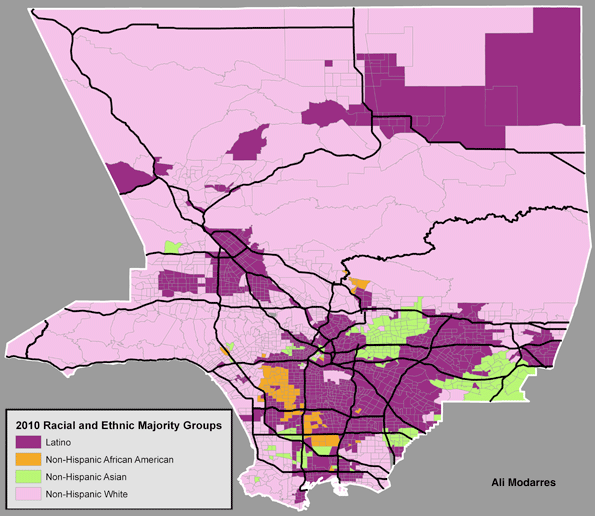
    As Figure 1 illustrates, the geography of race and ethnicity has changed little over the course of the last few decades. Latinos have retained or expanded their majority status in a significant number of neighborhoods. Asian and Asian-American neighborhoods are highly concentrated in an area known as the San Gabriel Valley, while the non-Hispanic white population continues to dominate in areas outside the central city, with the exception of a few tracts in and around the Figueroa corridor (in downtown LA) connected with recent downtown development. Non-Hispanic African Americans have lost their majority status in some South LA neighborhoods where Latinos have come to outnumber them.
     

    Immigration

    California’s declining immigration can be attributed to a tarnished economic image of the state and its anti-immigrant sociopolitical environment.  This might seem puzzling to many residents of Los Angeles, who live a very immigrant-rich environment.

    First, are immigrants still coming to Los Angeles at the same rate as before)?  

    Figure 2 helps provide the answer to this question, by illustrating the annual immigration patterns to the county. The 2007–2009 period has seen less annual immigration, but the nearly 80,000 immigrants per year is as many or more than those from 1994 to 2000. Comparing the period of 1990–1999 with 2000–2009 illustrates that, during the last ten years, a larger number of immigrants have arrived in the county (718,166 versus 841,325).
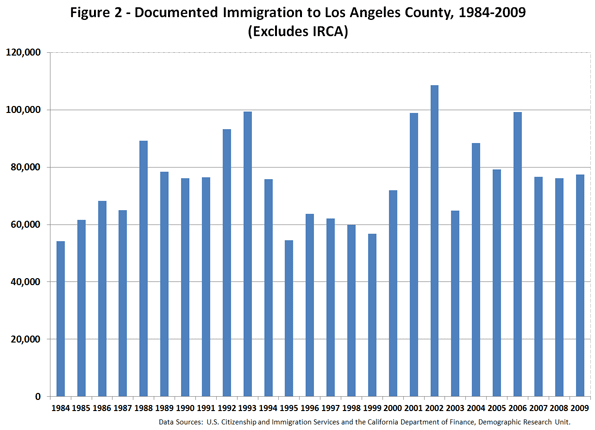
    But what seems clear is that if they are arriving in LA, fewer are staying for the long term. This secondary migration can be made visible by comparing the number of immigrants arriving in Los Angeles County with a tabulation of LA’s foreign-born population by year of U.S. entry.

    The 2009 American Community Survey shows that, among the nearly 3.5 million foreign-born residents of the county, 909,692 arrived between 1990 and 1999 and 811,808 between 2000 and 2009 (see Table 2). Comparing these figures with the number of immigrants who arrived in Los Angeles during the same periods from their countries of origin (718,166 in the 1990s and 841,325 in the 2000s) indicates that we attracted more immigrants from the 1990–1999 cohort (a net gain of close to 192,000) and lost members of the 2000–2009 cohort (about 30,000).

    Clearly the county lost its foreign-born population to other regions of the state and the nation. This is somewhat troubling since it reveals that the allure of the region may be waning among the working-age immigrant population. In fact, as Table 2 portrays, Los Angeles has gradually become home to an old-stock immigrant population, where the foreign-born population hails from earlier eras (i.e., the 1980s and the 1990s).

    Does this mean that the foreign-born population is also getting older? The answer to this question is complicated. Based on 2009 American Community Survey (ACS) data, the average age of the foreign-born population in the country is slightly over 44, with 70% of the population falling between the ages of 27 and 62. This suggests that the immigrant population is a bit older than commonly expected.   Also, with fewer than 6% of the foreign-born population being younger than age 18, it is clear that the number of children arriving is significantly less than often assumed.   

    Therefore, it may be crucial to ask a pointed question. Does Los Angeles have the appropriate economic infrastructure to attract new immigrant while keeping more of our working age immigrants?  Considering the economic circumstance of the recent immigrants, the cost of living in Los Angeles, and the current economic and job environment, it should not come as a shock that many are leaving Los Angeles. After all, this is exactly what the native-born population has done throughout the history of the United States: leaving harsh economic conditions for better opportunities in other cities and states.

    Native born

    What about the native born population? 

    Surprisingly, with an average age of slightly over 30 years, the native-born population is younger than its foreign-born counterpart. This becomes clear as we compare the age structure of both groups. Among the working-age population, the foreign-born outnumber the native-born. However, among young and old residents, the native-born population is a larger group. Before jumping to any particular conclusion, we should be reminded that the native-born population includes a large number of individuals whose parents are immigrants. This means that the younger population is multi-racial and multi-ethnic in character. To illustrate this, I provide a detailed analysis of the native-born population in the following paragraphs.

    As Table 3 illustrates, among those 0–19 years old (the first two columns), Latinos outnumber other racial and ethnic groups. This is more pronounced among those 0–9 years old. However, in every age category older than 19, the non-Hispanic white population outnumbers others. Interestingly, it is only among the age 60+ residents that non-Hispanic African Americans outnumber Latinos (124,587 versus 119,676). This information, combined with what appears on Figure 3, suggests our foreign-born population is aging and new immigrants are not arriving fast enough to keep their average age low. But at the same time their children (particularly among Latinos) are clearly a significant portion of the younger and the working-age population. This illustrates that our economy and social structure operate largely based on the dividends from past decades of high immigration. Without a renewed immigration pattern that expands the working-age population, our economic prospects are somewhat dubious.  

    LA’s Demographic Future

    Table 4 provides a brief glimpse to our demographic future. Here we have the average age for the native-born population by race and ethnicity. With an average age of 20.6, native-born Latinos are younger than the non-Hispanic native- born population (at an average of 37.4). In fact, a significant majority of native-born Latinos are under age 40. This is in stark contrast to foreign-born Latinos who are, on an average, in their early 40s. Compared with an average age of 20.6 among native-born Latinos, the age gap between the two groups becomes clear, further highlighting the decline of younger Latino immigrants in Los Angeles.  

    Clearly the demographic path of Los Angeles County has been altered. We are becoming older and more native born. Blaming immigrants, the easy game of the last two decades, can no longer explain our social and economic ills. We need to embrace who we are and what our economy, politics, and collective decision making have brought to our doorsteps. It may be difficult to accept that we are getting older, but our region is losing young people as well. Table 5 contains the last bit of information we need to understand about how we became a region with a graying population.

    Between 2000 and 2010, we lost residents in five age categories: 0–4, 5–9, 10–14, 25–34, and 35–44. This suggests that – as we have seen in other high-cost urban regions – young families are leaving! Among the working-age population, we were able to hang on to those 15–24 and age 45 and older. These individuals are from older families whose young adults (15–24) may or may not choose to stay in the region. With declining immigration and departing younger families, the Los Angeles region is on its way to becoming a much grayer place.

    A Brief Note on Policy Options

    To be sure, there is nothing wrong with aging. It happens to the best of us. However, one needs to plan for it. Los Angeles County can develop policies that benefit a working-age population and its pending retirement needs (or rethink why it has lost its luster to immigrants and the native-born population.

    Unless conditions change, the ambitious children of immigrants will surely behave like other native-born citizens and look to regions where economic prosperity is most likely. High cost of housing, a less than satisfactory educational system, inadequate health services, and an inefficient transportation system might drive the second generation young families to other region.   

    The solution to the growing loss of our productive population does not lie in building more condos and subsidizing iconic places, such as downtown LA.   We need more jobs a burgeoning economy to keep productive people here. This needs to be tied to the integration of immigrants and their children.  Immigrants are not different from those who were born here. They also want the best quality of life they can get: for themselves and their children. If Los Angeles cannot provide that, perhaps other cities and regions can.

    Table 1 – Racial and Ethnic Structure of Los Angeles County, 2000-2010
    Population by Race and Ethnicity 2000 2010 Change 2000-2010 % Changes 2000-2010
      Population Percent Population Percent
    Total 9,519,338 100.0 9,818,605 100.0 299,267 3.1
    Not Hispanic or Latino 5,275,851 55.4 5,130,716 52.3 -145,135 -2.8
    Not Hispanic or Latino; White alone 2,946,145 30.9 2,728,321 27.8 -217,824 -7.4
    Not Hispanic or Latino; Black or African American alone 891,194 9.4 815,086 8.3 -76,108 -8.5
    Not Hispanic or Latino; American Indian and Alaska Native alone 26,141 0.3 18,886 0.2 -7,255 -27.8
    Not Hispanic or Latino; Asian alone 1,123,964 11.8 1,325,671 13.5 201,707 17.9
    Not Hispanic or Latino; Native Hawaiian and Other Pacific Islander alone 24,376 0.3 22,464 0.2 -1,912 -7.8
    Not Hispanic or Latino; Some other race alone 18,859 0.2 25,367 0.3 6,508 34.5
    Not Hispanic or Latino; Two or more races 245,172 2.6 194,921 2.0 -50,251 -20.5
    Hispanic or Latino 4,243,487 44.6 4,687,889 47.7 444,402 10.5
    Hispanic or Latino; White alone 1,676,614 17.6 2,208,178 22.5 531,564 31.7
    Hispanic or Latino; Black or African American alone 25,713 0.3 41,788 0.4 16,075 62.5
    Hispanic or Latino; American Indian and Alaska Native alone 42,330 0.4 53,942 0.5 11,612 27.4
    Hispanic or Latino; Asian alone 10,299 0.1 21,194 0.2 10,895 105.8
    Hispanic or Latino; Native Hawaiian and Other Pacific Islander alone 2,845 0.0 3,630 0.0 785 27.6
    Hispanic or Latino; Some other race alone 2,244,066 23.6 2,115,265 21.5 -128,801 -5.7
    Hispanic or Latino; Two or more races 241,620 2.5 243,792 2.5 2,172 0.9
    Source: U.S. Census Bureau, 2000 and 2010


    Table 2 – Foreign Born Population in Los Angeles County by Decade of Entry in the U.S.
    Decade of entry Population Percent
    Before 1950 24,568 0.7
    1950-1959 67,127 1.9
    1960-1969 182,618 5.2
    1970-1979 569,689 16.3
    1980-1989 934,034 26.7
    1990-1999 909,692 26.0
    2000-2009 811,808 23.2
    Total 3,499,536 100
    Source: U.S. Census Bureau, American Community Survey, 2009 
    Note: Selected Data is from PUMAs 4500 to 6126


    Table 3 – Race and Ethnicity among Native Born Population, by Age – Los Angeles County
    Race and Ethnicity 0 – 9 10-19 20-29
    Non-Hispanic Latino Non-Hispanic Latino Non-Hispanic Latino
    White alone 235,638 433,253 245,522 374,450 299,123 233,629
    African Americans 97,213 4,494 115,954 3,908 116,017 4,569
    Native Americans 2,010 5,093 1,930 5,102 4,179 3,720
    Asian 106,150 2,007 98,866 2,413 76,293 2,094
    Pacific Islander 2,806 150 4,262 479 3,141 155
    Other 3,989 360,581 4,908 317,786 2,830 203,948
    Two ore more  races 44,079 33,447 31,733 30,319 28,443 19,189
    Total 491,885 839,025 503,175 734,457 530,026 467,304
    Race and Ethnicity 30-39 40-49 50-59
    Non-Hispanic Latino Non-Hispanic Latino Non-Hispanic Latino
    White alone 293,983 138,832 348,042 90,154 346,481 57,596
    African Americans 97,312 2,297 116,845 1,065 99,881 816
    Native Americans 2,180 2,557 2,371 1,872 4,205 2,249
    Asian 39,582 1,992 22,476 772 20,151 515
    Pacific Islander 3,740 354 2,149 157 1,556 57
    Other 2,182 103,856 958 53,540 742 36,311
    Two ore more  races 20,435 11,770 13,319 7,022 10,131 4,695
    Total 459,414 261,658 506,160 154,582 483,147 102,239
    Race and Ethnicity 60+ Total Total
    Non-Hispanic Latino Non-Hispanic Latino  
    White alone 522,510 80,945 2,291,299 1,408,859 1,821,615
    African Americans 124,587 1,011 767,809 18,160 342,155
    Native Americans 1,883 1,483 18,758 22,076 22,034
    Asian 32,665 845 396,183 10,638 287,823
    Pacific Islander 2,395 147 20,049 1,499 10,993
    Other 1,029 30,085 16,638 1,106,107 894,042
    Two ore more  races 10,254 5,160 158,394 111,602 187,210
    Total 695,323 119,676 3,669,130 2,678,941 3,565,872
    Source: U.S. Census Bureau, ACS 2009


    Table 4 – Average Age by Race and Ethnicity, Los Angeles County
    Race Latino Non-Hispanic All
    Average Age Population Std. Deviation Average Age Population Std. Deviation Average Age Population Std. Deviation
    White 21.7 1,408,859 18.9 41.2 2,291,299 23.0 33.7 3,700,158 23.5
    African American 23.2 18,160 18.0 36.2 767,809 22.1 35.9 785,969 22.1
    Native American 26.6 22,076 20.0 36.3 18,758 20.1 31.1 40,834 20.6
    Asian 26.9 10,638 19.0 24.2 396,183 20.8 24.2 406,821 20.8
    Pacific Islander 28.5 1,499 18.7 31.2 20,049 19.8 31.0 21,548 19.7
    Other 19.0 1,106,107 16.0 23.5 16,638 18.3 19.1 1,122,745 16.1
    Two or more races 21.2 111,602 17.7 24.7 158,394 19.7 23.2 269,996 19.0
    All 20.6 2,678,941 17.8 37.4 3,669,130 23.2 30.3 6,348,071 22.6
    Source: U.S. Census Bureau, ACS 2009


    Table 5 – Age Composition and Changes from 2000 to 2010, Los Angeles County
    Age 2000 2010 Change % Change
    Under 5 years 737,631 645,793 -91,838 -12.5
    5 to 9 years 802,047 633,690 -168,357 -21.0
    10 to 14 years 723,652 678,845 -44,807 -6.2
    15 to 19 years 683,466 753,630 70,164 10.3
    20 to 24 years 701,837 752,788 50,951 7.3
    25 to 34 years 1,581,722 1,475,731 -105,991 -6.7
    35 to 44 years 1,517,478 1,430,326 -87,152 -5.7
    45 to 54 years 1,148,612 1,368,947 220,335 19.2
    55 to 59 years 389,457 560,920 171,463 44.0
    60 to 64 years 306,763 452,236 145,473 47.4
    65 to 74 years 492,833 568,470 75,637 15.3
    75 to 84 years 324,693 345,603 20,910 6.4
    85 years and over 109,147 151,626 42,479 38.9
    Total 9,519,338 9,818,605 299,267 3.1
    Source: U.S. Census Bureau, 2000 and 2010


    Ali Modarres is an urban geographer at California State University, Los Angeles. This report is based on a longer article appearing in the 2011 edition of the journal of California Politics and Policy.

    Photo by Bigstockphoto.com