Author: admin

  • Malthusian Delusions Grip Australia

    Entrepreneur Dick Smith wants Australian families to be subject to China-like population doctrine. Families should be limited to just two children, the father of two and grandfather of six says, because our population growth is something like ‘a plague of locusts.’

    Yet in reality, as in many other advanced countries, our population crisis may have more to do with having too few — specifically younger — people than too many.

    The anti-population jihad is nothing new. Thomas Malthus was an 18th century economist and Anglican clergyman, whose ‘Essay on the Principles of Population’ (published 1798) popularised the notion that vice, plague and famine were natural forms of population control. In short, overpopulation would be subject to control by food scarcity.   

    Maulthusians almost 200 years later, in 1968, Paul Ehrlich wrote the blockbuster ‘The Population Bomb’ which warned of imminent mass starvations and famine due to overpopulation.  

    Now joining the fray is our very own Dick Smith, former super-nerd and founder of Dick Smith Electronics stores, aviator, publisher (of Australian Geographic), entrepreneur and 1986 ‘Australian of the Year.’  

    Dick’s a popular figure in Australia, and when he speaks people (and the media) listen. But Dick’s suggestion that Australia is overpopulated, and thus requires we need to limit our growth through a two child policy borders on the hysterical.

    First, let’s start with some global perspective. Overall, world population growth rates are slowing according to the United Nations and the US Census Bureau. Further, based on United Nations forecasts, populations by 2050 will be smaller than they are today in 50 countries – leading economies included. Here’s a useful article from The Economist which explains. And in this article from Bloomberg’s Businessweek, titled ‘Shrinking Societies: the other Population Crisis’, the massive economic and social problems of countries with falling populations are highlighted.

    Australia’s ageing population is not as severe as that looming in Europe and much of east Asia, but this country also faces a demographic implosion that, in the absence of more young people, will place unprecedented demands on a welfare system largely unfunded by the present tax system and those who fund it (namely, workers in the private sector).

    But strangely, discussions about our ageing population and how to fund it and concerns about the overpopulation of Australia take place largely without a logical connection drawn between the two. If we are to avoid a horrendous tax burden on the future generation of workers, in order to maintain our standard of living and support the needs of the boomers, we will need more workers. It’s either that or higher taxes. And the problem with higher taxes, as other countries with similar problems have found, is that they can lead to an exodus of the workforce seeking better opportunities elsewhere. This in turn reduces the tax base. No ‘win-win’ there.

    Doug Saunders is the author of ‘Arrival City,’ a book about the conflicts and change brought on by massive urban migrations. And in this article he explains, “by 2050, most Western countries will have to devote between 27 and 30 per cent of their GDP to spending on retirees and their needs”. This he adds, will produce fiscal deficits in most advanced countries of almost 25 per cent of GDP, making the current crisis seem minuscule by comparison.

    This is not a remote or abstract crisis. Countries like Canada will soon be fighting to attract anyone we can get to work – and squeezing as much as we can from the remaining few.

    Australia has been fond of comparing itself to Canada. We are both western democracies, operating under similar governance systems. We both have relatively small populations given our geographic size (Canada has 34 million people, we have 23 million) and abundant natural resources. The resource we both lack is people. If Saunders is right about Canada fearing the same demographic problems as Japan (population 127 million), Australia might want to take note.

    Dick Smith’s concerns for Australia rely on a second, also false, argument:

    "We are putting our kids into high-rise because we are running out of land, because people want and need to live close to the city. We pay $50 million a year for free range eggs for our bloody chooks to be free range – what about our kids? I was a free range kid. I had a backyard. We are starting to lose that now, and it’s only driven by the huge population increases." (full article here)

    But Dick, we aren’t running out of land. This argument is preposterous, on any valid domestic or global comparison. The reason we are denying future generations a backyard in preference over high density dwelling is not a land shortage brought on by population growth, but a planning philosophy which insists on growth boundaries and high density. This policy is embraced by most planners. Developers and land economists could explain this to Dick, if he were prepared to listen. Plenty of people, given the choice, would happily occupy suburban blocks far from CBDs because their work (which for 9 out of 10 Australians is not in the CBDs) and their lifestyle preferences (typically raising a family) are that way inclined. Those people though are not planners, and neither are they part of the current oligarchy which delivers decisions allegedly in their interests via the confines of inner city coffee shops.

    Even in the United Kingdom (population 62 million, in an area slightly larger than Victoria) there are those proposing the establishment of new urban centres to provide housing choice and to accommodate growth. Ian Abley’s Audacity.org has proposed a ‘250 New Towns’ movement, which seeks to do precisely that.

    If there are those prepared to venture such audacious ideas in a small place like the UK, one wonders why Australia has allowed itself to become preoccupied with the notion that we are somehow running out of land.

    Australia’s growth rate is currently a dizzying 1.6% per annum. It’s fallen from a high of 2%, as international migration was reduced. Neither rates of growth, on a global scale, are remarkable. By 2050, when global population growth is predicted to stop, our total population will reach an estimated 35 million people, of whom 23% – or nearly one in four – will be aged over 65.

    It reads not like a recipe for over population, but one of under population.  Perhaps it’s time the tiny thought bubbles of Dick Smith and his cohorts in this discussion were well and truly pricked by the sharp end of reality?

    Ross Elliott has more than 20 years experience in property and public policy. His past roles have included stints in urban economics, national and state roles with the Property Council, and in destination marketing. He has written extensively on a range of public policy issues centering around urban issues, and continues to maintain his recreational interest in public policy through ongoing contributions such as this or via his monthly blog The Pulse.

  • A Requiem for “High-Speed Rail”

    In the interest of maintaining some balance and perspective on what the Administration proudly calls "President Obama’s bold vision for a national high-speed rail network," at InnovationBriefs we have tried to offer our readers a range of different points of view. It is in this spirit that we present below two commentaries. The first contribution is by Matt Dellinger, author of the highly praised book, "Interstate 69: The Unfinished History of the Last Great American Highway" and a frequent contributor on transportation topics to the progressive website, Transportation Nation. The second contribution is by Ron Utt, Senior Research Fellow at the conservative Heritage Foundation, whose analyses of transportation policy have been a longstanding feature of that Foundation’s work.

    Along with our two commentators, we do not question the merits of intercity rail transportation— an integral and essential part of this nation’s economy, culture and history over the past century and a half. Readers of Steven Ambrose’s history of the transcontinental railroad, Nothing Like It In the World, can only marvel at the indomitable spirit and entrepreneurial energy that drove the creation of the continental rail network. Rail transportation has been intimately woven into the social and economic fabric of this nation ever since. Nor do we forget the huge contribution that private railroad companies have made, and continue to make, to maintaining and growing the nation’s rail network. By investing billions of private dollars, they have made the US freight rail system the envy of the world. Lastly, we believe that intercity passenger rail servic is essential in densely populated heavily traveled corridors, in particular the Northeast Corridor, where road and air traffic congestion will soon be reaching levels that will threaten its continued growth and productivity. In sum, we are not mindless opponents of rail transportation.
    Rather, along with Messrs. Dellinger and Utt, and many other responsible observers inside and outside the railroad community (including notably, Michael Ward, Chief Executive Officer of CSX, the nation’s third largest freight railroad), we take issue with the Obama Administration’s lofty but misleading rhetoric of "high-speed rail." Instead of representing its initiative for what it really is: a program of incremental improvements to the existing rail infrastructure, the Administration has tried to create the impression that it has embarked on a bold and revolutionary program of building a continent-wide high-speed rail network, a legacy reminiscent of President Eisenhower’s Interstate Highway Program.

    As Dellinger and Utt point out, the recently announced spate of awards funded out of the $2.4 billion rejected by Florida’s Gov. Rick Scott will hardly lead to bullet trains speeding from coast-to-coast at 250 mph. These grants, along with most of the earlier awards, will support engineering and planning studies, incremental upgrades in the facilities of freight railroads and modest improvements in existing passenger rail service. For example, the latest list includes a study to replace Amtrak’s Baltimore Tunnel; development of Missouri’s and West Virginia’s state rail plans; final design of the New Jersey Portal Bridge; and modest corridor improvements in Amtrak service in Connecticut, New York and Washington State.

    The above-mentioned $300 million worth of awards was announced on April 8, just a few hours before agreement was reached on a short-term continuing resolution that would cut $1.5 billion in unobligated HSR money. It also preceded by three days the release of a GAO report criticizing the lack of transparency in the Administration’s HSR grant selection process (GAO-11-283). Citing the GAO findings, Rep. John Mica, Chairman of the House Transportation and Infrastructure Committee blasted the Administration in a strongly worded press release. "In the name of high-speed rail, the Administration has squandered limited resources on dozens of slow-speed rail projects across the country," Mica said. "I cannot imagine a worse beginning to a U.S. high-speed rail effort. …It is critical that there be transparency for why these projects were selected in the first place and why any future projects will be selected."

    Had the objective and the selection criteria of the $10 billion program been stated candidly from the outset as an effort to modestly upgrade existing intercity passenger rail services, the White House would have spared itself this criticism and the attendant ridicule of "ObamaRail" and "the Railroad to Nowhere." As it is, the Administration dug itself into an even deeper hole with a quixotic and hardly credible pledge of "making high-speed rail accessible to 80 percent of Americans in 25 years." A promise that was made without any hint as to how this ambitious plan would be paid for and against a background of the House Republicans’ announced intention to totally eliminate federal support for high-speed rail beginning next year. Without further congressional appropriations, the President’s dogged pursuit of the $53 billion high-speed rail initiative will simply collapse.

    As Matt Dellinger pointedly concluded, "If High-Speed Rail ever happens, future Americans might not remember the President who circulated the maps and funded the studies. They’ll remember the President who figured out how to pay for it all."

    Matt Dellinger: "How Much High Speed Rail will $2.4 Billion Buy?" Transportation Nation

    Ronald Utt: "The Death of a High Speed Rail Program," National Review Online

    Ken Orski has worked professionally in the field of transportation for over 30 years.

    Photo by narent23

  • The End of the Line: Ambitious High-speed Rail Program Hits the Buffer of Fiscal Reality

    A well-intentioned but quixotic presidential vision to make high-speed rail service available to 80 percent of Americans in 25 years is being buffeted by a string of reversals. And, like its British counterpart, the London-to-Birmingham high speed rail line (HS2), it is the subject of an impassioned debate. Called by congressional leaders “an absolute disaster,” and a “poor investment,” the President’s ambitious initiative is unraveling at the hands of a deficit-conscious Congress, fiscally-strapped states, reluctant private railroad companies and a skeptical public.

    The $53 billion initiative was seeded with an $8 billion “stimulus” grant and followed by an additional $2.1 billion appropriation out of the regular federal budget. But instead of focusing the money on improving rail service where it would have made the most sense— in the densely populated, heavily traveled Northeast Corridor between Boston and Washington— the Obama Administration sprinkled the money on 54 projects in 23 states.

    Some of the awards are engineering and construction grants but many more are simply planning funds intended to plant the seeds of future passenger rail service across the country. Only two of the projects could be called truly “high-speed rail” because they would involve construction of dedicated rail lines in their own rights-of-way where trains could attain speeds of 120 mph and higher. The remaining construction money will be used to upgrade existing freight rail facilities owned by private railroad companies (the so-called Class One railroads) to allow “higher speed” passenger trains to run on track shared with freight carriers.

    Many of the proposed improvements will result in only small increases in average speed and in marginal reductions in travel time. For example, a $1.1 billion program of track improvements on Union Pacific track between Chicago and St. Louis is expected to increase average speeds only by 10 miles per hour (from 53 to 63 mph) and to cut the present four-and-a-half hour trip time by 48 minutes. A $460 million program of improvements in North Carolina will cut travel time between Raleigh, NC and Charlotte, NC by only 13 minutes according to critics in the state legislature.

    Shared-track operation has raised many questions in the minds of the intended host freight railroad companies. Railroad executives are concerned about safety and operational difficulties of running higher speed passenger trains on a common track with slower freight trains and they are determined to protect track capacity for future expansion of freight operations. Their first obligation, they assert, is to protect the interests of their customers and stockholders. This has led to protracted negotiations with state rail authorities in which the private railroads are fighting Administration demands for financial penalties in case passenger train operations fail to achieve pre-determined on-time performance standards. In some cases, negotiations have hit an impasse causing the Administration’s implementation timetable to fall behind. In other cases, freight railroad companies have reluctantly given in, not wishing to alienate the White House or fearing its retaliation.

    A serious blow to the presidential initiative was delivered by a group of three determined, fiscally conservative governors who rejected billions of dollars in grant awards because they were concerned that the proposed passenger rail services could require large public subsidies to keep the passenger trains operating. In the U.S. federal system, the governors and state legislatures have the final say concerning construction and operation of public transportation services within state boundaries. The refusal of the governors of Wisconsin, Ohio and Florida to participate in the White House HSR program thus took much wind out of the sails of the Administration initiative.

    Perhaps the most serious blow was delivered by Governor Rick Scott whose state of Florida was supposed to host one of the Administration’s showcase projects: an 86-mile true high-speed rail line, built in its own right-of-way in the median of an interstate highway between the cities of Tampa and Orlando. A score of international rail industry giants converged on Florida in the expectation of participating in a rich bonanza of contract awards and a chance to bid on a future rail extension from Orlando to Miami.

    But they came to be disappointed. A study conducted by the libertarian think tank, the Reason Foundation, convinced Governor Scott that the project could involve serious cost overruns and the risk of continuing operating subsidies. This caused the Governor to decline the federal grant, thus putting an effective end to the project. A last-minute effort by rail supporters to challenge the Governor’s decision was stopped in its tracks when the state supreme court upheld unanimously his right to veto the project.

    This left the Administration with just one true high-speed rail project: California’s proposed 520-mile high-speed rail line connecting Los Angeles with Northern California’s San Francisco Bay area and Sacramento. The origin of this venture dates back to 2008 when voters approved a $9.95 billion bond measure as a down payment on the $43 billion system. Since then the project became mired in multiple controversies. One relates to a lack of a clear financial plan, another to what critics, including the state’s official “peer review” panel, claim to have been overly optimistic forecasts of construction costs, ridership and revenues. Then came a report raising questions about the escalating price tag for the project which now is estimated at $66 billion. This is occurring in a state that is staggering beneath a $26 billion deficit.

    In the face of fierce opposition that developed in the wealthy Bay Area communities lying in the proposed path of the rail line, the sponsoring agency, the California High-Speed Rail Authority, decided to start construction in the sparsely populated and economically depressed Central Valley, where land is relatively cheap, unemployment is high and community opposition was expected to be minimal. The decision was spurred by demands from the Obama Administration that its $3.6 billion grant result in a rail segment that has “operational independence.” The first 123-mile stretch, to be built between Fresno (pop. 909,000) and Bakersfield (pop. 339,000), was quickly derided by critics as a “railroad to nowhere.” Even in the low-density Central Valley, the expected disruption caused by the project to communities, farms and irrigation systems has stirred political opposition. Its future – as indeed the fate of the entire $43-66 billion (take your pick) venture – is shrouded at this point in uncertainty.

    The same can be said of President Obama’s high-speed rail initiative as a whole. Just as the proposed £32 billion high-speed rail link between London and Birmingham has been called an “expensive white elephant” and a “vanity project,” so the White House high-speed rail initiative is being criticized as a “boondoggle” and derided as a monument to President Obama’s ambition to leave behind a lasting legacy à la President Eisenhower’s Interstate Highway System. Editorial opinion of major national newspapers has turned critical as have many influential columnists and other opinion leaders. A number of senior congressional leaders – including the third-ranking Republican in the House, Majority Whip Kevin McCarthy, and the chairman of the influential House Transportation and Infrastructure Committee, John Mica, have likewise openly criticized the initiative as wasteful and poorly executed.

    Even elected representatives from states that would potentially benefit from the government’s largesse have been skeptical about plans for high-speed rail in their states. “Blindly committing huge sums of money to this project will not make it worthwhile, and to do so at this time would be premature and fiscally irresponsible,” wrote one member of the congressional delegation from the state of New York. Members of the North Carolina legislature have introduced a bill to bar the state department of transportation from accepting $460 million in federal high-speed rail funds, pointing to the meager trip time savings resulting from the proposed rail projects and the potential need for operating subsidies.

    As this is written, Capitol Hill observers give the high-speed rail program only a small chance of obtaining additional congressional appropriations in Fiscal Year 2012 and beyond. A March 15 report in which the congressional House Committee on Transportation and Infrastructure discusses its views of the forthcoming Fiscal Year 2012 transportation budget, the Obama Administration’s proposed $53 billion high-speed rail program is not even mentioned. Turning off the spigot of federal dollars next year would effectively starve out the Administration’s rail initiative.

    The President’s proposal came at a most inopportune time, when the nation is recovering from a serious recession and desperately trying to reduce the federal budget deficit and a mountain of debt. In time, however, the recession will end, the economy will start growing again, and the deficit will hopefully come under control. At that distant moment in time, perhaps toward the end of this decade, the nation might be able to resume its tradition of “bold endeavors” — launching ambitious programs of public infrastructure renewal.

    That could be an appropriate time to revive the idea of a high-speed rail network, at least in the densely populated Northeast Corridor where road and air traffic congestion will soon be reaching levels that threaten its continued growth and productivity. For now, however, prudence, good sense and the common welfare dictate that we, as a nation, learn to live within our means.

    Ken Orski has worked professionally in the field of transportation for over 30 years.

  • Vietnam, No Longer an Underdeveloped Country

    The most recent estimates for 2010 indicate that Vietnam is no longer among the underdeveloped countries of the world and has moved onto the ranks of middle-income countries.  Financial remittances – better known as money being sent back to the home country – have lent a critical hand in accomplishing this major triumph in the country’s formerly depressed economy.

    The influx of money by overseas Vietnamese, many of whom fled as political refugees, has dramatically changed the economic landscape of the country in terms of poverty levels and development.

    Development Since the War

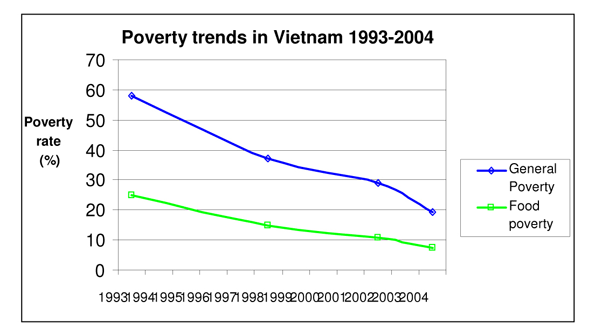
    The aftermath of the war had left Vietnam among the five poorest countries in the world with 75 percent of the population living in poverty in 1984. Since then, the poverty level had dramatically decreased to 37 percent in 1998 and later to 29 percent in 2002, according to the World Bank.

    The CIA World Factbook more recently estimated Vietnam as having only 10.6 percent of the population living below the poverty line in 2010, a far cry from the 75 percent just 26 years earlier. In terms of economic output, a brief on Vietnam by the World Bank reported that the real GDP increased by 7.3 percent per year during 1995-2005 and per capita income by 6.2 percent per year.

    Vietnam was expected to enter the ranks of other middle-income countries by reaching the $1,000 GDP per capita marker by 2010, which it did according to the International Monetary Fund (IMF). The IMF estimated Vietnam’s GDP per capita as $1,155 for the 2010 fiscal year. Since then, the country’s Ministry of Planning and Investment (MPI) has set a new target that nearly doubles Vietnam’s current GDP per capita over the next four years. An expected GDP per capita of $2,100 by 2015 will allow Vietnam to surpass India’s GDP per capita in the global economy and be among the ranks of the Philippines.

    The target GDP per capita, however, is still well below its communist competitor, China, which now boasts an average GDP per capita of $4,520. Even though China presently holds the title as the “Red Dragon of the East,” Vietnam, with its enormous potential for economic growth, has recently been referred to as the “Rising Dragon” and the “New Asian Dragon” by various scholars.

    The World Bank avowed, “Vietnam is one of the best performing economies in the world over the last decade.” It further stated, “Vietnam’s poverty reduction and economic growth achievement in the last 15 years are one of the most spectacular success stories in economic development.”

    Remittances Over the Years

    Financial remittances have had a notable influence on the improved economic conditions in Vietnam over the years. This has been especially evident since the U.S. rescinded the embargo against Vietnam in 1995, which allowed for greater opportunities to remit money through formalized channels.

    In the years immediately following the Vietnam War, it was close to impossible for Vietnamese-Americans to send money directly to their home country. The majority of remittances that were successfully sent back to the home country were primarily conducted through informal money transfers.

    The gradual increase in official remittances over the past few decades, however, has been attributed to a combination of key events, which include but are not limited to: the Vietnamese government launch of a renovation process (Doi Moi) in 1986, the U.S. lifting of the embargo against Vietnam in 1995, and Vietnam’s membership into the World Trade Organization in 2007.

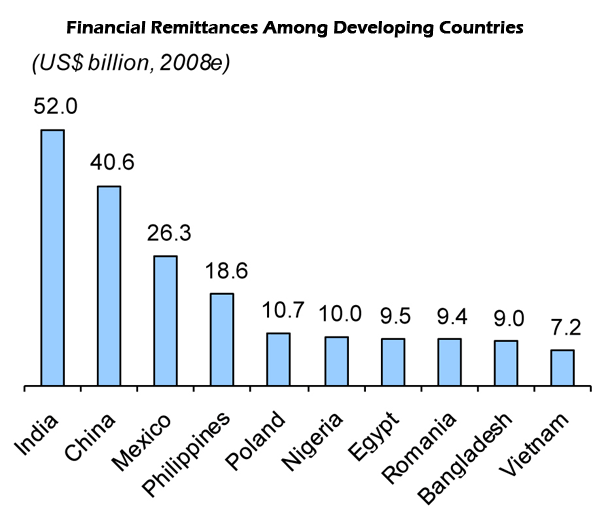
    In 2008, Vietnam emerged as the tenth leading recipient of migrant remittances among developing countries with $7.2 billion received during that year alone. The U.S. neighbor to the south, Mexico, with $26.3 billion, was third behind India and China.

    Later in 2009, Vietnam’s financial remittances fell slightly to $6.8 billion despite predictions of a greater drop among all developing countries. The slight decline during the considerable global economic downturn illustrated the resilience of money being sent to Vietnam from abroad, particularly from troubled economies such as the United States, France and in Eastern Europe.

    In addition, remittances appear again on an upswing.  By the end of the 2010 fiscal year, Vietnam set a new total inward remittance record of more than $8 billion through official channels. This $8 billion represented about 8 percent of the overall GDP for the country that year.

    The Role of remittances on development

    Although there have been no notable studies that directly connect migrant remittances and development specifically in Vietnam,  the effects of financial remittances on the Vietnamese economy are likely to be profound.

    Existing studies on other countries in the world have already illustrated the significant relationship between migrant remittances and development in the home country in terms of balance of payments, saving and investment, structural changes in the economy, and other channels influencing development and growth. In recent decades, these links between mother country and expatriates have played a critical role in the rise of both China and India.

    Such ties are particularly critical for developing countries which see remittances as a reliable long-term source of foreign capital. In 2000, the United Nations reported that financial remittances had increased the GDPs of El Salvador, Jamaica, Jordan, and Nicaragua by 10 percent. The World Bank in 2004 further revealed that financial remittances accounted for 31 percent, 25 percent, and 12 percent of the GDP in Tonga, Haiti, and Nicaragua, respectively.

    More recent data from the Migration Policy Institute (MPI) in 2009 astonishingly showed that remittances constituted 49.6 percent, 37.7 percent, and 31.4 percent of the overall GDP for Tajikistan, Tonga, and Moldova, respectively. Although Vietnam’s inward formal remittances comprise less than 10 percent of the country’s overall GDP, it was still ranked 16th among the top 30 remittance receiving countries by the World Bank in 2010.

    The existing potential of remittances on development has been notable in Vietnam and continues to grow exponentially – even despite the slowing of the economy in the rest of the world.

    Whether or not these effects are positive or negative may be a matter of ideology and politics. The Vietnamese government clearly wants to maximize the benefits of remittances. But there is concern about such issues as “dollarization” of the economy and the role such transfer may play in worsening the growing inequality between the rich and poor widely decried in Vietnam. Yet overall remittances should be seen as a net positive, helping to spark entrepreneurial ventures critical to the country’s movement from a third world to a solidly second world status.

    Jane Le Skaife is a doctoral candidate in the Department of Sociology at the University of California, Davis. She is currently conducting her dissertation research involving a cross-national comparison of Vietnamese refugees in France and the United States.

    Photo by Yen H Nguyen