Author: admin

  • Chicago’s Unique Population Loss of the 1 Million Plus Cities

    There are only 9 cities in the United States with populations over 1 million. The list includes New York, Los Angeles, San Diego, Philadelphia, Chicago, Phoenix, Houston, San Antonio, and Dallas. With this afternoon’s release of Census 2010 numbers for New York City, the final 2010 data is in.

    Of these 1 million or more cities, only Chicago lost population over the last decade, yet the media seems to be in love with Mayor Daley.  The New Yorker called Mayor Daley “America’s most successful mayor.” Newsweek is equally “impressed” with Daley’s performance, saying “Daley also leaves behind a glittering metropolis that Chicagoans rightly love and outsiders can only envy.”

    Chicago’s 200,000 person loss shows Mayor Daley’s failed legacy as Mayor. Daley leaves office with a smaller population than when he took office in 1989. Numbers are stubborn things. There was no Chicago comeback of the middle class to experience bad public schools, high taxes, and corruption.  Almost no one predicted Philadelphia would gain population while Chicago declined. Mayor Daley’s legacy appears to be built on smoke and mirrors. A fawning media of urban reporters puffed up Daley for years. According to the numbers, Mayor Daley is America’s worst Mayor leaving Rahm Emanuel with intractable problems. Is it more accurate to call Mayor Daley the white man’s Coleman Young?

  • The Deconstruction of Barack Obama

    The first two years of the Obama Administration have been historic and eventful. The first openly liberal president in a generation has dramatically increased government spending and intervention in the nation’s economy. The federal deficit soared to $1.65 trillion dollars and 35% of Americans now receive some type of government assistance.

    The President seems to view the American economy through the prism of an academician. His vision of America held that his New Economy would be supported by the troika of plentiful Green jobs, new federal employment, and a revitalized and robust union based economy.

    Give him credit. President Obama has held true to his vision even if the economy, and the American people, did not.

    The “Green Jobs” of Mr. Obama’s new economy have not materialized despite huge government incentives. The president’s New Energy for America plan called for a federal investment of $150 billion over the next decade to catalyze the private sector to build a clean energy future.

    Obama’s plan is to:

    • Provide short-term relief to American families facing pain at the pump
    • Help create five million new jobs by strategically investing $150 billion over the next ten years to catalyze private efforts to build a clean energy future.          
    • Within 10 years save more oil than we currently import from the Middle East and Venezuela combined    
    • Put 1 million Plug-In Hybrid cars – cars that can get up to 150 miles per gallon – on the road by 2015, cars that we will work to make sure are built here in America
    • Ensure 10 percent of our electricity comes from renewable sources by 2012, and 25 percent by 2025
    • Implement an economy-wide cap‐and‐trade program to reduce greenhouse gas emissions 80 percent by 2050

    The President’s plan called for renewable energy to supply 10% of the nation’s electricity by 2012, rising to 25% by 2025. The problem with his vision was that America was already generating 11.4% of its electricity from renewable sources when he delivered his speech. Ironically, most renewable energy comes from hydro-power, a source disdained by many greens. (US Energy Information Administration, Electric Power Monthly, June 2010.). T. Boone Pickens’s plan to build wind farms across the Great Plains was the most publicized private response to Obama’s vision never materialized. The U.S. Chamber of Commerce reported on March 10th that 351 “shovel ready” energy projects were stalled nationally due to “a tangle of state and local regulations”. These 351 projects were to create 1.9 million jobs and infuse the economy with “a $1.1 trillion short-term shot in the arm”. William Kovacs, senior vice-president of the chamber said, “In fact, there weren’t any shovel ready projects.”

    In the end, the outpouring of new technologies and jobs in the new “green” economy simply never materialized. 

    Indeed, despite the grand vision of a Green economy, America remains deeply dependent on others for its energy.

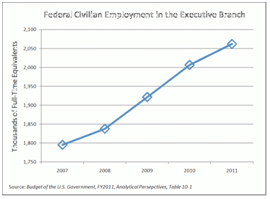
    The second leg of Obama’s troika was new government employment. He was successful in signing his health care reform into law but delayed implementation to 2014. The 2010 election that changed 63 House seats to the Republicans, has acted to unwind much of this legislation. If not repealed outright, Obamacare will likely face starvation from Republican cuts in funding necessary to implement the 2,900 page law with its hundreds of new federal regulations. Federal civilian employment in the president’s 2012 budget, will be 15 percent higher in 2011 than it was in 2007. This effort is also likely to be stymied.

    Union workers, the third leg of Obama’s troika, were well served in the first two years of the Obama Administration. The United Auto Workers inherited ownership in General Motors and Chrysler, and obtained federal protection of their relatively high wages and Cadillac health care benefits.  Had GM and Chrysler been allowed to enter Chapter 11 bankruptcy, it’s likely both would have been drastically reduced. Under the health reform act, union workers received exemptions from taxation for their Cadillac health care plans – unlike those of private companies.

    According to the most recent Employer Costs for Employee Compensation survey from the U.S. Bureau of Labor Statistics, as of December 2009, state and local government employees earned total compensation of $39.60 an hour, compared to $27.42 an hour for private industry workers – a difference of over 44 percent. This includes 35 percent higher wages and nearly 69 percent greater benefits. (Adam Summers Reason Foundation – Comparing Private Sector and Government Worker Salaries May 10, 2010).

    Will union members be able to hold their ground or be forced into major concessions during the coming deconstruction? State governors like Christie (NJ), Daniels (IN), Kasich (OH), and now Governor Walker of Wisconsin are taking on the unions head-on for the first time in generations. New conservative majorities in state house around the country are deconstructing collective bargaining agreements, above market wage gains, and Cadillac fringe benefits. Labor’s gains, and political clout, may have peaked in 2008. 

    Will President Obama adhere to his academician’s vision of the New Economy or will he be forced to succumb to the realities of the coming Great Deconstruction? Congress is arguing whether it can afford $4 billion in cuts to a $3 trillion budget in order to avoid an imminent government shutdown.

    Overlooked and more momentous is that for the first time since World War II, both houses of Congress – and some in both parties – are debating how to enact massive cuts in government spending. This is the beginning of the Great Deconstruction. Like the proverbial snowball rolling downhill, the $4 billion cuts of March 2011 could eventually canonball into hundreds of billions of actual spending reductions as the federal government deconstructs.

    The Government Accounting Office released a report on March 1st entitled ‘Opportunities to Reduce Potential Duplication in Government Programs, Save Tax Dollars, and Enhance Revenue.’ The report identified $200 billion in annual waste from duplicative federal programs. The agency found 82 federal programs to improve teacher quality; 80 to help disadvantaged people with transportation; 47 for job training and employment; and 56 to help people understand finances. Finding ways to cut billions in federal spending is not be the problem. Finding politicians with the political will to withstand the barrage of criticism from impacted constituents is another matter.

    The Great Deconstruction has already begun. Will President Obama, clearly a savvy politician, recognize this inexorable reality of this gathering force, leap in front of it, and claim ownership? Or will he stick to his academician’s vision and allow the snowball of deconstruction to roll over him? 

    Robert J Cristiano PhD is the Real Estate Professional in Residence at Chapman University in Orange, CA and Head of Real Estate for the international investment firm, L88 Investments LLC. He has been a successful real estate developer in Newport Beach California for thirty years.

    Other works in The Great Deconstruction series for New Geography
    Deconstruction: The Fate of America? – March 2010
    The Great Deconstruction – First in a New Series – April 11, 2010
    An Awakening: The Beginning of the Great Deconstruction – June 12, 2010
    The Great Deconstruction :An American History Post 2010 – June 1, 2010
    A Tsunami Approaches – Beginning of the Great Deconstruction – August 2010
    The Tea Party and the Great Deconstruction – September 2010
    The Great Deconstruction – Competing Visions of the Future – October 2010
    The Post Election Deconstructors – Mid-term Election Accelerates Federal Deconstruction – November 2010
    The State Government Deconstructors – November 2010

  • English Goddess

    Chandra Bhan Prasad, a political activist from Northern part of India, has recently constructed a temple enshrining “Goddess English” in Bankagaon, near Lakhimpur in Utter Pradesh, India. The statue resembles the Statue of Liberty (but no crown; just a hat), carries a copy of the Indian constitution, and holds a fountain pen. Representing the unshaken belief by many Indians that English is a passport for good education, well respected and good paying jobs, and a modern outlook, no wonder the Goddess English stands on a personal computer. The temple will have symbols and formulae of chemistry, mathematics and physics engraved on the walls, and current plans are to build the staircase in the form of a computer keyboard replica.

    India is a country with over 1,652 languages spoken by its 1.2 billion residents. Hindi is one of its two official languages, spoken by about 350 million people, and the primary language of North India. But about 300 to 350 million Indians speak English. Most linguists rank India as the largest English language user in the world.

    Knowledge of English is one of the key factors in India’s new prosperity. You can feel the correlation between English language acceptance and personal income. India’s haves and have-nots are basically divided by their knowledge of the English language.

    Do we see similar pattern in the border states of the United States? The USA, as a single language country, has been engulfed in multi-language education controversies, especially in California, Arizona and Texas. A very unacceptable high school dropout rate can be observed in school districts where English is not spoken well, and the per capita income of the non-English speaking Latino population is substantially lower than US median household income.

    Is there a lesson to be learned?

  • What India Hands to the World

    Yoga. Mantras. Bollywood. Henna tattoos. Once unique to India, each of these has now become commonplace in households across the globe. As a first generation East Indian American, I’ve had an opportunity to contrast the world my parents experienced with the one I inhabit. When my parents first settled here in the 1980s Indian cultural influences were not this prominent, but the increases in America and around the globe have been dramatic.

    Any gym is bound to teach a yoga class. Popular exercise regimens such as Pilates have been influenced by ancient Indian spiritual exercises. During a recent study abroad trip to Goiania, a medium sized city in the Brazilian countryside, I was surprised to encounter yoga classes, and many of my Brazilian classmates wanted to learn Yoga from me.

    Bhangra, a North Indian folk dance, has been incorporated into gym workouts. Sarina Jain, the Indian American creator of The Masala Bhangra Workout, says she’s “the first to bring Indian dance to the U.S. fitness industry at a global level.” The DVD has been named one of the five hottest workouts by America Online.

    Meditation, similarly, has become widely popular. This ancient Vedantic technique to reach inner peace has been popularized by Indian gurus who have spread the practice throughout the West; one transcendental meditation organization claims to have taught more than 50,000 students across the United States, Latin America and Africa during the past two years alone. The bestselling book (and then film) “Eat, Pray, Love” has further popularized the use of meditation to tame the mind. Julia Roberts, who plays the protagonist in the film, even identifies herself as a Hindu who regularly meditates.

    Other Vedantic influences on daily life include reciting mantras, and the popularization of words such as “guru” and “pundit” to describe people with expertise. The idea that all of your actions, whether good or bad, produce consequences that shape your future is a common theme in many cultural value systems, but the term “karma” captures that concept in one word and has become used throughout the English-speaking world, as well as elsewhere.

    Billions of people around the world also value the concept of ahimsa — non-violence — as popularized by Mahatma Gandhi. His ideas strongly influenced Martin Luther King Jr. Ahmisa also explains why many Hindus and Jains are vegetarians The belief that what you eat affects your behavior, and that a vegetarian diet can help tame the mind, has been popularized worldwide by Indians, who are known for their exquisite vegetarian cuisine.

    Worldwide, flavorful Indian spices and seasonings have increased the appeal of vegetarian food. India produces over four million tons of spice, and exports around 180 spice products to over 150 nations. The Indian Spice Board is currently planning to set up three promotional centers in, respectively, Dubai, Chicago and Europe.

    Spices are also of special interest in the alternative health community, where they are viewed as anti-inflammatory agents, that can help the aging brain and play a role in cancer prevention. Turmeric and several other spices are part of the Indian Ayurvedic system. Ancient Indian epics like The Ramayana reference Ayurveda, a holistic approach to health that fuses the forces of mind, body, senses and spirit. Today, about thirty companies are leading the way, with a million dollars or more per year in business to meet the growing demand for Ayurvedic medicine. The larger Ayurvedic medicine suppliers have also moved into the businesses of toiletries —soap, toothpaste, shampoo — which use traditional herbal ingredients.. For example, L’Oreal has been reported to be looking into purchasing an Indian Ayurvedic skin care brand, and companies like Estée Lauder have created their own Ayurvedic spa treatments.

    But even more wide-spread is India’s music and dance scene. The sitar, first popularized in the US by Ravi Shankar, has been used by artists from the Beatles to Janet Jackson. The most powerful Indian cultural export, though, has long been its film industry, nicknamed Bollywood, which is generally believed to produce the largest number of feature films in the world. Bollywood makes more ticket sales than Hollywood does, though revenue figures are much higher for the latter Sometimes dubbed in local languages, these films, filled with colorful costumes, dances, music, and love stories are watched in Kuwait, Nigeria, Russia, Scandinavia, the Caribbean and even Fiji.

    Through television, Brazil has been particularly touched by India. Brazil’s 2009 Emmy Award-winning telenovela (soap opera), Passage to India, introduced Indian culture there on a broad scale. As an Indian traveling through Brazil, almost every person I met asked whether I watched the show. Even in Cavalcante, a remote area, a truck driver knew that the cow is considered sacred in India, and was newly aware of the Indian custom of arranged-marriage.

    Another result of the show’s popularity has been that Brazilians are now fascinated by Indian clothing. I noticed malls consistently had at least one Indian themed store selling kurti tops – Indian style blouses which are popularly worn over skinny jeans or tights. I also saw men wearing t-shirts with pictures of Indian Gods and Goddesses, and saw them printed on swim suit cover ups. Of course, you rarely see Indians wearing this kind of garment, since, many consider these displays on clothing to be somewhat offensive.

    There are many other aspects of Indian culture that have spread on a global scale. From curries to computer programs, self-realization to the arts, and well beyond, we are seeing its influence. The popular Indian art of using henna to create beautiful body designs and patterns only temporarily affects the surface of the skin. But the influence of India is likely to leave a permanent — and positive —impact on the world.

    Photo from Travelscope

    Sheela Bhongir is an undergraduate student at California State University, Northridge studying Urban Studies and GIS. She is working as an intern on Legatum’s new map of the world project.
  • High-Speed Rail vs. Modal Neutrality

    Isn’t it curious that an Administration devoted to the principle of multi-modalism is so obsessively determined to promote a single mode of its own preference — that of high-speed rail? All three governors who rejected the federal HSR grants — Govs. Walker, Kasich and Scott — told Sec. LaHood that their states could badly use that money for more urgent needs of fixing roads, bridges and transit systems and, in the case of Gov. Scott, rebuilding Florida’s ports in anticipation of the Panama Canal expansion.

    Yet Sec. LaHood turned a deaf ear to those requests, insisting that the stimulus money must be spent on high-speed rail — even though money spent on other modes could have been just as effective in creating jobs. After justly condemning “stove pipe” mentality and modal biases in federal decision making it is ironic to find the Administration ignoring its own principles of modal neutrality in such a blatant manner.