Author: admin

  • Are Developers Greedy, Or Just Misunderstood?

    Construction starts in Australia, like much of the English-speaking world, are falling across a spectrum from commercial to retail, industrial and housing. Construction industry jobs – one of the few sources for well compensated blue collar employment – are going with them. Yet developers, the very group who would create these jobs, continue to suffer a poor public image. Why, and can it ever be improved?

    The Reserve Bank of Australia’s recent move to increase interest rates was not well received by the development and construction industry. Housing and non-residential approvals are in a general slide and a widely reported lack of new supply in housing is compounded by private sector commercial development at a virtual standstill, with development finance the most widely cited culprit. According to the UDIA, construction industry jobs are down by around 25,000 in just one Australian state, the formerly booming Queensland. That’s a lot of incomes not being spent in the economy.

    Yet despite these problems, developers aren’t exactly being courted by policy makers or regulators. Quite the opposite – politicians still regularly throw the mud at the very industry which holds a key to improving housing supply and construction industry jobs. “I won’t stand by and let greedy developers get away with … blah blah blah.” You’ve all heard it before. Denial, pass the buck and shoot the messenger continue to be preferred defensive tactics of politicians responding to industry complaints of excessive regulation. Labeling all developers “greedy has about as much validity as suggesting all politicians are corrupt simply because a handful break the law, but the latter (politicians) continue to target the former (developers) – and get away with it.

    It’s not just the politicians of course. Many regulators and planners, if you believe the horror stories, have taken an adversarial stance to development assessment whereby the developer is regarded with suspicion from the outset. The regulators don’t see themselves as facilitators of new activity but as ‘growth managers’ exercising every precautionary principle known in a bid to slow, curtail, check and re-check the consequences (real or imagined) of a proposal.

    Then there’s community opinion, which puts developers and real estate agents and used car dealers into the same category. Development proposals that align with local or state planning schemes, and which may have already jumped through several hoops before a public airing, are often widely rejected via the pages of the local press. This isn’t just NIMBYism, because the target of hostile public complaint isn’t the planning scheme or the local or state politician who endorsed it, but the developer applicant who is simply complying with the scheme’s intent. Irrespective of how green, how sustainable, how rational or how much needed the proposal may be in community or economic terms, it’s the developer who gets the bad press.

    Why is it that developers just can’t win?

    I’ll venture a theory that many readers won’t like. Developers are too meek, too obsequious, too prepared to be thrashed with a wet lettuce and succumb. With rare exceptions (Stockland’s Matthew Quinn is one) developers rarely comment publicly about the problems imposed on the industry by excessive and growing regulatory burdens. The allegations of land banking, of profiteering, greed, opportunism, social irresponsibility and environmental vandalism are too infrequently challenged in the public domain.

    Some blame no doubt lies in the politicization of development assessment: development is no longer an exercise in market and land economics, but a political game. Political intervention in planning schemes and the ability to kybosh proposals means that developers need to be acutely sensitive to political trends. Throwing back the facts and arguing the case publicly may not win political friends, and developers certainly don’t need any more political enemies. But what that means is that as more mud is thrown, more mud sticks.

    It’s true that industry groups have their role to play in advocating development industry positions and promoting the benefits the industry brings, and by and large do a good job with the resources available. But is it also true that developers themselves tend to hide behind their industry groups in a sort of ‘good guy, bad guy’ act where industry group executives are left to do the sledging while developers do the schmoozing?

    I recall a meeting with a Government Minister some years ago, dealing with a mounting problem in the Minister’s Department which threatened to cost the industry dearly. The meeting was civil but the issues weren’t danced around – “a full and frank discussion” might be its best description. The Minister was getting the message, loud and clear. But then, at the close of the meeting, the developer representative left the Minister with the comment that “Minister, thanks for your time and we want you to know you’re doing a great job.” Bang, pop – the pressure was instantly deflated. That Minister no doubt reported to their colleagues that the industry was pretty put off but didn’t present a political problem.

    Perhaps asking individual developers to publicly challenge the opprobrium being thrown at them and defend themselves more aggressively is akin to asking them to paint a target on their forehead saying ‘shoot me’ But perhaps they can take a hint from Australian farmers. Farmers, thanks to aggressive environmental politics, were copping all the bad press from tree clearing and land erosion to fertilizer and herbicide runoff. Somehow the community was allowed to forget that without farmers we don’t eat, they responded. The ‘Every Family Needs a Farmer’ campaign was a defensive community education campaign, designed to build more empathy amongst urban consumers of the issues faced by farming communities. The campaign has run through several incarnations over several years, and was no knee-jerk, one-off exercise.

    Now if Australian entrepreneur Dick Smith can fund a TV documentary and anti-growth campaign single handed, you’d think the entire development industry could manage something in its own interests, especially when those interests are closely aligned to the interests of the community. You wouldn’t call it ‘Every Family Needs a Developer’ but you could start with a few things that the community as a whole seems to have forgotten:

    • Almost every street and the houses in it, in every neighborhood, is the result of a developer at some stage taking a risk.
    • Every shop in every high street, and every shopping mall your family visits, is the result of some developer at some stage, taking a risk.
    • Almost every workplace, whether it’s a medical centre, a factory, or an office building, is the result at some stage of a developer taking a risk.
    • Increasingly, many of the schools, roads and community facilities that we enjoy are funded through the activity of developers.

    The homes we will need so that people aren’t sleeping on the streets won’t be provided by governments, or politicians, but by developers. The economy that we need to feed our families and support our aged and infirm, relies heavily on developers and the construction jobs that flow from them.

    Many developers go broke trying, and in doing so they lose their own money, not public money. It’s a high risk venture where certainty is essential. It’s not an industry where the public sector has ever shown much of a track record – witness the billions squandered on public housing programs which produce very few roofs.

    Developers have legitimate concerns about the cost of doing business. It means their costs to the consumer,in the form of houses young people can’t afford, or rents that businesses struggle to pay, are higher than they need to be. It’s not developers making this happen; it’s regulation.

    At the end of the day, developers can sit back and wait for more mud to be thrown, or begin to defend their reputation, and to defend the need for growth.

    Is there anything to be lost by trying?

    Ross Elliott has more than 20 years experience in property and public policy. His past roles have included stints in urban economics, national and state roles with the Property Council, and in destination marketing. He has written extensively on a range of public policy issues centering around urban issues, and continues to maintain his recreational interest in public policy through ongoing contributions such as this or via his monthly blog The Pulse.

    Photo by Scorpions and Centaurs

  • Cities That Prosper, Cool or Not

    Over the past few years, the raging debate in economic development has been over whether cities should be cool or uncool. Should cities pursue “the creative economy” by going after arts, culture, creative research & development, and innovation? Or should they focus on the bread-and-butter economy: hard infrastructure, traditional industries like manufacturing, and blue-collar jobs?

    Usually a raging debate is an indication that the wrong question is being asked, and that’s the case here. The question is not whether cities must be cool or uncool in order to prosper. Clearly, there are some cities in each camp that prosper, and some cities in each camp that do not. The question is deeper: In both cool and uncool cities, what is the underlying nature of the economy? Does the city simply import money from other places, or does it export goods and services to other places? Because it is this distinction – not cool or uncool – that serves as the dividing line between prosperity that is real and prosperity that is illusory.

    Not long ago, I was interviewing a retired politician in a fast-growing Southern metropolis. Even though he was a good ol’ boy who had never left home, he bore no resentment for the retired Yankees who flooded his town. In fact, he attributed the whole area’s prosperity to them. A retirement community, he said, “is like a high-wage factory. You build 1,000 houses, you have 1,000 households making $90,000 a year. A high-wage factory without the factory.”

    I grew up in a factory town, and this got me thinking about a factory’s huge and multi-faceted contribution to a region’s economy. But is a retirement community really similar?

    In some ways the answer is yes — and that’s a good thing. The most obvious similarity, as my politician friend pointed out, is that the residents live in town, get steady paychecks to spend locally, and become involved in local life. Like factory workers, retirees can support a whole service economy with their local spending.

    But there’s more to a factory-town economy than simply Saturday grocery shopping by the workers. Factories are in the export business, while retirement communities are in the import business. An export economy spins off all kinds of economic benefits that you don’t get from an import economy. A big factory requires lots of suppliers, and tends to stimulate the creation of an economic cluster — a group of businesses that feed off each other and, in time, find new customers outside the region.

    A retirement community creates a cluster of suppliers, too. But this cluster tends to be composed of local service-sector businesses that create low-wage jobs and aren’t interested in repackaging their services for export outside the region — retailers, contractors, landscapers and pool-maintenance companies.

    There’s also a psychological difference. Factory workers are connected to the local economy in a way that retirees are not. If orders fall off, they might get laid off for a while, switch jobs and go to work over at a supplier, sometimes for more money, sometimes for less. But the point is that they have a stake in the regional economy. Factory workers don’t like traffic jams anymore than the rest of us, but they see the value of an expanding economy. They see how growth can be good as well as bad.

    Retirees see no such thing. They are tied to the global economic system in which their investments are based, or else to the economic fortunes of, say, a government pension system in another part of the country. They might want tax revenue to flow into public coffers in New York or Ohio to protect their public pensions, or they might want interest rates to go up so that their incomes rise.

    But they see no benefit in an expanding local economy. If a bunch of factory workers get laid off, the retirees don’t need to worry, in fact, they might actually benefit because local prices might fall. If business is booming and people are employed and labor rates are going up, they don’t have to worry about that, either. They might even be harmed by it, because their incomes are fixed — not tied to the local economy — and prices will go up.

    A retirement community is not the only type of place that operates this way. Tourist towns and bedroom suburbs function pretty much the same way. All are in the business of importing money from somewhere else, rather than exporting goods and services. And the recession has shown, once again, how fragile import-based economies are. A few years ago, Las Vegas was the biggest boomtown in America. Today, it’s become crash city, largely because the two-tier economy tied to tourism — a few wealthy casino owners and managers, a vast number of low-paid hotel service workers — couldn’t sustain the huge increase in home prices that occurred during the housing bubble.

    There’s nothing new in this distinction between import and export economies. Jane Jacobs laid out the thesis magnificently, almost 30 years ago, in Cities and the Wealth of Nations. But it’s become more relevant in the last couple of years, as the cool v. uncool cities debate has heated up.

    The argument that cool cities are involved in fluff, and therefore aren’t creating real economic growth, is based on the perception that cool cities are in the import business. If you build arts centers and sports stadiums and convention centers and subsidize lofts for artists, you’re not really creating any wealth… or so the argument goes. All you’re really doing is drawing people to your city so you can empty their pockets while they are having a good time; the classic import economy.

    That’s true sometimes, but not always. At its best, a creative economy is generating innovations that turn into products that get exported elsewhere, whether those innovations are fashion trends or software applications or biotech breakthroughs. And in many cases, a more plodding blue-collar economy requires fluffy arts stuff to create the quality of life that will attract top people. My grandfather left the Cornell faculty to run the research lab of a rope manufacturing company in my hometown in upstate New York, but I’m pretty sure one of the attractions was a symphony orchestra that my grandmother, a concert pianist, could perform with now and then.

    Similarly, just because a city is a lunch-bucket town doesn’t mean it’s sending goods and services out into the world and truly creating a lot of wealth. Here again, Las Vegas is a great example. Despite the glitz, Vegas is basically a blue-collar town. It’s job-rich, and workers traditionally didn’t need a lot of education or a high skill level to succeed, they just needed drive. Yet, by and large, the jobs created in Vegas aren’t very good. They’re relatively low-wage service jobs, and they come and go depending on the economy. Vegas’ business leaders are accumulating wealth quickly, and maybe eventually it will become an export economy. But for now, like the retirement community in the South that I mentioned, it depends entirely on importing money.

    It’s time to stop talking about whether towns should be cool or uncool. What really matters is what they are producing. If all they’re producing is some kind of experience that induces people to come to town and spend money, it doesn’t matter how cool the town is; it’s probably not sustainable economically. If, on the other hand, the city is creating and exporting something the world needs – whether that product is cool or uncool – it’s a good bet that both the city and its people will do pretty well for a long time.

    Photo by Stuck in Customs/Trey Ratcliff. Prosperity, or just an illusion? Building 43 at Google.

    William Fulton is a principal at Design, Community & Environment (dceplanning.com) and mayor of Ventura, California. This article is adapted from his new book, Romancing the Smokestack: How Cities and States Pursue Prosperity.

  • I Opt-out of California

    Like the harried traveler who made famous the expression, “Don’t touch my junk”, I have elected my own personal protest, California style. I have decided to OPT-OUT of California to protest my overgrown state government. I am tired of California legislators sticking their hands in my pants to pay for the European style social welfare state they have created. My work, my earnings and my taxes will go elsewhere.

    I am one of those evil “high-earners” in California with income over $200,000 per year. It is unimportant to state legislators that we high-earners pay most of California’s taxes. According to the Franchise Tax Board, in 2007 more than 87 percent of California capital gains taxes came from taxpayers with adjusted incomes of more than $200,000. Residents with incomes over $200,000 pay 66 percent of its income taxes even though earn just 39 percent of the state’s income. More important to California’s future, most of us are small businesses, which account for 65 percent of new job growth in the state.

    When I moved to California in 1981, California was truly the Golden State. Its budget revenues of $22.1 billion levied just $920 per person from its population of 24 million. It had great freeways, great schools and its inexpensive college/university system was the envy of the planet. By 2009, the budget revenues had grown to $86 billion, or $2,324 per person from each of its 37 million residents. But California has a $25.4 billion deficit, which means the aging “movement” activists who govern this state are spending $114 billion or $3,081 per resident. Spending is up 520% from 1981.

    The $86 billion in revenues California collected from capital gains and income taxes is not the only tax that has increased. Despite Prop 13 that capped property taxes at 1%, property taxes expanded from $6.36 billion from 1980-1981 to $43.16 billion in 2006-2007, an increase of 579%. For point of reference the CPI index increased just 133%, from 88 in 1980-1981 to 202.4 in 2006-2007.

    The Legislative Analyst’s Office says California will have an additional $6.1 billion shortfall in the current fiscal year reaching $25.4 billion next year. Legislative Analyst Mac Taylor says the state faces deficits of $20 billion each year through 2015.

    “Unless plans are put in place to begin tackling the ongoing budget problem, it will continue to be difficult for the state to address fundamental public-sector goals — such as rebuilding aging infrastructure, addressing massive retirement liabilities, maintaining service levels of high-priority government programs and improving the state’s tax system,” the report said.

    How did California voters respond to this fiscal irresponsibility in November? They rewarded the Democratic Party with every elected office from Governor to Insurance Commissioner, and returned Barbara Boxer to the US Senate. I guess California voters did not get the Tea Party memo that resulted in a “shellacking” of 64 Democrat Congressional seats in the rest of the nation. The political tsunami that hit even parts of the Eastern seaboard in 2010 totally missed California. Perhaps it ended somewhere in Nevada with the re-election of Harry Reid.

    So, in protest to the insensitive indulgent big-spenders that run Sacramento, I say, “Don’t touch my junk!!!” My beautiful California home is now on the market for $2,000,000. My next home will be in a no state income tax state like Texas or Nevada. I will not buy that new Jaguar that I was planning to purchase for $75,000. I will keep my old Cadillac and deprive Sacramento of $6,562 from its 8.75% sales tax. My next purchase for my real estate business will be an office building in Prague in the Czech Republic, a democracy that has lower taxes and fewer regulations. My income will remain either offshore or in a state that does not confiscate like the money grubbers in Sacramento. And, I will not be investing my capital to create any new jobs in California. In the digital age, my staff will be located in states that are a little more business friendly.

    Apparently, I am not alone. Migration out of California exceeds the rate of almost every other state. Why are my fellow “high-earners” leaving the Golden State? Maybe it is because California ranks nationally in the bottom two for business friendliness while placing third in state income taxes.

    We have Jerry Brown as our Governor again, meaning that he will live his entire life without a real job. The Central Valley, once agricultural wonderland of America, has Depression era unemployment, this as a result of a green-inspired court water shut-off designed to protect an Anchovy sized piece of bait called the Delta Smelt. And, our brilliant voters – including those working class voters most impacted – rejected Prop 23. That means that on January 1, 2011, California must begin to reduce our greenhouse gases by 40%. To achieve this noble goal, we seem certain to make ourselves even more uncompetitive with other countries and other states.

    If that was not enough, voters also approved Prop 25 which allows the public union dominated Democrats to pass its budget with a simple majority. They did such a good job ($20 billion shortfalls) when they were forced to obtain a 2/3rds vote for approval. They no longer will need a single Republican vote to pass their budgets.

    Margaret Thatcher remarked to Parliament on February 22, 1990, “The trouble with socialism is that you eventually run out of other people’s money.” Such will be the fate of the failed state of California and its free spending legislators, when high-earners like myself vote with their feet, and their wallets, and take their earnings elsewhere.

    **************************

    Robert J Cristiano PhD is the Real Estate Professional in Residence at Chapman University in Orange, CA and Head of Real Estate for the international investment firm, L88 Investments LLC. He has been a successful real estate developer in Newport Beach California for twenty-nine years.

    Photo by ASurroca

  • A New Word in Development

    In the old days a “blurb” was a positive promotional recommendation statement on a book jacket. I have done a few myself. Now we are informed by the developer of Civita, an urban infill project in San Diego, that “blurb” really means a cross between suburban and urban.

    Are they going to put a picture of it on a book jacket?

    As for villages, I live in one myself. Fine and dandy, Very nice to have shops, bars, and restaurants you can walk to. But most people are not going to want to be limited to the retail and recreational opportunities of their “village,” nor even to those one can reach by good public transport from said “village.” Most particularly, most people are not going to be able to be limited to the job opportunities reachable on foot or by public transit from one’s “village.”

  • China’s Urbanization: It Has Only Just Begun

    In May, disgruntled workers of Honda factories in Zhongshan, southern China, went on strike at the Honda Lock auto parts factory and started posting accounts of the walkout online, spreading word among themselves and to workers elsewhere in China.

    In June, Bloomberg reported that China, “once an abundant provider of low-cost workers, is heading for the so-called Lewis turning point, when surplus labor evaporates, pushing up wages, consumption and inflation.” China had depleted its surplus labor; the period of cheap labor was over.

    In the subsequent debate, some observers concurred with the observation that a turning point had arrived in China. Others noted that the conclusion is too simplistic because it does not fit into the big picture of China’s demography.

    With the gloomy economic prospects in the advanced economies and relatively strong recovery in the large emerging economies, the debate is about to resurface.

    Eclipse of “Unlimited Supplies of Labor”

    In 1954 Arthur Lewis published one of the most influential development economics articles, “Economic Development with Unlimited Supplies of Labor,” which contributed to his Nobel Prize a quarter of a century later. In this paper, Lewis sought to provide a broad portrayal of the development process, based on the current state of the developing countries, the historical experience of developed countries, and some central ideas of the classical economists.

    In the Lewis story a “capitalist” sector develops by taking labor from a non-capitalist backward “subsistence” sector. At an early stage of development, there would be “unlimited” supplies of labor from the subsistence economy, which means that the capitalist sector can expand without the need to raise wages. The implication is that industrial wages in developing countries begin to rise quickly at the point when the supply of surplus labor from the countryside tapers off.

    Lewis likely would have recognized the validity of his tipping point in the more prosperous first-tier cities of China where there clearly are increasing labor shortages and which thus reflect the world of classical economics. However, had he taken a tour in China’s smaller cities, or ventured into the countryside, he would have recognized there still remains “unlimited supplies of labor” – the world portrayed by the classical political economists, including David Ricardo, Adam Smith, and Karl Marx.

    So has China reached the Lewisian tipping point? The answer is yes and no: in some regions yes, but in all of China, emphatically n no.

    Urbanization and Growth through Tiered Cities

    Starting in the 1980s, China’s reform and opening up were initiated by the creation of the coastal special economic zones (SEZs), initially in the southern province of Guangdong, close to Hong Kong and Macao. Soon the reform extended from urban agglomerations such as Shenzhen and Guangzhou to other primary cities, from Beijing to Shanghai – thanks to the colossal investment projects in Pudong which turned the swampland into an emerging global financial hub.

    During the past decade, the economic success of these megacities has been spilling over into other tiers of Chinese cities. Even before the onset of the global financial crisis, second-tier cities – such as Suzhou, Tianjin, Shenyang, Chengdu, Dalian and Chongqing – had already attracted significant attention with investments from global corporate giants.

    At the same time, third-tier cities, from Ningbo and Fuzhou to Wuxi and Harbin, have been following in the footprints of first- and second-tier cities. Behind these three tiers of rapidly-growing urban agglomerations, there are still others such as Kunming and Hefei, seeking to take advantage of the urban growth trajectories.

    Some 60 years ago, Lewis saw something similar in several developing countries, with their polar opposites, vibrant and modern cities, and sleepy and traditional rural villages. “There are one or two modern towns, with the finest architecture, water supplies, communications and the like, into which people drift from other towns and villages which might almost belong to another planet.”

    Migration and the Turning Point

    Paced by strong economic growth, China’s leading megapolises are also evolving very fast. The urbanization that took almost a century in the West is occurring in a decade or two in China. In 1979, Shenzhen was still a poor fishing village with some 20,000 inhabitants. In 2009, it had a population of 9 million, and income per capita exceeded $13,600, only $3,000 less than in Taiwan or South Korea. Now Shenzhen plans to achieve an average GDP per capita of $20,000 by 2015, the level of European countries, such as Portugal and Slovenia. In the latter, the real GDP growth will be more subdued in the coming years, at best. In Shenzhen and China’s other megacities, it will be around 10%.

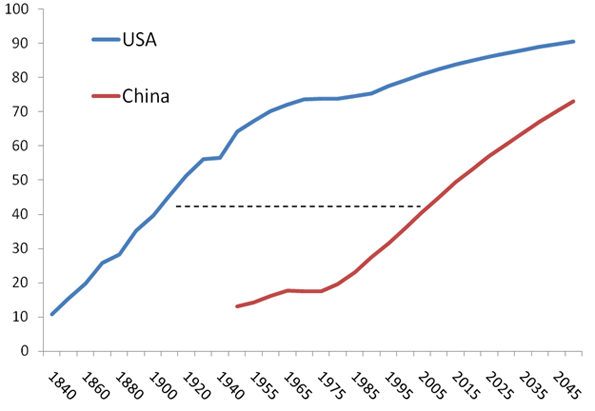
    Yet, despite these colossal shifts, China’s urbanization still has a long way to go. In 1980, the U.S. urban population was 74% of the total; China’s comparable figure was only 19%. Today, America’s urban share of the population is more than 80%, whereas China’s remains less than 50%. Taken into consideration China’s colossal size and development level, this gap suggests extraordinary potential. In 2025, America will have two cities (New York and Los Angeles) with more than 10 million people, three with 5-10 million and 37 with more than a million. By then, China will have five cities with more than 10 million people, 9 with 5-10 million, and almost 130 with more than a million. Viewed this way, China’s urbanization has barely begun (Figure 1).

    Figure 1: Percentage of Urban Population: United States and China

    Winning China’s West
    If Lewis had spent even some time in the rural China or the emerging new tiers of cities, he would have associated them with the world of “unlimited supply of labor”.

    During the past three decades, migrant laborers have played a key role in China’s economic growth in the first-tier cities. Now as living costs rise fast in Beijing, Guangdong, and the Yangtze River Delta region, employment prospects are improving in the inland cities and the West.

    Since the early 2000s, the new “Go West” policy covered the huge municipality of Chongqing, six provinces, from Gansu to Sichuan and Yunnan, and five autonomous regions. At the time, this region accounted for almost 30 percent of China’s population, but less than 17 percent of its GDP. Initially, the policy focused on the development of infrastructure (transport, hydropower plants, and energy and telecom establishments). But it is the new stage of development in eastern China that is now dramatically accelerating growth in the West.

    Even before the global financial crisis, the Ministry of Commerce designated more than 30 “priority relocation destinations” in China’s inland to increase the share in the processing industry in central and western areas, especially in labor-intensive manufacturing.

    In the future, China’s West hopes to catch up with its East through domestic consumption, cost advantage, investment policies and infrastructure, which has been boosted by the nation’s stimulus policies. China’s West is about to experience a revolution in durable consumer goods, from color TV sets to refrigerators. True, the volume of retail sales remains higher in China’s East, but sales growth is stronger in the non-coastal areas.

    As costs have risen, China has lost some jobs to Bangladesh, Vietnam and Cambodia, primarily for cheaper, labor-intensive goods like textiles, simple electronics, and toys. Yet, China’s West still offers many of the comparable benefits and an emerging infrastructure.

    The Decades to Come

    In the next two decades, China’s urbanization is expected to boost domestic demand by $4.5 trillion, which should assure a stable economic development even if exports decline. In effect, the urban migrants’ demand for housing is likely to become the largest driving force for China’s economic growth in the future.

    During the past three decades, the share of China’s city dwellers has more than doubled to 45 percent. And by 2040, the urbanization rate is expected to be close to 67 percent. In the next three decades, the number of China’s urban residents is expected to grow by 360 million people to 970 million. In terms of current urban populations, this is the same as creating city space for entire urban America (260 million), Japan (85 million) and another 15 million people – within one generation.

    This great transformation, however, is predicated on sustained economic growth and a stable international environment. China’s first-tier cities are now coping with the coming of the Lewisian turning point/ The big story in the coming decades, will be the takeoff in the west and among many once peripheral cities. Due to China’s sui generis magnitude, this process will take another decade or two.

    Dan Steinbock is Research Director of International Business at India China and America Institute (USA), and Visiting Fellow at Shanghai Institutes for International Studies (China).

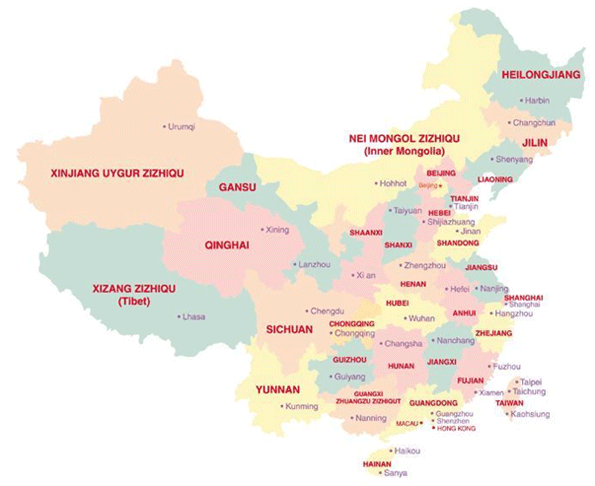
    China’s Provinces and Cities

    References

    1 Hamlin, K. et al. (2010), “China Reaches Turning Point as Inflation Overtakes Labor,” Bloomberg News, June 11.

    2 On the argument that China is coping with the Lewisian turning point, see Cai, Fang, Wang, Meiyan, 2008. A counterfactual analysis on unlimited surplus labor in rural China. China & World Economy 6 (1), 51–65.; Fang Cai, Meiyan Wang (2010), “Growth and structural changes in employment in transition China,” Journal of Comparative Economics 38 (2010) 71–81. On the argument that Lewisian turning point is years away, see Yang Yao (2010), “No, the Lewisian turning point has not yet arrived,” Economist, July 16, 2010; Roach, S. (2010), “ Chinese wage convergence has a long way to go,” Economist, July 18.

    3 Lewis, W. Arthur (1954). “Economic Development with Unlimited Supplies of Labor,” Manchester School of Economic and Social Studies, Vol. 22, pp. 139-91

    4 Steinbock, D. (2010),” Legacy of Globalization: Shanghai and Hong Kong as China’s Emerging Financial Hubs,” Policy Brief, Shanghai Institutes for International Studies, January 2010.

    5 These tiers of cities are evolving dynamically and through a national plan. With its more than 31 million people, Chongqing, for instance, is already one of China’s five national central cities. National central cities have a great impact around the surrounding cities on integrating services in infrastructure, finance, public education, social welfare, sanitation, business licensing and urban planning.

    6 In fact, Lewis’s classic article offers also another clue to assess China’s stages of growth. As far as he is concerned, small migrations explain little. In the 1950s, he noted, 100,000 Puerto Ricans emigrate to the United States every year. Still, it is Puerto Rican wages which are pulled up to the U.S. level. Mass immigration is quite a different kettle of fish. “If there were free immigration from India and China to the U.S.A., the wage level of the U.S.A. would certainly be pulled down towards the Indian and Chinese levels,” Lewis argued. In China’s economic development, the tens of millions of migrant workers have played the comparable role of pulling down the national wage level.

    7 In the beginning of the “Go West” program, the largest proportion of the West’s total fixed asset investment was in infrastructure. And almost half of China’s huge stimulus of $586 billion was earmarked for transportation, infrastructure and power grids. These, in turn, facilitate the exploitation of minerals, natural gas and oil in China’s West. In addition to the stimulation of domestic demand, the government’s strategy is to “cultivate areas of high consumer demand and expand consumption in new areas”.

    8 “China’s urbanization to fuel domestic demand,” China Daily, November 15, 2010.

    9 Steinbock, D. (2010), “Growth fueled by urban investment,” China Daily, February 25, 2010.

    10 On the international relations dimensions of China’s stages of growth, see Steinbock, D. (2010), “China’s Next Stage of Growth: Reassessing U.S. Policy toward China,” American Foreign Policy Interests, No 6, December 2010.