Author: admin

  • Modifying Loans and the Decision-Makers

    A recent editorial in The New York Times lamented the latest housing market woes, this time resulting from various banks’ disregard for, or inattentiveness to, a legal foreclosure process. As the article correctly states, “It is hard to be shocked.”

    Further fueling uncertainty is of immediate concern, adding another layer of doubt to what may end up proving to be a formerly nascent recovery. While President Obama is calling for more thorough analysis to determine if foreclosure or modification is more prudent, and a provision in the Dodd-Frank bill authorizes government aid for troubled homeowners to assist with legal services, neither gets to the heart of the problem.

    Homeownership is not an inalienable right, and should be reserved for those who are in the financial position to shoulder the burdens that come with the supposed pride. The banks reviewing loan applications should be the final bastion of culpability in assessing prospective buyers’ financial wherewithal.

    This creates a moral conflict in many cases, as banks make money by lending money. In the interest of financial stamina, however, the banks have overlooked the simple fact that they only make money by lending money if the borrowers can pay them back. While there will always be some percentage of borrowers that fail to pay back their loans, it is all too well documented now that those levels are excessively high in today’s economic environment.

    Most troubling is the realization that many bank REO departments (for “real estate owned,” the class of property that goes back to lenders upon unsuccessful foreclosure auctions) are not staffed by real estate minds. While it is not fair to make a wholesale categorization of REO departments nationwide as real estate deficient, there are multiple cases where simple real estate fundamentals are unknown.

    Examples here include law firms, architecture firms and real estate advisory firms being engaged to teach real estate 101 to national banks’ REO departments. There have been cases where those making the decisions between lending or not lending, or foreclosure or modification, are unable to effectively comprehend sale and purchase agreements, site plans and floor plans, inspection reports or market analysis documents. This is not to suggest that these are bad people. But, as clerks, statisticians and analysts who are not educated or trained in the intricacies, or even general principles of real estate, they simply do not get it. How can such fragile issues with widespread economic and social ramifications be addressed by anything less than experts?

    In other words, these last bastions of culpability are unable to perform the simple tasks that even a reasonably responsible borrower should comprehend. Banks are in the business of making money, and that, in and of itself, is not a crime in a capitalist economy. But they should at the very least properly train those who are making decisions on lending millions upon millions of dollars to aspiring, whether ready or not, homeowners.

  • The Great Deconstruction: Competing Visions of the Future

    During the Great Recession, America’s wealth has diminished while indebtedness has increased. This is simply a matter of fact. How the United States will marshal its resources and deploy its wealth in the future is a matter of great public debate. Previous installments of the Great Deconstruction series have explored the debate over the growing size of government and the impact the Tea Party movement may have on a possible smaller role for future government.

    The current administration has its own vision of how to address the coming period of deconstruction. John P. Holdren, Director of the White House Office of Science and Technology, shied away from using the term “de-development” that he endorsed in past writing. When asked by CNSNews how he would “de-develop” the United States, Holdren said he would use the “free market economy” to implement “stopping the kinds of activities that are destroying the environment and replacing them with activities that would produce both prosperity and environmental equality”.

    But this stated new appreciation for market forces likely does not mean he has shifted from his belief that resources “must be diverted” from advanced countries to the underdeveloped countries. An example of how Holdren’s vision of the future may be implemented as policy in the United States can be found in this administration’s actions towards energy and in particular, oil drilling. The BP oil well, Deep Horizon, has been officially capped yet the federal ban on all drilling in the Gulf remains in place. The administration estimates the ban cost just 8,000 – 12,000 jobs but Baton Rouge-based Louisiana Mid-Continent Oil and Gas Association believes that the moratorium may put as many as 46,000 rig workers out of work. If all workers on deep water rigs were laid off during the suspension, the moratorium would lead to the loss of 23,247 jobs.

    In contrast, the same Administration approved $2 billion in loan guarantees from the US Import Export Bank to Brazil’s state owned oil giant, Petrobas, to open the giant Tupi oilfields in the Santos Basin fields near Rio de Janeiro. The oil recovered from the Tupi fields will not go to the US and US taxpayers, but it will make Brazil richer and energy independent

    Critically much of what the Administration has proposed follows the contours of “de-development”. This can be seen in a host of initiatives that would hit Americans economically from the “cap and trade” scheme, support for solar and wind energy, as well the attempt to regulate greenhouse emissions through the EPA.

    Oddly the Administration has not put much priority on nuclear power, which is arguably the most effective way to reduce greenhouse gases. Despite announcing an $8 billion loan program for nuclear power plant construction, there is only one nuclear power plant under construction in the US, compared to 50 worldwide. Jeff Immelt, CEO of General Electric, joked that the nuclear industry’s most important output these days is press releases. Nuclear power remains banned in many states. Just 6 states are able to generate more than 40% of their electricity from nuclear power.

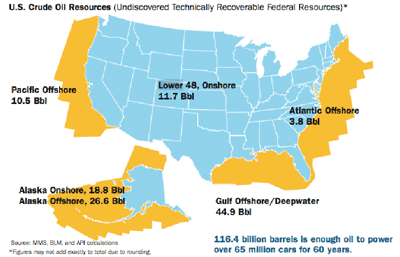
    The drive to de-develop America begins with control of energy. This includes actions to restrict access to our natural resources. The United States has 31 billion barrels of oil reserves on-shore in the lower 48 and Alaska. Off-shore oil reserves include 60 billion barrels along the coastal US and 26 billion barrels in off shore Alaska. Yet almost all of these reserves remain untouchable. Drilling in ANWAR is still banned and due to the BP oil leak in the Gulf, a drilling ban remains in place on the only coastal resource previously open for drilling.

    The US oil reserves are a pittance compared to our reserves of oil shale deposits. Estimates put oil shale reserves at 1.5 – 2.0 trillion barrels or five times that of Saudi Arabia. “The technical groundwork may be in place for a fundamental shift in oil shale economics,” the Rand Corporation recently declared. “Advances in thermally conductive in-situ conversion may enable shale-derived oil to be competitive with crude oil at prices below $40 per barrel. If this becomes the case, oil shale development may soon occupy a very prominent position in the national energy agenda.” Shell utilized a process called “in situ” mining, which heats the shale while it’s still in the ground, to the point where the oil leaches from the rock. The process eliminates the need to mine the shale to get to the oil. The Administration has shown little sign of encouraging the development of these resources, particularly in the areas controlled by the federal government.

    US policy towards the coal industry is no more favorable. U.S. coal production decreased in 2009, dropping by 8.5 percent to a level of 1,072.8 million short tons. The decline in coal production in 2009 was the largest percent decline since 1958 and the largest tonnage decline since 1949.

    In sharp contrast, the administration openly promotes green technologies like wind and solar. Unfortunately, these sources provide just 1% of our energy requirements.

    De-development, the Obama Administration’s version of deconstruction, is very different from a growing political movement aimed at reducing the nation’s debt and current spending. The Great Deconstruction will not come from a government policy of reducing energy consumption to bring America into a more correct distribution and use of the world’s resources. Rather, it will come from the people demanding a smaller bureaucracy, more efficient government and government employees actually willing to do the job they are paid to do.

    The election in November offers the most profound choice for the future of America that we have seen in decades. One choice espouses government control of our natural resources, motivated by the strategy of “de-development” and expensive, rationed energy. The other choice seeks deconstruction of unsustainable and dysfunctional bureaucracies and intends to choke off the money supply from Congress and defund these programs.

    **************************

    Robert J Cristiano PhD is the Real Estate Professional in Residence at Chapman University in Orange, CA and Head of Real Estate for the international investment firm, L88 Investments LLC. He has been a successful real estate developer in Newport Beach California for twenty-nine years.

    Other works in The Great Deconstruction series for New Geography
    Deconstruction: The Fate of America? – March 2010
    The Great Deconstruction – First in a New Series – April 11, 2010
    An Awakening: The Beginning of the Great Deconstruction – June 12, 2010
    The Great Deconstruction :An American History Post 2010 – June 1, 2010
    A Tsunami Approaches – Beginning of the Great Deconstruction – August 2010
    The Tea Party and the Great Deconstruction – September 2010

  • The Tea Party and The Great Deconstruction

    Some say a Second American Revolution has begun. In the first American Revolution, American militiamen at the Old North Bridge in Concord, Massachusetts, fired the Shot Heard Round the World at British Redcoats on April 19, 1775.

    The Shot Heard Round the World in the Second American Revolution was the surprise election of Scott Brown, again in Massachusetts, on January 19, 2010. The bullets fired were ballots as a Tea Party-backed candidate captured the “Kennedy seat” in the US Senate. The militiamen of 2010, riding pickup trucks rather than horses, call themselves the Tea Party, named after an act of insurrection against the out of touch establishment of King George.

    Since January of 2010 the Tea Party has swept Republican establishment politicians from office in Massachusetts, New Jersey, Pennsylvania, Alaska, Delaware, Utah and Florida. Like King George, the establishment does not plan to go quietly. Governor Crist continues to run as an independent in Florida. Senator Murkowski announced she would run as a write-in candidate in Alaska.

    Americans who joined the Tea Party movement believe our government has grown too big. In this they have broad support that extends beyond the 50% coalition that elected George Bush. Part of the key to their successes to date has been steering clear of divisive social issues and concentrating on fiscal ones.

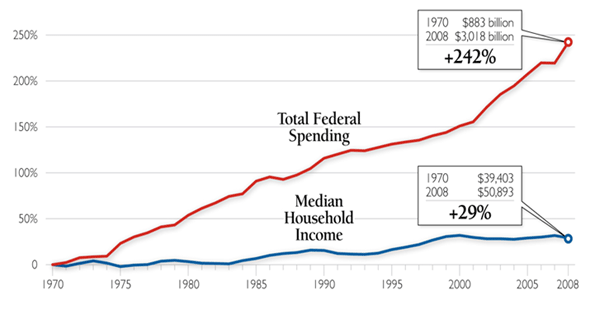
    Like a majority of Americans, Tea Parties are alarmed that government spends too much (Chart from Heritage Foundation) and does so with borrowed money. They understand that our children and grandchildren will be forced to pay for today’s reckless spending. As a result they have gone to the polls in record numbers to make their voice heard. They want the spending to stop and if the politicians do not listen, they will throw them out as their forefathers displaced King George. It does not appear that the politicians are listening. Despite the boisterous town hall meetings of 2009 and a string of primary upsets in 2010, politicians discount the public sentiment. Democratic Congressman Tom Perriello of Virginia recently said, “If you don’t tie our hands, we’ll keep stealing.”


    Source: Heritage Foundation

    What kind of America does the Tea Party want?

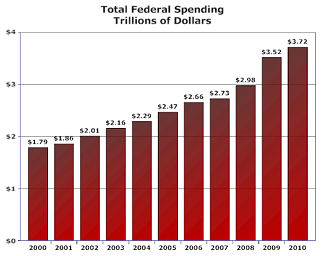
    The Tea Partiers have watched the federal budget double under Bush and Obama at a time hen they have had to cut back on their own family expenditures. (Chart from the Cato Institute) They want a smaller, less intrusive government and most importantly, a government that lives within its means. The Tea Party wants an end to trillion dollar deficits. Where the two political parties accept trillion dollar deficits, The Tea Party demands draconian change in our system of governance. They recognize the need for the coming Great Deconstruction.

    The Cato Institute has offered a website dedicated to downsizing the federal government. Cato outlines clear and concise methods to reduce spending and deconstruct the various departments of government as the Tea Party is demanding. Cato’s author, Chris Edwards, envisions the elimination of entire branches of the federal government by “devolving” various programs to the states.

    The annual savings proposed by the Cato Institute study total more than $400 billion per year. Some call the recommendations draconian and outrageous. Yet the savings represent just 11% of current spending – a critical way to adjust to the new realities of the deconstruction.

    The Second American Revolution may have begun. If it is so, and America earns its independence from trillion dollar budget deficits and professional politicians, the future of America may look very much like Cato study has proposed. No matter what the outcome of the elections in November of 2010, the future will look very different than today as the Great Deconstruction comes to pass.

    ***************************

    Robert J Cristiano PhD is the Real Estate Professional in Residence at Chapman University in Orange, CA and Head of Real Estate for the international investment firm, L88 Investments LLC. He has been a successful real estate developer in Newport Beach California for twenty-nine years.

    Other works in The Great Deconstruction series for New Geography

    Other works in The Great Deconstruction series for New Geography
    Deconstruction: The Fate of America? – March 2010
    The Great Deconstruction – First in a New Series – April 11, 2010
    An Awakening: The Beginning of the Great Deconstruction – June 12, 2010
    The Great Deconstruction :An American History Post 2010 – June 1, 2010
    A Tsunami Approaches – Beginning of the Great Deconstruction – August 2010

  • Fortress Australia: Groundhog Day

    A decade ago, politics in Australia lurched to embrace all things rural, happily demonizing urban interests. This happened in response to a renegade Politician – Pauline Hanson – who for a time captured public sympathy with populist anti-immigration sentiments, threatening to unseat entire governments in the process.

    Now the result of the recent National Election in Australia has seen not only the return of anti immigration sentiments, but the ascendency of anti-growth statements in mainstream politics. For a large country with only 24 million people, it’s a dangerous development.

    Two things are shaping in the aftermath of the 2010 Federal Election as portents of things to come for our economic future. One is the rise of an increasingly orthodox view that Australia at 24 million people is reaching its maximum sustainable population. The second is toward appeasing the agrarian socialism and social conservatism of rural politics. Together, this could mean we are about to usher in an era of low growth, high protection policies. Fortress Australia could easily become a reality no matter which side ultimately claims the keys to the Government benches.

    Prior to the recent Federal Election (August 2010) both major political parties have become shy of the country’s long term population growth patterns. In September 2009, Federal Treasurer Wayne Swan released some early findings of the Intergenerational Report, which predicted Australia could reach 35 million by 2050. Although this rate of growth was pretty much the same as the preceding 40 years, the figure was greeted with alarm by media, the community, and much of the political herd. ‘Australia Explodes’ went the headlines and the lemmings followed over an ideological cliff. (See this blog post from a year ago).

    A month later, then Prime Minister Kevin Rudd was proclaiming that he believed in ‘a big Australia’ but by mid 2010 his later nemesis Deputy Prime Minister Julia Gillard was proclaiming she ‘did not believe in a big Australia.’ Gillard replaced Rudd in a Labor Party coup, and then as Prime Minister declared we shouldn’t ‘hurtle’ toward 36 million but instead plan for a ‘sustainable’ population, renaming the recently created portfolio of ‘Population Minister’ the ‘Sustainable Population Minister’ in the process. The word ‘sustainable’ in this context stands for ‘slow down or stop.’

    Then came the election campaign with Opposition Leader Tony Abbot promising to ‘slash’ the ‘unsustainable’ immigration numbers (that his mentor John Howard had been responsible for as conservative Prime Minister for over a decade) and to ‘turn back the boats’ of illegal immigrants and asylum seekers, mainly from south east Asia or Afghanistan. Population growth was to be cut to 1.4% (a long term trend anyway) and migrants potentially forced to settle in rural areas (some dodgy form of zipcode migration policy).

    The message from both political leaders was clear: support for a ‘big Australia’ (35 million population by 2050 or the same rate of growth we’d seen in the last 40 years) was gone.

    Add to that the quixotic Australian entrepreneur Dick Smith and his population TV documentary ‘The Population Puzzle’ where he alleged Australia was at risk of running out of food, out of space and out of control, comparing us (oddly) with places like tiny Bangladesh (population 160 million). Smith might be mad but you can’t discount the impact he has on Australian popular opinion. People believe him, politicians included.

    Could it get any worse for the prospects of maintaining even modest levels of population growth in Australia? The last election outcome means the answer is yes. The balance of power in the Senate of the Australian Parliament will now be controlled by ‘The Greens’ (a left wing environmental party). The Greens’ view on population growth is clear: they don’t support it (unless oddly if you’ve arrived illegally, by boat). “This population boom is not economic wisdom, it is a recipe for planetary exhaustion and great human tragedy” said Greens leader Bob Brown when the Intergenerational Report was released last year.

    In the House of Representatives, the balance of power is now held by a handful of independents, representing rural seats. Socially conservative but economically protectionist, the independents’ views on population suggest they would lean toward the Abbot view: turn back the boats, and slow the overall rate of growth. They are quite likely to also push for a redistribution of economic riches to a range of projects for rural and regional areas. The irony that the election result hinged on big swings in urban seats but that a handful of rural independents are now trying to call the shots shouldn’t be lost on anyone.

    Joining the growing chorus of slow or no growth chants is municipal government. The Local Government Association of Queensland’s annual conference this year talked of limits on population growth unless bountiful riches are showered on local governments to cope with ‘unsustainable’ rates of growth. Association President Paul Bell says “councils cannot let population growth exceed infrastructure needs.”

    “Where we find water supplies no longer match the size of the community, where we find roads are congested, where we’re seeing other infrastructure whether it be health or education are falling behind,” he said, population growth was by implication to blame.

    The bottom line? Population growth is now a dirty word in politics and for any business which relies on growth for its prosperity, this is not good news. Everything from airports to property to construction to farming to retailers, manufacturers and tourism will be affected by slowing growth.

    Even social services could suffer if growth is deliberately slowed. Why? Because in 50 years time, without migration or natural growth, the ageing bubble of post-war baby boomers may mean there are two working adults for every five retired. You wouldn’t want to be one of those two and paying their tax bill in 50 years’ time or dependent on the kindness of those workers.

    How has this come about? The answer is simple: growth itself has never been the problem. Instead, it’s been a notoriously inefficient planning approach which has misdirected precious infrastructure spending, pushed up housing prices through artificial restraint on supply combined with usurious upfront levies, which now average $50,000 per dwelling in Queensland (often more) and considerably more in NSW.

    In the last decade, can anyone honestly claim that our planning schemes are now more efficient and quicker, or more easily understood, or better targeted, than a decade ago? I doubt it.

    Would it be too much to ask for a sensible, evidence-based approach that ties population growth to urban and regional strategies, which emphasises economic progress while maintaining lifestyle and environmental standards? How about some decent plans to link regional urban centres to major cities, based not on pork barrels to influential independents but based only on the business case and community mutual benefit? Or how about putting the ‘growth’ back into smart growth, with policies that allow our urban areas to expand in line with demand matched to infrastructure spending, rather than policy dogma?

    Those same questions were being asked a decade ago. Welcome to ground hog day.

    For those interested, here’s a couple of yarns from 10 years ago:
    Slicker Cities for City Slickers. October 1999.
    Nation Building and a National Urban Strategy. May 2001.

    Ross Elliott has more than 20 years experience in property and public policy. His past roles have included stints in urban economics, national and state roles with the Property Council, and in destination marketing. He has written extensively on a range of public policy issues centering around urban issues, and continues to maintain his recreational interest in public policy through ongoing contributions such as this or via his monthly blog The Pulse.

    Photo by Linh_rOm
  • Mayor Daley Calls it Quits

    Chicago’s Mayor Daley has decided to end his political career. Chicago’s Mayor since 1989, in December he will break his father’s record as Chicago’s longest serving Chief Executive. No one knows the real reason Daley chose to hang it up, whether it’s his wife’s health or his low polling numbers. Long time Chicago Sun-Times reporter Fran Spielman summarizes Daley’s current troubles:

    Chicago’s stunning first-round knock-out in the Olympic sweepstakes, political fall-out from his nephew’s pension fund deals and a budget crisis that forced him to deplete the city’s long-term reserves and demand furlough days and other cost-cutting concessions from city employees.

    Chicago is facing more of the same — and another painful round of service cuts — to erase a record $654.7 million shortfall in 2010.

    The city’s bond rating was dropped. Its homicide rate is on the rise, including the murder of three Chicago Police officers in recent months.

    More voters were increasingly viewing Chicago as a city that doesn’t work. Being known as a “union” town isn’t an asset in a competitive, global economy. Who will confront Chicago’s problems as the next Mayor?

    Several people are interested in being Chicago’s next Mayor. The most noteworthy is Obama’s Chief of Staff Rahm Emanuel. Whether Emanuel will leave the White House before the November election to start a campaign for February is anyone’s guess. Would President Obama get involved in local Chicago politics to endorse Emanuel?

    Emanuel will face scrutiny over his tenure as a board member of the failed GSE Freddie Mac. What exactly did Rahm Emanuel know about corrupt accounting there? But, Emanuel has other problems. Whether Emanuel can overcome hostility from the African-American and Hispanic community over comments made about issuing drivers licenses to high school dropouts is another issue. Both communities will look to run a candidate in February’s election.

    Then there’s the problem Chicago may be reluctant to elect a Jewish Mayor. As Alderman Burke told Professor Milton Rakove’s in an interview:

    “There is a latent anti-Semitism in Chicago and a large population that will never vote for a Jew. They would vote for anybody before a Jew.”

    Whoever decides to run for Mayor will have to have the backing of powerful Alderman Ed Burke, who is Chairman of the Finance Committee. With $6 million in his campaign fund, Alderman Burke will be the kingmaker behind the scenes. After all, the business community “feels” it is good business to be on the good side of Alderman Burke. Chicago Sun-Times reporter Fran Spielman asked Alderman Burke if he would run:

    “Stay tuned,’’ he said, laughing. “It would be one of the farthest things from my mind. [But] in Chicago politics, people never close the door.”

    It’s not likely Alderman Burke is going to give up his lucrative legal business to take a pay cut as Chicago’s Mayor. Alderman Burke was handing out the money before Mayor Daley was elected and he will continue in that role no matter who is Chicago’s next Mayor.

    The “Chicago Way” is likely to continue whoever is the next Mayor.

  • A Tsunami Approaches: The Beginning of the Great Deconstruction

    In the distant horizon, a giant wave is building. There are some who recognized the swell and raised the alarm. There are others who deny the possibility of such a wave. Most remain blissfully unaware. The wave is building and when it reaches our shores, it will hit with the force of a tsunami.

    The wave is propelled by government spending and crested with unfunded pension obligations. The Pew Center on the States wrote in The Trillion Dollar Gap (February 2010), “A $1 trillion gap exists between the $3.35 trillion in pension, health care and other retirement benefits states have promised their current and retired workers as of fiscal year 2008 and the $2.35 trillion they have on hand to pay for them.”

    Like any tsunami, the wave began long ago and very far out to sea. Thirty years ago the vast majority of union workers were in the private sector. Public employees in unions reached parity with private sector members by 2009. This was aided in part by campaign contributions from the unions to elect Democratic Party candidates and generous pay packages and retirement plans passed by those same politicians in return.

    By 2010, the general public received a series of shocks. The first shock was the jobless recovery of the Great Recession that cost 8 million jobs. Most of the job losses occurred in the private sector yet the majority of the $800 billion Stimulus Bill went to “save and create” public sector employment. The second shock was learning that civil servants earned twice that of private workers. According to the Bureau of Economic Analysis, Federal workers received average pay and benefits of $123,049 while private workers made $61,051 in total compensation. The third shock was revelation of incredible retirement plans doled out by politicians since 1999. In 2002, California passed SB 183 that allowed police and safety workers to retire after 30 years on the job with 3% of salary for each year of service, or 90% of their last year’s pay. During the Great Recession, fireman began retiring with $150,000 pensions at age 52 despite a life expectancy approaching 80. In Orange County CA, lifeguards, deemed safety workers, retired with $147,000 annual pensions. The Orange County sheriff, recently convicted of witness tampering, will receive $215,000 annually while in jail. Bob Citron, the Treasurer of Orange County who pushed the county into bankruptcy in the 1990s, receives a pension of $150,000 per year. A tsunami of anger and resentment is building.

    As the wave approaches, economists issue thick reports with ominous names like “The Gathering Storm” (Reason Foundation) advising us that the pension obligations we have created are unsustainable. They report cities and states cannot economically allow workers to retire at 52 when they have a life expectancy of 26 years of retirement. They simply cannot pay for these pensions with existing revenue. Services will go down and taxes will go up to pay for these generous pension obligations. Orange County’s CEO, Thomas G. Mauk, predicted that pension requirements in 2014 will take 84% of the county’s law enforcement payroll. It is already 50% today. To exacerbate the problem, The Great Recession forced most states into budget deficits as their revenues decline. For FY2010, every state except Montana and North Dakota has projected a budget deficit. (RedState 3/21/2010).

    California once again leads the nation with a $26 billion budget deficit plus an unfunded pension obligation of $500 billion. Its current financial structure is clearly unsustainable. It has an operational structure that in ungovernable with often duplicative agencies, some collecting less in tax revenue than the agencies spend on collection. Wikipedia lists 500 existing public agencies for the State of California. California can no longer afford such a luxury. It must deconstruct these bloated inefficient government agencies, and rid itself of their chairman, staff, offices, cars, pensions and the overhead that such excess represents. A $26 billion dollar deficit is not something that can be corrected with a wage freeze or job furloughs. Bold leadership can lead California to deconstruct its 500 agencies down to 100 functional organizations. California is a classic example of what must change in the coming Great Deconstruction.

    One Orange County city has already taken bold steps to correct its $10 million deficit. It may be a model for other cities and states across the country. Internally, it has decided it will not replace any city worker that dies, retires, moves or quits. The city will simply out source the employment to an outside service company and eliminate healthcare requirements and unsustainable pensions. Building inspectors will be out sourced as will city plan checkers, librarians and meter maids. Only essential services like top executives and cops will remain on the city payroll. The city staff will eventually decrease from 220 to approximately 35 personnel. This is the essence of deconstruction.

    At the state and local level, the Great Deconstruction has already begun albeit delayed by an infusion of federal stimulus dollars and grants in 2009 and 2010. The federal government must deconstruct as well. It must happen, if only because the revenue is no longer there to sustain all of these often well-intentioned programs. The federal government will not be immune from fiscal reality.

    In this sense, the election in November will be a referendum on the very sustainability of our system of government. One party will continue to borrow and spend in order to maintain the 500 agencies in California and the abundance of federal programs. They have not said how long they will be able to borrow money to sustain their system. The other party will try to simply turn off the spigot – now. Either way, one day the money will run out and the inevitable deconstruction will occur.

    ***************************************************

    The Great Deconstruction is a series written exclusively for New Geography. Future articles will address the impact of The Great Deconstruction at the national, state, county and local levels.

    Robert J. Cristiano PhD is the Real Estate Professional in Residence at Chapman University in Orange County, CA and Director of Special Projects at the Hoag Center for Real Estate & Finance. He has been a successful real estate developer in Newport Beach California for twenty-nine years.


    Other works in The Great Deconstruction series for New Geography

    An Awakening: The Beginning of the Great Deconstruction – June 12, 2010
    The Great Deconstruction :An American History Post 2010 – June 1, 2010
    The Great Deconstruction – First in a New Series – April 11, 2010
    Deconstruction: The Fate of America? – March 2010