Author: admin

  • The Three Ages of Boss Rule

    Between roughly the Civil War and World War II, most American cities were at some point dominated by a boss and his machine. The term “boss” referred not only a powerful politician, but one who acquired, held and exercised power outside the channels dictated by law. Progressive reformers fought the bosses for control of American city government for over a century. The Progressives ultimately won, or, at least, the bosses lost.

    All this is well known. What is less well known is that the entire history of bossism is contained in three films: Martin Scorsese’s Gangs of New York (the origin), Preston Sturges’The Great McGinty (the peak), and John Ford’s The Last Hurrah (decline).

    Gangs of New York: How Tammany Hall Civilized New York City

    Gangs of New York (Gangs) takes place in New York City during the Civil War. Its plot concerns the war between Irish and nativist gangs for control of lower Manhattan. Both lose, leading to the rise of Tammany Hall, whose innovative manner of conflict resolution laid the foundation for modern New York. The ward heelers replace the warlords and the rigid identities of immigrant and nativist are dissolved. That’s how New York was tamed.

    The film’s most memorable character is Bill the Butcher (Daniel Day-Lewis), the nativist gang leader bent on keeping the Irish down. A primitive man, Bill resembles Homer’s Cyclops in that he has only one eye and maintains his political authority through the open threat of violence. He’s the sometimes ally of Boss Tweed (Jim Broadbent), who functions as Tweed’s liaison to the slums of lower Manhattan.

    In Gangs’ moral order, Boss Tweed represents progress. Tweed’s understanding of progress means thievery on a grand scale (rigging contracts for a new courthouse vs. exacting tribute from pubescent pickpockets) and bringing the Irish into the fold. Tweed tells Bill that to rely purely on violence is crude and inflexible, and he vows that Bill won’t last if he doesn’t adapt. Bill is less greedy than Tweed, and more principled in his own (bigoted) way. He’s ferociously independent, but also fatalistic. Bill knows that Tweed is right that his days are numbered. Nonetheless, he will go down fighting.

    But the debate between Bill and Tweed is really a side show. Gangs’ main action concerns the struggle between the Irish and natives. The Irish are if anything even more primitive than Bill. They live in torch-lit caves, they are vengeful and as bigoted towards blacks as Bill’s crowd, and they reject the Civil War. Unlike Bill, the Irish have a bright future, but they, too, have bitter truths to learn. They seem to think that they can be New Yorkers without also being Americans. They are wrong. Scorsese asserts this by making the film’s climax not the 1863 draft riots themselves but the Union Army’s brutal suppression of them. The Army forces the Irish to submit to the legitimacy of the Civil War, and, by extension, the unconditional obligations implied by American citizenship. (Nation-building, 19th-century style.) Becoming American means becoming an American citizen, and citizenship implies renouncing the right to pick and choose among one’s obligations, and not least during times of crisis. Scorsese is slightly less clear about what becoming less Irish and more American will mean for the Irish than he is about the nativists’ education. But, at bare minimum, it means that they too will have to become more tolerant and capable of solving their conflicts through politics instead of violence.

    Tammany did not itself vanquish the gangs (which were real by the way-see Herbert Asbury’sGangs of New York (1928), on which the film was based, and Tyler Ambinder’s Five Points(2010)). That task required guns and muscle. But, in providing a ready-at-hand political alternative to the gangs, Tammany answered the question what next?

    What is the purpose of city government? It is not only to provide basic services such as education and street-cleaning, but to manage conflict. Government is much more than just a fee-for-service arrangement. Humans tend to disagree about the true and the good, which produces conflict, which we need politicians to manage for us by means of persuasion, intimidation, flattery, deal making, and so forth. Politics will always be with us and we will always need politicians.

    The urban party machines excelled at managing conflict. If we believe that honest, rational debate will be inadequate to resolve most conflicts, then something else will be necessary to prevent government from being rendered completely impotent and to minimize the potential for violence. In most functional democracies, that “something else” has been a party system. Centuries of political experience strongly suggest that a democracy requires some form of organized mediation to recruit and vet candidates for office, and then, when in office, provide them with the support they need to be effective. “Parties are as natural to democracy as churches to religion (James Q. Wilson).”

    Scorsese seems to understand these virtues of boss rule, while remaining aware of its corruption and vulgarity. Gangs argues that boss rule was an improvement over what came before: the gangs were just as corrupt, more violent, less enlightened, and, most crucially, pettier. Modern New York for Scorsese is, above all, a great city. Tweed was not a great man, but, according to Scorsese, Tweed’s political system provided the conditions for New York’s future greatness.

    The Great McGinty: Bossism Ascendant

    The Great McGinty (McGinty) takes place in an unnamed American city sometime in the first half of the 20th century. Its plot traces the title character’s (Brian Donlevy) rise from the soup line to the governorship by means of his skills at repeat-voting, fighting, bullying, carousing, wisecracking, bid-rigging and spending public money wastefully. “The boss” (Akim Tamiroff) gives McGinty his initial break and then directs his rise. McGinty chafes under the rule of the boss, and hilarity, and McGinty’s downfall, ensue. The third major character is McGinty’s wife (Muriel Angelus), his moral guide, who bucks him up to reject the boss.

    McGinty depicts boss rule at its height, when it seemed almost the natural form of American city government. Sturges gives us the fully-developed specimen. All of the essential features of Progressive age city politics are in evidence:

    First, the boss was often not the mayor. Of the 20 municipal bosses surveyed in Harold Zink’sCity Bosses in the United States (1930), 19 held some public office of some kind, but only two were mayors. There was no reason for the boss himself to be the mayor, since it was a ceremonial position with no real power. The office now known as the “strong mayor” did not become common until well into the 20th century. Progressive reformers strengthened the office of mayor by wresting fiscal and administrative authority away from the local legislature and lengthening the term of office. This left no choice to the boss but to become mayor. What few bosses have emerged to dominate urban politics since WWII have all been mayors. Examples include Richard Daley pere, Philadelphia’s Frank Rizzo, and Newark’s Sharpe James.

    Second, Machine politics was genuinely democratic in the sense that it enabled men to rise from exceedingly humble beginnings to positions of high authority. In this respect, a real life equivalent of McGinty would be Harry Truman, who owed his career to Tom Pendergast, the notorious boss of Kansas City.

    Third, the lines between reformer and boss could be sometimes blurry. McGinty is first elected as a reform candidate (“Down with McBoodle! Up with McGinty!”). Wise bosses were highly sensitive to public opinion. They sometimes had to run candidates who were just distant enough from the machine to be considered graft-free. This practice was known as “perfuming the ticket.” Problem was, such candidates did not always stay in line when they got into office. Sometimes they chafed like McGinty did.

    Fourth, women hated grafters. The Progressive-era movements for women’s suffrage and municipal reform were practically indistinguishable. Women getting the vote dealt the bosses a grievous blow.

    McGinty is a satire and therefore anti-boss. Sturges certainly expects us to like McGinty, the boss and the gang, and McGinty does eventually redeem himself by breaking with the boss (on top of earning the love of a good woman), but to say that his deep engagement in machine politics required redemption implies that bossism was a rotten system. The audience’s proxy is McGinty’s wife. She loves him, but she certainly doesn’t love his politics.

    At the same time, Sturges depicts a world in which bossism as such is not seriously under threat. No fundamental structural reforms are at hand, just the occasional defeat at the polls and visit to the hoosegow.

    The Last Hurrah: Ciphers Ascendant

    The Last Hurrah’s protagonist Frank Skeffington (Spencer Tracy) is based on Boston’s James Michael Curley. We know this because of the many details drawn directly from Curley’s eventful life and career: Skeffington’s longstanding feuds with his city’s Cardinal and with the bluebloods, his personal dislike for FDR, his uxoriousness, his considerable charm and rhetorical skills, and the fact that he’s an old man running yet again for mayor in a predominantly Irish New England city. Skeffington’s final campaign forms the plot of Hurrah. Its events transpire in the mid-20th century, contemporaneously with the film itself (1958) and the book on which it was based (by Edwin O’Connor, published in 1956). Skeffington loses, to a young, upwardly-mobile Irish American put up by the local WASP establishment. Times have changed since Skeffington entered politics in the late 19th century. TV and radio have replaced flesh-pressing and spontaneous, street-corner oratory. The city is wealthier, and some of that wealth has reached the Irish, Skeffington’s traditional base. Their wealth has made them less resentful, rendering WASP-baiting demagoguery less effective than it used to be. Skeffington is aware of these changes, but he’s still convinced that one last victory is in his grasp. He believes that all it will take is a mix of charm, intimidation, patronage and loyalty, but events prove him wrong.

    Skeffington’s is a personal machine. Bosses created machines, not vice versa. All urban machines depended on the leadership from a strong boss. We see this in the fact that we tend to refer to most of the important machines by the names of the boss who gave them life and influence (Pendergast, Hague, Crump). Tammany Hall, which did manage to last a long time and transcend the leadership of individual bosses, was the exception, not the rule.

    And in that he controls the machine and not vice versa, Skeffington may be said to be his own man, the genuine article. He may be a bit of a grafter, but, in Hurrah, he’s not the candidate beholden to special interests. That would be McCluskey, Skeffington’s nebbish opponent. The film argues that, for all their faults, decline of Skeffington and his like heralded a more inauthentic form of politics. (The phrase used in Hurrah the novel is “a generation of ciphers.”) Politicians would thenceforth be packaged, handled and promoted like so many different brands of soap. The backlash against scriptedness and inauthenticity we see in the appeal of candidates such as Herman Cain and Ross Perot. These are not great men, but, in that authenticity is surely a condition of greatness, the decline of Skeffington’s ways portends the decline of greatness in city politics.

    That’s the bad news. The good news is that Hurrah depicts the last stages of unity and reconciliation projected by Gangs. The subtitle of The Last Hurrah could be The Revenge of the WASP. Skeffington finds himself fighting against both the new Irish middle-class and old money Protestants. His moment seems to have been a blip, a brief transition phase in American urban history. By the film’s conclusion, history has come full circle and ethnic conflicts are resolved in a way that could never have happened while blueblood-baiters like Skeffington remained in power.

    It’s somewhat difficult for the audience to appreciate how Skeffington could have lost to McCluskey. Based on what we are shown, the latter seems like a total boob. But we’re not the voters. To the increasingly affluent second and third generation Irish-Americans, Skeffington comes off as uncouth, just as he always did to the WASPs. They want a mayor that mirrors their conception of themselves: young, well-educated (in a conventional sense), nicely (not nattily) attired, and untainted by unsavory connections and loyalties.

    In their classic study City Politics (1963), Edward Banfield and James Q. Wilson argued that this trend was general among ethnic voters in the American city at mid-century. Yes, Jews still preferred to vote for Jewish candidates, Irish for Irish candidates and so on, but:

    [t]he candidates must not be too Polish, too Italian, or too Irish in the old style…[N]owadays, the nationality-minded voter prefers candidates who represent the ethnic group but at the same time display the attributes of the generally admired Anglo-Saxon model. The perfect candidate, then, is of Jewish, Polish, Italian, or Irish extraction and has the speech, dress, manner, and the public virtues-honesty, impartiality, and devotion to the public interest-of the upper-class Anglo-Saxon (p.43).

    According to Hurrah, the Progressives were far less consequential in bringing down the bosses than two other factors. First, New Deal social welfare programs devalued the soft and hard currencies with which the machines purchased the immigrant vote (this thesis is advanced more explicitly in the book than the film). Second, the rising tide of prosperity produced the lace curtain Irish, who were wealthier, younger and less angry than their parents and grandparents who had composed Skeffington’s base. There are Progressives in Hurrah, who provide important leadership and money, but this was a battle that they had been waging for decades. Why did they prove more successful at this moment? Because the Irish were ready to move on.

    Steve Eide is a Senior Fellow at the Manhattan Institute and also runs its fiscal policy oriented web site Public Sector, Inc.

  • Why Modern Architecture Struggles to Inspire Catholics

    Inspired by a recent visit to a Le Corbusier-designed Dominican monastery near the French city of Lyon, I’ve been thinking a lot about the interaction between Catholicism and modernist aesthetics.   It has little to do with whether the Church affects what designers create beyond filling the program.   Instead, I’ve tried to examine how the architect’s religion influences the Church’s own self-image.  I’ve concluded that the Church, an institution that has been the guardian tradition and the patron artistic and architectural development in the West for almost two millennia, never could reconcile itself comfortably with Modernism.

    I was reminded of this when I shared with my brother news on the opening of a new convent and Visitor Center buried into the hill on which sits Le Corbusier’s famous Notre Dame-du-Haut Chapel at Ronchamp.  The convent was but the latest creation of the contemporary master Renzo Piano, featuring architect’s trademark manipulation of natural light, spatial simplicity, open views of nature and elegant detailing.  My brother seemed to shrug at these qualities, writing:

    Seems more like a fish tank with Ikea finishes than a cloister. I know natural light, rectangles, and windows are nice, but its openness and simplicity feel like some vapid unbearable lightness than a place of spiritual reflection. Zen monks might appreciate it more.

    I replied that he seemed to have a very narrow idea of what constitutes a proper place for spiritual reflection, and that lightness and simplicity had a place Catholic doctrine.  I referred to him to a series of pictures  I had taken of Le Corbusier’s monastery, wondering what he thought of his more ‘Brutal’ approach.  My brother elaborated:

    Ugh, these architects have no god. That thing (by Corbu) is hideous. Look, meditation takes place in the mind, but more in the soul. Christianity places the priority on man’s soul transcending his surroundings, not blending with it (a la Zen). Man is large, not small. Churches should be ornamented and highly symbolic, teeming with life, not stark and barren. It all has to do with Being not Nonbeing. The church is a foundation, it’s heavy, it imitates the eternal. It’s not some flimsy plates of glass and concrete garnished with random primary colors here and there.


    Bedroom of Convent by Renzo Piano Workshop at Ronchamp, France

    Though there are indeed gaps in his argument that can be exploited, I think his overall opinion is respectable and shared by many of the Catholic faithful who possess a sophisticated understanding of their beliefs and how to translate them into sacred art.  Often such views completely contrast from many members of the clergy, who have more of an interest in revitalizing the church by embracing contemporary artistic trends than by responding to wishes of their flock.  The Dominican monastic order prizes scholasticism above all else, and finds it fully consistent to hire a leader at the forefront of architectural progress like Le Corbusier.  The nuns were probably thinking along the same lines, wondering less about how sacred life can transform architecture, but rather how architecture can transform sacred life.

    Outside a few rare examples such as Ronchamp,  I sense that Modernism has failed to deliver an architecture  that connects with most Catholics and other traditional Christians.  Much of this has to do with fact that Modernism as a cultural movement is inherently atheistic as it is based on a secular materialist philosophy.  Even Renzo Piano admits as much, describing his client from the convent: “She has a profound love of architecture, of landscape, of sacred space – and even of people without religion, like me.  She wanted a place of silence and prayer. I said: ‘I can’t help you with prayer, but perhaps I can help with silence and a little joy.”


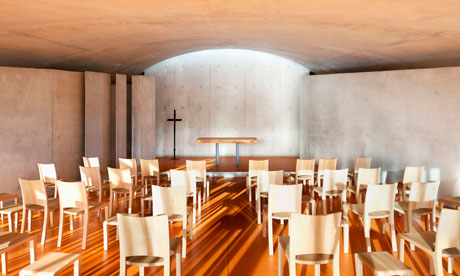
    Chapel at Convent by Renzo Piano Workshop, Ronchamp, France

    And therein lies the crux of the problem: When one has done away with symbols, theology, and the act of worship, there’s little else to inspire a credible work of sacred art or architecture.  Piano, like any committed Modernist, is left with little more than a preference for abstraction, technology  and  some vague nostrums about nature and  space.  For a Modernist, the point of architecture is to convey an image of maximum clarity, in which all elements are related by function and little else.  As long as a space is adequately sheltered and functions for the use of its occupants, there is no need for decorative flourish.  Piano is reduced to checking off boxes for the client’s wish list, from the number of rooms, to furnishings, and to achieving a quality of ‘silence’.  There’s nothing all that particular about an architecture of silence–maybe  a dark room secluded from more socially active spaces.  Given the right palette of materials and details, any space can be turned into something contemplative.  But can this generic approach to design evoke much meaning beyond mere emotional states such as peace?

    Sacred spaces achieve much of its effect by emphasizing mystery. This is at the core of any religion, in which divine truth is revealed beyond any logical or rational framework.  As is often said, God is revealed in mysterious ways, and the purpose of any sacred space is to embody this reality.  It is inherent that a secular space is completely  counter to this and thus adopts an architectural language devoid of mystery or even ambiguity.   Secular spaces instead embrace the language of the engineer, someone who works outside the world of art, poetry, and indeed of mystery, by solving problems with the most rational tools of math and science.  There is a lot of work that goes into making successful settings for secular activities, much of it having to do with the science of building, such as lighting, acoustics, and visibility.  There is also a tendency for generating phenomenological effect through technology, such as making walls highly transparent or reflective, surfaces either smooth or deliberately rough.  To the Modernist who puts its faith in technological progress, the more an effect can exceed what can be done by the human hand, the better.


    La Tourette Monastery by Le Corbusier, Eveux, France

    Such attention to a material’s effects point to Modernism’s essentially materialist philosophy on architecture. In sacred architecture, the building and the spaces within serve  to connect users to a deeper reality that transcends its walls. They function as a gateway from the material world to a spiritual realm–the focus is on the eternal, not the object that portends to represent it.  In a secular context like Modernism, the object is the thing itself, and all meaning is tied directly to that object.   Walking into a exemplary Modernist space, one is supposed to marvel at its lightness, smoothness and simplicity, attributes that are commonly summarized as ‘machine-like’.  If one desires a more ‘humanist’ look and feel, the designer can instill a quality of ‘roughness’ by texturizing concrete, oxidizing steel,  and inserting warmth by using  natural materials such as wood and stone.  Industrialization gives us that much more control to generate a precise effect, and empowers the designers unlimited opportunities in experimenting.  At the same time, it diminishes the role of the craftsman, who throughout most of human history was the guardian in generating material effects, and in  many ways assumed the role of architectural detailing.  Machines take the human factor out of the art of making, thus producing something devoid of passion, feeling that imbues every man-made object.

    Piano singles himself better than most of his contemporaries by his ability to reinsert the human touch in his design process. His architectural details are truly works of art and are usually the result of a distinct craftsman-like approach in generating them.  The name of his firm, The Renzo Piano Workshop, harkens back to the time when architecture was realized by stone masons, who would accumulate specialized design knowledge in the development of style details and templates.  Where Piano departs is the end result of his craftsman-like approach: highly refined, ultra-precise, machine-polished building systems and parts.  The structural connections in his projects are beautiful  and poetic pieces of engineering, much like Apple products, but like most industrial artifacts, they cannot express the ancient, primordial aspects of our humanity.  Is that necessary to fully immerse oneself the Catholic experience?

    I believe so.  A fundamental assumption in Catholicism is that history is linear and that God was incarnated in the human form of Jesus Christ at a precise point in history to the point that the period before and after this event are neatly divided (BC vs. AD).  Its doctrines and liturgy are part of an evolutionary process that have taken place in the world for two thousand years, and followers actively partake in this history by participating in the mass.  For most Catholics, weekly mass is the only time that they are reminded that they are tied to humanity in throughout the ages, both in the past and the future.  This goes against ‘modernity’, or the idea that the times are so new and different that prior truths or solutions are irrelevant.  In Christianity, Truth is eternal, and the problems that afflict humanity are no different during the time of Christ than they do now. There is no ‘new and improved’. Rather, the ideal was was established two-thousand years ago (the life of Christ) and no amount of social or technological advance (or regression) can change this. 


    View of Crypt inside the La Tourette Monastery by Le Corbusier

    In addition, Christianity relies on communicating its ideas through allegories conveyed verbally in the Bible, musically in its music and visually illustrated in its art and architecture.  These are designed to make the message accessible to all people, as opposed to keeping revelations close to a self-selected elite.  The message has to be clear, the context must be provided and the characters believable.  Visually, this requires the use of lines and recognizable figures placed in a narrative relationship. These demands don’t lend themselves well to abstraction, the modus operandi of the Modernist.   Abstraction is by nature open to individual interpretation; Christian revelation is not.  Abstraction is deliberately exercised by an individual, driven by their own desire to create original content; Christian subjects and themes are the content, with the artist sharing his visceral imaginings of truths he does not question (like most European art before the 19th Century).

    This probably explains why many Catholics feel a certain frustration with the role played by modern music, art and design in today’s church.  The music uses irregular folk beats, vulgar melodies and harmonies, and seem composed to bring attention to the songs themselves rather than acquainting singers to a more transcendent reality.  In contemporary Christian art, Christ is portrayed as a non-descript figure, and often times and rendered in an abstracted archaic style that is flat and lacks feeling.  The cross is abstracted to emphasize its iconic nature as a symbol, detached from any literal representation of what actually happened on the cross.  In most modern churches, seating is arranged as a theater in the round, focusing the parishioners’ attention to the the priest, or the choir, rather than to God as manifested in an elaborately decorated apse wall or a ceiling pointed to heaven. This was vividly brought to my attention when watching the broadcast of Christmas mass from the Vatican–most of the camera shots showed details of the sanctuary’s glorious interior and symbolic art, with the occasional view of the Pope.  Catholic worship is not about the mere men (priests) who help conduct its rituals but is instead is about how God is revealed in them by means of humanity’s most outward expression of what lies within its soul: Art. When there is nothing meaningful or moving to look at, one is resigned to paying attention to a charismatic individual standing on a stage, transcendent beauty is loss, and the Christian message takes on a banal delivery.


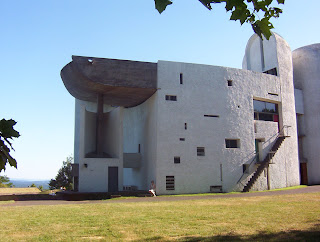
    Chapelle Notre Dame du Haut by Le Corbusier, Ronchamp, France

    Architects, a growing number of whom fall into agnosticism and atheism, often seem to forget this when visiting sacred yet Modern masterpieces.  Just because Le Corbusier’s Ronchamp chapel makes some of my colleagues cry doesn’t mean it fulfills its ecclesiastical responsibilities particularly well.  They are likely overwhelmed by the chapel’s poetic mastery of form and light and how it provokes a profound yet undefinable emotional response.  I succumbed to this response myself when I went to Ronchamp as well when I toured  Le Corbusier’s monastery of La Tourette.  I was taken aback by his buildings’ abstract forms, its play with light, its vivid use of color, its sophisticated relationship to its site.  In the end, I didn’t develop a more profound appreciation of Christian revelation, but a greater respect for mathematical proportion, abstract formal metaphors, primary colors and geometries–transcendent things nonetheless, but a bit too esoteric for most people.  La Tourette was clearly a more regulated composition compared to Ronchamp, which is probably why is probably why the latter provokes a more emotional response.  In  a sense, the chapel is Le Corbusier at his least ‘modern’ and more archaic, while his monastery is likely intended to feel more academicized due to that typology’s tradition of being repositories for knowledge. Ronchamp’s form sweeps up to heaven, its dark sanctuary enclosed in thick walls reminds one of a cave evocative of early Christianity, while its rounded towers mimick Mary in her veil, sheltering the church below. Though these moves aren’t literal, there is just enough reference to the symbols and ideas of Catholic church that make this more approachable to average followers.


    Church on the Water by Tadao Ando, Tomamu, Japan

    This isn’t to suggest that modern architecture can’t achieve successful spaces for spriritual contemplation. Tadao Ando’s Church by the Water is especially powerful, manipulating natural light and framing views that heightens the senses and fuses nature into the act of worship. The church is stripped of traditional Christian decoration, illustrations of bibical stories or saints, or any other reference to the history of the church. It works for those who wish to understand God through nature’s primal elements and how they change through the passage of time. There is a sense of ignoring the human presence altogether, as it invites one to blend into the natural surrounding (as my brother’s comment on zen indicates), which may work in more minimalist strains of Christianity and even Catholicism, but will leave many believers hungering for a place rich in narrative objects and a more fully enclosed communal response among people.   There is no altar to focus on, only a highly abstracted cross standing in a reflecting pond, which could have all sorts of meanings, but not one that concentrates the mind of the believer on Christ and his passion.

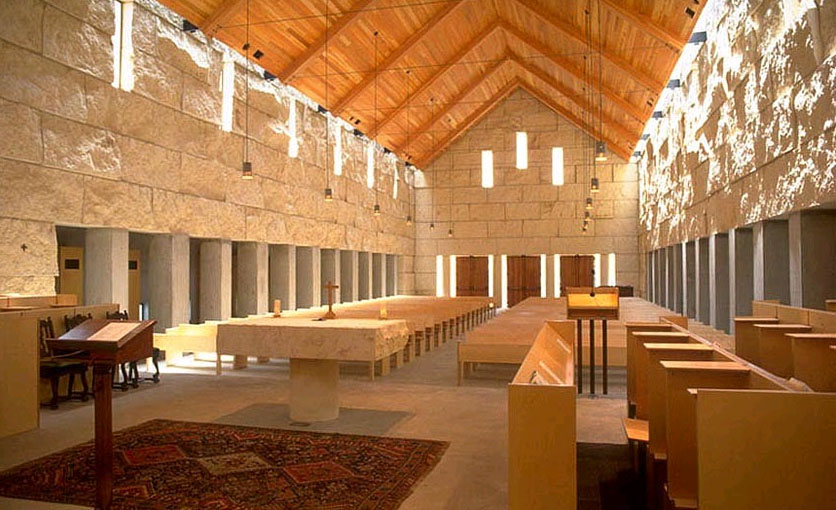
    A truly inspiring space that uses a modern architectural language for catholic worship is extremely difficult to find.  While many architects simply choose to employ a historicist style for even newest churches, it is possible to address the particular characteristics of a catholic church while maintaining a modernist sensibility.  I submit a Cistercian chapel located not far from where I live in Irving outside of Dallas designed by Gary Cunningham. Long an admired designer in the area, Cunningham’s work can be characterized as simple, straight-forward, and sensitive to materials. His award-winning residences follow a rather conventional contemporary style but he also is very accomplished in the art of adaptive reuse, in which he repurposes an existing building by carefully juxtaposing old and new elements.  This consciousness of how time plays a role in the way a building expresses itself is strongly manifested in the Cistercian chapel.  The space is enclosed in rough quaried limestone, cut in massive blocks and stacked in traditional running bond, which instantly strikes any visitor as reminiscent of the Catholic church’s earliest Romanesque sanctuaries with their thick walls and small windows. Its wood roof floating above the nave takes the shape of a traditional ceilings found in these churches, while also resembling the underside of a ship (which is where the word ‘nave’ comes from). Spans are short, further emphasizing the weight of the stone, even as they maintain familiar rhythm suggestive of the old ambulatory aisles with the repetitive row of vertical windows.  It follows more of a classic basilica typology than the popular theatre-in-the round, which indicates a desire to focus on the liturgy as opposed to the priest. But more than merely echoing the churches of the past, this chapel appears as a direct architectural metaphor for the creation of the church itself: “And I say also unto thee, That thou art Peter, and upon this rock I will build my church…(Matthew 16:18)”  While obviously an abstract design, Cunningham manages to endow the chapel with an important phrase from the Gospel and thus Christian revelation.  Sleek details and delicate connections between the roof and walls betray its contemporary origins, but the way it highlights the split-faced texture of the rock wed the chapel to the church’s long institutional history, and the countless number of people who dedicated their lives in building structures fitting to God’s glory.


    Cistercian Chapel by Gary Cunningham, Irving, Texas

    And that, to me, is what is necessary for a compelling Catholic worship space–a connection not only with the divine, but just as importantly with an institution comprised of people throughout the ages. Its walls should reveal human intent, either through a man-made texture or through an ornament that is the work of genuine human input. Machine-smooth de-personalizes this experience. As any human institution that is an essential part of catholic identity, it carries a rich artistic and architectural heritage that brings with it a kind of unassailable authority not found in Protestantism, which devalues the human institution in favor of interpreting directly from the Bible. The result of of relying on scripture, however justifiable from a theological standpoint, seems to lead towards a breaking down of a rich visual language and an embrace for abstraction. A small cultural vacuum subsequently takes root, which grows to consume what’s left of symbols, music, and eventually the walls. The ultimate result is either a television studio black-box with no windows preferred by evangelicals or a zen-like meditation space with no walls and a subtle symbolic indication that it’s even Christian (such as Ando’s church).

    I’m sure that Piano’s and Le Corbusier’s clerical clients were pleased with the result, and fans of high-design with no opinion on proper Catholic aesthetics are moved by their examples, too. But I wonder if these exercises in abstraction, lightness, and trying to stay relevant in fast-changing contemporary culture win much in the way of converts. People who seek the church want their souls nourished by the church’s message in as many forms as possible. When many of these forms are abstracted or simplified to an incomprehensible level, it leaves such people feeling unfulfilled, and causes many of them to leave the church for a place that offer a richer, more visually arresting environment of the older historic sanctuaries.  At least these modern ecclesiastical masterpieces continue to open their arms to the perennial pilgrimage of people most interested in them: architecture students.

    Julien Meyrat is an architect living in the Dallas area.

    Lead photo La Tourette Monastery by Le Corbusier in Eveux, France.

  • Michigan’s State Legislature Needs to Cut Detroit Down to Size

    What’s often forgotten in politics and governance is municipalities are the creation of state legislatures.  A good deal of the population growth in major cities in the second half of the nineteenth century was due to annexation. One of the best examples is New York‘s amazing growth due to annexing Brooklyn. Few people are talking about it but it’s time to consider smaller political units. As Detroit struggles with failure of bankruptcy, the geographical size of the Motor city is becoming a major issue.

    Detroit’s long decline eventually put it a federal bankruptcy court. The reasons are numerous but the reality is here.  How Detroit exists from bankruptcy court is now an issue. Putting Detroit on a sound economic footing is essential to preventing another bankruptcy. The Detroit Free Press reports:

    The investment banker representing the City of Detroit had talks with billionaire real estate investor Sam Zell and investment firm the Blackstone Group about selling them the city’s vacant property — but the investors weren’t interested, the Free Press has learned.

    The revelation comes as the value of Detroit’s abandoned and blighted property — which the city considers assets in its Chapter 9 bankruptcy — is in dispute.

    Creditors argue that city-owned property is a source of significant value that is being ignored in the city’s bankruptcy restructuring blueprint, called a “plan of adjustment.” The creditors argue the approximately 22 square miles of vacant or blighted property the city owns could be sold — with the proceeds distributed to creditors and even reinvested in the city.

    But Ken Buckfire, president of the city’s investment banking adviser Miller Buckfire, testified that city-owned land “to some extent has negative value,” according to a deposition transcript obtained by the Free Press.

    One way to interpret the comment about “negative value” is where the land is located. If Michigan’s state legislature re-drew Detroit‘s geographical boundaries, investors would be more interested in the land. A new municipality, without Detroit’s corrupt and expensive politics would be a major reform. Detroit as it exists today isn’t viable for job growth and a stable population. Detroit’s local politicians and special interest groups would obviously fight any changes in geographical boundaries in Michigan’s state legislature because a declining Detroit was a way to plunder taxpayers. But Michigan taxpayers need to start asking themselves: is Detroit’s 143 square miles a viable long term enterprise?

  • Agrarianism Without Agriculture?

    The ever-surprising Ralph Nader has recently been reading some paleo-conservative sources, and has written a book entitled Unstoppable; the Emerging Left-Right Alliance to Dismantle the Corporate State. In the Acknowledgements at the end, he specifically thanks Intercollegiate Studies Institute, a conservative think tank, for keeping in print a tome from the 1930s called Who Owns America? A New Declaration of Independence. Nader devotes the seventh chapter of his book to a discussion of this volume. He quotes Edward Shapiro’s 1999 foreword at some length:

    In his 1999 foreword to the reissued edition, historian Edward S. Shapiro called Who Owns America? “one of the most significant conservative books published in the United States during the 1930s” for its “message of demographic, political, and economic decentralization and the widespread ownership of property” in opposition “to the growth of corporate farming, the decay of the small town, and the expansion of centralized political and economic authority.” ……

    In this mix, there was espoused a political economy for grass-roots America that neither Wall Street nor the socialists nor the New Dealers would find acceptable. It came largely out of the agrarian South, casting a baleful eye on both Wall Street and Washington, D. C. To these decentralists, the concentrated power of bigness would produce its plutocratic injustices whether regulated through the centralization of political authority in Washington or left to its own monopolistic and cyclical failures. They were quite aware of both the corporate state fast maturing in both Italy and Nazi Germany and the Marxists in the Soviet Union ……

    Nor did they believe that a federal government with sufficient political authority to modestly tame the plutocracy and what they called “monopoly capitalism” could work, because its struggle would end either in surrender or with the replacing of one set of autocrats with another. As Shapiro wrote in the foreward, “while the plutocrats wanted to shift control over property to themselves, the Marxists wanted to shift this control to government bureaucrats. Liberty would be sacrificed in either case. Only the restoration of the widespread ownership of property, Tate said, could ‘create a decent society in terms of American history.’”

    Although the decentralists were dismissed by their critics as impractical ….. their views have a remarkable contemporary resonance given today’s globalized gigantism, absentee control, and intricate corporate statism, which are undermining both economies and workers. They started with the effects of concentrated corporate power and its decades-long dispossession of farmers and small business. They rejected abstract theories by focusing instead on such intensifying trends as the separation of ownership from control; the real economy of production in contrast to the manipulative paper economy of finance; and the growth of “wage slavery,” farm tenancy, and corporate farming. One can only imagine what they would say today! (Nader, pp. 139-141.)

    I apologize for the long quote. These people advocated doing away with the “joint stock corporation” for the most part, to be replaced by cooperatives. I’m not sure about the liability of members of these cooperatives, but that’s a major issue. Without limited liability, I would hesitate to co-invest in any project unless all the partners were as liquid and wealthy as myself, otherwise guess who ends up holding the bag! And it is to be noted that many insurance companies, and some savings and loans, including, until the 1980s, all federally chartered ones, were in fact “mutual” and owned by their depositors or policy holders.

    They did not succeed as far as agricultural land was concerned. The concentration of agricultural land under fewer and fewer owners, and even more the oligopolies of processing food through such entities as Cargill, Tyson, and Archer Daniels Midland, proceeded apace. But “widely distributed property ownership” resurfaced on another front; the urban-suburban one. The New Deal first chartered the Federal Housing Administration to underwrite and guarantee loans for homes, and in Truman’s time the Veterans Administration and other reforms brought this regime into full flower. So instead of their forty acres and a mule, people got their ¼ acre and an automobile, the only practical way to travel from their ¼ acre to wherever they wanted to go.

    Eventually people came to see their ¼ acre with a house on it as an “investment,” and further, a “source of wealth.” But this was not a truly agrarian source of wealth. Farms depend for their value on the quality of their soil and their productivity as farms. They are truly commercial real estate. But residences depend for their value only to a minor degree on what is on the property itself, but rather on what is around it; and suburbanites demanded that covenants, or the Government in the form of City Hall or County Hall, control their neighbors and what is around them. Part of the reason for living in the suburbs, after all, is the presence of trees and green space. (The suburbanites have therefore been friendly to the environmental cause, as long as it did not touch their automobiles.) There was also the factor that just as printing money dilutes its value, “printing” a large number of houses in an area dilutes their value as well. And, the more development, the more traffic comes to resemble that of the centralized portion of the city and one’s automobile gets stuck in it. Fact: the borough of Irvine, where my office is, imposes a “cap and trade” system on those who would desire to build or repair commercial structures, and what one buys in this marketplace is not carbon or pollution, but potential car trips that one’s project might be potentially using. The suburban model, in the end, demanded that to preserve suburban values, that the building of suburbs be stopped! That’s the irony of the whole thing.

    Howard Ahmanson of Fieldstead and Company, a private management firm, has been interested in these issues for many years.