Author: admin

  • An Awakening: The Beginning of the Great Deconstruction

    The federal debt climbed above $13 trillion this month. An easier way to define the national debt is to comprehend that we each owe more than $39,000 to the Chinese, Japanese, and Arabs of the Persian Gulf. The budget deficit will exceed $1.5 trillion this year and forty-seven states are running deficits. California has a $19 billion deficit and its legislature’s landmark response was to pass a law banning plastic bags. Our cities are in worse shape. The former mayor of Los Angeles, Richard Riordan, says that a bankruptcy by that city is inevitable. At the same time, the United States’ Congress voted themselves a 5.8% pay increase. It is no wonder why Americans are nervous.

    Americans are stressed out because of debt, according to an Associated Press-GfK poll. They are trimming their debt at the fastest rate in more than six decades, according to the Federal Reserve. The average amount owed on credit cards is $3,900, the poll said. That’s down from $5,600 last fall and $4,900 last spring. Household debt fell 1.7 percent last year to $13.5 trillion, according to the Fed. It was the first annual drop, based on records going back to 1945. As Americans get their own house in order, the approval rating for Congress has fallen to an all time low. The public will likely make them pay for their angst in November.

    The American people are about a year ahead of the politicians. The spending by Washington, Sacramento, Los Angeles, and by politicians in general, is unsustainable. The people understand that it must be changed. As Senator Tom Coburn (OK) told me last week, either we change our ways or they will be changed for us. Leaders like Senator Coburn will begin The Great Deconstruction. The nation can no longer afford the government it has created.
    The Department of Energy was created by President Carter in 1977 after an OPEC embargo caused gas lines and rationing. In 1977, America imported 33% of its oil. The DoE’s goal was to eliminate our dependence on imported oil. The DoE budget for 2010 was $26.4 billion. It employs 116,000 workers. We now import 66% of our oil. America can no longer afford such an inefficient bureaucracy. Bureaucracies like the DoE that have lost sight of their purpose must be deconstructed.

    Senator Coburn is preparing legislation to rescind $120 billion in 2010 spending by rescinding 2010 budget increases, consolidating 640 duplicative governmental agencies, returning unspent appropriations and cutting wasteful spending. A few examples:

    • Congress has a discretionary budget of $4.7 billion per year. They voted themselves a 6% increase in 2010. Coburn wants this increase rescinded for a saving of $250 million.
    • The Department of Education spends $64.2 billion per year. They spend $1 billion each year administering 207 separate programs at 13 different federal agencies to “encourage” students to take math and science.
    • The Department of Agriculture owns 57,523 buildings. More than 4,700, valued at $900 million, are vacant. Despite this vacant space they spend $193 million per year renting an additional 11 million square feet.

Our politicians have perfected the art of spending money, or as we now know, wasting money. Last year, they loaded spending bills with $11 billion of earmarks – after spending $860 billion on a Stimulus Bill. A new breed of politician, like Senator Coburn, will begin the long process of deconstruction.

There is precedent for deconstruction. In 1945, federal spending ballooned to $106 billion, $93 billion of which was for defense. The deficit jumped from $40 billion in 1938 to $253 billion in 1945. A Democrat President and a Republican Congress established the Commission on Organization of the Executive Branch of the Government in 1947. President Truman put a former Republican President, Herbert Hoover, in charge. It became known as the Hoover Commission. It created the structure of government that exists today and generated savings of $7 billion at the time. A total of 273 recommendations were presented to Congress in a series of nineteen separate reports. A 1955 study concluded that 116 of the 273 recommendations were fully implemented and that another 80 were mostly or partly implemented. By 1949, the federal budget had fallen to $40 billion.

It will come to be known as The Great Deconstruction because it must occur at every level of government. Federal spending is unsustainable. Moody’s is already speculating that we may lose our AAA rating. The states are in crisis with 46 in deficit. The press is referring the California as a “failed state” and “our Greece”. The $860 billion Stimulus Bill sent approximately 30% to the states to support their public employees. But it was a one-year fix. This year, the states are burning through their reserves and next year, they will be forced to cut services, raise taxes, or both. Connecticut, the wealthiest state on a per capita basis with personal income of $54,397 in 2009 (Department of Commerce) saw its Fitch rating lowered from AA+ to AA. Connecticut needs to borrow $956 million to close a budget gap this fiscal year and it borrowed $947.6 millionto cover last year’s deficit.

The cities are no better off with many states raiding their reserves. Many cities are exploring municipal bankruptcy, Chapter 9, as a way out of unsustainable contracts. The Great Deconstruction will take a decade or more. Like the Hoover Commission before it, this process will transform the role of government, and the image of government as it transforms the cost of the people’s business.

***************************************************

The Great Deconstruction is a series written exclusively for New Geography. Future articles will address the impact of The Great Deconstruction at the national, state, county and local levels.

Robert J. Cristiano PhD is the Real Estate Professional in Residence at Chapman University in Orange County, CA and Director of Special Projects at the Hoag Center for Real Estate & Finance. He has been a successful real estate developer in Newport Beach California for twenty-nine years.


Other works in The Great Deconstruction series for New Geography

The Great Deconstruction :An American History Post 2010 – June 1, 2010
The Great Deconstruction – First in a New Series – April 11, 2010
Deconstruction: The Fate of America? – March 2010
  • It is Time to Plant

    It is springtime in Kentucky – think foals and mares in the pristine meticulously fenced pastures. But, in another part of the state – the Appalachia region of eastern Kentucky – it is time to plant on those rocky hillsides. As my 90 year old father puts it, you plant your corn when tree buds are the size of squirrel ears. I confess to not having given a thought to whether squirrels even have ears or not … but my father knows. He was born and raised in a part of the world where they know things like that, typical of the mostly Scots-Irish who settled there. He knows the land like the back of his hand, he is self-reliant and stubborn to a fault and he knows what it is like to be poor and bereft of opportunity.

    Appalachia Eastern Kentucky – take just one geographic area out of a huge region spread over several states – is negatively depicted in popular imagery and academic literature as a drag on the Kentucky economy. The whole region is enigmatic like the underachieving child in a family of superstars. Until now, that is. With the financial collapse having brought America to her knees, it is a bit like the screaming headline about Toyota’s debacle: “the A student flunked the class.” Perhaps that underachieving C student finally has her chance to shine. After all, who would have given Ford a chance a few years ago?

    But Appalachian eastern Kentucky is after all a land where every manner of program has been tried, books written, studies undertaken, and mournful music sung. It is where the failed War on Poverty was launched in the 1960s. The reason for a “new day dawning” is that there is a stir across the land that signaling an epochol shift in the evolution of the American Dream. Call it by wonky titles like “new localism” or call it “choosing who I want to be and where I want to do it.” But whatever it is, it is impacting on our lives dramatically and will do more so in the future.

    The prestigious Economist Magazine (May 15, 2010) recently reflected that in the future people will have unprecedented choices of living in big vibrant cities or in smaller more nurturing rural settings. And, the stories abound. Take Patty who left the factories of the north to return to her native land. Always known for her shrewd business acumen, she took over and renovated “The Old Schoolhouse” antique gallery located near Cave Run Lake. She scours the region for her “goods” and is visited daily by weary travelers seeking the authenticity of a culture too long locked in the shadow of conventional definitions of success. Likewise, despite the long held belief that they are leaving, young people are finding ways to stay in the region, such as the young man in a recent audience who has taken advantage of “tele-learning” and plying his trade as a graphic artist for a west coast software company.

    There appears to be a convergence of forces at work that could prove transformational for regions like Appalachia. Brought on by the Great Recession, people have to make choices about their priorities and perhaps even to downsize lifestyle appetites. But that’s not all. These forces will impact all places but particularly rural places like Kentucky, places of great beauty and tranquility and appeal waiting for the right moment that may finally be here.

    These converging forces are driven in large part by technology and the realization of its earlier promise that we truly can live and work anywhere. It is about participating in the preservation of a precious culture locked for too long in the closet of neglect and stigmatized with the label of backwardness. It is about an ability to do more than scrape out a meager living in the rocky hillsides. Evidence can be seen in a migration pattern that is, for the first time in decades, giving Kentucky and surrounding states a positive net migration from the rest of the country. We are seeing youthful retirees coming home in some instances and young families putting down roots in places that feel right for their chosen way of life. And there is a growing business culture that knows about the world but sees no paradox in growing itself in Appalachian soil – and using the culture to its advantage.

    Just take note of Kentucky “ham” country if you want to partake of successful business stories. Recently profiled in the New York Times Magazine (May 23, 2010), Kentucky’s home grown hams are making their way onto the world stage. The author marveled at the ham store owner’s chatter about attending a ham conference in Spain and the desire of buyers to travel to a small town to buy nitrate free bacon. Imagining Kentucky hams being worth a wait in noisy New York City restaurants defies explanation except to acknowledge that the song is right that “somethin’s happenin’ here.”

    What must the Appalachian region of eastern Kentucky and the rest of Appalachia do to take advantage of this new opportunity? It must reinvent itself as with many other aspects of the American Dream under the new rules of the 21st century. Reinvention will require answering the question “what is success”? With extreme partisanship and 30,000 foot politics at other levels of government, it is no longer viable to look in the direction of the “higher ups.” We must look to ourselves. Only we can provide the basis for community building and ensure the investments we need to make in health and education.

    Ah, springtime. Nature has taught us well; re-invention is to see the possible and to seize the moment. The moment is now.

    Sylvia Lovely is an author, commentator and speaker on issues relating to communities and how we must adapt to the new landscape that is the 21st century.

    Photo by J. Stephen Conn.

  • Can Europe’s Economy Turn Around If Its Great Cities Continue To Wither?

    Europe’s Greece crisis has turned the world’s attention to the continent’s fundamental flaw: burgeoning public spending and sluggish growth in some of its national economies.

    To the extent that Europe’s more economically fragile countries cannot fix this flaw, Europe poses a global financial risk as toppling EU countries cannot meet their obligations and those left standing cannot prop them up. Only fiscal discipline and boosting growth can save Europe in the long-run.

    And for this reason, we ought to worry about Europe’s cities. Why? Because as large cities increasingly drive national economies in our rapidly urbanizing global community, Europe’s urban growth patterns look alarmingly tepid.

    Around the world, people are clustering together faster than ever at a time when it seems technology should allow them to disperse more easily than ever. As it turns out, innovation and a growing services sector flourish best when lots of people and firms are geographically proximate. Ideas, knowledge and valuable skills are transferred more easily in denser areas.

    There is a direct relationship between economic competitiveness in the 21st century and the growth of metropolitan areas. But Europe’s cities show signs of trouble. They have almost entirely lost the momentum that has driven European pre-eminence for the past 200 years.

    In 1800, only 3% of the world’s population lived in urban areas, and the only Western cities among the world’s 10 largest urban areas were London and Paris. Neither had a population greater than 1 million. Just 100 years later, though, nine of the world’s 10 largest cities were in the West — with four of the top six located in Europe, propelled by their economic predominance through industrialization.

    Other countries followed the model. By the mid-20th century, 30% of the world’s population lived in urban areas, a considerable increase since 1800. But that was only the beginning of an explosive era in urbanization. Between 1960 and 2000, the number of people living in cities worldwide skyrocketed to 3 billion from 750 million.

    Currently, the world’s largest 100 cities generate 25% of global GDP, a figure that will continue to rise over the next few decades — and which will increasingly exclude Europe’s cities.

    Asia and Africa, often regarded poetically as agrarian societies, are leading the global urbanization boom. Today, London is the only European city among the world’s largest 20 metropolitan areas. Paris is 22nd. Among the top 25 cities, they are two of the three slowest-growing areas.

    Late-20th century growth has been driven almost entirely by suburban expansion around core cities. Nevertheless, central cities worldwide have added population on average over the past half century — except in Europe. It is the only continent where core cities have lost population over the past 45 years. While its suburban growth has kept its metropolitan areas growing overall, its net urbanization rate since 1965 is the slowest worldwide.

    Because developed countries are already highly urbanized, their metropolitan areas grow more slowly than those in emerging economies. But Europe’s rate is unusually slow compared to its peer group of developed nations.

    Europe’s main metropolitan areas grew just 28% since 1965, a period during which the United States essentially doubled its urban population. Australia and New Zealand have seen urbanization rates of 90% during the same period. Worldwide, the growth average in urban areas has been 135% since 1965.

    Europe is the only continent with cities growing at less than 1% annually. In Eastern Europe, the growth rate is actually negative. Some cities, such as Munich and Warsaw, have grown at respectable rates and mitigate Europe’s well-known population decline problems. For instance, each city grew between 2000 and 2010, while Germany and Poland each contracted as a whole.

    However, urban growth rates in Europe will likely stay low in coming years, which raises questions about whether Europe’s economy will continue to grow enough to help the continent out of its present troubles.

    European leaders’ disconnect with this important reality was on display several weeks ago when the European Commission chose to announce major carbon emissions in 500 cities at the same time its finance ministers were structuring the massive Greece bailout.

    However important greening urban areas may be, if Europe should be doing anything with its cities these days, it should be figuring out how to put them at the forefront of its economic recovery. The European habit of implementing growth-inhibiting policies — especially in its cities — has to change if the continent hopes to have a prosperous future.

    Given the increasingly metropolitan nature of economic growth around the globe, the health and vitality of Europe’s cities will be key to the continent’s future prosperity. Policymakers need now more than ever to ask serious questions about the origins of future growth. To answer those questions, they need to pay serious attention to their cities.

    This article first appeared at Investors Business Daily.

    Ryan Streeter is a senior fellow at the London-based Legatum Institute, an independent, nonpartisan organization that researches and advocates an expansive understanding of global prosperity.

  • Kevin

  • http://wm-themes.com

  • An American History Post 2010: The Great Deconstruction

    There is a great battle brewing – the proverbial paradox of the immovable object versus an irresistible force. The battle lines are drawn. On one side is the Greatest Generation, Americans over 60, middle class and mostly white. Mainstream media calls them The Tea Party and worse.

    On the other side is President Barack Obama and a younger generation of progressive Democrats who see the need for an ever more expansive government. The battlefield is spending and debt. The Greatest Generation, following World War II, bought homes with a 30-year mortgage and 20% down, and paid off those mortgages accumulating trillions in equity along the way. The Credit Card Generation – epitomized by both George W. Bush and his Democratic successor – nurtured the zero down, no doc, adjustable rate mortgage that allowed millions of homebuyers, who could not afford to purchase a home, to buy one. The bursting of the housing bubble cost trillions in lost equity and resulted in 2.8 million foreclosures in 2009.The figures tell the story.

    Spending

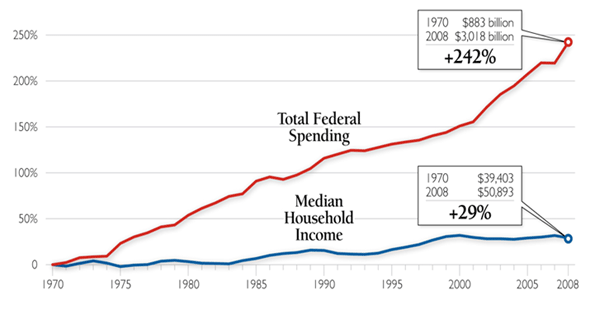
    According to the Office of Management & Budget (OMB), Federal spending has grown more than eight times faster than Household Median Income. Since 1970, middle-income Americans’ earnings have risen 29 percent, but federal spending has increased 242 percent (Percentage Change of Inflation-Adjusted Dollars, 2009). The Greatest Generation believes that spending by Washington politicians has grown out of control. They understand it is not a Republican or Democrat issue. They opposed the $800 billion TARP Bailout under Bush as much as Obama’s $800 Stimulus Bill. They opposed the trillion dollar Healthcare Bill recently enacted into law despite a clear majority opposed to its passage. They recognize that Social Security and Healthcare comprise huge unfunded obligations that will be passed on to their grandchildren.


    Source: Heritage Foundation

    Debt

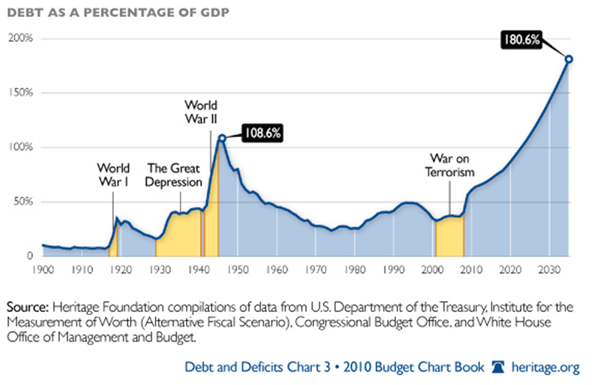
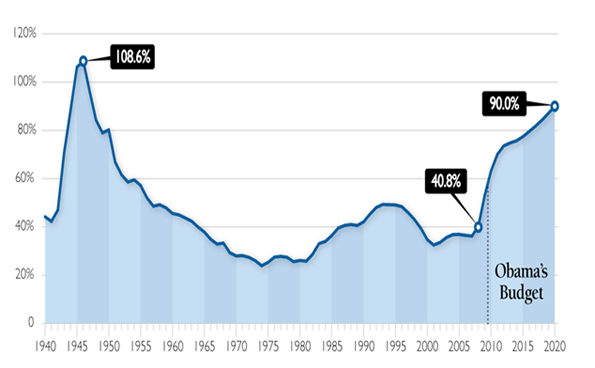
    Since World War II, publicly held debt as a percentage of the economy (GDP) has remained below 50%. In 2008 when President Obama took office, it was 40.8 percent, nearly five points below the post-war average. According to the OMB, Obama’s budget would more than double this figure to 90 percent of Gross Domestic Product by 2020, levels not seen since World War II. (Greece’s debt level of 150% precipitated their meltdown). By 2020, Americans will spend more on interest payments on the Federal debt than on military spending. The Greatest Generation believes these debt levels to be unsustainable.


    Source: Heritage Foundation

    An Unsustainable Path

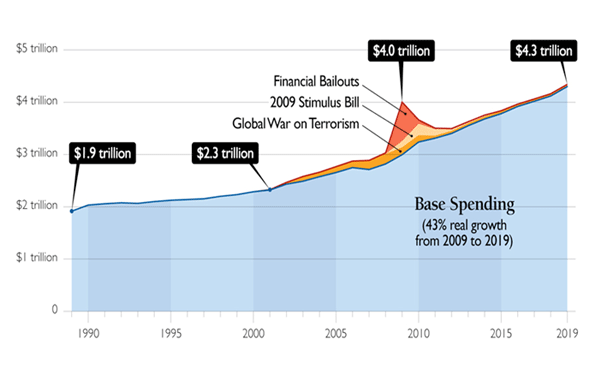
    In 1990, the federal budget was less than $2 trillion. Ten years later the federal budget was just $2.3 trillion. By 2010 the budget exploded to $4 trillion. The Obama budget projects a 43% growth to $4.3 trillion by 2019 according to the OMB. This massive increase over the $2.9 trillion budget Obama inherited in 2008 is not due to emergency spending alone but an intentional structural growth in government. Federal revenues have not kept pace with spending. The U.S. government was forced to borrow $1.5 trillion to pay its bills last year. The national debt is projected to increase from $13 trillion to $20 trillion by 2020 (Inflation-Adjusted Dollars, 2009). The path is unsustainable.


    Source: Heritage Foundation

    While the classic paradox of the immoveable object versus the irresistible force can never be solved, this battle will be settled at the ballot box in 2010 and 2012 when Americans determine the path their country will follow in the 21st Century. If the Greatest Generation prevails, many incumbent politicians will find themselves out of a job as collateral damage. A new wave of politicians will begin The Great Deconstruction.

    New Jersey Governor Chris Christie may be the prototype of this new generation of politicians. He was elected to deconstruct the dysfunctional government of New Jersey, an economy that resembles Greece. Christie inherited the nation’s worst state deficit — $10.7 billion out of a $29.3 billion budget. Christie is doing something unusual, honoring his campaign promises and acting like his last election is behind him. Christie epitomizes the politician the Greatest Generation craves, one willing to lose his job.

    Christie has already declared a state of emergency, signed an executive order freezing spending, and cut $13 billion in spending – in just two months. His first budget included 1,300 layoffs, cut spending by 9%, and privatized government services. The deconstruction of New Jersey has begun. New Jersey may be an unlikely place for The Great Deconstruction to begin, but it is a harbinger of things to come.

    The Great Deconstruction is a series written exclusively for New Geography. Future articles will address the impact of The Great Deconstruction at the national, state, county and local levels.

    Robert J. Cristiano PhD is the Real Estate Professional in Residence at Chapman University in Orange County, CA and Director of Special Projects at the Hoag Center for Real Estate & Finance. He has been a successful real estate developer in Newport Beach California for twenty-nine years.

    Other works in The Great Deconstruction series for New Geography
    The Great Deconstruction – First in a New Series – April 11, 2010
    Deconstruction: The Fate of America? – March 2010
  • Rail Transit Expansion Reconsidered

    More than two years ago we suggested in these pages that the era of multi-billion dollar system-building investments in urban rail transit is coming to an end. We wrote: “The 30-year effort to retrofit American cities with rail infrastructure, begun back in the Nixon Administration, appears to be just about over. The New Starts program is running out of cities that can afford or justify cost-effective rail transit investment. To be sure, federal capital assistance to transit will continue, but its function will shift to incrementally expanding existing rail networks and commuter rail services rather than embarking on construction of brand new rail systems.” (“Urban Rail Transit and Freight Railroads: A Study in Contrast,” February 18 2008).

    Now comes a startling new revelation from a senior U.S. DOT official that even rail extensions may be at risk. Speaking at a National Summit on the Future of Transit before an audience of leading transit General Managers on May 18, Federal Transit Administrator Peter Rogoff questioned the wisdom of expanding rail networks when money is badly needed to maintain and modernize existing facilities:

    “At times like these, it’s more important than ever to have the courage to ask a hard question: if you can’t afford to operate the system you have, why does it make sense for us to partner in your expansion? If you can’t afford your current footprint, does expanding that underfunded footprint really advance the President’s goal for cutting oil use and greenhouse gases… Or are we at risk of just helping communities dig a deeper hole for our children and our grandchildren?”

    In Rogoff’s judgment, the first priority for the transit industry is to follow the precept “fix it first.” “Put down the glossy brochures, roll up our sleeves, and target our resources on repairing the system we have,” he told the assembled transit officials. Transit systems that don’t maintain their assets in a state of good repair risk losing riders, he warned. The Administrator cited the preliminary results of an FTA study of the financial needs of 690 public transit systems across America that show a $78 billion backlog of deferred maintenance. Fully 29 percent of all transit assets are “in poor or marginal condition.” The challenge facing transit managers is to resist the siren call of new construction and devote money to the “unglamorous but absolutely vital work of repairing and improving our current systems.”

    At first blush Rogoff’s position would appear to go counter to the Administration’s announced policy of favoring public transit. Hasn’t Transportation Secretary Ray LaHood repeatedly championed public transit as an alternative to highway expansion? Hasn’t the Administration’s proposed Fiscal Year 2011 budget include major commitments to funding new rail lines in Denver, Honolulu, Minneapolis and San Francisco? Hasn’t the Federal Transit Administration dropped the former emphasis on cost-effectiveness as an evaluation factor in rail project selection in favor of a broader range of factors? All true.

    But fiscal realities can do wonders to bring federal officials down to earth. The Transit Account of the Highway Trust Fund is barely solvent. The U.S. DOT budget will grow by only one percent in 2011. With commendable consistency and fairness, the Administration seems to have decided to apply the same investment standard to transit as it has preached and laid down for highways: Forget about massive capacity expansion; focus on getting the most out of the assets already in place by maintaining them in a state of good repair. To critics of the DOT’s new posture – and there will be some – a good answer could be: It’s just a different way of looking at what it means to be pro-transit.

  • Livable Communities and the DOT

    “Fostering livable communities…is a transformative policy shift for U.S. DOT,” announced grandiloquently the Draft U.S. DOT Strategic Plan released for public comment on April 15, 2010. But what exactly does the Administration mean by “livability” and how does it intend to translate this vague rhetorical abstraction into a practical reality?

    To get an understanding of the Administration’s intentions one must delve into the stilted language and bureaucratic jargon of its policy pronouncements, notably the “HUD-DOT-EPA Interagency Partnership for Sustainable Communities” and the above-mentioned Draft Strategic Plan. “Livable Communities,” says the latter, are “places where transportation, housing and commercial development investments have been coordinated so that people have access to adequate, affordable and environmentally sustainable travel options.” The Interagency Partnership Agreement speaks in similar vague generalities. It defines livability principles as including “more transportation choices,” “equitable, affordable housing” and “reliable access to employment centers, educational opportunities and services.” Give credit to Transportation Secretary Ray LaHood to reduce these abstract concepts to plain language. “Livability,” he said, “ means being able to take your kids to school, go to work, see a doctor, drop by the grocery or post office, go out to dinner and a movie, and play with your kids in a park, all without having to get in your car.” In other words, “livability” in the Secretary’s mind means living in a dense urban environment where walking, biking and transit are realistic alternatives to using the car.

    But this definition is too narrow for most Americans whose notion of “livability” may include living in suburban communities and enjoy such obvious amenities as a safe neighborhood, access to good schools, the privacy of one’s own backyard and the freedom, comfort, convenience and flexibility of personal transportation. If “livability” becomes a euphemism for a federal policy of favoring high density, transit-dependent living, then we are moving closely to “newspeak” when words mean whatever Big Brother intends them to mean.

    How does the Administration intend to promote its vision of “livable communities?” Again, we must turn to the dense prose of its official policy statements. “To achieve our Livable Communities agenda,” states the Draft DOT Strategic Plan, “DOT will (1) Establish an office…to promote coordination and sustainability in Federal infrastructure policy; (2) Give communities the tools and technical assistance they need so that they can develop the capacity to assess their transportation systems…; (3) Work through the Partnership for Sustainable Communities to develop broad, universal performance measures that can be used to track livability across the Nation…; and (4) Advocate for more robust state and local planning efforts and create incentives for investments that demonstrate the greatest enhancement of community livability…”

    Note that all the intended actions are process-oriented. Nowhere in the Strategic Plan can one find any indication of programmatic objectives or implementation strategies. And no wonder. The power to shape local communities (and thus enhance their livability) resides not in the hands of federal agencies but those of local citizens and their elected officials. To assume that the federal government, despite the growing concentration of power in Washington, could coerce or persuade people across this vast land to abandon their preference for suburban amenities and the convenience of personal transportation for the “livability” norms preferred by federal officials is a notion that even the most dedicated progressives of our acquaintance find unpalatable and politically unrealistic.

    A portent of the political winds affecting the future of the Administration’s “livability” initiative may be gleaned from the recent Senate appropriations committee hearing on the U.S. DOT’s Fiscal Year 2011 budget. The Administration’s request for $527 million to support the Livable Communities Program – of which $200 million is proposed to be funded from the Highway Account of the Highway Trust Fund– met with skepticism from committee members of both parties. Committee Chairman Patty Murray (D-WA) said in her opening statement that she has “serious concerns” with the $200 million coming out of the highway program. Her Republican counterpart, Sen. Kit Bond (R-MO) challenged Secretary LaHood on the Administration’s ability or propriety to influence local development patterns. “I am not confident that trusting federal decision-makers in Washington to lead the process, to tell the communities how they should grow, is the right way to go,” Bond said. He observed that livability means different things to different communities: some communities may benefit from improved transit service, while others would benefit from improved roads and increased highway capacity.

    More criticism came from the House side. Said Rep. Adrian Smith (R-NE) ranking member of the House Subcommittee on Technology and Innovation at a hearing to examine the Administration’s R&D program: “At a minimum “livability” represents a concept difficult to define and measure progress toward. More troubling, however, key aspects of the livability agenda appear to involve significant Federal government intrusion into the manner in which Americans travel and live in general.” Rep. Tom Latham (R-IO), ranking Republican on the House Transportation Appropriations Subcommittee, expressed concern over the Transportation Department’s proposal to “skim off highway dollars…and take those dollars from cities and states to fund a boutique program.”

    The transportation community has been equally critical. The American Association of State Highway and Transportation Officials (AASHTO) has gently pointed out in its new report, The Road to Livability that “While some would suggest ‘livability’ means a life without cars, this definition really doesn’t work for the millions of Americans who have chosen the lifestyles that an automobile affords. … Equating ‘livability’ only to riding transit, walking and biking, limits its relevance and excludes a wide range of improvements and community needs.”

    Blunter criticism came from the blogosphere. “At a time of unprecedented global competition, the United States DOT is overwhelmingly focused on the neighborhood level,” wrote one respected transportation professional in commenting on the Draft Strategic Plan. “This vague term [“livability”] has become the new code word for ‘smart growth’ and diverting highway funds to transit,” wrote another. “Local elected officials are best equipped to decide how best to enhance their communities’ livability. A federally-imposed standard of livability, colored by some officials’ bias against the automobile would not do justice to the diversity of our suburban nation,” wrote yet another blogger. “An astounding claim accompanied by zero evidence,” wrote Robert Poole in commenting on the Strategic Plan’s claim that a “livability” strategy that promotes reduced demand for auto travel will lower the long-run costs of transportation for the taxpayers.

    At a May 11 Brookings symposium on the “State of Metropolitan America,” Brookings researchers noted the wide and growing disparities in demographic, cultural, transportation and educational attainment characteristics of America’s metropolitan areas, disparities that defy one-size-fits-all solutions. Increasingly, policy responses will have to be tailored to the needs of individual urban areas, the researchers concluded. The Brookings report reinforced the conclusions of many other urban observers, including some on this site. The Administration’s desire to impose its own vision of how Americans should live and travel represents an anachronistic and in the end a futile gesture. The gesture is futile for, as generations of political appointees before them have discovered, policies that do not resonate with the majority of Americans seldom survive after their authors have left office.

    Flckr Photo of the US Department of Transportation after dark from
    takomabibelot: http://www.flickr.com/photos/takomabibelot/3916809758/in/set-72157622361478452/

    Ken Orski has worked professionally in the field of transportation for over 30 years.

  • Hello everyone