Author: admin

  • The State of Illinois’ Long Term Decline

    Barack Obama’s home state is in the news but not for positive reasons. Fitch downgraded Illinois debt. At the end of March, according to the Bond Buyer:

    Fitch Ratings late Monday downgraded Illinois’ general obligation rating one notch to A-minus and warned of possible further action by leaving the state’s credit on negative watch ahead of $1.3 billion of short- and long-term GO issuance in three deals over the coming weeks.
    Gov. Pat Quinn had hoped that the General Assembly’s passage last week of pension reforms would stave off any negative rating actions and buy the state some additional time to address a nearly $13 billion budget deficit and liquidity crisis in the current legislative session.

    Fitch isn’t Illinois’ only problem. The Chicago Tribune wrote a devastating editorial concerning Illinois’ economic performance:

    once-thriving Illinois in February had 475,000 fewer jobs than it did in November 2000. Even replacing every one of those jobs wouldn’t fix the sorry state of this state: Factoring in population growth over the last decade, Illinois needs 600,000 new jobs just to get the employment level back to where it was. The cumulative cost to Springfield of those lost jobs: $6 billion in tax revenues through fiscal ’09 and, barring some miracle, $10 billion through fiscal ’11.

    Illinois politicians keep trying to blame job losses on the Great Recession. But this is only the latest bad patch in two decades during which Illinois has lagged the nation at growing jobs. Geoffrey Hewings, head of the U. of I.’s Regional Economics Applications Laboratory, says something else has to explain why Illinois unemployment keeps running well above the national rate: “Our economy looks like the U.S. economy” in terms of its blend of manufacturing, service and other sectors. “Yet since 1990, we’ve underperformed the U.S. in job creation.”

    In fact, for the decade before this recession began, other researchers have pegged Illinois’ job creation rate at 48th in the U.S., ahead of moribund Ohio and Michigan. Can’t blame recession for that.

    Illinois lawmakers spent much of the last 20 years treating private-sector employers as if they were stupid — unable to understand that they and their workers eventually would have to pay for too much state spending, borrowing and promises of future obligations — none more egregious than the now severely underfunded retirement benefits for public employees.

    This kind of editorial might scare away future business expansion in Illinois. It wasn’t easy for the Tribune to write this one because it’s so negative that it even might scare advertisers away. But, the truth can’t be ignored much longer. Special interest groups are thriving, but taxpayers are not. The long time Illinois Speaker of House is more responsible than any individual for Illinois’ persistent financial problems. Illinois declines, but Madigan’s property tax appeals law firm thrives.

  • Queensland, We’ve Got a Problem

    Queensland Premier Anna Bligh MP has a problem. Reacting to sensationalized media reports of runaway population growth as well as an infrastructure lag revealing itself in everything from mounting congestion to a lack of hospital beds, Queensland residents are starting to say ‘enough.’ The prospects of continuing population growth at around 2.5% or 100,000 people per annum, despite the economic benefits this brings, are increasingly unpopular, something that gets the attention of most politicians.

    In many ways it’s ironic for Premier Bligh to find herself in this position. She follows a succession of Premiers who managed to get away with weekly media boasts of “1500 people every week” moving into the State, drawn – it was alleged – by our climate and lifestyle. In the past, any Premier who questioned this growth would have felt the result at the ballot box.

    Bligh’s response has been (in a time honoured tradition) to convene a ‘summit of experts’ and community representatives (you can read it all here), designed to thrash out a policy accord for the future. No politician worth their salt holds an inquiry unless they have a fair idea of the outcome in advance, so it’s a fair bet the outcomes will include even more regulatory controls on urban growth, in the name of ‘sustainability’ to appease the anti-growth coalition of greens and neo-Malthusians. Pro-growth lobbies on the other hand will be promised a ‘business as usual’ attitude to economic expansion, only under more ‘responsible’ oversight.

    But the biggest irony is that attempts to contain or control growth may be too late. It is just possible that the unthinkable will happen: growth will stall, and in coming years, a future Premier will be wondering what went wrong.

    How could this happen?

    First, a bit of history. Queensland’s growth status in the Australian context has been driven over the past 30 years almost entirely from interstate migration. Low state taxes, relatively cheap housing, aggressively pro business governments (including one which famously went too far) and a ‘Florida-like’ allure of lifestyle and warm climate all combined to make the state a population magnet. “The Sunshine State” – just like Florida – was how tourism promoters labeled it. “The low tax state” was the label peddled by business promoters. Both became interchangeable.

    In contrast, international migration to Australia was largely focused on Sydney and Melbourne. The rate of natural births over deaths was barely in the positive, resurrected recently by a Federal Government baby bonus of questionable long lasting effect. This left interstate migration as Queensland’s growth driver.

    Arrivals from Victoria or Sydney could famously relocate to the south east corner of Queensland and find themselves in a better quality home, in a more convenient location, and with cash left over. They were faced with shorter commute times, lower taxes and overall a better quality of life than the one they left behind.

    But in the late 1990s this all started to change. Increasing land use controls appeared as planners sought to ‘manage’ the growth of the state better. “We can’t destroy what you came to enjoy” became a new mantra, and an urban growth boundary for the popular south east was introduced under ‘smart growth’ principles. In the 1995-2000 period, three statutory plans appeared for the south east, followed by a 10 year regional planning program in 2000 (SEQ 2021) followed by an Office of Urban Management in 2004, a South East Queensland Regional Plan in 2005 and then an updated version in 2009.

    It’s become an industry joke that we now produce more plans than houses. But the inevitable consequence of this explosion of planning regulation – matched at the same time by the surreptitious introduction of exorbitant per lot housing levies under the guise of ‘user pays’ – was to drive up housing costs rapidly while drying up new supply.

    Queensland housing construction is now at a 20 year low. The median house price, which in 1999 was half that of Sydney’s, is now 80% of Sydney prices and roughly at 8 times average incomes. A thirty year or more tradition of relatively lower cost housing in Queensland has been smashed in the space of six or seven years.

    Also over the same period, the state’s tax advantage has been eroded. Once Queensland boasted some of the lowest vehicle registration fees in the country; now it has the highest. Electricity prices, also once amongst the cheapest of any state, are now just as expensive. Land and other property taxes have rapidly caught up with other states and overshot others. According to the Institute of Public Affairs IPA, state business taxes in just one year went from being the second lowest in the country in 2008 to mid field by 2009. Roads and other infrastructure which were once enjoyed as part of the general tax contribution are separately tolled, water is priced and charged separately from council rates to residents. Overall, the general cost of living advantage compared to interstate rivals has evaporated.

    The rapid erosion of Queensland’s relative tax and cost of living advantage prompted a writer for The Australian newspaper to lament in late 2009 that: “Queensland has squandered its low-tax edge and become a public-sector spendthrift, putting at risk its long-term growth potential and ability to attract investment.”

    In fairness, maintaining low taxes and funding a generational catch up in infrastructure might be mutually exclusive. The state is now undergoing a record level of infrastructure investment, in response to the growth it has witnessed. The timing for Premier Bligh though is not good: the benefits of this new wave of infrastructure might not be felt for some years. In the meantime, residents are growing increasingly impatient and the prospects of adding to population numbers are being met with increasing hostility. Some of the more alarmist messages of green and ‘no growth’ advocates are finding traction. Even leading Australian business figure like entrepreneur Dick Smith is warning that we will soon run out of food. This in a state larger than Texas with a population of just 4 million, and in a country with five times the amount of arable land per capita than the USA.

    Faced with funding a much larger public sector plus a big infrastructure program, the state is whetting its tax appetite. Plus, the popular sentiment now turning against population growth suggests that relief from excessive land use controls on housing supply or a meaningful reduction in the level of upfront per lot levies is remote at best.

    The results are already apparent. Interstate migration – once the single biggest driver of growth in Queensland – has collapsed and now accounts for just half the level of births over deaths and only one third the level of international migration. The sun still shines in the Sunshine State but Queensland is now longer the low tax (and low cost of living) state. With lower average incomes than other states, the sums no longer add up for many people. And as birth rates slow, without the international migration tap, Queensland’s population growth overall could hit the brakes. The risk here is compounded by the increasing pressure on Prime Minister Kevin Rudd to slow down international migration to Australia (for an example, see here). If that happened, growth could fall to record low levels almost overnight.

    So while Premier Bligh prepares for the population summit and its aftermath, it could prove the ultimate irony that measures to control the rate of population growth in Queensland become quickly redundant and the very least of our worries.

    Ross Elliott is a 20 year veteran of property and real estate in Australia, and has held leading roles with national advocacy organizations. He was written and spoken extensively on housing and urban growth issues in Australia and maintains a blog devoted to public policy discussion: The Pulse.
  • Mayor Daley’s Report Card

    In December of 2010 Mayor Daley will become Chicago’s longest serving Mayor. In office since 1989, he will surpass the record held by his father. In the March issue of The New Yorker magazine, journalist Evan Osnos has a long article on Mayor Daley. The front cover of the magazine calls Daley, “America’s most successful mayor”.

    By longevity standards Mayor Daley is a success, but then again so was the late Coleman Young who was Detroit’s Mayor for over 20 years.

    The tone of Osnos’ piece is mostly positive, providing some history:

    He took office at a moment when Chicago was paralyzed by infighting and mismanagement. In 1987, William Bennett, the Secretary of Education, said that Chicago had the worst school system in the country—“ an education meltdown.” The center of the city was a desiccating museum of masterpieces by Mies van der Rohe and Louis Sullivan. Infant mortality in remote neighborhoods was comparable to levels in the Third World.

    In the years that followed, Detroit, Cleveland, and former industrial powers continued to wither, but Chicago did not. It has grown in population, income, and diversity; it has added more jobs than Los Angeles and Boston combined.

    The problem with Osnos’ history is it’s not entirely accurate. First of all, by the time Mayor Daley was elected in 1989 the City Council infighting had mostly stopped. Eugene Sawyer, Chicago’s second African American Mayor, was supported by the white elements of the Chicago Democratic Machine.

    Some of the mistakes are hard to fathom. Osnos cites no source on his rather incredible job numbers. Chicago has roughly the same population as it did in 1989, unlike Los Angeles which has climbed past the 4 million mark. Chicago is stuck under 3 million people with the long term population trend in decline. It’s difficult to have population growth without decent job growth.

    Osnos’ article has provoked a heated reaction from Chicago Reader ace columnist Ben Joravsky. The Chicago Reader and Joravsky, over the years, have covered Daley’s shady tenure as Mayor. Jorasky reminds us in attacking the New Yorker article:

    And why is it that Daley’s boosters always compare Chicago to poor, unfortunate Detroit—a one-industry town battered by the collapse of its one industry? Chicago has always been a larger, healthier, more diverse town than Detroit. If you want to see how Chicago really ranks, compare it to New York City, whose population and wealth are rising faster than Chicago’s with a fraction of the attendant corruption. In fact, Chicago’s population has fallen in the last few years.

    Joravsky could hardly keep from mentioning Chicago’s murder problem:

    Did I mention that in recent years Chicago has been the murder capital of the country? In fact, the murder tally has been much higher under Daley than it ever was under Byrne or Washington—it’s even higher than, yes, Detroit, which Osnos points out was known as the nation’s murder capital in the 1970s. And now we’re so broke we can’t hire police officers to replace the hundreds of veterans who are retiring—even though our taxes keep going up and up. My property taxes were $2,700 in 1997; this year I expect I’ll pay close to $8,000.

    This isn’t Chicago’s only problem. Its convention business is evaporating. Chicago’s union run McCormick Place is headed towards financial ruin. Major trade shows have left Chicago for better places to do business. Part of McCormick Place’s problem has been the pervasive influence of the Chicago Mob, also known as the outfit. Mayor Daley is quite sensitive to the subject because it has affected so many aspects of Chicago. Recently, the Chicago Tribune quoted former senior FBI agent James Wagner explaining the situation:

    The Outfit has long been entrenched at McCormick Place and in many of the unions and contractors that do business there.
    “It’s been a rehabilitate-the-felon location in terms of being a place to get people jobs when they get out of prison,” said James Wagner, a former longtime organized-crime supervisor for the FBI in Chicago and now top investigator at the Illinois Tollway. “It’s had these kinds of problems for about as long as it’s been there. And it’s had someone associated with the Outfit in just about every job there.”
    Among the factors that make McCormick Place a haven for the mob are its sheer size and the number of contracts and trade shows there, Wagner said.
    Four years ago, the riggers union, whose members set up exhibits at McCormick Place, was under federal investigation after its boss, Fred Schreier, who was once married to the niece of the late mob boss Tony Accardo, pleaded guilty to taking a bribe.

    Near the end of Osnos’ New Yorker article Mayor Daley’s scandals get a mention without too much detail. Daley fails to answer questions on the massive Hired Truck scandal which has been closely linked to the Chicago Mob. Daley also refuses to remain silent on why a major campaign contributor and close friend bombed a restaurant with the Chicago Mob, according to federal testimony. Recently, Daley admitted that he’s been questioned by the FBI concerning a major bribery and zoning case which just concluded.
    Chicago’s immediate economic situation has been nicely summarized by blogger Gary Lucido:

    How much worse can it get?

    I just picked up the January employment numbers for the greater Chicago metropolitan area and the picture is getting more grim than I thought – we have hit a new 14 year low. The Chicago area has lost 162,000 jobs in just the last 12 months and a total of 459,000 jobs have been lost since employment peaked in July 2007. The unemployment rate for the Chicago area is now at 11.7%, which is up from a low of 4.6% in November 2007 and that is higher than any rate that I have access to (going back to 1990).

    The New Yorker article mentions Mayor Daley polling numbers dropping into the 30s. In Chicago’s one party state, Daley can run next time, even with low polling numbers, and win — unless a credible wealth financed candidate materializes. No candidate has. But, one sign that Mayor Daley feels he’s got a bad report card coming: he opened up a Twitter page.

    Steve Bartin is a resident of Cook County and native who blogs regularly about urban affairs at http://nalert.blogspot.com. He works in Internet sales.

    Photo by kate.gardiner

  • Deconstruction: The Fate of America? – The Changing Landscape of America

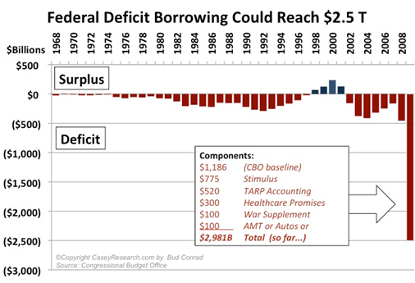
    America is at a crossroads. Its current path is unsustainable. The deficit for fiscal year ending Sept. 30, 2009 was $1.42 trillion. The National Debt is $12.5 trillion with the debt ceiling just raised to $14.9 trillion. The National Debt has increased $4 billion per day since September 28, 2007. The Obama Administration projects trillion dollar deficits for years to come. It has bailed out GM and Chysler, the banks “too big to fail” , and state governments that cannot manage their budgets. They have given away billions for clunkers and caulkers, and rewarded homeowners who bit off more than they can chew. We owe China $894 billion, Japan $764 billion and the Oil Exporters another $207 billion. It is uncertain how long foreigners will continue to finance our debt.

    There comes a breaking point at which the financial model is unsustainable and can no longer continue. For you and I, it is called bankruptcy. If we screw up financially, we are forced to declare bankruptcy. The courts offer protection until we can get our house in order but we are forced to stop spending. We solve our problems under Chapter 7 (liquidation) or Chapter 11 (reorganization).

    DECONSTRUCTION

    Cities can also be forced into Chapter 9 municipal bankruptcy. The City of Vallejo, California, population 120,000, filed for bankruptcy in 2008 after its politicians went fiscally berserk, paying the city manager $400,000 per year and its fireman an average annual wage of $175,000. Cleveland, Ohio declared bankruptcy in 1979 after defaulting on $15 million of bonds. (Seems trivial in this era of trillion dollar deficts). New York City avoided bankruptcy in 1975 when the teachers union forked over $150 million at the eleventh hour. These cities were forced to remedy their reckless spending.

    States cannot declare bankruptcy. Nor can they print money like the federal government. The Legislative Analyst’s Office estimates California has unfunded pension obligations of $237 billion. California is flirting with junk bond status. If it loses its credit rating, it will no longer be able to fund its bloated operations. The Golden State then will become the first failed state. They will be forced to dismantle their regulatory bureacracy. California has over 500 agencies and many are overlapping. They have 250,000 state employees. Thousands will lose their jobs as the financial community imposes cuts the legislature will not make. Such down-sizing will become known as deconstruction. California may be the first state to deconstruct its government services but it will not be the last. The Pew Center for the States reported that state governments have more than a trillion dollars in unfunded pension obligations.


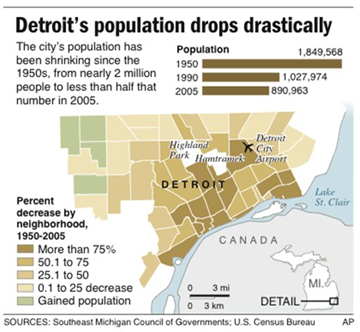
    There is no better example than the City of Detroit. Once the home of Henry Ford and the American automobile industry, Detroit has fallen on hard times. Its population has fallen from nearly 2 million residents to less than 900,000 today. With a budget deficit of $300 million per year, Detroit can no longer provide basic services to its own residents. There are 33,500 empty homes and 91,000 vacant residential lots. More than 300,000 buildings are vacant or in shambles. It is estimated that 40 square miles of Detroit lies abandoned.

    Twelve years ago, British urban historian Sir Peter Hall wrote in “Cities in Civilization” that Detroit “has become an astonishing case of industrial dereliction; perhaps, before long, the first major industrial city in history to revert to farmland.” Hall may have been prescient. This week, Mayor David Bing released the “Neighborhood Revitalization Strategic Framework,” a landmark document that suggests that vast sections of Detroit be razed and returned to farmland, open space and nature. The report suggests the first organized and orderly deconstruction of a major American city.

    The report envisons replacing entire neighborhoods with “Naturescapes” (meadows), “Green Thoroughfares” and “Village Hubs” that require fewer city services. But, it will require hundreds of millions of federal aid to finance such a major transformation, money the federal government no longer has to give.

    In an era of trillion dollar federal deficits, there are no longer easy solutions. The shift of tectonic plates caused by the Great Recession have exposed hopelessly unsustainable city and state budgets. Swollen payrolls, duplicative agencies and inefficient municipal services can no longer be afforded. The deconstruction of government services seems inevitable.

    In five years, will Detroit remain a cratered landscape of vacant buildings, broken promises, and smashed dreams? Or will a smaller, safer, more efficient city evolve out of its ruins? If deconstruction is successful in Detroit, it could serve as a model for many other governments as well, from City Hall to state capitols and all the way to the most bloated disaster of all, Washington, DC.

    ***********************************

    During the first ten days of October 2008, the Dow Jones dropped 2,399.47 points, losing 22.11% of its value and trillions of investor equity. The Federal Government pushed a $700 billion bail-out through Congress to rescue the beleaguered financial institutions. The collapse of the financial system in the fall of 2008 was likened to an earthquake. In reality, what happened was more like a shift of tectonic plates.

    ************************************

    This is the eighth ninth in a series on The Changing Landscape of America written exclusively for New Geography

    Robert J. Cristiano PhD is a successful real estate developer and the Real Estate Professional in Residence at Chapman University in Orange, CA.

    PART ONE – THE AUTOMOBILE INDUSTRY (May 2009)
    PART TWO – THE HOME BUILDING INDUSTRY (June 2009)
    PART THREE – THE ENERGY INDUSTRY (July 2009)
    PART FOUR – THE ROLLER COASTER RECESSION (September 2009)
    PART FIVE – THE STATE OF COMMERCIAL REAL ESTATE (October 2009)
    PART SIX – WHEN GRANNY COMES MARCHING HOME – MULTI-GENERATIONAL HOUSING (November 2009)
    PART SEVEN – THE FATE OF DETROIT: GREEN SHOOTS? (February 2010)
    PART EIGHT – THE FAILED STATE OF CALIFORNIA (March 2010)