Author: admin

  • If I Were Sheikh Mohammed

    On January 15th, Dubai’s ruler, Sheikh Mohammed bin-Rashid bin-Maktoum responded to an article written by the author and Joel Kotkin suggesting the United Nations should move its headquarters from New York to Dubai. Dubai issued a formal statement, “The emirate would welcome talks with officials at the organisation to inform them of the facilities and advantages that Dubai can offer.”

    If I were Sheikh Mohammed, I would follow this bold gesture with another and offer to lead a modern Marshall Plan for reconstruction of Haiti, fueled by the crude oil fortune pumped from the Persian Gulf. What better way to demonstrate the deservedness of Dubai and the Gulf region as the site of the new United Nations Headquarters than to demonstrate the ability to lead the world in a time of crisis.

    The Marshall Plan was announced by Secretary of State George C. Marshall during a speech at Harvard University on June 5, 1947. Marshall said,

    “The truth of the matter is that Europe’s requirements for the next three or four years of foreign food and other essential products – principally from America – are so much greater than her present ability to pay that she must have substantial additional help or face economic, social, and political deterioration of a very grave character”.

    The European Recovery Program, or Marshall Plan as it was known, reconstructed the war ravaged economies of Western Europe between 1948 and 1952. By 1952, these economies were 35% higher than in 1938. The recovery led to unprecedented growth for twenty years and stability on the continent.

    Change “Europe” to “Haiti” and the words ring as true in 2010 as they did in 1947. The United States has pledged $100 million. Britain has pledged $10 million. The UAE, to date, has offered just “shelter materials” according to the UN Office for the Coordination of Humanitarian Affairs (WSJ 1/16/10). Dubai must do more to take its place as a leader on the world stage.

    Haiti is a tiny island nation of 9,000,000. Between two and three million souls were clustered in ramshackle housing around the city of Port au Prince when a 7.2 earthquake hit. More than 100,000 perished although the true count may never be known. Haiti is one of the poorest places on earth with a per capita income of just $1,317 (2008).

    The Persian Gulf, half a world away, pumps 20,000,000 barrels of crude per day at a cost of approximately $4 per barrel. At current world prices of $80 per barrel, the gulf nations have free cash flow approximating $1.5 billion per day. The developed nations of the West pump more than half a trillion dollars per year into the coffers of the Persian Gulf nations and these nations are struggling with the worst financial crisis in a century. To the contrary, the sovereign wealth funds of Abu Dhabi, Saudi Arabia and other oil rich GCC nations contain $3 trillion dollars.

    Presidents Bill Clinton and George W. Bush have agreed to lead an international effort to raise emergency funds to aid in the immediate rescue of the Haitian people. They will raise enough to bring in badly needed rescue personnel, water, food and tents for 2,000,000 people living in hellish conditions. But their efforts do not touch Haiti’s long term needs.
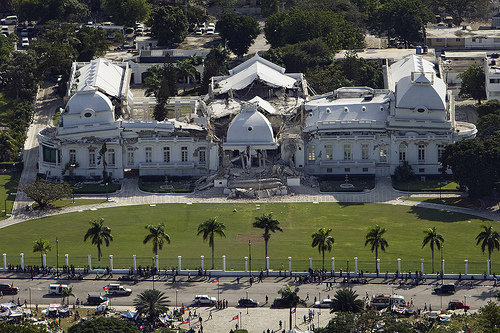
    Haiti has been mostly destroyed. It is estimated that 75% of its buildings have been damaged or destroyed. Its Presidential Palace collapsed as did its main Cathedral and the island’s UN Headquarters. Its infrastructure is in ruins, its water system destroyed. It looks reminiscent of Dresden, Germany during the carpet bombing of World War II. Dead bodies lie everywhere amidst the smoking ruins of a destroyed city.

    The city of Port au Prince needs to be razed to the ground. 2,000,000 people need to be dispersed around the Caribbean as the residents of New Orleans were after Hurricane Katrina. And then a massive reconstruction project, similar to the Marshall Plan after WWII, must be undertaken to rebuild everything from roads and ports to homes, hospitals and schools. Who will lead that effort? The nations of Latin America do not have the expertise or capital. The United States is financially exhausted, drained from two wars half a world away, 10% unemployment and a financial collapse as severe as the Great Depression.

    There is one man who is no stranger to multi-billion dollar projects and the transformation of a nation, Dubai’s ruler, Sheikh Mohammed bin-Rashid bin-Maktoum. Why would Sheikh Mohammed intervene and lead an effort to rebuild Haiti that will cost several billion dollars? Haiti is half a world away from the Persian Gulf. One reason is his proven ability to create and build a radical new urban vision. Sheikh Mohammed built the tallest structure on the planet, huge residential islands in the Gulf, and the world’s largest airport – simultaneously.

    The Gulf Cooperation Council, (GCC) consists of the UAE, Kuwait, Bahrain, Saudi Arabia, Oman and Qatar. To say these nations are rich is an understatement. Their oil reserves total somewhere around 500 billion barrels. Dedicating $10 billion to rebuild Haiti would require allocating a week’s revenue from crude oil production. That much money will not be needed tomorrow. A pledge of $3 billion per year for three years would suffice and not even dent the balance sheets of the Gulf nations.

    Sheikh Mohammed needs to take the lead if he wants the balance of power, respect and authority to move the UN from New York City to the Middle East. For too long, the Middle East has exported oil, its wars, the Israeli/Palestinian conflict and terrorists to the world. To many, the face of Islam has been the face of a terrorist, committing heinous acts on innocent people. Dubai, despite its majesty, has not yet become a true global destination, particularly in the wake of the world economic crisis. What better way to raise the image of Islam and the Middle East than to lead a 21st Century Marshall Plan to rebuild Haiti? The reward might just be a Nobel Peace Prize as George C. Marshall was awarded in 1953.

    Sheik Mohammed should make this announcement at the foot of the tallest structure ever created by man to show, while reaching for the sky, the ruler of Dubai can reach down to the poorest, most ravaged people on the earth and lift them up as well. He could take the center stage of the world, once again, and do what has made him arguably the most visionary developer since the Pharaohs of ancient Egypt.

    Robert J. Cristiano PhD is a successful real estate developer and the Real Estate Professional in Residence at Chapman University in Orange, CA.

    Photos:
  • The Economic Fallout of the Chicago Way

    Many large American cities are hurting from the recent recession. Unrealistic revenue assumptions based on ever higher real estate prices and sales tax receipts have left cities unable to pay their basic bills. As asset and consumer prices deflate, from a lack of demand, those cities with “sticky” costs – the result of overly powerful unions and excessive business regulations – are stuck in an economic quagmire.

    Chicago has become a leading poster child for recent urban economic malaise. With the election of Barack Obama, 2009 was supposed to be a year in which the Windy City basked in glory. The world was supposed to see the benefits of an administration run by Chicago Machine operatives such as David Axelrod, Rahm Emanuel, Valeria Jarret and Desiree Rogers.

    Yet despite the new power in Washington, the Chicago Way has not turned out well back home. A series of events has put Chicago in a funk, along with structural economic problems. In June, Chicago’s unemployment rate peaked at 11.3%, far outpacing the national unemployment rate.

    Since 2007 the region has lost more jobs than Detroit, and more than twice as many as New York. Over the decade that is about to end Chicagoland’s total loss was greater than any region outside Detroit. It has lost about as many jobs – 250,000 – as up and comer Houston has gained.

    Columnist Mary Schmich of the Chicago Tribune, usually a reliable booster, has described the situation:

    Chicago has a mood problem.

    It seems edgy lately, a little sullen and scared, verging on depressed. Some days, it feels more like the angry, confused place I moved to in 1985 than the exuberant city that has swaggered through the past two decades.

    One can question Schmich’s past description of Chicago as “exuberant”. But recently there’s been many Chicago problems.

    Chicago’s bid for the 2016 Olympics failed. Even with Chicago’s most prominent citizens, President Obama and Oprah Winfrey, making a pitch to the International Olympic Committee, the Windy City came up short, behind all the finalists.

    Oprah’s recent announcement that she’s ending her long run talk show will end Chicago’s most visible export. It appears much of the Oprah’s empire is moving to California to be closer to America’s entertainment capital, more celebrities and, of course, better weather.

    On a more serious note, Chicago also has had to deal with two high profile political suicides. Chicago Board of Education President Michael Scott committed suicide in November. Scott was subpoenaed before a federal grand jury that was investigating the sale of admissions to magnet schools.

    In September, a prolific Chicago fundraiser, Chris Kelley, committed suicide after pleading guilty to felony charges concerning the Blagojevich federal case. Kelly’s death was another reminder of the fallout of Chicago corruption.

    But it’s just the top of the social heap that’s hurting. The national recession also has been particularly harsh for union-dominated Chicago. The loss of employment has put pressure on Chicago’s politicians to allow Wal-Mart to expand their number of stores in the city. With only one Wal-Mart store in the city, the thousands of potential new jobs could be just what Chicago needs right now. Mayor Daley wants to let Wal-Mart open several more stores but faces stiff opposition in City Council. Alderman Burke, the Chairman of the Finance Committee, is the key decision maker concerning Wal-Mart, whose local expansion is anathema to the unions. Mayor Daley said this concerning when Alderman Burke is going to hold hearings on Wal-Mart:

    “That’s up to him. He could have had it six months ago or two months ago.”

    The other big union problem can be found in Chicago’s fast-eroding convention business. The union run McCormick Place has been making big news lately because of its loss of three major conventions. In November when two major conventions announced they were leaving Chicago, Crain’s Chicago Business made this stunning indictment:

    The chief executive officer won his post after raising campaign cash for disgraced Gov. Rod Blagojevich. The just-departed human resources director owed her job to a powerful state senator. Other top executives have long ties to Mayor Richard M. Daley’s political machine.

    That’s what clout looks like at the Metropolitan Pier and Exposition Authority, known as McPier, a little-understood government entity that operates the city’s primary convention venue, the vast McCormick Place complex; the adjacent McCormick Hyatt Regency Hotel, and the lakefront tourist center Navy Pier.

    The loss of two major trade shows this month and a deepening financial crisis raise questions of how the Chicago Way can compete with more efficient, warm-weather convention centers such as Orlando, Fla., and Las Vegas.

    With labor costs much cheaper in other venues, competing becomes very difficult, particularly in tough times.

    Fiscal incompetence has made the problems worse. To help with Chicago’s downturn a “rainy day” fund was set up by leasing major city assets. Chicago leased its parking meters to a private company. This controversial move was supposed to yield generous revenue up front. When Chicago recently passed the new city budget, the Chicago Sun-Times reported:

    Chicago’s 75-year, $1.15 billion parking meter windfall would be nearly drained in just one year to provide token property tax relief and stave off tax increases, thanks to a $6.1 billion 2010 budget approved Wednesday.

    Despite complaints that Chicago’s future was being mortgaged, the City Council voted 38-to-12 to approve Mayor Daley’s plan to drain reserves generated by asset sales to solve the city’s worst budget crisis in modern history.

    Chicago’s recent economic decline is also affecting the state of Illinois’ budget. It may be unfair to blame the Chicago Machine for Illinois’ budget situation, but they certainly have played their role. Just days ago Moody’s and S&P downgraded the state of Illinois debt. Only California now has a lower debt rating.

    Worse may be in the offing. Chicago’s recent economic malaise has been revealed in the stunning new documentary on the coming elimination of futures floor trading:

    The exchange, a critical element of Chicago’s economy, may be on the way to downsizing if not oblivion. That’s more bad news for a city that seems to be falling apart even as its operatives try to run the country.

    Steve Bartin is a resident of Cook County and native who blogs regularly about urban affairs at http://nalert.blogspot.com. He works in Internet sales.

  • Growing Today’s Green Jobs Requires Solid Economic Development Policy

    I was hired for my first Green Job, thirty-four years ago, shoveling horse stalls for a barn full of Tennessee Walking Horses. The droppings and bedding that was removed from the stables was then composted and applied to my employer’s crops in lieu of chemical fertilizers. You don’t get much greener than that!

    Now don’t get me wrong, I am not bragging about holding such a lucrative job because the 75 cents an hour they paid me made this Ozark, Missouri boy feel rich. Actually, I am bragging that I learned the value of environmental stewardship and the interdependence of our economy at an early age. For our community, no horses meant no corn.

    My employer, a local auto dealer who owned the farm, created these value-added “green jobs” without any subsidy from the government or without a governmental policy forcing his customers to pay him a subsidy. But I guess that is the good old days. So much for market forces and producing a product that customers will pay for.

    I have spent more than 25 years in the profession of economic development serving at the community and state levels. I have worked with hundreds of companies to create tens of thousands of jobs. In that time, I have seen more “silver bullets” than the Lone Ranger ever gave away. These have included the following “you must have” edicts: four lanes/interstate highway; a new airport terminal; micro chips; nanotechnology; aqua culture; speculative buildings; a Super Bowl; a bohemian bastion; or a biotech cluster. Now, it’s environmentally friendly “green” businesses like wind farms and solar fields that are calling for precious public resources.

    Yet in reality, these silver bullets usually work only for a few places and certainly do not constitute a national strategy for job creation. Some places may benefit from the rush to wind and solar energy, although the benefits may well diminish if the panels or turbines are made elsewhere. There are not too many industries that have such a large profit margin that they can afford to pay double or triple their existing electric rates.

    In fact, the answer to job creation is definitely not financially supported and government-mandated green energy policy that focuses its efforts on wind and sun. The reasons why that policy won’t work include:

    1. A quick review of a recent issue of a national economic development trade publication featured ads by 32 states that claim to be the next green energy place, although they only focus on wind and solar. Maybe it is because the public is being coerced into subsidizing these industries. But at the end of the day there will NOT be 32 places nationwide that are green energy centers of excellence, but more likely a dozen or so globally.
    2. Most of these green initiatives rely on nature. Nature is not constant – that is what makes it “natural.” Wind may be a suitable form of power off the ocean on Monday, Tuesday and Wednesday evenings but what happens when it quits blowing? Not only are the resources stranded and not providing a return on investment but no power is being generated.
      Now don’t get me wrong, wind power has worked for years. Farmers have been using it to fill up water tanks for their animals for hundreds of years. But as all farmers know, if the wind quits for long enough, the animals die. Are we to bet our economies and our lives on the hope that maybe someone can develop a storage tank for electricity generated by the wind even if it quits?

    3. Solar power is great. But let’s be realistic. How are we ever going to get solar panels on the roof of every home – at a cost of $60,000 or more – in America when some people don’t even have cable television or broadband access yet? And what about the heat radiated from the panels themselves? And, solar power still has the same storage and reliability issues that come with wind power.

    Let’s be clear that here are two very clear outcomes we, as a nation, must strive to achieve: low cost, environmentally sensitive energy independence and job creation. These are not mutually exclusive goals.

    Energy independence will never come from wind and solar power; neither is dependable or manageable enough to meet our needs. Compound this with artificially mandated requirements and the hidden taxes that go with them and we are facing higher energy prices which will cripple the economy.

    When it comes to jobs, we must embrace the age-old adage: Be yourself but be great. We call this model Community Capitalism. In short, Community Capitalism is focused and organized philanthropy and business investment occurring simultaneously in five strategic areas based upon historical and geographical advantages in order to create jobs and wealth.

    I am blessed to live in a place, Kalamazoo, Michigan, that has embraced the fundamentals of Community Capitalism for more than 100 years. Kalamazoo is the place where the friable pill, a pill easily dissolved when ingested, was invented; where Dr. Homer Stryker invented the oscillating device that cuts casts off; where the yellow-checkered cab was invented; where most of the nation’s corsets and paper were once produced, and home of the Kalamazoo sled, the direct-to-you-from Kalamazoo Stove, Shakespeare Rod & Reel and Gibson Guitars.

    So what are we great at? We are one of only a few places globally where a drug can move from concept through trials to market. We are centrally located, a short drive to the logistical hub of Chicago. We can staff a call center or customer care center with the speed of light. We will leave the micro chips to Boise, the film industry to Hollywood, the Country music business to Nashville, the financial district to Manhattan; and telecommunications to Dallas. Not to say we won’t welcome a few of their companies. But they are great at those things; we will be good at best.

    So how do we create jobs using the five precepts of Community Capitalism: place, capital, infrastructure, talent and education? The same way communities have grown for hundreds of years.

    First is the concept of place. Great economic regions know who they are and that sense of identity ensures people are not only comfortable within the environment but can nurture their personal and professional growth. Think about places that do this really well and where place has become their brand – like Boise, Idaho; Austin, Texas; Melbourne, Australia and Gorongosa in Africa.

    Capital is critical to spur innovation and entrepreneurship. In the case of Kalamazoo, we established in 2005 a limited partnership venture fund to invest in early-stage life science companies. The $100 million Southwest Michigan First Life Science Fund is believed to be the largest sum of community-based private capital ever to be raised and managed by an economic development organization. Other communities have focused on angel networks, revolving loan funds or even micro lending. But whatever the source, we know that companies cannot grow without the capital to grow a business.

    Great communities understand that great minds need the right place to make things happen and are committed to providing the necessary infrastructure. For example, when we saw the need to create a place for local talent to incubate biotech concepts, we created a 69,000-square-foot accelerator to do just that. This same catalyst served the Palm Beach, Florida region’s desire to grow life science research when Scripps Research Institute decided to locate there and mix its DNA with the local biotech economy. It also worked for Corpus Christi, Texas when the Harte Research Institute was built to chart the future of the Gulf of Mexico.

    Communities cannot be great if they lack a long-term, funded commitment to education and academic excellence. Our legacy in life science and manufacturing prominence has resulted in an indigenous cluster of highly educated people. And we realize that educated people seek out strong education for their families which in turn produces a high-performance workforce.

    We are home to the world-renowned Kalamazoo Promise college scholarship program which provides free scholarships to every child that graduates from the Kalamazoo Public school system. In fact, Southwest Michigan’s diversified workforce is highly educated and boasts one of the nation’s highest concentrations of Ph.D.’s (1.84%), more than two times the national average per capita (0.81 %).

    Other economic regions have used “education” to make a difference. For example, the African Children’s Choir uses its funds to build schools, provide medical care and fund community development projects in the villages from which its young members come from. Oprah Winfrey’s Leadership Academy for Girls in South Africa looks to instill change for young girls in a place where almost a third of all pregnant women are afflicted with HIV.

    Finally, we recognize that a community needs to embrace talent. Kalamazoo is home to the Stryker Corporation, which is the only publicly traded company to achieve double-digit growth every year over a twenty-year period due to its commitment to putting the right people in the right place at the right time.

    I understand that none of these five things is as easy as the Lone Ranger’s silver bullet. It is much harder to raise capital to grow companies than it is to get your congressman to earmark dollars for highways or build a speculative building in a corn field. But if we are to truly build a sustainable economy that grows jobs and wealth, we must invest in Community Capitalism while limiting artificial governmental manipulations of the economy.

    Ron Kitchens serves as the Chief Executive Officer of Southwest Michigan First, as well as the General Partner of the Southwest Michigan First Life Science Fund. Ron has worked with more than 200 Fortune 500 corporations as a Certified Economic Developer in addition to starting multiple privately held companies and serving as a city administrator, elected official and staff member to United States Senator John Danforth.

  • When Granny Comes Marching Home Again… Multi-Generational Housing

    During the first ten days of October 2008, the Dow Jones dropped 2,399.47 points, losing 22.11% of its value and trillions of investor equity. The Federal Government pushed a $700 billion bail-out through Congress to rescue the beleaguered financial institutions. The collapse of the financial system in the fall of 2008 was likened to an earthquake. In reality, what happened was more like a shift of tectonic plates.

    *******************************************

    The driveway tells the story. The traditional two-story 2,200 square foot suburban home has a two-car attached garage. Today’s multi-generational families fill the garage, the driveway and often also occupy the curb in front of the home. The economic crisis that is transforming America is also changing the way we live. The outcome will change the way America views its housing needs for the balance of the 21st Century.

    As is often the case, we can more clearly see the future by looking into our past. That is because time and time again America has reverted to its roots when confronted with a challenge. The root of the American family is the home. A century ago, America was an agrarian nation. Most Americans grew up on the farm or in a small town often tied to agriculture. A century ago, our census was 92,000,000, less than one-third of today’s population. Los Angeles was a city of 319,000. Cleveland was the fifth largest city with 560,000. The tenth largest city in 1910 was Buffalo NY with 423,000 souls.

    A century ago, parents, children, grown children, and grandparents lived together in America’s homes. In 1910, the vast majority of kids did not go off to college. They stayed home and worked the farm. Mom certainly did not drive and usually she did not work outside the home. Grandma – who then as now usually outlived grandpa – did not go off to an active senior housing project or nursing home at age 55. With the average life expectancy at just 49 years, there was little market for such facilities. A young Grandma lived in the family home and helped with the cooking, the sewing and the child rearing.

    Along the way, we fought in two world wars, America industrialized and the great Middle Class exploded. Our children went off to college and did not return. Our cities exploded. By the end of the century, Los Angeles grew to 3,700,000. The tenth largest city was Detroit with 1,000,000. Children were expected to leave the home shortly after high school and never come back, except to visit.

    Big changes occurred on the other end of the demographic curve. As life expectancy grew to 75. Grandma had her choice of active senior living, congregate care or a skilled nursing facility when she hit 70 and slowed down.

    The expectations of greater family dispersion – with young people leaving home early and grandparents on their own – drove much of real estate thinking at the end of the 20th Century. With empty-nesters and young people both heading back to the city, urban planners were focusing on high-rise apartments and condominiums in dense urban areas. Many eagerly anticipated the death of the suburbs since the number of young families declined. Across the country, and even in suburban areas like the City of Irvine, CA brilliant urban planners began rezoning industrial land into high density housing. The face of America was thought to be changing in predictable ways.

    Then, along came 2008 and the economic crisis. The plates under our feet began to shift. The mass migration to dense urban living evaporated as people stayed put and speculating in condos lost all economic logic. The shiny new urban corridor in Irvine now lined with high rise housing sits empty, with many units vacant and foreclosed. In nearby Santa Ana, twin 25-story residential towers sit eerily vacant with not a single unit sold or occupied. Central Park, a giant new urban project in Irvine that boasted dense high-rise, townhouse and mid-rise units, sits vacant behind green security fences.

    Where did the buyers go? Many young people moved back home with their parents when their high paying jobs in real estate or mortgage brokerage disappeared. With their jobs and income gone, they sought refuge in the safety of their childhood homes. Their parents ended any speculation of selling and down-sizing when their children returned. With job creation non-existent, they do not plan on leaving anytime soon. In one recent Pew study, 13 percent of parents with grown children reported one of their adult offspring had moved back home in the past year. Roughly half of the population 18 to 24 still lives with their parents.

    This stay-at-home trend predates even the recession. According to the U.S. Census Bureau, the national relocation rate in 2008 was the lowest since the agency started tracking the data in 1948. The rate was 11.9 percent in 2008, a decline from 13.2 percent in 2007. The 2008 figure represents 35.2 million people, which is the smallest number of residents to move since 1962. The number was 38.7 million in 2007.

    What about Grandma and, increasingly, even Grandpa? Our parents, thanks to the miracle of modern medicine, are living longer than ever. If she has reached age 65, she can expect to live another 20 years. Unfortunately, her retirement account and savings plan may not. Many Americans are living well into their 90s and we will see the first wave of centurions in our lifetime. No one expected this to happen and we are unprepared for it. Grandma will not be able to afford the $3,000 to $4,000 a month expense of a quality retirement facility – for 20 years.

    This changing dynamic will alter movement of Americans, which has now been slowing down for a generation. In 1970, nearly 20 percent of Americans changed their place of residence every year. But by 2004, that figure had dropped to 14 percent, the lowest level since 1950. The tough economy and aging demographics will slow migration down even more. Mom and Dad will not find it easy to take that new position in another city with the kids at home and now Grandma, and even Grandpa, too.

    This will have profound impact on the kind of housing Americans will want. Homebuilders may find lower demand for single family houses as America doubles up but it will be the much ballyhooed drive to urbanize America with dense high-rise units that is most in danger.

    Extended families will want larger – not smaller – houses. They may not be able to afford McMansions, but conventional suburban houses will be changed to meet the demands of extended families. Granny flats, consisting of self contained ground floor units, will be in demand as the baby boomer generation moves into retirement. Smaller single floor homes called Casitas will need to be mixed into planned developments so that the Grandparents can live closer to the children.

    City staff and urban planners, already grappling with a mandate to accommodate global warming and carbon footprints, will have to rethink existing zoning rules which have not yet responded to the new reality. This reality will be driven by aging demographics, diminished capital and the shifting plates of our economy. The baby boomer “bubble” that is now beginning to retire is a well established fact. Lesser known is the impact of the financial crisis on young workers who simply have been priced out of the housing market. Along the pricier coasts and Northeastern cities, they will need the down payment from their parents – who in exchange will live with their kids – to purchase their own home.

    The kids have already come home. Like the financial downturn, they will not be leaving anytime soon. Grandma is next in line. When she comes home, the circle will be complete, with consequences few in the real estate industry have yet to contemplate seriously.

    **********************************
    This is the sixth in a series on The Changing Landscape of America. Future articles will discuss real estate, politics, and other aspects of our economy and our society.

    Robert J. Cristiano PhD is a successful real estate developer and the Real Estate Professional in Residence at Chapman University in Orange, CA.

    PART ONE – THE AUTOMOBILE INDUSTRY (May 2009)
    PART TWO – THE HOME BUILDING INDUSTRY (June 2009)
    PART THREE – THE ENERGY INDUSTRY (July 2009)
    PART FOUR – THE ROLLER COASTER RECESSION (September 2009)
    PART FIVE – THE STATE OF COMMERCIAL REAL ESTATE (October 2009)

  • So Much for Evidence-Based Planning

    Has evidence-based planning fallen from grace in favour of catchy slogans and untested assumptions? In the case of urban planning, arguably that is just what’s happened. The evidence, in Australia at least, is worrying.

    “We must get people out of cars and onto public transport.” “We must stop urban sprawl and the consumption of valuable land.” “We must build higher density communities to achieve sustainable environmental outcomes.” Phrases like this are now de rigueur across many discussions about urban planning in the media, in politics and in regulatory circles in Australia. They are rarely challenged on the basis of what the actual social, economic or scientific evidence is really saying. It’s produced an Animal Farm like dogma: ‘Four legs good, two legs bad.’ Or ‘Napoleon is always right.’ Denial, followed by ‘pass the buck’ and ultimately ‘shoot the messenger’ are responses to legitimate questions.

    But given the far reaching social and economic changes which will invariably flow from some of the regulatory planning schemes now being legislated, we should at least ask whether the various policies will actually achieve their stated goals. After all, these regulatory planning schemes are intended to govern our urban growth over the next 20 years. It would be a shame to get it badly wrong, simply because assumptions weren’t tested.

    The rise of the big plan

    Since the late 1990s, there has been a raft of Australian regional planning schemes dealing with urban growth in our major centres. The common theme has been the creation of urban growth boundaries and increased density in established urban areas, with an emphasis on public transport as opposed to the private vehicle.

    Typical of these schemes is the recently released ‘South East Queensland Regional Plan 2009-2031’ (SEQRP) which aims to ‘manage growth and protect the region’s lifestyle and environment.’ The plan, like others of its type, is influenced by a desire to contain urban growth and implicitly assumes that we are at risk of reckless growth if we don’t. But Australia’s total population is currently around 24 million people, in a land mass roughly the size of continental USA. This puts us below Nepal and Uzbekistan but ahead of Madagascar in population rankings. Reports that Australia’s population may reach 35 million in another 40 years (the current population of Canada) have raised domestic fears that we might become over populated. (See my blog post ‘Australia Explodes’ for more on this).

    The State of Queensland is the second largest state by area, but contains only 4.4 million people in total. Its population growth rates have in the past been amongst the highest of any region in Australia, growing at up to 1500 people per week (close to 80,000 per annum). Much of this growth has occurred in the south east corner of the state, surrounding the capital city – Brisbane. While modest by global standards, this rate of growth has thrown governments and some sections of the community into apoplexy. How will we ever cope? The region of southeast Queensland (population 3 million) has even been compared to California (population 38 million) in terms of its growth rates and population pressures.

    Against this context, the SEQRP identifies the need to provide a further 750,000 dwellings in the period to 2031, with roughly 50% to be developed in established urban areas via infill, and the balance through new detached housing development on land within an urban growth boundary. The challenge for infill is greater in Brisbane, where 138,000 new dwellings are expected to be developed in established urban areas, especially around transit centres (typically rail).

    One of the many assumptions that underpin the core strategy of the SEQRP have to do with
    the risk of sprawl. This suggests that modest and manageable growth rates of 1500 people per week are somehow tipping the big end of the global scale. The region’s current population of 3 million shows obvious signs of urban expansion as a result of growth to date, yet, with some notable exceptions in recent years, infrastructure has generally kept pace with the growth. Even at the urban fringe, new housing development has been at higher rates of dwelling density than in years past (lot sizes are shrinking).

    There is also an assumption that we are running out of land. But South east Queensland has vast tracts of land suitable for urban expansion and has several established regional centres readily capable of servicing new expansion with infrastructure and town centres already in place and capable of upscaling. The urban growth boundary imposed by the SEQRP is approximately 300 kilometres in length as it curtains the urban area. An expansion of this boundary by as little as a kilometer (under a mile) would create a notional land supply suitable for an additional 500,000 detached homes at 15 to the hectare (or six to the acre).

    Behind the plan lies an accepted wisdom that demand for ‘the quarter acre block’ is driving excessive expansion. The evidence, however, suggests this is now ancient history: lot sizes have not been anywhere near a quarter acre since the 1960s. The typical lot size now is 400 square metres, or around one tenth of an acre, hardly an irresponsible over-consumption of land for housing.

    It is also assumed that all this growth imperils quality farm land. This assumption can only come from those with a vague understanding of farming practices. In the south east corner of Queensland, typically two types of land have been conserved for this reason. The first is land devoted to growing sugar cane which is no longer economically efficient. This agriculture produces a biodiversity desert and is far better suited to the more tropical north.

    The second type of land conserved under this rationale is land historically devoted to cattle grazing. This was always marginal grazing land in the main – dry, shallow soils that struggle to hold moisture or grow pasture. As technology improved and transport economics developed, more efficient grazing country has been opened up further from city markets. But as farmers are prevented from selling their land for housing, despite its logical location for that purpose, herds of bony cattle continue to roam the urban fringes of the metropolis.

    This assumption also seems to hold dear the notion that, for sustainability reasons, regions should source their food needs from within a nearby catchment, minimizing transport costs. Were this true, Queenslanders would not enjoy apples (grown in southern temperate zones) and neither would Tasmanians (our cool climate southern state residents) ever enjoy bananas (two thirds of Australia’s crop of which are grown in Queensland). It would also mean our agricultural industries, which rely heavily on export, would fail.

    The cost of infrastructure provision is a subject that preoccupies governments in growth regions. Perhaps for this reason, the suggestion that infrastructure is more economically deployed in established urban areas, as opposed to newly provided in outer growth areas, found much support in treasury corridors. However, the evidence suggests otherwise: established urban areas‘ essential services (electricity, water, sewerage, stormwater) are ageing and incapable of serving significantly higher demand loads. The replacement and upgrade cost of retrofitting these services is demonstrably higher than the cost of installing new services in new growth areas.

    It is also assumed outer suburban growth will mean worsening urban congestion. Yet relatively few residents of new outer suburban growth areas are employed in inner city areas: according to the Census and other official government data, most jobs are in suburban locations – 90% of all jobs in fact. The CBD (our downtown) is a high density focus area for many headquarter operations, but at 2 million square metres of office space, it cannot by any stretch of the imagination provide sufficient space for the majority of the region’s workers.

    There is the assumption that infill and higher density will get more people using public transport. Current public transport usage represents under 15% of all trips. With higher density housing in established areas, especially in and around transit nodes (TODs), that figure could theoretically increase. But even the most heroic of assumptions would put the future rate at little more than 30%. Meaning 70% of new residents will still be auto dependent. There is also an unanswered question on the capacity of existing rail and bus services to cope with additional demand (frequent reports mention chronic overcrowding) combined with the high level of public transit subsidies per passenger, which will somehow have to be funded.

    Finally, it’s assumed that high density housing is more ‘sustainable.’ But according to several Australian University studies, unit and townhouse dwellings actually consume more energy than equivalent detached dwellings. Common area lighting, lifts, clothes driers and airconditioning are all more commonplace in high density dwellings than detached (where natural light, cross flow ventilation and solar power for drying clothes are the norm). Factor in the higher number of persons per dwelling in detached housing, and the per person energy consumption of inner city, high density housing looks ordinary. No less an authority than the Australian Conservation Foundation actually proved this in their Consumption Atlas which revealed that inner city high density residents had much larger carbon footprints than their suburban cousins.

    On balance, many of the assumptions that underpin the central strategic intent of regulatory planning schemes such as The South East Queensland Regional Plan, just don’t stand the test of evidence. Indeed in many cases, the evidence suggests the opposite of what is assumed. But evidence, it seems, is out of favour and slogans are in.

    Four legs good, two legs bad. Napoleon is always right. Why consult the facts when the mantra will do?

    About the author: Ross Elliott has 20 years experience in the property and development field, including stints in research, advocacy and urban economics. He writes an occasional blog, which you can find here and works as a consultant in marketing, strategy and business development, specializing in the property sector.