Author: admin

  • When the Fat Lady Sings: The Fate of Commercial Real Estate

    During the first ten days of October 2008, the Dow Jones dropped 2,399.47 points, losing trillions of investor equity. The Federal Government pushed TARP, a $700 billion bail-out, through Congress to rescue the beleaguered financial institutions. The collapse of the financial system was likened to an earthquake. In reality, what happened was more like a shift of tectonic plates.

    ***********************************

    Like the Roaring Twenties of a century ago, the real estate bull market of the last ten years crashed in dramatic style in late 2008. The collapse of the residential market was led by massive defaults in ill-conceived “sub-prime loans”. Millions of American homes are now in default and in the process of loan modification, abandonment or foreclosure. There is no end in sight as Prime, Alt-A, and Option ARM loan resets come due beginning in 2010.
    Lurking around the corner, literally unnoticed by the average American worried about keeping his home, is a similar crisis in commercial real estate. For over a year commercial property values have been plummeting and have not begun to recover. A drive through both major cities and suburbia tells the story. Vacant stores, empty shopping malls, cancelled mixed use developments and eerily empty car lots presage bad things to come.
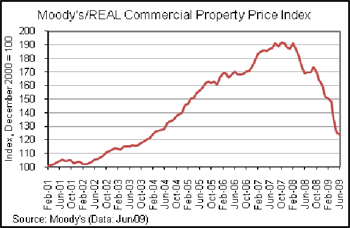
    We have discussed the origins of the housing crash before and the role played by feckless politicians and over-ambitious bankers. Now this crisis has spread to the commercial sector. Banks and commercial lenders saw in the new housing starts an equally promising demand for new shopping malls and suburban offices. Lenders forgot about pre-leasing requirements and made speculative loans on buildings that had no pre-leasing. As with housing, the rule book was thrown out the window. Like the aftermath of any wild party, there is hell to pay in the morning. It is morning in the commercial marketplace and the fat lady is singing.
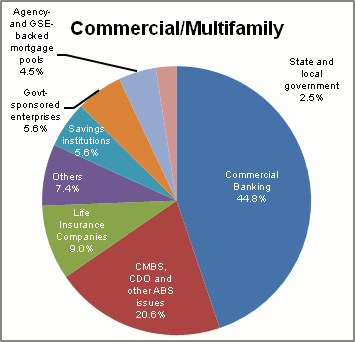
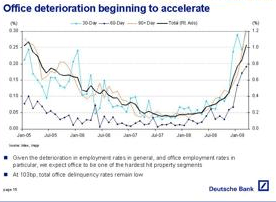
    Depository institutions hold about half of the $3.2 trillion of debt on US commercial property. The default rate in the first quarter of 2009 was just 2.25%. Sounds OK until you do the math and realize that $36 billion was in default and it is just beginning. The FDIC puts troubled banks on “the problem list”. In early 2008, there was one bank on the list. At the end of June 2009 there were 416, up from 305 at the end of the first quarter when the default rate was just 2.25%. Total assets at these problem institutions total $299 billion. The problem is that the total reserves of the FDIC are just $42 billion. The FDIC has closed over 100 banks and one good estimate is that they will close around 10% of US banks, 500 to 1,000, before the crisis runs its course. The losses will dwarf the $394 billion of the RTC and may surpass a trillion dollars. Is there any wonder why banks are loathe to make new loans?
    So what happens to commercial real estate? With prices plummeting, there must be some great buys out there, one must assume. But do not bet on it. This was not just an earthquake. The plates shifted, and like musical chairs, when the music stops there will be fewer chairs and many people left standing. Consolidation is the next step. There will be the inevitable drop in rents and with it property values. The better and stronger tenants will flee the less attractive Class B and Class C space and move to Class A properties. Class A properties will survive due to full occupancy and stable cash flow. But the lesser properties that were leased will empty.

    Like the suddenly quiet auto malls with the empty Pontiac, Saturn and Chrysler dealerships, lesser properties will lose their anchor grocery stores, Targets, and big box users. With the anchors gone, and traffic with it, the mom and pop small businesses cannot survive. There is no future for the marginal Class C shopping center. Tenants will flee to better locations and more affordable lease rates. Class A offices will survive. Well located and attractive Class B properties may muddle through at reduced revenues – if they can survive the refinancing maze. But, the poorly located Class C office will remain a “see-through” for years to come. Old, tired, and mostly vacant Class C office buildings line the crumbling freeways of Detroit, Cleveland, Youngstown, and countless smaller rust belt cities where excess capacity has eliminated the need for new development.

    A year from now, the landscape of America will be forever changed. The office and retail markets will be vastly different than they look today. Not much of it will be good. Five years from now, will empty shopping centers and auto dealerships remain shuttered or will they be rebuilt or torn down and their use converted to something more productive? Will our politicians cease their meddling in the market and allow the market to heal itself? These are questions that will haunt our economy for the next decade.

    ***********************************

    This is the fourth in a series on The Changing Landscape of America. Future articles will discuss real estate, politics, healthcare and other aspects of our economy and our society.

    Robert J. Cristiano PhD is a successful real estate developer and the Real Estate Professional in Residence at Chapman University in Orange, CA.

    PART ONE – THE AUTOMOBILE INDUSTRY (May 2009)
    PART TWO – THE HOME BUILDING INDUSTRY (June 2009)
    PART THREE – THE ENERGY INDUSTRY (July 2009)
    PART FOUR – THE ROLLER COASTER RECESSION (September 2009)

  • Forgetting Middle Skill Jobs

    A new report from Skills2Compete attempts to address a national problem which continues to diminish our country’s competitive edge in the global economy. The loss of middle-skill jobs and the lack of qualified workers to fill the remaining jobs are major barriers, not only to our economic recovery, but also to our ability to sustain a high quality of life for succeeding generations. The report concludes that a new state policy is needed to align the workforce and education and training to better meet California’s labor market demand. Accomplishing that goal means improving basic skills in the workforce and ensuring that skills training and education is available to anyone post high school. A major policy change is a good start, but the report does not go far enough in addressing what is needed to restore the importance of middle-skill jobs to the economy.

    Part of the challenge lies with the current mindset of the public education system and parents who value and push college as the only track to a well-paying and satisfying job. This leaves out a large segment of youth and the workforce who are not college bound and who need training and skills and encouragement to fill middle-skill jobs. Where does a high school student get vocational training or learn about middle skill jobs? Remember woodworking? Metal shop? Drafting?

    Vocational education was the name of the program that provided these courses, but now it’s labeled “career tech” and the classes are no longer available in most public high schools. As a result, students have little awareness of these careers. A few years ago, while conducting focus groups of freshman and sophomore students, I was stunned to learn that many did not know what an electrician, welder, auto technician, or HVAC technician did and worse, they disdained those jobs because they thought they were “dirty” and didn’t pay well. This doesn’t bode well for a functioning society or economy. Who will service our cars, fix our plumbing, and build machinery to process our food or the solar panels to heat our homes? It will take more than a policy change to transform awareness, perceptions and values about middle-skill jobs.

    The last economic boom was sustained, not by wealth created by high value manufacturing jobs, but by unbridled consumer spending particularly for houses and retail goods. If we want that standard of living to return, then we must address the greater challenge of how to grow and sustain an economy driven by production of goods instead of consumption. Along with a paradigm shift in our educational system that recognizes the importance of middle skill jobs, we must change our attitudes about work and what creates value not only for our economy but our worth to society.

    We continue to hold on to arcane principles and entitled expectations about work that are increasingly less relevant in a fast-paced globalized world. We are not prepared to re-invent ourselves and our careers in terms of continuous learning of new skills and training either for middle-skill or knowledge jobs. That is what is ultimately needed to succeed in the rapidly changing workplace.

    Leslie Parks has spent over ten years as a practitioner and consultant in the fields of economic and workforce development. She recently served as Director of Downtown Management and Industrial Development for the San Jose Redevelopment Agency until September 23, 2009 when she and 24 colleagues were laid off due to significant budget cuts. Leslie is now preparing for yet another career in the 21st Century workplace.

  • The Fog of Stimulus

    The news is full of stories about the the impact of the ARRA on job creation, including this one from the The Wall Street Journal about a shoe store owner who created or saved nine jobs with less than $900.

    In the story, the Army Corps of Engineers spent $889.60 buying boots from shoe store owner Buddy Moore of Kentucky. Because the boots were purchased with ARRA funds, the Corps asked Buddy to report how many jobs the boot order had “created or saved.” He and his daughter struggled with paperwork, online forms, and a “helpline,” only to make a wild guess 15 minutes before the reporting deadline that they had created nine jobs.

    Though not completely spelled out in the article, the impression is that Buddy and his daughter reasoned that they had created or saved nine jobs, because their boots had “helped nine members of the Corps to work.”

    This sort of misreporting is now fodder for ARRA opponents, and is the last thing that the White House wanted on its hands. In July the Office of Management and Budget (OMB) issued this memorandum and created a series of PowerPoints and PDFs intended to assist ARRA recipients with their reporting.

    These documents do not appear to be currently available on the White House website, but you can find the Google doc here. This list (also not directly available) shows that the Army Corps of Engineers is and was considered a primary recipient. Given its status, it is the one required in the initial PowerPoint to report the “job creation narrative and number.”

    As a prime recipient, the Corps should have been briefed on the fact that the key data issue to avoid was: “Significant Reporting Errors: (which are) instances where required data is not reported accurately and such erroneous reporting results in significant risk that the public will be misled or confused by the recipient report in question.”

    They also would have had to listen in to this presentation on data quality, which stresses that prime recipients are fully responsible for the quality of the data. The Corps could have caught the reporting mistake by running a simple math equation, which would have indicated that the shoe store had created a full-time job for every $98.84.

    If this were true, only $2 billion (administered by Buddy Moore) would have reemployed every single unemployed person in the US, a savings of $785 billion to the American taxpayer.

    In the end, it turns out that because the payment made by the Corps was less than $25,000, the Corps (while responsible for reporting the total number and amount of small sub-awards less than $25,000) was not required to have Buddy Moore report anything.

    Prime recipients are still responsible to report a total jobs creation estimate based off what sub-recipients and vendors do with the funds they disperse. To do that, the Corps could have called up Buddy and asked him to estimate the extra hours he worked for that specific order, and calculated Full Time Equivalents using those hour(s) by “… adding the total hours worked by all employees in the quarter, and dividing by the total hours in a full-time schedule.”

    In this case, let’s assume he worked an extra hour filling the boot order. A quarter-year full-time job would take 520 hours to complete, so he would report that the Corps funds created 1/520 of a quarterly FTE (.001923 FTE), or just about 2/1000th’s of a full-time job for a quarter of the year. The shoe store’s estimate of job creation, therefore, was 4,680 times too big.

    The OMB’s method of job reporting is, by our estimation, a good way of quantifying job creation. The problem, highlighted by the WSJ article, is that average businesses and recipients have had a hard time understanding what data was needed in the first place, and then what they were supposed to do with it.

    Mark Beauchamp is a customer service representative at Economic Modeling Specialists Inc., an Idaho-based data and economic analysis firm.

    Illustration by Mark Beauchamp.

  • Germany’s Role in the Green Energy Economy

    Germany likes to brag about its green credentials. It is a source of pride and it is justified to a certain extent. The country, which is located on the same latitude as Canada, had the largest number of installed solar panels as of 2007.

    The key to growth clearly has not been abundant sunshine, but massive subsidies. Germany sponsors its solar industry with generous tax credits that take the form of feed-in tariffs, i.e. payment above the going market rate for energy from renewable sources like solar panels, it can run anywhere from twice to three times the market rate for a conventionally produced kilowatt. These tariffs can run high. They are being lowered slowly but perhaps a bit too slowly. As we have recently seen with the disasters impacting Spain’s renewable energy industry, dependence on subsidies can create a potential catastrophic downturn once the spigot is turned off.

    Would a similar model be appropriate for sponsoring renewable energy in the US? Probably not, in large part the technology is already developed. The Germans and now the Chinese have already subsidized their industries. The legwork has been done and anti-greenhouse legislation will sustain the market without massive subsidization.

    The first factor is that most of the investment in research and development has created the pre-conditions for grid parity within the next few years for southern countries. Even Germany will achieve it by 2012 according to the German business newspaper Handelsblatt. The economies of scale are sinking unit costs dramatically and production technologies like thin film are allowing solar cell manufacturers to produce ever more efficient panels with less and less silicon. Several silicon production plants are set to come on line in China soon.

    The US, whose fiscal situation is parlous compared to China and even Germany, wants to waste years developing already available technologies from scratch. It could try the European approach but would probably be much better off to follow the same path that it followed with the automobile or the motion picture: allow other countries to get the basic technology in place and concentrate its exceptional energy on marketing and scaling up the technologies from abroad.

    China’s entry into the market seems destined to create a dramatic collapse in the price of what was until a few years ago essentially a cost plus industry. China has low labor costs and inflation busting economies of scale. China’s entry into the silicon wafer market already has depressed prices for the once dear raw material. They are also working on a massive power plant with First Solar of the United States.

    Some are predicting that China’s entry into the renewable energy market will have the same effect as its entry into the consumer electronics market, i.e. it will make the expensive affordable and then cheap. German solar cell production companies have suffered much like its chip producers but to the general benefit of the economy. China will drive production costs further down. Germany is still coming to terms with this.

    A recent article in Die Zeit illustrates the growing discrepancy between renewable energy policy and the market potential. The feed-in tariffs have the perverse effect of making solar energy far more expensive than it actually needs to be. The government subsidies are essentially shielding domestic producers from China making the consumers pay the higher rates. Germany needs to focus on its traditional strengths in producing industrial machinery and carve a niche for itself. The US would be better off to maintain trade relations with China and let Adam Smith’s invisible hand work its magic. It would be far cheaper than trying to use protectionist measures to protect domestic manufacturers.

    All this is predicated on the assumption that the price of oil will only increase in price in the coming decades as China and India motorize their masses. This in turn will drive up conventional power costs. Even at its current price of around $70 a barrel, oil is still 7 times more expensive than it was just a decade ago. Some are predicting that that last year’s prices of almost a $150 a barrel represent a taste of what will confront the world when the economy begins to grow again

    This, however, will be a gradual process, based on undulating prices. The hysterical claims of Peak Oil have been delayed again and again by technological improvements. The latest finds off of Brazil and the Gulf of Mexico represent dramatic examples. Massive new gas reserves in North America represent another countervailing force. In the end, fossil fuels will be more expensive, but they will make renewable energy more competitive only at reasonable price points.

    Politics will also play a role. Climate change and the perceived need to combat it has gained enormous currency among world leaders including German Chancellor Angela Merkel. Regardless of what one thinks of the arguments calling for action, we will probably see some sort of carbon tax in the future, whether it be cap and trade or some other means of increasing the costs of carbon emissions. Conventional fuels like coal, oil, and natural gas are only going to get more expensive for political if not economic reasons. The growing consensus, regardless of its veracity, is set to create huge costs for non-renewable sources of energy.

    Over time, this will make renewable energy more attractive and unit costs will shrink as economies of scale start to kick in. The European cheerleaders of climate legislation are not doing it out of the goodness of their heart. They want to see a return on the billions spent on developing renewable technology. The US would be ill-advised to simply try to create technologies that are already up and running. Take the technology, commercialize it and thank the Europeans for footing the bill.

    The US would be well advised to keep their renewable energy markets open. The Europeans will come and are coming. The solar energy trade fairs in Germany focus on the immense potential available in the US market. Several large German producers are expanding aggressively on the American market bringing with them the technologies that they have created. China will also start to flood the market with cheap silicon wafers and further reduce solar panel costs. The US does not need to subsidize this technology lavishly. It simply needs to allow the companies that have it to sell it on their market. The initial support provided by countries like Germany was more than enough to get the technology to the point where it is ready to survive on the free market.

    Kirk Rogers resides in Bubenreuth on the outer edges of Nuremberg and teaches languages and Amercan culture at the University of Erlangen-Nuremberg’s Institut für Fremdsprachen und Auslandskunde. He has been living in Germany for about ten years now due to an inexplicable fascination with German culture.

  • The IOC rejects Chicago in the First Round

    The International Olympic Committee has rejected Chicago in the first round. A delegation of President Obama, Michelle Obama, Oprah, Mayor Daley and others failed to convince the IOC. President Obama made an impassioned plea to the IOC:

    “Chicago is a city where the practical and the inspirational exist in harmony; where visionaries who made no small plans rebuilt after a great fire and taught the world to reach new heights,” Obama told the IOC’s members. “I urge you to choose Chicago.”

    This fell on deaf ears representing a major defeat for President Obama, Mayor Daley, and powerful Alderman Ed Burke (who was the point man to hand out the money).

    Veteran Chicago journalist Ben Joravsky summarized the negative concerning Chicago:

    the city hasn’t completed a major construction project on time or on budget in recent memory. Pick a project, any project: the reconstruction of Soldier Field, the creation of Millennium Park, the redevelopment of the prime downtown land at Block 37, the expansion of O’Hare airport—they were all finished way over budget if they were finished at all. In Chicago, people know that the question isn’t whether city projects will go over budget, but by how much.

    Even though Chicago’s City Council voted 49-0 in a guarantee to support the 2016, public support has been on the decline all year. A recent Chicago Tribune poll suggested half the public didn’t want the Olympics. The IOC, undoubtedly, had to be concerned the lack of public support in Chicago when making the final decision.

    The grass roots organization No Games Chicago deserves much credit for taking on the Chicago Machine with meager funds. Thomas Tesser of No Games ran an effective campaign in the media against the powerful Chicago interests. The Chicago Sun Times ran this Tesser attack which was quite effective:

    The City Council voted to give oversight of the City’s Olympic commitments to Ald. Ed Burke, chairman of the Finance Committee. This is the final cruel joke played by the Council on the taxpayers. Burke has become a millionaire doing deals with firms that have business with the city and has collected millions in campaign contributions from firms doing business with the city. Pat Ryan, the chairman of the 2016 effort, contributed $3,000 to Burke. Burke didn’t mention that he has ten clients who are major donors to the

    Will Chicago come back for another try in 2020? Only time will tell.

  • Crash in High-end Real Estate or a Roller Coaster Recession? :

    During the first ten days of October 2008, the Dow Jones dropped 2,399.47 points, losing trillions of investor equity. The Federal Government pushed TARP, a $700 billion bail-out, through Congress to rescue the beleaguered financial institutions. The collapse of the financial system was likened to an earthquake. In reality, what happened was more like a shift of tectonic plates.

    *******************************************

    In September 2009 the Fed proclaimed “The Recession is Over.” President Obama said his Stimulus Package saved the US economy and his international actions have “brought the global economy back from the brink.” Vice-President Biden declared, “The Stimulus Package worked beyond my wildest dreams.” I feel so much better. Living in California, I must have missed these events.

    If the recession is over, why is unemployment in California 12.2%? (Functional unemployment, the real number, is closer to 16%). In decimated areas like the Central Valley, unemployment is at Great Depression levels of 26%. If the economy was saved, why do our homes continue to lose value? And it is not just “our homes” that are impacted. Treasury Secretary Timothy Geithner was forced to rent out his Larchmont, N.Y., home after it failed to sell. President Obama’s Chicago home, purchased for $1.65 million with a $1.3 million jumbo mortgage at the height of the real-estate bubble is now worth less than $1.2 million according to an estimate by Zillow.

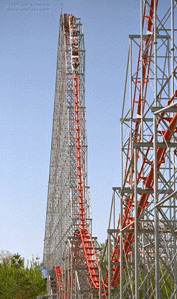
    The recession may be over but Americans are now experiencing The Roller Coaster Recession. Like a roller coaster chugging its way up to the top, home values climbed between 2002 and 2007. Beginning in the fall of 2007, home values declined, first slowly but inexorably until they bottom out and began to climb again. Have we bottomed out? The Atlantic screamed, “Home sales soared 11% in June”.

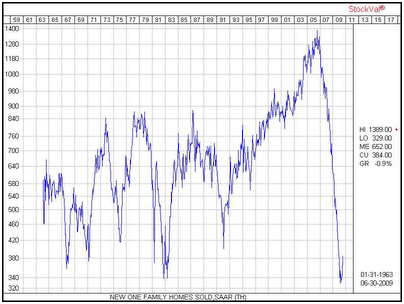
    Not so fast. Like the cars in a roller coaster, the first cars will begin to climb out while the last cars are still screaming downward at top speed. The Commerce Department reported sales in August rose a tepid .07% in August. What they did not highlight is that new home sales of 429,000 are at historical off the chart low compared to the last 50 years (see chart below).

    Such is the case with the Roller Coaster Recession. In California’s roller coaster ride the first car, The Inland Empire, crested the top in 2007. When pink slips were issued, these homeowners did not have deep pockets to sweat it out. All of their savings had been plowed into their down payment. When values declined, they had no staying power. They were gone in the first wave of foreclosures.

    Meanwhile, the rear car, Coastal California, continued to climb in value seemingly immune to the problems inland. The reason was staying power. The residents of tony Corona Del Mar were able to dump their third car, the Range Rover to keep solvent. When that ran out, Coastal California tapped their savings and finally used their equity lines to maintain their high mortgage payments while they waited for a buyer. But it is 2009 and the buyers have not materialized. More Jumbo Loans are falling behind in their payments. Watch the 60-day delinquency rate on prime Jumbo Loans. According to First American Core Logic, Jumbos in default jumped to 7.4% in May versus 4.9% for conforming loans

    Like our proverbial roller coaster, now it’s the turn for the first cars to rise. As the Inland Empire seems to have bottomed, Coastal California is still racing downward. There are 200 homes for sale between $1.5 and $3 million in ritzy Corona Del Mar. Even with a hefty 25% down payment, a $2 million property will require a $1,500,000 mortgage. Today’s lenders will require proof that the borrower can afford the $7,500 per month mortgage payment. They will demand a W-2 or 2008 tax return showing at least $22,500 per month in income to support a 30% housing expense ratio.

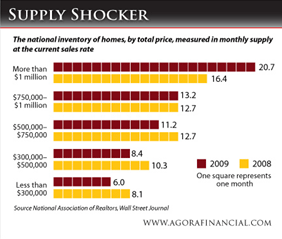
    The reality is there simply are not enough buyers earning $250,000 per year to buy up the 200 homes in Corona Del Mar. The current inventory will take 17 months to sell out but, as the recession continues, more homes are posting For Sale signs each month. Coastal California has not yet seen their bottom and they are still heading down at a rapid pace.

    Our national leaders may proclaim the end of the recession, but Californians have no reason to party. The Stimulus Package that shipped $50 billion to California was a one-time windfall that delayed but did not end California’s structural $26 billion budget deficit.

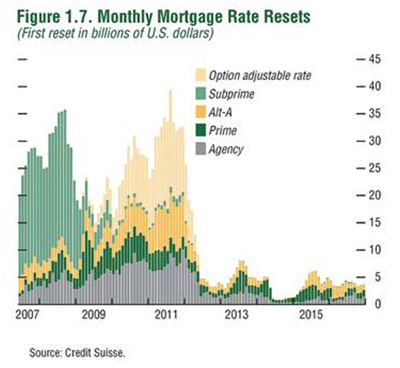
    Add to that the “Mortgage Armageddon” that is scheduled to hit next February. As the sub-prime mortgage defaults subside, the Option ARMS (adjustable rate mortgages) and Prime ARMs will begin to reset in early 2010 (see chart). This is not a working class but primarily a middle and upper-class problem. It is more a coastal than inland crisis; in New York terms, more Larchmont and less exurbia.

    There is a problem, however, with dinging the rich. They are the very folks expected to spend in our consumer-driven economy and invest in new ventures. If they have to re-route more dollars to mortgage payments, they not going to be able to help the economy.

    The Roller Coaster Recession will see more rises and dips before a sustainable recovery comes to California and other high-priced marekts. Those in the first car, like The Inland Empire, have nearly completed their ride. Any remaining dips will be minor in drop and brief in duration. But the genteel folks in the last car, in places like Coastal California, have another precipitous drop in front of them. This may come as a surprise to those believing the headlines that the recession was over. The wild ride for many is hardly over yet.

    ***********************************

    This is the fourth in a series on The Changing Landscape of America. Future articles will discuss real estate, politics, healthcare and other aspects of our economy and our society.

    Robert J. Cristiano PhD is a successful real estate developer and the Real Estate Professional in Residence at Chapman University in Orange, CA.

    PART ONE – THE AUTOMOBILE INDUSTRY (May 2009)
    PART TWO – THE HOME BUILDING INDUSTRY (June 2009)
    PART THREE – THE ENERGY INDUSTRY (July 2009)

  • Hyping Pittsburgh: With the Global Economy in Dire Straits, Hell with the Lid Blown Off Never Looked Better

    As host of the G-20 summit, Pittsburgh briefly will sit in the global spotlight. In this second article of a three part series featuring Pittsburgh, rust belt observer Jim Russell digs into migration and education trends and what it may mean for the region.

    Chris Briem (the blogger behind Null Space) jokingly called it the “Mystic Order of the Yinzerati”. He would later take the idea about the influence of Pittsburgh expatriates more seriously. I’ve referenced talk about a conspiracy theory involving the diaspora and how the current US President seems to favor the Steel City. How else does one explain the location of the upcoming G-20 economic summit?

    Site Selection magazine is the latest conduit for Pittsburgh’s aggressive image makeover. By now, the narrative is polished. As an active consumer of all media about Pittsburgh, I find the story stale. The lines are well-rehearsed and remind me of an article I read last year in the New York Times or a decade ago in the Wall Street Journal. More often than not, I would discover that the writer of the glowing review has a Pittsburgh connection.*

    Recently, a journalist from Forbes interviewed me about the Pittsburgh renaissance. I mentioned the positive press the city has received and how the Burgh Diaspora seemed to be behind it all. At that point, she confessed that she was from Pittsburgh. The result? Pittsburgh is an archetype for the thriving 21st century city.

    I’m an avid Pittsburgh booster and I would bet that this round of rebranding will finally take root. However, that doesn’t mean I believe everything I read. Left out are all the challenges the region faces. Local bloggers fret about the city pension crisis getting swept under the rug, pointing out that the many myths used to promote Pittsburgh are disingenuous. Some natives have gone so far as to suggest that all the propaganda is nothing more than gilding a turd. After all, the population of Pittsburgh is still in decline. What about the brain drain?

    Ironically, the brain drain from Pittsburgh is the reason why I’m so bullish on this region’s future. Taking notice of the prolific Yinzerati, I began to see talent out-migration in a different light. Not every Rust Belt city could marshal the kind of sustained campaign that has benefited the New Pittsburgh. The more fantastic the fabrication, the more impressive the media blitz would seem. Surely expatriates from other shrinking cities could do the same. I’ll tell you why they haven’t.

    As brain drain is commonly understood, every region suffers from the same affliction. But the exodus from Pittsburgh was exceptional. Chris Briem charted the difference between unemployment rates in Pittsburgh and the national average from 1970 to present day. You might note that right now, never has the job market looked relatively better. What should really stand out is how bad the economy was in the early 1980s. It was a remarkable period of out-migration for young talent, robbing Pittsburgh of almost an entire generation.

    As I began to understand the connection between educational attainment and geographic mobility, I speculated that Pittsburgh’s brain drain was the result of a substantial investment in local human capital. The chronic decline in population is the result of successful workforce development policy. At least, that was my theory.

    Bill Testa, who works for the Federal Reserve Bank of Chicago, provided the evidence I was seeking. Compared with other Rust Belt cities and the nation over the period 1969-2006, Pittsburgh has anemic total employment growth. Strangely, Pittsburgh is a cohort outlier (in positive respects) if we consider gains in per capita income.

    Testa hints at the reason behind the surprising statistic:

    While Pittsburgh ranked low in college attainment in 1970, its gains in this metric since then have been the most rapid. Perhaps not accidentally, Pittsburgh’s growth in per capita income also outpaced other cities in the region.

    Pittsburgh did a great job of educating its populace. This policy would betray the region during the hard times of the early 1980s. Dynamic labor mobility found expression in the only avenue available, relocation. The Mysterious Order of the Yinzerati was born.

    Pittsburgh hasn’t been able to cash in on the diaspora dividend until the last decade. As I noted above, positive spin about Pittsburgh isn’t anything new. During the early 1990s, the work of urban planner Paul Farmer was nationally admired. Cities such as Minneapolis hoped to mimic Pittsburgh success. Former mayor Tom Murphy, not remembered fondly in Pittsburgh, enjoys a strong reputation as a wizard of downtown revitalization almost everywhere else. I imagine the Burgh Diaspora actively evangelizing their hometown’s dramatic transformation. But if anyone was listening, they didn’t move there on the advice of these expatriates.

    The demographics quietly improved. What little immigration there was tended to be highly educated. Furthermore, the numbers of college educated residing in Pittsburgh are becoming more concentrated. All the while the population continues to decline and that’s what makes the front page, which brings me back to positive publicity push leading up to the G-20.

    Pittsburgh is finally ready to take advantage of the spotlight. With the global economy in dire straits, hell with the lid blown off never looked better. The underlying numbers, such as unemployment, are relatively strong. Pittsburgh is a place of brain gain, not drain. When national growth returns, people will begin to move again. Pittsburgh will be one of the places they will consider.

    Thanks to the considerable influence of the Yinzerati, historic federal expenditures will rain down on the land of Three Rivers. Chris Briem can tell you how many Yinzers end up in Washington, DC. Or, ask the head coach of the Washington Redskins. The point is that even if you don’t know much about Pittsburgh, many people inside the beltway do. The G-20 is just the tip of the iceberg.

    *For the record, my Pittsburgh connection is through my wife who grew up in the North Hills.

    Read Jim Russell’s Rust Belt writings at Burgh Diaspora.

  • Olympics the Chicago Way

    Most American cities chose not to bid on the 2016 summer Olympics and with good reason. With the exception of the 1984 Los Angeles games, the Olympics has proved a big time money loser in city after city. More often than not, it has been staged more for the prestige – think of Berlin in 1936 or China in 2008 – it brings to regimes, particularly autocratic ones.

    In Chicago, prestige is important, but graft is the real king. In Chicago, one of the most corrupt big cities, the Olympics represents, more than anything, a grand chance for a giant heist.

    Economists have a technical term for profiting from the political process: it’s called rent-seeking. Chicago’s politically favored businesses, unions, and insiders with ties to Mayor Daley and Alderman Burke have perfected this activity. The Olympics just provide another opportunity to clean up at the public expense.

    This is how it works. On Chicago public works projects, those on the inside hope to get overpaid at the expense of Illinois and federal taxpayers. Now throw in the Olympics where opportunities for such activities have long been rife with corruption and you can understand the glee in the Chicago machine’s eyes.

    Right now there isn’t any financial guarantee from the federal government. But Chicago’s power elite hopes Rahm Emanuel, Valerie Jarrett, David Axelrod, and others can convince the Congress at some point to help with Chicago’s Olympic sized costs if they get the 2016 games. They can always call it a “stimulus”!

    Yet is the average Chicagoan thrilled at this prospect to get reamed? A recent Chicago Tribune/WGN poll shows a slide in public support:

    Nearly as many city residents oppose Mayor Richard Daley’s Olympic plans, 45 percent, as support them, 47 percent. And residents increasingly and overwhelmingly oppose using tax dollars to cover any financial shortfalls for the Games, with 84 percent disapproving of the use of public money.

    The poll comes a month before the International Olympic Committee selects the host city for the 2016 Olympics. Chicago is competing against Tokyo, Madrid and Rio de Janeiro.

    The new results show slippage from the 2-to-1 support found in a Tribune poll in February, and experts said the findings could hurt Chicago’s chances.

    But fading public support in Chicago could be overwhelmed by political factors. With 107 votes on the International Olympic Committee(IOC), the African votes are considered the swing votes. President Obama made a special appeal to the African IOC voters. WLS TV reported:

    European IOC members may be inclined to support Madrid. Asian members may back Tokyo. There is one continent whose members are not aligned: Africa. Chicago’s bid team traveled to Abuja, Nigeria, to meet with Africa’s 16 IOC members, who may hold the swing votes.

    The fear of cost overruns, a history of bloated union contracts, and fraud has tempered enthusiasm for the Olympics. Mayor Daley has had to promise tighter oversight on the whole Olympics process. Yet this has not prevented an effective grass roots opposition organization from springing up. No Games Chicago has been instrumental at raising questions of money and accountability, dampening public support for the games. No Games Chicago spokesman Thomas Tesser explains:

    The City Council voted to give oversight of the City’s Olympic commitments to Ald. Ed Burke, chairman of the Finance Committee. This is the final cruel joke played by the Council on the taxpayers. Burke has become a millionaire doing deals with firms that have business with the city and has collected millions in campaign contributions from firms doing business with the city. Pat Ryan, the chairman of the 2016 effort, contributed $3,000 to Burke. Burke didn’t mention that he has ten clients who are major donors to the 2016 Committee, giving a total of at least $1 million in cash and services, and likely much, much more.

    But, Alderman Burke isn’t the only insider benefiting from the Olympics. Real Estate developer Michael Scott also stands to gain. The Chicago Tribune reports of Scott: “A member of Mayor Richard Daley’s team working to bring the Olympics to Chicago has quietly arranged to develop city-owned land near a park that would be transformed for the 2016 Summer Games, potentially positioning himself to cash in if the Games come here.”

    Michael Scott is also President of the Chicago Public School board. The Chicago Sun-Times reported that Scott

    has been subpoenaed to testify before a federal grand jury investigating how students are chosen for admission to some of the city’s most elite public schools.

    This new scandal might put in to question Secretary of Education Arne Duncan’s leadership as CEO of the Chicago Public School system.

    All the recent skepticism of the cost of the games couldn’t stop Chicago insiders from getting the stunning vote of support from Chicago’s City Council. This is still a one-party, all-machine, all-the-time town. In a vote of 49-0, the City Council showed that there is not a single vote to back the nearly fifty percent who oppose Mayor Daley’s plans.

    Michelle Obama will lead a Chicago delegation for the last pitch for the games in Copenhagen next month. Some speculate that President Obama will make a dramatic last minute appearance to make Chicago’s case in front of the International Olympic Committee. No one knows for sure whether Chicago will get the 2016 games but if it does, it will be a grand feeding time at the trough for the insiders and ever bigger burdens on the less well-connected businesses and individuals who inhabit Chicago.

    Steve Bartin is a resident of Cook County and native who blogs regularly about urban affairs at http://nalert.blogspot.com. He works in Internet sales.