Now that Senators have reconvened from summer hiatus, one of their first tasks will be to contemplate the greenhouse-gas cap-and-trade carbon market that President Obama would like to institute to blunt global warming. Their necks better be limber. Partisans of Keynesian, market-based regulations will undoubtedly point to the Midwest’s federally run “acid rain” program to reduce harmful power-plant emissions as proof that giving industry profit incentives in cleaning up their operations can be successful. Regulation skeptics will wave that example off dismissively, urging Senators to swivel their heads for a look across the Atlantic, where the European Union’s Emissions Trading System has registered lousy results.
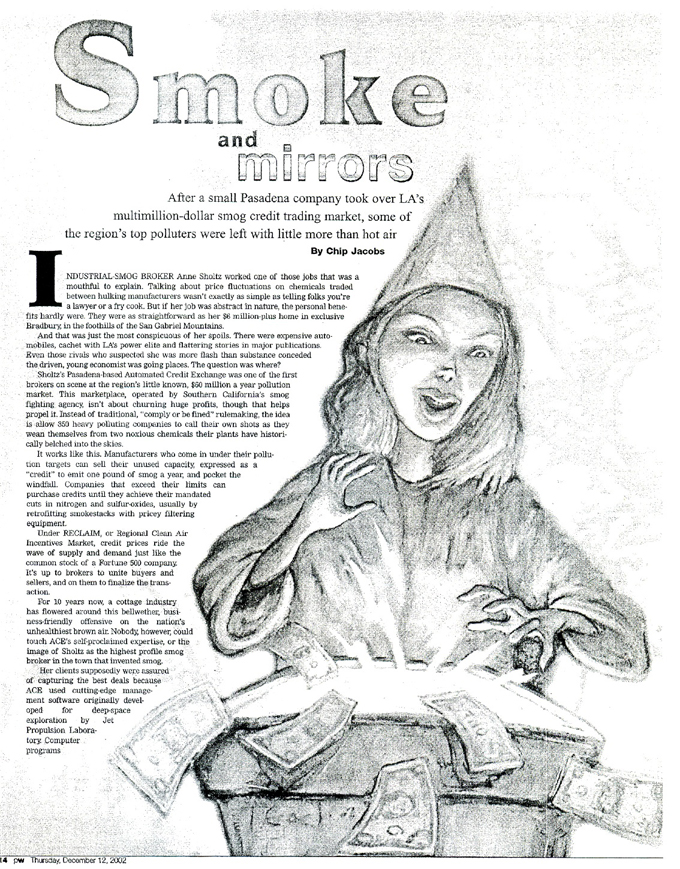
Whatever those markets do or don’t foreshadow, if the American Clean Energy and Security Act of 2009 and its mandated cap-and-trade become law, a glimpse of an unintended — and unsavory — future may reside in the tale of the inscrutable businesswoman from smog-bound Southern California who scammed the area’s pollution exchange…twice (see my site, www.chipjacobs.com, for the newest revelations of a second scam). Rather than a tale of a dreamer’s demise, Anne Sholtz’s story is a bracing reminder that to create a market, no matter its aim, is also to inspire a class of people determined to game it.
If Wall Street traders can commodify sub-prime mortgages with impunity, and the Enrons of the world can manipulate energy markets like a pinball machine, imagine a future when tradeable permits for carbon dioxide and other heat-trapping gases are auctioned and swapped over the public’s head. A Heritage Foundation economist expects the action to hit $5.7 trillion in value, and many experts say it all adds up to an irresistible buffet for chicanery.
Few in Washington ever heard of Sholtz, 44, before last spring, when the former Caltech economist was sentenced in federal court to a year of home-detention and five years of probation for defrauding the nation’s first air pollution cap-and-trade market. Sholtz was cozy with the RECLAIM program and the bureaucrats who run it at the South Coast Air Quality Management District (AQMD). That’s because in the early-1990s she had helped design the concept as an adviser.
Her know-how proved dangerous. Between November 2000 and April 2001, Sholtz tried fooling one of her clients, a New York-based energy trader, into believing she could complete a fat, multimillion-dollar deal with what is now ExxonMobil Corp. when in fact she could not. Stringing executives at the client company along until she could reactivate a transaction, she emailed and faxed falsified sales documents, including phony invoices.
Pleasant, brainy and ever-hustling, Anne Sholtz was not somebody folks expected to see handcuffed. Her 2004-arrest by EPA agents on white-collar fraud charges shocked and mystified local environmental circles. She and her companies, Automated Credit Exchange and EonXchange, had boasted a heavyweight list of clients and financial partners, and had worked with the Dutch government on an emissions test-market. As one of California’s rising green-entrepreneurs, Sholtz was a niche-celebrity with access to powerful politicians and regulators, and a hillside mansion, fine cars and whatnot to show for her ingenuity.
For our purposes, the reasons she’d risk all that matters less than the fact she was able to do so undetected. (You can read the entire expose here.) And that Obama’s proposed carbon market would look a lot like L.A.’s now 15-year-old smog bazaar. RECLAIM sets progressively lower emissions’ limits for roughly 330 of the Southland’s largest oil refineries, power plants and other manufacturers, and allocates credits calculated for each one. Companies that install new particle-trapping equipment or develop cleaner operations in other ways to reduce oxides of nitrogen and sulfur can sell their unused credits to peers who may exceed their allotment. Since 1994, there have been about $1 billion in trades, which brokers help negotiate, and about 40-million pounds of smog chemicals transacted.
AQMD contends that, after a languid start, its regimen has achieved its emission-cutting goals. At first, an over-allocation of credits to ease industry into the new system simply encouraged many companies to delay purchasing greener equipment. (Using the same logic, the current Obama-backed energy bill, sponsored by House Democrats Henry Waxman of California and Edward Markey of Massachusetts, would initially give away an eye-popping 85 percent of greenhouse-gas credits to cushion carbon-dependent states. This means dramatic emission reductions likely won’t happen for years.)
RECLAIM added another bold move to Southern California’s environmental pedigree, a change that industry actually wanted. But in developing such an open-ended, boutique market officials essentially flaunted their gullibility to cheaters, scammers and profiteers. It took AQMD several years to learn of Sholtz’s deceit, and only then after nine of her clients complained about being cheated.
A year before that, in 2001, the air district had been blindsided by California’s electricity crisis, and the subsequent order by then-Gov. Gray Davis that power-plants run nonstop to prevent rolling brownouts. Speculators from Texas to New York with no industrial operations in the South Coast basin hoarded RECLAIM credits they knew utilities needed, later reselling them at huge markups. The market teetered near meltdown, and district brass had to yank power companies from the market.
Ironically, one reason AQMD officials were oblivious to Sholtz’s actions was because they’d nixed her very own recommendation during RECLAIM’s design phase to stamp each credit with identifying marks, somewhat akin to a bar code. Loose trade-reporting requirements added more vulnerability. As California’s experience makes clear, building an incorruptible greenhouse-gas market may not be just formidable, it may be impossible, because the money and opportunities for deception are so tantalizing.
This May, two Republican congressmen skeptical of Obama’s cap-and-trade plan, Joe Barton of Texas and Greg Walden of Oregon demanded extensive answers from the EPA about the Sholtz case. Why, they asked, were so many case documents still sealed by the Justice Department? How could this have happened on regulators’ watch, and what does it portend for a greenhouse-gas market?
On their heels, AQMD executive officer Barry Wallerstein defended his market as virtually bulletproof to further criminality, while the EPA downplayed the matter as an isolated case. Those declarations occurred before documents emerged showing that Sholtz had told prosecutors during her 2005 settlement plea about “rampant” violations and graft by AQMD executives administering the market.
All of which is to say Senators should look straight forward with furrowed, “prove-it” brows when fellow members and environmental glitterati pronounce that a greenhouse gas market will operate cleanly because really smart people with nifty technology will be policing it. As the Waxman-Markey legislation stands, the Federal Energy Regulatory Commission, the EPA, and perhaps several more agencies will be patrolling for fraud, speculation, price manipulation and so-forth. Other enforcement details are hazy.
Chip Jacobs is the co-author, with William J. Kelly, of Smogtown: The Lung-Burning History of Pollution in Los Angeles
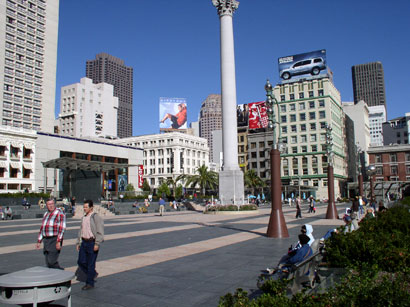 Union Square, San Francisco – Despite an expensive redesign nearly five years ago, Union Square is still not the central urban gathering space for San Francisco. Although it does serve as an incidental focus of pedestrian activity within the immediate neighborhood, the primarily hardscaped design is too fussy and too formal to encourage casual passive use and extended stays, except, perhaps, within limited zones at the fringes. The little available seating is poorly designed, intended to prevent homeless use rather than to promote use by casual park visitors. Primarily a concrete space with grass at the corners, Union Square lacks the “warmth” that makes such spaces comfortable. Imagine a Union Square with a great lawn in the middle, rather than cold (and expensive) hardscape.
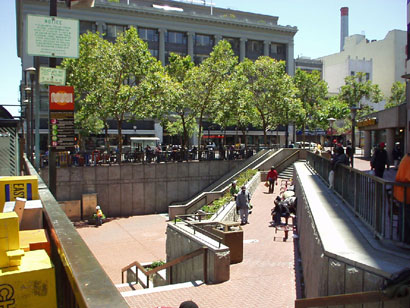 Market Street, San Francisco – Punctuated by intermittent triangular plazas along most of its downtown stretches, portions of Market Street’s public space are more the domain of homeless panhandlers than workers, residents, strollers, and the like (it should be noted, however, that some parts of Market Street, such as in the Financial District, can be pleasant at times). The plazas, quality architecture, and mix of uses create potential. But the pedestrian environment discourages extended dwell times, except by the homeless, panhandlers and drug dealers, many of whom, the city has documented, commute daily to Market Street from elsewhere in the Bay Area. The design offers little in the way of seating options and softscape. Sanitation and maintenance need to be substantially upgraded and programming is needed.
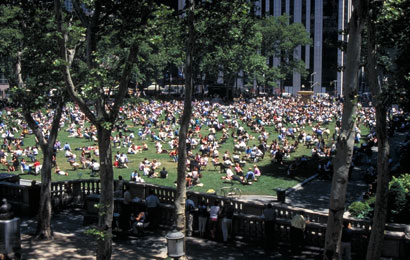 Proper seating, adequate lighting, and extensive horticultural displays would serve to populate these public spaces. Proper management and maintenance would ensure long-term success. Places such as Bryant Park in Midtown Manhattan, itself the beneficiary of a remarkable turnaround masterminded by Daniel Biederman of the Bryant Park Restoration Corporation, have shown what visionary management can do to struggling urban public spaces. [Kozloff worked for BRV Corp., Biederman’s private consulting company that is independent of the Bryant Park Restoration Corporation, from 2001-2004.] Although once run on a city budget of $200,000, Bryant Park is now managed on a privately-funded budget. Biederman turned Bryant Park – once the domain of drug dealers and other such undesirables – into Manhattan’s premier address without using public coffers.
 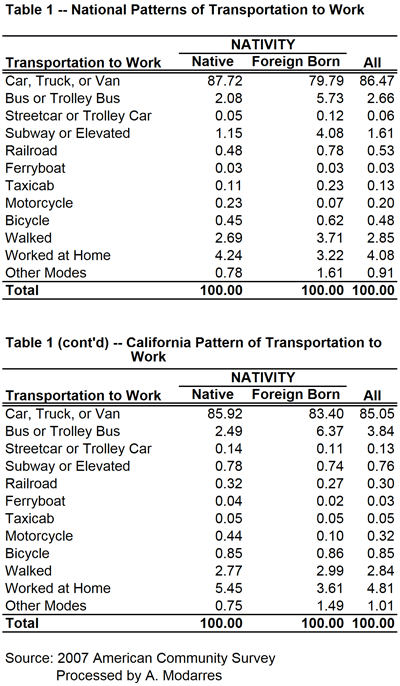 Based on the 2007 American Community Survey, 117.3 million native-born and 21.9 million foreign-born individuals commuted to work. As Table (1) illustrates, a higher percentage of immigrants rode buses (5.7% vs. 2.1%) and subways (4.1% vs. 1.2%) and many walked to work (3.7% vs. 2.7%). A much smaller percentage drove to work (79.8% vs. 87.7%). Unfortunately, despite their higher usage of alternate means of transportation to work, or perhaps because of it, the commute to work time was on average longer for the foreign-born commuters than their native-born counterparts (28.8 minutes versus 24.7).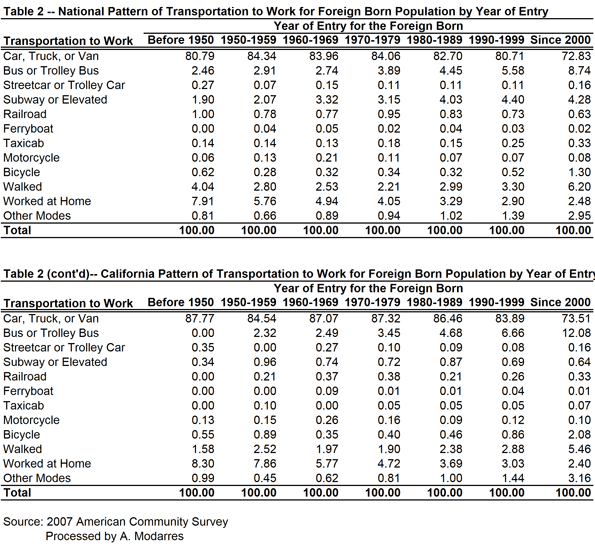
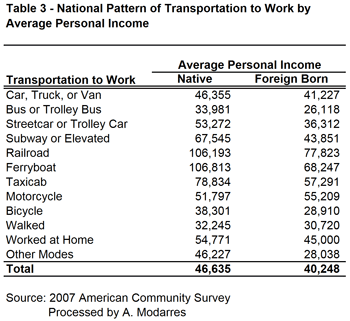 Even so, their rates are still slightly better than the native-born (compare Tables 1 and 2). This may be in part because of their lower incomes (see Table 3) yet at every level of income they are still more likely to take transit. Table (4) illustrates this point by grouping commuters into income categories and their nativity. In every income category, immigrants use their cars less and are more likely to use public transportation, even though their car ridership increases with income.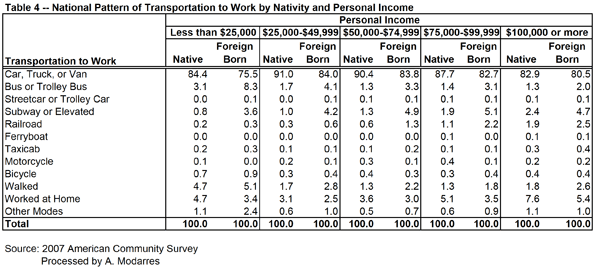
 explains the origins of the First Ward in the first decade of the Twentieth Century:
 200 brothels, many located in the First Ward. Colosimo is considered by the FBI to be the first head of the Chicago Mob. His base – organizing street sweepers – presaged the powerful role of public unions in Chicago nearly a century later.
  . Guzik, like Colosimo, was a pimp who passed his political connections on to his son, Jake. Jake Guzik, also a pimp, became the Chicago Mob’s accountant until his death in 1956. Guzik (note 1) was considered the number two man in the Chicago Mob and the financial brains behind the operation until his death in 1956.
 grave.