Author: admin

  • Washington, DC: The Real Winner in this Recession

    No matter how far the economy falters, there is always a winner. And no city does better when the nation is at the brink of disaster than Washington, DC. Since December 2007, when the current recession formally began, the nation has lost approximately 6 million jobs. Only two states, Alaska and North Dakota, have lost a smaller percentage of jobs than Washington, DC, which has seen a job loss of 0.6%, or 4,400. Simply put, Washington has done better in this recession than 48 of the fifty states when it comes to job performance.

    This is not the first time that Washington flourished while the rest of the nation suffered. For the first few, largely prosperous decades of the 19th Century, the district was a backwater, growing more slowly than the national average. It was widely reviled as fetid, swampy place with little in the way of commerce, industry or culture. Even its great buildings were compared to “the ruins of Roman grandeur.”

    It was only during arguably our greatest national tragedy – the Civil War – that the District of Columbia grew into an urban center, more than doubling in population from 1860 to 1870. Soldiers from the northern states flocked to the District of Columbia before going to battle, a new military force was established to guard against a Confederate attack, and the management of the war itself became a major federal enterprise. Slavery was abolished in Washington prior to emancipation, and freed slaves added to the District’s growing population.

    During the 1930s, FDR created an entirely new set of federal agencies designed to create jobs by financing projects across the country. At the same time, to prevent abuses on Wall Street, Congress created new regulatory agencies, such as the Securities and Exchange Commission, which hired droves of young accountants and lawyers unable to find work in other cities across the country.

    The Second World War and the Cold War also played to Washington’s advantage, as a vast military-industrial complex rose to the fore. So it’s not surprising that now, with the nation in the midst of its worst downturn since the Great Depression, that Washington appears about to indulge in yet another orgy of growth.

    Washington has always been a one industry town: that’s why it has an intrinsically self-absorbed monotonic culture. Everyone there depends on government for their livelihood. It is fundamentally not a city of competitive industries, but a giant taxpayer-funded office park, surrounded by museums and memorials. The great presidents: Washington, Lincoln, and Jefferson, have their own monuments, while more recent leaders have concert halls and office buildings named after them.

    Today Washington, DC appears much as the twenty-first century version of a gold mining town, even if the gold, so to speak, is coming from taxpayers as well as foreign buyers of our increasingly debased US currency. The Bush Administration kicked off this boom when it created the third largest cabinet department, the Department of Homeland Security, (by consolidating unrelated federal agencies into one super-sized department) and made it the employer of airport baggage and security inspectors across the nation. A new federal agency deserves a new headquarters, of course. DHS is now rising on the site of St. Elizabeth’s Hospital in southeast Washington DC, a pre-stimulus stimulus for the District of Columbia.

    The passage of the American Recovery and Reinvestment Act may be only slowly stimulating the nation’s economy but it is already working wonders in DC. Everyone wants a piece of the action. There is a surge in the lobbying industry, with every school board, regional transit agency and county government hiring a lobbyist to guide them through the new federal grant programs.

    Tourism may be temporarily down in DC, but the hotels are filled with local law enforcement officials, university bureaucrats, and housing advocates all trying to create jobs with federal dollars. The National Telecommunications and Information Administration and the US Department of Agriculture have just nineteen months to spend $4.7 billion on broadband communications.

    To evaluate the thousands of proposals for federal funding, expert panels will convene in Washington, DC. Where else? Communities across the country may receive grants, but the hotel and restaurant industry in the nation’s capital will also prosper from this new federal program.

    The same process will follow other Obama initiatives. Health care and climate change legislation will produce the same rounds of hearings, a growing cadre of regulators and the corps of tassel-shoed lobbyists who will try to influence them.

    The heightened emphasis on transparency in government has compelled every federal department to build sophisticated websites to engage the public, to distribute information, and to conduct the entire process of awarding grants and contracts. The demand for website designers and managers has grown so quickly that a Los Angeles-based interactive advertising agency, “Sensis,” a minority owned and operated corporation, recently opened an office in the District of Columbia just to “capitalize on the federal government’s new interest in digital communications.”

    There is one unambiguous measure that signals the growth of business activity within a city. Until recently, taxi fares in the nation’s capital were based on zones. These made it very inexpensive for members of Congress to go to and from the Capital. Today, every DC taxi has a meter and the old-fashioned zone-based system has been abolished. Both the municipal government and taxi drivers understand that there are more dollars to be made from those seeking to influence government than those who actually make the laws.

    Ben Smith of Politico.com has recently pointed out that five new Washington-based reality television shows are in the planning stages, with Bravo ready to launch “The Real Housewives of Washington, DC.” It is no accident that the entertainment industry has discovered the District of Columbia. A city that thrives in a recession may become the Fantasyland of our generation.

    Mitchell L. Moss is Henry Hart Rice Professor of Urban Policy and Planning at NYU Wagner School of Public Service.
  • Why Rapid Transit Needs To Get Personal

    Innovation in urban transportation is the only long-term correction for expensive environmental losses and energy waste. Why, then, isn’t there a US plan for more vigorous exploration and demonstration of new systems using advanced technologies, particularly automation? Where is the Personal Rapid Transit — PRT — in US transportation policy?

    PRT utilizes automated, energy efficient, very lightweight four seat vehicles that operate on narrow, electrified, dedicated guideways. PRT vehicles reduce pollution and conserve land use. The system preserves the benefits that have made automobiles our current dominant transportation mode: personal, on-demand, fast travel directly to arbitrary destinations. For non-drivers, it’s a form of public transportation that upgrades travel to the personal level now available with the automobile. It allows travelers to avoid the slow, stop and go, repetitive service schedule which has prevented meaningful acceptance of conventional mass transit in all but a few very dense cities.

    PRT works like this: At an off line station, a rider goes to a waiting group of personal cars, inserts a card, punches in a destination and joins the main line for the automatically controlled trip directly to his or her destination.

    By direct use of electric energy to power very efficient drive motors, the limitations and inconvenience of batteries are primarily avoided. In some cases, when complete area coverage for the guideway net is not completed, dual mode cars with minimum battery use can deliver the “last mile” to destinations. Of course, current programs for significant automobile improvement should continue until PRT operations are ready to supplant them.

    There is a safety bonus, since these very light weight, energy efficient cars are segregated from the mixed flow of heavy cars and trucks.

    The simpler, lighter PRT vehicles would use significantly less energy than hybrids or battery powered cars. PRT offers the most potential for deep cuts in greenhouse gases in a few decades, without restricting the mobility necessary for regional productivity.

    Community-useful PRT coverage is not possible “overnight”. But PRT and other emerging technologies can stimulate whole new job producing industries while reducing dependence on both fossil fuels and conventional autos for personal transportation.

    Billions are being spent on mass transit installations that few travelers want. Meanwhile, urban congestion increases. Urban “streamlined” mass transit is seldom faster than 100-year-old trolleys. No really new concepts have appeared, since government has not prioritized new systems. Instead, it supports minor changes in existing models. Look at the military’s successful history of taking advantage of risky new technologies. Imagine if it overlooked a comparable potential; it’s equally difficult to fathom telecommunications companies still offering “Ma Bell” style dial phones.

    There is some limited evidence that the concept and hardware are being adopted. Heathrow airport near London is about to open on-demand personal ground travel between parking and terminals. Masdar is a United Arab Emirates new city which will replace automobiles with PRT. In the US, completely automatic on-demand travel on a small, funds-limited basis has been operating successfully at the University of West Virginia for thirty years.

    Some investigators hope that private funding — perhaps an office park, or a campus — can give PRT its initial boost. Maybe a city would be willing to start such a system in a congested area.. Certainly, the automobile revolution started in piecemeal ways. The commitments that are needed today are larger, however. Today’s climate of regulation and progressive income tax discourage risk capital at the needed levels.

    There are signs that the Federal government realizes that transportation policy has lost direction. A recent National Transportation Policy Project report proposes performance-based investment decisions for economic productivity. Compared to other vital infrastructure and private enterprise accomplishments, truly new concepts in transportation have been missing for many decades. With an opportunity to stimulate the economy, and create new job producing industries of global significance, hopefully this new form of vital personal transportation can be the win-win basis for national economic health and efficient urban transportation.

    For more on PRT vehicles, see the Liberator Car by MonoMobile or the British/Swedish/Korean Vectusport-Vectur Transport.

    Walter Brewer is a retired Vice President of a concepts and management center supporting military missile and space programs.

  • Telecommuting And The Broadband Superhighway

    The internet has become part of our nation’s mass transit system: It is a vehicle many people can use, all at once, to get to work, medical appointments, schools, libraries and elsewhere.

    Telecommuting is one means of travel the country can no longer afford to sideline. The nation’s next transportation funding legislation must promote the telecommuting option…aggressively.

    The current funding legislation, called SAFETEA-LU, is set to expire on September 30. On June 24, a House subcommittee approved a discussion draft of the new funding bill: the Surface Transportation Authorization Act of 2009. U.S. Representatives James L. Oberstar (D-MN) and John L. Mica (R-FL), Chair and Ranking Member, respectively, of the Transportation Committee are now sparring with the Obama Administration about just when Congress should focus on reauthorizing SAFETEA-LU; the lawmakers say now; the Administration says 18 months from now. Regardless of the timetable adopted, the measure the House and Senate ultimately pass must maximize the powerful benefits of internet-based travel.

    Whereas the infrastructure for cars, buses and trains consists of roads and rails, the infrastructure required for telecommuting is broadband. Fortunately for the framers of the new transportation package, the stimulus legislation already provides significant funding – over $7 billion – to expand access to broadband. The transportation legislation should provide more. It should also expressly encourage the use of that broadband to telecommute.

    Some Congressional leaders have called on their colleagues to recognize telecommuting as a full-fledged transportation mode. On May 14th, twelve members of the House wrote to both the House Transportation Committee and the House Committee on Energy and Commerce, requesting that they consider including some pro-commuter reforms as they design the nation’s new transportation and energy laws. Among their requests were initiatives to incentivize telecommuting.

    One strategy these lawmakers proposed for encouraging telework was to condition federal grants to states and localities for transportation infrastructure on their creation of bold incentives for telework. Why impose this condition? Telework limits the wear and tear on new roads and rails, as well as the demand for further construction. Thus, it protects the federal investment in such infrastructure and mitigates future costs.

    There is precedent for insisting that the recipients of federal funding for infrastructure focus on telework’s potential to reduce the need for that infrastructure. Federal law provides that executive agencies, when deciding whether to acquire buildings or other space for employee use, must consider whether needs can be met using alternative workplace arrangements such as telecommuting. Requiring state and local governments that seek federal aid for new roads to include telecommuting in their transportation plans would demonstrate the same kind of fiscal responsibility.

    Other lawmakers have introduced legislation specifically linking broadband and more conventional kinds of transportation infrastructure. Representative Anna G. Eshoo, a Democrat from California, together with Democratic Representatives Henry A. Waxman from California, Rick Boucher from Virginia and Edward J. Markey from Massachusetts, has sponsored the Broadband Conduit Deployment Act, a bill that would require new federal highway projects to include broadband conduits. Democratic Senators Amy Klobuchar from Minnesota, Blanche L. Lincoln from Arkansas and Mark R. Warner from Virginia have introduced companion legislation in the Senate.

    The proposal set forth in the two bills makes economic sense. It would be an unconscionable waste of taxpayer dollars to dig up roadways, expand and repave them and then dig them up again to lay the broadband pipes the stimulus bill made possible. If the pipes are installed while the roadways are under construction, they will be available when broadband providers are ready to get communities online.

    If passed, the Broadband Conduit Deployment Act would only strengthen the case that funding for infrastructure projects should be conditioned on state and local government efforts to facilitate telework. If, as they finance highway projects, American taxpayers also fund broadband, they should not then have to struggle to telecommute. They should be able to help contain transportation costs and, at the same time, easily make the greatest possible use of the broadband access they financed.

    What kind of steps to promote telework should states and localities be required to take if they want to qualify for federal transportation funding?

    Congress should insist that they provide telework tax incentives for both employees and employers; eliminate tax, zoning and other laws that are hostile to telework; and offer both public and private sector employers technical help in developing and implementing robust telework programs. The government grantees should be required to create such programs for their own employees. They should also be required to designate certain high traffic and high pollution days as telework days — days when employees are specifically urged to take the web to work — and to conduct public awareness campaigns about the benefits of telework.

    These benefits go beyond transportation infrastructure savings, emissions reductions, and congestion management. Telework can help businesses and government agencies reduce real estate, energy and other overhead costs and use the savings to avoid job cuts or to hire new staff. It can increase employers’ productivity by 20% or more, and enable them to sustain operations if an emergency, such as the recent swine flu outbreak, compels significant absenteeism.

    Telework enables Americans who cannot find work in their own communities – and cannot sell their homes – to look for more distant positions. It can help those still employed to lower their commuting costs and juggle competing work and family obligations. It can help older Americans who cannot afford to retire to continue working even when they no longer have the stamina for daily commuting. And it can help disabled Americans with limited mobility join or re-enter the workforce.

    When Congress finalizes its new transportation policy, it must exploit the tremendous mileage it can get from encouraging web-based travel. Conditioning funding to state and local governments on investment by those governments in pro-telework measures – and offering meaningful federal funding to promote telecommuting – is a dual strategy that would yield a greener and leaner transportation system.

    In the process, this strategy would advance crucial energy, economic, quality of life and contingency planning goals. A clear emphasis on the need for telework in the new transportation bill is essential to help the nation get to where it needs to go.

    Nicole Belson Goluboff is a lawyer in New York who writes extensively on the legal consequences of telework. She is the author of The Law of Telecommuting (ALI-ABA 2001 with 2004 Supplement), Telecommuting for Lawyers (ABA 1998) and numerous articles on telework. She is also an Advisory Board member of the Telework Coalition.

  • View from the UK: The Progressive’s Dilemma

    American progressives long have looked upon Britain’s Labour Party as an exemplar of how to prioritize social welfare without entirely alienating business. Unlike their European counterparts, whose overly suspicious view of wealth and overly generous view of social welfare spending make poor role models for America, the British Labour Party has brokered a “partnership” between wealth and welfare over the years more suitable to the American psyche.

    Yet today that partnership is nearing collapse. For over a decade Britain’s supercharged financial sector fuelled the growth of an expansive state. But as the financial sector has cooled, Britain’s Labour party is now faced with the stark reality of burgeoning social welfare commitments, unprecedented public debt, and dubious upward mobility prospects for the ordinary citizen. The government has seemed more competent at creating upward mobility for civil servants who service the growing social welfare state than doing the same for the larger population who have to pay for it.

    Now the question for Labour – and the UK – is how to maintain an expansive social insurance program by somehow creating the kind of growth needed to pay for it. Once its “wealth creation strategy” of relying on a fecund banking sector fell apart, its project of providing income security rather than fostering income growth for ordinary people appears to be on the verge of failure.

    In order to maintain social welfare goals amidst a floundering economy, the UK has financed its shortfall through massive debt – something the average British household knows something about. Between 1997 and 2007 average household debt grew from 105 to 177 percent of disposable income. The US, of course, also experienced an explosion of household debt during the same period but not nearly to the same extent. At the end of 2007 America’s average household debt reached 106 percent of disposable income – essentially where the UK started 10 years earlier.

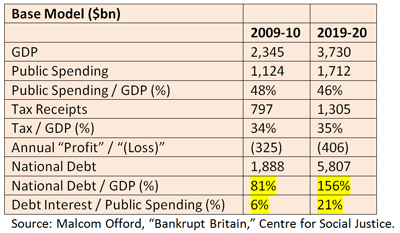
    The UK’s comfort with personal debt has now extended to the public realm. Even before the recession, Britain had $1.2 trillion of public debt, and by next year it will rise to $1.8 trillion, or 81 percent of GDP. If debt payment were a government agency, it would be the fourth largest in Britain. According to the London-based think tank the Centre for Social Justice, 21 percent of total public spending will be devoted to debt service in 2020, compared to 6 percent today. Public debt in the US, by comparison, will reach 60 percent of GDP by next year, and interest on the debt will rise from 4.6 percent to nearly 14 percent ten years from now. Labour’s legacy will be the Mount Everest of indebtedness it has left the current and subsequent generation.

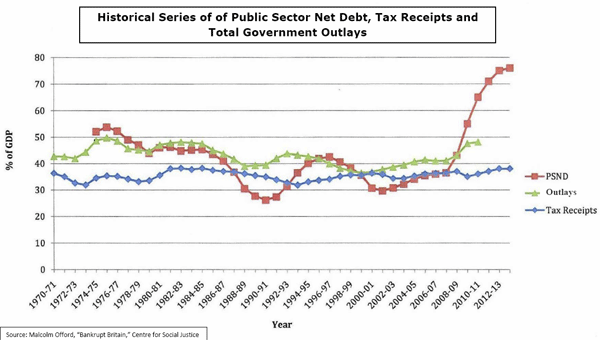
    To put this in perspective, we need look no further than historic trends over the past 30 years. Public debt has tracked fairly proportionately with public spending in the UK during this period. During the economic stagnation of the late 1970s, public debt rose to nearly 50 percent of GDP. It hit its nadir at around 25 percent in 1990 after the Thatcher era, and then rose to around 35 percent, where it has remained ever since – until last year. Suddenly, debt has skyrocketed to more than 75 percent of GDP in the past year – an unprecedented level – and will rise to 100 percent by 2012 before swelling to 150 percent by 2020. In order to reduce debt to its 45 percent level of just a few years ago, public spending would need to be cut by a third. Given that one-fifth of all public spending will go to debt service in 10 years, cutting spending will prove politically impossible for a government – and perhaps an entire nation – that identifies ever expanding government-funded services as essential.

    Even more disquieting, tax receipts have mainly hovered around 35 percent of GDP regardless of the tax rate during the past 30 years. This means that raising tax rates – such as Labour’s proposal to lift the top tax bracket to 50 percent– have little effect as high earners move away or find other ways to protect their assets. Logically, if it hopes to cope with its debt obligations, Britain should therefore keep taxes as low as possible and cut public spending. But instead the UK drives full-speed ahead into the fog of debt without having any notion of how to service its future obligations.

    The UK is therefore faced with a thorny dilemma: on the one hand, it has spent decades creating a social welfare system that reduces risk and promises citizens protection from life’s vagaries, and on the other, it needs people to take risks in order to revitalize the economy. Government spending fostered risk avoidance precisely when Britain most needs an entrepreneurial class that can help diversify the economy away from finance and, to a lesser extent, tourism.

    The people most hurt by social welfare are young working class people – the very group Labour purports to represent. In the UK there’s much talk about the NEETs – young people in their late teens who are Not in Employment, Education, or Training. In 2000 there were 630,000 young people between the ages of 16 and 19 in this group. Today, that number totals 860,000, a 36 percent increase in less than a decade. This would be the equivalent of 4.5 million young people in the United States. If NEETs were a city, they would be the third largest metropolitan area in the UK.

    Increasing numbers of able-bodied young people dropping out of society altogether reflects a growing sense of hopelessness. According to the Gallup World Poll, only 20 percent of 25-34 year olds, and 25 percent of 35-49 year olds, thought the economic conditions in the UK were good before the current economic crisis. The UK’s NEET problem and economic pessimism were rampant when the going was good – something that can only be worse now.

    This is not merely the result of a profligate welfare state. The NEET problem has its origins in complex cultural phenomena. However, it is difficult to argue with the conclusion that an increasing economic resignation among Britain’s younger population is ill-timed for a government betting on future workers to pay the public mortgage.

    The US has a more diversified economy than the UK and likely suffers from less economic resignation, but it is beset with a similar dilemma. Despite historically unprecedented levels of public debt, albeit less extreme than Britain’s, the Obama administration appears to be pursuing an economic program that bears similarities to the Labour preoccupation with creating prophylactics against risk and hardship. In a matter of months, the US deficit has risen from 3.2 to 13.1 percent of GDP, according to the Congressional Budget Office.

    Even with President Obama’s widely doubted promises to cut the deficit in half, the CBO estimates a yearly shortfall of more than $1 trillion ten years from now. Even worse, there is precious little in the administration’s plans – including its grandiose claims about “green jobs” – that will create the growth necessary to carry such debt in the future. In fact many of the administration’s proposals – from its healthcare program to its auto company ownership and a more heavily regulated financial sector – could serve more to curb growth than encourage it. In addition, increased taxes on “the rich” will hit small businesses most grievously, the most plausible engine for growth.

    It appears the administration seems intent on following Labour’s folly of mortgaging the future. Without addressing the issue of how to unleash the entrepreneurial energies of the young generation, it’s hard to see how America will avoid falling into the morass in which its British cousins are now so perilously trapped.

    Ryan Streeter is Senior Fellow at the London-based Legatum Institute.

  • America’s Energy Future: The Changing Landscape of America

    During the first ten days of October 2008, the Dow Jones dropped 2,399.47 points, losing 22.11% of its value and trillions of investor equity. The Federal Government pushed a $700 billion bail-out through Congress to rescue the beleaguered financial institutions. The collapse of the financial system in the fall of 2008 was likened to an earthquake. In reality, what happened was more like a shift of tectonic plates.

    History will record that the tectonic plates of our financial world began to drift apart in the fall of 2008. The scale of this change may be most visible in who controls the energy that powers our world.
    ***********************************

    May 2008 brought with it the highest price on record for Brent Crude Oil – $148 per barrel. At the pump that translated into prices in excess of $4.00 per gallon. A sixteen gallon fill-up of a Toyota Prius in Los Angeles cost its owner $72.00 and a fill-up of a twenty-five gallon Cadillac Escalade set its owner back more than $100.00. The largest transfer of wealth in the history of mankind was underway and consumers were feeling the pinch.

    The countries that border the Persian Gulf produce and export 20,000,000 barrels of oil per day. At its peak in May of 2008, the Persian Gulf producers (Saudi Arabia, Iran, Iraq, Kuwait, Qatar and the U.A.E) were receiving $3 billion per day, $90 billion per month and $1 trillion per year in revenues from the industrialized nations of the world, including the EU, North America and, most importantly, the rising powers of India and China.

    These Persian Gulf nations are mostly monarchies controlled by individuals, royal families or at best a few power brokers. American consumers abandoned their love affair with the SUV and Detroit’s assembly lines began to grind to a halt. New car sales which peaked at 17 million units in 2007 plummeted to a rate of 9.2 million within six months. The inventory of unsold vehicles built up and led inexorably to the bankruptcies of Chrysler and General Motors.

    At the same time, the airlines began charging for checked bags and discontinued the ubiquitous bag of peanuts as they reeled under the cost of jet fuel. Bellicose despots in oil rich lands outside the Middle East used their new found wealth to rattle their sabers. Russia, the world’s second largest oil producer after Saudi Arabia, began flying their venerable Backfire bombers to the American coast. Hugo Chavez of Venezuela, the world’s ninth largest oil producer, used his oil wealth to turn himself into an icon of the anti-gringo sentiment always beneath the surface throughout Latin America.

    Politicians, who placed America’s coastline off limits for drilling, were forced to recant their precious moratorium under the growing chorus of “Drill here and drill now”. Environmentalists, who destroyed the nuclear power industry with fearmongering over its safety, were increasingly on the defensive. T. Boone Pickens invested millions of his own money to promote wind farms – and more importantly natural gas – across America’s heartland. Sales of little known Jatropha seeds, a plant indigenous to India that produces an oil clean enough to run a diesel engine, skyrocketed. By the fall of 2008, the financial markets were buckling under the strain.

    As the economies of the world contracted, demand for oil plummeted and the price of crude collapsed. Terrified by the apparent mismanagement of the economy by the Republicans, Americans elected an untested junior Senator to the most powerful position in the world. Predictably, plans for alternative energy withered as prices plummeted and gas dropped to $1.50 per gallon. Russia, whose cost to develop crude is $50 per barrel, lost its swagger as its currency and stock market collapsed with the price of crude. The collapse of oil to $35 per barrel even silenced Hugo Chavez, at least for a moment.

    Sadly, the America public lost interest in energy as they were distracted by a 40% loss in their 401ks, corporate bankruptcies and the growing numbers of lay-offs. Politicians quickly shifted their focus from drilling, nuclear energy and independence from imported oil and began espousing the Obama administration mantra of “green energy” and “green collar jobs”. Unfortunately, these words are just a chimera since they are likely, even with massive subsidy, to produce only a small fraction of the nation’s energy for at least decade or two.

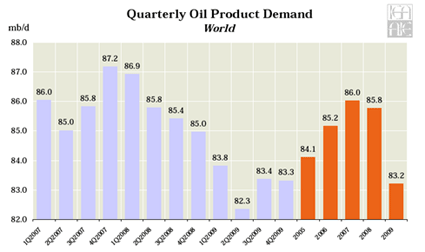
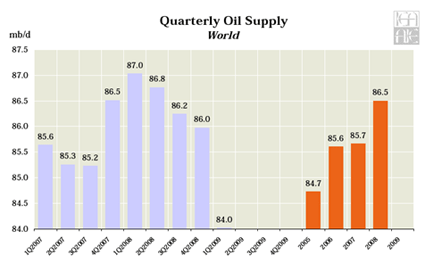
    These ephemeral goals only mask the real problem: America’s dependence on imported oil. The world demand for oil averages 85 mbd (million barrels per day). In the darkest days of the global financial crisis during the spring, when we stood at the abyss of The Great Depression, demand dropped to just 82.3 mbd. Conversely, world oil supply peaked at 87 mbd in 2007. This relative parity between supply and demand eliminates the elasticity that puts some control on prices. With literally no elasticity, speculators know that buyers will purchase every barrel of oil and prices rise. The proof of this market force is visible at the pump where gasoline has crested $3.00 per gallon in California and more than $2.66 per gallon nationwide. The United States consumes 20,000,000 barrels of oil per day or 24% of the world’s supply. In previous decades this was not a problem because the United States was a major producer of oil. But our peak production was reached in the 1970s when the US imported just 35% of its oil. Today we import more than 66% and no longer can influence the price of black gold. That price is now determined by despots in the Persian Gulf, Russia and Venezuela.

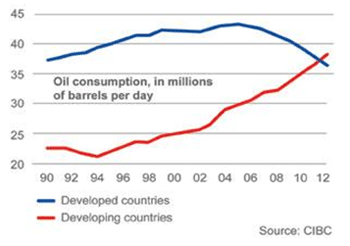
    This problem is not going away soon. According to the Energy Information Agency of the U.S. Government, the world demand for oil will require an additional 44 million barrels of oil every day to meet projected demand. The increase of demand is not going to come from the American or European markets. The developed nations through conservation, fuel standards, a reinvigorated nuclear power industry and, over time, the push for alternative fuels will actually reduce their consumption over the next twenty years. The push will come from India, Russia, Brazil, and of course China.

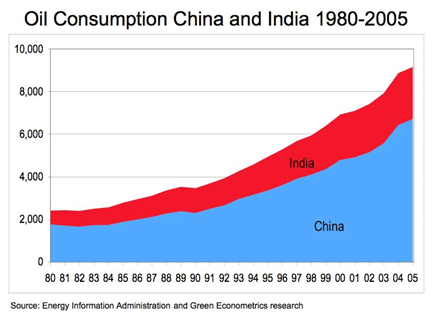
    India, with a population over one billion, has announced its version of the Interstate Highway System that opened America to its great Middle Class. After the acquisition of Jaguar and Land Rover, Tata Industries has begun production of the Nano, a car that sells for $2,000 in India. The demand for oil to power the cars for an educated and increasingly affluent Indian society will keep pressure on oil prices for years to come. India uses just 2.7 mbd today but expects that demand to grow to 4.5 mbd by 2030.

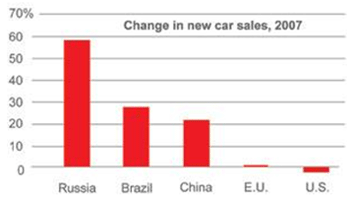
    There are now more than a billion Chinese. China consumed just 2 mbd of oil in 1990. Oil consumption jumped to 7.6 mbd in 2007 and is projected to grow to 15 mbd in 2030. The Chinese automobile industry grew at 21% last year while the US auto industry contracted by 40%. China displaced Germany as the third largest auto producer and will soon eclipse the damaged US auto industry which is contracting to a mere shadow of its former self. Chinese brands such as Chery and Geely, unknown to American consumers, may soon become as well known in America as Nissan or Hyundai.

    Demand will push oil over $100 barrels again. Vast capital will pour into the Persian Gulf, Russia and Venezuela once again. Into this tempest comes America with a thirst for 20,000,000 barrels each day. The major oil producers in the Middle East, Russia and Venezuela are not America’s friends. Russia will use its oil wealth to thwart the US and veto in the United Nations any effort to subdue the North Koreas and Irans of the world. China, with its surplus of US dollars, will continue to harvest natural resources around the world, and forge strategic alliances with the likes of Iran as it secures the flow of oil and natural resources to its industries for years to come.

    Meanwhile our politicians ignore our growing dependence on unfriendly nations and our weakening credit rating in the world to chase the chimera of green collar jobs and a green economy. Wind and solar will never power more than a minuscule fraction of America’s engines. America needs the equivalent of the Apollo moon project, a national challenge to move America off its dependence on foreign oil. We need simultaneous development of domestic oil and natural gas drilling, nuclear power, development of hydrogen fuel cells and clean coal technologies along with wind and solar power plants.

    A year from now the landscape of America will be forever changed. Five years from now, will American find the fortitude to grasp its energy independence? Or will our weak politicians in both parties keep their heads buried in the sand until China and India emerge to deny us what we are no longer in a financial position to demand?

    ***********************************

    This is the third in a series on The Changing Landscape of America. Future articles will discuss real estate, politics, healthcare and other aspects of our economy and our society. Robert J. Cristiano PhD is a successful real estate developer and the Real Estate Professional in Residence at Chapman University in Orange, CA.

    PART ONE – THE AUTOMOBILE INDUSTRY (May 2009)

    PART TWO – THE HOMEBUILDING INDUSTRY (June 2009)