Author: admin

  • The Fate of America’s Homebuilders: The Changing Landscape of America

    During the first ten days of October 2008, the Dow Jones dropped 2,399.47 points, losing 22.11% of its value and trillions of investor equity. The Federal Government pushed a $700 billion bail-out through Congress to rescue the beleaguered financial institutions. The collapse of the financial system in the fall of 2008 was likened to an earthquake. In reality, what happened was more like a shift of tectonic plates.

    History will record that the tectonic plates of our financial world began to drift apart in the fall of 2008. The scale of this change may be most evident in housing.

    PART TWO – THE HOME BUILDERS

    For decades, home ownership epitomized the American dream. For years, Americans saved their money for the required 20% down payment to purchase their dream home and become part of the great American Middle Class. They saved their money in a special account at the local savings & loan that paid a little more interest than the banks. Interest rates were fixed by law. A typical mortgage was written at a fixed rate for 30 years. Most American home owners stayed in their homes and celebrated the pay-off with a mortgage burning party.

    In this arrangement, it was understood that the savings & loans were allowed to pay more interest because they provided long term home mortgages. They paid depositors 4 – 5% and lent money at 6% making a little profit on the arbitrage for their risk. With a 20% down payment, there was little risk. Mortgage bankers knew the homes they lent money on and more importantly, they knew their clients. The mortgage stayed on the books at the local savings & loan until paid.

    In this time, home builders were mostly small local shops known by their customers and the lenders. For decades the industry was quite stable. Homes averaged 1,400 square feet in 1970 according to the National Association of Homebuilders. A quality home could be purchased for under $20,000. Not everyone could afford to buy a home but almost everyone aspired to this. Savings & loans provided 60% of all home mortgages.

    The first crack in the dam appeared in the late 1970s. Under President Jimmy Carter, America suffered double-digit inflation. As the value of the dollar eroded, Americans sought investments that could protect their dollars from the ravages of inflation. Regulation D prohibited banks from paying interest on checking accounts. A tiny bank in Massachusetts, the Consumers Savings Bank of Worcester, Massachusetts introduced the NOW Account (Negotiable Order of Withdrawal) and began paying a higher rate of interest than the savings & loans. Money flooded into the bank.

    The Depository Institutions Deregulation and Monetary Control Act of 1980 began the six-year process of phasing out limits on interest rate. Money flowed out of savings & loans and into NOW accounts and MMDA accounts (Money Market Depository Accounts). The S&Ls, with long term fixed loans on their books and short term money leaving for higher rates at the banks, never fully recovered. The primary source of funding for America’s home building industry was changed forever.

    In the late 1980s the S&L industry attempt to recapture market share by entering the equity side of real estate development with disastrous consequences. The government was forced to seize most of the S&Ls and sell off their assets through the Resolution Trust Company (RTC). In 1989, Congress passed TEFRA, the Tax Equity and Fiscal Responsibility Act that effectively outlawed direct ownership of property by S&Ls. It was a death blow to the industry and the end of the 30-year home mortgage as we knew it.

    This is where the seeds of the current housing disaster and financial meltdown were sown. Wall Street and politics entered the financial vacuum left by the demise of the savings & loan industry. The Garn-St Germain Depository Institutions Act of 1982 introduced the ARM (adjustable rate mortgage) which allowed rates paid to depositors to balance rates charged to borrowers. Our politicians, filled with good intentions, began down an irreversible path of using the home mortgage for social engineering.

    Seeking to increase homeownership, Congress began to unwind the financial safety net that protected the American dream for nearly 100 years. An ugly brew was concocted with the marriage of too much money and too much power. Congress began to consider housing as a right instead of a privilege.

    Over the ensuing quarter century, Wall Street and Congress conspired to turn the traditional 20% down, fixed 30 year mortgage on its ear. In 1977, they passed the Community Reinvestment Act that outlawed red-lining and forced lenders to make loans to poor neighborhoods. In 1982, they passed the Alternative Mortgage Transactions Parity Act (AMTPA) that expanded the funding and powers of Fannie Mae and Freddie Mac by lifting the restrictions on adjustable rate mortgages (ARM), balloon payment mortgages and the Option ARM (negative amortization loan). When a savings & loan made a mortgage in the past, they held it for 30 years or until paid. Freddie and Fannie became the new absentee owner of the majority of mortgages by purchasing them from the originators in the secondary market.

    Thus the die was cast. Mortgage bankers and brokers became salesman and paper pushers packaging applications for the secondary market and financial investors who never saw the asset they lent money against or met the borrowers for whom they made the loan. But this was not enough to satisfy the greed of Wall Street which invented the CMBS (commercial mortgage backed security) in 1991. This was nothing more than a private label pool of mortgages that they sold off to equally unconnected financial investors in their own secondary market. Home mortgage lending by commercial banks went from nothing to 40% of the market in a matter of years.

    The market could have possibly tolerated this bastardization of the conventional mortgage but neither Congress nor Wall Street could control themselves. There was simply too much money to be made. Congress determined that the credit score was discriminatory and violated the rights of the poor and minorities. In 1994, Congress approved the formation of the Home Loan Secondary Market Program by a group called the Self-Help Credit Union. They asked for and received the right to offer loans to first time homebuyers who did not have credit or assets to qualify for conventional loans. Conventional 80% financing was replaced with 90% loans and then 95% and finally 100% financing that allowed a home buyer to purchase a home with no down payment. The frenzy climaxed with negative amortization loans that actually allowed homes to be purchased with 105% financing.

    In June of 1995, President Clinton, Vice President Gore, and Secretary Cisneros announced a new strategy to raise home-ownership to an all-time high. Clinton stated: “Our homeownership strategy will not cost the taxpayers one extra cent. It will not require legislation.” Clinton intended to use an informal partnership between Fannie and Freddie and community activist groups like ACORN to make mortgages available to those “who have historically been excluded from homeownership.”

    Historically, a good credit score was essential to receive a conventional mortgage. Under pressure from the politicians, lenders created a new class of lending called “sub-prime” and as these new borrowers flooded the market, housing prices rose. Lenders used “teaser rates”, a form of loss leader, to help the least credit worthy to qualify for loans.

    Congress instructed Fannie and Freddie to purchase mortgages even though there was no down payment and no proof of earnings by the applicant. An applicant could “state” his or her income and provide no proof of employment. Stated income loans eventually became known as “liar loans”. Sub-prime loans grew from 41% to 76% of the market between 2003 and 2005.

    This devilish brew caused a record 7,000,000 home sales in 2005, including more than 2,000,000 new homes and condominiums. Mortgage lending jumped from $150 billion in 2000 to $650 billion in 2005. Prices rose relentlessly, pushed by more and more buyers entering the market. The top 10 builders in the United States in 2005 were:

    1. D.R. Horton – 51,383 Homes Built
    2. Pulte Homes – 45,630 Homes Built
    3. Lennar Corp. – 42,359 Homes Built
    4. Centex Corp. – 37,022 Homes Built
    5. KB Homes – 31,009 Homes Built
    6. Beazer Homes – 18,401 Homes Built
    7. Hovnanian Enterprises –17,783 Homes Built
    8. Ryland Group – 16,673 Homes Built
    9. M.D.C. Holdings – 15,307 Homes Built
    10. NVR – 13,787 Homes Built

    Economists and pundits eventually began to identify the phenomenon as the housing bubble. And, bubbles burst. But Congress was not ready to confront reality. Rep. Barney Frank testified he “saw nothing that questioned the safety and soundness of Fannie and Freddie”. Fannie Mae Chairman Franklin Raines was paid $91.1 million in salary and bonuses between 1998 and 2004. In 1998 Fannie’s stock was $75/share. Today it is 67 cents.

    In 2007 as prices stopped rising, the flood of buyers entering the market ceased putting market values into a free-fall. Home building is not a nimble industry. It takes years of planning and development to bring a project to market. America’s homebuilders had hundreds of thousands of homes and condos under construction when the housing market came to a crashing halt in the fall of 2008. New home sales, which topped 2,000,000 units per year in 2005, fell to an annual level of under 400,000 units in early 2009. Prices have retreated to 2003 levels and in some markets even lower.
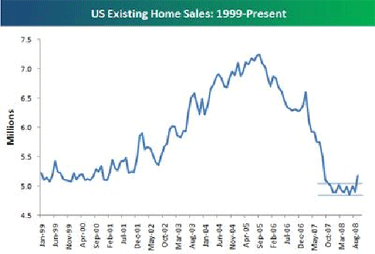

    What happens to America’s home builders? Do they follow General Motors and Chrysler into bankruptcy? Can they survive? New home sales are down 80% since 2005 – doing worse even than automobile sales. The tectonic plates of the housing industry are shifting rapidly and have not settled into any discernible pattern.

    Residential land has dropped precipitously in value but a case can be made that raw residential land now has a “negative residual value”. There are hundreds of thousands of completed but unsold, foreclosed, and vacant, homes littering the countryside. The chart above demonstrates how dramatically sales have fallen since their peak in 2005. This “overhand” inventory must be cleared out before any recovery can ensue. The prices of these units must be cut by draconian margins to attract the bottom fishers and speculators who will take the risk from the home builders and purchase the outstanding inventory. This will not happen quickly. This is not a market that can generate an early rebound.

    Has Congress learned from its mistakes? Apparently not. In March 2009, Democratic Representatives Green, Wexler and Waters introduced HR600 entitled “Seller Assisted Down Payments” that instructs FHA to accept 100% financing from those who cannot fund the required 3.5% down payment.

    A year from now the landscape of America will be forever changed. Five years from now, will American ingenuity have revolutionized the home building industry? The imperative is to find homebuilders who can speed production and lower costs. And government needs to learn from its own mistakes and realize that a successful housing sector depends on solid market fundamentals as opposed to pursuing an agenda of social engineering.

    ***********************************

    This is the second in a series on The Changing Landscape of America. Future articles will discuss real estate, politics, healthcare and other aspects of our economy and our society. Robert J. Cristiano PhD is a successful real estate developer and the Real Estate Professional in Residence at Chapman University in Orange, CA.
    PART ONE – THE AUTOMOBILE INDUSTRY (May 2009)

  • Rewriting The Oil Stock Story

    Could oil price manipulation have created the rerun of the Great Depression that we are currently enduring?

    Think about it. The doubling of gas prices had a profound effect on disposable income and the affordability of housing, whose subsequent downturn set the stage for economic collapse.

    We now know that Wall Street speculation drove oil from $69 a barrel to nearly $150. But this article purports to explain why.

    Back in early 2004, the nation’s investment banks began making large investments in oil stocks, which became the so-called “story stocks” of the era. The story was obvious. Emerging nations like China and India were driving up demand for oil, and supplies weren’t keeping pace.

    The investment banks had their analysts write papers espousing the profits to be made from oil, and they promoted the commodity itself as an asset class like real estate, stocks, and bonds, suggesting that it was suitable for long-term investment.

    To prove their point, the investment banks began investing in oil in the futures market. But their reason had nothing to do with what they were telling investors. It had to do with the long positions they held in oil stocks, which were certain to appreciate with the rise in the value of oil as a commodity. Exxon-Mobil stock, for example, went from around 40 in the spring of 2004 to a high of 95 on December 24, 2007. Merry Christmas and a Happy New Year!

    It was around this time that the Petroleum Marketers Association, which represents more than 8,000 retail and wholesale home heating oil companies and gas station owners, began getting hate mail. They were being blamed for gouging the public, even though their costs had more than doubled.

    Early in 2008, I received a call from a former stock brokerage client of mine, who is the CEO of a concern with factories and production facilities in China. “Tim, I keep getting these investment letters from the banks telling me how China is slurping up all this oil. But it simply isn’t true. Sure, the country is growing quickly, but no faster than last year, and certainly not enough to double the price of oil in less than a year.”

    Around the same time, Art Rosen, the former president of the National-Committee on U.S.- China Relations, also told me that China could not account for all the price spikes in oil. From what he could tell, there was plenty of product readily available at supply terminals throughout the Middle Kingdom.

    Now we know how this happened. The investment banks went to regulators to obtain permission to increase their leverage from a factor of 12 to a factor of 40 times capital. Much of that leverage was being applied to the already heavily leveraged oil market, where $10,000 controls over $100,000 of product. In the new scenario, $10,000 in the hands of an investment bank controlled $4 million in product.

    The levered effect on the price of oil was such that it began drawing huge amounts of money from stock and bond funds into the commodities markets, and specifically the market for oil. Institutional investors ranging from the Harvard Endowment to sovereign wealth funds got in on the oil action, which rose from $13 billion to over $300 billion in commodities transactions in just three years. At one point the markets were trading 27 barrels of crude oil for each barrel of oil that was actually being consumed in the United States, positions so large that they move the market in the cash commodity. In a single day in the price of oil jumped by more than $25, and yet there were no hurricanes or other supply disruptions that might have accounted for it.

    A report out of the MIT Center for Energy and Environmental Policy Research clearly showed that the dynamics of supply and demand for the cash commodity could not have been responsible for such a run-up in oil prices, which reached its steepest levels during an interval when supply was going up and demand was falling.

    By this time the price of gas was rising to five dollars a gallon. The owner of a $400,000 house who commuted by car suddenly discovered that that the price of gasoline had doubled and his commute was costing more than his mortgage payment. Something had to give and it was his mortgage. Suddenly, the $400,000 houses were worth $200,000, the mortgages were underwater, and the banks were drowning in red ink. The cascade in housing prices was soon mirrored in the price of oil. The money on Wall Street was now pulling out of the oil patch to drive down the bank shares and their mortgage-backed assets, setting the stage for the deepest economic contraction since the Great Depression.

    There’s plenty of blame to go around. But once again (as in Frontrunning and Finance; New Geography.Com), most of it should be borne by the people on Wall Street, best described as a bunch of crumbs held together by dough.

    Tim Koranda is a former stockbroker who now works as a professional speechwriter. He can be reached at koranda@alum.mit.edu.

  • The Gambler King of Clark Street, the Origin of Chicago’s Political Machine

    Long before Chicago sold off its assets, made plastic cows parade and outlawed goose guts, there was Michael Cassius McDonald, Big Mike. Where the Chicago Machine now grinds the citizen with Progressive idiocies, Mike McDonald and other Machine Mavericks like the Lords of the Levee appeared to actually help people. Vice and Government have gone hand-in-hand since Solon tried to reason with Croesus – Hesiod tells us that political corruption sparks political thought. The life of Michael Cassius McDonald was active and thought-provoking. Big Mike sleeps with counselors and kings a few hundred yards from my raised ranch along the tracks on Rockwell Street in the Morgan Park neighborhood of Chicago.

    Big Mike’s massive mausoleum dominates the entrance to Mount Olivet Catholic Cemetery on 111th street, situated between the railroad tracks that once served the Chicago Stockyards and the ones that connected to the steel mills of Indiana. Chicago workingmen had their pockets looted by Big Mike during the 19th Century, particularly those who were given to vice gambling, booze and broads. More importantly Michael Cassius McDonald was the architect of the Chicago Democratic Machine.

    Chicago journalist, lecturer, author and frequent guest contributor on the History Channel, Richard C. Lindberg has written a wonderful parallel to our current political situation. The Gambler King of Clark Street: Michael C. McDonald and the Rise of Chicago’s Democratic Machine – Southern Illinois University Press studies the life of this remarkable, energetic, romantic and larcenous Chicagoan.

    The flabby accolades and acclimations directed at Jane Addams by the PC crowd are all too tiresomely trumpeted. Socialist Sapphist has her own expressway, but most of Addams’ storied good works are more flatulence than wholesome air. In reality, her arch-nemesis 19th Ward Alderman John Powers did more for starving Greek, Italian, and Jewish families (while taking more than few spondulix for himself) than crop-haired Addams, whom Powers appointed to public office only to have Addams scream for his indictment. It is amazing, that, once one takes the time to read contemporary accounts from the archives, that iconic Harpies like Jane Addams emerge in the flesh. Likewise, traditional villains seem to have the scales of their sins drop like cotton-wood puffs. While doing some research on 1904 Stockyard Strike, I learned that Addams and her crowd seemed to sell out the strikers. Historians can deal with that, I guess. In the mean time Richard Lindberg casts a cold eye on history.

    Richard Lindberg studies Big Mike McDonald in the cold light of historical reality. This from the Amazon Product description:

    “Twenty-five years before Al Capone’s birth, Michael McDonald was building the foundations of the modern Chicago Democratic machine. By marshaling control of and suborning a complex web of precinct workers, ward and county bosses, justices of the peace, police captains, contractors, suppliers, and spoils-men, the undisputed master of the gambling syndicates could elect mayoral candidates, finagle key appointments for political operatives willing to carry out his mandates, and coerce law enforcement and the judiciary. The resulting machine was dedicated to the supremacy of the city’s gambling, vice, and liquor rackets during the waning years of the Gilded Age.

    McDonald was warmly welcomed into the White House by two sitting presidents who recognized him for what he was: the reigning “boss” of Chicago. In a colorful and often riotous life, McDonald seemed to control everything around him—everything that is, except events in his personal life. His first wife, the fiery Mary Noonan McDonald, ran off with a Catholic priest. The second, Dora Feldman, twenty-five years his junior, murdered her teenaged lover in a sensational 1907 scandal that broke Mike’s heart and drove him to an early grave.”

    I had the pleasure of chatting with Mr. Lindberg about his book that traces Illinois political corruption to the Chicago King of Vice in the 19th Century. Richard Lindberg traces the lineage of the modern machine and “boss rule” back to the 1870s – Big Mike was the uncrowned “boss” of the Democratic Party, controlling patronage, the gambling action, the Cook County Board, the neighborhood saloon bosses he anointed to aldermen and a bewildering array of contractors and spoilsmen not unlike the same kind of folks who cut the inside deals today. Rich moves the story forward to the 1890s and early 1900s when Mike relinquished his rule to younger up-and-comers. As the 19th Century rolled over and we move forward into the Cermak-Kelly-Daley years, the names become more familiar to us. After Mike settled in for a bitter and unhappy retirement having to contend with an unfaithful wife who ultimately drove him into the grave, the “impresarios of Democratic graft, clout and patronage” take over – James “Hot Stove” Quinn and Robert Emmet “Bobby” Burke (indicted); Roger C. Sullivan (who tried to ramrod through the Council the Ogden Gas Monopoly in the 1890s); George “Boss” Brennan, who mentored “Pushcart” Tony Cermak; the Pat Nash-Jake Arvey-Ed Kelly triumvirate through Depression and War; continuing on through the Daley Dynasty, the final destruction of Chicago’s Republican Party and the modern day notions of political correctness foisted on us that disguise a mountain of political malfeasance in good ole’ Crook County.

    There’s never been a book-length biography of McDonald written before – and Rich, the author of 14 books about his ‘ole home town, is contemplating making this Volume One of a three-volume history of Machine graft. The story is an eye-opener, but as Rich reminded me, the lakefront liberals who castigated John McCain and the GOP so savagely last Fall, turn a blind eye and say nothing about the 130 years of non-stop corruption in the City of Chicago – most of it perpetrated by the Lords of the Machine, of which Mike McDonald was its founding father. The shady history of the “Copperhead” Democrats of the Civil War, the 27 aldermen indicted since 1970 – none of that counts in this one-party, one-rule town championed by the Chicago Sun-Times (the Obama Times) when you get down to it, and that is the sad and sordid legacy of our past.

    This article is courtesy of the Chicago Daily Observer.

    Pat Hickey is an author, blogger, and regular columnist for the Chicago Daily Observer.

    You can buy Rich Lindberg’s book The Gambler King of Clark Street: Michael C. McDonald and the Rise of Chicago’s Democratic Machine here.

  • The Real Mayor of Chicago

    Most Americans living outside the Chicago area identify the city with Oprah, Obama, or Michael Jordan. When the subject of who really runs Chicago comes up, most people would say Mayor Daley. Chicago’s lack of term limits and persistent political machine have kept Mayor Daley in office for over 20 years.

    Those who know Chicago politics know there’s one man who’s more powerful than Mayor Daley, Alderman Ed Burke. Mayor Daley may be the identifiable public face of Chicago’s political system and act as a lightning rod for criticism, but the lower profile Alderman Burke wields the real power.

    Chicago’s City Council recently celebrated Alderman Burke’s record-breaking 40 years in office. No Chicago Alderman has served so long or accumulated so much power. No man represents Chicago’s political system better and all that is wrong with it. Only in a city that is hostile to checks and balances could a politician achieve what Alderman Burke has done. Since joining City Council in 1969, Alderman Burke has amassed a portfolio of positions to be the Machine’s top boss. Alderman Burke not only represents the 14th Ward but also serves as Chairman of the Finance Committee. The city of Chicago’s own website is quite honest about exactly who’s in charge:

    As Chairman of the City Council’s powerful Committee on Finance, Alderman Burke holds the city’s purse strings and is responsible for all legislative matters pertaining to the city’s finances, including municipal bonds, taxes and revenue matters. Alderman Burke became Chairman for the second time in 1989. He previously served from 1983 to 1987. He also serves as a member of the Chicago Plan Commission.

    One of the Finance Committee’s responsibilities is dealing with workers compensation claims. A few years ago, the Chicago Sun-Times explained Chicago’s system: “When city workers get hurt on the job, they usually turn to a handful of lawyers tied to City Hall. And the city often fights back by hiring lawyers with ties to Ald. Edward M. Burke, chairman of the City Council Finance Committee, which has sole authority to settle workers compensation claims against the city.”

    But, Alderman Burke’s control of Chicago’s financial purse strings isn’t his only lever of power. Cook County has the largest unified court system in America. In heavily Democratic Cook County, 100% of all of the judges are Democrats. The Chairman of the Democratic Party Judicial Slating Committee is none other than Alderman Burke.The Chicago Reader astutely observed Burke’s “Seat on the Democratic Party judicial slate-making committee ensures that Cook County judges owe him their jobs.” Alderman Burke’s influence goes beyond the Cook County level: his wife Anne is a justice on the Illinois Supreme Court.

    Along with all of Alderman Burke’s power to control Chicago’s tax code and Cook County’s judicial system comes campaign contributions. Alderman Burke doesn’t represent a wealthy ward, nor has he ever faced a serious political opponent, but he still has amassed an eye popping campaign fund. The Chicago Tribune explains:

    But the state’s richest political family was Ald. Edward Burke (14th) and his wife, Illinois Supreme Court Justice Anne Burke. Together, their political committees held $8.3 million in cash. The Tribune reported Monday that Anne Burke’s campaign was returning a large portion of her cash to donors because she is running unopposed in the Democratic primary.

    Mayor Richard M. Daley, who traditionally ceases fundraising after elections, raised just $43,000 in the last six months, but had $3.1 million in cash on hand.

    In terms of cash at the very least, Burke is already more potent not only than Daley but has more in his coffers than Daley and all 49 Aldermen combined. But, the ever active Alderman Burke is also a businessman, not surprisingly a rather successful one.

    The state of Illinois has rather lax ethics laws, and since being an Alderman is a “part time” job, Alderman Burke has outside employment. Burke runs a successful property tax appeals business. Burke’s latest ethics form filed with the city of Chicago shows his impressive list of clients. Such big corporations as AT&T, American Airlines, Bank of America, Northern Trust, Harris Bank, T Mobile and many others have done at least $5000 in legal business with Alderman Burke’s law firm in the last year. They also – I am sure readers will be shocked – do business with the city of Chicago. WBBM, the local CBS affiliate, even has Alderman Burke handle some of its legal business.

    Occasionally, Alderman Burke’s conflicts get reported on. When Obama ally and Blagojevich influence peddler Tony Rezko was looking to get his taxes cut on a big land deal the Chicago Sun-Times explained:

    Why did Ald. Edward M. Burke vote to approve Tony Rezko’s plans to develop the South Loop’s biggest piece of vacant land even as he was working for Rezko on that same deal?

    Burke says: I forgot to abstain.

    When Rod Blagojevich first decided to run for Governor in 2001, he got important backing from Burke. Blago’s father in law, by the way, is Alderman Dick Mell, a colleague of Alderman Burke’s who got the ball rolling.The Daily Herald unearthed this revealing statement from Alderman Burke in 2001 concerning Blago:

    “I am with Rod 100% because he has what it takes to win – money, message and an army of supporters,” said Burke, referring to a rousing announcement speech given by Blagojevich to a reported throng of 10,000 people on August 12. Burke also mentioned filings with election officials that show Blagojevich with over $3 million in his campaign fund, double the amount of cash on hand of all of his potential Democratic opponents combined.

    In the coming years, as Chicago style politics seeps into America’s mainstream, remember Alderman Burke. Thirty of Burke’s colleagues on Chicago’s City Council went on to become convicted felons since 1970. But Alderman Burke is still standing, and still dominating in the shadows, atop much of what happens in the Windy City.

    Steve Bartin is a resident of Cook County and native who blogs regularly about urban affairs at http://nalert.blogspot.com. He works in Internet sales.

  • The Changing Landscape of America: The Fate of Detroit

    INTRODUCTION

    During the first ten days of October 2008, the Dow Jones dropped 2399.47 points, losing 22.11% of its value and trillions of investor equity. The Federal Government pushed a $700 billion bail-out through Congress to rescue the beleaguered financial institutions. The collapse of the financial system in the fall of 2008 was likened to an earthquake. In reality, what happened was more like a shift of tectonic plates.

    In 1912 a German scientist, Alfred Wegener, proposed that the continents were once joined together as one giant land mass called Pangea.

    About 200 million years ago the continents began to drift apart as the globe separated into eight distinct tectonic plates. History will record that the financial tectonic plates of our world began to drift apart in the fall of 2008. They have not stopped moving and the outcome of where they will end up remains uncertain.
    PART ONE – THE AUTOMOBILE INDUSTRY

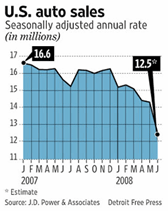
    Edsel, Packer, Studebaker, Hudson, Nash, AMC – the demise of these brands may have seemed tragic at the time, but were actually a sign of industrial health. In contrast, for the last fifty years the American automobile industry has been static. Despite the proliferation of Japanese, Korean and German imports, General Motors, Ford and Chrysler managed to hold on to a majority of the domestic market, with a dizzying stable of makes and models that grew to near 17 million new car sales in 2007. That epoch is now over. The tectonic plates have shifted under the automotive business and a year from now, the industry will bear little resemblance to the static structure of the last fifty years.

    Fifty years ago General Motors owned more than 50% of the American market and automobile jobs made up one seventh of the US workforce. It was said that when GM sneezed the US economy caught a cold. GM shares now sell for less than a cup of coffee at Starbucks. Now GM is about to enter bankruptcy.

    The brands are dissolving, Oldsmobile was the first casualty. Pontiac and Hummer have been discontinued. When they reorganize, eleven hundred dealers will be terminated. General Motors will close all its plants for three months this summer. Many will never reopen. The New GM, to be known as Government Motors, will be owned by the UAW (20%) and the Federal Government (70%). Twenty billion of tax-payer loans will be converted to ownership to make the UAW pensions liquid. The debt holders will see their senior $27 billion investment converted into just 10% of stock. The shareholders will be wiped out.

    The New GM will become the platform for small fuel efficient cars, hybrids, electric vehicles and experimental technologies mandated by an ever demanding government. Its shareholders vanquished, The New GM will bear no resemblance to the car company that we have known for the last 50 years. Can the Chevy Volt rescue GM? The answer is no.

    GM will continue to shrink as their SAAB and Saturn franchises are sold off to the Chinese. China’s automobile sales are up 10% this year versus declines of 23% in the US and 15% in Europe. Chinese automobile manufacturers are grabbing market share, 30% this year versus 26% in 2008, while their competitors are distracted. Chinese companies unknown to Americans like Geely Motors, Chery Automobiles or BYD Co. will buy SAAB or Saturn for their dealer network. Warren Buffett invested $230 million into BYD, a firm that has been manufacturing cars for just six years. They already provide batteries to Ford and GM and soon will be building the world’s least expensive mass produced hybrid and electric vehicles. Geely plans to triple its domestic sales to 700,000 by 2015 and Chery plans to introduce 36 new models over the next two years.

    Chrysler is in far worse shape and will likely never recover. The Federal Government already forced it into bankruptcy. Seven hundred and eighty nine dealers have been told that their franchises are terminated. Its shotgun marriage to Fiat will look more like a surgical amputation of unnecessary body parts than a marriage. If Fiat remains in the game, they will do so for the Jeep brand and a portion of the dealer network. Like Oldsmobile and Pontiac, Plymouth and Dodge brands are doomed as well as most of the Chrysler line. No one will mourn the demise of the Crossfire, Pacifica, Sebring, or the PT Cruiser. Fiat should keep the new Chrysler 300, a beautiful design that deserves to be built. Chrysler has not produced many stars in the last few decades. The trail blazing design of the 300 brought the full size sedan back from the dead.

    Chrysler will jettison the weakest of its dealers in bankruptcy. Fiat will retain the big dealers in the network. They will bring the stunning and iconic Fiat 500 to America, a fuel efficient small car that will enjoy the same success as Volkswagen’s retro Beetle. Fiat will also use the dealer network to bring the Alfa-Romeo back to America. The Fiat-Jeep-Alfa dealer of the future will bear no resemblance to the staid Chrysler-Dodge-Plymouth dealer of today.

    The surprising winner among the American troika of manufacturers is the Ford Motor Company. Ford and Lincoln will survive because they took no government bail-out money. Mercury may not survive but Ford and Lincoln should make it through the transition. The new Ford-Lincoln will be the refuge for auto enthusiasts who want attractive fast and powerful cars. Ford will become the Apple of the auto business, doing its own thing and flaunting political correctness and conventional wisdom. Ford’s namesake CEO has been an environmentalist for many years so Ford was well into fuel economy and hybrids before the tectonic plates began to move last fall. At just $5.00 per share, Ford is a tantalizing buy for the long term.

    One can no longer call Mercedes, BMW, Toyota and Honda imports as many of their cars are made entirely in the U.S. The Japanese system is different than the American counterpart although we are drifting toward their model. The Japanese government plays a heavy hand in their industry, subsidizing the encroachment into new markets until the brands have stabilized market share. But they are not immune. Toyota lost $7.7 billion in the last quarter – even more than GM.

    True imports like Volkswagen will weather the storm because they were well positioned with small fuel efficient cars long before the tectonic plates began to shift. VW is making a huge bet that oil will top $100/barrel again soon and their fuel efficient and clean diesels will be accepted by American drivers.

    The biggest winner is obviously the UAW and their pensions which have been bailed out with tax payer money by an administration beholden to its labor supporters. Who will be the biggest loser? Clearly, it will be America’s small towns. Our small towns will lose their local dealer and their choice in automobiles. They will be forced to buy the brand that remains in town or drive scores of miles to the next closest dealer for service. Most small town auto dealers were also the most generous members of the community. Charitable giving and support will wither as will local sales tax revenues when the big ticket automobile sales tax revenues disappear. Ironically, as the plates continue to shift, America’s small towns could be decimated by the changes in the automobile industry as they were one hundred years ago when the automobile shifted millions from rural communities to the cities.

    A year from now the landscape of America will be forever changed but the plates will continue to shift. Five years from now, will American ingenuity bring about a renaissance of the American automobile industry? Or, will what is left of this industry be gobbled up by the Chinese and the Korean manufacturers as the Japanese did in the 70s and 80s? The key issue may be what role the government will play. Will Americans buy cars designed by government bureaucrats and built by the unions that own the factories? Will an administration devoted to “coercing” Americans out of their cars be able to simultaneously save the auto industry?

    ***********************************

    This is the first in a series on the Changing Landscape of America. Future articles will discuss real estate, politics, healthcare and other aspects of our economy and our society. Robert J. Cristiano PhD is a successful real estate developer and the Real Estate Professional in Residence at Chapman University in Orange, CA.

  • Frontrunning and Finance: Left Foot Forward

    This month, the Obama administration moved to regulate the so-called ‘invisible’ financial instruments that have come to rule the world of finance. Variations of the ‘shadow’ banking system — or, in the preferred language of financiers, market ‘risk management tools’ — have increasingly taken the spotlight during the current crises.

    Jim Cramer, on one of those CNBC webcasts which he must have thought would never be seen by anyone who counts, appeared to admit in December to something illegal when he said, “A lot of times when I was short (stocks) at my hedge fund, I would create a level of activity beforehand that would drive the futures.”

    Might he have been referring to self-frontrunning, an egregious flim-flam that takes place on two separate exchanges almost simultaneously so that one regulatory eye can’t see what the other one sees? On one exchange, the hedge fund manager sells the index future, and on another, he executes a series of short sales in the stocks of which the index is composed. The net effect is to drive the future down to profitable levels. Or, in the case of Mr. Cramer, who goosed the futures after having shorted the stocks, to draw investors in to an arbitrage that he himself created.

    It is strange and striking that a practice responsible for the lion’s share of the trading profits of the nation’s hedge funds and investment banks should remain a secret… even an open secret. But every morning on CNBC’s Squawk Box, commentators comfortably predict that the market will open up or down based on the movement of the futures. And nine times out of ten they are right.

    This type of thing can go on ad infinitum: after having closed out the short position, one might readily go long the index future and likewise the composite stocks and make money on the upside as well. While not foolproof – a critical mass of fools could upend such plans in a jittery trading environment – one can achieve a comfortable margin of safety by working with other hedge funds to go long or short the identical stocks and futures in concert. The effect is momentum investing in the truest sense of the term. And lofty expectations are sure to be met because the law of one price will force the futures in line with the cash every time. Add computers and a little leverage, and your hedge fund will not only spectacularly outperform the market averages, but take on far less risk in the bargain.

    Of course, Wall Street firms which execute trades for hedge funds often have an advantage over the funds because they have inside knowledge of the trading plans. And they can and often do trade in advance of these moves to the detriment of the hedge fund customers. Recently, a jury convicted three former stockbrokers at Bank of America, Merrill Lynch and Smith Barney for placing open telephone lines next to the internal speaker systems to eavesdrop on block orders by hedge funds and other institutional clients.

    The hedge funds are run by bright people. They caught onto this scam quickly. And rather than miss out, they joined forces with the Wall Street firms themselves to combine their financial power in concerted transactions, which makes the markets even more volatile. Mighty orchestrations of computer-driven buy and sell orders then exploit the minute-to-minute differentials of the stocks and their derivatives. Those differentials add up to trillions of dollars.

    Such bold moves trigger wild price swings and send skittish investors to the exits. But the solipsistic trading strategy is so wonderfully profitable to the insiders that any thought of calming the waters prompts snickers. Regulators don’t seem to care; they think these moves improve efficiency, seemingly without realizing that the traders create the conditions under which index arbitrage makes sense.

    A variant of this practice played a major role in sinking the banks during the credit crisis that began last year. Hedge funds began by shorting the banks, and then forced them into the toilet by shorting the same mortgage pools that banks carried on their balance sheets.
    Mark-to-market accounting created the impression that the banks were insolvent. This not only ensured that the short positions were profitable, but forced the Financial Accounting Standards Board to rush rule changes.

    Years ago, when commodity firms first adopted it, marking to the market seemed like a good idea, as investors need to know not only the cost basis of an asset, but also what it would fetch in the marketplace. Today it’s clear that the market transactions may have less to do with an asset’s actual valuation in a normal trading environment than with its desired valuation in a manipulated one.

    Having ruined the banks, these same swindlers turned on the insurance companies whose short interest skyrocketed in tandem with the crashing of their shares because their annuity products were backed by the same triple-A rated mortgage bonds that reposed on the banks’ balance sheets. Ironically, some firms, such as Lincoln National, ended up buying banks to qualify for bailout money so that they could continue in business.

    The stakes to the economy may seem smaller when insurers — as opposed to banks — appear insolvent, but many alarmed customers were quick to move their business elsewhere at merely the whiff of insolvency. The consequences to both industries were such that for the first time in 16 years the finance and insurance sectors of the economy actually shrank by 16 percent. They now have to raise more equity just to keep their customers.

    The transactions at the source of these woes were the result of what one financial writer termed “regulatory somnambulism,” in that it allowed for the elimination of the up-tick rule — which stipulated that short sales be entered at a price that is higher than the price of the previous trade — and of naked short selling, which can sink a flagship faster than a broadside beneath the water line.

    Naked short selling is a vicious twist on the usual. Normal short selling occurs when investors borrow shares and sell them, hoping the stock will fall and they can buy back the shares at a lower price. Naked short selling artificially increases the supply of a security as one can sell them without first borrowing them and thereby might technically sell more shares than actually exist. This utterly speculative practice has no bearing on the efficiency of the markets, contrary to what its practitioners claim. Its only purpose is to flood the market with sell orders and drive down share prices.

    In doing so, it contributes to an inaccurate picture of financial stringency that plays a major role in the price and allocation of credit and capital, which is central to the proper running of the world economy. It’s a true tail wagging the dog phenomenon that enriches well-placed gamblers at the expense of everyone else.

    Tim Koranda is a former stockbroker who now works as a professional speechwriter. He can be reached at koranda@alum.mit.edu.

  • Who will win the Car-wars?

    General Motors, the venerable American auto manufacturer is sitting on the cliff’s edge in North America with a recent 3-month loss of $6 billion. However, GM watched its sales in China skyrocket 50% for the month of April, 2009. Ironically, Toyota, the company many Americans now cheer for, has posted a $7.7 billion loss for the first quarter.

    This now proves, without a doubt, that the auto industry – not just in the US – is going through a massive crisis. But it’s clear that American manufacturing has reached a critical, historical turning point. What was once good for General Motors is no longer good for the rest of the nation. The days are gone where an automobile must be designed in the Detroit region and manufactured in the Great Lakes. We have seen a shift in trade and production location from the north to the south. However, geographic arguments are only a small part of the overall challenge to the industry, especially in North America.

    When the dust settles, what will the American auto industry look like?
    Regardless of what some may say, there is no such thing as an “American” vehicle anymore. We are fast shifting into a global economy that requires the sharing and collaboration of multinational resources from across the globe. Consumers demand quality products at very affordable costs. Corporations have no choice but to comply with consumer demand even if it means off-shoring production and even trimming quality in order to save money. In many ways, this is the Wal-Martization of consumer goods.

    The 21st-century automotive industry will be geographically spread throughout North America. Modern technology allows engineers to work from just about any location regardless of population, climate or infrastructure. However, many engineering outfits have found that locating brainpower in dynamic places improves quality and innovation. A dynamic place is a place where the educated and skilled want to work. These includes places like southern California (where most of the design studios are located), Ann Arbor, Austin, and others.

    In the 1980s the Midwest watched the southern states gear up and recruit non-Detroit manufacturers, in large part due to the lack of unions in the land of Dixie. We have seen the southern United States explode in production and manufacturing capability. The two main reasons for this were lack of unions in the South as well as tax-payer funded incentives. However, the idea of receiving incentives from the public coffer can backfire.

    Just about every state offers some form of tax breaks or incentives to corporations looking to construct new facilities. Every large corporation now looks to the state where they can get the most incentives. Everything else, such as skilled workforce, distribution, infrastructure – that all comes secondary. In many ways, this is just an example of robbing Peter to pay Paul. And it doesn’t work. You cannot simply take tax dollars from one area of the state and pour them into another region with the long-shot hope that an industry will grow in that certain region. This is exactly what Tennessee is doing.

    However, the southern states have struggled and will continue to struggle to attract brainpower and engineering talent. What the American public doesn’t realize is that there is a lot more to the creation of a vehicle unit than mere assembly. Besides production, there is fabrication, engineering, design, testing, marketing, legal, and distribution. Even today, much of the world’s automotive intelligence and engineering is located in Southeast Michigan. This fact irks southern powerbrokers who have been so successful at bringing grunt work to their states.

    We will continue to see massive amounts of automotive-related manufacturing relocate to Mexico due to the extremely low cost of production. Many of the Japanese and German manufacturers are already starting to notice the negative consequences of setting up production facilities in the United States. Nissan, Toyota and Honda have all initiated cuts and hiring freezes in their American manufacturing facilities. These companies have also initiated major contact employee programs rather than hire full-time fully-hired help.

    So what happens now in the old auto belt? Certainly, Ohio as well as Michigan must figure out how they can re-deploy their engineering talent. Each seems to graduate a huge number of students year after year but this tends to benefit other places. States such as Wyoming, Arizona, Washington, and others have held job fairs in Michigan in order to gain talent. If there are no jobs in Michigan, why do they keep graduating so many students?

    Even without George Bush and the GOP in power, Texas seems also to be a big beneficiary of this brain drain. But for how much longer can this continue? Remember Texas went bust in the early 1980s with low energy prices. It could happen again.

    Another natural winner in the car-wars could be the southern states, but only once they consolidate their efforts to bring knowledge and engineering to the South. It is much easier to offer incentives for a production facility than to woo an engineering lab.

    Critically, there still seems to be a lack of emphasis on higher education in the south. Even the best universities in the South cannot fully compete with the universities in the Midwest from a technical standpoint. Institutions such as Michigan, Wisconsin, University of Chicago, Michigan State and Indiana are still levels above the universities found in Kentucky, Tennessee and Georgia. The Midwestern schools built their solid knowledge and research background over a period of decades. This cannot easily be duplicated.

    To be sure, the auto-dominated economies of Michigan and Ohio will be shrinking in the future. These states are shedding their manufacturing sectors while reinforcing their knowledge-based sectors. Over time they may find it much easier to morph into a knowledge-based economy by using previous know-how than to build a knowledge economy from scratch. Michigan, for example, may have been hit hard by this global schism in manufacturing, yet it has been left with the know-how and knowledge left over from industry in the form of a strong university system. In contrast, nowhere in the south can we find that.

    In conclusion, some individual Midwestern cities may come out of this crisis better than many expect. Younger workers in the future will look at specific towns such as Madison and Ann Arbor, which offer an excellent quality of life, rather than head off to the sunbelt. This may be particularly true as they enter their 30s and look for a good place to raise their children, hopefully close to grandparents. The Midwest may be down, but not all of it is out – far from it.

    Amy Fritz was born in Cambridge, England during World War II. Her mother was a seamstress and her father a pilot with the RAF. Her uncles worked in various capacities within the British automobile industry and her father became an engineer and professor.

    After studying engineering at Cambridge, Fritz developed an interest in automobiles and went to work for a now defunct automotive supplier. Her occupation took her to Europe, Asia and North America, where she eventually settled as a technical engineering contractor for various auto-related companies. She is now semi-retired and living in the Denver area.

  • Unintended Consequences

    Consider the tax credits for alternative fuels such as ethanol and biomass that were rolled into the 2005 Transportation Law to encourage energy independence. At the same time, re-consider the law of unintended consequences, enshrined in Adam Smith’s notion that the unregulated behavior of capitalists gives rise to an invisible hand “to promote an end which was no part of their intention.”

    The tax law included a fifty-cent-a-gallon credit for the use of fuel mixtures that combined “alternative fuel” with a “taxable fuel” such as diesel or gasoline.

    This ill-conceived legislation is now producing an $8 billion windfall for the nation’s paper companies that, in order to qualify for the subsides, began adding diesel fuel to a paper-making process that required none.

    Paper has been produced in basically the same way since the 1930s, when scientists learned how to leach cellulose from wood chemically. The chemical reaction produces a sludge containing lignin, which is so rich in carbon that the paper makers use it as fuel in the process that transforms the pulp into paper. It’s wonderfully efficient, and allows the nation’s paper companies to operate largely without foreign oil. But not, however, with subsides. That’s why the companies added diesel fuel to the lignin, effectively replacing a green technology with one that is dependent on foreign oil.

    The road to hell, as Adam Smith’s contemporary Samuel Johnson ironically observed, is paved with good intentions. But one can arrive there just as easily with bad intentions and bad faith.