Author: admin

  • The New Brooklyn: Girls Vs Ebbets Field?

    So much spit has flown on the topic of gentrification in New York City that it seemed at best superfluous and at worst suspicious for New York Times chief film critic A.O. Scott to say anything at all about the subject. But Scott couldn’t resist. In “Whose Brooklyn Is It, Anyway?” last month, Scott stuck a toehold into the debate sparked by film director Spike Lee, whose 7-minute rant against gentrification recently went viral. Lee compared the influx of white New Yorkers into the south Bronx, Harlem, Bedford-Stuyvesant, and Crown Heights to “motherfuckin’ Christopher Columbus,” and decried the pricing out of renters and the wholesale takeover of neighborhoods, whose schools and streets, he claimed, received few resources before the white interlopers arrived.

    Among the responders to Lee’s tirade was journalist Errol Louis, who accused Lee of hypocrisy. The filmmaker may have grown up in Fort Greene, Brooklyn, but the $32 million Upper East Side brownstone he just sold (or, as Louis argues, “flipped”), marked him as merely confused.

    Scott gets a lot wrong in his attempt to wade into this discussion, but he gets one thing right: “culture, rather than politics,” can be a fruitful area of investigation if “labor, wealth and power” are your lenses of choice. There is, of course, ample research on economic restructuring and gentrification, real estate and global capital, and spatial injustices in the history of the city. But sticking with culture—including popular culture—is also important. Scott’s headline indicated that he was “tracing urban change,” from Welcome Back Kotter to Girls. In his analysis, as waves of demographic changes occur television representations shift.

    He complicates this a touch by introducing the global branding of Brooklyn, but it isn’t quite clear how that branding is actually deployed. Through the ubiquity of artisanal shops? Scott’s partial answer is that this “New Brooklyn” found in “restaurants, real estate, and retail” is, in turn, seen—glorified? exaggerated? — on TV shows like Girls and 2 Broke Girls. In these shows, the borough “figures as a playground for the ambitious but not quite disciplined, broke but not really poor, mostly white, college-educated young.”

    But while Scott seems somewhat dubious of the images of Brooklyn represented by these shows, he ultimately writes as if he believes that TV or film can perfectly double reality, and, further, be trusted: “Girls” reflects a reality, but also popularizes a small sliver of experience as a global brand, and—here’s the nasty part—even is reality. Things have changed, he writes, as one can see in the development battles over Atlantic Yards: “the old Brooklyn mourned the loss of Ebbets Field, historic home of the Dodgers; the new Brooklyn reacted with ambivalence to the construction of Barclay’s Center, where the Nets now play.”

    Scott isn’t interested in how a show like Girls might change, absorb, or reinforce communities and/or realities. And he isn’t so much interested in what it might leave out. For Scott, the relationship between television shows and gentrification is fairly pat. This pits the “Old Brooklyn” against the new, as Scott trots out well-worn examples like the Honeymooners and Saturday Night Fever and The Squid and the Whale. Never mind that he could have easily chosen very different movies and TV shows—The Warriors or The Jeffersons or Willie Dynamite— but then the relationship would have been considerably less pat; the images and representations might have complicated his understanding of New York at a certain time, his simplistic vision of the Old Brooklyn of working-class aspiration and the New Brooklyn of handlebar moustaches.

    When we think of certain films or TV shows as “capturing” their time, we usually mean that they tap into an anxiety, a flavor, an aesthetic. TV shows, in their goofy approximations of urban life — think here the fake skyline of Friends—clearly remind us that cultural producers pick and choose symbols that they use to construct — represent, if you will — a certain reality. To what end? Pleasure, entertainment, authentication, maybe documentation. But these can be contested, too, and Scott’s insistence on ignoring the cultural sphere as its own field in which struggles for power take place (the power conferred by image and by representation) is troubling.

    In his tepid response via Twitter to Lee’s grouchy self-defense, Scott described his article as “reportage.” He identifies a correlation between a cheese store on his block and a cheese store in Girls and understands one as reflecting the other, yet longs for artists and writers to “discover” another Brooklyn, one that looks more like it did in Lee’s film Crooklyn, or Jonathan Letham’s novel Fortress of Solitude, when residents lived in “close, sometimes uncomfortable proximity to people in very different circumstances.” But he’s gotten himself into a pretzel here. Discontent with the world outside his window, he’s also vaguely discontent with the world on his TV.

    Coincidence? Like any representation, Girls might help us recognize something about ourselves; might deliver a particular kind of pleasure to a particular kind of audience. But there are brutalities and deceptions to be found in any artistic or cultural representation of a city, and Scott’s decision to switch hats from critic to commentator suggested something a little provocative: the potential for actual public debate related to representation and power and wealth.

    There’s a long history of artists protesting the way the Times evaluates and represents the outer borough neighborhoods of New York. In 1971, Robert Macbeth of the New Lafayette Theater in Harlem chided Times theater critic Mel Gussow for referring to a production at his theater as “defiantly parochial.” Although Gussow penned a glowing review, Macbeth took exception to the suggestion that the theatre company

    should have been something other than what they were…. Gussow, it seems, is saying that Black artists can and will and should only achieve full presence in his view when they are performing in his theatre, for him and his audience, like it was during slavery time…. Then he would be spared the long journey to the “narrow province” of Harlem. Harlem would come to him. And the artists of the province would insure that a transistorized translator would interpret their petty offerings for his “more universal” intelligence.

    In 2014, many critics still long for universal intelligence; it’s much easier than thinking about the particular, or what actual reportage on wealth, labor, and power in the Arts & Leisure section might be. All of the cultural elements at play here called for a rough and tumble sociology of culture approach, but in the end, we were left with a battle of wills (and egos). Lee and Scott engaged in a duel of authenticity: can Lee really speak as a victim of gentrification, or has the great leveler of wealth rendered him a gentrifier, in spite of his own self-identifications? Today’s duel of choice rages on at the expense of other questions: the lived experience of neighborhood in relation to cultural access, and the actual reach of cultural products.

    Rather than reflect on Girls as a true “copy” of the city, it would behoove Scott to demystify it. Why this curious game of pretending Girls is not the fruit of creative and commercial choices made in order to shape a particular urban experience? Why ignore labor issues and embedded assumptions about wealth and representation, in an article that purports to look at “labor, wealth, and power”? Perhaps the terrifying thing for Scott would be to question where the pleasure in watching Girls comes from– for him, and for audiences.

    Hillary Miller is Lecturer in the Program in Writing and Rhetoric at Stanford University, where she teaches in the Immersion in the Arts: Living in Culture program. Her current book project, “Drop Dead: Crisis and Performance in 1970s New York City,” looks at theater and community identity during the 1975 fiscal crisis.

    The “new” Brooklyn: Flickr photo by Matthew D. Britt, Barclays Center, Brooklyn, New York.
  • Leadership and the Challenge of Making a City Visible

    Cities of varying sizes struggle with two related, but seemingly opposing, global and local forces. At one level, every city would like to benefit from the global flow of capital and the emerging landscapes of prosperity seen in “other” places. At another level, to be a recipient of such attention, a city has to offer something more than cheaper real estate and tax benefits.

    What cities need is a sense of uniqueness; something that separates them from other cities. Without uniqueness, a city can easily be made invisible in a world of cities. In other words, without defining the “local,” there is no “global.” Here is where identifying a coherent message about a place, based on its identity, becomes crucial. One of the major challenges facing many cities, small and large, is how to make themselves visible, and how to identify, activate, and communicate their place identity – their brand – through actions.

    The challenge of urban branding is that cities are not commodities. As such, urban branding is not the same as product or corporate-style branding. Cities are much more complex and contain multiple identity narratives; whatever the business and leadership says, there are other local voices that may challenge the accepted “script”. In fact, while city marketing may focus mainly on attracting capital through economic development and tourism, urban branding needs to move beyond the simply utilitarian, and consider   memories, urban experiences, and quality of life issues that affect those who live in a city. A brand does not exist outside the reality of a city. It is not an imported idea. It is an internally generated identity, rooted in the history and assets of a city.

    Catchy phrases, logos, shiny booklets, invented cultural events, or the latest urban design schemes are not the answer. Copying tactics from other cities won’t make a city recognizable; it will make it less visible and less unique. The challenge is, then, to ask what assets a city has that others do not possess; which of these assets can be seen as a city’s mark of achievement or recognizable characteristics; and how does one activate, elevate and sustain those characteristics?

    This search necessarily starts with residents, who are best suited to answer the first question. And who can respond to the second question better than the collective leadership of a city, including its public and private sectors? Leadership needs to be inclusive of all stakeholder groups, as should the voice of the residents, which must include gender, race, class, and age differences.

    At every step of the way, from collecting the diverse narratives to formulating and activating a brand, leadership and inclusive governance play central roles. But who are the leaders? As Robin Hambleton suggested at a recent Urban Studies Lecture at University of Washington Tacoma, leadership does not exclusively translate to political leaders, and governance is not the same as government. He identified four categories of leaders: political, managerial/professional, community, and business. He was careful to distinguish between predatory businesses that are typically place-less and care little about the future of a city, and producer businesses that are typically rooted and place-bound. His fourth category of leaders came from the latter and not the former group of businesses.

    Based on his international observation of various cities, many of which suffered a post-industrial condition (e.g. Malmo, Sweden and Melbourne, Australia) the convergence and collaboration of the four leadership categories created an innovation zone that allowed them to turn their cities around and adopt a way forward. The example of Freiburg in Germany, a city of slightly larger than 200,000 residents, is instructive. With the persistence of the Green political party, the mayor, community activists and an imaginative public servant (the Director of Planning and Building), Freiburg was able to enact a particular vision that elevated its status regionally, nationally and internationally. The city is recognized today as a leading European ‘eco-city;’ its history, geography and natural settings at the edge of the Black Forest in Germany allow Freiburg to incorporate this brand with ease. The four categories of leadership converged on this issue and their innovation paid off.

    The challenge before most post-industrial and mid-size cities is as follows: who are the leaders within each of these four sectors who can help convene, identify, and activate an urban brand, befitting of this urban region? Are these categories equally powerful? Do political and community leaders carry the same clout as the business and the managerial class? Most mid-size cities typically lack predatory businesses, but who are the producer businesses? More importantly, who are the leaders from that sector that could play an active role in the branding process? Is the leadership balance-sheet lopsided in favor of the managerial/professional class? With limited budget, can they carry forward a bold plan that could make this city visible?

    To make a city visible takes more than a logo. The future of a city region depends on a diversity of political, managerial, community and business leaders who will participate and sustain a process that will lead to an inclusively created brand, followed by actions that embrace it. Cities without articulated identities will remain invisible, lamenting at every historical turn the loss of yet another opportunity to be like their more successful neighbors.

    Ali Modarres is the Director of Urban Studies at University of Washington Tacoma.  He is a geographer and landscape architect, specializing in urban planning and policy. He has written extensively about social geography, transportation planning, and urban development issues in American cities.

    Photo by FLickr user belem

  • Freedom and its Fruits: Fertility Over Time in Estonia

    Estonians and Latvians are the only independent nations in Europe with fewer people now than at the beginning of the 20th century. It is written in The White Book, 2004, about losses inflicted on the Estonian nation by occupation regimes. During the whole period (1940-1991) nearly 90,000 citizens of the Republic of Estonia perished, and about the same number of people left their homeland forever. It happened in a nation with a population number of about one million. Another nation, through centuries, gradually perished and disappeared from this territory: the Livonians. Their leader, Caupo, in 1203 was received with honor by Roman Pope Innocent III. Interestingly, at least three regions in America are named after Livonians. They are Livonia in New York State, Livonia in Pennsylvania, and Livonia in the Michigan. Do the inhabitants of these Livonias have any connection to the Livonians at the Baltic Sea?!

    The growth of the number of Estonians in 45 postwar years till 1990 was about 100 thousand. This was caused by natural increase, decrease of mortality, return of ethnic Estonians from Russia. The fertility rate of Estonians was below the replacement level for 40 years, but from 1970 to 1990 was at or above the replacement level. At the same time, the foreign-born population experienced a rate of fertility beneath the replacement level: 1.64 – 1.72.

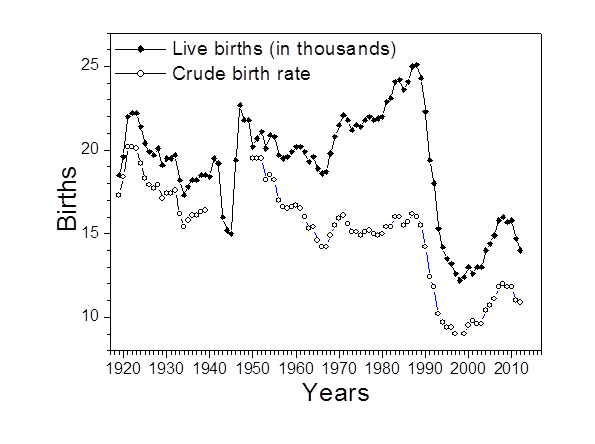
    The time between 1983 and 1988 was a positive period, with a crude birth rate (the number of births per 1000 people per year) of about 16.0. It is interesting that this situation arose during the so-called “stagnation era”. The stagnation period – life without radical changes – was probably fruitful for fertility growth. The same trend was noted for Russia. Perhaps this increase was caused by the decision of the Soviet government in 1981 to increase the birth rate “About Measures of Public Support to Families Having Children”. In 1989, the peak of fertility was over.

    The French demographer Adolphe Landry (1874-1956) defined genuine demographic revolution as the situation in which use of contraceptives and abortions by women becomes universal. This revolution detaches fertility from social control and transfers it to the interests of individuals. For Estonia, this period arrived at the beginning of nineties, when plenty of contraceptives became available, in addition to abortions continuing to be permitted.

    In 1991, the crude birth rate fell to 12.4, and the total fertility rate (number of children per woman during her lifetime, which characterize the necessary replacement level of 2.1) to 1.80. The year of 1991 was the first year of two decades of continuing decrease. Remarkably, fall of the birth rate at the beginning of nineties was much worse than it was during WW II. The population of about one million had 19.5 and 19.2 thousand births respectively in 1941 and 1942 during the war, but in 1993, when conditions were clearly better, only 15.3 thousand children were born to a population of one and a half million. The genuine demographic revolution had truly arrived!

    The reasons, in addition to the availability of contraceptives and abortions, were the decline of religion, economic uncertainty regarding the future, the opening of the world with a variety of lifestyle choices and career paths. Almost thirty decrees regarding the family benefits of the Soviet period that had been made by that government were cancelled in 1992. In the liberal market economy of the nineties, population policy was left largely to chance. Public attention to the issue was narrowly limited to family benefits and integration programs.

    The Parental Benefit Act passed in 2003 tried to attain the birth rate. According to the Act, persons have the right to receive parental benefits for 435 days from the day following the final day of maternity leave. The amount of the parental benefit received is calculated on the basis of the Social Tax paid during the previous year. If the parent didn’t work, the parental benefit is paid at the designated benefit base rate, which is 290 euros in 2013. The upper limit of the amount of the parental benefit is three times the average salary earned during the year before last, which – in 2013 – is 2,234 euros.

    If we take the birth rate of the years 2002 and 2003 – 13,000 births – as the plateau (base rate) and eliminate all other factors pertaining to reproductive behavior, then natality during the 2004-2012 period resulted in about 18 thousand additional births. This speaks to the effectiveness of the parental benefit. However, even this was insufficient for attaining positive natural increase. The total maximum fertility rate obtained was 1.65, but later, in 2011, it decreased to 1.52. In 28 countries of European Union the mean value of the total fertility rate was 1.58 in 2012, for euro area it was 1.56. However in France, which has perhaps the oldest experience in field of demography and demographic research, this indicator was 2.01. In contrast, Singapore’s total fertility rate steadily dropped from 1.6 in 2000 to a record low of 1.16 in 2010. It bounced back to 1.2 in 2011, and further to 1.29 in 2012, but last year slipped again to 1.19. 

    The government aims, by 2015, to achieve a birth rate that is higher than the death rate, meaning an increase of the total birth rate to 1.70. (Action Program of the Government of the Republic 2011-2015). This seems unattainable. Poverty and migration worsen the situation. The at-risk-of-poverty rate in Estonia in 2011 was 17.6% on the average. The parent benefit and family benefits together constituted 1,7% of GDP in 2011 ( the same figure in Sweden and Finland was 3%).  

    One key cause, ironically, is freedom to move that came with the fall of the Soviet Union. Handling the population decrease we described first of all the birth rate, but last years has been intensified external migration. Migration that took place in 2011 decreased the population of Estonia in 2012 by 6,600 inhabitants. The trend continued. In external migration, there was an increase in both immigration and emigration in 2012. Over 4,000 persons immigrated to and almost 11,000 persons emigrated from Estonia. The main destination countries for emigrants are Finland and the United Kingdom. Most of the immigrants are in fact returnees, mostly from Finland. The second place is held by Russia, but the immigrants from Russia are mainly new immigrants.

    Despite numerous attempts to boost birth rate, the years from 1991 to 2013 are characterized by a birth rate under the replacement level. The lowest point arrived in 1998, with a total fertility rate of 1.28. After that it began to rise, reaching 1.65 in the year of 2008, only to decrease again later. At the same time, the population figure decreased by 14%. Problems caused by decreasing population entail a threat to the survival of the Estonian national culture, issues with sustainable economic development and difficulties with the sustainability of the social infrastructure. 

    How to avoid the fate of Livonians? Is there a force majeure against the small nation? Or it is a problem of insufficient national steering without any specialized institution responsible on population?

    Jaak Uibu, a Phd. in human micro ecology, was former Deputy Minister of Health of Estonia and advisor to Minister of Population. 

    Oleviste photo by E. Kanash.