Author: admin

  • Street Furniture for ‘Sitable’ Cities

    How can street furniture improve not only the walkability, but the sustainability of a city?

    The completely self-sustaining city may seem like a pipe-dream to some, but as with all outwardly impossible tasks, it all starts with the first step. Urban planners have focused on making communities more walkable by improving public spaces and sidewalks. Large, pedestrian-only areas inspire people to shop, interact with others, and simply enjoy spending time in their community. Wider, safer sidewalks encourage pedestrians to walk, rather than drive from place to place.

    The walkability of city can be largely impacted by street furniture. If you’ve just envisioned a living room set sitting haphazardly in the middle of a sidewalk, you’re actually not that far off. Street furniture is a broad term that encompasses everything from benches to traffic signals, and you’ve likely encountered many examples without even realizing it.

    Seating placed in prime locations – where people work, shop, and eat – encourages pedestrians to linger, benefitting both the economics and the feeling of community. “Sitting, in order to rest, converse, beg and sell is what people have always done, and captures a major part of urban life. Sitting with style, grace, safety and reflection is a major element of “place capital”—an increasing buzzword for urban success,” points out Chuck Wolfe, who has written about “sit-able” cities.

    Building benches and other public seating out of green resources such as rapidly renewable plant material (bamboo and straw), recycled materials, and other reusable products adds to sustainability goals.

    Both walkability and ‘sitability’ are dependent on a safe atmosphere. If a sidewalk isn’t safe, pedestrians aren’t going to use it. Proper maintenance and lighting are incredibly important. Sidewalk safety features include curb extensions, striped crosswalks, and pedestrian rails.

    Also helpful: planting strips, areas of grass or vegetation between the street and the sidewalk that make pedestrians feel less exposed. Besides being a sustainable safety feature, planting strips benefit the environment by absorbing carbon dioxide from automobile emissions. They also assist with water drainage, helping both overtaxed storm drains and the natural aquifer.

    Bollards direct foot traffic and maintain a barrier between pedestrians and motorized vehicles. Sustainable metal bollards — like the ones we create at Reliance Foundry — are designed using an environmentally safe powder-coating that reduces peeling and chipping. Sustainable bollards can also be made from wood or recycled plastics. Bollards are commonly used in community areas to create pedestrian only zones, limiting vehicle use and carbon emissions.

    Streets that foster relaxation also benefit from recycling. Many large cities have implemented curbside recycling services, making it easier for householders to reduce their ecological footprint. The same progress that led to curbside recycling is now leading to recycling bins in public areas. The purpose is to reduce street and sidewalk litter, and to help people recycle when they’re out on the town.

    Street furniture is a funny thing; sometimes you only notice it by its absence.

    Robert Dalton is a writer and green-freak from Portland, Oregon (go Ducks!). He writes on behalf of Reliance Foundry, a supplier of innovative bollards and other site furnishings.

    Flickr photo by Diane Duane: Longhorn Bench, Freiburg-in-Breisgau, Germany

  • Rahm Emanuel’s Chicago More Violent than Al Capone’s Chicago and the Old West

    Since Rahm Emanuel entered the political scene years ago, he’s been a master at manipulating the press to his benefit. A pliant media has largely gone along with whatever talking point Emanuel desired. Lately, some of the media has begun to put the spotlight on violent Chicago with its rather high murder rate. Banning or restricting handguns has not been very successful in combatting violence in Chicago.  The website Big Government reports the bloody details:

    After Chicago recorded a terrible homicide total of 53 in August, September wasn’t much better for Rahm’s "world class" city. The city suffered 41 homicides, 30 of which resulted from 184 total shootings

    September brings more bad news for Chicago residents. While Mayor Rahm Emanuel, Police Superintendent Garry McCarthy, and the Chicago media have continued to hammer the point that the "crime rate is down," and "murder is down," as of September 22, the homicide total for 2013 now exceeds the rate up to the same date in 2011 by two percent at 350, according to the Chicago Police Crime Data Portal.

    How does today’s Chicago hold up at the violent memory of Al Capone’s Chicago of the 1920s? Not very well.  WLS-TV investigated the data and the evidence is rather stunning report in February:

    Let’s compare two months: January 1929, leading up to the St. Valentine’s Day Massacre, and last month, January 2013. Forty-two people were killed in Chicago last month, the most in January since 2002, and far worse than the city’s most notorious crime era at the end of the Roaring Twenties.

    Even though the image of Chicago, perpetuated by Hollywood over the years, was that mobsters routinely mowed down people on the streets, the crime stats tell us that we were safer under Capone than Emmanuel. In January 1929 there were 26 killings. Forty-two people were killed in Chicago last month, the most in January since 2002.

    Even though the image of Chicago, perpetuated by Hollywood over the years, was that mobsters routinely mowed down people on the streets, the crime stats tell a different story. The figures from January 2013 are significantly higher than the January of Al Capone’s most famous year.

    It’s not just the Capone era violence that doesn’t hold up to scrutiny. Constantly we hear from the media and advocates of gun control that we don’t want things to become “the Wild West”. In the last several years, historians have begun to look at this long time legend that was promoted by Hollywood movies.  As Ryan McMaken explains:

    Historian Richard Shenkman largely attributes this to the legacy of those reliably-violent Western films. "Many more people have died in Hollywood Westerns than ever died on the real Frontier…[i]n the real Dodge City, for example, there were just five killings in 1878, the most homicidal year in the little town’s Frontier history: scarcely enough to sustain a typical two-hour movie."

    The old West with its minimal government and armed populace has never been too popular with progressives. But, the reality is it was never really violent according to Terry Anderson and Peter Hill. So, the murder rate of the Capone era and Dodge city of 1878 would be a major improvement for Mayor Rahm Emanuel.

    Note: This post was originally incorrectly attributed to Wendell Cox.

  • Will Obamacare Bail Out Cities?

    When Rahm Emanuel was Barack Obama’s Chief of Staff, little did he know he’d be helping craft a law that would help him as the future Mayor of Chicago. Many American cities failed to put away enough money for current and former government workers.  Rahm Emanuel and powerful Democratic Party interest groups would like the federal government to bailout their pensioners. While the unions are less shy about looting federal taxpayers, Emanuel is working hard getting federal help.

    Emanuel needs to cut costs immediately to prevent more downgrades from the bond rating agencies.  One of Emanuel’s creative financial techniques involves the use of Obamacare as way of pushing some financial costs from the city of Chicago budget onto the federal government.  Many retired workers don’t like or want Obamacare.  The Chicago Sun Times reports :

    Chicago’s 30,000 retired city employees are trying to stop Mayor Rahm Emanuel from saving $108.7 million — by phasing out the city’s 55 percent subsidy for retiree health care and foisting Obamacare on them.

    One week after an unprecedented, triple-drop in Chicago’s bond rating, retirees have filed a class-action lawsuit against the city and its four employee pension funds that threatens to make the financial crisis even worse.

    The suit argues that the Illinois Constitution guarantees that municipal pension membership benefits are an “enforceable contractual relationship which may not be diminished or impaired.”

    Chicago’s retired workers aren’t the only individuals unhappy with Obamacare.  IRS workers don’t want Obamacare but likely will find they can’t keep their current health insurance.  All of this is providing massive strains on the Blue Model coalition of government workers and the Democratic Party.  In Chicago, at least retired government workers can know who to blame for their change in health insurance if they lose their lawsuit. Mayor Rahm Emanuel not only was instrumental in getting Obamacare passed but now he’s dumping Obamacare on thousands of workers as Chicago’s Chief Executive.

  • The Diminishing Returns of Large Cities: Population Growth Myths

    One of the big myths of the twentieth century is that large American cities are necessary and inevitable. Yet in reality growth has been dispersing to suburbs and smaller cities for the last two decades. As the decline of Detroit, once the country’s fourth largest city, reveals in all too harsh terms, being bigger is not always better.

    Yet the big city myth remains virtually unchallenged. A biased print media and a subsidized academic cartel are constantly singing the praises of big city life (as opposed to suburban or rural life). While American cities exhibited strong population growth in the early part of the twentieth century, recent Census numbers show America’s mega cities are growing below the national growth rate. According to the 2010 Census, San Antonio was the only city with a population of over 1 million people that grew above the national growth rate of 9.7%.   

    Years ago, scholar Milton Kotler wrote an important but much forgotten book on local government. Kotler showed what was behind the amazing growth numbers of the some big cities:

    Statistics show New York’s population increase from 1890-1900 to have been 2,096,370. This seems amazing, except that most of the increase came about with the annexation of Brooklyn, population 1,166,582. In short, its population grew at a rate far less than the increase by annexation.

    Municipalities are creations of the state legislature. In many cities, the boundaries changed to expand the power of cities along with their political class and related business rent-seekers. While some would argue about New York city’s population numbers, which has recovered from their lows, few would question Detroit’s long-term decline. As Detroit takes center stage line, the entire municipal bond market is about to take notice. Much is at stake here.

    Not only the economic foundation of a large American city but the concept that a creditor will get back its principal back.  The Detroit Free Press explains:

    Borrowing for Michigan cities could get more expensive in the future, if Detroit emergency manager Kevyn Orr’s restructuring plan is accepted by creditors and Chapter 9 bankruptcy is avoided, some bond experts caution.

    That’s because Orr’s plan would set a major precedent by treating all unsecured debt the same way — instead of giving a better payout or greater deference to general obligation bonds, sold for generations as safer investments backed by a city’s taxing authority.

    In Detroit, both the lack of checks and balances, and the maintenance of an engaged, informed public undermined the city’s fiscal health. Many Detroit citizens voted with their feet by exiting the corrupt system. With the middle class of all races deserting, the city of Detroit was ripe for looting of the taxpayers.

    In conclusion, it’s time for the informed public to realize many of our big cities are expensive, corrupt, and not redeemable. The Michigan Legislature should cut Detroit down to size. Perhaps they should consider de-annexation. It’s better to have Detroit become ten smaller municipalities. Of course there would be major political resistance for those who have made big money from Detroit’s decline. But without de-annexation, Detroit seems likely to remain on the brink of insolvency for a long-term since its political boundaries are too large for responsive governance and the crafting of unique solutions to its problems.

  • A Suburban Economic Future?

    The basic, often unappreciated, fact  about economic life in Australia’s  metropolitan regions are that most of the jobs are in suburban locations. Our central business districts (CBDs) – prominent though they are – account for only around 10% of all metro wide jobs. That rises to maybe 15% if you include inner city areas. But still, 85% of everyone else who calls Brisbane, Sydney, or Melbourne home works somewhere other than the CBD or inner city.

    Not only that, but the share of jobs in the suburbs versus the city has been rising, at least marginally. This doesn’t mean that CBD job markets are shrinking (in the main, they’re not) just that suburban employment markets are growing faster. So CBDs are becoming, perhaps inexorably, less dominant.

    The evidence also shows that suburban employment isn’t distributed evenly but in various concentrations. Some of these areas add to very large numbers – rivalling the totals found in CBDs – but they do so at much lower densities  of employment. Concentrations of 2,000 to 4,000 jobs per square kilometre are dense by suburban standards but still only a fraction of CBD concentrations, which can closer to 100,000 per square kilometre. For many suburban employment areas, concentrations are even lower at maybe 500 to 1000 jobs per square kilometre. While CBD office workers measure their space in square metres (roughly 15 to 20 per person) some suburban workers might measure theirs in acres.

    The income profiles of CBD and suburban workers vary. Across the three major centres of Brisbane, Sydney and Melbourne, the research shows that suburban workers, on average, earn considerably less than CBD workers. The top ten income areas city wide are nearly all inner city areas, and these workers earn more than double the average of the bottom 10 areas (which are invariably suburban). The average CBD worker, according to the census, pockets between A$80,000 and A$90,000 per annum. The average suburban worker pockets around $50,000 per annum. Given that suburban jobs account for around 85% of all jobs, the CBD is indeed a privileged centre of income earning ability.

    Having said that, there are still interesting pockets of suburban employment where above average incomes are to be found. The Brisbane airport and port region, for example, features in the top 10 income earning locations along with inner city locations, even though the majority of jobs (62% to 74% according to the Census) are blue collar.

    CBDs and suburbs vary widely as well in transit choice. For suburban workers, the private car is the overwhelming mode of transport (above 80% to 90%), not by choice or because of some “love affair” with the car, but of necessity. The very nature of dispersed suburban employment makes public transport uneconomic, which is why only around 5% of suburban workers use it. For CBD workers though, public transport is more widely used because it’s more available and convenient: more than 50% (and more than 60% in Sydney’s case) of CBD workers make use of it.

    The evidence also shows that the closer you live to the city, the more likely you are to use public transport to get to your CBD workplace. The proportion of people with CBD jobs falls the further you live from the CBD: meaning outer suburban residents are highly unlikely to have CBD jobs and hence only around 3% to 5% use public transport. Ironically, given CBD jobs earn the highest incomes and are also more likely to use public transport to get to work, we have a situation where those with the highest paying jobs are enjoying the biggest benefit of heavily subsidised public transport. You could argue on this evidence that those on lower suburban incomes are subsiding the train and bus fares of their higher paid CBD workforce cousins.

    Now for the future

    The evidence is one thing but where it all leads can provoke any number of alternative scenarios. Just for the sake of discussion, here’s one possibility: that cost and convenience factors will increasingly work against CBDs and inner cities and more and more businesses will establish, grow, or relocate to, suburban employment locations.

    It’s possible this shift is already underway. The evidence shows a slow diminution of CBD prominence. Technology is increasingly reducing the person to person immediacy and co-location advantages of a highly concentrated CBD environment. We communicate more and more through electronic means, which also means physical location is less and less essential to daily business contact.

    Costs are another factor. CBD offices and retail space are expensive relative to suburban locations. They are worth it in terms of prestige where this matters (leading legal or accounting firms for example), or where central location is important. But as costs via rents rise, the equation is constantly recalculated. Is it worth headquartering large numbers of staff in CBD offices when these staff have limited need for face to face business dealings outside the business? The cost/benefit analysis is an ongoing exercise and the business press contains plenty of evidence of companies who increasingly decide the suburban alternative is attractive. Rising car parking costs – for business visitors and clients along with staff – are just another factor in the falling competitive advantage for CBDs.

    Employee costs could also be a factor. Even basic administrative roles in CBD locations command higher pay packets than similar roles in suburban locations, for whatever reason. If it is possible for administrative functions to be located in a suburban location where total employee costs are less, will this become a factor in the trade-off between CBD and alternative suburban locations?

    Congestion may be another. As urban densities rise, especially around CBDs and inner city areas, congestion of all forms (private and public transport) will increase. Density is after all almost a synonym for congestion. Will businesses in increasingly congested CBD or inner city environments opt for suburban alternatives where congestion is less of an issue?  We can not yet say.

    On the other hand, because CBDs and inner cities feature such a concentration of social amenities through public infrastructure (entertainment, cultural and recreational facilities) they may continue to appeal as residential addresses. Is it possible that as CBDs and inner cities develop their residential stock, we may find significant numbers of people who live in CBD locations for the inner city amenity, but who work in suburban locations? Time will tell.

    Planning schemes would have to adapt to any of the above scenarios. Existing suburban economic areas may need their development density  under city plans increased to meet demand. TODs may become places where people travel to a suburban workplace centred on a train station or bus interchange, as opposed the current thinking which is that people will live near suburban transit nodes in order to work in inner city locations.

    Any number of other scenarios are possible. My research has attempted to present the statistical evidence on the suburban nature of employment in our metropolitan regions, and make some observations about the public policy and future development implications. Given the extent of commentary, research and public policy concentration around the CBDs and inner city, the research suggests that some equally intense efforts to improve our suburban economic environment would yield significant community wide results.

    Ross Elliott has more than 20 years experience in property and public policy. His past roles have included stints in urban economics, national and state roles with the Property Council, and in destination marketing. He has written extensively on a range of public policy issues centering around urban issues, and continues to maintain his recreational interest in public policy through ongoing contributions such as this or via his monthly blog The Pulse.

  • Falling In Love With Where You Are

    Where I live is where most Californians live: in a tract house on a block of more tract houses in a neighborhood hardly distinguishable from the next, and all of these houses extending as far as the street grid allows.

    My exact place on the grid is at the southeast corner of Los Angeles County, between the Los Angeles and San Gabriel rivers. But my place could be almost anywhere in the suburbs of Los Angeles and Orange counties.
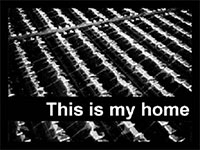
    My suburb may seem characterless, but it has a complex history of working class aspiration, of assumptions about social hygiene, of urban politics, and the decisions of many who imposed their imagination on the landscape.

    Where I live is a tract of wood-framed houses on a 5,000-square-foot lot at a density of about seven units per acre, where houses are set back 20 feet from the sidewalk and a street tree the city trims, and where neighborhood businesses are clustered at intersections so that anyone can walk to the store or a bar or to a fast food place.

    It’s also a place with 10 parks of 20 or more acres each so that everyone is about a mile from supervised open space with playgrounds, ball diamonds, picnic tables, and bar-b-cues.
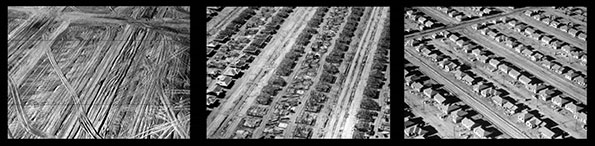
    There is a persistent belief that suburban places like mine must be awful places they must be inhuman and soul-destroying places. That belief persists partly because of these photographs, taken by a brilliant young aerial photographer named William Garnett who worked for the developers of Lakewood between 1950 and 1952.

    The historian and social critic Lewis Mumford used Garnett’s photographs in 1961 to indict the post-war suburbs which, he said, had become “A multitude of uniform unidentifiable houses, lined up inflexibly at uniform distances on uniform roads, in a treeless command waste inhabited by people of the same class, the same incomes, the same age group, witnessing the same television performances, eating the same tasteless prefabricated foods, from the same freezers … .Thus the ultimate effect of the suburban escape in our time is, ironically, a low grade uniform environment from which escape is impossible.”
    The architectural historian Peter Blake used these photographs in 1964 to define the post-war suburbs as “God’s own junkyard.”

    In 1969, Garnett’s photographs were part of Nathaniel Owings’s The American Aesthetic, a passionate critique of 20th century urban planning.

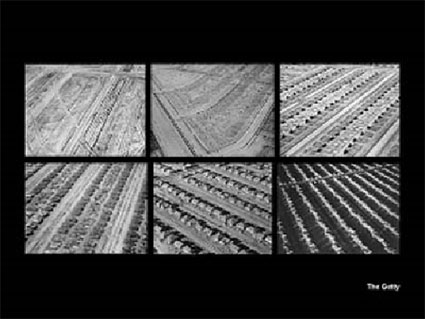
    Today, you can go to the Getty Museum in Brentwood and the Autry National Center in Los Angeles and see these photographs used as defining images of the suburbs of Los Angeles.

    They are beautiful and terrible photographs.

    With no little irony, these images of Lakewood became emblematic of the suburbs at the moment when Lakewood no longer was the eerie and empty place Garnett had photographed only a few months before. Between 1950 and 1953 – in less than 33 months – 17,000 houses had been built, sold, and made someone’s home. Nearly 100,000 people lived there, including my parents. In 1954, Lakewood had even become a city in the political sense, having completed the first municipal incorporation in California since 1939.

    Listen to Lakewood Blvd by Sara Lindsay

    We can presume that the developers of Lakewood – Mark Taper, Ben Weingart, and Louis Boyar – saw Garnett’s photographs mostly as a record to be filed with work logs and construction accounts when the project ended. But I also imagine that they looked at Garnett’s photographs and read into them a grandeur, a collective heroism that still attaches itself to the great construction projects of the 1930s and 1940s.
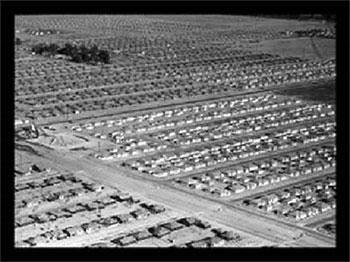
    And we know that Boyer, Taper, and Weingart and Fritz Burns and Joseph Eichler and Henry Kaiser understood that the Progressive era model of low-cost housing they had adapted to mass production would result in new relationships to the idea of place. Garnett’s photographs of deeply shadowed forms on a titanic grid would for some critics and many Americans permanently define that relationship as dread.

    In a memorable speech by James Howard Kunstler at the 1999 Congress for the New Urbanism, the kind of place where I live was described as a perversion of a place. “It is the dwelling place of untruth,” Kunstler told the New Urbanists. The title of his speech was “The place where evil dwells.”

    My parents and their neighbors more generously than Mumford or Blake or Kunstler understood what they had gained and lost in owning a small house on a small lot in a neighborhood connected to square miles of just the same.
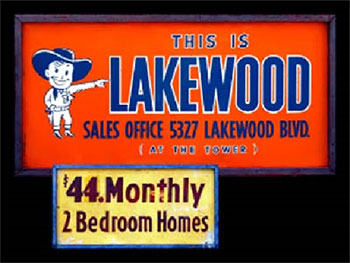
    Despite everything that was mistaken or squandered in making my suburb, I believe a kind of dignity was gained. More men than just my father have said to me that living in my kind of place gave them a life made whole and habits that did not make them feel ashamed.

    As far as I could tell by their lives, my parents did not escape to their mass-produced suburb. They never considered escaping from it. Nor have I.

    I’ve lived my whole life in the 957-square-foot house my parents bought when the suburbs were new, when no one could guess what would happen after tens of thousands of working-class husbands and wives – so young and so inexperienced – were thrown together without an instruction manual and expected to make a fit place to live.
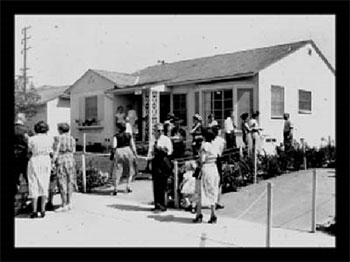
    What happened after was the usual redemptive mix of joy and tragedy.

    The suburb where I live is a place that once mass-produced a redemptive future for displaced Okies and Arkies, Jews who knew the pain of exclusion, Catholics who thought they did, and anyone white with a job. Left out were many tens of thousands of others: people of color whose exclusion was not just a Californian transgression.

    Today, futures still begin here, except the anxious, hopeful people who seek them are as mixed in their colors and ethnicities as all of southern California.

    I continue to live in Lakewood with anticipation because I want to find out what happens next to new narrators of suburban stories who happen to be my Latino, black, Filipino, Chinese, Korean, and Vietnamese neighbors.
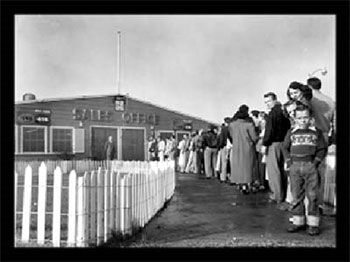
    There are Californians who don’t regard a tract house as a place of pilgrimage, but my parents and their friends did. They were grateful for the comforts of their not-quite-middle-class life. Their aspiration wasn’t for more but only for enough despite the claims of critics then and now who assume that suburban places are about excess.

    I actually believe that the place where I live is, in words of the Californian philosopher Josiah Royce, a “beloved community.” The strength of that regard, Royce thought, might be enough to form what he called an “intentional community” – a community of shared loyalties – even if the community is as synthetic as a tract-house suburb or the Gold Rush towns that Royce knew in his boyhood. I believe Royce was right: At a minimum, loyalty to the idea of loyalty is necessary, even if the objects of our loyalty are uncertain.

    Urban planners tell me that my neighborhood was supposed to have been bulldozed away years ago to make room for something better, and yet the houses on my block stubbornly resist, loyal to an idea of how a working-class neighborhood should be made.
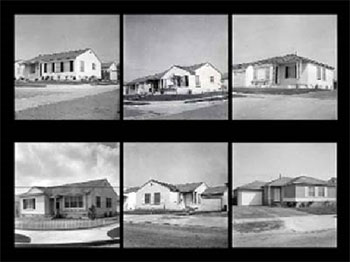
    It’s an incomplete idea even in Lakewood, but it’s still enough to bring out 400 park league coaches in the fall and 600 volunteers to clean up the weedy yards of the frail and disabled on Volunteer Day in April and over 2,000 residents to sprawl on lawn chairs and blankets to listen to the summer concerts in the park.

    I don’t live in a tear down neighborhood, but one that makes some effort to build itself up. All this is harder now, for reasons we all know.

    The suburbs aren’t all alike, of course, and there are plenty of toxic places to live in gated enclaves and McMansion wastelands. Places like that have too much – too much isolation and mere square footage – but, paradoxically, not enough. Specifically, they don’t have enough of the play between life in public and life in private that I see choreographed by the design of my suburb.

    With neighbors just 15 feet apart, we’re easily in each other’s lives – across fences, in front yards, and even through the thin, stucco-over-chicken-wire of house walls. When I walk out my front door, I see the human-scale, porous, and specific landscape into which was poured all the ordinariness that has shaped my work, my beliefs, and my aspirations. Out there, I renew my “sense of place” and my conviction that a “sense of place,” like a “sense of self,” is part of the equipment of a conscious mind.

    We often find it difficult to talk coherently about these issues or to make coherent policy choices for places to which our loyalty is only lightly attached.

    It seems to me that the abiding problem of southern California indeed of the entire West is the problem of home. We long for a home here, but doubt its worth when we have it. We depend on a place to sustain us, but dislike the claims on us that places make. Each of us is certain about our own preference for a place to live, but we’re always ready to question your choice.

    How do we make our home here, in new and sudden and places like Lakewood, like Irvine, like Santa Clarita? We’ve been asking that question for a very long time sometimes in despair. At almost the beginning of California, a disillusioned 49er named Thomas Swain wrote in 1851, “Large cities have sprung into existence almost in a day. . . The people have been to each other as strangers in a strange land ….”

    And too many of us are strangers still in a place that too many regard as uniquely perverse. And because much of southern California looks roughly the same too many of us see all these suburban places as aesthetically, politically, and morally perverse as well. And no place – however well crafted – is immune from the peculiarly American certainty that something better – something more adequate to the demands of our desire – is just beyond the next bend in the road.

    The question of “home” is increasingly acute because there’s hardly anywhere left to build another Lakewood or Irvine or Santa Clarita.

    The closing of the suburban frontier in southern California ends a 100-year experiment in place making on an almost unimaginable scale. The experiment was based on a remarkably durable consensus about the way ordinary people ought to be housed, beginning with turn-of-the-century beliefs about the power of a “home in its garden” to ameliorate the lives of working people and ending in the 1950s with tract houses turned into an affordable commodity.

    Today, most of southern California is what it will continue to be: uniformly dense and multi-polar, urbanized in fact but suburban in appearance, characterized by single-family homes in neighborhoods with a strong – but provisional – dependence on more “urban-like” nodes.

    This is a form for living and working, but it is neither “incoherent” nor “mindless sprawl.” That form in the future will, of course, be somewhat more dense – but our evolving suburbs cannot deliver mere density. In tandem with greater concentration of housing types must come what working-class people have always sought in southern California: a home with enough private space around it and enough public space adjacent to it so that this assemblage of house, lot, street, and transportation grid form the neighborhood-specific space that answers our desires.

    We can lament that too many suburban places are less than they some wish them to be, but I see no perfect way to bring “utopias” out of these suburban habits both good and bad. I see only a persistent longing to make fit places in which to live.

    Many of these places will look an awful lot like Orange County – dispersed, uniformly dense, and embedded in a metropolitan region in which historic downtowns function as “nodes.” The contest for the soul of our suburban region hinges on whether this constitutes enough to make a place where memories might be unblighted and desires assuaged.

    The author and environmentalist Barry Lopez considered some years ago what might be needed to make a durable life for ourselves in southern California. And in considering the problem of home, Lopez asked a challenging question: “How can we become vulnerable to the place where we live?”

    If that might be a goal if that tenderness were possible we might ask different questions when we build or approve a development project. We could ask, "What aspects of its design encourage loyalty to this place? What is built into this place that might evoke someone’s sympathy? Would anyone ever become vulnerable to this place?”

    What I have been speaking of is the acquisition something more than an idiosyncratic sensibility but a communal achievement that requires something from all of us. Built-out, maximally diverse, and more grown up, southern California requires courage to extend one’s imagination across its whole, tragic, human, and humanizing body.

    As for me, my suburb’s modesty keeps me there. When I stand at the head of my block, I see a pattern of sidewalk, driveway, and lawn, set between parallel low walls of house fronts that aspires to be no more than harmless. We live in a time of great harm to the ordinary parts of our lives and I wish that I had acquired all the resistance that my neighborhood offers.

    What I hope we might gain is a larger “moral imagination” … the imagination by which we might write ourselves into the story of our place and negotiate a way from the purely personal to the public.

    I don’t really know how (or perhaps I do only dimly). But faithfulness to what can be found in our history – to what can be found in our shared stories – impels me forward.

    It may surprise you to learn the object of Lopez’s meditation on vulnerability was the place where he grew up – a tract house neighborhood in the San Fernando Valley. And Lopez had this additional insight while contemplating his Valley home. He wrote . . . “Always when I return there, I have found again the ground that propels me past the great temptation of our time to put one’s faith in despair.”
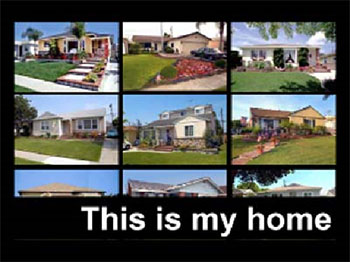
    Despair or regret: “There once was a perfect Eden,” the conventional story goes, “to which gullible people were lured and as a result this Edenic place declined into the horrors of suburbanization.” And the moral of that story is “people ruin places.”

    I believe that people and places form each other … the touch of one returning the touch of the other. What we seek, I think, is tenderness in this encounter, but that goes both ways, too. I believe that places acquire their sacredness through this giving and taking. And with that ever-returning touch, we acquire something sacred from the place where we live. What we acquire, of course, is a home.

    It’s a question of falling in love … falling in love with the place where you are; even a place like mine … so ordinary, so commonplace, and my home.

    # # #

    D. J. Waldie is a contributing editor at the Los Angeles Times and a contributing writer for Los Angeles magazine. He is the author most recently of California Romantica with Diane Keaton. He blogs for KCET TV at http://www.kcet.org/user/profile/djwaldie.

  • Genealogy Of Rust Belt Chic

    Some people don’t like the term “Rust Belt”. Others absolutely hate the word “chic”. Please don’t call the shifting mesofacts of dying Great Lakes cities “Rust Belt Chic”. Given the reaction, a lot of it negative, I decided to blog about how I came up with Rust Belt Chic. Way back in 2006, Shittsburgh was associated with a kind of urban chic. The South Side Slopes celebrated in the New York Times:

    “If Pittsburgh’s market were on steroids like New York’s, this would’ve happened a long time ago,” said one developer, Ernie Sota, referring to the recent spark of interest here. “But Pittsburgh’s kind of like an eddy. Things move slowly here.”

    Mr. Sota, 56, is a prolific local developer who is constructing a series of nine ‘green’ town houses, called Windom Hill Place, into a lush hillside here. He was drawn to the Slopes by the views and villagelike feel, which, for him, conjure memories of visits to Prague and Budapest.

    It’s just kind of quirky, funky and real, more organic, built by Europeans and other immigrants,” he explained. “The only other American cities that I find as geographically interesting are maybe San Francisco and Asheville, N.C.”
    Emphasis added. At the time, I thought of Sota’s sense of Pittsburgh place as unique to the city. I’m not from Pittsburgh. I don’t live in Pittsburgh. I didn’t go to school there. I’m a geographer. Pittsburgh appeals to my sensibilities. Pittsburgh is my Paris.

    The geographic scope of Pittsburgh urban chic became Rust Belt Chic upon meeting Phil Kidd and John Slanina in Erie, PA for a Rust Belt Bloggers summit. They introduced me to Youngstown. I was hooked.

    Rust Belt Chic always will be ironic. People are attracted to shrinking city hellholes. However, the hellhole part is misunderstood. What I mean is seeing opportunity hiding in a community struggling with survival. There’s just something about Youngstown that stirs passion in me. I’m not gawking at ruin porn or glossing over everything that is wrong. I love Rust Belt cities. I love Rust Belt culture. I’m proud to be from the Rust Belt. That’s what Rust Belt Chic now means to me. It’s personal. It’s who I am.

    For Pittsburgh, I could sense the tide turning. I see the same transformation taking place in other Rust Belt cities. A pejorative, Rust Belt-ness is an asset. It’s a starting point for moving forward, not a finish line or a civic booster campaign. Rust Belt Chic is in the same vein as rasquache:

    Rasquache sensibility that has become an important component of Chicana and Chicano art. The word, rasquache can be used in several senses. Its most common use is negative and relates to an attitude that is lower class, impoverished, slapdash and shallow. For this reason Tomás Ybarra Frausto who has written the cogent essay “Rasquachismo: A Chicano Sensibility” begins by stating, “One is never rasquache, it is always someone else, someone of a lower status, who is judged to be outside the demarcators of approved taste and decorum (in Richard Griswold del Castillo and others, Chicano Art: Resistance and Affirmation, 1965-1985. Los Angeles: Wight Gallery, UCLA, 1991, p. 155)

    However, as the case of several other terms and concepts (most notably the term and concept Chicano itself, which traditionally had a negative sense), the Chicano movement has turned the traditional notion of rasquache on its head. This important Chicano cultural sensibility has been particularly used to address, by means of a stance of resistance that is humorous and ironic rather than confrontational or hard-edged, the harrassments of external authorities such as the police, the immigration service, government officials, social services bureaucrats, and others. Chicano art that is rasquache usually expresses an underdog, have-not sensibility that is also resourceful and adaptable and makes use of simple materials including found ones, such as Luján’s cardboard, glue, and loose sand. 

    Rust Belt Chic turns the traditional notion of Rust Belt on its head. The Rust Belt is lower class, impoverished, slapdash, and shallow. At least, that’s how it looks from the coast, in New York City. Rust Belt Chic as a place to be is a form of resistance. It’s also a hot new trend and a threat to those neighborhoods that make my heart beat faster. From San Antonio:

    “I see a lot of progressiveness happening lightning quick now. When I came from Los Angeles as a visitor in 1992, I saw all these magic spaces you could rent for 300 or 400 a month. But I would laugh because there was little or nothing going on. I could get together some event with a friend or two and everybody thought it was so cool and innovative – I was just copping what I had seen in LA.

    San Antonio has gotten a lot more popular with Austin and California types discovering what a jewel this town is. Eclectic little restaurants and coffee places and shops growing up along Broadway and throughout Southtown. We’re being seen by a lot more cutting edge people by being open to contemporary signage and logos and creative design. With that, unfortunately, comes more expensive retail spaces and taxes are going up.

    There is a charm and real-ness to San Antonio I hope we don’t lose in the process. San Antonio is a non-materialistic town; people aren’t looking at your shoes or what kind of car you drive. When I leave San Antonio, it’s that real-ness that brings me back, every time. I left LA, and I left Austin because I got so tired of the trendy-ness. We’re growing fast, we’re drawing an eclectic market that will support artists. However, there will be a compromise. I don’t want to see it get too uptight.”

    –Robert Tatum

    Pittsburgh is Rust Belt Chic Paris. San Antonio is Rasquache Paris. When Richey Piiparinen and I were in San Antonio to do fieldwork, we were both struck by the Rust Belt Chic qualities of the city. At the time, we weren’t familiar with rasquache. We are now. I see a lot of similarities between Pittsburgh and San Antonio, particularly the way both places are under-appreciated. They enjoy a cult following. Hopefully, neither one will become the next Austin or Portland.

    Rasquache is further along, much further, than Rust Belt Chic. In fact, Rust Belt Chic is rasquache:

    This called to mind a passage I’d read in Have You Seen Marie? It’s an unusual book for a writer whose work has been at turns bawdy, avant-garde, and politically trenchant. Entirely autobiographical, Marie is a short, illustrated story with a childlike tone about Cisneros searching the streets of King William for a friend’s lost cat while mourning the loss of her mother, who died in 2010. I read Cisneros the passage I’d thought of: “ ‘King William has the off-beat beauty of a rasquache, and this is what’s uniquely gorgeous about San Antonio as a whole.’ ”

    She smiled. “Rasquache is when you make or repair things with whatever you have at hand. You don’t go to Home Depot. If you have a hole in your roof, you put a hubcap on there. Or you fix your fence with some rope. That’s rasquache. And then there’s ‘high rasquache,’ which is a term the art critic Tomás Ybarra-Frausto coined. He lives here. Danny Lozano knew high rasquache. He’d serve you Church’s fried chicken on beautiful porcelain and use Lalique crystal for flowers he’d cut from an empty lot.”

    “And that was one of the qualities that drew you to King William?”

    “Not just King William but San Antonio. A kind of elegance of found things. San Antonio has that soul. It’s not, ‘We gotta copy what we saw in New York.’ No! It’s going to come out of our own idea of what we think is beautiful.” She stared at me as if to make sure I understood. “But that’s also what’s getting lost. People feel like the city’s got to look like someplace else. Our mayor needs a stylist. He thinks he has to dress like a Republican. Pues, he’s Chicano! He’s got this gorgeous indigenous look, and he would look so cool if Agosto Cuellar, one of our local designers, dressed him, or someone like Franco, or Danny, or John Phillip Santos—he dresses totally San Antonio cool. He should do a style column for Texas Monthly.”

    I allowed that Santos, who is a regular contributor to this magazine, does have singular style (the last time I saw him, in December, he was wearing a horsehair charro tie and ringneck python boots) but joked that there might be a preponderance of leather pants in his fashion advice. Cisneros waved the joke aside.

    “Our problem is that we can’t recognize or celebrate what we have. We have this inferiority complex in Texas that we have to look elsewhere. Well, who knows more about inferiority than Chicanos? We grew up being ashamed because the history that is taught to us makes us ashamed. The whole colonial experience surrounding the Alamo is meant to make you feel ashamed.”

    In writer Sandra Cisneros, I sense a kindred spirit. As a Rust Belt native, Erie no less, I felt ashamed. I come from failure. I have no culture worth celebrating. Anywhere else must be better. That’s why we leave. Brain drain.

    I, too, was drawn to King William while in San Antonio. It is New Orleans (creole) and Pittsburgh (parochial). It’s like nothing I’ve experienced before. I get that boom town vibe of a place that is cool before anyone knows it is cool:

    Russell has seen what’s coming before. “When the buzz starts – when San Antonio embraces the brain gain, goes in the right direction on the talent economy and hipsters start to get wise to the neighborhood assets that are here – once the hipsters get wind of it – you’ll have to beat them away with a stick,” he said.

    I think that’s the concern of Robert Tatum. About a year ago, such a notion was unfathomable to Cleveland. What will the compromise with gentrification look like in Ohio City? Will somebody utter the words, “He dresses totally Cleveland cool”?

    Danny Lozano knew high rasquache. He’d serve you Church’s fried chicken on beautiful porcelain and use Lalique crystal for flowers he’d cut from an empty lot.

    Rust Belt Chic is served.

    Jim Russell is a talent geographer with particular interest in the Rust Belt. Read his blog at Burgh Diaspora, where this piece originally appeared.