Author: Andy Don

  • The Caribbean Tech Tide Rises

    The Caribbean has been a long-standing destination for holiday travelers, with its stunning beaches, clear waters, and the 20th century’s plummeting costs of long haul travel. The shift away from its historical sugarcane exporting heritage and towards tourism made the region heavily reliant on the world economy. A realization of this dependency has resulted in another shift: a reach to further develop digital and technological industries.

    For how to make the transition–and how not to–the region might look to Africa, where improvements in financial security, investments by Chinese MNC’s, and soaring commodity prices have transformed the prospects of many African nations. The creation of digital business in Africa has been growing, not just due to opportunism by entrepreneurs, but because of necessity– for the greater good of the countries.

    Mobile phones have led the charge in the continent’s technological revolution. Kenya, for example, had only about 200,000 mobile phone users at the turn of the century. For a country with a population of 40 million this was well below the mark. But it hit 50% saturation of mobile phone ownership in 2011 with the figure now close to 22 million. The boom in phone and computer ownership in Africa has also led to a much more accessible business start up programme. And the “ease of doing business” index by the World Bank goes some way to explaining the progress being made by African nations.

    Think about applying this model to a region with a safe banking infrastructure, a strong education system, and internet availability that rivals some of the world’s most financially developed countries, and you have all the ingredients to develop a thriving technological industry. In the Caribbean, most of the hard work has already been put in place for a vibrant economic system.

    The Afro-Caribbean Connection

    Historically, there has been a heavy reliance on the cooperation between Africa, the Caribbean, and the European Community (known collectively as the ACP). “The Lomé Convention” was part of an initiative to give preferential treatment and an economic commitment over a set number of years to developing economies.

    This convention broke down in 2007. After 30 years of varying success, the geopolitical landscape had changed dramatically, with China offering a new and better source of development to African nations. This opportunity for development through soft-loan diplomacy was not extended, however, to the Caribbean.

    For these island nations, the withdrawal of the agreement meant that, rather than having to focus on meeting quotas for mineral and food exports, they could focus on developing service, and especially technological industries, that were sidelined in the past.

    This new interest in Caribbean technological development has been given mass exposure by entrepreneurs that have started a yearly technology conference. Caribbean Beta serves as an industry hub, and highlights tech job opportunities. Though it is yet to pick up as much steam as any of the hundreds of conferences found in America or the UK, it is a step in the right direction to push the industry closer to international standards.

    Caribbean countries have shown a collective desire to be at the forefront in technology, with the Antigua minister, for example, displaying an understanding of the benefits of a strong internet infrastructure by demanding the country’s telecommunications companies introduce a 4G network. The nation wants to incorporate the same internet structure that you will find elsewhere. It plans, by 2012, not only to serve the tourism industry with wifi, but to provide police stations, fire stations and secondary schools teachers with high speed laptops, and to have the police force take part in ongoing digital training.

    The Digital Divide And Development

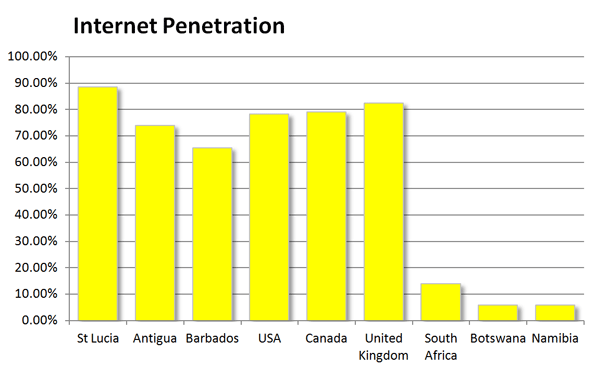
    The digital divide is described as the gap between those that have a computer and internet access and those that don’t. This divide is being slowly closed, despite the nay sayings of scholars in the mid 2000’s (found in this article by Lester Henry, for example) that challenged the regional leaders’ aspirations. Many Caribbean countries have kept to their policies on IT and telecommunications, and many have even exceeded penetration targets. So serious is this desire to be connected that countries in the Caribbean are not far off from matching, or, in St Lucia’s case, surpassing, the internet penetration of many super powers.
    Right now, tourism and industry typically make up around three-quarters of GDP for Caribbean nations like Barbados. For this to change, and for the region to become a place where a tech industry and start ups can thrive, there needs to be regional cooperation: a pooling together of resources from different countries. One day in the not too distant future, one of the region’s capitals may become a technological hub for the Caribbean and Central America. It’s both hard to imagine, but very possible, that with the right leadership the Caribbean might end up with a digital industry not dissimilar from the likes of Korea, of Thailand, or even of Scandinavia.

    Photo of crab on a keyboard: “Damn! I forgot my password again!” by Mean and Pinchy (Lisa Brown)

    Andy studied international Economics. He has seen the effect the downfall of the economy has had on the tourism industry first hand, and the will of a region to develop an economy not as fully dependent on outside sources.
  • Education as an Export

    A trade deficit is a negative balance between a nation’s imports and its exports, so a country with a trade deficit is spending more on imports than it is receiving for selling its exports. Is there any more that can be done to reduce this deficit over the course of time? One potential solution the US trade deficit would be to increase the attractiveness of its higher education institutions to international students, and to therefore increase the amount of money coming into the country. Money from abroad that is spent in the US, such as on tourism, or in this case, on education, is considered an export.

    President Obama identified a key element for future growth of the US economy as “exporting more of our goods,” and whilst this is a great way of decreasing the trade deficit, the actual ability of the country to create more manufactured goods or natural resources is fairly limited.
    But the US has a great potential for growth in the services sector, including financial services, licensing fees, entertainment, and telecommunications. Education could be a particularly high earner for the US, if it were prepared to put more money forward to attract international students.

    The US currently has around 691 thousand international students enrolled in higher education, with the tuition fees estimated to total around $13 billion during the 2009-10 academic year. Consider as well the cost of living for international students, and you can see that the economic impact of international students can be a major earner for the country.

    A University of California at Berkeley Center for Studies in Higher Education paper was released in support of the development of US higher education as an export. The Obama administration has set a goal of doubling export growth by 2015. Whilst this is an ambitious target, it is not beyond achievable.

    Increasing higher education for international students makes viable economic sense not only because the service itself is an extremely profitable one, but also because it will help meet future labour market and growth needs of the country, and fulfil “a diplomatic and cultural mission like no other form of trade”. International students can benefit from the experience of a well-organized educational system.

    There have been countries that have recognised this opportunity for growth and acted upon it. Australia, for example, has grown its educational market to attract more international students, although it has recently announced plans to prop up the educational system with a price hike for lower school years. It seems that the demand for Australian education has been on a steady rise, and there has been a corresponding increase in spending and development by higher education institutions. In the opinion of Michael Andrew, Chairman of Australia’s Skills and Innovation Task Force, after recognising the value of international students and scrutinizing the lengthy application process for higher education, Australia expects that the natural growth in interest will not be enough to keep maintain the industry’s economic boom.

    Andrew has highlighted the benefits of a strong educational policy which educates graduates to opportunities of forming strong links with Australian companies that currently operate in their home countries within Asia and India.

    Australia, the US and Canada would certainly benefit from working harder to encourage learning in industries that are suffering a skills shortage. Foreign students provide what’s been accurately called a ‘rich talent pool’ for industries that these countries have failed to utilize effectively.

    America and Canada differ from Australia in that their markets for labour are already quite saturated, so pushing education as an export and the advantages it can bring to the economy can be overlooked as an investment into future economic development.

    Exporting education can benefit the US in a way that not many other services can, by monetary gain, as well as by continual benefits should international students stay to ply their trades. And even those who don’t remain in the US will thereafter be advocates of the US educational system, and may inspire future generations to learn in the US. Finally, there will always be opportunities for the students to work in their own countries but under US corporations.

    Whether or not the Obama Administration will meet the targets they have set by positioning education as an export is another question in its own right. The US can not expect to grow this lucrative industry without further pushes to attract foreign students looking to learn at the higher education establishments of America.

    Either way, they are on the right track, and are onto how much of an advantage they have over other nations in the education system they can offer. With the right development and marketing, education, sold as an export, could grow to become one of the United States’ highest earners.

    Andy studied International Economics at University but now works as a freelance Search Engine Optimizer and travel advisor for All Inclusive Holidays provider Tropical Sky. Comment here or follow him on his twitter @andym23

    Photo by Evive: International Student Week

  • New Roller Coasters for 2011

    The recession has seen many capital budgets at theme parks held back over the last few years, but even still, there are many parks building new and exciting rides all over the world. Here is a round up of some rides to get you foaming at the mouth.

    Cheetah Hunt in Tampa Busch Gardens
    The Cheetah Hunt, as you might expect from its namesake, is a “Linear Synchronous Motor Launch Coaster”, i.e. it uses magnets to launch you off fast then it uses strategically places LSM launch pads two more times on your ride. It is set to open in Spring 2011 and is set to be one of the most exciting rides in the country. The 4.5 thousand feet of track will send you to the top of mountains to twisting through a rocky gorge. Watch the video to whet your appetite.

    The Green Lantern at Magic Mountain
    This new ride looks like unlike anything you may have seen before, unless you have been to Grona Lund where the exact same ride has been featured for a couple of years. Two carts each spin independently, which for me just means you get an inconsistent ride and could, if the weight isn’t distributed correctly, fail to even turn upside down on the ride.

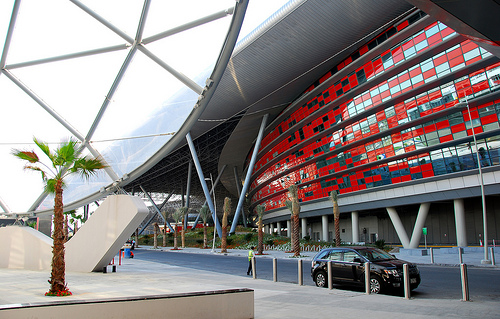
    Formula Rossa in Ferrari World, Abu Dhabi
    Another launched roller coaster, opened in November 2010 and is officially the worlds fastest roller coaster reaching 240 kph in 4.9 seconds, this ride uses a Hydraulic launch system and requires the riders to wear protective eye goggles due to the risk of impact with airborne particulates or insects. That just sounds crazy and the investment made to create it would have matched the investment of the cities in the Arab Emirates have seen.


    Ferrari World Abu Dhabi

    Superman: Escape from Krypton
    This isn’t in itself a new ride, as much as it is an update to an older slightly dated one. Formally Superman: The Escape, the upgrades are little more than the cars are turned backwards. But despite this less than impressive update the ride experience is jaw dropping. Being launched backwards, you are never too sure when you are about to reach the incline and once you reach the top the sustained weightlessness is amazing, all before you find yourself hurtling ground-wards.  Exhilarating update and the simplicity would have saved a few cents.


    http://www.flickr.com/photos/beaster725/5596829350/sizes/m/in/photostream/

    There are many more rides being planned in the next few years, including two big rides in the UK for Thorpe Park. Busch Gardens Williamsburg has had plans for a new rollercoaster or drop ride approved. So the outlook seems pretty hopeful for thrill seekers and adrenalin junkies looking for new thrills. The recession hasn’t dampened the record breaking spirits of the theme park owners. This is just a short list of new rides but there are many more all over the world. If you find yourself on Holiday in America or on any UAE or Dubai Holidays, try and visit a park with one of these exhilarating rides.

    Andy Don went to University in Brighton and travelled the world shortly after graduating; he is now working as a trip advisor and marketing executive. Follow him on his twitter @andym23.

    Lead Photo by Drew Bennet