Author: Anne Snyder

  • Houston, City of Opportunity

    This essay is part of a new report from the Center for Opportunity Urbanism titled “The Texas Way of Urbanism“. Download the entire report here.

    Creative friction – unchaperoned and unprescribed – is Houston’s secret sauce.

    At a time when Americans’ confidence in all major U.S. institutions – minus the military and small business – has sunk below the historic average, and only about 20 percent of Americans say they spend time with their neighbors, one would expect pessimism to be universal. But come to the concrete sprawl just north of the Gulf and you’ll find a different vibe, one that other cities would do well to emulate.

    Of course things aren’t perfect in Houston, and the region is taking it a bit on the chin due to the drop in oil prices. But look over the mid- and long-term and the place has consistently lured people from around the country and the world.

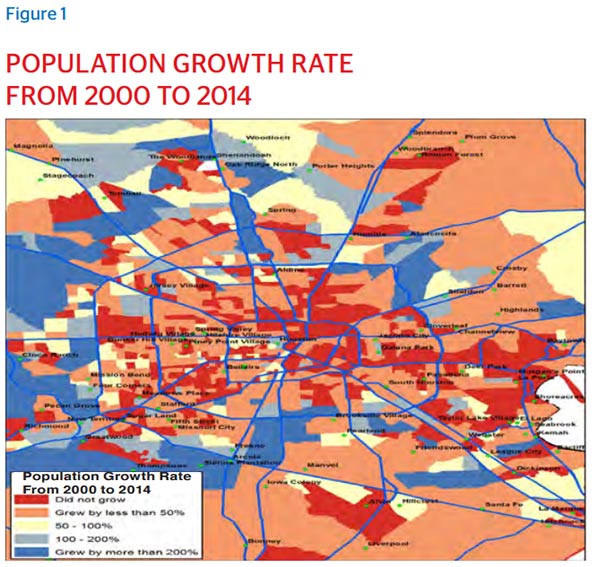
    People continue to move to the flat and humid city in higher numbers than any other metropolis. According to the United States Census Bureau, from 2014-2015 metro Houston attracted 159,083 total and 62,000 net domestic migrants, topping the Census list on new metro area residents. Critically, the newcomers represent those population groups most telling of a metro’s future: millennials, immigrants, and families.
    “The American Dream is still alive here,” say those migrants, one after another. 81 percent of Houston residents rate the city as a good or excellent place to live, according to the 2016 Kinder Houston Area Survey. That’s up from 70 percent a decade ago. And despite the recent economic slowdown, 62 percent of Houston-area residents rated the local economy as “excellent” or “good.”

    Even the most conventional of popular figures have begun to figure this out. “Houston will surprise you,” wrote Katie Couric when she stopped here on a nationwide tour of up-and-coming cities. It was a more iconic statement than perhaps she realized. Outsiders often misperceive Houston as politically conservative and totally dependent upon the energy business, but the city consistently busts internal expectations, too. In Houston, you don’t have to drive far to run into unexpected languages, unexpected restaurants, a huge informal economy and just a pervasive – and bracing – sense of random.

    “It’s a cat city,” says Bill Arning, director of Houston’s celebrated Contemporary Arts Museum. He moved here in 2009 from Boston. “If you arrive without a tour guide, without a friend who knows the city, it’s hard to figure out where things are. There are no landmarks. Whereas Austin is a dog city – you know where the beautiful people are – Houston is a cat city. Its charms are there, but you’ve got to come to it. You’ve got to take a little time.”

    What sets Houston apart? What about the city makes so many residents confident they will find their version of the American dream here? If it is indeed a city of opportunity, what lessons might other cities absorb and weave into their own policies and cultural fabric? Through many interviews, data sleuthing and the everyday experience of living here, I found five traits that define Houston: affordable proximity, multipolarity, social deregulation, an active future orientation, and humility. What follows is a tour of the city that knows no limits.

    Affordable Proximity

    “There’s always been a haphazard nature to the city, from the beginning,” says Sanford Criner, a native Houstonian as well as vice chairman at CBRE, the world’s largest real estate firm. “Where Chicago – which was founded the same year [1836] – had an economic reason for being the day it was founded, Houston was a real estate play. These guys came down from the northeast – New York, Pennsylvania – and they bought some land and sent out flyers.

    “I’ve seen some [of the flyers], and they’re hysterical,” Criner continues. “‘Salubrious environment!’ said one. ‘Well-watered!’ said another. They’d have this picture that looks like a little Swiss valley, with chalets up the hill, and there wasn’t a house here! It was a scam. But that’s how we now date the founding of our city.”

    Where others saw only wilderness along the banks of Buffalo Bayou, Augustus Chapman Allen and John Kirby Allen saw promise, and convinced people to take a gamble and move. This rambunctious “come one, come all” attitude continues to define the city’s development, 180 years later.

    The city of Houston is famous for its no zoning policies, the fruits of which are visible in the hodge-podge of commercial and residential hubs evident on a first drive in from one of the two airports. The apparent haphazardness may dizzy outsiders, but for Houston residents it’s a gift that my colleague Tory Gattis calls “affordable proximity”: the ability to live near one’s place of employment while keeping the cost of living affordable. It’s a challenge that has become onerous in many cities, but one that Houston manages to tackle with surprising efficiency.

    “It’s definitely true that it’s easier to build things here than elsewhere,” says Criner. “We’ve been able to build things relatively inexpensively and rapidly that have generally benefited everybody.”

    Since 2010, Houston has expanded its housing stock to issue construction permits for 189,634 new units, paralleling the population growth. This is in sharp contrast to competitor cities such as New York, Los Angeles, Chicago and the Bay Area, where construction tends to lag behind population.
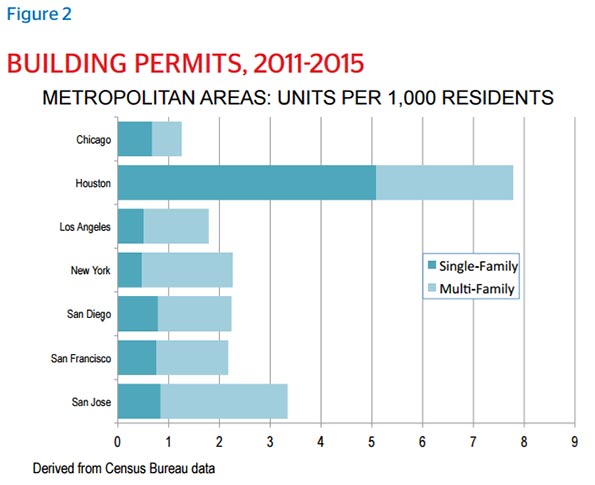
    Houston is uniquely able to create housing to meet demand. The populations in both New York City and Houston have grown significantly in the past six years, but New York, like many big cities, has not come close to meeting demand. A lot of this has to do with sheer land availability and willingness to expand outward, but Houston’s light regulatory touch has crucially allowed developers to be in sync with consumer need and preference, without the red tape that slows other cities’ building and adaptability. A key result has been a greater level of affordability, and of choice.

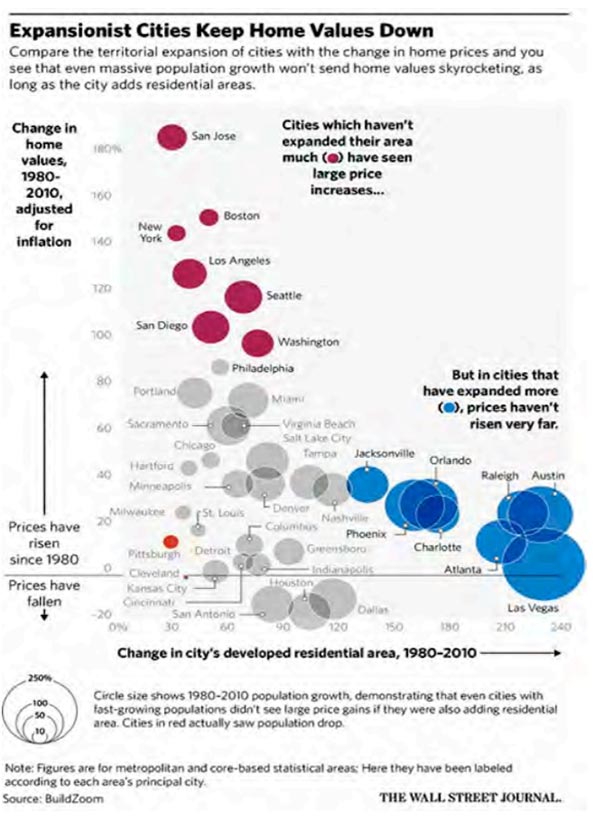
    In April of 2016, The Wall Street Journal highlighted groundbreaking research by Issi Romem, chief economist at real-estate site BuildZoom, showing that the cities that have expanded geographically have kept their house prices more affordable.
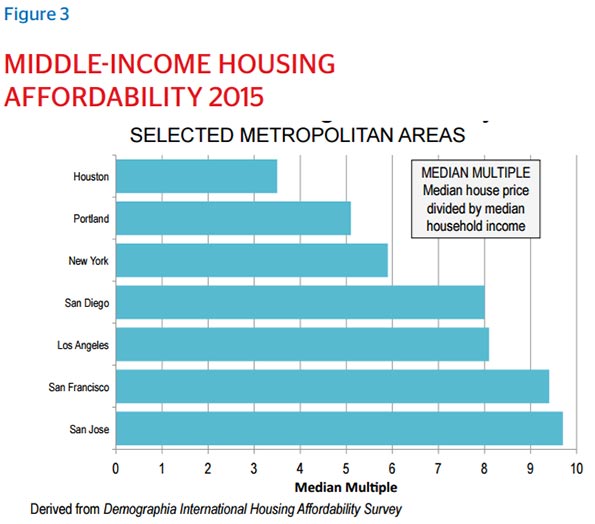
    According to the National Association of Home Builders/Wells Fargo Bank Housing Affordability Index, more than 60 percent of homes in the Houston metro area are now considered affordable for median-income families, compared with only 15 percent in Los Angeles, once ground zero for the dream of homeownership. According to Zillow, renters in New York spent 41.4 percent of their income on housing in 2015, whereas the share for their Houston counterparts was just 31 percent.

    The Demographia International Housing Affordability Survey provides ratings for all major metropolitan areas in the U.S., and Houston consistently ranks as more affordable than cities like Portland, New York, San Francisco and San Jose, all of which have more restrictive regulations.
    Houston’s housing is also diverse. Houston has become the national leader in new multifamily units, helping to preserve and expand access to urban living. At the same time, the Houston metro has led the country in new single-family houses.
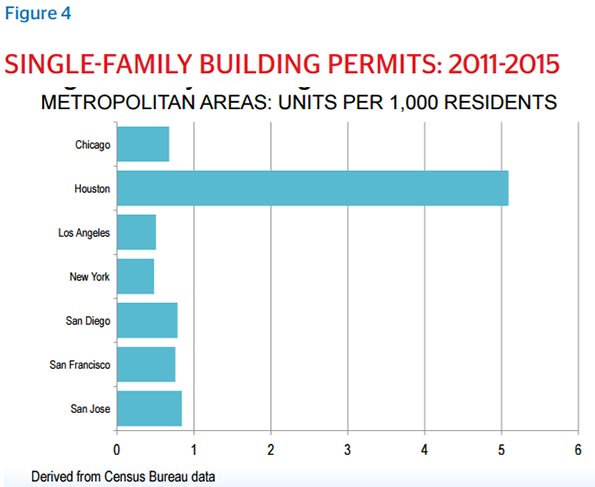
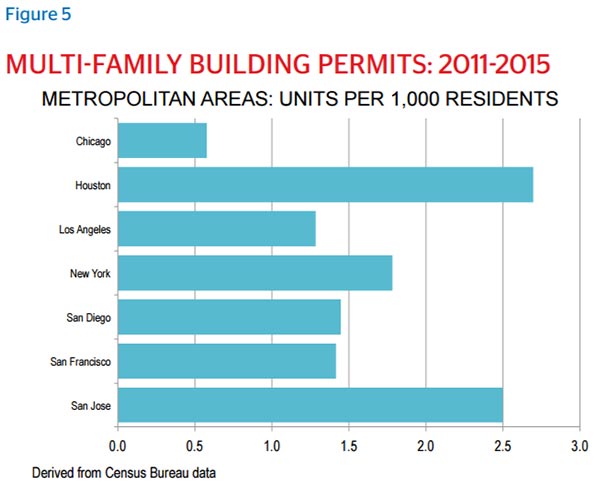
    Availability of affordable land and a lighter regulatory environment allowing for outward expansion has made it possible for many to afford a residence near the city’s dispersed job centers. In addition, as City Observatory recently reported, a series of reforms adopted in 1999 shrunk the required residential lot size from 5,000 square feet to 1,400 square feet, enabling town home development in high demand areas proximate to jobs.

    Proximity to work is especially appealing to millennials, who have moved to Houston in droves. The U.S. Census Bureau showed a 25 percent increase in millennial residents between 2000 and 2013, with millennials currently making up 24 percent of Houston’s total population. Many of these new adults want to reduce their commutes, or even ditch their cars for the sake of enjoying a more seamless transition between professional and personal life. Houston offers this possibility across urban and suburban areas, the multipolarity of business centers providing flexibility to carve a nice triad of work, residence, and play.
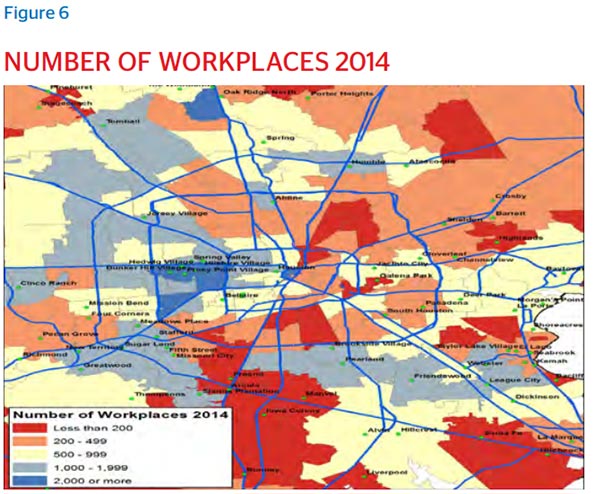
    Despite the impression of endless freeways, Houston’s commute times are better than those in metros of comparable populations. One-way commutes were 28.4 minutes in 2014, according to the American Community Survey, making Houston the fourth best out of nine comparable cities.
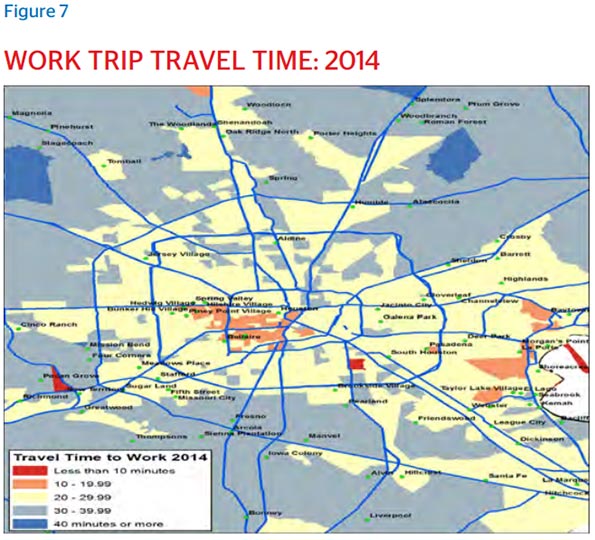
    Houston also does very well on an international scale with respect to traffic congestion, according to TomTom in 2015. The region ranked fifth out of the 38 urban areas that have populations over 5 million.
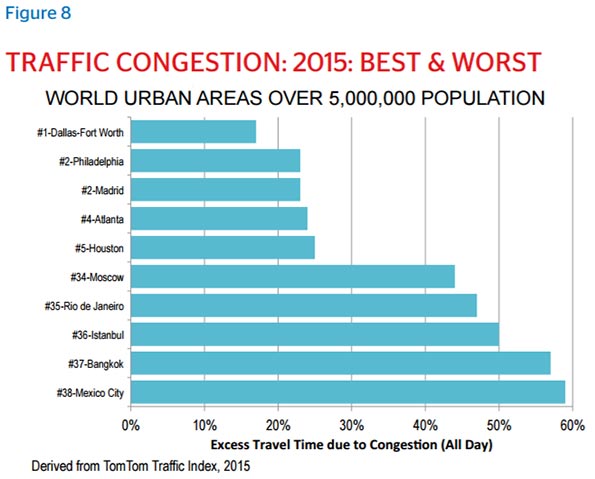
    None of this suggests Houston lacks room for improvement in mobility, but it’s credit to the city’s decision to dramatically increase roadway capacity and arterial streets that it has managed to improve its ranking in traffic congestion while experiencing a huge increase in population. According to the Texas A&M Transportation Institute, in 1984 and 1985 Houston was ranked with the worst congestion in the country, even worse than Los Angeles. Now Houston is ranked 10th, even as it’s nearly doubled its population, from 3.5 million in the mid-1980s to 6.5 million today. Only Atlanta and Dallas can boast similar mobility improvements.

    Multipolarity and Economic Diversity

    Most Americans think of Houston as an oil and gas town. And while energy still undergirds much of the city’s economy, Houston boasts many other assets as well: the world’s largest medical center, one of the world’s busiest ports, the third largest manufacturing hub in the country, a booming technology sector and a wide range of small to medium-sized businesses, including a thriving informal sector of immigrant-run businesses. This has led to demand for labor at all skill and education levels, unique among the top ten largest cities.

    “Best Online Programs in 2016,” said U.S. News & World Report about the University of Houston. “Top Cities for Competitiveness to Attract Investment in Chemicals & Plastics,” said Conway about Houston in 2015. “Best Hospitals for Adult Cancer – University of Texas MD Anderson Cancer Center” said U.S. News & World Report in 2015. “Top Blue-Collar Hot Spots,” said Forbes in 2014. “Most Favorable Metro for STEM Workers [Nationally],” said WalletHub in 2015.

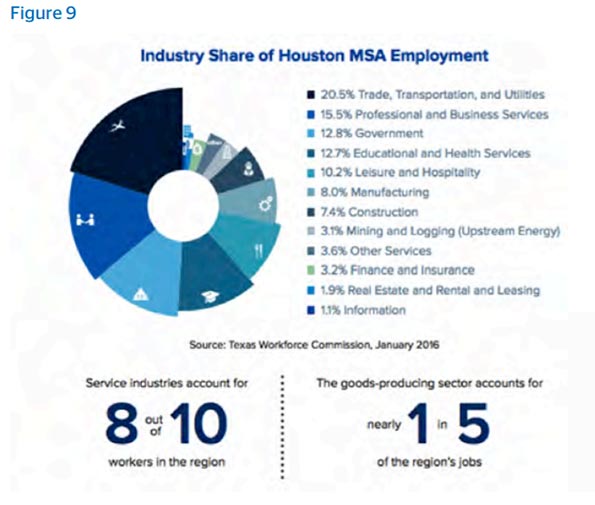
    Houston is no stranger to “Best Of” lists that today’s mayors scour. But what’s notable is the cross-sector nature of the superlatives. According to a June 2016 report from the Texas Workforce Commission, 20.3 percent of Houston’s workers are in Trade, Transportation and Utilities, 15.5 percent are in Professional and Business Services, 12.8 percent in Government, 12.7 percent in Education and Health Services, 10.2 percent in Leisure and Hospitality, 8 percent in Manufacturing and 7.4 percent in Construction.
    The city has learned from its mistakes. The 1980s, which saw a slump in oil prices much greater than that in 2015, bulged in profligate building and overconfidence. According to the Greater Houston Partnership, from 1982 to 1986, developers built more than 100,000 single-family homes, many of them without a signed contract from a purchaser. Even when the region lost more than 200,000 jobs, office developers continued to build, including adding more than 71.7 million square feet of office space while companies were laying off staff and declaring bankruptcy. Today, the office market is tighter, banking is better regulated and better capitalized, and few homes are built without a signed contract. Most importantly, the region is creating jobs that aren’t in energy, including in health care, business and professional services.

    Social Openness: A City for Everyone

    Houston is deregulated economically, but it’s of greater note that it’s deregulated socially. People come here from many walks of life and culture, and the relative youth of the city combined with its scrappy DNA means that there really isn’t a dominant Establishment, certainly not one that wants to block the efforts of ambitious newcomers.

    “If you talk to [old] Houstonians about social mobility,” says Sanford Criner, “they kind of give you this quizzical look. Like, ‘what do you mean?’ Like, ‘Sure, of course.’ It seems obvious.”

    This city’s always been a mixer; you just have to be willing to share what wakes you up in the morning. Marlon Hall is an African American filmmaker and native Houstonian who started Folklore Films, a documentary production company created to “tell better stories to our city about our city.” He and fellow filmmaker Danielle Fanfair have featured former Mayor Annise Parker, arts patron Judy Nyquist, internationally recognized musical artist DJ Sun and other community figures. As the Folklore Films crew has gotten better acquainted with Houston residents from across the social spectrum, Marlon locates the vocational “why” as central to the city’s currency.

    “Houston isn’t driven by who you know,” he says, “but by how you want to be known. It isn’t about what pedigree you have received, but about the possibilities you want to bring to bear.”

    This kind of invitation has attracted the motivated from all over the world, with the city now pulsating with 145 languages. An international city since the day it was founded, now more than one in five Houstonians are foreign-born, with the 2014 American Community Survey reporting that 63.9 percent of the foreign born population were Latin Americans, 25.2 percent were Asian, 5.1 percent were African and 4.6 percent were European. As of the 2010 Census, Greater Houston does not have a majority racial or ethnic group.
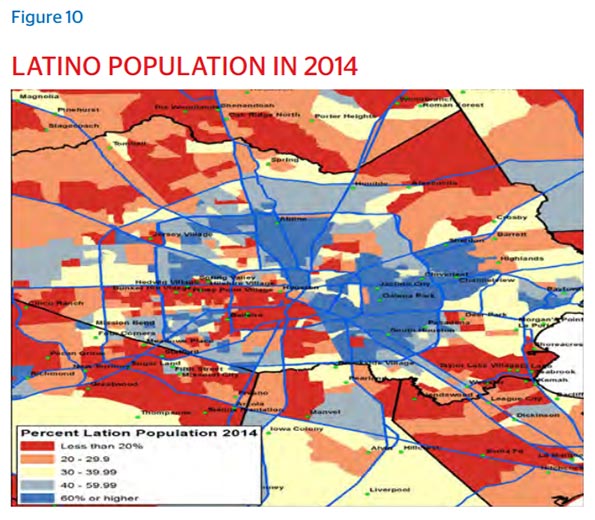
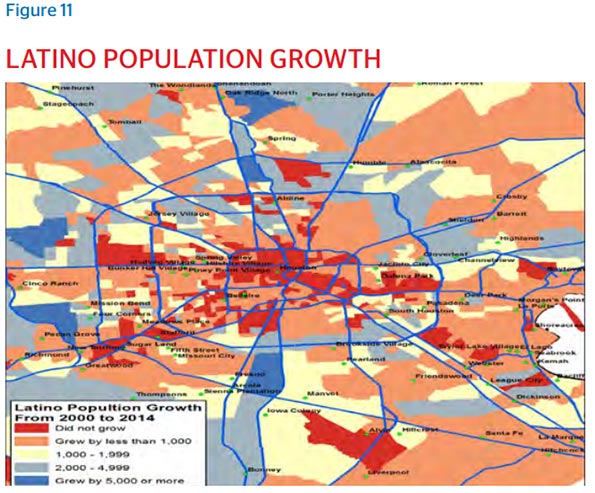
    People come to Houston seeking opportunity, and because they sense in the visible randomness the potential for surprise ingredients to leaven the traditions they’re bringing with them. This is as true for immigrants as well as domestic migrants, with the city’s celebrated restaurant scene born out of the unexpected merging of flavors from cultures that don’t typically mix. Underbelly’s Chris Shepherd, Bistro Menil’s Greg Martin and Lucille’s Chris Williams all cite Houston’s diversity as a major factor behind the city’s flavorful palate, in both story and succulence.

    “This is edible history,” says Chris Williams, the founding chef at Lucille’s, a restaurant that takes a modern approach to Southern classics. “The food that we do here pays homage to my great-grandmother, who was a chef and a pioneer and an American icon.”

    It’s not soul food, but Southern. With a rustic European style, and a multi-generational American story at the heart.

    “Like all chefs in [my great-grandmother’s] time, your style of food was defined by what was available to you. What you could afford to work with. The flavors that I grew up with…married with the techniques and the flair that I picked up working in Europe for four years. Everywhere from London to Lithuania. …I’m influenced by the simple rustic dishes – the ones about the culture, not the flashy ones. The perfect piece of fish fresh caught, served with good potatoes, great olive oil, fresh garlic, and a little bit of parsley.”

    Bistro Menil is another spot that takes a slice from Europe and re-interprets the classic dishes for Houstonians. Its patrons come from Rice University, the Medical Center, the Museum District and beyond, the attraction of the world-renowned Menil Collection standing just across the street. Inspired by the concept of cask wine, which head chef Greg Martin discovered on a trip to Rome, Bistro Menil relies heavily on relationships with cosmopolitan – yet locally centered – Houstonians.

    “I don’t want to compete with that dish that you had in Rome,” Martin says, aware of ingredient limits this side of the Atlantic. “I want to reinterpret it with more of a New American approach, with some fresh eyes on our market, using our ingredients. Our ingredients and produce come from everywhere…I work really closely with a local importer. We’ve been working together for 30 years. He brings in our duck legs from Canada, our jamón Serrano from Spain. He brings all of our cheese in from France, Italy and Spain.”

    It’s not just the food that shows Houstonians willing to work together across silos and lift up the local talent. “We have a very supportive gallery scene,” says Bill Arning, of the Contemporary Arts Museum. “Even the galleries that show a lot of major international and national artists, like the Texas Gallery and McClain Gallery, will not only show local artists, they’ll place them in the top collections in town. That’s unusual.”

    The social egalitarianism combined with a pervasive “show me what you got” curiosity creates something very unique. Hipster cocktail bars seem no more privileged than authentic Vietnamese restaurants than classic barbecue and the iconic Rodeo. The lack of zoning makes thoroughfares like Westheimer Road, which stretches for miles from the city center to the distant suburbs, an avenue of cultural mismatches: The New York Times’-celebrated Underbelly is sandwiched between three tattoo parlors, a Catholic guild clothing store and the latest in coffee-roasted curation. There are so many opportunities to mix with those different from you that only the snobby find themselves bored and excluded. Creative friction – unchaperoned and unprescribed – is Houston’s secret sauce.

    “This is a city that does not believe in censorship,” says Arning.

    Agile, Active, and Future-Orientated

    Houston is not Silicon Valley, but its entrepreneurial DNA is unmistakable, dispersed across many fields. The city emanates a conviction that people should have the freedom to determine their destiny, sometimes to the point of overlooking those that don’t have such clear vision, nor the resources and social networks to make it happen. The city is growth- and future-oriented, embracing change and risk. True to its namesake in Sam Houston – himself a failure before reinventing himself – Houston grants permission to fall hard.

    “Houston is the only town where a person with no prior experience in a particular vocation can get joint venture capital for something they’ve never done before,” says local arts patron Judy Nyquist in one of Marlon’s Folklore Films. “Simply by virtue of their commitment to their idea, and how it can make the city better.”

    This is true across sectors – for-profit, social service, and philanthropic.

    Ella Russell of E-dub-a-licious Treats was an African American single mom working for AT&T when a breakup with her partner caused significant financial hardship. Her two boys, then age 3 and 9, came home from school asking to bring in treats for a holiday party. Russell felt helpless, all disposable income had run dry. But she did find sugar, flour and eggs in her pantry.

    “I scraped up change to buy a bag of chocolate chips,” Russell recalls, “so I could make chocolate chip cookies. The kids took them in, and then I brought the leftovers in to work. My coworkers loved them, saying every future potluck would have to have my cookies.”

    Three years later, her friends urged Russell to turn the sweetness into a business.

    “I had no business experience other than what I knew working in corporate America,” Russell says. “I really winged it; I had no basis but the support of my friends.” In a couple years, she went from serving family and friends to delivering in seven different states.

    In the burgeoning scholarship entrepreneurship of the last decade, the work of Saras D. Sarasvathy of the Darden Business School at the University of Virginia stands out. She’s coined a term called “effectual reasoning” to describe the mindsets of master entrepreneurs, one that pairs well with Houston’s soil:

    Brilliant improvisers, the entrepreneurs don’t start out with concrete goals. Instead, they constantly assess how to use their personal strengths and whatever resources they have at hand to develop goals on the fly, while creatively reacting to contingencies. By contrast, [highly successful] corporate executives use causal reasoning. They set a goal and diligently seek the best ways to achieve it.

    Sarasvathy likes to compare expert entrepreneurs to Iron Chefs: “[They are] at their best when presented with an assortment of motley ingredients and challenged to whip up whatever dish expediency and imagination suggest,” she writes. “Corporate leaders, by contrast, decide they are going to make Swedish meatballs. They then proceed to shop, measure, mix, and cook Swedish meatballs in the most efficient, cost-effective manner possible.”

    If we could take her comparative study and extrapolate from it particular civic traits, you might see Chicago as the sort of personality for corporate leaders, Houston for the entrepreneurial. The city is rife with improvisers, fueled by a deep prioritization of human relationships, an affection for eccentrics and a perennial optimism that loves to build before over-planning. The fact that there are lots of open spaces to create, and fill, encourages new entrants into any kind of market, be it technological, artistic, or consumption-oriented.

    This goes well beyond profit-seeking ventures. The Chronicle of Philanthropy identifies Houston as one of the country’s most generous cities, ranking at #11 for giving as a percentage of adjusted gross income – three stops behind Dallas.

    “As [Dallas-Fort Worth and Houston] have each become centers of gushing economic production, and matured as communities, an energetic competition has grown up in their creation of impressive new parks, museums, hospitals, universities, and arts centers,” wrote Ari Schulman in the Fall 2015 issue of Philanthropy Magazine. “Burgeoning circles of local patriots wielding newly minted fortunes have dramatically changed the quality of life in both cities over the past decade or so.”

    This enhanced quality of life has involved a deeper renaissance in the arts, a proliferation in family-friendly green spaces, advancements in medical facilities and, increasingly, innovative educational ventures. Houston’s acclaimed Museum of Fine Arts is currently undergoing a $450 million redesign, two-thirds of that already raised with the help of giant gifts from pipeline entrepreneur Richard Kinder and money-manager Fayez Sarofim. Kinder and his wife Nancy have also given $30 million to a public-private partnership aimed at reviving a snaking bayou from a stagnant waterway to an attractive waterfront graced by 20 miles of hike-and-bike trails, canoe launches, playgrounds, art installations, and outdoor performance venues.

    “This kind of public-private partnership happens all the time,” says Criner. “In lots of other cities, philanthropic organizations tend to be run by the same group of guys that have been running stuff for a long time, and they treat them like their own turf. You don’t see that here at all. This is way more like, “if you can help, come on! What can you do? We’ll put you to work.”

    “We have a tradition of philanthropy that my colleagues in other cities [envy],” agrees Arning, of the Contemporary Arts Museum. “Privileged young people here feel they need to find their philanthropies early on. That is something uniquely Houston.”

    Humility and Cultural Accessibility

    Long considered the unattractive hothouse of the south, Houston has suffered from a long-running inferiority complex when comparing itself to other cities. Even since rising to the top of dozens of “Best of” lists in the last five years, the residue from generations of modesty remains.

    Before Marlon Hall was running Folklore Films, he and Danielle began something called the Eat Gallery, an incubator for budding chefs around the city that sought to turn food trucks into restaurants. In ramping up for this effort, they went around and asked Houstonians questions about where they found meaning, where they felt they fit, where they felt they made a difference. They discovered that people had low city esteem.

    “They’d go to a great ballet, and they’d be like, wow, this reminds me of Chicago, Hall recalls. “They’d go to a musical performance and be like, oh, this feels like New York. People were telling the worst stories to the city about the city.

    “So we said, what if we told better stories to Houstonians about Houstonians, featuring people that folks know and celebrate? But what if we began their stories with their brokenness, so that people would know that there’s something inherently broken about every beautiful person? So that’s what we did, that’s why we started Folklore Films. To raise the city esteem.”

    Folklore discovered that Houston is a city of new beginnings. When you move here, the past intrigues less than how you intend to exploit the future. Whether you’re an immigrant from overseas or a fellow American that’s left some entrenched failure behind, Houston pulses with a forward-looking frankness grounded in a humility shaped by whatever came before. This drive paired with an individual and corporate self-awareness defines the city’s character – culturally, spiritually and even economically.

    “There’s this at-homeness that people from Houston have,” Hall says. “When I think about people who have left Houston to do other things, like Beyonce, there’s this comfort to be who one is. She walks around with hot sauce in her purse – I mean, who else can say that from where else?”

    “There’s something about Houston that’s like…I’m not afraid to be who I am, even if it’s full of seeming contradictions.”

    “The collective body in Houston is significantly more adventurous than most cities,” Arning of the Contemporary Arts Museum says. “Both in use and collection. In most collection cities, you hear who supported or recommended the collection before going. Houstonians, because of their wildcat nature, [will try anything] they like.”

    Houston’s increasing diversity keeps the city vibrant and ever ready to accept change and innovation. There is no room for insularity because there is no homogeneity. Your ideas are constantly being chiseled and countered by the Other. No one has the luxury of feeling superior because everyone’s in a gem tumbler with folks not like them. It makes the city competitive, but not in a way that produces monopolies.

    “I think that Houston has come to this place where it’s a ‘My Space,’” says Marlon. People want to take ownership of their lives and creations here. “There’s a desire to own who you are in Houston, which is different from owning a business, a house a car.”

    Houston residents tend to be proud of their individual accomplishments, and feel an affection toward the place that allowed those accomplishments to happen. But there’s a recognition that success is the result of many different pieces coming together, usually organically and iteratively. The environment invites people to fulfill their individual destiny, and almost discourages any person or governing body to take credit for Houston’s successes as a whole.

    “I hesitate to say things like ‘I’m proud of Houston,’” Sanford Criner says. “What gives you the right to take pride in a place? Did you build it? Did you do it?”

    Challenges to Sustaining Opportunity

    Houston continues to beat the odds to this day. And while its adventurous impulse is what continues to draw people to Houston and make it the emblem opportunity city for 21st century dynamics and demographics, it must still be said that what you put into the world must survive. Houston is a much better place to live than it was 30 years ago. But will it continue on this trajectory, or even sustain the fruits of its triumphs?

    Houstonians recognize there needs to be a concerted effort to reform and improve Houston’s educational opportunities, its transportation and traffic infrastructure, and a more general care to respect tradition and an intensive effort toward more inclusive mobility. The city’s grown so big, so fast, it could inevitably buckle under its own weight.

    “We are not on track to make headway on a lot of the issues that are facing us,” says James Llamas, of Traffic Engineers, Inc. “We’re growing way faster than we’re adding transportation capacity or options, at the same time there does seem to be recognition that we need to do something and what we’ve been doing isn’t going to continue to work.”

    Despite precedent, massive infrastructure may not be the answer, especially given the shifting preferences of a younger population and the costs of maintenance. New mayor Sylvester Turner is considering expanding to two HOV lanes and providing express bus service. Others advocate for densification of the more traditional gridded neighborhoods that are far from holding their population capacity – but without adding infrastructure, and without pushing anyone out.

    And then there’s the perennial education challenges.

    “We are now in a different economy where education is critical,” says Stephen Klineberg, founding director of the Kinder Institute. “It never used to be critical, especially not in Texas. You made money by land – by exploiting all the natural resources you needed on the land. The great cattle, timber, oil. The source of wealth in the 21st century Houston, is knowledge. …If you don’t have education beyond high school, with the technical skills that allow you to get the jobs of the 21st century, and compete, you’re not going to make it. Texas hasn’t come fully to grips with it.”

    Conclusion

    In the last 20 years, Houston has cultivated a series of signaling mechanisms that continue to draw people into its orbit. It’s a welcoming city, supported by affordability and diversity. Majority opinion says “anything is possible if you’re willing to work hard,” a conviction increasingly on the decline in the rest of the country. And, crucially, it’s cultivated the conditions necessary for entrepreneurs to have a field day. “The assortment of motley ingredients” noted by innovation scholar Sarasvathy describes Houston in a nutshell, and the regulatory instinct has been to stay light, allowing imported imaginations to run experiments without interference.

    The city’s not beautiful upon first blush, nor does it offer the charm of pedestrian fancy that denser cities boast. But in an era of civic unrest, with many up and down the social spectrum feeling disconnected and robbed of agency, Houstonians can still shape their destiny. The city’s the clay; residents the potters. The wide range of home sizes and work-life arrangements makes Houston like the cowboy boot its Rodeo celebrates – adaptable to the needs of each life stage as residents progress through singleness, marriage, family and retirement. Residents are not trapped by the regulatory, financial or even social limits that other cities increasingly impose. The mindset is one of abundance, not scarcity.

    “This is the genius of this place,” wrote Cort McMurray in the Houston Chronicle in January of 2016, in a profile of an Iraqi refugee who had come to Houston with a B.S. in Chemistry, currently cleaning pools. “Houston will always be shambolic and stretched and not quite finished. We will never be the most beautiful city, or the most pedestrian-friendly city, or the most efficiently planned city: The heat and soul-sapping humidity, our adolescent fascination with cars and speed and shiny things, our perpetual craving for something new, all conspire against our best civic aspirations. Houston is a place to start over, and we do starting over better than any other city on the planet.”

    In an age of heightened political frustration, a sclerotic economy and shifting structural tectonics, it could be that the “starting over” ethos that Houston embodies is precisely what the country itself needs, and what other cities should seek to foster in their own policies and cultural climates. Innovation, reinvention and reinterpretation, after all, lie at the heart of the American genius.

    Anne Snyder is a Fellow at the Center for Opportunity Urbanism, a Houston-based think tank that explores how cities can drive opportunity and social mobility for the bulk of their citizens. She is also the Director of The Character Initiative at The Philanthropy Roundtable, a pilot program that seeks to help foundations and wealth creators around the country advance character formation through their giving. She previously worked at The New York Times in Washington, as well as World Affairs Journal and the Ethics and Public Policy Center. She holds a Master’s degree in journalism from Georgetown University and a B.A. in philosophy and international relations from Wheaton College (IL), and has published in The Atlantic MonthlyNational JournalThe Washington PostCity Journal and elsewhere.

    Top photo: Photo by Chris Doelle, Licensed under CC License.
  • “To the Suburb!” Lessons from Minorities and the New Immigrants

    This essay is part of a new report from the Center for Opportunity Urbanism called “America’s Housing Crisis.” The report contains several essays about the future of housing from various perspectives. Follow this link to download the full report (pdf).

    When I was in college the suburbs were vilified. It was the mid-2000s, and here we were, enlightened coeds having one last hurrah in the flat Midwestern expanse before finding our place in the world, and there really was only one world to find: the city.

    A lot was fueling this. Some of us were reacting to Walmart childhoods, the big box strip malls a symbol for all that embarrassed us about America – corporate consumerism, excess materiality, a primacy on efficiency over heart. Others found in urban contrasts a call to heal social divides. But whether motivated by altruism or hipsterdom, the city seemed like the only place to live a meaningful, “authentic” existence. We were taught that the suburbs were vanilla, bland, buffers for Boomers to hibernate with their own kind. Cities, by contrast, offered risk, adventure, diversity and grit.

    Fast-forward a decade, and these differences have faded and even reversed. Sure, cities in the mold of New York, San Francisco, Chicago and Los Angeles still appeal to the young and mobile. But, lately, as housing prices in the most appealing urban cores skyrocket across the country, metropolitan centers find their middle class aspirants fleeing for greener and less expensive pastures.

    Today, many suburbs are remaking themselves as formidable incubators for social mobility and globalism, their sprawl punctuated by street signs in other languages, strips of ethnic eateries, self- confident civic innovation and a fresh aura of hope.

    This suburban blossoming represents an underreported shift in settlement
    patterns of our new immigrants and minorities. Where “To the city! To the city!” was the unquestioned mantra of newcomers landing on Ellis Island in  the first wave of mass migration between 1880 and 1924, today’s Latin Americans, Asians, Africans and African Americans are voting with their feet in a new direction. “To the suburb!” – if it didn’t sound like a minivan’s whimper – would be the banner of the day.

    SOME FACTS

    It would take a hermit lifestyle not to notice the demographic sea change that’s swept the United States over the last three decades. European immigration, once the mainstay of growth for the U.S., fell 32 percent, even amidst the continent’s hard times, from 2010 to 2013. In 1980, Mexicans accounted for the most populous group of foreign-born at 2.2 million, followed by Germans at 849,000. By 2010, the Mexican population had more than quintupled while European immigrants had fallen from being 36.6 percent of the total foreign- born population in 1980 to 12.1 percent in 2010. Mainland China now follows Mexico at 2.2 million, with Indians and Filipinos close behind at 1.8 million each. Today, the sending regions with the largest numerical increases in the number of immigrants living in the United States since 2010 are East Asia (up 642,000), South Asia (up 594,000), Sub-Saharan Africa (up 282,000), the Middle East (up 277,000), the Caribbean (up 269,000), and Central America (up 268,000).

    The swell of these “new immigrants” has revived perennial American questions around national identity that ever undergird our migration policy debates. The issues touch almost every region, with suburbs and smaller cities in the country’s interior feeling them most acutely. Where Los Angeles, New York City and Chicago were once the obvious gateways to build an American life, now the cities in the South and West are increasingly attracting the foreign-born. Since 2000, 76 percent of the growth in the immigrant population has occurred in these smaller metropolises, with Pittsburgh, Indianapolis, Oklahoma City and Columbus growing the fastest. A related trend is that as of 2007, four in 10 immigrants now move directly from overseas to the suburbs, eclipsing the urban experience that had always been the landing pad.

    The Brookings Institution came out with an important report last year detailing these shifts. In 2000, more than half of the nation’s immigrants lived in the suburbs of our largest metros. According to census data from 2000-2013, that number is now up to 61 percent.

    More than a third of the 13.3 million new suburbanites between 2000 and 2010 were Hispanic, with whites accounting for a mere fifth of suburban growth in that same period. Between 2000 and 2012, the Asian population in suburban areas of the nation’s 52 biggest metro areas grew 66.2 percent, while that in the core cities grew only by 34.9 percent. African Americans have also been steadily moving from inner cities to the suburbs. The 2010 Census showed that each one of the nation’s 20 largest metro areas saw a significant decrease in their proportion of black residents, with African Americans as a group shrinking from 65 percent urban in 2000 to 49 percent in 2010.

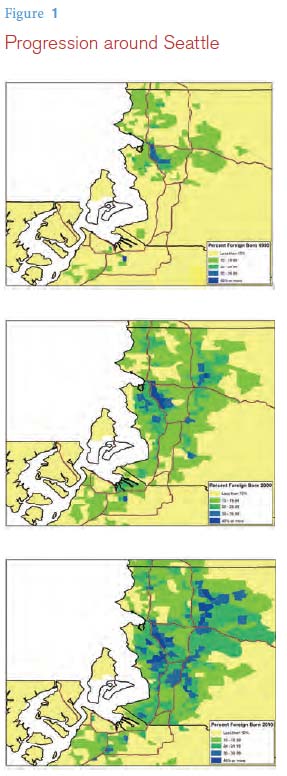
    The regional details are even more striking. Since 2000, the suburban immigrant population has doubled in 20 metro areas. In 53 metro areas, the suburbs accounted for more than half of immigrant growth, including nine metros in which all of the immigrant growth occurred on the periphery: Chicago, Cleveland, Detroit, Grand Rapids, Jackson, Los Angeles, Ogden, Rochester, and Salt Lake City. Atlanta and Seattle, long skirted by immigrants and even now ranking outside the top 10 largest immigrant destinations, each added more immigrants to their populations than did Chicago, San Francisco, Boston, or Los Angeles. Crucially, since 2000, not one metro area has seen its foreign-born population in the suburbs decrease.

    What this means is that the suburbs as a whole are now equally, if not more diverse, than the populations living in most urban cores. They also are generally less ethnically segregated.  Go to a Starbucks in Sugar Land, Texas, and you’re more likely to stand in a line resembling the United Nations than anything you’d find in the center of Manhattan. Same goes for Fairfax, Virginia, where the demographics far out-pixelate Washington, D.C. 29.5 percent of Fairfax residents are foreign born, compared to 13 percent in D.C. 16.4 percent of Fairfax’s residents are also of Hispanic origin and 19.2 percent are Asian, compared to only 10.4 percent Hispanic and 4 percent Asian in D.C.ix Irving City and Carrollton just outside Dallas see their foreign born comprising 35 and 28 percent of their residents, respectively, while Dallas proper caps at only 23 percent. In Washington State, 34 percent of Bellevue is foreign born, while Seattle’s foreign born stands at a mere 17.7 percent.

    It’s important to note that this movement to the periphery does follow overall population settlement patterns observed since 2000 – it is not simply an immigrant or minority phenomenon. As elite urban hubs suffer from high housing prices, experiencing then a widening chasm between the very rich and the very poor, the suburbs have become a harbor for the middle class to find more reliable footing. And while my suburban-raised college classmates and I turned our noses up at their presumed provinciality, an Aspen/Atlantic poll from three months ago showed that most Americans still consider a family-oriented, suburban neighborhood closest to their “ideal” in terms of where to live, with 53 percent of whites, 53 percent of African Americans, 53 percent of Hispanics and 63 percent of Asians aspiring to this future.

    Recognizing that immigrant and minority migration patterns mirror shifts undergone by the population at large, there remains a texture to the suburban shift specific to both the contexts and the aspirations of today’s immigrant and minority groups, a texture laden with distinct promises and challenges as many pioneer lives on a more sprawling landscape. Here is a closer look at why the New America is suburbanizing, and what this may bode for the future.

    THE CASE OF HOUSTON

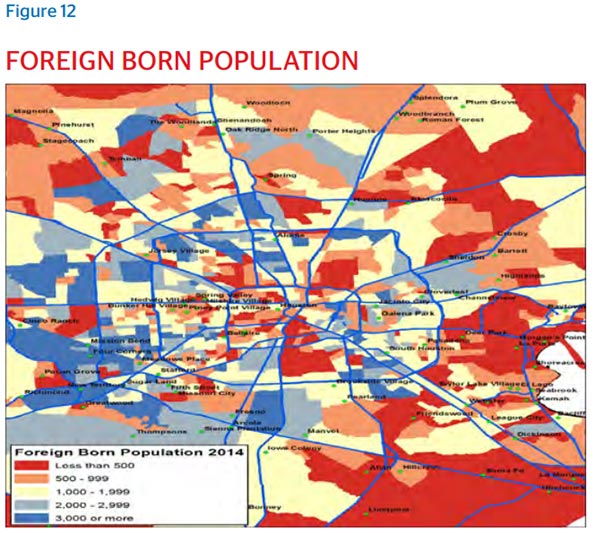
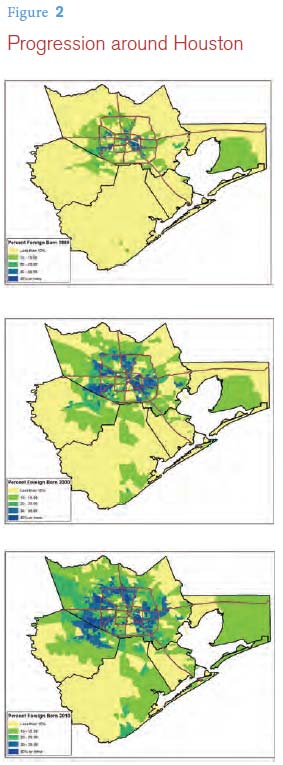
    Take a drive westward from almost any major airport today and you’ll see these worlds unfurling. In Houston, now the most ethnically diverse metropolitan area in the country, its white population is increasingly concentrated inside the inner loop (particularly millennial singletons) with everyone else settling beyond. As of 2013, over half of the city’s immigrant population—56 percent—live in Houston’s suburban municipalities, with 80 percent of the growth of the area’s foreign-born population since 2000 occurring in the suburbs.

    This diversity shapes how I live.  One recent Sunday, after waking up at 6:30 AM for a game of tennis with some Vietnamese friends who’d trekked in to Houston’s inner loop from Sugar Land, I found myself traveling the world in a zip code. The court transitioned to church at an all-black Methodist congregation 32 minutes from Houston’s downtown, followed by a Peruvian brunch at a rotisserie chicken eatery sitting just across the street from a large Indo-Pakistani shopping plaza. I then wandered over to the neighboring Hispanic mall known as PlazAmericas before taking a right on Bellaire Boulevard to peruse flavors of shaved ice at Chinatown’s Dun Huang Plaza and sampling Korean pears at the pristine Super H, with Latino shelf-stockers backing the Korean cashiers. Café Beignets, a Vietnamese interpretation of New Orleans charm, nourished with fried dough in the middle of a “Saigon Houston Plaza” that seemed to take its aesthetic cues from Pottery Barn, Asian-accented. All manner of sacred architecture beckoned from behind the strip malls, with the Buddhist Teo Chew Temple peeking out from beneath the tree tops and a dozen Spanish and African-speaking church signs within view around the corner.

    This was all a suburban version of “verges” – the vortexes where civilizations clash and conceive a fresh dynamism. Only in this case it wasn’t Istanbul; it was the Beltway crossing route 59.

    Houston rightly carries a reputation as one of the most welcoming cities in the U.S. While cultural traditions from elsewhere are invited to express themselves, the first question most Houstonians ask is not, “Where are you from?” but “Where are you headed?” The environment is future-oriented, open and adaptable. Buildings are torn down one month and rebuilt the next. There’s something for everyone, and the more outsiders come for jobs and the hope to establish a stable and happy life, the more Houston is texturizing to reflect the values and needs of the globe within it.

    “I think Houston offers people an opportunity to entrench themselves,” says John Tran, a second-generation Vietnamese lawyer in his mid-thirties, living in Sugar Land, also the town of his childhood. “It’s one of those places that gives people time to assimilate at the same time that it also gives them time to develop their own identity.”

    The sprawl invites a tension to play out between tradition and innovation, stability and risk.

    “The message is: Do it your own pace, do it your way, you have a home here,” Tran says.

    This is a great opportunity as well for the realtors and homebuilders as they reinvent the sprawling landscape to suit the aesthetic tastes of their diversifying clientele. Local architect Tim Cisneros is currently working on a $10 million dollar Indian wedding facility in Sugar Land that will be capped by a helipad and bridge built to withstand an elephant’s weight for the groom’s entrance. Cisneros serves some of Houston’s most entrepreneurial immigrants, his portfolio including a Chinese museum of history and culture (“Forbidden Gardens”), multiple Indian restaurants and a Messianic Jewish worship center.
    Each project involves an anthropological education. Cisneros recalls:

    “When I was in the running to design a Daoist temple, I had to go to this ritual. They’d put the various names of the architect candidates into a calligraphic gold pot with sparks and smoke. My job depended on whether some karma favored my name.”

    Cisneros now calls Houston his “favorite third world city,” hinting both at its development potential and the ambience that appeals to today’s new immigrants. From the tropical climate, to the zone-free real estate possibilities, to the hodge-podge aesthetic that disorients and welcomes anyone looking to make a mark, there’s both a familiarity to those coming from the developing world but also a chance to enjoy greater personal space than they were allowed in cities like Seoul, Abuja or Delhi.

    “The immigrants we work with,” says
    Cisneros, “they think they’ve died and gone to heaven. They don’t get caught up in the fact that their father’s generation wasn’t born here.” There’s opportunity, and perhaps more importantly, a sense of limitless sky.

    THE PERCEPTION OF MORE CHOICE AND OPPORTUNITY

    For most of U.S. history, immigrants have been concentrated in iconic cities. Early waves of European immigrants initially moved into neighborhoods close to the factories and shops that employed them. Go to Manhattan’s lower east side and you’ll still catch a whiff of the German, Irish and Jewish flavor that defined this neighborhood at the turn of the 20th century. As increasing numbers of immigrants have flocked to the suburbs at the turn of this century, however, it’s clear the new immigrants are reshaping the geography of opportunity.

    To dig into this, I’ve spent the last few months interviewing national migration experts and district school superintendents, exploring the growing array of suburban social services and attending a wide variety of religious services and cultural celebrations in the most diverse county in the nation—Fort Bend, just west of Houston. What’s come to the surface, amidst all the variance in regional patterns of settlement, is the issue of agency. Choice, or lack thereof, is the fault line in the nationwide trend toward suburban living. Some move because they can and choose to – the suburbs have attractive features worth pursuing. Others are forced out as they’re displaced by gentrification, changes in local labor demand, and, sometimes, black-white racial tensions.

    “You’ve got two streams of immigrants flowing out of the urban core,” says Stephen Klineberg, founder of the Houston-based Kinder Institute. “One contains the engineers, doctors and information technology professionals, many of whom are Asians and Africans that enter this country with higher educational levels than many native- born Anglos, and the other contains the poor and uneducated, most of whom are black and Hispanic. Where the upper middle class of Asians and Africans tend to go where the property values are higher, where the schools are good and the jobs plentiful, [poor] blacks and Hispanics are increasingly being clustered in low-cost areas, getting pushed farther and farther out.”

    These ethnic delineations may be too sweeping — there are many upper income Mexicans and Africans, for example — but Randy Capps of the Migration Policy Institute at least agrees on the pattern. “Your distressed communities are going to attract people who have no choice,” he says. “The poorest people are going to be increasingly transient, namely, poor blacks and Hispanics.”

    For those with the capacity to move of their own accord, choice itself explains the reasons for the suburban move. Behind the practical appeal of lower housing prices, more jobs and better schools, every immigrant I interviewed alluded to the air of untapped possibilities that they no longer sensed in dense urban cores. The growing magnetism of a city like Houston, for instance, along with other suburban cities in the South and West, is in part rooted  in the sense that you don’t have to be a part of the establishment to move up. Social mobility is possible for those with the wherewithal to climb.

    “The American Dream is alive and well here,” said one restaurant owner. “If you want to make it, you can. I haven’t been able to find that possibility in other cities.” Other suburban dwellers agreed. “Urban density doesn’t grant easy permission for the imagination,” said a Vietnamese couple. “Suburban landscapes at least invite you to try to make your own mark.”

    THE IMPORTANCE OF HOME OWNERSHIP

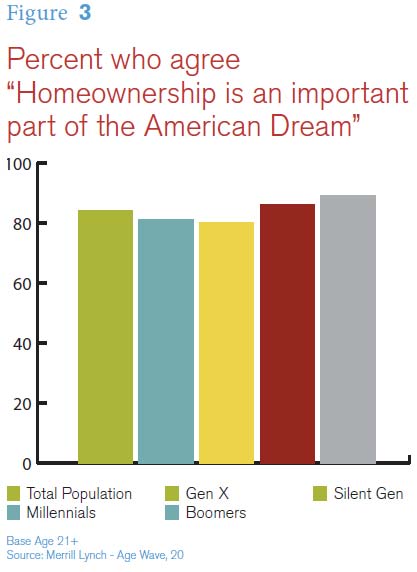
    If more space and choice lie at the core of most minorities’ hopes, buying a home seems the first logical step to securing them. For immigrants in particular, transitioning from renter to homeowner is an important milestone in committing to the United States. The question is: Where is this transition now possible? And are immigrants and minorities more willing to take the  leap into far-flung coordinates because owning a home is more critical to their civic credibility than it is for today’s average native citizen?

    There’s some data to suggest that in a society increasingly accepting of a “rentership” mentality, immigrants remain more likely to strain for permanence. The national homeownership rate has been declining for ten consecutive years.xii You see this pronounced especially amongst the young. Those in the prime of their adulthood, between 35 to 44 years of age, are buying homes at a low rate not seen since the 1960s. And for minorities, the numbers dip lower – the gap between white and minority home ownership is 25.5 percentage points.

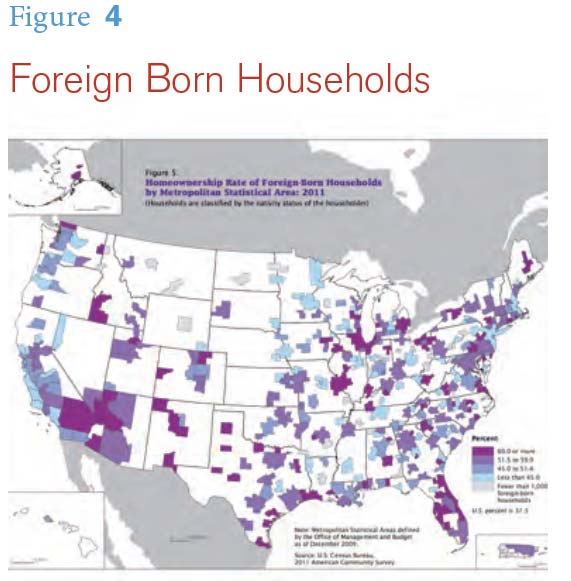
    However, when you look at the maps detailing migrations of minorities and immigrants, and where they tend to be growing, they are growing fastest in places where houses are being bought. According to a report by the Research Institute for Housing America, immigrants accounted for nearly 40 percent of the net growth in homeowners between 2000 and 2010; in the 1970s they represented just over 5 percent of the growth. Meanwhile, the foreign born have been moving towards ownership, with renting growth happening only in the states that have become tough for prospective homeowners – e.g. California, the Washington D.C. area, New York, New Jersey, Massachusetts, Connecticut and Illinois.xiv In the current decade, California and New York are projected to be the only two states where foreign-born homeowner growth declines. Texas and Florida, by contrast, are attracting foreign- born buyers in droves, with net increases of 492,000 and 342,000 projected.

    As Hispanic and Asian homeownership in particular is climbing, they’re buying in the second-ring suburbs and even exurbs where they are settling in large numbers. We can see this by looking at maps of several major metropolitan areas such as San Francisco, New York, and Chicago.

    Obviously, when home ownership is the top priority, where it can be affordably attained becomes all the more relevant. Aspiring homeowners tend to want to live around other homeowners – there’s a like-attracts-like buzz of “I want to be around other people who are making it.” Minorities also seem  to be maintaining the more traditional American idea that homeownership equals the final seal of adulthood.

    “Buying a house was important,” says Tran, the 35-year old lawyer who lives with his wife in Sugar Land, a town in Fort Bend County. “It was roots being planted, physically and emotionally. If marriage was the emotional commitment, the house was the physical aspect of that.”

    The Trans’ neighbors, an African American couple named Geoff and Robin Boykin, agree.

    “As a minority, owning a home gives you a level of credibility in the community that renting won’t,” Boykin says. “When we first moved to this neighborhood, we rented, just to be sure, and when people would come up and ask us about it, there was an underlying feeling of embarrassment. Like we were second-class citizens. Perhaps especially because we’re the only black couple in this neighborhood.”

    Geoff grew up in Brooklyn, New York, “where you don’t even think about buying.” But when he met a 24-year old who owned a house in Houston, he thought, “Wait a second. Where can you buy a house at age 24?” He moved to Texas to follow suit. Southwestern sprawl offered an opportunity to get established, cheaper.

    Suburbs have always been family- friendly, at least by brand, and as Caucasian family size continues to shrink, those Hispanic and African American still having children, even three to four, kids want to be in safer, more affordable family-oriented neighborhoods.

    “You are now more likely to have inter-generational communities in  the suburbs,” says Randy Capps of the Migration Policy Institute.

    Tim Cisneros, the architect who serves some of Houston’s most entrepreneurial immigrants, says that his clients typically want something “colonial or traditional, to show they’ve assimilated. They also want big, to host multi-families.”

    "It’s now the Indians and wealthy Mexicans building the McMansions in the exurbs,” says Cisneros. “In Sugar Land. Pearland. The Woodlands [just north of Houston] is like going to private
    Mexico now. With armies, guards, the whole nine yards of the Mexican elite.”

    If homeownership remains one of the more important seals of legitimacy for
    today’s immigrants and minorities, it’s also a tool for consumer status – in this case one’s civic and cultural status.

    “With many immigrants,” Cisneros says, “the shinier it is, the more expensive they assume it to be and thus more attractive. More ’making it’ in America.”

    On the other side of the real estate spectrum, of course, are those who are getting priced out of longstanding ethnic enclaves that lie closer to the city center. Ron Castro is a sociology and psychology teacher at Spring Woods High School in Spring Branch, a gentrifying suburb straddling Houston’s second freeway loop, and says that in 15 years of teaching, house prices have climbed from $90,000 to $400-500,000.

    “Folks I used to know can’t  afford to live here anymore,” he says. “Everyone’s saying, ’we’ll be on our way out pretty soon.’”

    “In ten years, these mini-mansions pop up. The neighbor can’t afford that. I don’t see how low-income people survive another 10 to 15 years here in Spring Branch.”

    JOBS, SCHOOLS AND AN ECONOMY AGING BACKWARDS

    Most of today’s middle class economy is now found outside of central downtowns. Suburbs and exurbs accounted for 80 percent of job growth between 2010 and 2013.
    Irvine and Santa Clara in California, Bellevue just outside Seattle, and Irving, a Dallas suburb, have higher job to resident worker ratios than their closest core municipality. The booming technology sector is adding most of its jobs to suburbanized areas like Raleigh-Durham, Dallas-Ft. Worth and Orange County, attracting high-skilled Indian and East
    Asian employees, in particular.
    And, as “live, work, play” locations proliferate, it isn’t just a matter of where the jobs are located, but also where the highest quality of integrated living – work + leisure + community – may be found.

    “Sugar Land’s Town Center has everything you need,” says Geoff Boykin, who works for Coca Cola two miles from his home. “All the amenities – restaurants, Home Depot, a movie theater, the gym – I love the convenience.”

    At the same time, many suburbs are developing multi-purpose complexes  of community and leisure that complement their growing professional class, while telecommuting is on the rise, especially amongst millennials. For younger minorities and adult children of immigrants, commuting to work is no longer a must. So long as a suburb is relatively close to a freeway entrance, other desires like strong recreational possibilities and a good night life can take the front seat. The Internet has lessened the need for many to weigh the variable of long commutes.

    Rental properties for small businesses – many of which are owned and run by immigrants – are almost universally cheaper in the suburbs. And as more and more millennials are moving to  the suburbs, businesses are noticing the outflow of their consumption habits.

    “My clientele here is getting older, less willing to spend,” says Yoichi “Yogi” Ueno, the owner of a Japanese Sushi restaurant in Rice Village inside Houston’s inner loop. A few years ago he decided to open another more casual location in Fort Bend County on Bellaire Boulevard, in part to attract the freer flow of youthful wallets.

    “The well-educated, higher income younger people are having kids and moving out to exploding suburbs like Sugar Land and Katy,” Ueno says. “They now have more vibrancy. I may move this restaurant out there one day. I think business may be better.”
    For those with kids, of course, the historic sense that the suburbs have better schools and safer streets remains true, and of acute appeal to those looking to give their offspring a secure and promising future. There’s also more educational choice in the suburbs, and with lower costs of living, the possibility to send one’s child to a private school becomes easier.

    “For many Asian families in particular,” says a Vietnamese couple with one middle schooler and two elementary-age sons, “living where the schools are ’good’ becomes the number one priority.”

    THE PRE-EXISTING CULTURAL CLIMATE

    The movement of immigrants to the suburbs draws more to the same places. Just as immigrants in the first wave of mass migration went where families had already set up house and shop, today’s suburbanizing immigrants report a stronger sense of belonging and feeling welcomed in the suburbs, compared with urban cores too entrenched in established legacies and racial histories to leave room for more. There is also more of a chance for coherence and authenticity in immigrant expression in the suburbs, manifested most obviously in ethnic restaurants and supermarkets, distinctive religious congregations and social networks.

    “In the suburbs, I can run a sushi restaurant more like they do in Japan,” says Yoichi Ueno. “Here, closer to the city, with more of an affluent and white clientele, I had to invite in a chef to introduce things like California rolls [to appease American tastes]. In Japan we don’t actually sell those rolls!”

    These commercial enclaves are attractive in both entrepreneurs and their customers.

    “I like being in a Latina neighborhood,” says high school teacher Ron Castro, who’s chosen to stay in what some consider a less desirable suburb outside the loop. “There’s a Fiesta out here. A carniceria.”

    There are also scads of religious communities in the suburbs, the spires of sacred structures peeping just behind the strip malls. With secularism predominant in elite urban hubs, faiths from all over the world are finding welcome and freedom of expression in the wide open spaces where immigrants and minorities are settling. Religion remains a central artery for those beginning new lives, providing a sense of ethnic identity and continuity, social services and social status.

    SOME BROADER OBSERVATIONS ABOUT TODAY’S SUBURBAN ECOLOGY

    As I’ve wandered through and sampled the flavors of various suburban communities in Houston and elsewhere (including Charlotte, Dallas, northern Virginia and Chicagoland), it is clear there is a more textured political climate developing there. Most minority suburban dwellers I spoke with sounded progressive on immigration and the role of government in providing social services, and conservative on business regulation. The flourishing of the family was clearly important, even in its traditional expression, but those interviewed skirted any political commentary on that front.

    The suburbs also appear to be eclipsing the city as centers for civic renewal and volunteerism, though more empirical study of this is needed. Every suburban resident I interviewed was involved in at least one local initiative, such as Moms against Drunk Driving, seasonal clean-up effort and local arts & craft festivals. This stands in stark contrast to the average single professional renting a loft downtown, most of whom are involved in loose social diasporas but otherwise see the city as a one-way consumption opportunity.

    Some of this may have to do with life stage, and the higher proportion of families in suburbs—the attendant reality being that kids naturally invite parental involvement in the milieu of their upbringings. But the sense of voluntary generosity is also a testament to the growing presence (and confidence) of immigrants in the suburbs, who show higher rates of volunteering both inside their ethnic networks and, with growing levels of affluence, beyond them.

    Finally, the influx of immigrants demonstrates how suburbs are where a strong sense of community can be built and sustained. I repeatedly noticed how rare I was as a single car-user in parking lots that otherwise saw piles of kids tickling each other in the back seat – particularly the case for lower to middle class Hispanic and African American neighborhoods. In a Peruvian restaurant in Fort Bend on a Sunday afternoon, I was the lone millennial eating lunch solo and scrolling through my iPhone, the other tables raucous with the laughter of children and grandfathers in church attire. It struck me that the suburbs, with all of their automobile dependence, remains a relative bastion of strong community feeling and sense of obligation. Contrary to the general academic and media portrayal of suburbs as hotbeds of alienation and anomie, they are becoming bastions against the seduction of a consumerist, individual autonomy.

    COMPLEXITIES AND CHALLENGES

    As stated at the outset, it is in many ways impossible to speak about “the suburbs” in a generic sense. There remain two streams of movement outward: one rooted in choice and the other in forced displacement. But there also remain important caveats to these selling points, caveats that illuminate the open questions around the future of suburban life and human flourishing within it. The first is the challenge of isolation and integration, especially as the suburbs continue pixelating in ethnic and cultural diversity.

    Houston, for instance, is a city that welcomes the stranger, but its layout is sprawling, enticing for those with gumption can prove intimidating for those torn from their native support structures (or lacking them in the first place). Social services slim down the further you get from the Beltway. Public transportation is sparse, and sustaining driver’s licenses can be tricky for the undocumented. Information is under-institutionalized and rife for predatory activity – immigration lawyers and mortgage brokers, both. For those with few resources, life can be a constant struggle.

    Public schools feel the brunt of these rapid demographic shifts, with diversifying student populations outpacing the cultural training of teachers. H.D. Chambers is the superintendent of the most diverse district in Texas – Alief – and he says the avalanche of students coming from economically disadvantaged backgrounds (800 new Burmese refugees amongst them), combined with those coming with little to no English knowledge, make providing a strong educational experience profoundly difficult.

    “I’m talking about diversity that’s deeper than color of skin,” Chambers says. “It’s about diversity of life experiences, and what these kids face when they go home. Many of their parents can’t help them. How do we teach them to interact with others? How
    do you prepare these sorts of kids for a global economy and the world at large?”

    Not all immigrants – particularly the children of the foreign born – appreciate the suburban edition of the American Dream their parents foisted upon their upbringings.

    Raj Mankad is the editor of an architecture magazine housed at Rice University, and as a child emigrated from India to a cul de sac in Mobile, Alabama. Years later, as an adult, he asked his parents why they opted for the spacious suburbs after the chaotic yet cozy density of living in India. They answered in classic 1.0 form: As an immigrant, you want to go for the opposite of what you left behind.

    “We arrived with five dollars in our pockets,” they told him. “We could not buy expensive things or houses in the best neighborhoods. And we grew up with very little, sharing bedrooms with all our siblings, sleeping on the floor, walking to school without shoes. So when we arrived in the United States, we wanted exactly the opposite.”

    Raj has since rejected a lifestyle he finds plastic for a hipper, culturally creative and environmentally conscious life with his Caucasian wife and two young kids in Houston’s Montrose corridor. He rides a bike to work and aspires to start his own spiritual community inside the loop.

    “I want my kids to understand their Hindu heritage, but the temples are in the suburbs, and I don’t want to schlep out an hour for a religious service. I want to start my own spiritual community, but not in a conservative way.”

    The price may be high compared to what his Indian American peers are choosing on the periphery, but it’s his preferred assimilation – honest, expensive, and full of uncomfortable tensions.

    CONCLUSION

    People have any number of reasons for move to suburban locales. But it’s not just the cash nexus at operation here. There’s also the emergence of more mysterious and fascinating blends of culture and community in ways that will shape our perceptions of what constitutes the best of American life.

    Suburbs used to be a device to “protect” people from the Other. No longer. Many now foster the creation of hybrid identities, tight yet pluralistic communities, alternate information loops and various commercial exper- iments. As immigration in particular plays out through the quotidian experiences of today’s suburban blends, the institutions and leaders within these communities could be critical to formulate policy reform, especially as it relates to questions around integration. More broadly, the suburbs will be the battleground where debates around home ownership, social mobility, and the promise and challenge of a pluralistic society will need to be waged.

    If you’re interested in the New America, keep an eye on your suburbs. They’re not as peripheral as the horizon would suggest, and may even be at the nexus of what is next.

    This essay is part of a new report from the Center for Opportunity Urbanism called “America’s Housing Crisis.” The report contains several essays about the future of housing from various perspectives. Follow this link to download the full report (pdf).

    Anne Snyder is a fellow at the Center for Opportunity Urbanism and covers stories within the vortex of immigration, social class and values. Prior to living in Houston she worked at The New York Times, World Affairs and the Ethics and Public Policy Center.