Author: Bill Steigerwald

  • America the Mostly Beautiful

    In the fall of 2010, as part of a book project, ex-newspaperman Bill Steigerwald retraced the route John Steinbeck took in 1960 and turned into his classic “Travels With Charley.” Steigerwald drove 11,276 miles in 43 days from Long Island to the top of Maine to Seattle to San Francisco to New Orleans before heading back to his home in Pittsburgh.  In “Dogging Steinbeck,” his new e-book about how he discovered “Charley” was not nonfiction but a highly fictionalized and dishonest account of Steinbeck’s real trip, Steigerwald describes the America he saw.

    "Big."

    "Empty."

    "Rich."

    "No change since 1960."

    Long after the old farms and new forests of New England disappeared in my rearview mirror, I was still scrawling those words in the reporter’s notebook on my knee. Big, empty, rich and unchanged – that’s a pretty boring scouting report for the America I “discovered” along the Steinbeck Highway. You can add a bunch of other boring but fitting words – “beautiful,” “safe,” “friendly,” “clean,” and “quiet.”

    Like Steinbeck, I didn’t see the Real America or even a representative cross-section of America, neither of which exist anyway. Because I went almost exactly where Steinbeck went and stopped where he stopped, I saw a mostly White Anglo Saxon Protestant Republican America, not a “diverse and politically correct” Obama one. Mostly rural or open country, it included few impoverished or crime-tortured inner cities and no over-developed/underwater suburbs.
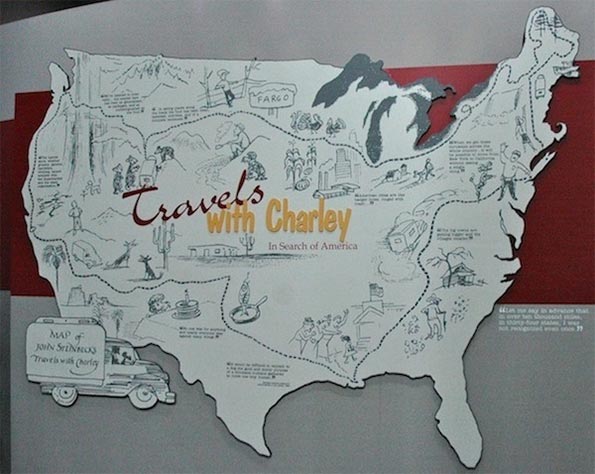
    America the Beautiful was hurting in the fall of 2010, thanks to the bums and crooks in Washington and on Wall Street who co-produced the Great Recession.  It still had the usual ills that make libertarians crazy and may never be cured: too many government wars overseas and at home, too many laws, politicians, cops, lawyers, do-gooders and preachers.

    But America was not dead, dying or decaying. There were no signs of becoming a liberal or conservative dystopia. The U.S. of A., as always, was blessed with a diverse population of productive, affluent, generous, decent people and a continent of gorgeous natural resources.

    Everyday of my trip I was surrounded by undeniable evidence of America’s underlying health and incredible prosperity. Everywhere I went people were living in good homes, driving new cars and monster pickup trucks and playing with powerboats, motorcycles and snowmobiles. Roads and bridges and parks and main streets were well maintained. Litter and trash were scarce. Specific towns and regions were hurting, and too many people were out of work, but it was still the same country I knew.

    I didn’t seek out poverty or misery or pollution on my journey, and I encountered little of it. The destitute and jobless, not to mention the increasing millions on food stamps, on welfare or buried in debt, were especially hard to spot in a generous country where taking care of the less fortunate is a huge public-private industry – where even the poor have homes, cars, wide-screen TVs and smart phones.

    I saw the familiar permanent American socioeconomic eyesores – homeless men sleeping on the sidewalks of downtown San Francisco at noon, the sun-bleached ruins of abandoned gas-stations on Route 66, ratty trailer homes parked in beautiful locations surrounded by decades of family junk. I saw Butte’s post-industrial carcass, New Orleans’ struggling Upper Ninth Ward and towns that could desperately use a Japanese car plant.

    But the country as a whole was not crippled or even limping. In the fall of 2010, nine in 10 Americans who said they wanted jobs still had them. The one in 10 who were jobless had 99 weeks of extended unemployment benefits and more than 90 percent of homeowners were still making their mortgage payments.

    Most of the states I shot through – including Maine, northern New Hampshire and Vermont, upstate New York, Wisconsin, Minnesota, North Dakota, Montana – had unemployment and foreclosure rates well below the national averages.

    I didn’t visit the abandoned neighborhoods of poor Detroit. I didn’t see battered Las Vegas, where 14.5 percent of the people were unemployed and one in nine houses – five times the national average – had received some kind of default notice in 2010. But I spent almost two weeks in the Great Train Wreck State of California, where jobless and foreclosure rates were higher than the national average and municipal bankruptcies loomed.

    America had 140 million more people than it did in 1960, but from coast to coast it was noticeably quiet – as if half the population had disappeared. Despite perfect fall weather, public and private golf courses were deserted. Ball fields were vacant. Parks and highway rest stops and ocean beaches were barely populated. Except for metropolises like Manhattan and San Francisco and jumping college towns like Missoula and Northampton, people in throngs simply did not exist. I went through lots of 30-mph towns that looked like they’d been evacuated a year earlier.
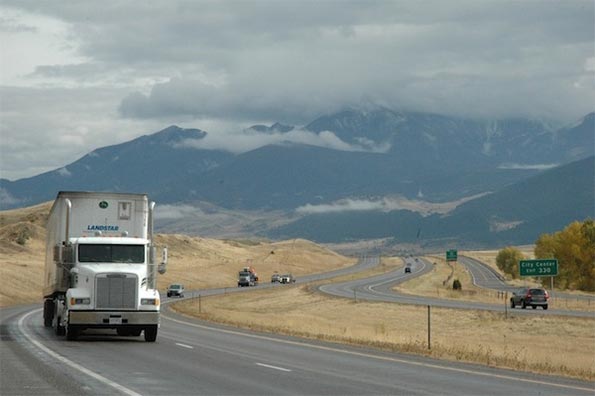
    As I drove what’s left of the Old Steinbeck Highway – U.S. routes 5, 2, 1, 11, 20, 12, 10, 101 and 66 – it was obvious many important changes had occurred along it since 1960. Industrial Age powerhouses like Rochester, Buffalo and Gary had seen their founding industries and the humans they employed swept away by the destructive winds of technology and global capitalism. Small towns like Calais in northeastern Maine had lost people and jobs, and vice versa.

    New Orleans had shrunk by half, and not just because of Katrina. The metro areas of Seattle, San Francisco and Albuquerque had exploded and prospered in the digital age. The populations of the West Coast and the Sunbelt had expanded since 1960. The South had shed its shameful system of apartheid and its overt racism, as well as much of its deep-rooted poverty and ignorance. The Northeast had bled people, manufacturing industries and its once overweening role in determining the nation’s political and cultural life.

    Change is inevitable, un-stoppable, pervasive. Nevertheless, it was clear that a great deal of what I saw out my car windows had hardly changed at all since Steinbeck and his French poodle Charley raced by.

    He saw more farmland and fewer forests than I did, especially in the East. But in many places I passed through almost nothing was newly built. Many farms and crossroads and small towns and churches were frozen in the same place and time they were eons ago, particularly in the East and Midwest.

    In Maine the busy fishing village of Stonington was as picturesque as the day Steinbeck left it. He’d recognize the tidy farms of the Corn Belt and the raw beauty of Redwood Country and the buildings if not the people of the Upper Ninth Ward. And at 70 mph whole states – North Dakota and Montana – would look the same to him except for the cell towers and Pilot signs staked out at the interstate exits.

    Steinbeck didn’t like a lot of things about Eisenhower America – sprawl, pollution, the rings of junked cars and rubbish he saw around cities. And he lamented – not in “Charley” but in letters to pals like Adlai Stevenson – that he thought America was a rotting corpse and its people had become too soft and contented to keep their country great and strong.

    But Steinbeck had America’s future wrong by 178 degrees. Fifty years later, despite being stuck in an economic ditch, the country was far wealthier, healthier, smarter and more globally powerful and influential than he could have imagined. Its air, water and landscapes were far less polluted. And, most important, despite the exponential growth of the federal government’s size and scope and its nanny reach, America in 2010 was also a much freer place for most of its 310 million citizens, especially for women, blacks, Latinos and gays.

    You don’t have to be a libertarian to know America is not as free as it should be. But there’s no denying that today our society is freer and more open than ever to entrepreneurs, new forms of media, alternative lifestyles and ordinary people who want to school their own kids, medicate their own bodies or simply choose Fed Ex instead of the U.S. Post Office.

    As for the stereotypical complaints about America being despoiled by overpopulation, overdevelopment and commercial homogenization, forget it. Anyone who drives 50 miles in any direction in an empty state like Maine or North Dakota – or even in north-central Ohio or Upstate New York – can see America’s problem is not overpopulation. More often it’s under-population. Cities like Butte and Buffalo and Gary have been virtually abandoned. Huge hunks of America on both sides of the Mississippi have never been settled.

    From Calais, Me., to Pelahatchie, Miss., I passed down the main streets of comatose small towns whose mayors would have been thrilled to have to deal with the problems of population growth and sprawl.  If anyone thinks rural Minnesota, northwestern Montana, the Oregon Coast, the Texas Panhandle or New Orleans’s Upper Ninth Ward have been homogenized, taken over by chains or destroyed by too much commercial development, it’s because they haven’t been there.

    The America I traveled was unchained from sea to sea. I had no problem eating breakfast, sleeping or shopping for road snacks at mom & pop establishments in every state. The motels along the Oregon and Maine coasts are virtually all independents that have been there for decades. You can go the length of old Route 66 and never sleep or eat in a chain unless you choose to.

    Steinbeck, like many others have since, lamented the loss of regional customs. (I don’t think he meant the local “customs” of the Jim Crow South or the marital mores of the Jerry Lee Lewis clan.)  I didn’t go looking for Native Americans, Amish, Iraqis in Detroit, Peruvians in northern New Jersey or the French-Canadians who have colonized the top edge of Maine.  But I had no trouble spotting local flavor in Wisconsin’s dairy lands, in fishing towns along Oregon’s coast, in the redwood-marijuana belt of Northern California, in San Francisco’s Chinatown or the cattle country of Texas.

    Not to generalize, but the New York-Hollywood elites believe the average Flyover Person lives in a double-wide or a Plasticville suburb, eats only at McDonald’s, votes only Republican, shops only at Wal-Mart and the Dollar Store, hates anyone not whiter than they are, speaks in tongues on Sunday and worships pickup trucks, guns and NASCAR the rest of the week.

    Those stereotypes and caricatures are alive and well in Flyover Country. But though I held radical beliefs about government, immigration and drugs that could have gotten me lynched in many places, I never felt I was in a country I didn’t like or didn’t belong in. Maybe I just didn’t go to enough sports bars, churches and political rallies, but for 11,276 miles I always felt at home.

    Bill Steigerwald, born and raised in Pittsburgh, is a former L.A. Times copy editor and free-lancer who also worked as a docudrama researcher for CBS-TV in Hollywood before becoming a reporter for The Pittsburgh Post-Gazette and a columnist for The Pittsburgh Tribune-Review. He recently retired from daily newspaper journalism.
  • Pittsburgh’s Tunnel of LOV

    Before Pittsburgh’s light-rail “Tunnel to Nowhere” under the Allegheny River came along, my favorite Port Authority boondoggle was the Wabash Tunnel under Mt. Washington.

    Most Pittsburghers know all they need to know about the notorious “Tunnel to Nowhere.”

    Still under construction and still disrupting downtown Pittsburgh after three years, it’s the 1.2-mile, $528 million extension of “The T” (Pittsburgh’s light-rail line to the South Hills suburbs) from Gateway Center under the Allegheny River to the North Shore (where the Steelers’ and Pirates’ subsidized playpens are).

    The “Tunnel to Nowhere’s” humorless fathers and mothers at the Port Authority of Allegheny County, the local Big Transit franchise, prefer to call it “The North Shore Connector.”

    But whatever they call it, their baby is still probably going to cost upwards of $.7 billion by the time it’s done in 2012. That’s when it will begin providing desperately needed cheap public transportation to its key customer base — Steeler and Pirates fans too lazy to walk across one of four bridges that already connect downtown and the ballparks.

    As for the humble Wabash Tunnel, most Pittsburghers have never heard of it and it’s a statistical certainty that most of them have never passed through its innards since it quietly opened in early 2005.

    Originally part of the grandiose “Airport Busway” plan, the tunnel’s rebirth is a textbook case of the confluence of dumb federal regulations, “free” federal transportation money, and criminally stupid local transit officials. As a local historian nicely explains and illustrates in “Pittsburgh’s Money Pit,” the tunnel has a long, sad and bankrupt life.

    To turn it into the Wabash HOV and make it suitable for car traffic, the Port Authority had to pour about $40 million in federal, state and local tax money into it. The ramps from the tunnel portals on each side of the hill to the existing road levels were about $10 million.

    Even if it had connected to an underused $326 million busway as planned, the Wabash would have been a waste of everyone’s money. As a stand-alone tunnel for cars under Mt. Washington, the hill that separates Downtown Pittsburgh from the city’s southern suburbs, it was and still is worthless.

    Paul Skoutelas, in 2005 the Port Authority’s Chief Exaggerating Officer, tried to justify the 3,600-foot tunnel by saying the Wabash HOV would alleviate commuter congestion on the Fort Pitt and Liberty bridges, the two main arteries into downtown from the south.

    That claim was always an absurdity bordering on a lie, since 200,000 vehicles a day used the two bridges in 2005 and the Wabash was projected at its peak – in 2015 — to handle a whopping 4,500 vehicles a day.

    That 4,500-car projection – a typical example of the phony projections Big Transit monopolies make when they justify their future fiascos – will only materialize if an earthquake closes off every other route from the south to downtown.

    Five years after it opened, the Wabash is what everyone knew it would be – a $40 million low-occupancy joke that costs the Port Authority of Allegheny County hundreds of thousands of dollars a year to maintain.

    When I drove through the Wabash LOV Friday, Dec. 3, during rush hour, I found myself riding in the only car in the tunnel. It was so lonely in that yellow tube at 6 p.m. that I decided to stop midway, jump out and take the picture at the top of the page.

    Back in 2007, the number of cars using the Wabash LOV tunnel every day was about 150 – a cost per trip to taxpayers of about $12, according to a local think tank. In the upside-down world of Big Transit accounting, that’s probably a bargain.

    For some strange reason, the Port Authority doesn’t bother to keep track of the number of vehicles using the Wabash each day on its otherwise statistic-filled Web site. I’ve got a couple of calls into my friends who do the PR for the Port Authority.

    They’ll eventually call me back with the official figures. But even if they don’t, it’s safe to assume that the Port Authority’s tunnel of LOV is still a long way from hitting that phony 4,500 projection.

    Bill Steigerwald, a free-lance libertarian writer who recently retired from daily newspaper journalism, loves his native Pittsburgh but hates the political and corporate power brokers who’ve been damaging the city for 60 years. His columns are archived at the Pittsburgh Tribune-Review and his 2000 article for Reason magazine on the city’s abuse of eminent domain powers is here.

    Photo: Evening rush hour in the Wabash LOV Tunnel at 6 p.m. Dec. 3, by author.

  • Pittsburgh Didn’t Volunteer for G20

    As host of the G-20 summit, Pittsburgh briefly will sit in the global spotlight. With this article by longtime Pittsburgh resident and columnist Bill Steigerwald, New Geography opens a three part series looking at this intriguing metropolis from the point of view of planning, demography and economic performance.

    Pittsburgh didn’t volunteer to host the G-20 Summit that is coming here next week to inflict so much civic pain and disruption.

    It was entirely President Obama’s call. He apparently thought it would be a good idea to have the finance ministers and central bankers of the world’s top 20 economies hold one of their city-disrupting conferences in downtown Pittsburgh on Sept. 24-25.

    Perhaps Mr. Obama, who will chair the G-20, thought he was doing the financially strapped city of Pittsburgh a favor by sending 4,000 foreign bureaucrats and media folk here to spend their Euros and Yen on Steelers T-shirts and game jerseys.

    Maybe he thought placing the G-20 meeting in Western Pennsylvania – a disproportionately Caucasian and socially conservative corner of America where his 2008 vote totals were disappointing – would pay him political dividends in the 2012 election.

    In either case, the president was sadly mistaken.

    Except for the local booster & tourism sector – who’d welcome a Category 8 hurricane to Pittsburgh as long as the international media covered it and said nice things about their no-longer smoky city – it’s safe to say everyone in this town who doesn’t work in the homeland security industry wishes they had never heard of the G-20.

    As months of local media stories have made plain, the conference is not only going to be a huge public annoyance, it’s going to be a lose-lose situation for everyone – especially the city government.

    Any economic benefits to the local GDP from the arrival of 4,000 visitors with fat expense accounts will be outweighed by the cost of protecting property from the tens of thousands of leftist protestors, angry anarchists and professional window-breakers who stalk G-20 meetings around the world.

    To maximize security and minimize destruction, the Secret Service and local authorities will fortify most of the Golden Triangle, the photogenic downtown business district squeezed between the Allegheny and Monongahela rivers as they meet to create the Ohio River.

    Barricades will be erected. Cars and mass transit will be diverted. Several major construction sites will be sealed off to deny protestors dangerous things to throw. Most downtown businesses probably will close. City schools and colleges will shut down.

    The predicted cost to local public coffers for hiring, feeding and equipping additional police and paying overtime will be at least $20 million, most of which will be reimbursed by the federal government.

    Whatever the final bill is, hosting the G-20 is an “honor” the city of Pittsburgh and its taxpayers didn’t need and can’t afford. The city is already bankrupt and in state receivership because of the generous pension deals it’s promised but won’t be able to pay for.

    The city of Pittsburgh looks fabulous and robust when its skyline and riverbanks are shown on TV during Steelers home games. But it’s really the capital city of an economically stagnant, over-taxed, over-regulated, steadily depopulating metropolitan region that has been horribly governed for 60 years.

    The private-public power-brokers who’ve run the city have wasted billions on a never-ending series of destructive urban renewal projects, redevelopment boondoggles and wasteful mass-transit projects.

    Almost nothing has been built in downtown Pittsburgh or on its riverbanks in the last 20 years without being handed millions in public subsidies – whether it was PNC Financial Service’s almost completed downtown skyscraper, a gorgeous Lazarus department store that went bust in the ‘90s or the shiny new homes for the Pirates, Steelers and (soon) the Penguins.

    If curious G-20 attendees have time to stroll around the city’s abandoned downtown streets on Thursday and Friday, they will have no trouble finding evidence of City Hall’s current crop of fiascoes-in-the making.

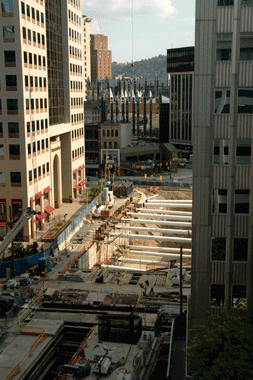
    Right in front of fancy Fifth Avenue Place, for example, is a deep trench where busy Stanwix Street should be.

    It’s not where a Scud missile hit during the first Gulf war. It’s the construction zone of one end of the local mass transit system’s infamous “Tunnel to Nowhere.”

    The 1.2-mile light-rail extension goes from Gateway Center downtown under the Allegheny River to the North Shore, where its other end has been tearing asunder the wasteland of former parking lots between the subsidized new homes of the Steelers and Pirates for several years.

    The twin light-rail tunnel – cleverly built under a river in the “City of Bridges” so as to maximize the cost and provide unions and construction companies with six or seven years of high-paid make-work – will allegedly carry 4.2 million riders a year in the distant transit future.

    That impressive but fraudulent projection comes out to about 11,000 “riders” a day – which actually represents only 5,500 human commuters making a (two-ride) round trip commute. A large proportion of those annual riders, by the way, will be baseball or football fans.

    All that socially correct “mass transit” will end up costing at least $650 million, with federal and state taxpayers picking up about 97 percent of the tab. Except for yours truly and the conservatives on the Pittsburgh Tribune-Review’s editorial page, virtually no one in local politics or the media questioned or challenged the lunacy of building the transit tunnel.

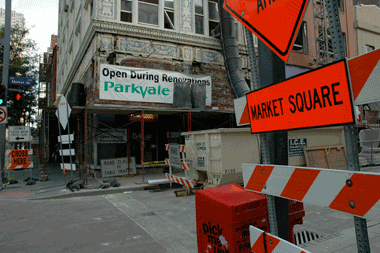
    Another wasteland in the middle of downtown that G-20-goers might visit is the flattened construction site that used to be Market Square.

    Once upon a time, before City Hall planners began demolishing and rebuilding huge chunks of downtown in the 1950s; it was what urbanists are supposed to encourage: an actual square with markets.

    Then, in the 1960s, the city took it over and transformed it into a poorly designed, commerce-free urban park with trees, grass and heavy city bus traffic. The public space delighted crowds of lunching office workers at midday but the rest of the time it was a lawless playpen for about 100 homeless people, drunks and drug pushers.

    Today the area around Market Square, last refurbished in the 1990s, hardly has a live store or restaurant left standing. It is waiting to be turned into its next reincarnation – a $5 million European-style piazza with no vehicles piercing its heart and no low walls and green spaces for social misfits to reside.

    On one edge of battered Market Square is Fifth Avenue, which has been tortured constantly by City Hall for about 25 years.

    In the early 1980s, its street surface was torn up for several years so the city’s rinky-dink light-rail subway could be built beneath it. Not long after that, Fifth Avenue was rendered virtually impassable to shoppers for a couple years while the city slowly redid its sidewalks and curbs.

    Then, in the late 1990s, Fifth was targeted by City Hall for a preposterously stupid and destructive redevelopment scheme.

    The crude 1960s-style renewal project would have misused eminent domain power to clear-cut Fifth Avenue and Forbes Avenue, wipe out nearly 100 businesses and build what amounted to an outdoor suburban mall anchored by a Nordstrom store.

    Fortunately, that plan was miraculously stopped by an alliance of preservationists and property rights defenders. But is it any wonder that after a quarter century of torture by city planners Fifth Avenue became “dilapidated” and in need of serious redevelopment?

    As G-20 attendees will learn if they bother to walk a few moments from their hotels, the nightmare on Fifth Avenue continues. Its northern end is currently being torn down, fixed up, blocked to pedestrians or under construction.

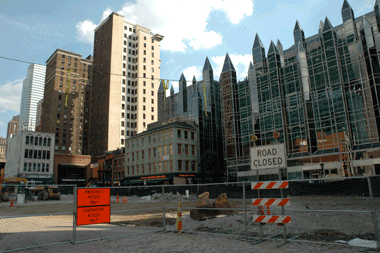
    PNC Financial is putting the final touches on its new 23-story, $178 million headquarters – which received $48 million in state and local subsidies and wiped out half a block of retail storefronts. Meanwhile, up the street, the lovely stone tomb the city erected in the late 1990s for Lazarus has been all but given away to a local developer who’s converted it into a pricy condo and office space that still has 32 of its 65 units to sell.

    Whenever the national media rediscover the glories of Pittsburgh’s clear skies and affordable livability, which they seem to do every four years, they never stick around long enough to note the failings of its governments and politicians.

    Taxes on property and people and businesses are too high. The city schools are absurdly expensive and ineffective. The roads and 1950s parkways are old, narrow and crumbling. Public services are often poor or costly. Unions and Democrats wield the sort of uncontested political power that’s never good for a municipality.

    Yes, it is still true, as the national media and local booster sector never tire of repeating, that the “City of Champions” and its suburbs are a great place in which to live, raise a family, grow old and die peacefully.

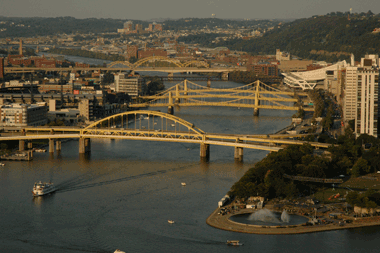
    With its famous three rivers and hills and bridges and skyscrapers and hillside homes and urban neighborhoods and spectacular views and historic downtown buildings, Pittsburgh is rich in natural and man-made charm.

    Toss in a cost of living 17 percent below the national average and low crime rates, lots of good affordable housing, major-league super-teams like the Steelers and Penguins, great museums like the Carnegie and top universities like Carnegie Mellon and Pitt – Pittsburgh does deserve to be ranked highly on those meaningless most-livable city lists.

    It’s also true – as some in the national media latched on to earlier this year – that compared with many other parts of the country, Pittsburgh has not suffered greatly in the current recession.

    Pittsburgh has an unemployment figure lower than the national average, a very low home-foreclosure rate and stable-to-slightly-rising housing prices.

    But Pittsburgh’s good fortune was not, as out-of-town media claimed, because its wise leaders had figured out how to dodge a severe economic downturn. Or because – as President Obama has been led to believe – the region’s post-industrial “eds and meds” service economy is particularly healthy or even resilient.

    Pittsburgh’s relatively impressive economic statistics are pretty much the 30-year norm for Pittsburgh – in times of national booms or busts. They probably won’t change for the better unless the spectacularly rich Marcellus shale natural gas deposits lying underneath western Pennsylvania are exploited, which may not happen for decades or ever happen at all.

    There’s one thing about Pittsburgh’s future that is a near certainty: It’s going to have fewer residents next year than it has today.

    Since the mid-1990s, Pittsburgh has had more deaths than births each year. Between 2000 and 2006, in fact, it had 21,045 more deaths than births, earning it the distinction of being the largest metropolitan area where deaths outnumber births.

    That negative ratio wouldn’t be so bad if immigrants from anywhere else were flocking to Pittsburgh. But they aren’t. Metro Pittsburgh has the lowest percentage of foreign-born residents of any major city – 3 percent – compared to 12.5 percent nationally.

    Pittsburgh has only about 7,000 immigrants from Latin America – second to the 7,800 who hail from India. Only 16,000 international immigrants arrived in metro Pittsburgh between 2000 and 2006, dead last among the 25 largest cities.

    Post-industrial decline, out-migration, too many older people, more deaths than births, too few immigrants from Mexico and Georgia – they’ve all contributed to Pittsburgh’s incredible six-decade population decline.

    In 1950, Pittsburgh was the country’s 12th biggest city. It had 676,806 citizens in a metropolitan area of about 2.5 million.

    Today the metro population, ranked 22nd, is down to 2.35 million and Pittsburgh’s surviving population of 310,000 live in the country’s 59th biggest city – right behind Aurora, Colo., a growing municipality that will never have to worry about getting stuck with hosting a G-20 summit.

    Photos by Bill Steigerwald.

    Bill Steigerwald, a free-lance libertarian writer who recently retired from daily newspaper journalism, loves his native Pittsburgh but hates the political and corporate power brokers who’ve been damaging the city for 60 years. His columns are archived at the Pittsburgh Tribune-Review and his 2000 article for Reason magazine on the city’s abuse of eminent domain powers is here.

  • Even the Super Bowl Can’t Defend Pittsburgh From a Recession

    Somebody call the New York Times. The national economic meltdown has finally come to Pittsburgh, a city-region where you’ll want to be on the day the world ends because you’ll still have several years to live.

    Sunday’s Super Bowl game between the mighty Steelers and the upstart Arizona Cardinals – teams representing regions going in exactly opposite socioeconomic directions since 1950 – has eclipsed all non-sports news coming from Pittsburgh.

    Pro football, which Pittsburgh continues to excel at despite 60 years of economic decline, brutal population loss and criminally inept public sector mismanagement, is a seasonal religion every fall no matter how well the Steelers do. But when the Steelers make it to the Super Bowl, as they did this year for an NFL record seventh time, the region and its 2.3 million people are paralyzed by a religious fervor that can be culturally embarrassing.

    “Go Stillers” signs appear everywhere. Secretaries, retail clerks and TV news anchors wear black-and-gold Steelers garb on game Fridays and during the playoffs. If Ben Roethlisberger game jerseys had collars, an embarrassing number of professional men would wear them under their suits. The Pittsburgh public schools have instituted a two-hour delay Monday morning in an effort to thwart what should be a severe epidemic of the usual morning-after-Steeler-Sunday-night game flu among teachers. Eat n’ Park, a venerable and highly profitable family restaurant chain that ordinarily wouldn’t close if a meteor struck downtown Pittsburgh, has won enormous goodwill because it’s decided to close at 3 p.m. on Sunday so its several thousand employees can not only watch the Super Bowl but have several hours to prepare the sacred sandwiches and dips and dress up for it. If the Steelers lose, the whole town will be on a suicide watch till March.

    Even the Steelers’ success on and off the field could not defend Pittsburgh from the recession forever, however. For the last two months national publications that should have known better (like the Times) came to Pittsburgh, looked around at its service sector-university-government economy, and declared that it was some sort of model for other city-regions because it was apparently recession proof.

    Of course, reality turned out to be not so kind. Pittsburgh’s unemployment rate and stable housing prices were relatively better than the national figures only because its deindustrialized economy was already so stagnant that it never experienced fast job growth or a recent real estate boom and therefore couldn’t go bust.

    The latest regional numbers, as reported by PittsburghToday.org, a useful web site devoted to documenting the economic reality of the Pittsburgh region as well as boosting it, showed job losses accelerating in December for the second straight month.

    Compared to December of 2007, Pittsburgh had 7,500 fewer jobs in December 2008. November’s revised numbers, according to PittsburghToday’s Harold Miller, showed a net loss of 1,600. These numbers, while negative, are minuscule in a region with over 1.1 million jobs. In December jobs were up slightly year-over-year in health care, higher education, professional and business services, mining and construction, Miller reported, but about 10,000 lost jobs in leisure and hospitality, retail and manufacturing offset those gains.

    Miller, per usual for a professional civic booster, looked for and found a few relative silver linings in Pittsburgh’s permanently gray clouds: The job loss – 0.6 percent in December – was small compared to Detroit, which has lost 5 percent of its jobs in the last year. And compared to Cleveland – Pittsburgh’s rival in all things, including pro football, population loss and the rate of post-industrial economic decline – the former Steel City did better.

    The capital of Steeler Nation lost only 1 manufacturing job in 2008 for every 5 lost by the Cleveland, a city whose hapless Browns finished 4-12. But even if the Steelers – who are narrow favorites – whip the Cardinals Sunday and win their sixth Super Bowl in seven tries, it won’t do much to protect Pittsburgh from eventually being hurt harder by the national recession/depression.

  • Calling Pittsburgh Depression-proof is a Journalistic Felony

    A guest-post from Bill Steigerwald in Pittsburgh:

    If the New York Times went to Berlin in 1936 to write a story about how that city was “Depression-proof,” would it forget to mention that Germany was being run by a bunch of Nazis? If it went to Pyongyang tomorrow would it go ape over that city’s tidy orderliness without noting that North Korea was a totalitarian hellhole? If the Times bureau in Moscow reported on wheat production in Ukraine in 1933, would it overlook the government-designed famine that was killing – oops, sorry, let’s not go there.

    Seriously, is it too much to ask for a little Journalism 101 from America’s Rag of Record?

    On Wednesday the Times, following a similarly lame piece of Chamber of Commerce journalism done by the Cleveland Plain Dealer on Nov. 23, did a glowing Page 1 story (“For Pittsburgh, There’s Life After Steel” by David Streitfeld) about the Pittsburgh region’s alleged imperviousness to the national recession.

    You see, cities that have pioneered deindustrialization, shed huge chunks of population and shifted to service economies that run on curing sick people, college kids and government bureaucrats, as the former Steel City basically does, are now recession-proof, the rationalizing goes, because they’ve essentially been in low-grade recessions for decades.

    Anyway, the Times – like the Plain Dealer and the parade of other national media that periodically traipses to this great town to gawk and glorify Pittsburgh’s many natural and man-made assets – forgot to tell its trusting readers that the city of Pittsburgh (where the Steelers and young Mayor Luke Ravenstahl play) is bankrupt and essentially in state receivership.

    Nor did the Times note that Pittsburgh’s ever-dwindling, ever-aging, relatively poor and under-educated population (down in the city to 310,000 from 650,000 about 50 years) is subjected to crippling high taxes and deprived of basic city services like reliable snow-plowing.

    Nor did it note that Pittsburgh’s city schools spend more than $20,000 per student per year yet are hemorrhaging students annually.

    Nor did it note that the city has wasted scores of millions of tax dollars on failed Downtown retail redevelopment schemes, subsidized professional sports stadia and a series of mass-transit boondoggles like our under publicized “Tunnel to Nowhere,” a 1.2-mile, $435-plus-million light-rail tunnel under the Allegheny River.

    It’s tragic enough that the Times’ national editors think that an over-taxed, chronically mismanaged city that has been deindustrialized, depopulated and abused by its political rulers for 70 years is favorably situated to deal with recession.

    But to not devote one paragraph to the shameful failings and idiocies of Pittsburgh’s public sector is a journalistic felony. Somebody please show the Times’ editors how to Google the word “Potemkin.”

  • Pittsburgh Turns 250 Years Old Today

    But instead of a nice birthday card, my home town of Pittsburgh could use a sympathy card. It’s been a tough last 100 years for a once great and powerful city.

    The first 150 years were not so bad. On Nov. 25, 1758 British Gen. John Forbes named the city for prime minister William Pitt after chasing the French from the militarily and economically strategic triangle of land where the Allegheny and Monongahela rivers meet to form the Ohio.

    Historically, we started off on a roll, thanks to our strategic location on the rivers, North America’s first oil and gas boom, and lots of coal. By 1909, when social scientist Paul Kellogg cataloged the city’s industrial might in “The Pittsburgh Survey,” he said it was not just “first among American cities in the production of iron and steel” but also “first in electrical apparatus and supplies.”

    “In coal and coke, tin plate, glass, cork, and sheet metal … its output is a national asset,” Kellogg wrote, adding that Pittsburgh’s banking capital exceeded “that of the banks of the North Sea empires and its payroll that of whole groups of American states.” “Here,” Kellogg claimed without exaggeration, “is a town, then, big with its works.”

    Unfortunately, that world famous powerhouse of iron and steel is long gone. Today the Pittsburgh region’s de-industrialized economy runs mainly on providing health care for its aging populace, the education of about 140,000 college students and the construction of taxpayer-subsidized professional sports stadia and mass-transit boondoggles.

    In her 1969 book The Economy of Cities, Jane Jacobs traced the origins of Pittsburgh’s economic downturn all the way back to 1910. But its demise, she claimed, was abetted and accelerated after World War II by its downtown political and corporate powerbrokers. These are the direct ancestors of the civic movers-and-shapers, government redevelopment planners and political hacks who have been mismanaging our city so horribly for the last 20 years.

    The post-WW II power elites cleaned up Pittsburgh’s poisoned three rivers and Venutian atmosphere, but Jacobs said they also worked overtime to protect incumbent steel and manufacturing industries and discourage new industries from being born. They also launched misbegotten urban renewal projects in three poor and/or black neighborhoods – the Hill District, East Liberty and the North Side – whose destructive effects still afflict the city.

    As most Americans know, having its biggest economic eggs in heavy manufacturing turned out not to be such a good long-term plan for Pittsburgh when the steel industry collapsed in the 1970s and 1980s. Its metropolitan population went into its nationally famous free-fall. In 1960, there were 2.4 million people in metro Pittsburgh and 604,000 in the city of Pittsburgh. Metro Pittsburgh was the 12th biggest TV market in the USA. Today, Pittsburgh metro has a population of 2.3 million and – incredibly – there are just 310,000 souls left in a city that peaked in 1950 with 676,000 people. Metropolitan Pittsburgh is ranked 26th today.

    As its population has shrunk, the region has emulated the demographics of Western Europe and Russia. Its population is disproportionately old (24 percent are 65 or older, about twice the national average) and since 1990 more Pittsburghers have died each year than have been born – a net loss of 25,000 people since 2000 alone. It also has fewer foreign-born immigrants (about 3 percent) than any major American metro area.

    This is all the more the shame since the city boasts many priceless assets. These include a relatively low crime rate, great old middle-class city neighborhoods, affordable suburban homes in good school districts, top universities like Carnegie-Mellon and Pitt, major league sports teams, big-time cultural attractions and a beautiful landscape of hills, hollows and wide rivers.

    These assets are one reason why “Places Rated Almanac” crowned it the country’s most livable city in 1985 and again last year. In 1985 The New York Times immediately dispatched a reporter to Pittsburgh to check out the claim and he wrote back that “With its breathtaking skyline, its scenic waterfront, its cozily vibrant downtown, its rich mixture of cultural amenities, its warm neighborhoods and its scrubbed-clean skies, it no longer is the smoky, smelly, gritty mill town of yesteryear.”

    Pittsburgh – which, for the record, hadn’t been “The Smoky City” since about 1950 – is re-discovered by the bicoastal media every few years. Brendan Gill of the New Yorker came here in 1990 and famously raved about the beautiful terrain, the old architecture and ethnic neighborhoods and said if it were a European city people would travel hundreds of miles out of their way to visit it.

    So if the place is so great why are people – especially young people – leaving in droves? For one thing pay scales are low and the general populace, though friendly and unassuming, fully embraces not risk-taking but the two unofficial regional religions – unionism and Steelerism.

    When it comes to pop culture and new retail chain outlets, Pittsburgh’s at least 5 years behind L.A. or San Francisco, which isn’t necessarily a bad thing. Pittsburgh remains a fine city in which to raise a family, grow old and die. What travel writers never seem to notice when they parachute into town however, is the chronically sorry state of Pittsburgh’s public sector.

    A one-party (Democrat) town since 1934, the city of Pittsburgh has been run like Argentina ever since. Over-taxed, over-regulated, over-planned, quick to abuse its eminent domain powers, it’s now virtually bankrupt. Its finances are now overseen by the state. Its budget flirts with red ink each year. On the horizon loom huge pension liabilities that it can’t possibly pay.

    City Hall can barely provide a decent level of basic services. Meanwhile, they find money to subsidize downtown retailers who often go bust and leave. The city’s redevelopment gurus have handed out tens of millions of taxpayers’ cash to private businesses. The most recent example was giving PNC Financial $48 million in public subsidies to build its new and superfluous skyscraper downtown where vacancy rates, pre-recession, stood well in the double digits.

    Pittsburgh’s public school district is equally inept and even more expensive. It spends well over $20,000 a year per student while enrollment – nearly 40,000 in 1998 – is down to 26,600 and falling. The graduation rate is 64 percent, according to a recent Rand Corp. study. Local school and property taxes are among the highest in the country.

    The region’s roads and parkways are in bad shape – can you spell p-o-t-h-o-l-e? – and designed for 1950s traffic counts. The city of Pittsburgh’s parking tax could be the highest on Earth – 40 percent. City firefighters have some of the highest public salaries in town – and trade their votes for sweetheart contracts.

    The poster child for mismanaged government bodies, however, is Pittsburgh’s public transit monopoly, the Port Authority of Allegheny County. For the last 20 years, as its ridership has fallen steadily and its annual budget has hit $350 million, it consistently enriched its union workers and managers with high salaries, super-generous benefits and pensions.

    Port Authority budgets have outpaced inflation since 1980 and with fares covering about a third of operating costs, it has had to ask for higher and higher subsidies from the state to keep its mostly empty buses lumbering around town. Since the late 1970s, it has spent upwards of $2 billion (in current dollars) on three dedicated busways and a rinky-dink light-rail system that serves about 12,500 suburban round-trip commuters a day.

    The transit agency’s proudest boondoggle, however, is the North Shore Connector, aka “The Transit Tunnel to Nowhere.” Arguably the premier transit boondoggle in North America today, it’ll cost $435 million (a low-balled figure that hasn’t been adjusted to reflect reality in several years) for a 1.2-mile twin light-rail transit tunnel under the Allegheny River from Downtown to the taxpayer-subsidized pro sports stadiums and not far from the new casino.

    The tunnel’s construction currently is tearing up a huge chunk of the North Shore between PNC Park and Heinz Field. It is projected (most dubiously, of course) to carry 16,000 passengers a day – by 2030. A local think tank, the Allegheny Institute, worked out the per-trip subsidy to be $15.50. Set to be completed in 2011, it will be a miracle if the project comes in under $600 million.

    Today Pittsburgh’s regional economy is what it’s been for the last 40 years – stagnant at best. Yet perversely, but predictably, its civic boosters are trying to sell the anemic economy as something to be thankful for because it is “recession-proof.” Since Pittsburgh never had a housing bubble, the spin goes, the foreclosure crisis will hardly affect it. Because Pittsburgh has all those extra citizens on Social Security, the economic meltdown will be less severe. Maybe becoming a morgue might be even safer.

    Yet somehow the local spinmeisters continue to put a bright spin on Pittsburgh’s century-long death spiral. For example, USA Today recently cranked out a big upbeat feature on how wonderful Pittsburgh is – without mentioning such unseemly things as high taxes, bankruptcies or out-of-control government agencies.

    And on Sunday, Nov. 23, the Cleveland Plain Dealer – hometown paper of a city arguably in even worse shape – published a similarly glowing piece of chamber-of-commerce journalism with the headline “Pittsburgh’s renaissance holds lesson for Cleveland.” It began with the sentence “The city that once defined rust belt decay might show the rest of the nation how to weather a recession.”

    True to form, it went on to say that while the rest of the country “reels in debt and despair, Pittsburgh is on the move: A new $200 million downtown office tower, upscale condos, a casino, a new hockey arena and a riverfront convention center.”

    What the Plain Dealer never bothered to note, of course, was that the office tower, the pricy condos and the hockey arena were not being built in downtown Pittsburgh because they actually made economic sense. They were being built only because local politicians had handed millions of dollars in public subsidies to their private, well-connected owners. If this is the road to an urban renaissance, it’s certainly an expensive one. Most likely, it will prove the path to yet another dead end.

    Bill Steigerwald, born and raised in Pittsburgh, is a former L.A. Times copy editor and free-lancer who also worked as a docudrama researcher for CBS-TV in Hollywood before becoming an associate editor and columnist for the Pittsburgh Tribune-Review.

  • Gas boom ripples through Pennsylvania economy

    Almost 150 years after Colonel Edwin Drake drilled the country’s first commercial oil well in Western Pennsylvania and transformed Pittsburgh into a manufacturing powerhouse, a huge natural gas field could be about to rescue this region’s sluggish economy from its post-industrial death spiral.

    The future energy boom will come from tapping an estimated 50 trillion cubic feet of recoverable natural gas that is locked into the Marcellus Shale, a huge, 400-million-year-old layer of sedimentary rock that lies about 8,000 feet beneath all of Western Pennsylvania and most of West Virginia, eastern Ohio and western New York. Worth an estimated $1 trillion, the gas from the Marcellus Shale could do for the Pittsburgh area what the smaller but similar Barnett Shale did for the Dallas-Fort Worth area in Texas – pump billions of dollars into local economies for two decades.

    Rodney Waller, a vice president at the Fort Worth-based Range Resources Corp. oil and gas company, said the exact size and scale of the Marcellus play is not yet known. But he says his company – the leading gas driller in Pennsylvania with 5,400 shallow producing wells – already has invested $500 million in the project. Marcellus’s gas is costly and technologically tricky to reach.

    Wells must be drilled to 7,000 or 8,000 feet, then a high-pressure mix of water, sand and chemicals is used to fracture the shale and liberate the gas molecules locked in it. Horizontal drilling allows each well to capture the gas within a 3,000- or 4,000-foot radius.

    Western Pennsylvania’s “Gas Rush” has already started slowly and quietly in the rural counties surrounding Pittsburgh and Allegheny County, where, since 1950, the economy has shed hundreds of thousands of manufacturing jobs and the metro population has been stuck at about 2.3 million. Thousands of landowners have leased their mineral rights to energy outfits like Range Resources. Waller said the coming gas boom could last 15 years or more, as the Barnett Shale field has in Texas. And the drilling pattern in Pennsylvania will follow the same rural-to-urban scenario it did in Texas, with the richest and most easily accessible deposits taken first and densely populated areas near Pittsburgh last. Waller says that in Dallas-Fort Worth, where gas production has escalated in the last five years, it seems everyone has been getting a cut of the Barnett Shale’s riches.

    For example, the homeowners’ association that runs Waller’s 38-acre gated community received a $25,000-per-acre signing deal. That $950,000, plus royalties, will be shared proportionally by the association and residents. Thanks to the techno-miracle of horizontal drilling, the well will be three blocks away.

    A million dollars is chicken feed compared to what the city of Fort Worth expects to get from gas leases and royalties over the next 20 years – nearly $1 billion. For the right to drill for gas under its 18,460 acres, the Dallas-Fort Worth International Airport alone received a check in 2006 from Chesapeake Energy for $185 million – not to mention the additional 25 percent of all royalties.

    Meanwhile, Arlington, the growing community of 367,000 between Fort Worth and Dallas, has already banked $50 million in signing bonuses for leasing 4,300 of its acres, according to city real estate manager Roger Venables. Signing bonuses in Arlington – $75 per acre in 2005 – were $30,000 in July, said Venables, who estimates that the city’s nearly 7,000 acres will ultimately generate about $850 million. He said most of that gas revenue will go into an endowment and be distributed through community grants to improve the quality of life in Arlington.

    In Washington County south of Pittsburgh, where Range Resources drilled a test well in 2002 that proved the Marcellus Shale contained enough gas to be profitable, the early returns are more modest. Hundreds of landowners who own the mineral rights beneath their property have penned “signing bonuses” that have now risen to $4,000 per acre. They also will get at least 12.5 percent of production royalties.

    Washington County’s government has already scored a small benefit: Planning Department Director Lisa Cessna says the county was paid an upfront bonus of $17,000 from Range Resources in 2002 to explore for gas in 2,700-acre Cross Creek Park. Plus, it gets a now laughably low price of $10 per acre per year. So far, the county has realized about $60,000 in gas-related revenue, but royalty checks will soon sweeten that figure, as will a deal the county is seeking for its other major land holding, 2,289-acre Mingo Park.

    Whoever wins the right to drill at Mingo must pay Washington County at least $4,000 an acre, fork over at least 15 percent in royalties and abide by strict environmental regulations, Cessna said. Bids will be opened Nov. 4.

    By the end of the year, Range Resources will finally see its first commercial flow of gas from the Marcellus from three wells operating in Cross Creek Park, Waller said last week. As for the cash-starved governments of the City of Pittsburgh and Allegheny County, which controls 9,300 acres of land at Pittsburgh’s two airports, they too will most likely benefit handsomely from the Marcellus gas play.

    But they’ll have to be patient. In Texas, the development of the Barnett Shale took 15 years to spread from the hinterland to downtown Fort Worth, where drilling is occurring now.