Author: Bill Watkins

  • Trump and California’s Economy

    Defenders of California’s status-quo claim to be proud of California’s economic growth and worry about what Trump will do to that growth. If you are so impolite as to mention that this has been California’s slowest recovery in 70 years, as the following chart shows, you will be told that slow growth is good. It avoids the excesses of previous business cycles.

    That’s nonsense. Slow growth is anti-poor and anti-minority. Here’s a simple way to analyze economic policy: Ask how the policy changes the probability of a young person finding a job. If the policy increases their chances, it’s good policy. If it decreases the probability, it’s bad policy.

    I go farther than that. To me, deliberately enacting a policy that reduces a young person’s prospects is immoral.

    California, and the nation, have lots of policies that reduce young people’s job prospects. So, there are lots of opportunities to increase economic growth. Certainly, it’s possible to present a set of policy proposals that would increase California’s economic growth.

    Evaluating Trump’s economic plan is difficult, though. So far, it’s a mixed bag. It has policies that would increase economic growth. It also has some that would decrease economic growth. I think the best way to evaluate the impact is to look at his major proposals for their growth impact and probability of becoming law.

    Trump has promised to reduce American business’s regulatory burden. That would reduce costs, encourage domestic production and jobs, and provide a strong economic boost. Some of that overhead was created by executive action and can be reversed by executive action. The probability of reversing those regulations is high, as are the economic benefits.

    He’s also promised to eliminate or “fix” Dodd-Frank and the Affordable Healthcare Act. Exactly what he intends to do, fix or eliminate, depends on the tweet of the day. It’s also not clear what fix means. Still, any real change will face significant hurdles, even with a Republican controlled Congress. To be conservative, we need to assume that he will be unsuccessful in his attempts to significantly change these laws. If he does, and it’s done in a way that reduces costs, it will be a happy plus.

    Then there is his immigration policy, if you can figure out what it is. He’s been all over the map, from shipping out all undocumented residents to only shipping out the criminals. Of course, if he is able, as some fear, to move millions of our workers, the economic impact would be seriously negative.

    Realistically, the most he is likely to accomplish is exporting criminals and slowing immigration. The numbers of undocumented criminals is small enough to have no measurable impact on the economy. Decreasing immigration tends to slow economic growth, but it may reduce inequality a bit by reducing competition faced by our low-productivity workers. Overall, Trump’s immigration policies will likely have modest negative economic impacts.

    As in all things Trump, his trade proposals are inconsistent and vague. One thing has been consistent. Trump wants to reduce trade. We can only hope that he’s unsuccessful. The economic impacts of reducing trade would be large and negative. Presumably, Congress will effectively resist his most egregious proposals.

    Reducing trade would particularly hurt California’s economy, as a large percentage of what the United States exports and imports goes through California’s ports, which are a significant portion of the state’s limited remaining industrial assets.

    Taxes are one area of Trump policy clarity. He wants to reduce corporate taxes and reduce the tax impediments to repatriating foreign corporate earnings. By themselves, these would provide an economic stimulus. Repatriating foreign earnings has no obvious downside. By contrast, without some action somewhere else, reducing corporate taxes could increase the severity of our already severe budget challenges. Eliminating deductions, as proposed, would lessen the budget impacts, as would taxing repatriated earnings at the suggested 10 percent rate. These, combined with increased economic activity, potentially brings the long-run budget impact to near zero. Supply-siders would argue that the package would reduce deficits. That’s probably a stretch, although the combination of regulatory reform and tax reform could very well reduce the deficit.

    Trump proposes a stimulus package that appears to be another public capital spending spree. This would add to our budget challenge, but it’s far worse than cutting taxes to businesses. Cutting taxes at least has the benefit of generating new economic activity to offset some of the budget impact. Public capital spending at the national level is non-stimulative and inefficient. Given the budget impacts, zero economic impact is the best we can hope for.

    Some California leaders worry that Trump will retaliate economically for California giving Hillary Clinton a popular-vote victory. I don’t believe that the presidency has enough power for a vindictive new president to exact revenge by economically punishing states that voted for his opponent. If he does, the presidency is way too powerful.

    Overall, it’s likely that Trump’s economic impacts will be a small positive, but with an increase in an already too-large budget deficit. California’s impact could be smaller, or even negative, depending on Trump’s success reducing trade.

    Whatever Trump’s impacts on the national economy, they are likely to be far less for California, as his program will be swamped by California’s own unilateral deindustrialization. While the rest of the nation will be enacting a program intended to be pro-business and pro-job, California is firmly embarked on an agenda that promises to be anti-business and anti-job, with increased regulation and costs for businesses and consumers.

    Examples of California’s anti-business agenda are easy to come by. Governor Brown has recently asked the Federal Government to ban all offshore oil and gas drilling off of California. In the most recent election, Californians renewed their commitment to environmental purity, embracing carbon emissions targets 40 percent below 1990 levels by 2030. Nothing is beyond the reach of California’s environmentally devout. They’ve already regulated cow flatulence, which could lead to backpacks and plumbing to collect cow gas. More likely, it will lead to fewer cows in California, but more in other places and no change in global bovine emissions.

    While it’s entertaining to speculate what California regulates after cow flatulence, there are serious consequences to the state’s regulatory enthusiasm. Unless the rest of the country embraces California’s agenda, very unlikely under a Trump administration, its economy and the nation’s will eventually diverge, even with California’s location, climate, and tech advantages. This will lead to slower economic growth and increased migration out of the Golden State.

    Bill Watkins is a professor at California Lutheran University and runs the Center for Economic Research and Forecasting, which can be found at clucerf.org.

    Photo: Wendell, Flickr

  • The Perils of Public Capital

    Most discussions of our slow economic growth includes a seemingly compulsory demand for increased public capital spending, so-called infrastructure spending or simply “roads and bridges.”  Both Donald Trump and Hillary Clinton promise increased public capital spending on their websites.   Larry Summers made perhaps the best case for public spending when he claimed that our failure to invest in public capital creates the “worst and most toxic debts.”

    I’m not buying it.

    Interest rates are low as is investment, by all types of entities.  This implies that the return on investments is low.  Why should government investments be any different?

    There are many reasons to believe that government investment provides a low return in the best of times.  Government investment decisions are the outcome of a political process.  One result of the political process is that one senator’s low-return project is funded in order to obtain concurrence for funding another senator’s high-return project. 

    The Bridge to Nowhere is an excellent example of the political process forcing low-return investments.  Fortunately, that project was abandoned due to widespread ridicule, but just as worthless projects are funded.  I just Googled “wasteful government projects” and had 538,000 results in 0.45 seconds.  You find things like spending hundreds of thousands of dollars on running shrimp and mountain lions on treadmills, $387,000 for Swedish massages for rabbits, and $18 million to renovate the airport for Sun Valley Ski Resort’s airport, and $800,000 to develop a food-fight video game.  These are hardly our most pressing issues.    

    The existence of low-return projects leads to a higher required return on the profitable projects in order for the average project to be profitable.

    Then, there is the problem of fads.  Governments tend to make popular investments and popular doesn’t mean profitable.  After the success of the Erie Canal in 1825, other states started building canals.  Eventually eight states defaulted on their debt because of those canals.

    More recently, Californians voted in 2004 to provide $3 billion they didn’t have to support stem cell research that private industry was already pursuing. 

    Government investment may be appropriate for projects where the return can’t be realized by the investor, or for investments that private firms won’t make because they lack information.  Neither condition applied to the stem cell research.  Stem cell research’s potential was a well-discussed topic in 2004.  The many private firms that are investing in stem cell research will have no problem capturing the returns.

    Any project well known enough to carry an election fails to meet the second condition for government investment.  If it’s well known enough to carry an election, private firms know all about it.

    Government projects have other costs because of the approval process.  These include the costs of lobbying, selling the project to the public, and sometimes elections.  These costs, and the uncertainty associated with them, increase the required return for profitability.  It may be that costs of approval are so high that a net-positive return is impossible.

    Consider harbor expansion.  California’s ports are major import-export facilities.  Huge amounts of goods are imported through these ports, with final destinations throughout the United States.  Large amounts of goods from throughout the United States are exported through these ports.

    Because of a lack of investment, California’s ports are destined to become increasingly less important.  It’s been consensus for years that these ports need larger and more efficient breakdown and distribution centers, but serious hurdles may prevent any significant improvement.  

    More importantly, California’s ports cannot accept the largest tankers or container ships, and there is no will to expand the ports to accept these very large vessels.  Canadian and Mexican Pacific port expansions and a widened Panama Canal will handle traffic that traditionally would go through California’s ports, if the ports could accommodate the ships.

    At this point, I believe that the political costs of significant harbor expansion, and in fact any large infrastructure project in California, are so high that profitable investments are impossible.  

    There is also the question of government competency.  Can government still build things efficiently?  There are lots of examples that suggest maybe not: 

    • The American Recovery and Reinvestment Act of 2009 was to fund almost a Trillion dollars of “shovel ready” projects.  Some roads were repaved, but nothing of real significance was built.
    • In August 2015, the EPA released three million gallons of toxic waste into the Animus River while trying to clean the site of the Gold King Mine near Silverton Colorado.
    • The eastern span of California’s San Francisco-Oakland Bay Bridge was damaged in the 1989 Loma Prieta earthquake.  Reconstruction was originally expected to cost $250 million and be completed by 2007.  It finally opened in September 2013 at a cost of $6.5 billion, and it’s still plagued with very serious problems.
    • Solyndra received a $535 million federal loan in September 2009.  It filed bankruptcy in August 2011.

    There was the I35 Bridge collapse in Minneapolis.  California’s High Speed Train is an ongoing disaster.  Americas publicly run, once very successful, manned space program has been abandoned because of accidents.  We built an airport security system after 9/11 that is ineffective, hugely disruptive, and very expensive.  The list could go on and on.  Even public capital’s most prominent proponent, Larry Summers, has come to see this as a challenge to public capital.

    Even if government was efficient and competent at building capital, it’s not clear what to build.  Proponents of more government capital look longingly back to the 1930s.  They talk about bridges, roads and dams.

    Good luck building a major dam today.  Environmentally motivated resistance makes it impossible, which is good.  Dams are not an appropriate investment today.  Dam building in the 1930s was critical in bringing electricity to millions of Americans and reducing the frequency of major floods, but those gains have mostly been realized.  The return on future dams is far less. 

    Most of the gains from new roads have also been exploited.  Slowing population growth implies that fewer new lane miles will be needed, while drone technology and autonomous vehicles may increase efficiency of existing roads.

    Dams and roads are the technology of the 20th Century.  We don’t know what the technology will drive the 21st Century, but it appears that private industry will provide it.  There have been attempts to make wireless internet service a government-supplied good, but markets seem to be providing it just fine.  Is there a coffee shop in America that doesn’t provide free wireless?

    Perhaps worse, governments are essentially prohibited, because of political pressures, from some potentially very profitable projects.  Call them taboo projects.  Taboo projects cannot be built no matter how profitable they may be.  These include nuclear facilities, coal or oil based energy projects, and canals.

    So.  Governments are self-prohibited from some profitable projects.  The political process requires the funding of worthless projects.  And when they have a good project, governments appear incompetent at actually building it.  I’d ask why more government projects are in the platforms of the two major presidential candidates, but I’m still trying to figure out why the two major parties selected such flawed presidential candidates.  Still, those candidates provide an excellent example of how our political process leads to far-from-optimal decisions.

    Bill Watkins is a professor at California Lutheran University and runs the Center for Economic Research and Forecasting, which can be found at clucerf.org.

  • Geography and the Minimum Wage

    Most commentary on California’s decision to increase the state minimum wage to $15 over time is either along the lines of it being a boon to minimum-wage workers and their families or a disaster for California’s economy.  Neither is accurate.  Different regions sill see different outcomes.  Central California, the great valley that runs from Bakersfield to Redding, once again, will bear a disproportionate burden. 

    Some workers’ income will increase, but hardly enough to afford a standard of living that most readers would find acceptable.  At 40 hours a week and working 52 weeks a year, the minimum-wage worker will earn $31,200 a year before taxes.  Try living on that in San Francisco or Santa Barbara.

    Then, there are the workers who will lose their job, or never get one in the first place.

    A $15 an hour wage would devastate some economies, but California is different.  Individuals and families may be devastated.  Regions may be devastated.  Coastal California, with the possible exception of Los Angeles and the far northern counties, will do just fine.  You will probably not be able to see an effect in their data.

    Central California is another story.

    California is in transition from a tradable goods and services producing economy to a consumption and non-tradable services producing economy.  Tradable goods and services are goods and services that can be consumed far from where they are produced.  Manufacturing is the classic example of tradable products, but thanks to the internet, services are also increasingly tradable. 

    These days, many services that were once non-tradable are tradable.  Tax preparation, legal research, accounting, and term-paper writing are examples of tradable services that were once non-tradable.  As a friend of mine says, anything done at a computer can be done anywhere in the world.

    Non-tradable services are those that must be consumed where they are produced.  Lawn care, haircuts, and home maintenance are some examples.

    The distinction is important because a minimum wage increase affects each differently.

    The initial impact of a minimum wage increase is to increase the cost of the goods or services, tradable or non-tradable.  It’s what happens after the increase in cost that makes the difference.

    Consider a minimum wage increase on one side of a street and not the other side.  You might consider walking across the street for a burrito, cup of coffee, or haircut, if the price is cheaper there.  This is the substitution effect.  It will be almost non-existent for non-tradable services with a statewide minimum wage increase.  No one will drive to Arizona for a haircut or cup of coffee. 

    Non-tradable services are left with only a price effect, to be discussed in a bit.

    Tradable producers, though, face a formidable substitution effect.  They are competing with producers worldwide.  If they raise their prices, it is likely that enough customers will switch to other producers that tradable producers will be forced to relocate for lower-wage workers of go out of business.  If they lack monopoly power, they are unlikely to be able to absorb the cost increase.

    One impact of California’s minimum-wage increase, then, will be an acceleration of California’s transformation to non-tradable services production and the permanent loss of tradable sector jobs, outside of fields like software.

    It is fundamental to economics that the higher the cost of any good or service, the less that will be consumed.  This is the price effect, and it affects tradable producers differently than non-tradable producers.

    Unless they have monopoly power, tradable producers will not see a price effect.  The world price will remain the same.  Total world consumption will stay the same.  The distribution of sellers, however, will change.  Agriculture is an excellent example of competitive world markets.  California will likely provide a smaller share of the world’s agricultural output.

    If the tradable producer has monopoly power, the price effect may be large or small.  If it is small, they will see a small decline in sales.  If it is large, they may have to absorb the increase, sacrificing some of their monopoly profits.

    Non-tradable producers will face a price effect.  How big that price effect is depends on the wealth of their customers and how essential the service is to the consumer.  A wealthy person will probably not change their behavior because of, say, a ten percent increase in the cost of haircuts.  A poor person may reduce the frequency of haircuts.

    Tradable sector and non-tradable sector businesses will attempt to minimize the cost increase of a minimum wage hike.  This is most easily achieved by replacing some labor with capital.  This is the production function effect.  Assembly line workers may be replaced with robots.  Waiters may be replaced with tablets at the table, as we’ve already seen in some restaurants.

    Some would argue that there is another effect, an income effect.  The idea is that the increased income, and spending of minimum-wage workers will more than offset the price and substitution effects.  This violates another fundamental economic principle, the one that asserts that there are no free lunches.  The minimum wage earner’s new income is not new wealth miraculously provided by the minimum-wage fairy.  For every new dollar the minimum-wage worker has to spend, someone else has one less dollar to spend. In fact, due to inefficiencies (distortions in product mix and markets resulting from non-market prices) created by the transfer, someone else must forego more than one dollar in order to create the dollar provided by wage increase.

    Analysis of price and substitution effects implies that different California regions will be affected differently by the minimum wage increase.

    Because wages are generally lower in Central California than in Coastal California, the minimum wage increase will be more impactful in Central California, amplifying both price and substitution effects relative to Coastal California.  Central California’s economy is also more dependent on tradable-goods production than is Coastal California, it will, therefore, be hurt more by the decline in tradable-goods producers.  Similarly, because Central California’s income is less than Coastal California’s, it will also see a greater price effect on its non-tradable producers.

    Central California is seemingly in perpetual recession.  Even in good times, many Central California counties see double-digit unemployment.  Colusa County’s unemployment rate was over 20 percent in the most recent data release.  The region also sees disparate impacts from California’s high energy costs, water policies, and regulatory infrastructure, all of which hit them much harder.

    Coastal Californians underestimate the economic differences between California’s regions.  They are huge.  California simultaneously has some of America’s wealthiest communities and some of its poorest.  It’s important that we remember that California, with about 12 percent of America’s population, has 35 percent of the nation’s welfare recipients.

    Most of California’s wealthy coastal citizens never see California’s poor inland communities.  Yet, wealthy Coastal Californians — particularly from San Francisco — dominate state policy.  They implement policy as if the entire state were as wealthy as the communities they live in.  The minimum wage increase is just the latest example.

    Decency would seem to require that California find ways to accommodate the circumstances and needs of our least advantaged citizens and regions.  We don’t though.  Instead we create policy that hurts our least advantaged and makes their challenging lives even more so.

    Bill Watkins is a professor at California Lutheran University and runs the Center for Economic Research and Forecasting, which can be found at clucerf.org.

    Unemployed woman photo by BigStockPhoto.com.

  • Education and Economic Growth

    It is an article of faith among California’s political class that insufficient higher educational opportunities are a constraint on California’s economic and job growth.  Just about every California economic development document includes a discussion of California’s desperate need for more college graduates.

    Unfortunately, the facts disagree with the faith.  California is educating far more people than it is creating jobs for them to take.  In the past 10 years, California’s public higher education system alone issued 2,455,421 degrees.  Over the same period, the state saw a net increase of only 1,136,642 jobs.

    That’s right.  California granted more than twice as many post-high-school degrees as net new jobs.

    We can quibble about the numbers, but the conclusion does not change. The number of degrees includes 871,922 community college degrees, including a conservative estimate of 94,000 in 2015, because data are not yet available.

    If we exclude community college degrees, California’s university and state college systems still granted 1,583,499 degrees, a much greater number than new jobs.  Some of those represent one person earning multiple degrees, but more than 28 percent of students would have to have earned multiple degrees for the number of college graduates to be less than the number of net new jobs.

    These numbers don’t include California’s private colleges and universities, of which there are many.  The University of Southern California, for example, granted 14,633 degrees in June 2015.

    You cannot escape the conclusion that California job growth lags the rate at which the state creates college degrees.  College graduates are a significant California export.

    Of course, not all of California’s new jobs require college degrees.  For example, almost 31 percent (351,926) of California’s net new jobs over the past 10 years were in the Leisure and Hospitality sector.  Very few of those jobs require a college degree.

    So, why is everybody saying that higher education is a constraint on California’s growth?

    Part of the reason is that education ranks with motherhood and “tolerance” on California’s pantheon of virtues, particularly among the highly educated political class, and education — notably the teachers’ unions — has a powerful lobby, perhaps the most powerful in California.

    Part of it is a poor understanding of statistics.  People observe that, on average, college graduates earn far more than non-graduates and conclude that education creates higher income, completely ignoring the self-selection bias: The lowest-ability student in your high school didn’t go to college, because he was the lowest-ability student. The highest-ability student went to college because she would have been bored beyond measure holding up a “slow” sign in a construction zone.  Repeat after me: correlation does not imply causation.

    Then, even after all this pumping out of graduates, there remain persistent shortages of qualified Californians to fill some jobs. Of course there are.  Nobody expects San Jose to produce all the geniuses that drive Silicon Valley’s innovation. Why should we expect them to all come from California?  These are very special jobs requiring very special skills. In this situation, large numbers work to employers’ advantage.  If the entire world is your source of these special workers, you have a much better chance of finding exactly who you need, or pay what you prefer.

    The forecasting industry is a big part of the problem. It is easy to find forecasts such as this Georgetown University report that says by 2020, a whopping 65 percent of all U.S. jobs will require post-secondary education. It is just as easy to find forecasts that robots will take away all of our jobs— including in the so-called “knowledge” sector.

    Long-term forecasts are extraordinarily unreliable. Long-run forecasts of necessary skill sets for future jobs are even more unreliable. They are completely dependent on assumptions that frequently prove wrong. Famously bad long-term forecasts include Time Magazine 1966 statement that “Remote shopping, while entirely feasible, will flop.” and Western Union rejecting the telephone in 1876 as having “… too many shortcomings to be seriously considered as a means of communication.”

    Forecasts of increasing demand for educated workers seems to be contrary to observation. Because of computers, a McDonalds’ worker doesn’t need to know how to make change, or the price of any product. All they need to know is what a product looks like and how to push a button.

    What we appear to be seeing is what my colleague Dan Hamilton calls a “hollowing out of the middle.”  Technology has increased demand for very-high-skilled people, as we see in the Silicon Valley, and it’s increased the demand for low-skilled people, as in the McDonalds example. It’s also reduced demand for many people in between, that is, the middle class.

    Focusing excessively on higher education creates problems while doing no good. It is ridiculous to attempt to give 65 percent of young people a college degree. You cannot achieve that goal without reducing the quality of the graduates, which reduces the value of the degree for the better students.  This would be repeating what California has done with high school diplomas. Graduation requirements have been reduced to the point that the degree is meaningless for almost all purposes. 

    Increasing supply at any educational level will not make new jobs appear; in fact, many of those workers are likely to go to where there are jobs and basic costs, particularly housing, are more reasonable.  A recent study by Cleveland State University documents the ongoing migration of educated Millennials from high-cost places with few opportunities to places with lower costs of living. 

    Yet rather than into look how to create better paying jobs across the board, the education lobby — including many now at universities — have a perfect motivation to support more spending on, well, they and their friends. If we did achieve a 65 percent college graduate rate, we’d hear the policy wonks calling for more advanced degrees.

    So, we ask, why we are creating so many more college graduates than jobs for college graduates?  I think it’s because we’ve promised our young people an education to match their abilities. That’s fair.  Government is providing a service for citizens. If it provides an educated workforce for Arizona and Texas, well that’s an unintended consequence.

    We also need to ask, why is California not creating jobs for our educated young people? That’s another discussion, with lots of reasons. But, creating more college graduates is not among the answers to that question. Focusing on it diverts energy and resources from the real challenges to California’s economic growth.

    Bill Watkins is a professor at California Lutheran University and runs the Center for Economic Research and Forecasting, which can be found at clucerf.org.

  • Is California’s Economy Swell?

    Every now and then, something happens to cause California’s comfortable establishment to celebrate the state’s economy.  Recent budget surpluses and jobs data have provided several opportunities, never mind that these are hardly summary statistics.  They don’t tell the complete story.

    The celebrants conveniently ignore California’s nation-leading poverty, huge inequality, persistent negative domestic migration, and the fact that with about 12 percent of the nation’s population, California is home to about 30 percent of the nation’s welfare recipients.

    A recent Next 10 report, prepared by Beacon Economics, has provided another opportunity for celebration.  The Los Angeles Times’ coverage of the report is here.  Their reporter, Chris Kirkham, provides a straight-forward summary, including charts not in the original report and quotes from people who might not be expected to be mindless cheerleaders.  Full disclosure: He tried to interview me, but I was unavailable.

    My favorite coverage was a celebratory piece at The National Memo, by one Froma Harrop, titled High Taxes, Regulations, and a Swell Economy.  Try telling the children of one of the several families living in a single-family home, children with little prospect of ever living a middle-class lifestyle, that California’s economy is swell.  Try telling that to the huge numbers of long-term unemployed in California’s Central Valley, or one of the many people who, like Martin Saldana, have been poorly served by California’s swell economy.  California’s economy might be swell, but only for a portion of the population.

    Harrop, and apparently large numbers of California’s comfortable establishment, don’t appear to care much about their less-fortunate fellow citizens.  She’s channeling Marie Antoinette when she says “OK.  Those who can’t pay the price—or who want bigger spaces—can and often do consider other parts of the country.”

    Right.  What about all the people who provide services to California’s wealthy coastal residents in places like Monterey and Santa Barbara?  What about counties like Napa and Ventura that insist, by law, that land be set aside for agriculture, an industry that employs thousands, but can’t survive and pay wages that would allow a respectable standard of living in these high-cost counties?

    This time the celebration turns out to be about nothing.  The Next 10 report is seriously flawed.  The first hint of weakness is on the first page of the actual report, page 4 of the document, where they say “This analysis is trying to show….”  Serious analysis attempts to answer questions, not support a pre-conceived opinion.

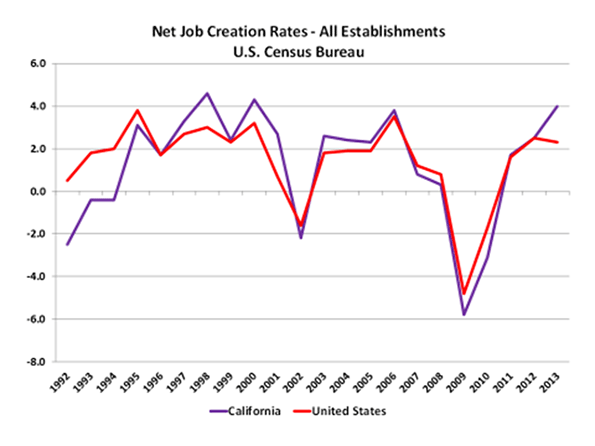
    The next clue is Table 1.  In a report filled with time series, the authors present data on one point in time, say that California has the fourth highest net job growth rate, and conclude all is good.  Why would they do that?  Could it be that the time series doesn’t support the narrative?

    Actually, they used the only recent year where California performed significantly better than the United States.  Here’s the data in time series.  It’s similar to a chart in the Los Angeles Times’ piece.  We compare California’s net job creation rate with that of the United States:

    Doesn’t look so spectacular, does it? 

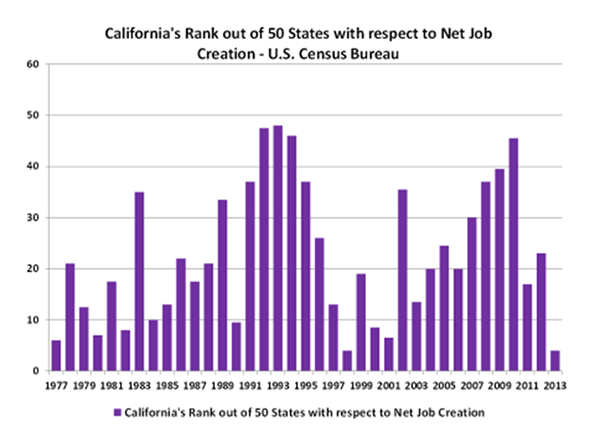
    Maybe the rankings would look better?  Below is a chart of California’s ranking going back to 1977.  Remember, one is good, 50 is bad:

    The narrative isn’t supported here either.  California has only ranked in the top 20 twice since 2006, and over that time it’s been in the bottom 20 three times.  Indeed, California has been in the top ten only once since 2001.  That was the data point they used in their analysis.

    The report has other weaknesses.

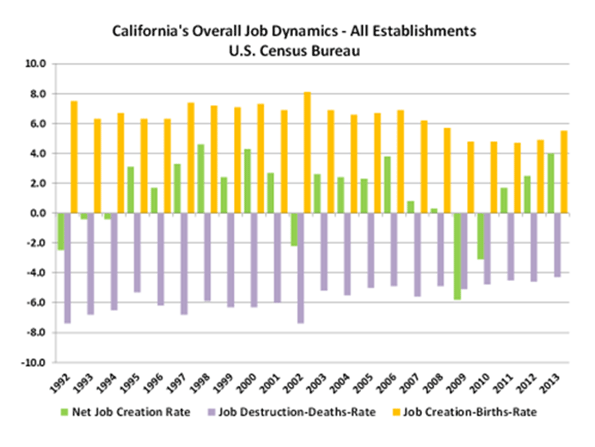
    Consider the charts 4a through 4f.  Combined, they purport to show that for California, firms of all ages were net job creators every year.  There is no year where they show firms of any age group having net job losses.  Given the well-documented massive California job losses in the past few recessions, this is simply unbelievable. 

    Indeed, a close look at the charts yields apparent internal inconsistencies.  Chart 4e is an example.  In 2002, 2009, and 2010 job destruction rates were far greater than job creation rates, but somehow they report that net job creation rates managed to remain positive in each of these years?  For the record, we built a chart using aggregate data that show net job loss rates for all California establishments of -2.2, -5.8, and -3.1 for the years 2002, 2009 and 2010, respectively:

    California’s apologists don’t do themselves any favors by resorting to such shoddy and misleading work.  California has had some good job years recently.  It also has some huge strengths.  These include a world-leading venture capital infrastructure, a world-leading climate, and a fantastic location between Asia and the massive American consumer market.

    California has some huge challenges too, including the poverty, inequality, and limited opportunity for minorities.  Ignoring these challenges and exaggerating the state’s strengths is a guarantee that California will never be the land of opportunity that it was — or could be.

    Bill Watkins is a professor at California Lutheran University and runs the Center for Economic Research and Forecasting, which can be found at clucerf.org.

  • Is California’s Bubble Bursting?

    California has a long history of boom and bust cycles, but over the past 25 years or so, California’s cycles appear to be becoming more volatile, with increasing frequency, higher highs, and lower lows.  The fast-moving business cycle may not provide the time necessary for many people to recover from previous busts, and may be too limited in its impact. Even now, 22 of California’s 58 counties have unemployment rates of 7.5 percent or higher. Eleven California counties have unemployment rates of at least nine percent.  And these, we are told, are the best of times.

    Policy behavior is predictable throughout the business cycle. 

    Sacramento is awash in cash during a boom, because California’s revenues are more closely related to asset prices than economic activity.  As the economy grows, particularly in an era of ultra-low interest rates, asset prices climb faster than the economy grows, and California is flush.  Sacramento acts as if the boom will continue forever.  Spending commitments are increased, or taxes are decreased.  Politicians congratulate themselves on “fixing” the budget problem.

    For Sacramento, economic busts and the resulting fiscal crisis are acts of God, completely independent of policy.  State revenues fall more rapidly than economic activity falls, because asset prices fall faster than overall economic activity. Sacramento tries to transfer the fiscal pain to local governments.  Mostly, they are successful. As of July, Local government employment was still down almost five percent from its pre-recession high, while state government employment is up about 4.5 percent over the same period.

    Sacramento is currently enjoying a boom, but this boom, like all booms, will ultimately lead to a bust.  There are signs that California’s confrontation with its next bust could come soon.

    Asset prices are cause for concern.  After a five-year Bull Market that saw cumulative gains of over 70 percent, the S&P is little changed this year.  Over the past 60 days, it’s been very volatile.  California’s median home price is up over 70 percent from its recession low.  It too has recently shown volatility, reflecting the huge differences between regional markets.

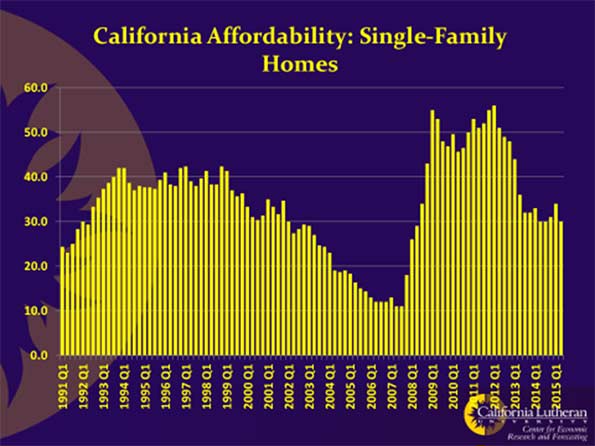
    Housing affordability (percentage of population that could afford the median home) is down too.  It’s fallen from over 50 percent to about 30 percent.  We can’t be sure, but it’s probably below a sustainable level.  That is, below a level that can sustain a middle-class population.  Several California communities have lower levels home ownership rates, but places like Marin County have minimal middle classes.

    California’s tech sector has served the state well over the past business cycle.  In quarter after quarter the Bay Area has led the state in job creation.  In many quarters, the Bay Area was the only California region to gain jobs.

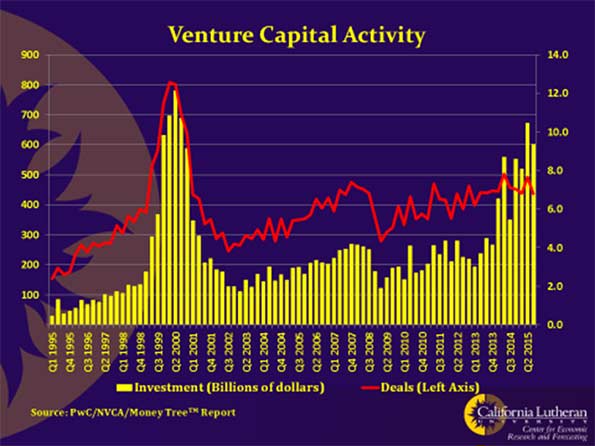
    But California’s tech sector can be very volatile, as the last dot.com bust in 2000 showed.  Today, venture capital investment is near the levels we saw just before tech’s big bust.  The number of deals is lower though.  It’s not clear that it is again a bubble about to bust, the possibility should be seriously considered.  Ideally, we would have a plan to deal with the subsequent fiscal challenges.

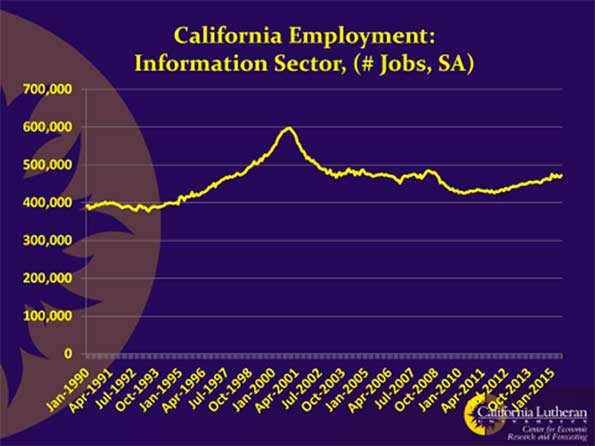
    If tech does decline, the impacts will be more than fiscal.  California’s Information sector, down more than 100,000 jobs from its previous high, still has not recovered from the dot.com bust:

    Recent data imply that continued economic growth, even the slow growth we’ve become accustomed to, is threatened.  California’s most recent jobs report was a big disappointment.  National data was disappointing too.  Only 20 states saw employment increases in September.

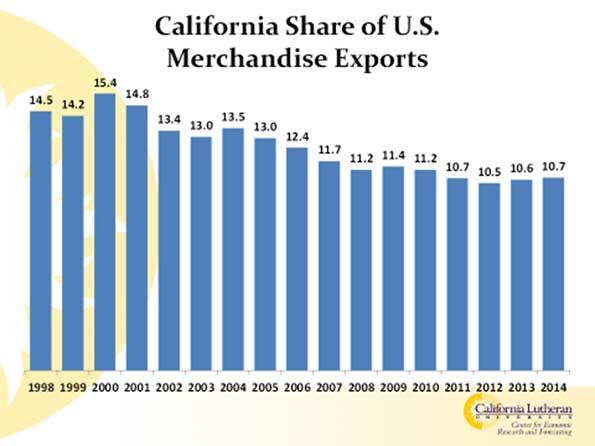
    California’s position on the Pacific Rim between Asia’s manufacturing sector and the world’s largest consumer market guarantees that trade is an important sector for California.  Increasingly, however, that sector is at risk.  China’s economic growth is weakening.  Competing ports in Mexico and Canada threaten California’s trade sector, as does the Panama Canal expansion.  California’s response has been to ignore the challenges and to refuse to expand ports to accept today’s largest ships.  California’s share of North American trade will surely continue to decline:

    An economic downturn would have a huge impact on California and its citizens.  California’s budget surplus is precarious, and the state has failed to make any real changes in California’s fiscal structure.  Instead of using California’s period of good fortune to reduce the budget’s vulnerability to volatile asset prices, by broadening the tax base, Sacramento has amazingly elected to increase revenue volatility by augmenting the status quo with a temporary tax.

    The games that partisan politicians play leads me to the conclusion that they either don’t believe that their policies adversely affect real lives, or they don’t care.  Certainly, economic outcomes   affect real lives.  There is abundant evidence that unemployment and poverty cause drug abuse, domestic violence, broken families, poor health outcomes, and many other social pathologies.

    The question, then, is do policies affect economic outcomes?  In their book Why Nations Fail, Acemoglu and Robinson compare side-by-side communities that appear identical but have different economic outcomes, cities like Nogales Arizona and Nogales Mexico.  These two cities, and the other pairs in the book, are identical, except for being in different countries.  They are adjacent to other.  They have the same resources.  They are demographically very similar.  They only differ by political regimes.   Acemoglu and Robinson find that policy decisions and the inclusiveness of the decision process have dramatic impacts on economic outcomes, and thus people’s lives.

    California policy is dominated by a rich coastal elite who control most of the media, finance campaigns, rule over the universities and generally dominate all discussion.  The result is extreme inequality, persistent nation-leading poverty, high housing costs, and limited opportunity for California’s most disadvantaged populations.  And, California’s most disadvantaged will pay the most for California’s next downturn.  They won’t write checks, because they can’t.  Their net worth won’t decline, because it’s already at or below zero.  They’ll pay a far higher cost in broken homes, broken families, and broken lives.

    Bill Watkins is a professor at California Lutheran University and runs the Center for Economic Research and Forecasting, which can be found at clucerf.org.
  • Conferences and Progress

    Californians attend innumerable conferences on housing and economic growth.  Year after year, in counties across California, the same people show up to say and hear the same things.  Mostly what they say and hear is naive, and nothing ever changes.

    I was reminded of this when I saw a report on what appears to have been a typical conference at the Harris Ranch on Growing the Central Valley Economy.

    There is no doubt that the Central Valley economy could use some economic growth.  After years of paying a disproportionate share of the costs of California’s coastal-driven energy, environmental and water regulations, the Valley’s economy is suffering.  Poverty is rampant, as California leads the nation with a three-year average poverty rate of 23.4 percent according the Census Bureau’s most recent comprehensive poverty measure.

    The Valley and some other inland areas are the primary reason California leads the nation in poverty and inequality.  Throughout the Valley, economic growth is anemic.  It’s negative in some areas.  Some counties are seeing declining populations.

    Conferences, at least the typical California conference, won’t help.  They only serve to provide a low-cost means to salve the participants’ consciences, allowing them to feel that they are doing something.

    Consider the recommendations that came through the report:

    Creative thinking from the public policy sector

    You can bet your net worth that you will hear about creative thinking or thinking outside the box at every California housing or economic development conference. At best, it doesn’t mean anything. If it does mean anything, creative thinking from the public policy sector is the worst thing that could happen.

    Public policy sector creative thinking is what has created the San Joaquin Valley’s stagnant economy and California’s poverty and inequality in the first place. California’s ruling elite are proud of California’s regulatory quagmire. No one could have imagined 20 years ago how successful they would be in putting it in place. Today, it remains unduplicated by any state, but Oregon is trying.

    The public sector does not create jobs or wealth, although it can provide preconditions through infrastructure development or contracts. But government is not the source of innovation or wealth creation. That comes from entrepreneurs, whether in the once-dominant aerospace industry or the early days Silicon Valley’s world-leading tech sector.  It won’t create any in the future.

    The best that government can do is to get out of the way of innovators—that means stream-lining the regulatory process and protecting property rights, in order to provide a predictable business environment.

    Let’s hope we don’t see more creative thinking from the public policy folks.

    Putting a “face” on the Valley and individual lives affected, emphasizing the continuing drought, pending fracking legislation, and burgeoning trade and logistic sectors in the seven-county region known as the San Joaquin Valley

    I think the idea is that if the coastal elite could just see the impacts of their policies, they would change those policies to allow more economic vigor in the Valley. The naivety is touching, and shockingly naive.

    Let’s face it, California’s coastal elite likely care more about some Minnesota dentist’s shooting a lion than they care about the lives of Valley residents. Their policies are there to save the world. If they cause some inconvenience for people in the Valley, well that’s just the cost of progress.

    It might be different if they thought their policies would impact their own incomes. Their policies don’t. Tech sector people know their incomes come from all over the world, and they just relocate plants, call centers, tech support and even development outside of California if costs become too high. There is a reason that the Silicon Valley no longer is building more of the chip factories for which it was named.

    The retired coastal elite’s income is mostly independent of California’s economy. Once again, the checks come from someplace else.

    Accessing and employing the most effective tools from science, engineering and technology to responsibly advance technological applications

    Yep, and motherhood is a wonderful thing. Technology and applications will advance, regardless of what happens in the San Joaquin Valley. How is this supposed to help the Valley? California has priced itself out of competitive tradable goods production. That’s why Intel, Apple, Facebook and others are spending billions expanding outside of California.

    Technology will benefit Valley residents, but it won’t be a source of economic growth until the Valley has a competitive cost structure. And that cannot happen until the state takes its foot off the valley’s neck.

    Building coalitions to ensure adequate resources and investment in the Central Valley during what is likely to be a dramatic transition period

    Coalitions are another topic that comes up in every California conference. We’ve heard this for decades, and nothing has happened.

    All that coalitions, at least as they materialize in California, can do is advocate. Most often, they advocate to the government. Since governments are the source of the problem and not the source of economic growth and wealth, this not an effective strategy. The coalitions might extract some wealth from someone else, but they are not going to create economic vigor.

    Focusing locally on training and retaining that will help boost opportunities for employment and contribute to an improved quality of life as the region continues its transformation to a progressively more sustainable future

    This is another thing you hear constantly California conferences. Education and training are something that we have chosen to do for our young people. It can be an economic development tool. In California today, though, education is not an economic development tool.

    San Joaquin Valley graduates of high school or college can’t get jobs in the Valley. The Valley’s unemployment rates are way above the State’s even in good years. More individuals with degrees won’t change this. All it means is that Texas, Arizona, Utah, and other states will have a better pool of California workers to supply their economies. We may feel a moral obligation to educate, but it’s not a local economic development tool.

    What Could Work?

    The California Environmental Quality Act (CEQA) was originally enacted to protect California’s pristine natural environments. Since then it’s evolved into a tool which allows almost anyone to stop or delay just about any project. In fact, the threat of a CEQA case is often wielded by project opponents in order to extort concessions from companies.

    CEQA dramatically increases the uncertainty and costs associated with California projects. It needs to be rewritten to achieve its original purpose while limiting its use as a tool for maintaining the status quo.

    California’s other regulations that most hurt economic growth are either environmental or are designed to bring in “stakeholders .” All need to be evaluated on a cost-benefit basis.

    Chapman University researchers have presented compelling evidence that California’s greenhouse gas regulations have almost no impact on global carbon levels, but we know they have considerable costs.

    Regulations designed to bring in “stakeholders” effectively grant almost everyone veto power over most projects. You could hardly design a more effective method to slow or stop growth.

    Politically, there is no chance of making necessary regulatory revisions anytime soon. There is hope, though. California’s minority caucus recently stopped proposed regulation mandating a 50 percent decrease in California’s use of gasoline. The minority caucus’ constituents are California’s primary regulatory victims. It was good to see them stand up for their constituents. I hope to see more of it in coming years. That will be far more effective than another conference.

    Bill Watkins is a professor at California Lutheran University and runs the Center for Economic Research and Forecasting, which can be found at clucerf.org.
  • When Stocks Drop, California Suffers

    I recently made a couple of tweets/Facebook posts pointing out that market declines threaten California’s budget surplus. I referenced articles in the WSJ and Bloomberg, and I thought the observation was non-controversial—almost banal.

    So I was surprised at the feedback. One person asked why. Another said it doesn’t mean anything until holders of declining assets cash out. Yet another pointed out that the wealthy were back to where they were eight months ago. Finally, one said we wouldn’t know of the impact until after the end of the next budget year.

    Let’s answer the question “Why?” first: A decline in asset prices would have a detrimental impact on California’s budget because California’s tax system is extraordinarily progressive, with the result that a few really wealthy people pay a huge proportion of California’s taxes. California’s Legislative Analyst’s Office has estimated that the top one percent of California’s population paid half of the state’s income taxes in 2012. Income taxes are California’s major revenue source, comprising about 65 percent of the state’s income.

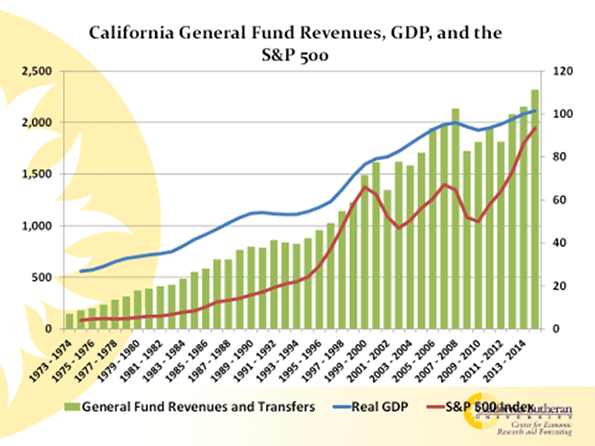
    Since much of wealthy people’s income is from increased asset values—capital gains—rather than from wages that have been paid to them, their income, and thus California’s tax revenue, is more volatile than the economy. California revenue tracks changes in asset values more closely than it tracks changes in economic growth. See the following chart:

    The increased revenues from the dot-com boom, the 2000s asset boom, and today’s boom are readily apparent in the chart. The declines that inevitably follow booms are also apparent.

    California goes through these repeating cycles like a bad dream. Asset prices increase. California’s revenues increase. Sacramento spends that windfall as if asset prices will continue to rise forever. Worse, legislators commit to future spending as if the boom will continue forever.

    Of course, booms don’t go on forever. Inevitably, prices fall. The gains that drive California’s revenue turn into losses, and California faces yet another budget crisis. Sacramento responds by raising taxes on the wealthy, and increasing the state’s reliance on the few wealthy. This pretty much guarantees that the problem will be even worse in the next cycle.

    It’s a self-reinforcing boom and bust cycle of ever increasing revenue volatility.

    It’s amazing to me that California’s leadership continues to do this, and that Californians allow it. It can only be possible because so few Californians understand the state’s finances. The people who responded to me are relatively well informed; far better informed than most Californians. Yet, even they don’t know how California’s revenues work.

    It appears that California’s susceptibility to asset volatility is California’s best kept secret. That needs to change.

    Governor Brown was hailed as a hero when proposition 30 was passed, raising taxes on those who earn over $250,000 a year. It was even retroactive. California’s revenues soared, a result of the combination of new taxes and a huge bull market on Wall Street. It was said that Brown had solved California’s deficit problem. What he really did was sow the seeds of California’s next budget crisis.

    What about the next response I heard, the objection that losses have to be realized before they impact California’s budget? Can we be realistic? The people who pay over half of California’s income taxes have resources that are unimaginable to most of us. You can bet your net worth that, for tax purposes, they recognize losses as quickly as possible and do their best to never realize gains. The gains we’ve seen were only reluctantly recognized. The losses will be enthusiastically recognized.

    The comment about retained wealth—that the wealthy were back to where they were eight months ago—is a red herring. Wealth is irrelevant. Income taxes are paid on changes to wealth, not wealth. And, we don’t have to wait until after the fact, or until the end of the fiscal year, to know what the story will be. We don’t even need a real bust to see California’s surplus slip away. The surplus is dependent on increasing asset values. It’s not necessary for asset prices to decline for the surplus to be eliminated. All that is required is that asset values cease increasing.

    I thought it was irresponsible for people to cheer California’s surplus without at least recognizing its fragility. Ignoring the fragility now, when asset prices are especially volatile, is foolhardy. Our governor and legislators know what will become of California’s surplus when asset prices decline. They should be developing a plan.

    Of course, California’s leadership is not working on a plan. Instead, the best of them (admittedly a low hurdle) continue to pat themselves on the back and hope for the best. Some do worse by attempting to increase California’s spending even more.

    Besides developing a plan to deal with the sure-to-come deficit, Sacramento should be working on a plan to make California’s revenues more closely track broad economic activity, instead of volatile asset prices. This would require a broader tax base and a less progressive income tax. Unfortunately, that’s not likely to happen.

    Bill Watkins is a professor at California Lutheran University and runs the Center for Economic Research and Forecasting, which can be found at clucerf.org.
    Flickr photo by Thomas Hawk: The Good Life; the Ritz Carlton, Laguna Niguel, California.

  • 21st Century California Careers

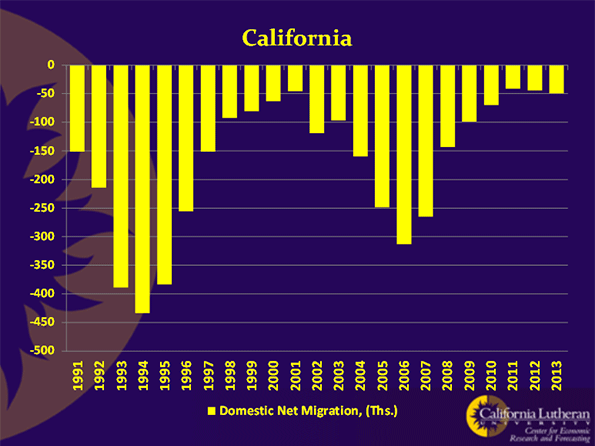
    California is undergoing profound change.  Most strikingly, people are leaving the Golden State, which was once the preferred destination of migrants worldwide.  California’s domestic migration has been net negative for over 20 years.  That is, for 20 years, more people have been leaving California for other states than have been arriving from other states.  The state’s population is only growing because of a relatively high birthrate, mostly among immigrants.

    Domestic migration is not a one-way street.  It may be net negative, but lots of people are coming to the state.  It’s just that more are leaving. Generally speaking, low and middle-income people are leaving.  Those coming tend to be wealthier and older than those leaving.  They are people who can afford California’s higher costs and limited opportunity.  These migratory trends are increasing income-inequality in America’s most unequal state.

    Businesses are leaving the state too, but not all businesses.  Tradable goods producers are leaving California, because the state has for ten years maintained the single worst business climate in America.  Tradable goods are goods that can be produced in one place and consumed in another.  Manufacturing is the classic example, but technology is changing what is a tradable good.

    Today, many jobs that used to be considered non-tradable services are now tradable services.  Back-office accounting functions can be done anywhere, as can legal research or title research.  Just about any job that is done at a computer is now a tradable service.

    Unless they have a monopoly, tradable goods and tradable service providers face relentless price competition.  California’s high-cost environment is forcing them to relocate to lower-cost communities to survive.  Tradable producers won’t be providing 21st Century California jobs.

    California, with its beaches, deserts, mountains, cosmopolitan cities and other attractions, is a major tourism destination.  These amenities also make California a wonderful place to live for those who can afford it.  So, wealthy people come to or stay in California, and then try to close the gate behind them.  Our cities become ever more divided between the older haves and the younger have-nots, between opulent consumption and not-so-much consumption.

    So who will provide jobs for 21st Century Californians?  In a single word the rich and upper middle class affluents. When they come as tourists, they spark demand for leisure and hospitality jobs.  Consequently, this sector has been California’s second most rapidly growing sector with over 15 percent (239,400 jobs) growth since the beginning of the recession in October 2007.  Only healthcare grew faster or created more California jobs.  Since it is hard to guide tourists or change bed sheets remotely, these are non-tradable services jobs. 

    The resident rich will also create jobs.  We see this already in places like Santa Barbara, where there are types of jobs that were unimaginable until recently.  People will come to your house to cook your gourmet meal, clean your house, bathe your dog, trim your toenails, and supervise your exercise. They’ll even bring an athletic gym in the back of a truck.  There are doggy day care centers, with web cams to watch your puppy while you’re separated.  There is a pet cremation center.  There is a dog bakery.  Some people make a living walking other people’s dogs, while some people make a living taking older, apparently poorly-motivated, people for exercise walks.   

    Huge amounts of money are spent on homes, and not just on the purchase.  Remodels are almost perpetual for some, and they are happy to pay huge sums for quality craftsmanship.  So it is with cars.  Car collectors used to be hands-on.  Today, many hire someone to restore their cars.

    The list of services that wealthy people are willing to pay for is unlimited.  Rich people, indeed all of us if we could afford it, enjoy paying someone else to do even mildly unpleasant chores. 

    This has resulted in rapid-for-California growth in non-tradable services jobs.  According to the California Employment Development Department, non-tradable services jobs grew 14 percent since 2000, while tradable-goods jobs declined by 24 percent.

    We’ve seen this before.  Domestic service was a large sector in Victorian England, peaking about 1891 when internal combustion engines and automobiles brought renewed economic growth.  This provided new opportunities for workers and raised the cost of service workers.

    California won’t see a new burst of economic or job growth in tradable sectors, particularly when the current tech boom evaporates. This is because California’s coastal elites will more successfully restrain growth than did their Victorian predecessors, perpetuating and increasing the state’s income inequality. 

    While the Irish Potato Famine and popular pressure forced the Corn Laws’ repeal, California’s elite face no such pressure.  In California’s one-party system, environmental purity easily trumps economic opportunity, and since California is only a state, it has a relief valve for disaffected citizens.  They can easily leave, and everyone that leaves increases the sustainability of the Coastal Elite’s no-growth, consumption based economy.

    California’s bureaucracy will provide plenty of jobs too.  When the bureaucracy decides everything, as it does in California, it’s a unique source of middle class jobs.  Working for California’s bureaucracy pays well, but other options can be more profitable.  Lobbying and fighting the bureaucracy can be big business.  As it is, every California community has people whose only job is to help businesses and people navigate the local bureaucracy.

    California’s formidable tech sector will diminish as a source of jobs and economic growth.  Venture capital’s changing economics and California’s ever-increasing costs will drive new growth to up-and-coming centers of innovation, places like Austin.  As it is, Austin, with 73.9 percent growth in tech-sector jobs between 2004 and 2014, saw more rapid growth in tech-sector jobs than San Jose, with 70.2 percent growth in tech-sector jobs over the same period.

    We’ll be left with a bunch of rich people and a big bureaucracy and the people who serve them.  California will still be a beautiful place, but it’ll hide an increasingly ugly social reality.

    Bill Watkins is a professor at California Lutheran University and runs the Center for Economic Research and Forecasting, which can be found at clucerf.org.
  • The California Economy: A Strength Vs Weakness Breakdown

    Part two of a two-part report. Read part 1.

    The problem with analyzing California’s economy — or with assessing its vigor — is that there is not one California economy. Instead, we have a group of regions that will see completely different economic outcomes. Then, those outcomes will be averaged, and that average of regional outcomes is California’s economy. It is possible, even likely, that no region will see the average outcome, just as we rarely see average rainfall in California.

    California’s Silicon Valley region continues to be a source of innovation, economic vigor, and wealth creation. But the Silicon Valley, named because silicon is the primary component of computer chips, no longer produces any chips. The demands for venture capital are also changing, with the demand for cash falling because new products often take the form of apps instead of something that is manufactured. This type of investing doesn’t need the infrastructure that the Silicon Valley provides. Increasingly, other communities such as Boston, Northern Virginia, and Houston are becoming centers of technological innovation.

    Workers recognize the changes. They may not know the reasons, but they know the impacts, and they are voting with their feet. Domestic migration — migration between states, — is a good measure of how workers see opportunity. California’s domestic migration, in a dramatic reversal of a 150-year trend, has now been negative for over 20 consecutive years. That is, for over 20 years more people have left California for other states than have come to California from other states. Workers simply haven’t seen opportunity in California. How can this be? Why would people be leaving when jobs are being created in the Silicon Valley?

    The Silicon Valley jobs are rather specific. They require higher skill sets than most workers possess. One consequence is that the Silicon Valley’s prosperity hasn’t helped California’s other workers much. We are left with a situation where California’s tech firms search worldwide for workers, while California workers search for work.

    It didn’t have to be this way. High housing prices and environmental regulations, a result of state policies, have driven away the jobs that could be performed by typical California workers. Those jobs are now in Oregon, Texas, or China.

    A short distance away, in California’s Great Central Valley, there is poverty as persistent, deep, and widespread as anyplace in the United States. A recent report shows that California has three of the 20 fastest growing US cities in terms of jobs. It has four in the bottom 20.

    For a while, at least, the differences between California’s fastest growing regions and its slowest (or declining) areas will grow. In general, coastal areas will see more rapid economic growth than inland ones. Even within these broad regions, there will great heterogeneity. Bakersfield, boosted by a booming oil sector, will see stronger growth than Stockton. San Jose, with its thriving tech sector, will see far more growth than Santa Barbara or Monterey. Furthermore, the best performer among California’s inland cities will probably see faster growth than the slowest growing coastal city.

    On average, California’s economic growth will be far below its potential. In most of the state it will be disappointingly low to dismal, as California’s economy is held back by well-meaning but seriously flawed regulations. At the same time, a few super-performing cities may see spectacular growth, at least for a few years.

    Eventually, even California’s most vibrant economies will slow, gradually strangled by the lack of affordable housing and of an infrastructure necessary to move people from affordable housing to their jobs. People are willing to drive very long distances daily in pursuit of the twin goals of income security and the American dream of a home in the suburbs. The traffic on Highway 14 between Palmdale and Los Angeles reminds us of this twice every working day. But, they need roads, and affordable housing within commuting distance.

    Different growth rates and different levels of economic vitality will exacerbate the vast gulf that exists between California’s wealthiest communities and its poorest. Inequality will increase as California’s fabulously wealthy become ever wealthier, and California’s poor suffer in surprising silence, living on whatever aid we give them, denied the hope and the basic dignity that comes from a job.

    Domestic outmigration will increase, but the people who leave won’t be California’s poorest. Instead, young middle-class people will lead the exodus, as they move to wherever opportunity is more abundant. This, of course, will further increase California’s inequality and decrease its economic vitality.

    We will also see an increase in consumption communities. Already, many of California’s coastal communities are reflexively averse to any new activity that actually creates value, opting instead to become ever more exclusive playgrounds for the very rich. These communities will see rising home prices as they restrict new units, and will see rising demand, a result of ever greater concentrations of wealth worldwide and the unmatched amenities available in Coastal California.

    By contrast, some inland areas will see declining home values and eventually declining populations, as the lack of opportunity drives potential home buyers to places like Phoenix and Houston.

    For many of us, this is a depressing forecast, and it is fair to ask whether or not it is inevitable. It isn’t. Few things are. At a statewide level, I hope that representatives of California’s large and growing minority communities demand policies that support the opportunity that previous generations of Californians enjoyed. Absent such demands, California’s policies are unlikely to change.

    At a local level, cities would do well to eliminate all policies that contribute to economic stagnation. When a business is making locational decisions, it reviews lists of positive and negatives for the candidate communities. No place has only positives, and few places have only negatives. California cities are endowed with one huge positive: California is a wonderful place to live. That’s not enough, though. A city would do well to minimize the list of negatives.

    For businesses, an aggressive minimum wage is a negative, as it raises costs. Uncertainty and delay in a city’s response to an economic proposal increases the risk and costs of proposals. It’s a negative. So is unaffordable housing, as it increases wage demands and makes it harder for businesses to recruit top talent. The best way for a city to encourage the supply of affordable housing is to allow new-home development.

    Finally, areas of economic blight increase crime, raise city costs, reduce city revenues, and are unattractive to businesses considering moving to or expanding in an area. Cities need to be flexible in responses to proposals for these areas. Our work at CERF convinces us that we will need less commercial space in the future. Therefore, almost any proposal for dealing with these areas is preferable to inflexible adherence to existing zoning or plans.

    California cities are constrained by California policy. That doesn’t mean that California cities are without tools for economic development. Almost any California city — no matter which region it is in — is a better place to live than almost any city in, say, Texas. If that can be leveraged by minimized costs, flexibility, and creativity in adapting to the needs of job-creating businesses, a California city, even today, can assist businesses creating opportunity for its citizens

    This is the second part of a two-part report. Bill Watkins is a professor at California Lutheran University and runs the Center for Economic Research and Forecasting, which can be found at clucerf.org

    Flickr photo by Aude Lising: The Central California Coast, viewed from the Pacific Coast Highway — one of California’s unmatched amenities.