Author: Bill Watkins

  • California: Club Med Meets Third World?

    On March 25th, the Bureau of Labor statistics released a report that showed that California jobs had increased by 96,000 in February.  The state’s cheerleaders jumped into action. Never mind that the state still has a 12.2 percent unemployment rate, and part of the decline from 12.4 percent is because just under 32,000 discouraged workers left California’s labor force in February. 

    Unfortunately, the cheerleaders are likely to once again be disappointed.  It is unwise to build a case on one data point.  Data are volatile and subject to all sorts of technical issues.  For example, the estimate of California’s job growth is seasonally adjusted data and subject to revision.

    More importantly, even if California did see 96,000 new jobs in February, that pace is unlikely to be maintained.  California’s economy is just too burdened by the State’s DURT: Delay, Uncertainty, Regulation, and Taxes.  Instead of enjoying the truly vibrant recovery one would expect given its climate, location, natural resources, university network, workforce, and natural and manmade amenities, California’s economy will grow far below its potential, burdened by its DURT. 

    People often ask me to identify the most important impediment to California’s economic growth, but there isn’t just one.  Every business is different.  One may be most impacted by regulation, another by taxes.  Instead, it is the total cost of the DURT.

    Taxes are certainly one component of DURT.  The Tax Foundation ranked California 49th in business taxes and Kiplinger ranks California worst in retiree’s taxes, which serves as a good proxy for individual tax burdens.  No doubt, California’s taxes are high, but that alone wouldn’t be too big a problem.  People happily pay to live in California.  Higher taxes and home costs are just the beginning.

    California is in its own class when it comes to regulation; nothing is unimaginable in a state where bulk of the executive leadership comes from the San Francisco-Oakland area.  Today, there are two regulations that are particularly hurting California’s economy, AB32 and SB375.  AB32 is California’s attempt to unilaterally solve the planet’s global warming problem.  It will have serious implications, all of them detrimental to economic activity.  SB375 attempts to advance its global warming  goals through regional planning mandates.  Here’s a sympathetic analysis of SB375 from a smart guy.

    Those are just the most onerous regulations.  California has thousands of regulations and more come daily.  California had 725 new laws come into effect on January 1, 2011, and the state has over 500 constitutional amendments, averaging over four new constitutional amendments a year.

    Which brings us to uncertainty.

    Uncertainty about the future regulatory environment is detrimental to economic activity.  It is extraordinarily difficult to plan when the regulatory environment is in such a state of flux, and nothing is unimaginable.

    Regulatory uncertainty is far from California’s only source of uncertainty.  California’s local governments are notoriously fickle, particularly in the generally affluent coastal areas.  I know of one project that spent four years in planning, only to be denied by the City Council, even though the project was supported by the planning department.  That’s just expensive.  Developers spend hundreds of thousands of dollars on architects, engineers, and planning consultants while jumping through the hoops set up by the planning department, neighborhood groups, environmentalists, and other special interest groups.

    This type of story is all too common in Coastal California.  Some California communities, such as Santa Monica, require that prior to building a new house, you must use two by fours, string, and flags to provide the outline of the proposed structure for up to 90 days.  This is to facilitate neighbor complaints before the project is built.

    The previous story also relates to delay.  Delay in California is legendary, a result of regulatory hurdles, demand for studies, and legal action.  California newspapers often describe projects as controversial, but this is redundant.  Every project is controversial in California. 

    Want to rebuild an aging bridge?  Someone will sue you and claim the old bridge is a historical landmark.  Want to put in a solar farm?  Someone will sue you because the land is home to endangered rats, turtles, salamanders, toads, fairy shrimp, or something.  Endangered species are everywhere in California.  Want to put a condominium project in a depressed part of town?  Someone will sue you because it doesn’t match the neighborhood.  Want to build a house?  Someone will sue you because it will block their view.

    All these things and more happen in California.  It’s no surprise that businesses find California a very challenging place to be profitable.  California’s markets are huge.  No doubt about it.  So, some business will operate in the state.  California’s location on the Pacific Rim and it ports also compel some business to be in California, even if costs are high.  California is a fantastic place to live.  So, people who can afford to will live here.  Some business owners will locate businesses where the owner wants to live.  But, most businesses are too competitive to give up profits to live in California.  Many keep their headquarter s here while shipping their new jobs to other states, or abroad.

    Even so, California is unlikely to become Detroit.  It, sadly, is also unlikely to achieve its potential or regain its previous economic vigor.  The cost of California DURT is just too high.  Instead, the place will become increasingly divided.  Coastal regions, for the foreseeable future, will become even more affluent, heavily white and increasingly Asian.  Hosts of unseen, less fortunate people support them, often commuting from more hardscrabble interior locations.

    Considerable poverty will coexist uncomfortably in California’s coastal paradise.  Working class families already crowd into housing units designed for one family, and this will likely only get worse. 

    What Coastal California won’t have is much of a middle class.  Lack of opportunity and high housing costs makes the most pleasant parts of California an unattractive place for people who define quality of life by opportunity and affordable housing, young families.  Domestic migration is likely to continue to be negative.

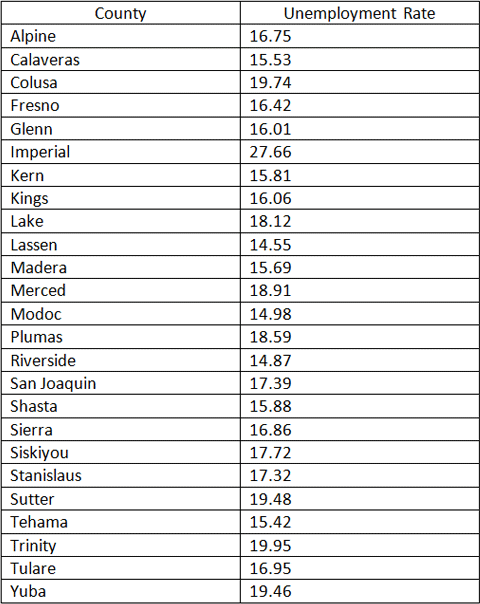
    For its part, inland California is already depressed, 27 counties have unemployment rates over 15 percent.  Eight have unemployment rates above 20 percent.  Even during the boom, many of California’s inland areas had extraordinarily high unemployment rates.  Central California’s poverty and blight will only get worse.

    All this is courtesy of expensive California DURT.  Because of it, California’s economy will lag.  More importantly, California seems to be morphing into almost a Hollywood caricature.  The self-absorbed hedonistic wealthy live side by side with the poor, like  a combination of a Club Med and Leisure Village in a third-world country.

    Bill Watkins is a professor at California Lutheran University and runs the Center for Economic Research and Forecasting, which can be found at clucerf.org.

    Photo by chavez25
  • The Rest of the Story on Krugman and the Economy

    Paul Krugman really doesn’t like the possibility that there is a structural shift in employment, because it weakens the argument for the massive Keynesian spending spree he’d like to see the government initiate.  To that end, he published this piece on his blog February 13th.

    Before we go on, some readers may wonder what a structural shift is and why it weakens the argument for Keynesian spending.  A structural shift is when employment permanently shifts (well, as much as anything is permanent in economics) from one economic sector to another, say from construction to healthcare.

    The reason that a structural shift weakens the Keynesian’s argument is that moving workers from one sector to another takes time.  They may need retrained.  They may need to move to another location.  Think of our construction worker moving to health care.  He or she probably doesn’t have the skills to be immediately employable in health care.  Some sort of education or training has to happen first.

    This poses a problem for Keynesian expansionists, because their argument is that the only problem is a drop in aggregate demand (consumer spending) brought about by….well, animal spirits.  Since there is no real problem, government can increase spending (it doesn’t matter what you spend the money on.  You could dig holes and fill them back up), fool the consumer into thinking she is better off, and voilá, aggregate demand goes up with the government spending.

    Problem solved.  It’s a beautiful thing.

    However, spending can’t solve the problem of unemployment brought about by a structural shift.  It takes time to retrain the affected workers.  There are things government can do to speed the process, but spending willy-nilly is not one of them.

    Hope that clears things up.  Let’s get back to Krugman’s piece.

    He claims that unemployment in every sector has just about doubled since the recession began, and that this is proof that no structural shift is going on.  He has a nice chart to show the increase in unemployment by sector.

    There is a problem though.  The Bureau of Labor Statistics—the same source that Krugman claims originated his data—reports that construction jobs fell by 2 million, or 26.7 percent, from December 2007 through December 2010, while education and healthcare jobs grew by1.2 million, or 6.5 percent.

    This appears to contradict Krugman’s data, but it is possible that both sets of data are true.  If they are both true, then Krugman is being no less dishonest than if he created his numbers out of thin air.
    If Krugman is telling the truth when he presents a graph showing that unemployment approximately doubled from 2007 to 2010 in both the construction and the education and healthcare sector, then is must be that large numbers of unemployed construction workers migrated to being unemployed education and healthcare workers.

    There is no other possible explanation.

    This, of course, completely contradicts Krugman’s argument.  If his data are true, he’s using data that confirms a structural shift to argue that there is no structural shift, by neglecting to disclose the jobs data I’ve disclosed above.

    Krugman is not a dumb guy.  He has a well-deserved Nobel Prize for his work on international economics.  He has a career of looking at data, in depth and with insight.  His failure to provide the entire story has to be considered something besides an oversight.  We have to conclude that he’s purposely being deceitful.

    I don’t know why a guy with all of Krugman’s gifts and accomplishments would use data deceitfully.  It is a shame, though, that an economist at the top of his profession and with the New York Times bullhorn uses that bullhorn to confuse instead of to enlighten.

  • Brown’s California Budget Proposals: a Big Step in the Right Direction

    I admit it. I had low expectations for Jerry Brown’s third term as governor. After seeing his budget proposal, I’m ready to reconsider my expectations. I think it is a great effort, and it deserves the support of all of us tired of seeing our state reduced to laughing stock.

    Being an economist, I first went to the Economic Outlook section of the Proposed Budget Summary. This is where governors put in rosy expectations and forecasts, thus enabling a multitude of fiscal sins. I was shocked to find a realistic and sober economic analysis. In fact the U.S. and California GDP projections were lower than ours, and we are among the least optimistic forecasters in America. There is no smoke here. There are no mirrors. It is apparent to me that if Brown is to be surprised, he only wants good ones.

    This may be the most honest forecast accompanying a proposed budget that Californian’s have seen in decades.

    The realistic economic forecast leads, reasonably, to lower budget revenue assumptions, lower by billions of dollars. With more realistic revenue assumptions, Brown forecasts a larger budget problem than did his more easily deluded predecessor.

    Then, Brown demonstrates that he’s learned some things over his lifetime in politics. He splits the budget problem in half, proposing cuts for half of the problem and proposing extending temporary taxes for the other half. Predictably, the dinosaurs in both parties howled.

    The howling was all for show.

    The Democrats can’t possibly believe that they can solve California’s budget problems by raising taxes. California is already one of the United States most difficult places to establish and maintain a business, burdened as it is by an expensive soup consisting of delay, uncertainty, regulation, and among the nation’s highest marginal tax rates. Increasing taxes to solve the deficit would only further weaken California’s already ailing economy, ultimately resulting in lower state revenues and new budget shortfalls. It would be a self-reinforcing death spiral.

    The Republicans are, if anything, even more disingenuous. After telling us for months, on a national level, that allowing temporary tax cuts to expire is a tax increase, they now want us to believe that extending a temporary tax is a tax increase. I have news for them. People aren’t that stupid. If allowing temporary tax cuts to expire is a tax increase, allowing temporary taxes to expire is a tax cut. Extending the temporary taxes is simply not cutting taxes. Calling it a tax increase insults our intelligence. Reducing revenues when the budget is so imbalanced would be irresponsible.

    Then, there is the composition of the cuts. Deciding where to cut government spending is extremely difficult. Cutting any spending is going to hurt someone, which means that every nickel has a constituency. Here again, Brown showed his savvy by exempting K-12 education, placing himself in the calculated intersection of economic virtue and political expediency.

    If I was going to prioritize government spending by its impact on future government budgets, I would prioritize those spending items that prevented future costs and increased future revenues. Given the high social and government costs associated with failed educational outcomes–teen pregnancies, high crime, low productivity–there is a strong practical incentive to improve educational outcomes. To the extent that K-12 educational spending improves outcomes, preserving that spending makes strong economic sense, though the research is far from conclusive that spending does improve educational outcomes.

    Politically, preserving K-12 spending is probably necessary if Brown is to have a successful governorship. Schwarzenegger provides the counter example. His governorship was doomed after the 2005 special election. Each of Schwarzenegger’s 2005 proposals had merit, but by bringing all of them to the voters at one time, he committed the tactical error that destroyed his governorship. He allowed the enemies of each proposal to band together, and they mugged him.

    When the dust settled, Schwarzenegger was as badly beaten as any of his action-film opponents. The Terminator became Arnold, and Arnold didn’t look very tough. He abandoned any real effort to deal with California’s budget issues, searching instead for a legacy built on imposing a green wish list of environmental regulation.

    In contrast, Brown showed his street smarts and sidestepped the problem of fighting too many constituencies. Like an aging martial artist, he channeled their energy to his benefit. Instead of fighting the powerful K-12 education lobby, he can count on them helping him convince California voters to extend the temporary taxes. They know what a failure to extend the temporary tax means for them- and their children.

    I do have one problem with Brown’s proposal. I see the cuts as a down payment on California’s budget issue, and the expiration of the temporary taxes as the due date for the balance. I would have preferred to have the due date come in Brown’s term, say in three years instead of five. As it is, if the temporary taxes are extended, Brown has put the budget problem behind him, and he has no incentive to finish the job. That will be up to the next governor.

    But by putting the budget behind him, Brown will be free to deal with California’s other big problem, its economy. California, with all its natural advantages and former economic glory, has managed to become one of the Unites States basket cases, with extraordinary unemployment, decimated real estate markets, and an accelerating stream of businesses and individuals leaving the state. If Brown can deal as adroitly with the economy as he has with the budget, he can go down as one of California’s great governors — with a legacy more akin to his father Pat Brown than the one Jerry accumulated in his first two terms.

    Bill Watkins is a professor at California Lutheran University and runs the Center for Economic Research and Forecasting, which can be found at clucerf.org.

    Photo by Troy Holden

  • Fuzzy Thinking by Famous Economists

    Edward L. Glaeser, in an end-of-year piece for the New York Times, claims that generous housing supply is the reason that Texas’s economy is performing so well. As he says in his final paragraph:

    “Housing regulations, more than those that bind standard businesses, explain the Sun Belt’s population growth. If New York and Massachusetts want to stop losing Congressional seats, then they must revisit the rules that make it so difficult to build. High prices show that the demand would be there if the supply is unleashed.”

    This can’t be true.

    If it were true, Fresno, Modesto, and other cities in California’s Central Valley would be booming. They are not. Instead, six of the ten worst U.S. Metro Areas for joblessness are in California’s Central Valley.

    It is not just California. There are lots of places where housing is abundant and inexpensive and economic activity is dismal, Michigan for example. Maybe bringing up Michigan is a little unfair, Glaeser does mention demand for housing in the essay, and there is clearly little demand for Michigan housing. Still, it brings up the question of where demand for housing comes from. It’s a question Glaeser does not address.

    We’ll get back to the question of demand for housing.

    Glaeser claims that building homes causes prosperity, but Michigan’s housing abundance is not because of recent construction. He mentioned Georgia and Arizona, but those economies have been performing worse than the national average in terms of jobs and unemployment since the crash of the housing bubble. Now Nevada leads the nation in the AP’s Economic Stress Index, the sum of unemployment, foreclosure, and bankruptcy rates.

    As it turns out, Texas is the only state among the ones that Glaeser discusses that has outperformed the national average since the recession. Something else is going on, and that something is opportunity, but Glaeser makes a fundamental mistake early in the paper:

    “If economic productivity – created by low regulations or anything else – was causing the growth of Texas, Arizona and Georgia, then these places should have high per capita productivity and wages. Yet per capita state product in Arizona in 2009 was $35,300, 16 percent less than the national average. Per capita state products was $36,700 in Georgia and $42,500 in Texas.”

    It is a mindboggling mistake for an economist to claim that business decisions are made based on productivity, without consideration of costs. If productivity was all that mattered, little manufacturing would take place in China, as United States factory workers are about five times more productive than their Chinese counterparts.

    Paul Krugman, in another New York Times piece, takes up where Glaeser leaves off and makes another amazing mistake:

    “Part of the answer is that reports of a recession-proof state were greatly exaggerated. It’s true that Texas job losses haven’t been as severe as those in the nation as a whole since the recession began in 2007. But Texas has a rapidly growing population — largely, suggests Harvard’s Edward Glaeser, because its liberal land-use and zoning policies have kept housing cheap. There’s nothing wrong with that; but given that rising population, Texas needs to create jobs more rapidly than the rest of the country just to keep up with a growing work force.”

    Krugman goes on to say that people move to cheap housing, and economic growth follows.

    People make locational decisions based on far more factors than housing costs, factors like job prospects and opportunity, climate, cultural amenities, taxes and the like. In economic terms, we say that job growth and population growth are jointly determined. There is nothing sequential going on at all. Instead, population growth (and housing demand) reflects job growth prospects, housing costs, and other factors. Job growth reflects population growth prospects (and housing supply), productivity, wage rates, and other costs and resources.

    Krugman also asserts that Texas’s economy is not exceptional among the large states, citing unemployment rates equal to New York or Massachusetts. But he ignores the fundamentals here – like higher job growth and more in-migration. During its boom period, California often suffered higher unemployment because so many people were coming there. In contrast, the workforces in both Massachusetts and New York are among the slowest growing in the country. New York, in particular, competes with California and Michigan for the highest rates of domestic outmigration. People would stay if there was opportunity.

    In his rush to denounce Texas, Krugman exaggerates or dismisses facts. Yes, Texas has a twenty billion deficit now, but that the Lone Star State budget is for two years, something he neglects to mention. These estimates may soon be downgraded, as the price of oil rises. In addition, he fails to acknowledge Texas’s stellar performance in creating both high-tech and middle skill jobs at many times the rate of such favored blue states as Massachusetts, New York and California. People are not as stupid as many Nobel Prize winners might think; they move for opportunity, not just for cheap houses or low-paid work.

    You do not have to be a free market fundamentalist to recognize that, in relative terms, we can see a band of prosperity from North Dakota to Texas. In general, economic performance declines as you move from this Heartland band to the coasts, particularly the West Coast. People who want to believe that policy doesn’t matter give oil and agriculture as the two major reasons for the Heartland’s relative prosperity. Krugman suggests that high oil prices are a key reason for Texas’s economic performance.

    No doubt, oil is important to Texas, but prices have been generally low throughout the recession, while the oil companies’ domestic capital budgets have been small. Similarly, agriculture is booming nationwide, not just in the Heartland, a result of high prices caused by growing global demand. California certainly has lots of oil and agriculture, and no one would claim that California is booming. There is more to the Heartland’s growth than agriculture and oil, and that includes states which are governed by Democrats, such as Montana.

    A region’s job growth is a result of business locational decisions. A business moves to or expands in a region based on a whole host of reasons. These include available infrastructure, resource availability, market size and location, labor supply and costs, worker productivity, facilities costs, transportation costs, and other costs. Those other costs include what I call DURT (Delay, Uncertainty, Regulation, and Taxes).

    There is no reason for every location to have the same DURT. On the contrary, a location blessed with an abundance of the other factors of business locational decisions could afford to have more expensive DURT, while locations less blessed need to have cheaper DURT to attract businesses.

    This is what we see. The coasts tend to be more intrinsically attractive than the Heartland, but they also tend to have more expensive DURT. But now many of these states – driven by such factors as public sector costs or environmental regulations – have raised the price of their DURT so high that they have driven business to expand more to less attractive locations with cheaper DURT, demonstrating once again that policy matters.

    Bill Watkins is a professor at California Lutheran University and runs the Center for Economic Research and Forecasting, which can be found at clucerf.org.

    Photo by Dean Terry

  • The California Cheerleaders Are at it Again

    State Treasurer Bill Lockyer and economist Stephen Levy published a piece in the Los Angeles Times that argues that California doesn’t really have any fundamental problems. In their piece, Lockyer and Levy don their rose-colored glasses and give us the same tired old excuses, twisted logic, and factual inaccuracies.

    I’ll begin with the factual inaccuracies:

    Lockyer and Levy claim that California is the state with the youngest population. That is just incorrect. The U.S. Census website has a map. California is not even the same color as that used to identify the lowest-aged states.

    The authors’ claim that California’s high unemployment rate is due to the loss of 600,000 construction jobs is also wrong. Since November 2007, the month before the recession started, California’s construction industry has lost 334.7 thousand jobs. This represents less than 25 percent of California’s 1.36 million job losses since the recession’s inception. The story is still wrong if we choose the starting date for calculating job losses as the date that most supports L&L’s argument. California’s construction jobs peaked at 948.3 thousand in February 2006. It appears to have bottomed out at 529.2 thousand in September 2010. This is a huge number of job losses, over 400,000, but it is only two-thirds of the 600,000 claimed, and it certainly does not explain all of California’s high unemployment or California’s million plus non-construction recession job losses.

    Lockyer and Levy claim that California’s budget crisis stems strictly due to revenue shortfalls, saying,

    “Our critics say we are addicted to spending. But the numbers show that isn’t true….California’s current budget woes have been caused by the devastation visited on our revenue base by the recession, not a failure to curb spending. In the three fiscal years preceding this one, general fund expenditures fell by $16 billion.”

    This is just disingenuous. Lockyer knows as well as anyone that the general fund comprises less than half of California’s spending, and while the general fund expenditures have indeed reflected a decline in taxes, total State spending has increased from $194.3 billion in fiscal year 2007/08 to $216 billion in the 2010/11 year. Furthermore, when the composition of State spending is evaluated, we see that virtually all of the cuts in the general fund have been in local assistance. State operations have been almost completely spared.

    Besides, California’s budget problems didn’t begin with the recession. Do Lockyer and Levy think that our memories are so short that we forgot that Gray Davis was thrown from office because of budget problems, and that Arnold came in office pledging to fix California’s persistent budget deficits?

    We are also again treated to Lockyer’s mantra that California has a constitutional requirement that it not default on bonds, adding,

    “During the current fiscal year, general fund revenues are expected to total $89.4 billion. Education spending under Proposition 98 will total $36 billion. That leaves $53.4 billion available to pay debt service on bonds — more than eight times the $6.6 billion the state will need.”

    That’s wonderful, but constitutional requirements and revenues don’t pay debt. Cash pays debt, and California does run out of cash. When California runs out of cash it issues vouchers. Already some banks have refused to accept California vouchers. What will the State do if all banks refuse to honor vouchers?

    I’m sure the Treasury sets aside funds for debt repayment before they issue vouchers. Whatever they set aside will probably not be enough if California finds itself in a situation where vouchers are not accepted. Do we think the unions will let their people work if they are not being paid? Would the workers want to work if they are not being paid? Would contractors work? Will there be anybody around to write a check, even if the reserves are there?

    The fact is that if vouchers are not accepted, California will be plunged into a very serious crisis, a crisis in which case California’s constitutional requirement to pay would have no more meaning than its constitutional requirement that it have a balanced budget by June.

    Lockyer and Levy ludicrously claim that California’s business environment is good. But disinterested groups that issue reports that consistently rank California as among the least attractive states are wrong, groups like the Tax Foundation and Chief Executive Magazine. Lockyer and Levy cite Public Policy Institute of California (PPIC) research that business relocations cause smaller percentage job losses in California, but the PPIC can’t measure jobs that aren’t created when businesses that could reasonably be expected to expand in or move to California don’t.

    Lockyer and Levy also repeat Brett Arends’s claim that California’s share of the World’s venture capital has increased to 50 percent, but they neglect to note that the amount is declining, a lot, as Tim Cavanaugh showed here. California is getting a larger share of a rapidly declining pie. The net result is a huge decrease in California’s venture capital.

    Finally, I’ll conclude with my favorite Lockyer and Levy quote:

    “California no doubt faces serious challenges. But our obstacles are not insurmountable.”

    That’s exactly right, but the problems are not insurmountable until you confront California’s real, fundamental, problems.

    Bill Watkins is a professor at California Lutheran University and runs the Center for Economic Research and Forecasting, which can be found at clucerf.org.

    Photo by Kevin Cole

  • If California Is Doing So Great, Why Are So Many Leaving?

    Superficially at least, California’s problems are well known. Are they well understood? Apparently not.

    About a year ago Time ran an article, “Why California is Still America’s future,” touting California’s future, a future that includes gold-rush-like prosperity in an environmentally pure little piece of heaven, brought to us by “public-sector foresight.”

    More recently, Brett Arends’ piece at Market Watch, “The Truth About California,” is more of the same. California’s governor elect, Jerry Brown, liked this piece so much that he tweeted a link to it.

    The optimist’s argument about California’s future ultimately hinges on the creativity of the state’s vaunted tech sector, in large part driven by regulation promulgated by an enlightened political class and funded by a powerful venture capital sector.

    No fundamentalist evangelical speaks with more conviction or faith than a California cheerleader expounding on the economic benefits of environmental purity brought about by command and control regulation.

    The more honest cheerleaders acknowledge that California has challenges, including persistent budget problems. Arends denies even the existence of a budget problem, demanding “Er, no, actually. It’s your assertion. You do the math.” Let me help you, Brett. The non-partisan California Legislative Analyst’s Office has done the math. You can find it here. They expect budget shortfalls in excess of $20 billion a year throughout their forecast horizon. This is on annual revenues of less than $100 billion.

    Last week the numbers got even worse, as the Governor-elect, Jerry Brown, acknowledged. The deficit may now be as much as $28 billion this year, and over $20 billion for the foreseeable future. This is more than a nuisance. There’s a reason, after all, why California has among the worst credit ratings of any state.

    Most people outside of California haven’t drank from this vat of the economic equivalent of LSD-laced Kool-Aid. People know that a state is in trouble when it has persistent intractable budget deficits, chronic domestic net out-migration, and 30 percent higher unemployment than the national average. Indeed, California’s joblessness, chronic budget deficits, governors, and credit rating have made the state the butt of jokes worldwide.

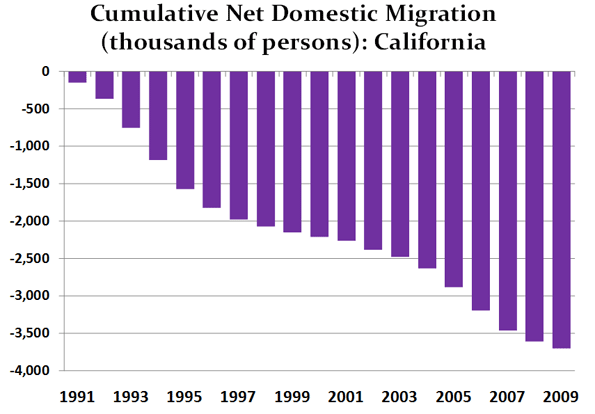
    How bad are things in California? California’s domestic migration has been negative every year since at least 1990. In fact, since 1990, according to the U.S. Census, 3,642,490 people, net, have left California. If they were in one city, it would be the third largest city in America, with a population 800,000 more than Chicago and within 200,000 of Los Angeles’ population.

    We’re seeing a reversal of the depression-era migration from the Dust Bowl to California. While California has seen 3.6 million people leave, Texas has received over 1.4 million domestic migrants. Even Oklahoma and Arkansas have had net-positive domestic migration trends from California.

    Those ultimate canaries in the coal mine, illegal immigrants, recognize California’s problems. Twenty years ago, about half of all United States illegal immigrants went to California. Today, that’s down to about one in four.

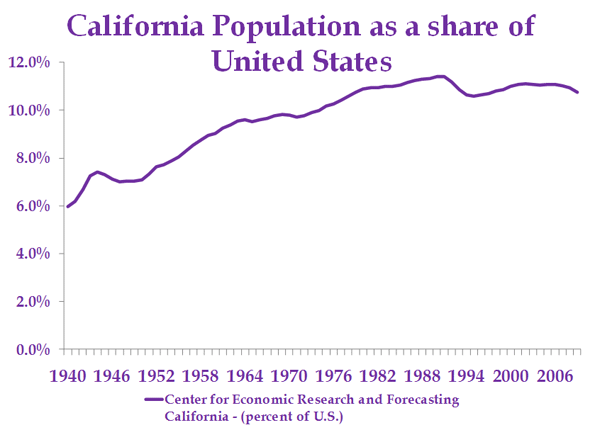
    The result of these migration trends is that California’s share of the United States population has been declining.

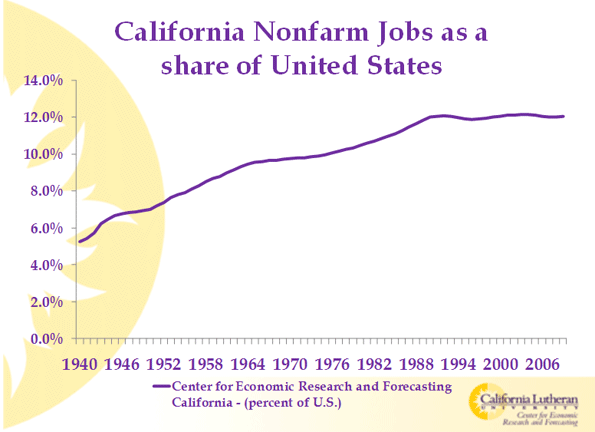
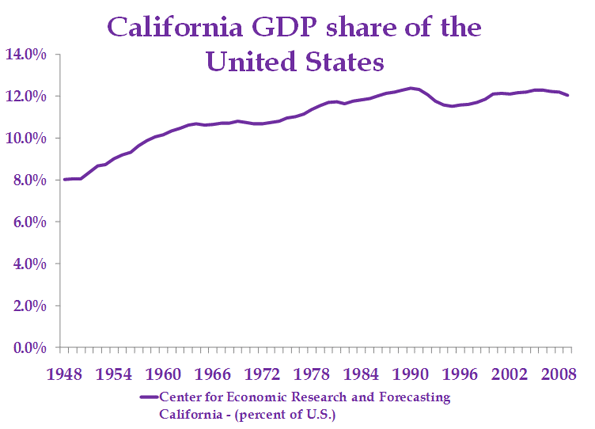
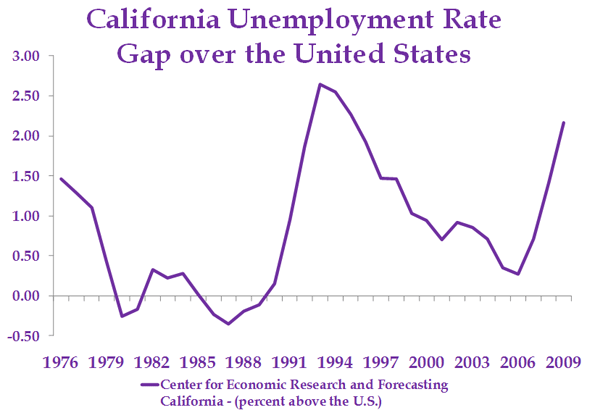
    What do these migrants see that so many of California’s political class do not see? They see a lack of opportunity. California’s share of United States jobs and output has declined since 1990, and its unemployment rate has remained persistently above the United States Average, only approaching the average during the housing boom.

    California’s unemployment is particularly troubling. As of October 2010, only two states, Nevada at 14.2 percent and Michigan at 12.8 percent, had higher unemployment rates than California’s 12.4 percent. California’s unemployment problem is particularly severe in its more rural counties. Twenty-five of California’s 58 counties have unemployment rates higher than Nevada’s:


    These unemployment rates approach depression levels. Some will excuse many of them because they are in agricultural areas, but many assert that low Midwest unemployment rates are due to a booming agricultural sector. Which one is it?

    California’s unemployment problems are not limited to rural and agricultural areas. Most of Riverside County’s population is very urban, yet the County’s unemployment rate is 14.87 percent. On December 7th, the Wall Street Journal listed the unemployment rates for 49 of America’s largest urban regions. California had six of the 19 metro areas with double-digit unemployment. These include such major cities San Diego, San Jose, and Los Angeles.

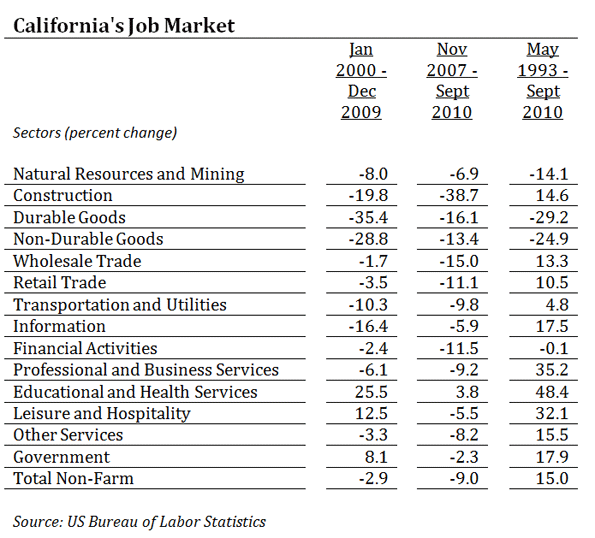
    Just as rural areas are not California’s only depressed areas, agriculture is not California’s only ailing sector. From 2000 to 2009, the only California sectors to gain jobs were government, education and health services, and leisure and hospitality.

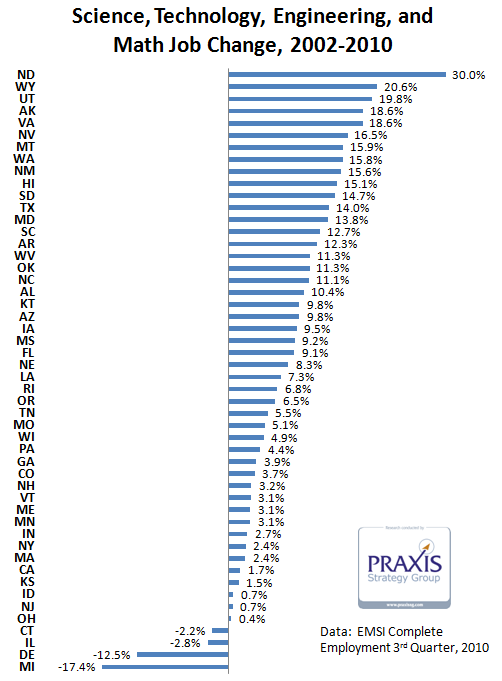
    California’s cheerleaders claim that the state’s future is assured by a vibrant tech sector, but the data do not support that assertion. North Dakota’s Praxis Strategy Group has performed analysis by job skills. They compare Scientific, Technical, Engineering, and Math (STEM) jobs across states. Their analysis shows that California is the Nation’s ninth worst state in creating STEM jobs in post dot-com-bust years. It has produced far fewer new tech jobs than Texas, and far less on average, than the country over the past decade:


    In this respect, California’s precipitous decline is really quite shocking. In just a couple of decades, California has gone from being America’s economic star, a destination for ambitious people from around the world and abundant with opportunity, to home of some of America’s most distressed communities. It has been a man-made, slow motion tragedy perpetuated by a political class that is largely deluded.

    The cheerleader’s faith in command and control regulation and environmental purity is so strong they cannot see anything that contradicts that faith.

    But that faith is misplaced. Joel Kotkin, Zina Klapper, and I performed an extensive review of the economic impacts of one of California’s most important greenhouse gas regulation, AB 32, and found that command and control regulation in general and AB 32 in particular is inefficient, cost jobs, and depress economic activity. California’s Legislative Analyst’s Office agrees, as evidenced by this report.

    More depressing still are the growing ranks of what could be called “the resigned”. They simply have given up. These include a business leadership that is more interested in survival and accommodation than pushing an agenda for growth. Easier to get along here, and expand jobs and opportunities elsewhere, whether in other states or overseas.

    Yet ultimately California’s future is what Californians make of it. No place on Earth has more natural amenities or a more benevolent climate. No place has a location more amenable to prosperity, located between thriving Pacific Rim economies and the entire North American market. No place has more economic potential.

    But unless policy is changed, California’s future is dismal, with the specter of stubbornly high unemployment, limited opportunity, and the continued exodus of the middle class. California’s political class needs first to confront reality before we can hope to avoid a dismal future.

    Bill Watkins is a professor at California Lutheran University and runs the Center for Economic Research and Forecasting, which can be found at clucerf.org.

    Photo by Stuck in Customs

  • Help Mexico: Legalize Pot

    Mexico is disintegrating. Bombings, kidnappings, assassinations, and shootings are now common. Recently, the mayor of Tancitaro Mexico was stoned to death. Mexican corruption is so rampant that United States law enforcement officials are reluctant to work with their Mexican counterparts out, fearing perverse results.

    The crimes are perpetuated by ruthless criminals whose depravity cannot be overstated. These are after all, people for whom torture, rape, and beheadings are normal parts of their business, and they show little reluctance to commit these atrocities against children. This link needs a strong-stomach warning.

    Most of Mexico’s violence and corruption has as much to do with our war on drugs than anything indigenous. It is thus preventable with a change of U.S. policy. This is not only in Mexico’s interest but ours as well: the drug-related violence has already begun to spill over into the United States.

    This cannot be avoided. The United States provides the customer base and the distribution network for Mexican drugs necessarily permeates the country. Increasingly, the product is produced in the United States. Travel in less-frequented California and Arizona wildernesses and parks is already dangerous. The problem is so pervasive that a fishing magazine, California Flyfisher, had an article in its October 2010 issue on how to avoid violent encounters with marijuana growers while fishing. The article documents how widespread and serious the problem is in California.

    The most immediate impact of Mexico’s violence’s will be felt along our common border. It’s already a violent place. It will become even more violent. However, the impacts will eventually be felt throughout the United States, challenging prison officials and law enforcement everywhere. Eventually, the corruption will infect our government and police, and the violence will impact everyone. For those who doubt that it can happen here, I recommend reviewing the history of prohibition in the United States.

    There will be other less direct implications of continued drug violence in Mexico. Immigration from Mexico will increase, but the composition of the immigrants will likely change. To date, our Mexican immigrants have mostly been relatively young, low-human-capital workers. As Mexican property rights—and what property rights can exist if your life is not reasonably secure?—decline, the middle and upper-middle class will be looking for alternatives. Many of them will see the United States as an attractive option.

    This can only be good for America. We should welcome these people, the wealth, the human capital, and the physical capital they will bring. They will provide a vigorous stimulus to our economy and our communities. These benefits, however, will not outweigh the costs of the crime and corruption.

    If we want to avoid the crime and corruption, we really need to abandon prohibition. We have a precedent.

    America’s 13-year nightmare of alcohol prohibition was initially popular. The eighteenth constitutional amendment creating prohibition passed both houses of congress with votes of 65 to 20 in the Senate and 282 to 128 in the House. It was ratified by 36 of the then 48 states in only 13 months. Eventually, 46 states ratified the amendment with only Connecticut and Rhode Island rejecting it.

    Ironically, the 21st amendment repealing prohibition was at least as popular as the 18th amendment that created prohibition. It passed the Senate with a vote 63 to 21 and the House by a vote of 289 to 121. Ratification by the necessary 36 states was achieved in only ten months, through State Ratifying Conventions. To date, the repeal of prohibition is the only constitutional amendment ratified by state conventions rather than by state legislatures.

    In only 13 years, prohibition went from being popular to being so unpopular that the amendment repealing it was ratified in 10 months. Something had changed. Prohibition had sparked an upsurge in crime and expanded the Mafia into a national powerhouse. Enforcement costs had soared. Government revenues had declined, and many officials corrupted. John D. Rockefeller summarized America’s change of heart:

    When Prohibition was introduced, I hoped that it would be widely supported by public opinion and the day would soon come when the evil effects of alcohol would be recognized. I have slowly and reluctantly come to believe that this has not been the result. Instead, drinking has generally increased; the speakeasy has replaced the saloon; a vast army of lawbreakers has appeared; many of our best citizens have openly ignored Prohibition; respect for the law has been greatly lessened; and crime has increased to a level never seen before.

    Today, alcohol still imposes huge personal and social costs, but we know that those costs are less than what we paid for prohibition. Drugs also impose huge personal and social costs, and the costs could increase in the event of legalization. The impacts of alcohol and drugs abuse on the abuser and those around him are terrible. The impacts of prohibition are worse.

    Continuation of drug prohibition will result in increased crime, increased corruption, and ever more of our public lands being diverted to illegal production. Thousands of people will continue die in the United States, Mexico, and other countries. The numbers of bombings, kidnappings, assassinations, and shooting will continue to increase. Thousand more will survive with diminished lives, a result of wounds, the loss of property, the loss of loved ones, or a life dominated by fear.

    Californians, by voting for Proposition 19, have to opportunity to take the first step in reducing the costs of prohibition. Despite the heartache and loss that drug abuse brings, voting for Proposition 19 is the humane thing to do, and it is one way that California can restore its now beleaguered reputation as a national thought leader.

    Bill Watkins is a professor at California Lutheran University and runs the Center for Economic Research and Forecasting, which can be found at clucerf.org.

    Photo by Troy Holden

  • Political Decisions Matter in State Economic Performance

    California has pending legislation, AB 2529, to require an economic impact analysis of proposed new regulation. Its opponents correctly point out that AB 2529 will delay and increase the cost of new regulation. There will be lawsuits and arguments over the proper methodology and over assumptions. It is not easy to complete a thorough and unbiased economic impact analysis.

    Should California incur the costs and delays of economic impact studies?

    California should, because political decisions matter and too many California politicians don’t believe it. I’ve had a State Legislator, sitting in her office in the Capital, tell me in essence that decisions made in this building won’t impact California’s economy.

    She’s not alone. It is common to hear politicians or their advisors claim that “California will come back” or something similar. They believe that California’s climate and abundant amenities are enough to guarantee prosperity. They are wrong.

    Consider North Dakota, and its booming economy. As of July 2010, North Dakota’s unemployment rate was 3.6 percent, and in 2008, the most recent year for which we have data, its economy grew at a 7.3 percent rate. California’s unemployment rate was 12.3 percent in July 2010, and its 2008 economic growth rate was an anemic 0.4 percent.

    That’s a very big difference. If California had North Dakota’s unemployment rate, it would have over 1.3 million jobs than it has today. That is almost the entire population of Sacramento County and 30 percent more than the entire population of Northern California’s Contra Costa County.

    Why the big difference? Why is North Dakota booming, as the United States suffers its most devastating economic decline in over 70 years? Why is California’s economy, with almost 30 percent higher unemployment than the United States, performing so poorly?

    Does North Dakota have some naturally endowed advantage over California? If so, nobody has noticed it before. It is not climate. California has a friendly Mediterranean climate, while North Dakota has a Northern Continental climate. North Dakota’s mean minimum temperature is below freezing six months of the year, and it gets as low as -60F! Many Californians, living on the coast, can go decades without witnessing a freezing temperature. I remember when we had a multi-day freeze in my hometown of Ventura, sometime in the 1980s. I was freezing; a North Dakotan would be walking around in a t-shirt.

    California has oil and gas. North Dakota has oil and gas. California has over 2,000 miles of beaches. North Dakota doesn’t have beaches. California has magnificent mountains. North Dakota doesn’t have any mountains and only a few hilly areas. Over 20 species of trees reach their largest size in California. Most of North Dakota doesn’t naturally grow many trees.

    Let’s face it. Most Californian’s consider North Dakota to be a cold, windy, God-forsaken piece of dirt best left to the bison. North Dakota’s natural endowment doesn’t explain why it has been growing with vigor while California has been stagnating.

    Maybe North Dakota has been lucky while California has been unlucky? Luck can play a part in economic performance, and North Dakota has almost surely been luckier than California over the past few years, but that can’t be the only explanation.

    It’s hard to point to a single source of North Dakota’s prosperity. Its taxes aren’t particularly low. It has a reasonable safety net for the unfortunate. It does have a booming oil and gas business. Its agriculture sector is doing well. It has a small, but dynamic, tech sector. Its universities remain well funded since the state is actually running surpluses. It has a hardworking, well educated, Midwestern population. Governments and politicians in both parties tend to be business friendly, willing to support business and enter into occasional partnerships. North Dakotans have done lots of things right, and they’ve probably also been a bit lucky.

    It’s just as hard to point to a single source of California’s dismal performance. California hasn’t maximized the economic potential of its oil and gas resources, but its economy is large, and oil and gas alone can’t explain the differences between California and North Dakota. California hasn’t updated its ports to accommodate the most recent and planned ships, but those ports see lots of activity. Many California communities are not business friendly, but some are, particularly some smaller ones inland. California has lost some military bases, but many remain. California is a relatively expensive place to do business, because of taxes and regulation, but California’s workers are more productive, even after adjustment for industrial composition and capital, and California’s consumers still constitute a huge market.

    California’s economy is dying the death of a thousand cuts: a tax here, a regulation there, an unfriendly city council in Coastal California, a lack of infrastructure investment everywhere. These things add up to a significant net negative for California, its businesses, and its workers.

    Californians have done lots of things wrong, and they’ve been a bit unlucky.

    That’s why AB 2529 is a good idea for California, why it’s worth the costs and delays. The analysis will require regulators to consider the economic costs of regulation, something many green activists and Sacramento politicians simply ignore. Perhaps if this regulation had been in place over the past few years, some of California’s 2.2 million unemployed workers would have jobs and once Golden State would not be on the verge of becoming, as historian Kevin Starr has noted, “a failed state”.

    Bill Watkins is a professor at California Lutheran University and runs the Center for Economic Research and Forecasting, which can be found at clucerf.org.

    Photo by Willem van Bergen

  • In California Cool is the Rule, but Sometimes, Bad is Bad

    Californians value cool. I’m not sure how this came to be. It might be the weather. It might be the entertainment industry. Whatever the reason, Californians don’t get excited. Better to go with flow than to get excited. Things will be ok. Concerned about the economy? Stay cool Dude. It’ll come back. Always has. Always will. Relax.

    It’s not cool to get excited, or heaven forbid, panic. Californians are not quick to react to problems, so confident that eventually the problem will just go away. This was forcefully brought home to me when a member of California’s legislature told me that “It doesn’t matter what we do in this building. California will always rebound.”

    California’s governance is seemingly designed to enforce cool in the government. Term limits, two-thirds requirements, and bipartisan gerrymandering combine to insure that change is not legislated. So you see absurdities, such as the legislature’s worrying about the asbestos content of the State Rock while the budget-less State goes down the path of bankruptcy and economy collapse.

    Institutionalized stasis is why I don’t think it matters who wins the upcoming gubernatorial election. Neither Mercurial Meg Whitman nor Moonbeam Jerry Brown will cause Sacramento to actually do anything to change California’s trajectory.

    Veteran capital-watcher Dan Walters likes to say that when legislators do agree and actually do something important, it’s usually bad. He cites California’s failed “electricity deregulation” back in 2000 as a case in point. The state does have a release valve, the initiative, which is much hated by the political class. But it is their fault. Legislative inaction is probably one reason for the increase we’ve seen in ballot initiatives. Of course, initiatives are seldom the optimal way to create change.

    Proposition 13 is an excellent example. Sacramento was aware of the property-tax problem, but was unable to deal with it. That created a vacuum, and the radical tax reformers stepped in. The result was a far more draconian and less flexible law than necessary or desirable. That’s the way initiatives work. The legislature fails to legislate. Inaction creates a vacuum. The vacuum is filled by more extreme interests. The resulting law is almost always flawed.

    California cool may be legendary, but as the Huey Lewis song says, sometimes bad is bad, and California’s economy is bad, very bad, and it’s not going to get better soon without real change. Plenty of lawmakers, especially the governor, are counting on renewable energy and green industry to provide California with an economic rebirth. It won’t happen. Read why here and here.

    I’m thinking that now would be a good time for Californians to lose their cool.

    Recently, Boeing announced that it is moving two programs from Long Beach California to Oklahoma. The move will cost California about 800 mostly well-paid engineering jobs. This is a relatively small event in an economy the size of California’s, but it is part of a steady drumbeat of businesses leaving California. Northrop Grumman has already decamped. General Dynamics’ San Diego shipbuilding subsidiary, Nassco, is shrinking its workforce by 300 workers, most of them highly skilled. Even the entertainment industry is slowly reducing its footprint in California. The list goes on and on.

    The main reason: California is an expensive place to do business, and the expense is made more onerous by uncertainty about future taxes and regulation. Consequently, those businesses that can increasingly are departing for more reliable, friendlier climes.

    Policy makers may find excuses for each of these events, but the persistence and size of the differences between California’s economic performance and those of better-managed states indicate something few in Sacramento understand: many of California’s economic problems are self inflicted. How big is the difference between California’s economy and other states? The unemployment rate provides one answer: California’s unemployment rate is about 30 percent higher than that of the rest of the country. That’s big, far larger than can be explained by demographic factors.

    High and persistent unemployment is not the only result of California’s job-killing environment. Income inequality is increasing, a legacy of declining opportunity for skilled blue collar workers and a failed educational system. Home prices and sales will not recover for years. Commercial real estate is in freefall, and we may not see anything approaching full occupancy for a decade. Real-per-capita retail sales may never recover, a result of joblessness, high taxes, and increased internet competition. Perhaps the most telling trend is that domestic migration has been negative for most of the past 15 years, as people vote with their feet and seek opportunity in other states.

    About the only source of hope, in a perverse way, is that government revenues are down. By now, it should be clear, even to those who thought their income was independent of economic activity, that a prosperous private sector is a necessary precondition for general prosperity. Professors, non-profit-sector workers, and government employees are learning the hard way their dependence on the private sector. We can hope that personal interest will drive them to more enlightened policy.

    That hope is tempered, though, by the political class’s willingness to embrace the mirage of a free lunch. The AB 32 climate change and SB 375 anti-sprawl bills were the result of a well-meaning search for the Holy Grail of costless environmental and economic virtue.

    Environmental and economic interests are not inherently incompatible, but environmental quality is not costless. In fact, it is a luxury good. Wealthier societies invest far more in environmental protection and rehabilitation than do subsistence societies whose primary concern is finding the next meal. In short, environmental protection requires investment, and wealthier societies are better able to pay the price.

    California’s leadership’s embrace of AB32/SB375 is unlikely to achieve any of its goals. It will be a drag on economic activity. Its impact on global greenhouse gasses will be negligible. Worse, it is very inefficient. Economic research is not ambiguous. Subsidies and command-and-control regulation are far from the cheapest way of improving the environment. The best way to reduce greenhouse gas emissions is through a rebated tax. This would be a carbon tax, where the tax revenue would be rebated to offset a more distortionary tax, say a labor or capital tax. This simultaneously discourages the bad, pollution, while encouraging the good, work or investment.

    AB32/SB375 is certainly not the source of all of California’s problems. The state has lots of them, and it’s time we took a serious approach of addressing them. Maybe, we should lose our cool and demand real leadership from Sacramento.

    Bill Watkins is a professor at California Lutheran University and runs the Center for Economic Research and Forecasting, which can be found at clucerf.org.

    Photo by Duncan H

  • Flexible Forecasting: Looking for the Next Economic Model

    Last autumn I gave a talk in California’s San Fernando Valley. I was the last of three economists speaking that day, and I watched the other economists’ presentations, each a rosy forecast of recovery and imminent prosperity. So, I was a bit nervous when it was my turn to speak, because I had a forecast of extended malaise. People don’t like to hear bad news, and they do blame the messenger. In the end, I was relieved. No tomatoes, no catcalls.

    That’s how things went last fall and winter. Many economists confidently predicted a rapid recovery, while my group’s forecasts were pretty dismal: weak economic growth with little if any job creation. Today, many of those same economists’ forecasts are far closer to ours. Why?

    Part of the problem is the fact that macroeconomics is an unsettled discipline. We have lots of macroeconomic models, none of which is adequate for all states of the world all the time. Each provides insight, but no single model can cope with the awesome complexity of the world. A large part of the art of forecasting is determining which model is most applicable to the current situation; which ones include insights that are dominant today.

    The problem is exacerbated when economists become excessively committed to a particular model. This isn’t religion or politics, it’s forecasting. It is hard enough. There is no reason to handicap yourself by excessive fealty to some model or doctrine.

    There was another problem that resulted in the change of tune. The world changed in September 2008. We call it a regime shift. It’s a move from one (good) equilibrium to another (bad) equilibrium. Statistical models that worked well in the old regime don’t work in the new regime. We hustled to adjust our models, but admitted that with limited experience in the new regime, we were less confident in our forecasts.

    The problem with a regime shift is that it is similar to a change in the rules of a game. Old relationships don’t hold anymore. Football is an example: If you changed the rules to allow five downs instead of four, nobody would predict punts on fourth down.

    Some economists didn’t recognize the regime shift. They went about their business using the same old models in a new world. Comments about the length of a typical recession or about how sharp declines are followed by rapid recoveries were clear signals that the speaker didn’t understand the situation.

    Some economists were fooled by the stimulus. The rules of accounting cause government spending to be reflected as an increase in economic activity. Stimulus plans such as Cash for Clunkers and tax credits for home purchases moved the timing of transactions, artificially reinforcing the direct spending impacts. Similarly, bailouts and foreclosure prevention programs postponed the recognition of losses.

    Many interpreted the resulting increase in last winter’s reported activity as permanent, but that could not be. We were not building anything or laying the groundwork for sustained prosperity. Instead, we were just continuing the previous decade’s consumption binge. The banks had failed, but the government had stepped in. It became the mother of all banks, borrowing from future citizens and other countries to fuel today’s consumption.

    Regime shifts that lead to a bad equilibrium appear to be similar to bank runs. There need be no basis for panic, but a panic can guarantee the demise of a bank. The result of a panic on a bank ends there. The bank is failed, gone. There may or may not be a contagion effect on another bank.

    A panic can also guarantee an economic decline. But our economy is different than a bank. It can’t fail, in the sense that we can’t shut it down and walk away. We’re all still here after a regime shift. We’re stuck with a mess.

    We did have a mess after September 2008. All of a sudden, everyone’s wealth had declined, a lot. Businesses, consumers and governments were over-leveraged. Risk aversion had increased, perhaps to remain high for decades. Our understanding of economic risks had changed. We had discovered black swans – rare and unexpected outliers — in our system.

    The problem with regime shifts is that we don’t know how to initiate or cause them. We see shifts to bad regimes, and we can see their self-fulfilling nature. Can there be some self-fulfilling process that leads to a shift to a better regime? I hoped so, and I hoped that Obama’s election would initiate such an event. Our forecasts aren’t based on hope though, and it’s just as well that we didn’t forecast that his election would generate a spontaneous recovery.

    Today, enough time has passed that even the most slowly adapting forecasters are forced to confront the post-2008 data and the government’s failed economic efforts. As forecasters confront these facts, their forecasts are becoming increasingly gloomy. Now, forecasts of protracted malaise or even a double-dip recession are increasingly common. Why?

    Because we borrowed to extend a consumption binge, and we compounded that error with omissions and perverse policy.

    The stimulus’s omissions are glaring. We didn’t significantly invest in infrastructure that would improve our future growth. We failed to address the weaknesses in our education sector that fuel increasing inequality, sentence many to a life of hopelessness, and permanently constrain our economic growth. We did nothing to encourage small business’s growth; in an example of perverse policy, we are actually creating a new regulatory regime that favors large companies.

    Then there were the actions that will probably restrain future economic growth. The minimum wage was raised. We had health care reform, but we didn’t address the real problem: the fact that the health care consumer pays an insignificant portion of the bill at the time of consumption. We had financial reform that failed to address the fundamental problems of too-big-to-fail, and we protected risky activities, increasing the regulatory burden and crippling the ability of small banks. We halted much of our offshore drilling.

    Looking forward, there is little reason for optimism. We’re considering huge increases in our energy costs through greenhouse gas regulation. We have a massive tax increase scheduled at the end of the year.

    While a double-dip recession is not the most likely outcome, we can’t reject the possibility. More likely, we face a long slow struggle to overcome ourselves and restore real prosperity. The forecasters’ consensus appears to be moving toward accepting that reality.

    Flickr photo of Petra’s Yoga Poses Around The World

    Bill Watkins is a professor at California Lutheran University and runs the Center for Economic Research and Forecasting, which can be found at clucerf.org.