Author: Bill Watkins

  • Economics: Green Shoots & Immigration

    A year ago we were hearing all about green shoots. Analysts claimed to find them everywhere.

    Today, we never see the term. In fact, there seems to be a growing malaise. By the end of June the first quarter’s Gross Domestic Product (GDP) estimate was revised downward a full half a percent, to 2.7 percent. Pundits are depressed. Our President and Secretary of the Treasury are telling the world that the United States cannot lead the world to sustained economic growth. Our Vice President announced that “there’s no possibility to restore eight million jobs lost in the Great Recession.” Our stock markets are down and volatile. Risk premiums have soared.

    What happened?

    Reality happened. The green shoots were always ephemeral, the result of massive government spending increases or temporary government programs. We had housing stimulus programs. We had Cash for Clunkers. We had foreclosure programs. We had bailouts.

    The increased spending and the various programs had an impact. Because of the way GDP is calculated, an increase in government spending results in an increase in GDP, but that is today’s GDP, not tomorrow’s. Tomorrow’s economic growth is a result of investment today, investment in physical capital, technology, and human capital.

    To the extent that government spending detracts from those investments, the growth we saw was cannibalized from the future. For example, the housing stimulus programs served only to change the timing of real estate purchases. Sales fell when the programs ended.

    Even worse, some programs resulted in temporary GDP growth, but were actually detrimental to long-term economic growth. The Cash for Clunkers program destroyed capital, since perfectly good cars were crushed. The foreclosure prevention programs delayed the needed decline in home ownership rates.

    The bailouts prevented assets from being transferred to more productive uses. Bailouts are inefficient, and they prolong periods of economic weakness. Uncertainty and risk premiums remain elevated, holding investment to a minimum, limiting short-term and long-term economic growth. They also leave a hangover of debt, which limits future growth.

    None of the programs addressed the underlying problems of the current economic circumstances, or paved the way for sustained economic growth. The immediate problem was that businesses, consumers, and governments were over-leveraged after September 2008’s asset-value collapse. The longer-term problem was insufficient investment, a result of years of credit-fueled consumption.

    What was needed was investment. What was provided was more credit-fueled consumption. You might be able to borrow your way to prosperity, but to do that you better be investing the borrowed funds. We didn’t do that. Instead we used the government as a bank to increase consumption. Credit-based consumption is not the way to long-term prosperity, regardless of who does the borrowing.

    And, while it appears that most of the decline in asset values has ended, over-leverage is still with us. Indeed, the increase in government leverage makes it more difficult to employ effective government intervention, government investment in productivity-enhancing capital and technology, and investment tax credits.

    Add to these factors the millions of American households, employed and unemployed, that remain over-leveraged. Millions of consumers have been unemployed for months, and many of those still working are uncertain about their future employment. Those who have the income to do so are attempting to pay down debt, and to reduce consumption in the process. The consumer is not likely to soon be a source of rapid economic growth.

    So, we have most or all of the problems of a year ago, but now, because of increased government debt, we have fewer options. Even worse, we now have new problems that were not present in September 2008.

    Today, sovereign default risks are significant and increasing. While potential sovereign debt problems in Europe have received a great deal of attention, the problems are not limited to the continent. Japan continues to have very high debt and deficits. Several U.S. states could also default. A failure of an American state is likely to have impacts very similar to the failure of a small European country.

    I don’t believe that the failure of a country is the most likely outcome, however. Instead, expect to see more international bailouts, just as you can expect to see the federal government bailout several American states.

    Our options are limited, but we do have one option that would provide immediate and sustained economic growth without increasing leverage. That option would be a massive increase in immigration.

    The initial benefits of a new wave of immigration would be seen remarkably quickly. Housing demand would increase, leading to renewed vigor in our real estate markets and the construction industry. Our inner cities would be renewed, as they always have been by immigration waves. New business formations would soar. The tax base would increase, helping to fund debt repayment and baby-boomer retirements.

    Many would oppose such an immigration increase. They worry about increasing job competition, unemployment, crime, and even more demand on welfare programs.

    These fears are misplaced. Criminals are easily sorted out by effective screening processes. People don’t migrate for welfare benefits, but if this is a concern, it is easy to deny immigrant access to social programs for some number of years after immigration. Similarly, people don’t migrate to be unemployed, and unemployment benefits can be denied to immigrants.

    People migrate to more effectively use their human and physical capital, their technology, and their labor. Effectively, immigration would provide new capital, technology, and labor. This is exactly what we need, and it is free. Immigration has served America well in the past. It can serve us well today.

    Red and Green, photo by Rupert Maspero

    Bill Watkins is a professor at California Lutheran University and runs the Center for Economic Research and Forecasting, which can be found at clucerf.org.
  • Stimulus, Spending and Animal Spirits: How to Grow the Economy

    The most fanatical Keynesians are losing their composure. Brad DeLong, a prominent Berkeley economist and Keynesian, is virtually yelling that “We Need Bigger Deficits Now!”, emphasis his. Paul Krugman does DeLong one better, calling proponents of fiscal responsibility madmen.

    They are following the gospel of John Maynard Keynes, who famously advocated government deficits to pay people to dig holes, increasing demand and therefore economic activity. This is, to be polite, bunk.

    It is worse than that actually. The logic implies that any government expenditure funded by debt will result in sustained economic growth. The result has been a stimulus plan that completely lacks coherence. Instead, we have a hodgepodge of spending initiatives that provide a temporary illusion of growth, but that will leave us with little that is long-term, except for huge hangover of debt which will be a drag on economic activity for years.

    Keynesian stimulus theory comes about because of what is called a liquidity trap, a situation where the interest rate is zero, because no one wants to invest. The logic is that you can spend your way out of a liquidity trap; that by spending, government can increase sales. Eventually the increased sales will cause businesses to invest, driving interest rates up.

    It is an article of faith among Keynesian economists that if the stimulus is big enough, it will generate sustained long-term growth. Call this the Tinkerbell Principle. You only have to believe in animal spirits to have expectations of a better future.

    Consequently, when the spending doesn’t achieve the desired result, Keynesians always call for more deficit spending, just as we see in the above-linked DeLong and Krugman arguments. And, when that doesn’t work, like a broken record, they will call for more, but there can never be enough.

    There is a case to be made for expectations, but they need to be rational. The recession was similar to a bank run, which can kill a bank, even when there is no initial weakness to generate the run. In this case, we had a run on the world’s financial system. Call it a regime shift from a good equilibrium to a bad equilibrium.

    Can government spending alone bring us back to a good equilibrium? It can if you believe in animal spirits, but I don’t.

    I believe that people are not excessively stupid. Economists call this concept rational expectations, the idea that most people can see obvious consequences most of the time.

    I believe that people spend out of wealth: the value of the assets they hold and the present value of future income. This may not be an easily calculated number, but people keep track of it. It is something like a fielder’s response when a batter hits a ball. This is a complex problem, but fielders respond instantly. The fielders are moving in the correct direction at the correct speed to intercept the ball while the bat is still in motion.

    Finally, I believe that people try to smooth consumption. That is, they like to eat a little every day rather than go without for several days and binge on other days.

    Let’s analyze typical deficit-financed government spending programs using these beliefs. Somebody is going to have to repay the debt someday. It can be the person who receives the money, some other person who is currently working, or some future worker.

    If the person who receives the money is the one who must repay it, she will normally save it. Her wealth has not changed, she knows that she will have to repay the money, and she’s not excessively stupid. She’ll want the money there when she needs it. We saw this with the Bush “tax rebates.” Consumers saved the rebates, and the administration did not see the consumption boost they had anticipated.

    There is another possibility though. She could be what we call ‘liquidity constrained’, holding no cash and unable to borrow. Her wealth is still unchanged, but she wants to smooth consumption — keep it at a relatively steady level — so she may spend some or all of the money. However, this implies that her future spending stream will be reduced. We’re taking from tomorrow’s economy to support spending today. This may be justifiable on humanitarian grounds, but it doesn’t generate sustained long-term economic growth.

    Suppose it is another worker who will repay the government debt. His wealth has just decreased. He’ll spend less, and, also being a consumption smoother, he’ll start spending less right now. Again, there is nothing here to generate sustained long-term economic growth.

    Finally, suppose it is some future worker who will repay the debt. He or she will enter life or the workforce with a debt. I’ll ignore the ethical implications of enabling increased consumption by current citizens by imposing, without consent, debt on future workers; instead, I’ll stick just to the economics.

    Our future worker starts a career, absent some other endowment, with a negative net worth. Over the course of his career he’ll spend and invest less than if he had started with a zero net worth. Again, this is not a prescription for sustained long-term economic growth.

    What we have to face is that by borrowing to consume now, we are taking away from the future. This is just not the way to achieve sustained long-term economic growth.

    So what to do if you are a politician who thinks something must be done?

    The liquidity trap comes about because no one wants to invest. What government should do in response is try to increase demand for investment. This would increase economic activity now and in the future. Increased demand for investment can be created by investing in public capital that makes private capital more productive, and by lowering the cost of borrowing.

    When the government borrows and invests the money in projects that increase private capital’s productivity, it is increasing the return to capital. Increasing returns to private capital increases the demand for private capital and investment. Current and future economic activity is increased.

    We have lots of examples of these types of investments, including canals, dams, highways, public utilities like the Tennessee Valley Authority, and more.

    The other approach to increasing investment is to lower the interest rate. This is difficult to do directly when the interest rate is zero, but the government can achieve the same result another way. An investment tax credit effectively lowers investors’ borrowing costs.

    So, if the government is going to actively stimulate the economy, it would be far better to invest in public capital that improves the returns to private capital. It will also help to provide a meaningful investment tax credit. Consumers could then rationally expect their future income stream, hence their wealth, to improve. With increased wealth their spending will increase, and we will be on our way to sustained long-term economic growth.

    Flickr photo “Búho Real” by sıɐԀ ɹǝıʌɐſ

    Bill Watkins is a professor at California Lutheran University and runs the Center for Economic Research and Forecasting, which can be found at clucerf.org.

  • Jobs, Environmental Regulation, and Dead French Economists

    The debate over the repeal of California’s global-warming regulation, AB32, has degenerated into a shouting match, each side claiming economic ruin if the other side wins. A couple of long-dead French economists can help us think about the debate.

    The great French economist Leon Walras (1834-1910) showed that perfect markets result in an allocation of goods and services that can’t be improved on, in the sense that no one could be made better off without someone else being made worse off.

    Of course, we don’t have completely unfettered markets. In fact, they have never existed. They will never exist. In particular, we economists like to talk about what we call negative externalities. These occur when I do something, but an unintended consequence is that it hurts you, and you have no recourse.

    An example may make things clearer. Suppose I have a factory that spews out a deadly chemical, one that destroys all life downwind for ten miles. Obviously I’ve reduced the property values for the downwind property owners. (We’re simplifying here. There are many other issues.) There is no market for the damage I’ve done, and downwind landowners may not be able to afford to sue me, and there was a time when they would have likely lost such a case.

    Society’s solution to the problem of negative externalities has been regulation. Until recently, the concept of negative externalities has been the rationale for most environmental regulation. Negative externalities’ victims have also been extended to include non-humans: flora, fauna, and “mother earth.”

    Climate change regulation, though, is a bit different. In the first place, we don’t know how much of its justification, the claim of manmade global warming with long-term negative economic impacts, is accurate. Some, the “non-believers” completely deny the possibility of man-caused global warming. Others, “the believers” believe in man-caused global warming with a fervor that matches that of any religious zealot. Another group, me included, believes that manmade global warming is a possibility that should be considered as a factor in making long-term economic policy.

    If manmade global warming was a certainty, you could reasonably argue that negative externalities justify regulation, the parties being hurt are just not yet born. That’s essentially what the believers are trying to say when they point to the imminent destruction of all life on earth.

    However, once the existence of manmade global warming becomes a probability, it becomes an insurance question. This dramatically increases the level of complexity of the problem, and it dramatically complicates the political problem of reaching consensus about what to do.

    So, proponents of climate-change regulation have tried to simplify the issue. One approach has been to turn everyone into believers, either by attempting to convince the skeptical—as it turns out by using gross exaggeration if necessary—or, failing conversion, excommunicating even the mildest skeptics from civil society.

    Climate-change regulation proponents have also tried, with success, to use the novel argument that climate-change regulation is not only costless but will generate economic growth. The most enthusiastic proponents of this argument, California’s Governor Schwarzenegger among them, describe a utopian future of happy people enjoying previously-unknown prosperity in a pristine earthly heaven.

    Sadly, this better-than-a-free-lunch deal is not likely to materialize. It is true that clever economists have constructed models where such an outcome is possible—models having to do with large-scale inefficiencies existing because of historical accident—but large-scale unrecognized opportunities are unlikely in today’s economy.

    It is also true that some economists have found some evidence of small un-captured gains. I’ve participated in this literature. However, those gains are also unlikely to be of the scale necessary to achieve the promised new economic age. Indeed, most economists doubt their existence, arguing, reasonably, that the researchers failed to measure all of the relevant costs. Economists have a hard time believing that markets are so bad that unrecognized profitable opportunities exist in abundance.

    Today, California is considering the repeal or postponement of its landmark global-warming regulation, AB32. Oddly, both sides are using the same argument. The forces arguing against the repeal of AB32 argue that the repeal will cost jobs. Those arguing for the repeal argue that failure to repeal will cost jobs.

    They are both correct, and they can both prove it with their warring models, which brings us to our second great dead French economist.

    Frederick Bastiat (1801-1850), not long before his death, wrote a piece What is Seen and What is Not Seen. In the essay, Bastiat gives the example of jobs created by breaking windows. The broken window creates work for the glazier, a multiplier is attached to that work, and it looks as if economic activity has increased. However, society is not better off. The problem is that we see, and account for, the work, but we do not see or count the costs associated with the initial destruction of capital.

    So it is with California’s regulation. Proponents of the regulation have research to support their claim of job creation. The “green jobs” created by the regulation are seen and counted. The jobs lost to the regulation are not seen and are not counted.

    The opponents of California’s regulation have estimated the jobs lost to the regulation, mostly a consequence of higher energy costs, but that research—the portion I’m aware of at least—has been criticized for ignoring the jobs created by the regulation. More importantly, they do not see the jobs that might be lost if global warming kills jobs. They only see, and show, the jobs lost to failure to repeal the regulation.

    Creating jobs is easy; creating real economic growth is harder. Banning the use of any productivity-enhancing technology will create jobs, but this could occur at the cost of societal well being. We could achieve full employment by banning all agricultural technology created after the 17th century. There is no unemployment in a Malthusian economy. We’d all have “idyllic” jobs on the farm, yet this would in reality be back-breaking work. Many people would live on the edge of starvation. I don’t think anyone really wants that outcome. It is also easy to create subsidized jobs, even if those jobs add nothing to, or worse detract from, society’s well being.

    Instead of jobs, the argument should focus on such things well being, consumption, income, probabilities, and the like. It is complicated by the uncertainty surrounding the theory of manmade global warming, and the uncertainty surrounding the economic impacts of any warming. But, the stakes are high. People’s lives will be changed. The debate deserves a higher-level of discourse than we’ve seen. Frenetic predictions of job losses or overly optimistic projections of employment created by a green economy will not do. Instead, let’s recognize the complexity of the issue and have a reasoned discussion.

    Bill Watkins is a professor at California Lutheran University and runs the Center for Economic Research and Forecasting, which can be found at clucerf.org.

    Photo by Diogo Martins.

  • California is Too Big To Fail; Therefore, It Will Fail

    Back in December I wrote a piece where I stated that California was likely to default on its obligations. Let’s say the state’s leaders were less than pleased. California Treasurer Bill Lockyer’s office asserted that I knew “nothing about California bonds, or the risk the State will default on its payments.” My assessment, they asserted, “is nothing more than irresponsible fear-mongering with no basis in reality, only roots in ignorance. Since it issued its first bond, California has never, not once, defaulted on a bond payment.”

    For good measure they labeled as “ludicrous” my comment that the Governor and Legislature may not be able to solve the budget problem next year because “debt service is subject to continuous appropriation. That means we don’t even need a budget to make debt service payments.”

    The Department of Finance was also not amused. They resented my prediction that California is on the verge of a default of its bond debt. They insisted that the state has

    “multiple times more cash coverage than we need to make our debt service payments.“

    “There are three fail-safe mechanisms in place to ensure that debt service payments are made in full and on schedule.”

    “Going back as far as the Great Depression, California has never — ever — missed a scheduled payment to a bondholder or a noteholder. Not during the recession of the early 1980s. Not during the collapse of the defense industry in the early 1990s. Not during the dot-com collapse of the early 2000s. And not now. And we, along with the Treasurer and the Controller, will continue to ensure that this streak will never be broken.”

    I am not alone in being taken to the state woodshed. More recently, Lloyd C. Blankfein, Chairman of the Board and CEO of Goldman, Sachs & Co. received this letter from Lockyer’s office, a letter that was ridiculed by The Financial Times’ Spencer Jacob here.

    Once you get past the name calling, California has two arguments. One argument is that California has never defaulted; therefore it will never default. This is, of course, absolutely absurd, insulting our intelligence. Every person, corporation or other entity that has ever defaulted on a loan has been able to say, at least once, that they have never defaulted. As they say in finance: Past performance is not a guarantee of future performance.

    California’s second argument is that it has both a constitutional requirement to meet certain debt payments and the cash to do so.

    That’s nice.

    I have no idea what a constitutional requirement to meet debt payment means, but it doesn’t mean that California will always pay its bills. California has a constitutional requirement to have a balanced budget every June. That constitutional requirement is ignored almost every year. It was ignored last year. It will be ignored this year. It will be ignored next year, unless the Feds have bailed out California, relegating the state’s legislature to rubber-stamp status.

    California’s constitutional requirement to meet debt payments will mean nothing when the state’s financial crisis comes. It won’t mean anything if a debt issue or rollover can’t be sold. It won’t mean anything if the state has no cash, and banks refuse to honor California’s vouchers.

    The relevant analysis begins with the recognition that California is too big to fail, which means it will fail.

    Since there is no procedure for a state to file bankruptcy, the solution to California’s financial crisis will be chaotic. What does it look like when the government of the world’s eighth largest economy can’t pay its employees, or pay its suppliers, or meet its obligations to school districts, counties, cities or other local government agencies?

    It looks ugly, ugly enough to have huge economic ramifications far beyond California’s borders. It looks ugly enough to mean that California is too big to fail, and that’s why we will have a financial crisis.

    Once something (a bank, a car manufacturer, a state) is too big to fail it has perverse incentives. A moral hazard is created because of the free insurance. In California’s case, the moral hazard is exacerbated by a system that assigns responsibility to no one. The super-majority requirement means that both parties will escape blame, and the required cooperation of the legislature will absolve the governor. The governor will blame the legislature. The Republicans will blame the Democrats. The Democrats will blame the Republicans. The citizens will blame the political class. Talking heads will blame an allegedly fickle electorate. Everyone will point fingers, but the blame will not settle on anyone.

    In the end, blame will not matter. No one in a position of power in California has the incentive to make the tough decisions needed to avoid a crisis. So, no one will. Indeed, at this point everyone has an incentive to not make any hard decisions. A bailout from the Feds will be a wealth transfer from the citizens of other states to California’s citizens. The incentive is to drag things out, to appear to be working on the problem, to maximize the eventual windfall.

    I’d love to see California’s political class show some leadership, step up, and effectively deal with the state’s financial problems, but that really is unlikely, requiring as it will, tough decisions on spending priorities and taxes and foregoing a windfall. Ultimately, money usually trumps character.

    Bill Watkins is a professor at California Lutheran University and runs the Center for Economic Research and Forecasting, which can be found at clucerf.org.

    Photo by pirate_renee

  • A Big Company Recovery?

    After the release of the 2009 fourth-quarter GDP estimate, some forecasters are now predicting a rapid recovery in 2010. Certainly, the fourth-quarter growth rate was impressive, particularly following the modest pickup reflected in the third-quarter results and the terrible results of the previous several quarters. Implicitly, these optimistic forecasts are based on the assumption that the United States economy has been fundamentally unchanged by the recession.

    I suppose an assumption that the economy has been fundamentally changed in a good way could motivate a positive forecast, but I’ve not seen anyone make that argument. If someone does, I’d like the chance to debate them. We certainly haven’t addressed the too-big-to-fail problem, the bank health issue, or Fed-induced moral hazard problem created by Greenspan’s repeated easing in response to market declines.

    On the other hand, we are promised increased regulation for many sectors and higher taxes. I’d like to know which sectors, besides legal and accounting perhaps, were the winners, and how they are poised for imminent booms.

    If the economy is unchanged, we would expect to see economic growth in small businesses, and a recovery in real estate markets and construction. I don’t see how that happens. I have a hard time seeing how the flow of capital to small businesses can be restored soon, and imagining a near-term robust real-estate and construction recovery is even harder, while foreclosures are still climbing and homeownership rates still high.

    Given these facts, most forecasts these days are, unsurprisingly, more modest. Forecasts of tepid economic growth with slow job gains are typical. Some are more pessimistic, anticipating a new slowdown brought about by increasing taxes or new financial crises.

    Certainly, the United States faces continued economic challenges. When one looks more closely at the past-two-quarter’s GDP estimates, it is difficult not to conclude that they were elevated by temporary factors, such as home-buying incentives, auto buying incentives, and inventory changes.

    Other data compel one to even less sanguine conclusions. Bank charge-offs, driven by weak real estate markets and weak economic activity, are still climbing, hitting new records every quarter. Jobs are still being lost, albeit at slower rates than those disastrous rates we saw in 2009’s first half. Residential foreclosures are still climbing. Many commercial real estate markets appear to be collapsing. Normalized TED spreads, the cost of an incremental increase in risk, are still high, implying continued risk aversion among market participants.

    The human costs of this recession have been even greater. About 15 million Americans are unemployed, over half of whom have been unemployed for 19 weeks. That doesn’t include the almost-five-million discouraged workers who have left the job market, or the over-nine million who are underemployed, involuntarily working at jobs below their capabilities or part time.

    The employment numbers are sobering, but they don’t do justice to the personal costs those without gainful work are enduring. The average unemployment duration is now about 30 weeks. Many of our new workers and long-term unemployed will never see their careers recover. Instead, they will toil at jobs below their abilities, earning lower salaries than would have been the case without the recession.

    For the rest of us, these workers represent underutilized human capital, perhaps even a financial burden. They imply slower long-term economic growth and suggest our economy has undergone a fundamental change.

    The magnitude and duration of unemployment are not the only changes we’ve seen. It appears that, for the next decade at least, the potential growth of small business has changed, for the worse.

    Many of our banks are essentially zombies, existing, but incapable of serving an economic purpose, and I see no initiative to fix the banks. Small businesses need financial intermediation to grow. They cannot grow without an active and vigorous banking sector. Big business, with its direct access to capital markets, does not need financial intermediation. It can grow without an active and vigorous banking sector.

    Big business also operates, if it is big enough, with a free insurance policy against failure. Some big businesses are not big enough to be considered too big to fail, but many of them are large enough to attract or lobby for subsidies or government protection.

    Small businesses, on the other hand, are on their own. No one insures or subsidizes small business. Few even notice when a small business fails.

    Big businesses are also likely to benefit from an increased regulatory environment. Proportionately, the compliance burden is far less for larger businesses than small businesses. Regulation often serves as a tax on entrepreneurs, but a boon for big company bureaucrats.

    Yet we cannot expect big business to rescue or re-invent the economy since they have little stake in pushing the envelope on innovation. Big businesses tend to be bureaucratic and risk averse. They do not innovate.

    However, small businesses are key to economic innovation and growth. There is a reason that the computer business is dominated by relatively young firms such as Microsoft and Google, instead of IBM. There is a reason that the old, protected, United States automobile companies couldn’t compete when the younger and more nimble, Japanese manufacturers entered the market with the higher-quality and more fuel efficient products.

    If the balance between large and small companies has been changed, fundamentally and at least semi-permanently, we are in big trouble. As our small firms are being stymied, the fundamental potential United States economic growth rate has shifted down, and the “natural” unemployment rate has shifted up. That is, we can expect slower growth and higher unemployment that we have become accustomed to in the past-unless somehow economic policy again favors entrepreneurs over corporate and government bureaucracies.

    Bill Watkins is a professor at California Lutheran University and runs the Center for Economic Research and Forecasting, which can be found at clucerf.org.

    Photo by Angela Radulescu

  • Recessions Destroy Lives

    Thursday a man flew an airplane into the Austin, Texas, IRS Building. The Left claimed he was a “Tea bagger,” their vulgar term for Tea Partiers, apparently because he was anti-government. The Right claimed he was a whacky leftist, apparently because he was critical of Bush. A Muslim group claimed he was a terrorist, apparently because he wasn’t a Muslim.

    They all miss the point, and quite frankly, the attempt to make political points out of personal tragedy is pretty disgusting.

    Today, there is a report of a Moscow, Ohio, man who bulldozed his home before it was foreclosed. No doubt someone somewhere will try to make political hay out of this man’s misfortune. That will be as misguided as the response to the Texas man’s misfortune.

    What these events really do is highlight the human costs of recessions, costs that increase in recession severity and duration. These are the more extreme examples, but the fact is, people’s lives are ruined in recessions. Some working families will suffer a permanent decrease in income. Some of our young people will never recover from a bad start to their working lives. Some families will be destroyed because of financial stress. Some individuals will commit suicide. A few will do things like bulldoze their home or fly into a building.

    To ask how big a problem we have is to ask how many are unemployed and how long have they been unemployed. Here are the numbers as of January 2010:

    • 14.8 million Americans were out of work and looking for a job.
    • 6.3 million Americans had been out of work over six months.
    • 9.3 million Americans were underemployed
    • Over half of unemployed Americans had been out of work for over 19 weeks.
    • The unemployed American’s average unemployment duration was 30 weeks.
    • 4.5 million Americans had left the labor force.

    All of these people deserve our sympathy. They also deserve more from our society and our leaders. Most of them are in their current circumstances through no fault of their own. Even worse, our political class appears to be far more interested in election, reelection, rewarding supporters, partisanship, and political purity than they are in providing the environment for job creation. They have also failed to provide a humane safety net, one that provides at least a minimum standard of living, maintains dignity, and provides appropriate incentives.

  • Oregon Tries to Catch California – On the way down!

    Oregon’s voters will soon give their judgment on Measures 66 and 67, measures that will raise income and corporate taxes in the recession-ravaged state – with unemployment at 11.1 percent, the eighth highest in the nation. Besides leaving the state with the highest marginal rate in the country, tied with Hawaii, more insidiously measure 67 will impose a minimum tax based on sales, not profits, implying an infinite marginal tax rate for low-profit companies.

    This is not good news for businesses and citizens of Oregon. In a report titled Tax Policy and the Oregon Economy: The Effects of Measures 66 and 67, Two Cascade Policy Institute economists, Eric Fruits and Randall Pozdena, thoroughly review the literature on the impacts of tax increases on jobs and domestic migration, and they rigorously analyze the measures’ impact on Oregon jobs and migration.

    They estimate the new measures through 2018, will cost Oregon employment losses of “approximately 47,000.”

    Finally, Fruits and Pozdena examine the impacts of measures 66 and 67 on migration. They find that adoption of measures 66 and 67 will result in the loss of approximately 80,000 Oregon tax filers with a loss of $5.6 billion in adjusted gross income.

    These results have to be taken as the minimum impacts. Fruits and Pozdena are careful researchers. They do nothing that is not completely defensible. Consequently, because of statistical issues, some of the potential impacts, particularly those of measure 67’s minimum tax based on sales are almost surely under measured.

    Clearly Oregon , where many residents look down on the increasingly bedraggled Golden State seems anxious to follow California’s decline trajectory. We all know how that story ends: high unemployment, domestic out-migration, declining jobs, declining opportunity, and a vanishing middleclass.

    I am not alone in seeing the warning signs.

    The PEW Center on the States issued a report in November 2009 titled Beyond California: States in Fiscal Peril. PEW created an index using foreclosure rates, job losses, state revenues, budget gaps supermajority requirements, and money-management practices. The index resulted in values ranging from 6, Wyoming, to 30 California. Higher values are bad here, and the closer to California’s 30, the more a state is at risk of California-style fiscal problems. Oregon, with a value of 26 is listed as one of nine states that the PEW researchers consider at high risk.

    Then there’s Small Business & Entrepreneurship Council’s recently released Small Business Survival Index. They use a much larger set of variables to create their index of public policy climates for entrepreneurship, a total of 39 indicators covering tax policy, regulation, crime rates, costs, and more. This index results in values ranging from 25.7 for South Dakota to 84 for the District of Columbia. As with the previous index, high numbers are bad. California, with a score of 77.7 is the second worst state, behind only New Jersey. Oregon’s score is 65.2, the 38th among states, and dangerously close to California’s score.

  • A Milestone on the Road to Becoming a Third-World Economy

    Northrop Grumman Corp started California’s New Year by announcing it is moving its headquarters to the Washington D.C. area. Unfortunately, they are neither the first nor the last major corporation to leave Southern California. It is a trend, one that may not last much longer, though since aren’t that many major corporations still headquartered in greater Los Angeles.

    For decades, Southern California was the center of the aerospace world, a basic part of the Southern California’s DNA. Now, once Northrop leaves, there will be no major aerospace companies still headquartered in Southern California.

    Aerospace is not the only industry abandoning Southern California. The region was once host to financial giants, like Bank of America, Security Pacific Bank, Countrywide, and First Interstate. Today, there are none. California was once a major automobile manufacturing state, with a dozen plants. Even the entertainment industry is slowly shifting away from its Hollywood roots.

    When you lose corporate headquarters, you lose more than jobs. You lose the tax base, the leadership, the philanthropic giving, and the intangibles. Corporate headquarters are usually very good citizens.

    Many local political leaders ignore this business’ exodus, or make excuses. The decline of the U.S. defense spending, aerospace spending in particular, is often given as a reason for the decline. But the last decade was not a bad one for defense; the industry thrived, just not in Southern California.

    The reasons for this exodus are both simpler and less flattering than those usually given. One big reason is selfishness. California’s decline chose to consume, and not to produce. Wealthy, aging, Baby Boomers control the state. In the cause of “quality of life,” or “the environment,” they have succeeded in limiting opportunity for everyone else.

    The other big reason for decline lies with governments, state and local, that now exist to serve themselves and not their citizens. The level of government goods and services, even infrastructure and basics, has declined, but state spending, adjusted for inflation and population, has continued to soar. The difference has been going into public employee’s pockets, through higher salaries, benefits, and generous retirement programs.

    Remarkably, no Southern California economic sector is in ascendancy. Unemployment remains well above the national average, particularly in the middle class Inland Empire. The growth in bankruptcies has been about twice that of the United States. The state is becoming less equitable, the divide between those who have and those who do not have constantly growing, the middle class declining.

    Southern California is starting to look a lot like a third-world economy, service based, inequitable, serving a wealthy, mostly aging few, with little opportunity for younger workers and a large underclass. Changing the region’s prospects will be very difficult. Nothing short of a major generational change in leadership is likely to change the current sad trajectory.

  • How California Went From Top of the Class to the Bottom

    California was once the world’s leading economy. People came here even during the depression and in the recession after World War II. In bad times, California’s economy provided a safe haven, hope, more opportunity than anywhere else. In good times, California was spectacular. Its economy was vibrant and growing. Opportunity was abundant. Housing was affordable. The state’s schools, K through Ph.D., were the envy of the world. A family could thrive for generations.

    Californians did big things back then. The Golden State built the world’s most productive agricultural sector. It built unprecedented highway systems. It built universities that nurtured technologies that have changed the way people interact and created entire new industries. It built a water system on a scale never before attempted. It built magnificent cities. California had the audacity to build a subway under San Francisco Bay, one of the world’s most active earthquake zones. The Golden State was a fount of opportunities.

    Things are different today.

    Today, California’s economy is not vibrant and growing. Housing is not affordable. There is little opportunity. Inequality is increasing. The state’s schools, including the once-mighty University of California, are declining. The agricultural sector is threatened by water shortages and regulation. Its aging, cracking, highways are unable to handle today’s demands. California’s power system is archaic and expensive. The entire state infrastructure is out of date, in decline, and unable to meet the demands of a 21st century economy.

    Indications of California’s decline are everywhere. California’s share of United States jobs peaked at 11.4 percent in 1990. Today, it is down to 10.9 percent. In this recession, California has been losing jobs at a faster pace than most of the United States. Domestic migration has been negative in 10 of the past 15 years. People are leaving California for places like Texas, places with opportunity and affordable family housing.

    California’s economy is declining. Those of us who live here can all see it. Yet, Californians don’t have the will to make the necessary changes. Like a punch-drunk fighter, sitting helpless in the corner, California is unable to answer the bell for a new round.

    Pat Brown’s California – between 1958 and 1966 – crafted the Master Plan for Higher Education, guaranteeing every Californian the right to a college education, a plan that has served the state very well. That system is threatened by today’s budget crisis and may be on the verge of a long-term secular decline. California was a state where people said yes, a state where businesses could be created, grow, and prosper. Some of these businesses were run by Democrats, others Republicans but all celebrated a culture of growth and achievement.

    Today’s California is a state where building a home requires charrettes with the neighbors, years in the planning department, architects, engineers, and environmental impact studies – we built the transcontinental railroad in three years, faster than a builder can get a building permit in many California communities. People here dream of a green future but plan and build nothing. There’s big talk about the future, but California now turns more and more of our children away from college, and too many of our least advantaged children don’t even make it through high school.

    Once, California was a political model of enlightened government. Now it’s a chaotic place where everyone has a veto on everything; a state where people say no; a state where business is wrapped up in bureaucracy and red tape; a state our children leave, searching for opportunity; a state with more of a past than a future.

    Some things have not changed. California’s physical endowment is still wonderful. The state is blessed with broad oak-studded valleys, incredible deserts, magnificent mountains, hundreds of miles of seashore, and an optimal climate. California’s location on the Pacific Rim situates the state to profit from growing international trade with the dynamic Asian economies. California didn’t change, Californians changed. Californians have forgotten basics that Pat Brown knew instinctively.

    How did California get to this point? How did it move from Pat Brown’s aspirational California to today’s sad-sack version? What did Pat Brown know in 1960 that Californians now forget?

    First thing: Pat Brown knew that quality of life begins with a job, opportunity, and an affordable home. Other Californians in Pat Brown’s time knew that too. His achievements weren’t his alone. They were California’s achievements.

    It seems that California has forgotten the fundamentals of quality of life. Instead, the state has embraced a cynical philosophy of consumption and denial. The state’s affluent citizens celebrate their enjoyment of California’s pleasures while denying access to those less fortunate, denying not only the ticket, but the opportunity to earn the ticket. At best California offers elaborate social services in place of opportunity.

    Today, too many Californians don’t rely on the local economy for their income. For them, quality of life has nothing to do with jobs, opportunity, or affordable homes. Many see the creation of new jobs as bad, something to be avoided. They see no virtue in opportunity. They have theirs, after all. It is their attitude that if someone else needs a job, let them go to Texas; if people are leaving California, so much the better.

    They see someone else’s opportunity as a threat to them. Perhaps the upstarts will want a house, which might obstruct their view. They see economic growth as a zero sum game. Someone wins. Someone loses.

    This type of thinking is unsustainable. Opportunity is not a zero sum game. It may be a cliché, but it is true, that if something is not growing it is dying. Many of the things that make California the place it is are not part of our natural endowment. The Yosemite Valley is part of the state’s natural endowment, but the Ahwahnee Hotel is not. Monterey, Santa Barbara, San Francisco, the wine countries, and California’s many other destinations were made possible and built because of economic growth. Will California add to this impressive list in the 21st century?

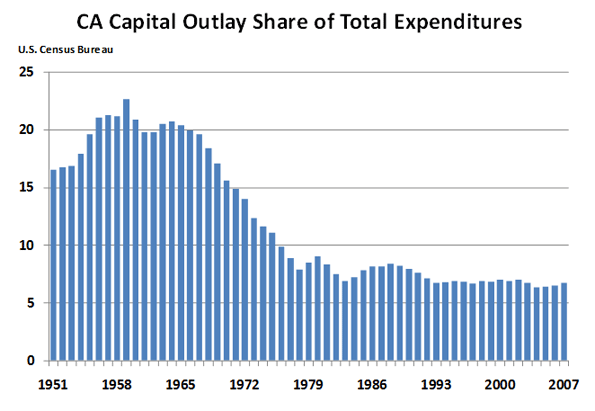
    Not likely. Today, we are not even maintaining our infrastructure. Infrastructure investment’s share of California’s budget has declined for decades. In Pat Brown’s day California often spent over 20 percent of its budget on capital items. Today, that number is less than seven percent. It shows.

    Pat Brown also knew that with California’s natural endowment, all he had to do was build the public infrastructure and welcome business, business will come. Too many today act as if they believe that business will come, even without the infrastructure or a welcoming business climate. Indeed, many Californians – particularly in the leadership in Sacramento – seem to think that business will come no matter how difficult or expensive the state makes doing business in California. This is just not true.

    California needs to embrace opportunity and economic growth. It is necessary if California is to achieve its potential. It is necessary if California is to avoid a stagnant future characterized by a bi-modal population of consuming haves and an underclass with little hope or opportunity and few choices, except to leave.

    Bill Watkins is a professor at California Lutheran University and runs the Center for Economic Research and Forecasting, which can be found at clucerf.org.

  • What Happens When California Defaults?

    The California Legislative Analyst’s Office recently reported that the State faces a $21 billion shortfall in the current as well as the next fiscal year. That’s a problem, a really big problem. My young son would say it was a ginormous problem. In fact, it may be an insurmountable problem.

    Our governor and legislature used every trick in their books when they created the most recent budget. They even resorted to mandatory interest-free loans from the taxpayers. Now, they have no idea where to go. The Democrats have declared that they will not allow budget cuts. The Republicans will not allow tax increases. They have probably run out of smoke and mirrors, although their ability to engage in budget gimmickry is enough to make an Enron accountant blush. No one is considering raising revenues by increasing economic activity.

    In my opinion, California is now more likely to default than it is to not default. It is not a certainty, but it is a possibility that is increasingly likely.

    Then what?

    Ideally, we’d see a court-supervised, orderly bankruptcy similar to what we see when a company defaults. All creditors, including direct lenders, vendors, employees, pensioners, and more would share in the losses based on established precedent and law. Perhaps salaries would be reduced. Some programs could see significant changes. This is distressing, but it is better than other options.

    Unfortunately, a formal bankruptcy is not the likely scenario. There is no provision for it in the law. Consequently, absent framework and rules of bankruptcy, the eventual default is likely to be very messy, contentious and political.

    Other states have defaulted. Nine states defaulted on credit obligations in the 1840s. Most of those states eventually repaid all of their creditors (see William E. English “Understanding the Costs of Sovereign Default: U.S. State Debts in the 1840s,” American Economic Review, vol. 86 (March 1996), pp. 259-75.) Unfortunately, the examples in the 1840s are not much help in anticipating the impacts of a modern default. Circumstances are different, and things have changed, a lot.

    We’re left with the question: what happens when California defaults?

    The worst case would be the mother of all financial crises. According to the California State Treasurer’s office, California has over $68 billion in public debt, but the Sacramento Bee’s Dan Walters has tried to count total California public debt, including that of local municipalities, and his total reaches $500 billion. Whatever the amount, the impact of default could be larger than the debt amount would imply. Other states – New York, Illinois, New Jersey, for example – are in almost as bad shape as California, and they could follow California’s example. The realization that a state could default would shock markets every bit as much as when Lehman Brothers failed. Given the precarious state of our economy and the financial sector, another fiscal crisis would be disastrous, with impacts far beyond California’s borders.

    What would a California default look like? In a sense, we’ve already seen California default, when that state issued vouchers. If any company tried that, they would be in bankruptcy court in days. Issuing vouchers didn’t trigger a California crisis because banks were willing to honor the vouchers. If banks refuse to honor the vouchers next time, employees and vendors won’t be paid, and state operations will come to a halt. This could happen if our legislature locks up and is unable to act on the current $21 billion problem.

    Another possible California scenario is that the State will try to sell or roll over some debt, and no one buys it. Already, we’ve seen California officials surprised with the interest rates they have had to pay. What happens if no one buys California’s debt? We saw last September what happens when lenders refuse to lend to large creditors.

    If we continue on the current path, the worst case is also the more likely case. Bad news keeps dribbling out. One day we find we are paying 30-percent-higher-than-anticipated interest on a bond issue. A few days later, we find the budget shortfall is billions of dollars higher than projected just a short time ago. Every month brings new bad news. The risk that one of those news events triggers a crisis grows with every news event.

    Given California’s recent history, it is difficult to believe that the people with the authority and responsibility for California’s finances can act responsibly, but that is what we need. Responsible action would be creating a gimmick-free budget that places California finances on a sustainable path, and provides an environment that allows for opportunity and job creation. But, sadly, Sacramento probably cannot draft an honest balanced budget, and will thus need to plan for California’s eventual default. They need to work with Federal Government and Federal Reserve Bank officials to insure a coordinated plan to limit damage to financial markets. That plan needs to be ready to release when markets go crazy, which is exactly what could happen when participants realize that default is possible. It could be needed sooner than they think.

    Bill Watkins is a professor at California Lutheran University and runs the Center for Economic Research and Forecasting, which can be found at clucerf.org.