Author: Bill Watkins

  • Too Big To Fail Needs to Go

    One of the causes of last year’s financial collapse was the adoption of the concept, ‘Too Big To Fail’. Washington decided long ago that some firms are so large and so integral to the economy that the failure of one of these firms would put the entire economy at risk. So, the government insures them at no cost.

    The problem with free insurance against failure is that it encourages excessive risk taking. This is the much-talked-about moral hazard problem, and it was a serious contributor to how we got to September 2008 in the first place. Since then, we’ve merged big bad financial institutions with big good financial institutions to create even larger financial firms. This has to stop.

    Why would a firm grow to the size we observe?

    Often, the firms’ managers tell us they merge to diversify. It is not true. Research I did with Bill English while I was at the Fed showed that large banks really didn’t diversify after they merged. They merged with firms much like themselves in similar markets.

    Besides, the argument for diversification is flawed on its face. Financial theory is clear. The investor can diversify more efficiently than the firm can diversify on the investor’s behalf.

    Firms also claim that they are merging to obtain economies of scale. That is not true either. A reasonably large literature is available on economies of scale. This literature is clear. Economies of scale are fully exploited when firms are much smaller than the ones that are currently considered Too Big To Fail. Indeed, diseconomies may exist at the size of our largest financial firms.

    Are there other reasons firms might want to become the size we see? Sure, but the participants are not likely to advertise those reasons. Firms constantly strive for market power, and size can help them achieve that market power. Of course, when firms have market power, the consumer loses.

    Firms might also merge to get the free Too Big To Fail insurance. That is clearly not in the best interest of anyone except the insured firm.

    The two most believable reasons that firms become Too Big To Fail are counter to the public’s interest. That’s worth repeating more forcefully. Firms that are Too Big To Fail serve no public interest. Since the public is funding the insurance, it needs to go.

    Washington’s response has been counterproductive. The preferred model seems to be fewer and even larger firms subject to more government regulation. This makes no sense. There is no evidence that regulation prevents financial collapse. The firms that were involved in last September’s nightmare were all heavily regulated. Indeed, they are among the most heavily regulated firms in the world, and we still saw the most devastating financial collapse since 1929.

    Additional consolidation and regulation is not only counterproductive, it approaches criminal insanity. It guarantees that we will see something like September 2009 again.

    We can only speculate as to why policy makers are responding to the financial crisis by increasing regulation of a consolidated financial sector. The most generous speculation is that fewer larger firms are easier to regulate effectively. Easier, maybe, but not more effectively.

    We would all be better off if there were no firms that were Too Big To Fail. So, let’s provide a strong incentive for them to voluntarily split themselves up into little, more efficient pieces. The easiest way to do this is to apply an onerous tax on any firm considered Too Big To Fail.

    This would be equivalent to overpricing the Too Big To Fail insurance. If the insurance is overpriced, no one will buy it. Instead, they will divide themselves up into several smaller, hopefully more specialized, firms.

    Implementing such a tax would be very easy to do, and it would be far cheaper than the alternatives. We need to get on with it before another crisis comes our way.

    Bill Watkins is a professor at California Lutheran University and runs the Center for Economic Research and Forecasting, which can be found at clucerf.org.
  • Healthcare: The Cost Of The Greatest Wealth

    This week and over the coming weeks the media and the nation will once again focus on healthcare. Before we launch into the next phase of the argument, though, we should first dismiss a couple of “Red Herring” claims that we spend too much on health care.

    These claims are the ones based on a view of healthcare spending as a percentage of Gross Domestic Product (GDP), or that look at the increase in healthcare spending over time. Proponents say that spending 14 to 17 percent of gross product on health care is evidence that we spend too much. Or, they say that health care spending is increasing at a far faster rate than the economy is growing.

    So what?

    There is no optimal amount of healthcare as a percentage of GDP. Remember, healthcare is a good thing.

    We live far healthier and longer lives today than we did just a few decades ago. The technology is constantly improving, and marginal improvement is expensive. Life expectancy, both at birth and conditional on age, is constantly increasing; our population is getting older. Our income has been increasing, at least it was prior to the recession, and I’m confident that it will eventually resume growing. All this would imply that we would expect to see increasing healthcare spending. As Virgil said, “the greatest wealth is health.”

    That is not to say that there is no waste in our healthcare system today. We do way too much diagnostic testing in the United States. Our doctors work in constant fear of lawsuits. Consequently, they order far too many diagnostic tests and procedures. The problem is that in a U.S. court — long after the fact and with years to reflect — any test that would have diagnosed the problem always looks as if it would have been the right thing to do. This is true even if not one in a thousand doctors would have performed the test in the same situation.

    In contrast, some countries have special courts for the medical industry. These courts are well-versed in the reasonable procedures and diagnostics that competent, reasonable doctors would perform. Consequently, there are fewer suits, smaller judgments, and less money spent on unnecessary diagnostic tests or procedures. Implementing something like this, or some other tort reform, would lead to potentially huge savings.

    In addition, American healthcare is still a paper-based system. Even after just about every other sector has converted to computer-based record-keeping, the medical sector persists in maintaining paper files. There are estimates that as much as a $300 billion could be saved by digitizing medical records while improving service and health care.

    Arthur Laffer, in an August 5, 2009 Wall Street Journal opinion piece, argued that the problem with US healthcare is that the payer of healthcare services and the user are not the same person or entity. He correctly pointed out that this creates a wedge that enables excessive consumption of healthcare. It’s as if you had a brother-in-law who eats hamburgers, French fries and sodas when he pays his own dinner bill, but orders prime rib and wine when you purchase his meal. He may also be willing to use a generic drug if he is paying for his medicine, but will insist on a more expensive name-brand if someone else is paying. Laffer argues that a private, low-cost, high deductible, catastrophic insurance program would be more efficient. Basically, he wants to let the markets work.

    That’s a great idea. But there is no way we will let markets work. Efficient markets would require that we pay for insurance or medical care or go without.

    It is not going to happen. As a nation, we’re not about to let someone suffer or die because they didn’t purchase insurance, or they can’t pay the deductible, or they can’t afford insurance or medical care.

    A market-driven, high-deductible catastrophic plan would work just fine for many people, but it won’t work for everyone. Some people just can’t afford medical care or insurance, and we have lots of potential ways to help them. A progressive negative income tax could provide a minimal standard of living that included healthcare and an incentive to work, but there are other ways. The government could provide medical care or insurance, or it could simply require that medical providers perform an adequate amount of pro-bono work.

    The real problem lies with people who can afford to purchase insurance, but who rationally may choose to be uninsured—call them the intentionally uninsured. A healthy young person could very well elect to be uninsured, even if we were to allow him or her to suffer the consequences of an uninsured accident or disease. Knowing that we are unwilling to let him face those consequences only makes the decision to be uninsured more attractive.

    How to deal with this incentive problem? Require medical financial responsibility, even though the approach would face some challenges. The result could be something parallel to the requirements California and other states have for automobile drivers. To qualify for a driver’s license, or to register your vehicle, you have to have insurance. Even with these requirements in place, I don’t know of anyone who drives without additional insurance protection for encounters with uninsured motorists.

    Of course, you don’t need a license to live. Knowing that medical treatment is available if needed, many would go uninsured. The question of how we should deal with the intentionally uninsured when they come into the emergency room is a real problem with important implications. These are people who would contribute more than they would consume, and cut the cost to other recipients. It would also increase total spending on health care, as the people would access service more often if they were insured.

    But that’s OK… health care is a good thing.

    Bill Watkins is a professor at California Lutheran University and runs the Center for Economic Research and Forecasting, which can be found at www.clucerf.org.

  • California Meltdown: When in doubt, Blame the Voters!

    By rejecting the complex Sacramento budget settlement, Californians have brought about an earthquake of national significance as has not been seen since the passage of Proposition 13 over thirty years ago. Once again, California voters handed politicians something they fear more than anything else, constraints on the ability to raise taxes and raid revenues for their pet interests.

    Some, like long time Los Angeles Times statehouse reporter George Skelton thinks it’s the voters’ fault, as he suggested in his recent op-ed. The problem, we are told, lies with voters. The state’s massive fiscal crisis, which I and others warned was coming, was apparently unforecastable to California politicians and their enablers, like Skelton.

    Blame the voters will become a large part of the national and local media spin. It is not the first time. Consider Proposition 13. The problems that led up to Prop 13 were years in the making, and they were well understood. Inflation and rising home prices were increasing taxes beyond what citizens were prepared to pay. Sacramento tried several times to address the problem, but then as now, politicians couldn’t make hard decisions. The entrenched interests, notably the public employee unions, would not hear of anything that might shrink state revenues.

    Contrary to some versions of history, Proposition 13 was not backed by oil companies, land developers and other business interests. In fact, most opposed it.

    Proposition 13 backers were outmanned, outspent and certainly without much media support. The measure was passed because after years of incompetence in Sacramento, California voters, like Medieval peasants, grabbed their pitchforks and torches and stormed the castle. They passed Prop 13.

    Some interpret this story as showing voter ignorance and fickleness. I interpret it as showing that California voters are patient, but only to a point. Once they have reached a certain point, California voters take matters into their own hands. The results are invariably far more onerous for the state than if the political class had effectively faced the issue. Part of the reason for this is because the voters have fewer tools available to them. Legislatures and governors may have scalpels, voters have only axes.

    Gray Davis was the victim of a similar uprising. He took the fall for a government that had failed. Arnold was going to be different. He would be the Governator. He won election promising mortal combat with special interests. In 2005, he tried to change things but was outmaneuvered by his union-backed opponents. After losing round one, he became Gray Davis but without his predecessor’s grasp of the essentials of government. As the Sacramento Bee’s Dan Walters has pointed out, hubris and ignorance make a deadly combination.

    Now, we have a budget crisis, and California voters are unwilling to give Sacramento a pass. Why?

    Maybe they don’t think they are getting value for their increased investment in government. California spent about $2,173 per resident (2000 dollars) in the 1997-1988 budget. The 2007-2008 budget spends about $2,738 (2000 dollars) per resident. That represents a 26 percent increase in real (inflation adjusted) per-capita spending in ten years.

    What have California voters purchased with their 26 percent increase in government spending? Are the roads 26 percent better? Are schools 26 percent better? What is 26 percent better?

    That is Sacramento’s problem. It is very hard to identify what good that this increase in spending has purchased. If it has been a good investment, why haven’t California’s leaders convinced the voters?

    Maybe you can make a case that we are 26 percent better off; maybe not. I don’t know, but then I haven’t seen a strong effort to make the case. Instead, we get predictions of doom. We’ll cut back on teachers. We’ll let prisoners out of jail. Skelton says “And, oh yes, the elderly poor, blind and disabled – welfare moms and children’s healthcare? They’ll take the biggest hits, as usual.”

    The problem with predictions of doom is that they don’t ring true, or they sound as if the political leaders will punish voters for forcing the leaders to face a budget constraint. Voters can remember 1997-1998. California had teachers. Prisoners were in jail. Healthcare was provided for those with the least resources. If California had these essential services then, and the State is spending 26 percent more now, why cut those essential services now?

    That is the question the California’s leaders have to answer soon. Today Sacramento faces a crisis. The governor and the legislature will have to deal with a real binding budget constraint, and how they choose to deal with that constraint will make a huge difference. They could show leadership. They could make difficult choices. They could stand up to the special interests that will spare no effort to punish them.

    They may not. They may try to punish voters by cutting essential services. They may try even more Enron-style accounting tricks. They may sell assets or use federal money to push the problem to future legislators and governors. They may make poor choices. They may avoid cutting entitlements and public employee pensions, the real source of the state’s fiscal distress.

    We are heading towards a convulsion, not only here in California but in a host of high-tax, high-regulation states now controlled by their own employees. This includes New York, Illinois, and New Jersey for starters. In the age of Obama, with its celebration of bigger government, this suggests perhaps a whiff of a counter-revolution.

    Bill Watkins, Ph.D. is the Executive Director of the Economic Forecast Project at the University of California, Santa Barbara. He is also a former economist at the Board of Governors of the Federal Reserve System in Washington D.C. in the Monetary Affairs Division.

  • In California, the Canary is Dead

    Canaries were used in early coal mines to detect deadly gases, such as methane and carbon monoxide. If the bird was happy and singing, the miners were safe. If the bird died, the air was not safe, and the miners left. The bird served as an early warning system.

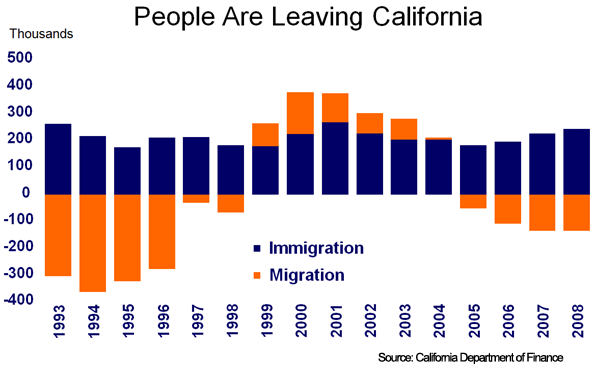
    Domestic migration trends play a similar early warning system for states. California’s dynamism was always reflected by its ability to attract newcomers to the state. But today California’s canary is dead.

    Here’s the logic. If net domestic migration is positive, the state’s economy is reasonably sound. Economic growth, taxes, housing, and amenities are strong enough to keep people where they are and attract others. If net domestic migration is negative, it usually means that lack of economic growth, taxes, quality of life, and housing have deteriorated sufficiently to drive people away. This happens despite the inevitable pain of leaving the security and comfort of family, friends, and familiar surroundings.

    California has been a destination for migrating workers and families since 1849. They came form every state and from around the world. Often the migrants faced tremendous challenges and hardship. Illegal immigrants from Mexico and other developing countries still must leap over such barriers. Often, California’s migrants came in waves. The 1850s, 1930s, and 1950s all saw huge surges tied to huge events – the Gold Rush, the Depression and the post-war boom. But even between these waves, California consistently experienced a steady inflow of new immigrants.

    Immigration has been good for California. The new residents brought ambition, skills, and a willingness to take risks. They found a state with abundant natural resources, from oil to rich soil and ample, if sometimes distant water resources. Together with the people already there, they created an economic powerhouse. They built cities with amenities that rival any other. They fed much of the nation and large numbers overseas. They did this while persevering much of California’s unique endowment: the vast coastline, the Sierra Nevada, and the deserts.

    California, with 12 percent of the United States population, became the world’s sixth largest economy while managing to maintain the aura of paradise at the same time. Opportunity and housing were abundant. California was a great place to have a career and raise a family.

    Most recently, though, this has begun to change. California is no longer a preferred destination, at least for domestic migrants. The state’s economy is limping along considerably worse than that of the nation. Opportunity is limited. Housing is relatively expensive, even after the dramatic deflation of the past two years, except for some very hard-hit and generally less attractive inland areas. Taxes are high and increasing. Regulation is onerous and becoming more so. Many California communities are outright hostile to business.

    Consequently, net domestic migration has been negative for 10 of the past fifteen years. International migration to California remains positive, but that reflects more on the weakness of the economies and the attraction of existing ethnic networks than the intrinsic superiority of California. This represents a sea change: anyone predicting it fifteen years ago would have been laughed out of the room.

    What happened?

    California’s economy was badly hit by the 1990s recession. The State’s aerospace and defense sectors were especially decimated. Middle-class families moved out by the hundreds of thousands.

    The 1990s out migration caused some soul searching in California. There was lots of talk, and a little action on making the State more competitive. Then came the technology and real estate booms. Domestic migration turned positive. The half-hearted efforts to make California more competitive faded as policy makers were lulled into complacency by the strength of California’s resurgence.

    But the problems that bedeviled the state in the 1990s – high housing prices and taxes, cascading regulations and a deteriorated infrastructure – had only been obscured by the boom. By 2005 migration began to turn negative, largely as soaring housing prices discouraged newcomers and encourage many residents to cash out and move to less expensive places. California had priced itself, and the dream, out of competitiveness. Since then, California has seen four consecutive years of increasingly negative domestic migration. The recent net outflow numbers have been smaller than in the 1990s, but it may be because other tradidional California migrant destination economies – like Oregon, Washington, Nevada and Arizona – have become less competitive as well.

    Today, many argue that California will bounce back, but they can’t identify the reason. What sector will lead the resurgence? They seem to think economic growth will come with the sunshine, beaches, and mountains. There was plenty of sunshine in the 80 years between the founding of the first mission and the gold rush, and not much happened. Similarly, the differences between California cities and neighboring Mexican cities show clearly that successful economies need more than good looks and nice climate.

    It’s hard right now to assume California’s future will include the same predominance in technological innovation. Agriculture is running out of water, in large part due to environmental lawsuits, and the state no longer seems willing to invest in new water projects. Even the entertainment industry is increasingly looking outside of California for growth. You have to ask: what does California offer that will overcome the State’s high costs, regulatory environment, and antipathy to business?

    That is the short term. The long term doesn’t look very good either. The public universities, a major source of innovation over the past two decades, are facing increasingly severe budget challenges. It is unlikely that they will be able to maintain their status even as other states – Texas, Colorado, New Mexico – eye further expansion. Even more ominous are gains in countries, such as China and India, who have long sent their best and brightest to the Golden State.

    All this suggests a relative decline in California’s long-term prospects. What should we do? Part of California’s problem is its political process. The state’s chronic inability to do much of anything reinforces stasis. As Dan Walters says, “everyone has a veto on everything.”

    But even improving the political process may not be enough. Much of Coastal California is dominated by rich, aging, baby boomers. The residents of this increasingly geriatric ghetto often don’t worry much about economic opportunity. They may have the money and votes to guarantee that growth does not impinge on their lifestyles. Unless these conditions change, it will be unlikely to see a renewal of strong domestic migration to California in the coming years.

    Bill Watkins, Ph.D. is the Executive Director of the Economic Forecast Project at the University of California, Santa Barbara. He is also a former economist at the Board of Governors of the Federal Reserve System in Washington D.C. in the Monetary Affairs Division.

  • Solving the Economic Crisis: Fix the Banks

    Economic forecasts today reflect a remarkable variation. Some economists are predicting a rapid increase in economic activity within just a few months. Some are forecasting an economic decline that persists for years.

    At the root of the debate lies the question: where is the heart of darkness? Primarily, forecasters are focusing on the impact of the fiscal stimulus and the efficacy of monetary policy. Yet they have been less forthcoming to center on the real problem, which is fixing the banks.

    Government spending as economic stimulus is typically rejected by economists based on either a crowding-out or a Ricardian Equivalence theorem. The crowding out theory says that government spending can replace, or “crowd out”, more productive private investments. The perverse result is that the economy may slow down even more.

    The Ricardian Equivalence theory holds that future taxpayers, recognizing their increased tax obligations, simply increase savings by an offsetting amount. The result is no change in economic activity. Though I’ve simplified the respective cases, crowding-out and Ricardian Equivalence arguments are persuasive for most states of the world. So, for the moment, let’s reject fiscal stimulus as a way out of recession.

    What about monetary policy? One of Ben Bernanke’s contributions to monetary policy has been the notion that the central bank still has policy tools even when interest rates fall to zero. The FED can still purchase all sorts of assets. Those purchases increase the monetary base and directly impact targeted non-liquid markets. Continued action after interest rates reach zero addresses one criticism of Japan’s response to the 1990s in which their central bank essentially did nothing once interest rates reached zero.

    First we need to consider how monetary policy affects economic activity. We teach students that monetary policy works through a money multiplier. The money multiplier is based on lending by a fractional reserve banking system. The money goes to the banks, and the banks lend it out. The reserves are provided by FED purchases of financial assets.

    Of course the multiplier depends on the bank’s lending. What happens when banks don’t choose to lend? Scott Sumner, an economist at Bentley University, has pointed out that this is exactly the situation we have right now. The FED has been increasing reserves, but the banks are not lending. Since October, bank reserves and vault cash has grown to over a trillion dollars but lending has declined. Sumner recommends a penalty on excess reserves, but more is needed to restore bank lending.

    I see three significant issues that are driving the banks’ apparent reluctance to lend. First, banks appear to expect deflation. Fear of deflation is not unfounded. Prices are falling in many markets, impacting bank behaviors.

    I keep hearing that “Cash is king.” This is exactly what one would expect in a deflationary environment, and there is no obvious way to deal with it. You can tax excess reserves and vault cash. You can tax bank deposits. You cannot tax money that is under the mattress, and money under the mattress is profitable in a deflationary world.

    This is what some call Keynes’ famous liquidity trap. Technically, a liquidity trap is when zero interest rates make monetary policy ineffective. As Scott Sumner and others point out, the described situation is really an expectations trap. The problem isn’t zero interest rates, the problem is deflationary expectations.

    But if the “trap” makes monetary policy ineffective the arguments against fiscal stimulus are much weaker. This is where Paul Krugman says we are today, and it changes everything. We need to go back to fiscal policy to find hope for effective policy.

    If we are in a trap, it bolsters Krugman’s criticism that the existing stimulus is too little. To be effective, the stimulus would need to be very large, perhaps 40 to 50 percent of gross product. This would imply a stimulus package in the range of 6 to 8 Trillion dollars!

    But even if we were to follow this notion, I would argue that the composition of the stimulus would have to change. To be effective, government spending would have to create assets that significantly increase the productivity of private assets. We have examples from history. The Tennessee Valley Authority in the Southeast and Hoover Dam in the West cut private industry’s production costs by providing abundant and cheap energy. California’s water system, with its dams and canals, expanded agriculture’s productivity and range.

    Sadly, in spite of its size, the current stimulus plan has nothing that will significantly enhance private-sector productivity. And even any attempt to boost productivity investments is likely to run into roadblocks from the very powerful, well-connected green lobby which enjoys a far more favorable press than does business.

    Are we doomed then to deflation and slow growth? I don’t think so. The federal deficit, monetary policy, the impending Social Security and Medicare crisis, and baby-boom demographics imply eventual inflation.

    The real problem is with the banks. Banks can fail because of a lack of liquidity or a lack of equity. Last fall banks faced a liquidity crisis. There was a run on the entire financial sector. Today banks are probably facing an equity crisis, and the Treasury’s Toxic Asset Plan is exhibit one.

    The Treasury’s Plan does not make sense as presented. The plan is to leverage private sector resources, expertise and cash, with government funds to purchase underpriced toxic assets. This would supposedly reveal a true price for toxic assets. However, Gary Becker and Jeffrey Sachs have convincingly shown that the plan provides strong incentives to dramatically overprice the assets at the taxpayers’ expense. What if those toxic assets are already correctly priced?

    The Treasury’s Toxic Asset Plan does make sense if the banks are insolvent, and policy makers are unwilling or unable to more directly and transparently tackle the problem. To me, the Toxic Asset Plan looks a lot like a backdoor way to recapitalize the banks. If so, we have a problem. Insolvent banks must deleverage as rapidly as possible. That is, they must reduce assets, and a bank that is reducing assets in not a bank in the lending business.

    Here our problem is a variation of the problem faced by the Japanese in the 1990s. Their economic malaise continued for a decade in large part because they would not or could not clean up their banks. We and the rest of the World told Japan, time and again, that there was a toxic asset problem at their banks. Informed observers, inside Japan and out, knew that the core problem was bad bank assets.

    Today, the United States is probably in the same position. Our banks and other financial institutions are in trouble. They are sitting on a bunch of bad assets. If the banks recognize their bad assets, their equity is inadequate. The banks’ unpopularity prevents a bailout or a restructuring, but policy makers are afraid to let them fail. The other solution would be the Swedish solution, but policy makers don’t want to be accused of nationalizing the banks. Right now even President Obama lacks the political capital to address the problem. So, we get the convoluted Treasury Plan.

    What we need is political courage. We need to clean up the banks, and it doesn’t much matter how. We could crank up the bankruptcy courts, or we could implement the Swedish plan. Inaction will only prolong the economic pain. Backdoor plans from an unpopular Secretary of the Treasury aren’t going to get the job done. The sooner we clean up the banks, the sooner they will return to the business of lending, and the sooner we will have a recovery.

    Bill Watkins, Ph.D. is the Executive Director of the Economic Forecast Project at the University of California, Santa Barbara. He is also a former economist at the Board of Governors of the Federal Reserve System in Washington D.C. in the Monetary Affairs Division.

  • Why The Stock Market Matters

    My father was a career enlisted man in the United States Air Force. I was in the third or fourth grade when he graduated from high school. My mother graduated from high school after I was married. My dad worked for several companies after his Air Force career. He was working for Disney when he died. My mother worked part time in child care from time to time.

    I tell you this to show that this is not a wealthy family. When my dad died, my mother received the standard Disney benefits. My guess is that those benefits were more generous than average for American business, but not extravagant.

    My mother put the death-benefit funds at a bank trust department. They invested the funds in a portfolio that is standard for widows. Some of the funds were put in fixed securities. Some were invested in stocks that were considered safe. These funds, along with some fixed income securities, represent her liquid assets. Her only other assets are her survivor’s share of my father’s pensions, and a small condominium.

    What has happened to her portfolio? Let’s look at the Dow for an indication. The Dow peaked at 14,164.53 on October 9, 2007. It was down to 13,264.82 by the end of 2007. It was only 8,776.39 at the close of 2008. Today, Monday, March 09, 2009, the Dow closed at 6,547.05.

    Since its high, the Dow has lost 53.79 percent of its value. It lost 33.84 percent of its value in 2008. So far this year, it has lost another 25.40 percent. These are huge losses.

    If we apply this year’s average daily loss, we are less than three days from a Dow value of 6,422.94. This was the value of the Dow at the closing on December 4, 1996, the day before Greenspan gave his famous quote on the market’s irrational exuberance. Remember that? It was a very long time ago. We’ve lost more than a decade’s gain in a remarkably short time.

    When asked about the stock market, President Obama dismissed it as unimportant: “You know, the stock market is sort of like a tracking poll in politics,” he said last week. “It bobs up and down day to day, and if you spend all your time worrying about that, then you’re probably going to get the long-term strategy wrong.” It is just a guess, but I’m thinking that if his poll numbers had declined over 25 percent this year, he’d be spending some time worrying.

    A friend of mine dismisses the stock market losses as paper losses. He claims that the firms, factories and other assets still exist. I don’t buy that. If that is the case, why would we have mark-to-market rules? The fact is that many assets have vanished. They are gone. Many more are reduced in value. Certainly, today’s present value of future earnings — the fundamental source of stock value — is far below what it was on October 9, 2007.

    Wealth has disappeared, and that disappearance has serious consequences to real people. Which brings me back to my mother: The combined impact of stock and real estate values has caused her net worth to fall over 50 percent. She’s half as wealthy as she was just a short time ago. That is a problem for her, and it is a problem for America.

    Economists are notorious for disagreeing. However, the belief that people spend out of wealth is about as close to a consensus as one can find. My mother will confirm that belief with her actions. The children and grandchildren will get smaller gifts on their birthdays and at Christmas. She will travel less. She will eat out less. She’ll cut her spending.

    There will be other impacts. My siblings expect an inheritance, and that inheritance is a significant portion of their wealth. Right now, with the inheritance being less than half of what it was, their wealth is down a lot. That means they’ll be spending less. That is a problem for America.

    This sort of wealth destruction is happening to families across the country. It is happening to rich families and to families that are far from rich. The Dow has declined an average of about 50 points a trading day this year. Millions of American families, responding to the steady erosion of wealth, are cutting back their spending plans. This feedback from the stock market to the economy will likely swamp any stimulus plan.

    The message is clear. The stock market matters. Its freefall must be halted before the recovery can begin.

    Bill Watkins, Ph.D. is the Executive Director of the Economic Forecast Project at the University of California, Santa Barbara. He is also a former economist at the Board of Governors of the Federal Reserve System in Washington D.C. in the Monetary Affairs Division.

  • One Fundamental Problem: Too Many People Own Homes

    Ben Bernanke made the following statement as he attempted to justify bailing out bad borrowers:

    “…from a policy point of view, the large amount of foreclosures are detrimental not just to the borrower and lender but to the broader system. In many of these situations we have to trade off the moral hazard issue against the greater good.” – Ben Bernanke, February 25, 2009

    I think he is wrong on this, and the moral hazard issue is only a small part of my objections.

    One of the fundamental problems we have right now is that too many people own homes. It sounds harsh, but please bear with me a few sentences. I think we can agree that 100 percent home ownership is not possible, or even desirable. Most of us can remember a time when our income and our jobs were such that home ownership was a bad idea. Home ownership is a commitment that requires a significant amount of stability and discipline. Not everyone is so stable or has the discipline to keep up with the payments.

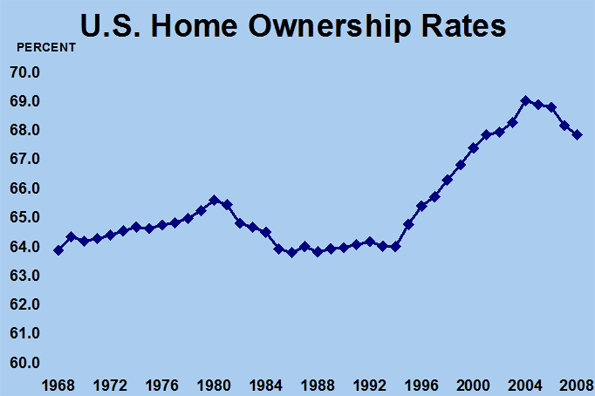
    What is an appropriate national homeownership rate? Theory gives us no answer. We look to the data for a clue. Here’s a chart of home ownership rates since 1968:

    It seems pretty clear that a homeownership rate between 63 percent and 65 percent works pretty well. When we get above that range, problems seem to crop up. This was true in 1980 – the worst recession of the past 30 years – and it is true now.

    In light of these data, let’s think about what Bernanke is saying. He’s arguing that to execute the foreclosures required to move the rate back to that 63 percent to 65 percent range are bad for the economy. So bad in fact, that we’re better off not going there.

    The problem with that argument lies in a lack of historic understanding of the proper levels of homeownership. Financial and real estate markets can’t stabilize until we get closer to that equilibrium. Until we lower the home ownership rate, financial institutions will have a cloud around them, and residential real estate markets will be lifeless. It may not be politically popular, but those are the realities.

    This is a critical issue. For years, economists have believed that the failure of banks to recognize and remove bad assets contributed to Japan’s long period of economic malaise. I agree. Forbearance on bad real estate loans here in the states constitutes much the same thing. Our financial institutions are holding a bunch of bad assets; these are homes that are owned by people who can not afford them – never did, and likely never will. Until the financial institutions recognize those bad assets and get them off their books, our financial institutions won’t have the resources to fund, stabilize and then drive a broader economic recovery.

    What we need is not more mindless beneficence to everyone from Wall Street to Detroit and Main Street. The more we bailout failed financial institutions, automobile manufactures, or any business, the longer we postpone our recovery.

    Recessions are periods when assets are reallocated from less productive to more productive uses. That requires processes like repossession, foreclosure, mergers, and bankruptcy. These processes have been developed over centuries. They are the most efficient methods to restore an economy.

    Why are we suddenly abandoning these processes that have proved themselves in many business cycles? I suppose part of it is the desire to eliminate the business cycle. This is the same thinking that had many – including conservatives – arguing that stocks could not fall during the dot.com bubble or that housing prices would also move up.

    In reality the business cycle can not be eliminated. It can’t be done and it is pure hubris to try. One of the fundamental insights to come out of Real Business Cycle research is that recessions constitute the most efficient response to a negative shock.

    We need to stop wasting resources trying to stem the tide. Instead, let us allow the recession to work for us. In the meantime we can provide a backstop through unemployment benefits and some reasonable fiscal stimulus. But we have to experience some pain and let our processes and institutions work for us. The sooner we get these foreclosures, repossessions, mergers, and bankruptcies behind us, the sooner we will see a return to the only sure cure for a sick economy: real economic growth.

    Bill Watkins, Ph.D. is the Executive Director of the Economic Forecast Project at the University of California, Santa Barbara. He is also a former economist at the Board of Governors of the Federal Reserve System in Washington D.C. in the Monetary Affairs Division.

  • The Aging of Paradise in Ventura County California

    You could say that Ventura County, just north of Los Angeles, represents what is best about California. Some people believe that its amenities – beaches, gorgeous interior valleys and parks – assure perpetual economic growth for Ventura County and California. They are wrong. There is trouble in paradise.

    Ventura County has changed, and not for the better. It is aging, losing its demographic as well as economic vitality. This represents a relatively new phenomenon, the slow decline of even formerly healthy suburban areas.

    The current recession illustrates the change. In the past Ventura County suffered mild recessions even as the country and the region suffered mightily. The County saw no annual net job losses in the 2001 recession. The early 1990s recession was more painful, but Ventura County did far better than California as a whole.

    All of that has changed with the current recession. Ventura County has recently been losing jobs at a faster pace than California. In 2007, the County lost jobs while California gained jobs.

    The picture is even worse when Ventura County’s economy is compared to the Los Angeles County economy. In 2008, Ventura County’s economy shrank at a rate about five times faster than did Los Angeles’s economy.

    What is going on here? In the past, Ventura County has been buffered by its twin giants, Amgen and Countrywide. Amgen’s Ventura County growth has slowed. Countrywide has done much worse than Amgen, and its demise has been well documented.

    But you can’t blame all of Ventura County’s weakness on Countrywide. It has contributed, but it is not Ventura County’s sole source of economic weakness. The weakness is quite general, spanning the construction sector, non-durable manufacturing, retail trade and other services. Each lost over 1,000 jobs in 2008. By contrast, the finance, insurance, and real estate sectors, where Countrywide resides, lost just fewer than 900 jobs, accounting for about 4 percent of the job losses.

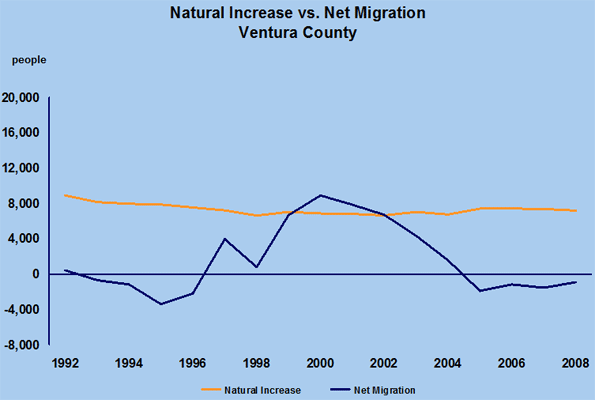
    My sense is the real underlying problem is demographic, and this may not go away even if the economy recovers. One clue is that more people have been leaving Ventura County than moving in from all sources, and this has been happening long enough to be a trend. It reflects still-high housing costs and limited opportunity. It implies a weak future.

    This chart shows that in exactly half of the past 16 years, migration has been negative. That is total migration, not just domestic migration.

    Think about this for a moment. More people are leaving Ventura County than are moving in. That is certainly counter to what has happened in most of the past 150 years.

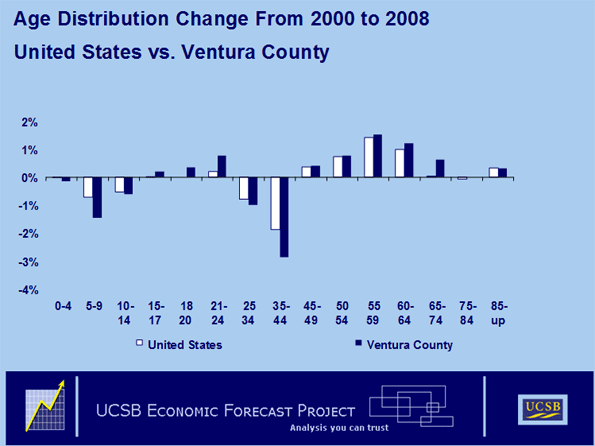
    Ventura County’s net out migration has impacts beyond its effect on the size of the population. The composition of the county is also changing, away from working age people and families and towards people either close to retirement or already there.

    The above chart compares relative changes, by age cohort, in Ventura County’s population since the 2000 census with changes in the United States population since the 2000 census. The County’s population between 25 and 44 years of age and their children has been collapsing. At the same time, the County’s populations of both young adults and people over 45 have been growing as a percentage of the total population. The bulk of that growth has occurred in the over 55 cohort.

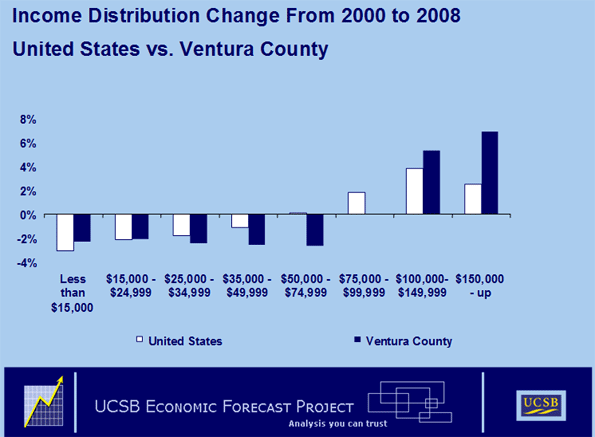
    The migration out of Ventura County has also resulted in changes to the County’s income distribution. The following chart compares changes in the County’s income distribution to changes in the United States income distribution since the 2000 census:

    The comparisons are telling. The County has been losing very-low-income people at a slower pace than has the United States. At the same time, the growth in population with incomes over $100,000 has been spectacular. The local population with incomes between $25,000 and $75,000 has fallen far more rapidly than that of the United States. The County’s population with incomes between $75,000 and $100,000 is relatively unchanged, while that of the United States has shown significant growth.

    People – particularly in the late 20s and early 30s – aren’t leaving Ventura County because amenities have suddenly disappeared. They are leaving because of a deficit in opportunity. Their leaving has consequences. Ventura County’s population is aging more rapidly than it otherwise would. The net result of these demographic changes is that Ventura County’s median real per-capita income is declining, while the County’s median age is rising. Real per-capita personal income has fallen almost $1,000 in only eight years, to $32,718 (Constant 2000 dollars) from $33,797 in 2000.

    Ventura County’s demographic changes can be easily summarized. It is losing its middle class and becoming bi-modal. The young families that provide a community’s vigor and future have been leaving. There is no reason to believe that the trend will reverse itself. Ventura County home prices are still relatively high, while opportunity is declining.

    The County is left with an aging and increasingly wealthy population along with the lower-income people that service the wealthy aged and the very-low-income farm workers. In a sense, it now resembles what we see in many expensive city cores – even if it is on the periphery!

    This creates enormous risks. Most amenities are luxury goods. Poor people don’t invest in luxury goods. Generally, the lower-income population does not have the resources to provide leadership or invest in a community’s future. They have their hands full just taking care of their families, particularly in an expensive place like Ventura County. Their children will likely join the middle class, but in someplace more affordable like Texas, Arizona, or Nevada.

    High concentrations of older people and declining incomes are often associated with deteriorating schools, amenities and increasing crime. The aged wealthy are not in Ventura County to invest in its future. They are there to consume it. They will not invest in the future – particularly if their children and relatives have gone elsewhere.

    Ventura County is not unique. It is fairly representative of Coastal California. Communities like Ventura, Goleta, and San Luis Obispo used to be middle-class communities that valued opportunity. Things are even more extreme in California’s elite playgrounds: Monterey, Malibu, and Santa Barbara. Populations in Monterey and Santa Barbara have actually declined over the past several years. Similar phenomena may be noticeable in other formerly elite suburbs within our most favored metropolitan areas.

    These changes present serious challenges to California’s workers, businesses, and those policy makers who still care about something other than greenhouse gases and public employee pensions. Something needs to be done, and quickly. But the immediate prognosis is less than encouraging. Like Ventura County, California is suffering its worst recession in decades, and policy makers don’t seem to be focusing on policies that may help the area return to its previous status as a region of opportunity.

    Portions of this essay have previously appeared in a UCSB-EFP Ventura County Forecast.

    Bill Watkins, Ph.D. is the Executive Director of the Economic Forecast Project at the University of California, Santa Barbara. He is also a former economist at the Board of Governors of the Federal Reserve System in Washington D.C. in the Monetary Affairs Division.

  • The Recession: Fuzzy Thinking Delays A Recovery

    I keep hearing how the current recession will end in 2010 because the average United States recession from 1854 to 2001 has been 17 months. This is silly for a variety of reasons.

    One reason is that there is no average recession. Post-World War II recessions have lasted from a minimum of six months to a maximum of only 16 months. If we were to apply the “average recession” logic to post World War II recessions, the current recession, which the NBER — the National Bureau of Economic Research — says started December 2007, would have ended 10 months later, last October.

    Another reason is that few previous recessions have been accompanied by the financial sector collapse that we witnessed in September. Worldwide experience indicates that recessions associated with financial sector panics tend to be longer than those without panics.

    Since 1854, five United States recessions have been accompanied by financial panics. These are the recessions of 1857, 1873, 1893, 1907, and 1929. The average duration of these recessions was 31 months. The 1907 recession was the shortest, at only 13 months. The 1873 recession was the longest, at 65 months. For comparison, the 1929 recession was 43 months. Interestingly enough, J.P. Morgan was instrumental in ending the financial panics of the two shortest recessions, 1893 and 1907.

    If we were to engage in the same sort of fuzzy thinking as the “average recession” analysis applied to “financial Panic” recessions, and assuming we use the NBER recession start date of December ‘07, the current recession could be expected to end 31 months later in July 2010. Is that too long for you? You could use the average 20th Century recession accompanied by a financial panic length. That is 28 months, so maybe the recession will end in April 2010.

    Maybe we should look at foreign data? The point is that if you play this game long enough, you can find a date you like.

    Finally, the method of dating recessions changed with the 2001 recession. The new method is much more likely to declare an economy in recession. If the old method had been used — if previous criteria were applied to the current situation — I believe the recession would have commenced no sooner than July 2008. Recent data revisions increase my confidence that the NBER was wrong when they said the recession commenced in December 2007. If you have the wrong start date, any “average recession” method will be wrong.

    The facts are that we have a serious recession accompanied by a financial panic and continuing massive job losses. The correct way to analyze the current recession is to recognize that it was accompanied by financial panic, and that means we had a regime shift from a good equilibrium to a bad equilibrium.

    Game theory tells us that we can have multiple Nash Equilibria to certain games. A Nash Equilibrium is one where knowing your opponent’s decision you would not change your decision.

    Bank runs provide an excellent example. Suppose you have a bank that does not have deposit insurance. Most of the time things plug along. People make deposits, borrow, and the like. Everybody is happy with their decisions. Call this the good equilibrium. However, in the event of a bank run, everyone wants to participate in the run, because those who do not end up loosing. Call this the bad equilibrium. Furthermore, nothing real has to change. We can switch from the good equilibrium to the bad equilibrium on unfounded rumors.

    The financial panic we witnessed last September was exactly like a bank run. In an amazingly short time, we switched from a good equilibrium to a bad equilibrium. The bad news is that we have no idea how to switch from a bad equilibrium to a good equilibrium. It will surely happen, but we don’t know how to cause it. We don’t know what will cause it. We can’t predict when it will happen.

    We do know that a lot of assets need to change hands. These include financial assets, auto factories, and homes. Recessions are periods when assets are reallocated to better uses.

    Current policy, with its obsessive pursuit of bailouts, seems to be focused on delaying those reallocations. That will delay the recovery. So-proposed government efforts to limit the impact will be ineffective, if not counterproductive. That is why I don’t see any reason to expect a recovery in 2009.

    Bill Watkins, Ph.D. is the Executive Director of the Economic Forecast Project at the University of California, Santa Barbara. He is also a former economist at the Board of Governors of the Federal Reserve System in Washington D.C. in the Monetary Affairs Division. All recession dating data in this article is from the NBER website.