Author: Charles McGlynn

  • A Geographer Who Navigated the Globe

    Many people ask, “What do geographers do?” I would suggest that Marvin Creamer’s life story is all you need to know about the practical application of geography, even though most of us will never be stuck in a horizonless Indian Ocean on a “sea of glass”, or try to navigate the ferocious Drake’s Passage. Ancient mariners may have been able to sail long distances without instruments, but it is difficult, tricky, and can be extremely hazardous. Only one person, New Jersey’s Marvin Creamer, has ever attempted to circumnavigate the globe this way. I had the distinct honor of interviewing Marvin Creamer for the thirtieth anniversary of his historic achievement. The 96 year old sailor and geographer also founded Rowan University’s geography department, and taught there for over three decades.

    At 66 years old in 1982 (five years after his retirement), Creamer became the only person ever to sail around the world without any navigational aids, not even a watch. He had spent three years thinking about it, two years making practice runs and doing research on the possibility, and 18 months accomplishing it. Instead of a compass and sextant, his only navigational tools were his extensive knowledge of geography, an hourglass, and a lot of optimism.
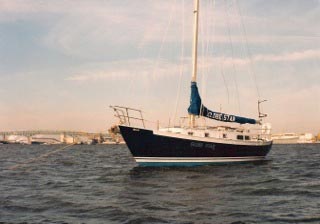
    Creamer and his crewmates braved all manner of conditions over an 18 month period to accomplish the truly historic feat. He became an expert at celestial sailing, designating a “North Star” and triangulating his position off of it. Using this method he could keep within 1 degree of latitude and longitude, but this would not help him during the daytime or cloudy conditions.

    For navigation during daytime or overcast conditions, he needed to find other ways to determine latitude. He studied ocean currents, marine life, water color and temperature. These skills would be critical not only in stormy conditions, but also in calms under slate skies.. He used his encyclopedic geographic knowledge to — for example — glean vital information from a squeaky hinge by determining where a desiccating wind (that caused the squeaking) would originate from. Sailors can become disoriented the same way pilots become confused when they have no visual cues to reference. More than once Creamer found himself fogged in on a shipping lane, and shaken by the blaring fog horns of massive tankers nearby.

    The biggest planning problem was how to get around Cape Horn. Scientists who had worked in Antarctica advised that maybe once a month clear skies would exist on the Cape. He would have to be able to navigate the world’s most treacherous waters blind. Not only were the currents savage, the winds were often gale force, with high waves and icebergs. It’s no surprise that the Drake Passage is known as a sailor’s graveyard.

    The southern sky is also much cloudier on average that the northern hemisphere’s, which would add to the difficulty of navigating without instruments there. But Boy Scouts in New Zealand taught him how to use the Southern Cross and only a thin sliver of sky to find the Polar Point.

    Marvin Creamer departed Cape May, NJ on December 21, 1982 under overcast skies with temperatures in the teens and an advancing cold front. He arrived in Cape Town South Africa on March 31st , 1983, and spent 8 weeks there fixing the boat and getting rest. The next leg was crossing the Indian Ocean in winter time to get to Tasmania. Upon arrival in Hobart, the fishermen there were so impressed that he could make landfall in such harsh conditions on the dark and desolate coast that they threw him 36 parties in the 6 weeks he stayed. Heading back down the Derwent River, 90 mph winds tossed the Globe Star upside down. His steel hulled boat with its shortened mast, built for this trip., sustained only minor physical damage, but an ill crew member needed to be dropped off in Sydney.

    On the way he was trapped for two days by Bomboras — dangerous eddies over hidden reefs of rocks — crashing around him (he described them as ‘going off like geysers’ all around him), in one of the journey’s most terrifying episodes. Finally, after navigating through a minefield of rocky outcrops, he made it through to the East Australian Current and Sydney. After stopping in New Zealand, it was off to Cape Horn and Drake’s passage.

    Sailing through the Drake was a wild adventure with winds and currents so strong that the boat could never be turned more than 15 degrees without it feeling and sounding like it was being hit with mortar fire. During the 600 mile passage his tiller broke and his shoulder was dislocated. Creamer worked furiously to cut loose his camera mount and build a makeshift steering shaft.

    After the near catastrophe he turned north towards the Falklands, which are notoriously difficult to sail, due to their remoteness and constantly changing conditions. In addition to the geographic challenges, he had entered a sensitive area that had seen war only months before. The British were still on high alert. When Creamer saw British fighters overhead (and they spotted him as well), he looked for a place to make port, and unknowingly chose a top secret British base, where he immediately found himself under house arrest. But after a little dialogue his captors treated him royally, and provisioned him for the final leg of his incredible journey. Marvin arrived in Cape May, NJ safely on May 17, 1984.

    Photos by Ralph Harvey

    Chuck McGlynn is an assistant professor at Rowan University in Glassboro, New Jersey. The university is planning a series of major events next spring to commemorate Creamer’s achievement, including a planetarium experience where attendees will be able to “travel with Marvin and the Globe Star” around the world. An interactive map experience will allow users to select any point along the journey for a display of the Globe Star journey’s date, time, longitude, average air and water temperatures, prevailing winds and sea-current.

  • Need Your Water Treated? In the Philippines, Call a Mom & Pop Shop

    “The history of cities can be described as the history of water.” — UK Urbanist Matthew Gandy, 2003

    In Cebu City, the second largest city in the Philippines, that particular history is being rewritten in a way never seen anywhere before. Contrary to the well-known major municipal water privatizations of the last two decades (including that of Manila), the existing utility in Cebu City is not functionally obsolete, nor has it been systematically de-funded in order to justify a contract with a private vendor. Here, the city’s individual entrepreneurs have bypassed the municipal provider on their own.

    Personal interviews with officials from the Philippine Department of Environmental Resources, the University of San Carlos Water Resources Department, the Metropolitan Cebu Water Department, residents, business owners, and other civic leaders reveal much about the water politics in this physically small but densely packed city of over two million people. In 2010, tests of well and municipal water showed both the saline intrusion and bacteriological contamination that have led to the private revolution.

    While water supply is certainly part of political discourse, the politics of water are rarely transparent. The public is seldom aware of the tradeoffs that are made. Governments are not about to implicitly offer a menu of choices when doing so might undermine a choice that has already been made. In the case of large scale water privatization, the money and complexity are such that contracts cannot be easily be broken without heavy losses and penalties. In 2002, the U.N. decreed that humans have a right to safe, sufficient and affordable water for personal domestic use. But this did not imply that it must be provided by the public sector. In fact, reaching international safe water goals is often the rationale used by international aid agencies to justify privatization.

    Private water systems were not uncommon historically, but a shift to public control took place in the United Kingdom and elsewhere beginning in the late 19th century, when private control did not result in safe water. During the 1990s, new privatization efforts were made. State failure replaced market failure as a conceptual framework on which this could be built. Under this rubric water is a private, tradable good, and scarcity is the result of mismanagement by government entities.

    Major privatization deals were made in Latin America and in Asia. Their large cities with a burgeoning middle class, and — often — failing utilities seemed to offer the perfect void for large multinational firms such as Bechtel and Suez to fill with modern and efficient delivery systems. But despite the promises of privatization, the areas least served by public regimes tended to remain so under private controls. The shift from government–as- provider back to dependence on the private sector was based on the assumption that government wastes resources because it lacks competition.

    Arguments on the issue come up against the inherent difficulties in applying market value to government works. Water pricing rarely takes into account the public health benefits of safe water. And externalities like pollution and disease are impossible to price and easy to undervalue.

    Cebu is one of several Asian mid-sized cities where small, private water providers thrive. These providers — hundreds of them — have taken ‘small scale’ to a new level: they are literally mom and pop operations. Where suppliers in other mid-sized Asian cities are part of a small network, in Cebu none of the private operations has a network. They do not complete with the Municipal Cebu Water Department, or extend its network cooperatively. Instead, all are relying on existing groundwater supplies, whether from a private well or a municipal connection.

    Cebu’s water has become contaminated with a combination of saltwater intrusion and bacteriological agents. The saltwater is a result of the pumping of more water than is being recharged; the pathogens stem from the lack of a sewerage system. The private suppliers that began to appear in the middle of the last decade are actually water purifying operations. As Cebu’s water quality deteriorated precipitously and the municipal water department did not respond adequately, these suppliers appeared in every barangay. Chlorination is the sole municipal method of treatment, and while it kills most pathogens, it does nothing to reduce salinity. The private purification operations handle both problems with aplomb. The systems cost about $4,500, and in many cases were staked by remittances from relatives living abroad. They distribute purified water in containers that range in size from a single cup (or baggie) up to five gallons.

    The local Carcar aquifer was once a richly productive treasure that offered a bountiful yield to the city above it. But what began with saltwater intrusion around 30 years ago has metastasized into a menace that has overwhelmed the water district’s ability to respond. In its place, the private sector has moved in to meet the needs of most, but this informal hodgepodge of private businesses is not in a position to obtain the additional water supply that this rapidly growing city needs. Cebu is currently at maximum production from the Carcar aquifer. This is the reason water runs out every evening. The beach resorts on neighboring Mactan Island are already desalinating water to meet their needs.

    The 2020 projection is sobering; demand in Cebu is expected to exceed twice the aquifer’s estimated maximum output. What is left out of the projections is the possibility that production from the overstressed aquifer will simply collapse, due to over-pumping and contamination.

    Amazingly, the humid Cebu City appears headed for the same fate as coastal locales in the arid Middle East. Ideally, sound management strategy would prevail, but absent the ability to monitor private groundwater withdrawals, this is not possible. Industrial and commercial users are already treating their water, even if they have a municipal connection. One thing is certain: Cebu City’s water supply rests on a precipice.

    Does Cebu foreshadow a paradigm shift, or is it just a historical curiosity? Only the future will tell. But it is undeniable that, right now, it has the dubious distinction that, due to its inaction, it is facing a tragic fouling of its primary water resource.

    As Cebu’s water supply degraded, a bureaucratic stalemate between the water district and city officials precluded action. Proposed joint public-private ventures designed to augment the water supply were never approved. It is imperative now that an additional supply is sourced, or that a large scale reverse osmosis project is undertaken without delay.

    In 2005, the controversial Japanese author Masaru Emoto wrote,“Usually we drink water without paying much attention to it. We know that water is important to our life, but because of its familiarity very rarely do we consciously appreciate it.” The proud citizens of Cebu are among that very rare few who appreciate every drop they drink.

    Chuck McGlynn is an assistant professor at Rowan University in Glassboro, New Jersey, whose research interests include water resources, Asian studies and aviation. He spent 15 years in aviation management at two US majors, and has worked with the University of San Carlos Water Resources Department on water supply and quality issues in Cebu City, Philippines. He resides in South Jersey with his wife, Jenny, and their six children.

    Photo by the author