Author: Charlie Stephens

  • The Sociology of Fear

    As part of its annual Survey on American Fears, Chapman University has tried to identify what Americans fear the most. A team of professors and students teamed up to retool last year’s survey tool and dig up American’s deepest horrors. In total, a random sample of 1,500 adults across the country were  asked about 88 different individual fears, in which they were to rank questions accordingly. Last year Americans were worried about walking alone at night and identity theft. But with the presidential elections just around the corner, it wasn’t surprising to see that corruption of our own government officials topped this year’s results.

    Sociology of Fear
    Nobody has ever cracked the code of human emotions. Our feelings are rooted within the depths of our physiology, but our cheers and screams are also products of our environment. Put in sociological terms, “fearfulness in varying degrees is part of the very fabric of everyday social relations”. This is bad news for those who thought the pursuit of happiness would be all fun and games.

    Director of the Fear Survey Chris Bader recruited a group of interdisciplinary students to join the semester long course to help retool last year’s survey and to provide fresh perspective on what American’s Fear. But when the student researchers involved in the project (including me) arrived at the first class of Sociology of Fear, we weren’t completely aware of what would be a grueling month of debate, passion, and even tears.

    Our class conducted multiple rounds of survey testing with friends, family and strangers to get feedback on additions made to last year’s survey tool. The most common fear amongst us twenty something college students facing the brink of graduation was “not living up to our potential”, and we considered this when evaluating the current state of American fears.

    Rapid communication and transfer of information creates the perception that our peers are having more fun and being more productive than us, and FOMO (Fear of Missing Out) was brought up numerous times during discussion. But our personal explorations did not interfere with the macro-level research conducted for the project, and in the end, the fears that rose to the top of the list were cross-generational.  After all, the survey was on American fears, not millennial anxieties.

    The course was a growing experience, but it was the work of the research faculty and project leaders that transformed this experience into excellent insights on the current American situation.

    Biggest Fears Today
    The survey explored four categories of fear: personal fears, natural disasters, paranormal fears, and drivers of fear behavior. The top American domains of fear averaged to be man-made disasters, technology, and government. Given the political transformations and technological developments taking place today, the results seem spot on.
    In order of most feared to least, the environment, personal future, natural disasters, crime, personal anxieties, daily life, and judgment of others came in next on the list. Makes sense – I’m sure most of us have some concern about how we’re perceived by others, but this sentiment doesn’t quite stack up to a 8.0 earthquake or creepy government spying.

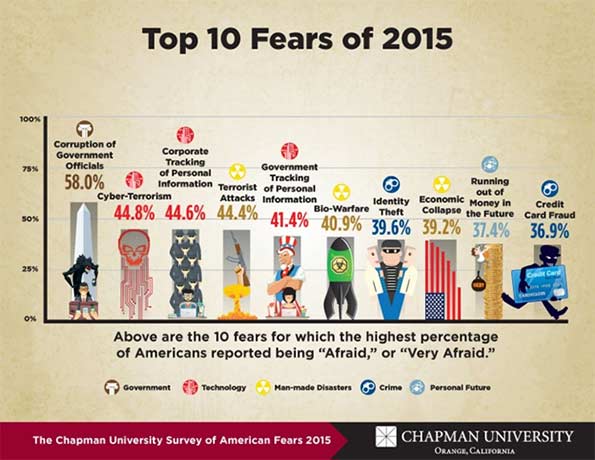
    As for the top individual fears, 58% of respondents were afraid or very afraid of corruption of government officials. Perhaps Americans are on to some of the fishy things going on in Washington at the moment, or are simply sucked into the negative rhetoric commonplace in some opinion outlets.  Meanwhile, only 30% of Americans are afraid or very afraid of global warming impacting their lives.

    Following behind fear of government officials, 44.8% of Americans are afraid or very afraid of cyber terrorism. 44.6% are afraid or very afraid of corporate tracking of personal info, and 44.4% of terrorist attacks. 41.4% where afraid or very afraid of government tracking of personal info, and 40.9% of bio-warfare. The remaining top fears surrounded financial and personal issues, with identity theft coming in at 39.6%, economic collapse at 39.2%, running out of money in future at 37.4%, and credit card fraud at 36.9%.

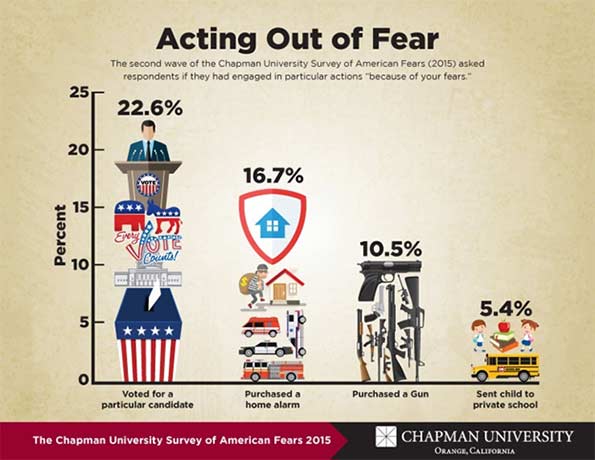
    The survey also found that these fears are actually driving our actions. Fear has the strongest impact on our voting patterns. About one third who have an above average fear of government reported having voted for a particular candidate due to their fears. Even more alarming is the fact that “of those respondents who have an above average fear of the government, over 15% have purchased a gun due to fear.” Eight percent of people with an above average fear of the government send their children to private school out of fear.
    As if gun control and education reform weren’t complicated enough, we can say that emotions will play some role in how policy is shaped in the coming years.

    A society of hope or fear?
    That fact that Americans fear government and technology is not surprising, given the individualist basis on which our nation was founded and the exponential technological growth we’re experiencing today. The Internet is forcing institutions and businesses to be increasingly transparent in everything from product sourcing to internal communications, and the watchdog power that citizens now have is both empowering, and frightening.

    It’s easy to be blinded by fear, as our emotions are the most mysterious, yet powerful forces behind our decisions. But for every 58% who are afraid of government corruption, there is 42% who isn’t. For every 44.4 percent who are afraid of terrorism, there is 55.6% with no worries. Surely, there are preventative benefits that come with healthy skepticism and insecurity, but too much diminishes any hope for societal progress. Can we keep this in mind as we go about our business, citizenship, and personal lives?

    The things that make us afraid can be dealt with. Some of them are opportunities, others are threats, and a good deal of them are complex issues and events that require brave souls to challenge them head on. This being said, we can all use a little inspiration to give us light in the face of darkness.

    Nelson Mandela told us quite simply, “May your choices reflect your hopes, not your fears.” Emerson’s advice was a bit more menacing, perhaps more appropriate given the nature of this survey. “Always do what you are afraid to do.”

    Charlie Stephens is a researcher at the Chapman University Center for Demographics and Policy, and an MBA candidate at the Argyros School of Business and Economics at Chapman University.He is also a regular contributor to the creative business site PSFK.com and the founder of substrand.com, a social awareness site that helps people, businesses, and communities understand their cultural environments and connect in new grounds.

    Photo: “Actress-fear-and-panic” by MyName (Bantosh) – self-made, taken in course of professional work. Licensed under Wikimedia Commons.

  • The Challenge of the Digital City

    The people we associate with don’t necessarily live right next to us. This is more common than ever before, as social media and other communication technologies allow us to stay connected with people across the globe. But as our urban social networks – the ones that define our lives in cities – continue to transcend traditional geographic boundaries, we must strike a balance along this line.

    Ultimately this is not about choosing one way or another. We should contribute to the growing digital infrastructure while also staying in touch with society’s innate emotional fabric. The task is not simple, but in order to properly adapt to this modern urban form, it’s up to city leaders, business managers, and the rest of the working class to understand today’s spatial, social, and emotional city contexts.

    A Digital Urban Fabric

    People from the same city may attend different schools, travel to different often far-off vacation spots, or go to various international business conferences. Knowledge is gained, experiences take place, and relationships are developed across the world that are all brought back to home-cities.

    When we experience these institutions and destinations, we typically experience them with others who share similar interests, socio-economic statuses, or career plans. And with social media we can maintain and navigate this social relationship however closely we’d like.

    Just recently researchers from MIT published a paper that outlined this idea: that social distance is a greater determinate of city networks than geographic distance. Cities have traditionally been analyzed at the national scale, with social data and activity being compared to other cities around the country. But now the urban environment is being explored at a deeper level, and we’re beginning to understand how people form sub-communities within their cities. Department of Civil and Environmental Engineering (CEE) Associate Professor Marta González, co-author of the paper explains:

    "We found that geography plays only a minor role when forming social networking communities within cities. Unlike the country [as a whole], cities have more dispersed communities.”

    The implications of this work is that by understanding how social networks are developed, and how connections are maintained, policy makers can make better informed decisions when working with different social groups. Leaders can examine social data to understand how epidemics are spread, and how new innovations should be applied in cities. Gonzalez even predicts new, progressive uses for social media:

    "We are envisioning social media apps for social good – in this case, sustainable adoptions in the city."

    These new insights are reaffirming that the way we experience our cities is being affected by our digital connections. The urban network is evolving. Cities are traversing geographic boundaries, and people are networking with those that share common interests, passions, and goals, rather than with their geographic neighbors. Our country is a compilation of different cultures, all of which are found in different geographic locations. Is it not appropriate to say that our cities are sharing these same diverse characteristics?

    Maintaining Earthly Ties

    This abstract conception of urban life is important to grasp for both scientific and personal reasons, but as we speed along this path of digital connections, physical interaction will play an especially important role in preserving civic relations.

    Information from the General Social Survey tells us that neighborly relations have declined significantly since the 1970s, a trend which hampers community planning efforts as well as crime prevention. In fact, a third of Americans have never interacted with their neighbors and neighborhood relations represent less than a quarter of all social ties. A 2010 PEW study also shows that 28% of us know none of our neighbors’ names, with young people at the forefront of this somewhat depressing reality. That is, while about 50% of Baby Boomers know all or most of their neighbors, the same is true for only 27% percent of millennials.

    The reason for this? Internet use alone has not been directly linked to neighborhood decline, but those who use social networking services are 30% less likely to know their neighbors. Researchers from the University of Toronto conducted an ethnographic study of Canada’s “wired” city, Netville. The authors’ findings complement the MIT study on social distance:

    “people are much more likely to associate with those that are more like themselves in terms of lifestyle, stage in the lifecycle, beliefs, and participation in common activities, than what can be easily found through physical proximity.”

    Rather than favor one side or the other, new social apps are trying to find that balance between digital and face-to-face interactions, using social media to enhance the physical neighborhood experience. Nextdoor is a Facebook-like app that lets neighbors add each other as friends and discuss community issues. RipeNearMe is also encouraging neighborly exchanges by allowing people to sell left over produce that grows on their lawns. Our cities are so diverse, and people are associating with others based on social proximity, but new technologies like these are fostering friendly engagement and constructive community dialogue throughout both digital and physical networks.

    In terms of business, telecommuting has been on the rise- a prime example of business’s growing digital infrastructure. Remote employees maintain corporate ties through the Internet and e-mail, and creative types can access a global platform for artistic demonstration.

    Such digital connections let workers create flexible schedules, decrease or eliminate commute times, and strive for a greater work-life balance. The benefits are far and wide, but the downside to what can result in worker isolation can be longer, distracted work hours and stifled creativity. Working at the office can boost creativity and enhance our social network, and even Yahoo and Reddit have gone so far as to shut down telecommuting in efforts to promote physical connectivity.

    There are two sides to this personal interaction coin. Both face-to-face communication and telecommuting have their positives, and we should be looking to cater to them both, as each works better for different people. Community hubs such as Wi-Fi connected cafés and retail centers give workers a space to interact with others, stay close to home, and be productive. Rather than shun the workplace or ban telecommuting altogether, a better approach involves investing our energies in local amenities that integrate physical and digital experiences, amenities that are demanded by today’s modern worker.

    Living in a Digital City

    Meanwhile, cities around the globe are experiencing a cultural homogenization in part as a result of digital advancements. There will always be those nuances that distinguish cities from each other – food, arts, architecture, language, and even politics – but these urban intricacies are getting harder to seek out as corporate chains increasingly dominate local economies and online mega-stores lure shoppers off the streets and into digital shopping malls.

    Design, music, culinary and fashion trends are also a function of digital proliferation. The artistic eye in a New York gallery is subject to some of the same inspirations as that in a Parisian loft thanks to YouTube, Tumblr, and Internet libraries. Such a cultural proliferation surely comes with its benefits (creative inspiration, a larger consumer base, and greater cultural access), but the disintegration of local ties has its troubling side effects. Today with online media we have easy access to a greater variety of cultures, but we must consider the cultural dilution that results from globalization. And while we engage with far-off societies whether through business, social, or artistic relations, we sometimes ignore the creative production, or potential, in our own backyards.

    There has been some blowback from these trends, as hipsters take up organic, local, and sustainable causes. But even these habits only feed back into the global cloud. Cities thousands of miles away from each other are finding their streets filled and dominated by similar environmental, political, and artistic ideologies. In order to prevent the local from being dictated by the global, or the national for that matter, we should focus our efforts on cultivating the relationships, as well as creative and economic potential at the local level, using progressive technologies and social urban spaces.

    Tying together the Digital and the Physical

    Cities are now part of a growing, global system and are becoming subject to the same determining factors. But the social ties that are coming to define this urban network are not one-dimensional. They’re also constructed from friendship, love, and the human desire to be with others. They make up our own mental infrastructure- shaping our perceptions of others and everyday experiences. But as these networks are transitioning into the digital realm we need to remember that the physicality of these networks are just as important for our own well-being. 

    Public spaces are crucial for fostering this traditional interaction. Parks, shopping districts, co-working spaces, open-universities can serve as social hubs- places where people of different social spheres can come together in a real-life setting. With good design and proper maintenance we can ensure that these spaces offer us a meeting area to explore and strengthen our digital ties at an even greater level.

    So while social networks might at times defy geography, they are enhanced and more thoroughly explored when they materialize in ‘real-life’. The cities we live in today are not even close to being entirely digital, but they aren’t completely physical either. We spend hours online, communicating through airwaves and searching through the ‘cloud’, but we still act out our daily lives with every muscle in our body. But how can we properly integrate these two dimensions, so that we can lead socially connected, and meaningful lives?

    Lying somewhere between the digital and the physical is a potential substrata, which is neither completely digital or physical, conceptual or concrete, yet it ties us all together. We can think of it as a shared human essence, a collective understanding of what it means to be alive, and what it means to be with others. So no matter which physical city we’re in or culture we’re experiencing, it’s from this thread that all of social life stems. It’s from this strand that we can explore and derive true meaning behind our actions.

    We call this a digital city not just because we’re all connected in this new technological age, but because we’re intertwined amongst a new social fabric: a modern social system that is both digital and physical, global yet local. This substrata manifests throughout our digital social networks as well as the built urban infrastructure, but the governing body of this modern urban experience remains out of sight- embedded in the depths of our own emotions. 

    As we navigate city streets, we’ll need to keep our minds open. To be independent citizens, free to explore at our own will and pursue our passions, we’ll need to uncover the governing laws – whether we interpret them scientifically, or spiritually – and be critically aware of the people and events that may appear as opportunities or threats.

    Highly conceptual, yet surprisingly relevant, this city we all inhabit is an exciting place to learn, play, consume, and create. We can either choose to remain aloof in the digital, or keep stagnant in the physical. Or we can consciously settle on a new frontier that combines digital possibilities with a keen focus on physical space.

    Charlie Stephens is a researcher at the Chapman University Center for Demographics and Policy, and an MBA candidate at the Argyros School of Business and Economics at Chapman University. He is also a regular contributor to the creative business site PSFK.com and the founder of substrand.com, a social awareness site that helps people, businesses, and communities understand their cultural environments and connect in new grounds.