Author: Daniel Jelski

  • Lost City

    We agreed, last time, to meet at the corner of Yonge & Bloor – Toronto’s busiest subway stop.

    Presumably you’ll arrive by subway. There are two main lines: one east-west along Bloor-Danforth, from Kipling Ave. in Etobicoke to Scarborough Town Centre. The intersecting north-south line is actually double. One branch runs almost the entire length of Yonge St., from Finch to Union Station. From there it doubles back, heading north again under University Ave and Avenue Road, finally ending near Downsview Airport. They intersect at three stations, all along Bloor Street: Bloor & Spadina, Bloor & Avenue Road (St. George), and Bloor & Yonge. The latter is where you want to get off.

    The Toronto subway is clean, quiet, convenient and runs on time. It is also very slow; I doubt top speed is much over 30 mph. You can get most places you need to go, but you won’t get there quickly.

    Another way to get close to Yonge & Bloor is by street car. Actually, the best you’ll do is Yonge and College, and then you’ve got a few blocks to walk. Tourists and Americans love the street cars – they are fun. For the commuter they are a pain. Mostly they share right-of-way with cars. This slows down the street car, and worse, slows vehicle traffic to the same pace (they’re almost impossible to pass). The result: traffic down Queen St. rolls by at a solid 15 mph. This is not an efficient mass transit method, but tourists love it.

    Metro Toronto consists of six boroughs: Toronto, Scarborough, North York, Etobicoke, York, and East York. The latter two are very small – I have never actually “been” to either; I’ve just driven through. I’ve stayed over night in all of the others. Metro Toronto resulted from city-county consolidation of York County in 1954. (Toronto was originally founded as York, but changed the name shortly after, presumably to avoid confusion with New York.)

    Skipping the two little ones (directly adjacent to Toronto proper), Toronto City is the original city. It is bounded by the lake to the south and very roughly Eglinton Ave. in the north, the Don Valley to the east, and the Humber River in the West. Scarborough is east of the Don Valley, Etobicoke is west of the Humber, and North York is north of Eglinton.

    So here we are at Yonge and Bloor Streets. Let’s go east. Bloor ends within a mile at Parliament St. and then becomes Danforth. Danforth crosses over the Don Valley in a most dramatic way. Given that Toronto cannot effectively use its lakefront, the most prominent natural landmark in the city is the Don Valley. This is a deep gorge cut by the Don River, which flows south to Lake Ontario, east of the city centre. The gorge is a park traversed by the Don Valley Parkway – an expressway that runs along the bottom of the gorge from the Gardiner Expwy to the northern city limit. The Don Valley also marks the approximate boundary between Toronto City and Scarborough (the actual boundary lies to the east at Victoria Park Ave.).

    Crossing the Don Valley, especially near the southern end where the gorge is deepest, requires a significant bridge. And this is what happens on Danforth – probably the most spectacular view in the whole city. It’s even nice on the subway, which crosses the same bridge on a lower level. Across the bridge (not yet in Scarborough) is Toronto’s vibrant Greek community. Once in Scarborough, Danforth veers northeast so as to parallel the lake. It will eventually take you to Scarborough Town Centre.

    My first impression of Scarborough was British. The place is full of typical Toronto bungalows that look very much like typical suburban London bungalows (think Keeping Up Appearances). But in the meantime appearances don’t mean much: Scarborough has become one gigantic Chinatown. The predominant language at the corner of Midland and Finch (where I have spent a lot of time) is Chinese. The primary commercial street, Kingston Road (the continuation of the Gardiner Expwy along the lake) is mostly Chinese. Now Chinese are likely a bigger share of commercial life than population, but without a doubt, Scarborough has a large Chinese community. It’s very vibrant, and it makes for good food.

    The main street of North York, on the other hand, is the 401 expressway. This is the longest expressway in Canada, going from Windsor to Montreal. In Toronto it runs from Pearson Airport in the west through Etobicoke, North York, Scarborough and points east, roughly along Lawrence Ave. On my most recent visits, North York struck me as at best lower middle class – it is definitely the poorest of the six boroughs (at least the bigger ones). Immigrants are from all over: Russia, India, Africa, Latin America, the Caribbean. It is not as lively as Scarborough, but it still has very good food.

    I haven’t been to Etobicoke since the early eighties. Then it was mostly Italian and solidly middle class. The eastern boundary of the borough is the Humber River, a much less dramatic counterpoint to the Don Valley.

    Starting at Bloor and heading north on Yonge, one comes first to St. Clair – about a mile away. Yonge & St. Clair is called Midtown, and is an elegant residential neighborhood. A mile north of St. Clair brings you to Eglinton, which (apart from the expressways) is the major E-W traffic thoroughfare. It is the first street north of Danforth to cross the Don Valley; it spans the entire city from Pearson Airport to eastern Scarborough.

    Continuing north puts one in North York – Wilson (which doesn’t go through), the 401, Lawrence (a shopping street in North York), Sheppard, Finch and Steeles (the northern city limit). The latter three cross the Don Valley, which is much smaller that far north. All of these are about a mile apart.

    Recall the history of Toronto: founded as the cultural capital of British North America, dedicated to British rule, Good Government & Good Order. When I first visited Toronto in the 1970s it lived up to that ideal. Since then the city has become one of immigrants, lots of good food, but not very British. What does that mean for British North America? Is Good Government & Good Order a sufficiently stirring rallying cry to create a civic life from all the ethnic groups? Where is the unum amidst all that pluribus? Canada is betting its future on multiculturalism. They really have no other choice, but will the city maintain its original soul throughout these changes?

    Daniel Jelski is Dean of Science & Engineering State University of New York at New Paltz.
  • The Compromise by the Lake

    Toronto is a nice city.

    If that seems like faint praise, then so be it; I’m not a great Toronto fan. Don’t get me wrong. It is a wonderful city for the tourist, and temporary residents I know swear by the place. But it’s not my kind of town.

    I spent much time in Toronto in the 1980s and 90s. My first visit must have been in 1970 or so, and I was last there on a very cold, January day in 2003.

    The city used to be known as “Tidy Toronto.” Indeed, that was the impression I got from my first visit – it all seemed very British, very clean, very orderly. In the 1970’s the Blue Laws were strict – it wasn’t possible to buy a cup of coffee on a Sunday morning. For the tourist (as I was then) it made for an unpleasant stay. These rules have weakened over the years, but as far as I know, many shopping malls and large stores are still closed on Sunday.

    In contrast to the United States (Life, Liberty & the Pursuit of Happiness), Canada was founded as British North America on the principles of Good Government & Good Order. The Blue Laws are of a piece. There are some nice things about this: Canadian parks, including Toronto city parks, are much nicer and better maintained than their American counterparts. Toronto supports one of the largest public library systems in North America (an expensive anachronism?). They have street cars. The streets are (or at least were) cleaner. Canadian hotels and motels are fantastic – and apart from boring Sundays, Canada surely is one of the best countries in the world for the tourist. By all means, visit Toronto.

    But compared to American cities of comparable size – Boston, Atlanta, Seattle – Toronto is stifling, provincial, and culturally unimportant. This, I believe, is why.

    The city is situated on the northwest shore of Lake Ontario. The street system is oriented by the lake, which means E-W streets roughly parallel the shore. Thus, going east on Bloor will put you on a 75 degree heading. North-south streets are perpendicular – Yonge Street heads north at 345 degrees.

    The lake is the city’s geographical feature of note, and serves as a transportation artery. Both the railroad and the Gardiner Expressway run right along the lakefront, thus cutting the city off from the water. City planners have tried mightily to rectify this fundamental error in design: they have built as many urban attractions as they can on the water side of the tracks, beginning with Queen’s Quay. This is nice enough, but is not easily accessible for pedestrians (one has to cross both the expressway and the tracks to get there). And then it is a synthetic cityscape, such as Manhattan’s South Street Seaport or Chicago’s Navy Pier: seen one, you’ve seen them all. Off shore are the Toronto Islands, now mostly used as park space. I’m ashamed to admit I’ve never been there.

    I’ve always thought of the center of town being the corner of Yonge and Bloor Streets, for that surely is the busiest subway stop. It is an impressive corner, similar to Chicago’s Michigan Ave (though on a much smaller scale).

    South of Bloor, Yonge Street is the city’s major promenade, where young people go to see and be seen. They strut by on wheels and on foot, in hot rods and hot clothes. It’s a great place to walk on a Summer evening.

    A half mile (Toronto’s streets were designed long before Canada went metric) south of Bloor is Dundas Street, a street that doesn’t follow the grid (probably an old Indian trail). Yet another half mile south is Queen Street, the main E-W pedestrian thoroughfare and location of Eaton Centre – a huge, indoor shopping mall (apparently now open on Sunday). Further south are King Street, Front Street, Union Station, and then the Gardiner Expressway at the foot of Yonge Street. Yonge St. becomes less lively south of Queen St.

    Walking west on Queen Street (highly recommended) one comes first to Nathan Phillips Square, location of the justly famous Toronto City Hall. The old city Hall, a beautiful red brick building to the east, is just as impressive. In the summer there are fountains, and in the winter ice skating. Beyond this is Osgood Hall, a judicial institution and a lovely building surrounded by a marvelous garden. Go inside if you can. En route you will cross Bay Street, Canada’s financial center. The heart of the financial district is Bay & King Streets.

    Continuing west brings one to University Avenue, a broad, visually spectacular boulevard. It is full of institutions: Ontario Hydro has its headquarters here, as do large insurance companies. It is not a shopping street. About a mile north, University Ave. divides to surround Queen’s Park, the location of the Ontario Provincial Legislature. It is a beautiful park and an interesting building. “At Queen’s Park today,” begins many a news cast, “Premier McGuinty announced…” North of Queen’s Park, University Avenue turns into the redundantly named Avenue Road.

    Continuing west on Queen brings one to Spadina Avenue, a major N-S traffic thoroughfare. Spadina and Dundas is the center of the traditional Chinatown. North of that, between Spadina and Queen’s Park, is the University of Toronto – the center of the campus is surrounded by King’s College Circle, and a pleasant walk.

    Beyond Spadina, Queen Street is Toronto’s version of Greenwich Village, known as the Gallery District. Here are nice cafes, bookstores, small shops. I believe this used to be the center of the Italian district, and Italians still live on the West End and in Etobicoke. But West Queen St. has outgrown the ethnic identity.

    Bathhurst, about a mile west of Spadina, forms the outer edge of the city center. Beyond this Queen Street looked like a slum, at least when I was last there.

    East Queen Street, east of Jarvis, is skid row.

    North of Bloor, between Yonge and Avenue Road, is an area called Yorktown – a mostly pedestrian area with narrow streets, small shops, and sidewalk cafes. Just to the east of Yorktown is Rosedale, a very elegant neighborhood of beautiful homes. Both are worth exploring on foot.

    So that brings us back to the corner of Yonge & Bloor. Next time we’ll start again from there.

    And what happens if you go east on Bloor?

    Daniel Jelski is Dean of Science & Engineering State University of New York at New Paltz.

  • Obama’s Home Town

    Hyde Park, in Chicago, is where President Obama called home before moving to Pennsylvania Avenue.

    I once called 5118 S. Dorchester home.

    Hyde Park is a college town surrounded by – but not really part of – a big city. The University of Chicago, founded in 1890, is the heart of the community. The campus was built of Indiana limestone, fake Gothic, and made to look old from its very inception. Some people like it.

    In 1893, Hyde Park hosted the World’s Columbian Exhibition (a year late). This showcased the new campus, and also what is now the Museum of Science & Industry, at the northern edge of Jackson Park. The Midway Plaisance – as in carnival midway – then a canal traversed by Venetian gondolas, now marks the southern boundary of Hyde Park.

    The tradition continued with Robert Maynard Hutchins and Mortimer Adler – the latter founder of Encyclopedia Britannica, and both authors of the Great Books model of liberal arts education. Subsequent residents have included Muhammad Ali, William Ayers, Saul Bellow, and Barack Obama.

    The community is bordered on the east by Lake Michigan, on the west by Washington Park (as in green grass – where few white residents dare to picnic), on the south by the ghetto community of Woodlawn, and to the north by Kenwood – also mostly a ghetto. The formal northern boundary is Hyde Park Blvd (51st St.), but really the neighborhood extends a couple of blocks north into Kenwood. Including this (say to 49th St.), Hyde Park is less than two square miles, and has about 30,000 people.

    To preserve its integrity as a college town, the area is separated as much as possible from the surrounding ghetto. As a result, public transportation to and from Hyde Park is poor to anyplace besides the Loop. It is difficult to get to Hyde Park from nearby communities. This is what gives it the feel of a separate village. It takes half an hour to get to the rest of Chicago.

    The Illinois Central tracks bisect Hyde Park along Lake Park Ave. East of the tracks is a lakeshore community, traditionally Jewish. Here are high-rise condos such as one would find on the North Side. The famous and impressive Shoreland Hotel has become a college dormitory. Hyde Park Blvd. turns south, east of the tracks, and is a very impressive avenue leading to the Museum of Science & Industry. A pedestrian tunnel leads under Lakeshore Drive to the marvelous Hyde Park Point – a peninsula jutting out into the lake. This offers the very best view of the Chicago skyline from anywhere in the city. Drive to the very end of 55th St. and you’re there.

    The town-gown divide runs right along 55th Street: south is gown (and mostly white), north is town (and majority Black). The entire community is racially integrated – one of the defining features of Hyde Park. Nevertheless, east of Woodlawn and south of 55th Street is mostly faculty and graduate student housing. Conversely, the northwest part of town is predominantly Black.

    55th Street itself is very boring – the victim of urban renewal in the 60’s and 70’s. The only interesting place is the Lutheran School of Theology at Chicago, a modern but very satisfying building. (On my last visit the building looked to be in disrepair).

    The commercial main street is 53rd Street from Woodlawn to Lake Park. I am pleased to say that while individual businesses have come and gone, the character of this street is mostly unchanged over the past 30 years. Half white and half Black, half university and half blue-collar, the street is a great place for people-watching. The center is a small shopping area known as Harper Court. When I last visited, the Valois Cafeteria (53rd and Blackstone) was still there – great place!

    Four blocks south is 57th Street, the main street of the campus neighborhood. This used to be justly famous for fantastic bookstores, and probably still is. Please visit the Seminary Co-op Bookstore at the corner of 58th and Woodlawn. (It’s inside the Chicago Theological Seminary building, in the basement; there are small signs.) A less interesting branch is along 57th Street. A small used bookstore on 57th Street just before the tracks is still there (called Powell’s, but probably unrelated to the Portland store). I’m certain all the other independent bookstores are gone.

    The university proper starts at Woodlawn and extends west. The impressive Rockefeller Chapel is on Woodlawn south of 58th Street. Frank Lloyd Wright’s justly famous Robie House is at 58th and Woodlawn. The main quad of the university extends from 57th and University all the way to 59th and Ellis. It is well worth exploring. If you can, go into the Harper Library. And walk past the Divinity School. The unforgivably ugly Regenstein Library is across 57th Street – classic brutalism.

    West of Ellis is a huge medical complex: the University of Chicago hospitals. This neighborhood is very different still, as neither nurses nor patients live in Hyde Park. The academic core of the university extends west of Ellis as well, and now includes a Science Quad.

    By the time one gets to Cottage Grove – the western boundary of Hyde Park and the eastern limit of Washington Park – one is actually in the ghetto. I never felt safe walking along Cottage Grove. Indeed, except for the university campus, I rarely ventured west of Ellis. Otherwise I walked around town at all hours of the day or night.

    The campus has crossed the Midway Plaisance, and now includes a row of large buildings along 60th Street – notably the law school. This is a wall against impoverished (and increasingly uninhabited) Woodlawn.

    I understand that one additional building needs to be built in Hyde Park: the Obama Presidential Library. Please let the White House know where you think they should put it. The matter is of some urgency.

    I’m hoping they can start construction no later than 2013.

    Daniel Jelski is Dean of Science & Engineering State University of New York at New Paltz.

  • Positively Fifth Street

    The title of this essay is taken from a book by Jim McManus about his adventures as a poker player. The lingo for Texas Hold ‘Em mirrors Vegas geography: three cards are placed face up – together called “the flop” – and betting ensues. Then comes the “turn” card, otherwise known as Fourth Street. Finally one gets to “The River”, or Fifth Street, after which it is payday for somebody.

    Of course in most towns, the River is adjacent to First Street, not Fifth. And more, Las Vegas doesn’t have a river; it has a railroad, which as we’ve pointed out in Part 1 serves as a good substitute (best you’re going to get in a desert). So the analogy isn’t perfect, but there is a neat connection.

    As this 1952 map of Las Vegas shows, Main St. (then US 91) runs directly along the tracks. The train station was where the Golden Nugget casino is today. Parallel to Main St. are First, Second and Third Streets (should we call them “Flop Streets?”). These are followed by Fourth St. and Fifth St., and so on, as one might expect. But Fifth is significant because it is the next important N-S traffic thoroughfare.

    To be a N-S traffic thoroughfare in Las Vegas in 1952 meant that you somehow had to connect up with Main St. And sure enough, in the North the two meet at Harrison (now Owens). The southern intersection occurred at St. Louis Ave., where it still is.

    Now pay attention to the inset in the upper left corner of the map. Here we see the incipient “Strip” – “continuation of S. 5th St., US Highway 91, or LA Highway.” A pretty pathetic Strip by today’s standard, but surely it needed a better name than “continuation of S. 5th St.”

    Positively Fifth Street my rear end! Positively Las Vegas Blvd. (LVB) is much more like it. Payday, big time. And today, LVB runs the entire city from the Motor Speedway in the northeast, to Jean in the far south – about 40 miles. Main St., a mere shadow of its former self, only extends for about 3 miles. I don’t know when Fifth Street was renamed, but it can’t be long after this map was made.

    There is absolutely, positively no Fifth St. in Las Vegas.

    The Strip was built before the city grew up around it, and it made sense to name the major cross streets after the casinos of the day: Sahara, Sands/Spring Mtn., Desert Inn, Flamingo and Tropicana. Then comes the I-215 freeway, followed by Russell and Warm Springs. These are each about a mile apart.

    At Flamingo, LVB no longer follows the railroad, but instead heads due south. For the southern half of the Valley, LVB and Main St. constitute the meridian from which house numbers are measured. North of downtown the road angles too far to the northeast to be an effective meridian. As best I can tell, Commerce St. in North Las Vegas serves that purpose.

    West of Main St., the baseline is Bonanza Road, or it would be if the street went through. But Bonanza has mostly been replaced by the US 95 freeway, which is convenient. Effectively, US 95/Summerlin Pkwy serves as the baseline. East of Main St., Fremont St. is a lousy baseline downtown, but for most of the east side, Charleston Blvd. does a perfectly good job. In my own mind (since I rarely use freeways) I’ve always thought of Charleston as dividing north and south.

    For all practical purposes, the Las Vegas zero-point is the I-15 exit 42. House numbers count from there. That’s just across the tracks (west) from the corner of Main & Bonanza.

    There is no rush hour in Las Vegas, there being no 9 to 5 industry of any note. However, LVB along the Strip is very busy at all times except early morning. The key to getting around by car is to avoid crossing or driving along the Strip.

    Avoid Spring Mtn., Flamingo and Tropicana at all costs! Sahara, at the northern end of the Strip, works pretty well. But the best is Desert Inn, which no longer intersects the Strip, but instead passes as a viaduct underneath. It also goes under the interstate and the railroad tracks – it will take you from Paradise Road (west of the Strip) to Valley View (a mile to the east) nonstop. It’s the best way across town. Otherwise take the freeway if you must.

    Industrial Road, directly along the railroad tracks and parallel to the strip to the west, is an excellent thoroughfare from Charleston to Flamingo. (Quiz: why doesn’t it work well south of Flamingo?). On the east side, Paradise Rd. starts at McCarran Airport (Tropicana), about a mile from LVB. Paradise goes due north, and thus would intersect LVB at about Charleston; in practice, the street ends at St. Louis. Still, this is the best way north on the east side.

    On the west side, the main streets (about a mile apart) are Valley View, Decatur, Jones, Rainbow, Buffalo and Durango. They all go through except where River Railroad interferes. Hence Valley View ends at Flamingo, and Decatur won’t get you past Tropicana.

    On the east side one has Paradise, Maryland Pkwy, and Eastern. Boulder Highway is the main thoroughfare east of that.

    The Strip is great for walking at any time of the day or night. There is a monorail on the east side of the Strip. I’ve never ridden it – doesn’t seem to be very convenient unless you’re starting at the Convention Center (Paradise & Sahara).

    China Town Plaza is on Spring Mountain, just west of Valley View. We especially enjoyed Sam Woo’s Barbeque – cash only. There is a good Filipino restaurant, Pinoy Pinay, on the NE corner of Sahara and Maryland Pkwy. For my money (I’m cheap) the best all-you-can-eat buffet is at Sam’s Town, on Boulder Hwy near Tropicana. There are good Japanese restaurants everywhere, but we ate at one on Maryland Parkway – at Flamingo if memory serves. Bottom line: once you know your way around, there’s no reason to stay on the Strip for food.

    I hear that some casinos loosen their slots to attract and retain customers on certain days of the week. It is probably possible to find out which casino has the loosest slots on any given day. For this, I have a hot tip that will save you a lot of money:

    Stay home.

  • Three Roads and a Railroad

    For most visitors, Las Vegas is a one-dimensional town. One either walks up the Strip, or down (though for compass-challenged tourists, even that can be confusing). An adventurous minority will go downtown to Fremont Street, a few short blocks of casinos and souvenir shops that I liked better before they roofed it.

    It turns out that naïve tourists have stumbled onto the truth: there are no east-west highways in Las Vegas. And therein lies the tale.

    There are three US highways: 91, 93 and 95. All run from Canada to Mexico (except for 91, which only got as far south as Long Beach). They all intersect in Las Vegas.

    If you think of Nevada as a wedge pointed south, then US 95 roughly parallels the western boundary of the state, and is the main road between Reno and Las Vegas.

    US 93 parallels the eastern boundary of the state, and connects Elko and Ely with Las Vegas.

    US 91 is no longer marked in Nevada, and has been replaced by I-15, which really does go from the Canada to the Mexican border at San Diego. In Las Vegas, it is signed as northbound to Salt Lake City, and southbound to Los Angeles, reflecting the route of the original 91. And then there are the Union Pacific tracks, which run through town northbound heading 30 degrees, and southbound at 210 degrees. North of the city they curve to the east (45 degrees). A 1955 map of Nevada shows all of this in its original glory.

    The three roads meet in downtown Las Vegas. To understand why it is the way it is, we need to go back in time and see the way it was. This 1952 map of Las Vegas is helpful.

    Main St. parallels the tracks. Intersecting Main St., where the Golden Nugget Casino is today, is Fremont St., which heads 120 degrees southeast. Streets parallel to Main St. were numbered, 1st, 2nd, 3rd, etc., with the next major N-S thoroughfare being 5th St. Let’s trace the routes of the three highways through town.

    US 91 is the simplest – it simply followed Main St. from north to south. South of town it was known as the LA highway.

    Fifty miles north of the city (today only about 20 miles), US 91 and US 93 joined forces and shared the same road alongside the tracks to Las Vegas. They both entered Las Vegas along Main St., to the center of town. They parted ways when US 93 turned southeast along Fremont. After passing Charleston Blvd., then the southern city limit, US 93 was known as the Boulder Highway – the name it still has today – as it goes to Boulder City.

    US 95 was the most complicated. It approached Las Vegas from the northwest along Rancho Drive.

    The railroad tracks are like a river – for just as with a river, one needs a bridge to cross (or at least a crossing). There were only four streets that crossed the tracks in 1952: Harrison Ave. (now called Owens), Bonanza Rd., Charleston Blvd., and San Francisco Ave. (now Sahara Ave.). To avoid the tracks, Rancho Drive turned south (today it ends at Sahara, just as it did then). But US 95 headed east on Bonanza, crossed the tracks, and then joined up with 91 and 93 at Main St. For five blocks along Main St., from Bonanza to Fremont, US Highways 91, 93 and 95 all shared the same road.

    At Fremont, US 95 turned east, coincident with US 93. They diverge (then and now) 23 miles south of town (about 3 miles short of Boulder City). US 93 continues on through Boulder City and then over the Hoover dam (a new road and a beautiful new bridge are currently under construction). US 95 heads due south, toward Searchlight and Needles, leaving Nevada right near the southern tip of the wedge.

    So what does it look like today? US 91 has been replaced by I-15. Like its predecessor, the interstate follows the railroad, but now lying west of the tracks through the central city. I-15 is the major N-S traffic artery through town.

    At exit 42 – today the very center of Las Vegas where all three highways meet – I-15 intersects a freeway that has become the primary E-W artery. The new freeway has replaced Bonanza Road as the major route across the railroad tracks. Heading west the freeway is labeled US 95 North, with signage to Reno. It goes due west for about five miles to Rainbow Blvd, and then turns due north until it intersects Rancho Drive. From there it follows the original US 95 route (the freeway ends just past Durango).

    If you want to continue west past Rainbow Blvd., then you have to exit US 95 onto Summerlin Pkwy, which continues west to the mountains at the edge of the valley.

    Heading east, the freeway has three labels: I-515 South, US 93 South, and US 95 South. It heads east initially parallel to Fremont, and then due east parallel to Charleston. It goes east to the mountains at the valley’s rim, and then turns south, crossing Boulder Hwy, only to eventually end at Boulder Hwy south of Henderson, a few miles north of the 93-95 split.

    At exit 34, another E-W artery intersects I-15. Follow I-215 South to go east towards Henderson. Follow Nevada State highway 215 North to go west (and then north) towards Summerlin.

    Point proven: there are no E-W highways in Las Vegas. But it really isn’t that hard to find your way around: just ignore the compass markers on the freeways. Reno is to the west, Los Angeles is to the south, Henderson-Boulder City is to the east, and Salt Lake City is to the north. You won’t go wrong (as long as you remember the Summerlin Pkwy exit if you want to keep going west).

    In part 2 we’ll talk about Vegas surface streets, and I’ll drop a few hints for tourists. In some future post, I’ll even answer the vexing question of where Las Vegas really is.

    Daniel Jelski is Dean of Science & Engineering State University of New York at New Paltz.

  • The Edges of the Map

    There be dragons!

    That’s what they used to say at the edges of the map, where the known world became Terra Incognita.

    I find map edges intriguing – I want to turn the page, find out what is on the other side, see what is just over the horizon.

    In 1996 I visited Germany, and my favorite memento from that trip is an ADAC Street Atlas (ADAC is the German equivalent of the AAA). It is 211 pages of Germany, starting in the north where the Danish border meets the North Sea, and ending in the southeast, at Berchtesgaden and the Austrian border. Everything in between is depicted at a scale of 1:200,000 (1 cm = 2 km).

    And not just Germany! Neighboring countries are shown as well, at least as far as necessary to include all of Germany. Thus it includes a sliver of Denmark, a slice of Poland, chunks o’ Czech & Austria, half of Luxemburg, etc.

    A westernmost salient of Germany juts into the Netherlands to within a few kilometers of Nimjegen. Indeed, for a kilometer or two, the main street (literally: Hauptstrasse) of the German hamlet of Wyler constitutes the border. To the west (in Germany) it is called Nimwegerstrasse (loosely: “on the way to Nim”), and to the east it’s titled Oude Kiefsebaan.

    To include this salient on the map, the ADAC atlas also must include the cities of Nimjegen and Arnhem. But the map does not cover Arnhem’s western suburbs. I have no other map of Holland at anything approaching the same scale, so my knowledge of Dutch geography mostly ends at Arnhem. Beyond that, there be dragons!

    The border with Holland is anything but simple. It twists and turns, includes this farm but not the other, this hamlet but not its neighbor, goes to the center of that canal, but only the west bank of another. It seems irrational, but what it lacks in rationality, it keeps in precision. For the names are all Dutch on one side, but German on the other. I have found only one exception: the Dutch border village of Millingen a.d. Rijn. In Holland, the Rhine River is known as the Waal. Millingen sounds German to me, and it is pointedly not Millingen a.d. Waal. There must be some history there.

    I think of Paul Bunyan and his Blue Ox named Babe, who straightened the roads of Michigan. He did so by hitching Babe up to one end of the road, who then pulled mightily untangling all the curves. It’s too bad Mr. Bunyan didn’t travel to Germany to straighten out their borders – it would have saved the world no end of difficulty. (Even if he had thought of it, it probably wouldn’t have worked: borders are imaginary lines on a map, not something tangible like a road that you can hitch a blue ox to.)

    And yet, something has straightened German borders – and that something likely is war. There is a district in Hamburg named Altona. Altona never sounded German to me, so I asked my folks (who live there) where the name came from. They said it was Danish, and that Denmark used to own much of what is now the German state of Schleswig-Holstein. The border has since moved northward, but unlike the Dutch border it is relatively straight. I don’t know the history, but apparently the border has moved back and forth over the centuries, and has now settled on the current truce line at the 55th parallel. Good fences make good neighbors.

    Of course, since 1945 Germany’s eastern frontier has been severely rationalized. The border with Poland is now along the Oder-Neisse line. That line follows the Oder to just south of Frankfurt-Oder. The Oder veers off to the east, but the tributary Neisse goes almost to the border of the Czech Republic. The last few kilometers parallel a road, with said road on the Polish side of the line. Such a boundary has the advantage that it is easily defined, but it also divides communities that were formerly single metro areas. But as everybody on the Polish side is a refugee I guess that doesn’t matter.

    There has been war between Germany and Holland – twice in the last century. So why haven’t the Dutch “rationalized” the border in their favor? The Belgians certainly did: the district of St. Vith is Belgium’s German-speaking area, and it became part of Belgium after WWI – the fruits of Flanders Fields. But while the Germans have occupied all of the Netherlands, the border has apparently never been disputed. The precision shows – and why fix something if it isn’t broken? Good neighbors make good fences?

    Believe it or not, there is one German border that hasn’t seen a war in at least 1000 years: the frontier with Switzerland. And a more embroidered, intricate boundary probably exists no place else on earth (though lines between Indian states must come close). Germany, France and Switzerland meet at Basel in a region known as the Dreiländereck (three-country-corner). The Rhine, which to the north forms the border with France (German place-names on both sides), now veers to the east and “should” form the border with Switzerland. But the city of Basel is on both sides of the river, and there is a salient of Switzerland that looks more like the Caprivi Strip than any rational boundary. Who knows where that comes from?

    The Swiss canton of Schaffhausen sticks up north of the Rhine like a polyp, only 5 km wide at the base, but widens from there. Indeed, it gets so wide that it ultimately surrounds a bit of Germany – and here my two sources disagree. To drive to the German village of Büsingen am Hochrhein you must drive through Switzerland – ADAC helpfully labels it as a Swiss Customs Area. Yahoo maps show the district as a true exclave – a bit of Germany completely surrounded by Switzerland. The ADAC Atlas, however, is different: to the east of Büsingen am Hochrhein, both banks of the Rhine are shown as Swiss territory, but the river itself is part of Germany. By this reading, the area is not an exclave but is accessible from Germany by boat.

    I have no idea what the truth is. Let’s just say that Paul Bunyan would be flummoxed.

    And as for those dragons that be west of Arnhem? I’ve never seen one myself, but I have it on authority that they really are Dutch dragons.

    They wear wooden shoes.

    Daniel Jelski is Dean of Science & Engineering State University of New York at New Paltz.

  • Meet Me in St. Louis

    There is a bend in the river – and that’s where they put the city of St. Louis.

    St. Louis is fun – and here is a guide to finding your way around. Just remember the bend in the river.

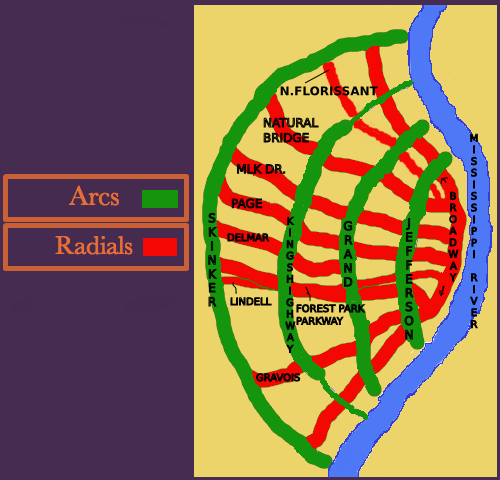
    Imagine a bow (as in bow and arrow) aimed to the east. The imaginary arrow slides right through the Gateway Arch overlooking the river. Just to the west, behind the levee, is the old downtown.

    The St. Louis westernmost city limit parallels Skinker Blvd. That boundary mirrors the river just as the string mirrors the bow. The city is almond-shaped, with the river on the east and Skinker Blvd. to the west. These two arcs meet at the northern and southern points of town. This is a simplification: Skinker Blvd. goes by that name for only a short part of the arc, roughly where the arrow’s feathers would be. To the north it becomes Goodfellow Blvd., and to the south it turns into McCausland Ave., along with other names. But those are details – the main point is this: following Skinker (or its renamed equivalents) to the north will eventually get you to the river, and likewise, following it to the south will also lead you to the river.

    And this is helpful: north-south streets in St. Louis form arcs parallel to Skinker that lead from river to river. Let’s call them arc streets. The inner-most such street is Parnell/Jefferson, followed by Grand Blvd. (that’s where St. Louis University is), Kingshighway Blvd., and then Skinker. To a first approximation, all of these streets parallel Skinker and intersect the river at points north and south of downtown.

    Superimposed on this are streets that radiate from downtown. Two important ones are North Florissant Ave., and South Broadway. These directly parallel the river, and (this is important) will intersect all of the arc streets. Thus North Grand Blvd. intersects North Florissant at approximately right angles – try something like that in Chicago. But in St. Louis it makes perfect sense – Grand is an arc that will intersect the river, and Florissant is a radial that parallels the river. (S. Grand Ave. should also intersect S. Broadway, but doesn’t because the very southern part of the city doesn’t follow the rules. I’ve never been there, so I don’t know why.)

    Starting with Florissant, the important radial streets are Natural Bridge, Martin Luther King, Page Blvd., Delmar, Olive/Lindell, Market/Forest Park, Chouteau, Gravois, and Broadway. These radiate fan-like from downtown, and all of them intersect the arc streets at approximately right angles. Of these, Lindell, Forest Park, and Chouteau are roughly east-west streets; the others head either northwest or southwest. (Quiz: which radial streets also intersect the river?)

    St. Louis University is at Grand & Lindell. Washington University is at Skinker & Forest Parkway. The justly famous Forest Park stretches along Forest Parkway from Kingshighway to Skinker. The Arch is at the foot of Market St. The cultural heart of the city is along Lindell Blvd. near Vandeventer Ave. (which, if it went through, would be an arc street west of Grand).

    Will you meet me in St. Louis? How about at a nice restaurant near the corner of Delmar and Skinker?

    You do know where that is, don’t you?

    Daniel Jelski is Dean of Science & Engineering State University of New York at New Paltz.