Author: Debora Dragseth

  • HELP WANTED: The North Dakota Boom

    The nation’s unemployment rate has been hovering at nearly nine percent since 2009. But not every state is suffering an employment crisis. In the remote, windswept state of North Dakota, job fairs often bustle with more recruiters than potential workers. The North Dakota unemployment rate hasn’t risen above five percent since 1987.  In the state’s oil country, unemployment hovers at around two percent, and pretty much everyone who wants a job—as long as they are old enough and not incarcerated—is employed.  North Dakota has either tied for or had the lowest unemployment in the country since 2008.   

    The job base of the state (population 672,500) has grown five percent in the past two years. Even more astonishing, there are over 16,000 unfilled jobs, and projections indicate that 45,000 more workers will be needed in the next two years.  Of those jobs, one out of three will be in oil and gas.

    The Booming West

    If you are willing to endure the blazing hot summers and bitterly cold winters, come to western North Dakota, young (or not) man (or woman) and you can get a job. Michael Ziesch has worked with Job Service of North Dakota for the past 15 years and is currently a manager in the Labor Market Information Center. “The average wage in oil and gas is $80,000 plus overtime, and there will likely be plenty of that,” said Ziesch.  Development of the massive Bakken oil field in the western part of the state has tapped out the local workforce.

     If you are not interested in an energy job, consider retail. Employers are paying $15 an hour for convenience store employees and fast food workers. Drive through any community in the area and you will be hard pressed to find a store front devoid of a sign shouting “Help Wanted, Now!” It seems that everything in the state these days ends with an exclamation mark, and for a state filled with unassuming, hardworking, family-centered kind of folks, it’s a little disconcerting.

    New North Dakotans

    Job seekers from outside the state are flocking to Williston, the unofficial capital of the oil boom, located in the remote northwestern corner of North Dakota. The population here has grown from 12,500 to an estimated 22,000 in the past five years.

    Williston is home to 350 oil service companies. Willistonlife.com, an employment and informational website built with the objective of attracting workers to the area, boasts that at any given time, over 1,200 job openings are available in the Williston area alone. On its home page, the website beckons to the nation’s unemployed in large white letters brightly juxtaposed against a black background, “Make Your Move!”

    The wildcat oil culture that the newly arrived encounter, though, is distinctly different than the risk-averse culture of the state. One “New North Dakotan” noted that although long-time residents of the state are pleasant (we smile a lot), helpful (there’s no better place to have a flat tire), kind (we’ll bring you a hot dish if you are sick), and polite (we almost always hold the door open for the person behind us), we are not quite “friendly.” We are a little guarded with folks we didn’t grow up with. Ethnic to us means Norwegian or German. We’re not used to accents other than our own. (And, no, we don’t talk like the actors in the movie Fargo.) One more thing — and this is important — we talk about the weather a lot.

    What should you know before you throw your last $100 in your gas tank and head up to Williston to make cold calls for jobs? Don’t come without a housing plan, or you may find yourself among the hundreds of parking lot denizens, living out of your car.

    New North Dakotans need places to live, creating an enormous construction boom. Williston formerly saw about five new homes a year. So far this year, 2,000 new homes have sprouted up. In 2012, the expectation is for 4,000 more along with apartments, hotels and, outside of town, dormitory-style housing facilities known as ‘man camps’. According to the Williston Herald, since the boom began, the market price of rental housing in Williston has jumped from $300 to $2,000 per month for a modest apartment. Hotels are full and booked for months, charging $170 to $200 a night.  

    Service is hard to come by. Waits of 45 minutes or more are not uncommon at fast-food restaurants. The Dairy Queen closes at 5:00 pm because they can’t retain enough staff to stay open any later, and many small businesses have simply closed their doors for lack of employees. The town’s Wal-Mart doesn’t have enough employees to stock the shelves, so boxes are simply laid open in the middle of the aisles for customers to grab what they need. Locals have discovered a “secret route” into the store to avoid the worst of the incoming traffic, and even the local Luddites have managed to learn how to use the self-checkout lanes as a matter of self-preservation. A professor at Williston State College complained recently that she had to text her husband with a request to pick up clothes hangers while he was out of town visiting relatives because local stores were completely sold out. It’s not only hangers; long lines and low inventory have made running everyday errands a vexing challenge. “It sounds crazy,” this same professor says, “but I order laundry detergent online and have it delivered by UPS to my front door.”

    At Williston State College, faculty often take out their own garbage to help out the strapped maintenance staff.  The school is seeing lower enrollments as students are drawn away from post-secondary education by the lure of instant cash.

    The law of supply and demand has kicked in across all sectors of the community. A severe shortage of contractors, plumbers and electricians means that homeowners wait weeks or even months for simple home projects. The local community college is putting out a second bid for a parking lot because, the first time, they didn’t get any bids at all.

    Even more disturbing in Williston are rumors of impending electricity shortages. Worried about brownouts and blackouts during the long North Dakota winter, many townspeople have picked up generators in Fargo, where they sell for $700, compared to the “sale” price of $1300 in Williston.

    Officials are quick to point out that the state’s larger cities, Bismarck and Fargo, are also thriving. In the Governor’s most recent State of the State address, he posited his explanation of ‘The North Dakota Miracle’: “It is about an educated workforce, low taxation, a friendly regulatory climate.” And if your state happens to be sitting atop 400 billion barrels of oil … hey, it can’t hurt.

    Energy Economics: Boom and Bust

    Oilmen have known for fifty years that beneath North Dakota’s surface lay billions of barrels of oil, perhaps as much as 4 million barrels per square mile.

    In 1952, The Wall Street Journal reported that Williston was receiving a “cornucopia of riches.” Banks were setting new deposit records weekly, and the population had jumped from 7,500 to 10,000.  In the early 1980s, oil prices skyrocketed and the region again became an exploration target as its vast deposits became economically feasible to drill. When prices began to slip, hitting a low of $9 a barrel by 1986, the boom faltered and, even more quickly than it began, it was over. The state spent the later part of the 1990s trying to recover from a brutal bust.

    Today, a perfect storm of two 21st century technologies, hydraulic fracturing and horizontal drilling, along with high prices and unprecedented demand, have come together to make drilling profitable, triggering a new boom that some experts say will be the biggest and longest lasting in the cycle of boom and bust. Conventional wisdom is that this time around the oil boom will be steadier and longer, because oil prices are no longer being defined by the cartels that once controlled the world’s oil prices and, therefore, the economics of energy. In the meantime, the oil pump jacks that dot the skyline are nodding their heads in greeting. Welcome to North Dakota.

    Debora Dragseth, Ph.D. is professor of business at Dickinson State University in Dickinson, North Dakota.

    Photo of Williston, ND traffic jam courtesy of Williston Department of Economic Development.
  • Corn Crop 2010: Food, Fuel, Feed and Folk Art

    The harvest of this year’s U.S. corn crop is about 90 percent complete, and it is going to be a bin-buster. If it surpasses 2009’s astonishing 13.1 billion bushels, it could become the largest in U.S. history. American farmers are growing more corn today than at any time in the past, and the trend is accelerating. The last five years have brought us five of the largest corn crops ever. Where to store the stuff is becoming an issue: When the bins and elevators are full, the corn is simply piled on the ground. Bankers are saying that we are experiencing the best farming environment in decades.

    Genetically modified seed, powerful fertilizer, and the rich soil of the Central Plains have turned field corn into the most prolific and versatile commodity on earth. It’s used in biofuel, animal feed, fabrics, biodegradable plastics, makeup, fireworks, crayons, shoe polish, batteries, and thousands of other products we consume every day.

    The U.S. Department of Agriculture reports that of the 13 billion bushels of field corn produced last year, 36 percent was used as feed for domestic livestock (beef, pork, poultry), 31 percent was used for ethanol (also resulting in 1.5 billion bushels of distiller grains, a byproduct of ethanol production that is used as livestock feed), 14 percent was exported to other countries (Japan, Mexico, South Korea, Taiwan and Egypt are the top recipients), 9 percent was used for human food, seed and industrial use, and 11 percent was carried over as a surplus.

    According to Nathan Fields, Director of Biotechnology and Economic Analysis for the National Corn Growers Association (yes, that is his real name), today’s farmers are good at growing corn—very good. No other county in the world even comes close.

    Corn was domesticated more than 7,000 years ago, when the early agronomists of the Americas instigated the upward trajectory of what might be described as the world’s first and most successful designer crop. In 1621, Squanto taught the pilgrims how to cultivate corn — maize —that sported only eight rows of kernels and was about one quarter of the length that it is today.

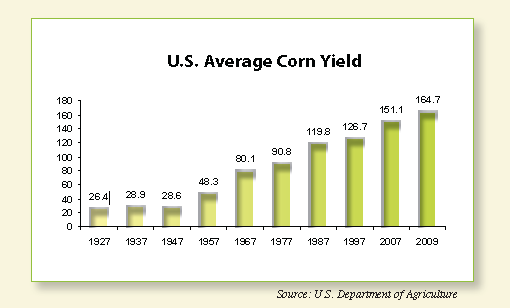
    In 2009, farmers in the Corn Belt — usually defined as Iowa, Illinois, Indiana, Minnesota, South Dakota, North Dakota, Nebraska, Kansas, Missouri, Ohio, Oklahoma, northern Texas, and Colorado— averaged a record yield of 165 bushels per acre. In 1927, when the first official records were kept, yield was only 26 bushels per acre. Fields asserts that the genesis of modern agriculture was in the 1880s, when ingenious farmers began to cross pollinate corn, creating hybrid seeds that produced hardier plants with the ability to outperform their parents. In the 1920s, geneticists developed inbred corn; after that, each decade brought and growth spurt after spurt. In the 1990s, biotech hybrids were developed that better tolerated drought, variances in temperature, and insects. But farmers still battle the weather every year. Indeed, it’s not unheard of for farmers to be fighting snow drifts during the last few weeks of harvest, and no amount of technology can stop a late summer hailstorm from destroying an entire crop in ten minutes or less.


    The winner of the National Corn Yield Contest last year grew 307 bushels per acre. A bushel of corn is 56 pounds and the size of a small laundry basket. A bold prediction is the expectation of 300 bushels per acre as a national average by 2030. It would be an 80 percent increase in just 20 years.

    Nathan Fields emphasizes that developments have led to higher US corn yields, grown on fewer acres with less water, chemicals, fertilizers, and fuel. Dramatic reductions in inputs per acre mean a smaller environmental footprint. There are 316,000 corn farmers in the U.S., and 95 percent of them are family farmers, the vast majority multigenerational. “For family farmers,” Fields asserts, “success is not measured by a single season. Family farmers are determined to leave the land in good shape for the next generation.”

    Enormous combines harvest biotech hybrid crops with the use of sophisticated GPS navigation systems—it’s no longer your grandfather’s farm, a fact reinforced to me recently by my 94-year-old grandpa, Ben Radcliffe. Radcliffe was a South Dakota farmer in the 1940s before he became the president of South Dakota Farmers Union and one of the country’s most revered farm activists. When Radcliffe’s father (my great-grandfather) was farming in the early 1900s, less than 1 percent of planted corn was hybrid; early farmers saved their seed from year to year. By the early 1940s, 78 percent of the corn planted was hybrid.

    Radcliffe notes,“Today, farmers use a weed control chemical so they don’t have to cultivate [plow between the rows]. We had to cultivate twice a year just to get the weeds out of the row. Today, the rows can be closer and the number of plants automatically doubles.”

    Today’s farmers also plant earlier. In the 1940s there was a farmer tradition that planting corn ideally began May 10th and was completed before June 1. Because today’s seed is more resistant to frost, farmers now begin planting in April. Today, most if not all of the corn harvest is sent to grain elevators. In Radcliffe’s day, most of it was fed to livestock right on the same farm. “Almost every farm, including mine,” he says, “had hogs and cows.”

    A new market for corn has recently opened up in China. According to CHS market analyst Kent Beadle, “China has undergone dramatic changes over the last decade. As incomes and lifestyles are changing, there is a demand for better food—specifically, more protein.” Pork, beef, and chicken consumption have caused demand to exceed supply, putting the world’s most populous country in a position to begin to buy U.S. corn.

    The U.S. supplies 62 percent of the world’s corn. Last year, America’s farmers exported $9 billion worth of it, an export surplus that most U.S. industries would envy… all from the ability of a genetically modified kernel of corn that weighs one-hundredth of an ounce to produce a 10 foot tall plant. A”maize”ing.

    Photo by Deborah Dragseth: The World’s Only Corn Palace, located in eastern South Dakota, twelve miles from where the author grew up in the heart of corn country. A folk art wonder, it is redecorated each year with 275,000 ears of corn. The 13 different colors and shades of corn include yellow, red, brown, blue, black, white, orange, calico and (this year for the first time via genetic engineering), green.

    Debora Dragseth, Ph.D. is an associate professor of business at Dickinson State University in Dickinson, North Dakota. She trains and develops leadership curriculum for CHS, Inc. a diversified energy, grains and foods company. The Fortune 100 company is the largest cooperative in the United States. Dragseth’s family owns a farm 8 miles east of the World’s Only Corn Palace.

  • Redefining ‘Niners’: Football on The Great Plains

    At 0.5 people per square mile, Harding County, South Dakota is one of the least populated places in the nation. The county’s only high school, located in Buffalo, is small by even small-town standards, with 85 students in grades 9-12. However, few schools can match its gridiron success. Nicknamed after the primary industry in the region, “The Ranchers” football team has experienced only one losing season in its 44-year history.

    Harding County’s teenage boys suit up every Friday night and dominate 9-man football.

    Nine-man football is a small-town sport. Unique to three upper Great Plains states (South Dakota, North Dakota, and Minnesota), it was designed for rural high schools, where mounting a standard 11-man team simply isn’t feasible.

    The first three games of the 2010 season are already in the books, all three ending early due to the 50-point mercy rule (any time after halftime, a 50-point lead wins the game). The Ranchers have so far outscored their opponents 172 to 14.

    The key to 9-man football, according to Ranchers head coach, Jay Wammen, is speed. “With two less defensive linemen, we have more space to work with. Like most 9-man teams, our kids play both offense and defense, so there is a demand for physicality and the ability to be on the field giving it their all from the first whistle to the last.”

    The Ranchers play on what many regard as the worst football field in South Dakota. “We tried raising grass on the field last year,” laments assistant coach and school principal Josh Page. “We laid some sod, but it died out.” The field is too muddy to use when it rains, and when it’s dry, clouds of thick dust blow across from the adjacent rodeo grounds. It’s not unusual for Friday night Ranchers games, originally scheduled for their home field, to be forced to move to their opponent’s school, due to unsuitable playing conditions. Visiting teams consider this good news — over the years players have come to dread the invasive cockleburs populating the Harding County High School football field.

    Football is a collision sport, and wrestling cattle on the ranch prepares these young men for confronting 250-pound opponents. Getting up at sunrise to feed livestock trains them to be alert, disciplined, and ready to execute. Says Wally Stephens, sports editor of The Nation’s Center News (circulation 1200) about the Ranchers’ style of play, “Our boys play hardnosed, power football. They grind the ball out and they hit hard.”

    Located in the farthest northwest corner of South Dakota, Harding County is known to paleontologists as the T-rex capital of the world — more T-rex fossils have been found here than in any other place on earth. It has a population of 1,353 people, spread out over 2,678 square miles. The region boasts the nation’s coldest winters, punctuated by fierce blizzards that are capable, even today, of immobilizing residents for weeks at a time. When its High School team members are not playing football or going to school, most are working on the family ranch: branding calves, wrestling steers, herding sheep, or moving hay. Many are the third or fourth generation on the land. When they start practice in August, the players are in shape and ready to work hard. Sure, they have a little swagger, notes Coach Wammen, but it’s been earned by their success.

    Whether they win or lose, away games constitute a long ride home over vast stretches of two-lane roads. The conference has nine teams and encompasses an impressive 38,000 square miles, with the farthest regular season game 213 miles away. Yet even with an average round trip of over 250 miles, Harding County fans often outnumber those of the opposing team. “The whole county comes,” according to Nora Boyer, the erudite 78-year-old volunteer curator at the Buffalo Historical Museum. “It gets pretty nippy around November and some people watch the game from their vehicles, but I say, if you sit in your pickup truck, you can’t holler.” Many of the players have fathers and grandfathers in the crowd who, when they were teenagers, played for Harding County High School.

    High school senior Jace Jenson is a standout wide receiver and line backer whose ranch is 40 miles from the high school. Jenson attended hometown games as a grade school student, playing rough-and-tumble football in the field behind the goalposts. “I remember being a little kid and goofing around with the same guys that I play with today.” One of those guys is current teammate and fellow senior Austin Brown who has been the Ranchers’ quarterback and safety since he was a freshman. Brown lives on a ranch that belonged to his grandfather, 25 miles north of the high school in Buffalo. He describes Harding County football as “tradition,” saying, “I have had a football in my hands ever since I can remember.”

    The 6’5” quarterback was one of only three South Dakota football players who were recognized in the renowned Tom Lemming’s Prep Football Report Summer 2010. The report calls Brown “…One of the biggest sleepers in the country . . . he plays way out in western South Dakota so most college coaches are unaware of the potential blue chipper.”

    Both Brown’s and Jenson’s fathers played for the Ranchers in the early 1980s. Jenson says, “My dad played Harding County football when he was in high school. But,” he adds with a sly grin, “I don’t know if he was any good. You could ask him . . . but he’s out moving hay.” The fathers of both the Ranchers’ head coach and assistant coach played football together on the same field that their sons coach on today. Coaches Page and Wammen are too young to have boys of their own on the field, but, most townsfolk believe it’s only a matter of time. People in ranch country are patient.

    Places as isolated as Harding County are sometimes referred to as ‘the middle of nowhere’. But for these exceptional football players, it’s not ‘nowhere’ — it’s ‘now’ and ‘here’– it’s their past, it’s their future, and it’s one of the best places to grow up in America.

    Photo: Friday night in Harding County

    Debora Dragseth, Ph.D. is an associate professor of business at Dickinson State University in Dickinson, North Dakota. She trains and develops leadership curriculum for CHS, Inc. a diversified energy, grains and foods company. The Fortune 100 company is the largest cooperative in the United States. Dragseth’s research interests include Generation Y (Millennials), outmigration and entrepreneurship.

  • Guys Gone Wild: Sturgis Motorcycle Rally Begins

    Yesterday marked the opening of the outrageous phenomenon known as the Sturgis Motorcycle Rally, a week-long, $987 million party for about 500,000 people. Every year in early August my sleepy hometown, Sturgis, population 6,500, hosts a half million biking enthusiasts who swarm here for a combination carnival, racing event, party, music festival, and shopping mall.

    Tucked into the scenic Black Hills of western South Dakota, for one memorable week each year Sturgis becomes the epicenter of the oldest, biggest, loudest, most authentic and out-of-control motorcycle rally in the world. We become the largest city in the state by a factor of three. That equates to each household in town hosting 183 “guests.” Nearly 500 festival-goers will land in jail; hundreds will be issued tickets for violations such as indecent exposure, open container, or driving on the sidewalk; 350 or so will require hospital emergency room visits; two or three will die of heart attacks; and a half-dozen or more will be killed in traffic accidents. Keeping its guests safe costs the city of Sturgis over $1 million in insurance, increased law enforcement, attorney costs, fire and ambulance services, and the like.

    Our temporary denizens are clad in skull caps, sunglasses, boots, sleeveless shirts, and black leather. Tattoos are required; piercings are optional. Body paint, thongs, and pasties will do for women. For men, cleanliness is not a virtue; grimy grubbiness is fine and chest hair encouraged. Don’t come to Sturgis looking for metrosexuals—you won’t find any.

    The streets are teeming with beautiful, scantily dressed women, but the real beauties are the motorcycles, their chrome sparkling in the sun as though they had just left the showroom floor. Few things you will ever see are as impressive as thousands of custom-painted Harley Davidsons parked four rows deep and lined up for blocks, many of them true works of art. Few things you will encounter can compare to the noise made by an undulating river of 700-pound motorcycles. Hunter S. Thompson described it as “a burst of dirty thunder.”

    The Sturgis Rally is an economic engine that drives state tourism and represents capitalism at its finest. According to a survey funded by the Sturgis Motorcycle Rally itself, $987 million comes into South Dakota annually from the event. Rally-goers will need to pay an inflated $5.50 for a beer at the world’s largest biker bar, but Mt. Rushmore, Custer State Park, and some of the most scenic drives in the country are complimentary. A free pancake breakfast is provided daily by the Son of Light Ministry whose sign proclaims, “Flapjacks along with the word of God. And the best part—they’re both free!” In the same vein, the Christian Motorcycle Association will bless your bike while offering you a free bike wash, coffee and pancakes.

    Tens of thousands of people will be “inked” at the rally. “A decision that will last a lifetime,” warns the tattoo artist doing business out of a small concrete building that just last week was my beauty parlor. Many local businesses have been “repurposed,” in other words, closed down and rented out to vendors for handsome sums. Grocery stores, gas stations, and the local department store remain open for business; items in high demand include sunscreen, pillows, and energy drinks. The city-owned liquor store, creatively named Sturgis Liquor, is the only liquor store in town, a pretty smart move on the part of our founding fathers, given that rally goers drink an estimated three million gallons of beer. On average, visitors stay 5.5 days and spend $180 per day. Says one local, “It’s like a really loud relative comes to your house, stuffs your pockets full of money, and leaves a week later.”

    Demand exceeds the supply of hotel rooms, camping spots, and bathrooms. Hotel rates double and triple, climbing as high as $300 a night for a room and are sold out for a 50-mile radius. It seems as though every square foot in town is rented to someone: Locals rent out their homes for $3,000 to $10,000 a week and rent their yards to campers who pitch tents or park bikes. City law limits homeowners to 19 renters per property.

    Consider this for comparison: New York City: 26,402 persons per square mile. South Dakota: 9.9 persons per square mile. Sturgis, South Dakota (August 9-16, 2010, projected) : 160,427 persons per square mile.

    There are three types of people who come to the Sturgis Rally. First, the casual observers who may ride occasionally, but more than likely not at all. They’re easy to spot — they point a lot and look like kindergarteners on the first day of school. They carry shopping bags filled with t-shirts as proof to the folks back home that they were here to experience the mayhem and rub shoulders with the real thing.

    Next are the recreational riders. Mostly in their late 40s and 50s, they own bikes but don’t belong to biker clubs. They ride their Harleys only on sunny and mild weekends. They trailered their $35,000 bikes to the rally behind 2010 Ford F-series pickups with heated leather captain’s seats. This group offers the best opportunity for venders. They look like walking billboards for the Harley-Davidson brand, and buying the fantasy of the biker subculture does not come cheap.

    Finally, there are the bikers whose leather jackets have a cracked “been there, done that” patina that matches their sunburned faces. (You don’t get to look like that by hauling your bike on a trailer or riding only on weekends.) Their bikes have never seen a trailer, they do their own tune-ups, they sport socially offensive tattoos, and they don’t own rain gear.

    Although it’s impossible to determine the exact number of people at the rally, there are several metrics used by the city to estimate annual attendance, including traffic counts and taxable receipts. Over 700 temporary vendors set up shop in the city, hawking everything from $2 rubber bracelets to $125,000 custom-made motorcycles. A more ingenious method of estimating crowd size is by examining the quantity of artifacts left behind. Six hundred tons of “rally garbage” was hauled away in 2009, and we don’t expect this year’s guests to leave any less.

    The rally has been held every year in Sturgis since 1938 with the exception of two years during WWII when gas rationing rules prevented recreational travel. Nine racers participated in the first rally, competing for $750 in prize money in front of a small crowd of racing enthusiasts who had paid 50 cents each for the experience. By 1960 attendance was 800, by 1970 that number had grown to 2,000, and in 2010, for the rally’s 70th anniversary, projections are for over 600,000 attendees.

    Campgrounds which are empty fields during the rest of the year pound with rock bands from high noon until early the next morning. The largest campground, the 600 acre Buffalo Chip, has been estimated to host 25,000 rowdy revelers, transforming it overnight into the third largest city in the state. Like several local campgrounds it is also a concert venue. This year’s lineup includes Kid Rock, Bob Dylan, ZZ Top, Ozzie Osbourne, and . . . wait for it . . . Pee-wee Herman. The Buffalo Chip also offers “less conventional” entertainment, such as topless beauty contests, redneck games, and a shooting arcade for grownups billed as the ultimate Second Amendment experience. Participants can choose from WWI, WWII, Korean, and Vietnam War era weapons and receive the training required for a 35-state concealed carry permit.

    Events like the Sturgis Motorcycle Rally hearken back to the Roman Empire. The Romans celebrated what anthropologists call rituals of reversal, times in the yearly calendar that allowed patricians, plebeians, and slaves to abandon the constraints of an ordered society. The society enjoyed a “time out” during these festivals. when people could break the rules without fear of recrimination. Reversal rituals included a strong sexual focus, anonymity, costumes, feasting to excess, and some form of intoxicant that reduces inhibitions.

    I asked my friend Tony Bender, an avid biker and former news director and publisher of Sturgis’s local newspaper, what the Sturgis Motorcycle Rally really means. “I think it is one of the great expressions of American freedom,” he told me. “The open road, the sense of rebellion, the pulse of the V-twin motors… and yet, a real sense of brotherhood. Modern day cowboys… Americans being utterly American.”

    Unleash your id. Come to Sturgis for an experience you’ll never forget. My 6,500 neighbors and I are happy to see you come, but to be honest, we’re looking forward to seeing our little town return to normal. Go home, shower and shave, put on your khaki dockers and your loafers, and squeeze back into your cubicle. In other words, get back to work — you are going need to pay off your August credit card bill.

    Photo: The author in Sturgis

    Debora Dragseth, Ph.D. is an associate professor of business at Dickinson State University who lives in Sturgis, South Dakota.

  • Sponge Cities on the Great Plains

    “Sponge cities” is an apt metaphor to describe urban communities in rural states like North Dakota which grow soaking up the residents of surrounding small towns, farms and ranches. North Dakota’s four largest cities, Fargo, Bismarck, Grand Forks and Minot, are growing in large part due to the young adults who for decades gone elsewhere to other regions. In the process, rural North Dakota is facing a protracted population crisis as significant numbers of its small communities are on a slow slide to extinction. This migration pattern is not new, nor is it unique to North Dakota. Historically, one of the most significant demographic trends in the United States has been the movement of people from rural to urban areas. In 1915 sociologist E.A. Ross declared that small Midwestern towns reminded him of “fished out ponds populated chiefly by bullheads and suckers.”

    Beginning in the 1920s, North Dakota and South Dakota youth stopped wanting to step into their parents’ worlds. According to the Department of Rural Sociology, in 1927 more than 87 percent of farmers encouraged their children to go into farming, but by 1938 less than half of Dakota high schoolers were taking that advice.

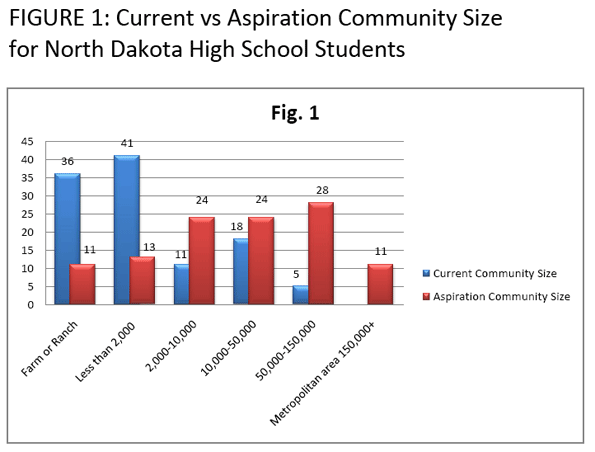
    A June 2010 survey of 111 North Dakota high school juniors and seniors offers a glimpse into the minds of the state’s young adults as they stand on the precipice of adulthood. They were asked to choose the size of community in which they aspire to live and work. Although roughly four in ten were raised in communities of fewer than 2,000 residents, out of the over 100 students surveyed, only six wished to live their adult lives in the a town of fewer than 2,000. Overall, 70 percent aspired to live in larger communities than those of their childhood (see Figure 1).

    Small towns struggle to provide urban amenities that can match the sponge cities’ bustling malls, skateboarding parks, concert venues and Olive Gardens. While the serene, friendly, stable rural communities, farms and ranches reflect the way that “life is supposed to be” in the minds of many outside the region, young adults often view that way of life as dull and sluggish. City life—albiet small scale by national standards—is perceived as fun, fast and fashionable; jobs pay better and there are more of them.

    There has always been a desire among young adults to experience life outside of where they grew up. Experts believe that economics and quality of life are the two dominant motivations people have for moving from rural areas into cities. Mark Stephens, a young college graduate who left his small town of under 400 for Fargo, with a metropolitan population pushing 200,000, the largest city in the state, said “The first thing people throw out as an excuse is increased opportunity, but let’s face it, 18- to 20-something adults are not thinking long term. For the most part, kids in that age group are really pretty shallow. In truth, I think it comes down to one word: Jealousy. They are walking down a gravel road in their tiny town with a link to massive amounts of media right in their back pockets. It’s no different than when they were little kids—they see someone with ice cream and they want some too.”

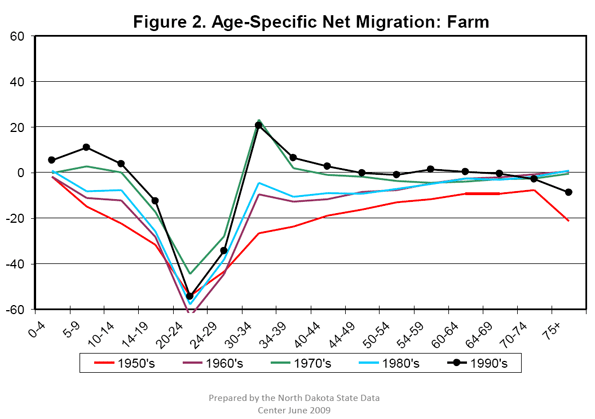
    Richard Rathke, director of the North Dakota State Dakota Center, notes that aggregate data demonstrate the movement of young adults to larger cities in the Great Plains The young adult population (age 20-30) has been inmigrating to metro areas each decade since 1950 while in the farm dependent rural counties, they are outmigrating in sizeable numbers (see Figure 2).

    A dozen young adults moving from Edgeley, North Dakota (population 637) to Fargo is irrelevant to Fargo as it absorbs the new residents with barely a nod, but to Edgeley, the shift represents significant and chilling loss of young, skilled, educated workers that will have a detrimental impact on the town’s future prosperity or even survival. Some predict that once Fargo has soaked up all the smaller communities, young professionals will then abandon Fargo for the more illustrious Minneapolis. North Dakota is touted in nationwide polls as one of the friendliest states in the nation, but schadenfreude flourishes on the Plains. Mayors of small towns that have lost their young people to growing population hubs have been known to remark, “Just wait until all of their kids move to Minneapolis.”

    Perhaps metropolises like Minneapolis or New York will not be the ultimate sponge cities. Indeed, Minneapolis has experienced a 1.4 percent drop in population since 2000. Demographers are beginning to observe that for many of us there is a point where diseconomy of size becomes real. Traffic, congestion, housing prices, crime and pollution levels may already be curtailing inmigration to the nation’s major metropolitan cities.

    The phenomenon of sponge cities will change the nature of states like North Dakota. At the turn of the twentieth century a mere 7 percent of North Dakotans were urban, by 1980 one out of every three residents was urban and in 2010 the state is projected to be 50 percent urban and 50 percent rural, a loss of nearly 88,000 rural residents in a state whose total population has remained stagnant, hovering between 600,000 to 650,000 for over a century.

    A legitimate reaction to the entrenched loss of people from rural areas of North Dakota might be, “So what?” What does a state or nation have at stake in the health of a small town like Edgeley? After all, one community’s loss is another community’s gain. Migratory patterns are simply indicative of an efficient labor market; employers discover employees and employees find jobs that fit their skills, interests and education. Thus, one might conclude that is does not really matter if a significant percentage of rural Americans move to more urban areas. In fact, what some perceive as a seemingly endless stream of discouraging census data may actually be a positive indicator. Robert E. Lucas, Jr., University of Chicago economist and winner of the 1995 Nobel Prize in Economics, believes that a region’s successful transformation from traditional agriculture to a modern, growing economy depends on talent clustering—an accumulation of human capital that sponge cities are performing. The future may not be rural, but sponge cities could make traditional rural states like North Dakota very viable.

    Wayne Sanstead, North Dakota’s State Superintendent of Public Schools and former lieutenant governor, has for decades watched rural schools close their doors. “We want the small communities to be a part of the state’s economic and social future, but we have to face reality and focus on retaining young adults within the state.” This may be the new reality. In large part due to the state’s booming economy, Sanstead asserts that in his 25 years as a state superintendent he has never seen a better opportunity then today for the state to retain its young people.

    Deb Kantrud, Executive Director of the South Central Regional Council in Jamestown, North Dakota, has spent her entire career as a community developer. She noted that if small town residents stay behind after high school graduation, they aren’t considered as successful as those who relocate. We need to figure out a way to keep some smaller communities viable—turning them into sponge cities—while acknowledging that some smaller communities may not be part of the brighter future that awaits our reviving state.
    Debora Dragseth, Ph.D. is an associate professor of business at Dickinson State University in Dickinson, North Dakota. She trains and develops leadership curriculum for CHS, Inc. a diversified energy, grains and foods company. The Fortune 100 company is the largest cooperative in the United States. Dragseth’s research interests include Generation Y, outmigration and entrepreneurship.